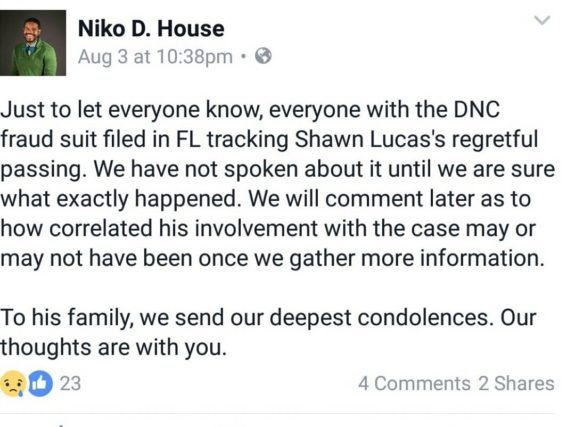
ANOTHER MYSTERIOUS DEATH – Activist and Sanders Supporter Who Served Papers to DNC on Fraud Case Found Dead

shawn-lucas

By Jim Hoft

Source: Gateway Pundit

On July 3, 2016, Shawn Lucas and filmmaker Ricardo Villaba served the DNC Services Corp. and Chairperson Debbie Wasserman Schultz at DNC’s headquarters in Washington, D.C., in the fraud class action suit against the Democrat Party on behalf of Bernie Sanders supporters.

Shawn Lucas was thrilled about serving the papers to the DNC before Independence Day.

** This was before Wikileaks released documents proving the DNC was working against the Sanders campaign during the 2016 primary.

Shawn Lucas was found dead this week.

shawn-lucas-dead-575x427

According to Snopes Lucas was found dead on his bathroom floor.

We contacted Lucas’ employer on 4 August 2016 to ask whether there was any truth to the rumor. According to an individual with whom we spoke at that company, Shawn Lucas died on 2 August 2016. The audibly and understandably shaken employee stated that interest in the circumstances of Lucas’ death had prompted a number of phone calls and other queries, but the company had not yet ascertained any details about Lucas’ cause of death and were unable to confirm anything more than the fact he had passed away.

An unconfirmed report holds that Lucas was found lying on the bathroom floor by his girlfriend when she returned home on the evening of 2 August 2016. Paramedics responding to her 911 call found no signs of life.

This follows the death of 27 year-old Democratic staffer Seth Conrad Rich who was murdered in Washington DC on July 8. The killer or killers appear to have taken nothing from their victim, leaving behind his wallet, watch and phone. Shortly after the killing, Redditors and social media users were pursuing a “lead” saying that Rich was en route to the FBI the morning of his murder, apparently intending to speak to special agents about an “ongoing court case” possibly involving the Clinton family.

seth-rich-bloomingdale_02

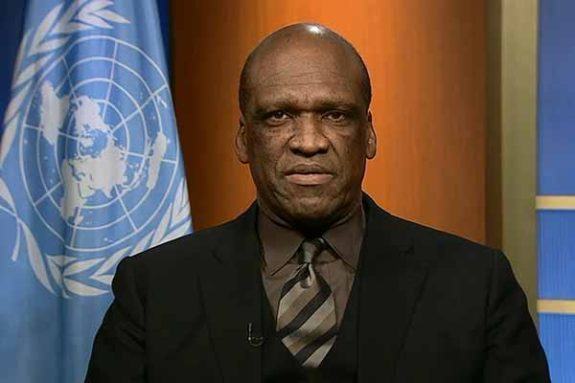
And on June 22, 2016, former UN official John Ashe “accidentally” crushed his own throat and died a week before he was scheduled to testify against the Clintons and Democrat Party.

john-ashe-un-575x383

John Ashes died before his court appearance.


Related Podcast:

The Opperman Report – 08.07.16 Niko House; DNC Infiltration, Rigging, Deaths


Fellow Americans, Wake Up & Escape The Matrix

MatrixBluePillRedPill-1024x534

Where Do Matters Stand?

On the eve of World War II the United States was still mired in the Great Depression and found itself facing war on two fronts with Japan and Germany. However bleak the outlook, it was nothing compared to the outlook today.

By Paul Craig Roberts

Source: Covert Geopolitics

Has anyone in Washington, the presstitute Western media, the EU, or NATO ever considered the consequences of constant military and propaganda provocations against Russia? Is there anyone in any responsible position anywhere in the Western world who has enough sense to ask: “What if the Russians believe us? What if we convince Russia that we are going to attack her?”

The same can be asked about China.

The recklessness of the White House Fool and the media whores has gone far beyond mere danger. What do the Russians think when they see that the Democratic Party intends to elect Hillary Clinton president of the US? Hillary is a person so crazed that she declared the president of Russia to be “the new Hitler” and organized through her underling, neocon monster Victoria Nuland, the overthrow of the democratically elected government of Ukraine. Nuland installed Washington’s puppet government in a former Russian province that until about 20 years ago was part of Russia for centuries.

I would bet that this tells even the naive pro-western part of the Russian government and population that the United States intends war with Russia.

Ever since Russia stood up to Obama over Syria, the Russians have been experiencing hostile propaganda and military operations on their borders. These provocations are justified by Washington and its NATO vassals as a response to “Russian aggression.” Russian aggression consists of nothing but obviously false assertions that Russia is about to invade the Baltics, Poland, and Romania and recreate the Soviet Empire, the Eastern European part of which, together with the former Russian provinces of Georgia and Ukraine, now belong to the American Empire.

The Russians know that the propaganda about “Russian aggression” is a lie. What is the purpose of the lie other than to prepare the Western peoples for war with Russia?

There is no other explanation.

Even morons such as Obama, Merkel, Hollande, and Cameron should be capable of understanding that it is extremely dangerous to convince a major military power that you are going to attack. To simultaneously also convince China doubles the danger.

Clearly, the West is incapable of producing leadership capable of preserving life on earth.

What can be done when the entire West demonstrates a death wish for Planet Earth?

Until the criminal regimes of Clinton, George W. Bush, and Obama, American presidents from John F. Kennedy forward worked to reduce tensions with the Soviets. Kennedy worked with Khrushchev to reduce tensions caused by US missiles in Turkey and Soviet missiles in Cuba. President Nixon negotiated SALT I (the Strategic Arms Limitation Treaty) and the Anti-Ballistic Missile Treaty. President Carter negotiated SALT II, which was never ratified by the US Senate but was observed by the executive branch. President Reagan negotiated with Soviet leader Gorbachev the end of the Cold War. President George H.W. Bush in exchange for Gorbachev’s agreement to the reunification of Germany promised that NATO would not move one inch to the East.

All of these achievements were thrown away by the neoconized Clinton, George W. Bush, and Obama regimes, each a criminal regime on par with Nazi Germany.

Today life on Planet Earth is far less secure than during the darkest days of the Cold War. Whatever threat global warming poses, it is miniscule compared to the threat of nuclear winter. If the evil that is concentrated in Washington and its vassals perpetrates nuclear war, cockroaches will inherit the earth.

I have been warning about the growing danger of a nuclear war resulting from the arrogance, hubris, ignorance, and evil personified by Washington. Recently, four knowledgable Russian-Americans spelled out the likely consequences of trying to drive Russia to submission with war threats: http://www.paulcraigroberts.org/2016/06/03/41522/

See also: http://www.paulcraigroberts.org/2016/05/28/as-our-past-wars-are-glorified-this-memorial-day-weekend-give-some-thought-to-our-prospects-against-the-russians-and-chinese-in-world-war-iii/

Don’t expect the brainwashed American population to have the moral conscience and fortitude to prevent nuclear war or even the intelligence to prevent their own vaporization. In a recent article in the Wall Street Journal Scott Sagan and Benjamin Valentino report that 59% of the US population support attacking Iran with nuclear weapons in the event that Iran sank one US Navy ship: http://www.wsj.com/articles/would-the-u-s-drop-the-bomb-again-1463682867

Republicans were much more likely than Democrats to approve attacking Iran with nuclear weapons with 81% of Republicans approving nuclear war compared to 47% of Democrats. Yet, the Democrats are behind Hillary who would be the first to use nuclear weapons. After all, a feminized woman has to prove how tough she is, just as Margaret Thatcher was “the Iron Lady.”

Before it is too late for Americans and all of humanity, arrogant Americans need to recall that “those who live by the sword, die by the sword.”

The economic picture is equally dismal and unpromising. The latest payroll jobs report was even more awful than reported. Hardly any new jobs were created, but what largely escaped reporting is the fact that the economy actually lost 59,000 full-time jobs.

Increasingly the US economy consists of part-time jobs that cannot support an independent existence. Thus, more Americans age 19-34 live at home with parents than independently with spouses or partners. Fully half of 25-year old Americans live in their childhood rooms in their parents’ homes.

This is the “New Economy” that the filthy lying neoliberal economists promised would be reward for the American work force giving up their manufacturing and professional skill jobs to foreigners. What a monstrous lie the neoliberal economists told so that corporate executives and shareholders could put into their own pockets the living wage of the American work force. These neoliberal economists, and, alas, libertarian “free market” ones, have not been held accountable for their impoverishment of the American work force deeply buried in debt with no future prospects.

Those few Americans who have any awareness are beginning to realize that the One Percent and the western governments that serve them are re-establishing feudalism. The brilliant and learned economist, Michael Hudson, has labeled our era the era of neo-feudalism.

He is correct. The majority of young Americans come out of university heavily indebted, primed for debtor prison. When half of 25-year olds cannot marry and form households, how can anyone believe that housing sales and prices are rising except as a result of speculative investors banking on rental income from a population that cannot even pay its student loans.

The United States is the sickest place on earth. There is no public or political discussion of any important issue or of the multiple crises that confront America or the crises that America brings to the world.

The American people are so stupid and unaware that they are capable of electing a criminal and a warmonger like Hillary president of the United States and be proud of it.

These “tough” Americans are so frightened of hoax dangers, such as “Muslim terrorists” and “Russian aggression” that they willingly sacrificed their depleted pocketbooks, the Constitution of the United States—an act of treason on the part of the American people who utterly failed their responsibility to protect the Constitution—and their own liberty to a universal police state that has all power over them.

It is extraordinary that once-proud, once-great European peoples look for leadership from a country of moronic non-entities who have pissed away the liberty, security, and prosperity that their Founding Fathers gave to them.

Fellow Americans, if you care to avoid vaporization and, assuming we do avoid it, live a life other than serfdom, you must wake up and realize that your most deadly enemy is Washington, not the hoax of “Russian aggression,” not the hoax of “Muslim terrorism,” not the hoax of “domestic extremism,” not the hoax of welfare bankrupting America, not the hoax of democracy voting away your wealth, which Wall Street and the corporations have already stolen and stuck in their pockets.

If you cannot wake up and escape The Matrix, your doom will bring the doom of the planet.

2016 election decides who controls the drug trade

04cd33bf632b3727f5f42ed26a16ae08

By Daniel Hopsicker

(Mad Cow Morning News)

In the Presidential Election of 2016, Republican and Democratic insiders are wrestling like two dogs over a bone over who controls the illegal drug trade.

To the victor go the spoils. Who wins the election wins control of America’s vast drug bazaar, largest in the world, whose proceeds prop up lucky bankers and politicians lapping at the trough of  the biggest richest slush fund in the history of the world.

It’s the smart play

It’s the biggest business in the world, and the No. 1 industry on the face of the planet, in terms of foreign trade. And if you didn’t know that about the illegal drug trade, then the vast amounts spent on propaganda and disinformation every year in the so-called “War on Drugs” is working.

The first industry to globalize vertically was the illegal drug business. It’s an open question whether drug trafficking drove globalization, or the other way around.

Negotiated by Bill Clinton, the chief beneficiary of NAFTA (North American Free Trade Agreement)—by dollar volume and impact on the economy—was the drug trade.

The Democrats, committed to globalization, will continue to farm out transportation and money laundering to, among others,  minions of Mexico’s President Enrique Nieto Pena, cronies of retired Colombian strongman Alvaro Uribe, and a host of eager bankers from the world’s largest banks.

Will a Republican victory will bring back Oliver North? No, it’ll be a Trump Administration appointee with a certain erect posture and short-but-stylishly-cut hair,  chosen to occupy the Oliver North seat on the National Security Council.

The Enterprise Lives. And prospers.

Why there’s no Global War on Johnnie Walker Red

Although America’s sun is slowly sinking  below the horizon, the country still boasts the biggest and the best illegal drug delivery pipeline on the planet, so efficient it’s sick, the and envy of the world. The UK and Europe may be nipping at our heels, growing bigger vis a vis the U.S. as drug consumers, but the U.S. remains the biggest market.

This market is what we sell to the world; one of a few businesses where we’re still No. 1, along with financial services, which basically means meaning laundering drug money, and movies based on comic books.

Here’s a statistic from the UN’s World Drug Report for 2016:

207,000 drug-related deaths globally.

Compare that with this fact from the UN’s World Health Organization:

“In 2012, 3.3 million deaths, or 5.9 percent of all global deaths, were due to alcohol consumption.”

If the U.S. cares about the health of its citizens we’ll soon have a Liquor Enforcement Administration(an LEA), with approximately sixteen times the funding that the War on Drugs receives every year, which is 40 billion dollars.

That’s within reach of the Pentagon budget; its safe to say it ain’t gonna happen.

It doesn’t happen, becauses of the banks, and also because, as the UN World Drug Report also states, and flatly, worldwide people spend more money on drugs every day than on food.

Yup. You can look it up.

An even bigger reason: Global Too Big to Jail Banks.

London’s Financial Times has warning for global elite

Even when you think you’re talking about something else, you’re talking about drugs, even if you don’t know it. London’s Financial Times briefly surfaced from the 19th Century with a headline reading “Global elites must heed the warning of populist rage’

“The explanation for the prolonged stagnation in real incomes are repeated financial crises and subsequent weak recoveries, which have destroyed popular confidence in the competence and moral principles, honesty, and decency of the elite.”

The greedy parasitic elite that betrayed the middle class, and the country.

The Times continues, “The role of finance is excessive. The financial system remains riddled with perverse incentives.”

Without drug money there is no financialization. Because the banks by themselves don’t have the capital. Some say that sounds like a good thing.

“Air America meets  Traffic meets Pineapple Express”

A steady diet of movies like the upcoming ‘Mena’ starring Tom Cruise playing the supposedly-swashbuckling former Air America  pilot Barry Seal, has given the movie-going public the idea that the real action in the illegal drug trade is in drug trafficking.

That’s not the case. The real action is in money laundering. Because if you can’t wash clean the money you end up with, it quickly becomes useless to anyone with more long-term goals than throwing the biggest party or longest orgy the world has ever seen. And because money weighs more than drugs—and is way more bulky unless you’re smuggling marijuana which is today considered more out of the stone age than old school.

So there’s a problem. Providing a solution are casinos, bodegas, cambios, Western Union, grocery stores, restaurants, even dry cleaners, and banks. Especially banks. In fact it they weren’t for laundering drug money, HSBC, JP Morgan, Barclays and Bank of America would have already gone the way of Mario Brothers or YAHOO, which only makes news anymore when pieces are sold off in foreclosure.

Three brief moments  in time in the drug trade

A Turkish boat carrying a massive 3.2 tonnes of high purity cocaine hidden in a ballast tank at the front of the MV Hamal was busted 100 miles east of the Aberdeenshire coast.

It was a record $673 million (£512 million) cocaine haul.The captain and second in command—Mumin Sahin and Emin Ozmen—were convicted, and sent to prison.

The Captain and the second in command” are the drug trade’s equivalent of David Letterman Show favorites Mujibur and Sirajul, who ran a t-shirt shop in a tiny frontage near the Ed Sullivan Theater. They were ordinary people who Letterman found exceptional just because there were so ordinary.

Is there a shortage of people ready to take a chance smuggling a half-billion cargo?  Is that the plan?

“Operation SCREENPLAY” gets a tentative green light

OPERATION Screenplay will go down as one of the all-time great UK drug busts,” enthused John McGowan, head of border investigations.

“To put it in perspective, the total seizure of cocaine by all police forces in England and Wales in 2014-15 was 3.4 tons. That was for everything.  This single seizure was 3.2 tons.”

In a blatant pitch for more government funding—so that he could presumably really go to town, he added, “And all we had was intelligence from the French that there was a considerable quantity of cocaine on board.”

The paper seemed not so sure. The report ended, “Despite the size of the seizure, anecdotal evidence suggests police did not record a dip in the amount of cocaine on our streets.”

Playing whack-a–mole around the world

An expert who testified at their trial about “recognised trade routes” for shipping cocaine was perhaps a little too candid. He told the jury:

“It is now south of Venezuela and Guyana because of a lot of enforcement activity by the USA patrolling the coast. It’s massive importation – unprecedented in my experience.”

Those sneaky traffickers. Always playing whack-a-mole.

Cocaine production in Colombia increased dramatically—shooting up a staggering 46 percent—last year.  The country now has the resources to produce 712 tons of cocaine annually. Growth exploded in lawless areas in the Sierra Nevada mountains in the north and in the Amazon region, on the Venezuelan and Ecuadorean borders and along the Pacific coast.

But cultivation dropped in central Colombia, where the people running  both Colombia’s government and drug trade of Colombia.

Huh. Imagine that.

The Mexican Navy left with many barrels of zesty condiments

The Mexican navy found 13 tons of cocaine inside barrels of hot sauce in Manzanillo, 500 miles west of Mexico City. The barrels full of zesty condiment and cocaine were believed to belong to the Sinaloa Cartel.

A week earlier, busy Mexican sailors discovered almost a ton of cocaine—more than 900 keys—floating in the open sea off the coast of Chiapas.

A ton of cocaine. Just… floating…100 miles from shore.

The world’s richest industries

How much money an industry makes is the best rule of thumb for how much clout that industry exerts on the countries in which it operates. The illegal drug trade has yearly revenues exceeding the 946 billion in annual revenue of Walmart, Microsoft, Google, Ebay, and British Petroleum, combined.

In the U.S., and almost everywhere else, it’s a cash cow of almost unimaginable proportions.

The richest industries are all based on at assets we use in our lives every day, from computers to entertainment, to oil, to shopping, to drugs. According to therichest.com, “They are industries we give our hard-earned money to out of necessity, desire, or a mix of the two. And they also tend to be the most valuable, and not just from a monetary standpoint.  Their value lies in the fact that they’re needed to help society advance and function smoothly.”

Imagine several hundred million people trying to get through Monday morning with coffee. Luckily, that won’t ever happen.


About Daniel Hopsicker

Daniel Hopsicker is an investigative journalist dubious about the self-serving assertion of U.S. officials that there are no American Drug Lords.

‘Stop Drinking the Kool-Aid, America: Political Fiction in an Age of Televised Lies’

20120527040549-stop-drinking-kool-aid

By John W. Whitehead

Source: A Government of Wolves

“We’ve got to face it. Politics have entered a new stage, the television stage. Instead of long-winded public debates, the people want capsule slogans—‘Time for a change’—‘The mess in Washington’—‘More bang for a buck’—punch lines and glamour.”— A Face in the Crowd (1957)

Politics is entertainment.

It is a heavily scripted, tightly choreographed, star-studded, ratings-driven, mass-marketed, costly exercise in how to sell a product—in this case, a presidential candidate—to dazzled consumers who will choose image over substance almost every time.

This year’s presidential election, much like every other election in recent years, is what historian Daniel Boorstin referred to as a “pseudo-event”: manufactured, contrived, confected and devoid of any intrinsic value save the value of being advertised. It is the end result of a culture that is moving away from substance toward sensationalism in an era of mass media.

As author Noam Chomsky rightly observed, “It is important to bear in mind that political campaigns are designed by the same people who sell toothpaste and cars.” In other words, we’re being sold a carefully crafted product by a monied elite who are masters in the art of making the public believe that they need exactly what is being sold to them, whether it’s the latest high-tech gadget, the hottest toy, or the most charismatic politician.

Tune into a political convention and you will find yourself being sucked into an alternate reality so glossy, star-studded, emotionally charged and entertaining as to make you forget that you live in a police state. The elaborate stage show, the costumes, the actors, the screenplay, the lighting, the music, the drama: all carefully calibrated to appeal to the public’s need for bread and circuses, diversion and entertainment, and pomp and circumstance.

Politics is a reality show, America’s favorite form of entertainment, dominated by money and profit, imagery and spin, hype and personality and guaranteed to ensure that nothing in the way of real truth reaches the populace.

After all, who cares about police shootings, drone killings, SWAT team raids, asset forfeiture schemes, private prisons, school-to-prison pipelines, overcriminalization, censorship or any of the other evils that plague our nation when you can listen to the croonings of Paul Simon, laugh along with Sarah Silverman, and get misty-eyed over the First Lady’s vision of progress in America.

But make no mistake: Americans only think they’re choosing the next president.

In truth, however, they’re engaging in the illusion of participation culminating in the reassurance ritual of voting. It’s just another Blue Pill, a manufactured reality conjured up by the matrix in order to keep the populace compliant and convinced that their vote counts and that they still have some influence over the political process.

Stop drinking the Kool-Aid, America.

The nation is drowning in debt, crippled by a slowing economy, overrun by militarized police, swarming with surveillance, besieged by endless wars and a military industrial complex intent on starting new ones, and riddled with corrupt politicians at every level of government. All the while, we’re arguing over which corporate puppet will be given the honor of stealing our money, invading our privacy, abusing our trust, undermining our freedoms, and shackling us with debt and misery for years to come.

Nothing taking place on Election Day will alleviate the suffering of the American people.

The government as we have come to know it—corrupt, bloated and controlled by big-money corporations, lobbyists and special interest groups—will remain unchanged. And “we the people”—overtaxed, overpoliced, overburdened by big government, underrepresented by those who should speak for us and blissfully ignorant of the prison walls closing in on us—will continue to trudge along a path of misery.

With roughly 22 lobbyists per Congressman, corporate greed will continue to call the shots in the nation’s capital, while our elected representatives will grow richer and the people poorer. And elections will continue to be driven by war chests and corporate benefactors rather than such values as honesty, integrity and public service. Just consider: it’s estimated that more than $5 billion will be spent on the elections this year, yet not a dime of that money will actually help the average American in their day-to-day struggles to just get by.

And the military industrial complex will continue to bleed us dry. Since 2001 Americans have spent $10.5 million every hour for numerous foreign military occupations, including in Iraq and Afghanistan. There’s also the $2.2 million spent every hour on maintaining the United States’ nuclear stockpile, and the $35,000 spent every hour to produce and maintain our collection of Tomahawk missiles. And then there’s the money the government exports to other countries to support their arsenals, at the cost of $1.61 million every hour for the American taxpayers.

Then again, when faced with the grim, seemingly hopeless reality of the American police state, it’s understandable why Americans might opt for escapism. “Humankind cannot bear too much reality,” T. S. Eliot once said. Perhaps that is one reason we are so drawn to the unreality of the American political experience: it is spectacle and fiction and farce all rolled up into one glossy dose of escapism.

Frankly, escapism or not, Americans should be mad as hell.

Many of our politicians live like kings. Chauffeured around in limousines, flying in private jets and eating gourmet meals, all paid for by the American taxpayer, they are far removed from those they represent. Such a luxurious lifestyle makes it difficult to identify with the “little guy”—the roofers, plumbers and blue-collar workers who live from paycheck to paycheck and keep the country running with their hard-earned dollars and the sweat of their brows.

Conveniently, politicians only seem to remember their constituents in the months leading up to an election, and yet “we the people” continue to take the abuse, the neglect, the corruption and the lies. We make excuses for the shoddy treatment, we cover up for them when they cheat on us, and we keep hoping that if we just stick with them long enough, eventually they’ll treat us right.

People get the government they deserve.

No matter who wins the presidential election come November, it’s a sure bet that the losers will be the American people.

As political science professor Gene Sharp notes in starker terms, “Dictators are not in the business of allowing elections that could remove them from their thrones.” As I make clear in my book Battlefield America: The War on the American People, the Establishment—the shadow government and its corporate partners that really run the show, pull the strings and dictate the policies, no matter who occupies the Oval Office—are not going to allow anyone to take office who will unravel their power structures. Those who have attempted to do so in the past have been effectively put out of commission.

So what is the solution to this blatant display of imperial elitism disguising itself as a populist exercise in representative government?

Stop playing the game. Stop supporting the system. Stop defending the insanity. Just stop.

Washington thrives on money, so stop giving them your money. Stop throwing your hard-earned dollars away on politicians and Super PACs who view you as nothing more than a means to an end. There are countless worthy grassroots organizations and nonprofits working in your community to address real needs like injustice, poverty, homelessness, etc. Support them and you’ll see change you really can believe in in your own backyard.

Politicians depend on votes, so stop giving them your vote unless they have a proven track record of listening to their constituents, abiding by their wishes and working hard to earn and keep their trust.

Stop buying into the lie that your vote matters. Your vote doesn’t elect a president. Despite the fact that there are 218 million eligible voters in this country (only half of whom actually vote), it is the electoral college, made up of 538 individuals handpicked by the candidates’ respective parties, that actually selects the next president. The only thing you’re accomplishing by taking part in the “reassurance ritual” of voting is sustaining the illusion that we have a democratic republic. What we have is a dictatorship, or as political scientists Martin Gilens and Benjamin Page more accurately term it, we are suffering from an “economic élite domination.”

A healthy, representative government is hard work. It takes a citizenry that is informed about the issues, educated about how the government operates, and willing to make the sacrifices necessary to stay involved, whether that means forgoing Monday night football in order to attend a city council meeting or risking arrest by picketing in front of a politician’s office.

It takes a citizenry willing to do more than grouse and complain. We must act—and act responsibly—keeping in mind that the duties of citizenship extend beyond the act of voting.

Most of all, it takes a citizenry that cares enough to get mad and get active. As Howard Beale declares in the 1976 film Network:

“I want you to get up right now, sit up, go to your windows, open them and stick your head out and yell, ‘I’m as mad as hell and I’m not going to take this anymore.’ Things have got to change. But first, you’ve gotta get mad!…You’ve got to say, ‘I’m as mad as hell, and I’m not going to take this anymore!’ Then we’ll figure out what to do about the depression and the inflation and the oil crisis. But first get up out of your chairs, open the window, stick your head out, and yell, and say it.”


Google’s lemmings: Pokémon go where Silicon Valley says

index

An analysis of Ingress and Pokémon Go reveals important truths about corporate control and the ability of our mobile phones to organize our desires.

By Alfie Brown

Source: ROAR Magazine

his article has a clickbaity title but a sobering and concerning point to make. In 2010, Google started up what is now a very important subsidiary, Niantic Inc. Google starts up a lot of companies each year and acquires a great many more, so there is nothing special in this. What is important is that whilst most of us see Google’s acquisition of every “start-up” and endless development of “subsidiary” companies with different names as simply an attempt to completely monopolize the market, the case of Niantic shows us that there is more to the extent of Google’s power.

Six years on from its inception with the launch of its biggest game yet, Pokémon Go, Niantic has hit the headlines and people are finally paying attention to the company, with some apparent leftists even claiming we ought to boycott Pokémon Go. In fact, Niantic have been working on mobile phone psychology and social organization for several years. An analysis of the company’s two big games, Ingress and Pokémon Go, shows us some important truths about the world we are living in, about corporate control and about the ability of our mobile phones to organize our desires.

Niantic developed their first major game, Ingress, in 2011. The game, one of the most important of recent years, is a key ideological tool for Google — one that, unlike Pokémon Go, is little publicized. Ingress has seven million or more players and Ingress tattoos show the degree to which people define themselves by the application. Some players even describe Ingress as a “lifestyle” rather than a “game”. The reader can be forgiven for thinking: “I don’t play it, so why would this apply to me?” But the entertainment coming out of Google via Niantic is in line with Google’s wider project of regulating our movements and experiences of the physical world; unless you don’t use Google or any of its applications, many of which come built-it to our phones and cannot be uninstalled, this applies to you.

Ingress reflects a trend of mobile phone application development (which includes Google Maps and Uber, among other well-known apps) designed to regulate and influence our experience of the city, turning the mobile phone into a new kind of unconscious: an ideological force driving our movements while we remain only semi-aware of what propels us and why we are propelled in the directions we are.

I first considered the importance of mobile phone games to be about a kind of “distraction” — an argument I made in my book and related article in The New Inquiry. Later, when playing Ingress for the first time, I realized there was a lot more to it than this. Ingress, rather than simply distracting us from the city around us, actually trains us to become Google’s perfect citizens. In Ingress, the player moves around the real environment capturing “portals” represented by landmarks, monuments and public art, as well as other less-famous features of the city. The player is required to be within physical range of the “portal” to capture it, so the game constantly tracks the player via GPS. Importantly, it not only monitors where we go, but directs us where it wants us to move.

As such it is very much the counterpart of Google Maps, which is also developing the ability not only to track our movements but to direct them. Of course, Google’s algorithms have long since dictated which restaurants we visit, which cafés we are aware of and which paths we take to get to these destinations. Now though, Google is developing new technology that actually predicts where you will want to go based on the time, your GPS location and your habitual history of movement stored in its infinitely powerful recording system. This, like Ingress, shows us a new pattern emerging in which the mobile phone dictates our paths around the city and encourages us, without realizing it, to develop habitual and repetitious patterns of movement. More importantly still, such applications anticipate our very desires, not so much giving us what we want as determining what we desire.

Here again, the connection with the concept of the unconscious is useful. While some have seen the unconscious as a morass of unregulated desires, followers of Freud and later of Lacanian psychoanalysis have been keen to show precisely how structured the unconscious is by outside forces. Our mobile phones pretend to be about fulfilling our every desire, giving us endless entertainment (games), easy transport (Uber) and instant access to food and drink (OpenRice, JustEat) and even near-instantaneous sex and love (Tindr, Grindr). Yet, what is much scarier than the fact that you can get everything you want via your mobile phone is the possibility that what you want is itself set in motion by the phone.

Into precisely this atmosphere enters Pokémon Go, out just days ago, and already the most significant mobile phone release of 2016. The game is, of course, made by none other than Niantic Labs. A series of hysterical events have already arisen from the ethical minefield that is Pokémon Go. In the case of Ingress, academic study has already been dedicated to the fact that the game has sent young children into unlit city parks at 3am. With Pokémon Go, Australian police have had to respond to a bunch of Pokémon trainers trying to get into a police station to capture the Pokémon within and some people found a dead body instead of a Pokémon. It has already been suggested that Pokémon Go is eventually going to kill someone — and since that article was published someone has crashed into a police car and another has been run-over while hunting Pokemon. But, as with Ingress, it is not the occasional mad story to emerge that should concern us, but the psychological and technological effects of every user’s experience.

The premise of Pokémon Go is simply that you use your GPS to find Pokémon in the real environment and then your camera to make the Pokémon visible, so that the world is enriched by looking through the screen at what lies behind it, as in the image below:

images

The Pokémon itself is an incredible phenomenon deserving of a book length study. Perhaps for now we can say that the Pokémon is the perfect example of what Jacques Lacan called the objet a, that perfectly cute fetishised but illusive object of desire that would truly make us happy if only we could just get our hands on it. We never do, because there is always a newer, cuter and harder to capture version that we just have to catch!

Dystopian visions of what technology and videogames would lead to seem to have got something completely wrong. Depictions of the dystopian videogame future have always tended to see the future as involving each individual isolated from the rest and sat quietly alone in a small room hooked up into a computer through which their lives are exclusively lived. In other words, the importance of the physical environment recedes in favor of the imaginary electronic world. On the contrary to these predictions of the future, we now live in a dystopia where Google and its subsidiaries send us madly around the city almost non-stop in directions of its choosing in search of the objects of desire, whether that be a lover on Tindr, a bowl of authentic Japanese ramen or that elusive Clefairy or Pikachu.

In the 1990s parents could ask their children to “get outside more” to escape the videogame space, but now it is the games that make us charge around the city capturing portals and collecting Pokémon and going on dates. Putting aside the full access that Google gets to your accounts via Pokémon Go, this shows us something really dangerous. It points to the increasing reality that there really is no escape from Google — and that while we are doing what we think we want, believing that we are just using our phones to help us get it, in fact Google has an even greater power, a truly revolutionary one: the ability to create and organize desire itself.

It is this truly revolutionary power that is important when it comes to Pokémon Go and Ingress. To say that these games are revolutionary is not to say that they are doing any good, nor that they are “radical”, and certainly it is not to say that they are left-wing — on the contrary, the revolution in desire appears to be corporate, hegemonic and centralized. If the left is to have any hope, however, it must not resist Pokémon Go, as Jacobin have now famously suggested, but understand and perhaps even embrace the power of the mobile phone to re-organize desire and look for ways forward from here.


Alfie Bown is the author of Enjoying It: Candy Crush and Capitalism (Zero, 2015) and The PlayStation Dreamworld (Polity, forthcoming 2017). He is the co-editor of the Hong Kong Review of Books and writes on the politics of technology and videogames for many publications.

SMARTPHONES, SOCIAL MEDIA AND SLEEP: THE INVISIBLE DANGERS OF OUR 24/7 CULTURE

cell-phone-addiction

By Martijn Schirp

Source: High Existence

If there is one book to read about our addictions to work, phones, consumption, and the current state of capitalism, it’s 24/7: Late Capitalism and the Ends of Sleep by Jonathan Crary, a professor of Modern Art & Theory at Columbia University. Crary argues that sleep is a standing affront to capitalism and while that seems grim, it highlights the very real dark sides of always having glowing LED screens clutched in our hands.

Technology has ushered us into a 24/7 state: we live in a world that never stops producing and is infinitely connected. We have digital worlds in our pockets, and we carry our phones and screens everywhere, feeding our dopamine addictions when we’re bored or lonely, cradling us before bed with endless scrolls of news and waking us up with notifications and emails.

The barrier between work and home life has disappeared, and most professionals are able to and choose to continue working all hours of the day in an increasingly competitive, winner-take-all environment.

Most of our time then, is either spent working or consuming (the upside of working so much is money, which is then used to consume): food, drugs, shopping, films, Youtube videos, Instagram feeds, news articles, updates from friends — even socializing-time has been reduced to a passive “Netflix & Chill”.

There are now very few significant interludes of human existence (with the colossal expectation of sleep) that have not been penetrated and taken over as work time, consumption time, or marketing time.

The social-world and the work-world are both digitized, which makes it increasingly difficult to distinguish between the two, and beyond the pop-ups and video ads, individuals have become their own marketers. Building a “personal brand” as a living is not uncommon.

It is only recently that the elaboration, the modeling of one’s personal and social identity, has been reorganized to conform to the uninterrupted operation of markets, information networks, and other systems. A 24/7 environment has the semblance of a social world, but it is actually a non-social model of machinic performance and a suspension of living that does not disclose the human cost required to sustain its effectiveness.

The average North American adult “now sleeps approximately six and a half hours a night, an erosion from eight hours a generation ago, and down from ten hours in the early twentieth century,” and what suffers most from this lack of sleep is our innate ability to dream. Most people tend to forget or don’t even think about their dreams, much less their extraordinary ability to control them. What is frightening about this is the prevalent attitude of accepting the current state of reality as it is:

The idea of technological change as quasi-autonomous, driven by some process of autopoiesis or self-organization, allows many aspects of contemporary social reality to be accepted as necessary, unalterable circumstances, akin to facts of nature. In the false placement of today’s most visible products and devices within an explanatory lineage that includes the wheel, the pointed arch, moveable type, and so forth, there is a concealment of the most important techniques invented in the last 150 years: the various systems for the management and control of human beings.

What may be the most important fact to remember: Nothing must be as it is. Here are a three ways to escape the never-ending 24/7 state:

Unplug Your Phone & Plug Into Your Imagination

Break your cell phone habit. The dopamine addiction is real. I keep my phone in a Faraday pouch, which blocks signals to my phone and keeps me to my rule of no cell phone or screen use one hour prior to sleeping and one hour after waking.

As “visual and auditory ‘content’ is most often ephemeral, interchangeable material that in addition to its commodity status, circulates to habituate and validate one’s immersion in the exigences of twenty-first-century capitalism,” it is important to focus on the power of our own imagination. The hierarchal and algorithm-driven fields of social media and newsfeeds tend to serve us things we already know or like, and keep us wanting.

Instead, we can explore the limitless field of our imagination. Write down your dreams in the morning and use them as a vehicle for self-exploration, or venture into lucid dreaming to manifest your own desires or to explore creative pursuits. And yet for most of us, when walking, during our daily commute, even sitting on the toilet or in any moment where it’s just us and our thoughts, we turn to our cell phones for comfort, to fill the silence:

One of the forms of disempowerment within 24/7 environments is the incapacitation of daydream or of any mode of absent-minded introspection that would otherwise occur in intervals of slow or vacant time.

Even when socializing with friends, it’s a common habit to check our phones again and again. I’ve found that when one person does this, it enables others:if I see someone sitting across from me at a dinner checking their Instagram feed, I’ll feel less guilty about doing the same. Make it can stop with you — turn off your phone.

Reevaluate Your Drug Habits & Addictions

Beyond digital dopamine, are you addicted to caffeine, sugar, alcohol, adderall, cocaine, Ambien, Lexapro, vicodin, etc., etc.? We live in a self-selecting society, where some drugs are perfectly acceptable as long as they are prescribed by a doctor and other drugs are deemed dangerous. I used to babysit for an eight-year-old who was fed Ritalin daily for his ADHD, and then at night, had to take a tranquilizer to help him fall asleep. He was speedballing throughout his childhood, and I’ve met others who had the same experience only to question the impact of these drugs on their personality and life-path.

There is a multiplication of the physical or psychological states for which new drugs are developed and then promoted as effective and obligatory treatments. As with digital devices and services, there is a fabrication of pseudo-necessities, or deficiencies for which new commodities are essential solutions… Over the last two decades, a growing range of emotional states have been increasingly pathologized in order to create vast new markets for previously unneeded products. The fluctuating textures of human affect and emotion that are only imprecisely suggested by the notions of shyness, anxiety, variable sexual desire, distraction, or sadness have been falsely converted into medical disorders to be targeted by hugely profitable drugs. Of the many links between the use of psychotropic drugs and communication devices, one is their parallel products of forms of social compliance.

Ritalin, adderall (and cocaine) not only make the takers compliant but fueled to tackle the 24/7 lifestyle, deadening empathy, increasing competitiveness and perhaps is linked to “destructive delusions about performance and self-aggrandizement”.

While methamphetamines are regularly fed to children, psychedelic drugs tend to be demonized as extreme and dangerous. Yet, refreshingly, there are organizations now like the Multidisciplinary Association of Psychedelic Studies (MAPS) and other studies looking into how psychedelics can not only treat addictions, anxiety, and disorders, but also how psychedelics can expand consciousness and leave lasting personality changes for the better.

Find Your Passion & Connect With Real Life Communities

Crary argues that “whatever remaining pockets of everyday life are not directed toward quantitative or acquisitive ends, or cannot be adapted to telematic participation, tend to deteriorate in esteem and desirability.” Our tendency to tie our social worth to digital networks takes the saying “if a tree falls in a forest and nobody is around to hear it, does it make a sound?” and turns it into “if you do something fun and meaningful and don’t post it to social media, does it matter?”

But those meaningful moments in real life do matter, as does having a strong community to participate in. After all, addictions are a result mostly of isolation and bad environments:

As stated earlier: it is much easier to fold to the insidious trap of looking at your cell phone or constantly working if the person across from you does so first. Find your passion beyond the screen. Find your source of dopamine, what drives you, what engages you and makes you want to get up every day.

Finding a real community centered around a meaningful activity can help tremendously. For me, rock climbing is a meditative activity that requires focus and attention, and is anchored in a community of people who are invested in your success as much as they are in their own. The nature of the sport is so individual because each person is unique; climbing is a niche that carves out time for people to participate in life without any social rules and concepts of winning over another. Climbing outdoors is a way to be connected to nature and to just hang out with friends.

I just returned from a week in New York City, the city that never sleeps, the capitol of the 24/7 world, and it took me two weeks just to be able to find the time to sit down and write this. It is not easy to accept the bleak claims in Crary’s book because it would be admitting our own addictions and how we play into this non-stop state. It’s just as hard to look away from our screens, but you can. Tonight, don’t put your phone or laptop into “sleep mode” — turn them off, and pay attention to your own dreams.

Further Study:


24/7: Late Capitalism and the Ends of Sleep
 by Jonathan Crary

24/7: Late Capitalism and the Ends of Sleep explores some of the ruinous consequences of the expanding non-stop processes of twenty-first-century capitalism. The marketplace now operates through every hour of the clock, pushing us into constant activity and eroding forms of community and political expression, damaging the fabric of everyday life.

Wikileaks Emails Bring New Attention to Hillary Victory Fund “Money Laundering” Charges

index

By Pam Martens and Russ Martens

Source: Wall Street on Parade

The problem with conspiracy theorists is that, quite frequently, the theorists lack adequate imagination. That seems to be the case when it comes to the Democratic National Committee’s behind-the-scenes machinations to muscle Hillary Clinton into the White House while plotting against her main challenger, Bernie Sanders. That conclusion stems from the trove of 20,000 DNC emails dumped into the public sphere by Wikileaks last Friday.

The leaked emails have cost Debbie Wasserman Schultz her job as Chair of the DNC but other top DNC officials captured in devious plots against Sanders in the email exchanges still have their jobs – or at least no official firings have been announced. This makes the conspiracies seem more like a DNC business model.

The DNC’s own charter demands that it treat all Democratic primary candidates fairly and impartially, but top DNC officials made a mockery of that mandate. In addition to conjuring up ways to smear Clinton challenger Bernie Sanders during the primary battles, the leaked emails show a coordinated effort to cover up what the Sanders camp called “money laundering” between the Hillary Victory Fund and the DNC.

Despite the fact that the Sanders campaign had no such active arrangement with the DNC, the DNC agreed to participate in the Hillary Victory Fund, a joint fundraising committee that sluiced money to both Hillary’s main candidate committee, Hillary for America, as well as into the DNC. To a much tinier degree, funds also went to dozens of separate State Democratic committees.

On May 2 of this year, the Sanders campaign released a statement charging Clinton with “looting funds meant for the state parties to skirt fundraising limits on her presidential campaign,” and exploiting “the rules in ways that let her high-dollar donors like Alice Walton of Wal-Mart fame and the actor George Clooney and his super-rich Hollywood friends skirt legal limits on campaign contributions.”

Despite Clinton’s promise to rein in tax dodges by hedge funds, Wall Street On Parade reported in April that major hedge fund titans were also big donors to the Hillary Victory Fund. We wrote at the time:

“Federal Election Commission records show that S. Donald Sussman, founder of hedge fund Paloma Partners, gave $343,400 to the Hillary Victory Fund while also donating $2.5 million to Priorities USA, the Super Pac supporting Hillary. Hedge Fund billionaire George Soros donated $343,400 to the Hillary Victory Fund while sluicing a whopping $7 million into Priorities USA to enhance Hillary’s efforts to move into the Oval Office.”

Today, reporters Ken Vogel and Isaac Arnsdorf of Politico have provided significant new details from the leaked emails to show how the DNC worked behind the scenes to control the media’s handling of revelations involving the Hillary Victory Fund.

Vogel was criticized by some media outlets when the Wikileaks emails revealed he had allowed a DNC official to review one of his articles critical of the joint fundraising operation prior to publication. Erik Wemple of the Washington Post has provided some necessary clarity to that issue here.

The Clinton camp and the DNC had attempted publicly to defend the joint fundraising operation as providing critical help to State Committees in order to help down-ticket candidates. But today, Vogel and Arnsdorf report the following:

“Between the creation of the victory fund in September and the end of last month, the fund had brought in $142 million, the lion’s share of which — 44 percent — has wound up in the coffers of the DNC ($24.4 million) and Hillary for America ($37.6 million), according to a POLITICO analysis of FEC filings. By comparison, the analysis found that the state parties have kept less than $800,000 of all the cash brought in by the committee — or only 0.56 percent.”

Vogel and Arnsdorf also detail how the DNC attempted to stonewall reporters on the topic, writing:

“The emails show the officials agreeing to withhold information from reporters about the Hillary Victory Fund’s allocation formula, working to align their stories about when — or if — the DNC had begun funding coordinated campaign committees with the states.”

The Politico reporters also note that Hillary Clinton’s campaign attorney, Marc Elias of law firm Perkins Coie, also appears in a Wikileaks email suggesting media strategy to the DNC:

“ ‘The DNC should push back DIRECTLY at Sanders and say that what he is saying is false and harmful to the Democratic party,’ Marc Elias, an attorney who advises the DNC and the Clinton campaign, wrote in an email to DNC officials. [DNC] CEO Amy Dacey responded ‘I do think there is too much of this narrative out there — I also worry since they are emailing to their list (which has overlap with ours!)’

“In another email, Miranda, the [DNC] communications director, suggested that the campaign tell other journalists seeking to follow POLITICO’s story that “Politico got it wrong.” But the rest of his email failed to indicate any errors in POLITICO’s story, nor did the DNC or the Clinton campaign seek a correction.”

Politico’s latest revelations build on the allegations in the class action lawsuit that has been filed against the DNC and Wasserman Schultz by Sanders’ supporters. One document submitted in that lawsuit came from a previous hack of the DNC server by an individual known as Guccifer 2.0. That document shows that even after Bernie Sanders had announced he was entering the race on April 30, 2015, the DNC was brainstorming on how it could advance Hillary Clinton to the top of the ticket. The memo is described as follows in the lawsuit:

“Among the documents released by Guccifer 2.0 on June 15th is a two-page Microsoft Word file with a ‘Confidential’ watermark that appears to be a memorandum written to the Democratic National Committee regarding ‘2016 GOP presidential candidates’ and dated May 26, 2015. A true and correct copy of this document (hereinafter, ‘DNC Memo’) is attached as Exhibit 1. The DNC Memo presents, ‘a suggested strategy for positioning and public messaging around the 2016 Republican presidential field.’ It states that, ‘Our goals in the coming months will be to frame the Republican field and the eventual nominee early and to provide a contrast between the GOP field and HRC.’ [HRC means Hillary Rodham Clinton.] The DNC Memo also advises that the DNC, ‘[u]se specific hits to muddy the waters around ethics, transparency and campaign finance attacks on HRC.’ In order to ‘muddy the waters’ around Clinton’s perceived vulnerabilities, the DNC Memo suggests ‘several different methods’ of attack including: (a) ‘[w]orking through the DNC’ to ‘utilize reporters’ and create stories in the media ‘with no fingerprints’; (b) ‘prep[ping]’ reporters for interviews with GOP candidates and having off-the-record conversations with them; (c) making use of social media attacks; and (d) using the DNC to ‘insert our messaging’ into Republican-favorable press.” [Read the full memorandum here.]

The response to all of this from Hillary Clinton has further enraged Sanders’ supporters. After the emails were leaked and written about in the media over the weekend, Hillary Clinton made Wasserman Schultz the honorary chairperson of her 50-state program and President Obama praised Wasserman Schultz in a statement that can only be described as bizarre, given the contents of the leaked emails. Obama said on Sunday:

“For the last eight years, Chairwoman Debbie Wasserman Schultz has had my back. This afternoon, I called her to let her know that I am grateful. Her leadership of the DNC has meant that we had someone who brought Democrats together not just for my re-election campaign, but for accomplishing the shared goals we have had for our country.”

Apparently, missing from those “shared goals” is allowing a fair primary process within the Democratic party or a challenge to the political machine that controls Washington.


Related Article: IRS Will Investigate Clinton Foundation ‘Pay-to-Play’ Corruption Accusations

Dem politician questions Israel’s ties to terrorism

Featured-image

Source: Press TV

Former US Democratic Representative Cynthia McKinney has questioned Israel’s ties to recent attacks in France and Germany, after an Israeli reporter managed to capture both attacks as they were happening.

“Same Israeli photographer captures Nice and Munich tragedies,” the six-term congresswoman from Georgia said in a tweet on Saturday.

The journalist in question is Richard Gutjahr, who videotaped the truck attack in Nice, France, that killed more than 80 people and injured dozens more on July 14.

Eight days later, the reporter happened to be on the site of another attack in Munich, Germany, where a shooting rampage claimed nine lives.

“How likely is that? Remember the Dancing Israelis?” McKinney asked, referring to reported Israeli celebrations during the September 11, 2011, attacks in the US.

The former American lawmaker also posted a video, showing an article with the headline: “Same Israeli photo-propagandist pre-positioned in Nice AND NOW MUNICH.”

“The fact that this guy happened to be at both, there’s no way it’s a coincidence,” the narrator of the video said.

He went on to talk about Gutjahr’s wife, a former Israeli Kensset member, before concluding that “it’s 100 percent clear that Israel’s fingerprints are all over these events.”

During the Nice attack, Gutjahr filmed the whole incident from a balcony at the Westminster Hotel, right next to the street where the French National Day celebrations were being held.

a2dcaa0e-d7cd-4837-b5f6-f6e2333fbc2d

He also provided major Western media outlets with extensive reports about the Munich attack, posting images and videos on his Twitter account. Some of the tweets like the one showed above were deleted later on.

Munich police chief Hubertus Andrae identified the gunman as an 18-year-old German-Iranian man from Munich, who had no criminal record and whose motive was “completely unclear.”


Related Articles:

Shooter apparently inspired by Anders Behring Breivik

München Shooting: Terror Embedded Journalism?