
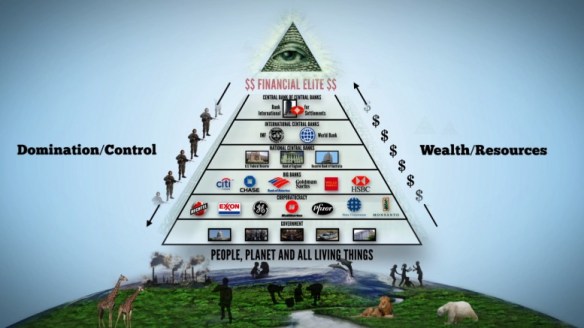
The Great Ponzi Scheme of the Global Economy

FollowTheMoney-Bank-Pyramid

By Michael Hudson and Chris Hedges

Source: CounterPunch

CHRIS HEDGES: We’re going to be discussing a great Ponzi scheme that not only defines not only the U.S. but the global economy, how we got there and where we’re going. And with me to discuss this issue is the economist Michael Hudson, author of Killing the Host: How Financial Parasites and Debt Destroy the Global Economy. A professor of economics who worked for many years on Wall Street, where you don’t succeed if you don’t grasp Marx’s dictum that capitalism is about exploitation. And he is also, I should mention, the godson of Leon Trotsky.

I want to open this discussion by reading a passage from your book, which I admire very much, which I think gets to the core of what you discuss. You write,

“Adam Smith long ago remarked that profits often are highest in nations going fastest to ruin. There are many ways to create economic suicide on a national level. The major way through history has been through indebting the economy. Debt always expands to reach a point where it cannot be paid by a large swathe of the economy. This is the point where austerity is imposed and ownership of wealth polarizes between the One Percent and the 99 Percent. Today is not the first time this has occurred in history. But it is the first time that running into debt has occurred deliberately.” Applauded. “As if most debtors can get rich by borrowing, not reduced to a condition of debt peonage.”

So let’s start with the classical economists, who certainly understood this. They were reacting of course to feudalism. And what happened to the study of economics so that it became gamed by ideologues?

HUDSON: The essence of classical economics was to reform industrial capitalism, to streamline it, and to free the European economies from the legacy of feudalism. The legacy of feudalism was landlords extracting land-rent, and living as a class that took income without producing anything. Also, banks that were not funding industry. The leading industrialists from James Watt, with his steam engine, to the railroads …

HEDGES: From your book you make the point that banks almost never funded industry.

HUDSON: That’s the point: They never have. By the time you got to Marx later in the 19th century, you had a discussion, largely in Germany, over how to make banks do something they did not do under feudalism. Right now we’re having the economic surplus being drained not by the landlords but also by banks and bondholders.

Adam Smith was very much against colonialism because that lead to wars, and wars led to public debt. He said the solution to prevent this financial class of bondholders burdening the economy by imposing more and more taxes on consumer goods every time they went to war was to finance wars on a pay-as-you-go basis. Instead of borrowing, you’d tax the people. Then, he thought, if everybody felt the burden of war in the form of paying taxes, they’d be against it. Well, it took all of the 19th century to fight for democracy and to extend the vote so that instead of landlords controlling Parliament and its law-making and tax system through the House of Lords, you’d extend the vote to labor, to women and everybody. The theory was that society as a whole would vote in its self-interest. It would vote for the 99 Percent, not for the One Percent.

By the time Marx wrote in the 1870s, he could see what was happening in Germany. German banks were trying to make money in conjunction with the government, by lending to heavy industry, largely to the military-industrial complex.

HEDGES: This was Bismarck’s kind of social – I don’t know what we’d call it. It was a form of capitalist socialism…

HUDSON: They called it State Capitalism. There was a long discussion by Engels, saying, wait a minute. We’re for Socialism. State Capitalism isn’t what we mean by socialism. There are two kinds of state-oriented–.

HEDGES: I’m going to interject that there was a kind of brilliance behind Bismarck’s policy because he created state pensions, he provided health benefits, and he directed banking toward industry, toward the industrialization of Germany which, as you point out, was very different in Britain and the United States.

HUDSON: German banking was so successful that by the time World War I broke out, there were discussions in English economic journals worrying that Germany and the Axis powers were going to win because their banks were more suited to fund industry. Without industry you can’t have really a military. But British banks only lent for foreign trade and for speculation. Their stock market was a hit-and-run operation. They wanted quick in-and-out profits, while German banks didn’t insist that their clients pay as much in dividends. German banks owned stocks as well as bonds, and there was much more of a mutual partnership.

That’s what most of the 19th century imagined was going to happen – that the world was on the way to socializing banking. And toward moving capitalism beyond the feudal level, getting rid of the landlord class, getting rid of the rent, getting rid of interest. It was going to be labor and capital, profits and wages, with profits being reinvested in more capital. You’d have an expansion of technology. By the early twentieth century most futurists imagined that we’d be living in a leisure economy by now.

HEDGES: Including Karl Marx.

HUDSON: That’s right. A ten-hour workweek. To Marx, socialism was to be an outgrowth of the reformed state of capitalism, as seemed likely at the time – if labor organized in its self-interest.

HEDGES: Isn’t what happened in large part because of the defeat of Germany in World War I? But also, because we took the understanding of economists like Adam Smith and maybe Keynes. I don’t know who you would blame for this, whether Ricardo or others, but we created a fictitious economic theory to praise a rentier or rent-derived, interest-derived capitalism that countered productive forces within the economy. Perhaps you can address that.

HUDSON: Here’s what happened. Marx traumatized classical economics by taking the concepts of Adam Smith and John Stuart Mill and others, and pushing them to their logical conclusion. Progressive capitalist advocates – Ricardian socialists such as John Stuart Mill – wanted to tax away the land or nationalize it. Marx wanted governments to take over heavy industry and build infrastructure to provide low-cost and ultimately free basic services. This was traumatizing the landlord class and the One Percent. And they fought back. They wanted to make everything part of “the market,” which functioned on credit supplied by them and paid rent to them.

None of the classical economists imagined how the feudal interests – these great vested interests that had all the land and money – actually would fight back and succeed. They thought that the future was going to belong to capital and labor. But by the late 19th century, certainly in America, people like John Bates Clark came out with a completely different theory, rejecting the classical economics of Adam Smith, the Physiocrats and John Stuart Mill.

HEDGES: Physiocrats are, you’ve tried to explain, the enlightened French economists.

HUDSON: The common denominator among all these classical economists was the distinction between earned income and unearned income. Unearned income was rent and interest. Earned incomes were wages and profits. But John Bates Clark came and said that there’s no such thing as unearned income. He said that the landlord actually earns his rent by taking the effort to provide a house and land to renters, while banks provide credit to earn their interest. Every kind of income is thus “earned,” and everybody earns their income. So everybody who accumulates wealth, by definition, according to his formulas, get rich by adding to what is now called Gross Domestic Product (GDP).

HEDGES: One of the points you make in Killing the Host which I liked was that in almost all cases, those who had the capacity to make money parasitically off interest and rent had either – if you go back to the origins – looted and seized the land by force, or inherited it.

HUDSON: That’s correct. In other words, their income is unearned. The result of this anti-classical revolution you had just before World War I was that today, almost all the economic growth in the last decade has gone to the One Percent. It’s gone to Wall Street, to real estate …

HEDGES: But you blame this on what you call Junk Economics.

HUDSON: Junk Economics is the anti-classical reaction.

HEDGES: Explain a little bit how, in essence, it’s a fictitious form of measuring the economy.

HUDSON: Well, some time ago I went to a bank, a block away from here – a Chase Manhattan bank – and I took out money from the teller. As I turned around and took a few steps, there were two pickpockets. One pushed me over and the other grabbed the money and ran out. The guard stood there and saw it. So I asked for the money back. I said, look, I was robbed in your bank, right inside. And they said, “Well, we don’t arm our guards because if they shot someone, the thief could sue us and we don’t want that.” They gave me an equivalent amount of money back.

Well, imagine if you count all this crime, all the money that’s taken, as an addition to GDP. Because now the crook has provided the service of not stabbing me. Or suppose somebody’s held up at an ATM machine and the robber says, “Your money or your life.” You say, “Okay, here’s my money.” The crook has given you the choice of your life. In a way that’s how the Gross National Product accounts are put up. It’s not so different from how Wall Street extracts money from the economy. Then also you have landlords extracting …

HEDGES: Let’s go back. They’re extracting money from the economy by debt peonage. By raising …

HUDSON: By not playing a productive role, basically.

HEDGES: Right. So it’s credit card interest, mortgage interest, car loans, student loans. That’s how they make their funds.

HUDSON: That’s right. Money is not a factor of production. But in order to have access to credit, in order to get money, in order to get an education, you have to pay the banks. At New York University here, for instance, they have Citibank. I think Citibank people were on the board of directors at NYU. You get the students, when they come here, to start at the local bank. And once you are in a bank and have monthly funds taken out of your account for electric utilities, or whatever, it’s very cumbersome to change.

So basically you have what the classical economists called the rentier class. The class that lives on economic rents. Landlords, monopolists charging more, and the banks. If you have a pharmaceutical company that raises the price of a drug from $12 a shot to $200 all of a sudden, their profits go up. Their increased price for the drug is counted in the national income accounts as if the economy is producing more. So all this presumed economic growth that has all been taken by the One Percent in the last ten years, and people say the economy is growing. But the economy isn’t growing …

HEDGES: Because it’s not reinvested.

HUDSON: That’s right. It’s not production, it’s not consumption. The wealth of the One Percent is obtained essentially by lending money to the 99 Percent and then charging interest on it, and recycling this interest at an exponentially growing rate.

HEDGES: And why is it important, as I think you point out in your book, that economic theory counts this rentier income as productive income? Explain why that’s important.

HUDSON: If you’re a rentier, you want to say that you earned your income by …

HEDGES: We’re talking about Goldman Sachs, by the way.

HUDSON: Yes, Goldman Sachs. The head of Goldman Sachs came out and said that Goldman Sachs workers are the most productive in the world. That’s why they’re paid what they are. The concept of productivity in America is income divided by labor. So if you’re Goldman Sachs and you pay yourself $20 million a year in salary and bonuses, you’re considered to have added $20 million to GDP, and that’s enormously productive. So we’re talking in a tautology. We’re talking with circular reasoning here.

So the issue is whether Goldman Sachs, Wall Street and predatory pharmaceutical firms, actually add “product” or whether they’re just exploiting other people. That’s why I used the word parasitism in my book’s title. People think of a parasite as simply taking money, taking blood out of a host or taking money out of the economy. But in nature it’s much more complicated. The parasite can’t simply come in and take something. First of all, it needs to numb the host. It has an enzyme so that the host doesn’t realize the parasite’s there. And then the parasites have another enzyme that takes over the host’s brain. It makes the host imagine that the parasite is part of its own body, actually part of itself and hence to be protected.

That’s basically what Wall Street has done. It depicts itself as part of the economy. Not as a wrapping around it, not as external to it, but actually the part that’s helping the body grow, and that actually is responsible for most of the growth. But in fact it’s the parasite that is taking over the growth.

The result is an inversion of classical economics. It turns Adam Smith upside down. It says what the classical economists said was unproductive – parasitism – actually is the real economy. And that the parasites are labor and industry that get in the way of what the parasite wants – which is to reproduce itself, not help the host, that is, labor and capital.

HEDGES: And then the classical economists like Adam Smith were quite clear that unless that rentier income, you know, the money made by things like hedge funds, was heavily taxed and put back into the economy, the economy would ultimately go into a kind of tailspin. And I think the example of that, which you point out in your book, is what’s happened in terms of large corporations with stock dividends and buybacks. And maybe you can explain that.

HUDSON: There’s an idea in superficial textbooks and the public media that if companies make a large profit, they make it by being productive. And with …

HEDGES: Which is still in textbooks, isn’t it?

HUDSON: Yes. And also that if a stock price goes up, you’re just capitalizing the profits – and the stock price reflects the productive role of the company. But that’s not what’s been happening in the last ten years. Just in the last two years, 92 percent of corporate profits in America have been spent either on buying back their own stock, or paid out as dividends to raise the price of the stock.

HEDGES: Explain why they do this.

HUDSON: About 15 years ago at Harvard, Professor Jensen said that the way to ensure that corporations are run most efficiently is to make the managers increase the price of the stock. So if you give the managers stock options, and you pay them not according to how much they’re producing or making the company bigger, or expanding production, but the price of the stock, then you’ll have the corporation run efficiently, financial style.

So the corporate managers find there are two ways that they can increase the price of the stock. The first thing is to cut back long-term investment, and use the money instead to buy back their own stock. But when you buy your own stock, that means you’re not putting the money into capital formation. You’re not building new factories. You’re not hiring more labor. You can actually increase the stock price by firing labor.

HEDGES: That strategy only works temporarily.

HUDSON: Temporarily. By using the income from past investments just to buy back stock, fire the labor force if you can, and work it more intensively. Pay it out as dividends. That basically is the corporate raider’s model. You use the money to pay off the junk bond holders at high interest. And of course, this gets the company in trouble after a while, because there is no new investment.

So markets shrink. You then go to the labor unions and say, gee, this company’s near bankruptcy, and we don’t want to have to fire you. The way that you can keep your job is if we downgrade your pensions. Instead of giving you what we promised, the defined benefit pension, we’ll turn it into a defined contribution plan. You know what you pay every month, but you don’t know what’s going to come out. Or, you wipe out the pension fund, push it on to the government’s Pension Benefit Guarantee Corporation, and use the money that you were going to pay for pensions to pay stock dividends. By then the whole economy is turning down. It’s hollowed out. It shrinks and collapses. But by that time the managers will have left the company. They will have taken their bonuses and salaries and run.

HEDGES: I want to read this quote from your book, written by David Harvey, in A Brief History of Neoliberalism, and have you comment on it.

“The main substantive achievement of neoliberalism has been to redistribute rather than to generate wealth and income. [By] ‘accumulation by dispossession’ I mean … the commodification and privatization of land, and the forceful expulsion of peasant populations; conversion of various forms of property rights (common collective state, etc.) into exclusive private property rights; suppression of rights to the commons; … colonial, neocolonial, and the imperial processes of appropriation of assets (including natural resources); … and usury, the national debt and, most devastating at all, the use of the credit system as a radical means of accumulation by dispossession. … To this list of mechanisms, we may now add a raft of techniques such as the extraction of rents from patents, and intellectual property rights (such as the diminution or erasure of various forms of common property rights, such as state pensions, paid vacations, and access to education, health care) one through a generation or more of class struggle. The proposal to privatize all state pension rights, pioneered in Chile under the dictatorship is, for example, one of the cherished objectives of the Republicans in the US.”

This explains the denouement. The final end result you speak about in your book is, in essence, allowing what you call the rentier or the speculative class to cannibalize the entire society until it collapses.

HUDSON: A property right is not a factor of production. Look at what happened in Chicago, the city where I grew up. Chicago didn’t want to raise taxes on real estate, especially on its expensive commercial real estate. So its budget ran a deficit. They needed money to pay the bondholders, so they sold off the parking rights to have meters – you know, along the curbs. The result is that they sold to Goldman Sachs 75 years of the right to put up parking meters. So now the cost of living and doing business in Chicago is raised by having to pay the parking meters. If Chicago is going to have a parade and block off traffic, it has to pay Goldman Sachs what the firm would have made if the streets wouldn’t have been closed off for a parade. All of a sudden it’s much more expensive to live in Chicago because of this.

But this added expense of having to pay parking rights to Goldman Sachs – to pay out interest to its bondholders – is counted as an increase in GDP, because you’ve created more product simply by charging more. If you sell off a road, a government or local road, and you put up a toll booth and make it into a toll road, all of a sudden GDP goes up.

If you go to war abroad, and you spend more money on the military-industrial complex, all this is counted as increased production. None of this is really part of the production system of the capital and labor building more factories and producing more things that people need to live and do business. All of this is overhead. But there’s no distinction between wealth and overhead.

Failing to draw that distinction means that the host doesn’t realize that there is a parasite there. The host economy, the industrial economy, doesn’t realize what the industrialists realized in the 19th century: If you want to be an efficient economy and be low-priced and under-sell competitors, you have to cut your prices by having the public sector provide roads freely. Medical care freely. Education freely.

If you charge for all of these, you get to the point that the U.S. economy is in today. What if American factory workers were to get all of their consumer goods for nothing. All their food, transportation, clothing, furniture, everything for nothing. They still couldn’t compete with Asians or other producers, because they have to pay up to 43% of their income for rent or mortgage interest, 10% or more of their income for student loans, credit card debt. 15% of their paycheck is automatic withholding to pay Social Security, to cut taxes on the rich or to pay for medical care.

So Americans built into the economy all this overhead. There’s no distinction between growth and overhead. It’s all made America so high-priced that we’re priced out of the market, regardless of what trade policy we have.

HEDGES: We should add that under this predatory form of economics, you game the system. So you privatize pension funds, you force them into the stock market, an overinflated stock market. But because of the way companies go public, it’s the hedge fund managers who profit. And it’s those citizens whose retirement savings are tied to the stock market who lose. Maybe we can just conclude by talking about how the system is fixed, not only in terms of burdening the citizen with debt peonage, but by forcing them into the market to fleece them again.

HUDSON: Well, we talk about an innovation economy as if that makes money. Suppose you have an innovation and a company goes public. They go to Goldman Sachs and other Wall Street investment banks to underwrite the stock to issue it at $40 a share. What’s considered a successful float is when, immediately, Goldman and the others will go to their insiders and tell them to buy this stock and make a quick killing. A “successful” flotation doubles the price in one day, so that at the end of the day the stock’s selling for $80.

HEDGES: They have the option to buy it before anyone else, knowing that by the end of the day it’ll be inflated, and then they sell it off.

HUDSON: That’s exactly right.

HEDGES: So the pension funds come in and buy it at an inflated price, and then it goes back down.

HUDSON: It may go back down, or it may be that the company just was shortchanged from the very beginning. The important thing is that the Wall Street underwriting firm, and the speculators it rounds up, get more in a single day than all the years it took to put the company together. The company gets $40. And the banks and their crony speculators also get $40.

So basically you have the financial sector ending up with much more of the gains. The name of the game if you’re on Wall Street isn’t profits. It’s capital gains. And that’s something that wasn’t even part of classical economics. They didn’t anticipate that the price of assets would go up for any other reason than earning more money and capitalizing on income. But what you have had in the last 50 years – really since World War II – has been asset-price inflation. Most middle-class families have gotten the wealth that they’ve got since 1945 not really by saving what they’ve earned by working, but by the price of their house going up. They’ve benefited by the price of the house. And they think that that’s made them rich and the whole economy rich.

The reason the price of housing has gone up is that a house is worth whatever a bank is going to lend against it. If banks made easier and easier credit, lower down payments, then you’re going to have a financial bubble. And now, you have real estate having gone up as high as it can. I don’t think it can take more than 43% of somebody’s income to buy it. But now, imagine if you’re joining the labor force. You’re not going to be able to buy a house at today’s prices, putting down a little bit of your money, and then somehow end up getting rich just on the house investment. All of this money you pay the bank is now going to be subtracted from the amount of money that you have available to spend on goods and services.

So we’ve turned the post-war economy that made America prosperous and rich inside out. Somehow most people believed they could get rich by going into debt to borrow assets that were going to rise in price. But you can’t get rich, ultimately, by going into debt. In the end the creditors always win. That’s why every society since Sumer and Babylonia have had to either cancel the debts, or you come to a society like Rome that didn’t cancel the debts, and then you have a dark age. Everything collapses.


Michael Hudson’s new book, Killing the Host is published in e-format by CounterPunch Books and in print by Islet. He can be reached via his website, mh@michael-hudson.com. Chris Hedges’s latest book is Days of Destruction, Days of Revolt, illustrated by Joe Sacco.

The National Endowment for Democracy: Not National and Not for Democracy

ned

By Tony Cartalucci

Source: New Eastern Outlook

Using a front to hide illegal or immoral activities has been a feature of human criminality since the beginning of human civilization itself. Facades, both ideological and economical, have helped criminal enterprises conceal the true nature of their activities for centuries.
In ages past, organized religion would often take systems of legitimate philosophy and spirituality, and transform them into a means of organizing the masses for the benefit of an elite few, often those heading empires, kingdoms, or nation-states. More recently, patriotism and now the notion of “democracy” have been used successfully by similar cadres of special interests to conceal their self-serving agendas behind notions likely to recruit support from large segments of a population that would otherwise be disinterested.

There is no example of this more transparent than that of the US National Endowment for Democracy (NED). According to its own website, it claims:

The National Endowment for Democracy (NED) is a private, nonprofit foundation dedicated to the growth and strengthening of democratic institutions around the world. Each year, NED makes more than 1,200 grants to support the projects of non-governmental groups abroad who are working for democratic goals in more than 90 countries.

“The growth and strengthening  of democratic institutions around the world” sounds noble enough. One would expect, then, that the NED would be led by a collection of some of the most notable activists involved in the empowerment of “the people.” Instead, upon NED’s board of directors, we find people representing corporate-financier interests notorious for instead, exploiting and subjugating “the people.”

Unfortunately, for those receiving the millions upon millions of dollars the NED hands out annually to “nongovernmental organizations” (NGOs) around the world, few bother to actually check who it is underwriting their daily activities, and fewer still have the integrity to both turn down the money let alone inform the people they claim to represent just who is attempting to reach into their respective nations and subvert their political systems, and to what end.

Quite literally, each and every member of the NED’s board of directors represents Fortune 500 corporations, insidious corporate-financier funded policy think-tanks, and a wide variety of other obvious conflicts of interest unbecoming of an organization truly interested in, “the growth and strengthening of democratic institutions around the world.” 

NED: Who’s Who

The worst part of NED’s activities worldwide and the fact that allegedly liberal progressive NGOs are taking money from them and aiding and abetting their agenda, is the fact that the background of NED’s board of directors is posted directly on NED’s own website. This means recipients of NED cash either recklessly didn’t bother to look into the organization sponsoring them, or simply do not care about the compromised nature of their sponsors.

For example, Marilyn Carlson Nelson (NED secretary) is co-CEO of one of the largest privately held companies in the world, Carlson Holdings operating hotels around the world. She also serves on the board of Exxon Mobil and chairs the U.S. Travel and Tourism Advisory Board. She alone represents such a tangled web of compromising and conflicting interests, it calls into question the integrity and true agenda of NED.

Carlson Nelson’s company, Carlson Holdings, deals in hotels, yet she concurrently sits on a government board under the International Trade Administration which makes decisions and policies on behalf of the US that directly benefits private industry specifically like that of Carlson Holdings. Her position upon Exxon Mobil’s board of directors is also troublesome. Exxon, a gargantuan multinational corporation, conducts business around the world and by necessity, requires political (and military) interventions to enter into and overwhelm those few remaining markets it has yet to dominate.

Carlson Nelson’s role in the NED, then, could be (and is) easily abused to subvert foreign governments that pose barriers to Carlson Holdings or Exxon, and put into power opposition parties that would deal in favor of such multinations – all under the guise of “the growth and strengthening of democratic institutions around the world.” 

Other NED board members representing compromising corporate-financier special interests include Marne Levine (Facebook, Coo, Instagram), Mark Ordan (WP Glimcher – real estate), and with Carl Gershman, Princeton Lyman, Stephen Sestanovich, and Melanne Verveer serving as members of the Council on Foreign Relations (CFR) – a corporate-financier funded think-tank representing the collective economic and geopolitical ambitions of Wall Street, London, and Brussels’ most powerful special interests.
The CFR’s corporate sponsors include Bank of America, Chevron, Citi, Exxon, Goldman Sachs, JP Morgan, PepsiCo, Shell Oil, Coca-Cola, BP, Google, Lockheed Martin, AT&T, Boeing, Facebook, DynCorp, Northrop Grumman, Pfizer, Raytheon, Microsoft, and Merck – a virtual who’s who of abusive special interests plaguing the world with socioeconomic disparity, compromising “free trade” deals, and driving conflicts ranging from “color revolutions” and proxy wars to full-scale invasions and decade-long occupations.

NED – which poses as a liberal-progressive organization – includes a surprising number of right-wing Neoconservatives (Neocons). This includes Vin Weber, a Bush-era Neocon who strongly advocated the invasion and occupation of Iraq – a war now revealed to have been predicated on an intentional lie regarding Iraq’s supposed chemical and biological weapons program.

Weber is a partner at the public strategy firm, Mercury. There, he consults and lobbies for multinational corporations, governments, and corporate-funded foundations including Microsoft, Visa, Pfizer, AT&T, Ebay, the Ford Foundation, pharmaceutical firm Gilead, NBC, the government of Qatar, and many others.

For what reason would NED include a pro-war corporate lobbyist on its board of directors if not for the fact that NED itself is but a facade for carrying out pro-corporate-financier agendas under the guise of promoting “democracy” around the world?

Other Neocons populating NED’s board of directors includes Elliot Abrams, Francis Fukuyama, Zalmay Khalilzad,  and Will Marshall. One pro-war Neocon could have been an anomaly – five begins to fit a pattern. It should be noted that NED’s subsidiary, Freedom House, also hosts corporate lobbyists and pro-war Neocons as well, including Kenneth Adelman.

NED Funds Your Local “Pro-Democracy Activists,” But Who Funds NED? 

One of NED’s subsidiaries, Freedom House, is admittedly funded by multinational corporations including AT&T, defense contractors BAE Systems and Northrop Grumman, industrial equipment exporter Caterpillar, tech-giants Google and Facebook, and financiers including Goldman Sachs.

NED itself – according to a 2013 disclosure (.pdf) – is funded by among others, Chevron, Coca-Cola, Goldman Sachs, Google, Microsoft, and the US Chamber of Commerce.

What do these corporations have to do with “the growth and strengthening of democratic institutions around the world?” 

The US Chamber of Commerce in particular is also heavily involved in post-regime change operations carried out by the US government either through direct military conflict or proxy wars and “color revolutions,” being the first to appear in front of new proxy governments to establish Western corporate-financier hegemony over newly “opened” market space.

NED’s individual donors also are telling. They include Frank Carlucci of the notorious Bush-family linked equity firm, the Carlyle Group. There is also former NED board member Kenneth Duberstein, a board member of defense contractor Boeing, big oil’s ConocoPhillips, and the Mack-Cali Realty Corporation. Duberstein also served as a director of Fannie Mae until 2007. He too is a CFR member as are two of the companies he chairs, Boeing and ConocoPhillips.

Also listed as an individual donor to NED is Neocon Paula Dobriansky – a trustee at NED’s subsidiary Freedom House, as well as former US Secretary of State Condoleezza Rice who served during the Bush administration.

Supposedly liberal-progress NGOs around the world taking money from corporate-financiers, warmongers, and right-wing ideologues embodies perfectly the notion of a fraudulent front used to conceal criminal intentions under the guise of a noble cause.

How it Works: A Case Study 

The Southeast Asian state of Thailand is currently gripped by a long-running political crisis centered around Thailand’s indigenous institutions and political order, and that of US-backed proxy Thaksin Shinawatra. Shinawatra himself was – like NED individual donor Frank Carlucci, a member of the Carlyle Group. Before becoming prime minister in 2001, Shinawatra would pledge to his friends in the US business community that he would use his office to serve as a “matchmaker” between Wall Street and Thailand’s people and resources.

Upon taking office, he would carry out a series of abusive and unpopular moves including the commitment of  Thai troops to America’s illegal invasion and occupation of Iraq, the hosting of the CIA’s abhorrent rendition program on Thai soil, and an attempt to ram through a US-Thai free trade agreement in 2004 without parliamentary approval.

In 2006, Shinawatra would ultimately be ousted from power by the Thai military. Since then, he has been represented by some of the largest lobbying firms in Washington, including by the above mentioned Freedom House trustee Kenneth Adelman. However, that is not the limit to which the NED has helped prop up Shinawatra’s political front in Thailand.

The NED also funds a myriad of “NGOs” in Thailand aimed specifically at undermining Thailand’s institutions – most notably the military, monarchy, courts, and even the economy itself. These are included on a long list on NED’s own website and include:

  • Thai Poor Act;
  • Thai Civil Rights and Investigative Journalism;
  • Thai Volunteer Service;
  • Makhampom Foundation;
  • Cafe Democracy;
  • Media Inside Out Group;
  • ENLAWTHAI Foundation;
  • Human Rights Lawyers Association and;
  • Foundation for Community Educational Media

It should be noted that in recent years, NED has become as ambiguous as possible about listing which NGOs it specifically funds – while NGOs in Thailand receiving NED funding regularly attempt to conceal NED funding and have been caught on several occasions outright lying about it.

For instance, while NED lists “Foundation for Community Educational Media,” it actually includes organizations like Thai Netizen and Prachatai – two entwined media fronts who have habitually covered up their foreign funding all while asking for donations locally.

Such behavior indicates that NGOs like Thai Netizen and Prachatai are fully aware of the impropriety they are a party to.

Each and every NED-funded NGO in Thailand is currently engaged in daily attacks against the current government, and serves a direct supporting role in bolstering opposition fronts directly tied to the ousted regime of Thaksin Shinawatra. “Human rights lawyers” underwritten by NED regularly represent US-backed agitators rounded and charged for various crimes while media fronts like Prachatai churn out a daily tidal wave of disinformation in support of US interests both in Thailand and across Asia.

Legitimate grassroots campaigns such as opposition to foreign multinational agribusiness and attempts to impose genetically modified organisms (GMOs) upon Thai agriculture receive little to no support from this milieu of US-funded fronts. Likewise, pragmatic and constructive opposition to current government policies done within a framework of cooperating with government agencies to arrive at compromises are also ignored entirely by NED’s networks.

NED’s various fronts are solely focused on pressuring the government into arranging elections and giving America’s proxies, Thaksin Shinawatra and his political allies, another opportunity at seizing power.

Shinawata, once back in power, and after sufficiently diminishing the power of Thailand’s existing political order, would return to destructive pro-US policies ranging from “free trade” with Wall Street special interests to supporting America’s unending wars worldwide. His regime would also likely mobilize Thailand’s population and resources on behalf of Washington’s proxy war with China – costing Thailand a valuable trade and military partner along with peace and stability across Asia.

When political instability surfaces around the world – opposition forces mobilizing in the streets and over the airwaves must be carefully scrutinized. Determining from where they receive their funding and political support is essential in determining whether these opposition forces are legitimate or the manufactured pawns of Western corporate-financier special interests being funded through fronts like the National Endowment for Democracy – a front that is private – not national, and that is for corporate-financier special interests – only under the guise as being “for democracy.”


Mobility, Meritocracy and Other Myths

justice-fish


By Kevin Carson

Source: Center for a Stateless Society

At the American Enterprise Institute, Mark Perry (“Yes, America’s middle class has been disappearing… into higher income groups,” Dec. 17) justifies the shrinking middle class and growing economic inequality by citing the finding of a recent Pew Institute study that of the 11% shrinkage in the American middle class, 7% have gone to the top and only 4% to the bottom.

First, movement between strata doesn’t legitimize stratification if the structure itself is illegitimate. Meritocracy is a legitimizing myth created to distract people from the question of whether the system of power those meritocratic functionaries serve is just. As Chris Dillow, an unorthodox British Marxist economist, observed (“Beyond social mobility,” Stumbling and Mumbling, Dec. 19):

“Imagine a dictator were to imprison his people, but offer guard jobs to those who passed exams, and well-paid sinecures to those who did especially well. We’d have social mobility — even meritocracy and equality of opportunity. But we wouldn’t have justice, freedom or a good society. They all require that the prisons be torn down.”

Also note that what’s called the “upper class” in the study includes not only the super-rich rentier classes and people in the C-Suites with million-dollar salaries, but also most of the larger managerial stratum. There’s a good reason this stratum has expanded from 14% to 21% of the general population. As David Gordon argued in Fat and Mean, it was the neoliberal decision in the ’70s to cap real hourly wages and shift a greater share of income upwards to rentiers and cowboy CEOs that resulted in increasing internal authoritarianism in the corporation and a need for a larger class of overseers to monitor the (understandably) increasingly disgruntled work force.

And despite the increased income of the managerial classes, the great bulk of them are still salaried employees whose income depends on the ongoing approval of their superiors. That 14-21% of the population is more or less what Orwell, in 1984, called the “middle” stratum (represented in the story by the Inner Party to which Winston and Julia belonged). Here’s how Orwell described the same general type in the corporate England of his day in another novel, Coming Up for Air:  “in every one of those little stucco boxes there’s some poor bastard who’s never free except when he’s fast asleep…”

Not only do these people continue to collect their managerial salary at the good pleasure of the senior oligarchs of the corporate hierarchy, but to even have a shot at that management pay in the first place they’ve got to put themselves in a position of student debt peonage that will likely eat up a major part of that increased income for years (along with a mortgage that means they’ll really be renting their house from the bank into old age). Add to that the long hours middle management types have to work coupled with the endless bureaucratic toadyism and sycophancy required of them, and the ongoing precarity of their position.

Getting back to the issue of legitimacy, there’s also the fact that the functions exercised by most of these managerial types are illegitimate and would be unnecessary absent an exploitative class society. They are, in anarchist anthropologist David Graeber’s famous phrase, “b***s*** jobs.” They exist because the American state, in league with corporate capital, has cartelized the economy under the control of bureaucratic hierarchies many times larger than the point of declining returns in efficiency, and because the authoritarian nature of those hierarchies and the rent-seeking nature of their management creates a conflict of interest that necessitates intensified surveillance and control.

The late Joe Bageant aptly described the nature of the work these people perform: “The empire needs… about 20-25% of its population… to administrate and perpetuate itself — through lawyers, insurance managers, financial managers, college teachers, media managers, scientists, bureaucrats, managers of all types and many other professions and semi-professions.”

When workers own the firm and manage their own work, as in the recuperated enterprises of Argentina, not only can workers be trusted to use their own superior knowledge of the work process but what little coordinating costs remain are a small fraction of U.S. corporate administrative costs. In fact eliminating all those management salaries solved the unit costs problem at one stroke.

The upper quintile is growing in size and income because all the value created by actual productive workers in the lower quintiles gets extracted by those at the top. When the top classes rob everybody else, they need a lot more guard labor to keep their stolen loot secure.

And whether or not there’s been an increase in the real income of the lower four strata, production workers’ loss of control over the work force and increased precarity is even worse than that of those middle managers in the top 21%. Whether for production workers or middle management, stress correlates directly with powerlessness.

We don’t need meritocracy. We need justice.

The new mind control

mind_control

The internet has spawned subtle forms of influence that can flip elections and manipulate everything we say, think and do

By Robert Epstein

Source: Aeon Magazine

Over the past century, more than a few great writers have expressed concern about humanity’s future. In The Iron Heel (1908), the American writer Jack London pictured a world in which a handful of wealthy corporate titans – the ‘oligarchs’ – kept the masses at bay with a brutal combination of rewards and punishments. Much of humanity lived in virtual slavery, while the fortunate ones were bought off with decent wages that allowed them to live comfortably – but without any real control over their lives.

In We (1924), the brilliant Russian writer Yevgeny Zamyatin, anticipating the excesses of the emerging Soviet Union, envisioned a world in which people were kept in check through pervasive monitoring. The walls of their homes were made of clear glass, so everything they did could be observed. They were allowed to lower their shades an hour a day to have sex, but both the rendezvous time and the lover had to be registered first with the state.

In Brave New World (1932), the British author Aldous Huxley pictured a near-perfect society in which unhappiness and aggression had been engineered out of humanity through a combination of genetic engineering and psychological conditioning. And in the much darker novel 1984 (1949), Huxley’s compatriot George Orwell described a society in which thought itself was controlled; in Orwell’s world, children were taught to use a simplified form of English called Newspeak in order to assure that they could never express ideas that were dangerous to society.

These are all fictional tales, to be sure, and in each the leaders who held the power used conspicuous forms of control that at least a few people actively resisted and occasionally overcame. But in the non-fiction bestseller The Hidden Persuaders (1957) – recently released in a 50th-anniversary edition – the American journalist Vance Packard described a ‘strange and rather exotic’ type of influence that was rapidly emerging in the United States and that was, in a way, more threatening than the fictional types of control pictured in the novels. According to Packard, US corporate executives and politicians were beginning to use subtle and, in many cases, completely undetectable methods to change people’s thinking, emotions and behaviour based on insights from psychiatry and the social sciences.

Most of us have heard of at least one of these methods: subliminal stimulation, or what Packard called ‘subthreshold effects’ – the presentation of short messages that tell us what to do but that are flashed so briefly we aren’t aware we have seen them. In 1958, propelled by public concern about a theatre in New Jersey that had supposedly hidden messages in a movie to increase ice cream sales, the National Association of Broadcasters – the association that set standards for US television – amended its code to prohibit the use of subliminal messages in broadcasting. In 1974, the Federal Communications Commission opined that the use of such messages was ‘contrary to the public interest’. Legislation to prohibit subliminal messaging was also introduced in the US Congress but never enacted. Both the UK and Australia have strict laws prohibiting it.

Subliminal stimulation is probably still in wide use in the US – it’s hard to detect, after all, and no one is keeping track of it – but it’s probably not worth worrying about. Research suggests that it has only a small impact, and that it mainly influences people who are already motivated to follow its dictates; subliminal directives to drink affect people only if they’re already thirsty.

Packard had uncovered a much bigger problem, however – namely that powerful corporations were constantly looking for, and in many cases already applying, a wide variety of techniques for controlling people without their knowledge. He described a kind of cabal in which marketers worked closely with social scientists to determine, among other things, how to get people to buy things they didn’t need and how to condition young children to be good consumers – inclinations that were explicitly nurtured and trained in Huxley’s Brave New World. Guided by social science, marketers were quickly learning how to play upon people’s insecurities, frailties, unconscious fears, aggressive feelings and sexual desires to alter their thinking, emotions and behaviour without any awareness that they were being manipulated.

By the early 1950s, Packard said, politicians had got the message and were beginning to merchandise themselves using the same subtle forces being used to sell soap. Packard prefaced his chapter on politics with an unsettling quote from the British economist Kenneth Boulding: ‘A world of unseen dictatorship is conceivable, still using the forms of democratic government.’ Could this really happen, and, if so, how would it work?

The forces that Packard described have become more pervasive over the decades. The soothing music we all hear overhead in supermarkets causes us to walk more slowly and buy more food, whether we need it or not. Most of the vacuous thoughts and intense feelings our teenagers experience from morning till night are carefully orchestrated by highly skilled marketing professionals working in our fashion and entertainment industries. Politicians work with a wide range of consultants who test every aspect of what the politicians do in order to sway voters: clothing, intonations, facial expressions, makeup, hairstyles and speeches are all optimised, just like the packaging of a breakfast cereal.

Fortunately, all of these sources of influence operate competitively. Some of the persuaders want us to buy or believe one thing, others to buy or believe something else. It is the competitive nature of our society that keeps us, on balance, relatively free.

But what would happen if new sources of control began to emerge that had little or no competition? And what if new means of control were developed that were far more powerful – and far more invisible – than any that have existed in the past? And what if new types of control allowed a handful of people to exert enormous influence not just over the citizens of the US but over most of the people on Earth?

It might surprise you to hear this, but these things have already happened.

To understand how the new forms of mind control work, we need to start by looking at the search engine – one in particular: the biggest and best of them all, namely Google. The Google search engine is so good and so popular that the company’s name is now a commonly used verb in languages around the world. To ‘Google’ something is to look it up on the Google search engine, and that, in fact, is how most computer users worldwide get most of their information about just about everything these days. They Google it. Google has become the main gateway to virtually all knowledge, mainly because the search engine is so good at giving us exactly the information we are looking for, almost instantly and almost always in the first position of the list it shows us after we launch our search – the list of ‘search results’.

That ordered list is so good, in fact, that about 50 per cent of our clicks go to the top two items, and more than 90 per cent of our clicks go to the 10 items listed on the first page of results; few people look at other results pages, even though they often number in the thousands, which means they probably contain lots of good information. Google decides which of the billions of web pages it is going to include in our search results, and it also decides how to rank them. How it decides these things is a deep, dark secret – one of the best-kept secrets in the world, like the formula for Coca-Cola.

Because people are far more likely to read and click on higher-ranked items, companies now spend billions of dollars every year trying to trick Google’s search algorithm – the computer program that does the selecting and ranking – into boosting them another notch or two. Moving up a notch can mean the difference between success and failure for a business, and moving into the top slots can be the key to fat profits.

Late in 2012, I began to wonder whether highly ranked search results could be impacting more than consumer choices. Perhaps, I speculated, a top search result could have a small impact on people’s opinions about things. Early in 2013, with my associate Ronald E Robertson of the American Institute for Behavioral Research and Technology in Vista, California, I put this idea to a test by conducting an experiment in which 102 people from the San Diego area were randomly assigned to one of three groups. In one group, people saw search results that favoured one political candidate – that is, results that linked to web pages that made this candidate look better than his or her opponent. In a second group, people saw search rankings that favoured the opposing candidate, and in the third group – the control group – people saw a mix of rankings that favoured neither candidate. The same search results and web pages were used in each group; the only thing that differed for the three groups was the ordering of the search results.

To make our experiment realistic, we used real search results that linked to real web pages. We also used a real election – the 2010 election for the prime minister of Australia. We used a foreign election to make sure that our participants were ‘undecided’. Their lack of familiarity with the candidates assured this. Through advertisements, we also recruited an ethnically diverse group of registered voters over a wide age range in order to match key demographic characteristics of the US voting population.

All participants were first given brief descriptions of the candidates and then asked to rate them in various ways, as well as to indicate which candidate they would vote for; as you might expect, participants initially favoured neither candidate on any of the five measures we used, and the vote was evenly split in all three groups. Then the participants were given up to 15 minutes in which to conduct an online search using ‘Kadoodle’, our mock search engine, which gave them access to five pages of search results that linked to web pages. People could move freely between search results and web pages, just as we do when using Google. When participants completed their search, we asked them to rate the candidates again, and we also asked them again who they would vote for.

We predicted that the opinions and voting preferences of 2 or 3 per cent of the people in the two bias groups – the groups in which people were seeing rankings favouring one candidate – would shift toward that candidate. What we actually found was astonishing. The proportion of people favouring the search engine’s top-ranked candidate increased by 48.4 per cent, and all five of our measures shifted toward that candidate. What’s more, 75 per cent of the people in the bias groups seemed to have been completely unaware that they were viewing biased search rankings. In the control group, opinions did not shift significantly.

This seemed to be a major discovery. The shift we had produced, which we called the Search Engine Manipulation Effect (or SEME, pronounced ‘seem’), appeared to be one of the largest behavioural effects ever discovered. We did not immediately uncork the Champagne bottle, however. For one thing, we had tested only a small number of people, and they were all from the San Diego area.

Over the next year or so, we replicated our findings three more times, and the third time was with a sample of more than 2,000 people from all 50 US states. In that experiment, the shift in voting preferences was 37.1 per cent and even higher in some demographic groups – as high as 80 per cent, in fact.

We also learned in this series of experiments that by reducing the bias just slightly on the first page of search results – specifically, by including one search item that favoured the other candidate in the third or fourth position of the results – we could mask our manipulation so that few or even no people were aware that they were seeing biased rankings. We could still produce dramatic shifts in voting preferences, but we could do so invisibly.

Still no Champagne, though. Our results were strong and consistent, but our experiments all involved a foreign election – that 2010 election in Australia. Could voting preferences be shifted with real voters in the middle of a real campaign? We were skeptical. In real elections, people are bombarded with multiple sources of information, and they also know a lot about the candidates. It seemed unlikely that a single experience on a search engine would have much impact on their voting preferences.

To find out, in early 2014, we went to India just before voting began in the largest democratic election in the world – the Lok Sabha election for prime minister. The three main candidates were Rahul Gandhi, Arvind Kejriwal, and Narendra Modi. Making use of online subject pools and both online and print advertisements, we recruited 2,150 people from 27 of India’s 35 states and territories to participate in our experiment. To take part, they had to be registered voters who had not yet voted and who were still undecided about how they would vote.

Participants were randomly assigned to three search-engine groups, favouring, respectively, Gandhi, Kejriwal or Modi. As one might expect, familiarity levels with the candidates was high – between 7.7 and 8.5 on a scale of 10. We predicted that our manipulation would produce a very small effect, if any, but that’s not what we found. On average, we were able to shift the proportion of people favouring any given candidate by more than 20 per cent overall and more than 60 per cent in some demographic groups. Even more disturbing, 99.5 per cent of our participants showed no awareness that they were viewing biased search rankings – in other words, that they were being manipulated.

SEME’s near-invisibility is curious indeed. It means that when people – including you and me – are looking at biased search rankings, they look just fine. So if right now you Google ‘US presidential candidates’, the search results you see will probably look fairly random, even if they happen to favour one candidate. Even I have trouble detecting bias in search rankings that I know to be biased (because they were prepared by my staff). Yet our randomised, controlled experiments tell us over and over again that when higher-ranked items connect with web pages that favour one candidate, this has a dramatic impact on the opinions of undecided voters, in large part for the simple reason that people tend to click only on higher-ranked items. This is truly scary: like subliminal stimuli, SEME is a force you can’t see; but unlike subliminal stimuli, it has an enormous impact – like Casper the ghost pushing you down a flight of stairs.

We published a detailed report about our first five experiments on SEME in the prestigious Proceedings of the National Academy of Sciences (PNAS) in August 2015. We had indeed found something important, especially given Google’s dominance over search. Google has a near-monopoly on internet searches in the US, with 83 per cent of Americans specifying Google as the search engine they use most often, according to the Pew Research Center. So if Google favours one candidate in an election, its impact on undecided voters could easily decide the election’s outcome.

Keep in mind that we had had only one shot at our participants. What would be the impact of favouring one candidate in searches people are conducting over a period of weeks or months before an election? It would almost certainly be much larger than what we were seeing in our experiments.

Other types of influence during an election campaign are balanced by competing sources of influence – a wide variety of newspapers, radio shows and television networks, for example – but Google, for all intents and purposes, has no competition, and people trust its search results implicitly, assuming that the company’s mysterious search algorithm is entirely objective and unbiased. This high level of trust, combined with the lack of competition, puts Google in a unique position to impact elections. Even more disturbing, the search-ranking business is entirely unregulated, so Google could favour any candidate it likes without violating any laws. Some courts have even ruled that Google’s right to rank-order search results as it pleases is protected as a form of free speech.

Does the company ever favour particular candidates? In the 2012 US presidential election, Google and its top executives donated more than $800,000 to President Barack Obama and just $37,000 to his opponent, Mitt Romney. And in 2015, a team of researchers from the University of Maryland and elsewhere showed that Google’s search results routinely favoured Democratic candidates. Are Google’s search rankings really biased? An internal report issued by the US Federal Trade Commission in 2012 concluded that Google’s search rankings routinely put Google’s financial interests ahead of those of their competitors, and anti-trust actions currently under way against Google in both the European Union and India are based on similar findings.

In most countries, 90 per cent of online search is conducted on Google, which gives the company even more power to flip elections than it has in the US and, with internet penetration increasing rapidly worldwide, this power is growing. In our PNAS article, Robertson and I calculated that Google now has the power to flip upwards of 25 per cent of the national elections in the world with no one knowing this is occurring. In fact, we estimate that, with or without deliberate planning on the part of company executives, Google’s search rankings have been impacting elections for years, with growing impact each year. And because search rankings are ephemeral, they leave no paper trail, which gives the company complete deniability.

Power on this scale and with this level of invisibility is unprecedented in human history. But it turns out that our discovery about SEME was just the tip of a very large iceberg.

Recent reports suggest that the Democratic presidential candidate Hillary Clinton is making heavy use of social media to try to generate support – Twitter, Instagram, Pinterest, Snapchat and Facebook, for starters. At this writing, she has 5.4 million followers on Twitter, and her staff is tweeting several times an hour during waking hours. The Republican frontrunner, Donald Trump, has 5.9 million Twitter followers and is tweeting just as frequently.

Is social media as big a threat to democracy as search rankings appear to be? Not necessarily. When new technologies are used competitively, they present no threat. Even through the platforms are new, they are generally being used the same way as billboards and television commercials have been used for decades: you put a billboard on one side of the street; I put one on the other. I might have the money to erect more billboards than you, but the process is still competitive.

What happens, though, if such technologies are misused by the companies that own them? A study by Robert M Bond, now a political science professor at Ohio State University, and others published in Nature in 2012 described an ethically questionable experiment in which, on election day in 2010, Facebook sent ‘go out and vote’ reminders to more than 60 million of its users. The reminders caused about 340,000 people to vote who otherwise would not have. Writing in the New Republic in 2014, Jonathan Zittrain, professor of international law at Harvard University, pointed out that, given the massive amount of information it has collected about its users, Facebook could easily send such messages only to people who support one particular party or candidate, and that doing so could easily flip a close election – with no one knowing that this has occurred. And because advertisements, like search rankings, are ephemeral, manipulating an election in this way would leave no paper trail.

Are there laws prohibiting Facebook from sending out ads selectively to certain users? Absolutely not; in fact, targeted advertising is how Facebook makes its money. Is Facebook currently manipulating elections in this way? No one knows, but in my view it would be foolish and possibly even improper for Facebook not to do so. Some candidates are better for a company than others, and Facebook’s executives have a fiduciary responsibility to the company’s stockholders to promote the company’s interests.

The Bond study was largely ignored, but another Facebook experiment, published in 2014 in PNAS, prompted protests around the world. In this study, for a period of a week, 689,000 Facebook users were sent news feeds that contained either an excess of positive terms, an excess of negative terms, or neither. Those in the first group subsequently used slightly more positive terms in their communications, while those in the second group used slightly more negative terms in their communications. This was said to show that people’s ‘emotional states’ could be deliberately manipulated on a massive scale by a social media company, an idea that many people found disturbing. People were also upset that a large-scale experiment on emotion had been conducted without the explicit consent of any of the participants.

Facebook’s consumer profiles are undoubtedly massive, but they pale in comparison with those maintained by Google, which is collecting information about people 24/7, using more than 60 different observation platforms – the search engine, of course, but also Google Wallet, Google Maps, Google Adwords, Google Analytics, Chrome, Google Docs, Android, YouTube, and on and on. Gmail users are generally oblivious to the fact that Google stores and analyses every email they write, even the drafts they never send – as well as all the incoming email they receive from both Gmail and non-Gmail users.

According to Google’s privacy policy – to which one assents whenever one uses a Google product, even when one has not been informed that he or she is using a Google product – Google can share the information it collects about you with almost anyone, including government agencies. But never with you. Google’s privacy is sacrosanct; yours is nonexistent.

Could Google and ‘those we work with’ (language from the privacy policy) use the information they are amassing about you for nefarious purposes – to manipulate or coerce, for example? Could inaccurate information in people’s profiles (which people have no way to correct) limit their opportunities or ruin their reputations?

Certainly, if Google set about to fix an election, it could first dip into its massive database of personal information to identify just those voters who are undecided. Then it could, day after day, send customised rankings favouring one candidate to just those people. One advantage of this approach is that it would make Google’s manipulation extremely difficult for investigators to detect.

Extreme forms of monitoring, whether by the KGB in the Soviet Union, the Stasi in East Germany, or Big Brother in 1984, are essential elements of all tyrannies, and technology is making both monitoring and the consolidation of surveillance data easier than ever. By 2020, China will have put in place the most ambitious government monitoring system ever created – a single database called the Social Credit System, in which multiple ratings and records for all of its 1.3 billion citizens are recorded for easy access by officials and bureaucrats. At a glance, they will know whether someone has plagiarised schoolwork, was tardy in paying bills, urinated in public, or blogged inappropriately online.

As Edward Snowden’s revelations made clear, we are rapidly moving toward a world in which both governments and corporations – sometimes working together – are collecting massive amounts of data about every one of us every day, with few or no laws in place that restrict how those data can be used. When you combine the data collection with the desire to control or manipulate, the possibilities are endless, but perhaps the most frightening possibility is the one expressed in Boulding’s assertion that an ‘unseen dictatorship’ was possible ‘using the forms of democratic government’.

Since Robertson and I submitted our initial report on SEME to PNAS early in 2015, we have completed a sophisticated series of experiments that have greatly enhanced our understanding of this phenomenon, and other experiments will be completed in the coming months. We have a much better sense now of why SEME is so powerful and how, to some extent, it can be suppressed.

We have also learned something very disturbing – that search engines are influencing far more than what people buy and whom they vote for. We now have evidence suggesting that on virtually all issues where people are initially undecided, search rankings are impacting almost every decision that people make. They are having an impact on the opinions, beliefs, attitudes and behaviours of internet users worldwide – entirely without people’s knowledge that this is occurring. This is happening with or without deliberate intervention by company officials; even so-called ‘organic’ search processes regularly generate search results that favour one point of view, and that in turn has the potential to tip the opinions of millions of people who are undecided on an issue. In one of our recent experiments, biased search results shifted people’s opinions about the value of fracking by 33.9 per cent.

Perhaps even more disturbing is that the handful of people who do show awareness that they are viewing biased search rankings shift even further in the predicted direction; simply knowing that a list is biased doesn’t necessarily protect you from SEME’s power.

Remember what the search algorithm is doing: in response to your query, it is selecting a handful of webpages from among the billions that are available, and it is ordering those webpages using secret criteria. Seconds later, the decision you make or the opinion you form – about the best toothpaste to use, whether fracking is safe, where you should go on your next vacation, who would make the best president, or whether global warming is real – is determined by that short list you are shown, even though you have no idea how the list was generated.

Meanwhile, behind the scenes, a consolidation of search engines has been quietly taking place, so that more people are using the dominant search engine even when they think they are not. Because Google is the best search engine, and because crawling the rapidly expanding internet has become prohibitively expensive, more and more search engines are drawing their information from the leader rather than generating it themselves. The most recent deal, revealed in a Securities and Exchange Commission filing in October 2015, was between Google and Yahoo! Inc.

Looking ahead to the November 2016 US presidential election, I see clear signs that Google is backing Hillary Clinton. In April 2015, Clinton hired Stephanie Hannon away from Google to be her chief technology officer and, a few months ago, Eric Schmidt, chairman of the holding company that controls Google, set up a semi-secret company – The Groundwork – for the specific purpose of putting Clinton in office. The formation of The Groundwork prompted Julian Assange, founder of Wikileaks, to dub Google Clinton’s ‘secret weapon’ in her quest for the US presidency.

We now estimate that Hannon’s old friends have the power to drive between 2.6 and 10.4 million votes to Clinton on election day with no one knowing that this is occurring and without leaving a paper trail. They can also help her win the nomination, of course, by influencing undecided voters during the primaries. Swing voters have always been the key to winning elections, and there has never been a more powerful, efficient or inexpensive way to sway them than SEME.

We are living in a world in which a handful of high-tech companies, sometimes working hand-in-hand with governments, are not only monitoring much of our activity, but are also invisibly controlling more and more of what we think, feel, do and say. The technology that now surrounds us is not just a harmless toy; it has also made possible undetectable and untraceable manipulations of entire populations – manipulations that have no precedent in human history and that are currently well beyond the scope of existing regulations and laws. The new hidden persuaders are bigger, bolder and badder than anything Vance Packard ever envisioned. If we choose to ignore this, we do so at our peril.

The Rise of the Corporatocracy

Hillary Clinton revealed to have serious health issues and probably permanent brain damage

clinton_seizure_brain_tumor_2016_election_dnc_hillary

(Editor’s Note: The more indebted a politician is to corporate interests, indicated by sources of their personal income and campaign funding, the more of a puppet figure they become. As much as I dislike Clinton and similar puppets for all the harm they enable, I dislike the puppet masters even more. If allegations about Hillary’s health are true, shame on them for pushing her through the campaign trail to get their interests served at all costs).

By TBR

Source: Regated via TBR News

Washington, D.C. August 9, 2016:”Although I do  not consider myself to be a Hillary Clinton fan, I admit to having mixed emotions about her mental state. I once worked in Washington and know many officials still there and many of them are aware of various psychological and now, physical, problems she had and does have now. Two Secret Service agents I know, both now retired, have said she had Borderline Personality Disorder when she was First Lady. She would suddenly, and for no reason, erupt into screaming rages directed any anyone near her, staff, her husband, Secret Service agents, government officials and others. Now, I think her bizarre public behavior has become evident to a large number of the American public. There are far too many television clips circulating and increasing discussion by legitimate sources about her serious impairments to ignore them or blame them on the Republicans or the Russians. Hillary Clinton is quite simply unfit to occupy the Oval Office and ought to have the good grace to withdraw from the race but such is not the way of those who have had power and crave for more. Her personal staff and her family may suffer her incoherent rages and bizarre behavior but the country ought not to.”

HILLARY CLINTON REVEALED TO POSSIBLY HAVE SERIOUS HEALTH ISSUES AND BRAIN DAMAGE

By Robert Powell

Increasing evidence has emerged over the past several months that Democratic presidential nominee Hillary Clinton may be suffering serious physical health problems that would very likely be impacting her judgement and mental faculties. A photo recently released would appear to confirm rumors that Clinton is suffering some type of physical or mental impairment.

On December 17, 2012, CNN reported that then-Secretary of State Clinton sustained a concussion after becoming dehydrated and fainting, rendering her unable to testify that coming Thursday before the House Foreign Affairs Committee on Benghazi. Her press aide reached out to the NFL for PR advice on the concussion. She was later hospitalized after doctors discovered a blood clot during a follow-up exam. Neurologists have noted that Clinton was at a relatively increased risk of developing post-concussion syndrome, which is more likely in women and older individuals.

Post-concussion syndrome is a form of traumatic brain injury and is associated with a range of symptoms, not limited to but including difficulty concentrating, headaches, irritability, mood swings, dizziness, and memory loss; Clinton was referred to as “often confused” in an email by top aide Huma Abedin, and she is known by her staff to suffer severe headaches. Her celebration of Nancy Reagan as a hero in the fight against AIDS was met with bewilderment, as one of the biggest criticisms of the Reagans by gay groups was their handling of the AIDS crisis. Clinton actually attempted to march in New York’s Pride Parade  in June, but only managed to walk around four blocks before she was rushed into a waiting vehicle.

Clinton has been having “coughing fits” since she began her campaign, the hacking sometimes interrupting her in the middle of a speech or meeting. Perhaps most obvious are her sudden, bizarre emotional reactions and sharp head movements; this video of Clinton “reacting” to an unexpected mob of reporters strongly resembles a seizure. Another such moment occurred at the DNC when Clinton accepted her nomination. Experts note that sufferers of these types of seizures become adept at playing them off by quickly altering their facial expressions.

On August 4th, Secret Service rushed the stage at one of Clinton’s rallies to protect her when protestors showed up, a very common occurrence at Donald Trump’s rallies that generally doesn’t require security to storm the stage. On stage was a man who appeared to be a Secret Service agent holding Clinton’s hand, patting her on the back and telling her softly, “It’s OK, keep talking, we’ll handle it, we’re not going anywhere”. Clinton replies, “OK, we’ll keep talking”. Whatever his position, he appeared to be in charge, moving quickly around and directing the other agents on stage.

This same man appears in this photo walking next to Clinton, carrying what has been identified as an emergency Diazepam syringe in his hand. Diazepam, the generic name zWoxT0-1-288x300for Valium, is a benzodiazepine used to treat anxiety, muscle spasms, and a range of conditions, but its primary purpose in emergency epi-pen style syringes is a first line medication to stop seizures.

Following the spreading of this image on social media, the hashtag #HillarysHealth began trending on Twitter before it was removed by Twitter staff. Clinton’s campaign has refused to comment or elaborate on her health conditions. Although she released her medical records last year, details are scant on the exact nature of the aftermath of her concussion. According to those records, she remains on blood thinners.

Update:

https://twitter.com/_AltRight_Anew/status/762718618249367552


Confirmed: “Draw Mohammed” Contest Attackers Were Managed by FBI

david-yerushalmi-pamela-geller-640x480

Anti-Muslim activists Pamela Geller and David Yerushalmi

UPDATE: Readers should backtrack to CNN’s 2015 coverage of the Garland, Texas shooting to see just how badly they are being deceived. As readers watch CNN’s video coverage and read the article, they must keep in mind that the FBI had been in contact with the suspects for years, and encouraged them to carry out the attack.

By Tony Cartalucci

Source: Land Destroyer

To some the 2015 shooting in Garland Texas at a “Draw Mohammed” contest organized by state-sponsored agitators seemed all too convenient.

The protest was meant to prove Muslims were irrational and violent, and amid the protest two armed men did indeed attack, both killed by police who were already on the scene.

The event was meant to reinforce the narrative that Islam is an irrational and dangerous ideology, that Muslims pose a danger to America and the West in general, and that both Islam and Muslims should be actively resisted culturally, politically, and militarily.

It was the culmination of years of agitation through networks maintained by Washington politicians and policymakers, particularly those who have – ironically – not only engineered America’s various and unending wars begun during the so-called “War on Terror,” but who have also armed and funded some of the most dangerous terrorist organizations on Earth via America’s Persian Gulf allies.

Now it is revealed that not only was the protest organized by politicians and organizations associated with Washington, but the shooting was as well.

The two suspects were being directed by undercover FBI agents, one of which reportedly told one of the shooters shortly before the attack to “tear up Texas.”

The Daily Beast in its article, “FBI Agent Apparently Egged on ‘Draw Muhammad’ Shooter,” would report that:

Days before an ISIS sympathizer attacked a cartoon contest in Garland, Texas, he received a text from an undercover FBI agent. 

“Tear up Texas,” the agent messaged Elton Simpson days before he opened fire at the Draw Muhammad event, according to an affidavit (pdf) filed in federal court Thursday.

The Daily Beast would also report:

That revelation comes amidst a national debate about the use of undercover officers and human sources in terrorism cases. Undercover sources are used in more than half of ISIS-related terror cases, according to statistics kept by the George Washington University Program on Extremism, and civil liberties advocates say some of those charged might not have escalated their behavior without those interventions.

This latest development regarding the 2015 incident reveals how the entire event and attack were organized by the state for the expressed purpose of creating fear, hysteria, and division within American society. It is very likely that similar attacks both in the United States and across Europe are also the work of concerted efforts by Western governments to manipulate public perception.

The toxic climate created by a phenomenon known as “Islamophobia” is helping the West justify an increased police state at home and wider wars abroad. It is also playing a role in helping to radicalize Muslims sorely needed to fill the ranks of the West’s militant fronts in nations like Syria where they are being used to target and overthrow governments obstructing American special interests.

Despite the rhetoric, there are approximately 1.6 billion Muslims on Earth today, meaning that if even 1% were truly as they are characterized by state-sponsored propaganda – as violent fanatics bent on global conquest – that would constitute an army of some 16 million strong – or in other words – an army larger than all of the military forces of the industrialized world combined.

In reality, the number of extremists is extremely low – a fraction of 1% of the total global Muslim population – and the vast majority of these extremists are indoctrinated by US-Saudi funded and facilitated “madrases,” trained, funded, and armed by US and its Persian Gulf allies, and “coincidentally” waging war on all of the West’s enemies – ranging from the now toppled government of Libya to the current governments of Syria and Iraq, as well as even Russia and China.

Those feeding into Islamophobia – then – are in fact aiding and abetting the cycle of violence, ignorance, and fear that keeps viable the West’s use of terrorism as a geopolitical tool both at home and abroad. It is particularly ironic that the “radical Islam” many Westerners are now paralyzed in fear over, is in fact a creation of the modern Western state, springing out of Washington-based policy papers, not the pages of the Qu’ran.

You Should Be Terrified That People Who Like “Hamilton” Run Our Country

maxresdefault

The American elite can’t get enough of a musical that flatters their political sensibilities and avoids discomforting truths.

By

Source: Current Affairs

In 2012, Captain Dan and his Scurvy Crew, a four-man hip-hop ensemble trying to cement “pirate rap” as a tenable subgenre, appeared on America’s Got Talent. The quartet had clearly put some thought, or at least effort, into the act; their pirate costumes might even have passed historical muster were it not for the leftmost crewmember’s Ray-Bans and Dan’s meticulously groomed chinstrap beard.

The routine itself went precisely in the direction one might have expected:

Captain Dan: When I say yo, you say ho. Yo!

Scurvy Crew: HO!

Captain Dan: YO!

Scurvy Crew: HO!

The group managed to rattle off two-and-a-half stilted lines before the judges began sounding their buzzers. Howard Stern was the last to give them the red “X,” preferring to let the audience’s boos come to a crescendo before he cut the Scurvy Crew off. Stern seemed to take great pleasure in calling the group “stupid,” “moronic,” “idiotic,” and “pathetic” on a national stage (Captain Dan grimaced through his humiliating dressing-down while his bandmates laughed it off, exposing a gap in emotional investment in the project between captain and crew, one that likely led to some intra-group tension during the post-show commiseration drinks).

Howie Mandel: They have restaurants like this—like Medieval Times—where you go and you get a pirates thing and you get a chicken dinner. We didn’t get a chicken dinner with this.

In 2012, everyone (save for Captain Dan himself, along with people whose tastes range from “music from video games” to “music about video games”) was in agreement that performing high-school-history-project rap in Colonial Williamsburg garb was culturally unconscionable. Right?

Wrong. The world in which we live now includes Hamilton, a wildly successful “hip-hop musical” about the first Secretary of the Treasury of the United States of America.

Now, perhaps the America’s Got Talent audience isn’t an accurate sample of the American population as a whole. Perhaps they actually thought “when I say yo, you say ho” was clever , but were directed to boo by an off-screen neon sign. Or perhaps something happened in the past four years that made everyone really stupid.

But what if the American public’s taste hasn’t devolved? What if Hamilton’s success is the result of something else altogether?

Brian Eno once said that the Velvet Underground’s debut album only sold a few thousand copies, but everyone who bought it started a band. The same principle likely applies to Hamilton: only a few thousand people could afford to see it, but everyone who did happened to work for a prominent New York/D.C. publication.

The media gushing over Hamilton has been downright torrential. “I am loath to tell people to mortgage their houses and lease their children to acquire tickets to a hit Broadway show,” wrote Ben Brantley of the New York Times. “But Hamilton… might just about be worth it.” The hyperbolic headlines poured forth unceasingly: “Is Hamilton the Musical the Most Addicting Album Ever?” Hamilton is the most important musical of our time.” Hamilton Haters Are Why We Can’t Have Nice Things.” The media then got high on their own supply, diagnosing all of America with a harrowing ailment called “Hamilton mania.” The work was “astonishing,” “sublime,” the “cultural event of our time.” Clarence Page of the Chicago Tribune said the musical was “even better than the hype.” Given the tenor of the hype, one can only imagine the pure, overpowering ecstasy that must comprise the Hamilton-viewing experience. The musical even somehow won a Pulitzer Prize this year, alongside Nicholas Kristof and that book by Ta-Nehisi Coates you bought but never read.

One of the publications to enter swooning raptures over Hamilton was BuzzFeed, which called it the smash musical “that everyone you know has been quoting for months.” (Literally nobody has ever quoted Hamilton in my presence.) BuzzFeed’s workplace obsession with the musical led to the birthing of the phrase “BuzzFeed Hamilton Slack.” That three-word monstrosity, incomprehensible to anyone outside the narrowest circle of listicle-churning media elites, describes a room on the corporate messaging platform “Slack” used exclusively by BuzzFeed employees to discuss Hamilton. J.R.R. Tolkien said that “cellar door” was the most beautiful phonetic phrase the English language could produce. “BuzzFeed Hamilton Slack,” by contrast, may be the most repellent arrangement of words in any tongue.

Those of us unfortunate enough not to work media jobs can never be privy to what goes on in a “BuzzFeed Hamilton Slack.” But the Twitter emissions of the Slack’s denizens suggest a swamp into which no man should tread. A tellingly ominous and thoroughly representative Tweet:

“When the Buzzfeed #Hamilton slack room has a heated debate about which Hogwarts houses the characters belong to” —@Arielle07

“Nerdcore” music (Wikipedia: “a genre of hip hop music characterized by themes and subject matter considered to be of general interest to nerds”) has always had trouble getting off the ground. The “first lady of nerdcore,” rapper MC Router (responsible for the song “Trekkie Pride”), never achieved the critical success for which she had seemed destined, instead ending up on the Dr. Phil show after an acrimonious dispute with her family over her unexpected conversion to Islam. Similarly, the YouTube series “Epic Rap Battles of History,” however numerous its subscribers may have been, has consistently been unjustly robbed of the Pulitzer. Now, finally, nerd rap has apparently found in Hamilton its own Sgt. Pepper, a lofty, expansive work that wins the hearts and minds of previously skeptical elite critics.

One should have no doubt that “expensively-staged nerdcore” is a perfectly accurate, even generous description of Hamilton. Doubters need only examine a brief lyrical snippet. Consider this, from “The Election of 1800”:

Madison: It’s a tie! …

Jefferson: It’s up to the delegates!…

Jefferson/Madison: It’s up to Hamilton!

Hamilton: Yo.

The people are asking to hear my voice ..

For the country is facing a difficult choice.

And if you were to ask me who I’d promote …

Jefferson has my vote.

Perhaps marginally less embarrassing than “when I say yo, you say ho.” But only ever so marginally.

One could question the fairness of appraising a musical before putting one’s self through its full three-hour theatrical experience. But if nobody could criticize Hamilton without having seen it, then nobody could criticize Hamilton. One of the strangest aspects of the whole “Hamiltonmania” public relations spectacle is that hardly anyone in the country has actually attended the musical to begin with. The show is exclusive to Broadway and has spent most of its run completely sold out, seemingly playing to an audience comprised entirely of people who write breathless BuzzFeed headlines. (Fortunately, when you can get off the waitlist it only costs $1,200 a ticket—so long as you can stand bad seats.) Hamilton is the “nationwide sensation” that only .001% of the nation has even witnessed.

There’s something revealing in the disjunction between Hamilton’s popularity in the world of online media and Hamilton’s popularity in the world of actual human persons. After all, here we have a cultural product whose appeal essentially consists of a broad coalition of the worst people in America: New York Times writers, 15-year-olds who aspire to answer the phone in Chuck Schumer’s office, people who want to get into steampunk but have a copper sensitivity, and “wonks.” Yet because a large fraction of these people are elite taste-makers, Hamilton becomes a topic of disproportionate interest, discussed at unendurable length in The New Yorker and Slate and The New York Times Magazine, yet totally inaccessible to anyone besides the writers and members of their close social networks. When The New Yorker writes about a book that nobody in America wants to read, at least they could theoretically go out and purchase it. But Hamilton theatergoing is solely the provenance of Hamilton thinkpiece-writers. The endless swirl of online Hamilton-buzz shows the comical extreme of cultural insularity in the New York and D.C. media. The “cultural event of our time” is totally unknown to nearly all who actually live in our time.

Given that Hamilton is essentially Captain Dan with an American Studies minor, one might wonder how it became so inordinately adored by the blathering class. How did a ten-million-dollar 8th Grade U.S. History skit become “the great work of art of the 21st century” (as the New Yorker’s Adam Gopnik says those in his circle have been calling it)?

To judge from the reviews, most of the appeal seems to rest with the forced diversity of its cast and the novelty concept of a “hip-hop musical.” Those who write about Hamilton often dwell primarily on its “groundbreaking” use of rap and its “bold” choice to cast an assemblage of black, Asian, and Latino actors as the Founding Fathers. Indeed, Hamilton exists more as a corporate HR department’s wet dream than as a biographical work.

The most obvious historical aberration is the portrayal of Washington and Jefferson as black men, a somewhat audacious choice given that both men are strongly associated with owning, and in the case of the latter, raping and impregnating slaves. Changing the races allows these men to appear far more sympathetic than they would otherwise be. Hamilton creator Lin-Manuel Miranda says he did this intentionally, to make the cast “look like America today,” and that having black actors play the roles “allow[s] you to leave whatever cultural baggage you have about the founding fathers at the door.” (“Cultural baggage” is an odd way of describing “feeling discomfort at warm portrayals of slaveowners.”) Thus Hamilton’s superficial diversity lets its almost entirely white audience feel good about watching it: no guilt for seeing dead white men in a positive light required. Now, The New York Times can delight in the novel incongruousness of “a Thomas Jefferson who swaggers like the Time’s Morris Day, sings like Cab Calloway and drawls like a Dirty South trap-rapper.” Indeed, it does take some getting used to, because the actual Thomas Jefferson raped slaves.

“Casting black and Latino actors as the founders effectively writes nonwhite people into the story, in ways that audiences have powerfully responded to,” said the New York Times. But fixing history makes it seem less objectionable than it actually was. We might call it a kind of, well, “blackwashing,” making something that was heinous seem somehow palatable by retroactively injecting diversity into it.

Besides, you don’t actually need to “write nonwhite people into the story.” As historians have pointed out, there were plenty of nonwhite people around at the time, people who already had fully-developed stories and identities. But none of these people appears in the play. As some have quietly noted, the vast majority of African American cast members simply portray nameless dancing founders in breeches and cravats, and “not a single enslaved or free person of color exists as a character in this play.” (Although Jefferson’s slave and mistress Sally Hemings gets a brief shout-out.)

Slavery is left out of the play almost completely. Historian Lyra Monteiro observes that “Unless one listens carefully to the lyrics—which do mention slavery a handful of times—one could easily assume that slavery did not exist in this world.” The foundation of the 18th century economic system, the vicious practice that defined the lives of countless black men and women, is confined to the odd lyrical flourish here and there.

Miranda did consider adding a slavery number. But he cut it from the show, as he explains:

There was a rap battle about slavery, where it was Hamilton and Jefferson and Madison knocking it from all sides of the issue. Jefferson being like, “Hey, I wrote about this, and no one wanted to touch it!” And Hamilton being very self-righteous, like, “You’re having an affair with one of your slaves!” And Madison hits him with a “You want to talk about affairs?” And in the end, no one does anything. Which is what happened in reality! So we realized we were bringing our show to a halt on something that none of them really did enough on.

Miranda found that by trying to write a song about his main characters’ attitudes toward slavery, he ran into the inconvenient fact that all of them willfully tolerated or participated in it. That made it difficult to square with the upbeat portrayals he was going for, and so slavery had to go. Besides, dwelling on it could “bring the show to a halt.” And as cast member Christopher Jackson, who plays George Washington, notes: ‘‘The Broadway audience doesn’t like to be preached to.” Who would want to spoil the fun?

Instead, Hamilton’s Hamilton is what Slate called simply “lovable—a product of the play’s humanizing focus on Hamilton’s vulnerabilities and ambitions.” The play avoids depicting his unabashed elitism and more repellent personal characteristics. And in the brief references that are made to slavery, the play even generously portrays Hamilton as far more committed to the cause of freedom than he actually was. In this way, Hamilton carefully makes sure its audience is neither challenged nor discomforted, and can leave the theater without having to confront any unpleasant truths.

Just as Hamilton ducks the question of slavery, much of the actual substance of Alexander Hamilton’s politics is ignored, in favor of a story that stresses his origins as a Horatio Alger immigrant and his rivalry with Aaron Burr. But while Hamilton may have favored opening America’s doors to immigration, he also proposed a degree of economic protectionism that would terrify today’s free market establishment.

Hamilton believed that free trade was never equal, and worried about the ability of European manufacturers (who got a head start on the Industrial Revolution) to sell goods at lower prices than their American counterparts. In Hamilton’s 1791 Report on Manufactures, he spoke of the harms to American industry that came with our reliance on products from overseas. The Report sheds light on many of the concerns Americans in the 21st century have about outsourcing, sweatshops, and the increasing trade deficit, albeit in a different context. Hamilton said that for the U.S., “constant and increasing necessity, on their part, for the commodities of Europe, and only a partial and occasional demand for their own, in return, could not but expose them to a state of impoverishment, compared with the opulence to which their political and natural advantages authorise them to aspire.” For Hamilton, the solution was high tariffs on imports of manufactured goods, and intensive government intervention in the economy. The prohibitive importation costs imposed by tariffs would allow newer American manufacturers to undersell Europe’s established industrial framework, leading to an increase in non-agricultural employment. As he wrote: “all the duties imposed on imported articles… wear a beneficent aspect towards the manufacturers of the country.”

Does any of this sound familiar? It certainly went unmentioned at the White House, where a custom performance of Hamilton was held for the Obamas. The livestreamed presidential Hamilton spectacular at one point featured Obama and Miranda performing historically-themed freestyle rap in the Rose Garden.

The Obamas have been supporters of Hamilton since its embryonic days as the “Hamilton Mixtape song cycle.” By the time the fully-fledged musical arrived in Washington, Michelle Obama called it the “best piece of art in any form that I have ever seen in my life,” raising disquieting questions about the level of cultural exposure offered in the Princeton undergraduate curriculum.

In introducing the White House performance, Barack Obama gave an effusive speech worthy of the BuzzFeed Hamilton Slack:

[Miranda] identified a quintessentially American story in the character of Hamilton — a striving immigrant who escaped poverty, made his way to the New World, climbed to the top by sheer force of will and pluck and determination… And in the Hamilton that Lin-Manuel and his incredible cast and crew bring to life — a man who is “just like his country, young, scrappy, and hungry” — we recognize the improbable story of America, and the spirit that has sustained our nation for over 240 years… In this telling, rap is the language of revolution. Hip-hop is the backbeat. … And with a cast as diverse as America itself, including the outstandingly talented women — (applause) — the show reminds us that this nation was built by more than just a few great men — and that it is an inheritance that belongs to all of us.

Strangely enough, President Obama failed to mention anything Alexander Hamilton actually did during his long career in American politics, perhaps because the Obama Administration’s unwavering support of free trade and the tariff-easing Trans-Pacific Partnership goes against everything Hamilton believed. Instead, Obama’s Hamilton speech stresses just two takeaways from the musical: that America is a place where the poor (through “sheer force of will” and little else) can rise to prominence, and that Hamilton has diversity in it. (Plus it contains hip-hop, an edgy, up-and-coming genre with only 37 years of mainstream exposure.)

The Obamas were not the only members of the political establishment to come down with a ghastly case of Hamiltonmania. Nearly every figure in D.C. has apparently been to see the show, in many cases being invited for a warm backstage schmooze with Miranda. Biden saw it. Mitt Romney saw it. The Bush daughters saw it. Rahm Emanuel saw it the day after the Chicago teachers’ strike over budget cuts and school closures. Hillary Clinton went to see the musical in the evening after having been interviewed by the FBI in the morning. The Clinton campaign has also been fundraising by hawking Hamilton tickets; for $100,000 you can watch a performance alongside Clinton herself.

Unsurprisingly, the New York Times reports that “conservatives were particularly smitten” with Hamilton. “Fabulous show,” tweeted Rupert Murdoch, calling it “historically accurate.” Obama concluded that “I’m pretty sure this is the only thing that Dick Cheney and I have agreed on—during my entire political career.” (That is, of course, false. Other points of agreement include drone strikes, Guantanamo, the NSA, and mass deportation.)

The conservative-liberal D.C. consensus on Hamilton makes perfect sense. The musical flatters both right and left sensibilities. Conservatives get to see their beloved Founding Fathers exonerated for their horrendous crimes, and liberals get to have nationalism packaged in a feel-good multicultural form. The more troubling questions about the country’s origins are instantly vanished, as an era built on racist forced labor is transformed into a colorful, culturally progressive, and politically unobjectionable extravaganza.

As the director of the Hamilton theater said, “It has liberated a lot of people who might feel ambivalent about the American experiment to feel patriotic.” “Ambivalence,” here, means being bothered by the country’s collective idol-worship of men who participated in the slave trade, one of the greatest crimes in human history. To be “liberated” from this means never having to think about it.

In that respect, Hamilton probably is the “musical of the Obama era,” as The New Yorker called it. Contemporary progressivism has come to mean papering over material inequality with representational diversity. The president will continue to expand the national security state at the same rate as his predecessor, but at least he will be black. Predatory lending will drain the wealth from African American communities, but the board of Goldman Sachs will have several black members. Inequality will be rampant and worsening, but the 1% will at least “look like America.” The actual racial injustices of our time will continue unabated, but the power structure will be diversified so that nobody feels quite so bad about it. Hamilton is simply this tendency’s cultural-historical equivalent; instead of worrying ourselves about the brutal origins of the American state, and the lasting economic effects of those early inequities, we can simply turn the Founding Fathers black and enjoy the show.

Kings George I and II of England could barely speak intelligible English and spent more time dealing with their own failed sons than ruling the Empire —but they gave patronage to Handel. Ludwig II of Bavaria was believed to be insane and went into debt compulsively building castles — but he gave patronage to Wagner. Barack Obama deported more immigrants than any other president and expanded the drone program in order to kill almost 3,500 people — but he gave patronage to a neoliberal nerdcore musical. God bless this great land.

Related Article:

 The Hardest Politics to Catch: Lin-Manuel Comes to Puerto Rico