Goose-stepping Our Way Toward Pink Revolution

7158ef9ad95b21ae22abe271cdefd349

By CJ Hopkins

Source: CounterPunch

So the global capitalist ruling classes’ neutralization of the Trumpian uprising seems to be off to a pretty good start. It’s barely been a month since his inauguration, and the corporate media, liberal celebrities, and their millions of faithful fans and followers are already shrieking for his summary impeachment, or his removal by … well, whatever means necessary, including some sort of “deep state” coup. Words like “treason” are being bandied about, treason being grounds for impeachment (not to mention being punishable by death), which appears to be where we’re headed at this point.

In any event, the nation is now officially in a state of “crisis.” The editors of The New York Times are demanding congressional investigations to root out the Russian infiltrators who have assumed control of the executive branch. According to prize-winning economist Paul Krugman, “a foreign dictator intervened on behalf of a US presidential candidate” … “we are being governed by people who take their cues from Moscow,” or some such nonsense. The Washington Post, CNN, MSNBC, The Guardian, The New Yorker, Politico, Mother Jones, et al. (in other words virtually every organ of the Western neoliberal media) are robotically repeating this propaganda like the Project Mayhem cultists in Fight Club.

The fact that there is not one shred of actual evidence to support these claims makes absolutely no difference whatsoever. As I wrote about in these pages previously, such official propaganda is not designed to be credible; it is designed to bludgeon people into submission through sheer relentless repetition and fear of social ostracization … which, once again, is working perfectly. Like the “Iraq has WMDs” narrative before it, the “Putin Hacked the Election” narrative has now become official “reality,” an unchallengeable axiomatic “fact” that can be cited as background to pretend to bolster additional ridiculous propaganda.

This “Russia Hacked the Election” narrative, let’s remember, was generated by a series of stories that it turned out were either completely fabricated or based on “anonymous intelligence sources” that could provide no evidence “for reasons of security.” Who could forget The Washington Post‘s “Russian Propagandist Blacklist” story (which was based on the claims of some anonymous’ blog and a third rate neo-McCarthyite think tank), or their “Russians Hacked the Vermont Power Grid” story (which, it turned out later, was totally made up), or CNN’s “Golden Showers Dossier” story (which was the work of some ex-MI6 spook-for-hire the Never Trump folks had on their payroll), or Slate‘s “Trump’s Russian Server” story (a half-assed smear piece by Franklin Foer, who is now pretending to have been vindicated by the hysteria over the Flynn resignation), or (and this is my personal favorite) The Washington Post‘s “Clinton Poisoned by Putin” story? Who could possibly forget these examples of courageous journalists speaking truth to power?

Well, OK, a lot of people, apparently, because there’s been a new twist in the official narrative. It seems the capitalist ruling classes now need us to defend the corporate media from the tyrannical criticism of Donald Trump, or else, well, you know, end of democracy. Which millions of people are actually doing. Seriously, absurd as it obviously is, millions of Americans are now rushing to defend the most fearsome propaganda machine in the history of fearsome propaganda machines from one inarticulate, populist boogeyman who can’t maintain his train of thought for more than fifteen or twenty seconds.

All joking aside, the prevailing mindset of the ruling classes, and those aspiring thereto, is more frightening than at any time I can remember. “The Resistance” is exhibiting precisely the type of mindlessly fascistic, herd-like behavior it purports to be trying to save us from. Yes, the mood in Resistance quarters has turned quite openly authoritarian. William Kristol captured it succinctly: “Obviously strongly prefer normal democratic and constitutional politics. But if it comes to it, [I] prefer the deep state to the Trump state.” Neoliberal Rob Reiner put it this way: “The incompetent lying narcissistic fool is going down. Intelligence community will not let DT destroy democracy.” Subcommandante Micheal Moore went to the caps lock to drive the point home: “It doesn’t take a rocket scientist to figure out what was going on: TRUMP COLLUDING WITH THE RUSSIANS TO THROW THE ELECTION TO HIM,” and demanded that Trump be immediately detained and renditioned to a secure facility: “Let’s be VERY clear: Flynn DID NOT make that Russian call on his own. He was INSTRUCTED to do so. He was TOLD to reassure them. Arrest Trump.”

These a just a few of the more sickening examples. The point is, millions of American citizens (as well as citizens of other countries) are prepared to support a deep state coup to remove the elected president from office … and it doesn’t get much more fascistic than that.

Now I want to be clear about this “deep state” thing, as the mainstream media is already labeling anyone who uses the term a hopelessly paranoid conspiracy theorist. The deep state, of course, is not a conspiracy. It is simply the interdependent network of structures where actual power resides (i.e., the military-industrial complex, multinational corporations, Wall Street, the corporate media, and so on). Its purpose is to maintain the stability of the system regardless of which party controls the government. These are the folks, when a president takes office, who show up and brief him on what is and isn’t “possible” given economic and political “realities.” Despite what Alex Jones may tell you, it is not George Soros and roomful of Jews. It is a collection of military and intelligence officers, CEOs, corporate lobbyists, lawyers, bankers, politicians, power brokers, aides, advisers, and assorted other permanent members of the government and the corporate and financial classes. Just as presidents come and go, so do the individuals comprising the deep state, albeit on a longer rotation schedule. And, thus, it is not a monolithic entity. Like any other decentralized network, it contains contradictions, conflicts of interest. However, what remains a constant is the deep state’s commitment to preserving the system … which, in our case, that system is global Capitalism.

I’m going to repeat and italicize that to hopefully avoid any misunderstanding. The system the deep state primarily serves is not the United States of America, i.e., the country most Americans believe they live in; the system it serves is globalized Capitalism. The United States, the nation state itself, while obviously a crucial element of the system, is not the deep state’s primary concern. If it were, Americans would all have healthcare, affordable education, and a right to basic housing, like more or less every other developed nation.

And this is the essence of the present conflict. The Trump regime (whether they’re sincere or not) has capitalized on people’s discontent with globalized neoliberal Capitalism, which is doing away with outmoded concepts like the nation state and national sovereignty and restructuring the world into one big marketplace where “Chinese” investors own “American” companies that manufacture goods for “European” markets by paying “Thai” workers three dollars a day to enrich “American” hedge fund crooks whose “British” bankers stash their loot in numbered accounts in the Cayman Islands while “American” workers pay their taxes so that the “United States” can give billions of dollars to “Israelis” and assorted terrorist outfits that are destabilizing the Middle East to open up markets for the capitalist ruling classes, who have no allegiance to any country, and who couldn’t possibly care any less about the common people who have to live there. Trump supporters, rubes that they are, don’t quite follow the logic of all that, or see how it benefits them or their families.

But whatever … they’re all just fascists, right? And we’re in a state of crisis, aren’t we? This is not the time to sit around and analyze political and historical dynamics. No, this is a time for all loyal Americans to set aside their critical thinking and support democracy, the corporate media, and the NSA, and CIA, and the rest of the deep state (which doesn’t exist) as they take whatever measures are necessary to defend us from Putin’s diabolical plot to Nazify the United States and reenact the Holocaust for no discernible reason. The way things are going, it’s just a matter of time until they either impeach his puppet, Trump, or, you know, remove him by other means. I imagine, once we get to that point, Official State Satirist Stephen Colbert will cover the proceedings live on the “Late Show,” whipping his studio audience up into a frenzy of mindless patriotic merriment, as he did in the wake of the Flynn fiasco (accusing the ruling classes’ enemies of treason being the essence of satire, of course). After he’s convicted and dying in jail, triumphant Americans will pour out onto the lawn of Lafayette Square again, waving huge flags and hooting vuvuzelas, like they did when Obama killed Osama bin Laden. I hope you’ll forgive me if I don’t attend. Flying home may be a little complicated, as according to The Washington Post, I’m some kind of Russian propagandist now. And, also, I have this problem with authority, which I don’t imagine will go over very well with whatever provisional government is installed to oversee the Restoration of Normality, and Love, of course, throughout the nation.

On the Process of Awakening

lifestyle

By Charles Hugh Smith

Source: Of Two Minds

We cannot help but feel a hunger for authenticity, honesty, spiritual solace and human connection, but these are precisely what is scarce in our social and economic structure.

There is a tremendous amount of pain in our society. There are many sources of this pain: the emotional desertification of dysfunctional families, the knowledge that we don’t fit in and never will, a widening disconnect between the narratives we’re told are true and our experience, and a social and economic structure that tosses many of us on the trash heap.

The lifestyle we’re told we need to be happy is unattainable to many, and disconcertingly unsatisfactory to the top 10% who reach it.

We cannot help but feel a hunger for authenticity, honesty, spiritual solace and human connection, but these are precisely what is scarce in our social and economic structure.

The process of awakening has many paths. For some, the path starts with the incoherence of official explanations and narratives. For others, it’s the inner search for truth via psychotherapy or spiritual practice.

For some, it’s an investigation into the way our economic and political hierarchy function. For others, art is the starting point: a film, a novel, a comic, a song.

For many of us, it begins with this simple but devastating realization: I don’t fit in. I don’t fit in, have never fit in and never will fit in. I play along because it’s easier on me and everyone I interact with to do so, and I value my independence which means I have to find a way to support myself. That is difficult, as what I like to do has little to no value in our economy.

What interests me is how the epidemic of pain and alienation that characterizes our society is the direct result of how our economy and social order is structured. Incoherence, self-destruction, pain and alienation are the only possible outputs of the system we inhabit.

I have explored this dynamic in my books, starting with Survival+ in 2009 and working forward to my latest book, Why Our Status Quo Failed and Is Beyond Reform. (My other books are: A Radically Beneficial World: Automation, Technology and Creating Jobs for All; Get a Job, Build a Real Career and Defy a Bewildering Economy; The Nearly Free University and the Emerging Economy: The Revolution in Higher Education; Resistance, Revolution, Liberation: A Model for Positive Change; Why Things Are Falling Apart and What We Can Do About It and An Unconventional Guide to Investing in Troubled Times.)

I recently had an amazing free-form 1:50 hour conversation on these topics with New Zealand talk-show host Vinny Eastwood. Any conversation that stretches from the erosion of community to loneliness to Daniel Ellsberg to Marx to Taoism to alienation to Michelangelo Antonioni and on to the process of awakening is amazing in my view.

Here’s Vinny’s page with listening/viewing/downloading options, and the program on Youtube (please ignore my goofy expressions): The magic of bitcoin and cryptocurrencies (1:49:54)

My conclusion may strike many as radical, but to me it is self-evident: the primary source of the rot, insecurity, inequality and alienation of our society is the way we create and distribute money, which is the conduit for creating and distributing political power.

I explain why this is so in my books A Radically Beneficial World: Automation, Technology and Creating Jobs for All and Why Our Status Quo Failed and Is Beyond Reform.

If we don’t change the way money is created and distributed, we change nothing. Money = power. If we don’t devise a form of money that is beyond the reach of central banks and states, all “reform” is just window-dressing, simulacra of “change” that simply solidifies the system’s bogus claim of being reformable.

Cryptocurrencies are in their infancy. There will be many more iterations of Cryptocurrencies beyond bitcoin and Ethereum; recall that bitcoin went public in 2009.

There are security challenges with cryptocurrencies, and the potential for central-state meddling via backdoors in computer operating systems. But once we understand that community and the potential for a less toxic society and economy are crippled by the centralized structure of the state and its money, then there is no way forward but to develop structures of money, work, community, purpose and meaning that are outside the direct control of the state and central bank.

This sort of “crazy talk” is unwelcome. As I noted earlier this week on my chart of the Ministry of Propaganda, in the status quo, skepticism is always a conspiracy or a hoax.

So instead we consider an exploding opiate epidemic, an epidemic of obesity and metabolic illnesses, a discourse of inchoate rage and a Grand Canyon-sized gap between what we’re told is true and what we experience as true “normal.” These things are not normal; they are manifestations of a system that can only generate one output: self-destruction.

We Still Want Everything: The Politicisation of Anti-work

balestrini-we-want-everything-650

By Hans Rollman

Source: PopMatters

If there is such a thing as a ‘revolutionary novel,’ Nanni Balestrini’s We Want Everything is as good an example as any. The novel, first published in Italy in 1971, recounts in dramatic narrative form actual events that occurred in late 1969 in Italy: a massive mobilization and strike against Italian auto-maker Fiat that erupted into civil violence and came close to political revolution.

Balestrini—a poet, visual artist and writer—was himself personally involved in these struggles. In 1979, explains Rachel Kushner in an introductory essay, he had to flee the country on skis through the Alps in order to avoid arrest on charges of insurrection and terrorism, later dropped. But more than offering a dramatic recount of the events of 1969, the book offers a potent political analysis of today’s ‘mass worker’ and the struggles they face, couched in everyday language and dramatic action.

The novel offers a fast-paced first-person narrative. The language is blunt, unadorned and honest; the action sticks to key points and races along without detours from the main theme. The narrator comes from southern Italy, and like others from the region, he is lured north by the promise of easy quick cash in the newly modernising factory towns.

The context of this historical moment of capitalist development in Italy is important. For centuries Italians, particularly in the south, had lived an essentially feudal subsistence lifestyle. They eked out a living working the fields and farms of petty landlords, meeting their needs with relative ease but living in a constant state of abject poverty. They could gather food from the forests and fields around them; they could live in fairly basic housing and even sleep comfortably outdoors for much of the year. They wore simple clothing, handed down and patched up.

But then the factories arrived, luring young people off the land with the promise of cash and all that it offered: things their families had never even dreamed of. Stylish clothes, cars, modern homes of their own. At first the lure seemed attractive. But once they left their traditional lifestyles, they discovered they had new needs as well that they had never had before: the need to pay for housing, for food, for clothes for their families. To meet these needs, they had to work, and work hard; they no longer had the right to take a day off whenever they wanted to sit at the beach. To obtain the consumer goods they wanted and needed, they had to surrender to the tyranny of bosses and to the tyranny of work itself.

But they didn’t go without a fight, and that fight is the subject of Balestrini’s classic novel.

Kushner makes an important point in her introduction: the struggle depicted in the novel is predominantly depicted as a masculinist struggle. Women have very little presence in the novel and are objectified when they are. This is an ironic oversight, as Kushner notes, because women more than anyone had call to demand everything. It’s an unfortunate oversight too, she observes, since “it’s accurate to say that feminism had the most lasting and successful impact among the demands made in the revolts of 1970s Italy.”

The narrator—based loosely on a real figure, Alfonso Natella, to whom the author dedicates his work—is a happy-go-lucky southerner who comes north looking for easy cash. He gets it, drifting through a series of jobs, filling his wallet and then quitting jobs just as quickly as he gets them in order to enjoy the cash he’s earned. Then he finds new jobs, and becomes quite adept at scamming employers, as well.

The point of his continuous lies and scams is this: work is not something to be respected. He wants to have a good time, a natural human inclination, and so wants money, but sees no reason to respect the principle of work. At first his hatred of work is primal and intuitive; he has no real political analysis, just knows he wants to enjoy life and is happy to take the quickest route to get there. He’s willing to work for money—and only as long and as hard as it takes to get some—but understands there is nothing intrinsically worthy or noble about work. His views crystallize after he obtains one of the coveted jobs at Fiat, the Italian automaker. There, he eagerly joins in with students, union organizers and other activists who are vying with each other to gain adherents among the Fiat workers.

So I started stirring things up at the gates. Comrades, today we must stop work. Because we’ve fucking had it up to here with work. You’ve seen how tough work is. You’ve seen how heavy it is. You’ve seen that it’s bad for you. They’d made you believe that Fiat was the promised land, California, that we’re saved.

I’ve done all kinds of work, bricklayer, dishwasher, loading and unloading. I’ve done it all, but the most disgusting is Fiat. When I came to Fiat I believed I’d be saved. This myth of Fiat, of work at Fiat. In reality it’s shit, like all work, in fact it’s worse. Every day here they speed up the line. A lot of work and not much money. Here, little by little, you die without noticing. Which means that it is work that is shit, all jobs are shit. There’s no work that is OK, it is work itself that is shit. Here, today, if we want to get ahead, we can’t get ahead by working more. Only by the struggle, not by working more, that’s the only way we can make things better. Kick back, today we’re having a holiday.

The Politicisation of Anti-work

Gradually he comes to develop a political analysis as well. It’s not just that work is bad and pointless: it’s hypocritical as well, with arbitrary determinations of whose work is valued over others, and who gets paid what.

But organizing the workers and inciting them to go on strike is challenging at first. One of the barriers is what the narrator refers to as workers’ ‘neurosis’.

What is this neurosis? Every Fiat worker has a gate number, a corridor number, a locker room number, a locker number, a workshop number, a line number, a number for the tasks they have to do, a number for the parts of the car they have to make. In other words, it’s all numbers, your day at Fiat is divided up, organised by this series of numbers that you see and by others that you don’t see. By a series of numbered and obligatory things. Being inside there means that as you enter the gate you have to go like this with a numbered ID card, then you have to take that numbered staircase turning to the right, then that numbered corridor. And so on.

In the cafeteria for example. The workers automatically choose a place to sit, and those remain their places for ever. It’s not as if the cafeteria is organised so that everyone has to sit in the same place all the time. But in fact you always end up sitting in the same place. It’s like, this is a scientific fact, it’s strange. I always ate in the same seat, at the same table, with the same people, without anyone ever having put us together. Well this signifies neurosis, according to me. I don’t know if you can say neurosis for this, if that is the exact word. But to be inside there you have to do this, because if you don’t you can’t stay.

The narrator’s point is clear: the regimentation and routinization of work tasks generates a tendency to accept the routinization of daily life—a hesitation to question or challenge norms; an inclination toward accepting the status quo, even when there is no rule saying they have to.

We Challenge Everything

Two aspects of the workers’ struggle are impressively articulated and conveyed in We Want Everything. The first is an abject hatred of work—a clear indictment of the pointlessness and myth of work. Work is not noble, work does not contribute to the self or society; it is oppression and exploitation, pure and simple.

“Workers don’t like work, workers are forced to work. I’m not here at Fiat because I like Fiat, because there isn’t a single fucking thing about Fiat that I like, I don’t like the cars that we make, I don’t like the foremen, I don’t like you. I’m here at Fiat because I need money.”

The narrator is careful to emphasize that it’s not just manual labour, it’s not just certain kinds of work that are useless and disgusting—it’s all work. The narrator knows from the beginning, with an instinctive honesty, that he doesn’t like work, but it’s only as the novel progresses that he understands the oppressive and exploitative nature of all work, realizes the political and social nature of the demand—“Less work!”

The other refreshing dimension of We Want Everything is the perceptive critique of unions. Yes, this is a workers’ struggle, but it’s not a union struggle. The unions are portrayed as the enemy of the working class. They’re exposed as serving a mediating role for the company bosses; it’s a critique that is still appropriate to level at many unions today. The unions, in their efforts to retain their control over the workers’ movement, to ensure that they control the workers and members, connive and conspire to undermine autonomous and spontaneous workers’ struggles. They fear loss of control as much as the company bosses do. The bosses want to control the factory, and the union leaders want to control the movement.

What both fear is a spontaneous, grassroots, autonomous and democratic movement self-organized by workers themselves. Example: when the struggle starts, there are various categories of workers, each of which earns different salaries. Because the workers are demanding more money, the union and bosses negotiate the creation of new categories, to provide more pay scales. The workers reject this: they want the elimination of all the different pay scales, so that all the workers earn the same amount, and that it’s an acceptable amount for all. The narrator’s lesson is this: the unions want tangible victories to wave in the air; but the workers want a powerful united movement capable of taking on the bosses.

The Outcome of the Struggle Has Yet to Be Written

“The unions try to start the struggles one at a time, one finishing and another starting, to avoid the struggle widening and to stop the workers organising themselves in the factories from expressing their will autonomously. But the working-class struggle won’t be controlled this way. Almost every day a new struggle starts, and it’s the workers who start it. This is a big test of the working class’s strength… If workers end up divided and disorganised after the struggle, this is a defeat, even if something has been gained. If workers come out of the struggle more united and organised, this is a victory, even if some demands remain unmet.”

The narrator does a superb job of chronicling the gradual evolution of the unions’ role in the struggle: at first encouraging strikes and actions, but as the workers start organizing autonomously and making their own—often more radical—decisions, the unions begin to panic and escalate their own efforts to suppress the autonomous workers’ struggle. Eventually, they even cooperate with the bosses in this effort, each of them terrified that a system which benefits them both might actually be overthrown.

“Unionists, PCI bureaucrats, fake Marxist-Leninists, cops and fascists all have one characteristic in common. They have a total fear of the workers’ struggle, of the workers’ ability to tell the bosses and the bosses’ servants to go to hell and to organise their struggle autonomously, in the factory and outside the factory. We made them a leaflet that finished like this: Someone once said that even whales have lice. The class struggle is a whale, and cops, Party and union bureaucrats, fascists and fake revolutionaries are its lice.”

The Assembly

The varied themes come together in a workers’ assembly that takes place toward the end of the novel. Workers denounce the fact that the union, instead of fighting for equal wages for everyone, has settled for an even more convoluted hierarchy of pay. Workers point out that even though the bosses have conceded a pay increase, the price of consumer goods and housing is rising accordingly. What good is a pay increase, then? Others demand a guaranteed wage for all, regardless of whether they’re employed or unemployed.

The unions warn them against radical demands, since they could upset the country’s economic system. But the workers counter that’s precisely what they want: the destruction of an economic system that perpetually exploits them. Union reforms only strengthen that system. “We say no to the reforms that the unions and the party want us to fight for. Because we understand that those reforms only improve the system that the bosses exploit us with. Why should we care about being exploited more, with a few more apartments, a few more medicines and a few more kids at school. All of this only advances the State…”

But communism is no solution either, observe other workers—the communists are just as obsessed as the capitalists with making people work hard for no reward. What the workers want is an end to work. “Comrades, I’m from Salerno, and I have done every kind of work in the south as well as the north and I have learned one thing. That a worker has only two choices: a grueling job when things are going well or unemployment and hunger when they go badly. I don’t know which of the two is worse.”

“We started this great struggle by demanding more money and less work. Now we know that this is a call that turns everything upside-down, that sends all the bosses’ projects, capital’s entire plan, up in smoke. And now we must move from the struggle for wages to the struggle for power. Comrades, let us refuse work. We want all the power, we want all the wealth.”

The Struggle Continues

The struggle against work portrayed in the novel was sparked by a particular type of worker. Earlier in the century, Italian workers’ struggles (like elsewhere) were defined by skilled workers who could more effectively demand more wealth because of their highly specialised skills. And it was that type of worker around which left-leaning political parties and labour unions organised their strategies. But in the ‘60s a new type of worker appeared: “adept at a thousand trades because he has no trade, without a single professional quality even when he possesses a diploma, lacking a steady job and often unemployed or forced into casual service, who can’t find work and so seeks it in Turin, in Milan, in Switzerland, in Germany, anywhere in Europe. Who finds the hardest, most exhausting, most inhuman jobs, those that no one else is prepared to do.” It is on this worker, Balestrini points out, that the postwar economies of the West were built.

What is significantly different about this worker is that unlike the skilled worker of the past, who could often take pride in their sought-after technical skills, the new worker is defined by “his ideological estrangement from work and from any professional ethic, the inability to present himself as the bearer of a trade and to identify himself in it. His single obsession is the search for a source of income to be able to consume and survive… For him work and development are understood solely as money, immediately transformable into goods to consume.”

As Balestrini notes in his afterword, this worker is in many ways still the worker of today. In the ‘60s and ‘70s the state and the capitalist system hastily responded to the workers’ challenge with a series of measures which suppressed that struggle for a time—automation and robotisation of factories, outsourcing of production to the third world, co-optation of unions and where none of these strategies worked, brutal police repression. But the workers, the issues, and the struggle continues today.

It was because of this new and unpredictable type of worker—who wasn’t fooled by the notion of a ‘work ethic’ and was uninterested in the elitist machinations of unions and political parties—that unprecedented revolts broke out across Italy (and elsewhere) during this period. The novel ends with a dramatic street battle between workers and police, the end of which is left hanging. Throughout that dramatically depicted battle, which rages throughout the city, it becomes clear that the workers’ strength comes from the self-empowered, self-organised movement they have been building in the weeks and months previous.

These weren’t workers following union instructions, or students playing at textbook revolutionary. These were workers who had challenged their bosses face-to-face in the factory; who had walked off the assembly lines in solidarity when one of their fellows was fired. It was their unity that was their strength—not their union or their political ideology. And as the battle rages, they realize that this unity can bring them real power.

“People kept coming from all around. You could hear a hollow noise, continuous, the drumbeat of stones rhythmically striking the electricity pylons. They made this sound, hollow, striking, continuous. The police couldn’t surround and search the whole area, full of building sites, workshops, public housing, fields. People kept attacking, the whole population was fighting. Groups reorganised themselves, attacked at one point, came back to attack somewhere else. But now the thing that moved them more than rage was joy. The joy of finally being strong. Of discovering that your needs, your struggle, were everyone’s needs, everyone’s struggle.”

The aftermath of the battle is left hanging, uncertain. Balestrini’s message is clear: the outcome of the struggle has yet to be written. “Capital only appeared to have won a victory; it has triggered a process that leads unavoidably to a confrontation with the underlying issue, expressed clearly 30 years ago in the struggles of the mass worker with the slogan ‘refusal of work’,” writes Balestrini in his afterword.

More and more the automation of production, and also the possibility in general of trusting almost every type of work and activity to machines and computers, requires a laughably small quantity of human labour power. Therefore why shouldn’t everyone profit from the wealth produced by machines and from the time freed from labour? Today, absurdly, work that is no longer necessary continues to be imposed because only through this is it possible to conceive of the distribution of money, allowing the continuation of the cycle of production and consumption and the accumulation of capital.

It’s surely no coincidence that Balestrini’s novel is undergoing a renewed popularity, at a time of mass mobilizations by a public whose ideological estrangement from work echoes so strongly with that of the characters in his 45-year old book. As demands arise again that echo the demands of the period—less work, more pay, more leisure, guaranteed income—We Want Everything sends a stirring reminder that these are not new demands, and that although it is a new generation rising to the challenge, it is the same fundamental struggle that continues.

“A new era is waiting for humanity, when it will be freed from the blackmail and the suffering of a forced labour that is already unnecessary and the enslavement to money, which prevent the free conduct of activity according to the aptitudes and desires of each and steal and degrade from the rhythm of life, at the same time that there is the real possibility of widespread and general wellbeing. This was the meaning, and could again be the meaning today and in the future, of that old rallying cry: Vogliamo tutto!” We want everything!

10 Signs Of Our Global Awakening

trueworldorder-1024x531

By Paul A. Philips

Source: Activist Post

Since time immemorial, under the ruling thumb of the world’s dark overlords, humanity has been hacked, stymied, suppressed and coerced into submission through mind-controlling, soul-destroying atrocities. Those unable to see that just about every subject under the sun is a deception and how their family and friends are affected don’t yet realize the extent to which the dark overlords have us snugly stitched up.

However, alternative media sources tell us that people are awakening exponentially to the realization that they’re being stitched up and in the swathe of these awakened souls, more and more are playing their dutiful part in enlightening others.

So, here are 10 signs of our global mass awakening.

1. The fall and further fall of the mainstream media

Trust in the mainstream media has fallen to an all-time low and continues to plummet. Much of this has to do with an increasingly aware and disgruntled public: More and more people are able to discern a mainstream media totally lacking in integrity, thanks to the rising popularity of the independent/alternative media exposing the dishonesty.

Unlike the alternative/independent sources, the servile corporate-controlled mainstream media has been a highly effective tool used to manipulate the consensus reality of the masses for a number of powerful individuals having political and financial self-interests. A number of us know we have seen attempts by these elitist individuals controlling the mainstream media to thwart the rising popularity of the independent/alternative media through false, baseless accusations of ‘fake news.’  Indeed, it’s an attempt to discredit because it exposes the truth about the elite and reveals their hidden agendas….

Essentially, the unjust ‘fake news’ labelling of the independent/alternative media has backfired on the manipulators: Instead of achieving censorship it has given rise to further increasing support for the alternative/independent media, while the mainstream media has taken an even bigger fall. As many of us know, the real fake news exists in the mainstream media with its propaganda and mind control…

Given that these 2 paradigms cannot live side by side each other, which one will win the information war?

Besides the mainstream media, worldwide, an increasingly aware public show a growing distrust for Big Government and Big Business institutions from multiple polls.

The distrust and unpopularity implicitly expressed by the public on these crooked institutions with their resident crooks mainly come from the truth revelations put out by the alternative/independent media.

Further, this is what happens when Big Government and Big Business not only ignores the people’s voice in decision making, but also demonizes their dissension and public opinion, which only serves to fuel the public’s uprising.

3. Marches against Monsanto have intensified

There couldn’t be a better example of the public’s growing distrust in Big Business than Monsanto. As the years roll by marches against Monsanto from people of many different backgrounds all over the world have risen significantly and don’t look to be cooling down….

Although there are signs of Monsanto clawing back, in recent years earnings have plummeted. The earnings drop for the biotech company suggests a growing public disdain for their GM seeds as more and more people realize the dangers of GMO and its glyphosate herbicide.

More and more realize that Monsanto are out to patent, own and control every seed in the world. This threatens the destruction and diversity of every natural God-given seed….

4. Increasing health awareness

Although still very popular, people’s awareness of the dangers of fast food has increased, as indicated by recent erratic share prices in some of the major fast food corporations who’ve had to pull out all marketing stops to claw back on fallen share prices.

Reports indicate that last year people have shown more interest than ever in organic non-GMO healthier food options. Besides how these choices affect health, people’s increased interest and awareness has extended into concerns over the environment, animals and the workers involved in food production.

5. Increasing recognition of disinformation

People are increasingly seeing right through those various media sources with their dogmatic unhealthy skeptics, shills, trolls, pseudo-debunkers, controlled opposition agents, biasing, filtering and in-your-face lies intended to sell you the spin of disinformation to keep you ignorant, deceived and helplessly anesthetized in the matrix control system…

6. Increasing support for social media

The social media outlet has greatly contributed to our awakening. It has indeed provided a unique and effective platform for the people’s voice. No wonder the mainstream media and elitists are unpopular:  It has allowed us to spread the word on subjects such as PizzaGate and the Clinton conspiracies….

Along with the alternative/independent media, the explosive interest in the social media outlet has not only changed our views but also continues to redefine journalism and how information is shared. How this is redefining media is a subject for another piece.

Simple to say we’re in a golden age of alternative/independent and social media which has contributed greatly to our global awakening.

7. Changing viewpoint towards the ‘Conspiracy Theorist’

Another blatant indicator confirming our awakening is a change in how the term ‘Conspiracy Theorist’ is now generally viewed.

Used frequently over the years in mainstream media the term ‘Conspiracy Theorist’ was invented in the ’60s by the CIA (Crooks IAction). It has been used as a cover up to discredit those aware of the facts on how the dark overlords and their associates have been involved in criminal activity….

No longer generally viewed as a label to slap on crazy kooks believing Richard Nixon was a werewolf… etc… Conspiracy Theory has become more generally viewed as either conspiracy fact or at least something worth investigating rather than flatly dismissing.

For more on this see: 9 Indisputable Truths about “Conspiracy Theorists”

8. Increasing attempts to shut us up

Our global mass awakening has got the dark overlords greatly concerned as they question the effectiveness of their control systems over us. How can they deal with our awakening in growing overwhelming numbers?

Desperately, in cahoots with their associates, they’re throwing everything at us ranging from the grossly suppressive, the extremely petty, the violent and the ridiculous to try to shut us up and deny our self-expression, keep us mentally, spiritually and physically enslaved in the matrix controlling system.

9. Awakening through unknown/unforeseen processes

Our awakening goes beyond the specific and measurable: We cannot simply quantify our awakening: There are circumstances occurring on a spiritual level that go beyond our limited understanding. Such as, for example, claims have been made recently of energetic emissions from our galactic centre that could affect our spirituality and transform us….

10. Rise in local meet-up groups

As already mentioned, the Internet and social media has indeed been great for exchanging information to wake people up but what if these set ups become censored? Further, large groups, virtual or real, run the risk of infiltration for dumbing down and deliberate disinformation.

So the solution lies (in part) in the forming of local community-based in-person groups to cultivate the resistance and humanity; and local meet-up group numbers are already growing.

In conclusion

Will our mass awakening to the deception produce a turnaround — a world that makes a difference for everyone? A world where there are no predators, no controlling hierarchy, no blood-sucking vampiric slave-drivers at the top ruling the numerous enslaved at the bottom… no more fight for self-sufficiency because it’s already been achieved in the communities… etc.

It is up to us all to play our part.


You can read more from Paul A. Philips at his site NewParadigm.ws, where this article first appeared.

Stop Pretending the Rich Care About You

meryl-streep-poses-with-the-iron-lady-billboard-pic-getty-567547143

By Dr. Bones

Source: The Conjure House

One of the terrible things about being a lone bastion of bomb-throwing, fire-starting, up-against-the-wall-fascist-killing type of Anarchism is you have to mingle and jive with the enemy. Like a Seminole off the reservation and walking into the Hard Rock Casino for the first time your nerves and mind are almost assaulted by the sheer idiocy of what we call modern living. I speak of course of the fake empathy held by rich “left” liberals and their kin.

Take for instance the Meryl Streep acceptance speech, widely being lauded as…well, nobody really seems to say what it is besides some rich lady getting up on stage and talking about somebody she doesn’t like. Everywhere I look online the words “heroic” are being used, how the speech was “everything.”

Why?

Because some Hollywood actress who supported a widely acknowledged War Criminal feels salty that her personal team of bourgeoisie didn’t win an election? Because she “bravely” stood up at a catered event in a dress that cost more than you or I make in a month to tell other rich people how “persecuted” they were?

I heard the speech, actually sat down and watched it. No where is she saying that the United States is some fascist superpower, that we’ve fucked up the world and Donald Trump is set to make it even worse; she’s merely upset it’s not bombing the ever-living shit out of Syria with silk gloves on.

These people are not your goddamn comrades, they are not far away intellectuals that only need to read “the bread book” to figure out where they’ve gone wrong. These are the same people who RALLIED around a woman that called Black children “super-predators” for godsake!

These creatures, these slimy denizens of far off nooks and crannies filled with champagne and $100,000 fundraisers are absolutely wedded to the same system that produced Donald Trump in the first place. They are not looking to rock the boat, they are not feeling sorry for foreign-born people and outsiders when they declare anything not on TV as “fake news” from spooky ole’ Russia and casually muse how many megatons it might take to wipe Moscow off the fucking map.

How about that speech to a bunch of bankers where Hillary makes clear her support for a no-fly zone over Syria would end up turning its people into hamburger meat?

“They’re getting more sophisticated thanks to Russian imports. To have a no-fly zone you have to take out all of the air defense, many of which are located in populated areas.  So our missiles, even if they are standoff missiles so we’re not putting our pilots at risk—you’re going to kill a lot of Syrians.”

Where was the concern for foreign lives then?

Hollywood “care” for the most “at risk” is merely an act, a feigned empathy that is designed to make you forget that when push comes to shove they will make sure their money in tax-free offshore accounts stays safe rather than fund homeless shelters or soup kitchens.

They are as deceitful and treacherous as their cousins on the Right are stupid and violent. They are the Athenian merchants hailing their own empire while criticizing the growth of Sparta.

“Disrespect invites disrespect. Violence incites violence,” says Meryl, clutching her pearls amid other American aristocrats whose lives depend on the ongoing exploitation of millions. I looked twice to see if the fucking Romanovs or Marie Antoinette had possessed the woman but alas, she was spirit free. She is so out of touch she seems bewildered that anybody might disagree or even dislike the esteemed patricians she’s speaking to.

From where exactly does Meryl think the rage of the Red States comes from, their desire for change at any cost? Could it be the strip-mining of American manufacturing?

“The story changed dramatically in 2000. Since then, the U.S. has shed 5 million manufacturing jobs, a fact opponents of free trade mention often…

Since the 1960s, manufacturing has always paid substantially more than the minimum wage. Even today, the manufacturing jobs that remain average $20.17 an hour. That’s nearly three times the federal minimum wage.”

The fall in American standards of living?

“Today the average worker makes $8.50/hour — more than 57% less than in 1970. And since the average wage directly determines the standard of living of our society, we can see that the average standard of living in the U.S. has plummeted by over 57% over a span of 40 years.”

The obscene growth in CEO profits while Millennials earn less than their parents did?

“U.S. CEOs of major companies earned 20 times more than a typical worker in 1965; this ratio grew to 29.9-to-1 in 1978 and 58.7-to-1 by 1989, and then it surged in the 1990s to hit 376.1-to-1 by the end of the 1990s recovery in 2000. The fall in the stock market after 2000 reduced CEO stock-related pay (e.g., options) and caused CEO compensation to tumble until 2002 and 2003. CEO compensation recovered to a level of 345.3 times worker pay by 2007, almost back to its 2000 level. The financial crisis in 2008 and accompanying stock market decline reduced CEO compensation after 2007–2008, as discussed above, and the CEO-to-worker compensation ratio fell in tandem. By 2014, the stock market had recouped all of the value it lost following the financial crisis. Similarly, CEO compensation had grown from its 2009 low, and the CEO-to-worker compensation ratio in 2014 had recovered to 303.4-to-1, a rise of 107.6 since 2009.

“Single young people are getting poorer compared to the average population even those with dependent children, with stagnating disposable income and onerous living costs pressing down on prosperity.

New data accessed by the Guardian reveals that singletons aged 25 to 29 in eight rich countries – the US, UK, Australia, Canada, Spain, Italy, France and Germany – have become poorer over the last 20 years compared with the average population, and unattached young adults are finding it harder than ever to set up on their own.”

All facts conveniently left out of Meryl’s hard-hitting critique. The Left abandoned the working class for 50 years in favor of upper-middle class kids in college who spent more time dying their hair than reading Marx or even Stirner. NAFTA, a hellish neo-liberal agreement that looted Mexico to fatten the profits of American corporations, was drawn up not by some scary Republican tyrant but the “cool” Democrat and blowjob-aficionado Bill Clinton.

“During NAFTA, Mexico has had the slowest rate of economic growth than [with] any other previous economic strategy since the 1930s. From 1994 to 2013, Mexico’s gross domestic product per capita has grown at a paltry rate of 0.89 percent per year.” Additionally, “During NAFTA, Mexico’s economy grew much slower than almost every Latin American country. So to say that NAFTA has benefited the Mexican economy is also a myth. It has boosted trade and investment, but this has not translated into meaningful growth that generates jobs. One of the problems that NAFTA has generated is basically an exporting economy for transnational corporations, not for the Mexican industry per se.”

It turns out that not only did NAFTA, “flood Mexico with imported corn and cheap grains from the United States,” but “it also destroyed Mexico’s own industries,” according to Perez-Rocha.”

Where THE FUCK was Hollywood for that? For Libya? For Fast and Furious? For literally any of the ongoing despicable behavior this godforsaken Imperium has exported to millions of innocent human beings across the globe for the last eight fucking years?

Meryl Streep, and the millions of well-to-do liberals like her, want to live in a world where every McDonald’s is turned into a Panera, where every Wal-Mart blossoms into a Target. Sure you still work there, and you have no organizing rights and your pay is shitty, BUT at least your owners give money to gay charities and recycle!

Hooray ethical consumption! Never mind the suicide nets around those factories, did you know for every shirt you buy we’ll give $5 to help feed silverback gorillas? I mean, we don’t know how it works, and we can’t really say HOW we feed them but…but you can feel good about the shirt!

These people are only allies in the sense that they discredit our other enemies. Anybody that wants to shit on Donald Trump has my blessing but to pretend that they actually desire anything close to an increase in economic quality is a farce.

They are merely rich people that don’t want to feel guilty about being rich.

Don’t worry Meryl, as the US economy continues to take a shit and standards of living race to the bottom, more and more of us will be more than happy to help you overcome your feelings of guilt.

By seizing and redistributing the excesses that vex you so.


Gonzo journalism at no cost is my gift to you. Want to help keep me from starving to death or buy me a beer? Do me a favor and make a donation of any size and I’ll promise not to haunt you when I die.

And the Beat Goes On: Mega-rich get richer. Society Crumbles

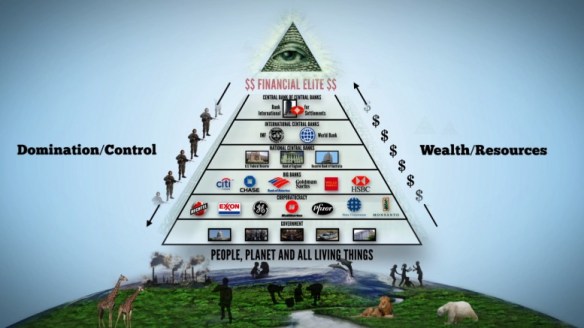
FollowTheMoney-Bank-Pyramid

By Robert De Filippis

(OpEdNews.com)

While most of us have been taking our kids to Little League games, betting on the Super Bowl, taking an occasional vacation and waiting for the American Dream to become a reality, we haven’t noticed something important happening all around us. Society has been crumbling at the edges for the last several decades.

This is not to say that lots of human beings haven’t already experienced the early stages of this societal disintegration. But they tend to be the people at the margins. People without a voice. People whose interests are not understood, let alone represented in the great debates of our times.

Think of the Mideast. Think ISIS here. Think of terrorism. Terrorists don’t attack us because of our freedoms. They attack out of desperation. Out of a frustration that comes with no future, and a feeling of impotence in the face of the continued economic violence committed in the name of corporate profits and greed. Corporations protected by the most powerful military in the history of the world. Ours!

Is it any mystery why we have over six hundred military installations in other countries around the world? We’re not under threat from anyone, but our corporation’s interests in those countries must be protected while they rape them of their labor and natural resources.

History is written by the victors and the popular public narratives are circumscribed by those whose interests they serve and not those who suffer. At the core of this phenomenon is complicity. A subconscious complicity made up of an ultra-resistant trifecta of human thinking — greed, ignorance, and certainty.

Greed now normalized has made the great American dream indistinguishable from having basic financial security to making everyone a billionaire-in-waiting. An inability to distinguish fact from opinion leads the wave of ignorance that engulfs us. Our arrogance disguised as fervent patriotism defends our ignorance and allows us to reject the knowledge we need to save ourselves.

Our generalized confusion of what constitutes a fact allows an individual’s certainty to form a resistance similar to the bacterial infections that threaten to make modern antibiotics useless. It continues to evolve. “If I can’t figure out who’s lying, I’ll believe the one who confirms my point of view. Of that I’m certain.”

Until we learn that having our beliefs validated by a media being paid to manipulate us for political gain, society will continue to disintegrate for larger and larger groups of people.

Seems like a stretch, I know. But think about how we’ve become polarized. How we are so sure of our positions that we just can’t have a conversation with those from the other side. The very conversation we need to have to figure out how we’re being duped. Then think about how our politicians use the greed, ignorance and certainty on both sides to work us up into an emotional lather. And finally, how they ignore our interests while they do the bidding of their owners keeping us distracted with our petty differences with each other.

This will come to an end. There will either be a major social revolution at the least or outright raw violence at the worst. As the authority structures lose the willing conformance of the masses, all that’s left to police them is force. And at some point – like is beginning now — the response will be violence in return. Think of the proliferation of guns in America. Think of people shooting police.

It doesn’t take much discernment to see that corporate structures are highly sophisticated mechanisms for funneling money upwards. That government collusion protects the interests of the owners of capital at the expense of the employees, customers, the general public. And the military protects their international interests.

The largest wealth producer in the world is the financial industry that simply makes money from money and produces nothing. It serves no interests but its own. Yes, some of us fortunate to have salvaged what’s left of our life savings after repeated financial crashes still enjoy the crumbs from the tables of the elite. I do mean crumbs.

Do the math. At the current rate of the upward movement of wealth, there is no other outcome but final disaster. The top 1/10th of 1 percent — not 1 percent — but 1/10th of 1 percent in America owns almost as much wealth as the bottom 90 percent in America, and it gets worse as you leave our shores.

At this rate, the world will eventually consist of gated enclaves of the mega-wealthy guarded by elite corps of paid mercenaries surrounded by billions of impoverished people.

This trajectory has increased dramatically for the last several decades. More and more of the world’s wealth is pouring into the coffers of the mega-rich. This is a zero sum game. When the masses have no wealth left, the game will be over. No matter how powerful the wealthy are, no matter how much wealth they possess, the game will be over.

Thanksgiving. A National Day Of Mourning.

By Mr. Militant Negro

Source: The Militant Negro

screenshot-318

This Thanksgiving, join me in celebrating but not in the traditional way you’re used to celebrating. In the video below, I suggest 2 ways of celebrating with The Standing Rock Sioux Nation, The Water Protectors and The Oceti Sakowin to show unity and solidarity.

Thanksgiving: A National Day Of Mourning.

Published on Nov 20, 2016


Unarmed #NoDAPL water protectors are currently being attacked by militarized police in North Dakota. They’re being sprayed with water in sub-freezing temperatures, hit with rubber bullets, and maced.

You can express outrage and demand cessation by calling any and all of the numbers below:

  • White House Situation Room – 202-456-9431
    • I was told they’re “monitoring the situation.” I asked that the White House actually intervene on behalf of water protectors.
  • Morton County Sherriff Department – 701-328-8118
    • I left a voicemail saying I’d encourage no one to ever visit North Dakota ever again if they keep attacking unarmed citizens.
  • Governor Dalrymple – 701-328-8118
    • Voicemail full; I was unable to leave a message
  • North Dakota National Guard – 701-333-2000
    • No answer outside of business hours
  • Army Corps of Engineers – 202-761-8700
    • I left a voicemail asking that they please take any and every action to ensure (1) no further harm to water protectors and (2) DAPL stop efforts to drill, for benefit of this land and all its people.

Please call. Please protest the abuse of people and earth for profit.

Your voice can make a difference.

Follow #NoDAPL on Twitter for up-to-the-minute information

https://twitter.com/MrNegroMilitant/status/800608499231236096

Standing Rock 11/20 LIVE Bridge Protest by Kevin Gilbertt Part VI #NoDAPL

From The Raw Story:

Broken treaties, cultural genocide and murder: Here are 5 ways the US has ‘given thanks’ to Native Americans

By 

The urban legend about Thanksgiving is that the Native Americans helped save the Pilgrims who had a rough start to their settlements. Once they had a bountiful harvest they invited their Native neighbors over for a nice dinner party to give thanks to them and to God. That story has been soundly refuted by actual accounts of the day, but for reasons passing in understanding, we still celebrate the holiday as we perceive it went down.

After that, however, the friendly relationship between Natives and white settlers was over, and what followed was 300 years of some of the most heartbreaking and disgraceful actions the United States has ever committed.

While there are hundreds, here are 5 huge ones:

1. Stolen Land

pipe

From the day we landed in 1492 until even today, Native Americans are still fighting over land rights.

A Proclamation was signed by King George III of England in 1763, prohibiting any English settlers from pushing further west than the Appalachian Mountains and anyone already there would be required to move back east. Even across the ocean the King knew there were tensions between Natives and settlers. Unfortunately, the King had no real way of enforcing it and 13 years later the Colonies filed the Declaration of Independence and the war with England was on.

One of the worst and most disgusting things happened in the 1829 decision by the Supreme Court in Johnson v. M’Intosh. The court ruled that the U.S. Government could sell Native American land to non-Native people out from under the tribes. Believe it or not, they were actually trying to.

The decision began a set of rulings under the Marshall Court that outlined what is now referred to as the “Doctrine of Discovery.” It’s basically a set of western laws that “allowed” the legal framework to take land from aboriginals living on it because it was “discovered” by a European Christian monarchs. The logical conclusion that you can’t discover something if someone already lives there was basically thrown out thanks to the Marshall Court.

Who knows why they even bothered with the paperwork, it isn’t like they were going to be stopped anyway.

2. Andrew Jackson

1b-002-ss-07-egander_lg

“This emigration should be voluntary, for it would be as cruel as unjust to compel the aborigines to abandon the graves of their fathers and seek a home in a distant land. But they should be distinctly informed that if they remain within the limits of the States they must be subject to their laws…” – President Andrew Jackson, State of the Union 1829

There were plenty of presidents that did horrific things to Native Americans, but for the most part Washington and Jefferson honored the idea of Native sovereignty. President Andrew Jackson did not.

On May 26, 1830 Congress passed the Indian Removal Act which gave the power to the President to “negotiate” the removal of all Native Americans and force them West of the Mississippi River. Jackson signed it into law and the farce of “negotiations” began.

In 1831, Georgia tried to pass a law that prevented Native Americans from being within the borders of their state. In 1833, Florida actually passed the same law. The Cherokees took Georgia to court and demanded an injunction to prevent the forced removal of the tribe from the state. In Cherokee v. Georgia The Supreme Court ruled that the tribal lands were not sovereign and were essentially a ward of the federal government.

But one year later in Worcester v. Georgia, a missionary working on Cherokee lands was arrested. He sued the State of Georgia claiming that the state had no legal authority on Native soil, that they were sovereign lands. The Supreme Court ruled that the tribes were sovereign and that Georgia had no legal authority.

You would have thought that the 1832 legal battle would have been the major way that the tribes were saved from governments violating laws and treaties left and right, but no. Jackson proposed to the Cherokees Tribe that they move to Oklahoma (then called Indian Territory). The Cherokee said no.

Jackson didn’t care. Between 1830 and 1850 he ordered the forced removal of the Cherokee, Chickasaw, Choctaw, Muskogee, Creek and Seminole people. It was called the Trail of Tears because so many people suffered from death, disease, starvation, exposure and more than 10,000 died on the way.

3. Re-Education and Cultural Genocide

Natives were considered savages when they fought back against the government attempting to steal their land, kill their people and force them to move. Those that were marched to what is now Oklahoma were considered the “5 Civilized Tribes” because they didn’t fight back the way many others did. They agreed to assimilate into some white culture for fear of being killed by the government.

But the U.S. government took it a step further when they started opening up boarding schools where Native children were sent and taught how to be Christian, relinquish their heritage, forget their traditions and act more “white.”

Richard Pratt was an Army Officer when he began building the schools that would teach Native children. He said he developed the idea while in “an Indian prison.” His philosophy, he described, was simple “Kill the Indian … Save the Man.” By killing the Native American traditions and upbringing in children, they hoped to begin ridding the country of what they considered to be the “savage” behavior.

Many of these children encountered what can only be described as abuse. They were beaten and put in isolation until they’d submit to the ways of white people.

4. Broken Treaties

Over 500 treaties were made with Native American tribes over the last several hundred years and over 370 of which had to do with land. All were broken or changed.

As CJ says in the video “How do you keep fighting these smaller injustices when they’re all from the mother of injustices?”

5. Murder

USA Committed Genocide Against Native Americans

Published on May 5, 2012

MICHAEL MOORE: It’s not envy, it’s war, and it is a class war, and it’s a war that has been perpetrated by the rich on to everybody else. I mean, the class war is one they started. The mistake they’ve made, just to deal with the racial part of this, is their boot has been on the necks of people of color since we began. This is a nation founded on genocide and built, built on the backs of slaves. Alright?
So, so we started with a racial problem. We went, we tried to actually eliminate one entire race, and then we used another race to build this country actually quite quickly as a new country into a world power. This country never would have had the wealth that it had had it not had slavery for a couple of hundred years. If it had had, if it had had to pay people, if it actually had to pay people to build America, you know, we might just be at that point in Utah where we’re joining the two rails together maybe at this point right now.

From the moment that Columbus “discovered” a place that already existed, Native Americans began to die. Whether from “Old World” diseases like small pox and measles, battles with government soldiers or outright murder, the population declined by 96 percent.

American historian David Stannard argued in his book American Holocaust that the annihilation of the Native Americans from 76 million on both American continents to just a quarter-million “in a string of genocide campaigns,” that killed “countless tens of millions” was by far the largest genocide in world history.

Sir Jeffrey Amherst, commander-in-chief of British forces in North America, wrote to Colonel Henry Bouquet at Fort Pitt:

“You will do well to try to inoculate the Indians [with smallpox] by means of blankets, as well as to try every other method, that can serve to extirpate this execrable race.”

The intentional use of “germ warfare” to “extirpate this execrable race” is nothing more than brutal, hateful and horrific mass murder. Our country should be ashamed.

Even hundreds of years later, tribes are still fighting many of these same battles. Just last month, the federal government raided a Native American university that was growing a legal hemp crop as part of a pilot project under the Farm Bill.

The Lakota Tribe has been particularly hard hit. They have been fighting to preserve their land against the threat of the Keystone XL pipeline which the tribe argues would have caused an increase in the number of health and safety problems.

They’ve also had run-ins with local law enforcement and liquor stores that locate just outside dry tribal lands. At the same time their children have experienced appalling and cruel racism and outright assault from fellow South Dakota residents.

What we owe the Native Americans is a more complicated question, but for sure it begins with a greater respect and extends well beyond the limited reparations we’ve given them over the years. Perhaps it begins with the reclaiming of holidays like Columbus Day and Thanksgiving which have done nothing but perpetuate stereotypes and gloss over the history of violence and broken promises.

Happy Native American Heritage Month!

Thank you  The Raw Story & 

picture-31

American Indian Activist Russell Means Powerful Speech, 1989

Published on Oct 22, 2013

Legendary Russell Means harshly criticizes the Bureau of Indian Affairs and Indian leadership of reservations. One of a kind, RIP November 10, 1939 — October 22, 2012

Russell was an Oglala Sioux activist for the rights of American Indian people. He became a prominent member of the American Indian Movement (AIM) after joining the organization in 1968, and helped organize notable events that attracted national and international media coverage.

Russell Means has lived a life like few others in this century — revered for his selfless accomplishments and remarkable bravery. He was born into a society and guided by a way of life that gently denies the self in order to promote the survival and betterment of family and community. His culture is driven by tradition, which at once links the past to the present.

Russell Means was once called the “biggest, baddest, meanest, angriest, most famous American Indian activist of the late 20th century.”

He led a 71-day armed standoff in 1973 against federal agents at Wounded Knee, a tiny hamlet in the heart of South Dakota’s Pine Ridge Reservation.

It is considered to be one of his most famous act of defiance, however, occurred at Wounded Knee on February 27, 1973. Responding to the numerous murders perpetrated by puppet tribal governments and the extreme conditions of oppression, the takeover at Wounded Knee revisited the sight of the American Indian massacre at the hands of U.S. soldiers in 1890.

Ever vigilant for his cause, Russell has been lauded by the international community for his tireless efforts.

Later, he used film as a vehicle for his advocacy, thus enabling him to use different means to communicate his vital truths. Through the power of media, his vision was to create peaceful and positive images celebrating the magic and mystery of his American Indian heritage.

In contemplating the fundamental issues about the world in which we live, he was committed to educating all people about our most crucial battle-the preservation on the earth.

Means joined “The Longest Walk” in 1978 to protest a new tide of anti-Indian legislation including the forced sterilization of Indian women. Following the walk, the U.S. House of Representatives passed a resolution saying that national policy was to protect the rights of Indians, “to believe, express and exercise their traditional religions, including but not limited to access to sites, use and possession of sacred objects, and the freedom to worship through ceremonials and traditional rites.”

Russell Means has been called the most famous American Indian since Sitting Bull and Crazy Horse by the Los Angeles Times and recognized as a natural leader with a fearless dedication and indestructible sense of pride.

He took pride in having instituted programs for the betterment of his people: notable, the Porcupine Health Clinic (the only non government funded clinic in Indian Country) and KILI radio, the first Indian owned radio station.

Today, one of his principle goals has been the establishment of a “Total Immersion School”, which is based on a concept created by the Maori people of New Zealand, where children are immersed in the language, culture, science, music and storytelling of their own people.

Russell wanted to adapt this total immersion concept to the Indian way of life and philosophy which is taught from a perspective that will nurture a new generation of proud children educated in the context of their own heritage.

Russell Means has devoted his life to eliminating racism of any kind, and in so doing he leaves a historical imprint as the most revolutionary Indian leader of the late twentieth century.

Russell’s commitment to uplift the plight of his people escalated when he served as director of Cleveland’s American Indian Center.

It was there he met Dennis Banks, co-founder of the American Indian Movement, and embarked upon a relationship that would rocket them both into national prominence.

“If I want my people to be free, Americans have to be free.” –Russell Means

‘America is a stolen country’

Published on Jan 2, 2015

Alcoholism, unemployment and suicide are problems associated with Native American reservations in the US. But a new generation of young activists are dedicating themselves to a brighter future. Benjamin Zand from the BBC’s Pop-Up team is on a reservation in South Dakota — in the heart of America’s midwest.

images amerikanska_folk american_holocaust_poster-p228161433202423678t5ta_400 5206879923_663d69d836 45fba1f5937b9e9d6c3d7a1105f0dfc6

Right now, here today, our Native American brothers & sisters are being persecuted for being who they are.

The Standing Rock Sioux And The Water Protectors

Published on Nov 20, 2016

The treatment of the Native American Tribes who are standing united to protect THEIR Tribal lands, THEIR drinking water supply AND THEIR sacred burial grounds, are unacceptable, disgusting, disappointing and inhumane.

For A History of Native Americans Protesting the Dakota Access Pipeline & A Timeline, visit….
http://www.motherjones.com/environmen…

It’s time we stand united with The Native American Tribal Nations. It’s time we stop celebrating Thanksgiving, a racists holiday that actually celebrates the massacre and genocide of 100 MILLION indigenous people.

https://twitter.com/MrNegroMilitant/status/799835277988610048

People Of Color all over The United States Of America should unite and stop celebrating a holiday that glorifies the massacre of human life.

Water Protectors. Black Friday. Charity. Kindness. Focus. Action.

Published on Nov 21, 2016

Welcome to My Monday morning rants, raves & concerns. This voice video contains My thoughts on a plethora of issues, all current events and subjects we SHOULD ALL be pondering.

This is a link to The Jedi Youtube Channel:
https://www.youtube.com/channel/UCBC3…

This is a link to the explanation where “Black Friday” comes from and what it means:
https://www.youtube.com/watch?v=N4O5_…

Stand In Solidarity With The Standing Rock Sioux, The Water Protectors and The Oceti Sakowin.

image3-1 themilitantblogheader

Depicting Perpetual Crimes committed by Corporate Culture and its Mainstream Media

index-1-229x300

Russian Novels Combating Global Capitalist Nightmare

By Andre Vltchek

Source: Dissident Voice

Imagine Moscow being taken over by some international corporate cartel. By a monster which has its own factories and office buildings, security services, private prisons, re-education (‘training’) centers, and its obedient mass media outlets. Imagine that it also has detailed databases on almost everyone who really matters in the capital.

Imagine that human lives suddenly don’t matter. People are only expected to produce and consume; they become fully disposable.

Imagine that the once greatly educated Russia with its legendary artists and philosophers is gradually getting reduced to an unimaginably primitive level. Suddenly, there is US pop trash flying about everywhere, and the greatest entertainment for the masses comes from watching countless television ‘reality shows’, including those that graphically depict, candidly, how both men and women are shitting and pissing in the capital’s public toilets.

That’s what you get when reading a witty, provocative and thoroughly outrageous novel by Sergei Minaev, called R.A.B.; 521 pages of it!

In all his novels, including Soulless, The Telki, Media Sapiens and R.A.B., Minaev masterfully depicts the perpetual crimes committed by corporate culture and its mainstream media. Brutally and candidly he describes an apocalyptic society constructed on the soulless, merciless and murderous principles of the modern Western-style capitalist system.

In such a world, nothing is sacred anymore. The ‘elites’ are having great fun hunting on the outskirts of the city, not for some animals, but for homeless people living in abandoned pipelines (R.A.B.). A US mainstream television news channel, together with its local counterpart, manage to trigger a military conflict between Georgia and Russia, after hiring several combat helicopters and retired soldiers, killing real people, just in order to increase their ratings. And several terrorist attacks in Moscow are being paid for and staged by other big media conglomerates (Media Sapiens).

Minaev is not crying; he is definitely far from being a ‘bleeding heart’. He is tough and cynical. His characters are mostly ruthless super-yuppies from Moscow, go-getters, living a fast life, taking drugs, partying in luxury clubs, having sex literally with everything that moves (Soulless).

But they get burned, destroyed, brought to near suicide.

They have no ideology, no political views. They laugh at, they insult everything and everybody, but deep inside they are actually suffering from a horrible void, from emptiness. In those rare moments of honesty, they admit to each other and to themselves, that they are actually still longing for at least ‘something pure and decent’, uncorrupted by the global market-fundamentalist regime and its ‘values’ and ‘culture’.

*****

In R.A.B. Minaev goes much further. His yuppies (paradoxically, the mid and upper-level managers) start a rebellion against the system. They go on strike, march through the streets, and build barricades. They begin demanding social justice. They burn down their own offices.

They do it after their Russian toy-producing company (and other companies all over the city) gets swallowed by a US-based multi-national corporation, which immediately begins dismantling all social benefits, while injecting uncertainty and fear into the workplace. A multi-national also opens a horrid toy factory on the outskirts of Moscow, which then employs desperate immigrants from the Central Asian republics.

The privately-owned mass media outlets first confront the protesters, and then follow up with pro-corporate propaganda and in the end the corporate security services and the army. Many people disappear. Others are locked up in the offices and secret prisons of the corporations, and tortured. Those who survive become ‘unemployable’, their names permanently on the blacklist.

But what does Minaev really call for? Is it a true revolution?

Yes and no. He does not believe that in the countries that have been conquered by market fundamentalism and by unbridled consumerism, a ‘real revolution’ is possible. He does not think that the people there have any ideals or any zeal left. At the same time, at least some of his characters are clearly unwilling to surrender.

It is chilling to read R.A.B. while at the same time those ‘rebellions’ in Greece, France, Spain and the U.K. are taking place.

One of the main characters of R.A.B. confronts the demonstrators: It is not a revolution! You are all parts of the system. You just want a better deal for yourself. Through this rebellion, you are actually negotiating with the cartel of the corporations. If you get what you are asking for, you’ll happily remain where you are and carry on as if nothing happened.

*****

Then Minaev does exactly what no Western writer would dare to do. He begins to argue that to destroy the system, there has to be an armed struggle. Otherwise no real change could ever be achieved.

The suppressed rebellion of the yuppies eventually triggers much a wider movement, and soon there are real battles raging in several provincial capitals.

The end of the novel is open. The main character of R.A.B. is destroyed. He loses the love of his life (in desperation she commits suicide); he has no job, no money and no place to go. But he is still alive. Russia is still alive. It is obvious that no matter what, it will never accept this monstrous system that was forced on it by the West.

*****

It all may sound like an insane fantasy, but. in fact, what Minaev writes about is not too far from the nightmares that Russia was descending into right after Gorbachev allowed the country (USSR) to fall apart, and then Yeltsin introduced unbridled privatization and gave unprecedented concessions to foreign corporations. During that period, Russia went through something that could be easily described as a social genocide. Life expectancy dropped to the levels of war-torn countries in Africa. Lawlessness ruled. All ideals were ridiculed and spat at. A big number of Russian intellectuals were bought and organized by the West into countless NGO’s. The lowest grade of Western pop and entertainment torpedoed Russian culture. During those dark days, the West finally succeeded in bringing Russia to its knees.

Not even two decades later, a new Russia is once again proud, strong and confident.

It rose to its feet, it began successfully producing again, and it underwent a tremendous and positive social transformation.

Just one week ago I returned from the Russian Far East, from the cities of Vladivostok, Khabarovsk and Petropavlovsk Kamchatski. Wherever I went, I witnessed new and impressive infrastructure. I encountered a confident, hard working nation, which was working hard to restore at least some of the socialist structures and benefits that it used to enjoy in the past.

The new, present-day Russia is much closer to China; much more impressed by the Chinese system, than by what it was forced to adopt in the past; during the “pro-Western era” which is now generally considered to be synonymous to a national disaster.

Russian writers played an important role in describing the horrors of the Gorbachev/Yeltsin years, and of the brutal global economic, political and ‘cultural’ regime injected by the West to all the corners of the Planet. From an outrageous Eduard Limonov’s novel It’s Me, Eddie to Minaev’s R.A.B., Russian literature has been daring, insulting, direct and brutally honest.

While Limonov and Minaev sell millions of copies of their books at home, their work is virtually unknown in the West. I found no English translations when searching on Amazon.com, and elsewhere.

In his New York-based Eddie, Limonov is calling openly for terrorist acts against the Western regime, while some of Minaev’s characters also believe in an armed struggle, although of a more conventional type.

Nothing is spared. When the US toy-producing corporation demands a special tax from its employees in Russia, for “helping out those poor children in the Third World”, the main character of R.A.B. thinks: “well, they can now use that money to buy coffins for children they employ and kill in Indonesia or Thailand”. When the tax goes slightly up, he comments: “now they will have enough funds to dig at least a few mass graves”.

All this is simply too outrageous for Western readers. Or more precisely, the ‘book business’ most likely ‘thinks’ that it is.

The fact remains that despite what is constantly repeated by Western propaganda, those who read Russian can clearly see and appreciate that Russian literature is actually much more free, daring and rebellious than its counterpart in the West.

When several Russian bestselling novelists are calling openly for combat against the global regime (the same regime which is, until now, at least partially, controlling the economy of their country), one has no choice but to be impressed by the level of freedom in the country which allows such work to be published and then promoted.

But in the West, you would never know all this, unless you spoke Russian. It is because in the West (and in its ‘client’ states and colonies) you are being extremely well ‘protected’ from such uncomfortable (and the regime would even say ‘dangerous’) thoughts!


André Vltchek is a novelist, filmmaker, and investigative journalist. He has covered wars and conflicts in dozens of countries. His latest book is Exposing Lies of the Empire.