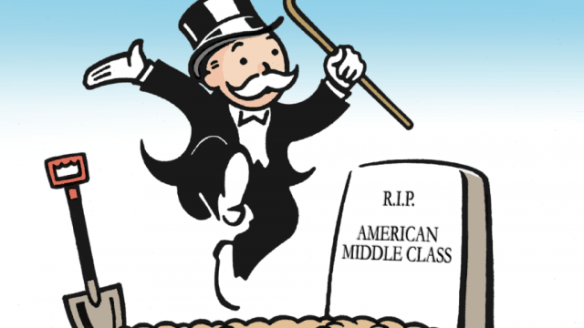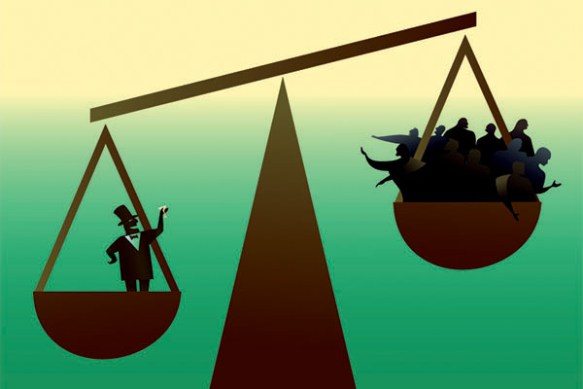
Why Are American Communities Dying?

By Tom Chatham

Source: Project Chesapeake

Most Americans who have been around for a while know life is nothing like it used to be. When someone wanted a job one was found with a little bit of searching. Today jobs are difficult to find, especially in small communities.

When I was growing up in the 70’s, there were several car dealers in my community. There were three tractor dealers and too many mom and pop stores to count. Today there are two used car dealers and the nearest tractor dealer is twenty miles away. So how is it that we now have more people, but fewer businesses to employ them?

A nations wealth is derived from having a product to sell. That wealth needs to circulate in towns and cities to compound the wealth effect and create jobs and businesses. When wealth is not created or it is siphoned off to other places, the wealth effect can not happen, and in many cases goes into reverse. A community needs a certain amount of service related jobs to function but it also needs some type of production jobs to bring in money from the outside. This can be mining , agriculture or manufacturing type jobs, but they must exist to insure a healthy economy.

America has two major problems today. A large amount of our production is done outside the country eliminating production jobs in local communities and many of the small local businesses that kept wealth within communities have been supplanted by large corporations that siphon wealth out of communities and send it to wall street.

In the past when a small business made profit, that profit was kept in the local community because that is where the owner lived. Now, that profit leaves the community never to be seen again. With less money to circulate within the community the businesses that depend on people spending their extra dollars, have fewer customers and eventually go out of business. With fewer jobs there is that much less money circulating and the economic situation spirals down until nothing is left.

These days corporate businesses and government jobs make up the major part of many local communities. In many cases if it were not for the government jobs, many communities would no longer exist. So what do you think would happen if the government suddenly no longer had money to pay those workers? What would happen if corporate profits dropped to the point where corporate stores decided to close and cut their losses?

To some extent we are seeing this happen now in many places. Corporate stores moved in and drove small local businesses out. Then when the profits dried up the corporate stores closed leaving the community with no jobs or products to buy. With no capital in the local communities to rebuild small businesses, the people simply drive to other areas to do their shopping.

The corporate cronies and government laggards control most of the money flowing through communities now and they want to keep it that way. Any attempt to rebuild local businesses is met with luke warm results. Any business that might make a difference is either killed outright or regulated into oblivion before it can get off the ground. The county where I live has all but abandoned local businesses. The bulk of their income comes from property taxes generated by vacation homes and retirement homes of retired government employees. As long as the government pensions and paychecks continue, they see no reason to change the status quo. The result is that the younger people leave as soon as they can and the average age of the population continues to get older. As with many places today, this area has no future.

Where I live is a microcosm of the nation. Corporate and government entities continue to siphon what little money there is out of communities and just as small communities are dying, the nation will soon follow if current trends do not change. A return to small local economics is the only way to reverse some of the damage and keep our communities livable. But, do not be deceived. There is no way to undo all of the damage that has been done and even if we survive, we will only be a shadow of what we once were as a nation.

Survival of the Richest

All Are Equal, Except Those Who Aren’t

By Nomi Prins

Source: TomDispatch.com

Like a gilded coating that makes the dullest things glitter, today’s thin veneer of political populism covers a grotesque underbelly of growing inequality that’s hiding in plain sight. And this phenomenon of ever more concentrated wealth and power has both Newtonian and Darwinian components to it.

In terms of Newton’s first law of motion: those in power will remain in power unless acted upon by an external force. Those who are wealthy will only gain in wealth as long as nothing deflects them from their present course. As for Darwin, in the world of financial evolution, those with wealth or power will do what’s in their best interest to protect that wealth, even if it’s in no one else’s interest at all.

In George Orwell’s iconic 1945 novel, Animal Farm, the pigs who gain control in a rebellion against a human farmer eventually impose a dictatorship on the other animals on the basis of a single commandment: “All animals are equal, but some animals are more equal than others.” In terms of the American republic, the modern equivalent would be: “All citizens are equal, but the wealthy are so much more equal than anyone else (and plan to remain that way).”

Certainly, inequality is the economic great wall between those with power and those without it.

As the animals of Orwell’s farm grew ever less equal, so in the present moment in a country that still claims equal opportunity for its citizens, one in which three Americans now have as much wealth as the bottom half of society (160 million people), you could certainly say that we live in an increasingly Orwellian society. Or perhaps an increasingly Twainian one.

After all, Mark Twain and Charles Dudley Warner wrote a classic 1873 novel that put an unforgettable label on their moment and could do the same for ours. The Gilded Age: A Tale of Today depicted the greed and political corruption of post-Civil War America. Its title caught the spirit of what proved to be a long moment when the uber-rich came to dominate Washington and the rest of America. It was a period saturated with robber barons, professional grifters, and incomprehensibly wealthy banking magnates. (Anything sound familiar?) The main difference between that last century’s gilded moment and this one was that those robber barons built tangible things like railroads. Today’s equivalent crew of the mega-wealthy build remarkably intangible things like tech and electronic platforms, while a grifter of a president opts for the only new infrastructure in sight, a great wall to nowhere.

In Twain’s epoch, the U.S. was emerging from the Civil War. Opportunists were rising from the ashes of the nation’s battered soul. Land speculation, government lobbying, and shady deals soon converged to create an unequal society of the first order (at least until now). Soon after their novel came out, a series of recessions ravaged the country, followed by a 1907 financial panic in New York City caused by a speculator-led copper-market scam.

From the late 1890s on, the most powerful banker on the planet, J.P. Morgan, was called upon multiple times to bail out a country on the economic edge. In 1907, Treasury Secretary George Cortelyou provided him with $25 million in bailout money at the request of President Theodore Roosevelt to stabilize Wall Street and calm frantic citizens trying to withdraw their deposits from banks around the country. And this Morgan did — by helping his friends and their companies, while skimming money off the top himself. As for the most troubled banks holding the savings of ordinary people? Well, they folded. (Shades of the 2007-2008 meltdown and bailout anyone?)

The leading bankers who had received that bounty from the government went on to cause the Crash of 1929. Not surprisingly, much speculation and fraud preceded it. In those years, the novelist F. Scott Fitzgerald caught the era’s spirit of grotesque inequality in The Great Gatsby when one of his characters comments: “Let me tell you about the very rich. They are different from you and me.” The same could certainly be said of today when it comes to the gaping maw between the have-nots and have-a-lots.

Income vs. Wealth

To fully grasp the nature of inequality in our twenty-first-century gilded age, it’s important to understand the difference between wealth and income and what kinds of inequality stem from each. Simply put, income is how much money you make in terms of paid work or any return on investments or assets (or other things you own that have the potential to change in value). Wealth is simply the gross accumulation of those very assets and any return or appreciation on them. The more wealth you have, the easier it is to have a higher annual income.

Let’s break that down. If you earn $31,000 a year, the median salary for an individual in the United States today, your income would be that amount minus associated taxes (including federal, state, social security, and Medicare ones). On average, that means you would be left with about $26,000 before other expenses kicked in.

If your wealth is $1,000,000, however, and you put that into a savings account paying 2.25% interest, you could receive about $22,500 and, after taxes, be left with about $19,000, for doing nothing whatsoever.

To put all this in perspective, the top 1% of Americans now take home, on average, more than 40 times the incomes of the bottom 90%. And if you head for the top 0.1%, those figures only radically worsen. That tiny crew takes home more than 198 times the income of the bottom 90% percent. They also possess as much wealth as the nation’s bottom 90%. “Wealth,” as Adam Smith so classically noted almost two-and-a-half-centuries ago in The Wealth of Nations, “is power,” an adage that seldom, sadly, seems outdated.

A Case Study: Wealth, Inequality, and the Federal Reserve

Obviously, if you inherit wealth in this country, you’re instantly ahead of the game. In America, a third to nearly a half of all wealth is inherited rather than self-made. According to a New York Times investigation, for instance, President Donald Trump, from birth, received an estimated $413 million (in today’s dollars, that is) from his dear old dad and another $140 million (in today’s dollars) in loans. Not a bad way for a “businessman” to begin building the empire (of bankruptcies) that became the platform for a presidential campaign that oozed into actually running the country. Trump did it, in other words, the old-fashioned way — through inheritance.

In his megalomaniacal zeal to declare a national emergency at the southern border, that gilded millionaire-turned-billionaire-turned-president provides but one of many examples of a long record of abusing power. Unfortunately, in this country, few people consider record inequality (which is still growing) as another kind of abuse of power, another kind of great wall, in this case keeping not Central Americans but most U.S. citizens out.

The Federal Reserve, the country’s central bank that dictates the cost of money and that sustained Wall Street in the wake of the financial crisis of 2007-2008 (and since), has finally pointed out that such extreme levels of inequality are bad news for the rest of the country. As Fed Chairman Jerome Powell said at a town hall in Washington in early February, “We want prosperity to be widely shared. We need policies to make that happen.” Sadly, the Fed has largely contributed to increasing the systemic inequality now engrained in the financial and, by extension, political system. In a recent research paper, the Fed did, at least, underscore the consequences of inequality to the economy, showing that “income inequality can generate low aggregate demand, deflation pressure, excessive credit growth, and financial instability.”

In the wake of the global economic meltdown, however, the Fed took it upon itself to reduce the cost of money for big banks by chopping interest rates to zero (before eventually raising them to 2.5%) and buying $4.5 trillion in Treasury and mortgage bonds to lower it further. All this so that banks could ostensibly lend money more easily to Main Street and stimulate the economy. As Senator Bernie Sanders noted though, “The Federal Reserve provided more than $16 trillion in total financial assistance to some of the largest financial institutions and corporations in the United States and throughout the world… a clear case of socialism for the rich and rugged, you’re-on-your-own individualism for everyone else.”

The economy has been treading water ever since (especially compared to the stock market). Annual gross domestic product growth has not surpassed 3%in any year since the financial crisis, even as the level of the stock market tripled, grotesquely increasing the country’s inequality gap. None of this should have been surprising, since much of the excess money went straight to big banks, rich investors, and speculators.  They then used it to invest in the stock and bond markets, but not in things that would matter to all the Americans outside that great wall of wealth.

The question is: Why are inequality and a flawed economic system mutually reinforcing? As a starting point, those able to invest in a stock market buoyed by the Fed’s policies only increased their wealth exponentially. In contrast, those relying on the economy to sustain them via wages and other income got shafted. Most people aren’t, of course, invested in the stock market, or really in anything. They can’t afford to be. It’s important to remember that nearly 80% of the population lives paycheck to paycheck.

The net result: an acute post-financial-crisis increase in wealth inequality — on top of the income inequality that was global but especially true in the United States. The crew in the top 1% that doesn’t rely on salaries to increase their wealth prospered fabulously. They, after all, now own more than half of all national wealth invested in stocks and mutual funds, so a soaring stock market disproportionately helps them. It’s also why the Federal Reserve subsidy policies to Wall Street banks have only added to the extreme wealth of those extreme few.

The Ramifications of Inequality

The list of negatives resulting from such inequality is long indeed. As a start, the only thing the majority of Americans possess a greater proportion of than that top 1% is a mountain of debt.

The bottom 90% are the lucky owners of about three-quarters of the country’s household debt. Mortgages, auto loans, student loans, and credit-card debt are cumulatively at a record-high $13.5 trillion.

And that’s just to start down a slippery slope. As Inequality.org reports, wealth and income inequality impact “everything from life expectancy to infant mortality and obesity.” High economic inequality and poor health, for instance, go hand and hand, or put another way, inequality compromises the overall health of the country. According to academic findings, income inequality is, in the most literal sense, making Americans sick. As one study put it, “Diseased and impoverished economic infrastructures [help] lead to diseased or impoverished or unbalanced bodies or minds.”

Then there’s Social Security, established in 1935 as a federal supplement for those in need who have also paid into the system through a tax on their wages. Today, all workers contribute 6.2% of their annual earnings and employers pay the other 6.2% (up to a cap of $132,900) into the Social Security system. Those making far more than that, specifically millionaires and billionaires, don’t have to pay a dime more on a proportional basis. In practice, that means about 94% of American workers and their employers paid the full 12.4% of their annual earnings toward Social Security, while the other 6% paid an often significantly smaller fraction of their earnings.

According to his own claims about his 2016 income, for instance, President Trump “contributed a mere 0.002 percent of his income to Social Security in 2016.” That means it would take nearly 22,000 additional workers earning the median U.S. salary to make up for what he doesn’t have to pay. And the greater the income inequality in this country, the more money those who make less have to put into the Social Security system on a proportional basis. In recent years, a staggering $1.4 trillion could have gone into that system, if there were no arbitrary payroll cap favoring the wealthy.

Inequality: A Dilemma With Global Implications

America is great at minting millionaires. It has the highest concentration of them, globally speaking, at 41%. (Another 24% of that millionaires’ club can be found in Europe.) And the top 1% of U.S. citizens earn 40 times the national average and own about 38.6% of the country’s total wealth. The highest figure in any other developed country is “only” 28%.

However, while the U.S. boasts of epic levels of inequality, it’s also a global trend. Consider this: the world’s richest 1% own 45% of total wealth on this planet. In contrast, 64% of the population (with an average of $10,000 in wealth to their name) holds less than 2%. And to widen the inequality picture a bit more, the world’s richest 10%, those having at least $100,000 in assets, own 84% of total global wealth.

The billionaires’ club is where it’s really at, though. According to Oxfam, the richest 42 billionaires have a combined wealth equal to that of the poorest 50% of humanity. Rest assured, however, that in this gilded century there’s inequality even among billionaires. After all, the 10 richest among them possess $745 billion in total global wealth. The next 10 down the list possess a mere $451.5 billion, and why even bother tallying the next 10 when you get the picture?

Oxfam also recently reported that “the number of billionaires has almost doubled, with a new billionaire created every two days between 2017 and 2018. They have now more wealth than ever before while almost half of humanity have barely escaped extreme poverty, living on less than $5.50 a day.”

How Does It End?

In sum, the rich are only getting richer and it’s happening at a historic rate. Worse yet, over the past decade, there was an extra perk for the truly wealthy. They could bulk up on assets that had been devalued due to the financial crisis, while so many of their peers on the other side of that great wall of wealth were economically decimated by the 2007-2008 meltdown and have yet to fully recover.

What we’ve seen ever since is how money just keeps flowing upward through banks and massive speculation, while the economic lives of those not at the top of the financial food chain have largely remained stagnant or worse. The result is, of course, sweeping inequality of a kind that, in much of the last century, might have seemed inconceivable.

Eventually, we will all have to face the black cloud this throws over the entire economy. Real people in the real world, those not at the top, have experienced a decade of ever greater instability, while the inequality gap of this beyond-gilded age is sure to shape a truly messy world ahead. In other words, this can’t end well.


Nomi Prins, a former Wall Street executive, is a TomDispatch regular. Her latest book is Collusion: How Central Bankers Rigged the World (Nation Books). She is also the author of All the Presidents’ Bankers: The Hidden Alliances That Drive American Power and five other books. Special thanks go to researcher Craig Wilson for his superb work on this piece.

The Erosion of the Middle Class — Why Americans Are Working Harder and Earning Less

By John Liberty

Source: The Mind Unleashed

“I don’t have to tell you things are bad. Everybody knows things are bad. It’s a depression. Everybody’s out of work or scared of losing their job. The dollar buys a nickel’s worth, banks are going bust, shopkeepers keep a gun under the counter. Punks are running wild in the street and there’s nobody anywhere who seems to know what to do, and there’s no end to it.” — Howard Beale

Howard Beale, the main character in the 1976 film Network, became a part of cinematic history when he uttered the line “I’m mad as hell and I’m not gonna take it anymore.” That one line expressed a growing rage among America’s shrinking middle class at a time when Americans were reeling from years of war, political scandals and economic downturn.

In the four decades that have followed, little has improved for the average American. We’re still ‘mad as hell’ and the middle class is being eroded right in front of our eyes. When adjusted for inflation, many Americans are working longer hours and earning less than they did in 1976. So, how have we gone from vibrant middle class to the working poor in a matter of decades?

Median Incomes Are Stagnant

Despite increases in the national income over the past fifty years, middle class families have experienced little income growth over the past few decades. According to U.S. Census datamiddle class incomes have grown by only 28 percent from 1979 – 2014. Meanwhile, a report from the Congressional Budget Office (CBO) shows that the top 20 percent of earners has seen their incomes rise by 95 percent over that same period of time.

Contributing to the stagnation of wages is a notable decrease in the workforce participation rate. According to the Brookings institute, “One reason for these declines in employment and labor force participation is that work is less rewarding. Wages for those at the bottom and middle of the skill and wage distribution have declined or stagnated.” Historical data from the Bureau of Labor Statistics backs up these findings, showing a steady decrease in workforce participation over the last two decades.

The Erosion of the Minimum Wage & America’s Purchasing Power

Anyone who has read a comment thread on the internet about minimum wage laws knows the debate is currently one of the most highly contentious political topics in America. In the halls of Congress, the debate has turned into a nearly decade long impasse. As a result, workers at the low end of the wage scale have watched the purchasing power of their wages decrease from $7.25 in 2009, to $6.19 in 2018 due to inflation. In 2018, you need to perform 47 hours of minimum wage work to achieve the same amount of purchasing power as 40 hours of work in 2009.

The inflation-adjusted minimum wage value has been in steady decline since 1968, when the $1.60 minimum wage was equal to $11.39 (in 2018 dollars). Since then, lawmakers have reduced minimum wage increases relative to the rate of inflation. As Christopher Ingraham reports:

“Recent research shows that the reason politicians — Democrats and Republicans alike — are dragging their feet on popular policies such as the minimum wage is that they pay a lot more attention to the needs and desires of deep-pocketed business groups than they do to regular voters. Those groups tend to oppose minimum wage increases for the simple reason that they eat into their profit margins.”

To be clear, the erosion of the purchasing power of everyday Americans is hardly a new phenomenon. According to data from the U.S. Bureau of Labor Statistics, the purchasing power of the U.S. Dollar has plummeted by over 95 percent since 1913, the year the Federal Reserve was created. The Bureau’s Consumer Price Index indicates that prices in 2018 are 2,436.33% higher than prices in 1913 and that the dollar has experienced an average inflation rate of 3.13% per year during this period.

The Rich Get Richer

While the outlook may be grim for low-wage workers, this is fantastic news for large corporations. Data from the U.S. Bureau of Economics shows that corporate profits are approaching all-time highs. But it’s not just workers who are feeling the effect of growing income inequality. The contrast is also being felt on Main Street. An analysis of the S & P 500 and the Russell 1,000 & 2,000 indexes by Bloomberg revealed a growing gap between America’s largest employers and smaller businesses.

A report from the Institute for Policy Studies entitled Billionaire Bonanza: The Forbes 400 and the Rest of Us echoed these findings when it revealed that America’s 20 wealthiest people — a group that could fit comfortably in one single Gulfstream G650 luxury jet –­ now own more wealth than the bottom half of the American population combined.

Although the Trump administration continues to tout stock market and labor force increases as signs of economic prosperity, numbers show that the wealthiest 10 percent of Americans own 84 percent of all stock. A study conducted by the Economic Policy Institute found that wage growth remains too weak to consider the economy at full employment and that stagnant wage growth has contributed to the growing level of income inequality in America. The study noted that while wages have recovered from the 2008 recession, the gap between those at the top and those at the middle and bottom has continued to increase since 2000. As the study’s author, Elise Gould writes:

“We’re looking at nominal wage growth that is still slower than you would expect in a full employment economy, slower than you would expect if you thought there were any sort of inflation pressures from wage growth.”

The Decimation of the American Dream

Comedian George Carlin once said, “The reason they call it the American Dream is because you have to be asleep to believe it.” For millions of middle class Americans Carlin’s statement has proven eerily accurate. Stagnant wages and decreased purchasing power has put the prospects for middle class children in a tailspin as upward mobility trends have reportedly fallen by over 40 percent since 1950.

A poll conducted by the Pew Research Institute corroborates this claim. According to Pew, only 37 percent of Americans believe that today’s children will grow up to be better off financially than their parents. That means more Americans think that today’s children will be financially worse off than their parents than those who believe they will be better off.

The sentiments expressed by millions of middle class Americans appear to be wholly justified due to the fact that middle class families are becoming more fragile and dependent on two incomes. A report from the Council of Economic Advisors found the majority of the income gains made by the middle class from 1979 to 2013 were a result of increased participation in the workplace by women. The report also noted the fragility of two income families amidst a decline in marriage and a drastic rise in single parent homes in recent years.

As a result of the slow growth in wages, over half of Americans now receive more in Government transfer payments (Medicare, Medicaid, food stamps, Social Security) than they pay in federal taxes. An analysis of all 50 states also found that in 42 states the cost of living is higher than the median income.

The rising cost of healthcare is also putting the pinch on the wallets of many Americans. As Jeffrey Pfeffer noted in his book Dying for a Paycheck, healthcare spending—per capita—has increased 29 fold over the past 40 years, outpacing the growth of the American economy.

While many Americans continue to look to the government to fix problems like wage stagnation, income inequality and rising healthcare costs, the sad truth is that we live in a time when 1 in 3 households has trouble paying energy bills and 40 percent of Americans face poverty in retirement at the exact same time the Federal Government has admitted that they lost $21 trillion. Not only did they lose $21 trillion (yes that’s TRILLION with a T), but the Department of Defense indicated in a press conference that they “never expected to pass” the audit to locate the missing taxpayer money.

John Emerich Edward Dalberg Acton famously proclaimed in 1887:

“Power tends to corrupt, and absolute power corrupts absolutely. Great men are almost always bad men.”

Perhaps it’s time for the millions of Americans who are quietly ‘mad as hell’ to start expressing their rage at the corrupt institutions of power that are decimating their livelihoods rather than expecting those very same institutions to fix the problems they created.


The Five Stages of Collapse, 2019 Update

By Dmitry Orlov

Source: Club Orlov

Collapse, at each stage, is a historical process that takes time to run its course as the system adapts to changing circumstances, compensates for its weaknesses and finds ways to continue functioning at some level. But what changes rather suddenly is faith or, to put it in more businesslike terms, sentiment. A large segment of the population or an entire political class within a country or the entire world can function based on a certain set of assumptions for much longer than the situation warrants but then over a very short period of time switch to a different set of assumptions. All that sustains the status quo beyond that point is institutional inertia. It imposes limits on how fast systems can change without collapsing entirely. Beyond that point, people will tolerate the older practices only until replacements for them can be found.

Stage 1: Financial collapse. Faith in “business as usual” is lost.

Internationally, the major change in sentiment in the world has to do with the role of the US dollar (and, to a lesser extent, the Euro and the Yen—the other two reserve currencies of the three-legged globalist central banker stool). The world is transitioning to the use of local currencies, currency swaps and commodities markets backed by gold. The catalyst for this change of sentiment was provided by the US administration itself which sawed through its own perch by its use of unilateral sanctions. By using its control over dollar-based transactions to block international transactions it doesn’t happen to like it forced other countries to start looking for alternatives. Now a growing list of countries sees throwing off the shackles of the US dollar as a strategic goal. Russia and China use the ruble and the yuan for their expanding trade; Iran sells oil to India for rupees. Saudi Arabia has started to accept the yuan for its oil.

This change has many knock-on effects. If the dollar is no longer needed to conduct international trade, other nations no longer have hold large quantities of it in reserve. Consequently, there is no longer a need to buy up large quantities of US Treasury notes. Therefore, it becomes unnecessary to run large trade surpluses with the US, essentially conducting trade at a loss. Further, the attractiveness of the US as an export market drops and the cost of imports to the US rises, thereby driving up cost inflation. A vicious spiral ensues in which the ability of the US government to borrow internationally to finance the gaping chasm of its various deficits becomes impaired. Sovereign default of the US government and national bankruptcy then follow.

The US may still look mighty, but its dire fiscal predicament coupled with its denial of the inevitability of bankruptcy, makes it into something of a Blanche DuBois from the Tennessee Williams play “A Streetcar Named Desire.” She was “always dependent on the kindness of strangers” but was tragically unable to tell the difference between kindness and desire. In this case, the desire is for national advantage and security, and to minimize risk by getting rid of an unreliable trading partner.

How quickly or slowly this comes to pass is difficult to guess at and impossible to calculate. It is possible to think of the financial system in terms of a physical analogue, with masses of funds traveling at some velocity having a certain inertia (p = mv) and with forces acting on that mass to accelerate it along a different trajectory (F = ma). It is also possible to think of it in terms of hordes of stampeding animals who can change course abruptly when panicked. The recent abrupt moves in the financial markets, where trillions of dollars of notional, purely speculative value have been wiped out within weeks, are more in line with the latter model.

Stage 2: Commercial collapse. Faith that “the market shall provide” is lost.

Within the US there is really no other alternative than the market. There are a few rustic enclaves, mostly religious communities, that can feed themselves, but that’s a rarity. For everyone else there is no choice but to be a consumer. Consumers who are broke are called “bums,” but they are still consumers. To the extent that the US has a culture, it is a commercial culture in which the goodness of a person is based on the goodly sums of money in their possession. Such a culture can die by becoming irrelevant (when everyone is dead broke) but by then most of the carriers of this culture are likely to be dead too. Alternatively, it can be replaced by a more humane culture that isn’t entirely based on the cult of Mammon—perhaps, dare I think, through a return to a pre-Protestant, pre-Catholic Christian ethic that values people’s souls above objects of value?

Stage 3: Political collapse. Faith that “the government will take care of you” is lost.

All is very murky at the moment, but I would venture to guess that most people in the US are too distracted, too stressed and too preoccupied with their own vices and obsessions to pay much attention to the political realm. Of the ones they do pay attention, a fair number of them seem clued in to the fact that the US is not a democracy at all but an elites-only sandbox in which transnational corporate and oligarchic interests build and knock down each others’ sandcastles.

The extreme political polarization, where two virtually identical pro-capitalist, pro-war parties pretend to wage battle by virtue-signaling may be a symptom of the extremely decrepit state of the entire political arrangement: people are made to watch the billowing smoke and to listen to the deafening noise in the hopes that they won’t notice that the wheels are no longer turning.

The fact that what amounts to palace intrigue—the fracas between the White House, the two houses of Congress and a ghoulish grand inquisitor named Mueller—has taken center stage is uncannily reminiscent of various earlier political collapses, such as the disintegration of the Ottoman Empire or of the fall and the consequent beheading of Louis XVI. The fact that Trump, like the Ottoman worthies, stocks his harem with East European women, lends an eerie touch. That said, most people in the US seem blind to the nature of their overlords in a way that the French, with their Gilets Jaunes movement (just as an example) are definitely not.

Stage 4: Social collapse. Faith that “your people will take care of you” is lost.

I have been saying for some years now that within the US social collapse has largely run its course, although whether people actually believe that is an entire matter entirely. Defining “your people” is rather difficult. The symbols are still there—the flag, the Statue of Liberty and a predilection for iced drinks and heaping plates of greasy fried foods—but the melting pot seems to have suffered a meltdown and melted all the way to China. At present half the households within the US speak a language other than English at home, and a fair share of the rest speak dialects of English that are not mutually intelligible with the standard North American English dialect of broadcast television and university lecturers.

Throughout its history as a British colony and as a nation the US has been dominated by the Anglo ethnos. The designation “ethnos” is not an ethnic label. It is not strictly based on genealogy, language, culture, habitat, form of government or any other single factor or group of factors. These may all be important to one extent or another, but the viability of an ethnos is based solely on its cohesion and the mutual inclusivity and common purpose of its members. The Anglo ethnos reached its zenith in the wake of World War II, during which many social groups were intermixed in the military and their more intelligent members were allowed to become educated and to advance socially by the GI Bill.

Fantastic potential was unleashed when privilege—the curse of the Anglo ethnos since its inception—was temporarily replaced with merit and the more talented demobilized men, of whatever extraction, were given a chance at education and social advancement by the GI Bill. Speaking a new sort of American English based on the Ohio dialect as a Lingua Franca, these Yanks—male, racist, sexist and chauvinistic and, at least in their own minds, victorious—were ready to remake the entire world in their own image.

They proceeded to flood the entire world with oil (US oil production was in full flush then) and with machines that burned it. Such passionate acts of ethnogenesis are rare but not unusual: the Romans who conquered the entire Mediterranean basin, the barbarians who then sacked Rome, the Mongols who later conquered most of Eurasia and the Germans who for a very brief moment possessed an outsized Lebensraum are other examples.

And now it is time to ask: what remains of this proud conquering Anglo ethnos today? We hear shrill feminist cries about “toxic masculinity” and minorities of every stripe railing against “whitesplaining” and in response we hear a few whimpers but mostly silence. Those proud, conquering, virile Yanks who met and fraternized with the Red Army at the River Elbe on April 25, 1945—where are they? Haven’t they devolved into a sad little subethnos of effeminate, porn-addicted overgrown boys who shave their pubic hair and need written permission to have sex without fear of being charged with rape?

Will the Anglo ethnos persist as a relict, similar to how the English have managed to hold onto their royals (who are technically no longer even aristocrats since they now practice exogamy with commoners)? Or will it get wiped out in a wave of depression, mental illness and opiate abuse, its glorious history of rapine, plunder and genocide erased and the statues of its war heroes/criminals knocked down? Only time will tell.

Stage 5: Cultural collapse. Faith in “the goodness of humanity” is lost.

The term “culture” means many things to many people, but it is more productive to observe cultures than to argue about them. Cultures are expressed through people’s stereotypical behaviors that are readily observable in public. These are not the negative stereotypes often used to identify and reject outsiders but the positive stereotypes—cultural standards of behavior, really—that serve as requirements for social adequacy and inclusion. We can readily assess the viability of a culture by observing the stereotypical behaviors of its members.

• Do people exist as a single continuous, inclusive sovereign realm or as a set of exclusive, potentially warring enclaves segregated by income, ethnicity, education level, political affiliation and so on? Do you see a lot of walls, gates, checkpoints, security cameras and “no trespassing” signs? Is the law of the land enforced uniformly or are there good neighborhoods, bad neighborhoods and no-go zones where even the police fear to tread?

• Do random people thrown together in public spontaneously enter into conversation with each other and are comfortable with being crowded together, or are they aloof and fearful, and prefer to hide their face in the little glowing rectangle of their smartphone, jealously guarding their personal space and ready to regard any encroachment on it as an assault?

• Do people remain good-natured and tolerant toward each other even when hard-pressed or do they hide behind a façade of tense, superficial politeness and fly into a rage at the slightest provocation? Is conversation soft in tone, gracious and respectful or is it loud, shrill, rude and polluted with foul language? Do people dress well out of respect for each other, or to show off, or are they all just déclassé slobs—even the ones with money?

• Observe how their children behave: are they fearful of strangers and trapped in a tiny world of their own or are they open to the world and ready to treat any stranger as a surrogate brother or sister, aunt or uncle, grandmother or grandfather without requiring any special introduction? Do the adults studiously ignore each others’ children or do they spontaneously act as a single family?

• If there is a wreck on the road, do they spontaneously rush to each others’ rescue and pull people out before the wreck explodes, or do they, in the immortal words of Frank Zappa, “get on the phone and call up some flakes” who “rush on over and wreck it some more”?

• If there is a flood or a fire, do the neighbors take in the people who are rendered homeless, or do they allow them to wait for the authorities to show up and bus them to some makeshift government shelter?

It is possible to quote statistics or to provide anecdotal evidence to assess the state and the viability of a culture, but your own eyes and other senses can provide all the evidence you need to make that determination for yourself and to decide how much faith to put in “the goodness of humanity” that is evident in the people around you.

The Psychological Warfare Behind Economic Collapse

By Brandon Smith

Source: Alt-Market.com

The concept of using the economy as a weapon is not an alien one to most people. Generally, we understand the nature of feudalism and how various groups can be herded onto centralized plantations to be exploited for their labor. Some people see this as a consequence of “capitalism,” and others see it as an extension of socialism/communism. Sadly, many people wrongly assume that one is a solution to the other — meaning they think that crony capitalism is a solution to communist centralization or that communism is a solution to the corruption of crony capitalism. The reality is that this is just another false paradigm.

What is most disturbing is that the majority of the public have no grasp whatsoever of the true solution to the problem of corrupt or totalitarian economies: free markets.

Free markets have not existed within the global economy on a large scale for at least the past 100 years. The rise of central banking has eroded all vestiges of freedom in production and trade. Crony capitalism with its focus on corporate power and monopoly has nothing to do with free markets, despite the arguments of rather naive socialists who blame “free markets” for the problems of the world. If you ever hear anyone making this claim, I suggest you remind them that corporations and their advantages are a creation of governments.

The protections of corporate personhood, limited liability, unfair taxation of small business competition and legislation shielding corporations from civil lawsuits are all generated by government. Therefore, corporations and crony capitalism are much more a product of socialist-style systems, not free markets. In a true free market devoid of constant government interference and favoritism, corporations could not exist and would be obliterated over time by the competitive environment. And without limited liability, business moguls that violate the rule of law and harm others would be subject to personal prosecution and jail time instead of simply paying a fine. The cost/benefit ratio for corrupt business would disappear and thus corrupt businesses would flounder.

At the very core of the combination of corporate power and government protection (what some might say is the classical definition of fascism), rest the central banks, globalist institutions and the banking elites behind them. Central banks are the stewards of the various plantations (nations) and oversee the exploitation of these societies and their labor. Major globalist constructs like the IMF or the Bank for International Settlements are the policy makers for the national central banks. They hand down the strategy, and the central banks implement that strategy in concert. At the top of the pyramid sit the round table groups and the international bankers themselves, reaping the rewards of the cycle of theft.

As noted scholar, globalist insider and mentor to Bill Clinton, Carroll Quigley wrote in his book Tragedy And Hope:

“The powers of financial capitalism had another far-reaching aim, nothing less than to create a world system of financial control in private hands able to dominate the political system of each country and the economy of the world as a whole. This system was to be controlled in a feudalist fashion by the central banks of the world acting in concert, by secret agreements arrived at in frequent private meetings and conferences. The apex of the system was to be the Bank for International Settlements in Basel, Switzerland, a private bank owned and controlled by the world’s central banks which were themselves private corporations. Each central bank … sought to dominate its government by its ability to control Treasury loans, to manipulate foreign exchanges, to influence the level of economic activity in the country, and to influence cooperative politicians by subsequent economic rewards in the business world.”

This is an easy notion to understand, I think. That is to say, the idea of oligarchs, the 1% if you will, controlling the other 99% through economic leverage is something that most people can agree exists, whether they identify with the political Right or the political Left. They may only have a vague notion of the facts behind this conspiracy, but they have seen it in action in their daily lives and they know it is real. Here is where most of them start to lose sight of the bigger picture, though…

Many see the conspiracy as merely a product of profit motive. That is to say, they don’t see it as a conscious and organized effort so much as unconsciously motivated greed. This reminds me of the most famous line from the movie The Usual Suspects:

“The greatest trick the devil ever pulled was to convince the world he didn’t exist.”

All the evidence overwhelmingly assures us that the conspiracy is fully conscious, organized and deliberate. It is not an ugly or random byproduct of “profit motive.” This is absurd when you consider the amount of coordination that is required or the number of think tanks and secretive conferences that occur yearly, from the Council on Foreign Relations, to Tavistock, to the Trilateral Commission, to the Brookings Institute, to Davos, to Bilderberg and to even weirder circles like Bohemian Grove. These are very real centers of power that can have far reaching influence in our daily lives.

To ignore this and reduce it all down to a “natural” extension of greed is to stupidly rest one’s soft spongy head in the jaws of organized evil while pretending you can’t smell the stench of its gingivitis.

The control mechanisms of the globalists are far more complex though than simply exploiting the flow of money or the accumulation of debt. Numerous liberty activists that have accepted the reality of institutionalized control of the economy still refuse to acknowledge another very real control mechanism — the use of economic collapse. I’m not sure why this idea is taken as farfetched by people who are already versed in the facts behind globalism. Their biases just won’t allow them to look at the environment objectively and see the usefulness of collapse as a tactic to gain more leverage and influence.

I believe the key to understanding economics and the world at large is to embrace the truth that almost everything that is done in the world of politics and finance is done to manipulate public psychology toward certain ends.  That is to say, the true battlefield is the human mind; everything else is secondary.

But what ends am I referring to? To be more specific, the masses are constantly being pressured into more dependency, more fear, less self-sufficiency and less awareness of the grand scheme. We are encouraged to box with our own shadows, to produce for the system but not for ourselves, to struggle for minimal gains spent haphazardly on meaningless objectives, to fight with each other for scraps while remaining blind to the enormous parasites attached to our backs, to affiliate with pointless causes led by puppet politicians and controlled opposition, to never build anything ourselves, always waiting for some hero on a white horse to come and save us.

In essence, we are consistently being distracted or admonished from our natural inclination to establish free markets – free markets in thought, in trade, in information, in government, etc.  The globalists are even willing to collapse entire economic systems to prevent this outcome and to keep us trapped in centralization.  This prison is a mental one, for the most part.  At any time, we could walk away from the totalitarian model and build our own free market systems.  Getting to this point psychologically, getting people to take the first steps, is the hard part, however.

Economics as the globalists implement it is not about profit. It is sometimes about milking the population for labor or hard assets, but this is a side benefit. What economics is really about is molding minds; it is about changing the psychology of millions of people. It is about erasing inborn conscience and moral compass. It is about destroying long held societal principles and heritage. And sometimes, it is about erasing history altogether, killing most of a generation, and then writing a new history that is more suitable to the globalist ideal, which is much easier when there are so few people who remember the truth left to argue about it.

Globalists exhibit most, if not all, the traits of narcissistic sociopaths, who sometimes organize into cooperative groups as long as there is a promise of mutual gain and a structure of top down dominance. Narcissistic sociopaths are notorious for using crisis as a means to keep the people around them off balance and serving their interests. Their ultimate goal is rarely profit. Instead, they seek power; power over every aspect of every life of every person around them. A modicum of power is not enough. They want total control, and they will use any means to get it, including engineering threats and disasters to elicit compliance or to paint themselves as a necessary hero or “protector.”

A sociopath is not content to control people through fear or violence alone. They want their victims to love them; to view them as saviors instead of tyrants.

To reiterate, the goal of economic subversion is to break down the human mind and change it into something else; something less human or, at the very least, something less rebellious. One can only control people through debt and false rewards for so long before they start to recoil and revolt. Economic collapse, on the other hand, can change people fundamentally through persistent terror and through tragedy. Through trauma, the globalists hope to make men into monsters or robots.

The current system was never built to last. Our economy is designed to fail, yet few people seem to question why that is? They tell themselves that this is because greed has led the money elite to self-sabotage, but this is a fantasy. It is not just that the system is designed to fail, but that it is designed to fail according to an organized timetable.

The globalist magazine The Economist announced in 1988 the coming of a one-world currency system, one that would be launched in 2018 and that would require the decline of the U.S. economy and the dollar to open the door to the reset. It is no coincidence that we are now witnessing the beginning of a major financial crash in the last quarter of 2018. This crash was engineered starting in 2008 by central banks first through the inflation of a historic bubble encompassing almost all asset classes using stimulus measures and near zero interest rates, and it is being imploded today by the same central banks using tightening measures into economic weakness.

It is also no coincidence that the globalists have announced in 2018 that their intention is to adapt to a digital monetary system using blockchain technology and cryptocurrency. That is to say, the one world currency system predicted in The Economist is already here. They are only waiting for a crisis large enough to pressure society to accept total global centralization as a solution.

Forcing the public to embrace worldwide centralization would require several measures. First, the current system, which as stated is designed to fail, would have to be allowed to crash. Second, the crash would have to be blamed on someone other than the globalists and their ideology of globalism. Third, philosophical opponents of globalism (i.e., conservatives, nationalists and decentralization activists) would have to be demonized or eliminated so that the globalists can build their new world order without opposition. Fourth, the population would need to be sufficiently traumatized to the point of psychological submission and desperation, so that when the new system is introduced, they will be grateful for it, thus preventing future rebellion by making the public a willing cooperator in their own enslavement.

The success of such a plan is not guaranteed. In fact, I believe the globalists will ultimately fail in their endeavor as I have outlined in past articles. This does not mean though that they aren’t going to try. Liberty activists must accept the fact that the plan of the globalists involves the deliberate destruction of our current economy. Those who refuse will find themselves bewildered by the outcome of future financial developments, instead of being prepared. They will find themselves easily subdued, instead of ready to rebel. And they will wonder after it’s all over why they didn’t see it coming when the end game was so obvious.

Wake From The Nightmare Or Eternal Sleep For Humanity

By Frank Scott

Source: Dissident Voice

The tradition of the dead generations weighs like a nightmare on the minds of the living.

— Karl Marx

Marx offered a thought for all seasons but one that might especially ring true during what is supposed to be a season of peace, joy and humanity. Contradicted by the ever more insanely harsh reality of marketing mass murder under the guise of creating freedom, much of our race, though still too few to radically transform the totality of our reality, has begun to rise in defense of all against a system that profits only a few. France’s recent experience was part of a hopeful trend in that segments of a public which has been bought, sold and rented into near poverty showed they are tired and demanded social justice over becoming what capital sees as a loss of its private profits. Their awakening from humanity’s nightmare, however brief it may seem, is inspiring as well as overdue. The actions of a predominately working class group of citizens demonstrating with enough fervor to force the French government to at least renege on some issues is in stark contrast to Americans trooping off to the polls to “resist” a personality while their system – the same one the French are up in arms about – disintegrates all around them. If we have anything to be happy about during the annual shopping frenzy of an alleged spiritual time for humanity, in a small way it’s a few changes in our congress, but in a greater way it’s the sign of awakening we see in France which will hopefully spread to more places in the New Year.

The social democratic salvation capital arranged after the depression of the twenties and thirties has collapsed and become a renewal of the worst forms of fascist capital that preceded and soon followed that brief cosmetic safety for some made possible only by the reduction to disfigured ugliness of others. The rise in status of a new middle class for millions in the western world was only possible with the misery of greater multitudes in what was called the third, or undeveloped world, but also the poverty class in that same west. There were people sleeping on the streets of America before, during, and after the last breakdown of capital given the brand name “the great depression”. This latest collapse that began in 2008 and is very possibly the last one that will wake up more than the French is only different in that it is worse and the numbers in the street have grown so much only the intellectually and morally blind cannot see them.

The wealth accumulation of the return to market fundamentalist roots was and continues to be shared by a shrinking minority while growing majorities have seen the facade of humanity brought about by social democratic capitalism dissolve in the reality of a take-no-prisoners brand of marketing. This Artificially Intelligent farce not only prides itself on the creation of poverty and warfare but dulls the sense of many of its innocent subjects by filling heads with propaganda that passes for news, entertainment to distract consciousness further, and the combination of the two that marketers call “infotainment”.

Thus we have a perverse form of capital therapy that herds us into near frenzied lynch mobs of genuinely frustrated and set upon souls directing energy at everything but the cause of most if not all the things that plague us. Rich individuals approaching deity status with economic powers beyond those of past royal despots are relatively invisible while some of their employees in government attract enough attention to be replaced by other of their employees who appeal to one or another interest or identity group affording pleasure to some, pain to most and continued ruling power to the incredibly rich minority at the top of the modern pyramid of capital.

Preposterous stories blaming Russia, China, Iran and possibly the Tooth Fairy for every sign of failure in what passes for a language perversion called the “free world” confuse and convince enough among the well fed and supposedly educated classes for the moment. When hardship eventually hits them in a material, rather than mental way, they will hopefully leave their identity groups and join the human race in the work necessary to transform global society.

Until the public good comes before private profit, things will get worse for all of us and any focus that continues separation of humans from potential majorities into smaller identity groups is simply the age old divide and conquer strategies always employed by minority rulers. This helps lead people with individual moral codes that find poverty and injustice intolerable to not only tolerate but to practice the most dreadful social policies imaginable. Privately, we Americans are as good, kind, compassionate, decent, and humane as any people on earth. Socially, however, we spend trillions on war, billions on pets, leave millions to live in poverty and hundreds of thousands to live on the street, and thus collectively become among the most degenerate moral perverts on the planet.

The skin tone, ethnicity, religion, sex or sexual preference of those serving capital while eating meals and flushing toilets at the white house or in slightly lesser roles in congress makes no difference to their victims reduced to cleaning the debris of death and destruction in the places where they oversee the bombing and looting. After their homes and nations are ruined we welcome some of them as migrants offering us cheap labor and a balm for our souls to maintain holiday spirit until the next slaughter we conduct. Food, clothing and shelter are basic human needs, not separate identity practices. They become so under private profit first economics that assure only some of the public will experience good, and that group is shrinking. The only way to assure a better life for all is for the ruling power to come from people who put the public good first, before any private gain is considered. Everyone has to be assured of food, clothing and shelter before anyone can aspire and work for even more by achieving private profit at the market. There is only one way to achieve that change and end society’s nightmare: the democratic forces of humanity must replace the market forces of capital. Happy New Year.

How the West eats its children

By Thierry Meyssan

Source: VoltaireNet.org

The cause of Western recession

International relations experienced a profound change with the paralysis of the Soviet Union in 1986, when the State was unable to control the civilian nuclear incident in Tchernobyl [1], then with the revocation of the Warsaw Pact in 1989, when the East German Communist Party [2] destroyed the Berlin Wall, and finally, with the dissolution of the USSR in 1991.

At that time, the President of the United States, George Bush Sr., decided to demobilise one million soldiers and devote the efforts of his country to its own prosperity. He wanted to transform US hegemony within its zone of influence, and expand it into that of the leader of the world, the guarantor of world stability. With that, he laid the foundations for a « New World Order », first of all in the speech he gave side by side with British Prime Minister Margaret Thatcher, at the Aspen Institute (2 August 1990), then during his speech to Congress (11 September 1990), announcing operation « Desert Storm » [3].

The world of the après-Soviet Union is one of free circulation, not only of merchandise, but also world capital, under the unique control of the United States. In other words, the passage from capitalism to financialisation – not the triumphant culmination of free exchange, but an exacerbated form of colonial exploitation of the whole world, including the West. Within the space of a quarter of a century, the major US fortunes have multiplied many times, and the global wealth of the world has increased considerably.

By allowing capitalism to run wild, President Bush Sr. hoped to extend prosperity to the world. But capitalism is not a political project, it is simply a system of logic designed for creating profit. The logic of the US multinationals was to increase their profits by delocalising production to China, where it is now possible, and where workers are the lowest paid in the world.

Those who were prepared to measure the cost of this advance for the West were few and far between. New middle classes began to appear in the third world, and although they were, of course, far less wealthy than those in the West, they enabled new, mainly Asian states, to play a rôle on the world stage. But simultaneously, Western middle classes began to disappear [4], meaning that it became impossible for the democratic institutions they built to survive. Above all, the populations of entire regions were to be entirely crushed, starting with those of the African Great Lakes. This first regional war caused 6 million deaths, in Angola, Burundi, Namibia, Uganda, the Democratic Republic of Congo, Rwanda and Zimbabwe, and was met with general incomprehension and indifference. The aim was to continue to seize the natural resources of these countries, but to pay less and less for them, which meant dealing with gangs rather than with the States who had to feed their populations.

The sociological transformation of the world is happening very fast and is clearly without precedent, although we do not have the statistical tools available today to evaluate it with precision. However, everyone can witness the increase in power of Eurasia, (not in the Gaullist sense of « Brest to Vladivostok », but that of Russia and Asia without Western and Central Europe), which seeks liberty and prosperity, while the Western powers, including the United States, are slowly and progressively declining, limiting individual freedom and ejecting half of their population into zones of poverty.

Today, the percentage of imprisonment in China is four times inferior to that of the United States,while their purchasing power is slightly higher. Objectively therefore, with all its faults, Chine has become a freer and more prosperous country than the United States.

This process was predictable from the beginning. Its application was studied for a long time. So, on 1 September 1987, a US forty-year-old published a page of counter-current publicity in the New York Times, the Washington Post and the Boston Globe. He warned his compatriots about the rôle that President Bush Sr. was planning to allocate to the United States – to assume and finance out of their own pockets the responsibility for the developing « New World Order ». People read it and laughed. The author of these texts was real estate promoter, Donald Trump.

The application of the economic model to international relations

One month after the attacks of 11 September 2001, US Secretary of Defense Donald Rumsfeld nominated his friend Admiral Arthur Cebrowski as Director of the new Office of Force Transformation. He was tasked with changing the culture of the entire US military in order to enable it to respond to a complete change in its mission

There was no longer question of using US armies to defend principles or interests, but to use them for a reorganisation of the world by dividing it into two parts – one one side the states integrated into the globalised economy, and on the other, the others [5]. The Pentagon would no longer fight wars in order to steal natural resources, but to control access to those resources by the globalised nations. A division directly inspired by the process of globalisation which had already trashed half of the Western populations. This time, it was half of the world’s population which was to be excluded [6].

The reorganisation of the world began in the political zone known as the « Greater Middle East », that is to say stretching from Afghanistan to Morocco, with the exception of Israël, Lebanon and Jordan. This brought about the alleged epidemic of civil wars in Afghanistan, Iraq, Sudan, Libya, Syria and Yemen, which has already caused several million deaths.

Like a monster eating its own children, the global financial system based in the United States faced its first crisis in 2008, when the subprime bubble burst. Contrary to a commonly-held belief, this was absolutely not a global crisis, but a Western problem. For the first time, the NATO states experienced the first consequences of the policy they were supporting. Yet the upper Western classes changed nothing in their behaviour, as they witnessed with compassion the wreck of the middle classes. The only notable modification was the adoption of the « Volcker rule » [7], which forbade banks from profiting from information obtained from their clients in order to speculate against their interests. But while conflicts of interest enabled a number of crooks to get rich fast, they are not the root of the problem, which is far more wide-reaching.

The revolt of the Western populations

The revolt of the Western middle and working classes against the globalised upper class began two years ago.

Aware of the Western recession as compared with Asia, the people of the United Kingdom were the first to attempt to save its life-style by leaving the European Union and turning to China and the Commonwealth (referendum of 23 June 2016) [8]. Unfortunately, the leaders of the United Kingdom were unable to conclude the agreement they hoped for with China and experienced great difficulty in reactivating their links with the Commonwealth.

Then, witnessing the collapse of their civil industries, a part of the United States voted, on 8 November 2016, for the only Presidential candidate who was opposed to the New World Order, Donald Trump. He spoke of a return to the « American dream ». Unfortunately for his voters, although Donald Trump began to question the rules of globalised commerce, he had no team with him apart from his family, and was only able to modify, but not change, the military strategy of his country. Almost all of the general officers had adopted the Rumsfeld-Cebrowski ideology, and could no longer imagine themselves in any other role than defenders of financial globalisation.

Aware of the collapse of their national industry, and certain that they would be betrayed by their upper class, the Italians voted, on 4 March 2018, for an anti-system party composed of the Ligue and the 5-star Movement. These parties built an alliance in order to implement social policies. Unfortunately, they were rejected by the European Union [9]. In France, tens of thousands of SME’s (small and medium-sized enterprises), subcontractors of industry, had gone bankrupt over the last ten years, but their compulsory tax deductions, already among the highest in the world, increased by 30 % over the same period.

Several hundreds of thousands of French people suddenly took to the streets to demonstrate against abusive financial measures. Unfortunately for them, the French upper classes have been contaminated by the very idea that was rejected by the United States, and therefore did their best to adapt their policies to the popular revolt, but not to change its basic causes.

If we look at each of these four countries separately, we will find four different explanations for what is happening there. But if we analyse the situation as a single phenomenon affecting different cultures, we will discover the same mechanisms across the board. In these four countries, consecutive with the end of capitalism, the middle classes disappeared more or less rapidly, and with them the political system that they incarnated – Democracy.

So either the Western leaders abandon the financial system they have developed and return to the productive capitalism of the Cold War, or they will have to invent a different organisation that no-one has so far been able imagine. Failing that, the West, which has directed the world for five centuries, will sink into a long period of internal chaos.

The Syrians were the first non-globalised People capable of surviving and resisting the destruction of Rumsfeld-Cebrowski’s infra-world. The French were the first globalised people to rise up against the destruction of the West, even if they are not aware that they are fighting the same unique enemy of all of humanity. President Emmanuel Macron is not the man for the situation, not because he has any responsibility for the system that preceded him, but because he is pure product of that system. In response to the riots in his country, he spoke from the G20 in Buenos-Aires, declaring that the meeting was a success in his eyes, (which it was not), and that he intended to advance more efficiently than his predecessors – in the wrong direction.

How to save privilege

It appears that the British ruling class has its solution – if London in particular and the Western nations in general are no longer capable of ruling the world, it will be necessary to cut one’s losses and divide the world into two distinct zones. This is the policy implemented by Obama in the final months of his presidency [10], then by Theresa May, and now by Donald Trump, with their refusal to cooperate and their ready-made accusations, first of all against Russia and now against China.

It also seems that Russia and China, despite their historical rivalry, are aware that they will never be able to ally themselves with these Westerners who have never ceased trying to carve them up. This is the source of their project, the « Eurasian Economic Union » – if the world must be split in two, each participant will have to organise its own. In concrete terms, for Beijing, this means abandoning half of its « Silk Road » project and its redeployment with Moscow only in Greater Eurasia.

How to determine the line of demarcation

For the West and Greater Eurasia, it will be necessary to determine the split line as fast as possible. For example, what side will Ukraine choose? The construction by Russia of the Kertch bridge was aimed at separating the country, absorbing the Donbass and the Azov Sea basin, then Odessa and Transnistria. On the contrary, the incident at Kertch, organised by the Western powers, is aimed at enrolling all of Ukraine into NATO before the country fractures.

Since the ship of financial globalisation is sinking, many people are beginning to save their personal interests without any care for others. For example this is the source of the tension between the European Union and the United States. As far as this game is concerned, the Zionist movement has always had a length’s lead, which explains the mutation of Israëli strategy, which has abandoned Syria to Russia, and turned to both the Gulf States and East Africa.

Perspectives

Taking into account what is at play here, it is obvious that the insurrection in France is only the beginning of a much wider process which is going to spread to other Western countries.

It would be absurd to believe that at a time of financial globalisation, a government, whatever it might be, could resolve the problems of its country without first of all questioning international relations and at the same time regaining its capacity for action. But precisely, foreign policy has been kept on the sidelines of the democratic field since the dissolution of the Soviet Union. It is both necessary and urgent to resign from almost all of the treaties and engagements of the last thirty years. Only the states which are able to re-affirm their sovereignty can hope to recover.

Translation
Pete Kimberley

[1] According to Michaïl Gorbatchev, this was the event that made possible the dissolution of the Warsaw Pact and the Soviet Union in so far as it delegitimised the State.

[2] Contrary to a commonly-held belief in the West, it was the nationalists from the East-German Communist Party (and the Lutheran churches), and not the anti-Communists (and pro-US movements), who broke down the symbol of Soviet domination, the Wall.

[3] The main purpose of the invasion of Iraq was not to liberate Kuwaït, but to use this affair to build the strongest coalition possible under US command, including the USSR.

[4] Global Inequality. A New Approach for the Age of Globalization, Branko Milanovic, Harvard University Press, 2016.

[5] “The US military project for the world”, by Thierry Meyssan, Translation Pete Kimberley, Voltaire Network, 22 August 2017.

[6] It is obvious that the wars of Bush Jr. and Obama were never intended to expand the Empire. First of all because by definition, democracy can only come from the People, not imposed by bombs. And then because the United States was already a plutocracy.

[7] The ex-president of the US Federal Reserve, Paul Volcker, is on the other hand, one of the architects of global financialisation. It is Volcker who took legal action on behalf of the UNO against the people and entities who had helped Iraq to bypass the UN embargo (the « oil for food » affair). Volcker is one of the principal personalities of the Pilgrim’s Society, the trans-Atlantic club presided by Queen Elizabeth II. As such, he became the main economic advisor to President Barack Obama, and organised part of his cabinet.

[8] “The new British Foreign Policy”, by Thierry Meyssan, Translation Pete Kimberley, Voltaire Network, 4 July 2016.

[9] Replacing the European Common Market, which was originally a system for cooperation between states, the European Union, as defined by the Treaty of Maastricht, is a supranational

[10] “Two separate worlds”, by Thierry Meyssan, Translation Pete Kimberley, Al-Watan (Syria) , Voltaire Network, 8 November 2016.

CEOs should have been the fall guys; why are they still heroes?

By Carl Rhodes

Source: aeon

On 15 September 2008, the giant financial services firm Lehman Brothers filed for bankruptcy, starting a chain reaction that saw the global economy spiralling toward total collapse. The global financial crisis that ensued revealed just how fragile and unstable the world economic order really was. If there was ever a time that neoliberal capitalism should have faced a legitimation crisis, this was it.

One only needs to think back to December 2008 when the then US president Barack Obama scolded the heads of the largest US auto firms for flying to Washington in private jets to ask for financial bailouts. As one Democratic Party representative added: ‘Couldn’t you all have downgraded to first class or jet-pooled or something to get here? It would have at least sent a message that you do get it.’

For a short time after the crash, those on the top of the corporate ladder seemed as powerless as those on the bottom. The failure demonstrated that neither chief executive officers (CEOs) nor their financial advisors had much of an idea of how the market worked or how to control it. All that was left for modern citizens was to brace themselves as a runaway global free market fell off the proverbial cliff. The CEO suddenly appeared like a fall guy for the crash rather than as a hero.

Fast-forward 10 years, and it’s hard to believe that the economic and political supremacy of the CEO could have even been put into radical question the way it was in 2008. CEOs never really lost their stride and, now more than ever, they are considered to be visionaries and idealised as leaders. Nor did they lose their corporate jets. Other than for a brief symbolic belt-tightening immediately after the crisis, CEOs were soon flying high again on company planes.

Today, business founders such as Elon Musk, Mark Zuckerberg or even Larry Fink epitomise a new class of celebrity CEOs, seen by so many as personal heroes who can save the world, and the same goes for the larger array of employee CEOs such as Jamie Dimon at JPMorgan Chase or Tim Cook at Apple. Yet all the while, CEOs participate in a world economy wracked by increasing inequality, as epitomised by the kind of obscene CEO remuneration that sees the likes of Amazon’s boss Jeff Bezos earning almost a million times that of the workers in his warehouses.

More ominously, millions of Americans voted for an ostentatiously super-rich CEO, electing Donald Trump as their president. In his acceptance speech, Trump praised his own business acumen as being key to his political success: ‘I’ve spent my entire life in business, looking at the untapped potential in projects and in people all over the world. That is now what I want to do for our country.’

The barely interrupted veneration of the CEO as a hero, marked most expressively by the Trump presidency, has brought us to a point today where CEOs are not just valued for their skills in business but have become role models in all walks of life. We now live in what we call a ‘CEO society’: a society where corporate leadership has become the model for transforming not just business, but all human activity, where everyone from politicians to jobseekers to even those seeking love are expected to imitate the qualities of the lionised corporate executive.

The contemporary adulation and admiration of CEOs raises the question of what enabled their continued idolisation, given what could well have been their fall from grace 10 years ago? At the time, many hoped that the sad devastation of the crisis might open the door for an economic and political paradigm shift that would usher in a fairer, more equal and just society. It’s not that this promise of change has not arrived, it’s that it seems farther away than ever.

After 2008, for a brief time, people clamoured for CEOs to be held accountable and be prosecuted. This was, not least, a practical matter. With jobs being lost, shop fronts being boarded up, and politicians crying austerity, what people wanted above all else was economic recovery. Yet with the world’s top executives in disgrace, who could lead such a dramatic economic revival?

What arose from peril was a novel fantasy of executive-led recovery that allowed the shattered reputation of the CEO to stage a prompt, if not miraculous, comeback. This played into an appealing crisis narrative. With such a narrative, all faith must be invested in the recuperation of an imaginary golden past that existed before the upheaval. Most recently, this has manifested in Brexit’s investment in the promise of a renewed British sovereignty, as well as in populist political rallying cries such as ‘Make America Great Again’.

These desires for recovery and return are of course perfectly understandable, and they clearly shed light on why ideologies of free-market heroism thrived again after crisis. But this still only scratches the surface of why CEOs continue to be idolised by so many. Whereas individual executives from Martin Shkreli of Turing Pharmaceuticals to Harvey Weinstein of Miramax might be reviled for their greed, corruption or abuse of power, the CEO – as an ideal – has been reinstated with a solid-gold allure.

The financial crisis pointed to a deep insecurity rested in the fear that it was futile for humans to control the economic world that we had created, and this reverberated with a more general fear that we lack agency more widely. Suddenly, people were pushed into facing the possibility that their lives were lost to the whims and unpredictable fate of a supernatural market. Where since the advent of the 20th century it had been righteously condemned that ‘money is the secular God of the world’, now it was feared that finance had become an even more reckless God, one who cared little for the humans who worshiped at his gilded altar.

The quick rehabilitation of the image of the CEO in the popular imagination was not just a practical matter of wanting to hold on to the material benefits afforded by neoliberal capitalism. It was a psychic measure needed to counteract the fear of dehumanisation at the hands of a runaway Frankenstein economy. In other words, we just wanted to pretend that someone was in control, even if all the facts and evidence were telling us that this wasn’t the case. Everything could be forgiven if hope could be returned.

The retention of the CEO myth was an assertion of the power of individuals to shape events and control their destiny. To achieve this meant holding on to the heroic character of the CEO such that people might regain a sense of control over their own lives too.

Maintaining faith in the CEO was less a matter of empirical fact and more a symptom of a human need to find something to believe in at the end of a hard-earned day; with the reality too hard to bear, the fantasy had to return. Held out was the promise that everyone could receive grace if only he accepted the modern CEO gospel. This is the very same faith that allows people to believe that the business acumen of an impetuous, loud-mouthed, misogynist bully is able to lead America to greatness. When Trump said that he would run the US like a business project, ‘under budget and ahead of schedule’, enough people believed him to pave his way to the White House.

CEOs represent the ability to be in control of a market that appears uncontrollable and uncaring of its profound human costs. This desire for control belies the reality for too many people of being on the wrong side of the rising tide of inequality, and of being subjected to the tyranny of a new singleminded political authoritarian intolerance. Let’s hope that with the next crisis we learn that we need to let go of the fantasy of the CEO.