Why Do Some Men Rape?


By Robert J. Burrowes

A recent report from Equality Now titled ‘The World’s Shame: The Global
Rape Epidemic‘ offered a series of recommendations for strengthened laws to deter and
punish sexual violence against women and girls.

However, there is substantial evidence that legal approaches to dealing
with violence in any context are ineffective. For example, the empirical
evidence on threats of punishment (that is, violence) as deterrence and
the infliction of punishment (that is, violence) as revenge reveals
variable impact and context dependency, which is readily apparent
through casual observation. There are simply too many different reasons
why people break laws in different contexts. See, for example, ‘Crime
Despite Punishment‘.

Moreover, given the overwhelming evidence that violence is rampant in
our world and that the violence of the legal system simply contributes
to and reinforces this cycle of violence, it seems patently obvious that
we would be better off identifying the cause of violence and then
designing approaches to address this cause and its many symptoms
effectively. And reallocating resources away from the legal and prison
systems in support of approaches that actually work.

So why do some men rape?

All perpetrators of violence, including rapists, suffered enormous
violence during their own childhoods. This violence will have usually
included a great deal of ‘visible’ violence (that is, the overt physical
violence that we all readily identify) but, more importantly, it will
have included a great deal of ‘invisible’ and ‘utterly invisible’
violence as well: the violence perpetrated by adults against children
that is not ordinarily perceived as violent. For a full explanation, see
Why Violence?‘ and ‘Fearless Psychology and Fearful Psychology: Principles and Practice‘.

This violence inflicts enormous damage on a child’s Selfhood leaving
them feeling terrified, self-hating and powerless, among other horrific
feelings. However, because we do not allow children the emotional space
to feel their emotional responses to our violence, these feelings of
terror, self-hatred and powerlessness (among a multitude of others),
become deeply embedded in the child’s unconscious and drive their
behaviour without their conscious awareness that they are doing so.

So what is ‘invisible’ violence? It is the ‘little things’ we do every
day, partly because we are just ‘too busy’. For example, when we do not
allow time to listen to, and value, a child’s thoughts and feelings, the
child learns to not listen to themSelf thus destroying their internal
communication system. When we do not let a child say what they want (or
ignore them when they do), the child develops communication and
behavioural dysfunctionalities as they keep trying to meet their own
needs (which, as a basic survival strategy, they are genetically
programmed to do).

When we blame, condemn, insult, mock, embarrass, shame, humiliate,
taunt, goad, guilt-trip, deceive, lie to, bribe, blackmail, moralize
with and/or judge a child, we both undermine their sense of Self-worth
and teach them to blame, condemn, insult, mock, embarrass, shame,
humiliate, taunt, goad, guilt-trip, deceive, lie, bribe, blackmail,
moralize and/or judge.

The fundamental outcome of being bombarded throughout their childhood by
this ‘invisible’ violence is that the child is utterly overwhelmed by
feelings of fear, pain, anger and sadness (among many others). However,
parents, teachers and other adults also actively interfere with the
expression of these feelings and the behavioural responses that are
naturally generated by them and it is this ‘utterly invisible’ violence
that explains why the dysfunctional behavioural outcomes actually occur.

For example, by ignoring a child when they express their feelings, by
comforting, reassuring or distracting a child when they express their
feelings, by laughing at or ridiculing their feelings, by terrorizing a
child into not expressing their feelings (e.g. by screaming at them when
they cry or get angry), and/or by violently controlling a behaviour that
is generated by their feelings (e.g. by hitting them, restraining them
or locking them into a room), the child has no choice but to
unconsciously suppress their awareness of these feelings.

However, once a child has been terrorized into suppressing their
awareness of their feelings (rather than being allowed to have their
feelings and to act on them) the child has also unconsciously suppressed
their awareness of the reality that caused these feelings. This has many
outcomes that are disastrous for the individual, for society and for
nature because the individual will now easily suppress their awareness
of the feelings that would tell them how to act most functionally in any
given circumstance and they will progressively acquire a phenomenal
variety of dysfunctional behaviours, including some that are violent
towards themselves, others and/or the Earth.

So what is happening psychologically for the rapist when they commit the
act of rape? In essence, they are projecting the (unconsciously
suppressed) feelings of their own victimhood onto their rape victim.
That is, their fear, self-hatred and powerlessness, for example, are
projected onto the victim so that they can gain temporary relief from
these feelings. Their fear, temporarily, is more deeply suppressed.
Their self-hatred is projected as hatred of their victim. Their
powerlessness is temporarily relieved by a sense of being in control,
which they were never allowed to be, and feel, as a child. And similarly
with their other suppressed feelings. For example, a rapist might blame
their victim for their dress: a sure sign that the rapist was endlessly,
and unjustly, blamed as a child and is (unconsciously) angry about that.

The central point in understanding violence is that it is psychological
in origin and hence any effective response must enable the suppressed
feelings (which will include enormous rage at the violence they
suffered) to be safely expressed. For an explanation of what is
required, see ‘Nisteling: The Art of Deep Listening’ which is referenced
in ‘My Promise to Children’.

The legal system is simply a socially endorsed structure of violence and
it uses violence, euphemistically labeled ‘punishment’, in a perverse
attempt to terrorise people into controlling their behaviours or being
treated violently in revenge by the courts if they do not. This approach
is breathtakingly ignorant and unsophisticated in the extreme and a
measure of how far we are from responding powerfully to the pervasive
problem of violence in our world. See ‘The Rule of Law: Unjust and
Violent’  and ‘Punishment is Violent and Counterproductive’.

So what are we to do?

Well we can continue to lament violence against women (just as some
lament other manifestations of violence such as war, exploitation and
destruction of the environment, for example) and use the legal system to
reinforce the cycle of violence by inflicting more violence as
‘punishment’.

Or we can each, personally, address the underlying cause of all
violence.

It might not be palatable to acknowledge and take steps to address your
own violence against children but, until you do, you will live in a
world in which the long-standing and unrelenting epidemic of violence
against children ensures that all other manifestations of human violence
continue unchecked. And our species becomes extinct.

If you wish to participate in the worldwide effort to end human
violence, you might like to make ‘My Promise to Children’ outlined in
the article cited above and to sign the online pledge of ‘The People’s
Charter to Create a Nonviolent World‘.

You might also support initiatives to devote considerable societal
resources to providing high-quality emotional support (by those expert
at nisteling) to those who survive rape. This support cannot be provided
by a psychiatrist. See ‘Defeating the Violence of Psychiatry‘. Nisteling
will enable those who have suffered from trauma to heal fully and
completely, but it will take time.

Importantly, the rapist needs this emotional support too. They have a
long and painful childhood from which they need a great deal of help to
recover. It is this healing that will enable them to accurately identify
the perpetrators of the violence they suffered and about whom they have
so many suppressed (and now projected) feelings which need to be felt
and safely expressed.

You need a lot of empathy and the capacity to nistel to address violence
in this context meaningfully and effectively. You also need it to raise
compassionate and powerful children in the first place.


Biodata: Robert J. Burrowes has a lifetime commitment to understanding
and ending human violence. He has done extensive research since 1966 in
an effort to understand why human beings are violent and has been a
nonviolent activist since 1981. He is the author of ‘Why Violence?
His email address is flametree@riseup.net
and his website is at http://robertjburrowes.wordpress.com


Robert J. Burrowes
P.O. Box 68
Daylesford
Victoria 3460
Australia
Email: flametree@riseup.net

Websites:
Nonviolence Charter
Flame Tree Project to Save Life on Earth
‘Why Violence?’
Nonviolent Campaign Strategy
Nonviolent Defense/Liberation Strategy
Anita: Songs of Nonviolence
Robert Burrowes
Global Nonviolence Network

4 Theses on Depression and Radical Praxis

wip-draft-of-the-prison-of-the-mind-by-blacksmiley

By Sophie Monk and Joni Cohen

Source: The Fifth Column

Depression is political. As mental health service funding is steadily cut and suicide and substance abuse statistics rise, it is becoming increasingly obvious that depression is a condition of the political situation under which we live. In a UK context, austerity has mobilised a technique of responsibilisation functioning at every level of society to justify the catastrophic fallout of the regime, from healthcare to unemployment. Mark Fisher has written resonantly in his essay Good for Nothing about how as a generation we suffer from a kind of collective imposter syndrome, convinced simultaneously of our complete lack of worth and that any recognition of our worth is mistakenly given. And yet the message constantly reinforced by the ruling classes is that the class system our parents were born into and lived through has dissolved, making way for a world of frictionless social mobility, where the only blockages to success are from within ourselves. We are stuck in a tragic cycle of unfulfillable desires produced by capital; we are “a population that has all its life been sent the message that it is good for nothing [and] is simultaneously told that it can do anything it wants to do.”

And so we find ourselves in a situation where a huge majority of the people we know and love are engaged in fraught attempts to cope with chronic and severe depression. This community to which we refer also tends to understand itself as engaged in an antagonistic relationship with capital, the state, and other forms of social power. Taking Fisher’s key propositions on both how it feels to be depressed and where depression comes from as our reference points, we want to formulate an understanding of the relationship between depression and radical praxis that can be directly applied within our organising communities.

1. Depression can and does affect our capacities to give to struggle and each other.

For those of us who suffer from depression, organising can be hard. It is also inevitable that once struggle reaches a certain fever pitch, violence and traumatic backlash follows, and we become painfully aware of the manifold ways in which we are policed, surveilled and disciplined. At this point, continuing to fulfil one’s action points, attend regular meetings, and put oneself through further confrontations with the state can feel as impossible as going to the job centre, or turning up at your 9 to 5. It’s a basic point, but the important thing to acknowledge here is that depression is incapacitating, and that we must learn to live within our capacities or risk worsening our conditions.

2. Medication has the potential to both pacify and galvanise us.

According to a report by the Health and Social Care Information Centre, the number of anti-depressants prescribed to people in England doubled between 2006 and 2016. While so many of us share this experience of medicating with prescription drugs, it is astonishing how little we actually talk about the ways in which this chemical intervention affects our bodies, emotions, and even our struggle.

There exists a dogma on the left that anti-depressants form part of a technique of politico-pharmacological control invested in the mass suppression of the negative and antagonistic affect necessary for struggle or revolution. In other words, psychiatry is thought to play a role in pacifying the masses, chemically inducing consent and tolerance of our conditions.

We believe this approach fundamentally ignores many important aspects of being on anti-depressant medication, and also misinterprets the affects required by anti-capitalist struggle. Certainly, the experiences of chronic fatigue and a general restricting of the range and intensity of emotional experience can lead us to invest less of ourselves in revolutionary politics. But the demand for radicals to always be immediately and fully emotionally present in anti-capitalist struggle is strangely purist and misses the key point that, at times, a reprieve from the highs and lows of depression can actually provide us with the emotional distance required to participate at all. To share from our own personal experiences: while physical confrontation with the police has in the past quickly become unbearably traumatic and overwhelming, the dulling of the senses by SSRIs has in actual fact proved advantageous to dealing strategically with situations as they escalate. This represents a possibility of a weaponisation of the collective depression that we suffer; using the medication that we require because of our conditions, to in fact enable us to struggle against those conditions. We should develop a more nuanced thinking of pharmaceuticals and resist conflating them entirely with the grimy fingers of corporate power.

3. Mental illness is a relation between individual pathology and social conditions.

This article is first and foremost a set of propositions for how to approach radical anti-capitalist praxis in an age of mass depression. And yet, these notes are not the first of their kind, but emerge from and in response to a long melancholic tradition of understanding mental illness. This Adornoian approach, which Rosi Braidotti has attributed to the “melancholy brigade”, forecloses the possibility of joy in struggle, arguing instead for the nobility of depression, figuring depression as a state of enlightenment akin to accessing the radical truth of one’s lived conditions, rather than a state that is induced by them, with the possibility of amelioration.

We want to move away from this anti-psychiatric position and instead embrace a paradigm of mental illness that acknowledges the relation between individual pathology and social conditions. Depression often feels like a terrible, unmoveable weight, pushing down, crushing the air out of us – a literally depressing sensation. But this is not to say that there are not different techniques for coping and managing its effects, nor that we shouldn’t endeavour to find them. To take this point a step further, we want to argue that it is the responsibility of radical communities to foster ecologies of care in which both the dictates of formal psychiatry and the anti-psychiatric melancholy brigade are circumvented. In practice this may look like the setting up of medication cooperatives and voluntary crisis teams, as well as collectively enjoying social activities and downtime, which is fundamental to the reproduction of our struggle.

4. We need to re-structure our organising practices to not only accommodate but deal therapeutically with mental illness.

Mental illness accessibility strategies in political organising, insofar as they are implemented at all, follow a logic of an add-on, as opposed to a fundamental restructuring of the way we organise. We drop out of organising for periods of time, take breaks to heal, and this is finally being accepted as valid and needed. But nonetheless it is expected that the activism machine will keep on ticking along without us and its progress must remain unhindered by the mental illness that its participants suffer. This logic fundamentally misunderstands the role that depression can and should play in our radical praxis. We need to recognise that mental illness is not simply the state that prevents us from struggling effectively, but rather is the position and condition from which we collectively struggle. Struggle doesn’t happen in a stratum of health that we intermittently drop out of into a nether world and eventually (hopefully) return to, but struggle must be located within the realm of illness. We must transform our organising to be such that it aims at therapeutic goals simultaneous to and embedded in its more traditionally political goals. Organising must be self-sustaining and as such must be a life-producing and therapeutic praxis that incorporates depression rather than abjecting it.

I think therefore I am capital

ea35012b67112d2997cf0b42c21e2b928e14e6e4

By Jamie Goldrick

Source: Adbusters

In the worldview of the Cree, life is lived along a trail of experiences. Sharing experience with others is a result of the crossing of two life trails. Life is experienced as a tangled pattern of all beings. In this way, beings do not occupy one world, as in the Western sense: they inhabit their own relational field.

To the Cree, even the wind is alive. It interacts and has agency, and it has the capacity to come into contact with other beings and be affective. In this respect the wind too has the capacity to be alive as it can give shape to the world. For the Yukaghir in Siberia, Elk have the capacity to enter into personhood depending upon which relational field they enter.

In animist cosmology, objects can be ascribed personhood simply by the fact that they have potential to enter into relations with the environment and other living beings. According to Anthropologist Tim Ingold, “different creatures have different points of view of the world, because of different capabilities and perception they attend to the world in different ways”. Thus to the animist, life is lived through the relational field that objects enter into with each other. Regarding all beings and objects, we exist, therefore we are.

Edward Tylor coined the term animism in 1871. He used it to describe the idea that inanimate beings and objects were attributed with spirits. To Tylor, an evolutionist, this was just an aberration on the part of the animists, a “magical philosophy grounded in error” and nothing more than the simple mistake of a basic society on the path to modernity.

Steeped in the western philosophical tradition, Tylor naturally found focus in rational inquiry and scientific progress. He is a product of the Enlightenment, espousing such values as the natural rights of humans to life, liberty and property. Roy Porter, describing Immanuel Kant, observes:

For Kant enlightenment was man’s final coming of age, the emancipation of human consciousness from an immature state of ignorance and error. He believed that this process of mental liberation was actively at work in his own lifetime. The advancement of knowledge – understanding of nature, but human self-knowledge no less -would propel this giant leap forward.

Yet even to this day Enlightenment values have yet to break free from the shackles of Christianity, perhaps even the Classical Period that came before it as well. There are blind spots and limitations to rational inquiry and scientific progress. Our thinking is infected by it.

One such blind spot presumes a nature-culture divide, the notion that we are different than other sentient beings. In this worldview, animals exist as mere automata. They are machines without consciousness, all body and no mind, or to use Descartes’ famous cogito ergo sum, the definitive difference between us and all other beings on this planet is consciousness: I think, therefore I am.

Thus the environment, the humans who had yet to achieve enlightenment and the animals alike who inhabited it were objects to be manipulated and used by us, the subjects. This is the ontological basis that the West is built upon. It is the foundation that provides the philosophical conditions for capitalism to flourish. The gulf between what is theorized in the minds of men and what is a lived environmental reality was alluded to by one of the foundational thinkers of the Enlightenment, Adam Smith in The Wealth of Nations:

The same division that caused the social organism to grow also causes the individual worker to become impoverished …the man whose life is spent in performing a few simple operations generally becomes as stupid and ignorant as it is possible for a human creature to become.

The Wealth of Nations relied upon the bodily suffering of the disempowered to function at the expense of an abstract social body and to those in possession of the means of production. Written in 1776, things have somewhat changed in the past 240 years.

Briefly, it has been a long, arduous, and somewhat brutal journey for capital to the present day. Capital, in its search for surplus value, has penetrated through domestic markets, foreign markets, future markets, even now to our very sociality via the technological advances that have allowed for online social networking to occur. The collapse of the Bretton Woods agreement, which eliminated the gold standard, allowed the dollar to become symbolic and abstract, facilitating a new definition of economic worth, as evinced by the liberalization of capital markets, the emergence of futures markets, and the notorious derivatives. Economic value has become anthropocentric, a closed human based value system, abstracted from the material environment.

Take for example Google’s $66 billion turnover in 2014, Facebook’s 1.3 billion users, or Twitter’s initial stock market flotation of 23 billion. This value is located in the climate cooled data centers of financial institutions, abstracted from reality. This descent into the digital ether compounds as these abstract value systems begin to play a greater and more influential role in our lives. At a time when our relationship to nature urgently needs to be re-­examined, the gulf between nature and culture grows exponentially. Nature – earth’s ‘free gifts’ – becomes further objectified, commodified and excluded from our sense of being-in-the-world.

Maurizio Lazzarato notes that Neoliberalism relies on the individuality of its users, which has a profound effect upon our understanding of the new digital labor. To Lazzarato, digital labor functions by uniting and bringing together extreme individualization and dividuation (the collection of individuals’ idiosyncrasies into data banks) of individuals. The appendages of digital labor feed off our subjectivity and thus enslave us. As Marx argued, machinery enslaves and is manifested as a form of fixed capital. Today these machinic processes have invaded the daily. Lazzarato observes that we are currently enslaved by the mega-machine. Once our individual identity is stripped, a process called machinic enslavement, the individual is rendered as “a gear, a cog, a component part of business and financial assemblages”.

Today the circulation of capital is now the principal means of generating profit. Capital is reliant on human activity to function and flow. Immaterial capital flows are reliant on dividuals to •connect the circuits• between entities. This modern machinic enslavement does not subscribe to traditional categories of subject/object or human/machine binaries. The dividual does not stand by an external machine, for as Lazzarato notes “together they constitute a human machine apparatus in which humans are but recurrent and interchangeable parts of production and consumption. The individual is part of the machine: part-mineral, part-mind and integral to the functioning of modern day capitalism. By habitually updating a status, Googling a mundane thought, or checking into any given establishment, the bodily language of non-engagement now screams: I think, therefore I am capital.

Technology, paced by notions of progress and modernity, has always had an ambivalent place in Western discourse. The obsession with progress obfuscates the objective effects of technology. Technology once demarcated the distinction between work time and leisure time. According to E.P. Thompson: “Before the industrial revolution, time was task based, with the introduction of the machine to the factory floor, this brought the time-keeper, the informer and the fines.” Capital intensive machines had to be attended to round the clock to function. With the advent of the steam engine, the shift from organic to carbon power, a new proletariat was born. Today technology is once again blurring the boundaries by creating a social factory from out of our leisure and private time. History repeats itself, first as tragedy, second as farce. Innovation within the dominant paradigm of capitalism serves to innovate existing forms of domination. In this case, those who control the visions of the future control the present.

The predominant discourse of think therefore I am, and our obsession with progress blinds us to the realities of the day. We are within its apparatus when we work, or when we play, when reaching out to others, or solitarily in our own homes. What if we could see the true effects of this mega-machine? Strip away Cartesian subjectivity and take on the oft forgotten worldview of the animist. Proclaim “what manner are these things, part mineral, part mind that serve the few and enslave the many, while fouling the land, the water and the air! “We can no longer see objects as they truly exist in the world. To use Descartes’ term, now we are the automata, cogs and gears, the circuitry of the mega­ machine, assembled on the false logic of a nature/culture divide.

Set to the backdrop of species collapse, the disappearance of the rainforests, the acidification of the oceans, the mega-machine operates faster than ever before. The creatures outside look in, from person to machine, and then from human to person, and from person to machine again; but already it is impossible to say which is which….


-Jamie Goldrick is a filmmaker and contributing editor to Rabble magazine in Ireland.

A New Map

Collective-Consciousness-1

By Kingsley L. Dennis

Source: Waking Times

‘It is the tragedy of our time that the average individual learns too late that the materialistic concept of life has failed utterly in every department of living.’  ~Manly P. Hall 

We have entered times of incredible change, readjustment, and upheaval. There are many contrary forces pushing through our diverse societies and straining to breaking point the incumbent structures and institutions that, in many cases, are no longer functional for progress. Politics – politikos, ‘of, for, or relating to citizens’ – is in a sense the science of community. It is also an expression of the science of the soul; it reflects the state of human consciousness, and the political sphere provides a vessel for the growth and transformation of the human being. Our social communities are the incubators for the enhancement and expansion of human consciousness.

Political and social theories and practices do not exist in a philosophical and psychological vacuum. Importantly, they are related to two important factors: i) the human being’s worldview, and view of the universe, and ii) the human being’s view of himself or herself. A concept of society, government and justice always rests on the conceptions we have of the cosmos and our place in it.

The orderly medieval worldview was held together by a largely coherent religious cosmological system. This was then replaced by a scientific paradigm held together by a Cartesian-Newtonian cosmological doctrine. And yet in our modern age of scientific-psychological exploration we are witnessing the demise of this once-dominant consensus. To put it plainly, as a species we are lacking any coherent cosmological view to provide us with meaning and significance. Human consciousness is lacking a coherent and shared vision, which in turn affects how we project ourselves onto society and within socio-political discourse. C.G. Jung said that ‘Every advance in culture is psychologically an extension of consciousness.’ Likewise, an extension of human consciousness lacking coherence and meaning projects dissonance into our societies. This is why it is imperative we adopt a new map of reality that can provide us with a new cosmology and worldview that has meaning for our times. Especially as we are on the cusp of transitioning into a diverse yet hopefully unified planetary civilization.

Modern western society places little or no value upon the inner experience, thus placing no value or attention upon the need for conscious evolution, preferring to dwell within a largely economic rationalization of the world. In this worldview the human ego exalts the individual personality at the expense of compassionate relations, empathy, and connectedness. It is the ego which propels a minority of voices on the world stage to declare separatism, division, and national self interests over and above the need for international cooperation, collaboration, compassion, and understanding. It is this rhetoric which gives the opportunity for a hitherto neglected section of society to come forward through the expression of repressed anger and the unleashing of chaotic, disruptive energy. It also allows for the mindset that economic and political changes and upheavals are able to solve all problems because the source of such ills is in the objective environment rather than in the consciousness of the human being.  And yet whilst the projection of peoples’ anger and negativity onto others creates the illusion of improvement, it is actually an unhealthy mechanism that fails to address the real concern. The projection of repressed anger attaches itself to external socio-political movements and charges them with great power – this has long been the bane of human history!

That is why today we are desperately in need of a new understanding – a new map of reality – that allows us to recognize the greater truth. A truth that shows how our material reality is interconnected at the most fundamental level. It is a truth which shows how all living beings are inherently immersed within a collective field of consciousness that resonates between us. We are not separate individuals – isolated islands – but individualized expressions of a unified consciousness that embraces us all at the very core of our being. The new map of the cosmos tells us that the evolutionary trend is toward ever-greater coherence and cohesion, and not it’s opposite. It is these aspects which are conducive to a thriving, sustainable future – not the elements of division, conflict, competition, or fear.

If we are to transition into an integrative, coherent phase of human civilization we need to adopt as soon as possible the new paradigm – the new map – that comes at a time when it is most needed. Each person determines his or her conduct within the larger context of the nature of the world and the meaning of human life. We find this context through our ideas – our maps of reality. We need to share the new cosmological understanding through our institutions, our educational systems, and most importantly of all – in our human relations with one another. We are a human family, diverse and yet unified; each an expression of a cosmic oneness that seeks expression within a material reality. We are now called upon to reflect that unity, and to represent the true legacy that is the human race. Our time is now.


About the Author

Kingsley L. Dennis is the author of The Phoenix Generation: A New Era of Connection, Compassion, and Consciousness. Visit him on the web at http://www.kingsleydennis.com/.

Embedded beings: how we blended our minds with our devices

besucher-mit-smartphone-im-louvre-in-paris_image_width_884

By Saskia K Nagel  & Peter B Reiner

(aeon)

Like life itself, technologies evolve. So it is that the telephone became the smartphone, that near-at-hand portal to the information superhighway. We have held these powerful devices in the palms of our hands for the better part of a decade now, but there is a palpable sense that in recent years something has shifted, that our relationship with technology is becoming more intimate. Some people worry that one day soon we might physically attach computer chips to our minds, but we don’t actually need to plug ourselves in: proximity is a red herring. The real issue is the seamless way in which we are already hybridising our cognitive space with our devices. In ways both quotidian and profound, they are becoming extensions of our minds.

To get a sense of this, imagine being out with a group of friends when the subject of a movie comes up. One person wonders aloud who the director was. Unless everyone is a movie buff, guesses ensue. In no time at all, someone responds with: ‘I’ll just Google that.’ What is remarkable about this chain of events is just how unremarkable it has become. Our devices are so deeply enmeshed in our lives that we anticipate them being there at all times with access to the full range of the internet’s offerings.

This process of blending our minds with our devices has forced us to take stock of who we are and who we want to be. Consider the issue of autonomy, perhaps the most cherished of the rights we have inherited from the Enlightenment. The word means self-rule, and refers to our ability to make decisions for ourselves, by ourselves. It is a hard-earned form of personal freedom and, at least in Western societies over the past 300 years, the overall trajectory has been towards more power to the individual and less to institutions.

The first inkling that modern technology might threaten autonomy came in 1957 when an American marketing executive called James Vicary claimed to have increased sales of food and drinks at a movie theatre by flashing the subliminal messages ‘Drink Coca-Cola’ and ‘Hungry? Eat Popcorn’. The story turned out to be a hoax, but after attending a demonstration of sorts, The New Yorker reported that minds had been ‘softly broken and entered’. These days, we regularly hear news stories about neuromarketing, an insidious strategy by which marketers tap findings in neuropsychology to read our thoughts as they search for the ‘buy button’ in our brains. To date, none of these plots to manipulate us have been successful.

But the threat to autonomy remains. Persuasive technologies, designed to change people’s attitudes and behaviours, are being deployed in every corner of society. Their practitioners are not so much software engineers as they are social engineers. The most benign of these ‘nudge’ us in an attempt to improve decisions about health, wealth and wellbeing. In the world of online commerce, they strive to capture our attention, perhaps doing nothing more nefarious than getting us to linger on a webpage for a few extra moments in the hope that we might buy something. But it is hard not to be cynical when Facebook carries out an experiment on more than 680,000 of its loyal users in which it covertly manipulates their emotions. Or when the choices of undecided voters can be shifted by as much as 20 per cent just by altering the rankings of Google searches. There is, of course, nothing new about persuasion. But the ability to do so in covert fashion exists for one simple reason: we have handed the social engineers access to our minds.

Which leads us to the threat to privacy of thought. Together with his Boston law partner Samuel Warren, the future US Supreme Court Justice Louis Brandeis published the essay ‘The Right to Privacy’ (1890). They suggested that when law was still being developed as codified agreements among early societies, redress was given only for physical interference with life and property. Over time, society came to recognise the value of the inner life of individuals, and protection of physical property expanded to include the products of the mind – trademarks and copyright, for example. But the intrusive technology of the day – apparently, the first paparazzi had appeared on the scene, and there was widespread worry about photographs appearing in newspapers – raised new concerns.

Today’s worries are very similar, except that the photos might be snatched from the privacy of any one of your interconnected devices. Indeed, having institutions gain access to the information on our devices, whether flagrantly or surreptitiously, worries people: 93 per cent of adults say that being in control of who can get information about them is important. But in the post-Snowden era, discussions of privacy in the context of technology might be encompassing too broad a palette of potential violations – what we need is a more pointed conversation that distinguishes between everyday privacy and privacy of thought.

These issues matter, and not just because they represent ethical quandaries. Rather, they highlight the profound implications that conceiving of our minds as an amalgam between brain and device have for our image of ourselves as humans. Andy Clark, the philosopher who more than anyone has advanced the concept of the extended mind, argues that humans are natural-born cyborgs. If that is the case, if we commonly incorporate external tools into our daily routines of thinking and being, then we might have overemphasised the exceptionalism of the human brain for the concept of mind. Perhaps the new, technologically extended mind is not so much something to fear as something to notice.

The fruits of the Enlightenment allowed us to consider ourselves as rugged individuals, navigating the world by our wits alone. This persistent cultural meme has weakened, particularly over the past decade as research in social neuroscience has emphasised our essentially social selves. Our relationship to our devices provides a new wrinkle: we have entered what the US engineer and inventor Danny Hillis has termed ‘the Age of Entanglement’. We are now technologically embedded beings, surrounded and influenced by the tools of modernity, seemingly without pause.

In 2007, Steve Jobs introduced the world to the iPhone with the catchphrase ‘this changes everything’. What we didn’t know was that the everything was us.

Courage and Free Speech

img301

Throughout human history there have been individuals who have been ready to risk everything for their beliefs

By Timothy Garton Ash

Source: aeon

‘Nothing is more difficult,’ wrote the German political essayist Kurt Tucholsky in 1921, ‘and nothing requires more character, than to find yourself in open contradiction to your time and loudly to say: No.’ First of all, it is intellectually and psychologically difficult to step outside the received wisdom of your time and place. What has been called ‘the normative power of the given’ persuades us that what we see all around us, what everyone else seems to regard as normal, is in some sense also an ethical norm.

Numerous studies in behavioural psychology show how our individual conviction of what is true or right quails before the massed pressure of our peers. We are, as Mark Twain observed, ‘discreet sheep’. This is what John Stuart Mill picked up when he wrote in On Liberty (1859); that the same causes that make someone a churchman in London would have made him a Buddhist or a Confucian in Beijing. The same truth is gloriously captured in the humorous song ‘The Reluctant Cannibal’ (1960) by Michael Flanders and Donald Swann, in which a young cannibal revolts against the settled wisdom of his elders and declares that ‘eating people is wrong’. At the end of the song, one of the elders exclaims, to huge belly laughs all round: ‘Why, you might just as well go around saying: “Don’t fight people!”’ Then he and his colleagues cry in unison: ‘Ridiculous!’

Yet norms change even within a single lifetime, especially as we live longer. So as elderly disc jockeys are arrested for sexual harassment or abuse back in the 1960s, we should be uncomfortably aware that some other activity that people regard as fairly normal now might be viewed as aberrant and abhorrent 50 years hence.

To step outside the established wisdom of your time and place is difficult enough; openly to stand against it is more demanding still. In Freedom for the Thought that We Hate (2007), his fine book on the First Amendment tradition in the United States, Anthony Lewis quotes a 1927 opinion by the Supreme Court Justice Louis Brandeis, which Lewis says ‘many regard as the greatest judicial statement of the case for freedom of speech’.

The passage Lewis quotes begins: ‘Those who won our independence… believed liberty to be the secret of happiness and courage to be the secret of liberty.’ This is magnificent, although it also illustrates the somewhat self-referential, even self-reverential, character of the modern First Amendment tradition.

Lewis cites Brandeis, who credits this thought to the 18th-century founders of the US. But those founders would have been well aware that they got it straight from Pericles’ funeral oration during the Peloponnesian War of the fifth century BCE, as reported – if not invented, or at least much improved upon – by Thucydides. ‘For you now,’ Thucydides’ Pericles admonishes his ancient Athenian audience, after praising the heroic dead, ‘it remains to rival what they have done and, knowing the secret of happiness to be freedom and the secret of freedom a brave heart, not idly to stand aside from the enemy’s onset.’

More directly, the US tradition of courage in the defence of free speech draws on the heritage of the 17th-century English. People such as John Lilburne, for example. In 1638, while still in his early 20s, Lilburne was found guilty by the Star Chamber court of helping to smuggle into England a tract against bishops that had been printed in the Low Countries. He was tied to the back of a cart on a hot summer’s day and unremittingly whipped as he walked with a bare back all the way from the eastern end of Fleet Street to Westminster Palace Yard. One bystander reckoned that he received some 500 blows that, since the executioner wielded a three-thronged whip, made 1,500 stripes.

Lilburne’s untreated shoulders ‘swelled almost as big as a penny loafe with the bruses of the knotted Cords’, and he was then made to stand for two hours in the pillory in Palace Yard. Here, in spite of his wounds and the burning sunshine, he began loudly to tell his story and to rail against bishops. The crowd was reportedly delighted. After half an hour, there came ‘a fat lawyer’ – ah, plus ça change – who bid him stop. The man whom the people of London had already dubbed ‘Free-Born John’ refused to shut up. He was then gagged so roughly that blood spurted from his mouth. Undeterred, he thrust his hands into his pockets and scattered dissident pamphlets to the crowd. No other means of expression being left to him, Free-Born John then stamped his feet until the two hours were up.

As an Englishman, I find particular inspiration in the example of Free-Born John, and those of all our other free-born Johns: John Milton, John Wilkes, John Stuart Mill (and George Orwell, a free-born John in all but name). More broadly, there is no reason to understate, let alone to deny, a specifically Western tradition of courage in the advancement of free speech, one that can be traced from ancient Athens, through England, France and a host of other European countries, to the US, Canada and all the liberal democracies of today’s wider West. But it would be quite wrong to suggest that this habit of the heart is confined to the West. In fact, there have been rather few examples of such sturdy defiance in England in recent times, while we find them in other countries and cultures.

Consider, for instance, the Chinese dissident Liu Xiaobo. Liu was sentenced to 11 years’ imprisonment in 2009 for ‘subverting state power’. Both his written response to the charges against him and his final speech in court are, like many of his earlier writings, lucid and courageous affirmations of the central importance of free speech. He definitely does not draw only on Western traditions. For example, in his book No Enemies, No Hatred (2012), he quotes a traditional Chinese 24-character injunction: ‘Say all you know, in every detail; a speaker is blameless, because listeners can think; if the words are true, make your corrections; if they are not, just take note.’

After paying a moving tribute to his wife (‘Armed with your love, dear one, I can face the sentence that I’m about to receive with peace in my heart’), Liu looks forward to the day ‘when our country will be a land of free expression: a country where the words of each citizen will get equal respect, a country where different values, ideas, beliefs and political views can compete with one another even as they peacefully coexist’. The judge cut him short in court before he had finished speaking, but free-born Xiaobo, like free-born John, still got his message out. In his planned peroration, Liu wrote: ‘I hope that I will be the last victim in China’s long record of treating words as crimes. Free expression is the base of human rights, the root of human nature and the mother of truth. To kill free speech is to insult human rights, to stifle human nature and to suppress truth.’

Liu was by this time famous, and that great speech made him more so. He was awarded the Nobel Peace Prize in 2010. But perhaps the most inspiring examples of all come from people who are not famous at all: so-called ordinary people doing extraordinary things. People such as the Hamburg shipyard worker who, at the launch of a naval training vessel in 1936, refused to join all those around him in making the Hitler salute. The photograph only achieved wide circulation on the internet more than 60 years later. There he stands amid a forest of outstretched arms, with both his own firmly folded across his chest, a portrait of stubborn worker’s pride. His name was August Landmesser. He had been a Nazi party member but was later expelled from the party for marrying a Jewish woman, and then imprisoned for ‘dishonouring the race’. After his release, he was drafted to fight in the Second World War and never returned.

Again, such moments are emphatically not confined to the West. During the Arab Spring of 2011, a ‘day of rage’ was proclaimed by dissidents in Saudi Arabia. Faced with a massive police presence at the appointed location in the country’s capital Riyadh, almost nobody showed up. But one man, a strongly built, black-haired teacher called Khaled al-Johani, suddenly approached a group of foreign reporters. ‘We need to speak freely,’ he cried, with an explosion of pent-up passion. ‘No one must curb our freedom of expression.’ A BBC Arabic service film clip, which you can watch on YouTube, shows a tall secret policeman, in white robes, headdress and dark glasses, looming in the background as he snoops on al-Johani’s speech. A little further away, armed police mutter into their walkie-talkies. ‘What will happen to you now?’ asks one of the reporters, as they escort the teacher back to his car. ‘They will send me to prison,’ al-Johani says, adding ironically: ‘and I will be happy.’ He was subsequently condemned to 18 months’ imprisonment.

In many places, we can find monuments to the Unknown Soldier, but we should also erect them to the Unknown Speaker.

We’ve Been Sold a Lie – Time to Stop Watching the Show

platonic_cave

By Julian Rose

Source: Waking Times

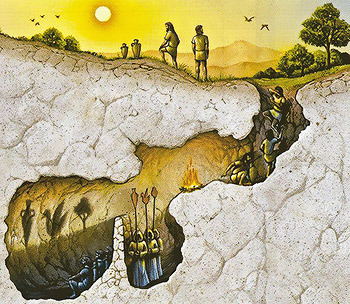
‘The show must go on’ as they say in the theatre. And indeed, so it would appear. Only this particular show seems to have no beginning or end. The curtain never comes down; there isn’t even an interval in which to draw breath and stretch one’s legs.

It’s a 24/7 bonanza, and the cost of a seat is almost certain to put you out-of-pocket. In spite of which, the auditorium is full of expectant faces staring up at the unfolding scenes and drinking in the drama being staged for their consumption.

So few actors, so many spectators. Yet the actors hold the attention and the spectators soon forget that they are in a theatre and have paid for their seats.

We are all at this performance. Its setting is planet Earth. The actors strut around feigning importance, playing the role ascribed to them by the writer of the script and the director of ‘the show’. You know who they are – you see them everyday on TV screens and newspapers. A few are quite convincing, and like most actors they feign true sincerity and then pause for the applause.

The director remains largely invisible, but in the background he has fixed the agenda and set the scene. The script writer also remains largely incognito. However, his words on the page provide the narrative without which the actors would not be able to perform their predesignated roles.

The cast of todays crowd pulling drama have names like May, Merkel and Trump. The play in which they are currently performing is entitled ‘If I Ruled the World’, and there are many other roles for aspiring lesser performers and even for some retired leading-lights of yesteryear.

New scripts continuously emerge so as ‘to keep the show on the road’. A recent hit, for example, was ‘Brexit’, a play in four acts, featuring a strong line-up of music hall performers as well as some fine orators, one of whom cut his teeth in the great performing venues of Continental Europe.

But look, these marionettes of the political charade called ‘democracy’ can only be where they are, and do what they do, because we give them centre stage. We let ourselves become embroiled in their show and convince ourselves that it’s the only show in town. But it’s not, and in spite of being big and noisy, it’s actually a facade designed and orchestrated by the hidden hands who pull the strings that tweak the marionettes into action. Very occasionally a true leader emerges. An individual who stands out for their empathy with a struggling humanity.

But for decades now, it is ‘the show’ that has contrived to dominate. A show kept in place by stage managers who ensure all the rules, regulations and disciplines are operating as they should. But it is we the people who elect the cast of this play. A cast who promise to reflect and represent our needs on the national stage. To bring change where change is needed and to stand firm in the role that they are given.

So you see, we are complicit in the maintenance of ‘the rules of the game’ that keep the control system under which we suffer, alive and well.

Those who we elect mostly fall at the first hurdle – and all their promises go with them. ‘The system’ is in charge, after all, and our elected representatives quickly fall under the spell of its mechanics and become victims of its sinister agenda. An agenda played-out on the global stage with the help of powerful centralized banks, mega corporations and a heavily funded military. Yes, this is the show we have paid to bring to town.

But we have been sold a lie. We have bought into a chimera, a charade, and the biggest part of the problem is that we fail to recognize this fact. We actually believe it is a bona fide happening, without which we would all be thrown into chaos and despair.

So it is that we cling on to this outworn model of ‘democracy’, fearful of what might happen if it were dismantled and consigned it to history. Fearful maybe, of what might emerge in its place.

But that’s no good, and you know it. Because what stands in front of us is a choice; to remain a slave to a system which cannot survive without slaves – or to break free and give form to something altogether different.

Are you ready to take such a step?

So what might bringing about something altogether different actually involve? We must have a go at answering this, because it is the most critical question of this era, one we all face today – whether we realize it or not.

What we are talking about is taking back control of our destinies, not giving responsibility for them to someone else. Try to conceive what this might be like.. Well, for a start, out goes ‘the politician’ and with him/her the central control system called ‘parliament’. By the way, parliament did once represent the venue for an ideal in the making. An aspiration to give voice to those who never had a voice and to introduce collective justice where only the will of a monarch had previously prevailed.

But such a situation has long been redundant, because parliament was hijacked decades ago by the hidden hand of centralised control, and the politician became a stooge for the banking, military and corporate power cartels seemingly beyond his control. That is why this ‘corrupted beyond repair’ model has to go.

There’s a new lightness in the air at the sheer mention of such an action! What is mainstream media going to talk about without the mock democracy to fill its airwaves? Where will attention be turned once the charade of politics is removed from its pompous pedestal? What would we like to see fill the vacant place?

Think about it, because almost nobody is, and that is in large part the reason why it hasn’t yet happened.

It is at around this point that something valuable starts stirring within, and the seeds of a fresh vision put forth their first shoots. The low vibratory rate of energy to which we have adapted, shifts upward a gear. The fog starts to clear. We can see more clearly what we couldn’t see at all before we dared dispense with the old lie.

The new perception looks and feels something like this: we are here on this world having something called ‘a life’. It might last seven or eight decades, or more, or less; but as far as we know, it’s the only one we’ve got. How did we acquire this special gift? What are we going to do with it? Since it’s special and quite unique – isn’t it logical that we would want to do something special and unique with it?

Once we see we’ve been sold a lie, our next logical realization is to recognize that it’s a massive waste of this one life we have, to pretend we can ignore reality. It is then that the possibility of something altogether different entering the arena, makes its unexpected debut.

“My God” it says “I want to live!” “I want to confront this lie head-on and cease running away from it!” And that is a truly revolutionary happening; one which can – in an instant – change our entire outlook on life. For although it’s only a beginning, it’s a real beginning, one full of promise for what might follow.

Looking back at the crazed and confused scenes taking place on the world stage, shifting like tides between high melodrama and low bestiality, we can now see that it is no use trying to paper-over the cracks and pretend that we can go on living life ‘as usual’. The cracks are the dominant factor and what lies in between is so insubstantial as to be of no practical use.

Our only way forward is to invent a new future. Open a fresh page in the book of life. Not ignoring the past, but getting to grips with understanding it – and then bringing it with us on the great new journey upon which one has embarked. Let a new found passion lead the way. Let intuition be your guide. Let awareness be your tool box.

If you had identified yourself with any facet of the crumbling status quo, you will soon find yourself untethered, because there is nothing left able to hold a stake to which you can attach yourself.

There is nowhere left to turn except into your own inner resources. For it is from this region that the new vision emerges. That place where truth still resides, untrammelled by the ways of the world.

And then, on peering ever deeper within, one can begin to see the emerging presence of another world altogether. A world awaiting birth. Longing for birth. Waiting to be born. A world shimmering with expectation and excitement. A world lit-up by luminous energies.

Men and women alike give birth to this great entity. It does not require a womb or a phallus, although it’s composition embraces the essence of female and male, finally liberated to give full focus to the building of the new society which it is our imperative to create.

Now is the time to set aside all that would try to close the window on our true destinies.

Here is where we will find the footings, the solid ground, from which we can start building the World to Come. A place to carry us through the storm which cannot be by-passed. That is our true work from now on.

The mad actors who strut the world stage today do not realize that they are playing-out the final scene of an apocalyptic epic. A drama devised and directed by the architects of control. Criminals, whose full exposure is ever closer at hand.

We are moving into an auspicious time. A time in which mankind frees itself from the prison that has for so long-held it hostage. An event which will break the cords of fear-induced captivity and finally bring down the curtain on this devious age of deception.

On the Process of Awakening

lifestyle

By Charles Hugh Smith

Source: Of Two Minds

We cannot help but feel a hunger for authenticity, honesty, spiritual solace and human connection, but these are precisely what is scarce in our social and economic structure.

There is a tremendous amount of pain in our society. There are many sources of this pain: the emotional desertification of dysfunctional families, the knowledge that we don’t fit in and never will, a widening disconnect between the narratives we’re told are true and our experience, and a social and economic structure that tosses many of us on the trash heap.

The lifestyle we’re told we need to be happy is unattainable to many, and disconcertingly unsatisfactory to the top 10% who reach it.

We cannot help but feel a hunger for authenticity, honesty, spiritual solace and human connection, but these are precisely what is scarce in our social and economic structure.

The process of awakening has many paths. For some, the path starts with the incoherence of official explanations and narratives. For others, it’s the inner search for truth via psychotherapy or spiritual practice.

For some, it’s an investigation into the way our economic and political hierarchy function. For others, art is the starting point: a film, a novel, a comic, a song.

For many of us, it begins with this simple but devastating realization: I don’t fit in. I don’t fit in, have never fit in and never will fit in. I play along because it’s easier on me and everyone I interact with to do so, and I value my independence which means I have to find a way to support myself. That is difficult, as what I like to do has little to no value in our economy.

What interests me is how the epidemic of pain and alienation that characterizes our society is the direct result of how our economy and social order is structured. Incoherence, self-destruction, pain and alienation are the only possible outputs of the system we inhabit.

I have explored this dynamic in my books, starting with Survival+ in 2009 and working forward to my latest book, Why Our Status Quo Failed and Is Beyond Reform. (My other books are: A Radically Beneficial World: Automation, Technology and Creating Jobs for All; Get a Job, Build a Real Career and Defy a Bewildering Economy; The Nearly Free University and the Emerging Economy: The Revolution in Higher Education; Resistance, Revolution, Liberation: A Model for Positive Change; Why Things Are Falling Apart and What We Can Do About It and An Unconventional Guide to Investing in Troubled Times.)

I recently had an amazing free-form 1:50 hour conversation on these topics with New Zealand talk-show host Vinny Eastwood. Any conversation that stretches from the erosion of community to loneliness to Daniel Ellsberg to Marx to Taoism to alienation to Michelangelo Antonioni and on to the process of awakening is amazing in my view.

Here’s Vinny’s page with listening/viewing/downloading options, and the program on Youtube (please ignore my goofy expressions): The magic of bitcoin and cryptocurrencies (1:49:54)

My conclusion may strike many as radical, but to me it is self-evident: the primary source of the rot, insecurity, inequality and alienation of our society is the way we create and distribute money, which is the conduit for creating and distributing political power.

I explain why this is so in my books A Radically Beneficial World: Automation, Technology and Creating Jobs for All and Why Our Status Quo Failed and Is Beyond Reform.

If we don’t change the way money is created and distributed, we change nothing. Money = power. If we don’t devise a form of money that is beyond the reach of central banks and states, all “reform” is just window-dressing, simulacra of “change” that simply solidifies the system’s bogus claim of being reformable.

Cryptocurrencies are in their infancy. There will be many more iterations of Cryptocurrencies beyond bitcoin and Ethereum; recall that bitcoin went public in 2009.

There are security challenges with cryptocurrencies, and the potential for central-state meddling via backdoors in computer operating systems. But once we understand that community and the potential for a less toxic society and economy are crippled by the centralized structure of the state and its money, then there is no way forward but to develop structures of money, work, community, purpose and meaning that are outside the direct control of the state and central bank.

This sort of “crazy talk” is unwelcome. As I noted earlier this week on my chart of the Ministry of Propaganda, in the status quo, skepticism is always a conspiracy or a hoax.

So instead we consider an exploding opiate epidemic, an epidemic of obesity and metabolic illnesses, a discourse of inchoate rage and a Grand Canyon-sized gap between what we’re told is true and what we experience as true “normal.” These things are not normal; they are manifestations of a system that can only generate one output: self-destruction.