Jacques Ellul: A Prophet for Our Tech-Saturated Times

Read his works to understand how we’ve been caught in technology’s nightmarish hold.

By Andrew Nikiforuk

Source: The Tyee

By now you have probably read about the so-called “tech backlash.”

Facebook and other social media have undermined what’s left of the illusion of democracy, while smartphones damage young brains and erode the nature of discourse in the family.

Meanwhile computers and other gadgets have diminished our attention spans along with our ever-failing connection to reality.

The Foundation for Responsible Robotics recently created a small stir by asking if “sexual intimacy with robots could lead to greater social isolation.”

What could possibly go wrong?

The average teenager now works about two hours of every day — for free — providing Facebook and other social media companies with all the data they need to engineer young people’s behaviour for bigger Internet profits.

Without shame, technical wonks now talk of building artificial scientists to resolve climate change, poverty and, yes, even fake news.

The media backlash against Silicon Valley and its peevish moguls, however, typically ends with nothing more radical than an earnest call for regulation or a break-up of Internet monopolies such as Facebook and Google.

The problem, however, is much graver, and it is telling that most of the backlash stories invariably omit any mention of technology’s greatest critic, Jacques Ellul.

The ascent of technology

Ellul, the Karl Marx of the 20th century, predicted the chaotic tyranny many of us now pretend is the good and determined life in technological society.

He wrote of technique, about which he meant more than just technology, machines and digital gadgets but rather “the totality of methods rationally arrived at and having absolute efficiency” in the economic, social and political affairs of civilization.

For Ellul, technique, an ensemble of machine-based means, included administrative systems, medical tools, propaganda (just another communication technique) and genetic engineering.

The list is endless because technique, or what most of us would just call technology, has become the artificial blood of modern civilization.

“Technique has taken substance,” wrote Ellul, and “it has become a reality in itself. It is no longer merely a means and an intermediary. It is an object in itself, an independent reality with which we must reckon.”

Just as Marx deftly outlined how capitalism threw up new social classes, political institutions and economic powers in the 19th century, Ellul charted the ascent of technology and its impact on politics, society and economics in the 20th.

My copy of Ellul’s The Technological Society has yellowed with age, but it remains one of the most important books I own. Why?

Because it explains the nightmarish hold technology has on every aspect of life, and also remains a guide to the perplexing determinism that technology imposes on life.

Until the 18th century, technical progress occurred slowly and with restraint. But with the Industrial Revolution it morphed into something overwhelming due in part to population, cheap energy sources and capitalism itself.

Since then it has engulfed Western civilization and become the globe’s greatest colonizing force.

“Technique encompasses the totality of present-day society,” wrote Ellul. “Man is caught like a fly in a bottle. His attempts at culture, freedom, and creative endeavour have become mere entries in technique’s filing cabinet.”

Ellul, a brilliant historian, wrote like a physician caught in the middle of a plague or physicist exposed to radioactivity. He parsed the dynamics of technology with a cold lucidity.

Yet you’ve probably never heard of the French legal scholar and sociologist despite all the recent media about the corrosive influence of Silicon Valley.

His relative obscurity has many roots. He didn’t hail from Paris, but rural Bordeaux. He didn’t come from French blue blood; he was a “meteque.”

He didn’t travel much, criticized politics of every stripe and was a radical Christian.

But in 1954, just a year before American scientists started working on artificial intelligence, Ellul wrote his monumental book, The Technological Society.

The dense and discursive work lays out in 500 pages how technique became for civilization what British colonialism was for parts of 19th-century Africa: a force of total domination.

In the book Ellul explains in bold and uncompromising terms how the logic of technological innovation conquered every aspect of human culture.

Ellul didn’t regard technology as inherently evil; he just recognized that it was a self-augmenting force that engineered the world on its terms.

Machines, whether mechanical or digital, aren’t interested in truth, beauty or justice. Their goal is to make the world a more efficient place for more machines.

Their proliferation combined with our growing dependence on their services inevitably led to an erosion of human freedom and unintended consequences in every sphere of life.

Ellul was one of the first to note that you couldn’t distinguish between bad and good effects of technology. There were just effects and all technologies were disruptive.

In other words, it doesn’t matter if a drone is delivering a bomb or book or merely spying on the neighbourhood, because technique operates outside of human morality: “Technique tolerates no judgment from without and accepts no limitations.”

Facebook’s mantra “move fast and break things” epitomizes the technological mindset.

But some former Facebook executives such as Chamath Palihapitiya belatedly realized they have engineered a force beyond their control. (“The short-term dopamine-driven feedback loops that we have created are destroying how society works,” Palihapitiya has said.)

That, argued Ellul, is what technology does. It disrupts and then disrupts again with unforeseen consequences, requiring more techniques to solve the problems created by latest innovations.

As Ellul noted back in 1954, “History shows that every technical application from its beginnings presents certain unforeseeable secondary effects which are more disastrous than the lack of the technique would have been.”

Ellul also defined the key characteristics of technology.

For starters, the world of technique imposes a rational and mechanical order on all things. It embraces artificiality and seeks to replace all natural systems with engineered ones.

In a technological society a dam performs better than a running river, a car takes the place of the pedestrians — and may even kill them — and a fish farm offers more “efficiencies” than a natural wild salmon migration.

There is more. Technique automatically reduces actions to the “one best way.” Technical progress is also self-augmenting: it is irreversible and builds with a geometric progression.

(Just count the number of gadgets telling you what to do or where to go or even what music to play.)

Technology is indivisible and universal because everywhere it goes it shows the same deterministic face with the same consequences. And it is autonomous.

By autonomous, Ellul meant that technology had become a determining force that “elicits and conditions social, political and economic change.”

The role of propaganda

The French critic was the first to note that technologies build upon each other and therefore centralize power and control.

New techniques for teaching, selling things or organizing political parties also required propaganda.

Here again Ellul saw the future.

He argued that propaganda had to become as natural as breathing air in a technological society, because it was essential that people adapt to the disruptions of a technological society.

“The passions it provokes — which exist in everybody — are amplified. The suppression of the critical faculty — man’s growing incapacity to distinguish truth from falsehood, the individual from the collectivity, action from talk, reality from statistics, and so on — is one of the most evident results of the technical power of propaganda.”

Faking the news may have been a common practice on Soviet radio during Ellul’s day, but it is now a global phenomenon leading us towards what Ellul called “a sham universe.”

We now know that algorithms control every aspect of digital life and have subjected almost aspect of human behaviour to greater control by techniques whether employed by the state or the marketplace.

But in 1954 Ellul saw the beast emerging in infant form.

Technology, he wrote, can’t put up with human values and “must necessarily don mathematical vestments. Everything in human life that does not lend itself to mathematical treatment must be excluded… Who is too blind to not see that a profound mutation is being advocated here.”

He, too, warned about the promise of leisure provided by the mechanization and automatization of work.

“Instead of being a vacuum representing a break with society,” our leisure time will be “literally stuffed with technical mechanisms of compensation and integration.”

Good citizens today now leave their screens at work only to be guided by robots in their cars that tell them the most efficient route to drive home.

At home another battery of screens awaits to deliver entertainments and distractions, including apps that might deliver a pizza to the door.

Stalin and Mao would be impressed — or perhaps disappointed — that so much social control could be exercised with such sophistication and so little bloodletting.

Ellul wasn’t just worried about the impact of a single gadget such as the television or the phone but “the phenomenon of technical convergence.”

He feared the impact of systems or complexes of techniques on human society and warned the result could only be “an operational totalitarianism.”

“Convergence,” he wrote, “is a completely spontaneous phenomenon, representing a normal stage in the evolution of technique.”

Social media, a web of behavioural and psychological systems, is just the latest example of convergence.

Here psychological techniques, surveillance techniques and propaganda have all merged to give the Russians and many other groups a golden opportunity to intervene in the political lives of 126 million North Americans.

Social media has achieved something novel, according to former Facebook engineer Sam Lessin.

For the first time ever a political candidate or party can “effectively talk to each individual voter privately in their own home and tell them exactly what they want to hear… in a way that can’t be tracked or audited.”

In China the authorities have gone one step further. Using the Internet the government can now track the movements of every citizen and rank their political trustworthiness based on their history of purchases and associations. It is, of course, a fantastic “counterterrorism” tool.

The Silicon Valley moguls and the digerati promised something less totalitarian. They swore that social media would help citizens fight bad governments and would connect all of us.

Facebook, vowed the pathologically adolescent Mark Zuckerberg, would help the Internet become “a force for peace in the world.”

But technology obeys its own rules and prefers “the psychology of tyranny.”

The digerati also promised that digital technologies would usher in a new era of decentralization and undo what mechanical technologies have already done: centralize everything into big companies, big boxes and big government.

Technology assuredly fragments human communities, but in the world of technique centralization remains the norm.

“The idea of effecting decentralization while maintaining technical progress is purely utopian,” wrote Ellul.

Towards ‘hypernormalization’

It is worth noting that the word “normal” didn’t come into currency until the 1940s along with technological society.

In many respects global society resembles the Soviet Union just prior to its collapse when “hypernormalization” ruled the day.

A recent documentary defined what hypernormalization did for Russia: it “became a society where everyone knew that what their leaders said was not real, because they could see with their own eyes that the economy was falling apart. But everybody had to play along and pretend that it was real because no one could imagine any alternative.”

In many respects technology has hypernormalized a technological society in which citizens exercise less and less control over their lives every day and can’t imagine anything different.

Throughout his life Ellul maintained that he was “neither by nature, nor doctrinally, a pessimist, nor have I pessimistic prejudices. I am concerned only with knowing whether things are so or not.”

He called a spade a spade, and did not sugarcoat his observations.

If you are growing more anxious about our hypernormalized existence and are wondering why you own a phone that tracks your every movement, then read The Technological Society.

Ellul believed that the first act of freedom a citizen can exercise is to recognize the necessity of understanding technique and its colonizing powers.

Resistance, which is never futile, can only begin by becoming aware and bearing witness to the totalitarian nature of technological society.

Ellul believed that Christians had a special duty to condemn the worship of technology, which has become society’s new religion.

To Ellul, resistance meant teaching people how to be conscious amphibians, with one foot in traditional human societies, and to purposefully choose which technologies to bring into their communities.

Only citizens who remain connected to traditional human societies can see, hear and understand the disquiet of the smartphone blitzkrieg or the Internet circus.

Children raised by screens and vaccinated only by technology will not have the capacity to resist, let alone understand, this world any more than someone born in space could appreciate what it means to walk in a forest.

Ellul warned that if each of us abdicates our human responsibilities and leads a trivial existence in a technological society, then we will betray freedom.

And what is freedom but the ability to overcome and transcend the dictates of necessity?

In 1954, Ellul appealed to all sleepers to awake.

Read him. He remains the most revolutionary, prophetic and dangerous voice of this or any century.

Expect Increased Smearing Of Progressives As Russian Assets

By Caitlin Johnstone

Source: CaitlinJohnstone.com

After WikiLeaks documents provided irrefutable evidence that the Democratic National Committee had violated its charter by rigging its primary for Hillary Clinton against Bernie Sanders, what should have happened is this:

  • The DNC apologizing profusely to the public for violating the promises it had made to the electorate.
  • Massive, sweeping changes to bring transparency and public accountability to the DNC’s inner workings, including a complete overhaul of staff and leadership.
  • If at all possible, a complete do-over of the primary vote.
  • A dedication to attacking Trump’s right-wing policies from the left, showing the public that a progressive approach works better than a conservative one.

If this had happened Americans would not only be living in a vastly saner political landscape, but Trump probably would not have won in 2016. If the Democratic establishment had shown clearly and unequivocally that it was remorseful for its malfeasance and made an immediate overhaul that people could see for themselves, they wouldn’t have alienated nearly as many voters.

Instead, what happened was the DNC changing absolutely nothing, Nanci Pelosi saying she doesn’t see anything wrong with primary rigging, and the Democratic Party shrieking about Russia for more than two years.

Watching the establishment Russia narrative take hold of public consciousness was like watching a zombie outbreak. First it infected the slow ones, the virulent Clintonites who never had any natural defense against CIA/CNN narratives, which was disturbing and distressing but not at all surprising. Then, bit-by-bit, the Russia hysteria began to creep leftward. Progressives I’d been fighting alongside in 2016 began succumbing to the Russiagate mind virus in 2017, folding under peer pressure and aggressive mass media manipulation. Some of them held strong for a few months, then when one of the hollow but oh-so-confident-sounding “bombshell” Russiagate reports struck them in the right way at the right time they made public social media posts saying they were now convinced.

I watched them drop like flies. To this very day I still see Russia hysteria on my social media feeds from progressive Berniecrats I’d followed early on who transformed into McCarthyite cold war hawks at some point in the interim. When I post something skeptical of the establishment Russia narrative on Twitter I see accounts with red roses next to their name, a sign of support for the Democratic Socialists of America, arguing with me and accusing me of sympathizing with Trump and Putin.

Writers like Max Blumenthal and Glenn Greenwald have been warning since the outbreak of this pernicious mass manipulation that it would be used to target the left, but their warnings went unheeded as more and more progressive minds were funneled into the belief that the best way to fight Trump was to get behind the Russia hysteria bandwagon and push with all your might. And now, even as America’s 2020 presidential race is barely in its infancy, we are already beginning to see Russiagate used to smear anyone to the left of Hillary Clinton as Russian dupes.

I’d like to draw attention to a few recent social media posts which have gained a lot of traction in the last few days, not for the impact those posts have but for what they portend for the rest of the 2020 race. The first is from the Twitter account for the Russiagate documentary Active Measures, and it received thousands of shares:

“Bernie was the one Democrat not to vote to keep sanctions on Deripaska (he also voted against Russia sanctions and Magnitsky),” the post reads. “@SenSanders won’t stand up to billionaires in Russia and he wants you to to believe he’ll stand up to them in America. #fraud”

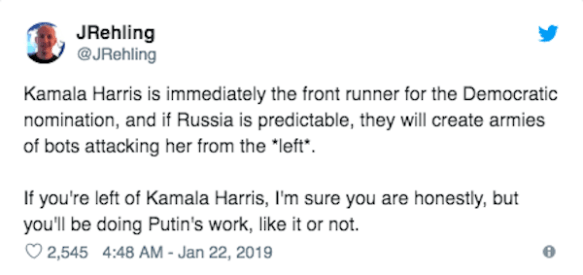
The second comes from professional linguist and engineer John Rehling, who has over 50 thousand Twitter followers, and it received hundreds of shares:

“Kamala Harris is immediately the front runner for the Democratic nomination, and if Russia is predictable, they will create armies of bots attacking her from the *left*,”  reads Rehling’s (now deleted) tweet. “If you’re left of Kamala Harris, I’m sure you are honestly, but you’ll be doing Putin’s work, like it or not.”

The third comes from Shareblue manipulator Caroline Orr, just one of many similar posts that she has made in recent days. Orr has also launched a GoFundMe to investigate Tulsi Gabbard’s imaginary Putin-Assad ties/score a free vacation to Hawaii, and is also circulating the baseless rumor that “Russian-linked accounts” are pushing for a Bernie-Tulsi 2020 ticket. Note the URL Orr highlighted in the tweet below featuring her allegation that Gabbard is “pro-Putin” and “pro-Assad”.

https://twitter.com/RVAwonk/status/1085084216726044672

In each case, posts punching left with accusations of Kremlin servitude gained traction with their followers, which means there is already an audience for this schtick. And, again, the presidential race has barely even begun. Things are likely to get a whole lot uglier between now and November 2020.

This is your life for the next two years, progressives. This is what those of you who drank the Russiagate Kool-Aid have helped buy for what passes for America’s political left today. You can expect such accusations to get far more common and far more aggressive as this thing drags on. The left can either play along with this and let centrist cold war rhetoric suck all the oxygen out of the room for the advancement of progressive policies, or they can fight back against this moronic facilitation of longstanding intelligence community agendas.

This use of Russiagate to herd the political left toward supporting America’s “center” (so-called only because it is the mainstream view, which in turn is only due to plutocratic narrative control) will actively move things further into corporatist dystopia. Supporting a “moderate” Democratic Party while the Republican Party always pushes as far to the right as it possibly can is guaranteeing a continuous overall movement to the right, which is why the gains made by the left in the early 20th century are almost gone now. If you have one person half-pulling westward on one end of a rope and another person tugging eastward with all their might, they’re going to move steadily east.

The slow, incremental changes advocated by the political “center” are code for no change whatsoever; they’re just buying time so that their corporate sponsors, who themselves never slow down, can finish shoring up control before the public forces them to scale back. If progressives don’t start attacking this “Move right or you’re a Russian agent” schtick directly and with full force, it will snuff them out completely.

Death Of Russiagate: Mueller Team Tied To Mifsud’s Network

By Elizabeth Vos

Source: Disobedient Media

In April last year, Disobedient Media broke coverage of the British involvement in the Trump-Russia collusion narrative, asking why All Russiagate Roads Lead To London, via the quasi-scholar Joseph Mifsud and others.

The issue was also raised by WikiLeaks’s Julian Assange, just days before the Ecuadorian government silenced him last March. Assange’s Twitter thread cited research by Chris Blackburn, who spoke with Disobedient Media on multiple occasions covering Joseph Mifsud’s ties to British intelligence figures and organizations, as well as his links to Hillary Clinton’s Presidential campaign, the FBI, CIA and the private cyber-security firm Crowdstrike.

We return, now, to this issue and specifically the research of Chris Blackburn, to place the final nail in the coffin of the Trump-Russia collusion charade. Blackburn’s insights are incredible not only because they return us to the earliest reporting on the role of British intelligence figures in manufacturing the Trump-Russia collusion narrative, but because they also implicate members of Mueller’s investigation. What we are left with is an indication of collusion between factions of the US and UK intelligence community in fabricating evidence of Trump-Russia collusion: a scandal that would have rocked the legacy press to its core, if Western establishment-backed media had a spine.

In Disobedient Media’s previous coverage of Blackburn’s work, he described his experience in intelligence:

“I’ve been involved in numerous investigations that involve counter-intelligence techniques in the past. I used to work for the 9/11 Families United to Bankrupt Terrorism, one of the biggest tort actions in American history. I helped build a profile of Osama bin Laden’s financial and political network, which was slightly different to the one that had been built by the CIA’s Alec Station, a dedicated task force which was focused on Osama bin Laden and Al-Qaeda. Alec Station designed its profile to hunt Osama bin Laden and disrupt his network. I thought it was flawed. It had failed to take into account Osama’s historical links to Pakistan’s main political parties or that he was the figurehead for a couple of organizations, not just Al-Qaeda.”

“I also ran a few conferences for US intelligence leaders during the Bush administration. After the 9/11 Commission published its report into the attacks on the World Trade Center and the Pentagon it created a public outreach program. The US National Intelligence Conference and Exposition (Intelcon) was one of the avenues it used. I was responsible for creating the ‘View from Abroad’ track. We had guidance from former Senator Slade Gorton and Jamie Gorelick, who both sat on the 9/11 Commission. We got leaders such as Sir John Chilcot and Baroness Pauline Neville Jones to come and help share their experiences on how the US would be able to heal the rifts after 9/11.”

“The US intelligence community was suffering from severe turf wars and firewalls, which were hampering counter-terrorism efforts. They were concentrating on undermining each other rather than tackling terrorism. I had mainly concentrated on the Middle East, but in 2003 I switched my focus to terrorism in South Asia.”

Counter Terrorism, Not Counter Intelligence, Sparked Probe

In an article published by The Telegraph last November, the paper acknowledged the following:

“It forces the spotlight on whether the UK played a role in the FBI’s investigation launched before the 2016 presidential election into Trump campaign ties to the Kremlin… Mr. Trump’s allies and former advisers are raising questions about the UK’s role in the start of the probe, given many of the key figures and meetings were located in Britain… One former top White House adviser to Mr. Trump made similar insinuations, telling this newspaper: “You know the Brits are up to their neck.” The source added on the Page wiretap application: “I think that stuff is going to implicate MI5 and MI6 in a bunch of activities they don’t want to be implicated in, along with FBI, counter-terrorism and the CIA.” [Emphasis Added]

The article cites George Papadopoulos, who asked why the “British intelligence apparatus was weaponized against Trump and his advisers.” Papadopoulos has also addressed the issue at length via Twitter. In response to the Telegraph’s coverage of the issue, Chris Blackburn wrote via Twitter: “The Telegraph story on Trump Russia acknowledges that activities involving counter-terrorism are at the heart of the scandal…not counter-intelligence. If the [London Centre for International Law Practice] was British state, not private, some Commonwealth countries are going to be seriously pissed off.”

Blackburn spoke with Disobedient Media, saying: “If you factor in the dreadful reporting to discredit Joseph Mifsud and leaks, it is pretty clear something rather strange happened to George Papadopoulos during the campaign while he was shuttling around Europe and the Middle East. He was working with people who have intelligence links at the London Centre of International Law Practice. A recent article in The Telegraph also alludes to MI5, MI6, and CIA using counter-terrorism assets which would tie into the London Centre of International Law Practice (LCILP), and its sister organizations, doing counter-terrorism work for the Australian, UK and US governments. They quote anonymous officials who believe that their intelligence agencies used counter-terrorism personnel to kick start the investigation/scandal.” [Emphasis Added]

Blackburn discussed this differentiation with Disobedient Media: “Counter-terrorism is obviously involved in more kinetic, violent political actions-concerning mass casualty events, bombings, assassinations, poisonings, and hacking. But, the lines are blurring between them. Counter-intelligence cases have been known to stretch for decades- often relying on nothing more than paranoia and suspicion to fuel investigations. Counter-terrorism is also a broader discipline as it involves tactical elements like hostage rescue, crime scene investigations, and explosive specialists. Counter-Terrorism is a collaborative effort with counter-terrorism officers working closely with local and regional police forces and civic organizations. There is also a wider academic field around countering violent, and radical ideology which promotes terrorism and insurgencies. Cybersecurity has become the third major discipline in intelligence. The London Center of International Law Practice, the mysterious intelligence company that employed both Papadopoulos and Mifsud, had also been working in that area.”

Continuing, Blackburn pinpointed the significance of defining counter-terrorism as the starting point of the investigation, saying: “It shows that there is a high probability that intelligence was deliberately abused to make Papadopoulos’ activities look like they were something else. As counter-terrorism and counterintelligence are close in tactics and methods, it would seem that they were used because they share the same skill sets – covert evidence gathering and deception. It’s basically sleight of hand. A piece of theatre would be more precise. However, we don’t know if the FBI knew it was real or make-believe. It’s more likely that the CIA played the FBI with the help of close allies who were suspicious and frightened of a Trump presidency.”

Mueller’s Team And Joseph Mifsud

Zainab Ahmad, a member of Mueller’s legal team, is the former Assistant United States Attorney in the Eastern District of New York. As pointed out by Blackburn, Ahmad attended a Global Center on Cooperative Security event in 2017. In recent days, Blackburn wrote via Twitter: “Zainab Ahmad is a major player in the Russiagate scandal at the DOJ. Does she work for SC Mueller? She was at a GCCS event in May 2017. Arvinder Sambei, a co-director of the [London Centre of International Law Practice], worked with Joseph Mifsud, [George Papadopoulos] and [Simona Mangiante]. She’s a GCCS consultant.”

Blackburn told this author: “Zainab Ahmad was one of the first DOJ prosecutors to have seen the Steele dossier. In May 2017, she attended a counter-terrorism conference in New York with the Global Center on Cooperative Security (GCCS), an organization which Joseph Mifsud, the alleged Russian spy, had been working within London and Riyadh, Saudi Arabia.”

“Richard Barrett, the Former Chief of Counter-Terrorism at MI6, Britain’s foreign intelligence department traveled with Mifsud to Saudi Arabia to give a talk on terrorism in 2017. Ex-CIA officers, US Defense, and US Treasury officials were also there. The London Centre of International Law Practice’s relationship to the Global Center had been established in 2014. The Global Center on Cooperative Security made Martin Polaine and Arvinder Sambei consultants, they then became directors at the London Centre of International Law Practice.”

“The Global Center on Cooperative Security’s first major UK conference was at Joseph Mifsud’s London Academy of Diplomacy (LAD). Mifsud then followed Arvinder Sambei and Nagi Idris over to the London Centre of International Law Practice. Sources have told me that Mifsud was moonlighting as a specialist on counter-terrorism and Islamism while working at LAD which explains why he went to work in counter-terrorism after LAD folded.”

“I don’t think it’s a coincidence that Global Center on Cooperative Security is connected to various elements that popped up in the Papadopoulos case. The fact that a prosecutor on Mueller’s team was at Global Center before Mueller was appointed as special counsel is also troubling.”

Days ago, The Hill reported on Congressional testimony by Bruce Ohr, revealing that when served as a DOJ official, he warned FBI and DOJ figures that the Steele dossier was problematic and linked to the Clintons. Critically, The Hill writes:

“Those he briefed included Andrew Weissmann, then the head of DOJ’s fraud section; Bruce Swartz, longtime head of DOJ’s international operations, and Zainab Ahmad, an accomplished terrorism prosecutor who, at the time, was assigned to work with Lynch as a senior counselor. Ahmad and Weissmann would go on to work for Mueller, the special prosecutor overseeing the Russia probe.” [Emphasis Added]

This point is essential, as it not only describes Ahmad’s role in Mueller’s team but places her at a crucial pre-investigation meeting.

Last year, Blackburn noted the connection between Mifsud and Arvinder Sambei, writing: “LCILP director and FBI counsel, works with Mike Smith at the Global Center. They ran joint counter-terrorism conferences and training with Mifsud’s London Academy. Sambei then brought Mifsud over to the [London Centre of International Law Practice]. [Global Center works with Aussies, UK and US State too.”

Sambei has been described elsewhere as a “Former practising barrister, Senior Crown Prosecutor with the Crown Prosecution Service of England & Wales, and Legal Adviser at the Permanent Joint Headquarters (PJHQ), Ministry of Defence.” [British spelling has been retained]

That Sambei has been so thoroughly linked to organizations where Mifsud was a central figure is yet another cause of suspicion regarding allegations that Joseph Mifsud was a shadowy, unknown Russian agent until the summer of 2016. She is also a direct link between Robert Mueller and Mifsud.

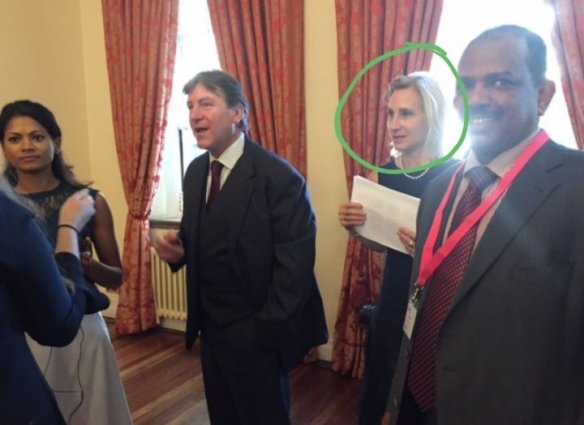
Blackburn wrote via Twitter: “Arvinder Sambei helped to organize LCILP’s counter-terrorism and corruption events. She used her contacts in the US to bring in Middle Eastern government officials that were seen to be vulnerable to graft. Lisa Osofsky, former FBI Deputy General Counsel, was working with her.” Below, Arvinder is pictured at a London Centre of International Law Practice (LCILP) event.

As Chris Blackburn told this author: “Mifsud and Papadopoulos’s co-director Arvinder Sambei was also the former FBI British counsel working 9/11 cases for Robert Mueller. She also runs a consultancy which deals with Special Investigative Measure (SIMs) which is just a posh description for covert espionage and evidence gathering. She has worked for major intelligence and national law agencies in the past. She wore two hats as a director of London Centre and a consultant for the Global Center on Cooperative Security (GCCS), a counter-terrorism think tank which is sponsored by the Australia, Canada, UK and US governments. Alexander Downer’s former Chief of Staff while at the Australian Department of Foreign Affairs and Trade now works for the Global Center. Mifsud was also due to meet with Australian private intelligence figures in Adelaide in March 2016. So. Australia is certainly a major focus for the investigation.” [Emphasis Added]

Below, former FBI Deputy General Counsel Lisa Osofsky is pictured at a London Centre for International Law Practice event. Osofsky also served as the Money Laundering Reporting Officer with Goldman Sachs International. Since 2018, she has served as the Director of the UK’s Serious Fraud Office (SFO).

An Embarrassment For John Brennan?

Disobedient Media previously reported that Robert Hannigan, then head of British spy agency GCHQ, flew to Washington DC to share ‘director-to-director’ level intelligence with then-CIA Chief John Brennan in the summer of 2016. This writer noted that “The Guardian reported Hannigan’s announcement that he would step down from his leadership position with the agency just three days after the inauguration of President Trump, on 23 January 2017. Jane Mayer, in her profile of Christopher Steele published in the New Yorker, also noted that Hannigan had flown to Washington D.C. to personally brief the then-CIA Director John Brennan on alleged communications between the Trump campaign and Moscow. What is so curious about this briefing “deemed so sensitive it was handled at director-level” is why Hannigan was talking director-to-director to the CIA and not Mike Rogers at the NSA, GCHQ’s Five Eyes intelligence-sharing partner.”

Blackburn told Disobedient Media: “Former Congressman Trey Gowdy, who has seen most of the information gathered by Congress from the intelligence community concerning the Russia investigation, said that if President Trump were to declassify files and present the truth to the American public, it would “embarrass John Brennan.” I think that is pretty concrete for me, but it’s not definitive. I know the polarization and spin in Washington has become perverse, but that statement is pretty specific for me. If Brennan is involved, it is most probably through Papadopoulos who sparked off the ‘official’ investigation at the FBI. He also made sure the Steele dossier was spread through the US government.”

Blackburn added: “Chris Steele was also working on FIFA projects, and a source has told me that he was working to investigate the Russian and Qatari World Cup bids. The London Centre of International Law Practice has been working with Majed Garoub, the former Saudi legal representative of FIFA, the world governing body for soccer. He’s also been working against the Qatari bid. Steele likes to get paid twice for his investigations.”

“Mifsud has also been associated with Prince Turki the former Saudi intelligence chief, Mifsud and the London Academy of Diplomacy used to train Saudi diplomats and intelligence figures while Turki was the Saudi Ambassador to London. Turki is a close friend of Bill Clinton and John Brennan. Nawaf Obaid was also courting Mifsud and tried to get him a cushy job working with CNN’s Freedom Project at Link Campus in Rome. He also knows John Brennan. Intelligence agencies like to give out professional gifts like this plum academic position for completing missions. In the US, it is widely known that intelligence agencies gift the children of assets to get them into prestigious Ivy League schools.”

At minimum, we can surmise that Mifsud was not a Russian agent, but was an asset of Western intelligence agencies. We are left with the impression that the Mifsud saga served as a ploy, whether he participated knowingly or not. It seems reasonable to conclude that the gambit was initially developed with participation of John Brennan and UK intelligence. Following this, Mueller inherited and developed the Mifsud narrative thread into the collusion soap opera we know today.

Ultimately, we are faced with the reality that British and US interests worked together to fabricate a collusion scandal to subvert a US Presidency, and in doing so, intentionally raised tensions between the West and a nuclear-armed power.

Cyberwar: #RussiaGate Is US

By Rob Williams

Source: Project Censored

The following is a critical book review of Kathleen Hall Jamieson’s Cyberwar: How Russian Hackers and Trolls Helped Elect A President – What We Don’t, Can’t, And Do Know (Oxford: Oxford University Press, 2018).

“Russia hacked the 2016 US election!”

Since November 2016, the US “news” chatterati – pundits and poets, priests, prognosticators and politicians – have repeated this statement ad nauseum. The #RussiaGate story has become a commonly-accepted article of faith amongst the US neoliberal faithful – disgruntled Clintonistas, bereaved “Bernie Bros,” US news flaks, and anyone else who dislikes the current occupant of the White House. If the “Russia hacked the 2016 US election” meme warriors had a high-viz US standard bearer, it would probably be popular MSNBC performance artist Rachel “All Russia, All The Time” Maddow, who serves up the #RussiaGate sauce with reckless abandon to high TeeVee viewer ratings, earning somewhere between $30 and $40 K daily in salary. (LINK to RM mashup here).

And now, we have a scholarly book published by Oxford University Press with an epic title – Cyberwar: How Russian Hackers and Trolls Helped Elect A President – What We Don’t, Can’t, And Do Know – that purports to prove that Russia’s cyber-meddling helped sabotage the HRC campaign, swinging the 2016 US presidential election in favor of DJT.

To approach Cyberwar, first consider everything on the table re: the 2016 US presidential election.

Here‘s just a short list.

Witness the two most unpopular presidential candidates in US political history (one of whom confidently encouraged the other to run, convinced she could beat him); massive and well-documented bipartisan digital vote count manipulation (“electile dysfunction”) courtesy the 2002 “Help America Vote Act” (Orwell would be impressed); the grotesque (human) nature of Donald J Trump and Republicans’ comical attempts to first displace and then eventually come to terms with his 2016 candidacy; the complete corruption of the national Democratic Party leadership, which did everything it could to crown HRC the Dem standard bearer, from systematically undermining insurgent Vermont “progressive” Bernie Sanders’ presidential bid (read the 110 page report “Democracy Lost” for detailed descriptions of how the DNC manipulated 2016 Democratic primary outcomes in 11 swing states) to diverting DNC fundraising – millions of dollars collected from the pockets of ordinary Americans – away from so-called “down ballot” local office races and into HRC presidential campaign coffers during the heated months of 2016.

There’s so much more, but I’ll simply stop there.

Rather than looking in the 2016 mirror, however, US blames…Russians?

To be clear, I approached Cyberwar with an open mind. I am a big fan of the book’s author, distinguished US media scholar Kathleen Hall Jamieson (KHJ), longtime badass in the world of political communications scholarship, and current Elizabeth Ware Packard Professor at the Annenberg School for Communication at the University of Pennsylvania and the Director of the Annenberg Public Policy Center. Jamieson’s got street cred. However, after a close read and re-read of KHJ’s new book, including all the footnotes, Cyberwar left me unconvinced by its “more or less” central conclusion – “Russia trolled and hacked the 2016 US election, sorta!” In fact, I’d suggest that Cyberwar is a deeply problematic book, a fascinating scholarly study in “manufacturing consent” – the term Edward Herman and Noam Chomsky borrowed from Walter Lippman to title their 1988 book of the same name – describing how US elites “massage” US news channels like the New York Times, “filtering” into public view the “news” stories most beneficial to their strategic goals, while downplaying or censoring other worthy “news” stories of significance.

To fully understand my critique of Cyberwar, start with Jamieson’s credulous acceptance of “facts” provided by the US “intelligence community” (my new favorite Orwellian trope) re: the Russian government’s “interference” to advance her Cyberwar case. More on that in a moment. In the meantime, here is KHJ’s central Cyberwar claim, summarized in a single long sentence, slightly paraphrased for brevity, from her book’s conclusion: “In the run up to the 2016 US presidential election, Russian trolls and hackers carried out a strategically systematic and ultimately successful communications campaign to discredit Democratic presidential candidate Hillary Rodham Clinton and support Republican presidential candidate Donald J. Trump through sufficiently widespread messaging that focused on issues compatible with Trump’s strategic needs, addressing constituencies he had to mobilize and demobilize, by employing persuasive, visually evocative and well-targeted content that was amplified in swing states through sharing, liking, and commenting.” (p. 203).

It’s a mouthful, I know, and when you read it over a few times, removing both Clinton and Trump’s names, you quickly realize that this is what ANY strategic political campaign using digital tools –Cyberspace’s unique power and reach – would set out to do to try and win any election, anywhere. Russian president Vladimir Putin himself concedes that Russia wages “campaigns of political influence” wherever and whenever they can, just as the US and other powerful countries do and have done for decades, using as many communications tools as they can leverage.

So – how does Jamieson set out to prove Russian Cyberwar? She divides her book into four parts.

Part One of Jamieson’s book explores “who did it, why, and what research says about it might matter.” Here, KHJ flags the Internet Research Agency (IRA), a Russian troll farm, and introduces the reader to her previous ground-breaking work on communications effects research – how techniques like agenda-setting, framing, priming and “contagion creation” have worked over time to influence US voter decisions, and thus, perhaps, election outcomes. Big caveat here, that KHJ leaves unacknowledged. To wit – presumably, Russian “trolls” share the same primary goal as ALL trolls on the Internet, namely, maximizing audience engagement (and thus profit) through the creation and deployment of relevant content, with their chief “currency” being click-throughs, likes, shares, retweets, etc.

In Part Two of Cyberwar, Jamieson looks at what she calls “the prerequisites of [Russian] troll influence.” “Were the extent and virality of Russian social media content and the nature, coverage, and exposure of Russian-hacked Democratic materials,” she asks, “sufficient and sufficiently persuasive to plausibly affect the outcome of an election decided in three states by about 78,000 votes?” (p. 65). Hint – her final answer is a circumspectly strong “maybe.”

Part Three of Cyberwar finds KHJ considering “how the Russians affected the news and debate agendas in the last month of the presidential campaign.” Here, Jamieson looks at how “Russian hacked content” (her words) transformed the nature of US news coverage surrounding HRC in the month before the 2016 election, with a particular focus on the “drip drip drip” impact of “WikiLeak’d” emails illegally obtained from Democratic National Committee (DNC) servers, as well as FBI director James Comey’s role, during October 2016, in reopening the investigation into “newly-found” HRC emails, which KHJ argues helped shape public impressions around HRC for undecided US voters in the days just before the election.

Jamieson uses Cyberwar Part Four to provide a brief summary of “what we don’t, can’t, and do know about how Russian hackers and trolls helped elect Donald Trump.” “My case that the uses of Russian-hacked (emphasis added) Democratic materials influenced voters is built on scholars’ understandings of the effects of linguistic priming, media agenda setting, and framing the susceptibilities of late deciders, the dispositions of those who view both candidates unfavorably, the effects of imbalances in the amount of negative information available about alternative candidates, and scholarship on how debates affect voter attitudes,” Jamieson concludes. “It is scaffolded on evidence that the hacked content not only altered the media and debate agendas but also increased the negative press about Clinton. And it is bolstered by the possibility that Russian access and anticipated use of illegally gotten or fabricated Democratic content shaped a key decision by FBI director Comey.” (210)

To be fair, Cyberwar is an engaging read. Jamieson is a fine scholarly writer, and she has a field day digging into the aesthetics of individual Russian troll farm memes – complete with pictures. (The “Army Of Jesus” Facebook page, purportedly created by Russian trolls, features a boxing glove clad HRC sporting devil horns engaged in a fierce arm-wrestling match with Aryan Jesus himself. Hilarious.) KHJ also does a credible job tracing the evolution of the US news narrative around HRC in the weeks leading up to the 2016 election, showing how pivotal moments may have influenced voter perceptions about both HRC and DJT.

However! Individual Russian troll farm memes and evolving US “news” media coverage negatively impacting HRC do NOT a strategic Kremlin-led messaging campaign make.

Cyberwar continually flirts with a central question (which has become a story routinely told by US “news” media outlets)  – “Was Russian troll farming some sort of Kremlin-staged strategic cyber-op?” – without ever really answering it. The result is a book-length begging of this very important question, and here we come to the primary problem with Cyberwar– and it’s a whopper. Jamieson build her case for the Russian “tanking” of HRC’s candidacy on two central assumptions, both unproven.

Assumption #1: Jamieson implicitly asserts in Cyberwar that the Russians “hacked” into the Democratic National Committee (DNC) computer servers (as well as other hacks) and obtained digital copies of thousands of what became publicly damning emails from members of the DNC leadership team – Clinton campaign advisor John Podesta, HRC herself, and others – and then (by extension) tried to leverage the contents of these stolen documents for months in US social media spaces (and, by extension, influenced the shaping of US news narratives about HRC.) Interestingly, KHJ sneaks in “Russia hacked” and “Russian-stolen Democratic content” language into the last third of her book, without directly addressing this BIG rhetorical move or providing any proof that the Russians did so. Instead, she appears to implicitly draw on “evidence” for Russian hacking provided by the US “intelligence community” – former FBI director turned Trump special prosecutor Bob Mueller, former director of national intelligence James Clapper, and former National Security Agency director Michael Hayden chief among them. (Mueller, Clapper, Hayden – three US government officials who have all been less than honest with the American people, and I’m being generous.)

The counternarrative to the “Russia hacked into the DNC computers” story? Information was “leaked” from inside the DNC, not hacked from the outside. How might we know? Former NSA cryptographer Bill Binney, former CIA official Ray McGovern, and many other members of the 2003-founded Veteran Intelligence Professionals for Sanity (VIPS) argue that, based on their review of computer bit rate information, the stolen DNC content traveled at bandwidth rates too high to have been an external “hack,” but rather an internal “leak.” The reality? We’ll never know for sure, because the DNC refused to hand over their compromised computer servers to the FBI, instead contracting with Crowd Strike, a private US cybersecurity firm, to ascertain affirmative Russian hacking involvement (#Surprise!). For interested readers, NSA whistleblower Bill Binney discusses his “leak versus hack” conclusions on this recent episode of Brass Check TV between 1:27 – 1:37 here.

Assumption #2: In Cyberwar, Jamieson implies that WikiLeaks closely collaborated with the Russian government, or at the very least (it’s a bit hard to tell from her lack of analysis here), Putin used WikiLeaks as its public relations machine to destroy HRC’s reputation and elevate DJT as a presidential candidate. In other words, from his Ecuadorian embassy prison, Assange was in close cahoots with Putin, Cyberwar implies, or at the very least, Assange served as a “useful idiot” for the Kremlin. Here again, KHJ offers no proof, other than continually flagging the usual suspects, Russian troll farmers and hackers, as well as other sources such as the popular RT (formerly Russia Today) news channel for alleged disinformation shenanigans, such as broadcasting an exclusive in-depth interview between independent British journalist John Pilger and WikiLeaks’ co-founder Julian Assange on November 6, 2016, two days before the election.

Side note – this interview, entitled “Secret World of US Election,” is fascinating (see here).

RT/Russia Today now carries a variety of US news shows  hosted by US news journalists now unable to find access to the US airwaves, individuals like former MSNBC journalist Ed Schultz (now deceased), former US talk show host Larry King, and Pulitzer Prize winning former New York Times foreign correspondent Chris Hedges. Ironically, RT’s news content is often much more in-depth than any stories provided by the US corporate commercial TeeVee channels – watch any episode of Chris Hedges’ “On Contact,” for example, to hear perspectives on US politics you’ll rarely find on any other US news channel. On December 31, 2018, RT aired an episode of Larry King’s program talking with longtime Russia expert and War With Russia? author Stephen Cohen, and the show begins with King parroting the “Russia interfered in the US election” meme, a claim Cohen respectfully disputes before launching into a cogent and thoughtful analysis of the importance of a 21st century US-Russia “partnership” (not “friendship”) instead of more US/NATO aggression on Russia’s borders,  and how DJT’s overtures to Russia have been continually hamstrung by US political and media elites. Here’s a link for further listening. It bears repeating, and King and Cohen discuss this at some length, that Cohen’s point of view re: Russia is now considered “radical” in US policy-making circles, despite the Cold War between the US and Russia having been officially over for thirty years.

Back to WikiLeaks and the organization’s alleged conspiring with the Kremlin. Suffice to say, as the world’s first truly “stateless” news organization, WikiLeaks’ role as a powerful platform for publishing information provided by corporate and state insiders-turned-whistleblowers has been consistently credible and accurate, as well as proving a colossal PITA for US political and economic elites on all sides of the aisle. And yes, Assange and WikiLeaks have reserved special ire for the Clintons, and indeed, Assange admitted to actively working with the DJT campaign in the months leading up to the 2016 US presidential election. To implicitly blame the Russians for WikiLeaks’ behavior, however, as KHJ does in Cyberwar, is disingenuous at best.

Here’s a single example of this troublesome conflation based on faulty assumptions from page 149 pf KHJ’s Cyberwaranalysis: In early October 2016, Jamieson asserts, “a DHS-ODNI intelligence report confirmed that the Russians were behind the hacking of the DNC…and a first tranche of Russian-hacked Podesta emails was WikiLeak’d.” She then goes on to detail (rightly in my estimation) the damning impact of these documents on US news coverage of HRC’s campaign. But read her sentence above again to understand the broad leaps she is making, which go well beyond Russian troll farmers.

And here is the rub. At day’s end, Jamieson’s case for Russian Cyberwar squarely rests on these two assumptions, both unproven. The result? KHJ makes mountains out of molehills – amateurish Russian troll farming on Facebook and Twitter, and (maybe?) a “campaign of influence targeting HRC” is transmogrified, in her implicit final analysis AND by uncritical coverage of her Cyberwar book in the popular US news media, into Putin’s Russian government strategically penetrating to the very heart of the US electoral process, “gaming” the outcome against HRC and in favor of DJT. In this tense geopolitical moment, when corporate for-profit and “deep state” US “news” media mouthpieces supporting the Empire’s “full-spectrum dominance” of planet Earth on the Pentagon’s behalf are blindly thrashing about looking for someone (or some country) to blame, Cyberwar only adds fuel to the fires of the #RussiaGate hysteria.

Bigger picture? Even more troublesome for any American who still believes in the transformative power of free, open, and democratic discourse are the ways in which the two-year-old #RussiaGate tale is now being leveraged by US elites here in the “Homeland.” “Behavioral microtargeting,” a digital communications strategy pioneered in 2016 by UK-based Cambridge Analytica CEO Alexander Nix, Trump chief strategist Steve Bannon, and Facebook (unwittingly?) through “data breaches” of 50 million (with an M) Facebook user accounts, is now being used in state and local political races around the US as a viable political strategy. Social media censorship, meanwhile, is emerging as a strategic US synergistic state/corporate response to so-called “fake news” – witness neoliberal think tank Atlantic Council’s recent collaboration with Facebook to “purge” more than 800 “suspect” Facebook accounts, or Google’s “algorithmic censorship,” gaming its algorithm to marginalize US news outlets – TruthDig, Alternet, TruthOut, WWSA – critical of the US imperial status quo, or the complete purging of controversial independent analyst and so-called “conspiracy theorist” Alex Jones from pretty much ALL mainstream (read corporate) US digital platforms – all happened within the past year. And, as US comedienne Michelle Wolf pointed out at the annual Washington Press Club banquet last spring, MOUNDS of money are being made by US neoliberal “news” outlets – clicks, ratings, book sales – through this sort of Trump-bashing and fear-mongering, while pressing issues impacting the lives of ordinary Americans – “still no clean water in Flint, Michigan!” – are completely ignored. #RussiaGate, in sum, is now a rationale for demonizing, marginalizing, and censoring any US individual or organization that does not tow the #RussiaGate party line.

Despite the US news-induced hysteria surrounding the #RussiaGate tale, voices of reason persist. Most prominent include Rolling Stone investigative journalist Matt Taibbi, LA-based nightclub comedian Jimmy Dore (who regularly covers the excesses of the #RussiaGate story with his comedic colleagues on is popular YouTube channel “The Jimmy Dore Show”), and Nation reporter Aaron Maté, whose December 28, 2018 article calls BS on the #Russiagate nonsense. The complete title of Maté’s article? “New Studies Show Pundits Are Wrong About Russian Social-Media Involvement in US Politics – Far from being a sophisticated propaganda campaign, it was small, amateurish, and mostly unrelated to the 2016 election.” (read Maté’s piece here). Maté, who has covered the #RussiaGate story extensively since 2016, provides in-depth analysis of two new reports alleging Russian cyber meddling – one produced by the University of Oxford’s Computational Propaganda Research Project and the other by the US consulting corporation with deep ties to the national security state, New Knowledge. I encourage interested readers to take the time to read his story.

Maté’s conclusion, meanwhile, is worth quoting here at length:

Based on all of this data, we can draw this picture of Russian social-media activity: It was mostly unrelated to the 2016 election; microscopic in reach, engagement, and spending; and juvenile or absurd in its content. This leads to the inescapable conclusion, as the New Knowledge study acknowledges, that “the operation’s focus on elections was merely a small subset” of its activity. They qualify that “accurate” narrative by saying it “misses nuance and deserves more contextualization.” Alternatively, perhaps it deserves some minimal reflection that a juvenile social-media operation with such a small focus on elections is being widely portrayed as a seismic threat that may well have decided the 2016 contest.

Indeed.

Would that Kathleen Hall Jamieson was not a bit more “nuanced” in “contextualizing” her Cyberwar analysis.

What to do? The best answer is critical media literacy education – moving beyond partisan politics and moral panics to more thoughtfully engage these important political questions in open dialogue and debate.

Until we do so, we will continue to be enthralled by the #RussiaGate tale, with potentially deleterious geopolitical consequences. (Again, Cohen’s interview with Larry King is a good starting place).

To wit, in Pogo’s famous phrase – “we have met the enemy and he is US.”

A N.Y. Times Story Just Accidentally Shredded the Russiagate Hysteria

By Lee Camp

Source: TruthDig

Every once in a while, one of those stories comes along that makes the mainstream corporate media look like a bunch of middle-school kids filming their “news show” on an iPhone with their neck ties crooked. Recently, one of those stories splashed down into the middle of our cultural zeitgeist like a small meteor landing in the middle of an elite dinner party.

It made our mass media pundits look like hardened fools. But they have kept spouting their nonsense anyway, hoping no one notices the soup dripping down their faces.

But to talk about that, I have to talk about this: Last month we finally got to see the Senate report spelling out the Russian meddling in our last election. And it was a bombshell. It rocked the heart of our country. It shredded the inflamed mucousy core of our palpitating democracy.

As Dan Cohen reported for the Grayzone Project, the report said that “…everything from the Green Party’s Jill Stein to Instagram to Pokemon Go to the African American population had been used and confused by the deceptive Facebook pages of a private Russian troll farm called the Internet Research Agency.”

That’s right. Russia even used Pokémon Go to pulverize the previously pristine 2016 election. That’s ever so frightening, since Pokémon Go is CIA-backed. (I guess it’s high time we just accept that the CIA has been taken over by those ruthless vodka drinkers.)

Back to the point—we learned from the report last month that the Russian Internet Research Agency manipulated every one of us with Facebook ads. If you don’t mind though, the Senate and the corporate media (and anybody else who knows the secret oligarchy handshake) would really prefer you just ignore the fact that Facebook clearly stated: “…56% [of the Russian ads] were after the election” and “…roughly 25% of the ads were never shown to anyone.”

But like an overweight man dressed like Wolverine at a Comic-Con, our brave congressmen and -women are not about to be dissuaded by reality. After the reports came out, Sen. Mark Warner tweeted, “Incredible. These bombshell reports demonstrate just how far Russia went to exploit the fault lines of our society and divide Americans, in an attempt to undermine and manipulate our democracy.”

Just after posting that, Warner patriotically pissed his red, white and blue Underoos.

So who are these amazing nonpartisan unbiased sleuths who put together this legitimate and nonpartisan unbiased Senate report? The New York Times found out they are a group called New Knowledge (which sounds like a terrible boy band). New Knowledge was founded by two veterans of the Obama administration, Jonathon Morgan and Ryan Fox. …So, I guess we’re, um, doing away with the “nonpartisan unbiased” thing.

Well, in that case—I say go hard or go home. I want MORE bias!

The Grayzone Project pointed out that besides working for Obama and the State Department, “… Morgan also developed technology for the Defense Advanced Research Projects Agency (DARPA), the arm of the Department of Defense created for basic, applied technological research, and futuristic war toys.”

All right, all right, not bad. But I know what you’re thinking. “Lee, that might be a great bias appetizer, but we want the full bias entree!”

OK, how about this?

Ryan Fox is a 15-year veteran of the NSA and was a computer analyst for the Joint Special Operations Command (JSOC) military unit. JSOC is notorious for its spree of atrocities across the Middle East. …

Hell yeah! You can feel that bias in my toes, can’t ya? But, the truth is, we’re still only at a 45 percent bias rating. I say we get it up to at least 65 percent. Back to Dan Cohen:

The report … was overseen by Renee DiResta, a former Wall Street trader and tech specialist who was recruited by Obama’s State Department to devise strategies for combating online ISIS propaganda.

So now we’ve got former Wall Street, former State Department, former Obama White House, former NSA, former DARPA, and former JSOC writing this completely legitimate completely factual report for the Senate about the powerful Russian impact of Facebook ads that no one ever saw.

I love it. This is like a report written by a hungry virus telling you not to wash your hands.

But hold on, it’s not only this Senate report that showed nefarious Russian meddling. It’s also all of those evil Russian bots. How do we know there are evil Russian bots? Well, most outlets quote Hamilton 68, which tracked Russian influence operations on Twitter.

Outlets like MSNBC, The Washington Post, The New York Times, Mother Jones and Tiger Beat. They’re all quoting Hamilton 68 or people who are referencing work done by Hamilton 68. Well, who the hell made Hamilton 68, and why does it sound like a ’90s alt-rock band that opened for Blink 182?

Oh, what do you know! Our old friend “[Jonathon] Morgan is also one the developers of Hamilton 68. … Funded by the German Marshall Fund’s Alliance for Securing Democracy—which is itself backed by NATO and USAID.”

Well OK, that sounds pretty serious. Clearly these people have found a special device that locates Russian bots on the interwebs, and it most likely resembles the thing Egon used in the “Ghostbusters” movies. So, shouldn’t we just congratulate Morgan on helping to develop the holy grail for spotting Russian bots and then call it a day? Well, there’s one itsy bitsy problem:

 … one of Hamilton 68’s founders, Clint Watts, admitted that the Twitter accounts it follows may actually be real people who are not Russian at all.

Real people? Who aren’t Russian? Call me crazy, but what I personally look for in a Russian bot is something that is at least Russian. And if not that, then a bot. And if neither, then you don’t have much of a goddamn Russian bot, do ya? Claiming these are Russian bots is like saying, “I just met the Queen of England, except she may have been a small Icelandic goat.”

Then, a few weeks ago The New York Times revealed that New Knowledge carried out an elaborate false flag operation to hurt the election chances of Judge Roy Moore in Alabama. You might recall that Roy Moore is an accused pedophile and a proven dipshit. And I don’t believe he should be elected to pick the bedbugs out of Rush Limbaugh’s armpits. But that doesn’t mean I think these New Knowledge charlatans shouldn’t be revealed for what they are.

So here’s how New Knowledge’s game worked, according to the Times. New Knowledge created a fake Facebook page in order to get conservatives in Alabama to support patio supply salesman Mac Watson instead of Roy Moore.

New Knowledge then tried to make everyone think that Moore’s campaign was working with the Kremlin by showing that he had thousands of Russian bots following his Twitter account. Many in the mainstream media ran with this outlandish idea. Mother Jones’s well-researched (sarcasm) article on the topic was titled “Russian Propagandists Are Pushing for Roy Moore to Win!” In the article they sourced (Can you guess?) Hamilton 68.

So to rehash: Hamilton 68, using their “Ghostbusters” device (patent pending), found that Russian bots (which may not be Russian and may not be bots and may not be Russian bots) were simply in love with alleged pedophiliac Alabama judges. So much so, that a majority of their tweets (meaning at least 51 percent) were in support of Roy Moore.

But as The New York Times has revealed, New Knowledge’s own internal report said, “We orchestrated an elaborate ‘false flag’ operation that planted the idea that the Moore campaign was amplified on social media by a Russian botnet.”

After these revelations came out a few weeks ago, Facebook suspended some of the accounts. So now The New York Times found itself in a quandary. They must have been thinking, “We need to report on this huge development in which the core authors of the Senate report on Russian meddling and the co-founder of Hamilton 68 were involved in lying, bullshitting, and false-flagging in order to help the Democratic party. But that completely undermines the Russiagate hysteria we have anchored our ship to. What do we do?”

Well, kids, take notes. This is how you do it. This is how you have your yellowcake uranium story and eat it too.

The New York Times headline was “Facebook Closes 5 Accounts Tied to Russia-Like Tactics in Alabama Senate Race”

Russia-like tactics?! This is literally an article about how Russia was NOT involved in the Alabama senate race false flag. In fact, it’s an article on how the guy who helped write the Senate report on the so-called Russian tactics is also one of the top people at New Knowledge, which either created or pushed pretend Russian bots to support Roy Moore so that they could leak to the press, “Russian bots are supporting Roy Moore!”

Sometimes the ability of the legacy media to believe (or at least regurgitate) their own bullshit is truly breathtaking.

To sum up this fuck de cluster:

1) The Senate report is laughable.

2) Any journalist who quotes Hamilton 68 should have their face sewn to the carpet.

3) If you want ridiculous pathetic reporting on nonsense that seduces us all to the edge of nuclear annihilation, turn to your mainstream corporate media.

4) If you want someone to actually put together the truth about these issues, you’ll have to turn to alternative outlets like Truthdig or the Grayzone Project.

5) Bill Murray and the Ghostbusters were ahead of their time.

If you think this column is important, please share it. To find out about all of Lee Camp’s columns, subscribe to his free newsletter here

 This column is based on a monologue Lee Camp wrote and performed on his TV show “Redacted Tonight.”


US Backs Coup in Oil-Rich Venezuela, Right-Wing Opposition Plans Mass Privatization and Hyper-Capitalism

The US has effectively declared a coup in Venezuela. Trump recognized unelected right-wing opposition leader Juan Guaidó as new “president,” who plans mass privatization and neoliberal capitalist policies.

By Ben Norton

Source: GrayZone

The United States has effectively declared a political coup d’état in Venezuela, from abroad. Trump announced on January 23 that the US recognizes the unelected, illegitimate right-wing opposition leader Juan Guaidó as the supposed new “interim president” of Venezuela’s supposed new “government.”

Venezuela’s US-backed opposition has pledged to carry out a mass privatization of state assets and to implement harsh neoliberal capitalist policies. The opposition-controlled legislatures declared in its “transition” plans that the “centralized model of controls of the economy will be replaced by a model of freedom and market based on the right of each Venezuelan to work under the guarantees of property rights and freedom of enterprise.”

The US has also hinted at violence in Venezuela. During a background briefing after Trump’s declaration, journalist Dan Cohen heard a US official declare that if the government of actual President Nicolás Maduro responds with any violence, “They have no immediate future, they have no immediate livelihood. One way or another they have their days counted.”

Trump administration officials added, “When we say all options are on the table, all options are on the table… Let’s hope Maduro and his cronies see the magnitude of the message.”

Region’s Right-Wing Countries Join US in Recognizing Coup

Canada’s Liberal government, led by Prime Minister Justin Trudeau; Brazil’s new far-right leader Jair Bolsonaro; and the overtly pro-US Organization of American States (OAS) and its Secretary General Luis Almagro have joined Trump in endorsing this diplomatic coup in Venezuela.

Likewise, the right-wing, US-allied countries in Latin America, including Argentina, Chile, Colombia, Costa Rica, and Ecuador have joined Trump in anointing Guaidó as leader.

The region’s few remaining leftist governments, Bolivia, Cuba, and Nicaragua, have continued recognizing Venezuela’s legitimate government, as has Mexico’s newly elected left-wing President Andrés Manuel López Obrador.

Bolivian President Evo Morales warned that “the claws of imperialism again seek to fatally wound the democracy and self-determination of the peoples of South America,” adding, “No longer will we be the backyard of the US.”

The US government, its right-wing allies, and an obeisant corporate media have repeatedly referred to Venezuela’s actual president, Nicolás Maduro, as an “authoritarian dictator.” What they have failed to mention is that Venezuela still has regular elections, but the US-backed right-wing opposition, which is notoriously disunited and incompetent, has chosen to boycott these elections, preferring to call for foreign-backed military coups instead.

One of the only elected officials in the US who has spoken out against the coup is left-wing California Congressman Ro Khanna. Other progressive and anti-Trump US politicians, including self-declared “democratic socialists,” have remained silent on Trump’s effective declaration of a coup in Latin America.

Opposition Plans for Privatized ‘Free Market’ Economy

While supporters of regime change in Venezuela insist this blatantly undemocratic move is necessary to “defend democracy,” make no mistake, the upheaval is clearly not motivated by resistance to authoritarianism.

Venezuela, which has the world’s largest oil reserves and has challenged the hegemony of the US dollar, has long been a target of US aggression. In 2002, the United States supported a military coup that briefly ousted democratically elected President Hugo Chávez and replaced him with the right-wing oligarch Pedro Carmona. US intervention, including crippling economic sanctions, has only continued since then.

Elements of Venezeula’s opposition have portrayed themselves to credulous foreign observers as “social democratic,” but their real intentions are very clear: The opposition-controlled legislature has demanded mass privatization of state assets and a return to a capitalist oligarch-controlled economic system built on “property rights and freedom of enterprise.”

In 2017, the Venezuelan government declared the creation of the Constituent Assembly, to rewrite the constitution. Venezuela’s opposition refused to recognize this body and boycotted the elections. The opposition instead remained in control of the National Assembly and decided to run it as a separate parallel legislature.

The opposition-controlled National Assembly drafted a “transition” law that openly outlines what policies the opposition, led by Juan Guaidó, would pursue in its illegitimate, US-recognized “government” in Venezuela. Analyst Jorge Martín, explained what this means in an article published by VenezuelaAnalysis:

The “transition law” drafted by the Assembly National (in contempt) is explicit about the central objectives of the coup in the political and economic field:

“[C]entralized controls, arbitrary measures of expropriation and other similar measures will be abolished… For these purposes, the centralized model of controls of the economy will be replaced by a model of freedom and market based on the right of each Venezuelan to work under the guarantees of property rights and freedom of enterprise.”

In other words, the nationalised companies will be returned to their former private owners (including telecommunications, electrical, SIDOR, cement, etc), as will expropriated landed estates. It is noteworthy that there is a lot of talk of property and business rights, but no mention is made of workers’ rights, which would certainly be abolished. It continues:

“Public companies will be subject to a restructuring process that ensures their efficient and transparent management, including through public-private agreements.”

What this means, in plain language, is massive dismissal of workers from state companies and the entry of private capital into them: a policy of looting which has already proved to be a disaster in all countries where it has been applied.

The model of the opposition’s new coup regime in Venezuela — backed by the US, Canada, and Brazil — is the reimposition of neoliberal capitalism and the recolonization of Latin America. Any bluster about restoring democracy is a mere pretense at this point.

State Secrets and the National-Security State

By Jacob G. Hornberger

Source: Activist Post

Inadvertently released federal documents reveal that U.S. officials have apparently secured a secret indictment against Julian Assange, the head of WikiLeaks who released secret information about the internal workings of the U.S. national-security establishment. In any nation whose government is founded on the concept of a national-security state, that is a cardinal sin, one akin to treason and meriting severe punishment.

Mind you, Assange isn’t being charged with lying or releasing false or fraudulent information about the U.S. national-security state. Everyone concedes that the WikiLeaks information was authentic. His “crime” was in disclosing to people the wrongdoing of the national-security establishment. No one is supposed to do that, even if the information is true and correct.

It’s the same with Edward Snowden, the American contractor with the CIA and the NSA who is now relegated to living in Russia. If Snowden returns home, he faces federal criminal prosecution, conviction, and incarceration for disclosing secrets of the U.S. national-security establishment. Again, his “crime” is disclosing the truth about the internal workings of the national-security establishment, not disseminating false information.

Such secrecy and the severe punishment for people who disclose the secrets to the public were among the things that came with the conversion of the federal government to a national-security state.

Recall that when the U.S. government was called into existence by the Constitution, it was a type of governmental structure known as a limited-government republic. Under that type of governmental structure, the federal government’s powers were extremely limited. The only powers that federal officials could lawfully exercise were those few that were enumerated in the Constitution itself.

Under the republic form of government, there was no enormous permanent military establishment, no CIA, and no NSA, which are the three components of America’s national-security state. The last thing Americans wanted was that type of government. In fact, if Americans had been told that the Constitution was going to bring into existence a national-security state, they never would have approved the deal and would have continued operating under the Articles of Confederation, a type of governmental system where the federal government’s powers were so few that it didn’t even have the power to tax.

Under the republic, governmental operations were transparent. There was no such thing as “state secrets” or “national security.” Except for the periodic backroom deals in which politicians would make deals, things generally were open and above-board for people to see and make judgments on.

That all changed when the federal government was converted from a limited-government republic to a national-security state after World War II. Suddenly, the federal government was vested with omnipotent powers, so long as they were being exercised by the Pentagon, the CIA, or the NSA in the name of “national security.”

Interestingly enough, the conversion of the federal government to a national-security state was not done through constitutional amendment. Nonetheless, the federal judiciary has long upheld or simply deferred to the exercise of omnipotent powers by the national-security establishment.

An implicit part of the conversion was that the Pentagon, the CIA, and the NSA would be free to exercise their omnipotent powers in secret. Secrecy has always been a core element in any government that is structured as a national-security state, especially when it involves dark, immoral, and nefarious powers that are being exercised for the sake of “national security.”

One action that oftentimes requires the utmost in secrecy involves assassination, which is really nothing more than legalized murder. Not surprisingly, many national-security officials want to keep their role in state-sponsored murder secret. Another example is coups initiated in foreign countries. U.S. officials bend over backwards to hide their role in such regime-change operations. And then there are the surveillance schemes whereby citizens are foreigners are spied up and monitored. Kidnapping, indefinite detention, and torture are still more examples.

Of course, these are the types of things that we ordinarily identify with totalitarian regimes. The reason for that is that a national-security state governmental system is inherent to totalitarian regimes. For example, the Nazi government, which was a national-security state too, had an enormous permanent military establishment and a Gestapo, which wielded the powers of assassination, indefinite detention, torture, and secret surveillance. And not surprisingly, to disclose the secrets of German’s national-security state involved severe punishment.

But it’s not just Nazi Germany. There are many other examples of totalitarian regimes that are based on the concept of national security and structured as a national-security state. Chile under Pinochet. The Soviet Union. Communist China. North Korea. Vietnam. Egypt. Pakistan. Iraq. Afghanistan. Saudi Arabia. Turkey, Myanmar. And the United States. The list goes on and on.

And every one of those totalitarian regimes has a state-secrets doctrine, the same doctrine that the Pentagon, CIA, and NSA have.

A newspaper in Vietnam, which of course is ruled by a communist regime, reported that a Vietnamese citizen named Phan Van Anh Vu was sentenced to 9 years in prison for “deliberately disclosing state secrets.”

A website for the Committee to Protect Journalists reported that the Chinese communist regime charged a Chinese journalist named Yang Xiuqiong with “illegally providing state secrets overseas.” The Chinese Reds have also charged a prominent environmental activist named Liu Shu with “revealing state secrets related to China’s counterespionage work.”

The military dictatorship in Myanmar convicted two Reuters reporters for violating the country’s law that prohibits the gathering of secret documents to help an enemy.

RT reports that the Russian military will “launch obligatory courses on the protection of state secrets starting next year.

US News reports that the regime in Turkey is seeking the extradition from Germany of Turkish journalist Can Dunbar, who was convicted of revealing state secrets.

Defenders of Assange and Snowden and other revealers of secrets of the U.S. national security state point to the principles of freedom of speech and freedom of the press to justify their disclosures.

I’ve got a better idea: Let’s just dismantle America’s decades-long, nightmarish Cold War-era experiment with the totalitarian structure known as a national-security state and restore a limited-government republic to our land.


A New Narrative Control Firm Works To Destroy Alternative Media

By Caitlin Johnstone

Source: CaitlinJohnstone.com

The frenzied, hysterical Russia narrative being promoted day in and day out by western mass media has had two of its major stories ripped to shreds in the last three days.

A report seeded throughout the mainstream media by anonymous intelligence officials back in September claimed that US government workers in Cuba had suffered concussion-like brain damage after hearing strange noises in homes and hotels with the most likely culprit being “sophisticated microwaves or another type of electromagnetic weapon” from Russia. A recording of one such highly sophisticated attack was analyzed by scientists and turned out to be the mating call of the male indies short-tailed cricket. Neurologists and other brain specialists have challenged the claim that any US government workers suffered any neurological damage of any kind, saying test results on the alleged victims were misinterpreted. The actual story, when stripped of hyperventilating Russia panic, is that some government workers heard some crickets in Cuba.

Another report which dominated news headlines all of yesterday claimed that former Trump campaign manager Paul Manafort (the same Paul Manafort who the Guardian falsely claimed met with Julian Assange in the Ecuadorian embassy) had shared polling data with a Russian associate and asked him to pass it along to Oleg Deripaska, who is often labeled a “Russian oligarch” by western media. The polling data was mostly public already, and the rest was just more polling information shared in the spring of 2016, but Deripaska’s involvement had Russiagaters burning the midnight oil with breathless excitement. Talking Points Memo‘s Josh Marshall went so far as to publish an article titled “The ‘Collusion’ Debate Ended Last Night”, substantiating his click-generating headline with the claim that “What’s crystal clear is that the transfer to Kilimnik came with explicit instructions to give the information to Deripaska. And that’s enough.”

Except Manafort didn’t give any explicit instructions to share the polling data with Deripaska, but with two Ukrainian oligarchs (who are denying it). The New York Times was forced to print this embarrassing correction to the story it broke, adding in the process that Manafort’s motivation was likely not collusion, but money.

These are just the latest in a long, ongoing pattern of terrible mass media debacles as reporters eager to demonstrate their unquestioning fealty to the US-centralized empire fall all over themselves to report any story that makes Russia look bad without practicing due diligence. The only voices who have been questioning the establishment Russia narrative that is being fed to mass media outlets by secretive government agencies have been those which the mass media refuses to platform. Alternative media outlets are the only major platforms for dissent from the authorized narratives of the plutocrat-owned political/media class.

Imagine, then, how disastrous it would be if these last strongholds of skepticism and holding power to account were removed from the media landscape. Well, that’s exactly what a shady organization called NewsGuard is trying to do, with some success already.

A new report by journalist Whitney Webb for MintPress News details how NewsGuard is working to hide and demonetize alternative media outlets like MintPress, marketing itself directly to tech companies, social media platforms, libraries and schools. NewsGuard is led by some of the most virulently pro-imperialist individuals in America, and its agenda to shore up narrative control for the ruling power establishment is clear.

The product which NewsGuard markets to the general public is a browser plugin which advises online media consumers whether a news media outlet is trustworthy or untrustworthy based on a formula with a very pro-establishment bias which sees outlets like Fox News and the US propaganda outlet Voice of America getting trustworthy ratings while outlets like RT get very low ratings for trustworthiness. This plugin dominates the bulk of what comes up when you start researching NewsGuard, but circulating a plugin which individual internet users can voluntarily download to help their rulers control their minds is not one of the more nefarious agendas being pursued by this company. The full MintPress article gives a thorough breakdown of the yucky things NewsGuard has its fingers in, but here’s a summary of five of its more disturbing revelations:

1. The company has created a service called BrandGuard, billed as a “brand safety tool aimed at helping advertisers keep their brands off of unreliable news and information sites while giving them the assurance they need to support thousands of Green-rated [i.e., Newsguard-approved] news and information sites, big and small.” Popularizing the use of this service will attack the advertising revenue of unapproved alternative media outlets which run ads. NewsGuard is aggressively marketing this service to “ad tech firms, leading agencies, and major advertisers”.

2. NewsGuard’s advisory board reads like the fellowships list of a neocon think tank, and indeed one of its CEOs, Louis Gordon Crovitz, is a Council on Foreign Relations member who has worked with the American Enterprise Institute and Heritage Foundation. Members of the advisory board include George W Bush’s Secretary of Homeland Security Tom Ridge, deep intelligence community insider Michael Hayden, and the Obama administration’s Richard Stengel, who once publicly supported the need for domestic propaganda in the US. All of these men have appeared in influential think tanks geared toward putting a public smiley face on sociopathic warmongering agendas.

3. Despite one of its criteria for trustworthy sources being whether or not they are transparent about their funding, the specifics of NewsGuard’s financing is kept secret.

4. NewsGuard is also planning to get its news-ranking system integrated into social media outlets like Facebook and Twitter, pursuing a partnership which will make pro-establishment media consumption a part of your experience at those sites regardless of whether or not you download a NewsGuard app or plugin.

5. NewsGuard markets itself to state governments in order to get its plugin installed in all of that state’s public schools and libraries to keep internet users from consuming unauthorized narratives. It has already succeeded in accomplishing this in the state of Hawaii, with all of its library branches now running the NewsGuard plugin.

https://twitter.com/Daniel_Rubino/status/1081271640925921280

We may be absolutely certain that NewsGuard will continue giving a positive, trustworthy ranking to the New York Times no matter how many spectacular flubs it makes in its coverage of the establishment Russia narrative, because the agenda to popularize anti-Russia narratives lines up perfectly with the neoconservative, government agency-serving agendas of the powers behind NewsGuard. Any attempt to advance the hegemony of the US-centralized power establishment will be rewarded by its lackeys, and any skepticism of it will be punished.

Whoever controls the narrative controls the world. Ruling power’s desire to regulate people’s access to information is so desperate that it has become as clumsy and ham-fisted as a teenager pawing at his date in the back seat of a car, and it feels about as enjoyable. They’re barely even concealing their desire to control our minds anymore, so it shouldn’t be too difficult to wake everyone up to their manipulations. We need to use every inch of our ability to communicate with each other before it gets shut down for good.