After the Crash

Dispatches From a Long Recovery (Est. 10/2024)

After the Crash

Forbidden Questions? 24 Key Issues That Neither the Washington Elite Nor the Media Consider Worth Their Bother

By Andrew J. Bacevich

Source: TomDispatch.com

Donald Trump’s election has elicited impassioned affirmations of a renewed commitment to unvarnished truth-telling from the prestige media.  The common theme:  you know you can’t trust him, but trust us to keep dogging him on your behalf.  The New York Times has even unveiled a portentous new promotional slogan: “The truth is now more important than ever.” For its part, the Washington Post grimly warns that “democracy dies in darkness,” and is offering itself as a source of illumination now that the rotund figure of the 45th president has produced the political equivalent of a total eclipse of the sun. Meanwhile, National Public Radio fundraising campaigns are sounding an increasingly panicky note: give, listener, lest you be personally responsible for the demise of the Republic that we are bravely fighting to save from extinction.

If only it were so.  How wonderful it would be if President Trump’s ascendancy had coincided with a revival of hard-hitting, deep-dive, no-holds-barred American journalism.  Alas, that’s hardly the case.  True, the big media outlets are demonstrating both energy and enterprise in exposing the ineptitude, inconsistency, and dubious ethical standards, as well as outright lies and fake news, that are already emerging as Trump era signatures.  That said, pointing out that the president has (again) uttered a falsehood, claimed credit for a nonexistent achievement, or abandoned some position to which he had previously sworn fealty requires something less than the sleuthing talents of a Sherlock Holmes.  As for beating up on poor Sean Spicer for his latest sequence of gaffes — well, that’s more akin to sadism than reporting.

Apart from a commendable determination to discomfit Trump and members of his inner circle (select military figures excepted, at least for now), journalism remains pretty much what it was prior to November 8th of last year: personalities built up only to be torn down; fads and novelties discovered, celebrated, then mocked; “extraordinary” stories of ordinary people granted 15 seconds of fame only to once again be consigned to oblivion — all served with a side dish of that day’s quota of suffering, devastation, and carnage.  These remain journalism’s stock-in-trade.  As practiced in the United States, with certain honorable (and hence unprofitable) exceptions, journalism remains superficial, voyeuristic, and governed by the attention span of a two year old.

As a result, all those editors, reporters, columnists, and talking heads who characterize their labors as “now more important than ever” ill-serve the public they profess to inform and enlighten.  Rather than clearing the air, they befog it further.  If anything, the media’s current obsession with Donald Trump — his every utterance or tweet treated as “breaking news!” — just provides one additional excuse for highlighting trivia, while slighting issues that deserve far more attention than they currently receive.

To illustrate the point, let me cite some examples of national security issues that presently receive short shrift or are ignored altogether by those parts of the Fourth Estate said to help set the nation’s political agenda. To put it another way: Hey, Big Media, here are two dozen matters to which you’re not giving faintly adequate thought and attention.

1. Accomplishing the “mission”: Since the immediate aftermath of World War II, the United States has been committed to defending key allies in Europe and East Asia.  Not long thereafter, U.S. security guarantees were extended to the Middle East as well.  Under what circumstances can Americans expect nations in these regions to assume responsibility for managing their own affairs?  To put it another way, when (if ever) might U.S. forces actually come home?  And if it is incumbent upon the United States to police vast swaths of the planet in perpetuity, how should momentous changes in the international order — the rise of China, for example, or accelerating climate change — affect the U.S. approach to doing so?

2. American military supremacy: The United States military is undoubtedly the world’s finest.  It’s also far and away the most generously funded, with policymakers offering U.S. troops no shortage of opportunities to practice their craft.  So why doesn’t this great military ever win anything?  Or put another way, why in recent decades have those forces been unable to accomplish Washington’s stated wartime objectives?  Why has the now 15-year-old war on terror failed to result in even a single real success anywhere in the Greater Middle East?  Could it be that we’ve taken the wrong approach?  What should we be doing differently?

3. America’s empire of bases: The U.S. military today garrisons the planet in a fashion without historical precedent.  Successive administrations, regardless of party, justify and perpetuate this policy by insisting that positioning U.S. forces in distant lands fosters peace, stability, and security.  In the present century, however, perpetuating this practice has visibly had the opposite effect.  In the eyes of many of those called upon to “host” American bases, the permanent presence of such forces smacks of occupation.  They resist.  Why should U.S. policymakers expect otherwise?

4. Supporting the troops: In present-day America, expressing reverence for those who serve in uniform is something akin to a religious obligation.  Everyone professes to cherish America’s “warriors.”  Yet such bountiful, if superficial, expressions of regard camouflage a growing gap between those who serve and those who applaud from the sidelines. Our present-day military system, based on the misnamed All-Volunteer Force, is neither democratic nor effective.  Why has discussion and debate about its deficiencies not found a place among the nation’s political priorities? 

5. Prerogatives of the commander-in-chief: Are there any military actions that the president of the United States may not order on his own authority?  If so, what are they?  Bit by bit, decade by decade, Congress has abdicated its assigned role in authorizing war. Today, it merely rubberstamps what presidents decide to do (or simply stays mum).  Who does this deference to an imperial presidency benefit?  Have U.S. policies thereby become more prudent, enlightened, and successful?

6. Assassin-in-chief: A policy of assassination, secretly implemented under the aegis of the CIA during the early Cold War, yielded few substantive successes.  When the secrets were revealed, however, the U.S. government suffered considerable embarrassment, so much so that presidents foreswore politically motivated murder. After 9/11, however, Washington returned to the assassination business in a big way and on a global scale, using drones.  Today, the only secret is the sequence of names on the current presidential hit list, euphemistically known as the White House “disposition matrix.” But does assassination actually advance U.S. interests (or does it merely recruit replacements for the terrorists it liquidates)?  How can we measure its costs, whether direct or indirect?  What dangers and vulnerabilities does this practice invite?

7. The war formerly known as the “Global War on Terrorism”: What precisely is Washington’s present strategy for defeating violent jihadism?  What sequence of planned actions or steps is expected to yield success? If no such strategy exists, why is that the case?  How is it that the absence of strategy — not to mention an agreed upon definition of “success” — doesn’t even qualify for discussion here?

8. The campaign formerly known as Operation Enduring Freedom: The conflict commonly referred to as the Afghanistan War is now the longest in U.S. history — having lasted longer than the Civil War, World War I, and World War II combined. What is the Pentagon’s plan for concluding that conflict?  When might Americans expect it to end?  On what terms?

9. The Gulf: Americans once believed that their prosperity and way of life depended on having assured access to Persian Gulf oil.  Today, that is no longer the case.  The United States is once more an oil exporter. Available and accessible reserves of oil and natural gas in North America are far greater than was once believed. Yet the assumption that the Persian Gulf still qualifies as crucial to American national security persists in Washington. Why?

10. Hyping terrorism: Each year terrorist attacks kill far fewer Americans than do auto accidents, drug overdoses, or even lightning strikes.  Yet in the allocation of government resources, preventing terrorist attacks takes precedence over preventing all three of the others combined. Why is that?

11. Deaths that matter and deaths that don’t: Why do terrorist attacks that kill a handful of Europeans command infinitely more American attention than do terrorist attacks that kill far larger numbers of Arabs? A terrorist attack that kills citizens of France or Belgium elicits from the United States heartfelt expressions of sympathy and solidarity.  A terrorist attack that kills Egyptians or Iraqis elicits shrugs.  Why the difference?  To what extent does race provide the answer to that question?

12. Israeli nukes: What purpose is served by indulging the pretense that Israel does not have nuclear weapons?

13. Peace in the Holy Land: What purpose is served by indulging illusions that a “two-state solution” offers a plausible resolution to the Israeli-Palestinian conflict?  As remorselessly as white settlers once encroached upon territory inhabited by Native American tribes, Israeli settlers expand their presence in the occupied territories year by year.  As they do, the likelihood of creating a viable Palestinian state becomes ever more improbable. To pretend otherwise is the equivalent of thinking that one day President Trump might prefer the rusticity of Camp David to the glitz of Mar-a-Lago.

14. Merchandizing death: When it comes to arms sales, there is no need to Make America Great Again.  The U.S. ranks number one by a comfortable margin, with long-time allies Saudi Arabia and Israel leading recipients of those arms.  Each year, the Saudis (per capita gross domestic product $20,000) purchase hundreds of millions of dollars of U.S. weapons.  Israel (per capita gross domestic product $38,000) gets several billion dollars worth of such weaponry annually courtesy of the American taxpayer.  If the Saudis pay for U.S. arms, why shouldn’t the Israelis? They can certainly afford to do so.

15. Our friends the Saudis (I): Fifteen of the 19 hijackers on September 11, 2001, were Saudis.  What does that fact signify?

16. Our friends the Saudis (II): If indeed Saudi Arabia and Iran are competing to determine which nation will enjoy the upper hand in the Persian Gulf, why should the United States favor Saudi Arabia?  In what sense do Saudi values align more closely with American values than do Iranian ones?

17. Our friends the Pakistanis: Pakistan behaves like a rogue state.  It is a nuclear weapons proliferator.  It supports the Taliban.  For years, it provided sanctuary to Osama bin Laden.  Yet U.S. policymakers treat Pakistan as if it were an ally.  Why?  In what ways do U.S. and Pakistani interests or values coincide?  If there are none, why not say so?

18. Free-loading Europeans: Why can’t Europe, “whole and free,” its population and economy considerably larger than Russia’s, defend itself?  It’s altogether commendable that U.S. policymakers should express support for Polish independence and root for the Baltic republics.  But how does it make sense for the United States to care more about the wellbeing of people living in Eastern Europe than do people living in Western Europe?

19. The mother of all “special relationships”: The United States and the United Kingdom have a “special relationship” dating from the days of Franklin Roosevelt and Winston Churchill.  Apart from keeping the Public Broadcasting Service supplied with costume dramas and stories featuring eccentric detectives, what is the rationale for that partnership today?  Why should U.S. relations with Great Britain, a fading power, be any more “special” than its relations with a rising power like India?  Why should the bonds connecting Americans and Britons be any more intimate than those connecting Americans and Mexicans?  Why does a republic now approaching the 241st anniversary of its independence still need a “mother country”?

20. The old nuclear disarmament razzmatazz: American presidents routinely cite their hope for the worldwide elimination of nuclear weapons.  Yet the U.S. maintains nuclear strike forces on full alert, has embarked on a costly and comprehensive trillion-dollar modernization of its nuclear arsenal, and even refuses to adopt a no-first-use posture when it comes to nuclear war.  The truth is that the United States will consider surrendering its nukes only after every other nation on the planet has done so first.  How does American nuclear hypocrisy affect the prospects for global nuclear disarmament or even simply for the non-proliferation of such weaponry?

21. Double standards (I): American policymakers take it for granted that their country’s sphere of influence is global, which, in turn, provides the rationale for the deployment of U.S. military forces to scores of countries.  Yet when it comes to nations like China, Russia, or Iran, Washington takes the position that spheres of influence are obsolete and a concept that should no longer be applicable to the practice of statecraft.  So Chinese, Russian, and Iranian forces should remain where they belong — in China, Russia, and Iran.  To stray beyond that constitutes a provocation, as well as a threat to global peace and order.  Why should these other nations play by American rules?  Why shouldn’t similar rules apply to the United States?

22. Double standards (II): Washington claims that it supports and upholds international law.  Yet when international law gets in the way of what American policymakers want to do, they disregard it.  They start wars, violate the sovereignty of other nations, and authorize agents of the United States to kidnap, imprison, torture, and kill.  They do these things with impunity, only forced to reverse their actions on the rare occasions when U.S. courts find them illegal.  Why should other powers treat international norms as sacrosanct since the United States does so only when convenient? 

23. Double standards (III): The United States condemns the indiscriminate killing of civilians in wartime.  Yet over the last three-quarters of a century, it killed civilians regularly and often on a massive scale.  By what logic, since the 1940s, has the killing of Germans, Japanese, Koreans, Vietnamese, Laotians, Cambodians, Afghans, and others by U.S. air power been any less reprehensible than the Syrian government’s use of “barrel bombs” to kill Syrians today?  On what basis should Americans accept Pentagon claims that, when civilians are killed these days by U.S. forces, the acts are invariably accidental, whereas Syrian forces kill civilians intentionally and out of malice?  Why exclude incompetence or the fog of war as explanations?  And why, for instance, does the United States regularly gloss over or ignore altogether the noncombatants that Saudi forces (with U.S. assistance) are routinely killing in Yemen?

24. Moral obligations: When confronted with some egregious violation of human rights, members of the chattering classes frequently express an urge for the United States to “do something.”  Holocaust analogies sprout like dandelions.  Newspaper columnists recycle copy first used when Cambodians were slaughtering other Cambodians en masse or whenever Hutus and Tutsis went at it.  Proponents of action — typically advocating military intervention — argue that the United States has a moral obligation to aid those victimized by injustice or cruelty anywhere on Earth.  But what determines the pecking order of such moral obligations?  Which comes first, a responsibility to redress the crimes of others or a responsibility to redress crimes committed by Americans?  Who has a greater claim to U.S. assistance, Syrians suffering today under the boot of Bashar al-Assad or Iraqis, their country shattered by the U.S. invasion of 2003?  Where do the Vietnamese fit into the queue?  How about the Filipinos, brutally denied independence and forcibly incorporated into an American empire as the nineteenth century ended?  Or African-Americans, whose ancestors were imported as slaves?  Or, for that matter, dispossessed and disinherited Native Americans?  Is there a statute of limitations that applies to moral obligations?  And if not, shouldn’t those who have waited longest for justice or reparations receive priority attention?

Let me suggest that any one of these two dozen issues — none seriously covered, discussed, or debated in the American media or in the political mainstream — bears more directly on the wellbeing of the United States and our prospects for avoiding global conflict than anything Donald Trump may have said or done during his first 100 days as president.  Collectively, they define the core of the national security challenges that presently confront this country, even as they languish on the periphery of American politics.

How much damage Donald Trump’s presidency wreaks before it ends remains to be seen.  Yet he himself is a transient phenomenon.  To allow his pratfalls and shenanigans to divert attention from matters sure to persist when he finally departs the stage is to make a grievous error.  It may well be that, as the Times insists, the truth is now more important than ever.  If so, finding the truth requires looking in the right places and asking the right questions.


Andrew J. Bacevich, a TomDispatch regular, is the author of America’s War for the Greater Middle East: A Military History, now out in paperback. His next book will be an interpretive history of the United States from the end of the Cold War to the election of Donald Trump.

DISMISSED: Trump Fires Scandal Plagued FBI Director James Comey – What Does It Mean?

Image (from Land Destroyer Report): The FBI has an impressive portfolio of intentionally created, then foiled terror plots. Its methods include allowing suspects to handle both real and inoperable weapons and explosives. These methods allow the FBI to switch entrapment cases “live” at any moment simply by switching out duds and arrests with real explosives and successful attacks. Because the FBI uses “informants,” when attacks go live, these confidential assets can be blamed, obfuscating the FBI’s involvement.

By Shawn Helton

Source: 21st Century Wire

US President Donald Trump has accepted a recommendation to ‘dismiss’ FBI director James Comey. Was this a reprisal for the suddenly widened Russia-gate probe into the White House or was there something else at play within the operations of the deep state?

Comey was at the center of a political controversy over much of the last year during the US presidential election cycle in 2016, and well into 2017. Throughout 2016, the former FBI director opened, closed and reopened (only to close again) a probe into Hillary Clinton, her email server and looking into accusations leveled at the Clinton Foundation, while also entertaining a dubious Russian probe into the Trump administration alleged ‘connections to Russia’ that helped mine various stories, including a so-called ‘dossier‘ regarding the newly elected president in early 2017.

In recent years, there have been many highly questionable actions under Comey’s leadership at the FBI, such as the Orlando nightclub shooting incident – who’s main suspect was previously interviewed by the FBI, as well as a highly questionable ‘ISIS inspired’ shooting event in Garland, Texas linked to an FBI informant case run out of Phoenix, Arizona, and the federal agency’s dramatic encroachment on public privacy following a suspicious San Bernardino mass shooting.  These are only just a few examples…

Grabien News highlights a list of scandals that were either attached to Comey or perpetuated under his watch:

“Here are 10 of Comey’s biggest embarrassments at the FBI:

1. Before he bombed the Boston Marathon, the FBI interviewed Tamerlan Tsarnaev but let him go. Russia sent the Obama Administration a second warning, but the FBI opted against investigating him again.

2. Shortly after the NSA scandal exploded in 2013, the FBI was exposed conducting its own data mining on innocent Americans; the agency, Bloomberg reported, retains that material for decades (even if no wrongdoing is found).

3. The FBI had possession of emails sent by Nidal Hasan saying he wanted to kill his fellow soldiers to protect the Taliban — but didn’t intervene, leading many critics to argue the tragedy that resulted in the death of 31 Americans at Fort Hood could have been prevented. 

4. During the Obama Administration, the FBI claimed that two private jets were being used primarily for counterterrorism, when in fact they were mostly being used for Eric Holder and Robert Mueller’s business and personal travel. 

5. When the FBI demanded Apple create a “backdoor” that would allow law enforcement agencies to unlock the cell phones of various suspects, the company refused, sparking a battle between the feds and America’s biggest tech company. What makes this incident indicative of Comey’s questionable management of the agency is that a) The FBI jumped the gun, as they were indeed ultimately able to crack the San Bernardino terrorist’s phone, and b) Almost every other major national security figure sided with Apple (from former CIA Director General Petraeus to former CIA Director James Woolsey to former director of the NSA, General Michael Hayden), warning that such a “crack” would inevitably wind up in the wrong hands.

6. In 2015, the FBI conducted a controversial raid on a Texas political meeting, finger printing, photographing, and seizing phones from attendees (some in the group believe in restoring Texas as an independent constitutional republic).

7. During its investigation into Hillary Clinton’s mishandling of classified material, the FBI made an unusual deal in which Clinton aides were both given immunity and allowed to destroy their laptops. 

8. The father of the radical Islamist who detonated a backpack bomb in New York City in 2016 alerted the FBI to his son’s radicalization. The FBI, however, cleared Ahmad Khan Rahami after a brief interview. 

9. The FBI also investigated the terrorist who killed 49 people and wounded 53 more at the Pulse Nightclub in Orlando, Fla. Despite a more than 10-month investigation of Omar Mateen — during which Mateen admitting lying to agents — the FBI opted against pressing further and closed its case. 

10. CBS recently reported that when two terrorists sought to kill Americans attending the “Draw Muhammad” event in Garland, Texas, the FBI not only had an understanding an attack was coming, but actually had an undercover agent traveling with the Islamists, Elton Simpson and Nadir Soofi. The FBI has refused to comment on why the agent on the scene did not intervene during the attack.”

It’s important to remember that Comey is not the only FBI director who bears responsibility for the controversial aspects of 2013’s Boston Bombing. Under FBI director Robert Mueller “Tamerlan Tsarnaev came to the attention of the FBI on at least two occasions” prior to allegedly being involved in what many researchers have described as a false flag terror event in Boston. A questionable event that has arguably been used as a pretext to further clamp down on individual rights in the US.

We should also be reminded that the FBI has been routinely caught foiling their very own ‘terror plots’ over the past several years.

In recent years, the investigative tactics of various intelligence agencies have come into question, none perhaps more dubious then the Newburgh FBI sting that involved entrapping four men to participate in a fabricated event created by the bureau. Here’s a 2011 passage from The Guardian describing how an FBI informant named Shahed Hussain coerced four others into a fake terror plot:

“The “Newburgh Four” now languish in jail. Hussain does not. For Hussain was a fake. In fact, Hussain worked for the FBI as an informant trawling mosques in hope of picking up radicals.

Yet far from being active militants, the four men he attracted were impoverished individuals struggling with Newburgh’s grim epidemic of crack, drug crime and poverty. One had mental issues so severe his apartment contained bottles of his own urine. He also believed Florida was a foreign country.

Hussain offered the men huge financial inducements to carry out the plot – including $250,000 to one man – and free holidays and expensive cars.

As defence lawyers poured through the evidence, the Newburgh Four came to represent the most extreme form of a controversial FBI policy to use invented terrorist plots to lure targets. “There has been no case as egregious as this. It is unique in the incentive the government provided. A quarter million dollars?” said Professor Karen Greenberg, a terrorism expert at Fordham University.”

The reputation of the FBI has suffered greatly in the recent past as well as over the past couple of decades. Incidentally, the FBI is on record as ‘handling’ Emad A. Salem, a former Egyptian army officer who was a prized undercover operative thrust into confidential informant status and person who played a key role in the 1993 WTC bombing.

All of this has happened under the watchful eye of the FBI…

Over last summer, 21WIRE observed some curious connections between the Clinton Foundation and FBI director James Comey, as well as his questionable handling of other cases related to the Clinton family. Here’s the following passage to consider in light of the new information related to the Clinton investigation:

“Many will also be unaware that before Comey was installed by the Obama Administration as FBI Director, he was on the board of Director at HSBC Bank – a bank implicated in international money laundering, including the laundering of billions on behalf of international drugs and narcotics trafficking cartels.Forbes also points out where Comey was also at the key choke-point during the case involving dodgy auditor KPMG which followed on by the HSBC criminal case:

“If Comey, and his boss Attorney General Alberto Gonzalez, had made a different decision about KPMG back in 2005, KPMG would not have been around to miss all the illegal acts HSBC and Standard Chartered SCBFF +% were committing on its watch. Bloomberg reported in 2007 that back in June of 2005, Comey was the man thrust into the position of deciding whether KPMG would live or die for its criminal tax shelter violations.”

Is this just a surface effort by the White House to clean the slate for an agency perpetually embroiled in controversy?

More from RT below…

Trump fires FBI Director James Comey

RT

President Donald Trump has fired FBI Director James Comey at the recommendation of US Attorney General Jeff Sessions and Deputy Attorney General Rod Rosenstein, according to a White House announcement.

“The FBI is one of our Nation’s most cherished and respected institutions and today will mark a new beginning for our crown jewel of law enforcement,” said President Trump.

“While I greatly appreciate you informing me, on three separate occasions, that I am not under investigation, I nevertheless concur with the judgment of the Department of Justice that you are not able to effectively lead the Bureau,” Trump told Comey in a letter.

The letter announcing the termination was hand-delivered to FBI headquarters by Keith Schiller, a Trump security aide, according to several reports citing a White House official.

A search for a new permanent FBI Director will begin immediately.

The firing of Comey comes days after he testified to Congress on investigations into alleged Russian meddling in the 2016 US election.

RT continues here

The Government Is Still the Enemy of Freedom

By John W. Whitehead

Source: The Rutherford Institute

“Rights aren’t rights if someone can take them away. They’re privileges. That’s all we’ve ever had in this country, is a bill of temporary privileges. And if you read the news even badly, you know that every year the list gets shorter and shorter. Sooner or later, the people in this country are gonna realize the government … doesn’t care about you, or your children, or your rights, or your welfare or your safety… It’s interested in its own power. That’s the only thing. Keeping it and expanding it wherever possible.”— George Carlin

My friends, we’re being played for fools.

On paper, we may be technically free.

In reality, however, we are only as free as a government official may allow.

We only think we live in a constitutional republic, governed by just laws created for our benefit.

Truth be told, we live in a dictatorship disguised as a democracy where all that we own, all that we earn, all that we say and do—our very lives—depends on the benevolence of government agents and corporate shareholders for whom profit and power will always trump principle. And now the government is litigating and legislating its way into a new framework where the dictates of petty bureaucrats carry greater weight than the inalienable rights of the citizenry.

We’re in trouble, folks.

Freedom no longer means what it once did.

This holds true whether you’re talking about the right to criticize the government in word or deed, the right to be free from government surveillance, the right to not have your person or your property subjected to warrantless searches by government agents, the right to due process, the right to be safe from soldiers invading your home, the right to be innocent until proven guilty and every other right that once reinforced the founders’ belief that this would be “a government of the people, by the people and for the people.”

Not only do we no longer have dominion over our bodies, our families, our property and our lives, but the government continues to chip away at what few rights we still have to speak freely and think for ourselves.

If the government can control speech, it can control thought and, in turn, it can control the minds of the citizenry.

The unspoken freedom enshrined in the First Amendment is the right to think freely and openly debate issues without being muzzled or treated like a criminal.

In other words, if we no longer have the right to tell a Census Worker to get off our property, if we no longer have the right to tell a police officer to get a search warrant before they dare to walk through our door, if we no longer have the right to stand in front of the Supreme Court wearing a protest sign or approach an elected representative to share our views, if we no longer have the right to protest unjust laws by voicing our opinions in public or on our clothing or before a legislative body—no matter how misogynistic, hateful, prejudiced, intolerant, misguided or politically incorrect they might be—then we do not have free speech.

What we have instead is regulated, controlled speech, and that’s a whole other ballgame.

Protest laws, free speech zones, bubble zones, trespass zones, anti-bullying legislation, zero tolerance policies, hate crime laws and a host of other legalistic maladies dreamed up by politicians and prosecutors are conspiring to corrode our core freedoms purportedly for our own good.

For instance, the protest laws being introduced across the country—in 18 states so far—are supposedly in the name of “public safety and limiting economic damage.”

Don’t fall for it.

No matter how you package these laws, no matter how well-meaning they may sound, no matter how much you may disagree with the protesters or sympathize with the objects of the protest, these proposed laws are aimed at one thing only: discouraging dissent.

In Arizona, police would be permitted to seize the assets of anyone involved in a protest that at some point becomes violent.

In Minnesota, protesters would be forced to pay for the cost of having police on hand to “police” demonstrations.

Oregon lawmakers want to “require public community colleges and universities to expel any student convicted of participating in a violent riot.”

A proposed North Dakota law would give drivers the green light to “accidentally” run over protesters who are blocking a public roadway. Florida and Tennessee are entertaining similar laws.

Pushing back against what it refers to as “economic terrorism,” Washington wants to increase penalties for protesters who block access to highways and railways.

Anticipating protests over the Keystone Pipeline, South Dakota wants to apply the governor’s emergency response authority to potentially destructive protests, create new trespassing penalties and make it a crime to obstruct highways.

In Iowa, protesters who block highways with speeds posted above 55 mph could spend five years in prison, plus a fine of up to $7,500. Obstruct traffic in Mississippi and you could be facing a $10,000 fine and a five-year prison sentence.

A North Carolina law would make it a crime to heckle state officials. Under this law, shouting at a former governor would constitute a crime.

Indiana lawmakers wanted to authorize police to use “any means necessary” to breakup mass gatherings that block traffic. That legislation has since been amended to merely empower police to issue fines for such behavior.

Georgia is proposing harsh penalties and mandatory sentencing laws for those who obstruct public passages or throw bodily fluids on “public safety officers.”

Virginia wants to subject protesters who engage in an “unlawful assembly” after “having been lawfully warned to disperse” with up to a year of jail time and a fine of up to $2,500.

Missouri wants to make it illegal for anyone participating in an “unlawful assembly” to intentionally conceal “his or her identity by the means of a robe, mask, or other disguise.”

Colorado wants to lock up protesters for up to 18 months who obstruct or tamper with oil and gas equipment and charge them with up to $100,000 in fines.

Oklahoma wants to create a sliding scale for protesters whose actions impact or impede critical infrastructure. The penalties would range from $1,000 and six months in a county jail to $100,000 and up to 10 years in prison. And if you’re part of an organization, that fine goes as high as $1,000,000.

Michigan hopes to make it easier for courts to shut down “mass picketing” demonstrations and fine protesters who block entrances to businesses, private residences or roadways up to $1,000 a day. That fine jumps to $10,000 a day for unions or other organizing groups.

Ask yourself: if there are already laws on the books in all of the states that address criminal or illegal behavior such as blocking public roadways or trespassing on private property—because such laws are already on the books—then why does the government need to pass laws criminalizing activities that are already outlawed?

What’s really going on here?

No matter what the politicians might say, the government doesn’t care about our rights, our welfare or our safety.

How many times will we keep falling for the same tricks?

Every despotic measure used to control us and make us cower and fear and comply with the government’s dictates has been packaged as being for our benefit, while in truth benefiting only those who stand to profit, financially or otherwise, from the government’s transformation of the citizenry into a criminal class.

Remember, the Patriot Act didn’t make us safer. It simply turned American citizens into suspects and, in the process, gave rise to an entire industry—private and governmental—whose profit depends on its ability to undermine our Fourth Amendment rights.

Placing TSA agents in our nation’s airports didn’t make us safer. It simply subjected Americans to invasive groping, ogling and bodily searches by government agents. Now the TSA plans to subject travelers to even more “comprehensive” patdowns.

So, too, these protest laws are not about protecting the economy or private property or public roads. Rather, they are intended to muzzle discontent and discourage anyone from challenging government authority.

These laws are the shot across the bow.

They’re intended to send a strong message that in the American police state, you’re either a patriot who marches in lockstep with the government’s dictates or you’re a pariah, a suspect, a criminal, a troublemaker, a terrorist, a radical, a revolutionary.

Yet by muzzling the citizenry, by removing the constitutional steam valves that allow people to speak their minds, air their grievances and contribute to a larger dialogue that hopefully results in a more just world, the government is deliberately stirring the pot, creating a climate in which violence becomes inevitable.

When there is no steam valve—when there is no one to hear what the people have to say, because government representatives have removed themselves so far from their constituents—then frustration builds, anger grows and people become more volatile and desperate to force a conversation.

Then again, perhaps that was the government’s plan all along.

As John F. Kennedy warned in March 1962, “Those who make peaceful revolution impossible will make violent revolution inevitable.”

The government is making violent revolution inevitable.

How do you lock down a nation?

You sow discontent and fear among the populace. You terrorize the people into believing that radicalized foreigners are preparing to invade. You teach them to be non-thinkers who passively accept whatever is told them, whether it’s delivered by way of the corporate media or a government handler. You brainwash them into believing that everything the government does is for their good and anyone who opposes the government is an enemy. You acclimate them to a state of martial law, carried out by soldiers disguised as police officers but bearing the weapons of war. You polarize them so that they can never unite and stand united against the government. You create a climate in which silence is golden and those who speak up are shouted down. You spread propaganda and lies. You package the police state in the rhetoric of politicians.

And then, when and if the people finally wake up to the fact that the government is not and has never been their friend, when it’s too late for peaceful protests and violence is all that remains to them as a recourse against tyranny, you use all of the tools you’ve been so carefully amassing—the criminal databases and surveillance and identification systems and private prisons and protest laws—and you shut them down for good.

As I make clear in my book Battlefield America: The War on the American People, once a government assumes power—unconstitutional or not—it does not relinquish it. The militarized police are not going to stand down. The NSA will continue to collect electronic files on everything we do. More and more Americans are going to face jail time for offenses that prior generations did not concern themselves with.

The government—at all levels—could crack down on virtually anyone at any time.

Martin Luther King saw it coming: both the “spontaneous explosion of anger by various citizen groups” and the ensuing crackdown by the government.

“Police, national guard and other armed bodies are feverously preparing for repression,” King wrote shortly before he was assassinated. “They can be curbed not by unorganized resort to force…but only by a massive wave of militant nonviolence….It also may be the instrument of our national salvation.”

Militant nonviolent resistance.

“A nationwide nonviolent movement is very important,” King wrote. “We know from past experience that Congress and the President won’t do anything until you develop a movement around which people of goodwill can find a way to put pressure on them… This means making the movement powerful enough, dramatic enough, morally appealing enough, so that people of goodwill, the churches, laborers, liberals, intellectuals, students, poor people themselves begin to put pressure on congressmen to the point that they can no longer elude our demands.

“It must be militant, massive nonviolence,” King emphasized.

In other words, besides marches and protests, there would have to be civil disobedience. Civil disobedience forces the government to expend energy in many directions, especially if it is nonviolent, organized and is conducted on a massive scale. This is, as King knew, the only way to move the beast. It is the way to effect change without resorting to violence. And it is exactly what these protest laws are attempting to discourage

We are coming to a crossroads. Either we gather together now and attempt to restore freedom or all will be lost. As King cautioned, “everywhere, ‘time is winding up,’ in the words of one of our spirituals, corruption in the land, people take your stand; time is winding up.”


ABOUT JOHN W. WHITEHEAD

Constitutional attorney and author John W. Whitehead is founder and president of The Rutherford Institute. His new book Battlefield America: The War on the American People (SelectBooks, 2015) is available online at http://www.amazon.com. Whitehead can be contacted at johnw@rutherford.org.


How to get rid the bastards before they murder us all

march_of_tyranny

By Jack Balkwill

Source: Intrepid Report

If most Americans knew what was happening in our extremely corrupt government, there would be a bloody riot, and most of the Democrats and Republicans would be slaughtered with as little mercy as they’ve shown the American public.

Through their actions, Democrats and Republicans have caused the deaths of millions from unsafe products, unsafe workplaces, lack of minimal health care, unnecessary wars, and other malfeasance resulting from their serving the vile capitalists who finance their elections.

True, a fourth of the electorate vote Democrat, and another fourth Republican, because they see no other hope. Delusions of “lesser evils” lead them to line up, lambs to the slaughter, hoping that the stinking pile of dung for whom they vote will enable less horror than the other stinking pile of dung.

Half of the electorate routinely do not vote, understanding that, in our system, decent candidates are not allowed air time by the corporate-viewpoint media, nor allowed the mountains of cash given to the Democrats and Republicans with which to purchase additional media exposure for deceitful campaign ads.

If a candidate of the people did find a way to be recognized, he or she would not be allowed into the controlled debates. Ballot access is another way the establishment blocks democracy from breaking out in the Land of the Free. The ruling plutocratic oligarchs have pretty much covered all the bases to snuff out any hope for an iota of democracy.

In many of our elections, far more than half of eligible voters do not cast ballots. Propaganda control by mainstream media tell us this is because those who do not cast votes are satisfied, when anybody with an IQ higher than their shoe size knows it’s a lie. “Let’s see now,” these potential voters ponder, should I vote for the guy who’ll stick a knife in my left hand, or the one who will put an ice pick through my right foot?

I’ve watched for decade after decade as young people voted for “lesser evil” scum, saying they will do better next time. Next time they do the same thing. The system is evil itself, if anything is evil, encouraging the hopeless to vote for scumbags with the hope to stop other scumbags from winning.

It is a part of American capitalism, where everything of importance is controlled and nobody is supposed to notice that it only works for the capitalists—those few who control most of the capital. American capitalism is so badly broken that it requires the world’s largest prison system to make it barely chug along. It requires thousands dying for a lack of health care each year, higher numbers than in any industrialized nation. It requires the highest homelessness and hunger among major industrialized nations.

And the corporate media, fawning lap dogs that they are, never notice any of it. If a corporate-paid journalist did, they would soon find themselves to be among the unemployed. Capitalism loves unemployment because it draws down wages, allowing the capitalists to increase their profits, the only thing that works in capitalism. That is why our submissive government lies about unemployment figures constantly, always giving the numbers as half or less than half of the true misery index.

When people begin to minimally get jobs, the Federal Reserve raises interest rates to increase unemployment and maintain the wealth disparity. As the poor are wiped out by the millions, no billionaire is allowed to lose a penny in the rigged system.

The problem in doing something about it is that the doors have just about all been shut by corrupt laws. There are groups of voters who have more right to be upset than others, but they are locked out of the system to prevent an outbreak of democracy.

For example, in most states convicted felons are not allowed to vote, even though they have officially “paid for their crime.” These people are ripe for voting for a people’s party, and the establishment knows it, so bars them. Unemployed, they may have sold some pot to feed their kids, the only real shot there is for many at the bottom of an economy in which more illegal drugs are sold than in any other nation.

And I’ve tried for decades to change the law in Virginia so that homeless people can vote. Long ago I was feeding homeless people on the street, spooning out grits in freezing cold, watching people with ice around their faces crawl out from doorways where they slept and thinking, “What if I could bring registration forms, get them to sign up and encourage them to vote for the Greens?”

I even found a legislator, a Black woman named Mary Christian, to sponsor me to speak before the Constitution Committee of the House of Delegates, the oldest legislature in North America, and ask that they allow homeless people to vote. To make a long story short, I failed in that attempt.

Didn’t know that homeless people can’t vote? Check your state and you will probably find it’s near impossible there as well. In Virginia, if you are caught with a false address on your registration, you are subject to a year in jail and a $10,000 fine. If you are homeless, and you register as living in the building whose doorway you slept in last night, chances are you won’t be there the next night after a cop tells you to move along.

The establishment knows who could be trouble, and has already enacted laws to make democratic participation hell for millions of Americans.

Most Americans live in ignorance of almost anything of importance to them, knowing only the myths given to them by the corporate media. That is what makes it so difficult to organize them—their heads are filled with propaganda. “But if I don’t vote for Hitler, Satan will get in. . . .”

So, in my entire life of trying to find ways to disrupt the system and make it work for the people, I always come back to the one thing that holds promise, and that is to find a way to get information to the masses around the corporate-viewpoint media. It is that mainstream media which keeps the masses ignorant and in thrall.

I hate to agree with Donald Trump, but he’s right that the mainstream media is the enemy of the people. They have been all my 72 years, but it is getting worse.

Once there were big dreamers in our government who came up with National Public Radio and the Public Broadcasting System, which were a great idea. The idea was to allow opinions around the corporate media, so that the public could get a second opinion.

But good ideas soon hit a meat grinder in our system. The scum who run the country had their bought-and-paid-for politicians cut funding, forcing NPR and PBS to take more and more corporate money, until they became a clone of ABC, NBC, CBS, CNN, FOX, etc.

If we had one TV channel of our own, we could destroy the entire house of cards. Years ago I wrote about it and it appears we need a Social Justice Network more than ever today. The thing the establishment fears most is information and democracy, and a Social Justice Network could bring us both, by opening the eyes of the public to the scam that keeps a boot on their backs. Ignorant people are controlled people.


Jack Balkwill has been published from the little read Rectangle, magazine of the English Honor Society, to the (then) millions of readers USA Today and many progressive publications/web sites such as Z Magazine, In These Times, Counterpunch, This Can’t Be Happening, Intrepid Report, and Dissident Voice. He is author of “An Attack on the National Security State,” about peace activists in prison.

4 Ways to Throw a Monkey Wrench into the War Machine

By Gary ‘Z’ McGee

Source: Waking Times

“When a public is stressed and confused, a big lie told repeatedly and unchallenged can become accepted truth.” ~George Orwell

One of the biggest lies told is the false notion that in order to maintain peace, we must have war. Orwellian logic.

As ridiculous as it sounds, the majority of naïve statists believe this notion to be true. This is due, in no small part, to statist conditioning and state-driven propaganda that capitalizes on a blind, patriotic whimsy. And so the war machine continues to rage on, destroying lives, while fattening the pockets of the fat cats at Lockheed Martin and Boeing, not to mention all the other companies which directly and indirectly profit from war. It’s an all-too-common tragedy. But what can you expect when living within an oligarchic plutocracy disguised as a democratic republic? Rhetorical questions aside, there must be ways in which we can, as courageous individuals, throw a monkey wrench into the war machine and thus stop it in its violent tracks.

Here are four ways to do precisely that.

1. Teach Military Members to Disobey Immoral Orders

“The surest way to corrupt a youth is to instruct him to hold in higher esteem those who think alike than those who think differently.” ~Friedrich Nietzsche

The military chain of command is an antiquated system of leadership that is, unfortunately still in use today. It’s the epitome of a human centipede. Everything just rolls downhill. Like lemmings hell-bent on going over whatever cliff the “higher ranking” lemmings tell them to, the military chain of command is a blatant case of “the blind leading the blind.” Leadership is nothing more than ad hoc authoritarianism disguising a greedy race to the next rank or pay raise. They are not trained to be true leaders who think for themselves; they are brainwashed to be obedient followers that follow orders without question. The entire system is set upon blind obedience.

One way to toss a wrench into the war machine is to teach its members how to courageously and strategically disobey orders, especially immoral ones. Teach them how to put their foot down, how to be a real leader who leads by example, which may, at times, seem like a “bad” example according to the corrupt chain of command, but a “good” example according to health, sustainability, morality, justice, liberty, and truth. Teach them how to be self-empowered human beings first and military members second. Teach them how all things are relative to the observer, especially regarding truth and power. Like Nietzsche said, “All things are subject to interpretation; whichever interpretation prevails at a given time is a function of power and not truth.”

2. Question the Statist Chain of Obedience

“Our scientific power has outrun our spiritual power. We have guided missiles and misguided men.” ~Martin Luther King, Jr. 

In today’s day and age, wars exist because of disagreeable nation states, when they could probably be resolved by reasonable men. The problem is most men are made unreasonable by being unwitting, prideful statists with nationalism and patriotism muddying their logic. As Nietzsche said, “In individuals, insanity is rare; but in groups, parties, and epochs, it is the rule.”

In order not to get caught up in the insanity that ends up leading to war, we must, as individuals, question the state-driven chain of obedience being shoved down our throats by the system. The problem is too many people blindly obey, even at the expense of their own freedom and liberty. There’s too much apathy and indifference and not enough logic and reasoning. We’re a nation of misguided statists propagandized and brainwashed to no end. It’s time to upset the rotten-apple cart. It’s time to turn the tables on insanity. It’s time to put the horse of spiritual power (morality), back in front of the cart of scientific power (military). In short: It’s time to disobey.

3. Transform Statist Patriotism into Worldly Patriotism

“Every transformation demands as it’s pre-condition the ending of a world-the collapse of an old philosophy of life.” ~Carl Jung

Patriotism is a tricky thing. It pulls at our heartstrings. It tugs at our pride like puppet strings. And before we know it, we’re a blind patriot, knee-jerk reacting to the prideful boasts of other blind patriots. And suddenly we’re at war. But there is a way out of this unthinking emotional bias: redefine patriotism itself by becoming an interdependent worldly patriot instead of a codependent statist patriot. All it takes is a little imagination, a little logic and reasoning toward the way everything is connected. Then we rise above the statist condition, think outside the statist box, and embrace the world-as-self/self-as-world dynamic as our patriotic start.

Becoming a worldly patriot is perhaps the most effective way to toss a wrench into the war machine, because the war machine feeds upon the statist patriotic whimsy of the masses; but it chokes on a worldly patriotism, which understands – war anywhere, is a war against ourselves as an interdependent whole.

4. Become An Anti-War Warrior

“The most useful piece of learning for the uses of life is to unlearn what is untrue.” ~Antisthenes

An anti-war warrior has unlearned what is untrue, and has become an anti-war activist par excellence. Anti-war warriors are peaceful warriors who know when to go Tiananman Square on the war machine. They have made an art form out of civil disobedience, strategic and intelligent with their anti-war activism. When the war machine rears it’s ugly head, anti-war warriors know how to ninjaneer inside and outside the belly of the beast, using the pen just as mightily as the sword to strategically transform statist mindsets and dismantle the machine itself.

At the end of the day, the war machine is still a very real menace that cannot be ignored. We can no longer remain silent to the atrocities of the corrupt nation states that “govern” us. Their wicked war machines have been running rampant over our precious planet for far too long. It’s time we challenged it. It’s time we countered it with logic, reasoning, and thinking outside the statist box. We do this by disobeying all immoral orders passed down from both the chain of command and the chain of obedience. We do it by becoming worldly patriots and anti-war activists with the courage it takes to change the world.

“The greatest threat to our planet is the belief that someone else will save it.” -Unknown

Four Kinds of Dystopia

welcome_to_dystopia_by_crystalryu

By Darren Allen

Source: ExpressiveEgg.org

The twentieth century saw four basic visions of hell on earth, or dystopia. These were:

Orwellian. Rule by autocratic totalitarian people, party or elite group, limitation of choice, repression of speech and repression of minorities, belief in order, routine and rational-morality. Control by enclosure, fear and explicit violence. Violent repression of dissent (via ‘the party line’). Erotic physicality and sexual freedom suppressed via control of sexual impulses. Control of thought by explicitly policing language (Orwellian Newspeak).

Huxleyan Rule by democratic totalitarian systems, excess of choice, limitation of access to speech platforms, assimilation of minorities, belief in emotional-morality, ‘imagination’ and flexibility, and control by desire, debt and implicit threat of violence. No overt control of dissent (system selects for system-friendly voices). Erotic physicality and sexual freedom suppressed via promotion of pornographic sensuality and dissolution. Control of thought by implicitly enclosing language within professional boundaries (Illichian Newspeak, or Uniquack).

Kafkaesque Rule by bureaucracy. Control of populace via putting them into writing, forcing people to spend free time on bureaucratic tasks, thereby inducing tractable stress and the schizoid, self-regulating self-consciousness (anxiety about low marks, unlikes, official judgements and the like) that bureaucratic surveillance engenders. Generation of a system which structurally rewards those who seek an indirect relationship with their fellows or who, through fear of life, seek to control it through the flow of paperwork.

Phildickian Rule by replacing reality with an abstract, ersatz virtual image of it. This technique of social control began with literacy*—and the creation of written symbols, which devalued soft conscious sensuous inspiration, fostered a private (reader-text) interaction with society, created the illusion that language is a thing, that meaning can be stored, owned and perfectly duplicated, that elite-language is standard and so on—and ended with virtuality—the conversion of classrooms, offices, prisons, shops and similar social spaces into ‘immersive’ on-line holodecks which control and reward participants through permanent, perfect surveillance, the stimulation of positive and negative emotion, offers of godlike powers, and threats to nonconformists of either narco-withdrawal or banishment to an off-line reality now so degraded by the demands of manufacturing an entire artificial universe, that only hellish production-facilities, shoddy living-units and prisons can materially function there.

The reader can decide for herself under which of above we currently struggle to eke out a life worth living. I would like to suggest that all modern societies are both Kafkaesque and Phildickian with either a Huxleyan or Orwellian overarching framework; modern, western, capitalist societies tend to be basically Huxleyan (HKP) and pre-modern, eastern, communist countries tend to be basically Orwellian (OKP).

The reason why ideological managers** (academics, film directors, journalists, etc) prefer to have two (or more) dystopian systems is that it makes us seem like the goodies and them the baddies. Communism is to blame for their foodbanks and breadlines, but capitalism has nothing to do with ours (or vice versa). Sure our masses have the same miserable lives as theirs, reel under the same bureaucratic insanity, stumble around the same shoddy unreal worlds, and witness the same catastrophic destruction of nature and beauty as theirs do, but at least we’ve got democracy! / at least our families stick together! / at least the trains run on time! / at least GTA 9 is coming out soon / at least the Olympics will cheer us up (delete as appropriate).


This is an adapted extract from The Apocalypedia.


* Obviously I’m not suggesting that literacy is inherently or completely dystopian, but it is the beginning of a dangerous and distorting process, which starts with societies demanding literacy for participation — and devaluing orality and improvised forms of expression — and ends with the complete eradication of reality. This danger and distortion increases with every step towards virtuality (print, perspective, photography, television, internet) until, by the time we reach VR, there remains no possibility of reverie, transcendence, humanity, meaning or genuine creativity, all of which become suspect.

** And of course for those who depend on their illusions.

Algorithmic Control and the Revolution of Desire

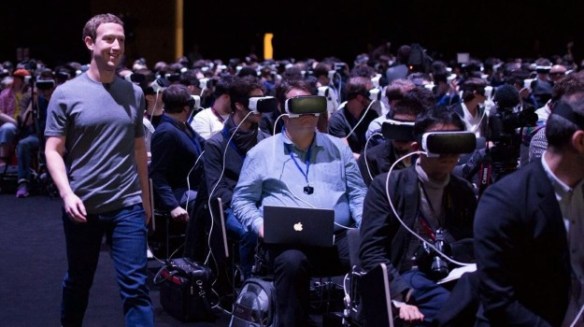
zuckerberg_VR_people-625x350

By Alfie Brown

Source: ROAR Magazine

Last year, Stanford University published a study confirming what many of us may long have suspected: that your computer can predict what you want with more accuracy than your spouse or your friends. Your digital footprint betrays the truth not only about what you “like” but about what you really like — or so the argument goes. But what if our digital footprints, besides revealing our desires, are also responsible for the very construction of these desires? If that were the case, we would need to display a far deeper level of suspicion towards the complex patterns of corporate and state control found in contemporary cyberspace.

There is little doubt that innovations in mobile technologies are part of emerging methodologies of social control. In particular, games and applications that make use of the Google Maps back-end system — including Uber, Grindr, Pokémon Go and hundreds of others — which should be seen as one of the most important technological developments of the last decade or so, are particularly complicit in these new regulatory practices. Putting the well-publicized data collection issue aside, such applications have two powerful ideological functions. First, they construct the new “geographical contours” of the city, regulating the paths we take and mapping the city in the service of both corporate interest and the prevention of uprisings. Second, and more unconsciously, they enact what Jean-Francois Lyotard once called the “desirevolution” — an evolution and revolution of desire, in which that what we want is itself now determined by the digital paths we tread.

The Psycho-Geographical Contours of the City 

In 1981, the French theorist Guy Debord famously wrote of the “psycho-geographical contours” of the city that govern the routes we take, even when we may feel we are wandering freely around the physical space. At that time, it was Debord’s topic — architecture — that was the dominant force in re-organizing our routes through the city. Today, however, that role is increasingly taken up by the mobile phone. It is Uber that dictates the path of your taxi, Maps that dictates the route of your walks and drives, and Pokémon Go that (for a summer at least) determined where the next crowd would gather.

Other similar map-based application programing interfaces, or APIs, dictate our jogging routes (MapMyRun), our recreational hikes (LiveTrekker) and our tourist activities (TripAdvisor Guides). Pokémon Go attracted some publicity because it accidentally and humorously gathered crowds in weird places, but this should only alert us to its potential ability to gather crowds in the right places (to serve corporate interest) or to prevent the gathering of crowds in the wrong ones (to prevent organized uprisings, for instance). Such applications should be seen as a testing phase in the project of Google and its affiliated corporations as they work out how best to regulate the movements of large populations via their phones. Pokémon Go players were the early cyborgs, complete with hiccups and malfunctions — a beta version of Google’s future human. These future humans will go where instructed.

On a smaller scale, this point can be seen in concrete terms with a case study of London. A recent Transport for London talk discussed the possibility of “gamifying” commuting. In order to facilitate this possibility, Transport for London have made the internet API and data streams used to monitor all London Transport vehicles open source and open access, in the hope that developers will build London-focused apps based around the public transport system, thus maximizing profit. One idea is that if a particular tube station is at risk of becoming clogged up due to other delays, TfL could give “in-game rewards” for people willing to use alternative routes and thus smooth out the jam.

While traffic jam prevention may not seem like evidence that we have arrived in the dystopia of total corporate and state control, it does actually reveal the dangerous potentiality in such technologies. It shows that the UK is not as far away from the “social credit” game system recently implemented in Beijing to rate each citizen’s trustworthiness and give them rewards for their dedication to the Chinese state. While the UK media reacted with shock to these innovations in Chinese app development, a closer look at the electronic structures of mapping and controlling our own movements shows that a similar framework is already in its development phase in London too. In the “smart city” of the future, it won’t just be traffic jams that are smoothed out. Any inefficient misuse or any occupation of public space deemed dangerous by the authorities can be specifically targeted.

The Corporate Surveillance State

When it comes to these developments in technology, state and corporate forces work more closely with each other than ever before — and much more closely than they are willing to admit. Srećko Horvat has pointed out the short distance between the creators of Pokémon Go and Hillary Clinton, despite her odd and unsolicited recent public claim that she didn’t know who made the game. Likewise, Julian Assange’s strangely under-discussed 2014 book When Google Met WikiLeaks showed the shocking proximity of Google chief Eric Schmidt and the Washington state apparatus. In terms of surveillance and the use of big data, it has become impossible to sustain the distinction between state control and the production of wealth, since the two have become so irrevocably intertwined. As such, old arguments that “it’s all just about money” need to be treated with greater suspicion, since major firms today are so closely tied to the state. Various aspects of state organization should likewise be considered equally suspect because of their corporate underpinnings.

Of course, when it comes to the mapping applications that promise to help us access the best quality objects of our desire with the greatest efficiency and the least cost, these tempting forces of joint corporate and state control are entered into willingly by participants. As such, they require something else in order to function in the all-consuming way that they do. Far from simply channeling and transforming our movements, they also need to channel and even transform our desires.

We are now firmly within the world of the electronic object, where the mediation of everything from lovers and friends to meals and activities via our mobile phones and computers makes it virtually impossible to separate physical from electronic objectivity. Whilst the electronic Pokémon or the “in-game rewards” offered by many applications may not yet have the physicality of a lover who can be accessed via Tinder, or a burger that can be located via JustEat, the burger and the lover certainly have the electronic objectivity of the Pokémon. We can therefore see a transformation in the objects of desire taking place by and through our devices, so that we are confronted not only with a change in how we get what we want, but with a change in what we want in the first place.

Italo Calvino once wrote of the “amorous relationship” that “erases the lines between our bodies and sopa de frijoles, huachinango a la vera cruzana, and enchiladas.” While in such a moment food and lover become one in a kind of orgy of physical consumption, in the same novel Calvino warned of a time “when the olfactory alphabet, which made them so many words in a precious lexicon, is forgotten,” and in which “perfumes will be left speechless, inarticulate, illegible.”

It is this world that we find ourselves desiring in, where an orgy of electronic objects with no olfactory physicality blurs the distinction between lovers, meals and “in-game” rewards. The purpose of this shift, of course, is to increase the power of technological corporations by giving them a new sort of control over the way we relate to our objects of desire. If the boundaries between the way we search, desire and acquire our burgers, lovers and Pikachus are dissolving, it is not so much the old point that everything has become a commodity, but a new point that this kind of substitutional electronic objectivity endows corporate and state technologists with unprecedented power to distribute and redistribute the objects of the desire around the “smart city.”

Data Centralization in China and the West

There is, moreover, a significant centralization of power underpinning these developments. Like the social credit idea, the Chinese phenomenon of WeChat — developed in 2011 by Tencent, one of the largest internet and mobile media companies in the world — has received concerned media coverage in the West. WeChat is the first truly successful “SuperApp,” the basic premise of which is that all applications like WhatsApp, Facebook, Instagram, OpenRice, Tinder, TripAdvisor and many more, are rolled into one cohesive application. All for our convenience, of course.

As a result, however, there is now a new level of cohesion between the data-collection and movement monitoring going on in the mobile phone as a whole, where all data is now directly collected in a single place. More than half of the 1.1 billion WeChat users access the app over 10 times per day, and many users simply leave it on continuously, using it to map, shop, date and play. This means that the app sets a new precedent for continually monitoring the movements of a whole nation of citizens. WeChat’s incredibly strange “heat map” feature actually lets users — and authorities — see where crowds are forming. The claim is that this has nothing to do with crowd control: the objective is simply to help us access the least crowded shopping malls, doing nothing more than helping us get what we want.

WeChat is already the most popular social media application in China, but it will soon have huge significance worldwide, with an international version now available and many replica “SuperApps” in production. What the Western media finds to be so concerning about WeChat is once again something that already exists here in the West, at least in beta form, without us knowing it. WeChat actually offers us a glimpse into an Orwellian future in which companies and governments can track every movement we make. While in China the blocking of Google means that WeChat uses Baidu Maps as its API, the international version of WeChat simply taps into Google Maps, showing just how deeply integrated these corporate technologies already are.

What emerges from Western media coverage of these developments is the continued insistence on an apparent division between the public and the private sphere in the United States and Europe. When it comes to digital surveillance and the monitoring of movement, the situation is almost certainly better in the West than it is in China at this moment. Yet from an analysis of recent developments in China we learn not only that we need to be attentive to similar dangers here in the West, but also that there are powerful ideological mechanisms at play to obscure these developments by presenting China and the US as fundamentally opposed to one another. Whilst in China the links between the new SuperApps and the state are commonly accepted, in the US the illusion of privacy remains paramount. Although data is often shared between different corporations and between the public and the private sectors, this fact is generally obscured. The continued expressions of shock at the more openly centralized state control visible in China serve only to further consolidate the impression that these things are not happening in the US and Europe.

Furthermore, WeChat reveals more than the dangers of mass data collection and new levels of technological surveillance. It also embodies the power of the phone over the objects of desire. Since one single app can successfully market us food, lovers, holidays, events, blogs and even charities, the connections between such “objects” become more important than the differences. While the structural similarities between Grindr, Pokémon Go and OpenRice become apparent via analysis of both their surfaces and back systems, WeChat makes the connections plain to see. The various forms and objects of each individual’s desire no longer represent discreet and separable elements of a subject’s life. Instead we enter a fully cohesive libidinal economy in which we are increasingly regulated and mapped via the organization of what and how we desire.

The Desirevolution

So what do we do when faced with this revolution — a technological revolution that is not overthrowing any existing power structures but rather transforming the world in the service of private corporations and the state? Often, the response of those concerned by such developments is to express hostility or distrust towards technology itself. Yet to break this corporate organization of desire, we need not nostalgically yearn for a desire that is free of politics and technology, for no such desire is possible. On the contrary, what we need is to recognize that desire is necessarily and always controlled by both politics and technology.

This awareness would be the first step towards ensuring that the centralized corporate and state organization of desire malfunctions — and, ultimately, it would be the first step towards its potential reprogramming. The corporate desirevolution depends on our blindness to the politics of its technologies, asking us to experience our desires as spontaneous yearning and our mobile phone and its powerful apps as just tools for our convenience, helping us get what we want in the easiest way possible. We need to recognize that this is far from the case. The principal concern of those who own the apps — perhaps even more powerful than data collection — is to transform desire itself. At the very least, we can make visible the complicity of such technologies in producing the perfect conformist modern citizen.

Are We Humans Terminally Insane or Just Waking Up?

Brain waves

By Paul Levy

Source: Reality Sandwich

The following article was originally published on Awaken in the Dream


“The world today hangs by a thin thread, and that thread is the psyche of man.”
– C. G. Jung

How does anyone possibly express in words the state of collective madness that humanity has fallen into at this time in our history? As if in a hypnotic trance, our species is enacting a mass ritual suicide on a global scale, rushing as fast as we can towards our own self-destruction. We are destroying the biospheric life-support systems of the planet in so many different ways that it is as if we are determined to make this suicide attempt work—using a variety of methods as a perverse insurance policy, in case a couple of them don’t do the job. What modern-day humanity is confronted with, to quote the author and Trappist monk Thomas Merton, is “a crisis of sanity first of all.”

In trying to find a way to write about this state of affairs, I find myself going “off-planet,” imagining what it would look like if some enlightened aliens, in their travels throughout the universe, came upon our planet. Observing from a distance, they would naturally see all the various living beings who call planet earth home as related members of one larger organism—a single eco-system—who literally depend upon each other for survival. From this vantage point, I imagine, they would be utterly baffled at why human beings—the seemingly most intelligent species ever to appear on planet earth—are acting out their destructive impulses practically without restraint in every corner of the globe. Contemplating the state of humanity, I imagine these awakened beings wondering, “What in the world has gotten into them?”

I imagine these illumined aliens, in agreement with Merton, would quickly conclude that human beings had become afflicted with some sort of psychological illness, a disease of the mind and soul that has caused us to turn on ourselves in self-and-other destruction. Apparently in a “fallen state,” we have lost our way, become disoriented, and, in our confusion, become quite deranged. It is as if our collective madness is so overwhelming—and by now so familiar and so normalized—that most of us, its sufferers, have no idea how to even think about it, let alone how to deal with it. Not knowing what to do, many of us inwardly dissociate—which only exacerbates the collective madness—and in our fragmented and disempowered state go about our lives in a numbed-out, zombie-like trance, making the best of what seems to be a bad situation.

The question naturally arises: how would these enlightened beings conspire with us to help wake us up? We can only imagine. For our part, it seems essential that we ask questions such as: what is the nature of this madness, and how can it be consciously engaged so that humanity can get back on the right track?

Seen as an organism, there is a systemic psycho-spiritual disease that has infected the whole body politic of humanity. At present we are having an acute—and potentially deadly—inflammation of this illness. As with any disease, in order to cure the pathology that ails us we must come up with the right diagnosis. Under the present circumstances, it is a healthy response for us to have an appropriate level of alarm. If we aren’t “alarmed” at what is happening in our world, we are still sleeping.

Economy

It’s difficult to appreciate how our behavior might appear strange—let alone completely insane—to an impartial observer. But engaging in a “benign onlooker” thought experiment—in this case, through the imagined insights of enlightened aliens—affords us some much-needed perspective. Even from this vantage point, though, the collective madness that humanity is acting out is hard to fathom. It is truly as if the inmates are running the asylum.

The first thing these aliens might perceive is a single living organism in crisis. What makes life itself possible is that every cell and organ of a living organism plays a uniquely vital role to the life and health of the greater organism; each part works together as part of an integrated and interdependent whole system. Our planet and its biosphere is a seamlessly interconnected whole system that operates as a macro-organism, and yet its supposedly most intelligent species has set up a global system for managing its rich diversity of natural resources that would kill a living organism in no time if such a system were implemented within the individual bodies of any of its members. If the human body was organ-ized and operated in a similar way to the global economy—where certain parts of the system demand disproportionate and ever-increasing shares of the existing resources—the body would die in no time.

At the heart of this reality is the fact that the way the global economic system has been crafted primarily serves the interests of the very few. Machine-like, “the system” relentlessly, and increasingly, sucks, drains and redistributes wealth from the majority of the populace—who more and more become impoverished and practically enslaved—into the hands of the already unthinkably wealthy. The powers-that-be then use coercive power to not only deny people the means to make even a subsistence living, but even denies them the basic human right to life on massive scales. This system doesn’t just passively allow people to fall below the poverty line, it actively pushes them under, as if poor people are being intentionally “left behind.” The most powerful and successful financial institutions have taken on the form of parasitic enterprises that have attached themselves to governments and people around the world, upon which they shamelessly and ravenously engorge themselves. These illumined aliens, with their clairvoyant vision, would surely find it revealing that the ones who own the wealth are—like vampires—energetically “feeding” off of the ones who barely have enough to eat.

The evidence is overwhelming. The current global economic system has brought us to a point where an incredibly small minority of human beings own a grossly disproportionate percentage of the planet’s resources. According to recent figures, the 62 richest people on the planet have more wealth than the poorest half of the global population combined, and over time this imbalance is increasingly getting worse. This is globalization at work. Much of this rising inequality is a direct result of the fact that globalization is the process by which multinational corporations are taking over sovereign governments—of the 100 largest economies in the world, over half are corporations.

These challenging economic times we live in are simultaneously the times of the greatest profits in all of history for certain select corporate conglomerates. Those at the top of the economic pyramid then use this ever-increasing gap between the rich and the poor to further game the system—itself riddled with corruption—so as to protect their advantage even more. The United States government in particular, instead of being a “government of the people, by the people, for the people,” has instead become a plutocracy—a government “of the rich, by the rich, for the rich.” It should get our attention that such economic stratification into the have and have-nots historically plays a crucial role in the collapse of civilizations.

These aliens would recognize that earth’s current way of “doing business” is unsustainable. Instead of creating value and wealth for the good of all, the way business is done on planet earth is actually destroying the genuine wealth and health of the whole system, with people, communities and the environment considered to be nothing more than collateral damage—all for the benefit of a small minority. If humanity is viewed as a family, there is abuse of power being perpetrated within the family system for the simple reason that those in the positions of power can act with total impunity and, in a case of “moral insanity,” can—and do—literally get away with murder.

These benign aliens would find it revealing that such a large percentage of earth’s resources—including humanity’s intrinsic ingenuity—instead of being used to care for each other and enrich life, are being used to create more potent and deadly weapons of mass destruction. In other words, humanity’s divinely inspired genius is being channeled into ever-more efficient ways of murdering each other! We have become conditioned to accept this astonishing cruelty and destruction as normal. We spend trillions of dollars to sustain a state of endless war against God knows who, while at the same time innumerable of our fellow brothers and sisters are impoverished and dying of starvation every day. These spiritually awake beings would realize that the destruction that humanity is playing out in the world is an unmediated reflection of an imbalance deep within the collective human psyche.

From the meta-perspective of the enlightened aliens, the behind-the-scene financiers who on the surface are benefitting the most from this diabolical set-up are themselves merely puppets in the hands of some darker forces that are informing the whole enterprise. To use writer Matt Taibi’s infamous phrase, a “vampire squid” is running rampant and feasting on the living body of humanity. To quote eminent theologian David Ray Griffin, “It does seem that we are possessed by some demonic power that is leading us, trancelike, into self-destruction.” Similarly, the Bible points out that our fight is not against “flesh and blood” (i.e., human forces), bot rather, against “powers and principalities” (spiritual forces). These forces are not only acting themselves out in our world, but are simultaneously interfacing with and covertly operating through our own minds.

It is as if we have become possessed by a self-created Frankenstein monster that is running amok, wreaking untold havoc all over the planet. This Frankenstein monster has seemingly gained a quasi-life and autonomous will of its own, independent of its creator—us—who it holds in its thrall, as we are unable to escape from the out-of-control hell of our own making. In any case, it certainly seems as if there is a force that is hell-bent on stopping us—both individually and collectively as a species—from reaching our full creative potential.

We are at a severe “crisis” point in our world, which, medically speaking, always tells us that our sickness has reached a dangerous climax. Our species is suffering from what the great doctor of the soul C. G. Jung calls a “sickness of dissociation,” which is a state of fragmentation deep within the collective unconscious that has seemingly spilled outside of our skulls and is playing itself out en masse on the world stage. This primordial rupture, which is a form of trauma on a cosmic scale, has become the in-forming force behind human history itself, conditioning the experience of each individual, as well as our species as a whole. Seen as a whole person, it is as if the undivided wholeness of the universe has split into cosmic multiple sub-personalities who are dissociated from and seemingly separate from each other, desperately in need of recognizing their connection so as to come together and reintegrate. Our sickness of dissociation and the world crisis we are facing as a result can be seen, as Jung points out, as the labor pains of a new birth.

Wetiko

Author and environmental activist Derrick Jensen writes in his foreword to the classic book Columbus and Other Cannibals by Native American scholar Jack Forbes, that it is “the most important book ever written on one of the most important topics ever faced by human beings: why is the dominant culture so excruciatingly, relentlessly, insanely, genocidally, ecocidally, suicidally destructive?” Oftentimes, the most important point in finding a solution to a problem is asking the right question; Jensen’s question feels like the right question, a question literally demanding to be answered.

Forbes’ book beautifully elucidates the Native American idea of “wetiko psychosis,” which can be likened to a mind virus that has infected the human psyche.[1] Jung never tired of pointing out that the greatest danger which threatens humanity comes from the psyche. We are living with the very real possibility that millions—maybe even billions—of us can fall into our unconscious together, reinforcing each others’ madness in such a way that we become unwittingly complicit in our own self-destruction. An inner disease of the soul, wetiko flavors our perceptions by stealth and subterfuge so as to act itself out through us while simultaneously hiding itself from being seen. Being an illness that afflicts the psyche itself, wetiko—a term connoting the spirit of evil—is a psycho-spiritual disease of the soul, a disorder of consciousness existing deep within the collective unconscious of humanity that is playing out writ large on the world stage. Like a cannibal, those taken over by wetiko—also called “cannibal sickness”—consume the life force of others, both human and nonhuman, for private purpose or profit, and do so without giving back anything of real value from their own lives.

The idea of wetiko can be enormously helpful in creating a wider context that can assist us in getting a handle on the mass insanity that is playing out in our world today. Though using individuals as its instruments, wetiko—a “collective psychosis”—can’t replicate itself; it needs the unconscious masses for its genesis and proliferation on the world stage. Wetiko psychosis is highly contagious, spreading through the channel of our shared unconsciousness, rendering us oblivious to our own madness. This fluidly moving, nomadically wandering bug reciprocally reinforces and feeds off and into each of our unconscious blind spots, which is how it nonlocally propagates itself throughout the field. A psychic epidemic, wetiko is at the bottom, at the very root of the seemingly never-ending destruction we are wreaking upon ourselves, each other and the very biosphere we depend upon for our survival as a species.

Every wisdom tradition throughout history has been pointing at wetiko in its own unique way. The Gnostics (“the ones who know”), for example, were pointing at wetiko when they spoke of the “Archons,” who they thought of as “mind parasites” which had infiltrated the human mind. The Nag Hammadi text called The Apocryphon of John II describes these Archons, “They sought to overpower humanity in its psychological and perceptual functions…their triumph is in deception.” Wetiko/the Archons occlude us in such a way that our occlusion becomes self-perpetuating, the result being that we can’t even tell we are occluded. Wetiko bedazzles, bewitches, and bedevils consciousness so that we become blind to the underlying, assumed viewpoint through which we perceive, conjure up and give meaning to our experience of both the world and ourselves. An intrinsic challenge to our investigation of the wetiko virus, therefore, is that it is incarnating in and through the very psyche which itself is the means of our inquiry. In our encounter with wetiko, we find ourselves in a situation where we are confronted—practically face-to-face—with the unconscious.

As Jung has pointed out, when it is a question of mass psychosis, nothing but “new symbolic ideas,” i.e., novel, creative, redemptive, archetypal conceptions, brought up from the depths—which embrace, express and help to re-contextualize the emerging chaos and disorder—can save us from the impending catastrophe. This is to say that in light of our current world crisis, a new creative achievement has become a necessity. The concept of wetiko and all that it stands for is precisely such a “new symbolic idea.” What Plato calls “the eyes of the soul,” ideas have real power, as they are the means by which we see the world and creatively envision and give meaning to our lives.

Being a disease of the soul, we all potentially have wetiko, as it pervades and in-forms the underlying field of consciousness. Any one of us at any moment can fall into our unconscious and unwittingly become an instrument for the evil of wetiko to act itself out through us and incarnate in our world, which is a realization that cultivates humility while simultaneously serving as an inoculation against wetiko’s pernicious effects. If we see someone who seems to be taken over by wetiko and we think that they have the disease and we don’t, we have then fallen under the spell of the virus, as wetiko feeds on the inner, psychological process of shadow projection which underlies and informs our experience of separation, polarization and the paranoid fear—and terror—of “the other.”

Wetiko can be conceived of as a cancer of the psyche that slowly metastasizes, gradually subsuming all of the healthy parts of the psyche into itself to serve its sinister agenda. The personality then becomes one-sided, self-organizing an outer display of coherence around this pathogenic core, which masks the inner dysfunction, making it hard to recognize. In a psychic coup d’état, the wetiko bug can usurp and displace a person, who becomes its puppet and marionette. Like a parasite, the wetiko virus can take over and subvert the will of an animal more evolved than itself, enlisting that creature into serving its nefarious agenda. The psychological fact of being taken over by something “other” than ourselves finds expression in the belief in demons and their ability to possess humans, a belief found among all peoples from time immemorial.

Once the wetiko virus becomes sufficiently entrenched within the psyche, the prime directive coordinating a person’s behavior comes from the disease, as it is now the one in the driver’s seat. As it commandeers and colonizes the psyche—centralizing power and control in the process—wetiko eventually incorporates a seemingly autonomous regime within the greater body politic of the psyche. Once it gains a sufficient sovereignty, wetiko forms something like a totalitarian “shadow government” within the psyche which dictates to the ego. Being an archetypal, transpersonal and daemonic energy, wetiko can not only take over an individual, but also a group of people, a nation or even—potentially—an entire species.

Wetiko is especially unique, in that, though an inner disease of the soul, it is able to inform, give shape to and configure events in the outer world so as to synchronistically express—and reveal—itself. For example, as if the boundary has dissolved between the inner and the outer, the internal landscape of the wetikoized psyche is mirrored in the external world through the totalitarian-like “shadow government”—with its ever-increasing centralization of power and control—that has taken over our seeming democracy. Both within our psyche and in our alleged “democracy,” we are allowed our seeming freedom, but only so long as it doesn’t threaten the sovereignty and dominance of the “ruling” power (interestingly, the word “Archon,” a synonym for wetiko, means “ruler”).

Wetiko covertly works through the projective tendencies of the mind to distract us, keeping our attention directed outside of ourselves, thereby obstructing us from finding and utilizing the immense light of intrinsic awareness within, which would “kill” wetiko, rendering it impotent. The “Buddha” (which means one who has woken up to the dreamlike nature of reality) realized in his enlightenment that the solution to the human predicament could never be found externally, but had to be discovered within the very nature of one’s own mind. If we don’t realize that our current world crisis has its roots within, and is an expression of, the human psyche, we are doomed to unconsciously repeat it, continually re-creating endless destruction in more and more amplified form—as if we are having a recurring dream. Our nightmare will then be fated to continue with ever-alarming intensity until we receive its message.

Wetiko can easily trick and deceive us by materializing itself in, as, and through the medium of the outside world, which we then assume—as if entranced—is distinct from our psyche. Once the ever-increasing sociopolitical insanity plays itself out on the world stage, we have all the proof we need that the conflict is outside of ourselves. It then becomes nearly impossible to convince anyone that the source of the conflict is to be found within the psyche of every individual. The psyche has then become exteriorized, as an internal psychic conflict takes place by way of projection in the outside world in living (and dying) flesh and blood. The sponsor of the whole project(ion), the wetiko bug remains behind-the-scenes, invisible and unnoticed.

Wetiko subversively turns our “genius” for reality-creation against us in such a way that we literally become entranced by our God-given power to create our experience of both our world and ourselves so that it boomerangs against us, undermining our potential for individual and collective evolution. Strangely enough, people under the enchantment of wetiko become compulsively, even fanatically, attached to supporting a social or political agenda that oftentimes is diametrically opposed to serving their own best interests. This self-sabotaging behavior is an outer reflection of the inner state of being under the sway of —and unwittingly serving—the self-destructive wetiko parasite.

An aberration of the psyche, wetiko cannot be ultimately healed by merely bringing about external reforms (although such reforms are welcome and needed); it must be dealt with where it originates—within the human psyche of each individual. Wetiko can’t be “legislated” out of existence via political or social means, but can only be transformed within the individual, who, as Jung reminds us, is the real carrier of life.

To the extent we are unconsciously possessed by the spirit of wetiko, it is as if a psychic tapeworm or parasite has taken over our brain and tricked us, its host, into thinking we are feeding and empowering ourselves while we are actually nourishing the parasite. Wetiko is a virulent, psychic pathogen that insinuates thought-forms and beliefs into our mind which, when unconsciously enacted, feed it, and ultimately, like a fatal addiction, kill its host—us. Beyond informing our addictions, wetiko psychosis is itself the addictive process taking living form so as to take life.

Savaged by the ferocity of their unending hunger, people who are sufficiently infected by the wetiko virus, like the hungry ghosts of Buddhist cosmology, have become possessed by an insatiable craving that can never be filled. Not in possession of their true selves, they try to possess something outside of themselves to both escape from and fill the void within—the result is a futile and never-ending grasping. Attempting to secure a self that by its very nature is illusory and thus can never be secured, their appetites can never be quenched, just as an illusion can never be satisfied.

At the collective level, this perverse inner process is mirrored in the outer world by the consumer society in which we live, a culture that continually fans the flames of never-ending and mostly unnecessary desires, conditioning us to always want more. As if starving, we are in an endless feeding frenzy, trying to fill a bottomless spiritual void. In this regard, wetiko can be likened to a psychic eating disorder.

If the planet were seen as a single organism, and people seen as cells in the greater organism of the planet, it would be as if these cells had become cancerous or parasitic, and had turned on themselves, destroying the very organism of which they are a part. Wetiko can be compared to an autoimmune disease of the psyche that is getting collectively acted out, writ large on the world stage. In autoimmune deficiency syndrome, the immune system of the organism, in its attempt to protect itself against perceived attacks, attacks projected aspects of itself that falsely appear to be “other,” leading, ultimately, to its own self-destruction. Bewitched by its own projections—as if hypnotizing itself—the autoimmune system of the wetikoized psyche has fallen under its own self-created illusion and in its state of confusion and trauma, is tricked into creating the very problem it is trying to resolve. One glaring example of how this internal process is getting acted out in the external world: the way our nation is fighting terrorism is creating ever-more terrorists, as if in fighting a fire we are pouring fuel on it.

Once the wetiko virus takes root in our minds and incorporates itself in the world, it “manages our perception” by framing the terms of our inner and outer dialogue through determining the metaphors which dominate the accepted historical narrative, thus controlling the parameters of our conversation and debate. The consensually agreed-upon thought-forms and beliefs act as an intrinsic, built-in control system, defining the limits of what we imagine our possibilities are, as individuals, nations and a species. If we don’t consciously tap into and use the power of our creative imagination, others, particularly “the state,” will be more than happy to do so in our stead.

Just like vampires, full-blown wetikos have a thirst for the very thing they lack—the mystical essence of life—that is, the “blood” of our soul. Wetiko is a deceptive spirit that apes, mimes and imitates the real thing—called the Antimimon pneuma(literally, “counterfeiting spirit”) in the Apocryphon of John (Apoc. John III, 36:17). Impersonating us, if we identify with wetiko’s false version of ourselves, we have then identified with who we are not while simultaneously disconnecting from—and giving away—who we actually are. We then become a duplicate, a copy of ourselves, losing touch with the original.

Wetiko is an expert at imitation, but it has no creativity on its own. Once it “puts us on,” i.e., fooling us into buying into its version of who we are, it can then piggyback onto and plug into our intrinsic creativity, co-opting our creative imagination to serve its malevolent agenda. When we fall under wetiko’s spell, our life-force and God-given creativity become vampirically drained, as we are bled dry of what really counts.

This situation is a reflection of what happens when wetiko infects an organism (be it a person or species)—certain aspects within its bio-system become starved. In essence, when we are under the thrall of wetiko, the creative spirit within us, the very function which connects us to something beyond ourselves, becomes malnourished and impoverished. We then can’t even imagine things being any other way, let alone being able to actively imagine a way out of our dilemma. This points to the profound importance for each of us to intimately connect with the creative spirit living within us as a way of abolishing wetiko’s death sentence.

Many of the institutions in our world are embodiments of the formless wetiko virus taking on corporeal—and incorporated—form. The counterfeiting spirit of wetiko, a true imposter, imitates something but—in a process known as countermimicry—with the intention of making the copy, the fake version, serve a purpose counter to that of the original thing or idea. For example, the entity of the global economic system itself is a living symbol of wetiko disease “in business.” A “real” economy has to do with the production and distribution of goods and services—generating wealth in the process—while the virtual “bubble economy” that we living in is mainly an exercise in profiting from the manipulation of money—draining real wealth in the process. It is as if wetiko has managed to create a simulation of the real economy, replacing the real thing with a copycat version (what I call the “wetikonomy”) that has inverted its original purpose. This is a reflection in the outer world of the covert operations of wetiko within our minds.

Finding the Name

Our collective psychosis is invisible to us, manifesting itself both in the way we are looking at the world as well as the unspoken ways we have been conditioned—i.e., programmed—to not perceive. Wetiko has the power to induce—both individually and en masse—what writer Philip K. Dick calls a “negative hallucination,” i.e., instead of seeing what is not there, we cannot see what isthere. When we are afflicted with wetiko, we literally are unable to see what is right in front of our face. Wetiko is a form of psychic blindness that not only believes itself to be sighted, but believes it is more sighted than those who are actually clear-sighted. This looking away, this “conspiracy of denial” that is endemic to our culture is simultaneously both the cause and effect of wetiko.

Because wetiko is a psychic blindness, the cure for wetiko starts with seeing it—both seeing how it operates in the world and also tracking how it covertly operates within our own minds. In the medical model we describe the various pathogens that make us sick as cancers, bacilli, parasites, plagues, viruses, etc.. Due to the materialistic culture we live in, we are attached to the idea that for something to have “reality” it must be made of a material substance. The implication of this perspective is that if something is not physical it is not real, which disables our capacity to see wetiko. Though “immaterial,” wetiko is as real as we are.

We have to name something, however, before it can be seen, formally “discovered,” and brought into our shared collective cartography. To quote Jung, “For mankind it was always like a deliverance from a nightmare when the new name was found.” Mythologies and fairy tales the world over have been expressing this from time immemorial—finding the name of the offending demon takes away its power over us. This is why it is important to introduce the word “wetiko”—and the idea it represents—into our planetary dialogue.

Once we become more acquainted with the idea of wetiko and all that it entails, we can “spread the word”—creating a new meme in the process—thus conjuring up a living antigen to the heretofore unrecognized mind virus of wetiko. For nothing is more powerful than an idea whose time has come—wetiko is just such an idea, pregnant with new possibilities. Similar to how a vampire hates the light of day, however, the wetiko virus can’t stand to be illumined, for in seeing how wetiko covertly operates through our own consciousness or lack thereof, we not only take away its seeming autonomy and power over us, we empower ourselves.

Seeing the correlation between the inner and the outer—which is to say, seeing the dreamlike nature of reality—is the doorway through which we develop the requisite vision to see wetiko. In a dream, the inner psyche of the dreamer is expressed through, and is therefore not separate from, the outer forms of the dream. Similar to a dream at night, in the waking dream called life, events in the outer world symbolically—and synchronistically—express the inner psychological situation of the dreamer, which is all of us. We don’t have to try to create or fabricate this correlation between the inner and the outer; rather, we simply have to recognize it, for it is always already the case. Once we realize the dreamlike nature of our situation, we have started to develop the eyes to see wetiko, and hence, dispel its malevolent effects. We have then broken the seeming curse we have fallen under (please see my book Dispelling Wetiko: Breaking the Curse of Evil).

A Catalyst for Human Evolution

People taken over by wetiko—a word Jung never used, but in his writings he referred to the same idea by the phrase “totalitarian psychosis”—are often attracted to positions of power, where, as if compelled by forces beyond themselves, they can’t help but to create scorched earths as outer correlates to the inner ravaged landscape of their souls. Insanely enough, many of the people who are most taken over by wetiko are not in asylums, but are freely running around (and running) the world, oftentimes established in positions of great power to influence world events.

Fueled by the myopic vision that prioritizes the bottom line of corporate-driven profits above anything else, people motivated by the greed of the wetiko virus have little meta-awareness of the long-term and whole-system implications of their rapacious actions. All that the wetiko bug craves is to satisfy its narcissistic desires, experience orgasmic release, and glory in the seeming victory of short-term profits. Hiding behind the deceptive banner of “progress,” the Frankenstein monster of ever-enlarging empire, with its incessant, greed-driven need for endless growth, is like a runaway locomotive gaining speed, approaching the catastrophic event horizon of its inevitable crash. Meanwhile, this “progress” destroys people, families, communities and threatens our entire species, as we potentially trigger a “sixth mass-extinction event.”

At the heart of wetiko is our identification with and subsequent grasping onto an illusory “me,” a seemingly separate, independent self which doesn’t actually exist in the way we think it does. Clinging onto this false sense of self—a “lethal mirage” that becomes a self-perpetuating addictive process with a life of its own—our life-force then gets continually invested into protecting, defending and maintaining an illusion. Identifying with a self-constructed illusion whose originating conditions remain obscure is the stuff of which madness is made.

Reciprocally co-arising with the subjectively convincing and self-validating feeling of a separate “I” is the feeling of “mine,” the sense that this “I” can possess and own things. Modern humanity is, in Walt Whitman’s phrase, “demented with the mania of owning things.” We insanely devote so much of our time and energy—our precious human life—in trying to obtain material goods that we really don’t need and that bring no real benefit to us. Speaking of the white man, Chief Seattle said, “His appetite will devour the earth and leave behind only a desert.” Along similar lines, Sitting Bull said, “the love of possession is a disease with them.” This love of possessing things to fill a void that can never be filled is wetiko disease in a nutshell.

Wetiko is a collectively “dreamed up” phenomena in which we are all ultimately implicated. This means that—at least in theory if not in practice—we have the capacity to dream it differently. In other words, because we’ve created wetiko, we can “un-create” it. We don’t yet know how to do this, however, or we wouldn’t be continuing to create it in a way that is destroying us. Our unconscious process of dreaming up wetiko in all its full-blown destructiveness is the way we are teaching ourselves how to not destroy ourselves, which we evidently haven’t yet learned or we wouldn’t be destroying ourselves. The fact that we wouldn’t have realized how to not destroy ourselves without wetiko’s arrival on the scene is to say that the seeming curse of wetiko actually has a hidden blessing secretly encoded within it.

Wetiko is a quantum phenomenon, in that it contains superposed within it both the deepest darkest evil imaginable, while hidden within it is its own medicine. Encoded within wetiko’s pathology is not only its own cure but a precious gift, as it can—in true quantum style, “potentially”—introduce us to our own agency in calling forth our experience of both the world and ourselves. In other words, the wetiko epidemic is revealing to us our nature as empowered co-dreamers/creators of a universe that is more malleable, plastic and dreamlike than we have previously imagined.

Similar to how the unconscious compensates a one-sidedness in the psyche through the dreams it sends our way, the totalitarian psychosis/wetiko running rampant throughout the world today is the psyche’s way of revealing to us that we are forgetting the crucial role it plays in creating our experience. Marginalizing our own authorship and authority, we then dream up totalitarian forces to limit our freedom and create our experience for us. The “totalitarian psychosis” known as wetiko is, in Jung’s words, “forcing us to pay attention to the psyche and our abysmal unconsciousness of it. Never before has mankind as a whole experienced the numen of the psychological factor on so vast a scale.” Literally demanding that we pay attention to our own psyche, wetiko is thus the greatest catalyst for human evolution that our species has ever encountered.

Wetiko can literally destroy our species through wrenching poverty, endless war and catastrophic environmental destruction. Or, if confronted, named and understood, it can introduce us to the dreamlike nature of reality, which changes everything. Wetiko is a living revelation that only reveals its gifts to us, however, if we recognize what it is a reflection of within ourselves. How it manifests depends upon how we dream it. The choice is truly ours.

It is as if through the instrument of wetiko, a higher intelligence is revealing to us the wholeness of our totality through our darker side. This darkness is revealing light by contrast to itself. As we recognize that the evil we see playing out in the world is a reflection of our own darkness, we notice that, paradoxically, with our increase in consciousness the good and positive features within us come more to light too. As we more and more recognize the correlation between the outer world with what is going on deep within our soul, the enlightened aliens, who have been signaling to us the dreamlike nature of our situation by synchronistically arranging events in the world to reflect back what’s going on deep within us, hide behind the scenes, laughing.

Lara Trace Hentz

INDIAN COUNTRY NEWS

In Saner Thought

"It is the duty of every man, as far as his ability extends, to detect and expose delusion and error"..Thomas Paine

ZEDJournAI

Human in Algorithms

Rooster Crows

From the Roof Top

Aisle C

I See This

The Free

blog of the post capitalist transition.. Read or download the novel here + latest relevant posts

अध्ययन-अनुसन्धान(Essential Knowledge of the Overall Subject)

अध्ययन-अनुसन्धानको सार