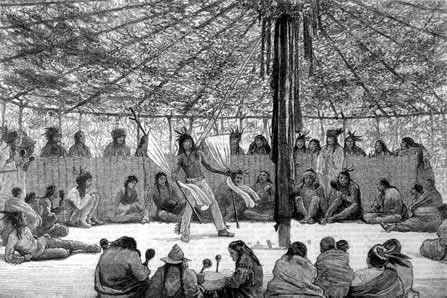
Seeing Wetiko: On Capitalism, Mind Viruses, and Antidotes for a World in Transition

images

By Alnoor Ladha and Martin Kirk

Source: Reality Sandwich

It’s delicate confronting these priests of the golden bull
They preach from the pulpit of the bottom line
Their minds rustle with million dollar bills
You say Silver burns a hole in your pocket
And Gold burns a hole in your soul
Well, uranium burns a hole in forever
It just gets out of control.
– Buffy Sainte-Marie, “The Priests of the Golden Bull”1

What if we told you that humanity is being driven to the brink of extinction by an illness? That all the poverty, the climate devastation, the perpetual war, and consumption fetishism we see all around us have roots in a mass psychological infection? What if we went on to say that this infection is not just highly communicable but also self-replicating, according to the laws of cultural evolution, and that it remains so clandestine in our psyches that most hosts will, as a condition of their infected state, vehemently deny that they are infected? What if we then told you that this ‘mind virus’ can be described as a form of cannibalism. Yes, cannibalism. Not necessarily in the literal flesh-eating sense but rather the idea of consuming others—human and non-human—as a means of securing personal wealth and supremacy.

You may dismiss this line of thinking as New Age woo-woo or, worse, a lefty conspiracy theory. But this approach of viewing the transmission of ideas as a key determinant of the emergent reality is increasingly validated by various branches of science, including evolutionary theory, quantum physics, cognitive linguistics, and epigenetics.

The history of this infection is long, strange, and dark. But it leads to hope.

Viruses of the Mind

The New World fell not to a sword but to a meme.
~ Daniel Quinn2

One of the most well-accepted scientific theories that helps explain the power of idea-spreading is memetics.

Memes are to culture what genes are to biology: the base unit of evolution. The term was originally coined by the evolutionary biologist Richard Dawkins in his 1976 book, The Selfish Gene. Dawkins writes, “I think that a new kind of replicator has recently emerged . . . It is still drifting clumsily about in its primeval soup, but already it is achieving evolutionary change at a rate which leaves the old gene panting far behind.” He goes on, “Examples of memes are tunes, ideas, catch-phrases, clothes fashions, ways of making pots or of building arches. Just as genes propagate themselves in the gene pool by leaping from body to body via sperms or eggs, so memes propagate themselves in the meme pool by leaping from brain to brain, via a process which, in the broad sense, can be called imitation.”3

One of the high priests of rationalism, the scientific method, and atheism, is also the father of the meme of ‘memes.’ However, like all memes or ideas, there can be no ownership in a traditional sense, only the entanglement that quantum physics reminds us characterizes our intra-actions.4

Of course, similar notions of how ideas move between us have been around in Western traditions for centuries. Plato was the first to fully articulate this through his Theory of Forms, which argues that non-physical forms—i.e., Ideas—represent the perfect reality from which material reality is derived.

Modern articulations of the Theory of Forms can be seen in Pierre Teilhard de Chardin’s idea of the Noosphere (the sphere of human thought) and Carl Jung’s Collective Unconscious, where structures of the unconscious are shared among beings of the same species. For Jung, the idea of the marauding cannibal would first be an archetype that manifests in the material world through the actions of those who channel or embody it.

For those who prefer their science more empirical, the growing field of epigenetics provides some intellectual concrete. Epigenetics studies changes in organisms caused by modification of gene expression rather than any physical alteration of the gene itself. In other words, how traits vary from generation to generation is not solely a question of material biology but is partly determined by environmental and contextual factors that affected our ancestors.5

The Wetiko Virus

We did not think of the great open plains, the beautiful rolling hills, and the winding streams with tangled growth as “wild.” Only to the White man was nature a “wilderness” and only to him was the land infested by “wild” animals and “savage” people. To us it was tame. Earth was bountiful and we were surrounded with the blessings of the Great Mystery. Not until the hairy man from the east came and with brutal frenzy heaped injustices upon us and the families we loved was it “wild” for us.
~ Luther Standing Bear, Land of the Spotted Eagle6

Many spiritual traditions, including Buddhism, Sufism (the mystical branch of Islam), Taoism, Gnosticism, as well as many Indigenous cultures, have long understood the mind-based nature of creation. These worldviews have at their core a recognition of the power of thought-forms to determine the course of physical events.

Various First Nations traditions of North America have specific and long established lore relating to cannibalism and a term for the thought-form that causes it: wetiko. We believe understanding this offers a powerful way of understanding the deepest roots of our current global polycrisis.

Wetiko is an Algonquin word for a cannibalistic spirit that is driven by greed, excess, and selfish consumption (in Ojibwa it is windigo, wintiko in Powhatan). It deludes its host into believing that cannibalizing the life-force of others (others in the broad sense, including animals and other forms of Gaian life) is a logical and morally upright way to live.

Wetiko short-circuits the individual’s ability to see itself as an enmeshed and interdependent part of a balanced environment and raises the self-serving ego to supremacy. It is this false separation of self from nature that makes this cannibalism, rather than simple murder. It allows—indeed commands—the infected entity to consume far more than it needs in a blind, murderous daze of self-aggrandizement. Author Paul Levy, in an attempt to find language accessible for Western audiences, describes it as ‘malignant egophrenia’—the ego unchained from reason and limits, acting with the malevolent logic of the cancer cell. We will use the term wetiko as it is the original, and reminds us of the wisdom to be found in Indigenous cultures, for those who have the ears to hear.

Wetiko can describe both the infection and the body infected; a person can be infected by wetiko or, in cases where the infection is very advanced, can personify the disease: ‘a wetiko.’ This holds true for cultures and systems; all can be described as being wetiko if they routinely manifest these traits.

In his now classic book Columbus and Other Cannibals, Native American historian Jack D. Forbes describes how there was a commonly-held belief among many Indigenous communities that the European colonialists were so chronically and uniformly infected with wetiko that it must be a defining characteristic of the culture from which they came. Examining the history of these cultures, Forbes laments, “Tragically, the history of the world for the past 2,000 years is, in great part, the story of the epidemiology of the wetiko disease.”7

We would presumably all agree that behavior of the European colonialists in North America can be described as cannibalistic. Their drive for conquest and material accumulation was a violent act of consumption. The engine of the invading culture suckedin lives and resources of millions of others and turned them into wealth and power for themselves. The figures are still disputed, but it is safe to place the numbers killed in the tens of millions, certainly one of the most brutal genocides in history. And the impact on non-human life was equally vast. Moreover, it was all done with a moral certainty that all destruction was justified in the name of ‘progress’ and ‘civilization.’

This framing belies the extent of the wetiko infection in the invader culture. So blinded were they by self-referential ambition that they could not see other life as being as important as their own. They could not see past ideological blinders to the intrinsic value of life or the interdependent nature of all things, despite this being the dominant perspective of the Indigenous populations they encountered. Their ability to see and know in ways different from their own was, it seems, amputated.

This is not an anti-European rant. This is the description of a disease whose vector was determined by deep patterns of history, including those that empowered Europeans to drive ‘global exploration’ as certain technologies emerged.

The wetiko meme has almost certainly existed in individuals since the dawn of humanity. It is, after all, a sickness that lives through and is born from the human psyche. But the origin of wetiko cultures is more identifiable.

Memes can spread at the speed of thought but they usually require generations to change the core characteristics of cultures. What we can say is that the fingerprints of wetiko-like beliefs can be traced at least as far back as the Neolithic revolution, when humans in the Fertile Crescent first learned to dominate their environment by what author Daniel Quinn calls ‘totalitarian agriculture’ — i.e., settled agricultural practices that produce more food than is strictly needed for the population, and that see the destruction of any living entity that gets in the way of that (over-)production—be it other humans, ‘pests’ or landscaping—as not only legitimate but moral.

This early form of wetiko-logic received an amplifying power of indescribable magnitude with the arrival of Christianity. “Let us make mankind . . . rule over the fish in the sea and the birds in the sky, over the livestock and all the wild animals, and over all the creatures that move along the ground,” said an authority no less than God in Genesis 1:26. After 8,000 years of totalitarian agriculture spreading slowly across the region, it is perhaps not surprising that the logic finds voice in the holy texts that emerged there. Regardless, it was driven across Europe at the point of Roman swords in the two hundred years after Christ’s death. It is no coincidence that, in order for Christianity to become dominant, the existing pagan belief-system, with its understanding of humanity’s place within rather than above nature, had to be all but annihilated.8

The point is that the epidemiology of wetiko has left clear indicators of its lineage. And although it cannot be pathologized along geographic or racial lines, the cultural strain we know today certainly has many of its deepest roots in Europe. It was, after all, European projects—from the Enlightenment to the Industrial Revolution, to colonialism, imperialism, and slavery—that developed the technology that opened up the channels that facilitated the spread of wetiko culture all around the world. In this way, we are all heirs and inheritors of wetiko colonialism.

We are all host carriers of wetiko now.

Wetiko Capitalism: Removing the Veils of Context

I don’t know who discovered water, but I can tell you it wasn’t a fish.
~ Attributed to Marshall McLuhan

When Western anthropologists first started to study wetiko, they believed it to be only a disease of the individual and a literal form of flesh-eating cannibalism.9 On both counts, as discussed, their understanding was, if not wrong, certainly limited. They did, however, accurately isolate two traits that are relevant for thinking about cultures: (1) the initial act, even when driven by necessity, creates a residual, unnatural desire for more; and (2) the host carrier, which they called the ‘victim,’ ended up with an ‘icy heart’— i.e., their ability for empathy and compassion was amputated.

The reader can probably already sense from the two traits mentioned above the wetiko nature of modern capitalism. Its insatiable hunger for finite resources; its disregard for the pain of groups and cultures it consumes; its belief in consumption as savior; its overriding obsession with its own material growth; and its viral spread across the surface of the planet. It is wholly accurate to describe neoliberal capitalism as cannibalizing life on this planet. It is not the only truth—capitalism has also facilitated an explosion of human life and ingenuity—but when taken as a whole, capitalism is certainly eating through the life-force of this planet in service of its own growth.

Of course, capitalism is a human conception and so we can also say that we are phenomenal hosts of the wetiko mind virus. To understand what makes us such, it is useful to consider a couple of the traits that guide the evolution of human cultures.

We have decades of evidence from social science describing just what highly contextual beings we are. Almost all aspects of our behavior, including our moral judgments and limits, are significantly shaped in response to the cultural signifiers that surround us. The Good Samaritan studies, for example, show that even when people are primed with the idea of altruism, they will walk by others in need when they are in a rush or some other contextual variable changes.10 And the infamous Stanley Milgram experiments show how a large majority of people are capable of shocking another human to a point they know can cause death simply because an authority figure in a white lab coat insists they do so.11

We really are products of our environment, and so it should be taken as inevitable that those who live in a wetiko culture will manifest, to one degree or other, wetiko beliefs and behaviors.

Looking through the broader contextual lens, we must also account for the self-perpetuating nature of complex systems. Any living network that becomes sufficiently complex will become self-organizing, and from that point on will demonstrate an instinct to survive. In practical terms, this means that it will distribute its resources to support behavior that best mimics its own logic and ensures its survival.12

In other words, any system that is sufficiently infected by wetiko logic will reward cannibalistic behavior. Or, in Jack Forbes’ evocative language, “Those who squirm upwards [in a wetiko system] are, or become, wetiko, and they only perpetuate the system of corruption or oppression. Thus the communist leaders in the Soviet Union under Stalin were at least as vicious, deceitful and exploitative as their czarist predecessors. They obtained ‘power’ without changing their wetiko culture.”13

This ensures that the essential logic of cultures spreads down through generations as well as across them. And it explains why they self-organize resources to maintain a high degree of continuity in distributions of power, when those distributions efficiently serve their survival and growth. When this continuity is interrupted or broken, revolutions occur and the system is put under threat.

However, as the above quote suggests, the disruption must happen at the right level. Merely trading one wetiko for another at the top of an otherwise unchanged wetiko infrastructure (as in the case of Stalin replacing the czars or, more contemporarily, Obama replacing Bush) is largely pointless. At best, it might result in the softening of the cruelest edges of a wetiko machine. At worse, it does nothing except distract us from seeing the true infection.

The question, then, for anyone interested in excising the wetiko infection from a culture is, where is it? In one respect, because it is a psychic phenomenon that lives in potential in all of us, it is non-local. But this, though ultimately important to understand, is not the whole truth. It is also true that there is a conceptual place where the most powerful wetiko logic is held, and that, at least in theory, makes it vulnerable.

In the same way that a colony of bees will instinctively house its queen in the deepest chambers of the hive, so a complex adaptive system buries its most important operating logic furthest from the forces that can challenge them. This means two things: first, it means siting the logic in the deep rules that govern the whole. Not just this national economy or that, this government or that, but the mother system—the global operating system. And second, it means making these rules feel as intractable and inevitable as possible.

So what is this deep logic of the global operating system?

It comes in two parts. First, there is the ultimate purpose, which we might call the Prime Directive, which is to increase capital.

We often dress this up in a narrative that says capital generation is not the end but the means, the engine of progress. This makes the idea of dethroning it feel dangerous and even contrary to common sense. But the truth is, we have created a system that artificially treats money as sacred. At this point in capitalism’s history, life is controlled by, more than it controls, the forces of capital. The clue is really in the name. But if you need further proof, look no further than how we define and measure progress: GDP. More on that below.

Then, there is the logic for how we, the living components of this system, should behave, which we would summarize with the following epithet:

Selfishness is rational and rationality is everything; therefore selfishness is everything.14

This dictates that if we all prioritize ourselves and maximize our own material wealth, an invisible hand (ah, what a seductive meme!) will create an equilibrium state and life everywhere will be made better. We are pitted against each other in a form of distributed fascism where we cocoon ourselves in the immediate problems of our own circumstances and consume what we can. We then couch this behavior in the benign language of family matters, national interests, job creation, GDP growth, and other upstanding endeavors.

Put these two parts of the puzzle together and it’s easy to see why the banker who generates excess capital receives vast rewards and is labelled ‘productive’ and ‘successful,’ almost regardless of the damage s/he causes. Those who are less ‘successful’ at producing excess capital, meanwhile, are rewarded far less, regardless of the life-affirming good they may be doing. Nurses, mothers, teachers, journalists, activists, scientists—all receive far less reward because they are less efficient at obeying the Prime Directive and may even be countermanding the ‘self-interest’ operating principle. And as for those who are actually poor—well, they are effortlessly labelled not just as practical but also moral failures.

This infection is so far advanced that the system now requires exponential capital growth. The World Bank tells us that we have to grow the global economy by at least 3 percent per year to avoid recession.15 Let’s think about what this means. Global GDP in 2014 (the last full year of data) was roughly USD $78 trillion.16 We grew that pie by 2.4% in 2015, which resulted in the commodification and subsequent consumption of roughly another $2 trillion in human labor and natural resources. That’s roughly the size of the entire global economy in 1970. It took us from the dawn of civilization to 1970 to reach $2 trillion in global GDP, and now we need that just in the differential so the entire house of cards doesn’t crumble. In order to achieve this rate of growth year-on-year, we are destroying our planet, ensuring mass species extinction, and displacing millions of our brothers and sisters (who we commonly refer to as ‘poor people’) from around the world.

So when people tell us that the market knows best, or technology will save us, or philanthrocapitalism will redistribute opportunities (pace Bill Gates), we have to understand that all of these seemingly common sense truisms are embedded in a broader operating system, a wetikonomy, with all that that means. And the more they are presented as ‘unchangeable,’ the more often we’re told, ‘there is no alternative,’ the more we should question. There is actually a beautiful irony in the fact that, when we know what we’re up against, such statements are our signposts for where to look.

It is not that we are against markets, technology, or philanthropy — they can all be wonderful, in the right context—but we are against how they are being used as alibis to excuse the insanity of the wetiko paradigm that they are inseparable from. We are reminded of Jack Forbes’ heavy words; “It is not logical to allow the wetikos to carry out their evil acts and then to accept their assessment of the nature of human life. For after all, the wetiko possess a bias created by their own evil lives, by their own amoral or immoral behavior. And too, if I am correct, they were, and are, also insane.”17

Information Tribalism, starring Terence McKenna, Marshall McLuhan and Alan Watts.

Seeing Wetiko: Antidote Logic

Launch your meme boldly and see if it will replicate—just like genes replicate, and infect, and move into the organism of society. And, believing as I do, that society operates on a kind of biological economy, then I believe these memes are the key to societal evolution. But unless the memes are released to play the game, there is no progress.
~ Terence McKenna, Memes, Drugs and Community18

You might just be a black Bill Gates in the making.
~ Beyoncé, Formation19

A key lesson of meme theory is that when we are conscious of the memetic viruses we are less likely to adhere to them blindly. Conscious awareness is like sunlight through the cracks of a window.

Thus, one of the starting points for healing is the simple act of ‘seeing wetiko’ in ourselves, in others, and in our cultural infrastructure. And once we see, we can name, which is critical because words and language are a central battleground. To quote McKenna again:

The world is not made of quarks, electromagnetic wave packets, or the thoughts of God. The world is made of language.. Earth is a place where language has literally become alive. Language has invested matter; it is replicating and defining and building itself. And it is in us.20

His last line is critical for exploring our own agency in the replication of wetiko. We are all entangled in the unfolding of reality that is happening both to and through us. In place of traditional certainties and linear cause-and-effect logic, we can recast ourselves “as spontaneously responsive, moving, embodied living beings—within a reality of continuously intermingling, flowing lines or strands of unfolding, agential activity, in which nothing (no thing) exists in separation from anything else, a reality within which we are immersed both as participant agencies and to which we also owe significant aspects of our own natures.”21

If wetiko exists, it is because it exists within us. It is also entangled with the broader superstructure, relationships, and choice architecture that we are confronted with within a neoliberal system on the brink of collapse.

Forbes reminds us that we cannot ‘fight’ wetiko in any traditional sense: “One of the tragic characteristics of the wetiko psychosis is that it spreads partly by resistance to it. That is, those who try to fight wetiko sometimes, in order to survive, adopt wetiko values.

Thus, when they ‘win,’ they lose.”22 A lot of reform-based initiatives, from the sharing economy to micro-lending have succumbed to the co-optation and retaliation of wetiko capitalism.

However, once we are in the mode of seeing wetiko, we can hack the cultural systems that perpetuate its logic. It is not difficult to figure out where to start. Following the money usually leads us to the core pillars of wetiko machinery. Those of us that are within these structures, from the corporate media to philanthropy to banking to the UN, have access to the heart of the wetiko monster.

For those of us on the outside, we can organize our lives in radically new ways to undermine wetiko structures. The simple act of gifting undermines the neoliberal logic of commodification and extraction. Using alternative currencies undermines the debt–based money system. De-schooling and alternative education models can help decolonize and de-wetikoize the mind. Helping to create alternative communities outside the capitalist system supports the infrastructure for transition. And direct activism such as debt resistance can weaken the wetiko virus, if done with the right intention and state of consciousness.

By contracting new relationships with others, with Nature, and with ourselves, we can build a new complex of entanglements and thought-forms that are fused with post-wetiko, post-capitalist values.

We have to simultaneously go within ourselves and the deep recesses of our own psyches while changing the structure of the system around us. Holding a structural perspective and an unapologetic critique of modern capitalism—i.e., holding a constellational worldview that sees all oppression as connected—serves our ability to see the alternatives, and indeed, all of us, as intricately connected.

Plato believed that ideas are the ‘eyes of the soul.’ Now that the veils obscuring wetiko are starting to be lifted, let us give birth to, and become, living antigens, embracing the polyculture of ideas that are challenging the monoculture of wetiko capitalism. Let us be pollinators of new memetic hives built on altruism, empathy, inter-connectedness, reverence, communality, and solidarity, defying the subject-object dualities of Cartesian/Newtonian/Enlightenment logic. Let us reclaim our birth right as sovereign entities, free of deluded beliefs in market systems, invisible hands, righteous greed, chosen ones, branded paraphernalia, techno utopianism and even the self-salvation of the New Age. Let us dance with thought-forms through a deeper understanding of ethics, knowing, and being,23 and the intimate awareness that our individual minds and bodies are a part of the collective battleground for the soul of humanity, and indeed, life on this planet. And let us re-embrace the ancient futures of our Indigenous ancestors that represent the only continuous line of living in symbiosis with Mother Nature. The dissolution of wetiko will be as much about remembering as it will be about creation.

Endnotes

1 These are lyrics from a song entitled “The Priests of the Golden Bull” by the Na-
tive Canadian singer/songwriter Buffy Sainte-Marie from her 1992 album entitled Coincidence and Likely Stories. The authors believe this was their first encounter
with the memetic mind virus of wendigo (a version of wetiko). This will all make sense at the end of this article.
2 Quinn, D. Beyond civilization: Humanity’s next great adventure. Broadway Books (2008), p. 50.
3 Dawkins, R. The selfish gene. Oxford University Press (1990).
4 ‘Intra-action’ is a neologism created by Karan Barad and described in her book, Meeting the Universe Halfway (2007). Barad writes about intra-action, rather than interaction, to illustrate how entanglement precedes thingness. In other words, there are no things as such, just relationships—and these ongoing relational dynamics are co-responsible for how things emerge.
5 Recent research, for example, has shown how the grandchildren of Holocaust survivors have different stress hormone profiles than those from otherwise very similar circumstances but whose grandparents did not suffer through the Holocaust. Rodriguez, T. “Descendants of Holocaust survivors have altered stress hormones,” Scientific American (March 2015), accessed at: http://www.scientificamerican.com/article/descendants-of-holocaust-survivors-have-altered-stress-hormones/
6 Luther Standing Bear. Land of the spotted eagle. Bison Books (2006).
7 Forbes, Jack D. Columbus and other cannibals: The wetiko disease of exploitation, imperialism and terrorism. Seven Stories Press (2008), p.46.
8 See Not in His Image (2006) by John Lamb Lash for a comprehensive account of the systematic annihilation of paganism by the new Christian religion.
9 Cooper, J.M. “The Cree Witiko Psychosis” in Primitive Man, Vol. 6, No. 1 (Jan., 1933), pp. 20-24: The George Washington University Institute for Ethnographic Research.
10 Darley, J. M., and Batson, C.D. “From Jerusalem to Jericho: A study of situational and dispositional variables in Helping Behavior.” Journal of Personality and Social Psychology (1973), Vol. 27, Number 1, pp. 100-108.
11 See https://en.wikipedia.org/wiki/Milgram_experiment.
12 Capra F, Luisi P, A systems view of life: A unifying vision. Cambridge (2014), Chapter 8.
13 Forbes, Jack D. Columbus and other cannibals: The wetiko disease of exploitation, imperialism and terrorism. Seven Stories Press (2008), p.46.
14 A version of this argument was originally published on Occupy.com by the authors in a two-part essay entitled “Capitalism is Just a Story and Other Dangerous Thoughts.” See more at: http://www.occupy.com/article/capitalism-just-story-and-other-dangerous-thoughts-part-i#sthash.INKCFdNs.dpuf.
15 For example, see this forecast report by the World Bank: http://www.worldbank.org/content/dam/Worldbank/GEP/GEP2016a/Global-Economic-Prospects-January-2016-Global-Outlook.pdf
16 See http://databank.worldbank.org/data/download/GDP.pdf
17 Forbes, Jack D. Columbus and other cannibals: The wetiko disease of exploitation, imperialism and terrorism. Seven Stories Press (2008), p.37.
18 See https://www.youtube.com/watch?v=NO6-1sqQme0
19 These lyrics are from Beyoncé’s song “Formation,” which was originally debuted at the 2015 Super Bowl. For a critical analysis, see Dianca London’s article entitled Beyoncé’s capitalism, masquerading as radical change.
20 McKenna, T. The archaic revival: Speculations on psychedelic mushrooms, the Amazon, virtual reality, UFOs, evolution, shamanism, the rebirth of the goddess, and the end of history. Harper Collins (1992).
21 John Shotter, “Agential realism, social constructionism, and our living relations to our surroundings: Sensing similarities rather than seeing patterns’’ Theory and Psychology, 2014.
22 Forbes, Jack D. Columbus and other cannibals: The wetiko disease of exploitation, imperialism and terrorism. Seven Stories Press (2008), p.61.
23 Karan Barad talks about the confluence of ethics, knowing, and being as an ‘onto-ethico-politico-epistemology.’ Ontology refers to what is in the world. Epistemology is about how we know what is in the world. And ethics is how we should engage in the world. These are not separate, but emerge materially in an ongoing dynamic. The nature of reality and the nature of knowledge are entangled—not fixed or final or determinate— and thus cannot be divorced from power and what we find valuable or just.


Lessons from George Orwell’s ‘1984’

1984

By Ethan Indigo Smith

Source: Waking Times

“Political language is designed to make lies sound truthful and murder respectable, and to give an appearance of solidity to pure wind.” — George Orwell

Some fictional literature is so profound as to be relevant for decades. George Orwell’s timeless 1984 is one such literary work. One of the most influential books of our time, its message resonates today as much as it did when it was first published over 65 years ago — as shown by its recent surge to the #1 spot on Amazon’s bestseller list.

So what can 1984 teach us about the modern day?

At its core, 1984 is a post-WWII interpretation of the relationship between individuals and institutions. It changed the course of social history by spawning new language relating to the structure and mechanisms of our society, expanding the scope of human language and thought, and therefore, humanity’s understanding of itself. And that legacy seems perfectly fitting, for in the story of 1984, the world is controlled by so many restrictions that even the expressiveness of the official language, “Newspeak”, is deliberately narrowed by the ruling institutions in a way that limits the ability of individuals to express “thoughtcrime” — that which is deemed illegal by the “Inner Party”, the State.

As a work of fiction, 1984 provides a stark view of a burgeoning culture of totalitarianism. As a work of symbolism, however, it stands as a reflection of modern fact in The U.S.A. and the world today. Within its narrative, the five freedoms of the First Amendment of the United States Constitution were infringed and removed; in particular, the freedom of speech was so restricted that there was only one source of news operated by the official governing body and an entire branch of government was dedicated to steadily eliminating language deemed detrimental to the State.

Orwell created new phrases like “Newspeak” (the official, limited language) and its antonym “Oldspeak”, “Goodthink” (thoughts that are approved by the Party) and its antonym “Crimethink”, and “Doublethink” (the normalized act of simultaneously accepting two contradictory beliefs). The new language allowed his narrative to portray and expose age-old structures of thought and language manipulation – structures that have exponentially escalated in the modern day.

In 1984 all opposition is controlled and absorbed into the background. ‘Big Brother’ is the human image that represents The Inner Party (and the Party line) via the Telescreen providing an ‘official’ narrative while appropriating and misrepresenting the notion of brotherhood and unity into a ‘brand name’ — one that actually instills a psychology of collectivism, not brotherhood, just as the controllers in our own world instill nationalism and war-mindedness in the name of “freedom” and “liberty”. Indeed, the Telescreen is the primary means through which norms were forced on the society and false imagery and narratives embedded in its collective consciousness. Totally transfixed on the Party line, as told by the Telescreen, the fictional society of 1984 has lost the ability to think such that it will believe two plus two is five, as the saying goes, as long as it is presented as such on the Telescreen. They have been captive to this set up their entire lives, and, with language and thought restricted and outlawed, they are blind to their own captivity, unable to discern for themselves. Thus, lies are made to be “truths” using logic so distorted that it not only convinces the masses that two plus two equal five, but that war is peace, freedom is slavery, and ignorance is strength.

In reality, individual ignorance is strength to institutions. Such distortions of language and thought (and, incidentally, history) are the perfect means by which to disempower and co-opt an entire society — means that are not limited to the works of fiction. Orwell knew that ideas do not exist separately from language. Language, in both spoken and written forms, is essential to our ability to form and communicate thoughts and ideas. That is why today the United States government, the shadow powerbrokers that control it, and the mainstream media that support it (the entirety of which is owned by only 6 corporations) continue their war on “fake news” — i.e. ideas that are skeptical of government pronouncements, and information that proves them to be false — taking aim not just at independent journalism but independent thought itself. While government surveillance of its own people continues to increase, government secrecy is at an all-time high, the sharing of ideas that challenge the status quo is becoming more heavily censored, releasing information on institutional and State activity is now punishable by law, and whistleblowers from inside the State are systematically destroyed. If that wasn’t Orwellian enough, Donald Trump’s advisors have begun coining phrases like “alternative facts”, and we have even seen the creation of an Orwellian “Ministry of Truth”, an “international fact-checking network” charged with deciding what is “truth” and what is “fake news”.

If the events of 1984 continue to hold true, and the ruling Party of today gets its way, words and ideas will soon become not only censored, but illegal and eliminated altogether, controlled by increasingly totalitarian governments steering our society down a dystopian path of censorship, blind belief, and misinformation — all in the name of the State. However, as our minds are freed, one at a time, we are ultimately finding that our society is heavily embedded with such norms and structures that perpetuate false imagery, preserving the status quo of the State from the ‘threat’ of individual thinking — hence the modern war on “fake news”. We are beginning, as a society, to question such falsehood, and exercise our inherent freedom to expose it.

“Freedom is the freedom to say that two plus two make four. If that is granted, all else follows”. ~ George Orwell

The Last Man in Europe

The original working title to 1984 was ‘The Last Man in Europe.’ This descriptive and evocative title idea provides a clear glimpse into George Orwell’s intent, and encapsulates a main point of 1984, a title perhaps too revealing to be anything but a working title. Certainly, that is the way many of us feel when we first become aware of lies and partial-truths that are presented as reality by those in control of our society today, and accepted in totality by seemingly everyone else – it is as if we are the last lone person. Indeed, the road of the freethinker can be a lonely one, and the story’s protagonist, patriot Winston Smith, is made to believe he is the last person who questions, who looks, listens and speaks.

In a totalitarian society — be it Orwell’s fictional world or the increasingly authoritarian political regimes of today — the official narratives portrayed by the “official” media portray that a society is in consensus with the State, and that those engaged in Thoughtcrime (whether or not it is legally a crime) are isolated social outcasts and lunatics, and demeaned as “rebels” and “conspiracy theorists” (despite the existence of actual conspiracy, against which the truly conscious mind must inevitably rebel.) Yet in reality, Crimethink is what differentiates we freethinkers from those who are lost in the spell of societal illusion and, therefore, pose a threat to the status quo of the State. But this is part of the trap of Goodthink — it creates the illusion of consensus, and therefore, engenders isolation in those who do not concede.

As a master of his craft, nothing Orwell wrote was off the cuff. Now it is not overtly spoken in the book, but there are four types of people in the fictional realm of 1984. There are three described classes and a suggested fourth, only later is it implied that the Brotherhood, anti-establishment rebels — has been eliminated from the narrative jut as those in power sought to eliminate them from the society.

The Secret to 1984 is ‘4’

1984 is in part an expose on the four basic types of people in a society, the four types of institutions and the four types of institutional lies that enable them.

Characterized by how they respond to information, modern societies are made up of four archetypes of people — idiots, zealots, elitists and patriots. Idiots refuse information, zealots blindly refute information, elitists misuse information, and patriots seek and distribute information. Despite dramatic alterations in the world’s geopolitical landscape, and some fluctuation of individuals from one group/role to another over time, the dynamic between these groups has historically remained the same, and are inevitably intertwined: Idiots avoid all new pertinent information in order to maintain their perspective, never questioning the status quo. Zealots ask certain questions of certain information, ignoring unaligned information in order to maintain their perspective, supporting the status quo at all costs. Elitists question information in order to manipulate and reap gains off those who don’t know, benefiting from the status quo. Patriots question information to educate themselves and share it with others, in order that we might enhance our lives and progress beyond the status quo.

It is no wonder, then, that the patriot has been all but deleted from today’s socio-political landscape, with those acting as true patriots being demonized by the State, and the meaning of the word “patriot” distorted and confused (by the likes of George W. Bush Jr.) to mean an unquestioning, flag-waving, with-us-or-against-us brand of nationalistic idiocy. (Check out my article, The First Amendment – The REAL Patriot Act for a deeper discussion of this.) Using a practice so well-defined by Orwell that it is known today as Orwellian speak, institutions transfer and confuse words and ideas by mixing up themselves, their policies and their products with patriotic ideas and words. They take the meaning of words and archetypes, and flip them on their heads: War is peace, freedom is slavery, ignorance is strength, and true patriotism (such as that shown by government whistleblowers) is traitorous.

In reality, the true patriots, the rebels who see through the lies of institutions and act accordingly, are removed from public consciousness in exactly the same way. In “Orwellian” fashion, the fourth deleted class of people in 1984, the Brotherhood, who are working to bring down the fascist Inner Party, are deleted through the admission of language. The other three types, which are specifically mentioned in the-book-within-the-book, the fictional The Theory and Practice of Oligarchical Collectivism, are the High, the Middle and the Low castes. Similarly, the other three types of people depicted in the society of Oceania are the Inner Party, the Outer Party and the Proles. The social classes interact very little.

The Inner Party and Outer Party make up 2% of the population, and are the institutionalized controllers of Oceania. They are akin to modern politicians and the financial elite, working with and against one another, and clamoring to gain and maintain power. They have privileges the other castes do not, including being able to (temporarily) turn off the propaganda-spewing Telescreens.

However, there is a pecking order within the Party. The Outer Party are given state administrative jobs and are composed of the more educated members of society. They are responsible for the direct implementation of the Party’s policies but have no say in decision making. They are the “artificial middle class” and as such, have strict rules applied to them. They are allowed “no vices other than cigarettes and Victory Gin”, are spied on via their Telescreens, and are encouraged to spy on each other, and to report suspicious activities to Big Brother.

The lower class of workers that perform the majority of menial tasks and labors are known as the Proles. They live in the poorest of conditions, are not educated, and instead are kept entertained with alcohol, gambling, sports, fiction and pornography (called “prolefeed”) — the 1984 equivalent of “bread and circus”.

According to the Inner Party and the Telescreen it controls, those who might challenge the system – the important fourth type of person – simply do not exist. The Brotherhood, the organization of patriots, are portrayed by the controlling ‘Inner Party’ as only a rumor, and the notion of their existence is belittled by the Inner Party, via the Telescreen. In Oceania, if the Telescreen is t be believed, there are no patriots, nor is such action allowed — and any who think that way are isolated by the divide-and-conquer tactic used by empires past and present. Thus, like so many in our failing society, Smith believes himself to be ‘The Last Man in Europe’…

“During times of universal deceit, telling the truth becomes a revolutionary act.” – George Orwell

And yet, as the character of Winston Smith accurately observes in his diary, “If there is any hope, it lies with the Proles” — just as our hope for today lies with the so-called “99%”. The “proles” in our society must begin to look beyond the bread and circus, beyond the prolefeed, and become a true brotherhood, and sisterhood, by questioning information, educating themselves, and sharing what they learn with others in order that we might overcome institutional oppression and finally create the ‘golden age’ that is our combined potential.

God and Gold is Within

“We shall meet in the place where there is no darkness.” — George Orwell, 1984

Nothing Orwell wrote was by accident. The name of the character who leads the Brotherhood rebellion is named Emmanuel Goldstein, a name that translates roughly to mean God (Emmanuel) and gold are within (Goldstein). The use of this character name by Orwell asserts a developed, even transmuted human being, who has transcended the imposed limitations of the system he is opposed to, and grown from dull to refined, disempowered to empowered. It also reveals Orwell’s knowledge of how such patriotism and rebellion can become revolution.

The word “prole” is short for prolétariat, a French word derived from the Latin proletarius, meaning “a man whose only wealth is his offspring, or whose sole service to the state is as father”. A word evoking pure institutionalized collectivism, it suggests that the individual has no value other than the labor and progeny he provides to the State. (If you’re only value to the state is as a breeder and consumer, well what kind of world does, sorry, would that result in??) Now compare that definition to the name Emmanuel Goldstein, Golden Godliness is Within. In complete contrast, it is a statement of inner development, of individual enlightenment and empowerment — which, as Orwell knew, are the only forces that can successfully lead a rebellion against the institutional oppression of both fiction and reality.

So, you see, the secret to 1984 is ‘4’. Its most powerful message is in its omissions: in the omission of information, which is the only way the Party/State can maintain authoritarian control, and in the deliberately-omitted fourth human archetype, the righteous rebel, the marginalized voice of descent who is led to believe he is the “last man in Europe”. But in fact, the last man in Europe is you and I. We are everywhere. And, as we open our minds and our mouths, and embrace the gold within, we re-tell the lost narrative of the Brotherhood, and turn our Proles into our Brothers.

The Future of Crime

mindinvaders

(Editor’s note: This essay was originally published in G-Spot 14 Winter 1994 and later included in the anthology book Mind Invaders: A Reader in Psychic Warfare, Cultural Sabotage and Semiotic Terrorism [Home, 1997]. Though intended as speculative satire, aspects of it now seem eerily prophetic.)

By Stewart Home

Source: Stewart Home Society

In the nineteen-sixties a group of French radicals called the Situationists suggested that ‘freedom is the crime that contains all other crimes’. Things have changed a lot since then, although those at the top of the social heap still believe that the vast mass of humanity are simply cattle to be fattened and slaughtered. It sounds like a cliche, but it’s now ten years since 1984 and the hardware for our total electronic control not only exists, it is also completely obsolete.

The industrial economy based around railways, electricity and the car is a historical curiosity. Until recently, the technological innovations revolutionising society were centred on the generation, storage, processing and transmission of information. Today, we are witnessing the rise of a new technological revolution, a bioeconomy dependent upon genetic engineering, nanotechnology and neurocomputers. Obviously, the level of scientific, technological and cultural development within any given society dictates the types of crime that may be committed within it. Among nomadic tribes, the chief crimes are rape and murder. With the establishment of agriculture and the development of a class system, theft became the major concern of those who controlled the fast expanding, and increasingly bureaucratic, legal system.

A lot of would-be trendy magazines and tv programmes like to pretend they’re covering the cutting edge of crime by running features on computer hacking. Basically, what these people present as the future of crime is hi-tech theft, with cybernauts ripping off money from bank accounts and credit card facilities. When you think about it, this scenario isn’t so different from some farmer of three thousand years ago stealing his neighbour’s cow. A theft, is a theft, is a theft, despite the fact that the methodology of larceny is transformed by technological developments.

What isn’t being reported by the mainstream media is the way in which biotechnology, based on genetic engineering, is being used to boost the profits of multinational corporations as it simultaneously destroys the health of ordinary people. At its most simple, this consists of drugs like Thalidomide being prescribed to pregnant women in Brazil, despite the fact that Thalidomide is banned in Europe because it causes children to be born without limbs. Biotechnology gets even sicker when it’s combined with pre-existing forms of mind control based on psychiatric and electro-shock treatments.

While RoboCop and Terminator were presented to the public as futuristic scenarios, they portray a situation that already exists. The technology required to remake a man or woman, either psychologically or physically, has existed for years. This is where the future of crime really lies, because the police and intelligence services require criminal activity to keep them in a job. While biotechnology is being used to transform the bulk of the population into obedient slaves, the psychological aspect of such mass brainwashing works much more effectively when a minority of individuals are programmed to act as violent psychopaths. The passive majority already accept that the constant surveillance of both public places and cyberspace is fully justified to protect them from those maniacs who threaten the smooth functioning of a well ordered society.

A huge body of publicly available literature exists on CIA experiments such as MK-Ultra, which used LSD as a means of turning ordinary men and women into mind controlled zombies. A number of MK-Ultra test subjects were programmed to slaughter their fellow citizens. Everyone from Luc Jouret and Charles Manson, to Jim Jones and Mark Chapman, the bloke who murdered former Beatle John Lennon, is a victim of coercive psychiatry which transformed them from a regular guy into a murder maniac. During LSD sessions, these future killers were subjected to ‘psychic driving’, a torture technique which consists of revelations extracted under psychoanalysis being played back over and over again, via a helmet the victim can’t remove. In the future, virtually every piece of mayhem to gain widespread publicity will be the involuntary act of some helpless sap whose murderous antics were pre-programmed in a government institution.

Alongside increasingly sophisticated mass murder programmes sponsored by the security services and multinational corporations, there will be resistance from those groups who have already been criminalised for wanting the freedom to party. The Criminal Justice Act, now in force, makes raves illegal and worse is to follow. Fortunately there are still plenty of people about who want to defend themselves from this crackdown. In England, the resistance will be led by the London Psychogeographical Association, who will use games of three-sided football to free people from the shackles of dualistic thinking. Already, the state is preparing to outlaw football played on triangular pitches, with three goals, where a tally of the goals conceded reveals who has won. The shifting allegiances this game brings into play teaches people to break out of the dualistic system of thought that tricks them into becoming victims of the mind control techniques employed by the ruling class.

When three-side football is banned, which will certainly happen in the next two or three years, the London Psychogeographical Association will organise games in abandoned multi-storey car parks and the basements of deserted office blocks. Some games will be played for a full ninety minutes, while others will be broken up by the cops. Anyone arrested will have been told in advance to claim that they are Luther Blissett, a name which has been appearing mysteriously on buildings all over Bologna, Italy, in recent weeks.  Some of those who are nicked during games of three-sided football will later reappear among their friends, and with great sadness they will be killed, to free them from the programming that’s destroyed their personality and will compulsively drive them to murder anyone who resists the state. This is the future of crime and it demonstrates that the Situationists were right. FREEDOM IS THE CRIME THAT CONTAINS ALL OTHER CRIMES.

Former World Bank Staffer Explains How Neoliberalism Is Destroying The World

neoliberal

By Dylan Charles

Source: Waking Times

More destructive than bombs, money has become the weapon of choice for the global elite, for the hidden hand of finance can plunder and conquer entire nations, assimilate whole cultures, exploit resources and rape the earth while forcing billions into poverty, all with the surprising stealth of pen-strokes and business contracts.

Neoliberalism is the economic and political philosophic driving force in the world today. It suggests that human progress is the result of competition, best expressed by an extremist version of unfettered capitalism, where privatization of profits and socialization of losses are acceptable ethics, regardless of human and environmental costs incurred along the way.

Neoliberalism is the killer plague of the 21st century. Neoliberalism is economic fascism. It is a criminal doctrine. Globalized neoliberalism privatizes public goods for private profit. Neoliberalism led by Washington with the shameful complicity of Europe has in the last fifteen years killed between 12 and 15 million people by wars, famine, deprived health services… forced refugees. Today a small world elite of corporate and Wall Street CEOs and selected politicians call the shots. ~Peter Koenig

First defined in 1938, its global implementation today is the product of the Washington Consensus of 1989 which describes a set of economic prescriptions for developing and crisis-wracked nations created by the World Bank, the International Monetary Fund and the U.S. Treasury Department. It is a policy which relies on the creation of social and financial crises to distract and soften target nations and peoples, creating problems while providing the ‘solutions.’

At present, Mexico is on the brink of revolution, a direct result of the fallout of three decades of neoliberal policy.

It [Neoliberalism] finds that representative democracy has been perverted through fear, putting central political decisions in the hands of power groups with special interests.The social impact of this process has been devastating, with a polarized income distribution, falling wages, increased precarious jobs, rising inequality, and extreme violence. Health conditions have also deteriorated and disorders associated with violence, chronic stress, and a changing nutritional culture have become dominating. [Source]

Journalist George Monbiot describes neoliberalism as follows:

Neoliberalism sees competition as the defining characteristic of human relations. It redefines citizens as consumers, whose democratic choices are best exercised by buying and selling, a process that rewards merit and punishes inefficiency. It maintains that “the market” delivers benefits that could never be achieved by planning.

Attempts to limit competition are treated as inimical to liberty. Tax and regulation should be minimised, public services should be privatised. The organisation of labour and collective bargaining by trade unions are portrayed as market distortions that impede the formation of a natural hierarchy of winners and losers. Inequality is recast as virtuous: a reward for utility and a generator of wealth, which trickles down to enrich everyone. Efforts to create a more equal society are both counterproductive and morally corrosive. The market ensures that everyone gets what they deserve. ~[Source]

Economic hitman turned whistleblower, John Perkins, wrote in detail of his ‘boots-on-the-ground’ experiences in conquering third-world nations through economic aid and infrastructure financing in his seminal classic, Confessions of an Economic Hitman. He’s since been on a world crusade to expose the madness of neoliberalism, seeking redemption by connecting with many of the indigenous cultures he previously had worked to enslave and oppress.

In recent years, Greece has become a more visible victim of this policy as the IMF and the European Union have forced the people of this ancient culture into austerity and starvation as part of a plan of economic restructuring to force repayment of illegitimate debts to international bankers.

Speaking at The Delphi Initiative in 2015, economist, geopolitical analyst, and former World Bank staffer, Peter Koenig, explained the scourge of this political and economic philosophy and how it is destroying our world today.

What we are confronted with today is the globalization, and the globalization basically that we are living is like a fetish of the neoliberals. The neoliberals who want to reduce the world to one culture, to one set of values, all based on greed consumption and maximizing profits. ~Peter Koenig

Koenig also speaks of neoliberalism as the root of the type of endless global conflict we see today, including wars of occupation and their resulting terrorism, noting that the U.S. economy is now so dependent on military spending that if peace were to break out, our economy would collapse.

Although from 2015, Koenig’s message is critically important today as the world continues to wake up to the reality that our lives are in the hands of a small exploitative group of inhumane corporations and governments who will stop at nothing to control the resources which make life possible, including water, destroying any civilization that stands in its way.


Snow, Death, and the Bewildered Herd

By Edward Curtin

Source: Behind the Curtain

Few people at this hour – and I refer to the time before the breaking out of this most grim war, which is coming to birth so strangely, as if it did not want to be born – few, I say, these days still enjoy that tranquility which permits one to choose the truth, to abstract one in reflection.  Almost all the world is in tumult, is beside itself, and when man is beside himself he loses his most essential attribute: the possibility of meditating, or withdrawing into himself to come to terms with himself and define what it is he believes and what it is that he does not believe; what he truly esteems and what he truly detests.  Being beside himself bemuses him, blinds him, forces him to act mechanically in a frenetic somnambulism.

-Ortega Y Gasset “The Self and the Other”

As I write these words, the house is being buried in a snowstorm. Heavy flakes fall slowly and silently as a contemplative peace muffles the frenetic agitation and speed of a world gone mad. A beautiful gift like this has no price, though there are those who would like to set one, as they do on everything.  In my mind’s eye I see Boris Pasternak’s Yurii Zhivago, sitting in the penumbra of an oil lamp in the snowy night stillness of Varykino, scratching out his poems in a state of inspired possession.  Outside the wolves howl. Inside the bedroom, his doomed lover, Lara, and her daughter sleep peacefully.  The wolves are always howling.

Then my mind’s lamp flickers, and Ignacio Silone’s rebel character, Pietro Spina (from the novel Bread and Wine) appears.  He is deep into heavy snow as he flees the Italian fascists by hiking into the mountains. There, too, howl the wolves, the omnipresent wolves, as the solitary rebel – the man who said “No” – slowly trudges in a meditative silence, disguised as a priest.

Images like these, apparitions of literary characters who never existed outside the imagination, might at first seem eccentric. But they appear to me because they are, like the silent snow that falls outside, evocative reminders of our need to stop the howling media streams long enough to set our minds on essential truths, to think and meditate on our fates – the fate of the earth and our individual fates. To resist the forces of death we need to concentrate, and that requires slow silence in solitude.  That is why the world’s archetypal arch-enemy, Mr. Death himself, aka Satan, aka Screwtape, advises his disciple Wormwood in C. S. Lewis’s The Screwtape Letters to befuddle people against the aberration of logic by keeping them distracted with contradictory, non-stop news reports. He tells him that “Your business is to fix his attention on the stream.  Teach him to call it ‘real life’ and don’t let him ask what he means by ‘real.’ “

It is a commonplace to say that we are being buried in continuous and never-ending information. Yet it is true.  We are being snowed by this torrent of indigestible “news,” and it’s not new, just vastly increased in the last twenty-five years or so.

Writing fifty-eight years ago, C. Wright Mills argued:

It is not only information they need – in the Age of Fact, information often dominates their attention and overwhelms their capacities to assimilate it….What they need…is a quality of mind that will help them to use information and to develop reason in order to achieve lucid summations of what is going on in the world and of what may be happening within themselves….what may be called the sociological imagination.

Today, as we speed down the information superhighway, Mills’s words are truer than ever.  But how to develop an imagination suffused with reason to arrive at lucid summations?  Is it possible now that “the information bomb” (attributed to Einstein) has fallen?

Albert Camus once said that “at any street corner the feeling of absurdity can strike any man in the face.”  While that is still true today, I would add that the feeling of an agitated and distracted bewilderment is everywhere to be seen as multitudes scan their idiot boxes for the latest revelations. Beeping and peeping, they momentarily quell their nervous anxieties by being informed and simulating proximity through the ether. Permanently busy in their mediated “reality,” they watch as streaming data are instantly succeeded by streaming data in acts of digital dementia. For Camus the absurd was a starting point for a freer world of rebellion. For Walter Lippman, the influential journalist and adviser to presidents and potentates, “the bewildered herd” – his name for regular people, the 99 % – was a beginning and a wished for end. His elites, the 1 %, would bewilder the herd in order to control them. His wish has come true.

A surfeit of information, fundamental to modern propaganda, prevents people from forming considered judgments.  It paralyzes them. Jacques Ellul writes in Propaganda:

Continuous propaganda exceeds the individual’s capacity for attention or adaptations. This trait of continuity explains why propaganda can indulge in sudden twists and turns.  It is always surprising that the content of propaganda can be so inconsistent that it can approve today what it condemned yesterday.

Coherence and unity in claims aren’t necessary; contradictions work just as well.  And the more the better: more contradictions, more consistency, more complementarity – just make it more.  The system demands more.  The informed citizen craves more; craves it faster and faster as the data become dada, an absurdist joke on logical thinking.

Wherever you go in the United States these days, you sense a generalized panic and an inability to slow down and focus.  Depression, anxiety, hopelessness fill the air.  Most people sense that something is seriously wrong, but don’t know exactly what. So they rage and rant and scurry along in a frenzy. It seems so huge, so everything, so indescribable.  Minds like pointilliste canvases with thousands of data dots and no connections.

In the mid-1990s, when the electronic world of computers and the internet were being shoved down our throats by a consortium of national security state and computer company operatives (gladly swallowed then by many and now resulting in today’s total surveillance state), I became a member of The Lead Pencil Club foundered by Bill Henderson (The Pushcart Press) in honor of Thoreau’s father’s pencil factory and meant as a whimsical protest: “a pothole on the information superhighway.”  There were perhaps 37 1/3 members worldwide, no membership roll, and no dues – just a commitment to use pencils to write and think slowly.

“Why should we live with such hurry and waste of life?” Thoreau asked.  “We are determined to be starved before we are hungry.”

So I am writing these words with a pencil, an object, to paraphrase Walter Benjamin, which haunts our present electronic world by being a ruin of the past.  It is not a question of nostalgia, for we are not returning to our lost homes, despite a repressed urge for simpler times. But the pencil is an object that stands as a warning of the technological hubris that has pushed our home on earth to the brink of nuclear extinction and made mush of people’s minds in grasping the reasons why.

I think of John Berger, the great writer on art and life, as I write, erase, cross out, rewrite – roll the words over and look at them, consider them.  Berger who wrote: “Writing is an off-shoot of something deeper”; that “most mainstream political discourse today is composed of words that, separated from any creature of language, are inert….dead ‘word-mongering’ [that] wipes out memory and breeds a ruthless complacency.”

The pencil is not a fetish; it is a reminder to make haste slowly, to hear and feel my thinking on the paper, to honor the sacredness of what Berger calls the “confabulation” between words and their meaning.  I smell the pencil’s wood, the tree of life, its slow ascent, rooted in the earth, the earth our home, our beginning and our end.

Imagining our ends, while always hard, has become much harder in modern times in western industrialized nations, especially the United States that reigns death down on the rest of the world while pretending it is immortal and immune from the nuclear weapons it brandishes. Yet the need to do so has become more important. When in 1939 Ortega y Gasset warned in the epigraph of a most grim war coming to birth so strangely, as people acted “mechanically in a frenetic somnambulism,” he was writing before nuclear weapons, the ultimate technology. If today we cannot imagine our individual deaths, how can we imagine the death of the earth? In a 1944 newspaper column George Orwell made an astute observation: “I would say that the decay of the belief in personal immortality has been as important as the rise of machine civilization.” He connected this growing disbelief to the modern cult of power worship.  “I do not want the belief in life after death to return,” he added, “and in any case it is not likely to return.  What I do point out is that its disappearance has left a big hole, and that we ought to take notice of that fact.”

I think that one reason we have not taken notice of this fact of the presence of a huge absence (not to say whether this disbelief is “true”) is the internet of speed, celebrated and foreseen by the grandmaster of electronic wizardry and obscurantic celebrator of retribalized man, Marshall McLuhan, who called the electronic media our gods whom we must serve and who argued that the extensions of human faculties through media would bring about abstract persons who would wear their brains outside their skulls and who would need an external conscience. Shall we say robots on fast forward?

Once the human body is reduced to a machine and human intercourse accepted as a “mediated reality” through so-called smart devices, we know – or should – that we are in big trouble.  John Ralston Saul, a keen observer of the way we live now, mimics George Carlin by saying, “If Marx were functioning today, he would have been hard put to avoid saying that imaginary sex is the opiate of the people.”

Saul is also one of the few thinkers to follow-up on Orwell’s point.  “Inexplicable violence is almost always the sign of deep fears being released and there can be no deeper fear than mortality unchained.  With the disappearance of faith and the evaporation of all magic from the image, man’s fear of mortality has been freed to roam in a manner not seen for two millennia.”  Blind reason, amoral and in the service of expertise and power, has replaced a holistic approach to understanding that includes at its heart art, language, “spirit, appetite, faith and emotion, but also intuition, will and, most important, experience.”  People, he argues, run around today in an inner panic as if they are searching for a lost forgotten truth.

Zygmunt Bauman, the brilliant sociological thinker, is another observer who has noticed the big hole that is staring us in the face.  “The devaluation of immortality,” he writes, “cannot but augur a cultural upheaval, arguably the most decisive turning point in human cultural history.”  He too connects our refusal in the west to contemplate this fact to the constant busyness and perpetual rushed sense of emergency engendered by the electronic media with its streaming information.  To this end he quotes Nicole Aubert:

Permanent busyness, with one emergency following another, gives the security of a full life or a ‘successful career’, sole proofs of self-assertion in a world from which all references to the ‘beyond’ are absent, and where existence, with its finitude, is the only certainty…When they take action people think short-term – of things to be done immediately or in the very near future…All too often, action is only an escape from the self, a remedy from the anguish.

McLuhan’s abstract persons, who rush through the grey magic of electronic lives where flesh and blood don’t exist, not only drown in excessive data that they can’t understand, but drift through a world of ghostly images where “selves” with nothing at the core flit to and fro. Style, no substance.  Perspective, no person.  Life, having passed from humans to things and the images of things, reduced and reified.  Nothing is clear, the images come and go, fact and fiction blend, myth and history coalesce, time and space collapse in a collage of confusion, surfaces appear as depths, the person becomes a perspective, a perspective becomes a mirror, a mirror reflects an image, and the individual is left dazed and lost, wondering what world he is in and what personality he should don. In McLuhan’s electronic paradise that is ours, people don’t live or die, people just float through the ether and pass away, as do the victims of America’s non-stop wars of aggression simply evaporate as statistics that float down the stream, while the delusional believe the world will bloodlessly evaporate in a nuclear war that they can’t imagine coming and won’t see gone. Who in this flow can hear the words of Federico Garcia Lorca: “Beneath all the totals, a river of warm blood/A river that goes singing/past the bedrooms…”?

If you shower the public with the thousands of items that occur in the course of a day or a week, the average person, even if he tries hard, will simply retain thousands of items which mean nothing to him.  He would need a remarkable memory to tie some event to another that happened three weeks or three months ago….To obtain a rounded picture one would have to do research, but the average person has neither the desire or time for it.  As a result, he finds himself in a kind of kaleidoscope in which thousands of unconnected images follow each other rapidly….To the average man who tries to keep informed, a world emerges that is astonishingly incoherent, absurd, and irrational, which changes rapidly and constantly for reasons he cannot understand.

Jaques Ellul wrote that in 1965. Lucid summations are surely needed now.

Here’s one from Roberto Calasso from The Forty-Nine Steps: “The new society is an agnostic theocracy based on nihilism.”

Anyone who sits silently and does a modicum of research while honestly contemplating the current world situation will have no trouble in noticing that there is one country in the world – the U.S.A. – that has used nuclear weapons, is modernizing its vast obscene arsenal, and has announced that it will use it as a first strike weapon. A quick glance at a map will reveal the positioning of U.S. NATO troops and weapons right up to Russia’s borders and the aggressive movement of U.S. forces close to China.  Hiroshima and Nagasaki make no difference.  The fate of the earth makes no difference. Nothing makes a difference. Obama started this aggressiveness, but will this change under Trump?  That’s very unlikely. We are talking about puppets for the potentates. It’s easy to note that the U.S. has 1,000,000 troops stationed in 175 countries because they advertise that during college basketball games, and of course you know of all the countries upon which the U.S. is raining down death and destruction in the name of peace and freedom.  That’s all you need to know.  Meditate on that and that hole that has opened up in western culture, and perhaps in your heart.

“If you are acquainted with the principle,” wrote Thoreau, “what do you care for myriad instances and applications?”  Simplify, simplify, simplify.

But you may prefer complexity, following the stream.

The snow is still falling, night has descended, and the roads are impassable.  The beautiful snow has stopped us in our tracks. Tomorrow we can resume our frantic movements, but for now we must simply stay put and wonder.

Eugene Ionesco, known for his absurdist plays, including Rhinoceros, puts it thus:

In all the cities of the world, it is the same.  The universal and modern man is the man in a rush (i.e. a rhinoceros), a man who has no time, who is a prisoner of necessity, who cannot understand that a thing might be without usefulness; nor does he understand that, at bottom, it is the useful that may be a useless and back-breaking burden.  If one does not understand the usefulness of the useless and the uselessness of the useful, one cannot understand art.  And a country where art is not understood is a country of slaves and robots.

Ionesco emphasized the literal insanity of everyday life, comparing people to rhinoceroses that think and act with a herd mentality because they are afraid of the solitude and slowness necessary for lucid thought. They rush at everything with their horns.  Behind this lies the fear of freedom, whose inner core is the fear of death.  Doing nothing means being nothing, so being busy means being someone.  And today being busy means being “plugged into the stream” of information meant to confound, which it does.

I return to the artist Pasternak, since the snowy night can’t keep me away. Or has he returned to me? I hear Yurii Zhivago’s uncle Nikolai speaking:

Only individuals seek the truth, and they shun those whose sole concern is not the truth.  How many things in the world deserve our loyalty?  Very few indeed.  I think one should be loyal to immortality, which is another word for life, a stronger word for it ….What you don’t understand is that it is possible to be an atheist, it is possible to not know whether God exists, or why, and yet believe that man does not live in a state of nature but in history….Now what is history?  It is the centuries of systematic explorations of the riddle of death, with a view to overcoming death. That’s why people discover mathematical infinity and electromagnetic waves, that’s why they write symphonies.  Now, you can’t advance in this direction without a certain faith.  You can’t make such discoveries without spiritual equipment.  And the basic elements of this equipment are in the Gospels.  What are they?  To begin with, love of one’s neighbor, which is the supreme form of vital energy.  Once it fills the heart of man it has to overflow and spend itself.  And then the two basic ideals of modern man – without them he is unthinkable – the idea of free personality and the idea of life as sacrifice.  Mind you, all of this is still extraordinarily new….Man does not die in a ditch like a dog – but at home in history, while the work toward the conquest of death is in full swing; he dies sharing in this work.  Ouf!  I got quite worked up, didn’t I?  But I might as well be talking to a blank wall.

I look outside and see the snow has stopped.  It is time to sleep.  Early tomorrow the plows will grind up the roads and the rush will ensue.  Usefulness will flow.

But for now the night is beautiful and slow. A work of art.

Why Do Some Men Rape?


By Robert J. Burrowes

A recent report from Equality Now titled ‘The World’s Shame: The Global
Rape Epidemic‘ offered a series of recommendations for strengthened laws to deter and
punish sexual violence against women and girls.

However, there is substantial evidence that legal approaches to dealing
with violence in any context are ineffective. For example, the empirical
evidence on threats of punishment (that is, violence) as deterrence and
the infliction of punishment (that is, violence) as revenge reveals
variable impact and context dependency, which is readily apparent
through casual observation. There are simply too many different reasons
why people break laws in different contexts. See, for example, ‘Crime
Despite Punishment‘.

Moreover, given the overwhelming evidence that violence is rampant in
our world and that the violence of the legal system simply contributes
to and reinforces this cycle of violence, it seems patently obvious that
we would be better off identifying the cause of violence and then
designing approaches to address this cause and its many symptoms
effectively. And reallocating resources away from the legal and prison
systems in support of approaches that actually work.

So why do some men rape?

All perpetrators of violence, including rapists, suffered enormous
violence during their own childhoods. This violence will have usually
included a great deal of ‘visible’ violence (that is, the overt physical
violence that we all readily identify) but, more importantly, it will
have included a great deal of ‘invisible’ and ‘utterly invisible’
violence as well: the violence perpetrated by adults against children
that is not ordinarily perceived as violent. For a full explanation, see
Why Violence?‘ and ‘Fearless Psychology and Fearful Psychology: Principles and Practice‘.

This violence inflicts enormous damage on a child’s Selfhood leaving
them feeling terrified, self-hating and powerless, among other horrific
feelings. However, because we do not allow children the emotional space
to feel their emotional responses to our violence, these feelings of
terror, self-hatred and powerlessness (among a multitude of others),
become deeply embedded in the child’s unconscious and drive their
behaviour without their conscious awareness that they are doing so.

So what is ‘invisible’ violence? It is the ‘little things’ we do every
day, partly because we are just ‘too busy’. For example, when we do not
allow time to listen to, and value, a child’s thoughts and feelings, the
child learns to not listen to themSelf thus destroying their internal
communication system. When we do not let a child say what they want (or
ignore them when they do), the child develops communication and
behavioural dysfunctionalities as they keep trying to meet their own
needs (which, as a basic survival strategy, they are genetically
programmed to do).

When we blame, condemn, insult, mock, embarrass, shame, humiliate,
taunt, goad, guilt-trip, deceive, lie to, bribe, blackmail, moralize
with and/or judge a child, we both undermine their sense of Self-worth
and teach them to blame, condemn, insult, mock, embarrass, shame,
humiliate, taunt, goad, guilt-trip, deceive, lie, bribe, blackmail,
moralize and/or judge.

The fundamental outcome of being bombarded throughout their childhood by
this ‘invisible’ violence is that the child is utterly overwhelmed by
feelings of fear, pain, anger and sadness (among many others). However,
parents, teachers and other adults also actively interfere with the
expression of these feelings and the behavioural responses that are
naturally generated by them and it is this ‘utterly invisible’ violence
that explains why the dysfunctional behavioural outcomes actually occur.

For example, by ignoring a child when they express their feelings, by
comforting, reassuring or distracting a child when they express their
feelings, by laughing at or ridiculing their feelings, by terrorizing a
child into not expressing their feelings (e.g. by screaming at them when
they cry or get angry), and/or by violently controlling a behaviour that
is generated by their feelings (e.g. by hitting them, restraining them
or locking them into a room), the child has no choice but to
unconsciously suppress their awareness of these feelings.

However, once a child has been terrorized into suppressing their
awareness of their feelings (rather than being allowed to have their
feelings and to act on them) the child has also unconsciously suppressed
their awareness of the reality that caused these feelings. This has many
outcomes that are disastrous for the individual, for society and for
nature because the individual will now easily suppress their awareness
of the feelings that would tell them how to act most functionally in any
given circumstance and they will progressively acquire a phenomenal
variety of dysfunctional behaviours, including some that are violent
towards themselves, others and/or the Earth.

So what is happening psychologically for the rapist when they commit the
act of rape? In essence, they are projecting the (unconsciously
suppressed) feelings of their own victimhood onto their rape victim.
That is, their fear, self-hatred and powerlessness, for example, are
projected onto the victim so that they can gain temporary relief from
these feelings. Their fear, temporarily, is more deeply suppressed.
Their self-hatred is projected as hatred of their victim. Their
powerlessness is temporarily relieved by a sense of being in control,
which they were never allowed to be, and feel, as a child. And similarly
with their other suppressed feelings. For example, a rapist might blame
their victim for their dress: a sure sign that the rapist was endlessly,
and unjustly, blamed as a child and is (unconsciously) angry about that.

The central point in understanding violence is that it is psychological
in origin and hence any effective response must enable the suppressed
feelings (which will include enormous rage at the violence they
suffered) to be safely expressed. For an explanation of what is
required, see ‘Nisteling: The Art of Deep Listening’ which is referenced
in ‘My Promise to Children’.

The legal system is simply a socially endorsed structure of violence and
it uses violence, euphemistically labeled ‘punishment’, in a perverse
attempt to terrorise people into controlling their behaviours or being
treated violently in revenge by the courts if they do not. This approach
is breathtakingly ignorant and unsophisticated in the extreme and a
measure of how far we are from responding powerfully to the pervasive
problem of violence in our world. See ‘The Rule of Law: Unjust and
Violent’  and ‘Punishment is Violent and Counterproductive’.

So what are we to do?

Well we can continue to lament violence against women (just as some
lament other manifestations of violence such as war, exploitation and
destruction of the environment, for example) and use the legal system to
reinforce the cycle of violence by inflicting more violence as
‘punishment’.

Or we can each, personally, address the underlying cause of all
violence.

It might not be palatable to acknowledge and take steps to address your
own violence against children but, until you do, you will live in a
world in which the long-standing and unrelenting epidemic of violence
against children ensures that all other manifestations of human violence
continue unchecked. And our species becomes extinct.

If you wish to participate in the worldwide effort to end human
violence, you might like to make ‘My Promise to Children’ outlined in
the article cited above and to sign the online pledge of ‘The People’s
Charter to Create a Nonviolent World‘.

You might also support initiatives to devote considerable societal
resources to providing high-quality emotional support (by those expert
at nisteling) to those who survive rape. This support cannot be provided
by a psychiatrist. See ‘Defeating the Violence of Psychiatry‘. Nisteling
will enable those who have suffered from trauma to heal fully and
completely, but it will take time.

Importantly, the rapist needs this emotional support too. They have a
long and painful childhood from which they need a great deal of help to
recover. It is this healing that will enable them to accurately identify
the perpetrators of the violence they suffered and about whom they have
so many suppressed (and now projected) feelings which need to be felt
and safely expressed.

You need a lot of empathy and the capacity to nistel to address violence
in this context meaningfully and effectively. You also need it to raise
compassionate and powerful children in the first place.


Biodata: Robert J. Burrowes has a lifetime commitment to understanding
and ending human violence. He has done extensive research since 1966 in
an effort to understand why human beings are violent and has been a
nonviolent activist since 1981. He is the author of ‘Why Violence?
His email address is flametree@riseup.net
and his website is at http://robertjburrowes.wordpress.com


Robert J. Burrowes
P.O. Box 68
Daylesford
Victoria 3460
Australia
Email: flametree@riseup.net

Websites:
Nonviolence Charter
Flame Tree Project to Save Life on Earth
‘Why Violence?’
Nonviolent Campaign Strategy
Nonviolent Defense/Liberation Strategy
Anita: Songs of Nonviolence
Robert Burrowes
Global Nonviolence Network

4 Theses on Depression and Radical Praxis

wip-draft-of-the-prison-of-the-mind-by-blacksmiley

By Sophie Monk and Joni Cohen

Source: The Fifth Column

Depression is political. As mental health service funding is steadily cut and suicide and substance abuse statistics rise, it is becoming increasingly obvious that depression is a condition of the political situation under which we live. In a UK context, austerity has mobilised a technique of responsibilisation functioning at every level of society to justify the catastrophic fallout of the regime, from healthcare to unemployment. Mark Fisher has written resonantly in his essay Good for Nothing about how as a generation we suffer from a kind of collective imposter syndrome, convinced simultaneously of our complete lack of worth and that any recognition of our worth is mistakenly given. And yet the message constantly reinforced by the ruling classes is that the class system our parents were born into and lived through has dissolved, making way for a world of frictionless social mobility, where the only blockages to success are from within ourselves. We are stuck in a tragic cycle of unfulfillable desires produced by capital; we are “a population that has all its life been sent the message that it is good for nothing [and] is simultaneously told that it can do anything it wants to do.”

And so we find ourselves in a situation where a huge majority of the people we know and love are engaged in fraught attempts to cope with chronic and severe depression. This community to which we refer also tends to understand itself as engaged in an antagonistic relationship with capital, the state, and other forms of social power. Taking Fisher’s key propositions on both how it feels to be depressed and where depression comes from as our reference points, we want to formulate an understanding of the relationship between depression and radical praxis that can be directly applied within our organising communities.

1. Depression can and does affect our capacities to give to struggle and each other.

For those of us who suffer from depression, organising can be hard. It is also inevitable that once struggle reaches a certain fever pitch, violence and traumatic backlash follows, and we become painfully aware of the manifold ways in which we are policed, surveilled and disciplined. At this point, continuing to fulfil one’s action points, attend regular meetings, and put oneself through further confrontations with the state can feel as impossible as going to the job centre, or turning up at your 9 to 5. It’s a basic point, but the important thing to acknowledge here is that depression is incapacitating, and that we must learn to live within our capacities or risk worsening our conditions.

2. Medication has the potential to both pacify and galvanise us.

According to a report by the Health and Social Care Information Centre, the number of anti-depressants prescribed to people in England doubled between 2006 and 2016. While so many of us share this experience of medicating with prescription drugs, it is astonishing how little we actually talk about the ways in which this chemical intervention affects our bodies, emotions, and even our struggle.

There exists a dogma on the left that anti-depressants form part of a technique of politico-pharmacological control invested in the mass suppression of the negative and antagonistic affect necessary for struggle or revolution. In other words, psychiatry is thought to play a role in pacifying the masses, chemically inducing consent and tolerance of our conditions.

We believe this approach fundamentally ignores many important aspects of being on anti-depressant medication, and also misinterprets the affects required by anti-capitalist struggle. Certainly, the experiences of chronic fatigue and a general restricting of the range and intensity of emotional experience can lead us to invest less of ourselves in revolutionary politics. But the demand for radicals to always be immediately and fully emotionally present in anti-capitalist struggle is strangely purist and misses the key point that, at times, a reprieve from the highs and lows of depression can actually provide us with the emotional distance required to participate at all. To share from our own personal experiences: while physical confrontation with the police has in the past quickly become unbearably traumatic and overwhelming, the dulling of the senses by SSRIs has in actual fact proved advantageous to dealing strategically with situations as they escalate. This represents a possibility of a weaponisation of the collective depression that we suffer; using the medication that we require because of our conditions, to in fact enable us to struggle against those conditions. We should develop a more nuanced thinking of pharmaceuticals and resist conflating them entirely with the grimy fingers of corporate power.

3. Mental illness is a relation between individual pathology and social conditions.

This article is first and foremost a set of propositions for how to approach radical anti-capitalist praxis in an age of mass depression. And yet, these notes are not the first of their kind, but emerge from and in response to a long melancholic tradition of understanding mental illness. This Adornoian approach, which Rosi Braidotti has attributed to the “melancholy brigade”, forecloses the possibility of joy in struggle, arguing instead for the nobility of depression, figuring depression as a state of enlightenment akin to accessing the radical truth of one’s lived conditions, rather than a state that is induced by them, with the possibility of amelioration.

We want to move away from this anti-psychiatric position and instead embrace a paradigm of mental illness that acknowledges the relation between individual pathology and social conditions. Depression often feels like a terrible, unmoveable weight, pushing down, crushing the air out of us – a literally depressing sensation. But this is not to say that there are not different techniques for coping and managing its effects, nor that we shouldn’t endeavour to find them. To take this point a step further, we want to argue that it is the responsibility of radical communities to foster ecologies of care in which both the dictates of formal psychiatry and the anti-psychiatric melancholy brigade are circumvented. In practice this may look like the setting up of medication cooperatives and voluntary crisis teams, as well as collectively enjoying social activities and downtime, which is fundamental to the reproduction of our struggle.

4. We need to re-structure our organising practices to not only accommodate but deal therapeutically with mental illness.

Mental illness accessibility strategies in political organising, insofar as they are implemented at all, follow a logic of an add-on, as opposed to a fundamental restructuring of the way we organise. We drop out of organising for periods of time, take breaks to heal, and this is finally being accepted as valid and needed. But nonetheless it is expected that the activism machine will keep on ticking along without us and its progress must remain unhindered by the mental illness that its participants suffer. This logic fundamentally misunderstands the role that depression can and should play in our radical praxis. We need to recognise that mental illness is not simply the state that prevents us from struggling effectively, but rather is the position and condition from which we collectively struggle. Struggle doesn’t happen in a stratum of health that we intermittently drop out of into a nether world and eventually (hopefully) return to, but struggle must be located within the realm of illness. We must transform our organising to be such that it aims at therapeutic goals simultaneous to and embedded in its more traditionally political goals. Organising must be self-sustaining and as such must be a life-producing and therapeutic praxis that incorporates depression rather than abjecting it.

I think therefore I am capital

ea35012b67112d2997cf0b42c21e2b928e14e6e4

By Jamie Goldrick

Source: Adbusters

In the worldview of the Cree, life is lived along a trail of experiences. Sharing experience with others is a result of the crossing of two life trails. Life is experienced as a tangled pattern of all beings. In this way, beings do not occupy one world, as in the Western sense: they inhabit their own relational field.

To the Cree, even the wind is alive. It interacts and has agency, and it has the capacity to come into contact with other beings and be affective. In this respect the wind too has the capacity to be alive as it can give shape to the world. For the Yukaghir in Siberia, Elk have the capacity to enter into personhood depending upon which relational field they enter.

In animist cosmology, objects can be ascribed personhood simply by the fact that they have potential to enter into relations with the environment and other living beings. According to Anthropologist Tim Ingold, “different creatures have different points of view of the world, because of different capabilities and perception they attend to the world in different ways”. Thus to the animist, life is lived through the relational field that objects enter into with each other. Regarding all beings and objects, we exist, therefore we are.

Edward Tylor coined the term animism in 1871. He used it to describe the idea that inanimate beings and objects were attributed with spirits. To Tylor, an evolutionist, this was just an aberration on the part of the animists, a “magical philosophy grounded in error” and nothing more than the simple mistake of a basic society on the path to modernity.

Steeped in the western philosophical tradition, Tylor naturally found focus in rational inquiry and scientific progress. He is a product of the Enlightenment, espousing such values as the natural rights of humans to life, liberty and property. Roy Porter, describing Immanuel Kant, observes:

For Kant enlightenment was man’s final coming of age, the emancipation of human consciousness from an immature state of ignorance and error. He believed that this process of mental liberation was actively at work in his own lifetime. The advancement of knowledge – understanding of nature, but human self-knowledge no less -would propel this giant leap forward.

Yet even to this day Enlightenment values have yet to break free from the shackles of Christianity, perhaps even the Classical Period that came before it as well. There are blind spots and limitations to rational inquiry and scientific progress. Our thinking is infected by it.

One such blind spot presumes a nature-culture divide, the notion that we are different than other sentient beings. In this worldview, animals exist as mere automata. They are machines without consciousness, all body and no mind, or to use Descartes’ famous cogito ergo sum, the definitive difference between us and all other beings on this planet is consciousness: I think, therefore I am.

Thus the environment, the humans who had yet to achieve enlightenment and the animals alike who inhabited it were objects to be manipulated and used by us, the subjects. This is the ontological basis that the West is built upon. It is the foundation that provides the philosophical conditions for capitalism to flourish. The gulf between what is theorized in the minds of men and what is a lived environmental reality was alluded to by one of the foundational thinkers of the Enlightenment, Adam Smith in The Wealth of Nations:

The same division that caused the social organism to grow also causes the individual worker to become impoverished …the man whose life is spent in performing a few simple operations generally becomes as stupid and ignorant as it is possible for a human creature to become.

The Wealth of Nations relied upon the bodily suffering of the disempowered to function at the expense of an abstract social body and to those in possession of the means of production. Written in 1776, things have somewhat changed in the past 240 years.

Briefly, it has been a long, arduous, and somewhat brutal journey for capital to the present day. Capital, in its search for surplus value, has penetrated through domestic markets, foreign markets, future markets, even now to our very sociality via the technological advances that have allowed for online social networking to occur. The collapse of the Bretton Woods agreement, which eliminated the gold standard, allowed the dollar to become symbolic and abstract, facilitating a new definition of economic worth, as evinced by the liberalization of capital markets, the emergence of futures markets, and the notorious derivatives. Economic value has become anthropocentric, a closed human based value system, abstracted from the material environment.

Take for example Google’s $66 billion turnover in 2014, Facebook’s 1.3 billion users, or Twitter’s initial stock market flotation of 23 billion. This value is located in the climate cooled data centers of financial institutions, abstracted from reality. This descent into the digital ether compounds as these abstract value systems begin to play a greater and more influential role in our lives. At a time when our relationship to nature urgently needs to be re-­examined, the gulf between nature and culture grows exponentially. Nature – earth’s ‘free gifts’ – becomes further objectified, commodified and excluded from our sense of being-in-the-world.

Maurizio Lazzarato notes that Neoliberalism relies on the individuality of its users, which has a profound effect upon our understanding of the new digital labor. To Lazzarato, digital labor functions by uniting and bringing together extreme individualization and dividuation (the collection of individuals’ idiosyncrasies into data banks) of individuals. The appendages of digital labor feed off our subjectivity and thus enslave us. As Marx argued, machinery enslaves and is manifested as a form of fixed capital. Today these machinic processes have invaded the daily. Lazzarato observes that we are currently enslaved by the mega-machine. Once our individual identity is stripped, a process called machinic enslavement, the individual is rendered as “a gear, a cog, a component part of business and financial assemblages”.

Today the circulation of capital is now the principal means of generating profit. Capital is reliant on human activity to function and flow. Immaterial capital flows are reliant on dividuals to •connect the circuits• between entities. This modern machinic enslavement does not subscribe to traditional categories of subject/object or human/machine binaries. The dividual does not stand by an external machine, for as Lazzarato notes “together they constitute a human machine apparatus in which humans are but recurrent and interchangeable parts of production and consumption. The individual is part of the machine: part-mineral, part-mind and integral to the functioning of modern day capitalism. By habitually updating a status, Googling a mundane thought, or checking into any given establishment, the bodily language of non-engagement now screams: I think, therefore I am capital.

Technology, paced by notions of progress and modernity, has always had an ambivalent place in Western discourse. The obsession with progress obfuscates the objective effects of technology. Technology once demarcated the distinction between work time and leisure time. According to E.P. Thompson: “Before the industrial revolution, time was task based, with the introduction of the machine to the factory floor, this brought the time-keeper, the informer and the fines.” Capital intensive machines had to be attended to round the clock to function. With the advent of the steam engine, the shift from organic to carbon power, a new proletariat was born. Today technology is once again blurring the boundaries by creating a social factory from out of our leisure and private time. History repeats itself, first as tragedy, second as farce. Innovation within the dominant paradigm of capitalism serves to innovate existing forms of domination. In this case, those who control the visions of the future control the present.

The predominant discourse of think therefore I am, and our obsession with progress blinds us to the realities of the day. We are within its apparatus when we work, or when we play, when reaching out to others, or solitarily in our own homes. What if we could see the true effects of this mega-machine? Strip away Cartesian subjectivity and take on the oft forgotten worldview of the animist. Proclaim “what manner are these things, part mineral, part mind that serve the few and enslave the many, while fouling the land, the water and the air! “We can no longer see objects as they truly exist in the world. To use Descartes’ term, now we are the automata, cogs and gears, the circuitry of the mega­ machine, assembled on the false logic of a nature/culture divide.

Set to the backdrop of species collapse, the disappearance of the rainforests, the acidification of the oceans, the mega-machine operates faster than ever before. The creatures outside look in, from person to machine, and then from human to person, and from person to machine again; but already it is impossible to say which is which….


-Jamie Goldrick is a filmmaker and contributing editor to Rabble magazine in Ireland.