Russia and the War Party

By Carl Boggs

Source: CounterPunch

The steady deterioration of American political discourse seems to have reached its lowest ebb in historical memory, visible in the rightward shift of both Democrats and Republicans.  One sign is the frenzied Democratic assault on Republicans from the right, especially in foreign policy.  Another is the resounding silence on the most crucial problems facing humanity: threat of catastrophic war, nuclear arms race, ecological crisis, health-care debacle, the worsening miseries of global capitalism.   Tabloid-style spectacles have increasingly filled media space.  Still another sign is the intensifying anti-Russia hysteria promoted by unhinged liberals in Congress and the corporate media, reminiscent of the worst McCarthyism.

Another example of this descent into absurdity is the book Russian Roulette, by liberals Michael Isikoff and David Corn – Beltway writers whose shrill anti-Russian crusade has received highest accolades by the New York Times and such promoters of the permanent warfare state as Rachel Maddow (whose gushing endorsement is on the back cover).  The subtitle – “The Inside Story of Putin’s War on America and the Election of Donald Trump” – reveals the political obsession of Democrats (and plenty of Republicans) for the past eighteen months, to the exclusion of most everything else.   More than anything, the volume illustrates the staggering level of ignorance in the U.S. about Russian history and politics, crude propaganda easily displacing coherent analysis.  (A more general – and devastating – review of Russian Routlette by Paul Street appeared earlier in CP.)

Russian Roulette is filled with 300 pages of meticulous detail – Trump’s (actual, planned, or failed) business dealings in Russia, endless goings and comings of shady characters and “operatives”, electronic transactions across the great divide, a litany of speeches, conferences, dinners and other activities, computer hacking and trolling schemes, breathless tales of lurid behavior, Russians clandestinely entering the U.S., reports on secret files, and of course the menacing specter of Russian “oligarchs”.  All this is believed to demonstrate Putin’s ruthless war against America, his supreme goal being to “destroy our democracy”, instill chaos, and neutralize U.S. as well as European geopolitical power.  As we have been ritually informed by CNN and kindred venues, cyber warfare (for now) is the Russians’ preeminent mode of combat – and it has been so devastatingly effective as to paralyze normal American politics.  It was cyber warfare, moreover, that delivered the 2016 presidential election to the Russia-loving Trump.

Trump, it turns out, was guilty of the most grievous sin: he went so far as to mention the possibility of cooperative relations with Russia, the idea being to help fight terrorism and better manage the nuclear threat. His other crime was to question the neocon/Democratic/Clintonite agenda of regime change in Syria – an agenda (still alive) that could bring military confrontation with a nuclear state. Trump’s fanciful hope meant that he had to be a willing “stooge” of Putin and his nefarious plots.

It turns out that the myriad claims, charges, and allegations set forth by Isikoff and Corn amount to little of substance – surely nothing to prove that Putin has been conducting warfare against the U.S., or that Russians had decisively influenced the 2016 presidential election.  Evidence that Trump conspired in any way with Putin or his imagined assemblage of henchmen, former KGB agents, cyberwarriors, and oligarchs is similarly lacking.   Yet, for the authors the only way Hillary Clinton could have lost the presidency that was rightfully hers was because the Russians intervened, with help from the treacherous Wikileaks, the authors writing: “Never before had a president’s election been so closely linked to the intervention of a foreign power.”

According to Isikoff and Corn, the scheming Russians managed to infiltrate party machinery, elections, and the Internet, deploying squads of cyberwarriors from the notorious Internet Research Agency and other sites.  They also placed ads in Facebook and other social-media sites.  How many American voters were even exposed to such fare, much less swayed by it, cannot be established, but vague popular awareness of this Russian skullduggery did not appear until the Mueller investigation called attention to it more than a year after the election.  No one denies the actuality of Russian trolling and hacking enterprises. The problem for the authors here is that such operations are so universally practiced as to be rather commonplace, while it has yet to be shown they can alter election outcomes in the U.S.. Moreover, in this area of intelligence work (as in so many others) the U.S. has long been unchallenged world champion.

The authors describe Putin as an “autocratic, repressive, and dangerous Russian leader” who routinely kills his political enemies and crushes dissent.  Such oversimplified descriptions of Putin and the Russian scene in general are set forth as established truths, no discussion or evidence needed.  Why a duly-elected leader (with 76 percent of the vote earlier this year) can be so ritually dismissed as a ruthless tyrant Isikoff and Corn never get around to explaining.  Were election irregularities or illegalities reported?   Were voters threatened or coerced?   Is Putin any more authoritarian than the vast majority of leaders around the world?  Would Netanyahu in Israel, Macron in France, or Merkel in Germany (all elected by much slimmer margins) be described as simple despots?

As for Trump, Russian Roulette seeks to demonstrate that the candidate and then president somehow “aided and abetted Moscow’s attack on American democracy.” That’s right: the White House served as a willing, secret accomplice in Putin’s criminal schemes.  So many Trump associates –Paul Manafort, General Michael Flynn, Carter Page, et. al. – had indeed previously traveled to Russia, talked and dined with Russians, and (gasp) seemed to want something of a cordial relationship with business and other interests there.  (Why this should have been shocking is hard to fathom, since in 2016 and 2017 the Russian Federation was still an integral part of the global capitalist economy and the U.S. has been doing plenty of business there since the early 1990s.)

The authors’ unfounded generalizations are based mainly on three sources, most crucially the all-important (but phony) Christopher Steele “dossier” that was said to implicate Trump in a variety of offenses and scandals that even Isikoff and Corn admit is comprised of “sensational and uncorroborated claims” – that is, fake news.  They argue, further, that Putin hacked DNC communications and passed along damning emails to Wikileaks, but investigation (by William Binney and others) suggests they were more likelyleaked than hacked; Julian Assange firmly denies that the files (never viewed by the FBI) came from any state actor.  The establishment media paid little attention to the damning content of these emails, so their impact on the election in any case could not have amounted to much.  Even the Mueller Committee report earlier this year, which indicted 13 Russian trolls and hackers, conceded they had no appreciable impact on the 2016 election results.

In Russian Roulette the authors seem infatuated with the American “intelligence community” – purported last word on the question of Russian interference — writing confidently but misleadingly: “The intelligence community has identified Moscow as the culprit in the hacks of Democrats in October [2016].”  One cannot help wondering what sort of “community” Isikoff and Corn have in mind.

By “intelligence community” do they include the NSA, an agency that has been spying on Americans and the world with impunity for years while a spokesperson (James Clapper) lied about it before Congress?  Could they be referring to the CIA, active for decades in clandestine and illegal operations such as unwarranted surveillance, sabotage, torture, drone strikes on civilians, and regime change (by military force, not just computer meddling) in Vietnam, Iran, Guatemala, Chile, Yugoslavia, Iraq, Libya, Ukraine, and too many other countries to list here, all aided and abetted by flagrant lies and cover-ups?  Perhaps they have in mind the FBI, an agency long dedicated to destroying popular movements (Civil Rights, anti-war, etc.) through COINTELPRO and other illegal operations.  Or the DEA (Drug Enforcement Administration), which for decades has squandered hundreds of billions of dollars on a futile but disastrous and racist War on Drugs, filling jails with people targeted, harassed, jailed, and ruined for the crime of using banned substances?

Can Isikoff and Corn actually take seriously the murky claims of the most Orwellian surveillance apparatus in history?  Do they believe that this “community” is subject to any meaningful oversight and accountability?  Their remarkably clueless account – basic to virtually every narrative in Russian Roulette – reveals an astonishing disconnect from postwar American (and world) history.

The central Isikoff/Corn thesis is not only devoid of factual support but is totally inverted: the present state of affairs is exactly the opposite of what they argue.  There has been no “Putin’s war on America”, but rather sustained U.S. (and NATO) warfare against Russia – political, economic, ideological, military – since 2000, if not earlier.  The Russians occupy the other, targetedend of the power spectrum, obvious to any serious observer.  Who has invoked harsh and repeated economic sanctions on whom?  Who has militarily encircled and targeted whom?  Who has deployed nuclear weapons at whose border?  Who has financed and orchestrated a hostile coup adjacent to whose territory?  Who has carried out non-stop ideological hysteria against whom?

In the world as it now exists, it is worth asking whether Russia could plausibly assume the role of imperial aggressor in its dealings with the world’s leading superpower?   Consider that in 2017 the total Russian GDP as barely 1.5 trillion dollars, roughly one-twelfth that of the U.S. ($19.5 trillion) and not even one-tenth that of the European Union ($14 trillion).  Military spending breaks down accordingly: nearly one trillion for the U.S. and $250 billion for NATO compared to $61 billion for Russia.  As for intelligence operations, the imbalance worsens – a budget of six billion dollars for the FSB and military GRU combined, compared to $75 billion for Washington not counting another $45 billion for the DEA and DHS (Department of Homeland Security) in tandem.

In fact Russia, despite its nuclear prowess, does not have the leverage and resources to threaten American (much less broader Western) geopolitical objectives – the real “threat” coming from the stubborn fact of Russian independence that was squelched during the Clintonite 1990s, when Washington used its power to reduce post-Soviet Russia to puppet status under Boris Yeltsin.   During the Yeltsin period the U.S. was never content with simple “meddling” in Russian affairs: it propped up a weak president, dismantled the public infrastructure, coddled an emergent stratum of oligarchs, and then spent $2.5 billion to sway the 1996 election in favor of a weak and unpopular Yeltsin.  Only with Putin’s emergence in 1999 did the nation regain a semblance of independence, restoring economic and political sovereignty, much to the disgust of Western ruling interests.

American intrusion into domestic Russian affairs is never explored by Isikoff and Corn, as it would undermine their one-sided tract. Nor do the authors have much to say about the post-Soviet eastward march of NATO, which allowed the U.S. and its allies to partially encircle Russia with both nuclear and conventional forces. The opening salvo of this strangulation gambit was President Bill Clinton’s “humanitarian” war against Serbia ending with the 1999 U.S./NATO bombings.   This was followed by President George W. Bush’s decision to scrap the crucial ABM Treaty with Russia in 2002 before invading Iraq in 2003.  CIA and State Department efforts to orchestrate regime change in Ukraine, ultimately achieved in 2014, came soon thereafter.

The ongoing Western campaign of economic warfare, media propaganda, and military provocations directed at Russia has only served to bolster Putin’s legitimacy, as shown by his overwhelming support in the 2018 election.  Yet Isikoff and Corn can write: “He [Putin] was a Russian nationalist to the core.  He wanted to extend Russian power. . . [as] an autocrat in the long tradition of Russian strongmen and had little interest in joining the club of Western liberal democracies – or winning its approval.”  Given the rampant imperial behavior of Washington and its European partners, Putin would have to be certifiably insane to respond in a manner that would permit further Western encroachments.

It is the expansionist U.S./NATO alliance that has maliciously targeted Russia, not the other way around.  Putin is surely a nationalist, but why not?  That just means he will fight for Russian national integrity against Western efforts to isolate and destabilize the country.  Any cyberwarfare activities launched by the Russians will appear to the rational observer as quite intelligible, a proven method to gain information about the plans of a vastly superior adversary overflowing with anti-Russia venom.

Like other Russia-bashing ideologues, Isikoff and Corn see terrible “oligarchs” everywhere, all naturally cozy with Putin. We have references to “Putin and his oligarch friends,” as if large-scale business interests could somehow have nothing to do with government.  They note that payments to IRA trolls “were being made through a holding company owned by Yevgeny Prigozhin, a Russian oligarch and restaurateur close to the Russian president and known as ‘Putin’s chef”.”  Along with this disturbing revelation we are told that a “clique of [oligarchic] hardliners was able to outgun Russian moderates – a group including Yury Kovalchuk, billionaire owner of Rossiya bank and friend of the president “known as Putin’s banker”.  It would be a mistake to overlook the infamous Aras Agalarov, a real-estate mogul identified as “Putin;s Builder”.  Left out was any reference to “Putin’s Gardener”.

The authors deftly uncover a clique of diabolical oligarchs colluding with Putin to launch attacks on the West.  It might be useful to clarify the meaning of “oligarch”. One generally held definition is that they are exceedingly wealthy and powerful business and financial elites – the same interests that Washington zealously supported in Russia during the 1990s. These would be aligned with the very corporate and banking interests that dominate the global capitalist system, everywhere seeming to enjoy close relations with their governments.  American oligarchs (multibillionaires) in fact far outnumber their Russian counterparts – 565 to 96 – and possess many times the wealth and influence.  Further, if Washington really despises oligarchs, why did it install billionaire Petro Poroshenko as Ukraine ruler after the 2014 coup?

For Isikoff and Corn, Hillary Clinton might have been a terribly flawed candidate, but her loss nonetheless would not have occurred in the absence of “Putin’s underhanded intervention”.  No one questions whether Russian trolls and hackers were active in 2016 – or that Facebook ads were placed – but no evidence of their actual effectiveness has been presented, much less their capacity to determine an election outcome.

As they righteously celebrate the virtues of multiculturalism, diversity, and tolerance, liberal Democrats – now more than ever a neocon party of war – have come to embrace just the opposite: fierce hostility against other nations and cultures, smug provincialism, a recycled McCarthyism that spews hatred at even the slightest dissent from super-patriotic orthodoxy.  They pretend victim status when they are the ones targeting, attacking, smearing, and warmongering.

Worse yet, to satisfy their narrow political agendas they are perfectly ready to risk military confrontation with a nuclear power – a conflict that could lead to unprecedented global catastrophe.  Nowhere in this parochial text do the authors express the slightest concern for the horrors that might result from years of U.S./European hostility toward Russia.  Despite an unlevel economic and political playing-field, it is worth remembering that in nuclear matters Russia has rough parity with the West.  This might deter the neocons of both parties or it might not, the sad reality being is that liberal Democrats exemplified by Isikoff and Corn have little to offer the world beyond continuous war shrouded in a flimsy, desperate identity politics.


Carl Boggs is the author of The Hollywood War Machine, with Tom Pollard (second edition, forthcoming), and Drugs, Power, and Politics, both published by Paradigm.     


NYT: Don’t Be Progressive, Be a ‘Liberal’

By Jim Naureckas

Source: FAIR

A New York Times op-ed by political scientist (and former Bob Kerrey aide) Greg Weiner (7/13/18) may well be the New York Times–iest op-ed ever.

Its ostensible subject is why Democrats should call themselves “liberals” and not “progressives.” But in making that case, it hits most of the main points of the New York Times‘ ideology—one that has guided the paper since the late 19th century.

First and foremost, it’s a defense of the status quo. “The basic premise of liberal politics,” Weiner writes, “is the capacity of government to do good, especially in ameliorating economic ills.” But not too much good, mind you:  “A liberal can believe that government can do more good or less,” he stresses. Weiner draws a contrast with progressives: “Where liberalism seeks to ameliorate economic ills, progressivism’s goal is to eradicate them.”

So Lyndon Johnson’s Great Society is cited negatively as an example of “a progressive effort to remake society by eradicating poverty’s causes”—in the process supporting  “community action” and  financing the “political activism”—presented without explanation as a self-evident evil.  The explanation, presumably, is that the poor should remain passive as they remain poor, gratefully accepting the handouts that “alleviate” their plight, as “cutting checks,” as Weiner puts it, is “something government does competently.”

Coupled with this anxiety about “eradicating poverty’s causes” is the confident assurance that the truth is always somewhere in the middle. “Unlike liberalism, progressivism is intrinsically opposed to conservation,” Weiner warns:

Nothing structurally impedes compromise between conservatives, who hold that the accumulated wisdom of tradition is a better guide than the hypercharged rationality of the present, and liberals, because both philosophies exist on a spectrum.

Conservatives make better partners for liberals than progressives, because “one can debate how much to conserve.” But you can’t debate how much to progress, apparently: “Progressivism is inherently hostile to moderation because progress is an unmitigated good.”

In other words: Equality and justice, sure, but let’s not rush into things, is the “liberal’s” advice. He endorses “policies [that] develop gradually and command wide consensus—at least under normal circumstances.” (Progressives have an unnerving desire to “depress the accelerator.”)

Something that doesn’t change is the right wing of the left’s attraction to redbaiting. Weiner praises “the Cold War liberal who stood for social amelioration and against Soviet Communism,” a figure who “was often maligned by progressives.” Without coming out and accusing progressives of Stalinism, he describes progressives’ response to critics as “a passive-aggressive form of re-education,” one that “supersedes the rights of its opponents.” The example he gives of this is the “progressive indifference to the rights of those who oppose progressive policies in areas like sexual liberation”—an odd arena to cite, since the main “rights” that opponents of “sexual liberation” have demanded in recent years are the “right” of small businesses to discriminate against gay customers and the “right” to check the chromosome status of people who use public restrooms.


You can send a message to the New York Times at letters@nytimes.com  (Twitter:@NYTimes). Please remember that respectful communication is the most effective.

Freedom Rider: Syria and Press Propaganda

By Margaret Kimberly

Source: Black Agenda Report

“Trump protects himself with war as Democrats and the rest of the ruling elite support his militarism.”

It is difficult for Americans to find out what is happening in their country and around the world. That is because corporate media outlets have nearly complete control over what they see and hear and because those interests are closely allied with the state. The promise of the internet, the hoped for level playing field for communication and information gathering, is also under corporate control. It is now part of a well coordinated censorship effort and attack against left wing sites such as Black Agenda Report.

The lies which allowed the United States, France and Britain to attack Syria are presented without contradiction. The people with knowledge and expertise who can counter these narratives are disappeared from access to newspapers or television stations. The close relationship between the deep state, the corporate media, and the establishment elite at home and abroad continues without hindrance.

“British prime minister Theresa May refused to allow a parliamentary vote on the Syrian missile strike.”

Donald Trump may be labeled a fascist but he attacked Syria with the help of France and Britain. Apparently every leader of a “free world” country is also a fascist. They certainly behave that way as they trample on the rights of millions of people. Far from being the “civilized” nations that Trump referred to in his televised address, these three countries are among the most criminal that have ever existed. They all grew rich on the slave trade, indigenous genocides, the plantation economies in the Americas, and the theft of resources all over the world. Now they run roughshod over their own people. British prime minister Theresa May refused to allow a parliamentary vote on the Syrian missile strike and showed the hollowness of claims that hers is a democratic nation. The same can be said of her partners in crime.

France impoverished Haiti with nearly 100 years of theft, murdered Algerians in the streets of Paris and keeps its former African colonies financially dependent. Former president Nicolas Sarkozy took millions of dollars from Muammar Gaddafi and then had him murdered, just like a mob boss would do. Now they have connived with the help of press propagandists in all three countries to fool millions of people as they try to continue their gangsterish aggression against Syria.

“Sarkozy took millions of dollars from Muammar Gaddafi and then had him murdered, just like a mob boss would do.”

If even mediocre journalists were allowed to report freely on this issue the crime would be obvious. Consider the timeline of events. On March 4, former Russian double agent Sergei Skripal and his daughter are poisoned with a chemical agent in Britain. The British government immediately blames Russia, which has no motive to harm a former spy they swapped eight years earlier. Saudi crown prince Mohammed bin Salman arrives in London for an official visit on March 7. On March 12 French president Emmanuel Macron states that France will attack Syria if any chemical weapons are used there. The next day the Russian military claims to have evidence that a chemical attack will be carried out against Syrian civilians as a pretext for war. On March 16 France warns French journalists to leave Syria. Mohammed bin Salman arrives in Washington on March 19. On April 8 he goes to Paris for yet another official visit. That same day Saudi funded jihadist groups and the White Helmets, who were created by a British intelligence officer, claim that a chemical weapons attack occurred in the city of Douma. On April 14 the United States, France and Britain join in the missile strike.

“They have connived with the help of press propagandists in all three countries to fool millions of people.”

The aggressors are very transparent. The plot was carried out in the open. But because they have a compliant media behind them they have no reason to worry. No journalist asked why Sergei Skripal and his daughter are in effect held hostage and denied access to Russian officials as a treaty between the two countries demands. No one questions a strangely worded statement allegedly from Yulia Skripal but issued by the London Metropolitan Police in which she said she didn’t want help from her government or contact with her own relatives.

Why shouldn’t Mohammed bin Salman openly plan with presidents and prime ministers? Who will question him? The New York Times and MSNBC and the Washington Post and the BBC and AFP certainly will not. We will probably never know the name of the person or persons who poisoned the Skripals but common sense tells us that the intended murders were ordered by someone with a motive to create a pretext for war.

“The plot was carried out in the open.”

The actual air strike was limited because of back channel negotiations between these countries. The danger may look like Kabuki theater but no one should assume that the peril is over. The criminals in Washington, London and Paris may yet go too far and provoke a major hot war.

All three heads of state have their own concerns. Macron was put into power to kill off his country’s welfare state and any remnants of left politics. May is struggling with Brexit negotiations and cruel austerity measures that have made her so unpopular she actively avoids voters. Trump may be impeached but he protects himself with war as Democrats and the rest of the ruling elite support his militarism.

Regardless of individual rationales these three people pose a threat to the entire planet. They are aided and abetted by corporate media who act as scribes and present war propaganda as fact. The Nuremberg trials after World War II established that planning aggressive war is a crime and so is the propaganda that promotes it. May, Trump and Macron are guilty but so-called journalists are as well. The criminals could not commit their dirty deeds without their help.


Margaret Kimberley’s Freedom Rider column appears weekly in BAR, and is widely reprinted elsewhere. She maintains a frequently updated blog as well at http://freedomrider.blogspot.com . Ms. Kimberley lives in New York City, and can be reached via e-Mail at Margaret.Kimberley(at)BlackAgendaReport.com.

On the Criminal Referral of Comey, Clinton et al: Will the Constitution Hold and the Media Continue to Suppress the Story?

Ray McGovern reports on a major development in the Russia-gate story that has been ignored by corporate media: a criminal referral to the DOJ against Hillary Clinton, James Comey and others, exposing yet again how established media suppresses news it doesn’t like–about as egregious an example of unethical journalism as there is. 

By Ray McGovern

Source: Consortium News

Wednesday’s criminal referral by 11 House Republicans of former Secretary of State Hillary Clinton as well as several former and serving top FBI and Department of Justice (DOJ) officials is a giant step toward a Constitutional crisis.

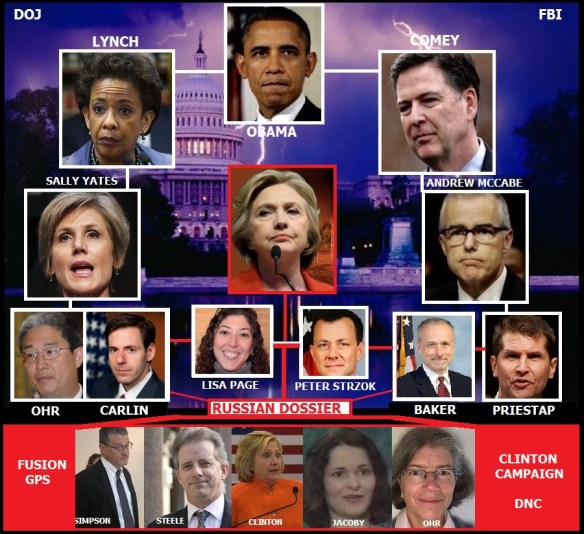
Named in the referral to the DOJ for possible violations of federal law are: Clinton, former FBI Director James Comey; former Attorney General Loretta Lynch; former Acting FBI Director Andrew McCabe; FBI Agent Peter Strzok; FBI Counsel Lisa Page; and those DOJ and FBI personnel “connected to” work on the “Steele Dossier,” including former Acting Attorney General Sally Yates and former Acting Deputy Attorney General Dana Boente.

With no attention from corporate media, the referral was sent to Attorney General Jeff Sessions, FBI Director Christopher Wray, and U.S. Attorney for the District of Utah John Huber.  Sessions appointed Huber months ago to assist DOJ Inspector General (IG) Michael Horowitz.  By most accounts, Horowitz is doing a thoroughly professional job.  As IG, however, Horowitz lacks the authority to prosecute; he needs a U.S. Attorney for that.  And this has to be disturbing to the alleged perps.

This is no law-school case-study exercise, no arcane disputation over the fine points of this or that law. Rather, as we say in the inner-city, “It has now hit the fan.”  Criminal referrals can lead to serious jail time.  Granted, the upper-crust luminaries criminally “referred” enjoy very powerful support.  And that will come especially from the mainstream media, which will find it hard to retool and switch from Russia-gate to the much more delicate and much less welcome “FBI-gate.”

As of this writing, a full day has gone by since the letter/referral was reported, with total silence so far from The New York Times and The Washington Post and other big media as they grapple with how to spin this major development. News of the criminal referral also slipped by Amy Goodman’s non-mainstream DemocracyNow!, as well as many alternative websites.

The 11 House members chose to include the following egalitarian observation in the first paragraph of the letter conveying the criminal referral: “Because we believe that those in positions of high authority should be treated the same as every other American, we want to be sure that the potential violations of law outlined below are vetted appropriately.” If this uncommon attitude is allowed to prevail at DOJ, it would, in effect, revoke the de facto “David Petraeus exemption” for the be-riboned, be-medaled, and well-heeled.

Stonewalling

Meanwhile, the patience of the chairmen of House committees investigating abuses at DOJ and the FBI is wearing thin at the slow-rolling they are encountering in response to requests for key documents from the FBI.  This in-your-face intransigence is all the more odd, since several committee members have already had access to the documents in question, and are hardly likely to forget the content of those they know about.  (Moreover, there seems to be a good chance that a patriotic whistleblower or two will tip them off to key documents being withheld.)

The DOJ IG, whose purview includes the FBI, has been cooperative in responding to committee requests for information, but those requests can hardly include documents of which the committees are unaware.

Putting aside his partisan motivations, House Intelligence Committee Chair Devin Nunes (R-CA) was unusually blunt two months ago in warning of legal consequences for officials who misled the Foreign Intelligence Surveillance Court in order to enable surveillance on Trump and his associates. Nunes’s words are likely to have sent chills down the spine of those with lots to hide: “If they need to be put on trial, we will put them on trial,” he said.”The reason Congress exists is to oversee these agencies that we created.”

Whether the House will succeed in overcoming the resistance of those criminally referred and their many accomplices and will prove able to exercise its Constitutional prerogative of oversight is, of course, another matter — a matter that matters.

And Nothing Matters More Than the Media

The media will be key to whether this Constitutional issue is resolved.  Largely because of Trump’s own well earned reputation for lying, most Americans are susceptible to slanted headlines like this recent one — “Trump escalates attacks on FBI …” — from an article in The Washington Post, commiserating with the treatment accorded fired-before-retired prevaricator McCabe and the FBI he (dis)served.

Nor is the Post above issuing transparently clever warnings — like this one in a lead article on March 17: “Some Trump allies say they worry he is playing with fire by taunting the FBI. ‘This is open, all-out war. And guess what? The FBI’s going to win,’ said one ally, who spoke on the condition of anonymity to be candid. ‘You can’t fight the FBI. They’re going to torch him.’” [sic]

Mind-Boggling Criminal Activity

What motivated the characters now criminally “referred” is clear enough from a wide variety of sources, including the text messages exchange between Strzok and Page.  Many, however, have been unable to understand how these law enforcement officials thought they could get away with taking such major liberties with the law.

None of the leaking, unmasking, surveillance, “opposition research,” or other activities directed against the Trump campaign can be properly understood, if one does not bear in mind that it was considered a sure thing that Secretary Clinton would become President, at which point illegal and extralegal activities undertaken to help her win would garner praise, not prison.  The activities were hardly considered high-risk, because candidate Clinton was sure to win.

But she lost.

Comey himself gives this away in the embarrassingly puerile book he has been hawking, “A Higher Loyalty” — which amounts to a pre-emptive move motivated mostly by loyalty-to-self, in order to obtain a Stay-Out-of-Jail card.  Hat tip to Matt Taibbi of Rolling Stone for a key observation, in his recent article, “James Comey, the Would-Be J. Edgar Hoover,” about what Taibbi deems the book’s most damning passage, where Comey discusses his decision to make public the re-opening of the Hillary Clinton email investigation.

Comey admits, “It is entirely possible that, because I was making decisions in an environment where Hillary Clinton was sure to be the next president, my concern about making her an illegitimate president by concealing the re-started investigation bore greater weight than it would have if the election appeared closer or if Donald Trump were ahead in the polls.”

The key point is not Comey’s tortured reasoning, but rather that Clinton was “sure to be the next president.”  This would, of course, confer automatic immunity on those now criminally referred to the Department of Justice.  Ah, the best laid plans of mice and men — even very tall men.  One wag claimed that the “Higher” in “A Higher Loyalty” refers simply to the very tall body that houses an outsized ego.

I think it can be said that readers of Consortiumnews.com may be unusually well equipped to understand the anatomy of FBI-gate as well as Russia-gate.  Listed below chronologically are several links that might be viewed as a kind of “whiteboard” to refresh memories.  You may wish to refer them to any friends who may still be confused.

2017

Russia-gate’s Mythical ‘Heroes’ June 6, 2017

The Democratic Money Behind Russia-gate Oct. 29, 2017

The Foundering Russia-gate ‘Scandal’ Dec. 13, 2017 

What Did Hillary Clinton Know? Dec. 25, 2017

2018

The FBI Hand Behind Russia-gate Jan. 11, 2018

Will Congress Face Down the Deep State? Jan. 30, 2018

Nunes Memo Reports Crimes at Top of FBI and DOJ Feb. 2, 2018

‘This is Nuts’: Liberals Launch ‘Largest Mobilization in History’ in Defense of Russiagate Probe Feb. 9, 2018

Nunes: FBI and DOJ Perps Could Be Put on Trial Feb. 19, 2018

‘Progressive’ Journalists Jump the Shark on Russia-gate March 7, 2018

Intel Committee Rejects Basic Underpinning of Russiagate March 14, 2018

McCabe: A War on (or in) the FBI? March 18, 2018

Former CIA Chief Brennan Running Scared March 19, 2018


America’s Descent Into Despotism: Finding Our Source of Power Within

By Nozomi Hayase

Source: The Indicter

The United States is in a major upheaval. Trump’s cabinet shake-up moves the country into an alarming direction. From the nomination of torturer Gina Haspel as the head of the Central Intelligence Agency to Mike Pompeo, former CIA Director and a vocal opponent of the nuclear deal with Iran as new secretary of state, his selection exposes the White House’s dangerous kill instincts.

An ultimatum came with the president’s appointment of John Bolton, the former American ambassador to the United Nations as his 3rd national security advisor. Bolton,  who served in the George W. Bush administration is notorious for his hawkishness, with a great zeal for military action against Iran and North Korea. This rearranging of the deck chairs in the sinking empire signals the great calamity of foreign policy ahead with potential threats of war.

In this seeming free-fall toward despotism, what can ordinary people do? Tackling corruption of our political system and averting a doomed future requires us to truly understand the problems we are facing. The crisis of representation didn’t just arise with Trump, the new commander in chief. A glimpse of it was shown during the 2008 financial meltdown, which was covered up swiftly by bank bailouts and politics of ‘hope and change’. The truth is that seeds for dystopia have been inside this country all along. The roots of the issues that are now emerging in Trump’s America go back to the very beginning of this nation.

In its modern formation, the United States inspired the world with its torch of liberty and equality. At the same time, this beacon of light had its darkness within. From the onset, America contained internal contradictions manifested as the founder’s hypocrisy and the violation of its own ideals with genocide of natives, slavery of blacks and suppression of women. The Founding Fathers of the United States brought a victory of rejecting the power of the King’s monarchy and pioneered a path for one’s own self-determination. The concept of “a government of laws, not of men” was groundbreaking at that time. Yet without reconciling its own shadow, this nation of law failed to fully shield the republic from the tyranny of the Old World.

Supremacy of reason

The unredeemed darkness found in America’s troubled past was a force inside Western civilization that tries to define history, subjugating other perspectives to its single vision. Europe, with its ethos of separation and objectivity set out to conquer the world, spreading its influence across many continents. This domineering power of reason found its new front of exploration in the New World.

America, driven by the monotheistic goal of Manifest Destiny, expanded its territory with brutality. It swallowed what is edible, assimilating immigrants one by one to its conception of what is civil, while spitting out those that it considered impalatable, relegating them into three-fifths of a person or exterminating them from the earth altogether as savages.

This maddened head centricity was manifested in the structure of a new government. Sheldon Wolin, author of Democracy Inc noted how the framers of the Constitution created a so-called managed democracy, a system that favored elite rule and that “the American political system was not born a democracy, but born with a bias against democracy” (2008, p. 228).

The intellectual elites regarded the democratic majority rule as an irrational force and they feared the tyranny of popular majorities. While the faculty of reason positioned itself as a supreme force, a potential to account its autocratic power was found inside America.

The sovereign power of We the People

Expressed in the preamble of the Constitution “We the People” was faith in the wisdom of ordinary people to govern themselves. This was an intention to shift from the model of government that acts as authority of their lives to one that places power in the hands of ordinary people. In this government established under the rule of the people, the source of legitimacy was not derived from a god or king, but was meant to come from people themselves.

This arrangement of governance was not granted from above. It was first demanded by those who opposed the ratification of the 1787 Constitution that lacked the guarantee of individual liberties. The proponents of the Bill of Rights articulated essential parts of the sovereign power of We the People as a freedom of expression; freedom of speech, religion, assembly and the right to petition the government for a redress of grievances. By building upon First Amendment rights, further efforts emerged from below. From abolitionists’ defiance and the women’s suffrage movement to civil rights and free speech movements, people’s determination for individual autonomy persisted.

Assault on this power of ordinary people intensified with the rise of corporate power in the ‘60s. Manifest Destiny is now carried out with Nike’s slogan of “just do it”. With limited liability and having no human beings in charge, the abstraction of the head inside transnational corporations took flight from the communal ground, plundering their way into the globe, without ever having to take responsibility for the consequences of their actions. Giant corporations became a sponsor for this managed democracy, gaining control over media to manipulate public perception, keeping American voters in hostage with the lesser of the two evils charade politics.

WikiLeaks, the rise of cryptographic direct action

In the political winter of the post-911 war on terror, as fear and apathy spread around the globe, a new civic force surfaced online. The waves of whistleblowers began shedding light on the collaborative secrecy of elites that deceive and manipulate the public behind a façade of democracy.

WikiLeaks, with its motto of “privacy for the weak and transparency for the powerful”, opened a floodgate of a free flow of information. This world’s first global Fourth Estate embodies the philosophy of cypherpunks– a loosely tied group of online privacy advocates who saw the potential of cryptography to shift the balance of power between individuals and the state. With the idea that cryptography is the “ultimate form of non-violent direct action” (2012, p. 5), WikiLeaks founder and editor in chief Julian Assange built the system of scientific journalism that would give everyday people around the world tools to combat military might and confront the madness of fallen reason that censors free speech.

The invention of the anonymous drop box was truly revolutionary. It enabled anyone to send information securely without a trace of his or her identity. Through the robust decentralized infrastructure built around this game changing technology, WikiLeaks was able to provide unprecedented source protection in the history of journalism. Here, the organization that derived its source of inspiration in American founding ideas, freed the First Amendment that had been captured through a corporate monopoly and co-optation of the media, making it available to people all around the world.

It is through WikiLeaks’ adamant commitment to the principle of free press that former U.S. Army intelligence analyst and whistleblower Chelsea Manning was able to exercise uncompromising free speech and engage in the American tradition of civil disobedience. Manning, whom the late attorney and President Emeritus of the Center for Constitutional Rights, Michael Ratner described as the “conscience of our nation”, let the American public see the US imperialism in action in the Middle East.

In her request for a presidential pardon, Manning stated her commitment to the ideal of America, saying how she was willing to pay the price if it would make this country be “truly conceived in liberty and dedicated to the proposition that all women and men are created equal.” Through her non-violent cryptographic direct action, she helped America find its conscience.

One individual’s act of courage brought another. Inspired by Manning, Edward Snowden came forward to inform people about the NSA’s mass surveillance. In one of the addresses he made, Snowden also described his act as a public service and connected it with Dr. King’s non-violent civil disobedience. Through his whistleblowing, the former NSA contractor defended individual privacy as fundamental civil rights for all people and tried to preserve the world where people can share creativity, love and friendship freely without every conversation and interaction being monitored and recorded.

Whistleblowers and their faith in ordinary people

From WikiLeaks disruptions to Snowden revelations, courageous act of truth-tellers renewed the faith in the wisdom of ordinary people to govern themselves. Both Manning and Snowden believed in the public’s right to know and held a view that when people are informed, they can make changes and determine their own destiny.

Faith is different than mere belief. It is not about one blindly trusting or passively accepting something. Faith is an active will that requires one to choose out of themselves to believe in something. When established media and trusted institutions failed, Manning chose to put her trust in the journalistic organization that was little known at that time. When the government’s internal mechanisms of accountability were broken, combined with the betrayal of Obama’s campaign promises and his war on whistleblowers, Snowden turned to American journalists whom he could trust by his own judgment of the integrity of their work. They placed faith not in political leaders or authority but in fellow men and women.

It is to this faith in the ability for the wise and knowledgeable public to govern themselves that fearless journalism responded. WikiLeaks, the publisher of last resort kept its promise to the source by publishing full archives with maximum political impact and bringing information back to the historical record. Through honoring Snowden’s wishes, journalists Glenn Greenwald, Laura Poitras and Barton Gellman broke the story of NSA surveillance and led the Guardian’s independent journalism, making the established media fulfill its duty. In the aftermath of Snowden’s disclosures, when this young whistleblower was stranded in Hong Kong, WikiLeaks demonstrated its extraordinary source protection with journalist Sarah Harrison risking her own liberty to help Snowden attain asylum.

With this faith given by peers, citizens around the world who have been distrusted by their own governments and made powerless began to claim their own power. By recognizing that someone believed in them and sacrificed their lives so that they can be free, they were able to believe in their own ability to protect those they love and preserve rights that they cherish. The will to respond to this faith in one another awakened love for one’s neighbor. This made it possible for ordinary people to carry out extraordinary acts, to choose paths that do not lead to financial success, fame and security, but one of scourging, persecution and punishment.

Manning was sentenced to prison for 35 years, initially being held in a cage in Kuwait and then being put in a tiny cell in solitary confinement. Snowden remains in exile, being called for execution by the president and his new nominee for the secretary of state, Mike Pompeo. WikiLeaks has been declared an enemy of the state by the most powerful government in the world, being subjected to legal and extra-legal pressure. Unconstitutional secret U.S. Grand Jury investigation against WikiLeaks and its staff continues, keeping its founder in long years of arbitrary detention in the Ecuadorian embassy in London in violation of the UN ruling. Now, threats of a free press increase with Trump’s Department of Justice stating the arrest of the Assange is a “priority” and the former CIA chief calling the whistleblowing site a “hostile intelligence service”.

Bitcoin, Innovation without Permission

Contagious courage lit by people’s faith created a fellowship that can withstand the state violence. It began to shift the balance of power, replacing the source of legitimacy from trusted institutions to ordinary people’s trust in one another. As the network of resistance grew, new attacks emerged. Following the release of U.S. diplomatic cables in 2010, WikiLeaks faced the unlawful financial blockade imposed by Bank of America, VISA, MasterCard, PayPal and Western Union. When this economic sanction starved the whistleblowing site, destroying 95% of their revenue, the flow of autonomy that helped the organization circumvent economic censorship came from fellow cypherpunks.

Bitcoin, as a peer-to-peer electronic cash was the holy grail of cypherpunks. With its defining feature of censorship resistance and permissionlessness, Bitcoin makes free speech an app that can be distributed across borders and used by anyone regardless of nationality, religion, race, gender or economic status. Here, imagination from computer science redeemed the reason that lost its connection to the heart, by synthesizing bits of isolated knowledge that had created separation and injustice, transforming them into a higher order of unification.

Networks of equal peers emerging around this invention opened up a new avenue of dissent in a form of decentralization. Adam Back, notable cryptographer whose work was cited in the Bitcoin white paper, described cypherpunks as “a state of mind” and explained its philosophy of “writing code” as a “proactive approach to societal change by doing: building and deploying tech – rather than by lobbying politicians or asking permission.”

This path toward decentralization was first taken by the creator of this technology. The anonymity of Satoshi Nakamoto represents the power of ordinary people. Through an act of publishing the white paper under a pseudonymous name and making the protocol open source, the mysterious author gave up ownership and simultaneously gave users control of the software, making it possible for each individual to use it as a tool to govern themselves.

What is enshrined in a piece of mathematics is wisdom of ordinary people that understands that man is corruptible, as well as perfectible and recognizes the security holes inherent in the existing model of governance that requires trust in third parties. It is the wisdom of history that teaches us how the best way to secure the system is not to have levers of control in the first place through which power concentrates, leading to despotism. With a consensus algorithm placed as a foundation, laws can be built that is more immune to man’s fallen nature. With this, idea of a government of laws, not of men can be truly realized. Governance of We the People now becomes possible, where rules of law are validated by consensus of ordinary people as opposed to elected officials having power over them.

Andreas Antonopoulos, a technologist and one of the respected figures in Bitcoin, in his talk titled “Courage to Innovate”, captured new enthusiasm and passion ignited around this technology in a phrase “innovation without permission” and connected it with civil disobedience. He reminded the audience how “almost every important innovation in history starts out being illegal or unregulated” and interesting technology started out with people who forgot to ask permission. Describing technology’s core invention as a platform to scale trust, Antonopoulos described how this is a system that makes it possible for people to make social decisions without hierarchy, whether it is government bureaucracy, corporations or any other institution. This system Antonopoulos characterized as “rules without rulers” is being built by people around the world without central coordination.

Claiming our revolutionary spirit

Our Founding Fathers, no matter how imperfect they were, brought us ideas conceived in a revolutionary spirit. The genius of the Constitution is that it makes fundamental laws and principles of government amendable. The highest law of the land preserved space for people to not accept authority imposed on them and even to revolt against it when it is necessary, by giving ordinary people means to change rules. America indeed was founded on rebelliousness and distrust of their own government, demonstrated in the Declaration that reads “whenever any Form of Government becomes destructive… it is the Right of the People to alter or to abolish it, and institute a new Government…”

The government brought by our forebears not only allowed dissent, but depended on our rebellion. The realization of the Constitution as the fulfillment of ideals in the Declaration required individuals with a strong and independent mind. It demanded people to develop moral courage to defend these ideals against special interests of single groups or nations and any adversarial forces that try to deny them.

From the civil rights movement to whistleblowers at the frontier of digital liberation, we have seen the awakening of revolutionary spirit in people’s courageous civic action upholding the ideals of this country. The networks from below expands, converging together to build a new global civil society. Bitcoin developers around the world put their knowledge and skills together, making improvement proposals and fixing bugs, striving to meet the demands of all users.

Innovation without permission is enlivening entrepreneurship. Instead of waiting for problems to be solved by politicians or corporate CEOs, working class began to have faith in their ability to make changes, finding strength and resources within themselves. Around this currency, a new economy is now being bootstrapped, with startups and new businesses hiring people and providing them with skills and knowledge, while many other industries are stagnating.

Solutions to the crisis of representation are within us. Ordinary people, through freely associating with one another, can now give birth to the rule of a real democracy, securing Life, Liberty and the pursuit of Happiness for all.

How The Guardian Fulfills George Orwell’s Prediction of ‘Newspeak’

By Eric Zuesse

Source: Strategic Culture Foundation

On Sunday April 15th, Britain’s Guardian bannered “OPCW inspectors set to investigate site of Douma chemical attack” and pretended that there was no question that a chemical attack in Douma Syria on April 7th had actually occurred, and the article then went further along that same propaganda-line, to accuse Syria’s Government of having perpetrated it. This ‘news’ story opened [and clarificatory comments from me will added in brackets]:

UN chemical weapons investigators were set on Sunday to begin examining the scene of a chemical attack in the Syrian city of Douma, which had prompted the joint US, French and British strikes against military installations and chemical weapons facilities near the capital, Damascus.

The arrival of the delegation from the Organisation for the Prohibition of Chemical Weapons (OPCW) came as the Syrian military announced that it had “purified” [no source provided, but this — from 7 March 2018  is the only source that existed prior to the April 14th missiles-invasion of Syria, and its meaning is very differentthe region of eastern Ghouta, of which Douma is a part, after a two-month campaign that killed nearly 2,000 civilians [no source provided as regards either the number, or that all of them were ‘civilians’ and that none of them were jihadists or “terrorists”], following years of siege.

The propaganda-article continued directly:

“Units of our brave armed forces, and auxiliary and allied forces, completed the purification of eastern Ghouta, including all its towns and villages, of armed terrorist organisations,” the general command statement said.

No source was provided for that, but this sentence is a sly mind-manipulation, because here is what the Syrian Government’s General Command had actually said: “Statement of the Army General Command declaring Eastern Ghouta clear of terrorism” as headlined by the Syrian Government itself. In other words: the Guardian’s ‘journalist’ had substituted the word “clear” by the word “purify” and did this after having already asserted but not documented, that the Government had just completed “a two-month campaign that killed nearly 2,000 civilians.” When the Syrian Government announces that an area has been “cleared of terrorists (or of terrorism),” the US-allied propagandist uses the word “purify,” such as “purified the region of eastern Ghouta” or “the purification of eastern Ghouta, including all its towns and villages, of armed terrorist organisations.” But by the time that the reader gets there to “purification … of armed terrorist organisations,” the reader has already been indoctrinated to believe that Syria’s Government is trying to “purify” land, or perpetrate some type of ethnic-cleansing.

Later, the article asserts that, “The OPCW mission will arrive in Douma eight days after the chemical attack, and days after the area fell to the control of Russian military and Syrian government forces. That delay, along with the possibility of the tampering of evidence by the forces accused of perpetrating the attack, raises doubts about what the OPCW’s inspectors might be able to discover.” However, a fierce debate is being waged over whether this was not any real “chemical attack” but instead a staged event by the jihadists in order to draw Trump back into invading Syria. In other words: any journalistic reference yet, at this time, to the event as “the chemical attack” instead of as “the alleged chemical attack” is garbage, just as, prior to the guilty-verdict in a murder trial, no journalistic reference may legitimately be made to the defendant as “the murderer,” instead of as “the defendant.” That is lynch-mob ‘journalism’, which Joseph Goebbels championed.

The Joseph-Goebbels-following ‘journalist’ has thus opened by implying that the Russia-allied Syrian Government is trying to crush a democratic revolution, instead of the truth, that the US-allied Governments are trying to overthrow and replace the Russia-allied Syrian Government. It’s a big difference, between the lie, and the truth.

Another story in the April 15th Guardian was “Pressure grows on Russia to stop protecting Assad as US, UK and France press for inquiry into chemical weapons stockpiles” and this one pretended that the issue is for “Russia to stop protecting Assad,” who is the democratically electedand popular President of Syria, and not to stop the invasion of Syria since 2011 by US and Saudi backed foreign jihadists to overthrow him. Furthermore, as regards “press for inquiry into chemical weapons stockpiles,” the real and urgent issue right now is to allow the Organization for the Prevention of Chemical Weapons (OPCW) into Douma to hold an independent and authoritative investigation into the evidence there. Russia pressed for it at the U.N. Security Council and the US and its allies blocked it there. But the OPCW went anyway — even after the US-allied invasion on April 14th — and this courageous resistance by them against the US dictatorship can only be considered heroic.

That type of ‘news’-reporting is virtually universal in The West, among the US and its allied governments, which refer to themselves as ‘democracies’ and refer to any Government that they wish to overthrow and replace by their own selected dictator, as ‘dictatorships’, such as these regimes had referred to Iraq in 2003, Libya in 2011, Syria forever, and Ukraine in 2014.


The Art of War: The Western American Empire in Crisis

By Manlio Dinucci

Source: Global Research

The US tariff war against China and the new sanctions against Russia are signs of a trend that goes beyond current events.

To understand what it is, we should go back about thirty years ago. In 1991 the United States, winners of the Cold War and of the first war after the Cold War, waged in the Gulf, declared that “the United States remains the only state with truly global strength, reach and influence in every dimension – political, economic and military” and that “there is no substitute for American leadership ” in the world.

By relying on the dollar hegemony, on the global reach of its multinationals and its financial groups, on the control of international organizations (IMF, World Bank, WTO), the United States promotes “free trade” and “Free movement of capital” on a global scale, reducing or eliminating tariffs and rules. The other Western powers move in their wake.

The Russian Federation, in a profound crisis after the disintegration of the USSR, is considered by Washington as an easy land of conquest, to be dismembered to better control its great resources.  China, open to the market economy, also appears to be conquerable with US capital and products and exploitable as a large reservoir of low-cost labor.

Thirty years later, the “American dream” of the unchallenged domination of the world has vanished.

Russia, by putting up an internal front to defend national sovereignty, has overcome the crisis and regained the status of great power.

China, “the world’s factory” where also US multinationals produce, has become the world’s leading exporter of goods and makes increasing foreign investments. Today it challenges the technological supremacy of the United States.

The project of a new Silk Road – a road, rail and maritime network between China and Europe through 60 countries – places China at the forefront of the process of globalization, while the United States is perched erecting economic barriers.

Washington looks with growing concern at the economic and political partnership between Russia and China, which challenges the hegemony of the dollar.

Failing to oppose this process only through economic instruments, the United States resorts to the military ones. The putsch in Ukraine and the subsequent nuclear escalation in Europe, the strategic shift to Asia, the wars in Afghanistan and Syria, are part of the strategy with which the US and the other Western powers try to maintain the unipolar dominance in a world that is becoming multipolar.

However, this strategy is suffering a series of setbacks. Russia and China, under increasing military pressure, reacted by strengthening their strategic cooperation.

Russia has not been got on the ropes but, in a surprise move, intervened militarily in support of the Syrian State which, in the US / NATO plans, should have ended up like the Libyan State. In Afghanistan, US and NATO are mired in a war that has been going on for over 17 years.

As a reaction to these failures, the propaganda campaign is intensified to make Russia appear as a dangerous enemy, also using the false flag of chemical attacks in England and Syria.

The same technique was used in 2003 when, to justify the war against Iraq, Secretary of State Colin Powell presented to the UN the “evidence” that Iraq possessed weapons of mass destruction. Powell, in 2016, had to admit the non-existence of such weapons. In 15 years, however, the war has caused over a million deaths.

Video: English Subtitles  (wait 1.06 minutes for the English subtitles)

Rest in peace to Art Bell, the man who made the paranormal normal

By Drew Millard

Source: The Outline

It does not seem like hyperbole to say that Art Bell was an American institution. As the host of the late-night radio show Coast to Coast A.M., he brought together millions of loners, insomniacs, and weirdos for a nightly deep dive into the fringe. He conducted interviews with self-professed experts in aliens and the Illuminati, time travelers and madmen. Every Halloween, he’d rename his show Ghost to Ghost A.M. and have listeners call in to tell “real” ghost stories. Broadcasting mostly from his compound in the High Desert of Nevada, Bell approached in the battiest conspiracy theories with an open mind and steady demeanor, good-naturedly probing his guests with his signature mix of bemusement and credulity.

Coast to Coast debuted in the late 1980s, just as talk radio began to take hold of the A.M. dial. But where Bell’s daytime counterparts stirred working-class conservative rage, Coast to Coast and its sister show Dreamland were genuine countercultural texts, explorations into the bizarre humans who share this planet with us.
If Art Bell was going to die at all, it’s only appropriate that he made his ascent to the afterlife on Friday the 13th.

Whitley Strieber, who took over Dreamland from Bell in 1999, posted the following message on the show’s website:

At 10:30 on the morning of Friday, May 13, Art Bell died. He passed away peacefully in his sleep, and there is at this time no known cause of death. The family had hoped to delay an announcement of his death, but the story was released by the Nye County Sheriff’s Office against their wishes.

Art was beloved of many millions of listeners and fans. He revolutionized late night radio with his famed show, Coast to Coast AM, which remains a popular feature on stations around the country, hosted by George Noory. He was also a dear friend of mine. We were born just three days apart in 1945 and over our 30 years of friendship we shared many wonderful hours together on the air and as friends in our private lives.

[The Dreamland] website will publish a more complete obituary shortly, but as the news has unexpectedly been released, I wanted to make this announcement at once, reminding his fans that his family has received a profound shock and is in need of privacy at this time.

The Outline reached out to the Nye County Sheriff’s Office in an attempt to verify Strieber’s claim that they had announced Bell’s death against the wishes of his family. Speaking over the phone, a representative of the Nye County Sheriff explained that it’s standard policy to issue releases whenever notable events occur in the county (watch their video announcing Bell’s death here). The representative added that they were unaware of any requests from Bell’s family to withhold the news of his death.


Related Article:

Art Bell Dead at Age 72—Days After Supporting a Friend’s Plan to Drive Into Area 51