Inventing the Future: The Collective Joy of Mark Fisher’s ‘k-punk’

By Michael Grasso

Source: We Are the Mutants

k-punk
By Mark Fisher
Foreword by Simon Reynolds, Edited by Darren Ambrose
Repeater Books, 2018

A little over two years ago, theorist and cultural critic Mark Fisher took his own life at the age of 48. I remember feeling numb at hearing the news; not out of sadness but more a sense of deja vu, of familiarity. I’d been through something similar already with David Foster Wallace’s suicide back in 2008; his Infinite Jest (1996) was one of the single most searing, searching moral indictments of the post-Cold War social and political order in the West, and a tremendously important work to me personally. Fisher toiled in very much the same fields in his writings. Both men had used their own struggles with depression (and in Wallace’s case, addiction) to fuel their insights into a world order that had run out of promise, of hope for the future. Wallace died two months before Barack Obama was elected, in the midst of the 2008 financial crisis; Fisher immediately after the election of Donald Trump. One American election offered (misplaced) hope, the other, a terminal kind of despair.

Over the past year or so I’ve also had the opportunity, while finishing my Master’s degree, to delve deeply into the work of cultural critic Walter Benjamin, who came to intellectual maturity in the Weimar Republic and found himself an exile with the rise of the Nazis in 1933. Like Wallace and Fisher, Benjamin used the cultural environment around him to help explain the world, to make sense of the turmoil that was roiling the once-orderly social order around him. Benjamin also killed himself, as he fled from the Nazi invasion of France in 1940 at the age of 48, just like Fisher. The parallels between all three men, to my mind, were uncanny. In the end, I feel the same thing got all three of these men: the encroaching feeling of dread at observing a world that had spun off its axis, beyond their ability to explain it.

I offer all this as a preface to my review of Mark Fisher’s collected online and unpublished writings, k-punk (Repeater Books, 2018), because I find myself thinking more often these days about the void of Fisher’s loss rather than the wealth of writings that he gave us while he was alive. And I feel like my despair essentially misunderstands what Mark Fisher was all about. The overwhelming feeling of most of the writings collected in k-punk is one of utter joy, whether it’s in celebrating a lost piece of media that Fisher wants us to know about, or his just and righteous delight in explaining exactly what late capitalism is doing to all of us.

A couple of years ago, my podcast partner Rob MacDougall and I had occasion to talk about the intellectual history of defining and preventing sexual harassment in the workplace for our podcast about WKRP in Cincinnati. And I’ll never forget the way he explained how clearly and uncompromisingly that defining a social problem can be the most important first step in combating it. He said, “Language is technology. Until you can name [something], you can’t get at it.” And I think that’s the legacy of Mark Fisher in a lot of ways. He gave us new terms—“pulp modernism,” “the precariat,” “hauntology,” “capitalist realism,” “acid communism”—that helped define not only our problems but our collective dreams for a better world. Like Benjamin before him, Fisher used his precise and profoundly moral observations of the world around him to give us a vocabulary to understand and express what is being done to us and how we can find our way out of it.

First things first: k-punk is a monster. Repeater Books has collected Fisher’s blog posts and unpublished writings in a massive 800-page tome. Given that the average length of one of these essays is about 3-4 pages, what you end up with is a bewilderingly encyclopedic collection of Fisher’s thoughts on seemingly everything. The conversion of once-hyperlink-laden web text to paper is sometimes jarring—the editor Darren Ambrose has done yeoman work in providing footnotes to mark where links to other bloggers and commenters once lay—but the reader almost never feels lost in figuring out what Fisher was trying to say. The foreword is by Fisher’s contemporary and friend, the music critic Simon Reynolds, whose seminal 2005 work on post-punk, Rip It Up and Start Again, is a favorite of mine. The same author’s 2011 Retromania: Pop Culture’s Addiction to Its Own Past was, like Fisher’s work, a major inspiration for my own Master’s capstone project on nostalgia and its use in museums. Reynolds’ foreword is not only a heartfelt and deeply touching tribute to Fisher’s life and work, it also illustrates well the cultural milieu in which both men worked in the early part of this century. Getting to know someone better by reading their blog everyday is a deeply familiar mode to me and many members of my generation, and here Reynolds nails the somewhat uncanny feeling of getting to be best friends with someone you’ve only hung out with a few times in person. Probably it will be less strange for the generations who come after us. I do admit stifling a chuckle as one of the first essays in this paperback collection is a “tag five friends” meme; seeing such an essentially “online” phenomenon in print, in an esteemed cultural critic’s essay collection no less, would probably be considered “weird” in the Fisherian “weird/eerie” schema: an intruder from Outside whose alien presence inflects its surroundings.

In his foreword, Reynolds dubs Fisher a member of a disappearing breed: “the music critic as prophet.” Both Reynolds and Fisher came of age in the golden era of British publications like the NME, which treated its readers with a modicum of sophistication and intellectual respect. British music critics in the 1980s were never afraid to throw in references to contemporary political philosophers and cultural critics from the world of academia, nor were they reluctant to blur the lines between artist and critic. Fisher himself offers tribute to one of these writer-artists in “Choose Your Weapons,” an essay focusing on NME writer and Art of Noise member/ZTT Records co-founder Paul Morley, as well as his fellow NME writer Ian Penman. Reynolds sees Fisher as the clear heir to this type of rock journalist; Fisher even had his own musical group in the early 1990s, D-Generation, which peppered press releases and music with references to cultural theory.

As mentioned above and in my earlier piece on him, Fisher was never afraid to unearth a piece of forgotten media from his childhood or adolescence for examination in the cold light of our present late capitalism. His mourning for the loss of risk-taking on the part of the gatekeepers at public broadcasters such as the BBC is well-known. (I highly recommend the essay “Precarity and Paternalism” in k-punk for Fisher’s breathtaking rhetorical link between the blandness of pop culture today and the burning down of the public sphere under neoliberalism.) But what k-punk puts forth clearly (and Reynolds makes clear in his foreword) is that Fisher was never solely a backwards-looking critic. In these essays you can see him fully engaged in the contemporary cultural scene in a way that can sometimes get lost in his reputation as “the hauntology guy.” I found Fisher’s recuperation of Donnie Darko director Richard Kelly’s odd little Twilight Zone riff from 2009, The Box, to be downright essential in explaining why I liked it so much but couldn’t articulate why at the time. Ironically, Fisher avers that it is a rare piece of American hauntology (an aesthetic I’ve been desperately trying to quantify here at We Are the Mutants), with Kelly exploring the legacy of his NASA employee dad during NASA’s own final years of glory as a public agency (the late ’70s era of the Viking and Voyager probes) before the ultimately doomed Shuttle program. As someone who only gave the k-punk blog a cursory look prior to Fisher’s death, being far more familiar with his published writings, reading Fisher on the Christopher Nolan Batman trilogy or on contemporary television series that I watched from the beginning, like Breaking Bad and The Americans, hit me in that same Fisherian-weird way.

Even though the essays in the k-punk collection are organized by content type—reviews of books, music, television/film, political writings, interviews—it’s easy to note Fisher’s evolution as a writer, with each content area organized chronologically within. Perhaps this is only my prejudice, but I notice in the early years of Fisher’s k-punk posts a distinct anxiety of influence with older writers and theoreticians, out of which he eventually matures. His early-’00s work centers writers and thinkers like J.G. Ballard, Franz Kafka, Dennis Potter, even Freud and Spinoza. Slavoj Žižek also looms very large, probably for no other reason than that he was (and still is) one of the only voices engaging intelligently with the political impact of the pop culture detritus of late capitalism. But it’s in this occasional early tension with Žižek that you start to see Fisher make his own conclusions, state his own thoughts. It’s not necessarily that Fisher ever makes an explicit break with Žižek; it’s just that you see him mentioned less and less and, finally, not at all.

It was in music that Fisher saw the greatest potential for social and cultural revolution. It’s become a thoroughly lazy trope among armchair cultural critics to keep quoting that bit from Plato’s Republic about how changing a society’s music will change the society, but Fisher actually convinces the reader of that idea, in a profoundly vital and contemporary context. For Fisher, mod, glam, and to a certain extent punk all offered the working classes a chance to grab the same aristocratic glamor and glory to which the bourgeoisie had always had access. (Reading Fisher on the unearthly magical “glamour” of pop stars gets me thinking about Kieron Gillen’s “gods come to earth as pop stars” comic The Wicked + the Divine; I’d be shocked if Gillen wasn’t a k-punk reader from way back.) I personally find Fisher far stronger on post-punk. His multi-part examination of The Fall and Mark E. Smith is downright essential; I thought often while reading how much I wish Fisher could have read Richard McKenna’s Sapphire And Steel-referencing encomium to Smith. A pure love of Green Gartside of Scritti Politti and his dance-floor theoretics, so beloved by that very same theory-soaked 1980s NME, shines through in several k-punk essays. Fisher’s multiple essays on the goth aesthetic (and adjunct aesthetic movements like steampunk) are insightful, even as he holds goth at a bit of a remove as compared to post-punk and dance music. His essays on the Cure, Nick Cave, and specifically Siouxsie Sioux’s visual aesthetic from early swastika-armband-wearing punk provocateur to glittering Klimt spectacle on A Kiss in the Dreamhouse are particularly good.

And it’s here in Fisher’s music writing that we see yet another evolution, this time in three phases roughly analogous to the Marxist-Fichtean dialectic. Fisher begins with an arguably essentialist, archetypal, borderline Paglian view of the aristocratic charisma inherent in pop music; moves to a canny and earnest recognition of the purely proletarian qualities of post-punk and dance music (and the paradoxically populist power of the “public information” aesthetic of hauntological music); and then shifts to an eventual synthesis of these very different conceptions of music-as-liberation.

That synthesis was to be the topic of his next book, Acid Communism, the preface for which is included at the end of k-punk: Fisher was going to look back at the origin point for neoliberalism in the 1970s and pinpoint exactly where the workers’ movement and the left had begun to lose the battle for power. Through a re-examination of the 1960s New Left under thinkers such as Herbert Marcuse, Fisher locates the real revolutionary promise and potential in the bewildering flowering of popular culture that occurred in the ’60s, as well as the profound societal change that this revolution in culture propelled. “Mass culture—and music culture in particular—was a terrain of struggle rather than a dominion of capital,” Fisher notes. The true conflict of workers’ leftism vs. neoliberalism, Fisher argued, happened nearly a decade before neoliberalism’s origin point, in the struggle between the liberal Cold War orthodoxies in the West and the profoundly psychedelic movement of the youth rebelling against these staid establishment cultural tendencies. In America, of course, this series of youth movements became inexorably intertwined with resistance to the Vietnam War, perhaps to its detriment. Fisher posits instead a youth movement that worked against the assumptions of Cold War-era society on a much more elemental level. He finds much more interesting the movements where the left chafed against the High Cold War hegemony of labor-leftism in the West and indeed the very idea of work, and sees glimmers of his “acid communism” in social milieus as disparate as Paris in 1968, the British miners’ strike (aided by students) in 1972, the GM strike in Lordstown Ohio in 1972, and Bologna in 1977. The essential question asked in all these times and places: what if the revolution happens and we are in thrall to just another set of labor bureaucrats? One might answer that this actually happened with the ascension of the Baby Boomers to places of authority in the supposedly kinder, gentler, more “diverse” digital capitalism we live with today.

Obviously, virtually every bit of cultural writing that Fisher published was viewed through the prism of a leftist politics, but in the Politics and Interviews sections of k-punk, we get those politics unfiltered through any particular piece of pop culture. Here is where you see Fisher at his most passionate, his most personal, his most vital. Most important, in my mind, is his relentless insistence that capitalism kills both body and soul. While a Marxist theory of alienation is certainly nothing new, Fisher’s own personal experiences with being a member of the “precariat,” dealing with the peculiar doublethink of the purported “freedom” of the gig economy, demonstrates how the market hands us all slavery in the guise of self-actualization. And here is where Fisher’s writing intersects with his profound personal interest in public health, specifically mental health. Digital technology allows the gig worker to be relentlessly surveilled and ruthlessly “reviewed”; the disappearance of the old forms of authority and hierarchy in the workplace are distributed among one’s fellow consumers to create a web of virtual bureaucracy that creates constant cognitive dissonance and the distinct feeling that one is truly never off the job. From the ancient dream of never working to the modern reality of constantly working: Fisher thus asks us over and over if it’s any wonder we are all anxious and depressed?

It’s glaringly obvious stuff to most of us living in 2019, but again: Fisher’s moral clarity shines through and illuminates the darker corners of a world to which we’ve all slowly acquiesced. And yes, Mark Fisher did suffer from severe depression himself. One of the editorial decisions that I disagree with most is the stated decision to not include Fisher’s more “pessimistic” work from earlier in his career. Here is k-punk‘s editor Ambrose on this decision:

A very small number of early k-punk posts, e.g. on antinatalism, are excluded by virtue of the fact that they seemed wildly out of step with Mark’s overall theoretical and political development, and because they seemed to reflect a temporary enthusiasm for a dogmatic theoretical misanthropy he repudiated in his later writing and life.

You still see glimpses of this pessimism and near-nihilism in a few of the essays; a startlingly good review of Mel Gibson’s The Passion of the Christ where Fisher sees its neo-Gnostic underpinnings, or a deep intrigue with the antinatalist works of horror writer and philosopher Thomas Ligotti (who would find unexpected mass popularity with Nic Pizzolatto’s use of Ligotti in the first season of True Detective). But speaking as someone who suffers with mental illness and profound depression, let me make clear: it is absolutely reasonable to expect someone even as optimistic and positive as Fisher to occasionally look at the world with abject despair. Moreover, I believe it is more than merely reasonable, it’s necessary. To dispute or deny that anyone with a modicum of political awareness would not be occasionally nihilistically fucking depressed with the world as it is today seems a massive mistake to me.

Immediately before presenting the unfinished introduction to Acid Communism, we’re presented with two of Fisher’s most famous essays: his polemic against the contemporary left’s tendency towards ideological puritanism, “Exiting the Vampire Castle,” and his personal memoir of living (and working) with depression, “Good For Nothing.” No two pieces in this book depict the central contradictions and tensions of Fisher’s ethics and philosophy more clearly. “Vampire Castle” is, in my personal opinion, one of Fisher’s greatest missteps and the one piece of his writing where I most see a distressing tendency towards a lack of empathy for his comrades. In the essay, Fisher excoriates a certain faction of the left and its tendency to center “identity politics.” He further posits that these identity-based politics are a way in which the mechanisms of late capitalist control attempt to neuter and split the political left, a profoundly “individualistic” movement rather than one that builds cross-cultural solidarity. Fisher states that humorless scolds participating in “call-out culture” are preventing the left from building true power. Every time I go back to this essay, I initially find myself seeing some some modicum of logic in Fisher’s arguments. But then I remember how much of the modern capitalism that Fisher despised is literally built on the backs of genocide, racism, slavery, colonialism. I remember all of capitalism’s own constant essentializing and dividing of the proletariat, purely on the basis of identity, a superstructure that has systematically disenfranchised entire peoples on this globe, and ultimately I react with, “This is the kind of take that only a white guy from Britain could make.” It’s tone-deaf, destructive, and has given fuel to the worst strains of white exceptionalism and disdain for so-called “idpol” on the left in the past few years. I would argue that nothing good and quite a bit that is bad has come from it.

In fact, I wish someone would’ve told Mark how harmful this piece was. I have a feeling all it would have taken is one person—a woman, a person of color, an indigenous person, someone queer—to explain to him that while there should obviously be solidarity on the left, there are profound issues of historical materialism here that stretch back centuries, unfinished work that needs a profound upheaval and seizure of power from below (and yes, to some degree the anger and fury and the positive social knock-on effects of a “call-out culture”) to even begin to deal with restoratively. I want to believe he’d understand. It can be true that the capitalist powers-that-be love watching the left devour their own over issues that might seem personalized and “individual” to a white British man, but it can also be true that the profound historical injustices inflicted on colonized peoples the world over need to be centered in any revolutionary left solidarity. Both can be true.

And then you have “Good For Nothing,” an essay that I can say confidently has saved my life, maybe several times, since I first read it a few years ago. It is overflowing with empathy: for those of us hedged in by our class identities and made to feel inferior, uneducated, unworthy, a cog in a machine that only views us for how useful we can be to an employer or to the economy. It is a crisp distillation of every piece of personal writing Fisher ever wrote about the dehumanizing and alienating collective psychological effects of neoliberalism. Most importantly, it is a clarion call for solidarity:

For some time now, one of the most successful tactics of the ruling class has been responsibilisation. Each individual member of the subordinate class is encouraged into feeling that their poverty, lack of opportunities, or unemployment, is their fault and their fault alone. Individuals will blame themselves rather than social structures, which in any case they have been induced into believing do not really exist (they are just excuses, called upon by the weak)…

Collective depression is the result of the ruling class project of resubordination. For some time now, we have increasingly accepted the idea that we are not the kind of people who can act. This isn’t a failure of will any more than an individual depressed person can “snap themselves out of it” by “pulling their socks up.” The rebuilding of class consciousness is a formidable task indeed, one that cannot be achieved by calling upon ready-made solutions—but, in spite of what our collective depression tells us, it can be done. Inventing new forms of political involvement, reviving institutions that have become decadent, converting privatised disaffection into politicised anger: all of this can happen, and when it does, who knows what is possible?

This call for collective action on a political, economic, psychological, and even spiritual level is the voice of Mark Fisher’s that I remember and hold close to my heart every day. In every one of us there is a person worthy of respect and dignity, regardless of how “useful” we might be to a boss or a manager; in all of us a person who deserves not to live a life of misery, a person worthy of joy and music and glamour. That’s the Mark Fisher who throbs under the surfaces of nearly every one of these 800 pages. k-punk is a fitting tribute to a thinker who showed us the wonder in our past and the promise in our future, if we but remembered each other and not merely ourselves.


Michael Grasso is a Senior Editor at We Are the Mutants. He is a Bostonian, a museum professional, and a podcaster. You can read his thoughts on museums and more on Twitter at @MuseumMichael.

Book Review: The Doomsday Machine

By Alex Cox

Source: Lobster Magazine

Until recently I only knew Daniel Ellsberg as the whistleblower who made the
Pentagon Papers public, and for his peace campaigning over the years. I had
no idea that prior to releasing a trove of documents related to the American
War in Vietnam, Ellsberg had been employed by the US Air Force at the RAND
corporation, as a nuclear war planner.

He had originally intended to reveal his nuclear war materials at the same
time as the Pentagon Papers, even though he knew he might face life
imprisonment for doing so. A bizarre series of events, recounted in The
Doomsday Machine, put them beyond the reach of both the FBI and the author.
There is much in Ellsberg’s book that is bizarre, if not amusing, as he recounts
what he learned about the workings of the nuclear-military-political complex. It
is disconcerting reading.

Ellsberg reveals the officially stated policy – that only the President can
authorise nuclear weapons use – to be a fiction. Based on what he learned
reviewing nuclear armed bases for RAND, there is delegation in the use of
nukes at every level. Local base commanders had discretion – or considered
they had it – to launch their nuclear bombers rather than risk losing them. As
in the film Dr Strangelove, there were envelopes aboard each plane containing
secret nuclear go codes (Strategic Air Command [SAC]’s one-size-fits-all
nuclear launch code was 00000000), but there were no recall orders.

As Ellsburg relates, base commanders and bomber pilots had real
autonomy to use their nukes; yet there was no system in place to stop them,
in the event (for example) of an error of judgment, or a presidential change of
heart. His description of the plans to get nuclear-equipped planes airborne at
US bases in Japan is grimly absurd. Smaller bombers were meant to take off in
neat rows, with other rows of bombers following seconds afterwards. Ellsberg
soon saw the possibility that a single pilot error could cause a catastrophic pileup, and atomic explosions, on the runway. Pilots who made it out, and other
US bases, would see or hear of the explosions and assume that Russian bombs
had landed . . . .

Not that it mattered where the US forces thought the bombs came from.
One of Ellsberg’s assignments was to find areas for flexibility in nuclear
weapons use. When he started working for RAND, the US Air Force had one
plan – SIOP, the Single Integrated Operating Plan – which involved a massive,
concerted nuclear weapons salvo against Russia, China, East Germany, Poland,
Hungary, and the other ‘Iron Curtain’ states. President Kennedy and his
defence chief, Robert McNamara, wanted some other options on the table,
besides instantaneous total destruction of all foreign communists and their
neighbours. Ellsberg tried hard to separate US nuclear war plans against
Russia from US nuclear war plans for China, but it was tough going. The Joint
Chiefs preferred one massive nuclear strike (‘general war’ or ‘central war’) to a
piecemeal one.

All the while, Ellsberg writes, he was morally opposed to the bombing of
cities, with the inevitable unnecessary loss of human life. In a brief aside he
recounts his friendship with Sam Cohen – another RAND specialist who liked to
be thought of as the ‘father of the Neutron Bomb’. 1

SIOP also worried Ellsberg since it was a plan for a first strike: all-out first
use of thousands of nuclear warheads against the Soviet Union and its allies, at
a time when the Russians had merely a handful of working atomic bombs.
RAND and Pentagon estimates of damage from nuclear weapons use never
included fire or firestorms; nor the spread of radiation into allied states; nor
the likely consequences for the climate. The consequences of nuclear weapons
use therefore being vastly underestimated, thousands of additional weapons
were built. In presidential briefings, the Pentagon was confident of prevailing
with a first strike: ‘if worst came to worst . . . a preemptive attack on the
Soviet Union would result in less than ten million deaths in the U.S.’

We now know that even a ‘small’ nuclear war – between India and
Pakistan, say – could have climate impacts which would cause billions of
deaths. ‘General’ or ‘central’ wars would do for just about all of us. Ellsberg
was foiled when he proposed changing US targeting policy so that Moscow
would not be destroyed in a first strike: at a NATO meeting, he was told that
even if SAC agreed to spare Moscow, the French would not. Moscow remained
a prime target for French nukes – and presumably for British ones, as well.

Over time, Ellsberg writes, the Russians and the Americans built a
‘doomsday machine’ very like the one Terry Southern envisaged in his script
for Stanley Kubrick’s Dr Strangelove. To protect them against surprise attack,
American and Russian nuclear weapons are numerous, widely dispersed, on
hair-trigger alert. In case the civilian or military leadership is killed, or unable
to communicate, the duty to launch those weapons has been delegated to
pretty much anyone capable of doing so. If the computers say a nuclear first
strike is incoming, if seismographs report massive, blast-style earth tremors, if contact with the leadership breaks down . . . someone will still be there to
push the button/insert the key code/flip the switch.

Ellsberg considers the bombing of civilians – whatever the weapons used –
to be a terrorist atrocity, not an act of war. He calls the ongoing nuclear
standoff between NATO and Russia a ‘moral catastrophe’. If you’re interested in
how close our silly species has come to wreaking its own imminent demise,
this is a valuable and fascinating book by a committed activist and excellent
writer.


1 I knew Sam Cohen, too, and he considered his Bomb to be a moral weapon, as it killed
fewer people than the Hydrogen Bomb, and left most of the physical infrastructure intact and potentially usable . . . at least once radiation levels dropped. Sam was insane, of course, but most of the people Ellsberg encountered on board the nuclear weapons project appear to have been insane, in the same way.

Alex Cox is a film-maker and writer.
He blogs at <https://alexcoxfilms.wordpress.com>.

The New Zealand Psyop

By Kurt Nimmo

Source: Another Day in the Empire\

Following the murder of fifty Muslims at a mosque in Christchurch New Zealand, the corporate media went into overdrive, describing the alleged shooter as a white supremacist Trump supporter.

This is clearly not the case. If we read a “manifesto” attributed to the accused shooter, Brenton Tarrant, we discover he followed the writing of Candace Owens, a “conservative” black woman, and predicts he will be set free like Nelson Mandela. 

Tarrant—if he is indeed the author of this professed manifesto—also criticized the leadership of President Trump and described himself as an “eco-fascist,” a socialist, a libertarian, an anarchist, and at the same time a follower of the Norwegian psychopath Anders Breivik, a self-described white nationalist. 

Despite these glaring incongruities, the agenda-driven corporate media has uniformly characterized the suspect as a white supremacist supporter of Donald Trump while either downplaying or ignoring the ideological contradictions and outright absurdity of Tarrant’s so-called manifesto. 

I believe this event is yet another psychological operation designed to 1) push anti-gun legislation (New Zealand wasted little time after the attack to call for confiscating the firearms of largely law-abiding individuals), 2) stoke and fan the flames of political division and portray “conservatives” as racist, misogynist, and fascist, and 3) conflate Trump (“Hitler”), the “Alt-Right,” and “conservatives” with “white nationalists” who are portrayed by an ideologically-driven media as the dangerous fellow travelers of psychotic murderers. 

The Southern Poverty Law Center set the tone while ignoring the massive contradictions that riddle the document, titled “The Great Replacement,” a title borrowed from the French writer Renaud Camus (“Le grand remplacement”). The book argues the French people and western civilization in Europe are being replaced by immigrants from the Middle East and North Africa. According to the left-leaning controlled information site Wikipedia, Camus is a conspiracy theorist.

“The type of racist rhetoric found in the manifesto is promoted heavily by Americans with large platforms like Rep. Steve King of Iowa and Tucker Carlson of Fox News,” writes Michael Edison Hayden on the SPLC “Hatewatch” web page. 

It should come as no surprise the SPLC would use the attack and a screed supposedly connected to Tarrant as ammunition to unfairly characterize Carlson and King as white supremacists and therefore legitimize (in the minds of progressives) the attacks on them, in particular the Antifa attack on Carlson’s family. 

I believe the shooting and others in the recent past are part of a psychological campaign first to identify and demonize critics of the establishment and then exclude them from political participation and possibly impose more draconian measures. 

In addition, this will give the state an excuse to place further restrictions on free speech and access to social media. Facebook, Twitter, YouTube, Instagram, etc., have initiated (at the behest of the state) a purge of their platforms based on a “progressive” political litmus test. 

Democrat Beto O’Rourke, a former member of the hacker group Cult of the Dead Cow, and who recently declared his intention to run for president, admitted there is no practical way to confiscate firearms owned by Americans, that number now totaling around 500,000,000 individual rifles and handguns. Instead, O’Rourke wants to circumvent the Bill of Rights and outlaw the sale of firearms, thus going the route New Zealand is now following. 

“In politics, nothing happens by accident. If it happens, you can bet it was planned that way,” quipped the master socialist politician, Franklin D. Roosevelt. 

I believe many of these mass shootings, especially those committed by supposed white supremacists and nationalists (many are controlled assets; e.g. Hal Turner), are part of a psychological operation designed to destabilize both America and Europe on a number of fronts. 

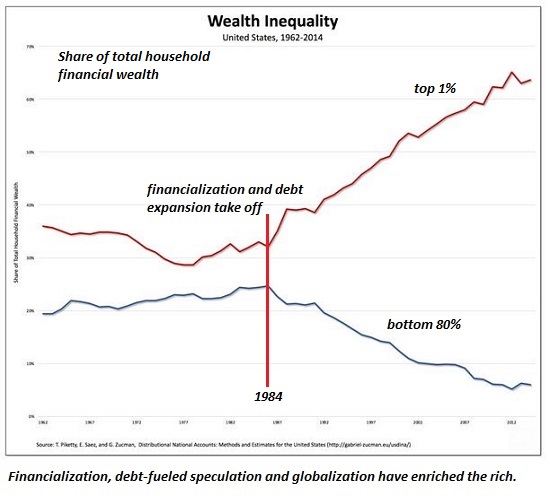
From borders and mass migration to economic austerity and the slow-motion erosion of the middle class and the export of industry and wealth by international banks and transnational corporations, we are witnessing a massive plan to usher in a unified global economy with its requirement for totalitarian governance.

For global elites working behind the scenes the ultimate goal is total, unquestioned control,  consolidation of wealth, and the impoverishment of humanity resulting ultimately in a serious reduction in world population. 

Before this can occur, however, the political and intellectual playing field must be cleansed of all dissent. The only dissent tolerated will be that of token groups and individuals keeping alive the illusion that we live in a democracy.

The Alt-Media Has Way More Fun than the Mainstream Media

By Charles Hugh Smith

Source: Of Two Minds

The corporate-state media lives in terror that the truth will somehow leak out of the corporate-Imperial fortress, imperiling their jobs and perks.

It’s not exactly news that the Alternative Media is under assault: skeptical inquiry and dissenting narratives are smeared as “fake news,” and new suspiciously corporate entities (NewsGuard et al.) claim to be “protecting” consumers from “fake news” as cover for their real agenda, which is limiting public exposure to skeptical, dissenting independent analysis.

Social Media and Search corporations are also censoring non-corporate, non-state media, again under the purported guise of stripping out “fake news.”

Despite this semi-official censorship, we in the Alt-Media are having way more fun that the anxiety-ridden serfs in the Mainstream Media. There are many hard-working, honest journalists slaving away in the Mainstream (more accurately, the corporate-state) Media, but there’s the neofeudal reality of their employment: If what they report undermines the ruling elites, they’re not allowed to do their job.

MSM journalists have no agency: they report what they’re told to report. They also have no control over what gets by their employers’ editorial / corporate filters: question a big advertiser and your report will quietly be buried. Question the approved narrative and conclusion, and you’ll be shunned, blacklisted, etc. If you make a fuss, you’ll be let go in the next round of lay-offs.

Everyone who labors in the corporate-state media lives in fear of the truth getting out: hence the full-spectrum freak-out whenever an insider turns leaker / whistleblower: oops, the happy-story cover is blown and the ugly truth is now revealed, including the collusion of the corporate-state media. (In the U.S. PBS / NPR is the quasi-state media, analogous to Japan’s NHK, Britain’s BBC or France’s France24.)

The corporate-state media lives in terror that the truth will somehow leak out of the corporate-Imperial fortress, imperiling their jobs and perks. Their job isn’t to report any truth that lays waste to the self-serving interests of the ruling elites; their job is to protect the ruling elites by “reporting” politically-correct narratives and playing up culturally divisive incidents to distract the masses from any awareness of their political invisibility and lack of financial independence or agency.

The MSM’s other job is to scrub any mass dissent from their “news.” So for example, U.S. corporate-state media coverage of the yellow vest movement in France is near zero. This is not random; it is all part of skewing the “news” to meaningless controversies and fawning politically correct / approved narratives stories.

A working-class rebellion against political and financial invisibility is anathema to America’s ruling elites and their corporate allies in the MSM and hence the minimal coverage. You basically have to understand French to follow on-the-ground Alt-Media coverage in France of the yellow vest protesters.

The American MSM dutifully regurgitates the bogus narrative being pushed by France’s elitist corporate-state media, that the yellow vest protesters are violent and thus need to be crushed by overwhelming paramilitary force. That the protesters are being beaten and provoked to respond to state-ordered violence is left unreported.

We in Alt-Media are confident the truth will eventually come out despite the efforts of the ruling elites and their MSM / social media corporate minions. It’s a lot more fun being on the side of skeptical inquiry and dissent than being behind the leaky dike, anxiously trying to stop the actual facts of the matter from entering the public awareness.

It’s more fun being on the side of free inquiry and meaningful analysis than being on the side of censorship, fear-mongering, propagandistic sowing of discord and the promotion of the corporate-state party line.

You won’t find any MSM reporting on the neofeudal structure of America’s economy and society:

Capitalism, Empire, and the Infernal Gloom Machine

By Jason Holland

Source: Dissident Voice

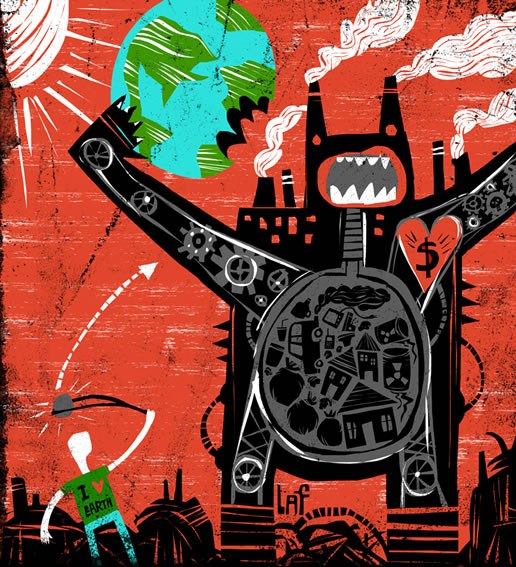
Depression is built into this machine and the evidence is plastered on the morose faces of people caught in the clutches of its business as usual activities. Depression is found in the insurmountable debts we owe for spending a lifetime of preparation and labor to serve the machine. In addition to debt, the machine awards us for our servitude with trinkets, gadgets, doodads and gizmos that provide a moment of hollow amusement and then sit on shelves in garages and decay. They represent the planned obsolescence of the human heart. The sacrifice paid for our fetish with materialism is the actual quality of our lives.

The gloom machine tells us the quality of our lives is defined by the machine in the driveway, and the machine that flushes away our excrement, and the machine that chills the tortured slaughtered animal flesh for later consumption, and the machine that flashes pornographic images and supplies numbers detailing how much we are liked by our so called friends. But to us humans it seems that quality of life is more appropriately measured in the amount of disposable time we have to pursue that which we want, and the quality of the community around us, and living without being chronically stressed with threats of being displaced from the land upon which we live for not working hard enough for the machine.

Depression is waking up at 6 in the morning in darkness to sit in traffic for an hour to arrive at a job that we don’t want to be at, only to serve the machinations of people with nothing but greed in their overstuffed bellies. And we go to these jobs so that we can pay rents that are unaffordable, and to service debt we’ll never escape, and we go home in darkness to our lonely lives in places where community is absent with a view of an equally lonely tree or a man-made retention pond which is an upgrade over the view of staring directly at your neighbor’s domicile. Depression is the realization there is no vacation on the horizon, no respite, just more of the same. Depression is knowing that such a life is better than many others have it.

Depression is recognizing the cynics were right about this society, that Cohen spoke truth when he sullenly moaned:

Everybody knows that the dice are loaded
Everybody rolls with their fingers crossed
Everybody knows the war is over
Everybody knows the good guys lost
Everybody knows the fight was fixed
The poor stay poor, the rich get rich
That’s how it goes
Everybody knows

Depression is watching art die. The surrealist, the bohemian, the rock ’n roll, and the anti-authoritarian soul has lain down and pledged fealty to the dollar. For money, they’re now all willing to become ready made predictable cubes to be packaged and sold in plastic wrap placed in cleverly designed boxes which deliver to the depressed public what they want, more of something that’s pretty on the outside and vacant within. We are left with monthly subscriptions of more tales of self aggrandizement for the throngs of temporarily embarrassed millionaires.

Depression is watching the worst of us rise to legitimacy and awarded iniquitous riches for it. The popular is depressive, musical hack Cardi B sings about her money money money and she is loved. Jordan Peterson sells cheap self help stolen from better written material decades ago amalgamated with misogyny and dictates of hierarchal subjugation and becomes wildly popular. Trump purveys hatred of people of color and a love of authoritarianism and the depressive people, oh do they eat it up. This is sickness, depressive sickness.

Depression is acceptance of the violent now. The grossly unhappy men with their armaments spread their gloom and horror across the planet and claim righteousness for doing so. Depression is watching society applaud murderous hearts for their crimes who don badges and camouflage and have holidays to celebrate their violent history, while villains are made of those who simply don’t want to stand up for songs of oppression. Thank you for your service to the machine.

Depression is watching notions of resistance and revolution take form in slightly altered subservience. The great reformation desired now is for a “green new deal” that doesn’t come close to mitigating the impending culling of humanity from soon to be ecological catastrophes. Their plans offer only more endless work at the behest of the gloom machine while promising healthcare that will never happen, less debt it will also never deliver, and affordable housing that still won’t solve homelessness. They don’t want to break the machine, just tweak it, and they lack the ability to do that even. Never have I borne witness to such eager slaves and such depressive aspirations. The people seem to adore their cubicle lives, their environmental destruction, their corporations, their debts, their corrupt leaders, their prisons, their banks, and their taxes.

They want to continue to be put to work under the thumb of the status quo western civilization authoritarian mind and this is all the depressed mentally dominated masses can think of as a possible improvement. Instead of wanting to taste real liberty and be actual equals, their dreams are limited to being better treated servants. The gloom machine chugs along fueled with dimwitted ideas sold by boxed-in thinkers without any possibility of escaping the darkness, rather simply offering a more cushy seat for viewing the end of everything.

The machine bellows out demanding more, more, you owe me more, and somehow those wearing red, white, and blue agree and celebrate the demands of the machine. These debts we owe are servitude. The numbers held in digital machines are immoral which demand one must wake up to a dreary existence to do more of what is killing our souls along with the flora and fauna around us.

Depression is the downtrodden plebs who celebrate their corrupt democracy, which is in reality a thinly veiled oligarchy that should be obvious to all. They prop up a system of voting that allows the election of the presidency, a position that shouldn’t exist in the first place in an egalitarian society, to be awarded to candidates who don’t capture the most votes. What little democracy there is in a representative system is lost in totality when the winner of elections need not win the majority of votes. The gloom machine is straight up tyranny.

A non-depressed society would reject being served faux democracy. They’d reject a system absent of reason or compassion and disdain would be for ideas of continuing to support such a destructive way of being. But instead, within the gloom machine shame is reserved for those who don’t want to take part in the busted system, and it venerates those who cast votes for imperialist conquerers and planet destroyers, and those voters are lauded as doing their civic duty for taking part in open public corruption.

Depression is the insincere know it all crowd who are incapable of honest debate and have rarely endeavored to open a book of substance or engage in critical thought, but they know trivialities which they mistake as facts and wisdom. They know arrogance well and emanate it with aplomb. They know how to believe all they see in the corporatized media, but thinking without boundaries or limitations is beyond their capacity. This is not even depression, this is tragedy.

Depression is watching the trees be plowed down for more tract housing, a portion of which will sit empty for years because no one can afford to move there, and even if they could it’s a heinous boring life that awaits which is only significantly better compared to being homeless. Depression is knowing this is the reason why we are rapidly destroying our habitable environment and commencing a 6th mass extinction event which is now accelerating.

Depression is to know there is nothing we can do to stop the country we live in from mercilessly killing innocent people all over the world for no reason other than more economic expansion and our sadistic ideas of exceptionalism that entail spreading pain and hardship so a few elites can have more of what they already have more than enough of.

Depression is the powerlessness to change anything of significance. There is no other way they say other than the desolate gloom machine, they say this is how it must be. And so we remain here waiting for the horror that is soon to approach us all as the gloom descends in ever quickening waves.

A zombified indoctrinated populace can see no other way than capitalism and beating each other over the heads to satiate egos in needless competition that is unnecessary for survival and deleterious to the common good. Capitalism is the primary tool of empire, and a word that should be synonymous with depression. It’s the accumulation of resources in an effort to gain more power in man-made markets to leverage that power over other people and get them to do what the person with the most power desires. Capitalism’s depressing ideology is defined by the lecherous desire for more for the sake of it so the winner can pound their simian chest in victorious celebration of the devastation they’ve created.

Capitalism is inherently unsustainable due the way it allows power to coalesce via the leveraging abilities given to money to buy land, the means of production, elections, and advertising. It allows the whims of the few to overrun the needs of the many where those with the worst intentions aspire to gain more than others because they will attempt to fill the void in their hearts with self importance expressed via power over others. This is why it cannot be used.

If there is no central currency or advantage to collecting huge amounts of resources then the motivation to hoard would evaporate, as those resources would simply rot or become a burden to maintain. There’s no fun in that kind of hoarding. The “fun” comes to the simpleton power seeker when they acquire power to make others do what they want and thus gain the ephemeral validation they so desperately seek.

If one runs the math on players competing for money at different rates of gain over a certain amount of time, there will be a doubling effect which becomes exponential. And this effect will accelerate as it plunders along due to gains in leverage which allows for ever greater amounts of money to be made at faster rates. Eventually it always ends the way a game of monopoly ends, someone has all the power and everyone else is subservient to that entity/person.

These dour thoughts manifest from the recognition of the stranglehold empire has over our lives. The depression is the result of the myriad of expectations I can’t let go of that wants to see a kinder more egalitarian and sustainable world emerge while knowing how unlikely it is. Our collective depression is rooted in the foundations of social hierarchy and its economic tools of control, and understanding what a perfect trap it is, and so it goes, and everyone doesn’t know, but they feel it, though.

Why only fools trust America’s mainstream ‘news’

By Eric Zuesse

Source: CounterCurrents.org

Here will be yet another current example to demonstrate that all U.S. mainstream ’news’ media hide from their respective public that the U.S. government is lying, when the U.S. government lies—i.e., that all of the mainstream ’news’ media in America hide the truth, when the government itself is lying. In other words: the U.S. mainstream ’news’ media are propaganda organs for the U.S. government.

While some American news media are Democratic Party propagandists, and others are Republican Party propagandists, and therefore all of them eagerly expose lies that are of only a partisan nature, none of them will expose lies that both parties share—such as, in 2002 and 2003, the central fact at that time. They hid that George W. Bush and his administration were outright lying to the public in each and every instance in which they said they possessed conclusive evidence that, as Bush himself put it on 7 September 2002 (and no mainstream and only one alt-news medium exposed as being a lie): “a report came out of the Atomic—the IAEA that they [Iraq] were six months away from developing a [nuclear] weapon. I don’t know what more evidence we need [before invading].” That was his answer when he was asked at a press conference on 7 September 2002, “Mr. President, can you tell us what conclusive evidence of any nuclear—new evidence you have of nuclear weapons capabilities of Saddam Hussein?” Immediately, the IAEA said then that there was no such “new report,” and that the last they were able to find, there was nothing at all left of WMD, nor of an ability to make any, in Iraq. The American news media simply ignored the IAEA’s denial that they had issued any new report at all such as Bush had alleged they had issued. Republican ‘news’ media hid that Bush’s allegation was a lie, and Democratic ‘news’ media likewise hid it. And, so, the American people trusted Bush, and destroyed Iraq. (Anyone who says that America’s invasion didn’t vastly harm the Iraqi people is either a liar or else ignorant of the realities, such as the last two links document.)

The example this time will be taken from The Week magazine, which is a compendium of summaries of the week’s ’news’ from America’s major ‘news’-media. The 1 March 2019 issue had this, on its page 8:

“Aid for Venezuela: U.S. military planes delivered more than 180 tons of humanitarian aid for Venezuela to the Colombian border city of Cucuta this week, setting up a showdown with Venezuelan President Nicolas Maduro, who has vowed to block the supplies. Sen. Marco Rubio (R-Fla.) made a surprise visit to Cucuta and told Venezuelan troops stationed at the border that it was their patriotic duty to let aid through. ‘Will you prevent the food and medicine from reaching your own people?’”

The presumption there is that readers are simply too stupid to wonder, “Why should I trust that this military plane doesn’t also carry weapons for supporters of a coup to overthrow Venezuela’s president and to replace him with Trump’s choice, Juan Guaido—trust that weapons aren’t included in the cargo of ‘food and medicine’? Is Trump really so kind a person as to care about the Venezuelan people? Or is this instead yet another U.S. set-up for a brutal coup, such as the U.S. did in 1953 to Iran, and in 1954 to Guatemala, and in 1973 to Chile, and, more recently, in 2014, to Ukraine?”

That ‘news’ report, since it’s from The Week, is about what other U.S. propaganda agencies are saying, and it’s true about that (they actually are saying this), but it’s summarizing from two very untrustworthy ‘news’ media, one being a tweet from Senator Rubio on 18 February 2019 that was immediately posted at sites such as ABC News, and the other being a ‘news’ report from the Miami Herald, which added that this shipment came from USAID—and yet they ignored that USAID is a major part of almost every U.S. coup.

Here’s more context about this incident of ‘aid’ shipments: On 6 February 2019, Britain’s Daily Mail, which is less dishonest about the U.S. government than U.S. ‘news’ media are, headlined “Venezuelan officials accuse the US of sending a cache of high-powered rifles on a commercial cargo flight from Miami so they would get into the hands of ‘extreme right fascist’ groups looking to undermine Maduro’s regime”, and reported that:

Officials in Venezuela have accused the US of sending a cache of high-powered rifles and ammunition on a commercial cargo flight from Miami so they would get into the hands of President Nicolás Maduro’s opponents.

Members with the Venezuelan National Guard [GNB] and the National Integrated Service of Customs and Tax Administration [SENIAT] made the shocking discovery just two days after the plane arrived at Arturo Michelena International Airport in Valencia.

Inspectors found 19 rifles, 118 magazines and 90 wireless radios while investigating the flight which they said arrived Sunday afternoon.

Monday’s bust also netted four rifle stands, three rifle scopes and six iPhones.

And here’s yet more context: the independent American journalist Aaron Mate, tweeted on 18 February 2019:

Aaron Mate

Page 136 [near end of Ch. 4] of [Andrew G.] McCabe’s new [and only] book [THE THREAT, which was published on 19 February 2019], recounting a [July] 2017 Oval Office meeting: “Then the president talked about Venezuela. That’s the country we should be going to war with, he said. They have all that oil and they’re right on our back door.” [Stated there by the authoritarian McCabe, in order to prove how crude Trump is, and McCabe was not condemnatory of such international thefts of Venezuela’s natural resources, but only of Trump’s crudity.]

12:59 PM – 18 Feb 2019

Furthermore, yet another independent journalist, Ben Norton, at “The GrayZone Project,” headlined on 29 January 2019, “Corporate Interests—Militarist John Bolton Spills the Beans”, and he provided a complete transcript of a brief interview that John Bolton had done with Fox Business Channel five days before, on January 24. That interview wasn’t publicized by Fox, and its headline was as dull as possible, “Venezuela regime change big business opportunity: John Bolton”, and the ‘news’ report posted below it was empty of anything important, but Ben Norton captured the entire interview, and on January 29 he posted it to YouTube and to The GrayZone Project as a news report, with the full interview-segment also being transcribed there by Norton. In it, Bolton had said, on January 24:

We’re looking at the oil assets. That’s the single most important income stream to the government of Venezuela. We’re looking at what to do to that. … We’re in conversation with major American companies now that are either in Venezuela, or in the case of Citgo here in the United States. … It will make a big difference to the United States economically if we could have American oil companies really invest in and produce the oil capabilities in Venezuela.

Of course, that’s an attempt at theft of the property of another sovereign nation—theft of natural resources assets of Venezuela, from the people who live in Venezuela—it’s a huge theft attempt, which is being bragged about by the U.S. regime. Though they’ve done this type of heist in many instances during the past few decades (including in Iraq, where U.S. oil companies now extract), Bolton’s outright bragging about it is certainly extraordinary, and thus is major news. This was major news that however hasn’t been focused upon except in the few honest sites, all of which are non-mainstream (most non-mainstream sites are just as dishonest as America’s mainstream ones are—they’re fake ‘alt-news’ instead of authentically against false ‘news’, but all mainstream national news sites routinely report lies stenographically, as if what the government says is always true, and so they’re propaganda). The GrayZone Project is one of the few honest sites, and Norton luckily discovered this huge news-break from the blunder by Fox Business Channel to have aired it—that revelation having been a freak event by America’s major media, a rare slip-up.

And, finally, the great investigative journalist Wayne Madsen headlined sarcastically but truthfully on 4 March 2019, “Military Intervention and Mercenaries, Inc. (MIAMI)”, and he (a journalist whose trustworthiness I have checked and verified for many years—he’s really one of the best) opened with:

The city of Miami, Florida may have started out as a retirement mecca for winter-worn pensioners from northern climes. However, after the beginning of the Cold War and US military and Central Intelligence Agency intervention in Guatemala, Cuba, the Dominican Republic, Chile, Nicaragua, Venezuela, Guyana, the Bahamas, and other Western Hemisphere nations, Miami became a refuge for exiled wealthy businessmen escaping populist revolutions and elections in South and Central America and spies. The retirement and vacation capital of the United States quickly became the “Tropical Casablanca.”

Now home to thousands of limited liability corporations linked to the CIA, as well as private military contractors, sketchy airlines flying from remote Florida airports, the interventionist US Southern Command (SOUTHCOM), and exiled oligarchs running destabilization operations in their native countries, Miami—or MIAMI, “Military Intervention and Mercenaries, Inc.”—serves as the nexus for current Trump administration “regime change” efforts. …

Earlier, on February 18, President Trump had delivered a lengthy speech in Miami, titled “Remarks by President Trump to the Venezuelan American Community”, and this was obviously aimed at passionate enemies of Venezuela’s government. Here is a typical passage, with accompanying documentations of the actual truth regarding his lies as stated there. Trump’s allegations are in boldface italics, and my commentaries are in regular type within brackets, and linked there to my sources:

Not long ago, Venezuela was the wealthiest nation, by far, in South America. [The allegation that Venezuela’s economy has done less well since Hugo Chavez became President on 2 February 1999 is disconfirmed by World Bank data showing that Venezuela reached its all-time-high economic-growth rate in 2004, 5 years after Hugo Chavez became democratically elected and took office as the country’s President. The economy rapidly declined as soon as the U.S. started its coup-attempts. Furthermore, a scientific study of the data showed in 2017 that: “Mexico’s and Venezuela’s numbers on this question [[of ‘Where would you place our country ten years ago?’”]] with a 1 to 10 scale, from absolutely democratic, to not democratic, throughout the period of 2013-2017, compared to those of other countries in the region, clearly show Venezuela as the country where the highest percentage of people believed that democracy had increased during the 2003-2013 decade. Mexico ranked in twelfth place, out of eighteen surveyed countries. “This comparison helps to dimension the solid sense that Venezuelans had about the strength of their democracy during the Chávez administration, and the weak one that Mexicans had.”] But years of socialist rule have brought this once-thriving nation to the brink of ruin. [That too is false—socialism wasn’t the cause of Venezuela’s economic come-down. Venezuela’s boom-time was the period of massive public-debt buildup prior to the exceptionally high oil prices in 1973-1985, as shown in “Figure 4: Venezuela Real GDP per Capita”. Moreover, as the CIA-edited and written Wikipedia says about Venezuela: ”The election in 1973 of Carlos Andrés Pérez coincided with an oil crisis [[the OPEC oil-embargo]], in which Venezuela’s income exploded as oil prices soared; oil industries were nationalized in 1976. This [oil-nationalization and oil-production investment all at the worst possible time] led to massive increases in public spending, but also increases in external debts, which continued into the 1980s when the collapse of oil prices during the 1980s crippled the Venezuelan economy.“ That “oil crisis” was actually the period of exceptionally high oil prices resulting from Israel’s 1973 invasions and OPEC embargoes, but it was actually hell for Venezuela because Venezuela was losing money on each barrel of oil sold because only the Arabic countries and Iran were able to sell profitably their oil after the period of OPEC”s oil-embargo. Venezuela, seller of the world’ dirtiest oil, after 1976 was losing money on each barrel, when they had to repay all those foreign loans amassed during the boom-period.]  That’s where it is today.

The tyrannical socialist government nationalized private industries and took over private businesses.  They engaged in massive wealth confiscation, shut down free markets, suppressed free speech, and set up a relentless propaganda machine, rigged elections, used the government to persecute their political opponents, and destroyed the impartial rule of law.

In other words, the socialists have done in Venezuela all of the same things that socialists, communists, totalitarians have done everywhere that they’ve had a chance to rule.  The results have been catastrophic.

In conclusion, then, no country in the world has a press that’s more dishonest than the United States of America does. “More dishonest” than this press would even be a ludicrous concept. Though the particular lies that are being promoted elsewhere might happen to be different, they can’t be worse. America’s having destroyed Iran and Libya, etc., is proof of this.

Consequently: Only people who possess a thoroughly scientific orientation toward confirming and disconfirming allegations, are capable of extracting from such ‘news’ a realistic understanding of what’s actually happening. The vast majority of people can be fooled, and they can be fooled constantly and even for (as in the instance of America, since at least 2003) decades, and yet still trust the institutions that have deceived them so mercilessly through all of those decades. This is the major reason why the United States is a dictatorship, not a democracy—and why any ‘news’ site which calls the U.S. a ‘democracy’ is thereby clearly demonstrating its untrustworthiness. But, of course, only honest news reporting organizations are publishing this report. And there will probably be very few that will do that, though all are receiving it for publication.

US Regime Change Blueprint Proposed Venezuelan Electricity Blackouts as ‘Watershed Event’ for ‘Galvanizing Public Unrest’

The US-funded CANVAS organization that trained Juan Guaido and his allies produced a 2010 memo on exploiting electricity outages and urged the opposition “to take advantage of the situation…towards their needs”

By Max Blumenthal

Source: Grayzone

A September 2010 memo by a US-funded soft power organization that helped train Venezuelan coup leader Juan Guaido and his allies identifies the potential collapse of the country’s electrical sector as “a watershed event” that “would likely have the impact of galvanizing public unrest in a way that no opposition group could ever hope to generate.”

The memo has special relevance today as Guaido moves to exploit nationwide blackouts caused by a major failure at the Simon Bolivar Hydroelectric Plant at Guri dam – a crisis that Venezuela’s government blames on US sabotage.

It was authored by Srdja Popovic of the Center for Applied Non-Violent Action and Strategies (CANVAS), a Belgrade-based “democracy promotion” organization funded by the US government that has trained thousands of US-aligned youth activists in countries where the West seeks regime change.

This group reportedly hosted Guaido and the key leaders of his Popular Will party for a series of training sessions, fashioning them into a “Generation 2007” determined to foment resistance to then-President Hugo Chavez and sabotage his plans to implement “21st century socialism” in Venezuela.

In the 2010 memo, CANVAS’s Popovic declared, “A key to Chavez’s current weakness is the decline in the electricity sector.” Popovic explicitly identified the Simon Bolivar Hydroelectric Plant as a friction point, emphasizing that “water levels at the Guri dam are dropping, and Chavez has been unable to reduce consumption sufficiently to compensate for the deteriorating industry.”

Speculating on a “grave possibility that some 70 percent of the country’s electricity grid could go dark as soon as April 2010,” the CANVAS leader stated that “an opposition group would be best served to take advantage of the situation and spin it against Chavez and towards their needs.”

Flash forward to March 2019, and the scenario outlined by Popovic is playing out almost exactly as he had imagined.

On March 7, just days after Guaido’s return from Colombia, where he participated in the failed and demonstrably violent February 23 attempt to ram a shipment of US aid across the Venezuelan border, the Simon Bolivar Hydroelectric Plant experienced a major and still unexplained collapse.

Days later, electricity remains sporadic across the country. Meanwhile, Guaido has done everything he can “to take advantage of the situation and spin it” against President Nicolas Maduro – just as his allies were urged to do over eight years before by CANVAS.

Rubio vows “a period of suffering” for Venezuela hours before the blackout

The Venezuelan government has placed the blame squarely on Washington, accusing it of sabotage through a cyber-attack on its electrical infrastructure. Key players in the US-directed coup attempt have done little to dispel the accusation.

In a tweet on March 8, Secretary of State Mike Pompeo framed the electricity outage as a pivotal stage in US plans for regime change:

At noon on March 7, during a hearing on Venezuela at the Senate Foreign Relations Subcommittee, Sen. Marco Rubio explicitly called for the US to stir “widespread unrest,” declaring that it “needs to happen” in order to achieve regime change.

“Venezuela is going to enter a period of suffering no nation in our hemisphere has confronted in modern history,” Rubio proclaimed.

Around 5 PM, the Simon Bolivar Hydroelectric Plant experienced a total and still unexplained collapse. Residents of Caracas and throughout Venezuela were immediately plunged into darkness.

At 5:18 PM, a clearly excited Rubio took to Twitter to announce the blackout and claim that “backup generators have failed.” It was unclear how Rubio had obtained such specific information so soon after the outage occurred. According to Jorge Rodriguez, the communications minister of Venezuela, local authorities did not know if backup generators had failed at the time of Rubio’s tweet.

Back in Caracas, Guaido immediately set out to exploit the situation, just as his CANVAS trainers had advised over eight years before. Taking to Twitter just over an hour after Rubio, Guaido declared, “the light will return when the usurpation [of Maduro] ends.” Like Pompeo, the self-declared president framed the blackouts as part of a regime change strategy, not an accident or error.

Two days later, Guaido was at the center of opposition rally he convened in affluent eastern Caracas, bellowing into a megaphone: “Article 187 when the time comes. We need to be in the streets, mobilized. It depends on us, not on anybody else.”

Article 187 establishes the right of the National Assembly “to authorize the use of Venezuelan military missions abroad or foreign in the country.”

Upon his mention of the constitutional article, Guaido’s supporters responded, “Intervention! Intervention!”

Exploiting crisis to “get back into a position of power”

As Dan Cohen and I reported here at the Grayzone, Guaido’s rise to prominence – and the coup plot that he has been appointed to oversee – is the product of a decade-long project overseen by the Belgrade-based CANVAS outfit.

CANVAS is a spinoff of Otpor, a Serbian protest group founded by Srdja Popovic in 1998 at the University of Belgrade. Otpor, which means “resistance” in Serbian, was the student group that worked alongside US soft power organizations to mobilize the protests that eventually toppled the late Serbian President Slobodan Milosevic.

CANVAS has been funded largely through the National Endowment for Democracy, a CIA cut-out that functions as the US government’s main arm of promoting regime change.  According to leaked internal emails from Stratfor, an intelligence firm known as the “shadow CIA,” CANVAS “may have also received CIA funding and training during the 1999/2000 anti-Milosevic struggle.”

A leaked email from a Stratfor staffer noted that after they ousted Milosevic, “the kids who ran OTPOR grew up, got suits and designed CANVAS… or in other words a ‘export-a-revolution’ group that sowed the seeds for a NUMBER of color revolutions. They are still hooked into U.S. funding and basically go around the world trying to topple dictators and autocratic governments (ones that U.S. does not like ;).”

Stratfor subsequently revealed that CANVAS “turned its attention to Venezuela” in 2005, after training opposition movements that led pro-NATO regime change operations across Eastern Europe.

In September 2010, as Venezuela headed for a parliamentary election, CANVAS produced a series of memos outlining the plans they had hatched with “non-formal actors” like Guaido and his cadre of student activists to bring down Chavez. “This is the first opportunity for the opposition to get back into a position of power,” Popovic wrote at the time.

In his memo on electricity outages, Popovic highlighted the importance of the Venezuelan military in achieving regime change. “Alliances with the military could be critical because in such a situation of massive public unrest and rejection of the presidency,” the CANVAS founder wrote, “malcontent sectors of the military will likely decide to intervene, but only if they believe they have sufficient support.”

While the scenario Popovic envisioned failed to materialize in 2010, it perfectly describes the situation gripping Venezuela today as an opposition leader cultivated by CANVAS seeks to spin the crisis against Maduro while calling on the military to break ranks.

Since the Grayzone exposed the deep ties between CANVAS and Guaido’s Popular Will party, Popovic has attempted to publicly distance himself from his record of training Venezuela’s opposition.

Today, however, Popovic’s 2010 memo on exploiting electricity outages reads like a blueprint for the strategy that Guaido and his patrons in Washington have actively implemented. Whether or not the blackout is the result of external sabotage, it represents the “watershed event” that CANVAS has prepared its Venezuelan cadres for.

Government to Facebook Pipeline Reveals a Corrupt Mix of Social Media and the State

The next time someone tells you that “Facebook is a private company” ask them if they know about the dozens of government employees who fill its ranks.

By Matt Agorist

Source: The Free Thought Project

As the Free Thought Project has previously reported, the phrase “Facebook is a private company” is not accurate as they have formed a partnership with an insidious neoconservative “think tank” known as the Atlantic Council which is directly funded and made up of groups tied to the pharmaceutical industry, the military industrial complex, and even government itself. The Atlantic Council dictates to Facebook who is allowed on the platform and who is purged.

Because the Atlantic Council is funded in part by the United States government—and they are making decisions for Facebook—this negates the claim that the company is private. Since our six million followers and years of hard work were wiped off the platform during the October purge, TFTP has consistently reported on the Atlantic Council and their ties to the social media giant. This week, however, we’ve discovered something just as ominous—the government to Facebook pipeline and revolving door.

It is a telltale sign of a corrupt industry or company when they create a revolving door between themselves and the state. Just like Monsanto has former employees on the Supreme Court and Pharmaceutical industry insiders move back and fourth from the FDA to their companies, we found that Facebook is doing the same thing.

Below are just a few of corrupt connections we’ve discovered while digging through the list of current and former employees within Facebook.

Facebook’s Head of Cybersecurity Policy—aka, the man who doles out the ban hammer to anyone he wishes—is Nathaniel Gleicher. Before Gleicher was censoring people at Facebook, he prosecuted cybercrime at the U.S. Department of Justice, and served as Director for Cybersecurity Policy at the National Security Council (NSC) in the Obama White House.

While Facebook may have an interest in seeking out Gleicher’s expertise, this man is an outspoken advocate of tyranny.

After deleting the pages of hundreds of antiwar and pro-peace media and activist outlets in October, last month, Facebook made another giant move to silence. This time, they had no problem noting that they went after pages whose specific missions were “anti-corruption” or “protest” movements. And it was all headed up by Gleicher.

“Some of the Pages frequently posted about topics like anti-NATO sentiment, protest movements, and anti-corruption,” Gleicher wrote in a blog post. “We are constantly working to detect and stop this type of activity because we don’t want our services to be used to manipulate people.”

Seems totally legit, right?

The list goes on.

In 2017, as the Russian/Trump propaganda ramped up, Facebook hired Joel Benenson, a former top adviser to President Barack Obama and the chief strategist for Hillary Clinton’s failed 2016 presidential campaign, as a consultant.

While filling team Zuck with Obama and Clinton advisers, Facebook hired Aneesh Raman, a former Obama speechwriter who now heads up Facebook’s “economic impact programming.”

Highlighting the revolving door aspect of Facebook and the US government is Sarah Feinberg who left the Obama train in 2011 to join Facebook as the director of corporate and strategic communications. She then moved on after and went back to Obama in 2015 to act as the administrator of the Federal Railroad Administration (FRA).

David Recordon also highlights the revolving door between Facebook and the government. Recordon was the former Director of IT for Obama’s White House. He was also Engineering Director at Facebook prior to his role at the White House, and returned to the position after the 2016 election. He is currently Engineering Director for the Chan-Zuckerberg initiative.

Starting to see a pattern of political influence here? You should. But just in case you don’t, the list goes on.

Meredith Carden—who, you guessed, came from the Obama administration — joined the Facebook clan last year to be a part of Facebook’s “News Integrity Team.” Now, she’s battling fake news on the platform and as we’ve shown, there is a ridiculous amount of selective enforcement of these so-called “standards.”

In fact, there are dozens of former Obama staffers, advisers, and campaign associates who quite literally fill Facebook’s ranks. It is no wonder the platform has taken such a political shift over the past few years. David Ploufe, Josh W. Higgins, Lauryn Ogbechie, Danielle Cwirko-GodyckiSarah Pollack, Ben Forer, Bonnie Calvin, and Juliane Sun, are just some of the many Facebook execs hailing out of the Obama era White House.

But fret not right wingers, Facebook likes their neocons too.

Jamie Fly, who was a top adviser to neocon Florida Senator Marco Rubio and who started his career in US political circles as an adviser to the George W. Bush administration, actually took credit for the massive purge of peaceful antiwar pages that took place last October.

“They can invent stories that get repeated and spread through different sites. So we are just starting to push back. Just this last week Facebook began starting to take down sites. So this is just the beginning,” Fly said in December.

Fly backs up his words with the fact that he works with Facebook’s arm of the Atlantic Council to ensure those dangerous antiwar folks don’t keep pushing their propaganda of peace and community.

And yes, this list goes on.

Joel David Kaplan is Facebook’s vice president of global public policy. Prior to his major role within Facebook, Kaplan took the place of neocon extraordinaire Karl Rove as the White House Deputy Chief of Staff for George W. Bush. Before that, from 2001 to 2003 he was Special Assistant to the President for Policy within the White House Chief of Staff’s office. Then he served as Deputy Director of the Office of Management And Budget (OMB).

Myriah Jordan was a special policy assistant in the Bush White House, who was hired on as a policy manager for Facebook’s congressional relations team—aka, a lobbyist. Jordan has moved back and forth between the private sector and the US government multiple times over his career as he’s made millions greasing the skids of the state for his corrupt employers.

So there you have it. Facebook, who claims to be a private entity, is quite literally made up of and advised by dozens of members of government. We’re ready for a change, are you?