Rather than post a prank (which can all too easily be mistaken for “news” in today’s increasingly absurd media landscape) here’s a random assortment of intentionally funny clips:
The hypothesis behind The Walk of Life Project is that “Walk of Life” by Dire Straits improves the ending of any movie.
It certainly seems to work for The Shining, ideally the version depicted in this trailer:
Anyone who thinks the Democratic Party isn’t imploding for the exact same reasons the Republican party is imploding is purposefully ignoring reality.
Legions of pundits are crawling out of the woodwork to gloat over the implosion of the Republican Party. Corrupt, crony-capitalist, Imperial over-reach–good riddance.
But far fewer pundits dare declare that the other corrupt, crony-capitalist party of Imperial over-reach–yes, the Democratic Party–is imploding, too, for the same reason: it too is rotten to the core and exists solely to protect the privileges of the few at the expense of the many.
Democrats need to ask themselves: if Hillary Clinton is the shining epitome of what the Democratic Party stands for and represents, then what does the Democratic party stand for other than corruption, greed, pay-to-play, Imperial over-reach, elites who are above the law, and a permanent war state overseen by a corporatocracy bent on protecting the unearned privileges of the few at the expense of the many?
How about Hillary’s “super-delegates”–you know, the delegate system that makes the old Soviet Politburo look democratic by comparison. Hillary has rigged the media coverage, a fact that is painfully obvious to anyone who is non-partisan. The New York Times, for example, couldn’t wait to announce in blaring headlines that Hillary regains the momentum after she rigged a couple-hundred vote caucus in Nevada–and barely won that.
The mainstream media fell all over themselves to declare Hillary the clear winner in the Michigan debate, and were delighted to run story after story of Hillary’s commanding 21-point lead– all designed, of course, to discourage Sanders supporters from even going to the polls.
It was obvious to non-partisan observers that Sanders won the debate–no question. And he went on to trounce Clinton despite her “commanding 21-point lead”, which was quickly finessed away by a servile corporate media.
How many pundits are commenting on the fact that Democratic voters are staying away in droves? Or that–according to one zany poll–venereal disease is more popular than Hillary among young quasi-Democratic voters?
Every American knows the system is rigged to guarantee the skim of the protected classes. Insider Peggy Noonan recently penned an essay calling out the protected class, which can only be protected by stripmining the unprotected: Trump and the Rise of the Unprotected.
The only difference between the two parties’ protected class is the Democrats protect public union employees from any market or fiscal realities, until their unaffordable pay and health/pension benefits bankrupt local governments. At that point, the party bosses will come crying to Washington, D.C. to bail out benefit and payroll costs that were never fiscally viable in the first place.
The protected classes love the Status Quo, because it exists to protect their privileges. The unprotected classes loathe the Status Quo for the same reason.
Anyone who thinks the Democratic Party isn’t imploding for the exact same reasons the Republican party is imploding is purposefully ignoring reality–a reality that threaten the protected classes’ lock on wealth and power.
The way the masses view the world is a farce. Every single mainstream perspective is either purposely deceptive, or completely misses the point. Even the people in places of influence who we’re meant to trust have either sold out, or are just plain ignorant to the facts. There’s no need to have a heavy heart though; the matrix of control is crashing because the truth-seekers are dealing heavy blows to the false narratives that have for too long shaped the collective mindset of humanity.
Of course the internet can be celebrated for being the primary mechanism which has amplified the sharing of information across location, race, culture and belief systems. In retrospect, the powers-that-will-no-longer-bewould be kicking themselves for not trying harder to institute their insidious plan for humanity prior to the birth and growth of the world-wide-web.
Make no mistake though; they have been very successful on many fronts. For example, try to imagine a world where:
most journalists don’t report the real news;
the majority of doctors don’t truly understand the causes of poor health and how to legitimately resolve it;
a high proportion of politicians don’t know how the money supply works and what the agenda is of those who control it;
many so-called expert scientists ‘believe’ in a discredited philosophy which resembles a dogmatic religion;
the majority of teachers don’t realize they’re teaching a system of indoctrination that nowhere near gets close to the information and critical thinking that should be afforded our kids; and
the masses are not only ill-informed, divided and feverishly fighting against each other over small and irrelevant topics, but they’re also sleepwalking through one of the most majestic and reverent realities that could have ever been conceptualized.
Well, welcome to our world.
As we begin what we call the 21st Century, every system that should be designed to facilitate the health and vitality of the people has been hacked with lies, deception, dysfunction and disharmony. It’s easy to think that this is an embarrassment for our species because it’s beneath our intelligence and ethical capacity, yet there’s no need to lose faith in the inevitable betterment of humanity, including the way in which we organize and economize our societies.
Why? Because all of this dysfunction has been an effective driver of the collective awakening that is rising in the hearts and minds of humanity.
The inspiring fact is that more and more people are slowly waking up and realizing we all have the opportunity to come to our own, informed opinion on the truth, pertaining to both the spiritual and systemic realities. So many more people now understand the mainstream news is not to be taken seriously as its not where we can find information which is aligned with the deeper truths. They’re also acknowledging that we have the choice on what we decide to personally stand and fight for, as well as the legacy we leave for our children and our future generations.
Beware though; once we exit the matrix of control we’re faced with some serious challenges. We have a lot of inner work to do, such as designing a philosophy that ensures we’re at peace, as well as exercising patience in the quest to take back our liberties and design a legitimate and honorable future for humanity.
That’s why we’ve got to feel for those who have been long aware of the many dysfunctions of our world, especially those who have not learned peace and patience. Slowly they’ve watched:
the military-industrial-media-politico-banking complex increase their power and continue their pillage across the world;
pharmaceutical monopolies amplifying the drugging of society, as well as keeping many of us sick so that they maximize their profits;
movements rise up only to be vilified and disassembled, such as the Occupy Movement;
science turned into a corporate institution, as well as further hijacked by an inaccurate and small-minded philosophy of reality;
wars purposely created with millions of people dying for the whims of the shadow empire;
radical extremists massaged into proxy armies to do dirty work for the collapsing power structure;
air, medicine, food and water becoming purposely more toxic;
governmental policy increasingly being determined by corporate/elite interests;
police being militarized all around the globe;
the education model struggling to become less of an indoctrination system; and
the agenda of global governance becoming closer to fruition.
Some people have known about much of this for decades, so we should commend them for continuing to fight the good fight. They might have witnessed some disheartening developments, yet as much as all this sounds dire, they’ve also seen millions of people disengage from the propaganda narratives and align themselves with the systemic and spiritual pathways that will be the next stage of our evolution.
The point is that even though we need to be patient and persevere, we should recognize and celebrate the achievements that have been made so far. As I discussed in a previous article called “Whilst the Old System Crashes a New One is Being Built”, there are:
economists who want to transform the Keynesian model to legitimate alternatives;
teachers who understand the massive holes in the indoctrination system called public education;
scientists who want to evolve the way energy is created and shared;
health practitioners who see the limits of mechanistic and pharmacological medicine and the need for the reintroduction of natural and plant-based therapies;
journalists who demand that the media monopolies need to be disassembled;
environmentalists who want to transition the way food is grown and distributed;
community leaders who aim to reintegrate them to better support its members;
politicians who understand the democratic system has been hijacked by big money;
activists who campaign for revolutions in our value systems; and
futurists who want to change the systemic template for our societal health and well-being.
There are many beautiful souls who are leading the charge by attempting to redesign our society back into alignment with the natural laws of our universe. We should be one of them, regardless of which way we personally decide to contribute.
To do that, we all need to be super clear within ourselves what we believe and what we want to change. There are many ways to do it too, so finding our passions and strengths is critical to playing our own small part in the shift.
It is simply no longer acceptable to keep our heads in the sand; either we’re a minion of the system or we’re not. Of course its difficult to completely disconnect from the way resources flow through the control channels, yet that needn’t stop us from talking about it, sharing information online and somehow contributing, no matter how small, to local and global movements which aim to transition humanity into the new paradigm of abundance.
After all, the truth is what it is, and it is exposing itself to the world by powerfully flowing through all of us.
Ultimately, we needn’t wait for the zombie apocalypse because its already arrived. Most people are good people, yet the masses have been brainwashed into thinking in ways that are absolutely nowhere near aligned to the truth. They might be sleepwalking through a time where the tipping point for the conscious society builds, but that doesn’t mean they’re not salvageable. That’s why we all have a responsibility to help facilitate waking up the collective so that together we’re more empowered and informed to really bring about a future of justice and honor that we can all be proud of.
To do so, let me give you some advice. Don’t get frustrated, don’t be rude, don’t belittle, don’t condemn. We all had to wake up at one stage so its hypocritical if we are. Instead, be calm, be cool, be real, be articulate. Know the information that you advocate like the back of your hand. If we want to be successful in helping others to face the delusions then we need to ensure their defense mechanisms aren’t raised so they’re more likely to be open and receptive to embrace the truth.
And one more thing; hang in there guys and be patient, we’ve still got a long, arduous way to go but we know all the effort will be worth every second.
ABOUT THE AUTHOR
Phillip J. Wattlives in Australia. His written work deals with topics from ideology to society, as well as self-development. Follow him on Facebookor visit his website.
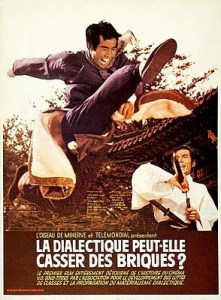
La Dialectique Peut-Elle Casser Des Briques?, in English, “Can Dialectics Break Bricks?”, is a 1973 Situationist film produced by the French director René Viénet which explores the development of class conflict through revolutionary agitation against a backdrop of graphic kung-fu fighting.
The film uses 1972 martial arts film Crush by Tu Guangqi, which tells the story of anti-colonialist revolt in Korea during the period of Japanese occupation, for its visuals which has been dubbed over by the filmmakers in an attempt at détournement. The concept and motivation of this film was to adapt a “spectacular” film into a radical critique of cultural hegemony and thus into tools of subversive revolutionary ideals.
The Narrative is based upon a conflict between the proletarian and bureaucrats within state capitalism. The proletarians enlist their dialectics and radical subjectivity to fight their oppressors whilst the bureaucrats defend themselves using a combination of co-optation and violence. The film is noted for its humorous approach to this serious subject matter.
The film also contains many praising references to revolutionaries who thought and fought for the realisation of a post-capitalist world, including Marx, Bakunin, and Wilhelm Reich, as well as scathing criticism towards the French Communist Party, trade unionism and Maoism. Also Subplots dealing with issues of gender equality, alienation, Paris Commune, May 1968, and the Situationist themselves are riddled throughout the film.
There are many signs pointing to a false flag attack in Brussels on 3-22-16. Independent and alternative media, as usual, has been right on top of the story catching many of the usual oddities, lies and coincidences which are characteristic of false flags and are now piling on top of each other as they always do. And here’s another thing everyone should take note of; something we also observed during the Paris attacks on 11-13-15. As we saw in the Paris attacks, once again we’re seeing a “global” component to the “reaction” phase of the usual problem-reaction-solution dialectic employed by the controllers. Look for it. Problem at point A, subsequent “reaction” to the problem at point B, all the way on the other side of the world. This then leads to a “solution” that applies to both point A and B. This also serves to endorse the illusion that the bogeymen, in this case ISIS of course, involved in the Brussels attack are somehow everywhere at once.
One of the key purposes of this event, among other purposes like maintaining an excuse for U.S. military intervention in Syria, is to reinforce the need for a global police which is being sold as a “global solution” to a “global problem.” This global police state is a very clear agenda of the U.S., NATO and the U.N. This entire event is also designed to push the Authorization for Unlimited Military Force (AUMF) the Pentagon wants so badly and it’s a perfect quick and easy event in NATO’s and the European Union’s home turf to push for all of these goals at once. What am I talking about?
Following the Brussels “attacks,” which were immediately and deliberately linked to “ISIS,” we saw how in the city of Atlanta, Georgia halfway across the world, police were “on edge” and completely evacuated the Atlanta airport because of an unattended “package” they thought could be related or connected to the “ISIS” Brussels attacks. Though the whole thing turned out to be nothing at all, make no mistake this is part of the mass conditioning that comes with the entire quest for global police and perpetuation of the ISIS psyop. Even the officers involved in the airport evacuations I’m sure got caught up in the hysteria simply following protocol. Can you imagine how easy it would be for someone to purposely leave an unattended package just to extract the reaction, fear and hysteria from the masses while at the same time endorsing the idea of “global terrorism” and conditioning the masses to accept the idea of a need for a “global police.” One tiny fake package in Atlanta accomplishes all of this and more. And it wasn’t just Atlanta caught in the psyop, in Denver we saw “evacuations” as well:
Atlanta’s airport was briefly evacuated on Wednesday over a suspicious package while U.S. law enforcement agencies and travelers were on edge a day after deadly suicide bombings by Islamist militants rocked Brussels.
Passengers were ordered out of public areas of the domestic terminal at Hartsfield-Jackson International Airport, the United States’ busiest by passenger volume, but the site was quickly cleared and operations resumed, airport officials said.
Parts of Denver airport were also evacuated on Tuesday, hours after at least 31 people were killed and 271 wounded in attacks on Brussels airport and a rush-hour metro train, as airports across the United States tightened security.
As you can see, the hysteria wasn’t just in Atlanta. Notice the article doesn’t even bother to discuss what exactly happened in Denver. Was it also a “suspicious package” there? Was it a phone call from ISIS? Who cares, right? Because apparently the only thing that matters is that it’s part of the “reaction” phase; and the true answer is, this is part of the mass conditioning for the new world order’s global police state which is now being born with every ISIS “attack.”
Historic Mass Conditioning
So for the first time in human history an event at point A in one side of the world forces a Pavlov-style reaction at point B, on the opposite side of the world; even though the 2 events (in the organic reality) have no association with each other other than the conditioned response. The conditioning of the masses can be compared to Pavlov’s dog experiment. In the Pavlov dog salivation experiment, Russian physiologist Ivan Pavlov was able to demonstrate that dogs can be conditioned to organically react a certain way by simply associating one artificial stimulus enough times with a natural stimulus. Eventually Pavlov demonstrated that you wouldn’t need the natural stimulus (food) to elicit the conditioned response (salivation) if you provide the artificial stimulus (a bell).
If you understand Pavlov’s classical conditioning then you should understand the mass conditioning of the masses going on right now via the mainstream media and politicians. The Brussels attacks is no different from the Paris “attacks” of November of 2015. Isn’t it a coincidence that less than a week ago the mainstream media brought back the Paris attack “story” as if to prepare the masses subconsciously for the upcoming Brussels attacks in Belgium? How about the fact the Turkish president Recep Tayyip Erdogan basically subliminally announced the upcoming attacks 4 days prior? Are we surprised given that Erdogan’s Turkey is right now the primary lifeline for ISIS purchasing their oil and supporting fighters with resources in the Turkey-Syrian border while blowing up Russian planes that interfere with that mission? This has all the markings of a mass psychological operation.
First of all, we don’t know who planted those explosives in the Brussels airport or subway system and we don’t know why or who told them to do it. With ISIS being credited, that alone is proof as far as I’m concerned that this is a state crime funded by NATO countries. We must all shed the myth that ISIS fighters are freely doing what they want, independent of the will of the states that created, funded, trained and armed them. Think about this. No one trains fighters only to let them go away and fight for someone else. Whoever trained these guys is still giving the orders or they wouldn’t have wasted their resources training these guys. Just like in the U.S. military, you wouldn’t train a Marine in boot camp, show them how to survive and offer weapons training only to watch them leave the Marines after boot camp and fight elsewhere. Yet this is precisely what Americans are asked to believe every day by the mainstream media. We’re told to believe these fighters just so happened to switch sides AFTER being trained to fight for the “Free Syrian Army.”
If it wasn’t that ISIS is a mercenary group employed by NATO countries, they’d be long gone by now. The only reason ISIS is still “alive” in our consciousness is because nations like Turkey, US, Israel and Saudi Arabia are keeping them alive both literally and figurative using their controlled media. ISIS is therefore alive because they (U.S., NATO and company) want and need them to be alive for political reasons. No ISIS means no Syria, no PNAC Middle East plan completion, no fear, no war on terror, no global police and no stripping away of individual rights, it’s that simple.
Incidentally the location of the explosions in Brussels Belgium is immensely convenient. There’s no question that the headquarters of NATO and the European Union would be a perfect place to execute and control a false flag like this. This is also the perfect false flag to quickly put together during this election year campaign hysteria pause. It likely took very little coordination and effort requiring a couple of explosives and a patsy or 2. Here’s the sequence as I see it: Boom! ISIS did it, lockdown airports in the U.S. due to an unattended package, goals and conditioning reinforced by media, back to election campaign with the candidates calling for “solution” to ISIS.
This is the part where ALL politicians running for president get to offer their “solution” to the same artificially created “problem.” In other words, this is a win-win for the ruling elite. And in this sense the Brussels attack is already part of the election campaign itself. Be on the look out for candidates endorsing ideas “global solutions” to ISIS.
Finally, I call on readers to observe how these false flags are getting easier and easier for them to do. I’m sure there was a time when a false flag attack like this took years to prepare (think 9/11). Now we are seeing quick attacks being strung together with minimal preparation, attacks which nonetheless have long-lasting implications for freedom, the rise of the global police, obtaining their AUMF license to kill, and obtaining all the excuses they need to justify U.S. aggression in Syria in hopes of forcibly removing their democratically elected president.
Remember practice makes perfect. So as they get better and more efficient at pulling these false flag attacks, let us get better and more efficient at diagnosing them and spreading the word. I believe both phenomenons are happening simultaneously. Hopefully, the ability of alternative and independent media to quickly diagnose these attacks by simply observing the process of problem-reaction-solution will help us turn a corner in changing minds at the highest level and thus effect much needed change sooner rather than later.
Editor’s note: Today marks the birthday of artist Mark Lombardi (born in 1951) and is also the day after the 16th anniversary of his suicide or murder. To learn more about Lombardi’s life, art and the suspicious circumstances surrounding his death, please take a moment to listen to the Radio WhoWhatWhy podcast and/or read the transcript.
A story of banking, organized crime, intelligence, petrodollars and politics…all seen through the lens of innovative Art.
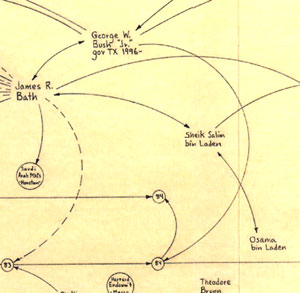
Patricia Goldstone’s INTERLOCKis the first biography to explore the life and suspicious death of Mark Lombardi, a controversial artist whose drawings walked the line between art and information — and revealed the incestous connections between banking, organized crime, politicians, the FBI and the CIA.
His work highlighted such subjects as the Bank of Credit and Commerce International (BCCI), the Iran-Contra affair, the World Finance Corporation, and the relationship between George W. Bush and Harken Energy Corporation. The mystery of Lombardi’s alleged suicide has yet to be resolved. On March 22, 2000, he was found hanged. Friends find it suspicious because Lombardi was on the the cusp of achieving the recognition that would crown his career.
Goldstone talks to WhoWhatWhy’s Jeff Schechtman about the full scope of Lombardi’s life and work.
For a look at some of Lombardi’s dangerously revealing and possibly fatal work, go here, and here.
JEFF SCHECHTMAN: Welcome back to radio who-what-why. I’m Jeff Schechtman. In March of 2000 the acclaimed conceptual artist, Mark Lombardi, was found hanged in his New York apartment. It was ruled a suicide but Mark Lombardi was no ordinary artist. His work, ‘Interlocks’ as they were called, art was also information shining light on the Vatican, the Mafia, the Bushes, international financiers, and the CIA. In the words of his biographer Patricia Goldstone, his death transformed itself into the ultimate piece of conceptual art. In fact, after his death, Lombardi’s work drew the attention of the most influential art museums in the world as well as the FBI and the CIA. Patricia Goldstone has been a reporter for the Los Angeles Times and a bureau chief for Cablevision. She has written for the Washington Post, Maclean’s and The Economist Intelligence Unit. She’s an award-winning playwright and she’s just completed Interlock: Art, Conspiracy, and the Shadow Worlds of Mark Lombardi. It is my pleasure to welcome Patricia Goldstone here to radio who-what-why.
PATRICIA GOLDSTONE: Thank you for having me on the show.
JEFF S.: Great to have you here. First of all, who was Mark Lombardi? It’s not a name that a lot of people instantly recognize.
PATRICIA G.: That’s quite true. Mark was a conceptual artist, as you said, which means he essentially drew ideas and not water lilies. Some people considered him to be the first great artist of the 21st century. He is unique in the art world because he used interlocks to create his art. Now interlocks are basically a form of flowchart tracing overly cozy relationships between boards of directors. And they’re common in accounting and in some forms of litigation, but they’re very, very unusual in the art world. Mark used interlocks to draw what amounts to a continual visual history of the interconnections between intelligence and organized crime and corporations and governments in the shadow banking industry that we’ve heard so much about since 2007. He was particularly fascinated in tracing things like money laundering and tax evasion. He was actually way ahead of Edward Snowden and Julian Assange in releasing a very wide swath of extremely uncomfortable information to the public. What he created was a form of visual wiki-leaks. His own life is actually the missing strand and several of the shadowy visual narratives that make up his work. He died, as you said, a very mysterious death.
JEFF S.: Talk little bit about how Mark first got interested in the shadowy world that he would come to depict in all of these interlocks.
PATRICIA G.: Well, Mark’s research skills were well known in the Houston art world which was very progressive in its politics, at least at that time, through major patrons like the de Menils, who were the heirs to the Schlumberger fortune and the owners of the world-famous de Menil collection and the Rothko Chapel where Mark was married. Sissy Farenthold, a very prominent Texas politician who once ran for president of the United States, was on the board of the Rothko Chapel and she met Mark at a gathering around 1986. Farenthold introduced Mark to an informal investigative salon of young people, in her words, who included a number of lawyers and investigative journalists and prosecutors etc. She also introduced him to Bill White who was changing our Bath former business partner. White was engaged in a long-running series of lawsuits at the time so that the group was digging into interconnections of the Texas Savings and Loan scandals and the Iran Contra funding network. So Mark was tasked to draw out these interconnections in a readable way.
JEFF S.: To what extent was Lombardi simply creating this conceptual art, creating these interlocks from what was the assumed knowledge of the time, as opposed to doing additional work, additional research, to try and find connections that didn’t exist out there, in the popular press for example?
PATRICIA G.: That’s a very good question. Mark was actually very methodical and systematic. He worked very much like the way a historian works. He learned about the flow of hot money largely through published material by well-respected academics and journals. His library, which I ran through in the course of researching the book, consisted of hundreds of books on the financial debacle he drew, which he rigorously boiled down to bullet points of essentially academically and dictated information which he compiled in thousands of 3 x 5 index cards. He would arrange these in a narrative design on the floor next to the drawing he was composing, much like a film director uses a storyboard. But as I explained in the book, at that time he was given a very large stash of internal memos and other primary documents by one of the participants in the scandals. These are documents that were never previously published and would be a prize of any serious historian. At the time I discovered that he was taught how to do interlocks by the lawyer who deposed Richard Shelby who was one of the major middlemen in the Iran Contra scandal and in DCI. So his research was quite professionally grounded,
JEFF S.: Who was it that originally recruited Mark to really start doing this political work in Houston?
PATRICIA G.: Well, I would say it was Farenthold. And you know, he was already rather motivated personally to do it according to a note I found in his files which was apparently written by him. He had a personal run in with the Bushes and it was hard to put this story together because nobody really wanted to talk about it, not even Mark. But according to what I pieced together, Mark moved down to Houston straight out of Syracuse University to work as a curator at the Contemporary Art Museum of Houston, which was a very important job for such a young man. He was hired to do that by Jim Harithas who was the director of the museum and Mark’s college teacher and mentor. And from what I understood from a number of sources under pressure from the board, Harithas terminated him after a famous impromtu bread fight at a major art opening which turned into a major brawl when certain of the eminent guests, who were perhaps inflamed by alcohol, the naughty nature of the proceedings started ripping apart the installation and throwing it around. And a couple of unidentified artists sailed into the melee and started punching up the guests. Now Mark never spoke about this incident again and in fact his ex-wife told me that as the reason for his firing was introduced into a conversation he would actually get up and leave the room. But in his personal files I found this note which looks like it was written by him and it reads “In the late 1970s,” – which is when this incident occurred – “I was working as an organizer of art exhibitions in the Houston area. First International Bank, which was George HW Bush’s bank, barged into the scene at about this time effectively vetoing my participation in a large number of projects.” And Mark said in this note, which is an addendum to the journalism that he was attempting, that he embarked on his research as a form of revenge.
JEFF S.: Was there anybody specifically, a specific individual that he had had a run-in with from the Bush family that really precipitated this?
PATRICIA G.: No, again, this is shared conjecture on my part. From the way the note is put together, from the sounds of this, the Bushes might’ve been present at this gathering.
JEFF S.: What happened to all of Mark’s file cards after his death?
PATRICIA G.: Well, all of them is kind of a subjective number. Because I was told by one major collector of his work that there were as many as 40,000 file cards. And this collector had access to his studio. But what is archived at the Museum of Modern Art in Long Island, the number is about 14,000 cards, a considerably smaller number and when I went to use the cards, all but four on the financial activities of the Bushes, on whom he focused much of his attention, were missing. That really did strike me as extremely odd. I asked the chief archivist if they had archived the Bush material elsewhere, if I had missed it, and she couldn’t answer the question. She referred me to the security department instead.
JEFF S.: To what extent was his interest in these things driven by a desire to continue to uncover new stuff or really to continue to uncover new areas to expand his art and create more interesting interlocks essentially?
PATRICIA G.: I think that Mark was primarily an artist. I think in many ways he can be considered the heir to Marcel Duchamp who was the founder of Dada, one of the most important of the early 20th century art movements. Now Duchamp created his revolutionary art out of ordinary objects like the famous Urinal. Mark took another kind of ordinary object, the interlock, and he used it to pursue that to produce his main track of thought: how the political influence that he was essentially tracing took shape in flows of hot money. And those flows continually expanded and pooled together over the period of years that he was tracing them. So yes, he was constantly expanding his artwork. In fact, he linked all of his drawings together to form one continual drawing he called ‘the one continual drawing in my head’.
JEFF S.: To what degree did accuracy matter to Mark?
PATRICIA G.: A great deal. A great deal, as I said. He worked like a historian and the file cards are amazing because they are very much like what an academic would use in compiling the bibliography and index of a 600- page work. So I think he was very, very scrupulous in his research and he relied on primarily unpublished material but by academics and journalists.
JEFF S.: How was he seen in the art world, his early work, and as his work progressed?
PATRICIA G: He was a late bloomer. He turned out his initial body of work at white-hot speed in the mid 1990s when he was already in his 40s. And he garnered quite a bit of attention with this one body of drawings. He had a solo exhibit in Houston. And the amazing thing about these drawings was that they answered a lot of the questions that John Kerry’s Senate Investigating Committee on BCCI which was winding down at about the same time that Mark was turning out his work, he answered questions that if you read the Kerry committee report they said they didn’t have the time or the resources to pursue. And he was this artist sitting on the floor of a tiny studio in Houston pursuing them.
JEFF S.: How did the subjects of these pieces of art, those that he really reflected in this interlocking aspect of crime and as you say, ‘hot money’, how did they react to what he was doing?
PATRICIA G.: Well, with some discomfort, as you might expect. I was told a story by one of my interviews that one of Neil Bush’s friends came to Mark’s first solo show in Houston and he was looking at a painting on the wall. It was the Silverado painting in which Neil figures and he remarked to someone “Well, I’m going to have to tell Neil that he is represented here.”
JEFF S.: Talk a little bit about the evolution of his work. How did it progress? How were some his later works and later interlocks different from the early ones?
PATRICIA G.: Well, the work became much more complex as he progressed because it all interconnected. So the genesis of his work really was a huge bank called BCCI that some people may not remember. It was a bank that billed itself as Bank of America for the Third World but in fact it was the CIA’s first global money laundry and BCCI was very connected to the subprime crises of the 1970s and 1980s and it was officially closed down in the 1990s. But Mark really developed all of his drawings from his initial two boxes of research into BCCI and ended up in this immense continuum of drawings that makes up his work tracing the genesis of BCCI all the way back to a trove of stolen World War II plunder.
JEFF S.: Talk about the FBI and the CIA and their interest in Mark’s work.
PATRICIA G.: Well, the FBI, the CIA, the Department of Defense and the Office of Naval Research actually all had to study Mark’s work in the wake of 9/11 which wasn’t really made public until my book came out. They were looking for clues for two terrorist social networks. That’s a subject Mark covered in some of his drawings and also for traffic analysis tools which is kind of a funny story because although the NSA, which also studied Mark’s work, may be very good at collecting data on all of us but are not terrific in analyzing it. And when they feed it into a main computer, the visualization tends to come out looking like what they call ‘house of spagetti’. But Mark’s work is actually used in the computer science world to study traffic analysis because he spaced his players in a particular way that makes them very easy to read and sort of aesthetically pleasing and directs the eye in certain ways.
JEFF S.: Tell us a little bit about Mark’s personality . What was he like?
PATRICIA G.: He was a fascinating person. He was a workingclass guy from Syracuse, New York, who had nothing more than a bachelors in fine arts. And he was intensely ambitious, untrained in finance or anything like that but very, very quick intuitively. And his talent as an artist was to be able to apprehend a lot of visual information all at once and to get at the big picture that lies below the surface of things. I suppose many people would call him obsessive. People have tended to use Aspergers as an explanation for his ability to focus very intensely for a very long period of time. I don’t think that that is quite fair or true. Mark was very charming, very funny, exuberant, impish, intensely attractive to women, and very good socially when he wanted to be. And very good verbally. He was a shrewd communicator and a cunning player of the art game who never quite revealed what he was really up to. I mean nobody in the art world, for example, had a clue that he had actually created his work out of interlocks.
JEFF S.: Talk about what happened in March of 2000.
PATRICIA G.: Mark was in the process of opening a very important show at one of the iconic exhibition spaces in New York and everything seemed to be going beautifully for him. He was getting attention, he was getting a great deal of critical acclaim that people were lining up to buy his work, he was making money which had always been an issue for him. His personal life was a bit rocky but that was not unusual. He had recently broken up with a girlfriend depending on whom you talk to and I heard many, many different renditions of this story and in the course of interviewing over 80 people who knew him for over a 50 year period. Depending on whom you talk to he was either happy about that or unhappy about that but he was certainly seeing other women at the time. So he had had a suspicious flood in his studio about three weeks before the show opened. His masterwork, which was the third version of his BCCI series, was very badly water damaged, and this drawing is remarkable because he actually strung all of his previous drawings together on a series of timelines so that you can see exactly how all the scandals from the 1970s onwards sort of add up to this one huge scandal which is BCCI. That painting was almost, almost destroyed but it does remain readable today. So Mark re-created it in a mad workspace. He reconstructed the whole drawing in the space of about four days and some people say that the strain of doing that drove him into a suicidal depression. I don’t quite buy that because he did open the show very successfully with the drawing that he had re-created and people told me that he was quite happy with that drawing. Regardless, about three weeks later he was found hanged in his studio. And the police reports which I got hold of in the beginning of my research, were rather sketchy. A lot of things didn’t ring true. The time of death was never established, for one. Establishing death by hanging is a controversial area of forensic pathology, and the police based their very hasty verdict of death by suicide on the testimony of one witness who appeared increasingly unreliable during the interview process. I actually did track down the two cops who found him , one of whom was a rookie at the time, still very disturbed by the experience. He was a policeman who actually pushed open the transom which is how they got into Mark’s studio and there was Mark staring him straight in the face because he didn’t hang from a sprinkler pipe and he had an open bottle of champagne suspended beside him. Till today I have never really seen anyone take a drink on the way out.
JEFF S.: Talk about the flood. What is it that made it suspicious? What do we know about that?
PATRICIA G.: Well, it was a sprinkler flood. And a lot of rumor and conjecture exist in the art world about Mark’s suicide/death/murder. But one artist told me what sounded like a rather implausible story that he had tried to hang himself earlier, at the time of this flood from one of the sprinkler pipes, and that his weight is what broke the pipe and that’s what caused the flood. That’s actually very difficult for that kind of a factor to trigger a flood. I mean sprinkler pipes go off because of fire or they can go off because of a sharp blow applied to a pipe from an upstairs apartment to the gage, to the gage on the pipe line or to apply heat to that gage, that can trigger a flood in the downstairs apartment but someone hanging himself, no, not very likely.
JEFF S.: Talk a little bit about whether or not there was any history of depression or mental illness or anything else with respect to him.
PATRICIA G.: No, there was no critical history of depression. In retrospect certain members of Mark’s family told me that they felt he was depressed. However, his mother, who was really the closest person to call me before she died – she died in 2012 – she told me that she had talked to him a couple of days before he was found and he said he was absolutely jubilant at the success his work had brought him and at the prospect of moving in with his girlfriend. So, you know, a lot of this doesn’t compute.
JEFF S.: The police report after his death, and all the investigation was, as you talk about it, a bit sketchy. Talk about that and was that normal at the time in terms of police procedure or was that unusual?
PATRICIA G.: Well, the circumstances surrounding his death were really quite strange. He had no clinical history of depression and his mother to whom he was closest and to whom he spoke almost daily, told me that he had told her that he was actually very happy a couple of weeks, a couple of days rather, before he died. And I believe that because Mark was quite single-mindedly ambitious and he was getting the success that he had worked for, for decades by this time, to achieve. He may have been unhappy at the breakup of a relationship but he was extremely attractive to women and extremely attracted to women, and in fact he was seeing somebody else at the time. So I actually began my research by getting hold of the police report through a friend of mine in the homicide division in New York, and there were a lot of things that didn’t ring quite true. A time of death was never established for one thing and that’s very important in this kind of investigation and standard procedure and establishing death by hanging is a controversial area in forensic pathology. That and the fact that the police based their very hasty verdict of death by suicide to close the case today on the testimony of one witness who appeared increasingly unreliable during the interview process. I actually ended up tracking down the two cops who found him. One of them who was a rooky at the time and showed signs of doubt; that and the other pillar, that there are other pillars of evidence which was the absence of signs of struggle and the fact that the door was securely locked from the inside are also questionable as I explained in my book. But the exact nature of what’s in the drawing which can cause any number of people to want him dead.
JEFF S.: Is there anything in the drawings, all of them, that was what we would classify, I suppose, is original material? One of the things you’ve talked about is that in many ways he worked based upon academic reports, in journalism, and in all the material that he could get his hands on, and he was graded at bringing all of this together in these interlocks. But was there anything in this material that was revealing of anything that hadn’t been revealed anywhere else?
PATRICIA G.: Well, I did find in his files a large cache of internal memos and other primary documents from James R Bath Company Highway and some of these connections come up in in the George W. Bush Harken Energy Jackson Stevens drawing which was of interest to the FBI after Mark’s death.
JEFF S.: Did the FBI ever do anything with any of that to your knowledge?
PATRICIA G.: Well, it might be known that the FBI went to the Whitney after Mark died to look at one of his big BCCI drawings but the FBI was really interested in the relationship between how bin Mahfouz was anchored to the Saudi Royals and certain Islamic charities in Virginia that were allegedly funding Al Qaeda and that the FBI ended up raiding in 2002. And there are some clues to those interconnections in the Lombardi and the George W. Bush Harken Energy Jackson Stephens drawing which focuses on Bush’s oil companies. Now bin Mahfouz allegedly bankrolled Arbusto which was one of George W. Bush’s companies through James Bath who represented Saudi business interests in America; and one of the documents I did find in Mark’s files was a copy of the 1976 trust agreement between James Bath and Salem bin Laden who was Osama’s older brother and died in a crash a few years later. bin Mahfouz was also allegedly the real owner of that aircraft leasing company Skyways. Now interestingly, bin Mahfouz himself doesn’t actually appear in this drawing. However, Salem bin Laden and also Abdullah Taka Bakhsh who was a major Harken shareholder and CEO of a Halliburton subsidiary who had close ties to bin Mahfouz does appear as a central hub or connection along with James Bath and so does Fox’s representative on the Harken board, an influential business name, who opened the 2000 Republican national convention with the Muslim benediction on Bush’s behalf and later successfully protested the FBI raid on the Virginia charities in a private meeting with Bush’s treasury secretary, Paul O’Neill.
JEFF S.: If not suicide, where does your speculation, or where can speculation lead in terms of the cause of Mark’s death?
PATRICIA G.: Well, I have to point out that Mark was actually pretty equal opportunity in his finger-pointing. He did focus a lot of attention on the Bushes for the reasons I go into in the book and he did die during the presidential election in which at least one of his drawings might have had an impact. That he did a number of important drawings that focused attention on the Clintons and knowing a little group of Indonesians and the Riady family who were the sources of Chinese influence peddling during the Clinton administration. Also Mark Rich who is famously connected to the Clintons was one of the key middlemen that hooked Mark’s drawings together as is Jackson Stephens who funded both the Bush and the Clinton campaign, so you know overall Mark was really more like a social scientist and political partisan and that I believed his overwhelming interest was in getting this whole financial system done on paper for everyone to see. And in fact, he had reportedly been threatened in the late 1990s. He got a call from someone telling him to back off investigating the five major New York Times families who were the subject of a preparatory sketch he had been working on. He mentioned it to a Williamsburg publication and it was repeated after his death by a German freelance journalist. So there are a lot of names in these drawings. One of them told me that he wouldn’t know a Lombardi drawing from a Mona Lisa.
JEFF S.: In the material that you’ve uncovered since in your investigation and your work on this, does it lead anyplace in particular?
PATRICIA G.: Well, you know I have to be careful to point out that I don’t have anything like the smoking gun, that I don’t have the power to pin people and I have many, many different stories from almost everyone I talked to on this subject. But the heft of circumstantial evidence makes me feel that at the minimum a lot more questions should have been asked at the time of his death.
JEFF S.: And is your conclusion that didn’t really suicide just seem the most unlikely scenario?
PATRICIA G.: Well, it’s not my impression of Mark as a human being. He was tremendously vital and totally committed to his work. They said he was getting where he wanted to go and he was quite ebullient really, as a person, very high energy. Now of course, you know, I didn’t know the man and it’s always possible for certain personality types to be very volatile and from what people told me he was particularly, when he had been drinking, but no, it doesn’t stack up with where he was going in his life at the time. Because he was really on the verge of very major success.
JEFF S.: Is there any evidence that he was on to something or that he had made a connection, or that his research had taken him somewhere that was new and heretofore undiscovered?
PATRICIA G.: Well, that’s an interesting question. One of his drawings, one of his late drawings is called George
Bush Harken Energy Jackson Stephens and the drawing focuses on relationships that apparently – my source for this was a rather particular intelligence newsletter that came out in March of 2000 - said that the Bush campaign might run into trouble over the Bush relationship with Khaled bin Mahfouz who was anchored to the Saudi royals and very much a presence in Houston. This drawing that Mark had done focused on that relationship.
JEFF S.: What was the interest like in his work after his death?
PATRICIA G.: Well, his prices took off, certainly. One of his larger drawings recently went up for sale at one of the most prominent art galleries in the country priced at $450,000. He’s been quite avidly collected. The Whitney has a major holding of his works, the Museum of Modern Art has a major holding of his work. A number of eminent computer scientists collect his works. There’s Robert in Germany who I think owns four of the drawings. Robert, whom I interviewed, is engaged in trying to convert Mark’s drawings into hypertext, stringtext, which means you click on the name and it pulls up the whole history. Through the drawings of the problems he told me he had had in completing this, was that some of the drawings are not available to view because they are in private collections.
JEFF S.: is there any work that disappeared after his death that anybody is aware of?
PATRICIA G.: The George Bush Harken Energy drawing did migrate to Germany for quite a number of years but it’s back in the United States now. Some people that I interviewed said they felt that drawings had disappeared from his studio but his studio was not actually very well secured. But it’s after his death and impossible to substantiate that.
JEFF S.: Patricia Goldstone: the book is Interlock: Art,Conspiracy, and the Shadow Worlds of Mark Lombardi. Patricia, thanks so much for spending time with us here on radio who-what-why.
PATRICIA: Oh, thank you for having me on the show.
JEFF S.: Thank you. And thank you for listening and joining us here on radio who-what-why. I hope you’ll join us next week for another radio who-what-why podcast. I’m Jeff Schechtman. If you like this podcast, please feel free to share it and help other people find it by rating and reviewing it on iTunes. You can also support this podcast and all the work we do by going to who-what-why.org/donate
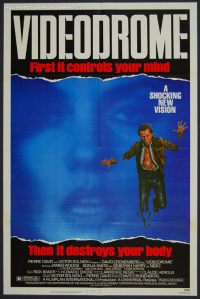
Editor’s note: Since today marks director David Cronenberg’s 73rd birthday, it’s a good time to appreciate one of his greatest and most notorious works. Though my favorite of his remains the distinctly PKD-like eXistenZ, a close runner up is the cult classic Videodrome, which the following analysis reappraises in the context of contemporary social media-fixated culture.
David Cronenberg’s vision of technology as the “new flesh” in Videodrome isn’t so shocking anymore.
Videodrome is the best movie ever made about Facebook.
What felt “vaguely futuristic” about it in 1983 is prescient today: technology and media are ever more intimate, personal, embodied, an interpenetration that David Cronenberg’s film graphically explores.
Videodrome offers a long-needed correction to how we collectively view and talk about technology. As the anti-Matrix, Videodrome understood that media is not some separate space, but something which burrows into mind and flesh. The present has a funny habit of catching up with David Cronenberg.
Still, Videodrome is deeply of its time and place. It’s set in Toronto, where Cronenberg was born and studied at the same time as University of Toronto superstar media theorist Marshall McLuhan, who coined the phrase “the medium is the message.” Beyond McLuhan’s reputation, Toronto was also known as a wired city; among other things, it was an early adopter of cable television.
In suit, Videodrome follows a Toronto cable television president, Max Renn (James Woods). He becomes involved with a radio psychiatrist named Nikki Brand (Debbie Harry, of Blondie fame), who reminds us of popular criticisms of television culture: we want to be stimulated until we’re desensitized, becoming (at best) apolitical zombies and (at worst) amoral monsters. Television signal saturates this film. The satellite dishes, screens, playback devices, and general aesthetics of analogue video are on glorious, geeked-out display. Although Videodrome’s operating metaphor is television, this film can be understood as being a fable about media in general. And what seemed possible with television in 1983 seems obvious today with social media.
Over the course of the film, Max comes to know a “media prophet” named Professor Brian O’Blivion—an obvious homage to Marshall McLuhan. O’Blivion builds a “Cathode Ray Mission,” named after the television set component which shoots electrons and creates images. The Cathode Ray Mission gives the destitute a chance to watch television in order to “patch them back into the world’s mixing board,” akin to McLuhan’s notion of media creating a “global village,” premised on the idea that media and technology, together, form the social fabric. O’Blivion goes on to monologue, “The television screen is the retina of the mind’s eye. Therefore, the television screen is part of the physical structure of the brain. Therefore, whatever appears on the television screen appears as raw experience for those who watch it. Therefore, television is reality; and reality is less than television.”
This is Videodrome’s philosophy. It’s the opposite of The Matrix’s reading of Baudrillard’s theories of simulation, and it goes completely against the common understanding of the Web as “virtual,” of the so-called “offline” as “real.” O’blivion would agree when I claim that “it is wrong to say ‘IRL’ to mean offline: Facebook is real life.”
This logic—that the Web is some other place we visit, a “cyber” space, something “virtual” and hence unreal—is what I call “digital dualism” and I think it’s dead wrong. Instead, we need a far more synthetic understanding of technology and society, media and bodies, physicality and information as perpetually enmeshed and co-determining. If The Matrix is the film of digital dualism, Videodrome is its synthetic and augmented opponent.
As P.J. Rey illustrates, fictional Web-spatiality is the favorite digital dualist plot device. Yet more than fiction books and films, what has come to dominate much of our cultural mythology around the Web is the idea that we are trading “real” communication for something simply mechanical: that real friendship, sex, thinking, and whatever else lazy op-ed writers can imagine are being replaced by merely simulated experiences. The non-coincidental byproduct of inventing the notion of a “cyber” space is the simultaneous invention of “the real,” the “IRL,” the offline space that is more human, deep, and true. Where The Matrix’s green lines of code or Neal Stephenson’s 3D Metaverse may have been the sci-fi milieu of the 1990s, the idea of a natural “offline” world is today’s preferred fiction.
Alternatively, what makes Videodrome, and Cronenberg’s oeuvre in general, so useful for understanding social media is their fundamental assumption that there is nothing “natural” about the body. Cronenberg’s trademark flavor of body-horror is highly posthuman: boundaries are pushed and queered, first through medical technologies in Shivers , Rabid , The Brood , and Scanners , then through media technology in Videodrome and eXistenZ , then, most notoriously, in The Fly, where the human and animal merge. If The Matrix is René Descartes, Videodrome is Donna Haraway.
Cronenberg’s characters are consistent with Haraway’s theory of the cyborg: not the half-robot with the shifty laser eye, but you and me. In the film, the goal is never to remove the videodrome signal that is augmenting the body, but to reprogram it. To direct it. As Haraway famously wrote, “I’d rather be a cyborg than a goddess.” “Natural” was never a real option anyways.
Max Renn is especially good at finding the real in the so-called “virtual” because he is equally good at seeing virtuality in the “real.” From the beginning, he understands that much of everyday life is a massive media event devoid of meaning. The old flesh is tired, used up, and toxic. The world is filled with a suffering assuaged only by glowing television screens. As the film progresses, the real and unreal blur, making each seem hyperbolic: hallucinations become tangible, while the tangible drips with a surrealism that’s gritty, jumpy, dirty, erotic, and violent—closer to Spring Breakers than The Wizard of Oz. As such, Cronenberg’s universe is always a little sticky: an unease which begs the nightmares to come true, so that we at least know what’s real.
Videodrome’s depiction of techno-body synthesis is, to be sure, intense; Cronenberg has the unusual talent of making violent, disgusting, and erotic things seem even more so. The technology is veiny and lubed. It breaths and moans; after watching the film, I want to cut my phone open just to see if it will bleed. Fittingly, the film was originally titled “Network of Blood,” which is precisely how we should understand social media, as a technology not just of wires and circuits, but of bodies and politics. There’s nothing anti-human about technology: the smartphone that you rub and take to bed is a technology of flesh. Information penetrates the body in increasingly more intimate ways.
This synthesis of the physical and the digital is mirrored in the film’s soundtrack, too. In his book on Videodrome’s production, Tim Lucas calls Howard Shore’s score “bio-electronic” because it was written, programmed into a synthesizer, and played back on a computer in a recording studio while live strings played along. Early in the film, the score is mostly those strings, but as time passes the electronic synthesizers creep up in the mix, forming the bio-electronic synthesis.
The most fitting example of techno-human union in Videodrome is the famous scene of Max inserting his head into a breathing, moaning, begging video screen; somewhere between erotic and hilarious, media and humanity coalesce. There isn’t a person and then an avatar, a real world and then an Internet. They’re merged. As theorists like Katherine Hayles have long taught, technology, society, and the self have always been intertwined. Videodrome knows this, and it shows us with that headfirst dive into the screen—to say nothing of media being inserted directly into a vaginal opening in Max’s stomach, or the gun growing into his hand.
Thirty years after its release, Videodrome remains the most powerful fictional representation of technology-self synthesis. This merger wasn’t invented with the Internet, or even television. Humans and technology have always been co-implicated. We often forget this when talking about the Web, selling ourselves instead a naive picture of defined “virtual” spaces which somehow lack the components of “real” reality. This is why The Matrix and “cyberspace” have long outworn their welcome as a frame for understanding the Internet. It should be of no surprise that body horror is as useful for understanding social media as cyberpunk.
This concerns the question of the identity of the people who are behind the violent protesters at Donald Trump’s rallies.
There are going to be ad-hominem attacks against me for my reporting this account, which will contradict the myths that both progressives and conservatives hold regarding the U.S. government, but anyone who recognizes that the press to this day hides its having hidden the incontestable fact that George W. Bush knowingly falsified, lied regarding the evidence concerning “Saddam’s WMD,” will at least give this account, and its source, fair and unprejudiced consideration, as being possibly accurate and honest. Sometimes, in order to get to the truth in a case, it’s necessary to rely upon the testimony of people that one considers despicable; the FBI wouldn’t be able to crack many cases otherwise — and, sad to say, neither can I. So: please don’t dismiss me for relying here upon a researcher whom I personally detest — and whom you might likewise detest.
I believe that the libertarian Roger Stone, who is the Republican Party’s most gifted opposition-researcher, after having been Richard Nixon’s most gifted dirty-trickster, and after his having ferreted out the hypocrisy of Eliot Spitzer for paying prostitutes — after, in other words, Stone’s having worked for politicians I despise, and destroyed the careers of ones I admire — is among this nation’s stellar investigative journalists; and I have found, over the years, that, when he reports about dirty tricks, what he has reported is only confirmed, not disconfirmed, as time passes. In other words: though I don’t like the man, and I disagree with his politics, I respect his news-reporting. And, here is what he says, in a rush interview with the ‘conspiracy theorist’ (another libertarian) Alex Jones, on Saturday evening, March 12th, and I think that the entire nation needs to hear Stone’s account, at least to give it consideration. So, here it is:
My rush transcript of highlights from his rush-interview:
I think everybody in the country has now heard about these violent protests [at Trump rallies] which are being blamed on supporters of Bernie Sanders. … This is a false-flag. These demonstrators are flying under a false banner. They are not Sanders supporters by-and-large. This is an operation directed by supporters of Hillary Clinton, paid for by George Soros and Move-On, by David Brock at Media Matters for America, also funded by Soros, and also by the reclusive billionaire Jonathan Lewis. Now, Lewis was identified by the Miami New Times as a ‘mystery man.’ He inherited roughly a billion dollars from his father Peter Lewis … [founder of Progressive Insurance Company]. Jonathan Lewis interestingly withdrew his support of the Democratic National Committee over the immigration bill that he thought was unfair to gays. In any event, this is a Hillary Clinton operation. The idea here, very clearly, is to divide the Sanders economic voters from Trump; in other words, those voters who lost their jobs because of NAFTA and all of the other globalist international trade-deals that have screwed this country, they now realize that these voters are potentially, when Sanders is out of the race, Trump votes, and this is an effort to make Trump toxic, to disqualify him, [as a] racist, bigot, the whole thing is essentially a hoax. It’s a gambit directed, by the way, by Brock. Brock was once a friend of mine and was a comrade in the fight for freedom; but he went over to the dark side, with the Clintons, for money: big, big, big, money; and this is unfortunately his little dirty trick, Unfortunately, they have leaks within their operation, my sources are of the very best. The entire collaboration in Chicago is a Hillary Clinton operation. And, frankly, I can’t see Bernie Sanders having anything to do with it. I don’t agree with Bernie, but I respect him, and this is not his handiwork or the handiwork of his campaign.
[Jones here goes on to explain why he respects the investigative reports from Stone, then says, “When I saw all these Bernie shirts and Bernie people saying ‘We attack!’ — you know, people shooting guns in the air saying ‘We support Bernie!’ that is so clearly a way to attack him, make him look like a radical revolutionary, and to make Hillary look good, and also make Trump look like a racist when the media plays this up. You’re absolutely right. … To be clear: you have sources inside saying this is a Soros/Brock Media Matters, which they admit is run by the White House, they have weekly meetings, Obama’s former transition chief. … We’ve seen the build-up toward race-war this summer, this fall, to try to cloud the entire election; is that what you’re getting at; is this the opening salvo … ]
[Stone continues] I think Hillary understands that Trump would lose the votes of certain establishment Republicans if he is the nominee. On the other hand, it doesn’t matter, because of his crossover outreach. Right now in Ohio, Democrats and independents in the Mahoning Valley, these people have lost their jobs because of these great globalist trade deals, are lining up to vote for Donald Trump in the Republican primary, which is legal in Ohio with some paperwork. And we saw this same crossover in Michigan. So it occurred to the Clinton people that Bernie’s economic voters — not his hard-left voters, she’s not going to get them, they’re not going for Hillary, blue-collar folks who have just figured out that they have been left out of the new-world-order economy, are a ripe target for Trump; he’s already getting that, she is petrified of it; so, this little maneuver, this David Brock dirty trick, solves two problems at once: it helps knock down Bernie, because after all these people are involved in violence; and it also disqualifies Trump as a future vote, by portraying him as a racist or a bigot. The whole thing is a kabuki dance. And I think it’s very important that Trump understand that it’s not the Sanders campaign that’s disrupting his rallies; this is a Hillary Clinton operation.
[Jones asks for more details.]
[Stone continues] Hillary Clinton empowered a certain member of Congress to approach the billionaire John Lewis to pay for a portion of this overall program. This isn’t just Chicago. You’re now going to see these phony demonstrators, these ringers, showing up at other Trump events. … That’s as much as I’m prepared to say. …
——
That’s the interview.
Hillary Clinton’s campaign benefits enormously by this tactic:
1: It re-orients the issue away from economics toward race; away from economic issues and toward ethnic conflicts
2: It identifies Sanders with violent supporters.
3: It identifies Trump with racism and violence by his having black ‘Bernie supporters’ (of which there are few) disrupting Trump’s rallies.
4: While it smears both Sanders, her current opponent, and Trump, her likely future opponent, it leaves Hillary herself unscathed.




 is the best movie ever made about Facebook.

