The Recession Will Be Unevenly Distributed

By Charles Hugh Smith

Source: Of Two Minds

Those households, enterprises and organizations that have no debt, a very low cost basis and a highly flexible, adaptable structure will survive and even prosper.

The coming recession will be unevenly distributed, meaning that it will devastate many while leaving others relatively untouched. A few will actually do better in the recession than they did in the so-called “recovery.”

I realize many of the concepts floated here are cryptic and need a fuller explanation: the impact of owning differing kinds of capital, fragmentation, asymmetry, opacity, etc. ( 2019: Fragmented, Unevenly Distributed, Asymmetric, Opaque).

These dynamics guarantee a highly uneven distribution of recessionary consequences and whatever rewards are generated will be reaped by a few.

One aspect of the uneven distribution is that sectors that were relatively protected in recent recessions will finally feel the impact of this one. Large swaths of the tech sector (which is composed of dozens of different industries and services) that were devastated in the dot-com recession of 2000-02 came through the 2008-09 recession relatively unscathed.

This time it will be different. The build-out of mobile telephony merging with the web has been completed, social media has reached the stagnation phase of the S-Curve and many technologies that are widely promoted as around the corner are far from profitability.

Then there’s slumping global demand for mobile phones and other consumer items that require silicon (processors) and other tech components: autos, to name just one major end-user of electronics.

The net result will be mass layoffs globally across much of the tech sector.Research is nice but it doesn’t pay the bills today or quiet the restive shareholders as profits tank.

The public sector is also ripe for uneven distribution of recessionary impacts.Local government and its agencies in boomtowns such as the SF Bay Area, Seattle, Los Angeles, NYC, etc. have feasted on soaring tax revenues and multi-billion dollar municipal bonds.

The Powers That Be in these boomtowns are confident that the good times will never end, and so the modest rainy-day funds they’ve set aside are widely viewed as immense bulwarks against recession when in reality they are mere sand castles that will melt away in the first wave.

A $1 billion reserve looks impressive in good times but not when annual deficits soar to $10 billion. Local governments depend on various revenue streams, and most rely on a mix of property, sales and income taxes, both wages (earned) and capital gains (unearned). All of these will be negatively impacted in the next recession.

Local governments are especially prone to The Ratchet Effect, the dynamic in which expenses move higher as revenues climb but the organization is incapable of shrinking, i.e. it only knows how to expand. This defines government as an organizational type.

Inefficiencies (including low-level corruption and fraud) pile up and are offset with higher revenues. When revenue crashes, the system is incapable of eliminating the inefficiencies or reducing benefits and headcount.

I call the endgame of The Ratchet Effect the Rising Wedge Model of Breakdown:

The Ratchet Effect is visible in organizations of all scales, from households to sprawling bureaucracies. The core of the Ratchet Effect is the ease with which the cost basis of an organization rises and the extreme resistance to any reduction in funding.

The psychology of this resistance is easy to understand: everyone hired in the expansion will fight to keep their job, regardless of the needs of the organization or the larger society. Every individual, department and division will fight with the fierceness of a cornered animal to retain their share of the budget, for their self-interest trumps the interests of the organization or society.

Since each “ratchet” will fight with desperate energy to resist being cut while those attempting to do the cutting are simply following directives, the group that has pulled out all the stops to resist cuts will typically win bureaucratic battles.

Broad-based cuts trigger Internecine Warfare Between Protected Fiefdoms as entrenched vested interests battle to shift the cuts to some politically less favored fiefdom. Bureaucracies facing cuts quickly shift resources to protecting their budget, leaving their mission on auto-control. (The Lifecycle of Bureaucracy December 2, 2010)

These dynamics create a rising wedge in which “minimum” costs continue to rise over time even if modest cuts are imposed from time to time. The eventual consequence is a cost basis that is so high that even a modest reduction collapses the organization.

In other words, incremental reductions and reforms have zero impact on the endgame. The organization has become so brittle that any structural reform triggers a breakdown.

Those households, enterprises and organizations that have no debt, a very low cost basis and a highly flexible, adaptable structure will survive and even prosper. Those with high debt loads, high fixed expenses and inflexible responses will find incremental reductions and reforms will have little impact on the endgame of breakdown and collapse.

This is one of the core topics of my latest book, Pathfinding our Destiny: Preventing the Final Fall of Our Democratic Republic.

Here’s a household example of the type of organization that won’t just survive but thrive in the recession: a household with $100,000 in revenues from multiple income sources and fixed expenses of $35,000, no debt and a management team (the spouses/adults) that’s willing to implement radical changes in lifestyle, expenses and work at the first disruption of revenues. The household that doesn’t just survive but thrives sees crisis / disruption as an opportunity, not a disaster to be mitigated with denial and wishful thinking.

Retconning History

By CH

Source: The Hipcrime Vocab

“He who controls the past, controls the future; and he who controls the present, controls the past.”–George Orwell

“The mistake of judging the men of other periods by the morality of our own day has its parallel in the mistake of supposing that every wheel and bolt in the modern social machine had its counterpart in more rudimentary societies…”–H.S. Maine

“The past is a foreign country; they do things differently there.” –L.P. Hartley

I’ve often referred to the “Flintstonization of history”—a concept I borrowed from the book Sex at Dawn. It’s the tendency to project our present-day circumstances onto the past, assuming that people basically thought and acted much as we do. But when we do that, we bring our “modern” sensibilities and worldview along with us. And those have been decisively shaped by the time and culture in which we live.

Today I’d like to introduce a related concept–the retconning of history.

Looking back, that’s been the theme of a lot of my writing over the past year. I’ve looked at a lot of history which challenges and overturns the conventional narrative that our present-day circumstances and social organization are basically the same as past societies, except with better technology and a few more creature comforts (i.e. the past, but with cell phones). Or that they are the way things have always been, and that there are no alternatives.

Now, most of you probably know what retconning is. It is short for the phrase “retroactive continuity”. In order to make a narrative coherent, the authors “rewrite” (or simply ignore) what has occurred in previous episodes or iterations of a long-running franchise in order to maintain continuity with the ongoing “new” narrative arc and characters. The phrase originated with comic books, and is typically used in reference to films, television shows, books, video games, etc.

From there, the word has passed into common parlance. Normally, retcon is still used in the context of a work of fiction. However, I’ve seen the word spread beyond just talking about movies and TV shows to the world in general. When people say retcon now, they are usually referring to an attempt to “rewrite” past events by deliberately distorting them or altering the record after the fact. That is, “[people] tell themselves a different story about what happened in prior events in order to maintain consistency with their current circumstances.” That story may include a blatant distortion of facts and a general disregard for reality. Much of this is derived from our current political situation. A politician may suddenly reverse their position, and then declare that what came before didn’t happen (“fake news”), or simply ignore it altogether if it doesn’t fit with the narrative “spin” of the political parties.

At it’s heart, it is an attempt to “erase” or “rewrite” the past for the sake of present circumstances. As one of it’s earliest descriptions had it“retroactive continuity ultimately means that history flows fundamentally from the future into the past.”

What’s any of this got to do with history? It strikes me that much of what we learn about history are attempts to “retcon” the past.

What do I mean by this? It seems that history often adopts a “modern” point of view to explain past events. In this narrative, we were always heading to exactly where we are: globalized free-market corporate monopoly capitalism.This is done to depict our present circumstances not as deliberately engineered, or contingent on any historical circumstances, or political choices, but rather as something “natural” and just an expression of unchanging human nature. With this retconning, we are unable to think of different ways of organizing things, because those ways—even in the very recent past—have been retconned out of history. Even things in recent living memory—such as not going into debt for an education, or being able to afford a single family house on 25 percent of your income—are retconned to make it so that they never happened.

Here are just a few of the major retcons I have discovered over the past year or so:

1. Economists tend to depict all of human history as heading towards “free and open” markets, if only government would only just “get out of the way” and drop all restrictions and regulations on merchant princes and wealthy oligarchs. That is, globalized corporate free trade is “natural” (as is currency), and collective governance is “artificial” and unnecessary. Our “natural instinct” is to “truck, barter and exchange” declared Adam Smith. John Locke argued that the reason governments came to exist was to protect and secure private property, and that they should do little else besides this.

Of course, all of this is false. For example, an attempt at retconning history was engaged in by economists Santhi Hejeebu and Deirdre McCloskey (of ‘bourgois virtues’fame) attempting to refute some of Karl Polanyi’s book The Great Transformation. As political economist Mark Blyth countered, citing the works of Polanyi and Albert Hirschmann:

“While gain-seeking has indeed existed throughout history…the historical oddity was that gain-seeking became equated with market transactions only relatively recently. This was a qualitative and not a quantitative change; otherwise Incas, Mayans, Romans, and contemporary Britons were/are all living in societies that were more or less similar in their economic structure, despite the differences in, for example, the presence of slaves.”

“Painting the history of all hitherto existing societies as the history of capitalism in vitro probably obscures more economic history than it illuminates…capitalism did not simply evolve, it was argued for. It was propagandized by Scottish enlightenment intellectuals, English liberals, and French physiocrats long “before its triumph”. And it was as much a project of governance; limiting the state; constructing the commodified individual; building a singular notion of economically based self-interest, as much as it was one of creating wealth…”
“Capitalism was created, it did not just ‘happen’, and labeling all hitherto existing societies as ‘almost capitalism’ hardly erases the distinctions between historical periods and economic systems. The fact the ‘we’ today accept Smith far more readily than ‘we’ accept Polanyi speaks directly to the power of ideas rather than the discovery of facts…”

The great transformation in understanding Polanyi: Reply to Hejeebu and Mccloskey(Critical Review)

As Polanyi himself summed it up: “Laissez-faire was planned, planning was not”. From The Great Transformation:

Indeed, on the evidence available it would be rash to assert that local markets ever developed from individual acts of barter.

Obscure as the beginnings of local markets are, this much can be asserted: that from the start this institution was surrounded by a number of safeguards designed to protect the prevailing economic organization of society from interference on the part of market practices. The peace of the market was secured at the price of rituals and ceremonies which restricted its scope while ensuring its ability to function within the given narrow limits. The most significant result of markets—the birth of towns and urban civilization—was, in effect, the outcome of a paradoxical development. Towns, insofar as they sprang from markets, were not only the protectors of those markets, but also the means of preventing them from expanding into the countryside and thus encroaching on the prevailing economic organization of society…
Such a permanent severance of local trade and long-distance trade within the organization of the town must come as another shock to the evolutionist, with whom things always seem so easily to grow into one another. And yet this peculiar fact forms the key to the social history of urban life in Western Europe…Internal trade in Western Europe was actually created by the intervention of the state.

Right up to the time of the Commercial Revolution what may appear to us as national trade was not national, but municipal…The trade map of Europe in this period should rightly show only towns, and leave blank the countryside—it might as well have not existed as far as organized trade was concerned. So-called nations were merely political units, and very loose ones at that, consisting economically of innumerable smaller and bigger self sufficing households and insignificant local markets in the villages. Trade was limited to organized townships which carried it on either locally, as neighborhood trade, or as long-distance trade—the two were strictly separated, and neither was allowed to infiltrate into the countryside indiscriminately…neither long-distance trade nor local trade was the parent of the internal trade of modern times—thus apparently leaving no alternative but to turn for an explanation to the deus ex machina of state intervention…

This retconning has been particularly egregious by the debunked “Austrian economic school” which was expressly created to overturn history and rewrite it for the benefit of capitalists and the wealthy. Michael Hudson, an economist who probably knows more about ancient economic organization than anyone since Polanyi, writes:

…Karl Polanyi[‘s] doctrine was designed to rescue economics from [the Austrian] school, which makes up a fake history of how economics and civilization originated.

One of the first Austrian’s [sic] was Carl Menger in the 1870s. His “individualistic” theory about the origins of money – without any role played by temples, palaces or other public institutions – still governs Austrian economics. Just as Margaret Thatcher said, “There’s no such thing as society,” the Austrians developed a picture of the economy without any positive role for government. It was as if money were created by producers and merchants bartering their output. This is a travesty of history.

All ancient money was issued by temples or public mints so as to guarantee standards of purity and weight. You can read Biblical and Babylonian denunciation of merchants using false weights and measures so see why money had to be public. The major trading areas were agora spaces in front of temples, which kept the official weights and measures. And much exchange was between the community’s families and the public institutions.

Most important, money was brought into being not for trade (which was conducted mainly on credit), but for paying debts. And most debts were owed to the temples and palaces for pubic services or tribute. But to the Austrians, the idea was that anything the government does to protect labor, consumers and society from rentiers and grabbers is deadweight overhead.

Above all, they opposed governments creating their own money, e.g. as the United States did with its greenbacks in the Civil War. They wanted to privatize money creation in the hands of commercial banks, so that they could receive interest on their privilege of credit creation and also to determine the allocation of resources.

Rewriting Economic Thought (Michael Hudson)

So we see that in this case that there is a very specific political agenda behind the retconning of history. It’s pressed in economic textbooks and expressly designed to promote a libertarian point of view. Much of retconning history does serve a political agenda that benefits a select group of people.

Trying to analyze all premodern economies as though they were just proto-capitalists lead to all sorts of errors, as Branko Milanovich points out in a recent post:

“The equilibrium (normal) price in a feudal economy, or in a guild system where capital is not allowed to move between the branches will be different from equilibrium prices in a capitalist economy with the free movement of capital. To many economists this is still not obvious. They use today’s capitalist categories for the Roman Empire where wage labor was (to quote Moses Finley) ‘spasmodic, casual and marginal’.”

Marx for me (and hopefully for others too) (globalinequality)

2. The individual has always been the basic unit of social organization. People have always thought of themselves primarily as citizens of territorial nation-states (British, German, French, Canadian, etc.) with well-defined borders. The neolocal monogamous nuclear family is the only natural and logical form of human social organization.

None of these statements are true, of course. Such arrangements are very contingent upon time and place and culture, and often very recent. For most of human history, the nation-state did not exist. There is nothing “natural” about it–it was created from above by oligarchic elites, just like the One Big Market. They are artificial creations.

And while families are, indeed, “natural,” the form they take varies widely. Most families were extended, and consisted of many generations living either on the same land or under the same roof, together with agnatic relations. Who was or was not considered a part of the family had to do with kinship structures, typically encoded into the language and culture.

Extended kinship networks were the primordial form of human social organization (as Lewis Henry Moran discovered). Religion, too, played a significant role, especially ancestor worship, collective rituals, and food-sharing meals and feasts (even bonobos do it).

This was the conclusion made by Henry Sumner Maine by studying ancient legal structures and comparing to them to surviving village communities in India, Java, North America, and elsewhere. He writes, “We have the strongest reason for thinking that property once belonged not to individuals nor even to isolated families, but to larger societies composed on the patriarchal model.” Concerning private property, he concludes,

“…[P]rivate property, in the shape in which we know it, was chiefly formed by the gradual disentanglement of the separate rights of individuals from the blended rights of a community. Our studies…seemed to show us the Family expanding into the Agnatic group of kinsmen, then the Agnatic group dissolving into separate households; lastly the household supplanted by the individual; and it is now suggested that each step in the change corresponds to an analogous alteration in the nature of Ownership.”

“…if it be true that far the most important passage in the history of Private Property is its gradual elimination from the co-ownership of kinsmen, then the great point of inquiry…what were the motives which originally prompted men to hold together in the family union? To such a question, Jurisprudence, unassisted by other sciences, is not competent to give a reply. The fact can only be noted.” (p. 159)

This is why Marxists argued that “primitive communism” was the original form of property ownership, i.e. socialism. Historically, this is correct. The problem was that this was predicated upon extended kinship networks and not large, industrial, nation states, composed of strangers. That is, primitive communism does not scale, which is why market economies came to supplant them over time.

Regarding the “lone individual” posited by Classical Liberals as the primordial atomic unit of society, this, too, is ahistorical. Like the primitive barter economy, anthropology has failed to turn it up anywhere it has looked for it:

It is here that archaic law renders us one of the greatest of its services, and fills up a gap which otherwise could have only been bridged by conjecture. It is full, in all its provinces, of the clearest indications that society in primitive times was not what it is assumed to be at present, a collection of *individuals*. In fact, and in the view of the men who composed it, it was an *aggregation of families*. The contrast may be most forcibly expressed by saying that the *unit* of an ancient society was the Family, or a modern society the individual. We must be prepared to find in ancient law all the consequences of this difference.

[Archaic Law] is so framed as to be adjusted to a system of small independent corporations. It is therefore scanty, because it is supplemented by the despotic commands of the heads of households. It is ceremonious, because the transactions to which it pays regard resemble international concerns much more than the quick play of intercourse between individuals.

Above all…it takes a view of *life* wholly unlike any which appears in developed jurisprudence. Corporations never die, and accordingly primitive law considers the entities with which it deals, i.e. the patriarchal or family groups, as perpetual and inditinguishable…
Ancient Law pp. 134-135

Surveying continental Europe and much of the colonial world, French scholar Emile de Lavaleye came to the same conclusion:

Originally the clan, or village, is the collective body owning the soil ; later on, it is the family, which has all the characteristics of a perpetual corporation. The father of the family is merely the administrator of the patrimony: when he dies, he is replaced by another administrator. There is no place for the testament, nor even for individual succession…Such was also the law everywhere where these communities have existed; and, probably, every nation has passed through the system.

The point of all this, of course, is not to advocate a rewind to the past. Rather, it is to show us that social forms change over time; and what may adaptive in one context (say, Fordism), will not work in another (say, an information economy). Lavaleye points this out himself:

“…the object of this book is not to advocate a return to the primitive agrarian community; but to establish historically the natural right of property as proclaimed by philosophers, as well as to show that ownership has assumed very various forms, and is consequently susceptible of progressive reform.”

3. Everyone before the Industrial Revolution was miserable, sick, and hungry all the time, irrespective of time and place. Life was, as Hobbes argued, “nasty, brutish and short” throughout prehistory before the last hundred years or so. We’ve doubled the human lifespan—a thirty year-old man was considered “old” just a few generations ago.

I’ve written so much disproving this idea that it’s not worth reiterating here. But here is yet another item that shows us that life in the past was not as horrible as it is commonly depicted by the evangelists of the Progress Gospel:

Medieval peasant food was frigging delicious (BoingBoing)

This Reddit Ask Historians question: Was there ever a civilization that had proper nutrition prior to modern society? begs the question. Its very formulation assumes that everyone was malnourished—a product of such retconning. Here are some good answers:

According to my history professor at Dalhousie University, Cynthia Neville (one of the top scholars in early medieval Scottish history), the Scots in medieval times had an incredibly healthy diet compared to many other parts of Europe at the time.

Wheat doesn’t grow well so far north, but hardier grains like oats and barley do quite well, and provide much better staple foodstock, along with many native vegetable varieties. Also, because cows weren’t as viable (except for the wealthiest lowland nobles), they lived on sheep’s milk and goat milk, which are much easier on the human digestive system. Much of their proteins came from seafood, which, as we know today, are loaded with omega fatty acids and essential vitamins.

There was a bit more to it, but that’s about all I can recall off the top of my head from her classes. This is one of the reasons why the Scots had a reputation for being taller and stronger, because their diets and hardy lifestyles kept them fit and healthy.

And:

When the Romans invaded Gaul, they noticed the Gauls were more than a foot taller, on average, than the Romans. This was due to better nutrition. Many prehistoric people’s had great nutrition. They were defeated by “civilized” people’s who had the advantages of greater numbers and organization. The same was true of the Indians of Massachusetts, when the Pilgrims arrived.

Not all prehistoric people had good nutrition, and not so people’s proliferate societies had bad nutrition. The Norse (Vikings) were dairy farmers and fishermen, and had excellent nutrition, like the Scotch, in medieval times.

4. People need “jobs” in order to feel valuable, or else they will go crazy. That is, we need to find a willing buyer for our labor, or we will feel like a useless burden on society. Furthermore, working forty hours a week is something we’ve just always done since forever. We would all be bored otherwise.

Of course, “jobs” are very recent invention. Most people in the past did not have formalized “jobs”—wage-labor was actually seen as a kind of slavery for much of ancient history. Yet today we’re told that jobs are an absolute necessity to feel “meaningful” and to have any kind of social outlet in today’s society.

Moreover, even when wages were paid, it was for a specific task and a specific duration (say, bringing in the harvest), not selling precisely 40 hours a week of your time to the highest bidder. Modern jobs are more of a babysitting operation than anything else. Of course people in earlier times had occupations and professions—farmers, craftsmen, warriors, artisans, clerks, priests, and so on. One of the biggest challenges capitalism faced was overcoming the previous work/leisure patterns and “disciplining” workers. Ryan Cooper sums up the very novelty of these ‘eternal’ notions:

The idea that work is a bedrock of society, that absolutely everyone who is not too old, too young, or disabled must have a job, was not handed down on tablets from Mount Sinai. It is the result of a historical development, one which may not continue forever. On the contrary, based on current trends, it is already breaking down.

The history of nearly universal labor participation is only about a century and a half old. Back in the early days of capitalism, demand for labor was so strong that all the ancient arrangements of society and family were shredded to accommodate it. Marx’s Capital famously described how women and very young children were press-ganged into the textile mills and coal mines, how the nighttime was colonized for additional shifts, and how capitalists fought to extend the working day to the very limits of human endurance (and often beyond).

The resulting misery, abuse, and wretchedness were so staggering, and the resulting class conflicts so intense, that various hard-won reforms were instituted: the eight-hour day, the weekend, the abolition of child labor, and so forth.

But this process of drawing more people into the labor force peaked in the late 1990s, when women finally finished joining the labor force (after having been forced out to make room for returning veterans after World War II). The valorization of work as the source of all that is good in life is to a great degree the result of the need to legitimate capital’s voracious demand for labor.

America is running out of jobs. It’s time for a universal basic income (The Week)

And here’s investigative journalist Yasha Levine recounting part of capitalism that have been retconned out of existence, citing the underappreciated work of economist Michael Perelman:

One thing that the historical record makes obviously clear is that Adam Smith and his laissez-faire buddies were a bunch of closet-case statists, who needed brutal government policies to whip the English peasantry into a good capitalistic workforce willing to accept wage slavery.

Francis Hutcheson, from whom Adam Smith learned all about the virtue of natural liberty, wrote: ”it is the one great design of civil laws to strengthen by political sanctions the several laws of nature. … The populace needs to be taught, and engaged by laws, into the best methods of managing their own affairs and exercising mechanic art.”

Yep, despite what you might have learned, the transition to a capitalistic society did not happen naturally or smoothly. See, English peasants didn’t want to give up their rural communal lifestyle, leave their land and go work for below-subsistence wages in shitty, dangerous factories being set up by a new, rich class of landowning capitalists. And for good reason, too. Using Adam Smith’s own estimates of factory wages being paid at the time in Scotland, a factory-peasant would have to toil for more than three days to buy a pair of commercially produced shoes. Or they could make their own traditional brogues using their own leather in a matter of hours, and spend the rest of the time getting wasted on ale. It’s really not much of a choice, is it?

But in order for capitalism to work, capitalists needed a pool of cheap, surplus labor. So what to do? Call in the National Guard!

Faced with a peasantry that didn’t feel like playing the role of slave, philosophers, economists, politicians, moralists and leading business figures began advocating for government action. Over time, they enacted a series of laws and measures designed to push peasants out of the old and into the new by destroying their traditional means of self-support.

“The brutal acts associated with the process of stripping the majority of the people of the means of producing for themselves might seem far removed from the laissez-faire reputation of classical political economy,” writes Perelman. “In reality, the dispossession of the majority of small-scale producers and the construction of laissez-faire are closely connected, so much so that Marx, or at least his translators, labeled this expropriation of the masses as “primitive accumulation.”

Yasha Levine: Recovered Economic History – “Everyone But an Idiot Knows That The Lower Classes Must Be Kept Poor, or They Will Never Be Industrious” (Naked Capitalism)

Indeed, average non-agricultural workers had much more autonomy and leisure time in the past, according to Perelman:

A medieval peasant had plenty of things to worry about, but the year-round control of daily life was not one of them. Perelman points out that in pre-capitalist societies, people toiled relatively few hours over the course of a year compared to what Americans work now. They labored like dogs during the harvest, but there was ample free time during the off-seasons. Holidays were abundant – as many as 200 per year. It was Karl Marx, in his Theory of Alienation, who saw that modern industrial production under capitalist conditions would rob workers of control of their lives as they lost control of their work. Unlike the blacksmith or the shoemaker who owned his shop, decided on his own working conditions, shaped his product, and had a say in how his goods were bartered or sold, the modern worker would have little autonomy. His relationships with the people at work would become impersonal and hollow.

Clearly, the technological wonders of our capitalist system have not released human beings from the burden of work. They have brought us more work. They have not brought most of us more freedom, but less.

Fifty Shades of Capitalism: Pain and Bondage in the American Workplace (Naked Capitalism)

Yet now we’re told that we need “jobs” to have any sort of meaning? Really?? WTF??? The vast majority of human existence has occurred outside of formalized wage work, as anthropologist James Suzman points out. Yet society will fall apart if we don’t submit ourselves to worker ‘discipline’ and scientific management? I don’t buy it. Whom does this narrative benefit, anyway?

See also this post from Reddit: What did an average day look like in medieval Europe?And this: Myths about the Medieval Times? Lots of good debunking in that last one.

In addition, laborers who recalled the previous autonomous lifeways–as late as the eighteenth century–were much more resistant to the constraints and insults of corporate capitalism. Now that the past has been retconned, we no longer even remember those past ways of being. Why is there no longer any resistance to the crushing or workers? Why do we not resist, even celebrate, the fortunes of today’s robber barons, unlike our forefathers? American resistance to our ruling elites has vanished. A lot of it has to do with the retconning of history, as this review of the Steve Fraser’s excellent book The Age of Acquiescence makes clear:

The fight against slavery had loosened the tongues of capitalism’s critics, forging a radical critique of the market’s capacity for barbarism. With bonded labor now illegal, the target pivoted to factory “wage slavery.” This comparison sounds strange to contemporary ears, but as Fraser reminds us, for European peasants and artisans, as well as American homesteaders, the idea of selling one’s labor for money was profoundly alien.

This is key to Fraser’s thesis. What ­fueled the resistance to the first Gilded Age, he argues, was the fact that many Americans had a recent memory of a different kind of economic system, whether in America or back in Europe. Many at the forefront of the resistance were actively fighting to protect a way of life, whether it was the family farm that was being lost to predatory creditors or small-scale artisanal businesses being wiped out by industrial capitalism. Having known something different from their grim present, they were capable of imagining — and fighting for — a radically better future.

It is this imaginative capacity that is missing from our second Gilded Age, a theme to which Fraser returns again and again in the latter half of the book. The latest inequality chasm has opened up at a time when there is no popular memory — in the United States, at least — of another kind of economic system. Whereas the activists and agitators of the first Gilded Age straddled two worlds, we find ourselves fully within capitalism’s matrix. So while we can demand slight improvements to our current conditions, we have a great deal of trouble believing in something else entirely.

A similar point is made in this review of the book in the London Review of Books:

Resistance to capitalism, it appeared, could look back as well as forwards; it was rooted not only in utopian visions of the future but also in concrete experience of the present and past, in older ways of being in the world, depending on family, craft, community, faith – all of which were threatened with dissolution (as Marx and Engels said) in ‘the icy waters of egotistical calculation’. Radical critiques of capitalism might well arise from conservative commitment to pre-capitalist ways of life, or memories of that life.

This wasn’t only an American pattern. E.P. Thompson, in The Making of the English Working Class (1963), rescued the Luddites and other artisans from ‘the enormous condescension of posterity’ by showing that their apparently reactionary attachments to custom and tradition created the leading edge of working-class consciousness. Soon American historians were making similar discoveries.
The Thompsonian history of the working class revealed a common pattern on both sides of the Atlantic: as workers became less grounded in traditional ways, their critique of capitalism tended to soften.

The Long Con (The London Review of Books)

5. New technology and innovation increases leisure time.The Industrial Revolution was accomplished purely by technological advances with no dislocation or bloodshed, and it made everyone better off with no government intervention whatsoever.

If there’s one consistent trend in technology, it’s this – new technology increases the amount of work! Greater leisure has only and ever been delivered due to worker insurrection and deliberate organization, and not by the “invisible hand” of the Market. Furthermore, entire generations were sacrificed and written out of the historical narrative to make the Industrial Revolution seem like a harmless win-win. As this commenter to Slashdot writes:

“Luddites weren’t just angry conservatives (literal, not political) trying to maintain some mythical “way of life”, it was a movement stated due to massive unemployment brought on by innovation in the textile industry. It became a generic insult because we’re so far removed from their (very real) suffering.”

There was [sic] close to 80 years of unemployment following the industrial revolution that is seldom talked about (if you took history in high school or college you got maybe a paragraph at best). This is because text book historians like to keep an upbeat tone and because school boards are often staffed by economically conservative (political now) who don’t want anyone speaking ill of capitalism. Go find a book called “A People’s History of the United States” if you want a sense for how screwed up American history actually is.”

https://hardware.slashdot.org/story/19/01/04/180226/robots-are-taking-some-jobs-but-not-all-world-bank

Or, just read this post: The US Government Has Always Been a Tool of Greedy Corporations (Vice)

5. Ancient people were uniformly ruled over by evil despots (i.e. ‘Oriental Despotism’). The “West” was all about freedom, justice, and democracy compared to the yoke of despotism the rest of the world lived under in primitive places such as Asia, Africa and the Americas.

As we’ve seen, Classical civilization–from the ancient Greeks to the Romans–was the most slave-driven economy in history to that point (only to be surpassed in the ‘Western’ colonial Americas). While that slavery decayed due to the dissolution of the Roman Empire, subsequent serfdom could hardly be considered freedom. By contrast, not all “primitive” societies were anywhere near as despotic as Western Europe and Imperial China were. That was a retconning of history to depict Western European civilization as “enlightened” in opposition to the ignorant “heathens.” For example, here is an excerpt from the book The Story of Manual Labor:

At no time in the history of ancient Mexico do we find that heartless oppression of the poor by the rich, that lack of humanity toward the wage-worker, that blackens the annals of so many European peoples. Luxury existed in the court of the Montezumas, it is true, but to support that luxury the poorer classes were not plunged into poverty and degradation. They were a simple people, and their needs were small and easily satisfied. Living in a tropical climate, upon a soil that repaid a thousandfold the slightest effort of the farmer; surrounded by forests full of game and rivers teeming with edible fish, the Mexican lived a life of comfort that to the Saxon churl or French bourgeoise of the same day would have seemed idyllic.

The Story of Manual Labor (Archive.org)

There are countless other examples, from long car commutes, to 20+ years of formalized schooling and expensive post-graduate degrees required for a job (or any formalized education at all), but I think you get the point.

As Chris Hedges poignantly writes in his latest book, America: the Farewell Tour:

If we do not know our history and our culture, if we accept the history and culture manufactured for us by the elites, we will never free ourselves from the forces of oppression. The recovery of memory and culture in the 1960s by radical movements terrified the elites. It gave people an understanding of their own power and agency. It articulated and celebrated the struggles of working men and women and the oppressed rather than the mythical beneficence of the powerful. It exposed the exploitation and mendacity of the ruling class. And that is why corporatists spent billions to crush and marginalize these movements and their histories in schools, culture, the press, and in our systems of entertainment.

Not only does the people have no precise consciousness of its own historical identity,” Gramsci lamented under fascism, “it is not even conscious of the historical identity or the exact limits of its adversary.

If we do not know our history we have no point of comparison. We cannot name the forces that control us or see the long continuity of capitalist oppression and resistance… p. 17

Anyway, here’s to a happy (or at least, tolerable) 2019, and I hope you all stick around and continue reading and commenting. Thanks!

Wake From The Nightmare Or Eternal Sleep For Humanity

By Frank Scott

Source: Dissident Voice

The tradition of the dead generations weighs like a nightmare on the minds of the living.

— Karl Marx

Marx offered a thought for all seasons but one that might especially ring true during what is supposed to be a season of peace, joy and humanity. Contradicted by the ever more insanely harsh reality of marketing mass murder under the guise of creating freedom, much of our race, though still too few to radically transform the totality of our reality, has begun to rise in defense of all against a system that profits only a few. France’s recent experience was part of a hopeful trend in that segments of a public which has been bought, sold and rented into near poverty showed they are tired and demanded social justice over becoming what capital sees as a loss of its private profits. Their awakening from humanity’s nightmare, however brief it may seem, is inspiring as well as overdue. The actions of a predominately working class group of citizens demonstrating with enough fervor to force the French government to at least renege on some issues is in stark contrast to Americans trooping off to the polls to “resist” a personality while their system – the same one the French are up in arms about – disintegrates all around them. If we have anything to be happy about during the annual shopping frenzy of an alleged spiritual time for humanity, in a small way it’s a few changes in our congress, but in a greater way it’s the sign of awakening we see in France which will hopefully spread to more places in the New Year.

The social democratic salvation capital arranged after the depression of the twenties and thirties has collapsed and become a renewal of the worst forms of fascist capital that preceded and soon followed that brief cosmetic safety for some made possible only by the reduction to disfigured ugliness of others. The rise in status of a new middle class for millions in the western world was only possible with the misery of greater multitudes in what was called the third, or undeveloped world, but also the poverty class in that same west. There were people sleeping on the streets of America before, during, and after the last breakdown of capital given the brand name “the great depression”. This latest collapse that began in 2008 and is very possibly the last one that will wake up more than the French is only different in that it is worse and the numbers in the street have grown so much only the intellectually and morally blind cannot see them.

The wealth accumulation of the return to market fundamentalist roots was and continues to be shared by a shrinking minority while growing majorities have seen the facade of humanity brought about by social democratic capitalism dissolve in the reality of a take-no-prisoners brand of marketing. This Artificially Intelligent farce not only prides itself on the creation of poverty and warfare but dulls the sense of many of its innocent subjects by filling heads with propaganda that passes for news, entertainment to distract consciousness further, and the combination of the two that marketers call “infotainment”.

Thus we have a perverse form of capital therapy that herds us into near frenzied lynch mobs of genuinely frustrated and set upon souls directing energy at everything but the cause of most if not all the things that plague us. Rich individuals approaching deity status with economic powers beyond those of past royal despots are relatively invisible while some of their employees in government attract enough attention to be replaced by other of their employees who appeal to one or another interest or identity group affording pleasure to some, pain to most and continued ruling power to the incredibly rich minority at the top of the modern pyramid of capital.

Preposterous stories blaming Russia, China, Iran and possibly the Tooth Fairy for every sign of failure in what passes for a language perversion called the “free world” confuse and convince enough among the well fed and supposedly educated classes for the moment. When hardship eventually hits them in a material, rather than mental way, they will hopefully leave their identity groups and join the human race in the work necessary to transform global society.

Until the public good comes before private profit, things will get worse for all of us and any focus that continues separation of humans from potential majorities into smaller identity groups is simply the age old divide and conquer strategies always employed by minority rulers. This helps lead people with individual moral codes that find poverty and injustice intolerable to not only tolerate but to practice the most dreadful social policies imaginable. Privately, we Americans are as good, kind, compassionate, decent, and humane as any people on earth. Socially, however, we spend trillions on war, billions on pets, leave millions to live in poverty and hundreds of thousands to live on the street, and thus collectively become among the most degenerate moral perverts on the planet.

The skin tone, ethnicity, religion, sex or sexual preference of those serving capital while eating meals and flushing toilets at the white house or in slightly lesser roles in congress makes no difference to their victims reduced to cleaning the debris of death and destruction in the places where they oversee the bombing and looting. After their homes and nations are ruined we welcome some of them as migrants offering us cheap labor and a balm for our souls to maintain holiday spirit until the next slaughter we conduct. Food, clothing and shelter are basic human needs, not separate identity practices. They become so under private profit first economics that assure only some of the public will experience good, and that group is shrinking. The only way to assure a better life for all is for the ruling power to come from people who put the public good first, before any private gain is considered. Everyone has to be assured of food, clothing and shelter before anyone can aspire and work for even more by achieving private profit at the market. There is only one way to achieve that change and end society’s nightmare: the democratic forces of humanity must replace the market forces of capital. Happy New Year.

The Evidence Pours In: Poverty Is Getting Much Worse In America

By Paul Buchheit

Source: Occupy.com

A White House report recently proclaimed that the “War on Poverty is largely over and a success.” United Nations Ambassador Nikki Haley said it was “ridiculous for the United Nations to examine poverty in America.”

Well-positioned Americans must talk like this, of course, because admitting the debilitating state of poverty in America might provoke feelings of guilt for 35 years of oppressive economic policies. Wealthier people need to take an honest look at the facts. They need to face reality as it sadly exists in America today.

1 in 7 Americans is Part of the World’s Poorest 10%

According to the Credit Suisse 2018 Global Wealth Databook, 34 million American adults are among the world’s poorest 10%. How is that possible? In a word, debt. In more excruciating words: stifling, misery-inducing, deadly amounts of debt for the poorest Americans. And it goes beyond dollars to the “deaths of despair” caused by the stresses of inferior health care coverage, stagnating incomes, and out-of-control inequality.

Numerous sources report on the rising debt for the poor half of America, especially for the lowest income group, and largely because of health care and education costs. Since 2008 consumer debt has risen almost 50 percent. The percentage of families with more debt than savings is higher now than at any time since 1962.

It could be argued that Scandinavian countries face the same degrees of debt as Americans. But far less of the debt is for health and education costs. And the Scandinavian safety net is renowned for its generous provisions for all citizens.

Half of us Are in or Near Poverty

$1 in expenses twenty years ago is now $1.25. $1 in earnings twenty years ago is now still $1.

More and more Americans are facing financial difficulty. Estimates of adults living from paycheck to paycheck range from half to 60 percent to 78 percent. Any sign of a recession would be devastating for most of us.

It’s estimated that a typical U.S. household needs about $60,000 annually to meet all expenses. That’s only manageable if two adults are working full-time for $15 per hour. Beyond that, little cushion exists. No American adult in the bottom 40% has more than $31,124 in total wealth, including house and car and savings (Table 3-4).

Booming Economy, Low Unemployment, and Other Deceptions

While 1 in 7 Americans is part of the world’s poorest 10%, nearly 3 in 7 Americans are part of the world’s richest 10%. The economy is booming for THEM. Yet the Wall Street Journal has the arrogance to claim that “Americans traditionally left behind…are reaping the benefits..”

How about the “jobs for everyone” fantasy? The official unemployment rate, according to the Bureau of Labor Statistics (BLS) itself, is based on employees “who did any work for pay or profit during the survey reference week.” The BLS workforce includes contingent and alternative employment arrangements that make up about 10% of the workforce. It includes part-time workers (even one hour a week!), who make up about 16% of the workforce. And, inexplicably, it fails to count as unemployed those who have given up looking for work – 4% more Americans than in the year 2000.

Many of today’s ‘gig’ jobs don’t pay a living wage, and most have no retirement or health benefits, no job security, no government regulations backing them, and usually a longer work day, with many people putting in 10- to 12-hour days for $13 per hour or less. According to a New York Times report, “41.7 million laborers – nearly a third of the American work force – earn less than $12 an hour, and almost none of their employers offer health insurance.”

Safety Net Failures

While it’s true that the U.S. spends a greater percentage of its GDP on social safety net programs than developing countries, Americans generally have to face much higher costs for housing, heating, transportation, child care, and other basic expenses.

Beyond this, there are significant shortcomings in American social protections, as pointed out by the UN. These include the “shockingly high number of children living in poverty” and the “reliance on criminalization to conceal the underlying poverty problem.” Furthermore, with the call for work requirements comes the realization that the job market for the poorest Americans is “extraordinarily limited.”

Poverty: Not Just a Number

Poverty is living without health care, and choosing the life-threatening alternative of opioid painkillers. Poverty is the stress of overwhelming debt; the steady decline of jobs that pay enough to support a family; the inability to afford a move to a desired neighborhood; the deadening impact of inequality on physical and mental well-being.

The United Nations describes America as a nation near the bottom of the developed world in safety net support and economic mobility, with its citizens living “shorter and sicker lives compared to those living in all other rich democracies,” with the highest infant mortality rate in the developed world, the world’s highest incarceration rate, and the highest obesity levels.

Low-income Americans are often surrounded by food deserts, with insufficient access to clean water and sanitation, and with the pollution levels of third-world countries. The poorest among us are even susceptible – unbelievably – to rare tropical diseases and once-eradicated scourges like hookworm.

The extreme levels of American poverty and inequality are ripping apart once-interdependent communities with mental health and homelessness problems, and with a surge in drug and alcohol and suicide“deaths of despair.”

Part of the definition of poverty is “the state of being inferior in quality.” As one of the most unequal nations in the entire world, America is also, in many ways, one of the most poverty-stricken.

Why Are so Few Americans Able to Get Ahead?

By Charles Hugh Smith

Source: Of Two Minds

Our entire economy is characterized by cartel rentier skims, central-bank goosed asset bubbles and stagnating earned income for the bottom 90%.

Despite the rah-rah about the “ownership society” and the best economy ever, the sobering reality is very few Americans are able to get ahead, i.e. build real financial security via meaningful, secure assets which can be passed on to their children.

As I’ve often discussed here, only the top 10% of American households are getting ahead in both income and wealth, and most of the gains of these 12 million households are concentrated in the top 1% (1.2 million households). (see wealth chart below).

Why are so few Americans able to get ahead? there are three core reasons:

1. Earnings (wages and salaries) have not kept up with the rising cost of living.

2. The gains have flowed to capital, which is mostly owned by the top 10%, rather than to labor ((wages and salaries).

3. Our financialized economy incentivizes cartels and other rentier skims, i.e. structures that raise costs but don’t provide any additional value for the additional costs.

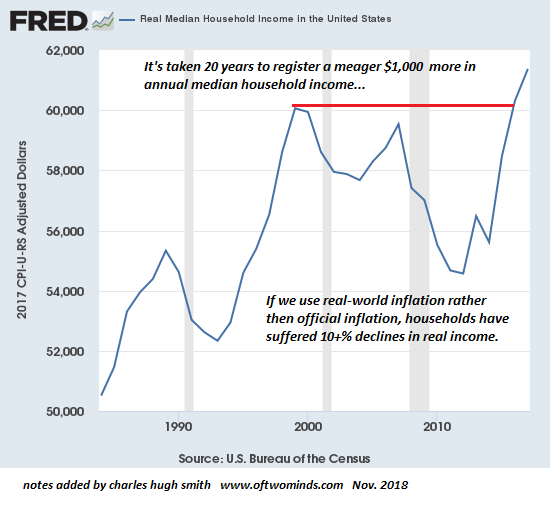
It’s instructive to compare today’s household with households a few generations ago. As recently as the early 1970s, 45 years ago, it was still possible for a single fulltime-earner to support the household and buy a home, which in 1973 cost around $30,000 (median house price, as per the St. Louis FRED database).

As recently as 20 years ago, in 1998, the median house price in the U.S. was about $150,000— still within reach of many two-earner households, even those with average jobs.

As the chart below shows, real median household income has only recently exceeded the 1998 level— and only by a meager $1,000 annually. If we use real-world inflation rather than the under-estimated official inflation, real income has plummeted by 10% or more in the past 20 years.

This reality is reflected in a new study of wages in Silicon Valley, which we might assume would keep up due to the higher value of the region’s output. The study found the wages of the bottom 90% declined when adjusted for inflation by as much as 14% over the past 20 years:

“The just-released report showed that wages for 90 percent of Silicon Valley workers (all levels of workers except for the top 10 percent)are lower now than they were 20 years ago, after adjusting for inflation. That’s in stark contrast to the 74 percent increase in overall per capita economic output in the Valley from 2001 to 2017.”

source: Why Silicon Valley Income Inequality Is Just a Preview of What’s to Come for the Rest of the U.S.

Meanwhile, the median house price has more than doubled to $325,000 while median household income has stagnated. Please note this price is not adjusted for inflation, like the median income chart. But if we take nominal household income in 1998 (around $40,000 annually) and compare it to nominal household income now in 2018 (around $60,000), that’s a 50% increase–far below the more than doubling of house prices.

To raise stagnant incomes, the Federal Reserve and other central banks have attempted to generate a wealth effect by boosting the valuations of risk-on assets such as stocks, bonds and commercial real estate. But the Fed et al. overlooked the fact that the vast majority of these assets are owned by the top 10%–and as noted above, the ownership of the top 10% is concentrated in the top 1% and .1%.

As a result, the vast majority of the wealth effect capital gains have flowed to the top 1%:

Lastly, the cartel structure of the U.S. economy has raised costs while providing no additional value. One example is higher education, a cartel that issues diplomas with diminishing economic value that now cost a fortune, a reality reflected in this chart of student loan debt, which simply didn’t exist a generation ago:

Our entire economy is characterized by cartel rentier skims, central-bank goosed asset bubbles and stagnating earned income for the bottom 90%. Given these realities, the bottom 90% are left with few pathways to get ahead in terms of financial security and building secure family wealth.


America’s Social Depression Is Accelerating

By Charles Hugh Smith

Source: Of Two Minds

We need to value honesty above optimism. Once we can speak honestly, there is a foundation for optimism.

Beneath the rah-rah statistics of “the greatest economy ever,” the social depression is accelerating. The mainstream is reluctantly waking up to the future of the American Dream: downward mobility for all but the top 10% of households. A 2015 Atlantic article fleshed out the zeitgeist with survey data that suggests the Great Middle Class/Nouveau Proletariat is also waking up to a future of downward mobility: The Downsizing of the American DreamPeople used to believe they would someday move on up in the world. Now they’re more concerned with just holding on to what they have.

I have been digging into the financial and social realities of what it takes to be middle class in today’s economy for years: Are You Really Middle Class?

The reality is that the middle class has been reduced to the sliver just below the top 5%–if we use the standards of the prosperous 1960s as a baseline.

The downward mobility isn’t just financial–it’s a decline in political power, control of one’s work and income-producing assets. This article reminds us of what the middle class once represented: What Middle Class? How bourgeois America is getting recast as a proletariat.

The costs of trying to maintain a toehold in the upper-middle class are illuminated in these recent articles on health and healthcare–both part of the downward mobility:

Health Care Slavery and Overwork

How a toxic workplace could, literally, destroy your health

We’re afraid our work is killing us, and we are right

This reappraisal of the American Dream is also triggering a reappraisal of the middle class in the decades of widespread prosperity: The Myth of the Middle Class: Have Most Americans Always Been Poor?

Downward mobility excels in creating and distributing what I term social defeat: In my lexicon, social defeat is a spectrum of anxiety, insecurity, chronic stress, powerlessness, and fear of declining social status.

Downward mobility and social defeat lead to social depression. Here are the conditions that characterize social depression:

1. High expectations of endless rising prosperity have been instilled in generations of citizens as a birthright.

2. Part-time and unemployed people are marginalized, not just financially but socially.

3. Widening income/wealth disparity as those in the top 10% pull away from the shrinking middle class.

4. A systemic decline in social/economic mobility as it becomes increasingly difficult to move from dependence on the state (welfare) or one’s parents to financial independence.

5. A widening disconnect between higher education and employment: a college/university degree no longer guarantees a stable, good-paying job.

6. A failure in the Status Quo institutions and mainstream media to recognize social recession as a reality.

7. A systemic failure of imagination within state and private-sector institutions on how to address social recession issues.

8. The abandonment of middle class aspirations by the generations ensnared by the social recession: young people no longer aspire to (or cannot afford) consumerist status symbols such as luxury autos or homeownership.

9. A generational abandonment of marriage, families and independent households as these are no longer affordable to those with part-time or unstable employment, i.e. what I have termed (following Jeremy Rifkin) the end of work.

10. A loss of hope in the young generations as a result of the above conditions.

The rising tide of collective anger arising from social depression is visible in many places: road rage, violent street clashes between groups seething for a fight, the destruction of friendships for holding the “incorrect” ideological views, and so on. I Think We Can Safely Say The American Culture War Has Been Taken As Far As It Can Go.

A coarsening of the entire social order is increasingly visible: The Age of Rudeness.

Depressive thoughts (and the emotions they generate) tend to be self-reinforcing, and this is why it’s so difficult to break out of depression once in its grip.

One part of the healing process is to expose the sources of anger that we are repressing. As psychiatrist Karen Horney explained in her 1950 masterwork, Neurosis and Human Growth: The Struggle Towards Self-Realization, anger at ourselves sometimes arises from our failure to live up to the many “shoulds” we’ve internalized, and the idealized track we’ve laid out for ourselves and our lives.

The recent article, The American Dream Is Killing Us does a good job of explaining how our failure to obtain the expected rewards of “doing all the right things”(getting a college degree, working hard, etc.) breeds resentment and despair.

Since we did the “right things,” the system “should” deliver the financial rewards and security we expected. This systemic failure to deliver the promised rewards is eroding social mobility and the social contract while generating frustration, anger, etc.

We are increasingly angry at the system, but we reserve some anger for ourselves, because the mass-media trumpets how well the economy is doing and how some people are doing extremely well. Naturally, we wonder, why them and not us? The failure is thus internalized.

One response to this sense that the system no longer works as advertised is to seek the relative comfort of echo chambers–places we can go to hear confirmation that this systemic stagnation is the opposing political party’s fault.

We don’t just self-sort ourselves into political “tribes” online– we are congregating in increasingly segregated communities and states:.

Americans are moving to communities that align more with their politics. Liberals are moving to liberal areas, and conservatives are moving to conservative communities. It’s been going on for decades. When Jimmy Carter was elected in 1976, 26.8% of Americans lived in landslide counties; that is counties where the president won or lost by 20% of the vote.

By 2004, 48.3% of the population lived in these counties. This trend continues to worsen. As Americans move to their preferred geographic bubbles, they face less exposure to opposing viewpoints, and their own opinions become more extreme. This trend is at the heart of why politics have become so polarizing in America.

We’re self-sorting at every level. Because of this, Americans are only going to grow more extreme in their beliefs, and see people on the other side of the political spectrum as more alien.”

Part of the American Exceptionalism we hear so much about is a can-do optimism: set your mind to it and everything is possible.

The failure to prosper as anticipated is generating a range of negative emotions that are “un-American”: complaining that you didn’t get a high-paying secure job despite having a college degree (or advanced degree) sounds like sour-grapes: the message is you didn’t work hard enough, you didn’t get the right diploma, etc.

It can’t be the system that’s failed, right? I discuss this in my book Why Our Status Quo Failed and Is Beyond Reform: the top 10% who are benefiting mightily dominate politics and the media, and their assumption is: the system is working great for me, so it must be working for everyone. That’s the implicit narrative parroted by status quo mouthpieces.

The inability to express our despair and anger generates depression. Some people will redouble their efforts, others will seek to lay the blame on “the other” (some external group) and others will give up. What few people will do is look at the sources of systemic injustice.

Perhaps we need a national dialog about declining expectations, rising inequality and the failure of the status quo that avoids the blame-game and the internalization trap (i.e. it’s your own fault you’re not well-off).

We need ways to express our resentment, anger, despair, etc. that are directed at the source, the complex system we inhabit, not “the other.” We need to value honesty above optimism. Once we can speak honestly, there is a foundation for optimism.

Reimagining the Middle Class

In her new book, Alissa Quart chronicles what happens when capitalism and families collide

By Ann Neumann

Source: The Baffler

AS THE ECONOMIC STATUS OF MANY in the United States has declined over the past several decades, journalists have often focused on the challenges faced by the working poor. In her new book, Squeezed: Why Our Families Can’t Afford America, Alissa Quart writes about how economic inequality has also drastically changed the middle class, destabilizing what was once considered a secure class and sending families into the tailspin of debt, overwork, underemployment, and precarious financial states. Squeezed demonstrates that inequality is not just a problem of those left behind in the lowest financial brackets, but a feature of our current economic system characterized by working professionals who are unable to pay for child care, declining job salaries, shifting work hours, and unaffordable housing. Families too often wrestle with “penalizing” factors, like women’s depressed salaries and unaffordable health care, making success unattainable for a formerly comfortable, educated, and skilled demographic of society.

The book challenges us to reimagine our prior understanding of what it means to be middle class, even as legislators champion “traditional values” that contradict the needs and responsibilities of families—and erode a safety net that once supported U.S. workers. Some of the factors that have upended the middle class are obvious—declining salaries, for instance—but others remain masked by corporate and social portrayal of them as a benefit to today’s workers. The gig economy, which, we’re told, gives workers young and old more flexibility and independence, turns out to be a contributor to what Quart calls the forever clock, a twenty-four-hour schedule that has usurped family and free time by keeping workers on constant call. Squeezed recounts the lives of the teachers who work second jobs, the professional mothers who struggle to pay for day care, the paralegals and adjuncts who have to moonlight to pay the rent, the well educated who never found a job in their intended profession that provides a livable salary. And the book causes us to ask why so many suffer in isolation, too ashamed to acknowledge their economic plight and too belabored to politically address it.

Quart is executive editor of the Economic Hardship Reporting Project, a nonprofit organization founded by Barbara Ehrenreich (a contributing editor for The Baffler) that supports journalism examining economic inequality, its causes and solutions (EHRP has funded my own work and that of others published at The Baffler). Quart is the author of four previous books: BrandedRepublic of OutsidersHothouse Kids, and the poetry book Monetized. She also co-writes, with Maia Szalavitz, a column for The Guardian titled “Outclassed.”

This month, Quart stopped by The Baffler office to talk to me about Squeezed. We’ve known each other for several years and I read the book in manuscript, so our conversation was casual, touching on individuals in the book, our own squeezed lives, how we can counter economic decline, and a necessary new definition of self-help.

Ann NeumannSqueezed straddles the Trump election and very often people on the left—and the right, to be honest—are using this as a clear demarcation. I think one of the things the book does really well is point out that the mechanisms in place that harm working class families have been long in coming.

Alissa Quart: The reason Sanders and Trump could tap into anger are the numbers of those economically squeezed; it’s what I was seeing anecdotally. And you can feel that. You can feel when you go sit in people’s living rooms, when you talk to them on the phone. I went to a conference called iRelaunch that was all about helping people to start their careers over and the room just rippled with shame and fear. And acidic humor.

AN: How did the election change this book project?

AQ: I think it gave it new urgency for me. Just as it gave urgency to the Economic Hardship Reporting Project, the organization I run. I think everyone in journalism felt like we have to tell these stories. The Trump effect has made me feel like I have to keep a laser focus on the things people are ignoring and try to find a way for readers to pay attention to them. We’re all focusing on Ivanka and whether she’s the c-word or not, which is fine, there are all kinds of things happening around us and in our own lives politically that have nothing directly to do with what Trump is tweeting, but the effects of his administration and long-term trends are real and we just need to keep looking.

We just published an article at EHRP about a journalist who lives in a $17 a night Airbnb, places below what you usually scroll to. But this person was a working journalist who was getting six-figure advances fifteen or twenty years ago. There are all these human examples that constantly show this decline. Fine, maybe the job numbers are up, but how many jobs are people working and are they jobs in the professions? Are they jobs that pay enough for people to live in cities? Or they’re working three different jobs which leads us to things like, as in this book, twenty-four-hour day care.

AN: Day care centers that are open twenty-four hours to accommodate parents with nontraditional work hours or multiple jobs.

AQ: And they are growing in number. I wrote a piece on this; I called it the dystopian social net. I feel like that’s part of my life’s work. I love dystopian fiction and science fiction, probably because it seems a few clicks away from the life we’re leading. It’s a markedly different life and childhood than the one you and I had. It may be horrible, or maybe not, but we’re seeing a palpable transformation in what childhood can be in the course of twenty years.

AN: And that’s really just the decline of income?

AQ: It’s people working different hours, it’s corporations using algorithms to find out what times of day are most profitable—when they’ll have the most foot traffic in retail, for instance—and demanding that employees work those times. It’s increasing nightwork. Nontraditional could mean 11 to 3 or it could mean working in the evening, or working in different jobs, hither and thither. That alone points to a huge transformation in things like time. A lot of the issues I address in the book are really about time, how we spend it. In the twenty-four-hour day care section I use the term the forever clock. But that’s true of the upper middle class too, they feel squeezed because they’re also on a forever clock. They’re working in IT, for instance, and they’re working unusual hours and they have the expectation that they should be better paid for it. 

AN: Your work has been focused on economic inequality for a long time.

AQ: Every single one of my books is in some way about economic inequality. I used to teach at Columbia J-school and I always told my students that every writer has a central question they spend their career trying to answer and your job is to find out what your question is. It’s like a parlor game. So I think mine is: what happens when the family—or childhood—hits capitalism? What are the deformations and the formations? I read so many nineteenth-century novels as a kid that I’m fascinated by that intersection. Naturalism is ascetically but also politically and intellectually appealing to me. I think I just like the texture of family, love, money, and how they all meet.

AN: That comes out in the writing of the book because, I’ll tell you, there are economics books that I have no interest in reading because they’re a slog, a data dump. You also coin terms that give us a way to think about worker’s plights. You just mentioned the forever clock but there’s also the middle precariat.

AQ: I was trying to explain the shift in the middle class as an imaginative category. The middle class used to equal solid, fixed, stable. Temporally it was about gratification later, but your life wasn’t miserable while you were waiting for it. It wasn’t like OK, total slog, but you’re going to get that pension. We have to now think of it as a shaken category, an unstable category, and that’s a big shift. When we visualize the middle class, we’re visualizing the white picket fence, like the blue sky on the cover of the book. But it’s really this truck being squeezed between two houses.

It’s an unsettled identity, and you can fall out of it, you can barely get into it, you certainly can’t rise above it very easily. Guy Standing coined the term precariat in 2011 to describe the proletariat, which is a Marxist way of understanding the working class, crossed with precariousness. And people get that. Every time they ride an Uber or they have a gig economy Task Rabbit person come to their house they’re like, OK, that’s the precariat. But I was seeing the same thing among paralegals or those who have law degrees but were still doing temporary work.

AN: Getting a law degree can be like selling your soul to the banks.

AQ: All these people are in debt. Some of it is because they went to for-profit colleges and those colleges were really expensive and they didn’t have a good rate of placement. Which can be traced to for-profit colleges and grad schools that have very little oversight—and are sometimes indeed federally funded. It can also be traced to fewer law jobs overall and too many people imagining that law is a secure profession. This is about reimagining. Once you can reimagine a profession, even if you choose to do it—you choose to be a journalist, you choose be a lawyer—we should understand that we’re choosing something unstable. Awareness is a huge part of survival and I guess part of what I want with this book is to increase awareness. This is your self-help: Don’t blame yourself. We have to come alive to this recognition. You can still do what you love, so long as you know what it can mean.

This is a personal journey for me too. When I was younger, as a freelancer, I had some recognition that journalism was starting to fragment. It was around 2006 or 2007—but it was before that too, the’90s. The word rates used to be consistent and for freelance writers those rates became lower or stayed the same while inflation rose. I remember talking to someone and they said, “just think about us as post modern.” Now you do lots of things, it’s a hustle here and a hustle there. That person was a boomer who had a steady job, who would get social security. I remember feeling an incredible resentment.

AN: So precarious employment has been described to us as a beautiful thing. We’re not chained to a factory job, we get to think and move around, but it doesn’t pan out.

AQ: I personally came from a middle class background. As I describe in the book, my parents were college professors, originally community college professors, and they could afford to send me to a private school. They didn’t have any inheritance or anything. That’s the sort of the world I thought I’d be living in. All of us, our generation, Generation X, had an idea of the world we thought we’d be living in. The generation after us has come to understand some of these things.

AN: That they’re fucked? So do you think this is a moment in capitalism, as we watch continued market decline over the next years, when we either do something about it or devolve into a disordered society?

AQ: Yes, I think so. But this book isn’t depressing because it points to some solutions—not in a pat way, but things that will work. It’s a way to think about what kind of family safety net, federal and local, we need to make sure people aren’t falling through. For instance, a few of the people I write about in the book are on food stamps and other kinds of support, but many of them are a little above that in terms of earning power and they can’t get help. There’s a labor organizer I spoke with who tries to lower her salary to be able to get some sort of subsidized day care, some sort of health insurance program. It’s that edge: people who are middle class in terms of education, but working class in terms of earning. They’re on the edge of being working poor and not being able to access any of those services. That’s most of the people in this book. Once we understand that they’re precarious we need to find a safety net for them.

AN: What this book does is lay out the many ways that people are hurting at the moment and it kind of gives a blueprint as to how precariousness could be addressed. Subsidized day care, for instance. I had no idea about how expensive child care is.

AQ: Child care can be 30 percent of many salaries. Or more. I think for us it was 30 percent of our take-home pay.

AN: How do people do it? In the book you show us. We spend a lot of time with individuals, we get a look at their lives and there’s a revelation for a reader to think, Oh, it’s not just me. There are things that I go without, there are resources that I don’t have access to, there are crises that I lose sleep over or pray will never come my way. There’s something about this book that brings this issue to light and I wonder if that was what you thought you’d get out of the stories? Is that why you used a storytelling approach?

AQ: That’s the chick lit, soap operatic part of me. And there is something of that in these stories. You think, What’s going to happen next? Sometimes I was surprised because they did have the messy amplitude of ordinary life. The people I write about aren’t just symbolic though. Some of them I followed for years.

AN: I think of the co-parenting section where you spend time with families who are trying to come up with creative solutions. In some cases, over time, things were better; in some cases they were worse. But readers still get the sense that nothing is fixed, no one really knows what’s working.

AQ: Or like the nanny who was separated from her son when I first met her and it was one kind of story. It became a story about them reunited, but then it became a story about school choice, and then it became a story about a mixed outcome at the end. She was actually happy, but I think the reader would want her to have a more middle class life given how hard she’s worked and all the effort she’s made to make the right choices.

AN: The anxiety of her life stayed with me. There are so many things that thwart her from getting ahead. She just needs the smallest break, trying to bring her son here, trying to find an affordable place to live. She’s doing everything right and she doesn’t deserve to go through this. That’s what comes out in the story. So when you were doing this reporting, did you get a sense of relief that we’re all going through this at the same time?

AQ: I definitely did. I felt relief. I say that this book is self-help because it makes you realize that it’s not your fault. And that’s how I see self-help. I see it as awareness, really granularly understanding all the ways that systems have made it impossible for you personally to overcome financial challenges—so that you’re no longer blaming yourself.

AN: Thank God someone’s redefining self-help.

AQ: [Laughs] But that’s it. How do you not feel stigmatized, how do you not feel isolated? So many of my friends feel ashamed that they can’t figure out the school system, can’t figure out how to own their home.

AN: The various penalties—for being a woman, for having children, for having debt—stack up. Shaming has abetted this erosion of rights and financial stability.

AQ: Time, day care scheduling, and other demands mean people can’t organize. They’re ashamed of where they are and so that becomes another debilitating factor. The adjunct in one chapter feels ashamed even though she knows politically she shouldn’t. There are people like the teachers who drive for Uber, who feel ashamed even though they know they shouldn’t. And it goes on and on. I don’t want to put it back on individuals, but the personal thing that people can do is start talking openly about their monetary situation. People are startled when you do that. It can erode social norms in a weird way, but I also think it’s important that people stop fronting with one another.

I write in one chapter about the 1 percent media, about the social media where people pretend to live in more expensive places than they do. I call them wealthies, not selfies. So it’s not your imagination when you’re in any of these circumstances and you see people in a sun dappled villa. People are representing themselves in this inflated way and then you feel terrible and isolated. There are so many ways in which the stigma, the isolation, around your class position gets underlined.

AN: Has it always been shameful to be poor?

AQ: Probably.

AN: It’s not a fair question!

AQ: But let’s be clear. A lot of these people are not poor. Most of the people in this book are earning between $45,000 and $125,000. Working class is $35,000. They’re not at the poverty level.

AN: So the shame then comes from not being able to make ends meet.

AQ: The shame comes from having debt for the education that you got in order to be middle class. The shame comes from not doing as well as your peers. The shame comes from not living up to your potential. The shame comes from not owning your home, defaulting on your mortgage. Not giving your kids as good a life as you had. I’m not writing about the working poor. I’m writing about the middle poor.

AN: We still operate under the myth that as a society we can continue to lift people into middle class and lift middle class into other class brackets. We no longer have any of that upward mobility. We cannot anticipate that our children will be better off.

AQ: No, we cannot anticipate that.

AN: But that’s still the American dream, isn’t it? And that American dream has been tied to, say, home ownership or a vehicle or not having debt.

AQ: In New York it’s like what school your kid goes to. What college your kid goes to.

AN: You use the word reimagining; it’s a word that I don’t hear often enough in politics, particularly not applied to class.

AQ: I mean reimagining what it means to be successful, reimagining what it means to be middle class. In a dream scape kind of way, like, This is what we would like to see in this country. But also reimagining middle class in its truth, what it actually means now? Let’s tear the veil and not just say, Oh, it means stability or security. It doesn’t.

Multi-Billion Dollar Giveaway to Amazon

By Stephen Lendman

Source: StephanLendman.org

Seattle-based Amazon is like corporate predator Walmart, exploiting communities, along with harming local businesses and workers for maximum productivity and profits.

The company’s $100 billion dollar CEO Jeff Bezos didn’t get super-rich by being worker and community friendly – just the opposite, the way all Western corporate giants operate and most others, power, profits, and crushing competition their priorities.

That’s what predatory capitalism is all about – benefitting from harmful practices, polar opposite the way many, maybe most, locally owned and run small enterprises.

A London Guardian investigation revealed “numerous cases of Amazon workers being treated in ways that leave them homeless, unable to work or bereft of income after workplace accidents.”

One worker’s experience is similar to countless others, saying Amazon “cost me my home. They screwed me over and over, and I go days without eating.”

This “case is one of numerous reports from Amazon workers of being improperly treated after an avoidable work injury,” the Guardian explained, adding:

“Amazon’s warehouses were listed on the National Council for Occupational Safety and Health’s ‘dirty dozen’ list of most dangerous places to work in the United States in April 2018.”

“The company made the list due to its pattern of unsafe working conditions and its focus on productivity and efficiency over the safety and livelihood of its employees.”

“Amazon’s emphasis on fulfilling a high demand of orders has resulted in unsafe working conditions for its warehouse employees.”

Numerous workers “succumb to the fatigue and exhaustion of the fulfillment center work environment and quit before getting injured.”

The company lied claiming it prioritizes worker safety, expressing “pr(ide)” in its shameful record, causing enormous harm to countless numbers of workers at its fulfillment centers.

On November 13, Amazon announced two new headquarters locations, besides its current Seattle one.

Additional ones will be in suburban Washington’s Arlington, Virginia’s Crystal City and Queens, NY Long Island City.

An astonishing 238 US cities competed for what the company calls its HQ2. In January, 20 finalists were chosen for its second headquarters –  19 in America, Toronto the only one abroad.

Up for grabs is about 50,000 promised jobs and around a $5 billion investment. Whenever a corporate headquarters is sought,  cities and regions compete by offering companies huge tax breaks and other benefits – at the expense of small local businesses and cuts in public services.

For ordinary people, having major operations like Amazon, Walmart, and other corporate predators in communities is more of a curse than benefit.

Economics Professor Edward Glaeser said the downside of competition for companies like Amazon is it “become(s) a contest for throwing cash at the giant(s).”

The same thing goes on when professional sports teams consider moving to a new city, or the International Federation Association Football (FIFA) World Cup and International Olympic Committee (IOC) select locations for future events.

New stadiums become fields of schemes, not dreams, ordinary people in chosen areas harmed so super-wealthy ones can benefit hugely.

New York City won the bidding for one of two Amazon HQ2 locations by throwing $2.1 in tax incentives at the company – money badly needed for public education, affordable housing, and other vital public services lost to benefit Amazon.

The company’s move to NYC will cost area taxpayers around $61,000 for each of 25,000 promised jobs – double the per capita $32,000 for Virginia residents for the same number of promised jobs, according to Bloomberg, adding:

Amazon’s presence in these cities will likely “exacerbate the already fragile public transportation system and clogged roadways, and raise housing prices.”

Arlington, VA won its bid by offering Amazon $573 million in tax breaks and other benefits.

Locating one of two HQ2 locations there is related to the company’s pursuit of a $10 billion Defense Department cloud-computing contract it’s the front-runner to get.

In summer 2014, it got a $600 million Amazon Web Services cloud-computing contract for the CIA, linking the company and its Washington Post subsidiary to Langley, the broadsheet serving as its mouthpiece.

Bezos has a disturbing history currying favor with national security officials. Winning a major Defense Department contract will assure the company serves its interests along with the US intelligence community’s – at the expense of world peace, stability, and rights of ordinary people everywhere.

City officials betray their residents by throwing enormous amounts of money at deep-pocketed corporate giants to lure them to their areas – well able to defray the cost of expansion and conducting business operations without government handouts.

Yet it’s been the American way for time immemorial – Washington, states and cities financing enterprises from the earliest days of the republic.

The more concentrated business gets, the more power companies have over government – doing their bidding at the expense of ordinary people nationwide.

Amazon’s HQ2 is one of countless other examples of the same dirty business – getting enormous amounts of public money diverted from the general welfare.