Martial Law By Other Means: Corporate Strangulation of Dissent

By Glen Ford

Source: Black Agenda Report

The ‘hate speech’ trick, in practice, rewards Black people’s occupiers and abusers (the police) and renders voices of protest illegitimate and mute.”

The people that rule the United States are in the third year of a frenzy to blame Russia and its “trolls,” “dupes,” and witting or unwitting “colluders” – including a sitting president – for racial conflicts, eroding respect for public institutions and a general social breakdown in the nation. “We are at war!” they scream, incessantly, in a thousand well-placed voices. The relentless barrage of war-talk crowds out all other subjects in the corporate media — the Omnipresent Voice of Oligarchy — including the actual wars waged all across the globe by the U.S. and its shrinking gaggle of allies.

By now, 65 percent of Americans — if asked — tell pollsters they think Russia “interfered” in the 2016 elections. According to an NBC/Wall Street Journal poll  released late last month, 41 percent believe that whatever the Russians did had some effect on the election, and 30 percent think Hillary Clinton would be president if the Russians had not interfered.

“The relentless barrage of war-talk crowds out all other subjects in the corporate media — including the actual wars.”

People don’t volunteer these opinions; the question is presented by the pollsters and respondents select an answer among the multiple choices offered. However, a Gallup poll , taken during the same period, that allowed respondents to offer their own list of problems besetting the nation showed that less than one percent thought “the ongoing situation with Russia was the top issue.” Immigration was the top problem on people’s minds (22 percent), followed by dissatisfaction with the U.S. government (19 percent), and racism (7 percent). Concerns over “unifying the country,” “lack of respect for each other,” “the economy in general,” “health care,” and the catch-all, “ethics/morality/religious/family decline” rank in the even lower single digits – but almost nobody considers Russia to be a top problem.

Apparently, Americans don’t yet believe that anything like a “Pearl Harbor” has occurred, despite the Herculean efforts of the corporate media, the Democratic Party, old school Republicans, and the National Security State (Spookland). Undeterred, these fevered fomenters of hysteria insist that Russia’s “war” against the United States — aided by a “fifth column” composed of left-wing and right-wing web sites — must be answered by putting the nation on martial footing, through further curbs on freedom of speech and association at home, and relentless pursuit of full spectrum military dominance over all potential adversaries and competitors abroad.

Less than one percent thought ‘the ongoing situation with Russia was the top issue.’”

The oligarch-declared state of war requires that there be one set of “truths” and a common worldview to unite the nation at this time of peril — whether the people perceive such a peril, or not. If there is insufficient public resolve to respond to the “threat” from Moscow and their partners in Beijing, then that is blamed on Kremlin-disseminated disinformation designed to confuse Americans or cause them to lose faith in U.S. institutions, and to fight among themselves – to “hate” each other — thus requiring more censorship.

It is the ruling class that is in panic, and using Russia as an all-purpose foil. The U.S. is in terminal decline, and has already been economically surpassed by China, based on “purchasing power parity,” the standard of measurement preferred even by the U.S dominated International Monetary Fund. According to an analysis by business columnist Noah Smith in Bloomberg , “not only is China already the world’s largest economy, the gap between it and the U.S. can be expected to grow even wider.” Dean Baker , co-director of the Center for Economic and Policy Studies, says “China’s economy is already 25 percent larger than the U.S. economy and is on a path to be almost twice as large in a decade.”

The era of U.S. economic dominance has already ended, and the Potemkin façade of American economic supremacy is only maintained by the U.S. dollar’s artificial status as the main international reserve currency – from which pedestal it will ultimately be toppled, and the imperial era will be over. But this is an historical verdict that the U.S. rulers cannot accept. Having lost the economic capacity to lord over the planet, they must now rely on their military — a terror machine more expensive than most of the rest of the world’s militaries, combined — in a “generational,” twilight battle to preserve the empire. The Lords of Capital cannot imagine a world in which they are not on top. They have chosen permanent, “infinite” war.

Not only is China already the world’s largest economy, the gap between it and the U.S. can be expected to grow even wider.”

On the home front, the ruling class policy is eternal austerity, dictated by the requirements of capitalism at this stage in its decline. It is a horrifically destructive process of corporate consolidation (the big get bigger, devouring each other and everyone else) and the shrinking of the public sphere, through public sector starvation and privation. The job market is restructured, with more and more workers becoming “casual” or “contracted” — the “gig” economy — and millions of others (especially Blacks) made permanently redundant and disposable.

A regime of permanent war and austerity — the fate that both corporate parties plan for us — requires the manufacture and perpetual maintenance of war hysteria, and the methodical suppression of popular demands for economic rescue of the affected classes. It demands Russiagate and the snuffing out of radical dissent. This is not about Hillary Clinton, although she was the presidential choice of the great bulk of the ruling class because she could be trusted to pursue permanent war and austerity. It’s about preserving and serving the oligarchy under capitalism in terminal decline.

“A regime of permanent war and austerity requires the manufacture and perpetual maintenance of war hysteria, and the methodical suppression of popular demands for economic rescue of the affected classes.”

A similar process is underway in Europe, where the welfare state is besieged by the ruling bankers and corporate chiefs. Some leftish pundits describe the corporate parties’ lashing out at “the left and the right” as an offensive of “the center” — but that’s nonsense. In both the U.S. and Europe, the corporate governments are to the right of the public; they don’t represent some political “center” — they represent only their corporate selves. The corporate leaders of the Democratic Party are positioned way to the right of Democratic voters, and also rightward of the general American pubic on most key economic issues. They are carrying out their corporate duties to preserve and maintain austerity and war.

This compels them to make a spectacle of Russiagate, and to ensure that the show never ends, but takes on new forms of hysteria. And it requires that internet-based dissent be brought to heal, as Hillary would say — even at the cost of billions to one of the top oligarchs, Facebook’s Mark Zuckerberg, who has been mercilessly bludgeoned by his fellow corporatists. Facebook’s political tampering with its algorithms to marginalize left-wing sites like BAR cannot help but suggest that the company also puts its fingers on the scales of the algorithms whose results Facebook sells to advertisers. But Zuckerberg no doubt understands that the purge of “left and right” sites is in the best interest of his class, and has accepted to forgo some profits.

“The corporate leaders of the Democratic Party are positioned way to the right of Democratic voters, and also rightward of the general American pubic on most key economic issues.”

Facebook, Apple, Google, YouTube and Spotify all came down  on right-winger Alex Jones and his Infowars, this week, in what appeared to be a coordinated purge. Although the corporate media have long accused Jones of spreading “disinformation,” he was not purged for telling non-truths. Apple announced that “it does not tolerate hate speech.” Facebook said “false news” was not the issue, but that Jones had violated its policies by “glorifying violence” and “using dehumanizing language to describe people who are transgender, Muslims and immigrants.”

When it comes to “hate,” the high tech oligarchs rely heavily on the Southern Poverty Law Center (SPLC), the Morris Dees – Richard Cohen  legal outfit in Montgomery, Alabama. The Center has a special animus towards Black nationalists, to whom it dedicates a whole page  on its web site. “Most forms of black nationalism are strongly anti-white and anti-Semitic,” the SPLC declares, as if its white, Jewish leadership are expert in the Black American polity. In addition to naming Min. Louis Farrakhan and every Nation of Islam mosque, the site lists a slew of “Black Nationalist Hate Groups,” including book stores, the Black Riders Liberation Party and all its affiliates, various Black Israelites, both halves of the split New Black Panther Party, and the Revolutionary Black Panther Party, as well as the Nuwaubian Nation of Moors. We can assume that these groups’ internet sites and Facebook presence are marked for special attention and future purging.

The Southern Poverty Law Center has a special animus towards Black nationalists.”

But, many more Blacks will be caught up in the “hate speech” net that the high tech monopolists have deployed. Anyone that has gone to protests against killer cops has shouted words that could be deemed hate speech — because we do hate killer cops, and we do hate their armed occupation of our communities, and we have every right to say so among ourselves or to shout it to the world. Black people — and especially Black activists — must be most zealous in defense of free speech, knowing that our speech will be the first to be curtailed and outlawed.

We can expect no defense of Black speech rights from the Black misleadership class, which has always opted to cut off Black lips in order to silence a few white racists’ mouths. In the early Seventies, the Congressional Black Caucus and the Atlanta NAACP tried to get the Federal Communications Commission to ban campaign ads by J.B. Stoner, the arch-racist candidate for one of Georgia’s seats in the U.S. Senate. I argued loudly against attempting to create a “hate speech” standard for the public airwaves, warning that among the first victims of such a standard would be Min. Farrakhan, whose weekly radio program was aired on over 100 Black-oriented radio programs.

“Black people — and especially Black activists — must be most zealous in defense of free speech, knowing that our speech will be the first to be curtailed and outlawed.”

The FCC ruled in J.B. Stoner’s favor in 1972, but it was a good day for Black political speech, too. In the same way, the high tech monopolists’ assault on right-winger Alex Jones under a “hate speech” standard is bad news for Black political speech, and for radical speech. “Hate speech” is a trap. A few months ago, all but eleven members of the Congressional Black Caucus voted to make any assault on police a “hate crime,” thereby giving police the status of a protected class. The “hate speech” trick, in practice, rewards Black people’s occupiers and abusers (the police) and renders voices of protest illegitimate and mute.

We will need every energizing expletive in our vocabularies to mobilize our folks against the racist repression that must accompany the rulers’ plans for permanent austerity and war. We need to hate them very deeply for what they are trying to do to humanity, and to express that hatred at the top of our lungs and in every forum possible.


BAR executive editor Glen Ford can be contacted at Glen.Ford@BlackAgendaReport.com.

When Worse is the Enemy of Bad

By Paul Edwards

Source: CounterPunch.org

There comes a time in the decline of an empire when–in its hubris, its arrogance–it decouples from reason and blindly blunders toward its fate in a ludicrous ugly trance of stupidity.  To paraphrase Walter Cronkite–we are there.

Trump makes his one positive, even useful, gesture as President, and the decayed corpse of the Democratic Party bursts its cerements with a stinking roar of horror.

The claim that all that is wrong with America is due to the malignant machinations of Putin is the most blatantly false, potentially disastrous bucket of bullshit ever inflicted by the matrix on this ignorant, credulous, propagandized people.

The MSM–the PR arm of the War Machine Complex that owns us–has so infected the national mind with the sleazy fiction concocted by the Democrat’s Geezer Politburo–the DNC slugs, Schumer, Pelosi and their geriatric myrmidons–that Trumpophobe Automatons rage at Putin and howl for a war, the horror of which they can’t begin to imagine.

Because hostility, provocation and resultant war is exactly what is comprehended in this national insanity.  Blaming their election loss on Russia, after decades impoverishing working people for the obscene enrichment of the War Machine and its megacorporate monsters, would just be ridiculous if it weren’t so foolishly, desperately dangerous.

As vile, as odious as he is, Democrat honchos know they can’ t beat Trump by shell-gaming Americans for their Wall Street donors any more–hey, it worked fine for ages–so they slime him as a traitor in bed with that monster we’ve been made to fear most: Putin and the Evil Empire Redux.

More incredibly, they’ve persuaded so-called progressives, who, historically, fiercely defended the Bill of Rights and valiantly battled the house organs of the National Security State, that those goats nests of dishonesty and disease are pure, unsullied repositories of Constitutional rectitude.

After decades of proven baldfaced crime, deceit and the  dirtiest pool at home and abroad, the CIA, FBI, NSA, the Justice Department and the whole foetid nomenklatura of  sociopathic rats, are portrayed as white knights of virtue dispensing verity as holy writ.  And “progressives” buy it.

These are the vermin that gave us Vietnam, the Bay of Pigs, Chile, the Contras, Iraq’s WMD, and along the way managed to miss the falls of the Shah and Communism.

Truly an Orwellian clusterfuck, this.  War Party Dems misleading naive liberal souls sickened by Trump into embracing the dirty, vicious lunacy Hillary peddled to her fans, the bankers, brokers, and CEOs of the War Machine.

Trump is a fool who may yet blunder us into war; the Dems and the Deep State cabal would give us war by design.

The Satanic Nature of the Atomic Bombings of Hiroshima and Nagasaki

By Edward Curtain

Source: Dissident Voice

Ahab is forever Ahab, man.  This whole act’s immutably decreed.  ‘Twas rehearsed by thee and me billion years before this ocean rolled.  Fool!  I am the Fates’ lieutenant; I act under orders.

— Herman Melville, Moby Dick

The greatest evil is not now done in those sordid ‘dens of crime’ that Dickens loved to paint…But it is conceived and ordered (moved, seconded, carried, and minuted) in clean, carpeted, warmed, and well-lighted offices, by quiet men with white collars and cut fingernails and smooth-shaven cheeks who do not need to raise their voice.

— C. S. Lewis, author’s preface, 1962, The Screwtape Letters

American history can only accurately be described as the story of demonic possession, however you choose to understand that phrase.  Maybe radical “evil” will suffice.  But right from the start the American colonizers were involved in massive killing because they considered themselves divinely blessed and guided, a chosen people whose mission would come to be called “manifest destiny.”  Nothing stood in the way of this divine calling, which involved the need to enslave and kill millions and millions of innocent people that continues down to today.  “Others” have always been expendable since they have stood in the way of the imperial march ordained by the American god. This includes all the wars waged based on lies and false flag operations. It is not a secret, although most Americans, if they are aware of it, prefer to see it as a series of aberrations carried out by “bad apples.”  Or something from the past.

Our best writers and prophets have told us the truth: Thoreau, Twain, William James, MLK, Fr. Daniel Berrigan, et al.: we are a nation of killers of the innocent.  We are conscienceless.  We are brutal.  We are in the grip of evil forces.

The English writer D. H. Lawrence said it perfectly in 1923, “The American soul is hard, isolate, stoic and a killer.  It has never yet melted.”  It still hasn’t.

This August 6, 1945 file photo shows the destruction from the explosion of an atomic bomb in Hiroshima Japan AP-Photo-File

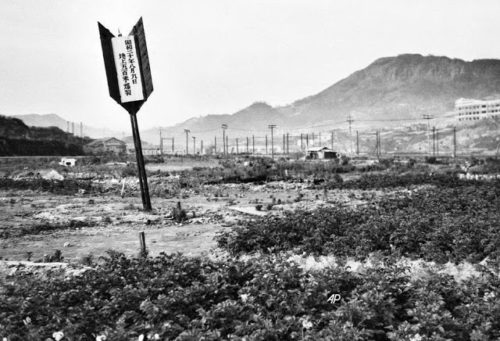
August 10, 1945: Arrow marks the spot where the atomic bomb hit in Nagasaki. Photo by AP

When on August 6 and 9, 1945 the United States killed 200-300 thousand innocent Japanese civilians with atomic bombs in Hiroshima and Nagasaki, they did so intentionally.  It was an act of sinister state terrorism, unprecedented by the nature of the weapons but not by the slaughter. The American terror bombings of Japanese cities that preceded the atomic bombings of Hiroshima and Nagasaki – led by the infamous Major General Curtis LeMay – were also intentionally aimed at Japanese civilians and killed hundreds of thousands of them.

Is there an American artist’s painting of Tokyo destroyed by the firebombing to go next to Picasso’s Guernica, where estimates of the dead range between 800 and 1,600?  In Tokyo alone more than 100,000 Japanese civilians were burnt to death by cluster bombs of napalm.  All this killing was intentional. I repeat: Intentional.  Is that not radical evil?  Demonic?  Only five Japanese cities were spared such bombing.

The atomic bombings were an intentional holocaust, not to end the war, as the historical record amply demonstrates, but to send a message to the Soviet Union that we could do to them what we did to the residents of Japan.  President Truman made certain that the Japanese willingness to surrender in May 1945 was made unacceptable because he and his Secretary-of-State James Byrnes  wanted to use the atomic bombs – “as quickly as possible to ‘show results’” in Byrnes’ words – to send a message to the Soviet Union.  So “the Good War” was ended in the Pacific with the “good guys” killing hundreds of thousands Japanese civilians to make a point to the “bad guys,” who have been demonized ever since.  Russia phobia is nothing new.

Satan always wears the other’s face.

Many Baby Boomers like to say they grew up with the bomb.  They are lucky. They grew up.  They got to be scared.  They got to hide under their desks and wax nostalgic about it.  Do you remember dog tags?  Those 1950s and 1960s?  The scary movies?

The children of Hiroshima and Nagasaki who died under our bombs on August 6 and 9, 1945 didn’t get to grow up.  They couldn’t hide.  They just went under. To be accurate: we put them under. Or they were left to smolder for decades in pain and then die.  But that it was necessary to save American lives is the lie. It’s always about American lives, as if the owners of the country actually cared about them.  But to tender hearts and innocent minds, it’s a magic incantation.  Poor us!

Fat Man, Little Boy – how the words echo down the years to the now fat Americans who grew up in the 1950s and who think like little boys and girls about their country’s demonic nature.  Innocence – it is wonderful!  We are different now. “We are great because we are good,” that’s what Hillary Clinton told us.  The Libyans can attest to that.  We are exceptional, special.  The next election will prove we can defeat Mr. Pumpkin Head and restore America to its “core values.”

Perhaps you think I am cynical.  But understanding true evil is not child’s play.  It seems beyond the grasp of most Americans who need their illusions.  Evil is real.  There is simply no way to understand the savage nature of American history without seeing its demonic nature.  How else can we redeem ourselves at this late date, possessed as we are by delusions of our own God-blessed goodness?

But average Americans play at innocence.  They excite themselves at the thought that with the next election the nation will be “restored” to the right course.  Of course, there never was a right course, unless might makes right, which has always been the way of America’s rulers.  Today Trump is viewed by so many as an aberration.  He is far from it.  He’s straight out of a Twain short story.  He’s Vaudeville. He’s Melville’s confidence man.  He’s us. Did it ever occur to those who are fixated on him that if those who own and run the country wanted him gone, he’d be gone in an instant?  He can tweet and tweet idiotically, endlessly send out messages that he will contradict the next day, but as long as he protects the super-rich, accepts Israel’s control of him, and allows the CIA-military-industrial complex to do its world-wide killing and looting of the treasury, he will be allowed to entertain and excite the public – to get them worked up in a lather in pseudo-debates.  And to make this more entertaining, he will be opposed by the “sane” Democratic opposition, whose intentions are as benign as an assassin’s smile.

Look back as far as you can to past U.S. presidents, the figureheads who “act under orders” (whose orders?), as did Ahab in his lust to kill the “evil” great white whale, and what do you see?  You see servile killers in the grip of a sinister power.  You see hyenas with polished faces. You see pasteboard masks.  On the one occasion when one of these presidents dared to follow his conscience and rejected the devil’s pact that is the presidency’s killer-in-chief role, he – JFK – had his brains blown out in public view.  An evil empire thrives on shedding blood, and it enforces its will through demonic messages.  Resist and there will be blood on the streets, blood on the tracks, blood in your face.

Despite this, President Kennedy’s witness, his turn from cold warrior to an apostle of peace, remains to inspire a ray of hope in these dark days. As recounted by James Douglass in his masterful JFK and the Unspeakable, Kennedy agreed to a meeting in May 1962 with a group of Quakers who had been demonstrating outside the While House for total disarmament.  They urged him to move in that direction.  Kennedy was sympathetic to their position.  He said he wished it were easy to do so from the top down, but that he was being pressured by the Pentagon and others to never do that, although he had given a speech urging “a peace race” together with the Soviet Union. He told the Quakers it would have to come from below.  According to the Quakers, JFK listened intently to their points, and before they left said with a smile, “You believe in redemption, don’t you?”  Soon Kennedy was shaken to his core by the Cuban missile crisis when the world teetered on the brink of extinction and his insane military and “intelligence” advisers urged him to wage a nuclear war.  Not long after, he took a sharp top-down turn toward peace despite their fierce opposition, a turn so dramatic over the next year that it led to his martyrdom.  And he knew it would.  He knew it would.

So hope is not all lost.  There are great souls like JFK to inspire us. Their examples flash here and there. But to even begin to hope to change the future, a confrontation with our demonic past (and present) is first necessary, a descent into the dark truth that is terrifying in its implications.  False innocence must be abandoned.  Carl Jung, in “On the Psychology of the Unconscious,” addressed this with the words:

It is a frightening thought that man also has a shadow side to him, consisting not just of little weaknesses – and foibles, but of a positively demonic dynamism. The individual seldom knows anything of this; to him, as an individual, it is incredible that he should ever in any circumstances go beyond himself. But let these harmless creatures form a mass, and there emerges a raging monster; and each individual is only one tiny cell in the monster’s body, so that for better or worse he must accompany it on its bloody rampages and even assist it to the utmost. Having a dark suspicion of these grim possibilities, man turns a blind eye to the shadow-side of human nature. Blindly he strives against the salutary dogma of original sin, which is yet so prodigiously true. Yes, he even hesitates to admit the conflict of which he is so painfully aware.

How can one describe men who would intentionally slaughter so many innocent people?  American history is rife with such examples up to the present day.  Iraq, Afghanistan, Libya, Syria, etc. – the list is very long.  Savage wars carried out by men and women who own and run the country, and who try to buy the souls of regular people to join them in their pact with the devil, to acquiesce to their ongoing wicked deeds.  Such monstrous evil was never more evident than on August 6 and 9, 1945.

Unless we enter into deep contemplation of the evil that was released into the world with those bombings of Hiroshima and Nagasaki, we are lost in a living hell without escape.  And we will pay.  Nemesis always demands retribution.  We have gradually been accepting rule by those for whom the killing of innocents is child’s play, and we have been masquerading as innocent and good children for whom the truth is too much to bear.  “Indeed, the safest road to Hell is the gradual one,” Screwtape the devil tells his nephew, Wormwood, a devil in training, “the gentle slope, soft underfoot, without sudden turnings, without milestones, without signposts.”  That’s the road we’ve been traveling.

The projection of evil onto others works only so long.  We must reclaim our shadows and withdraw our projections.  Only the fate of the world depends on it.


Related Article:

Barbarians at the Helm (Cindy Sheehan’s Speech in Hiroshima August 6th 2018)

OUR NEW, HAPPY LIFE? THE IDEOLOGY OF DEVELOPMENT

By Charles Eisenstein

Source: Waking Times

In George Orwell’s 1984, there is a moment when the Party announces an “increase” in the chocolate ration – from thirty grams to twenty. No one except for the protagonist, Winston, seems to notice that the ration has gone down not up.

‘Comrades!’ cried an eager youthful voice. ‘Attention, comrades! We have glorious news for you. We have won the battle for production! Returns now completed of the output of all classes of consumption goods show that the standard of living has risen by no less than 20 percent over the past year. All over Oceania this morning there were irrepressible spontaneous demonstrations when workers marched out of factories and offices and paraded through the streets with banners voicing their gratitude to Big Brother for the new, happy life which his wise leadership has bestowed upon us.

The newscaster goes on to announce one statistic after another proving that everything is getting better. The phrase in vogue is “our new, happy life.” Of course, as with the chocolate ration, it is obvious that the statistics are phony.

Those words, “our new, happy life,” came to me as I read two recent articles, one by Nicholas Kristof in the New York Times and the other by Stephen Pinker in the Wall Street Journal, both of which asserted, with ample statistics, that the overall state of humanity is better now than at any time in history. Fewer people die in wars, car crashes, airplane crashes, even from gun violence. Poverty rates are lower than ever recorded, life expectancy is higher, and more people than ever are literate, have access to electricity and running water, and live in democracies.

Like in 1984, these articles affirm and celebrate the basic direction of society. We are headed in the right direction. With smug assurance, they tell us that thanks to reason, science, and enlightened Western political thinking, we are making strides toward a better world.

Like in 1984, there is something deceptive in these arguments that so baldly serve the established order.

Unlike in 1984, the deception is not a product of phony statistics.

Before I describe the deception and what lies on the other side of it, I want to assure the reader that this essay will not try to prove that things are getting worse and worse. In fact, I share the fundamental optimism of Kristof and Pinker that humanity is walking a positive evolutionary path. For this evolution to proceed, however, it is necessary that we acknowledge and integrate the horror, the suffering, and the loss that the triumphalist narrative of civilizational progress skips over.

What hides behind the numbers

In other words, we need to come to grips with precisely the things that Stephen Pinker’s statistics leave out. Generally speaking, metrics-based evaluations, while seemingly objective, bear the covert biases of those who decide what to measure, how to measure it, and what not to measure. They also devalue those things which we cannot measure or that are intrinsically unmeasurable. Let me offer a few examples.

Nicholas Kristof celebrates a decline in the number of people living on less than two dollars a day. What might that statistic hide? Well, every time an indigenous hunter-gatherer or traditional villager is forced off the land and goes to work on a plantation or sweatshop, his or her cash income increases from zero to several dollars a day. The numbers look good. GDP goes up. And the accompanying degradation is invisible.

For the last several decades, multitudes have fled the countryside for burgeoning cities in the global South. Most had lived largely outside the money economy. In a small village in India or Africa, most people procured food, built dwellings, made clothes, and created entertainment in a subsistence or gift economy, without much need for money. When development policies and the global economy push entire nations to generate foreign exchange to meet debt obligations, urbanization invariably results. In a slum in Lagos or Kolkata, two dollars a day is misery, where in the traditional village it might be affluence. Taking for granted the trend of development and urbanization, yes, it is a good thing when those slum dwellers rise from two dollars a day to, say, five. But the focus on that metric obscures deeper processes.

Kristof asserts that 2017 was the best year ever for human health. If we measure the prevalence of infectious diseases, he is certainly right. Life expectancy also continues to rise globally (though it is leveling off and in some countries, such as the United States, beginning to fall). Again though, these metrics obscure disturbing trends. A host of new diseases such as autoimmunity, allergies, Lyme, and autism, compounded with unprecedented levels of addiction, depression, and obesity, contribute to declining physical vitality throughout the developed world, and increasingly in developing countries too. Vast social resources – one-fifth of GDP in the US – go toward sick care; society as a whole is unwell.

Both authors also mention literacy. What might the statistics hide here? For one, the transition into literacy has meant, in many places, the destruction of oral traditions and even the extinction of entire non-written languages. Literacy is part of a broader social repatterning, a transition into modernity, that accompanies cultural and linguistic homogenization. Tens of millions of children go to school to learn reading, writing, and arithmetic; history, science, and Shakespeare, in places where, a generation before, they would have learned how to herd goats, grow barley, make bricks, weave cloth, conduct ceremonies, or bake bread. They would have learned the uses of a thousand plants and the songs of a hundred birds, the words of a thousand stories and the steps to a hundred dances. Acculturation to literate society is part of a much larger change. Reasonable people may differ on whether this change is good or bad, on whether we are better off relying on digital social networks than on place-based communities, better off recognizing more corporate logos than local plants and animals, better off manipulating symbols rather than handling soil. Only from a prejudiced mindset could we say, though, that this shift represents unequivocal progress.

My intention here is not to use written words to decry literacy, deliciously ironic though that would be. I am merely observing that our metrics for progress encode hidden biases and neglect what won’t fit comfortably into the worldview of those who devise them. Certainly, in a society that is already modernized, illiteracy is a terrible disadvantage, but outside that context, it is not clear that a literate society – or its extension, a digitized society – is a happy society.

The immeasurability of happiness

Biases or no, surely you can’t argue with the happiness metrics that are the lynchpin of Pinker’s argument that science, reason, and Western political ideals are working to create a better world. The more advanced the country, he says, the happier people are. Therefore the more the rest of the world develops along the path we blazed, the happier the world will be.

Unfortunately, happiness statistics encode as assumptions the very conclusions the developmentalist argument tries to prove. Generally speaking, happiness metrics comprise two approaches: objective measures of well-being, and subjective reports of happiness. Well-being metrics include such things as per-capita income, life expectancy, leisure time, educational level, access to health care, and many of the other accouterments of development.  In many cultures, for example, “leisure” was not a concept; leisure in contradistinction to work assumes that work itself is as it became in the Industrial Revolution: tedious, degrading, burdensome. A culture where work is not clearly separable from life is misjudged by this happiness metric; see Helena Norberg-Hodge’s marvelous film Ancient Futures for a depiction of such a culture, in which, as the film says, “work and leisure are one.”

Encoded in objective well-being metrics is a certain vision of development; specifically, the mode of development that dominates today. To say that developed countries are therefore happier is circular logic.

As for subjective reports of individual happiness, individual self-reporting necessarily references the surrounding culture. I rate my happiness in comparison to the normative level of happiness around me. A society of rampant anxiety and depression draws a very low baseline. A woman told me once, “I used to consider myself to be a reasonably happy person until I visited a village in Afghanistan near where I’d been deployed in the military. I wanted to see what it was like from a different perspective. This is a desperately poor village,” she said. “The huts didn’t even have floors, just dirt which frequently turned to mud. They barely even had enough food. But I have never seen happier people. They were so full of joy and generosity. These people, who had nothing, were happier than almost anyone I know.”

Whatever those Afghan villagers had to make them happy, I don’t think shows up in Stephen Pinker’s statistics purporting to prove that they should follow our path. The reader may have had similar experiences visiting Mexico, Brazil, Africa, or India, in whose backwaters one finds a level of joy rare amidst the suburban boxes of my country. This, despite centuries of imperialism, war, and colonialism. Imagine the happiness that would be possible in a just and peaceful world.

I’m sure my point here will be unpersuasive to anyone who has not had such an experience first-hand. You will think, perhaps, that maybe the locals were just putting on their best face for the visitor. Or maybe that I am seeing them through romanticizing “happy-natives” lenses. But I am not speaking here of superficial good cheer or the phony smile of a man making the best of things. People in older cultures, connected to community and place, held close in a lineage of ancestors, woven into a web of personal and cultural stories, radiate a kind of solidity and presence that I rarely find in any modern person. When I interact with one of them, I know that whatever the measurable gains of the Ascent of Humanity, we have lost something immeasurably precious. And I know that until we recognize it and turn toward its recovery, that no further progress in lifespan or GDP or educational attainment will bring us closer to any place worth going.

What other elements of deep well-being elude our measurements? Authenticity of communication? The intimacy and vitality of our relationships? Familiarity with local plants and animals? Aesthetic nourishment from the built environment? Participation in meaningful collective endeavors? Sense of community and social solidarity? What we have lost is hard to measure, even if we were to try. For the quantitative mind, the mind of money and data, it hardly exists. Yet the loss casts a shadow on the heart, a dim longing that no assurance of new, happy life can assuage.

While the fullness of this loss – and, by implication, the potential in its recovery – is beyond measure, there are nonetheless statistics, left out of Pinker’s analysis, that point to it. I am referring to the high levels of suicide, opioid addiction, meth addiction, pornography, gambling, anxiety, and depression that plague modern society and every modernizing society. These are not just random flies that have landed in the ointment of progress; they are symptoms of a profound crisis. When community disintegrates, when ties to nature and place are severed, when structures of meaning collapse, when the connections that make us whole wither, we grow hungry for addictive substitutes to numb the longing and fill the void.

The loss I speak of is inseparable from the very institutions – science, technology, industry, capitalism, and the political ideal of the rational individual – that Stephen Pinker says have delivered humanity from misery. We might be cautious, then, about attributing to these institutions certain incontestable improvements over Medieval times or the early Industrial Revolution. Could there be another explanation? Might they have come despite science, capitalism, rational individualism, etc., and not because of them?

The empathy hypothesis

One of the improvements Stephen Pinker emphasizes is a decline in violence. War casualties, homicide, and violent crime, in general, have fallen to a fraction of their levels a generation or two ago. The decline in violence is real, but should we attribute it, as Pinker does, to democracy, reason, rule of law, data-driven policing, and so forth? I don’t think so. Democracy is no insurance against war – in fact, the United States has perpetrated far more military actions than any other nation in the last half-century. And is the decline in violent crime simply because we are better able to punish and protect ourselves from each other, clamping down on our savage impulses with the technologies of deterrence?

I have another hypothesis. The decline in violence is not the result of perfecting the world of the separate, self-interested rational subject. To the contrary: it is the result of the breakdown of that story, and the rise of empathy in its stead.

In the mythology of the separate individual, the purpose of the state was to ensure a balance between individual freedom and the common good by putting limits on the pursuit of self-interest. In the emerging mythology of interconnection, ecology, and interbeing, we awaken to the understanding that the good of others, human and otherwise, is inseparable from our own well-being.

The defining question of empathy is, What is it like to be you? In contrast, the mindset of war is the othering, the dehumanization and demonization of people who become the enemy. That becomes more difficult the more accustomed we are to considering the experience of another human being. That is why war, torture, capital punishment, and violence have become less acceptable. It is not that they are “irrational.” To the contrary: establishment think tanks are quite adept at inventing highly rational justifications for all of these.

In a worldview in which competing self-interested actors is axiomatic, what is “rational” is to outcompete them, dominate them, and exploit them by any means necessary? It was not advances in science or reason that abolished the 14-hour workday, chattel slavery, or debtors’ prisons.

The worldview of ecology, interdependence, and interbeing offers different axioms on which to exercise our reason. Understanding that another person has an experience of being, and is subject to circumstances that condition their behavior, makes us less able to dehumanize them as a first step in harming them. Understanding that what happens to the world in some way happens to ourselves, reason no longer promotes war. Understanding that the health of soil, water, and ecosystems is inseparable from our own health, reason no longer urges their pillage.

In a perverse way, science & technology cheerleaders like Stephen Pinker are right: science has indeed ended the age of war. Not because we have grown so smart and so advanced over primitive impulses that we have transcended it. No, it is because science has brought us to such extremes of savagery that it has become impossible to maintain the myth of separation. The technological improvements in our capacity to murder and ruin make it increasingly clear that we cannot insulate ourselves from the harm we do to the other.

It was not primitive superstition that gave us the machine gun and the atomic bomb. Industry was not an evolutionary step beyond savagery; it applied savagery at an industrial scale. Rational administration of organizations did not elevate us beyond genocide; it enabled it to happen on an unprecedented scale and with unprecedented efficiency in the Holocaust. Science did not show us the irrationality of war; it brought us to the very extreme of irrationality, the Mutually Assured Destruction of the Cold War. In that insanity was the seed of a truly evolutive understanding – that what we do to the other, happens to ourselves as well. That is why, aside from a retrograde cadre of American politicians, no one seriously considers using nuclear weapons today.

The horror we feel at the prospect of, say, nuking Pyongyang or Tehran is not the dread of radioactive blowback or retributive terror. It arises, I claim, from our empathic identification with the victims. As the consciousness of interbeing grows, we can no longer easily wave off their suffering as the just deserts of their wickedness or the regrettable but necessary price of freedom. It as if, on some level, it would be happening to ourselves.

To be sure, there is no shortage of human rights abuses, death squads, torture, domestic violence, military violence, and violent crime still in the world today. To observe, in the midst of it, a rising tide of compassion is not a whitewash of the ugliness, but a call for fuller participation in a movement. On the personal level, it is a movement of kindness, compassion, empathy, taking ownership of one’s judgments and projections, and – not contradictorily – of bravely speaking uncomfortable truths, exposing what was hidden, bringing violence and injustice to light, telling the stories that need to be heard. Together, these two threads of compassion and truth might weave a politics in which we call out the iniquity without judging the perpetrator, but instead seek to understand and change the circumstances of the perpetration.

From empathy, we seek not to punish criminals but to understand the circumstances that breed crime. We seek not to fight terrorism but to understand and change the conditions that generate it. We seek not to wall out immigrants, but to understand why people are so desperate in the first place to leave their homes and lands, and how we might be contributing to their desperation.

Empathy suggests the opposite of the conclusion offered by Stephen Pinker. It says, rather than more efficient legal penalties and “data-driven policing,” we might study the approach of new Philadelphia District Attorney Larry Krasner, who has directed prosecutors to stop seeking maximum sentences, stop prosecuting cannabis possession, steer offenders toward diversionary programs rather than penal programs, cutting inordinately long probation periods, and other reforms. Undergirding these measures is compassion: What is it like to be a criminal? An addict? A prostitute? Maybe we still want to stop you from continuing to do that, but we no longer desire to punish you. We want to offer you a realistic opportunity to live another way.

Similarly, the future of agriculture is not in more aggressive breeding, more powerful pesticides, or the further conversion of living soil into an industrial input. It is in knowing soil as a being and serving its living integrity, knowing that its health is inseparable from our own. In this way, the principle of empathy (What is it like to be you?) extends beyond criminal justice, foreign policy, and personal relationships. Agriculture, medicine, education, technology – no field is outside its bounds. Translating that principle into civilization’s institutions (rather than extending the reach of reason, control, and domination) is what will bring real progress to humanity.

This vision of progress is not contrary to technological development; neither will science, reason, or technology automatically bring it about. All human capacities can be put into service to a future embodying the understanding that the world’s wellbeing, human and otherwise, feeds our own.

US Intelligence Community as a Collapse Driver

By Dmitry Orlov

Source: Club Orlov

In today’s United States, the term “espionage” doesn’t get too much use outside of some specific contexts. There is still sporadic talk of industrial espionage, but with regard to Americans’ own efforts to understand the world beyond their borders, they prefer the term “intelligence.” This may be an intelligent choice, or not, depending on how you look at things.

First of all, US “intelligence” is only vaguely related to the game of espionage as it has been traditionally played, and as it is still being played by countries such as Russia and China. Espionage involves collecting and validating strategically vital information and conveying it to just the pertinent decision-makers on your side while keeping the fact that you are collecting and validating it hidden from everyone else.

In eras past, a spy, if discovered, would try to bite down on a cyanide capsule; these days torture is considered ungentlemanly, and spies that get caught patiently wait to be exchanged in a spy swap. An unwritten, commonsense rule about spy swaps is that they are done quietly and that those released are never interfered with again because doing so would complicate negotiating future spy swaps. In recent years, the US intelligence agencies have decided that torturing prisoners is a good idea, but they have mostly been torturing innocent bystanders, not professional spies, sometimes forcing them to invent things, such as “Al Qaeda.” There was no such thing before US intelligence popularized it as a brand among Islamic terrorists.

Most recently, British “special services,” which are a sort of Mini-Me to the to the Dr. Evil that is the US intelligence apparatus, saw it fit to interfere with one of their own spies, Sergei Skripal, a double agent whom they sprung from a Russian jail in a spy swap. They poisoned him using an exotic chemical and then tried to pin the blame on Russia based on no evidence. There are unlikely to be any more British spy swaps with Russia, and British spies working in Russia should probably be issued good old-fashioned cyanide capsules (since that supposedly super-powerful Novichok stuff the British keep at their “secret” lab in Porton Down doesn’t work right and is only fatal 20% of the time).

There is another unwritten, commonsense rule about spying in general: whatever happens, it needs to be kept out of the courts, because the discovery process of any trial would force the prosecution to divulge sources and methods, making them part of the public record. An alternative is to hold secret tribunals, but since these cannot be independently verified to be following due process and rules of evidence, they don’t add much value.

A different standard applies to traitors; here, sending them through the courts is acceptable and serves a high moral purpose, since here the source is the person on trial and the method—treason—can be divulged without harm. But this logic does not apply to proper, professional spies who are simply doing their jobs, even if they turn out to be double agents. In fact, when counterintelligence discovers a spy, the professional thing to do is to try to recruit him as a double agent or, failing that, to try to use the spy as a channel for injecting disinformation.

Americans have been doing their best to break this rule. Recently, special counsel Robert Mueller indicted a dozen Russian operatives working in Russia for hacking into the DNC mail server and sending the emails to Wikileaks. Meanwhile, said server is nowhere to be found (it’s been misplaced) while the time stamps on the files that were published on Wikileaks show that they were obtained by copying to a thumb drive rather than sending them over the internet. Thus, this was a leak, not a hack, and couldn’t have been done by anyone working remotely from Russia.

Furthermore, it is an exercise in futility for a US official to indict Russian citizens in Russia. They will never stand trial in a US court because of the following clause in the Russian Constitution: “61.1 A citizen of the Russian Federation may not be deported out of Russia or extradited to another state.” Mueller may summon a panel of constitutional scholars to interpret this sentence, or he can just read it and weep. Yes, the Americans are doing their best to break the unwritten rule against dragging spies through the courts, but their best is nowhere near good enough.

That said, there is no reason to believe that the Russian spies couldn’t have hacked into the DNC mail server. It was probably running Microsoft Windows, and that operating system has more holes in it than a building in downtown Raqqa, Syria after the Americans got done bombing that city to rubble, lots of civilians included. When questioned about this alleged hacking by Fox News, Putin (who had worked as a spy in his previous career) had trouble keeping a straight face and clearly enjoyed the moment. He pointed out that the hacked/leaked emails showed a clear pattern of wrongdoing: DNC officials conspired to steal the electoral victory in the Democratic Primary from Bernie Sanders, and after this information had been leaked they were forced to resign. If the Russian hack did happen, then it was the Russians working to save American democracy from itself. So, where’s the gratitude? Where’s the love? Oh, and why are the DNC perps not in jail?

Since there exists an agreement between the US and Russia to cooperate on criminal investigations, Putin offered to question the spies indicted by Mueller. He even offered to have Mueller sit in on the proceedings. But in return he wanted to question US officials who may have aided and abetted a convicted felon by the name of William Browder, who is due to begin serving a nine-year sentence in Russia any time now and who, by the way, donated copious amounts of his ill-gotten money to the Hillary Clinton election campaign. In response, the US Senate passed a resolution to forbid Russians from questioning US officials. And instead of issuing a valid request to have the twelve Russian spies interviewed, at least one US official made the startlingly inane request to have them come to the US instead. Again, which part of 61.1 don’t they understand?

The logic of US officials may be hard to follow, but only if we adhere to the traditional definitions of espionage and counterespionage—“intelligence” in US parlance—which is to provide validated information for the purpose of making informed decisions on best ways of defending the country. But it all makes perfect sense if we disabuse ourselves of such quaint notions and accept the reality of what we can actually observe: the purpose of US “intelligence” is not to come up with or to work with facts but to simply “make shit up.”

The “intelligence” the US intelligence agencies provide can be anything but; in fact, the stupider it is the better, because its purpose is allow unintelligent people to make unintelligent decisions. In fact, they consider facts harmful—be they about Syrian chemical weapons, or conspiring to steal the primary from Bernie Sanders, or Iraqi weapons of mass destruction, or the whereabouts of Osama Bin Laden—because facts require accuracy and rigor while they prefer to dwell in the realm of pure fantasy and whimsy. In this, their actual objective is easily discernible.

The objective of US intelligence is to suck all remaining wealth out of the US and its allies and pocket as much of it as possible while pretending to defend it from phantom aggressors by squandering nonexistent (borrowed) financial resources on ineffective and overpriced military operations and weapons systems. Where the aggressors are not phantom, they are specially organized for the purpose of having someone to fight: “moderate” terrorists and so on. One major advancement in their state of the art has been in moving from real false flag operations, à la 9/11, to fake false flag operations, à la fake East Gouta chemical attack in Syria (since fully discredited). The Russian election meddling story is perhaps the final step in this evolution: no New York skyscrapers or Syrian children were harmed in the process of concocting this fake narrative, and it can be kept alive seemingly forever purely through the furious effort of numerous flapping lips. It is now a pure confidence scam. If you are less then impressed with their invented narratives, then you are a conspiracy theorist or, in the latest revision, a traitor.

Trump was recently questioned as to whether he trusted US intelligence. He waffled. A light-hearted answer would have been:

“What sort of idiot are you to ask me such a stupid question? Of course they are lying! They were caught lying more than once, and therefore they can never be trusted again. In order to claim that they are not currently lying, you have to determine when it was that they stopped lying, and that they haven’t lied since. And that, based on the information that is available, is an impossible task.”

A more serious, matter-of-fact answer would have been:

“The US intelligence agencies made an outrageous claim: that I colluded with Russia to rig the outcome of the 2016 presidential election. The burden of proof is on them. They are yet to prove their case in a court of law, which is the only place where the matter can legitimately be settled, if it can be settled at all. Until that happens, we must treat their claim as conspiracy theory, not as fact.”

And a hardcore, deadpan answer would have been:

“The US intelligence services swore an oath to uphold the US Constitution, according to which I am their Commander in Chief. They report to me, not I to them. They must be loyal to me, not I to them. If they are disloyal to me, then that is sufficient reason for their dismissal.”

But no such reality-based, down-to-earth dialogue seems possible. All that we hear are fake answers to fake questions, and the outcome is a series of faulty decisions. Based on fake intelligence, the US has spent almost all of this century embroiled in very expensive and ultimately futile conflicts. Thanks to their efforts, Iran, Iraq and Syria have now formed a continuous crescent of religiously and geopolitically aligned states friendly toward Russia while in Afghanistan the Taliban is resurgent and battling ISIS—an organization that came together thanks to American efforts in Iraq and Syria.

The total cost of wars so far this century for the US is reported to be $4,575,610,429,593. Divided by the 138,313,155 Americans who file tax returns (whether they actually pay any tax is too subtle a question), it works out to just over $33,000 per taxpayer. If you pay taxes in the US, that’s your bill so far for the various US intelligence “oopsies.”

The 16 US intelligence agencies have a combined budget of $66.8 billion, and that seems like a lot until you realize how supremely efficient they are: their “mistakes” have cost the country close to 70 times their budget. At a staffing level of over 200,000 employees, each of them has cost the US taxpayer close to $23 million, on average. That number is totally out of the ballpark! The energy sector has the highest earnings per employee, at around $1.8 million per. Valero Energy stands out at $7.6 million per. At $23 million per, the US intelligence community has been doing three times better than Valero. Hats off! This makes the US intelligence community by far the best, most efficient collapse driver imaginable.

There are two possible hypotheses for why this is so.

First, we might venture to guess that these 200,000 people are grossly incompetent and that the fiascos they precipitate are accidental. But it is hard to imagine a situation where grossly incompetent people nevertheless manage to funnel $23 million apiece, on average, toward an assortment of futile undertakings of their choosing. It is even harder to imagine that such incompetents would be allowed to blunder along decade after decade without being called out for their mistakes.

Another hypothesis, and a far more plausible one, is that the US intelligence community has been doing a wonderful job of bankrupting the country and driving it toward financial, economic and political collapse by forcing it to engage in an endless series of expensive and futile conflicts—the largest single continuous act of grand larceny the world has ever known. How that can possibly be an intelligent thing to do to your own country, for any conceivable definition of “intelligence,” I will leave for you to work out for yourself. While you are at it, you might also want to come up with an improved definition of “treason”: something better than “a skeptical attitude toward preposterous, unproven claims made by those known to be perpetual liars.”

Strategy and Conscience: Subverting Elite Power So We End Human Violence

Fragment of “Butcher to the World” by Sue Coe.

By Robert J. Burrowes

Given the overwhelming evidence that activist efforts are failing to halt the accelerating rush to extinction precipitated and maintained by dysfunctional human behavior, it is worth reflecting on why this is happening.

Of course, you might say that the rush to extinction is being slowed. But is it? Even according to BP’s chief economist: ‘despite the extraordinary growth in renewables in recent years, and the huge policy efforts to encourage a shift away from coal into cleaner, lower carbon fuels, there has been almost no improvement in the power sector fuel mix over the past 20 years. The share of coal in the power sector in 1998 was 38% – exactly the same as in 2017…. this is one area where at the global level we haven’t even taken one step forward, we have stood still: perfectly still for the past 20 years.’ See Analysis – Spencer Dale, group chief economist.

And, to choose another measure that highlights our lack of ‘progress’: species extinctions proceed at a rate of 200 each day, which is vastly greater than the long-term background rate, with another 26,000 species already identified as ‘under threat’. See Red list research finds 26,000 global species under extinction threat.

But it wouldn’t matter what measure you analyzed – efforts to prevent cataclysmic nuclear war, to halt the many ongoing wars, to contain and reverse the prevalent and grotesque economic exploitation, to end slavery or the sex trafficking of women and children, to halt or even slow the rampant destruction of the biosphere, including the rainforests and oceans – we are rapidly losing ground (and often despite some apparent gains such as adoption of the ‘Treaty on the Prohibition of Nuclear Weapons’ by many non-nuclear states on 7 July 2017).

Not only are we destroying the rainforests – currently at the rate of 80,000 acres each day: see ‘Measuring the Daily Destruction of the World’s Rainforests’ – and oceans – see The state of our oceans in 2018 (It’s not looking good!)’ – as a fellow long-standing nonviolent activist, Kelvin Davies, recently observed to me: the oceans and remaining rainforests are ‘being emptied of life’ as impoverished people, forced to the economic margin, hunt remaining wildlife, including tropical fish, for food and/or trafficking.

Before we blame impoverished people for their destruction however, it is the consumption by those of us in industrialized countries that is generating the adverse circumstances in which they are forced to survive. For one simple example of this, related to our diet alone, see ‘Emissions impossible: How big meat and dairy are heating up the planet’.

Of course, you might object that it is not activist efforts that are responsible for the failure to halt elite violence and our complicity in it. It is the failure of corporatized society to seriously consider and respond intelligently to the scientific and other evidence in relation to all of the violence in its many manifestations. However, any explanation of this nature fails to understand and appreciate why progressive change has always occurred in the past.

Social progress is the result of people of conscience strategically challenging elite power in such a way that new norms become so widely accepted that elites are compelled to work within them. This has always been essential for the simple reason that elites are insane and have never acted sensibly, whatever the issue. Elites have only ever orchestrated events to maximize their own power, profit and privilege whatever the cost to the rest of us and the Earth itself. Hence, violence, war, grotesque economic exploitation and ecological destruction are rampant across the planet; that is the way elites want it; that is what maximizes elite power, profit and privilege. See ‘The Global Elite is Insane Revisited’.

As an aside: if you aren’t convinced that the global elite is insane, then perhaps you might ponder the possible implications of the recent call by US President Donald Trump, for the creation of a new Space Force as a sixth branch of the U.S. military – ‘We must have American dominance in space’ – in violation of the Outer Space Treaty of 1967. See ‘Trump Orders Establishment of Space Force as Sixth Military Branch’.

While this enterprise, if it gets Congressional approval, would be staggeringly profitable to the global elite while further gutting social and environmental programs to pay for it, the proposal also raises the possibility, as Professor Karl Grossman graphically expressed it (given that there is no way to have the envisaged weapons in space without nuclear power) that ‘the heavens are going to be littered with radioactive debris’ for millennia (but in substantially greater amounts than is already there). See ‘Trump’s Space Force: Military Profiteering’s Final Frontier’ and ‘Star Wars Redux: Trump’s Space Force’.

Of course, if you want even more evidence of elite insanity, then look no further than the current hysteria generated by Donald Trump’s supposed ‘treason’ for having a meeting with Russian president Vladimir Putin in Helsinki with the intention of improving mutual understanding and the prospects of peace between the two countries. For a sample of the literature that discusses this summit intelligently, which you won’t find in the corporate media, see US Media is Losing Its Mind Over Trump-Putin Press Conference, ‘Is President Trump A Traitor Because He Wants Peace With Russia?’, ‘Helsinki Talks – How Trump Tries To Rebalance The Global Triangle’ and Trump, The Manchurian Candidate: “Conspiracy” to Destabilize the Trump Presidency.

Some informed and thoughtful analysts believe this could lead to an elite coup to remove Trump from the US presidency. See Coming Coup Against Trump and The Coming Coup to Overthrow President Trump: Sedition at the Highest Levels.

So, to consolidate the information presented above, let me encapsulate the nature of geopolitics in one paragraph:

The military forces of the United States are not intended to defend the United States against military attack. The military forces of the countries in NATO are not intended to defend the respective member countries against military attack. The military forces of the United States and NATO are controlled by the global elite and used by the global elite to aggressively attack, in violation of all relevant national and international laws, any country that seeks independent control and development of its resources, particularly fossil fuels, strategic minerals and water. The global elite, which is in total control of the global economy and world affairs generally, does this in order to expand its own power, profit and privilege. It does this no matter what the cost to any individual (outside the elite), people, country and the biosphere. Why does the global elite do all of this? The global elite does this because it is completely insane.

Hence, to return to my point about the driver of social progress historically: Did the trans-Atlantic slave trade end because elites decided to halt the practice? Did gains for some women during the 21st century occur because elites committed themselves to ending patriarchal privilege? Did the British walk out of their colony in India because the British elite suddenly perceived the injustice of their violence and exploitation?

Despite the successes of activists of earlier generations, however, those of us who identify as activists of this generation are failing, quite comprehensively, to respond intelligently, powerfully and strategically to the vast challenges posed by an elite that has expanded its capacity to intimidate, outflank and overwhelm us (which is why, incidentally, slavery is now far more widespread than during any earlier period in human history, violence against women still manifests in a grotesque variety of forms all over the planet and even India has strayed monstrously from Gandhi’s vision).

In essence, strategic lessons learned by earlier generations of activists are forgotten or ignored as we stumble powerlessly to the extinction that is shortly to claim us all.

While I could write at some length about our shortcomings as activists in the era of perpetual violence and war, grotesque economic exploitation and pervasive climate and environmental destruction, I would like to focus on what I regard as the two key issues: strategy and conscience.

The global elite is deeply entrenched and manages world affairs, particularly through its capitalist economy. The global elite has developed over hundreds of years during which time it has fully and deeply penetrated all of the major power structures in world society, most of which it created (or moulded during their creation), so that the primary levers of power in the modern world – key financial institutions such as central banks, the major asset management corporations and the giant corporations in key industries (such as, but not limited to, the banking and weapons industries) – as well as the instruments through which its policies are implemented – including governments, military forces (both national and as ‘military contractors’ or mercenaries), key ‘intelligence’ agencies, legal systems and police forces, key nongovernment organizations such as the Vatican, and the academic, educational, media, medical, psychiatric and pharmaceutical industries – are all fully responsive to elite control.

More precisely than this, as explained in his forthcoming book ‘Giants: The Global Power Elite’, Professor Peter Phillips identifies the world’s top seventeen asset management firms, each with more than one trillion dollars of investment capital under management, as the giants of world capitalism. The total capital under management on behalf of all seventeen corporations is in excess of $US41.1 trillion; it represents the wealth invested for profit by thousands of millionaires, billionaires and corporations. These seventeen giants operate in nearly every country in the world and are ‘the central institutions of the financial capital that powers the global economic system’. They invest in anything considered profitable, ranging from ‘agricultural lands on which indigenous farmers are replaced by power elite investors’ to public assets to war.

Phillips goes on to note that the global elite develops and coordinates its policies through a variety of private planning fora such as the Group of Thirty, the Trilateral Commission and the Atlantic Council which determine the policies and issue the instructions for their implementation by transnational governmental institutions like the G7, G20, International Monetary Fund, World Trade Organization and the World Bank. Elite policies are also implemented following instruction of the relevant agent, including governments, in the context. These agents then do as they are instructed.

Or, if they do not, they are overthrown. Just ask any independently-minded government over the past century. For a list of governments overthrown by the global elite using its military and ‘intelligence’ agencies since World War II, see William Blum’s book ‘Killing Hope: U.S. Military and CIA Interventions Since World War II’ or, for just the list, see ‘Overthrowing other people’s governments: The Master List’.

As a result of coordination through the above elite fora, for example, gigantic media, public relations and entertainment corporations are used to reinforce elite dogma promulgated through national educational institutions so that most western humans become powerless consumers of elite product, informational and material, as the elite pursues ever-increasing profit, power and privilege. Oblivious to the way in which they are caught up in the elite drive to make us consume, even most western activists are major consumers, failing to limit their consumption in line with some appreciation of the per capita ecological carrying capacity of the Earth.

Hence, as should be obvious by now, with a deeply entrenched global elite in total control of major economic/financial, political, military, legal and social (including educational and media) power structures, only a comprehensive and sophisticated strategy has any prospect of succeeding, whatever the issue, and certainly the fundamental one: elite power.

In other words, if we want to end war (or even just one war), halt exacerbation of the climate catastrophe (in a region, country or the world), end environmental destruction on a vast range of fronts, terminate economic exploitation including (modern) slavery, end the sex trafficking of women and children, end the military occupation of Palestine, Tibet, West Papua… then we are going to have to think, plan and act strategically, which includes engaging and mobilizing, in a focused way, a significant proportion of the human population. Simply ‘campaigning’ on the basis of a few ideas and tactics that we think worked in the past, is not enough. Campaigning without strategy – and all that strategic thinking, including a penetrating analysis of the very nature of society and its power structure, entails – is a waste of time.

This is why most work of virtually all ‘activist’ NGOs is useless. They work within the elite-designed and managed global power structure, fearfully self-limiting their actions in accordance with elite-approved processes, such as those ‘within the law’ and lobbying elite-controlled governments and institutions, as well as international organizations such as the UN. By participating in elite-controlled processes, our dissent is absorbed and dissipated, as the elite intend.

This is the great achievement, from an elite perspective, of ‘democracy’: to the extent that people can be persuaded to participate in the delusion that democracy exists (anywhere on Earth) and that voting and lobbying changes anything important, they are unwitting victims of elite-manipulated processes and propaganda.

This also explains why virtually all NGOs invariably end up promoting elite-sponsored delusions such as, for example, those in relation to the climate catastrophe which talk of an ‘end of century’ timeframe (about 70 years more than we actually have), staying within 2 (or 3 or 1.5) degrees Celsius above the pre-industrial level (rather than the .5 degrees that is actually necessary) and, the most fundamental delusion of all, that we must substitute renewable energy for fossil fuels (which is certainly necessary), rather than (in addition) profoundly reduce – by at least 80% – consumption generally, involving both energy and resources of every kind – water, household energy, transport fuels, metals, meat, paper and plastic – while dramatically expanding our individual and community self-reliance if all environmental concerns are to be effectively addressed.

But elite-sponsored delusions are widely promulgated by its corporate media on a vast range of issues with only the rarest ‘activist’ NGO, concerned to focus on what it defines as its primary mission, taking a stand on these apparently ‘separate’ issues. So, for example, elite-sponsored delusions that are widely promulgated by its corporate media convince huge numbers of people that US-NATO wars against impoverished and militarily-primitive countries are in ‘self defense’ and that terrorists are a genuine threat to ‘national security’. At a more mundane level, elite-sponsored delusions propagated through its corporate media promote everything from genetically-mutilated, poisoned and junk food to psychiatric drugs. See ‘Defeating the Violence of Psychiatry’. These products are also highly profitable but because their insanity includes lacking any sense of morality, elites are unconcerned about the damage they inflict on us in these regards just as in all others.

Some grassroots activist groups are more politically savvy than NGOs but usually still lack comprehensive and sophisticated strategies. On rare occasions, it should be noted, one of these campaigns or national liberation struggles succeeds, because of such factors as the raw power of nonviolent action (even without strategy) or because they could rely on the NIMBY (Not In My Back Yard) effect to facilitate mobilization of significant numbers of people in a local area.

However, the global elite is unconcerned about the occasional local ‘setback’ which does not adversely impact its global agenda and where minor gains by grassroots activists can, if necessary, be subsequently reversed (including by simply violating the law, as the elite routinely does with impunity). Consider again, the above example of Trump’s call to violate the 1967 Outer Space Treaty or routine violation of legally-declared (and sometimes World Heritage-listed) national parks in Africa, Asia and Central/South America as major corporations seek to exploit oil and mineral wealth. The law is designed to intimidate and impede us; it is rarely used in an attempt to hold elites accountable and has little, if any, impact when it does: a corporation may, occasionally, be fined (an expense against generating monstrous profit). Fundamentally, elites are above the law: they draft it to defend their interests against the rest of us.

But to reiterate the main point: given the sheer number of (sometimes even large-scale) mobilizations on one issue after another around the world that achieve nothing of substance in relation to the issue itself (consider the demonstrations against the imminent war on Iraq, held in over 600 cities around the world and involving as many as 30 million people, on 15 February 2003), it is painfully clear that most grassroots activists have no conception of strategy either, including the appropriate strategic focus for their tactics.

And this applies equally to those national liberation activists in occupied countries such as Palestine, Tibet and West Papua, as well as those activists living in the many countries, such as Cambodia and the Democratic Republic of the Congo, run by dictatorships or where the elected government, such as that of Brazil, has been removed in a coup.

As touched on above, however, lack of sound strategy (including the structural analysis on which it must be based) is not the only shortcoming in our efforts to halt elite (or even our own) violence.

In the past, a primary motivator of activists, and particularly the great ones such as Mohandas K. Gandhi, was their conscience: The ‘inner voice’ that called them to action on both the personal and political levels.

But there is more to conscience than being called to action. So what is so important about conscience? Conscience is the mind function that asks the deeper questions such as ‘What is the right way to go about this?’, ‘How must I behave if I am to model what I ask of others?’ and ‘How will we design this campaign so that its conduct helps to create the world we envision?’ (rather than the simpler question ‘How will we win this campaign?’).

Moreover, living by one’s conscience requires courage: This includes making strategic choices to take significant or, occasionally, even great risks when elite violence threatens to intimidate a struggle into submission and silence.

It was his unyielding conscience, deeply guiding his personal and political behaviour (including his commitment to nonviolence and his extraordinarily austere lifestyle), and his superlative understanding of strategy that made Gandhi the great activist that he was. Why?

Because Gandhi’s nonviolence was based on certain premises derived from his conscience – including the importance of the truth, the sanctity and unity of all life, and the unity of means and end – his strategy was always conducted within the framework of his desired political, social, economic and ecological vision for society as a whole and not limited to the purpose of any immediate campaign.

It is for this reason that Gandhi’s approach to strategy is so important. He is always taking into account the ultimate end of all nonviolent struggle – a just, peaceful and ecologically sustainable society of self-realized human beings – not just the outcome of this campaign. He wants each campaign to contribute to the ultimate aim, not undermine vital elements of the long-term and overarching struggle to create a world without violence.

So what do we do?

If you would like to better understand why so many human beings, including those within the elite, are devoid of anything resembling a conscience, you can do so by reading what happened to them as a child in Why Violence? and Fearless Psychology and Fearful Psychology: Principles and Practice.

If you are interested in acting in ways that maximize the chance that elite opponents and their agents will reflect, deeply, on what they are doing, while fundamentally changing the power relationship between you and your opponents, then you are welcome to consider acting strategically in the way that Gandhi did. Whether you are engaged in a peace, climate, environment or social justice campaign or a national liberation struggle, the 12-point strategic framework and principles are the same. See Nonviolent Campaign Strategy and Nonviolent Defense/Liberation Strategy.

The strategic aims and a core list of strategic goals to end war and to end the climate catastrophe, for example, are identified in Campaign Strategic Aims’ and the strategic aims and a core list of strategic goals to defeat a political or military coup, remove a military occupation, remove a dictatorship or defeat a genocidal assault are identified here: Liberation Strategic Aims’.

If you would like a straightforward explanation of ‘Nonviolent Action: Why and How it Works’ and an introduction to what it means to think strategically, try reading about the difference between ‘The Political Objective and Strategic Goal of Nonviolent Actions’.

If you anticipate violent repression by a ruthless opponent, make sure that you plan and implement any nonviolent action as history has taught us: ‘Nonviolent Action: Minimizing the Risk of Violent Repression’.

If you are interested in nurturing children to live by their conscience and to gain the courage necessary to resist elite violence fearlessly, while living sustainably despite the entreaties of capitalism to over-consume, then you are welcome to make ‘My Promise to Children’. After all, capitalism and other dysfunctional political, economic and social structures only thrive because of our dysfunctional parenting which robs children of their conscience and courage, among many other qualities, while actively teaching them to over-consume as compensation for having vital emotional needs denied. See ‘Love Denied: The Psychology of Materialism, Violence and War’.

Why this emphasis on children you might ask? For good reason. It is dysfunctional human behavior that got us into this civilizational mess and allowed the emergence of exploitative social, political and economic structures. So if we do not emphasize the importance of profoundly changing the way in which we nurture children so that they behave functionally in context, everything else we do to preserve humanity and the biosphere must ultimately fail. The onslaught of our dysfunctional species will simply overwhelm the biosphere, sooner or later, whether it is this generation or the next.

But we don’t have to settle for improving our parenting. We can improve our own functionality and access our conscience and courage too. How? See ‘Putting Feelings First’.

If you are already guided by your conscience to act powerfully in response to elite violence, you might also consider joining those participating in The Flame Tree Project to Save Life on Earth, which outlines a simple plan for people to systematically reduce their consumption while progressively increasing their self-reliance, and consider signing the online pledge of ‘The People’s Charter to Create a Nonviolent World’.

You may believe that you can halt elite violence without engaging your conscience (and the deep internal search that this requires) and without using Gandhian nonviolent strategy. Even if you are right, the key question is then this: Is the world you will get any better than this one?

And don’t forget the timeframe. Major historical struggles, including those noted above, took decades (whatever the merits and shortcomings of their strategies) or, as in most cases, are ongoing. How long do you want to wait before you invest time in learning how to think, plan and act strategically when the future of humanity and the biosphere is now at stake?

So, to conclude: The global elite controls all significant human affairs and even exercises almost total control over the individual lives of human beings. Because the global elite is insane and its psychological (and hence behavioral) dysfunctionality is of a particular kind, it cannot pull back from its existing regime of violence and exploitation, even in response to imperatives from the biosphere.

In this circumstance our choice is simple: near-term human extinction based on our unwitting complicity in elite violence or a conscientious, courageous and strategic response that fundamentally undermines elite power.

This will require a significant number of interrelated nonviolent strategies that each tackle elite violence in one context or another.

You are welcome to consider the options presented just above for your own involvement.


Biodata: Robert J. Burrowes has a lifetime commitment to understanding and ending human violence. He has done extensive research since 1966 in an effort to understand why human beings are violent and has been a nonviolent activist since 1981. He is the author of ‘Why Violence?’ http://tinyurl.com/whyviolence His email address is flametree@riseup.net and his website is here. http://robertjburrowes.wordpress.com

Robert J. Burrowes
P.O. Box 68
Daylesford, Victoria 3460
Australia

Email: flametree@riseup.net

Websites:
Nonviolence Charter
Flame Tree Project to Save Life on Earth
‘Why Violence?’
Feelings First
Nonviolent Campaign Strategy
Nonviolent Defense/Liberation Strategy
Anita: Songs of Nonviolence
Robert Burrowes
Global Nonviolence Network

Western Elites Decrying ‘Populism’ Betrays Fear of Democracy

By Finian Cunningham

Source: Strategic Culture Foundation

A new dreaded word has entered into official Western media speak: “Populism”. Political parties and governments which are deemed to be illegitimate are invariably labeled with the prefix “populist”. There is a vague implication that “populist” parties are imbued with disreputable politics of xenophobia, racism, nationalism and even fascism.

But who is doing the “deeming” here? It is establishment political parties and politicians who have the advantage of establishment news media organizations conveying their words and terminology.

Take French President Emmanuel Macron. He may have coined a new political party, En Marche, but he is nevertheless a politician very much of the prevailing Western establishment. He is pro-European Union as it currently operates, albeit with reforming tweaks; he is pro-NATO, pro-Atlanticist; and pro-neoliberal economic policies.

Recently, Macron decried the rise of “populist” parties across Europe. He compared them to the spread of “leprosy” and claimed they were posing a morbid threat to the conventional order of politics. Macron was referring in particular to the new coalition government in Italy, comprising the anti-establishment Five Star Movement and the League.

The French leader could also have been referring to any number of governments as seen in Austria, Hungary and other Central European states which, like the new Italian government, have challenged the EU’s official stance overEU irregular migration into the bloc.

In this context, the word “populist” as used by Macron and other establishment politicians has the connotation of “racist” or “inhumane” owing to the opposition towards the uncontrolled influx of people from outside Europe.

The “populist” prefix is often used alongside the term “far-right”. Again, the implication is that somehow the largely newcomer parties are something that should be abhorred because they are tarnished with alleged proclivities towards fascism and authoritarianism.

To reinforce that implied demonization, it is often cited by Western establishment politicians and media that the “populist” parties in Europe are aligned with Russian President Vladimir Putin, if not stealthily bankrolled by the Kremlin.

American President Donald Trump also qualifies as “populist” according to the US political and media establishment. Again, the word is loaded to infer a uniquely noxious quality in the Trump presidency and his supporters, in the same way that Democrat presidential rival Hillary Clinton once haughtily denigrated Trump and his voter base as “deplorable”. It’s a way of sanitizing the establishment from any past, and far greater, sins.

The P-word does not always mean “rightwing nationalism”. The recent elected Mexican President, Andrés Manuel Lopez Obrador, has been described in Western media as a “leftwing populist”.

In Italy, the main ruling coalition party, the Five Star Movement, headed by Luigi Di Maio, is associated with leftwing social policy.

Parties and politicians deemed to be “populist” are eclectic and defy an easy categorization, as their detractors would perhaps like to assign them. Certainly, there is a strong common stance of being opposed to uncontrolled immigration. But it is too simplistic to explain such a stance as merely xenophobic or racist.

There are legitimate and reasonable concerns that the issue of large-scale immigration has been exploited by ruling establishments and their ideological backers as a way to undermine national sovereignty and workers’ rights, from the consequent lowering of wages and employment conditions.

There is also the legitimate concern in Europe that the migration phenomenon has been largely created by illegal wars pursued by the US and its European NATO allies. Why should European member states and ordinary taxpayers have to incur financial and cultural integration problems that have been largely manufactured by ruling elites who have never been held to account for their criminal wars?

So-called populist parties are also opposed to the seemingly slavish adherence by the European political establishment to neoliberal capitalism. There is a legitimate popular backlash to economic policies which are oppressive and destructive, and whose sole priority seems to be satisfying the profits of Big Business and transnational capital. Why should European governments be held in hock to fiscal rules and debt limitations set arbitrarily by institutions seemingly under the diktat of private banks?

There are several fundamental issues that form a groundswell of popular opposition towards the conventional ways of governance, both in Europe and the US. The failings of neoliberal capitalism and its rich-get-richer racket is surely top of the grievance list. So too is relentless, irrational militarism by Western governments, unleashing illegal wars and massive refugee problems, as well as stoking unnecessary hostility towards other powers like Russia, China, Iran and North Korea.

The conventional politics, that is, the ruling establishments and their dutiful news media, are increasingly seen as incompetent, if not bankrupt. The establishment across Western countries has lost legitimacy and “moral authority” in the eyes of masses of people. That dwindling authority of the ruling class in Western states is the real, morbid concern.

One factor for this is the growth of global communications and “alternative” media sources, which Western publics are availing of to inform themselves independently from the old information monopolies that served the established order. That is why the “problem” of alleged “Russian influence” has been invented. In a desperate gambit to distract the masses from noticing the real problem, which is the crumbling of legitimacy for the Western establishment and its obedient political parties.

The looming fear among the ruling order is the ever-growing dissent among the populace. It is a fear of their own inherent failing and impending doom in the face of democratic challenge to power.

It is not so much that Trump or the new Italian government or Hungarian leader Viktor Orban, and so on, represent a vanguard for renewed democracy. These changes are merely symptoms of a deeper popular opposition to the established way of conducting politics – the order that has prevailed for most of the seven-decade period following the Second World War.

There has always been a wariness among ruling elites on both sides of the Atlantic towards a genuine democratic order breaking out, as Noam Chomsky discusses in his book ‘Deterring Democracy’. Western elites have typically viewed the masses as “rabble rousers” who are deemed to be “incapable” of governing society in the “proper way” that benefits the elites, protects their profits and property, and safeguards their imperial war-making overseas.

This underlying tension about the control of political power in Western societies encapsulates the present historical juncture where the word “populist” is being increasingly deployed. It is a term of disparagement by a failing Western establishment. What the failed order is trying to do is divert genuine popular challenge by painting it as something uncouth, vulgar, noxious, or manipulated by foreign enemies like Russia.

As American political analyst Randy Martin notes: “Populism is a convenient term for those in power who seek to isolate those who would want to share, or worse, take that power.”

When you think of the original meaning of the word – “the people” – it is starkly revealing what is really at stake for those elites who wield the “populist” term as a disparagement.

Email Hacking Was ‘Pearl Harbor,’ Helsinki Presidency’s ‘New Low’: Welcome to the United States of Amnesia

By Jim Naureckas and Janine Jackson

Source: FAIR 

The media maelstrom around the Helsinki meeting between Donald Trump and Vladimir Putin obscures at least one point of view: that it’s possible to believe that Russia intervened in the 2016 election on behalf of Trump without thinking that this is remotely comparable to Pearl Harbor, as Politico (7/16/18) declared, or “the worst attack on America since 9/11,” as a Washington Postheadline (2/18/18) claimed earlier this year.

Not saying it doesn’t make it less true that both Russia and the United States frequently interfere in other countries’ elections—the US somewhat more frequently, according to a database of electoral interventions maintained by a political scientist at Carnegie Mellon. That’s a lot of Pearl Harbors.

In 1996, Time magazine published a cover story (7/15/96) headlined “Yanks to the Rescue: The Secret Story of How American Advisers Helped Yeltsin Win.” Russian President Boris Yeltsin, you may recall, embraced the idea pushed by Western advisors that what the Russian economy needed was “shock therapy,” a policy that resulted in the country losing about a third of its GDP. Yeltsin also created the model for the authoritarian post-Soviet Russia we have today, notably when he called out the military to shell the Russian parliament—just one of many examples that make clear that the difference between US and Russian electoral interference is not that “we” intervene on the side of democracy.

What justified concern there could be is undermined rather than served by airily ahistorical claims like that of a Washington Post op-ed by Garry Kasparov (7/17/18): “The Helsinki Summit Marks a New Low in the History of the US Presidency.” Suffice to say there are millions who disagree that Trump failing to acknowledge that he had Russian help in getting elected is worse than Bush Jr. invading Iraq, Reagan arming death squads in Central America, worse than Nixon bombing Cambodia, or Truman dropping atomic bombs on civilians, or FDR rounding up Japanese-Americans or, well,  worse than the deliberate separation of children from their families at the southern border. A conversation without that perspective is hardly worth having. Should we talk about electoral interference? Sure. But we don’t have to be led by media who are outraged at Moscow doing things that never bothered them when they were done by Washington—“It’s different cuz it’s us” is not really a moral principle—or whose concern about “foreign” interference in US elections is orders of magnitude greater than that around the interference represented by anti-black and anti-poor voter suppression, inaccessible polling places or partisan gerrymandering.