Brazile Fallout: Hillary Privatized the DNC with Help from a Washington Law Firm

By Pam Martens and Russ Martens

Source: Wall Street On Parade

Secret side agreements are a common maneuver by corporate law firms. Here’s how they work. An agreement that is legal and passes the smell test is drafted and submitted to a court or a regulatory body for public consumption. Then, a separate, secret side agreement is written and signed by both sides and it contains all of the smelly, shady, ethically questionable hard details on how the original agreement will be carried out.

Donna Brazile, the former interim Chair of the Democratic National Committee (DNC) during the 2016 presidential campaign, has written a new book, “Hacks: The Inside Story of the Break-ins and Breakdowns that Put Donald Trump in the White House,” and has revealed the secret side agreement that the DNC had with Hillary Clinton’s campaign.

In 2015, Hillary Clinton’s campaign set up a joint fundraising committee called the Hillary Victory Fund (HVF) with the DNC and over 30 state democratic committees. The public portion of the agreement indicated that Hillary would raise funds for her own campaign while also allocating a portion to the DNC to help the overall Democratic Party as well as allocating funds to state democratic committees in order to support down-ballot candidates in their local elections. But the secret side agreement that effectively privatized the DNC, giving Hillary and her campaign lawyers control of the DNC and its money, had yet to see the light of day.

This is how Brazile describes the secret side agreement in her book:

“The agreement—signed by Amy Dacey, the former CEO of the DNC, and Robby Mook [Clinton’s campaign manager] with a copy to Marc Elias [lawyer at Perkins Coie]  — specified that in exchange for raising money and investing in the DNC, Hillary would control the party’s finances, strategy, and all the money raised. Her campaign had the right of refusal of who would be the party communications director, and it would make final decisions on all the other staff. The DNC also was required to consult with the campaign about all other staffing, budgeting, data, analytics, and mailings.”

The Clinton camp has now attempted to defend itself by saying these terms are standard because they were not going to kick in until the Democratic Party had chosen its official presidential nominee at its party convention in July 2016. But that’s not what the actual secret side agreement says. It indicates the following: “Beginning October 1, 2015,” the HVF would begin transferring $1.2 million to the DNC at the start of each month with that release “conditioned on” Hillary Clinton’s primary campaign personnel being consulted “and have joint authority over strategic decisions over the staffing, budget, expenditures, and general election related communications, data, technology, analytics, and research. The DNC will provide HFA advance opportunity to review on-line or mass email, communications that features a particular Democratic primary candidate.”

Additionally, the secret agreement states that “the DNC agrees that no later than September 11, 2015 it will hire one of two candidates previously identified as acceptable to HFA” (Hillary for America, the primary campaign fund for Clinton) as its Communications Director. All of this is occurring in the fall of 2015 with the official Democratic nominating convention not taking place until July 2016.

As Politico reported in May 2016, the Hillary Victory Fund was a sham in multiple other ways. First, Politico writes that less than 1 percent of the money raised stayed in the state’s coffers. The Treasurer of the Hillary Victory Fund actually had the power to move money in and out of state committee bank accounts. Politico reporters Ken Vogel and Isaac Arnsdorf cite the following example to show how things actually worked:

“…the Minnesota Democratic-Farmer-Labor Party received $43,500 from the victory fund on Nov. 2, only to transfer the same amount to the DNC that same day. The pattern repeated itself after the Minnesota party received transfers from the victory fund of $20,600 on Dec. 1 (the party sent the same amount to the DNC the next day) and $150,000 on Jan. 4 (it transferred the same amount to the DNC that day).

“That means that Minnesota’s net gain from its participation in the victory fund was precisely $0 through the end of March. Meanwhile, the DNC pocketed an extra $214,100 in cash routed through Minnesota — much of which the DNC wouldn’t have been able to accept directly, since it came from donors who had mostly had already maxed out to the national party committee.

“A similar pattern transpired with most of the participating state parties. As of March 31, only eight state parties (most of which were in battleground states such as Colorado, Florida, Nevada, New Hampshire and Virginia) had received more from the victory fund than was transferred from their accounts to the DNC.”

Brazile backs up this account in her book, writing that “the states kept less than half of 1 percent of the $82 million they had amassed from the extravagant fund-raisers Hillary’s campaign was holding….”

Brazile notes in her book that the lawyer, Marc Elias, of the politically-connected law firm, Perkins Coie, was copied on the secret side agreement. Elias has repeatedly come under scrutiny for his multi-faceted roles in the 2015-2016 presidential campaign. Most recently, he was exposed as the guy behind the hiring of Fusion GPS which compiled the scandalous Russian dossier on Donald Trump, using both Hillary campaign funds and DNC funds. The Washington Post reported that Elias was allowed to spend these funds “without oversight by campaign officials, according to a spokesperson for his law firm.”

Elias served as the General Counsel to Hillary’s primary campaign committee, Hillary for America, as well as serving as one of a team of lawyers from Perkins Coie that provided legal advice to the DNC. (Elias also provided legal advice to the Democratic Senatorial Campaign Committee, Democratic Congressional Campaign Committee, and Democratic Governors Associations, according to the Perkins Coie web site last year.)

As a legal adviser to the DNC, Elias should have known that its charter mandated fairness and impartiality to all primary candidates. But when WikiLeaks released emails last year that had been hacked at the DNC, Marc Elias was caught giving advice on how to tar Senator Bernie Sanders after his campaign suggested that the Hillary Victory Fund was skirting Federal election law. The email from Elias read:

“My suggestion is that the DNC put out a statement saying that the accusations the Sanders campaign are not true. The fact that CNN notes that you aren’t getting between the two campaigns is the problem. Here, Sanders is attacking the DNC and its current practice, its past practice with the POTUS and with Sec Kerry. Just as the RNC pushes back directly on Trump over ‘rigged system’, the DNC should push back DIRECTLY at Sanders and say that what he is saying is false and harmful the [sic] the Democratic party.”

Writing for Politico in 2014, Ken Vogel detailed how Elias and Perkins Coie have not only been the legal go-to guys for the Democratic party over the years but how they have also tinkered with Federal election law to shift more power to the 1 percent. Vogel writes:

“Perkins Coie’s political law practice, anchored by Elias and former White House Counsel Bob Bauer, has something of a stranglehold on the Democratic Party’s election law business, representing not only the party committees themselves but everyone from [Harry] Reid (whose various committees have paid $317,000 in legal fees to Perkins Coie over the years) to Obama ($7.4 million) to the major Democratic super PACs ($19 million).”

The thrust of the article, however, is that Elias played a central role in further opening the spigots for legal revenues his firm might be expected to collect in the future by tinkering with Federal legislation at the eleventh hour. Vogel writes:

“A powerful Democratic lawyer helped craft a provision that was slipped into a year-end spending bill allowing political parties to raise huge new pools of cash — including some for legal fees that are likely going to be collected by his own firm…

“The change has the potential to halt or at least slow the erosion of power of the political parties, since it would increase the maximum amount of cash that rich donors may give to the national Democratic and Republican party committees each year from $97,400 to $777,600 or more.”

The question that no one seems to be asking is who are the main beneficiaries of Perkins Coie’s heavy influence at the top of the Democratic Party. Despite Obama’s re-election for a second term, the Democratic Party shed nearly 1,000 seats from coast to coast. The Republicans now control both houses of Congress and the Executive Branch. A man with the lowest approval rating in modern history now occupies the Oval Office.

The primary beneficiaries of this hubris have been the 1 percent – Wall Street and hedge fund titans – and giant multi-national corporations that dominate the client roster at Perkins Coie.

Those within the Clinton camp and DNC who are suggesting to the American people that there is nothing to see here, time to move along, are dead wrong. Just because the Republican presidential campaign may have been corrupted by outside forces doesn’t mean that the Democratic campaign wasn’t also corrupted by its own outside forces. It’s time to follow the obscene political money trail wherever it leads.

Related Articles:

Are Hillary Clinton and the DNC Skirting Election Law?

DNC’s Direct Marketing Firm Shows Bias on Facebook Against Bernie Sanders

WikiLeaks Bombshell: Emails Show Citigroup Had Major Role in Shaping and Staffing Obama’s First Term

The CIA Flips Off America

Photo credit: Adapted by WhoWhatWhy from sarang / Wikimedia and CIA / Wikimedia.

Open Letter from JFK Assassination Expert Dan Hardway

By Dan Hardway

Source: WhoWhatWhy.org

A 1964 CIA memo spells out clearly how James Jesus Angleton, the agency’s famous counterintelligence chief, wanted to deal with inquiries from the Warren Commission:

Jim would prefer to wait out the Commission.1

History seems to be repeating itself. The events of the past two weeks have shown that the CIA is still running a disinformation campaign against anyone who questions the “lone-nut” theory that, according to historian David Robarge, constitutes the agency’s “best truth.”

I recently published an article about the delay in releasing records under the 1992 JFK Records Collections Act. In that article I explained the CIA’s play to discredit those who question the agency’s lone-nut theory,2 and suggested that Robarge, its historian, has told us what to look for in the documents that are still being withheld.3

In that article I suggested we should look for information regarding covert operations against Cuba that would, according to Robarge, “circumstantially implicate CIA in conspiracy theories.”4 While I doubt the existence of a “smoking gun,” the circumstantial evidence we might look for in the delayed files could show a correlation between Lee Harvey Oswald’s activities in New Orleans and Mexico City in the late summer and fall of 1963 and CIA covert operations against Cuba being run by George Joannides and David Atlee Phillips involving anti-Castro groups such as the Directorio Revolucionario Estudiantil (DRE).5

I specifically suggested that we look to files on those operations. Some of these files are in the JFK records that are scheduled for release.

On October 26, 1992, Congress passed S. 3006, with only one amendment and very little, if any, opposition. The Senate bill, introduced by Sen. John Glenn (D-OH), was signed the same day by President George H.W. Bush and became Public Law 102-526, (“JFK Records Act”). Among other things the JFK Records Act provided for the collection, preservation and eventual release of all records related to the 1963 assassination of President John F. Kennedy, with minimal exceptions.

It mandates, in clear and unambiguous language, “[e]ach assassination record shall be publicly disclosed in full, and available in the Collection no later than the date that is 25 years after the date of enactment of this Act.” The Act allows an exemption to this mandatory requirement only if the president “certifies” that the release of each withheld document “is made necessary by an identifiable harm to” either 1) military defense; 2) intelligence operations; 3) law enforcement; or 4) the conduct of foreign relations and “the identifiable harm is of such gravity that it outweighs the public interest in disclosure.”6

On November 3, NARA released some of the files that I have been waiting on. The Excel spreadsheet listing the released files include four files referenced to David Atlee Phillips and one file referenced to the DRE.7 Of the files referencing Phillips, three are of an unspecified nature and one is listed as his Office of Personnel (OP) file. The DRE file is listed as “CIA file on DRE AMSPELL operations.”

AMSPELL is a CIA cryptonym for DRE, the anti-Castro Cuban group that was run by George Joannides in 1963, that had the encounter with Oswald in New Orleans in 1963, and published the first conspiracy theory blaming Castro in their CIA-financed newspaper in Miami on November 23, 1963. For such an active group, the file that was released is a very thin 87 pages of which 61 are expurgated in full.

Of the remaining 26 pages, many are largely expurgated. The Phillips files are even worse. The three files of unspecified type may be some of his operational files. These files are even more highly expurgated than the AMSPELL file. Taking the 73-pages long file RIF 104-10177-10135 as an example, a full 48 pages are completely redacted and NOTHING that was released in the file has any substantive info. For all intents and purposes, it remains withheld in full.

The file that is listed as David Atlee Phillips’s OP file is not as heavily redacted as the other three Phillips files, although many of the documents — mainly personnel forms — it contains have been cleansed of any significant data. That, however, is not the end of the story on this file.

The file starts with a few items of post-retirement correspondence between Phillips and the CIA in 1975 and then proceeds chronologically backwards from his retirement in 1975. I have not yet been able to go through the 358-page file to carefully study all the documents, but I have gone through it well enough to note that all his fitness reports between 1956 and 1965 are missing — not redacted, just simply not there.

Indeed, so far as I have been able to find, there is no record whatsoever of a document in the file dated between 1961 and 1965 — not redacted, just simply not there.

There has been no explanation, let alone a presidential certification, that the massive redactions in these “released in full” documents meet any of the mandatory exemptions that allow withholding. No identifiable harm is specified. No rationale is given as to why the secrets protected outweigh the public interest in disclosure.

These files are not in compliance with the law no matter what the mainstream media says.

They are an in-your-face flipped bird to the American public. They basically tell us that the CIA is saying that it doesn’t have to comply with the law of the land and that it will not tell us its secrets and that there is nothing we can do about it.

I’ve been here before. It was in a small room in CIA Headquarters in late 1978. I had been fighting to see a file generated by the CIA debriefing of its hired mafioso Johnny Roselli. Scott Breckinridge and George Joannides, CIA liaisons with the HSCA, had just handed me a highly redacted file that violated the HSCA/CIA Memorandum of Understanding mandating unexpurgated access by HSCA to CIA files.

They stood by, grinning, as they watched my reaction upon opening the file to find it largely expurgated. They were grinning so hard because they knew they had waited out the HSCA and there was nothing I could do about it. The Angleton strategy still worked. It is still working today.

This release not only demonstrates that the Angleton strategy is still being applied; it also illustrates the point I have been making about what they are covering up. There may well be nothing we can do about it. It appears our lawmakers are spineless in the face of the intelligence community. Joseph Burkholder Smith, a retired CIA officer, told me and fellow investigator Gaeton Fonzi in 1978, “You represent Congress. What the f*** is that to the CIA? You’ll be gone in two years and the CIA will still be there.”

To paraphrase that to fit the situation in which we now find ourselves: “You are the people that Congress supposedly represents. What’s that to the CIA? You’ll forget about it in a few weeks or so.”

But I won’t. I wrote a letter to my senator, West Virginia Democrat Joe Manchin, on November 3 before I saw the travesty that was the day’s release of JFK documents by NARA. Probably a futile gesture, but one I had to take anyway. Here’s part of what I told him:

On October 26, 2017, as I am sure you are aware, President Donald Trump, at the request of the Central Intelligence Agency and other intelligence community members, disregarded the clear provisions of the law and postponed release of ninety percent of the remaining withheld documents in the JFK Records Collection for an additional six months. In doing this, the President made no findings, issued no orders and certified nothing, merely issuing a statement through the press office saying that all documents will be released “with redactions only in the rarest of circumstances” by April 26, 2018.

The President’s action was not only without authority in law, it was also taken in patent violation of the clear, unambiguous and mandatory terms of a law that your institution passed. …

The real problem that this presents is that it is showing to the nation that the intelligence agencies of our nation are not subject to the laws of the nation. They are effectively above the law. At their request, or pressure, the President of the United States will violate the clear mandates of enacted legislation. And, to date, the reaction of our elected representatives in Congress seems to reinforce the fact that no one is willing to stand up to such blatant disregard of the clear provisions of the duly enacted laws of the nation. I understand that it is the executive branch that is charged with the enforcement of the laws your branch enacts and, in this case, it is the executive branch that is violating the law so there can be little realistic expectation of enforcement from them. But this is the heart of the problem and why it is incumbent upon the Congress to act. At a minimum there should be oversight hearings. At a minimum the Congress should not be seen to willingly acquiesce in executive contempt for the Legislative branch of government and the law of the land.

This action on the part of the intelligence community, the National Archives, and the Executive is only the latest in a long string of actions that disregard the provisions of the JFK Records Act that also subvert and cover up the information related to the assassination of our 35th president. Those other actions are beyond the present scope of this letter, but are things about which I would be glad to speak with you if you have any interest, so I will not go into them here.

To my knowledge there has been no coverage or explanation of why the intelligence community has requested this delay of the President. It was made in secret. What reason have they given for the delay? What kind of pressure have they brought to bear? How can they force a president to so blatantly disregard the law? If they can do this in regard to disclosure of fifty-year-old records, in what else can they exercise a like secret influence that corrupts the laws of the nation? What affect does the existence and use of such secret power have on our democracy? If these things — not just the documents but the method of influence — remain always secret, then how can a citizenry be sufficiently informed so as to exercise their franchise to any real purpose? How can we have faith in our democracy, let alone our government, if this kind of practice is allowed to continue unchallenged? These are the questions that I would like to have answered. But, to make it easier for you, I note you are in a unique position in regard to these issues due to your membership on the Senate Select Committee on Intelligence. Are you at least going to call and press for public hearings on any of these issues? Or are you going to join the vast majority of our representatives and once again cower before the intelligence agencies? Will you stand up for your constituents’ right to participate in their government on an informed basis? Will you stand for holding our government to a standard of open honesty before its citizens and against allowing the real affairs of state to be conducted in secret and in disregard of the laws enacted by the people’s representatives?8

The questions I asked Manchin in that letter are even more pressing today. I don’t know if he’ll even answer, let alone do anything. Maybe, like Sen. Chuck Grassley (R-IA), he’ll send out an apparently frustrated tweet. Or maybe, like the mainstream press, he’ll tout the release of the documents, hoping no one will look to see what a travesty the “release” is because of the massive redactions. At this point all I can do is try to tell the truth about this whole state of affairs.

I also encourage you to not take this insult to your intelligence and ability to govern yourselves without reaction. Do something. If nothing else, circulate this article to everyone you know. Refuse to accept the cancer of secrecy that destroys our liberty and ability to govern ourselves. Get involved. Get informed. Stay informed. Read and follow http://2017jfk.org/home/ and http://jfkfacts.org/. Read WhoWhatWhy.

Join the AARC at http://aarclibrary.org/aarc-membership/. Join CAPA at http://capa-us.org/membership/. If those who exercise the power in this country have such blatant contempt for the law, then the time for serious peaceful civil disobedience may be upon us. Get the word out. Don’t be silent any longer. This is not an issue of the left or the right. Do something. Say something. And don’t stop until you are heard.

Endnotes

.


1. Raymond Rocca to Richard Helms, Memo Re Response to Rankin, 5 Mar 1964, NARA Record No.  1993.06.24.14:59:13:840170, available at https://www.maryferrell.org/showDoc.html?docId=98075#relPageId=1&tab=page


2. David Robarge, “DCI John McCone and the Assassination of President John F. Kennedy,” Studies in Intelligence, (Vol. 57, No. 3, 09/2013), Approved for Release and declassified, 09/29/2014, at page 20.  Available at http://nsarchive.gwu.edu/NSAEBB/NSAEBB493/docs/intell_ebb_026.PDF. Robarge wrote: “The DCI was complicit in keeping incendiary and diversionary issues off the commission’s agenda and focusing it on what the Agency believed at the time was the ‘best truth’: that Lee Harvey Oswald, for as yet undetermined motives, had acted alone in killing John Kennedy.” For my commentary on the CIA’s “best truth”, see Thank You, Phil Shenon available at https://realhillbillyviews.blogspot.com/2015/10/. Note that the “best truth” was conditioned by “at the time” leaving open the real possibility that alternative cover stories may have to be brought to play in the event that time undermined what the Agency considered to be the best truth for them.


3. Dan Hardway, What Were They Hiding and What Should We Look For, 30 Oct 2017, available at https://realhillbillyviews.blogspot.com/2017/10/what-were-they-hiding-and-what-should_30.html


4. Robarge, n. 2 above, at p. 9.


5. This is addressed in more detail at JFKFacts, Exclusive: JFK investigator on how CIA stonewalled Congress, http://jfkfacts.org/hardway-declaration-cia-stonewalled-jfkinvestigation/; Declaration of Dan L. Hardway, Morley v. CIA, CA # 03-02545-RJL, D.C.D.C. 11 May 2016, Docket No. 156.


6. 44 U.S.C. § 2107 note  § 5(g)(2)(D). Emphasis added.


7. https://www.archives.gov/research/jfk/2017-release, RIF Nos. 104-10176-10121, 104-10177-10135, 104-10177-10134, 104-10194-10026, and 104-10170-10121.


8. See here for the full letter.

Carl Sagan’s Thoughts On The War on Drugs

cS8BmAg

Since today marks the birthday of the late Carl Sagan, we can remember a lesser-known aspect of his greatness by reading (or re-reading) the following 1969 essay he wrote under the pseudonym “Mr. X” published in 1971 in Lester Grinspoon’s “Marihuana Reconsidered”:

It all began about ten years ago. I had reached a considerably more relaxed period in my life – a time when I had come to feel that there was more to living than science, a time of awakening of my social consciousness and amiability, a time when I was open to new experiences. I had become friendly with a group of people who occasionally smoked cannabis, irregularly, but with evident pleasure. Initially I was unwilling to partake, but the apparent euphoria that cannabis produced and the fact that there was no physiological addiction to the plant eventually persuaded me to try. My initial experiences were entirely disappointing; there was no effect at all, and I began to entertain a variety of hypotheses about cannabis being a placebo which worked by expectation and hyperventilation rather than by chemistry. After about five or six unsuccessful attempts, however, it happened. I was lying on my back in a friend’s living room idly examining the pattern of shadows on the ceiling cast by a potted plant (not cannabis!). I suddenly realized that I was examining an intricately detailed miniature Volkswagen, distinctly outlined by the shadows. I was very skeptical at this perception, and tried to find inconsistencies between Volkswagens and what I viewed on the ceiling. But it was all there, down to hubcaps, license plate, chrome, and even the small handle used for opening the trunk. When I closed my eyes, I was stunned to find that there was a movie going on the inside of my eyelids. Flash . . . a simple country scene with red farmhouse, a blue sky, white clouds, yellow path meandering over green hills to the horizon. . . Flash . . . same scene, orange house, brown sky, red clouds, yellow path, violet fields . . . Flash . . . Flash . . . Flash. The flashes came about once a heartbeat. Each flash brought the same simple scene into view, but each time with a different set of colors . . . exquisitely deep hues, and astonishingly harmonious in their juxtaposition. Since then I have smoked occasionally and enjoyed it thoroughly. It amplifies torpid sensibilities and produces what to me are even more interesting effects, as I will explain shortly.

I can remember another early visual experience with cannabis, in which I viewed a candle flame and discovered in the heart of the flame, standing with magnificent indifference, the black-hatted and -cloaked Spanish gentleman who appears on the label of the Sandeman sherry bottle. Looking at fires when high, by the way, especially through one of those prism kaleidoscopes which image their surroundings, is an extraordinarily moving and beautiful experience.

I want to explain that at no time did I think these things ‘really’ were out there. I knew there was no Volkswagen on the ceiling and there was no Sandeman salamander man in the flame. I don’t feel any contradiction in these experiences. There’s a part of me making, creating the perceptions which in everyday life would be bizarre; there’s another part of me which is a kind of observer. About half of the pleasure comes from the observer-part appreciating the work of the creator-part. I smile, or sometimes even laugh out loud at the pictures on the insides of my eyelids. In this sense, I suppose cannabis is psychotomimetic, but I find none of the panic or terror that accompanies some psychoses. Possibly this is because I know it’s my own trip, and that I can come down rapidly any time I want to.

While my early perceptions were all visual, and curiously lacking in images of human beings, both of these items have changed over the intervening years. I find that today a single joint is enough to get me high. I test whether I’m high by closing my eyes and looking for the flashes. They come long before there are any alterations in my visual or other perceptions. I would guess this is a signal-to-noise problem, the visual noise level being very low with my eyes closed. Another interesting information-theoretical aspects is the prevalence – at least in my flashed images – of cartoons: just the outlines of figures, caricatures, not photographs. I think this is simply a matter of information compression; it would be impossible to grasp the total content of an image with the information content of an ordinary photograph, say 108 bits, in the fraction of a second which a flash occupies. And the flash experience is designed, if I may use that word, for instant appreciation. The artist and viewer are one. This is not to say that the images are not marvelously detailed and complex. I recently had an image in which two people were talking, and the words they were saying would form and disappear in yellow above their heads, at about a sentence per heartbeat. In this way it was possible to follow the conversation. At the same time an occasional word would appear in red letters among the yellows above their heads, perfectly in context with the conversation; but if one remembered these red words, they would enunciate a quite different set of statements, penetratingly critical of the conversation. The entire image set which I’ve outlined here, with I would say at least 100 yellow words and something like 10 red words, occurred in something under a minute.

The cannabis experience has greatly improved my appreciation for art, a subject which I had never much appreciated before. The understanding of the intent of the artist which I can achieve when high sometimes carries over to when I’m down. This is one of many human frontiers which cannabis has helped me traverse. There also have been some art-related insights – I don’t know whether they are true or false, but they were fun to formulate. For example, I have spent some time high looking at the work of the Belgian surrealist Yves Tanguey. Some years later, I emerged from a long swim in the Caribbean and sank exhausted onto a beach formed from the erosion of a nearby coral reef. In idly examining the arcuate pastel-colored coral fragments which made up the beach, I saw before me a vast Tanguey painting. Perhaps Tanguey visited such a beach in his childhood.

A very similar improvement in my appreciation of music has occurred with cannabis. For the first time I have been able to hear the separate parts of a three-part harmony and the richness of the counterpoint. I have since discovered that professional musicians can quite easily keep many separate parts going simultaneously in their heads, but this was the first time for me. Again, the learning experience when high has at least to some extent carried over when I’m down. The enjoyment of food is amplified; tastes and aromas emerge that for some reason we ordinarily seem to be too busy to notice. I am able to give my full attention to the sensation. A potato will have a texture, a body, and taste like that of other potatoes, but much more so. Cannabis also enhances the enjoyment of sex – on the one hand it gives an exquisite sensitivity, but on the other hand it postpones orgasm: in part by distracting me with the profusion of image passing before my eyes. The actual duration of orgasm seems to lengthen greatly, but this may be the usual experience of time expansion which comes with cannabis smoking.

I do not consider myself a religious person in the usual sense, but there is a religious aspect to some highs. The heightened sensitivity in all areas gives me a feeling of communion with my surroundings, both animate and inanimate. Sometimes a kind of existential perception of the absurd comes over me and I see with awful certainty the hypocrisies and posturing of myself and my fellow men. And at other times, there is a different sense of the absurd, a playful and whimsical awareness. Both of these senses of the absurd can be communicated, and some of the most rewarding highs I’ve had have been in sharing talk and perceptions and humor. Cannabis brings us an awareness that we spend a lifetime being trained to overlook and forget and put out of our minds. A sense of what the world is really like can be maddening; cannabis has brought me some feelings for what it is like to be crazy, and how we use that word ‘crazy’ to avoid thinking about things that are too painful for us. In the Soviet Union political dissidents are routinely placed in insane asylums. The same kind of thing, a little more subtle perhaps, occurs here: ‘did you hear what Lenny Bruce said yesterday? He must be crazy.’ When high on cannabis I discovered that there’s somebody inside in those people we call mad.

When I’m high I can penetrate into the past, recall childhood memories, friends, relatives, playthings, streets, smells, sounds, and tastes from a vanished era. I can reconstruct the actual occurrences in childhood events only half understood at the time. Many but not all my cannabis trips have somewhere in them a symbolism significant to me which I won’t attempt to describe here, a kind of mandala embossed on the high. Free-associating to this mandala, both visually and as plays on words, has produced a very rich array of insights.

There is a myth about such highs: the user has an illusion of great insight, but it does not survive scrutiny in the morning. I am convinced that this is an error, and that the devastating insights achieved when high are real insights; the main problem is putting these insights in a form acceptable to the quite different self that we are when we’re down the next day. Some of the hardest work I’ve ever done has been to put such insights down on tape or in writing. The problem is that ten even more interesting ideas or images have to be lost in the effort of recording one. It is easy to understand why someone might think it’s a waste of effort going to all that trouble to set the thought down, a kind of intrusion of the Protestant Ethic. But since I live almost all my life down I’ve made the effort – successfully, I think. Incidentally, I find that reasonably good insights can be remembered the next day, but only if some effort has been made to set them down another way. If I write the insight down or tell it to someone, then I can remember it with no assistance the following morning; but if I merely say to myself that I must make an effort to remember, I never do.

I find that most of the insights I achieve when high are into social issues, an area of creative scholarship very different from the one I am generally known for. I can remember one occasion, taking a shower with my wife while high, in which I had an idea on the origins and invalidities of racism in terms of gaussian distribution curves. It was a point obvious in a way, but rarely talked about. I drew the curves in soap on the shower wall, and went to write the idea down. One idea led to another, and at the end of about an hour of extremely hard work I found I had written eleven short essays on a wide range of social, political, philosophical, and human biological topics. Because of problems of space, I can’t go into the details of these essays, but from all external signs, such as public reactions and expert commentary, they seem to contain valid insights. I have used them in university commencement addresses, public lectures, and in my books.

But let me try to at least give the flavor of such an insight and its accompaniments. One night, high on cannabis, I was delving into my childhood, a little self-analysis, and making what seemed to me to be very good progress. I then paused and thought how extraordinary it was that Sigmund Freud, with no assistance from drugs, had been able to achieve his own remarkable self-analysis. But then it hit me like a thunderclap that this was wrong, that Freud had spent the decade before his self-analysis as an experimenter with and a proselytizer for cocaine; and it seemed to me very apparent that the genuine psychological insights that Freud brought to the world were at least in part derived from his drug experience. I have no idea whether this is in fact true, or whether the historians of Freud would agree with this interpretation, or even if such an idea has been published in the past, but it is an interesting hypothesis and one which passes first scrutiny in the world of the downs.

I can remember the night that I suddenly realized what it was like to be crazy, or nights when my feelings and perceptions were of a religious nature. I had a very accurate sense that these feelings and perceptions, written down casually, would not stand the usual critical scrutiny that is my stock in trade as a scientist. If I find in the morning a message from myself the night before informing me that there is a world around us which we barely sense, or that we can become one with the universe, or even that certain politicians are desperately frightened men, I may tend to disbelieve; but when I’m high I know about this disbelief. And so I have a tape in which I exhort myself to take such remarks seriously. I say ‘Listen closely, you sonofabitch of the morning! This stuff is real!’ I try to show that my mind is working clearly; I recall the name of a high school acquaintance I have not thought of in thirty years; I describe the color, typography, and format of a book in another room and these memories do pass critical scrutiny in the morning. I am convinced that there are genuine and valid levels of perception available with cannabis (and probably with other drugs) which are, through the defects of our society and our educational system, unavailable to us without such drugs. Such a remark applies not only to self-awareness and to intellectual pursuits, but also to perceptions of real people, a vastly enhanced sensitivity to facial expression, intonations, and choice of words which sometimes yields a rapport so close it’s as if two people are reading each other’s minds.

Cannabis enables nonmusicians to know a little about what it is like to be a musician, and nonartists to grasp the joys of art. But I am neither an artist nor a musician. What about my own scientific work? While I find a curious disinclination to think of my professional concerns when high – the attractive intellectual adventures always seem to be in every other area – I have made a conscious effort to think of a few particularly difficult current problems in my field when high. It works, at least to a degree. I find I can bring to bear, for example, a range of relevant experimental facts which appear to be mutually inconsistent. So far, so good. At least the recall works. Then in trying to conceive of a way of reconciling the disparate facts, I was able to come up with a very bizarre possibility, one that I’m sure I would never have thought of down. I’ve written a paper which mentions this idea in passing. I think it’s very unlikely to be true, but it has consequences which are experimentally testable, which is the hallmark of an acceptable theory.

I have mentioned that in the cannabis experience there is a part of your mind that remains a dispassionate observer, who is able to take you down in a hurry if need be. I have on a few occasions been forced to drive in heavy traffic when high. I’ve negotiated it with no difficult at all, though I did have some thoughts about the marvelous cherry-red color of traffic lights. I find that after the drive I’m not high at all. There are no flashes on the insides of my eyelids. If you’re high and your child is calling, you can respond about as capably as you usually do. I don’t advocate driving when high on cannabis, but I can tell you from personal experience that it certainly can be done. My high is always reflective, peaceable, intellectually exciting, and sociable, unlike most alcohol highs, and there is never a hangover. Through the years I find that slightly smaller amounts of cannabis suffice to produce the same degree of high, and in one movie theater recently I found I could get high just by inhaling the cannabis smoke which permeated the theater.

There is a very nice self-titering aspect to cannabis. Each puff is a very small dose; the time lag between inhaling a puff and sensing its effect is small; and there is no desire for more after the high is there. I think the ratio, R, of the time to sense the dose taken to the time required to take an excessive dose is an important quantity. R is very large for LSD (which I’ve never taken) and reasonably short for cannabis. Small values of R should be one measure of the safety of psychedelic drugs. When cannabis is legalized, I hope to see this ratio as one of he parameters printed on the pack. I hope that time isn’t too distant; the illegality of cannabis is outrageous, an impediment to full utilization of a drug which helps produce the serenity and insight, sensitivity and fellowship so desperately needed in this increasingly mad and dangerous world.

FIGHTING FOR OKINAWA — MY HOME, NOT A MILITARY BASE

By Moé Yonamine

Source: Rethinking Schools

My family moved to the United States from Okinawa when I was 7. But Okinawa is still home — and I’m hurt and angered at how the United States and Japan continue to treat Okinawa as little more than a colonial outpost. As a teacher, I’m even more dismayed at how the conventional school curriculum keeps young people in this country ignorant about the abuse, but also about the resistance, in my home islands.

“They are burying our beautiful ocean,” read the recent message from my mother in Okinawa, as though she was grieving the loss of a loved one. After decades of protest by Okinawan people to completely get rid of all U.S. military bases that occupy a fifth of the Ryukyu Island chain, the United States and Japan signed a treaty to evacuate one of the most contested bases located in the center of the main island, Futenma Marine Corps (MCAS) base. In exchange for the removal, both governments announced that they would construct a floating military base off the northeast coast of Henoko. Okinawans expressed vehement opposition, with a majority voting in a referendum for the complete removal of all bases. Still the construction continued and the people persisted in protest — marching for miles down main streets, creating human chains for peace, linking arms around military bases, elders repeatedly lying down in front of bulldozers. Governor Takeshi Onaga demanded the Japanese government terminate the heliport construction and city mayors prevented access of U.S. military construction vehicles through their districts — later overturned by federal court order last December sought by the Japanese federal government.

Today, the concrete seawalls are finished, and soon, rocks will be crushed and sand will pile high, burying the tropical, clear waters. The Japanese government and U.S. military continue to pursue the construction of the runway, despite community complaints of environmental damage and pollution, endangerment to sea life, harm to the fishing and tourism industry, as well as the ongoing threat to cultural survival and island sovereignty. On July 6th the Ryukyu Shimpo announced that the Japanese government would not return the land occupied by MCAS Futenma to the Okinawan people. The U.S. and Japan added a condition to the promise for Futenma’s removal: The Naha International Airport must be made available for the U.S. military any time they declare an emergency. When Governor Onaga rejected this demand, the U.S. military withdrew its promise to remove Futenma. Japanese Defense Minister Tomomi Inada stated, “If the requisite conditions for the return of Futenma are not met, it will not be returned.” In a surge of anger, pain and frustration, word spread quickly in Okinawa across social media.

Devastated at the sacrifice of my home, I turned to the news here in the United States, and there was not one story about Okinawa on any major network. Frustrated, I recalled my conversation with an elderly grandmother I met at a peace rally in my neighborhood when I went home last summer. When I told her I was a teacher in the United States, she told me that the best thing we as teachers can do is to teach kids about what’s happening in Okinawa and how we want a world without war. She said, “They need to know our story so they can stand up with us.”

But when I turn to a typical U.S. textbook, I see how students are ill-equipped to understand what’s happening in Okinawa. For example, in Holt McDougal’s widely used The Americans, there are a mere three paragraphs about Okinawa under the section, “The Atomic Bomb Ends the War.”

Discussion of Okinawa begins and ends with a skewed description of the Battle of Okinawa during WWII: “In April 1945, U.S. Marines invaded Okinawa,” it begins. “By the time the fighting ended on June 21, 1945, more than 7,600 Americans had died. But the Japanese paid an even greater price — 110,000 lives — in defending Okinawa.” Okinawans are completely invisible in this account of the war, the bloodiest battle in the history of the Pacific, where our islands were used as a battleground between the United States and Japan. The highest cost was in Okinawan lives, where more than a third of the population was killed within three months — almost 150,000 — and more than 92 percent were left homeless. The majority of today’s families — including mine — have experienced grief and loss of loved ones.What The Americans does not teach is that Okinawa was once an independent kingdom, was colonized by Japan, then controlled by the United States for 27 years, and finally became a Japanese prefecture. At the end of the war, the U.S. military stripped Japan of its constitution and replaced it with one that took away Japan’s right to have an offensive military. Henceforth, the United States would “protect” Japan, and create bases throughout Japanese territory. However, three-quarters of all U.S. bases on Japanese territory are on Okinawa, even though Okinawa makes up only .6 percent of Japan’s total landmass. Okinawa’s main island is just 62 miles long; and its width averages one mile.

MCAS Futenma was constructed in the middle of our skinny island — creating environmental destruction, air pollution and noise pollution, blocking direct access to roads in a densely populated community, and exposing survivors and families to the sights and sounds of war. Frequent violent crimes against women and children continue to bring hundreds of thousands of protesters together demanding justice and humanity — and the complete removal of U.S. military bases.

Not only do commercial textbooks fail to equip students to understand what’s happening in Okinawa, the mainstream school curriculum does not help students understand issues affecting island people more broadly. I have seen time and time again the shock when my high school students in Portland, Oregon, learn about the U.S. military’s long-standing nuclear testing in the Marshall Islands, the environmental damage to Vieques in Puerto Rico, or the history of U.S. military trainings on indigenous Hawaiian soil. Many of my students are confused when they learn that Guam is a “U.S. territory,” has the highest per capita U.S. military enlistment, has a huge U.S. base presence, but its people have no right to vote in U.S. elections. When I talk about the International Women’s Network Against Militarism, students wonder why women from places with high U.S. military presence — the Philippines, South Korea, Hawai’i, Puerto Rico, Guam and Okinawa — gather regularly to talk and organize.

When people say to me, “Why are Okinawans complaining? We’re there to protect you,” I want them to learn our whole history and to know our colonized story. When people ask, “Why don’t Okinawans complain to the Japanese government?” I want them to know about the history of our people’s movements to demand our rights. When people say, “So what? It’s just one little island,” I want them to know this is my home; it’s sacred — these are my loved ones. What’s more, our story of struggle today represents issues affecting so many island people.

The elderly grandmother from the peace rally told me that we must teach the children “that we have been fighting because we have always wanted peace but now we need the world to fight with us. Go back and tell our story.” Our story though, is much more than three short paragraphs in a textbook. It is a story about a people’s determination for sovereignty in the face of imperialism, resilience in midst of colonization, and perseverance for peace as survivors of war. Our story is urgent and it is a call for global action in the name of peace and justice. The history of Okinawa is a story of resistance but also a call to the world.


Moé Yonamine (moe@rethinkingschools.org) teaches at Roosevelt High School in Portland, Oregon, and is an editor of Rethinking Schools magazine. Yonamine is part of a network of Zinn Education Project teachers developing original people’s history curriculum. She is the author of “The Other Internment: Teaching the Hidden Story of Japanese Latin Americans During WWII,” “‘ANPO: Art X War’: A Film Tackles the U.S. Occupation of Japan,” a film review with teaching activities of “ANPO: Art X War,” a documentary about visual resistance to U.S. military bases in Japan, and “Uchinaaguchi: The Language of My Heart.”

Revolutionary Terror: Mark Steven’s ‘Splatter Capital’

By Michael Grasso

Source: We Are the Mutants

Splatter Capital: The Political Economy of Gore Films
By Mark Steven
Repeater Books, 2017

“Splatter confirms and redoubles our very worst fears. It reminds us of what capital is doing to all of us, all of the time—of how predators are consuming our life-substances; of how we are gravely vulnerable against the machinery of production and the matrices of exchange; and of how, as participants of an internecine conflict, our lives are always already precarious.”

—from the Introduction to Splatter Capital

Political readings or interpretations of horror films are nothing new. But in Mark Steven’s 2017 study, Splatter Capital, an explicit connection is made between the bloody gore of what Steven terms “splatter” horror films and the dehumanizing, mutilative forces of global capitalism. Moreover, Steven posits the artistic motivation behind splatter horror as an explicit repudiation of this system: “It is politically committed and its commitment tends toward the anti-capitalist left.” In splatter films, Steven tells us, the images of gory dismemberment do double duty. They both offer a clear metaphor for capitalism’s cruelty, and act as a cathartic revenge in which the bloody legacy of capitalist exploitation is often visited upon its perpetrators and profiteers among the bourgeoisie.

Some definitions are in order here, given that Steven’s schema of genres—“splatter,” “slasher,” “extreme horror”—draws distinctions that might not be apparent even to horror fans. Splatter horror, according to Steven, is all about the violence that can be visited upon the human body and all the abjection that follows. It is machinery tearing apart flesh, blood, and guts: the moment a human body becomes meat. It differs from the personalized and often sexualized “hunt” of the slasher flick. The protagonist in a slasher movie is an individual (often female) resisting violent death at the hands of another individual (often male). In victory against Jason, Freddy, or Michael Myers, this protagonist, in Steven’s words, “restores a social order, which is all too regularly white, middle-class, and suburban.” Splatter horror not only expands the horizons of mutilation and violence allowable in a horror film but systematizes it. The splatter enemy is an implacable, impersonal force, full of shock and awe; its grudge is not personal, but instead overwhelming, inescapable, and, most importantly, class-based.

The language of violence and horror has been with Marxist thought from the beginning. Steven gives us a good précis of Marx’s use of explicitly Gothic (along with bloody and cannibalistic) imagery throughout his works, as well as a splatter-tastic explanation of the exploitation behind surplus value, using an imaginary case study in the manufacturing of chainsaws and knives. The October Revolution in Russia is viewed as a reaction to the inhuman mechanized slaughter of the first World War; Eisenstein’s early filmic paeans to the necessity of revolution such as Strike (1925) demonstrate, thanks to Eisenstein’s pioneering use of montage, capitalism’s role as butcher. Steven also discusses avowed leftist filmmakers from outside the Soviet Union such as Godard, Makavejev, and Pasolini—specifically their use of gore to embody the cruelty of the ruling classes.

As we enter the world of Hollywood film in Chapter Three, Steven examines splatter film as a specifically American reaction to the constant churning crisis of capitalism. Specifically, Steven looks at the two peaks of gore-flecked horror—the mid ’60s through the early ’80s, and the post-Cold War “torture porn” trend of the early ’00s—as expressions of two very important economic and political shifts. The first splatter peak in the ’70s is seen as a clear reaction to the slow, inexorable widening of neoliberal and globalist postindustrial economics and its impact on the American industrial worker. (The aftermath of this trend continues into the 1980s with the evaporation of industry and the establishment of a new information-and-finance-based economy.) The splatter/torture porn trend of the ’00s and beyond is a reaction to the crises of capitalism under a new world order of neocolonialist conflict: the War on Terror, the final disestablishment of the Western industrial base in favor of cheap labor in the developing world, and the new interconnected, networked world’s rulership by speculative capital in the form of the finance sector.

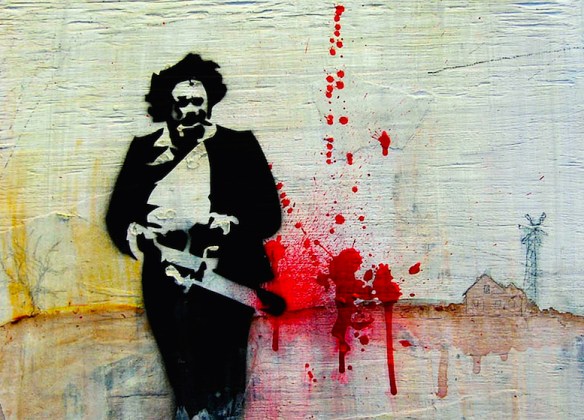
Steven cites too many splatter movies to cover in this review, but central to his thesis is the seminal 1974 Tobe Hooper film, The Texas Chain Saw Massacre. The death of local industry leads Leatherface and family to keep their slaughterhouse traditions alive by carving up and eating young people. These young people, Steven is quick to point out, are only here at all because they were unable to get gas for their car (thanks to the first of two 1970s oil crises). American decline is everywhere; betrayal by global economic forces are central to the trap that’s being laid by the cannibals. (Of course, the carnage of the Vietnam War can’t be overlooked here either, given the visual language of ambush, capture, and torture; Hooper himself has cited this in subsequent interviews.) Steven notes that the victims in The Texas Chain Saw Massacre are representative of a bourgeoisie who don’t know how the sausage is made. It’s important and vital, Steven says, that the cannibalistic side of splatter involves the bourgeoisie being forced to eat members of their own class. It’s Burroughs’s famous “naked lunch“: “the frozen moment when everyone sees what is at the end of every fork.”

As the neoliberal takeover of the world economy begins in earnest in the 1980s, as complex and largely ephemeral systems of mass media and finance take the place of the visceral, grinding monomania of industrial capitalism, splatter horror follows suit. Steven’s analysis of David Cronenberg’s Videodrome (1983) is especially sharp, examining the links between the body horror of the film and the Deleuzian body without organs. Max Renn’s body becomes an endlessly modular media node, able to accommodate video cassettes, to generate and fuse with phallic weapons (used to assassinate and destroy the media forces who’ve made him this way), to mesh and mold and mix with the hard plastic edges of media technology. By the end of the film, Renn is a weapon reprogrammed and re-trained on the very media-industrial complex that made him. More body horror: the cult classic Society (1989) and its shocking conclusion posits the ruling class as a cancerous monster, an amorphous leviathan straight out of a Gilded Age political cartoon, eating and fucking and vomiting, red in tooth and claw and pseudopod. Barriers between bodies break down; the system begins swallowing up all alternate possibilities.

By the time the Cold War is finished, the era of post-9/11 eternal war, of Abu Ghraib and Guantanamo, led to the popular new splatter sub-genre of “torture porn.” Steven identifies the genre’s distinguishing aesthetic feature: the indisputable, systematic, and worldwide victory of capitalism and the hypnotic Spectacle that accompanies it. In this era, there are no longer any alternatives. Everyone, rich and poor, is trapped in the system, and the system reintegrates torture into a worldwide video spectacle. This is embodied in both the global conspiracies of the wealthy in Roth’s Hostel series and in the Jigsaw Killer’s industrially-themed Rube Goldberg devices in the Saw franchise—devices of dismemberment explicitly linked to moral quandaries reminiscent of capitalism’s impossible everyday Hobson’s choices for the working class. The system will go on consuming you, whether you’re unlucky enough to be a splatter film’s victim, or “lucky” enough to wield the power to splatter (for example, Hostel: Part II‘s reversal of fate on the ultra-wealthy hunters, or the Jigsaw Killer’s death from cancer in Saw III—ultimately due to… a lack of health insurance).

Possibly the most intriguing aspect of this already very good book is Steven’s interspersing of personal anecdotes on when and where he discovered some of his favorite horror and genre films. By placing his personal and psychological experience of splatter films front and center, and linking it to his personal growth and increasing political maturity, he demonstrates the personal impact of the political, and the necessity of personal epiphany, mediated by culture, to achieve political awareness. Splatter Capital ultimately is not a book for the already-convinced and committed leftist, the Marxian thinker already well-versed in theory. (Another of Splatter Capital‘s very strong points is how Steven largely eschews jargon and obscurantism for an approachable tone and topic that laypeople can dive into easily.) It is for the fans of these films who’ve always wondered about the ineluctable appeal of visceral, shocking violence on screen, and perhaps why it all feels so strangely familiar.

George W. Bush and Barack Obama: Kings of Pain

Giggling Mass-Murderers

By Cindy Sheehan

Source: Cindy Sheehan’s Soapbox

The facts don’t lie.

Under the regimes of George W. Bush and Barack Obama, millions of civilians in places such as Iraq, Afghanistan, Libya, Syria, and Yemen have been slaughtered, wounded, displaced and made desperately ill with the effects of toxins such as depleted uranium: the “gift” that never ends, literally—it has a half-life of 4.5 billion years.

Now, “because Trump,” the image of George W. Bush has been rehabilitated and (if one can believe polls) now enjoys a 59% approval rating. He left office with ratings in the mid-20’s, which I thought were far too generous, at the time.

Since the imperial agenda of W. Bush murdered my son in Iraq on April 04, 2004, my personal grief has expanded to become global in nature and I can’t stomach any of this Bush-lite just because he has been critical of someone with whom his family has personal issues. Remember when Trump humiliated Jeb? Jeb, whom I believe was the next crown prince of the Bush Crime Family?

This is not a defense of Trump. I am sure given one or two full-terms, his regime will equal that of his predecessors in gore and pain, but he has a way to go if he wants to catch up with them. I also know, that when his term ends, whenever that is, whichever presidents are still alive will laugh it up with him, no matter what political points they seem to be scoring today.
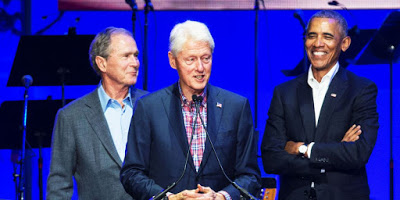
Recently, when The Five Former Presidents™ were on their “hurricane relief” tour (god help those poor people who have already been through so much), Bill Clinton was speaking with George and Barack standing behind him. George Bush apparently said something that “cracked” up Barack Obama. Of course, whenever one killer is making another laugh, the joke is usually on us. However, what disheartens me, is how many are raving about those two mass-murderers giggling just like 7th graders at a school assembly when so many are suffering because of their allegiance to empire.
Of course, the presidencies of Carter, Bush Sr. (perv and self-pro-claimed, “David Cop-a-Feel”) and Clinton (W. Bush destroyed Iraq, but Clinton “softened” it up with regular bombing raids and a decade of crippling sanctions that killed around 2 million) were blood-soaked, but Obama and W. Bush seem to radiate a certain kind of sleazy vibrancy.

To see these killers who have caused so much lingering pain have so much delightful fun (at taxpayer’s expense, by the way), is heartrending.

Even when I am at my happiest with my grandchildren and I feel my heart is filled with joy, it isn’t, quite. There is always a black hole of anguish that can never be filled. At any moment, without warning, I can be plunged back into despair, but, hey, at least The Five Former Presidents™ are still able to yuck it up and garner millions for speeches and public appearances. Who am I to deny all these war criminals a renewed lease on life?

They are not good humans and they ALL (yes even Carter) deserve to be incarcerated for life at The Hague, never to bother anyone again. Just because they all left office unfettered by shackles doesn’t mean they should be able to live long lives of peace and profit.

The people of the United States need to be deprogrammed from their cultish devotion to these mass-murderers: Absent incarceration in The Hague, they should be shunned and ridiculed at every opportunity.

I intend to make it my life’s work to hold them accountable.

The Informant Cometh

By James Howard Kunstler

Source: Kunstler.com

When you consider all the shadowy creatures scuttling around the backstage interstices of the Deep State, it’s a little wondrous that someone like this hasn’t stepped into the light before. Apparently now, a person whose name will soon be plastered across the pixel-verse, has been given clearance by the Justice Department to come forth and sing to the various house and senate committees about a fishy deal involving Russia and the Clinton dynasty.

The broad outlines of Uranium-Gate are already loaded like a platter of nachos grandes with piquant tidbits of suspicious detail. The informant worked for a DC Swamp lobbying firm that was hired by Tenex, a subsidiary of the Russian government-owned company Rosatom, to grease the skids for a deal to buy a Canadian company, Uranium One, which had substantial mining operations in the USA. According to The Hill website, the deal put about 20 percent of US uranium into the hands of the Russian company.

The informant recognized evidence of criminal behavior in the dealings he witnessed and voluntarily went to the FBI with it. The Hill report goes on:

     His work helped the Justice Department secure convictions against Russia’s top commercial nuclear executive in the United States, a Russian financier in New Jersey, and the head of a U.S. uranium trucking company in what prosecutors said was a long-running racketeering scheme involving bribery, kickbacks, extortion and money laundering.

Those charges, based on evidence gathered in 2009, were not taken to court until 2014. And that was supposed to be the end of it.

Now, it also happens that the deal for Tenex to buy Uranium One had to be approved by nine federal agencies and signed off on by Secretary of State Hillary Clinton, which she did shortly after her husband Bill Clinton was paid $500,000 to give a speech in Moscow sponsored by a Russian bank. The Clinton Foundation also received millions of dollars in “charitable” donations from parties with an interest in the Tenex / Uranium One deal. It happened, too, that the CEO of Uranium One at the time of the Tenex sale, Frank Guistra, was one of eleven board members of the Clinton Foundation.

The informant remained undercover for the FBI for five years. None of the Clinton involvement was included in the previously mentioned federal bribery and racketeering prosecutions. Meanwhile, the informant had signed a nondisclosure agreement with the Obama Justice Department, only just lifted last week.

As of this morning, the story is absent from The New York Times, formerly the nation’s newspaper of record. The FBI’s credibility is at stake in this case. Robert Mueller, who was Director of the agency during the Tenex /Uranium One deal, with all its Clintonian-Russian undertones is in the peculiar position now as special prosecutor for the Russian election “meddling” alleged to involve President Trump. Whatever that investigation has turned up is not known publicly yet, but the massive leaking from government employees that turned the story into roughly 80 percent of mainstream legacy news coverage the past year, has ceased — either because Mueller has imposed Draconian restraints on his own staff, or because there is nothing there.

The FBI has a lot to answer for in overlooking the Clinton connection to the Uranium One deal. The informant, soon to be attached to a name and a face, is coming in from the cold, to the warm, wainscoted chambers of the house and senate committees. I wonder if Mr. Trump, or his lawyers, will find grounds to attempt to dismiss Special Prosecutor Mueller, given what looks like Mueller’s compromised position vis-à-vis Trump’s election opponent, HRC. It’s hard to not see this thing going a long way — at the same time that financial markets and geopolitical matters are heading south. Keep your hats on.

What Did Hillary Clinton Know?

By Robert Parry

Source: Consortium News

The revelation that Hillary Clinton’s campaign and the Democratic National Committee helped pay for the notorious “Steele Dossier” of hearsay claims about Donald Trump’s relations with Russia is not surprising but is noteworthy given how long the mystery about the funding was allowed to linger.

Another mild surprise is that the Clinton campaign would have had a direct hand in the financing rather than maintaining an arm’s length relationship to the dossier by having some “friend of the campaign” make the payments and giving Clinton more deniability.

Instead, the campaign appears to have relied on its lawyer, Marc E. Elias of Perkins Coie, and a confidentiality agreement to provide some insulation between Clinton and the dossier’s startling claims which presumably helped inform Clinton’s charge in the final presidential debate that Trump was Russian President Vladimir Putin’s “puppet.” Indeed, how much Clinton personally knew about the dossier and its financing remains an intriguing question for investigators.

Ultimately, the facts about who commissioned the dossier were forced out by a congressional Republican subpoena seeking the bank records of Fusion GPS, the opposition research firm that hired former British intelligence operative Christopher Steele to compile the opposition research, known as “oppo,” against Trump.

As part of the legal wrangling over that subpoena, the Clinton/DNC law firm, Perkins Coie, wrote a letter releasing Fusion GPS from its confidentiality agreement.

After that letter, The Washington Post reported on Tuesday night that the Clinton campaign and the DNC had helped fund the Steele effort with attorney Elias retaining Fusion GPS in April 2016 and with Fusion GPS then hiring Steele.

The Post reported that “people familiar with the matter” disclosed that outline of the arrangement but still would not divulge how much the Clinton campaign and the DNC paid to Fusion GPS. One source told me that the total amount came to about $1 million.

‘Trash for Cash’

An irony about Hillary Clinton’s role in funding allegations about Trump’s connection to the Russians, including claims that he cavorted with prostitutes in a five-star Moscow hotel while Russian intelligence operatives secretly filmed him, is that the Clinton camp bristled when Bill Clinton was the subject of Republican “oppo” that surfaced salacious charges against him. The Clintons dismissed such accusations as “cash for trash.”

Nevertheless, just as conspiratorial accusations about the Clintons gave rise to the Whitewater investigation and a rash of other alleged “scandals,” which bedeviled Bill Clinton’s presidency, the Steele Dossier provided a map that investigators have followed for the ongoing Russia-gate investigation into President Trump.

Much like those Clinton allegations, Steele’s accusations have had a dubious track record for accuracy, with U.S. government investigators unable to corroborate some key claims but, I’m told, believing that some are true nonetheless.

In the 1990s, even though the core allegations of wrongdoing about the Clintons and their Whitewater land deal collapsed, the drawn-out investigation eventually unearthed Bill Clinton’s sexual relationship with White House intern Monica Lewinsky and led to his impeachment in the House although he was acquitted in a Senate trial.

Some Democrats have openly hoped for the impeachment of President Trump, too, and they have hitched many of those hopes to the Russia-gate bandwagon.

There is also no doubt about the significance of the Steele Dossier in spurring the Russia-gate scandal forward.

When Rep. Adam Schiff, the ranking Democratic member of the House Intelligence Committee, offered what amounted to a prosecutor’s opening statement in March, his seamless 15-minute narrative of the Trump campaign’s alleged collaboration with Russia followed the trail blazed by Steele, who had worked for Britain’s MI-6 in Russia and tapped into ex-colleagues and unnamed sources inside Russia, including supposedly leadership figures in the Kremlin.

Steele’s Methods

Since Steele could not reenter Russia himself, he based his reports on multiple hearsay from these anonymous Russians who claim to have heard some information from their government contacts before passing it on to Steele’s associates who then gave it to Steele who compiled this mix of rumors and alleged inside dope into “raw” intelligence reports.

Besides the anonymous sourcing and the sources’ financial incentives to dig up dirt, Steele’s reports had other problems, including the inability of FBI investigators to confirm key elements, such as the claim that several years ago Russian intelligence operatives secretly videotaped Trump having prostitutes urinate on him while he lay in the same bed at Moscow’s Ritz-Carlton used by President Obama and First Lady Michelle Obama.

That tantalizing tidbit was included in Steele’s opening report to his new clients, dated June 20, 2016. Apparently, it proved irresistible in whetting the appetite of Clinton insiders. Also in that first report were the basic outlines of Russia-gate.

But Steele’s June report also reflected the telephone-tag aspects of these allegations: “Speaking to a trusted compatriot in June 2016 sources A and B, a senior Russian Foreign Ministry figure and a former top level Russian intelligence officer still active inside the Kremlin respectively, the Russian authorities had been cultivating and supporting US Republican presidential candidate, Donald TRUMP for a least 5 years.

“Source B asserted that the TRUMP operation was both supported and directed by Russian President Vladimir PUTIN. Its aim was to sow discord and disunity both within the US itself, but more especially within the Transatlantic alliance which was viewed as inimical to Russia’s interests. … In terms of specifics, Source A confided that the Kremlin had been feeding TRUMP and his team valuable intelligence on his opponents, including Democratic presidential candidate Hillary CLINTON, for several years. …

“The Kremlin’s cultivation operation on TRUMP also had comprised offering him various lucrative real estate development business deals in Russia, especially in relation to the ongoing 2018 World Cup soccer tournament. However, so far, for reasons unknown, TRUMP had not taken up any of these.”

Besides the anonymous and hearsay quality of the allegations, there are obvious logical problems, especially the point that five years before the 2016 campaign, virtually no one would have thought that Trump had any chance of becoming President of the United States.

There also may have been a more mundane reason why Trump’s hotel deal fell through. A source familiar with those negotiations told me that Trump had hoped to get a half interest in the $2 billion project but that Russian-Israeli investor Mikhail Fridman, a founder of Russia’s Alfa Bank, balked because Trump was unwilling to commit a significant investment beyond the branding value of the Trump name.

Yet, one would assume that if the supposedly all-powerful Putin wanted to give a $1 billion or so payoff to his golden boy, Donald Trump, whom Putin anticipated would become President in five years, the deal would have happened, but it didn’t.

Despite the dubious quality of Steele’s second- and third-hand information, the June 2016 report appears to have impressed Team Clinton. And once the bait was taken, Steele continued to produce his conspiracy-laden reports, totaling at least 17 through Dec. 13, 2016.

Framing the Investigation

The reports not only captivated the Clinton political operatives but influenced the assessments of President Obama’s appointees in the U.S. intelligence community regarding alleged Russian “meddling” in the presidential election.

Still, a careful analysis of Steele’s reports would have discovered not only apparent factual inaccuracies, such as putting Trump lawyer Michael Cohen at a meeting with a Russian official in Prague (when Cohen says he’s never been to Prague), but also the sort of broad conspiracy-mongering that the mainstream U.S. news media usually loves to ridicule.

For instance, Steele’s reports pin a range of U.S. political attitudes on Russian manipulation rather than the notion that Americans can reach reasonable conclusions on their own. In one report dated Sept. 14, 2016, Steele claimed that an unnamed senior official in Putin’s Presidential Administration (or PA) explained how Putin used the alleged Russian influence operation to generate opposition to Obama’s Pacific trade deals.

Steele wrote that Putin’s intention was “pushing candidate CLINTON away from President OBAMA’s policies. The best example of this was that both candidates [Clinton and Trump] now openly opposed the draft trade agreements, TPP and TTIP, which were assessed by Moscow as detrimental to Russian interests.”

In other words, the Russians supposedly intervened in the U.S. presidential campaign to turn the leading candidates against Obama’s trade deals. But how credible is that? Are we to believe that American politicians – running the gamut from Senators Bernie Sanders and Elizabeth Warren through former Secretary of State Hillary Clinton to President Donald Trump – have all been tricked by the Kremlin to oppose those controversial trade deals, which are also broadly unpopular with the American people who are sick and tired of trade agreements that cost them jobs?

Of course, the disclosure that the Clinton campaign and the DNC help pay for Steele’s opposition research doesn’t necessarily discredit the information, but it does suggest a possible financial incentive for Steele and his collaborators to sex-up the reports to keep Clinton’s camp coming back for more.


Investigative reporter Robert Parry broke many of the Iran-Contra stories for The Associated Press and Newsweek in the 1980s. You can buy his latest book, America’s Stolen Narrative, either in print here or as an e-book (from Amazonand barnesandnoble.com).