Weaponized Hyperreality: Social Engineering Through Corporate State Propaganda and Religion

2789bbece2d59ed130d9d0ee1aeea307

By Luther Blissett and J. F. Sebastian of Arkesoul

Perhaps no philosophical concept more aptly describes the current cultural milieu than hyperreality, characterized by wikipedia as “an inability of consciousness to distinguish reality from a simulation of reality, especially in technologically advanced postmodern societies.” The predominance of hyperreality comes at a time when people in power have never had more to conceal, distort and distract the population from while there’s never been more people who have more means and motives to stay distracted. This is evident in many aspects of contemporary life from corporate news narratives shaped by sponsors and “official sources”, increasingly absurd denials of the true state of the economy from (mis)leaders, widespread dependence on pharmaceuticals worsened by direct-to-consumer advertising and a sham drug war, fanatical worship of celebrities, to slavish acquiescence to fads and fashion. But most obvious is the increasing amount of time spent in front of screens whether for work, shopping, social media, education, self-expression, games, web content, or the exponentially growing volume of video entertainment. Though video games and web series are catching up, the primary narrative formats for cultural expression and transmission today are still television and film.

Struggling to retain their cultural/economic status in the face of increased competition while appeasing shareholders of their monolithic multinational corporate owners, large film and television studios are increasingly risk averse. This is glaringly apparent in the output of major studios which are for the most part the media equivalent of comfort food; familiar (formulaic), satisfying (crowd pleasing), full of empty calories (lacking intellectual/emotional complexity or challenging ideas) and generally bland in terms of content and presentation. On television this is commonly displayed through clichéd tropes, characters and situations while films are now more than ever driven by CGI enhanced spectacle. Both rely on repeating what has worked in the past and (for viewers of a certain age) appealing to nostalgia while pandering to current cultural trends.

Of course such strategies overlap, as there’s more than a few television programs that offer Hollywood style spectacle and big budget movies which imitate successful formulas in the form of adaptations, sequels, prequels, reboots, spin-offs, and mockbusters. In fact the majority of Hollywood’s summer blockbuster output is now comprised of such derivative and safe content predominantly in the form of fantasy and science fiction films.

The ideological motives and functions of cinema and other pop culture are manifold, but a major one is control and influence of mass audiences. We now know the US government has been doing it at least since the 1950s. According to a Church Committee investigation detailing Operation Mockingbird in 1976:

“The CIA currently maintains a network of several hundred foreign individuals around the world who provide intelligence for the CIA and at times attempt to influence opinion through the use of covert propaganda. These individuals provide the CIA with direct access to a large number of newspapers and periodicals, scores of press services and news agencies, radio and television stations, commercial book publishers, and other foreign media outlets.”

More recently, in 1991 the Task Force Report on Greater CIA Openness revealed the CIA “now has relationships with reporters from every major wire service, newspaper, news weekly, and television network in the nation,” which enables them to “turn some ‘intelligence failure’ stories into ‘intelligence success’ stories, and has contributed to the accuracy of countless others.” It also revealed that the CIA has “persuaded reporters to postpone, change, hold, or even scrap stories that could have adversely affected national security interests…” (Global Research, Lights, Camera… Covert Action: The Deep Politics of Hollywood)

Government influence of culture factories such as Hollywood through covert infiltration or embedded advisors ensures that the end product reflects the values and behaviors they wish to promote (ie. xenophobia, deference to authority, nationalism, parochialism, narcissism, anti-intellectualism, consumerism, rapaciousness, etc). In some cases, most notably Zero Dark Thirty and United 93,  the goal is to cement an official narrative into the collective consciousness. A more sophisticated method of social engineering via Hollywood is predictive programming; presenting through media societal changes to be implemented by leaders in order to gradually condition the public and reduce resistance to such changes.

Manipulation of public sentiment through mass media also makes sense from a purely corporate perspective. Why wouldn’t media owners gear the ideological content of their products to support the systems they benefit from while screening out more critical messages? Occasional subversive content may get past the gatekeepers if it’s immediately profitable (which it sometimes can be if particularly resonant), can be co-opted in some way that serves the status quo, or if the creative minds behind it are particularly lucky, talented, and/or well connected. Regardless, one could argue uncritical media consumption is a form of pacification through distraction and escapism and all corporate media content are a result of calculating the highest return on investment, which more often than not reflects the culture’s most deeply ingrained values and myths.

This is particularly true for fantasy/sci film films, which have become ubiquitous for a number of reasons including cultural tastes of global demographics, aesthetic trends (eg. hyperreal CG effects for evermore spectacular imagery), impact of changing media technology on the economics of production and distribution, growing awareness of the value of properties belonging to rich fictional universes which can be mined by worldbuilding studio screenwriters, and in many cases, resonance with our increasingly dystopian world. Most fundamental is profitability, especially as sfx technology becomes more advanced and affordable, licensing opportunities increase, and film franchises that come with large and passionate built-in fan bases reduce the need for marketing and practically sell themselves.

Many who grow up immersed in geek culture already have a hyperreal relationship with fantasy and science fiction realms which heightens the nostalgia evoked by the stream of multimedia incarnations and product tie-ins (bolstered by cult-like fan communities). Is it any surprise that fans who’ve extrapolated on the “Jedi” concept from the Star Wars films turned it into a religion? The Jedi cosmology (and similar ones from countless sci-fi/fantasy films) are modeled on mysticism, a philosophical framework which could fill a void for spiritually deprived materialist cultures. For many people, comic book fandom is another safe and entertaining way to explore concepts that might otherwise be too “out there” (perhaps especially among those who share an equally strong interest in materialist science). At the same time, because of the influence of marketing, the greater role of technology in society and changing cultural trends, geek culture has become a larger part of mainstream culture. Combined with celebrity worship, the lure of technology (both on-screen and off), and increasingly omnipotent powers of multinational corporations, modern big budget sci-fi/fantasy films represent a confluence of potent socioreligious crosscurrents.

Recent works such as Christopher Knowles’s Our Gods Wear Spandex and Grant Morrison’s Supergods examine to an extent superheroes as modern mythological archetypes. Bill Moyer’s The Power of Myth explored how Joseph Campbell’s theory of the monomyth (or hero’s journey) influenced and shaped the Star Wars films (which itself has influenced myriad blockbusters since). In The Hero With a Thousand Faces, Campbell identified a story template used in almost all pre-modern cultures across the globe which goes something like this:

A reluctant “chosen one” in an ordinary world receives a call to adventure and warning of a danger that must be confronted. With the training and wisdom of a mentor the hero crosses the threshold into the unknown. Companions acquired along the way assist in overcoming a series of challenges and temptations until reaching the depth of their fears and resultant apotheosis or rebirth. This empowers them to achieve their goal and return triumphant to an admiring family/community/nation etc.

It’s not hard to see the attraction of narratives such as this which tap into primal emotional needs and can be found in a wide range of religious narratives such as the lives of Buddha, Christ, Muhammad and Rama among others. It also serves as a metaphor for spiritual/psychological journeys through life.

In a recent post on his Secret Sun blog, Christopher Knowles states “Myths grow out of times of crisis and upheaval, in one way or another. The current vogue for superheroes is a symptom of the powerlessness felt by a populace under assault by the realities of Globalist social engineering, war-making and economic redundancy.” I would add that myths can also be exploited to function as part of a cultural assault to perpetuate Globalist agendas. Authoritarians are all too eager to depict themselves as monomythic demigod saviors and/or those serving them as self-sacrificing rugged individualist heroes fulfilling their grand destinies.

In the same piece, Knowles concludes: “But myths do die. They aren’t immortal. The next war or wars may in fact sweep away the myths of the 20th Century entirely. The wars may send people reaching back to far older myths as civil wars can rekindle the bonfires of identity, sending people back to the myths of ancestors. This has always emerged in times of close conflict, particularly in conflicts seen as struggles against occupying powers.”

If he’s correct, there may be some hope for our culture to reclaim myths as a means of understanding reality rather than serve as a trapdoor to fabricated hyperreality. The problem is that there is a gap that needs “filling in” between reality and hyperreality. One of the many consequences of postmodernism is the complete blurring of the line between what is real and what is not. A sort of apathy has kicked in within the human psyche given that crushing truths, not easily discernable in the past, are all out there in the raw. Religious and scientific truths once held sacred can be easily discarded. Morality is a rare hobby in a generation both cynical and powerless to discern reality. This is as well due to globalism and technology, which serve as hubs for information retrieval that wasn’t readily available. Humanity has developed thicker skin, while at the same time widened the existential void left by a reality that is less and less objectifiable. Opinion makers are everywhere, information is ubiquitous, and the species is obsessed with being entertained while answers are readily manufactured in the shape of capital fetishes, all the while ideology that purportedly made a call for a “better and different” world, such as Marxism and psychoanalysis, has become both a haunting spectre and an empty promise.

In the past these formulae failed. In the future they seem more and more unlikely. Capitalism has adapted itself to revolutionary ideology. It has generated even more power from it, defusing the motivation for change and twisting the definition of revolution, all the while turning such concepts into brands. The irony. There is call for a “new objectivism”, however. A bet for a system reboot, in which categorical truths can be retrieved and argued from. The analogy is this: keeping what works and dismissing what doesn’t. Sounds like a simple and logical plan. The problem is that those who get to define what works and what doesn’t will be the powerful, uncanny minority. This is their game, and we have cynically accepted it. It is the way it is. Unless we can evolve from reality to hyperreality, and from hyperreality back into reality, as a species that learns, adapts, understands how high the stakes really are, and moves forward as a collective that is conscious and responsible of its flaws, it appears we are doomed. Three scenarios: first, the narrative will continue as is: the majority will continue to be repressed, and will perpetually seek escape by the hand that feeds until lost completely in hyperreality. Technology moves forward, religion condenses into inconvenient myth: we completely “plug in”. Then what? Well, you just have to see Her to see into this future. The second, war extinguishes civilization and winds back the evolutionary clock, think Mad Max, until we reach the first scenario, as if in a loop. The third and most bleak, nuclear war. The species ends.

What we learn from this exercise is that we are at the apex. This is it. The crushing truth of existence is firmly on our shoulders. War is unravelling. An ever-shrinking number of brands dominate the world. And an even smaller number of people call the shots. In between reality and hyperreality there is confusion. There is no longer a basis to discern between the two. We are as it were, lost. We need to fill in this gap. We need to dig deeper than ever before for a reason to dissolve our differences. Somehow the dilemma is set: surrender or die. But the crux of the problem can be overridden if we use the knowledge and tools we have to fight for a better, and more responsible alternative.

Keeping The Portal Open: Erik Davis on TechGnosis and the Blurring “Real” & “Virtual”

51klnRMeb8L

By Michael Garfield

Source: Reality Sandwich

Erik Davis is the author of TechGnosis: Myth, Magic, & Mysticism in the Age of Information (recently reissued by North Atlantic Books with a new afterword).  An investigation into how our transcendental urges play out in the realm of high technology, it is a rare treat – both an exemplary work of scholarship and also a delightful read – a florid, fun, and virtuosic play of language.  Even more impressive is that in our metamorphic times, this book has aged considerably well.  TechGnosis is in ways more relevant today than it was in the rosy dawn of 1998, before The Matrix and the iPhone, Facebook, and Edward Snowden.  We’re living in the future.  Read this book and learn the territory.

Over a glitchy Google Hangout (you can watch both parts on YouTube), Erik and I discussed our culture’s highest hopes and darkest dreams for our collective future, and how they’ve both become more complicated since the turn of the Millennium.

If you imagine browser windows as a kind of portal in between dimensions – if you wonder when the apes and whales will open social media accounts – if you believe that we can find a way to surf the turbulence of our connected century with grace and humor – then read on…

(Thanks to Terra Celeste and Ivan Marko for transcribing this!  This is about one-third of the full conversation.  You can also read the transcript in its raw entirety here.)

Erik: I apologize for our developing-world level of internet connectivity. Here in San Francisco! That’s right, folks, you heard it right: I live in the city of San Francisco, the absolute white hot center of the technological creative mutation, and yet my internet’s kind of crappy.

Michael: Well, you know, San Francisco was where Skynet was headquartered in the last Terminator film, so it may just be that your home is becoming ever-more inimical to human existence.

Erik: And the Federation, too! In a way those were the two models, right? On the one hand, you have the Federation from Star Trek, where it’s a liberal, UN, kind of globalist model – we’re no longer fighting nation states, we’re still human beings, we have desires, we get to drink tea and explore the universe. That sounds pretty cool from a humanist point of view, and yet on the other side we have Skynet, which is of course a whole other ball of wax. In a way, isn’t that it? It’s the struggle between the Federation and Skynet.

Michael:  It’s funny, ‘cause most of what I wanted to talk to you about today was about how your book -– which is a brilliant piece of writing – has aged since 1998. The new volume includes a new afterword from the 2004 edition, as well as a new afterword from the 2015 edition. One of the things that you discuss is the way that the expectation that we had of boundary dissolution and transcendence at the turn of the millennium has become more complex. Now, it’s more of just a general shifting and metamorphosis of the construction of new boundaries. And so, like in the most recent Star Trek films and Terminator films, we now have good Terminators that believe they are people and are willing to donate their heart to the dying members of the human resistance. You know, the actual human heart that these Terminators possess, in order spoof human security systems. And then, in the latest Star Trek film, the threat comes from within the Federation, from a black box military program. Our culture seems to be getting more and more comfortable with these liminal zones and these ethical complexities. Less naïve with respect to that kind of simple dyadic distinction.

Erik: Techgnosis first came out in ’98. I talk a lot about gnosticism in the book and about these ancient Christian heresies about the spark in us that can escape from this prison that’s run by evil demons who are fabricating reality. That ancient model of mysticism and theology just fits like a hand and glove in our digital era. And then the Matrix films come along and I was like, “Oh my God, so beautiful.” It was just a perfect expression, and I wrote about that in the afterword for the 2004 edition. Nowadays a lot of the topics that I wrote about are even more available and perceivable through popular culture because popular culture has gotten weirder, more full of occultism, more intense, even as, in some ways, it’s become more ordinary. A lot of these sort of topics were very fringe in the ’80s or even the ’90s, in the sense that you had to kinda dig for occultism, for Satanism, for people who believed that they were channeling deities. All this stuff was part of a subculture, an outsider culture. Whether we believed it or not doesn’t matter. In a way, it’s not that there are necessarily more people who believe in these things. It’s just that they’re more available, because of the way that popular culture introduces these ideas. We become fans of shows. Fantasy and science fiction have become the norm.

Michael:  I’m sure you remember when James Cameron’s Avatar came out, and the Avatar world immediately took off within the LARPing community. And so you started to see this foreshadowing of a new dysphrenia, a psychological disorder of the possible fragmentation of worldspaces that we seem kind of doomed to experience with the advent of the true landing of virtual reality. These people were so just morose and desperate because they became so immersed in the Pandora world that they couldn’t readjust to their life as human beings. It’s sort of akin to my generation’s wave of acid burnouts, maybe. As we invest more and more of ourselves into this increasingly popular and available and sexy because it’s not just animated by our religious impulses, but it’s actively being advertised, and commercialized and sold to us. We’re really being encouraged to throw ourselves into these alternative worldspaces. And then there isn’t a landing pad for when we get back. So I feel like one of the lasting lessons of your book, one of the reasons that I feel its resonance remains, is because it allows a person to integrate those experiences. In a way, it functions as a manual for understanding our drives and the larger emotional matrix in which we play with new freedoms to explore occult realities.

Erik: That’s very well said, actually, because in conventional society, even very recently, these things have largely been shuttered out. My generation grew up in the shadow of the hippies, and those things were around, but they were very much part of the counterculture. They were either mocked or ignored in the New York Times reality, which is still kind of a good symbol for consensus reality. I’m not even sure if we have a consensus reality anymore, or if it’s not some crazy topological knot, but in the old days, it had a little bit more stability to it, and you would never see these things acknowledged. Or if they were, they were pathologized – it was crazy, it was absurd, it was narcissistic and navel-gazing. This was true for a whole range of things – meditation, esotericism, UFOs, psychedelics, the whole range of extraordinary experience that people wanted to seek and experience.

As someone who basically keeps my feet on the ground, I’m largely skeptical in temperament. I’m very anthropological in my approach, which means I like to go into environments and participate as I observe, that classic stance of participant-observation. And what’s come from that is a realization that you can plunge very deeply into very interesting, rich otherworlds that are full of magic and enchantment and bizarre synchronicities and wonderful downloads, but at the same time you can also trust the ability to return to the body, to the ordinary, to the conditions of human experience in an everyday way, and that those don’t have to be in conflict so much.

I think that these experiences are not only really valuable, but they’re absolutely necessary to understand what’s actually happening. Whether people acknowledge it or not, a lot of the time we are driven by desires to be in dreamworlds, to achieve unusual-states-of-consciousness, to find them inside ourselves and see the way that they’re driving us. There’s a strong kind of rationalist technologized way of thinking about experience that’s very pervasive now, that’s actually carried like a philosophical virus through the widespread notions of tweaking and controlling your experience, of making yourself more efficient or powerful. So for me it’s really important to keep portals open to the unknown, to the mystery, to the bizarre, because it’s precisely in those encounters that we see beyond the rationalistic frame, which often is, in my opinion, benighted. Instead, we can adopt a more open-ended, but not necessarily mystical, attitude to the whole range of otherworldly experiences.

Michael: There’s a through-line here in one of the last chapters of Coming into Being: Artifacts and Texts in the Evolution of Consciousness by William Irwin Thompson, someone whom I know that has inspired us both immensely. That books last chapter a chapter is about how the Ramayana tells how humans and animals allied to expel the demons from what we now take as take as mundane, everyday reality. Bill Thompson’s view was that the Electrical Imaginary descending back into our networked global civilization is opening a portal, and that the screen is literally a shamanic window through which these spirits are granted fresh access to our world. And then in your latest afterword you talk about how the irony of these ultra-hyper-realist-skeptic-atheist-revenge-of-the-enlightenment types is that you can’t actually create a complete model of the mundane world. You can’t perfectly map the enlightened cosmos without getting into all of the weird stuff, the out-of-body experiences, the UFO abductions. These things have to be explained in order to cast out all of the shadows, but the naïve attempt to cast them out is really just an invocation. It’s like the topological knot you mentioned earlier, where merely addressing them makes them a more vivid part of our reality.

Erik: Absolutely. I think that that’s part of the deeper logic behind the renaissance of psychedelics. In many ways, “psychedelics” as a topic is a key site in understanding how modern technological scientific people recover, rediscover, and repackage, if you will, these kinds of liminal states and otherworldly encounters, with their potential sources of meaning and spiritual experiences. I also think that one of the reasons we have seen such an incredible renaissance emerge so quickly is because it was an inevitable part of scientific logic. Science has to take the brain seriously, it has to take the experiences in the brain seriously. Psychedelics are clearly physical, material agents that produce somewhat regular phenomenological effects. We have to understand that if we’re going to understand the brain. Any reasonable scientist is going to say that. And, whoa, lo and behold, it actually seems to do some good. So the genie is out of the bottle, and the genie doesn’t mean that we’re going to return to some kind of mystical worldview. I don’t believe we are. I think we’re in a state of tremendous mixing, of a multidimensional view where we have to learn how to move between different kinds of frameworks, including occult and animist frameworks, including mystical or religious frameworks, but also including secular, critical, analytic frameworks – scientific in that classic sense as well. How to do that I don’t know. But I do know that it’s a multidimensional field and I think that that’s why we see this turn towards the very multidimensional psychedelics.

Michael: Yeah, definitely. That is, in the sense of the original articulation of TechGnosis. You’ve got that chapter, “The Path is a Network”. There is something about the way the network allows for this manifold, multifaceted appraisal of reality, that really breeds and encourages and nourishes multiperspectivism. And so, in a way, I think the inherently psychedelic nature of our age, and what’s become really just like much more imminently and vividly obvious and easy to spot about the mainstream culture in general, is that we don’t all agree. It’s a much deeper revelation of the same kind of cultural relativism that we started to experience through the global interchange and commerce a couple hundred years ago, but now it’s to the point where culture has splintered to such an extraordinary degree due to the fact that everyone at the dinner table is occupying their own iPhone reality portal, that the main yoga of at least the first half of the twentieth century seems to be the psychedelic yoga, of being able to take our ontological conclusions lightly, and to be able to juggle them and to adopt them when they’re appropriate but to treat them with the kind of middle-way balance of skepticism and sympathy that you have modeled for your readers.

Erik: Yeah, that’s a really important thing for me. Also, itIt also plays an important role in a lot of the stuff that we haven’t been talking about, which is the dark side of the tale. Probably my proudest thing about TechGnosis is that it first came out in 1998, so the book was written during the first internet bubble. This was the time when a truly millennialist set of ideas were held by many people working in technology, the new rules of the economy of abundance. That kind of utopian thinking.was partly legitimately believed. I knew a lot of these people, I was kinda part of that world, of people who were imagining the potential of virtual reality, of new kinds of political formations, people drawn together in new forms of community, etc. At the same time those ideas were also ruthlessly exploited by capitalist forces, which created essentially a kind of ponzi scheme of IPOs. And so, the sense that something new and different was actually happening was simultaneously exploited.

When I was writing TechGnosis, it would have been easy for someone to write a much more happy, fluffy vision of the connections between spirituality and technology. “Here we are, just around the corner, just about to break through!” But for me, that sense of transformation was always accompanied by a shadow. If you open the portal and you accept the existence of these half-fantastic beings, there are demons there as well. In our future visions now we feel the presence apocalyptic energies. There’s the sense of mass breakdown, of ecological collapse, or the rise of a fascist surveillance state. On some intimate level we know that every time we’re using a device we’re moving through a shadow realm where we don’t know what sorts of agents – entities, algorithms, human beings – are perceiving and making meaning out of our operations. That is an unnerving, uncanny situation, and it’s one that we have to live with.

We have to acknowledge that we do have these fears and terrors, and apocalyptic presumptions inside of us, inside our imaginations, inside our hearts, inside our stories, inside our cultural traditions. And so we have to be very careful about where and how we mix the apocalyptic templates that we carry in our imaginations with the actual real conditions that we find ourselves in. It’s very tricky, but I suspect it takes that same sort of balance of skepticism and sympathy into the shadow realm as well as the utopian, or at least poetic possibility. And in a lot of ways I feel that’s where we’re at. That’s part of why I do what I do, is to try to kind of map that ginger, open, but questioning space, because it seems like one of the places to try to navigate these very difficult issues.

Michael: So many people worship the idea of the return to nature, or Terence McKenna’s idea of an archaic revival, this sort of forward-escape atavism where we go all the way around and end up back where we started, transformed. But we’re also naïve to the lived reality of not being on the top of the food chain, and that’s absolutely part of this that comes back, it can’t be divorced from the rest of it. We long for the community of the tribal life that we left behind, for the openness, the permeability of the self that we experience. The last experiment of civilization was profoundly dissociative, isolated, and lonely, and as consequence, we have a totally pathological relationship to the natural world. But in restoring that, in the humility of science recognizing its ultimate ignorance, we move back into an age where we’re no longer able to kid ourselves quite so successfully about the dragons that we have swept under the map. They’re still there, and they’re in a way even more alive for us now.

In your interview with Vice, you said a god is just a fiction that everyone believes in. So in a way – and this is kind of Information Warfare 101 – even if the NSA did not have supercomputers inside that Utah data complex, the fact that they built it, and that it can be observed on Google Maps, holds this profound power over the human imagination, and so we’re all having to catch up really quickly to these magical concepts. Even if they’re not clothed in the language and trappings of magical traditions, we’re being reacquainted with the power of the symbol and the power of ritual, and the sway that an idea has over the population when it becomes harder and harder to verify things beyond the shadow of a doubt.

Erik: You could call it conspiracy thinking, although that gets defined in all sorts of ways, some of which I think are themselves forms of mind-gaming. Either way, we’re in a realm of mind-games, where perception is reality, and where the crafting of perception takes place on multiple levels through multiple agendas. Multiple agents are crafting reality in a more and more overt way, even as we’re technically learning to craft subjective experience more and more. Here we’re getting into the edge of Virtual Reality 2.0.  I think that, again, familiarity with these occult or even animist liminal zones will help us navigate through the jungle that we’re in. I mean, I can totally understand why people want to drop out of this thing. Like, fully drop out – whether into criminal underworlds, into darknet trafficking, or whether they go off the grid, or try to monkey-wrench the show. Those desires makes a lot of sense to me. It’s not who I am, it’s not where I am, but I can resonate with that. So, as long as I’m still participating in this network world that we’re sharing, that we’re fabricating, that the machines are fabricating, that we’re sharing with the machines, we have to develop that kind of light step.

You also mentioned a sense of the larger ecological framework that we’re in. As we look at what’s happening with technology, as we try to understand what’s happening with communication and human civilization, it’s impossible to extricate it from this larger ecological condition of crisis and no-going-back. It really feels like what we’re being asked to do, ethically and imaginatively, is to extend our ability to sympathize, to engage with, and even just to leave a space open for that which is outside of us, outside of the human frame, outside of the human story. That Outside may be technology, in the sense of the algorithmic intelligences that are already beginning to swamp our world, as well as the complex institutions and networks that are distributing these things. But that Outside also supports a more ecological and even cosmic view. We’re on a planet, the planet’s changing rapidly, spinning in space. All of those larger views, I think, are what we’re called upon to connect with.

I think one of my greater fears or concerns – I mean, I have so many, but just talking specifically about technology, and how people use it – is that it’s very easy to stay within a kind of human narcissistic world through media, especially social media, and the internet. I see people putting their energy into virtual or technological information circuitry, getting absorbed into a mass-cybernetic web of media, with its transmission of human stories and human perceptions and human egos and identification and projection. The whole game is so absorbing, so seductive, so fascinating, so enervating, that it can drown out our ability to wrestle with the non-human – whether it’s technology, geology, animals, capital flows. We need to become better post-humans, not narcissistic post-humans seeking our pleasure buttons, figuring out the best way to design some kind of crazy experience. That’s great, it’s part of the whole picture, but we have to also really think about what does it mean to live in a profoundly interwoven cosmos that necessarily draws us out of our narrow human egoic frame.

Michael: I totally agree. So, in light of that, I’m really fascinated by what you might have to say on recent developments on the interspecies internet – have you heard much about this? There was a TED talk about it a year or two ago.

Erik: I think I know what you mean. Why don’t you set it up?

Michael: A couple of years ago, Vint Cerf, Peter Gabriel, and a couple other people – dolphin researchers, bonobo researchers, and technologists – came forward at a TED conference to launch the idea that we can get into the sensorium of other animals and understand the way they experience things well enough to create computer interfaces for them that perform something like “Babel Fish” or Google Translate, so that we can communicate – whether it’s through music, symbols, or something else – with some of these other animals that we know have high intelligence and a sense of self.

I was really excited about being a part of this in some way, just throwing my bid into this process, and then I started thinking about how it got more complex. Because, what’s really going on here is that we can scarcely recognize a world beyond ourselves without immediately attempting to colonize it with our technological bid for control. To reference George Dvorsky of io9, there’s something really beautiful in his fascination with animal uplift, and his vision of our ethical responsibility to involve non-human species in the fate of the planet – which is currently being decided by human parliamentary action. The dolphins should get a vote. The gorillas should get a vote. And the only way that they can get a vote is to involve them in the technological infrastructure that we’re creating that is allows us the hope and the opportunity for that Star Trek world government. At the same time, it enfolds them into our own personal and transpersonal nightmare that we just discussed, and ultimately they may not want to participate in our uniquely human breed of insanity.

Erik: Yeah, that’s very well put. You know, we keep stumbling onto this Faustian bargain. It increasingly seems to describe these kinds of situations. There are people who believe that we can design a good enough system where, even despite its flaws, we’re drawing in others to decisions about the best and most ethical thing to do. And at the same time you’re going to have people who are just, like, gagging in their throats.  It’s like, after all of the violence we have exerted on the animal world, to do this is the final, most nihilistic violence – to draw them into this madness! And you could have the same discussion about the desire to colonize planets. How could we not get excited about the idea of human beings on Mars or even robots landing on asteroids? It’s just totally fascinating and wonderful, and yet it’s pretty easy to see what that would look like as an industry, and the kinds of problems that would arise in the way that seems stitched into the nature of human beings. Sometime you can almost be Christian about it. It’s a kind of original sin, a way of, like, always fighting and competing and outmaneuvering and exploiting and trying to create elites. All these things that civilization has been doing since the get-go, since we stepped outside of the Paleolithic life and made a pact with writing and social organization, with pyramidical structures. It’s an old, old, old pact, and it’s deeply religious. Our religion is fundamentally bound up with the mythology of the state.

And so, where I stumble now is…where is the state? Is it everywhere? Is it nowhere? Are we at a point where that whole relationship is shifting? Is it worth extending hope into these things, or is it reasonable to say, “Look, we just keep doing the same horrible thing over and over again, so let’s just tear it down.”

Getting back to the specific question about animals, though. I really buy that radical democratic notion in a lot of ways. Turning to the Outside, whether it’s animals or elements of technology or geological forces, is part of what democracy means. Part of the constitution in Ecuador recognizes the rights of nature. Not just nature, but “Pachamama” – and, as people who are interested in medicine work and indigenous worldviews know, Pachamama is a goddess. It’s a way of understanding and relating to the fecund, beneficent giving quality of the earth, in a spiritual light, or a personhood light, or an animist light, whatever you want to call it. And that’s part of the constitution, part of a legal document. The thinking behind that document is, “Look, it’s just extending the idea of rights, which is a modern construct. The notion of inalienable rights emerges at a certain point in Western history, it gets installed into governmental and legal forms. Initially it’s just for white men with property, then it’s just for men, then women get it, then people of color, whatever – you have this spreading of the notion of rights, so that now we are called upon to spread it into the environment as well.” Very tricky, very complicated, very confusing. What does it mean, to give nature a voice? Is “nature”, or Pachamama, even the right word? And at the same time, that seems like a very vital and significant mutation in the operating system of the state. You’ve got to factor in these others, even though exactly how that happens is so difficult to understand. So again, here we go! Plunging into the Faustian bargain!

Michael: It’s very much related to a book that I feel stands in a fun balance with yours. It came out this last year by Christian Schwägerl. It’s called The Anthropocene, and if you haven’t read it I highly recommend the read (editor’s note: Shwägerl has a number of excerpts published on Reality Sandwich). It ignores the mystical dimensions of things. Schwägerl lives in Berlin, and he’s very much operating from a secular, European Union, modern global ecological sensibility.  But the whole idea of his book is that the last remaining wild places are, in a sense, artifacts, because they only exist due to the determination of the human hand to preserve them. That there is no real wilderness anymore on our planet, at least in the natural world. Everything is indoors, and we have to find a way to first recognize that the so-called “Human Age” is actually tilting us into this much more profound, complex, and difficult relationship with the non-human world.

But we do have to find a way to express that world in our own language and our own systems – for example, by honoring what he calls “ecosystem services” in our economy, not factoring out that the water cycle, the carbon cycle, and all of these supporting systems that have an order of magnitude greater economic value than anything we’re trading on the stock market. They must be preserved at literally all costs. But he is ethically divided by the question, “Do we have to talk about the rainforest in terms of its monetary value in order to save it?”

Erik: That’s the crux. I’m glad you brought up this topic of wilderness, because I think it’s a good way to reflect on one of the problems we face. On the one hand, we have the wild – what the wild represents, what it means to be wild, what it means to stumble across the wild in your life, We are talking the unknown, the mystery, the chaos, a kind of Dionysian encounter, an intensity that takes you beyond reason, whether it’s experienced in a natural environment or in your head, or in the city. There’s something about wildness that’s profound to human beings. It has a lot to do with what people seek when they’re spiritual seekers, when they’re religious, when they are plumbing the depths. When people question the autonomy or imperial demands of reason, it’s often in the name of some kind of wild – whether it’s the sacred or the archaic or the nonhuman.

At the same time, you can sit down and go, “But this whole idea of wilderness, of natural wilderness, well, it’s a construct, it’s part of the European imagination, and that imagination is over. It’s not doing anyone any good anymore.” Some very serious environmentalists will argue that ideas of wilderness or even “nature” are actually in the way. The argument is that the religious and spiritual ideas about nature that were such an important part of twentieth century environmentalism actually get in the way of the process of introducing these non-human factors into the system in a way that would actually force the system to recognize and negotiate with them, rather than pretending in this abstract, insidious way that they don’t exist. And I don’t know what to do with that tension between these two “wildernesses”. All I know is that it’s incredibly vital in whatever way that we keep a portal open to the wild.

In that sense I’m very different than rationalist people who think we just need to introduce everything into the system – that it has to be drawn into the logic of capital, it has to be commodified, it has to be seen.  That the way to deal with pollution is to create carbon debt and to introduce it into the financial system. But that solution is a house of cards. I have a slightly, perhaps darker view that whatever tumult lies ahead, whatever sorts of forms of chaos we confront, whether they’re through a highly developed technological society that manages to keep things going, or whether society is forced to reorganize in the face of a major hiccups and breakdowns, whatever the thing is, the more that we are actually able to handle the wild, the chaos, the unknown, the mystery, the others, the whispers on the edge of our vision, the better we’ll be able to actually navigate that situation on an individual and a cultural level. There is a problem with the rational, reasonable, incorporate-everything logic, with its call to squeeze everything for its monetary value, to quantify everything, to quantify the self. All of that may be fine and well, but only as long as it keeps a space open for those kinds of encounters, for that kind of imagination, for that kind of risk and vulnerability.

But that’s often what doesn’t happen. So, in a way, my work, not just in TechGnosis, but in all the writing and conversations that I’ve done and continue to do is about riding these edges. I just want to keep those portals open, to keep the spaces open, so that people don’t feel like they have to be fools in order to engage these broader ways of seeing the world. That’s why it’s really important to keep those portals, those edges open.


Read more by Erik Davis here.

Read more by Michael Garfield here.

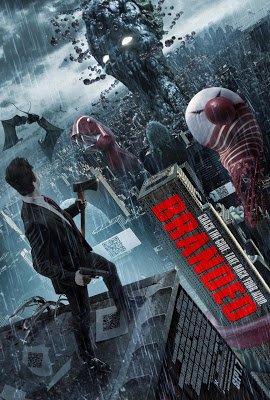
Saturday Matinee: Branded

Branded_US_film_poster

Branded (2012) is a Russian-US sci-fi parable written and directed by Jamie Bradshaw and Aleksandr Dulerayn. Much of the story is told in flashbacks documenting the rise, fall and rebirth of top-level advertising executive Misha (Ed Stoppard, son of playwright Tom Stoppard). Upon being scapegoated for a marketing disaster, Misha withdraws to the countryside where in a trance state he’s compelled to perform a bizarre ritual. Shortly after, he finds he has a unique ability to “see” strange parasitic creatures which are the embodiment of corporate influence. Horrified, Misha sets out to destroy the creatures of his visions, a quest which could ultimately liberate society but at the expense of his personal and professional life. Though the film is hindered by uneven tonal shifts and occasionally stilted performances, Branded is notable for its relevant social critique which mixes elements of Putney Swope, They Live  and novels of Philip K. Dick.

Saturday Matinee: Wave Twisters

index

“Wave Twisters” (2001) is a mindbending homage to hip-hop culture set to the music of DJ Q-Bert. Using a mix of live-action, CG and cel animation, it tells the story of a heroic team who confronts an army of anti-hip-hop oppressors with the help of a powerful weapon known at the Wave Twister. Buckethead, D-Styles and Flare also contribute to the excellent soundtrack.

Little Murders in Retrospect

LittleMurders_blood2

By John R. Hall

Source: Dissident Voice

After their wildly successful anti-war classic Mash, actors Elliott Gould and Donald Sutherland ventured out on a very weak limb and made a film version of a hit and miss Broadway production.  Alan Arkin directed the film and played the part of mentally disturbed Lieutenant Practice of the NYPD.  The year was 1971.  My beautiful baby daughter had just entered the world.  I’d recently been convicted of twice refusing induction into the U.S. Army, and was awaiting my court date for sentencing.  Somehow, amid the mix of joy, sadness, and confusion, my wife and I managed to slip out and take in a movie.  Little Murders would haunt me for the rest of my life.

If you’re like virtually everyone I’ve ever quizzed about Little Murders, you not only missed seeing it, you’ve never even heard of it.  It is also likely that, if you happen to be among the few who actually saw it, you’d really like to forget it.  But, of course, you can’t.  44 years later I don’t remember all the gory details of the flick, but I do remember apathetic Alfred Chamberlain (Elliott Gould), focusing his camera on a newly deposited bowel movement in a toilet, and on a steaming pile of dog crap in a park.  He was a photographer and poop was his forte.  His subject matter of choice also reflected his world view.  If Alfred could have possibly cared less about anything, he would have.  Alfred’s world was shit.

Then one day while he was being beaten to a bloody pulp by street thugs, and not even bothering to defend himself, Alfred was saved by feisty, optimistic Patsy Newquist (Marcia Rodd).  Apathist that he was, Alfred tried to walk away without even thanking his heroine.  But Patsy fell for him, and decided to show him that the world wasn’t such a bad place after all.  It was no easy task, but she eventually married Alfred, put a hesitant smile on his glum face, taught him to fight for himself,  and convinced him that life was worth living.  Then she took a random bullet, splattering her husband with blood, and dying.

Little Murders took place in a somewhat exaggerated version of New York City, or Anytown, U.S.A.  Civil society had spiraled out of control and degenerated into a cesspool of fear, loathing, and random violence.  In spite of the raging nightmare of The Vietnam War, few Americans in 1971 would have believed that their country 44 years later would become such an accurate replica of the social wasteland of “Little Murders”.  But that is exactly where we are today, and then some; living in a world so violent and cold that there is nothing left which can shock us.  Mass murders, school shootings, infanticide, beheadings, immolation, cops run amok, manufactured terrorism, the Airport Gestapo, black sites and torture, endless wars for corporate profit, daily specter of nuclear annihilation.

But here in the U.S.A. we like to look on the bright side.  No sense in focusing on the negative when there’s so much positive energy in the world.  We’ve got Kim Kardashian’s ass to obsess about.  A spectacular spectators’ array of gladiator sports:  NFL, NBA, MLB, NHL, NCAA FB, Cage Fighting, NASCAR, Pro golf & tennis.  Black Friday deals on electronics, reality television, celebrity weddings, divorces, and sex changes, Dancing with the Stars, The Voice.  The upcoming Presidential Coronation Circus and Candy Crush.  Did I mention Kim Kardashian’s ass?  Thank God for Pollyanna’s Glad Game.  If not for such an array of inane, petty distractions, Americans would all end up like apathetic Alfred Chamberlain, or worse yet like angry, infuriated me.

Any American with his head screwed on straight should have suffered an extended and incurable case of righteous indignation by now.  While the National Rifle Association has succeeded in enshrining The Second Amendment alongside mom, home, and apple pie, little murders on the domestic front have been on the rise to the point that they’re as common as bedbugs in cheap motels.  But my countrymen do love their portable WMDs, apparently more than life itself.  It’s not just gun violence defining the nightmare which is America.  What has finally emerged is a complete lack of respect.  Respect for self and others, for all life forms, for Mother Earth itself.  Anyone paying attention can see it in their actions.  They litter the streets with their garbage, litter their skin with ill-conceived epidermal etchings, litter their bodies with poisonous food-like substances and soul-killing drugs, litter maternity wards with litters of unwanted children.  Alfred Chamberlain’s world has grown to fruition.

Of course, Americans have had plenty of inspiration as they’ve sacrificed their souls upon the alter of American Exceptionalism.  Their government has waged a nearly non-stop series of wars for corporate profit since Vietnam, Laos, and Cambodia.  Anyone paying a lick of attention knows that every one of these wars were waged for the benefit of Ronald McDonald and Mickey Mouse, and that official government explanations are only believed by fools.  At least our heroes in the White House, the Halls of Congress, and the Pentagon learned something during the Vietnam fiasco:  The new definition of winning a war is that you slaughter as many civilians as possible, bomb cities, destroy infrastructure, burn crops, and create enough chaos that the U.S. Military is forced to open permanent bases and swing wide the doors for corporate plunder.  Conveniently under armed protection.

This is exactly what happened in Afghanistan and Iraq, what went on in Libya recently, and what is now happening in Syria and elsewhere.  The American agenda is being rammed down the throats of unwilling participants wherever there are valuable resources to be plundered by Wall Street pirates.  Migrations of refugees from U.S. bombings seek asylum elsewhere, while foolish, careless Americans pay little heed.  A few hoorays for the red, white, and blue, thanks to our brave fighting men for slaughtering innocent foreigners, and back to watching Kim Kardashian’s ass over a can of Coca-Cola.  Things go better with Coke.

In 1971, I was shocked by the last scene of Little Murders, in which Alfred (still wearing his shirt splattered with his wife’s blood), and the father and brother of his recently deceased bride finally have a few moments of sheer joy.  Taking turns with a loaded rifle, they join in with their fellow New York citizens, becoming snipers from their apartment window,  Finding fun and laughter with each kill.  I’d no longer be shocked by the scene.  Now I get it.  It’s what species do in the final death throes of extinction.


Related Articles

“One of Those Little Things You Learn to Live with”:  On the Politics of Violence in Jules Feiffer’s Little Murders

Saturday Matinee: Little Murders

Saturday Matinee: Children of Men

Children_of_men_ver4Today marks the birthday of Alfonso Cuarón, director of such notable films as Y Tu Mamá También, Gravity, and The Shock Doctrine short documentary. In my view, his greatest achievement is the dystopian classic Children of Men (2005), an adaptation of P.D. James’s 1992 novel. For those who have not yet seen it, an HD version is available here:

http://www.disclose.tv/action/viewvideo/145534/Children_of_Men/

Note: Streaming seems to run smoother when viewed in full-screen mode.

Saturday Matinee: Ms. 45

yeDpzSxdRvu5WhgOpjbLVmTtvTs

Synopsis by Danny Peary from “Cult Movies 2”:

Thana works as a seamstress in New York’s garment district. She is friends with Laurie and two other female coworkers, but lives a lonely existence in a small apartment in Clinton Gardens. She doesn’t enjoy her job because her boss Albert always is yelling at his female employees or is acting patronizingly toward her. Each day the four women must march past men who line the streets and fling obscene remarks at them. Laurie protests vehemently, but Thana must remain silent because she is a mute.

Returning from work one night, Thana is raped in an alley. She stumbles into her apartment. It is being robbed. The thief rapes her. She grabs her iron and smacks him on the head. She kills him and places him in the bathtub. The next day, she cuts his body up into little pieces, which she places in bags. She puts the bags in the refrigerator and gets rid of them one by one throughout New York. The newspapers begin reporting the discovery of parts of an unknown body. When a man retrieves one of Thana’s bags and without examining the contents goes after her to return it, Thana runs away. He catches up to her in an alley. She turns and fires the gun she took off the dead rapist. The man falls dead. Thana has trouble concentrating. At home, her nosy landlady and her yapping runt of a dog, Phil, get on her nerves. She gives Phil some of the rapist’s body to eat. At work, her boss complains that she’s not making her best effort. He wants her to come to the office’s costume party. She tells him she’ll let him know. The four seamstresses eat lunch at a hamburger joint. A man and woman neck nearby. When the woman leaves, the cocky man tries to flirt with the four women. Laurie tells him “Fuck off” and he backs away. But when Thana is alone, he coaxes her to come back to his beautiful studio. As soon as they enter what turns out to be a cheap studio, Thana shoots and kills him. At night, Thana dresses like a hooker and goes out. She kills a pimp who is beating a prostitute. She goes into Central Park. Gang members surround her as she wanted them to. She shoots them all down. A sheik picks her up. She kills him and his chauffeur. She meets an unhappy man. Her gun misfires. He places it against his own head and kills himself.

Thana continues to dispose of parts of the rapist’s body. She gets annoyed at Phil’s barking and sniffing and takes him for a walk. She ties him to a post near the East River.

Thana goes to the costume party. The landlady enters her apartment and finds a head. She calls the police. Thana wears a nun’s habit, boots, and much lipstick. Albert flirts with her. When he crawls under her habit, he spots the .45 in her corset. She kills him. Thana begins to shoot all the men at the party. Laurie stops her by fatally stabbing her in the back. Thana screams, the only time anyone has heard her utter a sound. She points her gun at Laurie, who backs up in terror. But Thana does not wish to harm her.

The landlady mourns for her missing dog. But Phil is not dead. He runs up the stairs and scratches at the door.

I caught up with Ms. 45 about a year after its release, when it had received fine reviews, and a few months after it played briefly as a Midnight Movie. It was second-billed to Amin: The Rise and Fall (1982) at a sleazy 42nd Street theater, not far from the garment district where Thana is employed. For the uninitiated: the legendary 42nd Street theaters, in which so many film fanatics grew up, have so deteriorated that with the exception of diehard movie buffs the only people who dare enter the darkness are pimps, pushers, alcoholics, addicts, and assorted degenerates who want to get off their feet or elude the police for a couple of hours. In the non-porno theaters, the fare of the day is bloody horror, kung fu, and sex and strong violence pictures because with such a dangerous clientele (almost exclusively men sitting alone), theater owners know better than to risk showing a dull film. (Hermann Hesse adaptations never play 42nd Street.) When not yelling at each other, the men excitedly talk back to the screen, cheering brutality (as was the case with Amin) and, misogynists all, directing lewd comments at every female character. Predictably, when Thana is being raped at the beginning of Ms. 45, an unsympathetic soul cackled: “How does it feel, baby?” I would guess that the feminists who attacked this film — some feminist critics voiced support — were angry with the male filmmakers for subjecting Thana to rape, not once but twice, and filming these scenes in such a way, with a gun in the frame, that violent men would want to identify with the rapist. But something fascinating happens. Once these men identify with the rapist, the filmmakers have Thana conk him on the head with an iron and kill him. Then she chops him up into little slabs and stores his parts in the refrigerator. Unexpectedly, the men who had whooped all through Amin and the obscenely gory previews of Dr. Butcher (1982), whimpered worrisomely “Oh, my God” and slumped in their seats and shut up. Never has a 42nd Street theater been so quiet and disciplined as when Thana went through her rounds and murdered every offensive male who crossed her path. Had the men in this audience witnessed their own possible fates if they continued to relate to women as they did? Certainly they could all identify with the foul-mouthed men Thana and her female coworkers must pass between each day in the garment district as if they were walking the gauntlet; could they also see themselves as the pimps, gang members, and pickup artists that Thana does in? The criminal element could enjoy such grotesqueries as The Last House on the Left (1973), in which two teen-age girls are kidnapped and tortured, and Maniac (1981), in which a psychopath scalps his female victims, but Ms. 45‘s director Abel Ferrara and screenwriter Nicholas St. John didn’t want to satisfy the sick men in the audience — they wanted to chastise them for being so revolting toward women and to scare them off. In an early scene, Thana starts to unbutton her blouse. Experts of exploitation films expect her to unbutton it all the way, look at her nude image in the mirror for a while, and then take a shower so men can get an eyeful. At the 42nd Street theater I could sense the anticipation. But just as Thana is about to disrobe, an imaginary hand shoots under her blouse, accompanied by a frightening blast of music, and the rapist’s cadaver suddenly appears behind her. It is a shocking scene — Thana stops disrobing — and has a strange effect on the audience: the men worry that if she starts to strip again, they will end up being scared again; consequently, they’d rather have Thana keep on her clothes and do without nudity. So in a way, Ms. 45 works as an odd form of therapy.

In a recent interview, Ferrara told me that “There was no conscious decision not to have nudity in the film. Zoë Tamerlis was willing to do it. It was just a flash decision to not have it. We were aiming at a cold sexuality, a violent tone. Roman Polanski is an influence on all my work.” While Ferrara points to Polanski’s Macbeth (1971) as the film which most influenced the tone of his first two films, Driller Killer (1379) and Ms. 45, the plot and thematic elements of Ms. 45 seem patterned after Polanski’s Repulsion (1965).

Catherine Deneuve is another beautiful, sexually confused young woman. While Thana works in a subordinate position as a seamstress, Deneuve is a beautician’s aide. Both suffer sexual harassment going to and coming from work. Both kill men who force themselves on them sexually. While corpses rot in their apartments, both continue to go to work for a time, both lapse into a temporary shock state while at work, both begin missing work. Like most Polanski characters, Deneuve and Thana both are subjected to meddling neighbors (and their dogs) that intrude on their privacy and their thinking — in Driller Killer, the maniac finally goes off the deep end when a loud punk-rock group moves into his building. The two women become increasingly isolated, but they go in different directions: Deneuve becomes paranoid and kills all men who come after her in her apartment; Thana breaks free of her initial paranoia and goes out into the city after men before they have the chance to come after her. Deneuve goes crazy — but Thana, though acting “crazy,” remains rational: she does not kill her lesbian friend Laurie, who has fatally stabbed her, and she does not kill her batty landlady’s dog Phil, despite how much he annoys her. “The public had a lot of trouble with the character,” says Ferrara. “Thana isn’t clearly defined. At times I think her sympathetic, and at other times, fascistic. It shook up people to see an innocent person like themselves suddenly become a wanton murderer.” Since many people loved the vigilante-justice character played by Charles Bronson in Death Wish (1974) — which professes that it’s okay to kill scum — it’s a relief that these exploitation filmmakers created a vigilante who, despite having sympathetic motivation for her actions, scares the living daylights out of all of us.

The mute Thana represents all the women of the world who don’t speak out against the daily outrages they are subjected to from men (bosses, boyfriends, strangers): a constant barrage of come-ons, orders, insults, patronizing conversation. “I just wish they would leave me alone,” she writes, but she hasn’t the nerve or the capacity to tell men to “Fuck off” like the brave Laurie. She is the passive female — her job is sewing — who kills a man with an iron, symbol of the stereotypical unliberated woman, signifying that woman’s passivity is not insurmountable. She picks up the rapist’s gun (obviously a phallic symbol) — she will use their weapon to destroy them. Thana, who had been the epitome of the desperate, faceless lone woman in New York, now becomes an angel of vengeance (Angel of Vengeance was the film’s foreign title as distributed by Warner Bros.). As she methodically, savagely, and silently avenges her abuse, she becomes far more intriguing than other cinema women who have retaliated for their own rapes: Raquel Welch in Hannie Calder (1971) and Margaux Hemingway in Lipstick (1976), to name just two. Ferrara credits Tamerlis, then a seventeen-year-old with an otherworldly resemblance to Nastassia Kinski, Simone Simon, and Bianca Jagger, for “giving the character more complexity than there was in the script. Zoë herself is complex.” And a fine actress, who, Ferrara says, is trying to make it in California after acting in films in Italy[*]. Thana never speaks, but Tamerlis gives her remarkable presence. Considering that she was a high school student who hadn’t been in films previously, she is extremely composed. I’m surprised no studio scout has taken an interest in her, because as we can see when she dresses up in a nun’s habit with heavy makeup, high boots, and her .45 stuck in her garter, she has astounding sex appeal.

What really distinguishes Ms. 45, in addition to Tamerlis’s fine performance, is the gifted direction by Abel Ferrara. Foremost, the picture is highly stylized. Witness the bizarre costume party massacre scene filmed in slow motion; it is truly surrealistic. Ferrara often uses a wide-angle lens to good effect (“I like using the wide angle when I film on location”); particularly impressive is the scene in which the guy chases Thana down the alley and runs toward the camera, which distorts his image at the precise moment Thana’s bullet smashes him in the skull and sends him reeling over backward. I also like the scene in which Thana studies herself in the mirror and keeps pretending to shoot in different directions: it is downright eerie seeing her dressed in the habit, wearing lipstick, and acting like a cowboy or Belmondo’s gangster in Breathless (1961) (as he drives along and aims his finger and makes shooting noises) while Ferrara uses slow motion and adds a sproingy noise on the soundtrack. I’m also impressed by the way Ferrara incorporates his music. He uses horns and drums, not just a synthesizer, which is utilized in many low-budget films. Thus the music adds to the feel of the film (and the New York City locales), i.e, the pulsating, heartbeat music before Thana shoots the photographer in his heart; the sleazy music (sax riffs) when Thana dresses like a hooker to go hunting for pimps and gang members; the blaring sound as Thana does away with the sheik and his chauffeur.

Ferrara inserts much humor into his morbid storyline. I also got a kick out of all Ferrara’s weird characters. Of landlady Editta Sherman, The New York Times wrote, “There hasn’t been a screen performance so hair-raising since Frances Faye played a madam in Pretty Baby (1978).” (In typical exploitation film fashion, the blurb the filmmakers attributed to the Times about the film as a whole was “Hair-raising!”) The landlady’s a great movie character, who wears a hat over long stringy gray hair and keeps pictures of both her husband and dog Phil on her mantel. All the other characters are memorable as well. Since this film was made by men, it’s amazing that every male character (including Phil) is obnoxious. Even when we only get to hear them say one or two lines, we can deduce their awful personalities: one partygoer talks about paying three hundred dollars to screw a virgin; another tells his girl he’s changed his mind about having a vasectomy. Put these men together in the world’s power elite with boss Albert (who’s always yelling at his seamstresses or putting the make on Thana), the conceited photographer (who smooches with his girl, then flirts with Thana the moment she leaves), the gang members, the sheik, the rapists, and the rude men who line the streets, and what’s a girl to do?

Saturday Matinee: The Internet’s Own Boy

internetsownboyEditor’s Note: Tomorrow marks the birthday of Aaron Swartz. Had the government not driven him to an early death he would have been 29.

Synopsis by TakePart.com

The Internet’s Own Boy follows the story of programming prodigy and information activist Aaron Swartz. From Swartz’s help in the development of the basic internet protocol RSS to his co-founding of Reddit, his fingerprints are all over the internet. But it was Swartz’s groundbreaking work in social justice and political organizing combined with his aggressive approach to information access that ensnared him in a two-year legal nightmare. It was a battle that ended with the taking of his own life at the age of 26. Aaron’s story touched a nerve with people far beyond the online communities in which he was a celebrity. This film is a personal story about what we lose when we are tone deaf about technology and its relationship to our civil liberties.