As you may have figured out by now, Hillary Clinton, warped by her own self aggrandizement of entitlement, did Tulsi Gabbard and her Presidential campaign against interventionist wars a huge incidental favor.
While the Democrats continue to splinter and spiral out of control on the eve of what promises to be a transformative national election, the Grand Inquisitor seized an opportunity to allege that Gabbard (and Jill Stein) are “Russian assets” and “Putin puppets”.
Since Tulsi is a Major in the US Army Reserves and holds the highest security clearance available, the term ‘asset,’ which is associated with being an agent of a foreign power, carries a level of national security significance.
Believing herself untouchable and immune from any genuine criticism or objective analysis after having successfully evaded prosecution from the nation’s top law enforcement agencies, HRC went off the deep end dragging the Democratic party further into the ditch.
She is a favorite of the Russians. That’s assuming that Jill Stein will give it up which she might not because she is also a Russian asset.”
Clinton’s historic pronouncement came in the mistaken belief that publicly humiliating Gabbard would intimidate the Aloha Girl to silence and seek refuge on her surfboard – but that is not how it has played out.
An unexpected bonus proved once again that political strategy has never been Clinton’s strong suit as her malicious comments have brought the anti-war alt left with the libertarian alt-right together in Gabbard’s defense. With HRC’s injudicious taunts, the glimmer of an emerging political realignment, one that has been at odds with both the Dem and Republican establishments, has surfaced – probably not exactly what HRC intended.
In response to having received a burst of unprecedented support, Gabbard is about to assure her place on the November debate stage and continues to solidify her credibility as a critic of a corrupt bipartisan political establishment and its endless wars.
If they falsely portray me as a traitor, they can do it to anyone. Don’t be afraid. Join me in speaking truth to power to take back the Democrat Party and country from the corrupt elite.”
It is noteworthy that HRCs accusation was to the only candidate who stands in direct opposition to the Queen Bee’s history for the war machine and all of its bells and whistles. As if to call attention to the contradiction, the entire fiasco has acknowledged what was never meant to be acknowledged: that one little known Congresswoman from Hawaii would dare to publicly confront the omnipotent HRC with her own demons and malfeasance; thereby elevating the one candidacy that represents a threat to the military industrial complex and its globalist order.
It is no coincidence that the corporate media operates in lockstep as an offensive October 12th NY Times article was immediately followed by a CNN commentary as well as other media sycophants, all tagging Gabbard as a Russian asset.
Contrary to Journalism 101 on how professional media should conduct themselves, there has been no evidence, no facts, no supporting documentation as they characteristically rely on innuendo and disinformation.
At the last Dem debate and during the kerfuffle with Clinton, Tulsi has stepped up and showed herself to be a candidate the country has been waiting for. With a powerful inner grit, she did not hesitate to take the Times and CNN publicly to task and then in response called HRC out as a warmonger and dared her to enter the 2020 fray.
There lies a deep truth within Gabbard’s response especially identifying Clinton as the “personification of the rot that has sickened the Democratic Party.”
During Clinton’s term as Secretary of State which is little more than a Glorified Global Hustler for the US military industrial complex, the Democratic Party lost its soul, morphing as nefarious neocons in pursuit of raw political and economic power that emanates from a policy of unfettered regime change and interventionist wars.
As Democrats embraced the neocons with no objection to the unrestrained violence, increased military budgets, indiscriminate selling of weapons to bomb a civilian population, then why should the party’s grassroots object to the Tuesday morning assassination list or drone attacks on civilians or creating war in four countries living in peace in 2008?
As the party faithful allow themselves to dismiss all the suffering, the death and destruction wrought by US-made weapons as if Amazon and Google toys were an acceptable trade, they lost their conscience and their connection to the basic essence of humanity’s need for peace, love and compassion.
The latest example of the Party’s devotion to war is their opposition to the withdrawal of US troops from Syria as they created the phony debate that the Kurds were worth more American blood or resources. The Dems have always been more pro-war than they have been given credit for with WWI, WWII, the Korean War and Vietnam all initiated and/or expanded under Democrat Presidents.
With no substantiation from the mindless meanderings of a seriously disoriented woman, it is now clear that Clinton’s derangement syndrome of unresolved guilt and denial led the Democratic party to its irrational embrace of Russiagate as the justification for her 2016 loss.
In other words, it was Russiagate that protected HRC’s fragile self-esteem from the necessary introspection as Americans were pitted against one another, dividing the nation in a deliberate disruption of civil society in a more acrimonious manner than any time since the 1860’s. The country has paid a bitter, unnecessary price for a divisive strategy due to Clinton’s refusal to personally accept responsibility for her own failings.
HRC’s most egregious war crimes as Secretary of State include assigning Victoria Nuland to conduct the overthrow of a democratically elected President in Ukraine in 2014 and the ensuing violence and civil war in the Donbass as well as her joyous rapture cackling at the death of Libyan President Qaddafi in 2011. The now infamous video “We came, we saw, he died” showed her to be more than just your average war criminal but a Monster who experiences an aberrant thrill at death and destruction.
Since June, TPTB have done their darnedest to deny Tulsi a spot on the debate stage rigging the qualifying requirements as best they could. Making it near impossible for the polling firms, which rely on campaign season and their economic connection with the DNC to call the shots in a fair and equitable manner.
As the early primary states loom ahead, the last thing TPTB need is a powerful pro-peace voice resonating with the American public. The message seems clear: talk of peace is verboten and equates with being a Russia asset and anyone with pacifist tendencies will be publicly chastised and condemned for being a tool of the Kremlin.
None of that has stopped Tulsi Gabbard.
Renee Parsons has been a member of the ACLU’s Florida State Board of Directors and president of the ACLU Treasure Coast Chapter. She has been an elected public official in Colorado, an environmental lobbyist with Friends of the Earth and staff member of the US House of Representatives in Washington DC. She can be found on Twitter @reneedove31
This is a chart of an informal kleptocracy which cloaks itself in the faux finery of democracy and a (rigged) “market” economy.
Back in the day, nations that didn’t qualify as either developed (First World) or developing (Second World) were by default Third World, impoverished, corrupt and what we now refer to as failed states–governments that were incapable of improving the lives of their people and the machinery of governance, generally as a result of corruption and self-serving elites, i.e. kleptocracies.
Is the U.S. slipping into Third World status? While many scoff at the very question, others citing the rise of homelessness, entrenched pockets of abject poverty and the decaying state of infrastructure might nod “yes.”
These are not uniquely Third World problems, they’re symptoms of a status quo that’s fast losing First World capabilities. What characterizes Third World/Failing States isn’t just poverty, crumbling infrastructure and endemic corruption; at a systems level these are the key dynamics in Third World/Failing States:
1. The status quo protects insiders at the expense of everyone else.
2. There is no real accountability; failure has no consequences, bureaucrats are never fired for incompetence, reforms are watered down or neutered by institutional sclerosis.
3. Pay-to-play is the most cost-effective way to influence policy or evade consequences.
4. The status quo is incapable of differentiating between complexity that serves the legitimate purposes of transparency and accountability and complexity that serves no purpose beyond guaranteeing insiders’ paper-shuffling jobs. As a consequence, complexity that adds no value chokes the economy and the government.
5. There are two sets of laws: one for insiders and the super-wealthy, and another harsher set for everyone else.
6. The super-wealthy fear nothing because the system functions to serve their interests.
7. The super-wealthy and state insiders control the media’s narratives and the machinery of governance to serve their interests. Reforms are in name only; the faces of elected officials change but nothing changes structurally.
8. Insiders, well-paid pundits and the technocrats serving the corporate and state elites believe the status quo is just fine because they’re doing fine; they are blind to the soaring inequality, systemic corruption, stupendous waste and the impossibility of real reform.
Does America’s status quo protect insiders at the expense of everyone else? Yes. As for the other seven characteristics: yes, yes, yes, yes, yes, yes and yes.
And lets’ not forget #9: the vast majority of the economic gains flow to the elite at the very top of the wealth-power pyramid: is this true in the U.S.? Definitively yes. Just look at this chart: this is a chart of an informal kleptocracy which cloaks itself in the faux finery of democracy and a (rigged) “market” economy.
That’s the very definition of a Third World failed state.
The corporate revolution will collapse if we refuse to buy what they are selling – their ideas, their version of history, their wars, their weapons, their notion of inevitability.
– Arundhati Roy
Last week, Hillary Clinton called Tulsi Gabbard (and Jill Stein) Russian assets on a podcast. More specifically:
“I’m not making any predictions, but I think they’ve got their eye on someone who’s currently in the Democratic primary and are grooming her to be the third-party candidate. She’s the favorite of the Russians,” said Clinton, apparently referring to Rep. Gabbard, who’s been accused of receiving support from Russian bots and the Russian news media. “They have a bunch of sites and bots and other ways of supporting her so far.” She added: “That’s assuming Jill Stein will give it up, which she might not because she’s also a Russian asset. Yeah, she’s a Russian asset—I mean, totally. They know they can’t win without a third-party candidate. So I don’t know who it’s going to be, but I will guarantee you they will have a vigorous third-party challenge in the key states that they most needed.”
Tulsi subsequently responded to this slanderous accusation with a series of devastating blows.
Her tweets set off a firestorm, and even if you’re as disillusioned by presidential politics as myself, you couldn’t help but cheer wildly that someone with a major political platform finally stated without any hint of fear or hesitation exactly what so many Americans across the ideological spectrum feel.
Of course, this has far wider implications than a high profile feud between these two. The “let’s blame Russia for Hillary’s loss” epidemic of calculated stupidity driven by Ellen-Democrats and their mouthpieces across corporate mass media began immediately after the election. I know about it on a personal level because this website was an early target of the neoliberal-led new McCarthyism courtesy of a ridiculous and libelous smear in the Washington Post over Thanksgiving weekend 2016 (see: Liberty Blitzkrieg Included on Washington Post Highlighted Hit List of “Russian Propaganda” Websites).
This is when it became clear it wasn’t just political operatives pushing fake news about Russian influence, but that “respected” mass media would be leading the charge for them. The rest is pretty much history. MSNBC, CNN, The Washington Post, etc have been spewing outlandish Russiagate nonsense for three years straight, and despite the complete failure of special counsel Robert Mueller to find any evidence of Trump-Russia collusion, these agents of empire refuse to stop. The whole charade seems more akin to an intelligence operation than journalism, which shouldn’t be surprising given the proliferation of former intelligence agents throughout mass media in the Trump era.
Former CIA Director John Brennan (2013-17) is the latest superspook to be reborn as a TV newsie. He just cashed in at NBC News as a “senior national security and intelligence analyst” and served his first expert views on last Sunday’s edition of Meet the Press. The Brennan acquisition seeks to elevate NBC to spook parity with CNN, which employs former Director of National Intelligence James Clapper and former CIA Director Michael Hayden in a similar capacity. Other, lesser-known national security veterans thrive under TV’s grow lights. Almost too numerous to list, they include Chuck Rosenberg, former acting DEA administrator, chief of staff for FBI Director James B. Comey, and counselor to former FBI Director Robert S. Mueller III; Frank Figliuzzi, former chief of FBI counterintelligence; Juan Zarate, deputy national security adviser under Bush, at NBC; and Fran Townsend, homeland security adviser under Bush, at CBS News. CNN’s bulging roster also includes former FBI agent Asha Rangappa; former FBI agent James Gagliano; Obama’s former deputy national security adviser Tony Blinken; former House Intelligence Committee Chairman Mike Rogers; senior adviser to the National Security Council during the Obama administration Samantha Vinograd; retired CIA operations officer Steven L. Hall; and Philip Mudd, also retired from the CIA.
Americans like to sneer at more transparently unfree societies around the world, but when you think about the disturbing implications of former spooks delivering news to the public, one can’t help but conclude that mass media in 2019 looks like a gigantic propaganda campaign targeting U.S. citizens. Moreover, as can be seen by the recent attacks by Clinton and her allies in the media on Gabbard, they aren’t easing up.
Which brings us to the crux of the issue. Why are they doing this? Why is Clinton, with zero evidence whatsoever, falsely calling a sitting U.S. Congresswoman, a veteran with two tours in Iraq, and someone polling at only 2% in the Democratic primary a “Russian asset.” Why are they so afraid of Tulsi Gabbard?
It’s partly personal. Tulsi was one of only a handful of congressional Democrats to set aside fears of the Clintons and their mafia-like network to endorse Bernie Sanders early in 2016. In fact, she stepped down from her position as vice-chairman of the Democratic National Committee to do so. This is the sort of thing a petty narcissist like Hillary Clinton could never forgive, but it goes further.
Tulsi’s mere presence on stage during recent debates has proven devastating for the Ellen Degeneres wing of the Democratic party. She effectively ended neoliberal darling Kamala Harris’ chances by simply telling the truth about her horrible record, something no one else in the race had the guts to do.
In other words, Tulsi demolished Kamala Harris and put an end to her primary chances by simply telling the truth about her on national television. This is how powerful the truth can be when somebody’s actually willing to stand up and say it. It’s why the agents of empire — in charge of virtually all major institutions — go out of their way to ensure the American public is exposed to as little truth as possible. It’s also why they lie and scream “Russia” instead of debating the actual issues.
But this goes well beyond Tulsi Gabbard. Empire requires constant meddling abroad as well as periodic regime change wars to ensure compliant puppets are firmly in control of any country with any geopolitical significance. The 21st century has been littered with a series of disastrous U.S. interventions abroad, while the country back home continues to descend deeper into a neo-feudal oligarchy with a hunger games style economy. As such, an increasing number of Americans have begun to question the entire premise of imperial foreign policy.
To the agents of empire, dominant throughout mainstream politics, mega corporations, think-tanks and of course mass media, this sort of thought crime is entirely unacceptable. In case you haven’t noticed, empire is a third-rail of U.S. politics. If you dare touch the issue, you’ll be ruthlessly smeared, without any evidence, as a Russian agent or asset. There’s nothing logical about this, but then again there typically isn’t much logic when it comes to psychological operations. They depend on manipulation and triggering specific emotional responses.
There’s a reason people like Hillary Clinton and her minions just yell “Russia” whenever an individual with a platform criticizes empire and endless war. They know they can’t win an argument if they debate the actual issues, so a conscious choice was made to simply avoid debate entirely. As such, they’ve decided to craft and spread a disingenuous narrative in which anyone critical of establishment neocon/neoliberal foreign policy is a Russia asset/agent/bot. This is literally all they’ve got. These people are telling you 2+2=5 and if you don’t accept it, you’re a traitorous, Putin-loving nazi with a pee pee tape. And these same people call themselves “liberal.”
Importantly, it isn’t just a few trollish kooks doing this. It’s being spread by some of the most powerful people and institutions in the country, including of course mass media.
This inane verbal vomit is considered “liberal” news in modern America, a word which has now lost all meaning. Above, we witness a collection of television mannequins questioning the loyalty of a U.S. veteran who continues to serve in both Congress and the national guard simply because she dared call out America’s perpetually failing foreign policy establishment.
To conclude, it’s now clear dissent is only permitted so long as it doesn’t become too popular. By polling at 2% in the primary, it appears Gabbard became too popular, but the truth is she’s just a vessel. What’s really got the agents of empire concerned is we may be on the verge of a tipping point within the broader U.S. population regarding regime change wars and empire. This is why debate needs to be shut down and shut down now. A critical mass of citizens openly questioning establishment foreign policy cannot be permitted. Those on the fence need to be bullied and manipulated into thinking dissent is equivalent to being a traitor. The national security state doesn’t want the public to even think about such topics, let alone debate them.
Ultimately, if you give up your capacity for reason, for free-thought and for the courage to say what you think about issues of national significance, you’ve lost everything. This is what these manipulators want you to do. They want you to shut-up, to listen to the “experts” who destroy everything they touch, and to be a compliant subject as opposed to an active, empowered citizen. The answer to such a tactic is to be more bold, more informed and more ethical. They fear truth and empowered individuals more than anything else. Stand up tall and speak your mind. Pandering to bullies never works.
“What I find [ominous] is how seldom, today, we see the phrase ‘the 22nd century.’ Almost never. Compare this with the frequency with which the 21st century was evoked in popular culture during, say, the 1920s.”
The 2010s are almost over. And it doesn’t quite feel right.
When the end of 2009 came into view, the end of the 2000s felt like a relatively innocuous milestone. The current moment feels so much more, what’s the word?
Ah, yes: dystopian.
Looking back, “dystopia” might have been the watchword of the 2010s. Black Mirror debuted close to the beginning of the decade, and early in its run, it was sometimes critiqued for how over-the-top it all felt. Now, at the end of the decade, it’s regularly critiqued as made obsolete by reality.
And it’s not just prestige TV like Black Mirror reflecting the decade’s mood of incipient collapse. Of the 2010s top 10 highest-grossing films, by my count at least half involve an apocalypse either narrowly averted or, in fact, taking place (I’m looking at you, Avengers movies).
People have reasons to wallow. I get it. The existential threat of climate change alone — and seeing efforts to mitigate it slow down precisely as it becomes more pressing — could fuel whole libraries of dystopian fiction.
Meanwhile, our current tech landscape — the monopolies, the wild spread of disinformation, the sense that your most private data could go public whenever, with no recourse, all the things that risk making Black Mirror feel quaint — truly feels dystopian.
We enjoy watching distant, imaginary dystopias because they distract us from oncoming, real dystopias.
Since no one in a position to actually do something about our dystopian reality seems to be admitting it — no business leaders, politicians or legacy media — it makes sense that you might get catharsis of acknowledgment from pop culture instead. And yet, the most popular end-of-the-world fiction isn’t about actual imminent threats from climate or tech. It’s about Thanos coming to snap half of life out of existence. Or Voldemort threatening to destroy us Muggles.
Maybe that kind of pop culture, which acknowledges dystopia but not the actual threats we currently face, gives us a feeling of control: Sure, Equifax could leak my social security number and face zero consequences, but there are no Hunger Games. Wow — it really could be so much worse! Maybe we enjoy watching distant, imaginary dystopias because they distract us from oncoming, real dystopias.
But let’s look at those actual potential dystopias for a moment and think about what we need to do to avert them.
I’d suggest the big four U.S. tech giants — Amazon, Facebook, Apple, Google — each have a distinct possible dystopia associated with them. If we don’t turn around our current reality, we will likely get all four — after all, for all the antagonistic rhetoric among the giants, they are rather co-dependent. Let’s look at what we might have, ahem, look forward to — unless we demand the tech giants deliver on the utopia they purportedly set out to achieve when their respective founders raised their rounds of millions. I would argue not only that we can, but that we must hold them accountable.
“Mad Max,” or, slowly then all at once: starring Apple
“‘How did you go bankrupt?’ Bill asked. ‘Two ways,’ Mike said. ‘Gradually and then suddenly.’”
—Ernest Hemingway, The Sun Also Rises.
When you think of Mad Max, you probably think of an irradiated, post-apocalyptic desert hellscape. You’re also not thinking of Mad Max.
In the original 1979 film, the apocalypse hasn’t quite yet happened. There’s been a substantial social breakdown, but things are getting worse in slow motion. There are still functioning towns. Our protagonist, Max, is a working-class cop; and while there’s reason to believe a big crash is coming, or has even begun, society is still hanging on. (It’s only in the sequels that we’re well into the post-apocalyptic landscape people are thinking of when they say “Mad Max.”)
A relatively subtle dystopia, where things gradually decline in the background, is also a good day-to-day description of a society overrun by algorithms, even without the attention-grabbing mega-scandals of a Cambridge Analytica or massive data breach. A kind of dystopia “light” — and Apple is its poster child.
After all, Apple has a genuinely better track record than some of the other tech giants on a few key privacy issues. But it’s also genuinely aware of the value of promulgating that vision of itself — and that can lead Apple users into danger.
In January, Apple purchased a multistory billboard outside the Consumer Electronics Show in Las Vegas, with this message: “What happens on your iPhone, stays on your iPhone.” Sounds great — but it’s deeply misleading, and as journalist Mark Wilson noted, Apple’s mismatch between rhetoric and behavior fuels the nightmare that is our current data security crisis:
“[iPhone] contents are encrypted by default […] But that doesn’t stop the 2 million or so apps in the App Store from spying on iPhone users and selling details of their private lives. “Tens of millions of people have data taken from them — and they don’t have the slightest clue,” says [the] founder of [the] cybersecurity firm Guardian […] The Wall Street Journal studied 70 iOS apps […] and found several that were delivering deeply private information, including heart rate and fertility data, to Facebook.” [Emphasis mine.]
A tech giant that is claiming it’s the path to salvation, while effectively creating a trap for those who believe it, sounds ironically familiar given Apple’s famous evocation of Big Brother.
After all, when people talk about habit-forming technology in terms so terrifying they’ve convinced Silicon Valley executives to limit their children’s access to their own products, let’s be real: They’re talking about iPhones.
When academic child psychology researcher Jean Twenge talks about a possible teenage mental health epidemic fueled by social media, we know what’s at the heart of it: She’s talking about iPhones.
All those aforementioned horror stories, and a huge slice of those algorithms you’ve heard so much about, are likely first reaching you on smartphones that, with world market share above 50%, are largely, you guessed it, iPhones. (And none of these stories even mention Apple workers at overseas at facilities like Foxconn who create our iPhones and who really are living in a kind of explicit dystopia.)
What happens on your iPhone almost certainly doesn’t stay on your iPhone. But who created that surveillance capitalism running it all in the first place?
Enter Google.
“Black Mirror:” “Nosedive,” or, welcome to surveillance capitalism: starring Google
“We know where you are. We know where you’ve been. We can more or less know what you’re thinking about.”
You’ve probably heard it before: “if you’re not paying, you’re the product.” This is usually in reference to ostensibly “free” services like Facebook or Gmail. It’s a creepy thought. And, according to Shoshana Zuboff, professor emeritus at Harvard and economic analyst of what she’s termed “surveillance capitalism,” the selling of your personal information undermines autonomy. It’s worse than you being the product: “You are not the product. You are the abandoned carcass.”
Google, according to Zuboff, is the original inventor of Surveillance Capitalism. In their early “Don’t Be Evil” days, the idea of accessing people’s private Google searches and selling them was considered unthinkable. Then Google realized it could use search data for targeting purposes — and never stopped creating opportunities to surveil their users:
“Google’s new methods were prized for their ability to find data that users had opted to keep private and to infer extensive personal information that users did not provide. These operations were designed to bypass user awareness. […]In other words, from the very start Google’s breakthrough depended upon a one-way mirror: surveillance.”
Twenty years later, surveillance capitalism has become so ubiquitous that it’s hard to live in Western society without being surveilled constantly by private actors.
As far as I know, no mass popular culture has really yet captured this reality, but one small metaphor that kind of hits on its effects is a Black Mirror episode called “Nosedive.”
In “Nosedive,” everyday people’s lived experience is very clearly the picked-apart carcass for an entire economic and social order; a kind of surveillance-driven social credit score affects every aspect of your daily life, from customer service to government resources to friendships, all based on your app usage and, most creepily, how other people rate you in the app.
If surveillance capitalism has been the engine powering our economy in the background for nearly two decades, it’s now having a coming-out party. Increasingly, Google isn’t just surveilling us in private — with its “designing smart cities” initiatives, the company will literally be making city management decisions instead of citizens: Sidewalk Labs, a Google sister company, plans to develop “the most innovative district in the entire world” in the Quayside neighborhood of Toronto, and Google itself is planning on siphoning every bit of data about how Quayside residents live and breathe and move via ubiquitous monitoring sensors that will likely inform — for a fee naturally — how other cities will develop.
If surveillance capitalism has been the engine powering our economy in the background for nearly two decades, it’s now having its coming-out party.
Much like Apple, Google takes pains to present itself as a conscientious corporate citizen. They might be paternalistic, or antidemocratic — but they have learned it’s important to their brand that they’re seen as responsive to their workers and the broader public, largely thanks to the courageous and persistent effort of their workers and consumer advocates in civil society.
Not so much with Amazon.
“Elysium,” or, dystopia for some, Prime Day for others: starring Amazon
“[The New York Times] claims that our intentional approach is to create a soulless, dystopian workplace where no fun is had and no laughter heard. Again, I don’t recognize this Amazon and I very much hope you don’t either.” —Jeff Bezos, August 17, 2015 letter to staff after the New York Times investigation into working conditions at the company.
In 2015, Jeff Bezos felt the need to set the record straight: The New York Times was wrong about Amazon. Working there did not feel like a dystopia.
The years since have only validated the New York Times story, which focused on life for coders and executives at Amazon. Notably, when the Times and other investigative journalists have probed life for the far more numerous warehouse workers employed by Amazon, Bezos has largely stayed silent.
In fact, the further down the corporate ladder you get at Amazon, the more likely it seems that Jeff Bezos will stay quiet on any controversy. Just this month, in a report published almost exactly four years after Bezos’ “Amazon is not a dystopia” declaration, the New York Times has uncovered almost a dozen previously unreported deaths allegedly caused by Amazon’s decentralized delivery network. Rather than defend itself out loud, Amazon has kept quiet while repeating the same argument in the courts: Those delivery people aren’t Amazon workers at all, and thus Amazon is not liable.
Amazon, like every major tech giant, has a key role in the dystopia of surveillance capitalism — the monopolylike market share of Amazon Web Services, and Amazon’s involvement in increasingly ubiquitous facial recognition software, represent their own deeply dystopian trends. But the most visible dystopia Amazon creates, for all to see, is dystopia in the workplace.
In many ways, Amazon is the single company that best explains the appeal of an Andrew Yang figure to a certain slice of economically alienated young voters. When speaking near Amazon’s HQ in Seattle, Yang explicitly talked about the surveillance of Amazon workers, and how reliable those jobs are in any case:
“All the Amazon employees [here] are like, ‘Oh shit, is Jeff watching me right now?’… [Amazon will] open up a fulfillment warehouse that employs, let’s call it 20,000 people. How many retail workers worked at the malls that went out of business because of Amazon? [The] greatest thing would be if Jeff Bezos just stood up one day and said, ‘Hey, the truth is we are one of the primary organizations automating away millions of American jobs.’ […] I have friends who work at Amazon and they say point-blank that ‘we are told we are going to be trying to get rid of our own jobs.’”
You can flat-out disagree with Yang’s proposed solutions, but a lot of his appeal stems from the fact that he’s diagnosing a problem that broad swaths of people don’t feel is being talked about. Yang validates his supporters’ concerns that they are, in fact, living in a dystopia of the corporate overlord variety.
In the movie Elysium, most work is done in warehouses, under constant surveillance, with workers creating the very automation systems that surveil and punish them. The movie takes place in a company townlike setting, with no such thing as a class system or social mobility. Meanwhile, the ruling class in Elysium lives in space, having left everyone else behind to work on Earth, a planet now fully ravaged by climate change.
That might sound particularly far-fetched, but given Bezos’ explicit intention to colonize space because “we are in the process of destroying this planet,” it suddenly doesn’t feel so off the mark. And in an era where Governors and Mayors openly genuflect to Amazon, preemptively giving up vast swaths of democratic powers for the mere possibility that Amazon might host an office building there, it’s hard not to feel like we’re already in an Elysium-flavored dystopia.
Amazon has their dystopia picked out, flavor and all. But what happens when the biggest social network in the world can’t decide which dystopia it wants to be when it grows up?
Pick a dystopia — any dystopia!: starring Facebook
“Understanding who you serve is always a very important problem, and it only gets harder the more people that you serve.”
—Mark Zuckerberg, 2014 interview with the New York Times.
Ready Player One is one of the more popular recent dystopian novels.
The bleak future it depicts is relatively straightforward: In the face of economic and ecological collapse, the vast majority of human interaction and commercial activity happens over a shared virtual reality space called Oasis.
In Oasis, the downtrodden masses compete in enormous multiplayer video games, hoping to win enough prizes and gain sufficient corporate sponsorship to scrape out a decent existence. Imagine a version of The Matrix, where people choose to constantly log into unreality because actual reality has gotten so unbearably terrible, electing to let the real world waste away. Horrific.
Ready Player One is also the book that Oculus founder and former Facebook employee Palmer Luckey used to give new hires, working on virtual reality to get them “excited” about the “potential” of their work.
Sound beyond parody? In so many ways, Facebook is unique among the tech giants: It’s not hiding the specter of dystopia. It’s amplifying dystopia.
It’s hard to pick a popular dystopia Facebook isn’t invested in.
28 Days Later, or any of the various other mass-violence-as-disease horror movies like The Happening? Facebook has been used to spread mass genocidal panics far more terrifying than any apocalyptic Hollywood film.
What about the seemingly way out there dystopias — something like THX-1138 or a particularly gnarly Black Mirror episode where a brain can have its thoughts directly read, or even electronically implanted? It won’t comfort you to know that Facebook just acquired CTRL-Labs, which is developing a wearable brain-computer interface, raising questions about literal thought rewriting, brain hacking, and psychological “discontinuity.”
Roger McNamee, an early Zuckerberg advisor and arguably its most important early investor, has become unadorned about it: Facebook has become a dystopia. It’s up to the rest of us to catch up.
We spent the 2010s on dystopia—let’s spend the 2020s on utopia instead
“Plan for the worst, hope for the best, and maybe wind up somewhere in the middle.” —Bright Eyes, “Loose Leaves”
People generally seem to think dystopias are possible, but utopias are not. No one ridicules you for conceiving of a dystopia.
I think part of that is because it gives us an easy out. Dystopias paralyze us. They overwhelm. They make us feel small and powerless. Envisioning Dystopia is like getting married anticipating the divorce. All we can do is make sure it’s amicable.
Is there room for a utopian counterweight? There’s not only room, there’s an urgent need if we want to look forward (as opposed to despondently) to the 22nd century. We cannot avert or undo dystopias without believing in their counterparts.
But we need to make the utopian alternative feel real, accessible, and achievable. We need to be rooting not for the lesser of two evils, but for something actually good.
Dystopias — real, about-to-unfold dystopias — have been averted before. The threat of nuclear apocalypse during the Cold War. The shrinking hole in the ozone layer (which is both distinct from, and has lessons to teach us about, the climate crisis). We didn’t land in utopia, but it was only by hitching our wagons to a utopian vision that we averted the worst.
In 2017, cultural historian Jill Lepore penned a kind of goodbye letter to dystopian fiction, calling for a renewal of utopian imagination. “Dystopia,” she lamented, “used to be a fiction of resistance; it’s become a fiction of submission.” Dystopian narratives once served as stark warnings of what might be in store for us if we do nothing, spurring us on to devise a brighter future. Today, dystopian fiction is so prevalent and comes in so many unsavory flavors that our civic imaginations are understandably confined to identifying the one we deem most likely to inevitably happen, and to come to terms with it.
But we don’t have to.
A new decade is on the way. Let’s spend the 2020s exercising our utopian imaginations — the muscles we use to envision dystopia are now all too-well-developed, and a body that only exercises one set of muscles quickly grows off-balance.
Dystopias disempower. We are tiny, inconsequential — how could we do anything about them? Utopias, on the other hand, are rhetorical devices calling upon us to build. They invite our participation. Because a utopia where we don’t matter is a contradiction in terms.
Let’s envision a world where those creating algorithms are thinking not only about their reach, but also about their impact. A world in which we are not the carcass left behind by surveillance capitalism. A world in which calling for ethical norms and standards is in itself a utopian act.
Let’s spend the next decade fighting for what we actually want: A world in which the powerful few are held to a higher standard; an industry in which ethics aren’t an afterthought, and the phrase “unintended consequences” doesn’t absolve actors from the fall out of their very deliberate acts.
Let’s actualize the utopia which, ironically enough, the tech giants themselves so enthusiastically promised us when they set out to change the world.
Let’s spend this next decade asking for what we actually want.
If you want a vision of the future, don’t imagine “a boot stamping on a human face — for ever,” as Orwell suggested in 1984. Instead, imagine that human face staring mesmerized into the screen of some kind of nifty futuristic device on which every word, sound, and image has been algorithmically approved for consumption by the Defense Advanced Research Projects Agency (“DARPA”) and its “innovation ecosystem” of “academic, corporate, and governmental partners.”
The screen of this futuristic device will offer a virtually unlimited range of “non-divisive” and “hate-free” content, none of which will falsify or distort the “truth,” or in any way deviate from “reality.”
Western consumers will finally be free to enjoy an assortment of news, opinion, entertainment, and educational content (like this Guardian podcast about a man who gave birth, or MSNBC’s latest bombshell about Donald Trump’s secret Russian oligarch backers) without having their enjoyment totally ruined by discord-sowing alternative journalists like Aaron Maté or satirists like myself.
“Fake news” will not appear on this screen. All the news will be “authentic.” DARPA and its partners will see to that. You won’t have to worry about being “influenced” by Russians, Nazis, conspiracy theorists, socialists, populists, extremists, or whomever.
Persons of Malicious Intent will still be able to post their content (because of “freedom of speech” and all that stuff), but they will do so down in the sewers of the Internet where normal consumers won’t have to see it.
Anyone who ventures down there looking for it (i.e., such “divisive” and “polarizing” content) will be immediately placed on an official DARPA watchlist for “potential extremists,” or “potential white supremacists,” or “potential Russians.”
Once that happens, their lives will be over (ie, the lives of the potentially extremist fools who have logged onto whatever dark web platform will still be posting essays like this, not the lives of the Persons of Malicious Intent, who never had any lives to begin with, and who by that time will probably be operating out of some heavily armed, off-the-grid compound in Idaho).
Their schools, employers, and landlords will be notified. Their photos and addresses will be published online. Anyone who ever said two words to them (or, God help them, appears in a photograph with them) will have 24 hours to publicly denounce them, or be placed on DARPA’s watchlist themselves.
Meanwhile, up where the air is clean, Western consumers will sit in their cubicles, or stagger blindly down the sidewalk like zombies, or come barrel-assing at you on their pink corporate scooters, staring down at the screens of their devices, where normal reality will be unfolding.
They will stare at their screens at their dinner tables, in restaurants, in bed, and everywhere else. Every waking hour of their lives will be spent consuming the all-consuming, smiley, happy, global capitalist Spectacle, every empty moment of which will be monitored and pre-approved by DARPA.
…or whatever ass-puckering apocalyptic panic the global capitalist ruling classes determine they need to foment that day, we will know that this news has been algorithmically vetted and approved by DARPA and its corporate, academic, and government partners, and thus, is absolutely “real” and “true,” or we wouldn’t be seeing it on the screen of our devices.
Fake news and social media posts are such a threat to U.S. security that the Defense Department is launching a project to repel ‘large-scale, automated disinformation attacks’…the Defense Advanced Research Projects Agency (DARPA) wants custom software that can unearth fakes hidden among more than 500,000 stories, photos, video and audio clips. If successful, the system after four years of trials may expand to detect malicious intent and prevent viral fake news from polarizing society…”
What could be more reassuring than the knowledge that DARPA and its corporate partners will be scanning the entire Internet for content created with “malicious intent,” or which has the potential to “polarize” society, and making sure we never see that stuff? If they can’t do it, I don’t know who can.
Anyway, according to the Bloomberg article, DARPA and its corporate partners won’t have the system up and running in time for the 2020 elections, so the Putin-Nazis will probably win again.
Which means we are looking at four more years of relentless Russia and fascism hysteria, and fake news and divisive content hysteria, and anti-Semitism and racism hysteria, and … well, basically, general apocalyptic panic over anything and everything you can possibly think of.
Believe me, I know, that prospect is exhausting … but the global capitalist ruling classes need to keep everyone whipped up into a shrieking apoplectic frenzy over anything other than global capitalism until they can win the War on Populism and globally implement the New Normality, after which the really serious reality policing can finally begin.
I don’t know, call me crazy, or a Person of Malicious Intent, but I think I’d prefer that boot in the face.
ɪˈluːʒ(ə)n/ noun
an instance of a wrong or misinterpreted perception of a sensory experience.
a deceptive appearance or impression.
a false idea or belief.
We live in a society in which spurious realities are manufactured by the media, by governments, by big corporations, by religious groups, political groups. I ask, in my writing, ‘What is real?’ Because unceasingly we are bombarded with pseudo realities manufactured by very sophisticated people using very sophisticated electronic mechanisms. ~Philip K. Dick
On the face of it, life is unruly – it is too complex, too dirty, too full of uncertainties and unknowns that would only disturb the masses. People, after all, need to be comforted. That’s why another reality is conjured up that is manufactured by the media. Philip K. Dick asks what is real as we are under the bombardment and assault of pseudo realities. We may ask ourselves the same question, what is real? Perhaps our perfect crime has been to hide the real so well that our modern societies have ventured beyond the illusion of reality itself. The perfect crime is the perfect cover up. The power to make better choices comes from the power to have information. Information has been the life-blood of our societies and cultures and has been guarded tenaciously throughout the centuries. Whether sacred ‘divine’ knowledge or information on how to improve one’s life in general; they have all been guarded by various institutions throughout our history. From priest kings to shamans; from religious figures to scientists; from life-coaches to gurus; and from governments to mainstream media – information has always come at a price, if it has come at all.
Information was something traditionally given to people in a controlled manner. The masses were provided information generally in-keeping with their level of intelligence as well as their need to know. And traditionally, both these factors were notoriously kept low. Anthropologists tend to agree that homo sapiens has conquered the globe due to its flexible ability to cooperate on a mass scale and with strangers. And historians add to this by saying that human societies have proved so successful because they are able to socially organize themselves and survive as long as order is maintained. That is, the unified elites have always been able to dominate the disorderly masses. The masses remain disorganized if they lack sufficient access to credible information. And that is where the cult of information and the spectacle of entertainment enter into the picture.
Modern life has become inundated with information, and it has spilled over into the hands of the masses. The age of illiterate masses listening to their local church sermons to receive the word of divine guidance is long gone. The Gutenberg Press managed to signal the end to the monopoly on scribes. Books began to bring new and inspiring information to the masses whom were quickly learning to read. And then something enormously powerful happened at the end of the 20th century – the communication channels were multiplied, and people began to talk back, in droves. People were no longer only receivers of information as in the past; they could now produce the information themselves and share it with a potential audience of millions around the globe. The planetary talking box was opened, and people were finding they had voices. And that is when propaganda stepped up a notch to become even more of a hardcore science and governmental tool.
In our not so distant past, if you wanted to seize political power in a country then normally your first step would be to control the army and the police; that is, the institutions of brute force. Today though it is only in the less ‘democratic’ countries where dictatorships still use such overt force when trying a coup d’etat. The real war is the war of minds. The day after the fall of Khrushchev in the former Soviet Union the editors of Pravda, Izvestiia, and the heads of the radio and television were replaced but the army wasn’t called out. More recently, after the failed coup attempt in Turkey, in July 2016, the incumbent government came down heavy on what it considered to be the country’s alternative media. In the immediate aftermath, 148 journalists and media workers were jailed, and 169 media and publishing outlets were closed down under the state of emergency.[i] And that was just the beginning. In any society it is important who controls the news information, and how it is dispersed. Yet since we now live in an ‘Internet Age’ of global communication and information networks, it is increasingly harder by the day to keep a tight control on things. In a sense, Pandora’s Box has already opened. And if there is so much information out there then how do you maintain order? The best answer is – provide more of it. Provide so much information that people are drowning in it. And then add some more to discredit what is already out there. People are then not only swimming in information but begin to drown in it. And the rest – well, that’s entertainment!
The Illusion of Truth
A spectral illusion is created through our mainstream media and news in order to offer a simplified vision of the world to us. It is Us vs. Them; Good vs. Bad; Developed vs. Undeveloped; Legal vs. Illegal; and all the rest of these bland dichotomies that are brandished as deep truths.
We have an ‘official culture’ that functions as the ether. We are immersed in it even if we are not aware, as fish in the sea do not always debate the water. This official culture creates the signs and symbols that affectively dictates our slice of reality: money, credit, status, intellect, policy, major sports, lesser sports, celebrities, good film, bad film, popular book, ignored book, love, sexy, seduction, disappointment, etc, etc. We buy into all these terms so deeply that it is no surprise to learn that we are a cultural species in therapy. We have been brought up and ‘educated’ to protect ourselves with the illusion of truth. Everything withdraws behind its own appearance, so that things appear to take place even when they do not. This is the great absence in our lives – excuses riddled with illusion, hiding through false appearance. We are left to decipher the world, to try and pull back the illusionary curtains. The crime of life is its incompleteness – a living absence that gnaws at us. We drift between second-hand news as ghosts drift between walls. If everyone believes in a lie, it doesn’t stop it from being a lie, or make it into a truth.
The illusion is often what many people want to hear, rather than the brutalities, or mundane reality, of life. It is as if we prefer bland information and filtered news, or celebrity gossip, as a complement to one’s own sense of restricted reality. Most modern societies thrive by the cultivation of illusion. In the end, such cultures of illusion may succeed in robbing the masses of their perceptual abilities to separate illusion from truth. As journalist Chris Hedges notes – ‘not since the Soviet and fascist dictatorships, and perhaps the brutal authoritarian control of the Catholic Church in the Middle Ages, has the content of information been as skillfully and ruthlessly controlled and manipulated.’1 Our so-called developed societies manufacture and peddle their illusion of reality as much as they can. And any denouncement or doubt upon this illusion is immediately met by a systemic defense that labels the critics as conspiracy theorists, anarchists, or anti-social. In other words, those who question the cultural narrative (a.k.a. illusion) are branded as deluded. Reality, it seems, is that which the majority believe.
It has been said that when a culture, and its people, become unmoored from reality then they retreat into a world of fantasy. And then this fantasy mode can invert meanings, truths, and all sense of what is going on. Such collective illusions – or ‘bubble realities’- can feed the populace on trigger words and phrases like war on terror or yes, we can or make us great again, and within these narrow hypnotic parameters all critical thought, ambiguity, and conscious observation vanish. And when the people can no longer distinguish between what is truth and what is fiction (make-believe), then reality gets usurped and the fantasy world takes over.
An epidemic of information can just as easily turn into a pandemic of misinformation. In many ways it already has. Information has always been used as a tool of psychological warfare as it forms a part of state-sponsored operations that serve as a new back door into peoples’ minds. Once false information is planted inside of our minds then it becomes harder to be objective or to make clear distinctions. Such information can then easily be hash-tagged, trended, and go viral. Going viral is now a common word, used to denote things, both positive and negative, that have gained rapid, and often unexpected, popularity. The word viral used to signify the behavior of a virus; that is, a small, infectious agent. The analogy is an apt one – agents of infection are now constantly roaming our information networks and entering into our minds. Information we receive is likely to be infected with a ‘viral agent’ just like coughing can and does spread the common cold. And one of the largest spreaders of ‘thought viruses’ today is social media. The social media, with customized targeting of news and adverts, is increasingly reinforcing the opinions, viewpoints, and beliefs we have already chosen to accept rather than presenting us with challenging new ones. We end up reinforcing our own bubbles of perception instead of expanding them.
The criteria and legitimacy of truth has been substituted by the promotion of incredulous untruths throughout our media systems. We now have a serious credibility issue with our major social institutions – media, politics, education, and finance. The mainstream media now represents the triumphant illusionism; the ambiguity of the spectacle that deceives and anaesthetizes the imagination. The gradual, uniform bombardment of information has succeeded in leveling out difference and now much of the content comes across as being almost the same. Diversity is just a superficial sleight-of-hand distraction. It doesn’t really matter which mainstream news channel a person tunes into; they are all getting their information from a very limited selection of sources. Information is dispersed from a very tightly centralized sphere of power.
Media Centralization
These days most western media organizations are owned by only a handful of giant conglomerates, such as Comcast; Disney; Time Warner; News Corp; Viacom; Vivendi Universal; and Bertelsmann. Over the years they have continued to absorb rival companies – called mergers – that expand their broadcasting reach. For example, the average person is not very likely to have heard of Charter Communications. Are they famous? Are they big? They are the second-largest cable operator in the United States, just behind Comcast, and the third largest pay-TV operator. In 2015 Charter bought out Time-Warner Cable in a deal valued at 78.7 billion dollars. Now that’s big. After the corporations, perhaps the next biggest information sources are the journalistic press companies, such as Associated Press and Reuters News. Are they objective?
In the US especially, television journalism has become a masquerade. Much of our news is personalized tidbits, intimate stories of stars, politicians, and the celebrity elite that are passed off as news in order to distract us. Such crass journalism seeks out not stories of depth or worth but a fantasy play of personalities. And the more ‘larger-than-life’ the stories then the more chance they have of success and of being taken into people’s hearts. Stories that reflect these ‘celebrity’ personalities get media attention, especially when saturated in gossip, relationships, or domestic struggles. Personalities are less adored when they go marching against fracking practices or oil pipeline proposals. Somehow it just doesn’t feel right that a beautiful star from a movie franchise should be protesting in a jumpsuit and sneakers in the rain. The two images just don’t go together well in people’s heads.
Information itself has now become its own form of stagecraft. And most of the news in today’s modern world is booby-trapped.
Newsflash: News is Fake
Today’s information and news is more about perception management than it is about educating the people. Influencing minds is more favorable, and more lucrative, than informing them. The end result is both more guaranteed and more controlled. Open information has always been a dangerous thing, as religious and social institutions have long known. Controlled information seeks to create contrived headlines, censored and cut images, and sanitized news. And as consumers of such news, we are accepting and buying into an encroaching unrealism. It is a world of substitution that subverts the mind. It is often easier to confuse and misinform than it is to inculcate opinion.
Today we are faced with a new type of news. We have entered a mirror hall of journalism where fake news and alternative facts are further obscuring the veneer of truth by tampering with the already fragile and fragmented sense of reality. The malady of the unreal is spreading like a pandemic. Fake is the new ‘new’!
In the last couple of years, the meme of ‘alternative facts’ has been gaining ground, especially in political talk. It is a convenient way of brushing off inconvenient news as well as appearing to discredit the source of the information. Not only that, it is also a deliberate way to add confusion to the issue. Once people begin to question the validity of reported news and the ‘facts of the truth’ then no one can be sure again of what is real or not. This appeared to be a political tactic during the 2016 US presidential campaign, especially on the part of the Republican nominee Donald Trump (who subsequently became president). Not only did Trump like to refer to inconvenient news as ‘alternative facts’ but he also cultivated a habit (whether consciously or not) of contradicting himself and being inconsistent in his policies. In the end, it proved confusing for journalists to pin him down, and social media was rife with a flood of contradictory statements, opinions, and criticism. Nobody really knew what Trump stood for, either politically or personally; and in the end not only did it not seem to matter to many, but the uncertainty and confusion most likely worked in his favor.
In a similar manner, it was noted by astute commentators that the Putin government in Russia also plays the ‘uncertainty card’ by playing all sides of the political game. In his documentary Hypernormalization Adam Curtis points out that the Putin regime backed and supported many of their political opponents and critical factions, unbeknown to the factions themselves, and then exposed this tactic publicly. The result was that credibility in the political domain was eroded and in its wake was left uncertainty and confusion. The role of ‘truth’ was no longer viable. It is hard for anyone to discern what is real and what is credible information when the playing field is deliberately manipulated with misinformation. A similar strategy has been used by governmental spy agencies the world over. In fact, it would be fair to say that a great deal of mainstream information currently in circulation is misinformation. That is, it has been tampered, doctored, censored, or falsified. Perhaps the only real ‘truth’ is that which comes through personal experience. The rest is a fabrication of the world. The recent much-publicized phenomenon of ‘fake news’ is not something new, only that once upon a time it was under controlled dispersion and called mainstream news.
Nowadays, that which is classed as knowledge is more often data-information that has been agreed upon for general dissemination. We find in our daily news that extracts from an upcoming political speech have been ‘leaked’ to the press. Why is it that the press seems to know what’s upcoming in almost all of the political speeches? It’s obvious to any half-serious observer that political offices pass on parts of their upcoming speeches deliberately to test the waters with their content and to prepare the public of what is to come. Leaky channels are just another name for information channels these days.
These all-too-often instances of leaks, or ‘legitimate’ news dissemination, are nothing when compared to the state-sponsored infiltrations from government agencies. The so-called ‘Russiagate’ scandal is just another mix of hypocrisy and misinformation. It shows a shameless level of hypocrisy in that it is well-known, and documented, that countries such as the US and China have a horde of cyber-technicians infiltrating online forums, chat sites, web gatherings, blogs, etc, and deliberately seeding and spreading a range of calculated (mis)information. This information may be pro-government propaganda, deliberate misinformation, alternative ‘facts,’ or downright post-truth irregularities aimed at confusing the infosphere. The information highways are an open playing field where many actors, agencies, and agendas are vying for presence, infiltration, and dominance. The game is now on in the digital realms – and it’s all about the management of perception. It’s hard to judge just exactly who is saying what, or why.
Who is saying what?
It is going to be increasingly likely that the news you read online or from your favorite newspaper will not have been written by whom you thought it was. Take a look at this example:
Thomas Keehn didn’t allow a single run as Stags defeated Good Counsel 1-0 on Wednesday. Keehn allowed just two hits and induced a fly out from Walker to end the game.
The pitching was strong on both sides. Thomas Keehn struck out nine, while Orie sat down three.
Stags captured the lead in the second inning.
A single by Grass in the second inning was a positive for Good Counsel.
Keehn earned the win for Stags. He went seven innings, giving up zero runs, two hits, and striking out nine. Orie took the loss for Good Counsel. He tossed six innings, giving up one run, three hits, and striking out three.
Timmy Pyne went 2-for-2 at the plate to lead Stags in hits.[ii]
Maybe not the most prosaic of pieces; and it certainly will not win any literary prizes. Yet I doubt that the author will care, for it is neither a he nor a she – it is an algorithm. It was written by a powerful artificial intelligence engine, named ‘Quill,’ that was created by Narrative Science, Inc; a company set up to produce automated articles in a variety of areas, including sports, business, and politics. This intelligence software can generate a news story approximately every thirty seconds. Many of their automated articles are already published and used by widely known and respected websites that prefer not to disclose this fact. A quick way to find articles produced by ‘Quill’ is to do a search using the following words – ‘Powered by Narrative Science and GameChanger Media’ – as I just did to find the above extract. The idea that people write all the news stories is just another illusion. At a 2011 industry conference the co-founder of Narrative Science, Kristian Hammond, predicted that the number of news articles that would be written by algorithms within fifteen years would be over ninety percent.2
On their homepage website Narrative Science boldly claim that:
Narrative Science is humanizing data like never before, with technology that interprets your data, then transforms it into Intelligent Narratives at unprecedented speed and scale. With Narrative Science, your data becomes actionable—a powerful asset you can use to make better decisions, improve interactions with customers and empower your employees.[iii]
So, our data information is being humanized ‘like never before’ by taking out the human element – how’s that? Well, it’s just another illusion – a great sleight-of-hand and the deft art of perception management. Yet whilst it’s hard to totally agree with the above prediction that in the near future over ninety percent of our news will be written by algorithms, it does show how those in the industry perceive our ever-decreasing human future.
My own sense is that with the continued rise of social media there will be a healthy civil journalism from the people on the ground. There is also likely to be an increase in alternative news gathering and dissemination. Yet it does beg the question of whether we will be able to discern the difference between human-generated news and an algorithm. How would you know that something you read online was written by an algorithm or not? And this takes us to the issue of trust, which is likely to be a growing area of concern in the years ahead. As the illusion of our information intensifies, the notion of trusted networks and trusted sources will become paramount. And trust is a matter of discernment.
During these years we will need to strengthen our senses of discernment. To have discernment means that we have an active critical faculty – and that means being alert. Alert to the sources of our news, opinions, and cultural reporting. And especially alert to what is being told (or fed) to us through our leaky political channels. We need to be alert and observe how the information is being played out through our mainstream institutional channels. Most of the news and information that will be on ‘public display’ in these years will be directed at an emotional level. And much of this too will be a pendulum swing between trite entertainment and emotional fear. The saturated world of information in which we now live can be a rich source for us or it can be a distracting circus. It is our responsibility to decide which one we wish to make it.
We need to really see what’s going on, and to see through the show. We have to take out the trash before it has a chance to enter into our minds. Working on being the grounded observer is subtler than we may ever suspect. And in our increasingly carnivalesque cultures it is ever more needed, and a counterbalance to the sparkling spectacles that beguile us. The spectacle, I suspect, is about to get a lot more expressive.
“Of all the enemies to public liberty war is, perhaps, the most to be dreaded because it comprises and develops the germ of every other. War is the parent of armies; from these proceed debts and taxes… known instruments for bringing the many under the domination of the few.… No nation could preserve its freedom in the midst of continual warfare.” — James Madison
Eventually, all military empires fall and fail by spreading themselves too thin and spending themselves to death.
At the height of its power, even the mighty Roman Empire could not stare down a collapsing economy and a burgeoning military. Prolonged periods of war and false economic prosperity largely led to its demise. As historian Chalmers Johnson predicts:
The fate of previous democratic empires suggests that such a conflict is unsustainable and will be resolved in one of two ways. Rome attempted to keep its empire and lost its democracy. Britain chose to remain democratic and in the process let go its empire. Intentionally or not, the people of the United States already are well embarked upon the course of non-democratic empire.
The American Empire—with its endless wars waged by U.S. military servicepeople who have been reduced to little more than guns for hire: outsourced, stretched too thin, and deployed to far-flung places to police the globe—is approaching a breaking point.
As The Washington Postpoints out, “The United States is now the world’s largest producer — and its reliance on Saudi imports has dropped dramatically, including by 50 percent in the past two years alone.”
So if we’re not protecting the oil for ourselves, whose interests are we protecting?
The military industrial complex is calling the shots, of course, and profit is its primary objective.
America has long had a penchant for endless wars that empty our national coffers while fattening those of the military industrial complex.
Aided and abetted by the U.S government, the American military-industrial complex has erected an empire unsurpassed in history in its breadth and scope, one dedicated to conducting perpetual warfare throughout the earth.
Unfortunately, this level of war-mongering doesn’t come cheap to the taxpayers who are forced to foot the bill.
Having been co-opted by greedy defense contractors, corrupt politicians and incompetent government officials, America’s expanding military empire is bleeding the country dry at a rate of more than $32 million per hour.
Despite the fact that Congress has only officially declared war eleven times in the nation’s short history, the last time being during World War II, the United States has been at war for all but 21 of the past 243 years.
The U.S. government is spending money it doesn’t have on a military empire it can’t afford.
As investigative journalist Uri Friedman puts it, for more than 15 years now, the United States has been fighting terrorism with a credit card, “essentially bankrolling the wars with debt, in the form of purchases of U.S. Treasury bonds by U.S.-based entities like pension funds and state and local governments, and by countries like China and Japan.”
Unfortunately, the outlook isn’t much better for the spending that can be tracked.
Consider that the government lost more than $160 billion to waste and fraud by the military and defense contractors. With paid contractors often outnumbering enlisted combat troops, the American war effort dubbed as the “coalition of the willing” has quickly evolved into the “coalition of the billing,” with American taxpayers forced to cough up billions of dollars for cash bribes, luxury bases, a highway to nowhere, faulty equipment, salaries for so-called “ghost soldiers,” and overpriced anything and everything associated with the war effort, including a $640 toilet seat and a $7600 coffee pot.
A government audit found that defense contractor Boeing has been massively overcharging taxpayers for mundane parts, resulting in tens of millions of dollars in overspending. As the report noted, the American taxpayer paid:
$71 for a metal pin that should cost just 4 cents; $644.75 for a small gear smaller than a dime that sells for $12.51: more than a 5,100 percent increase in price. $1,678.61 for another tiny part, also smaller than a dime, that could have been bought within DoD for $7.71: a 21,000 percent increase. $71.01 for a straight, thin metal pin that DoD had on hand, unused by the tens of thousands, for 4 cents: an increase of over 177,000 percent.
That price gouging has become an accepted form of corruption within the American military empire is a sad statement on how little control “we the people” have over our runaway government.
It’s not just the American economy that is being gouged, unfortunately.
Driven by a greedy defense sector, the American homeland has been transformed into a battlefield with militarized police and weapons better suited to a war zone. Trump, no different from his predecessors, has continued to expand America’s military empire abroad and domestically, calling on Congress to approve billions more to hire cops, build more prisons and wage more profit-driven war-on-drugs/war-on-terrorism/war-on-crime programs that pander to the powerful money interests (military, corporate and security) that run the Deep State and hold the government in its clutches.
Mind you, this isn’t just corrupt behavior. It’s deadly, downright immoral behavior.
Essentially, in order to fund this burgeoning military empire that polices the globe, the U.S. government is prepared to bankrupt the nation, jeopardize our servicemen and women, increase the chances of terrorism and blowback domestically, and push the nation that much closer to eventual collapse.
Making matters worse, taxpayers are being forced to pay $1.4 million per hour to provide U.S. weapons to countries that can’t afford them. As Mother Jones reports, the Pentagon’s Foreign Military Finance program “opens the way for the US government to pay for weapons for other countries—only to ‘promote world peace,’ of course—using your tax dollars, which are then recycled into the hands of military-industrial-complex corporations.”
Clearly, our national priorities are in desperate need of an overhauling.
As Los Angeles Times reporter Steve Lopez rightly asks:
Why throw money at defense when everything is falling down around us? Do we need to spend more money on our military (about $600 billion this year) than the next seven countries combined? Do we need 1.4 million active military personnel and 850,000 reserves when the enemy at the moment — ISIS — numbers in the low tens of thousands? If so, it seems there’s something radically wrong with our strategy. Should 55% of the federal government’s discretionary spending go to the military and only 3% to transportation when the toll in American lives is far greater from failing infrastructure than from terrorism? Does California need nearly as many active military bases (31, according to militarybases.com) as it has UC and state university campuses (33)? And does the state need more active duty military personnel (168,000, according to Governing magazine) than public elementary school teachers (139,000)?
The government is destabilizing the economy, destroying the national infrastructure through neglect and a lack of resources, and turning taxpayer dollars into blood money with its endless wars, drone strikes and mounting death tolls.
This is exactly the scenario Eisenhower warned against when he cautioned the citizenry not to let the profit-driven war machine endanger our liberties or democratic processes:
“Every gun that is made, every warship launched, every rocket fired signifies, in the final sense, a theft from those who hunger and are not fed, those who are cold and are not clothed. This world in arms is not spending money alone. It is spending the sweat of its laborers, the genius of its scientists, the hopes of its children. The cost of one modern heavy bomber is this: a modern brick school in more than 30 cities. It is two electric power plants, each serving a town of 60,000 population. It is two fine, fully equipped hospitals. It is some fifty miles of concrete pavement. We pay for a single fighter plane with a half million bushels of wheat. We pay for a single destroyer with new homes that could have housed more than 8,000 people. This is, I repeat, the best way of life to be found on the road the world has been taking. This is not a way of life at all, in any true sense. Under the cloud of threatening war, it is humanity hanging from a cross of iron.”
We failed to heed Eisenhower’s warning.
The illicit merger of the armaments industry and the government that Eisenhower warned against has come to represent perhaps the greatest threat to the nation today.
What we have is a confluence of factors and influences that go beyond mere comparisons to Rome. It is a union of Orwell’s 1984 with its shadowy, totalitarian government—i.e., fascism, the union of government and corporate powers—and a total surveillance state with a military empire extended throughout the world.
This is how tyranny rises and freedom falls.
As I make clear in my book Battlefield America: The War on the American People, the growth of and reliance on militarism as the solution for our problems both domestically and abroad bodes ill for the constitutional principles which form the basis of the American experiment in freedom.
After all, a military empire ruled by martial law does not rely on principles of equality and justice for its authority but on the power of the sword. As author Aldous Huxley warned: “Liberty cannot flourish in a country that is permanently on a war footing, or even a near-war footing. Permanent crisis justifies permanent control of everybody and everything by the agencies of the central government.”
The New York Times published an editorial comment on its front page in January 2019, provocatively entitled “abolish billionaires.” The editorial raised a serious question: what if instead of being a sign of economic success, billionaires are a sign of economic failure? In what ways can the boom in billionaires, and the dramatic increase in extreme wealth generally, be harmful?
To answer this question, we need to understand the origins of billionaire wealth, and to understand how that wealth is used once it is gained. The answer to both these questions I think rightly casts doubt on the value of the super-rich in our society.
Approximately one third of billionaire wealth comes from inheritance. It is very hard to make the case for the economic utility of inherited wealth, and instead there is a strong case for the fact that it undermines social mobility and economic progress. It creates instead a new aristocracy who are rich simply because their parents were rich which is hard to see as a good thing.
Whether inherited or secured in other ways, extreme wealth takes on a momentum of its own. The super-rich have the money to spend on the best investment advice, and billionaire wealth has increased since 2009 by an average of 11 percent a year, far higher than rates ordinary savers can obtain.
Bill Gates is worth nearly $100 billion dollars in 2019, almost twice what he was worth when he stepped down as head of Microsoft. This is despite his admirable commitment to giving his money away. As Thomas Piketty said in his book Capital in the 21st Century, “No matter how justified inequalities of wealth may be initially, fortunes can grow beyond any rational justification in terms of social utility.”
My Oxfam colleague Didier Jacobs calculated a few years ago that another third of billionaire wealth comes from crony connections to government and monopoly. This could be for example when billionaires secure concessions to provide services exclusively from government, using crony connections and corruption. The Economist has developed a similar measure of crony capitalism with similar findings. What is clear it seems to me is that corruption and crony connections to governments are behind a significant proportion of billionaire wealth.
Almost all sectors of our global economy are also now characterized by monopoly power, as is detailed by Nick Shaxson in his great new book, the Finance Curse. Whether food, pharmaceuticals, media, finance, or technology, each sector is characterized by a handful of huge corporations.
Decades of largely unquestioned mergers and acquisitions, where corporations have bought up competitors, have led to this. Historically, and especially in the United States in the early part of the 20th century, monopoly power was rightly viewed as a serious threat to the economy and to society, and steps were taken to break up monopolies. It was President Franklin Roosevelt who famously said that “government by organized money is just as dangerous as government by organized mob.” However, in recent decades, neoliberal economics has led a much more benign view of monopoly power, and very little action is now taken to dismantle them. I think this is a key distinction between neoliberalism and classical liberal economics. These monopolies impose hidden monopoly taxes on every consumer, as it enables these companies, and their wealthy shareholders, to extract excessive profits from the market, directly fueling the growth in extreme wealth at the expense of ordinary citizens.
The actions of corporations, including the move towards monopoly, are driven by a relentless focus on ever-increasing returns to shareholders — shareholders who are primarily the very same extremely wealthy people. Our new Oxfam paper on the “Seven Deadly Sins” of the G7, released this week, shows how returns to shareholders have increased dramatically whilst real wages have barely increased.
Behind corporate power and corporate actions is increasingly the power of super-rich shareholders.
Once billionaire wealth is accumulated, the way it is used also casts doubt on how useful it is to have billionaires. The super-rich use their wealth to pay as little tax as possible, making active use of a secretive global network of tax havens, as revealed by the Panama Papers and other exposes.
One ground-breaking study that made use of this leaked information showed that the super-rich are paying as much as 30 percent less tax than they should, denying governments billions in lost tax revenue, that could have been spent on schools or on hospitals. The super-rich are supported in this by the Society of Trust and Estate Practitioners (STEP), a secretive organization of over 20,000 wealth managers that actively pressures governments to reduce taxes on the richest.
Billions are not just used to ensure lower taxes. They can also be used to buy impunity from justice, to buy politicians, or to buy a pliant media. The use of “dark” money to influence elections and public policy is a growing problem all over the world. The Koch brothers — Charles and the recently deceased David — two of the richest men in the world, have had a huge influence over conservative politics in the United States.
Another recent Oxfam study showed the many ways in which politics has been captured by the very rich in Latin America. Many of today’s new breed of nationalist, racist leaders have substantial financial backing.
This active political influencing by the super-rich directly drives greater inequality, by constructing reinforcing feedback loops, in which the winners of the game get even more resources to win even bigger next time.
For all these reasons, I think there is a strong case to be made that rather than being celebrated, as one U.S. commentator recently said, “every billionaire is a policy failure,” and that in particular if we are to end poverty and build fairer societies, we need to bring an end to extreme wealth.



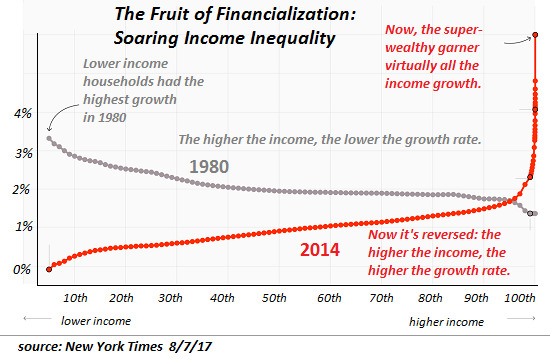




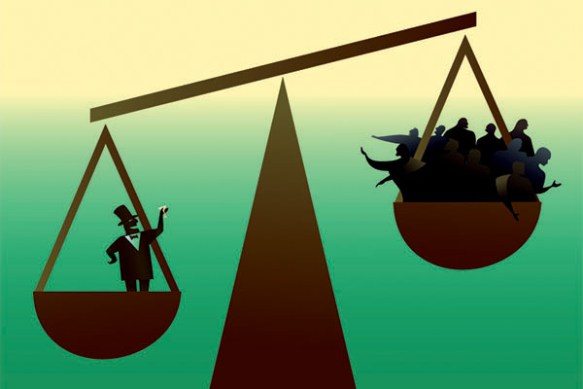
 After the Crash