Our Vanishing World: Insects

By Robert J. Burrowes

About 12,000 years ago, late stone age humans precipitated the neolithic (agricultural) revolution that marked the start of the steady rise to civilization. Coincidentally, this occurred at the same time as the beginning of what is now known as the Holocene Epoch, the geological epoch in which humans still live.

However, since the industrial revolution commencing in about 1750, just 270 years ago, humans have been destroying Earth’s biosphere with such tremendous ferocity that the Earth we inherited at the beginning of the Holocene Epoch is vanishing before our eyes. And life is vanishing with it.

While this catastrophe first gained significant public attention with the publication of Rachel Carson’s book Silent Spring in 1962, efforts in response to her effort to raise the alarm, credited with inspiring the modern environmental movement, have paled in comparison to the ongoing human effort to silence Spring.

In fact, we are destroying the biosphere with such ruthless efficiency that the global extinction rate is now 200 species per day, with another million species ‘under threat’. Moreover, according to the recent Global Assessment Report on Biodiversity and Ecosystem Services researched and published by the Intergovernmental Science-Policy Platform on Biodiversity and Ecosystem Services (IPBES) – the scientific body which assesses the state of biodiversity and the ecosystem services this provides to society – ‘Nature is declining globally at rates unprecedented in human history.’

So severe is the crisis through which we are now living that the normally sober tone of scientific papers is vanishing too, with words such as ‘biological annihilation’, a ‘frightening assault on the foundations of human civilisation’ and the ‘sixth mass extinction’ event in Earth’s history are being used with increasing frequency. See, for example, ‘Biological annihilation via the ongoing sixth mass extinction signaled by vertebrate population losses and declines’.

So how extreme is the threat?

Well, despite the number of elite-controlled intergovernmental processes and corporate scientists paid to promulgate delusion about our timeframe, an increasing number of scientists are now warning that existing and accumulating evidence indicates that human extinction is likely to occur by 2026 (assuming that we can prevent nuclear war and prevent the deployment of 5G in the meantime). Unfortunately, too, the full extent of this unfolding catastrophe is readily masked if the many interrelated factors – emotional, political, economic, social, climatic, environmental, military, nuclear, geoengineering and electromagnetic – synergistically shaping this outcome are not each and all considered. See ‘Human Extinction by 2026? A Last Ditch Strategy to Fight for Human Survival’.

For example, it is poor science to measure climate impacts in isolation from the cascading impacts they generate ‘downstream’ (such as the adverse impact of temperature increases on insect populations in rainforests and what this means for the rainforest habitats they occupy) and to predict outcomes for humanity based on the climate impacts alone. If enough insects are gone – whether through destruction of habitat, extensive pesticide use, 5G electromagnetic radiation, climate impacts… or a combination of these and other factors – before we reach the critical climate ‘tipping point’, then human food chains will collapse rapidly followed by the human population whatever the state of the climate at the time.

However, rather than reiterate the comprehensive evidence in relation to the synergistic threats to human survival here, let me instead present the evidence only in relation to the decimation of the global insect population – variously given such labels as ‘insectageddon’ and ‘insect apocalypse’ in an attempt to convey the gravity of the crisis – including what is driving it and what it means.

The Importance of Insects

So how important are insects? According to one recent study conducted by Caspar A. Hallmann and eleven associates, insects are vital to ecosystem functioning:

‘Insects play a central role in a variety of processes, including pollination, herbivory and detrivory [an organism, such as a bacterium, fungus or insect, that feeds on dead plant or animal matter], nutrient cycling and providing a food source for higher trophic levels such as birds, mammals and amphibians. For example, 80% of wild plants are estimated to depend on insects for pollination, while 60% of birds rely on insects as a food source. The ecosystem services provided by wild insects have been estimated at $57 billion annually in the USA. Clearly, preserving insect abundance and diversity should constitute a prime conservation priority.’ See ‘More than 75 percent decline over 27 years in total flying insect biomass in protected areas’.

To underscore the importance of insects, in their study Bradford C. Lister & Andres Garcia simply note that ‘arthropods comprise over two-thirds of terrestrial species’. See ‘Climate-driven declines in arthropod abundance restructure a rainforest food web’. And, as Robert Hunziker observes: without insects ‘burrowing, forming new soil, aerating soil, pollinating food crops…’ and providing food for many bird species, the biosphere simply collapses. See ‘Insect Decimation Upstages Global Warming’.

However, despite their crucial role in maintaining the habitable biosphere, insects have been in decline for several decades. And the decline is accelerating.

The Decline of Insects

Any study of insect populations readily confirms their rapid decline. For example, in the recent study by Lister and Garcia, they note that ‘Arthropods, invertebrates including insects that have external skeletons, are declining at an alarming rate. While the tropics harbor the majority of arthropod species, little is known about trends in their abundance.’ Hence they compared arthropod biomass in Puerto Rico’s Luquillo rainforest with data taken by Lister back in 1976. They found that ‘biomass had fallen 10 to 60 times’ and their analyses revealed ‘synchronous declines in the lizards, frogs, and birds that eat arthropods’. Moreover, they noted, over the past 30 years forest temperatures have risen 2.0 °C and their study indicated that ‘climate warming is the driving force behind the collapse of the forest’s food web’. Ominously, they observe: ‘A number of studies indicate that tropical arthropods should be particularly vulnerable to climate warming. If these predictions are realized, climate warming may have a more profound impact on the functioning and diversity of tropical forests than currently anticipated.’ See ‘Climate-driven declines in arthropod abundance restructure a rainforest food web’ and ‘Insect collapse: “We are destroying our life support systems”’.

Why? Well although climate warming is disrupting the entire biosphere at an accelerating pace, the rate is generally slower in tropical habitats. Nevertheless, the evidence still clearly suggests that tropical ectotherms (organisms reliant on environmental heat sources) may be particularly vulnerable to the warming climate. Citing an earlier report based on research by Daniel H. Janzen – see ‘Why Mountain Passes are Higher in the Tropics’ – Lister and Garcia note that tropical species that evolved in comparatively aseasonal environments have ‘narrower thermal niches, reduced acclimation to temperature fluctuations, and exist at or near their thermal optima. Consequently, even small increments in temperature can precipitate sharp decreases in fitness and abundance. These predictions have been verified in a variety of tropical reptiles, amphibians, and invertebrates.’ See ‘Climate-driven declines in arthropod abundance restructure a rainforest food web’.

In another recent report ‘Worldwide decline of the entomofauna: A review of its drivers’, Francisco Sánchez-Bayo and Kris A.G. Wyckhuys present ‘a comprehensive review of 73 historical reports of insect declines from across the globe, and systematically assess the underlying drivers’. In essence, their research reveals ‘dramatic rates of decline’ with the main drivers being i) habitat loss and conversion to intensive agriculture and urbanization; ii) pollution, mainly by synthetic pesticides (glyphosate, neonicotinoids and others) and fertilisers; iii) biological factors, including pathogens and introduced species; and iv) the climate catastrophe. ‘The latter factor is particularly important in tropical regions, but only affects a minority of species in colder climes and mountain settings of temperate zones.’

Moreover, they note, the general studies of insect declines are ‘in line with previous reports on population declines among numerous insect taxa (i.e. butterflies, ground beetles, ladybirds, dragonflies, stoneflies and wild bees) in Europe and North America over the past decades. It appears that insect declines are substantially greater than those observed in birds or plants over the same time periods and this could trigger wide-ranging cascading effects within several of the world’s ecosystems.’

But perhaps the most alarming report is the one written following research conducted by Caspar A. Hallmann and his associates. Noting widespread concern about insect loss, they observe that ‘Loss of insect diversity and abundance is expected to provoke cascading effects on food webs and to jeopardize ecosystem services.’ Employing a standardized protocol to measure total insect biomass using Malaise traps, deployed over 27 years in 63 nature protection areas in Germany (with 96 unique location-year combinations) their analysis estimated ‘a seasonal decline of 76%, and mid-summer decline of 82% in flying insect biomass over the 27 years of study’. Moreover, the decline was apparent regardless of habitat type. ‘This yet unrecognized loss of insect biomass must be taken into account in evaluating declines in abundance of species depending on insects as a food source, and ecosystem functioning in the European landscape.’ See ‘More than 75 percent decline over 27 years in total flying insect biomass in protected areas’.

Just one cascading impact of the rapid decline of insects in Germany is the ‘decimation’ of the bird population. See ‘“Decimated”: Germany’s birds disappear as insect abundance plummets 76%’.

In summary, from the study by Sánchez-Bayo and Wyckhuys: More than 40 percent of the world’s insect species are on the fast track to extinction. See ‘Worldwide decline of the entomofauna: A review of its drivers’.

Why are insects declining?

In essence, apart from the causes of insect decline noted above, such as destruction of habitat, poisoning (using glyphosate, neonicotinoids and other pesticides) – see, for example, ‘Trump EPA OKs “Emergency” to Dump Bee-killing Pesticide on 16 Million Acres’ – and the climate catastrophe, insects are also adversely impacted by light – see ‘Light pollution a reason for insect decline’ – ingestion of plastic – see ‘Microplastic ingestion by riverine macroinvertebrates’ – wars, nuclear contamination – see, for example, ‘Fukushima butterflies highlight heavy cost of nuclear disaster’ – and will be further and horrifically impacted, along with all life on Earth, if 5G is deployed. For an earlier study identifying the existing problem of electromagnetic radiation on life, see ‘Bees, Birds and Mankind: Destroying Nature by “Electrosmog”’, but for recent updates on the extraordinary hazards of 5G to all life, see ‘5G and the Wireless Revolution: When Progress Becomes a Death Sentence’ and ‘Western Insanity and 5G Electromagnetic Radiation’.

In essence, without sufficient diversity and density of insects the existing biosphere will collapse and homo sapiens will join the fossil record. And we are rapidly approaching that particular tipping point.

Part of the problem is that far too much attention is being directed at the climate catastrophe while ignoring the vast evidence from other disciplines offering highly instructive research not only in relation to climate impacts but to other human behaviours that are negatively impacting ecosystem functioning.

This has a range of negative impacts, including that it deludes people into seeking outcomes that are hopelessly inadequate if we are to address the full extent of the crisis in our biosphere.

Is anything being done?

Not much. The elite’s corporations have enormous political power so have little trouble resisting efforts to contain their destruction of the biosphere, including of insect populations.

Hence, while scientists routinely offer fine suggestions, such as the following one, they are also routinely ignored.

‘A rethinking of current agricultural practices, in particular a serious reduction in pesticide usage and its substitution with more sustainable, ecologically-based practices, is urgently needed to slow or reverse current trends, allow the recovery of declining insect populations and safeguard the vital ecosystem services they provide. In addition, effective remediation technologies should be applied to clean polluted waters in both agricultural and urban environments.’ See ‘Worldwide decline of the entomofauna: A review of its drivers’.

But, to reiterate, it is corporations that have political power and that also control the media narrative; not scientists.

So what can we do?

Given that the insect apocalypse is deeply connected to other issues of critical importance to human survival, as always it is vital that this issue is addressed strategically from a holistic perspective. For that reason, we must approach the issue by addressing fundamental drivers but also several vital symptoms that arise from those drivers. Let me explain what I mean.

The fundamental question is this: Why are humans behaving in a way that destroys Earth’s biosphere? Surely, this is neither sensible nor even sane. And anyone capable of emotional engagement and rational thinking who seriously considers this behaviour must realize this. So why is it happening?

Fundamentally it is because our parenting and education models fail utterly to produce people of conscience, people who are emotionally functional and capable of critical analysis, people who care and who can plan and respond strategically.

Given the preoccupation of modern society with producing submissively obedient students, workers, soldiers, citizens (that is, taxpayers and voters) and consumers, the last thing society wants is powerful individuals who are each capable of searching their conscience, feeling their emotional response to events, thinking critically and behaving strategically in response. Hence our parenting and education models use a ruthless combination of visible, ‘invisible’ and ‘utterly invisible’ violence to ensure that our children become terrified, self-hating and powerless individuals like virtually all of the adults around them.

This multifaceted violence ensures that the adult who emerges from childhood and adolescence is suppressing awareness of an enormous amount of fear, pain and anger (among many other feelings) and must live in delusion to remain unaware of these suppressed feelings. This ensures that, as part of their delusion, people develop a strong sense that what they are doing already is functional and working (no matter how dysfunctional and ineffective it may actually be) while unconsciously suppressing awareness of any evidence that contradicts their delusion. See ‘Why Violence?’, ‘Fearless Psychology and Fearful Psychology: Principles and Practice’, ‘Do We Want School or Education?’ and ‘Love Denied: The Psychology of Materialism, Violence and War’.

So if we are going to address the fundamental driver of both the insect apocalypse and destruction of the biosphere generally, we must address this cause. For those adults powerful enough to do this, there is an explanation in ‘Putting Feelings First’. And for those adults committed to facilitating children’s efforts to realize their potential and become self-aware (rather than delusional), see ‘My Promise to Children’.

Beyond this cause, however, we must also resist, strategically, the insane elite corporations that are a key symptom of this crisis by manufacturing and marketing a vast range of insect (and life)-destroying products ranging from weapons (conventional and nuclear) and fossil fuels to products made by the destruction of habitat (including rainforests) and the poisoning of agricultural land (to grow the food that most people eat) while now planning the imminent worldwide deployment of 5G. See Nonviolent Campaign Strategy.

But we can also undermine this destruction, for example, by refusing to buy the products provided by the elite’s corporations (with the complicity of governments) that fight wars (to enrich weapons corporations) to steal fossil fuels (to enrich energy, aircraft and vehicle-manufacturing corporations) or those corporations that make profits by destroying rainforests or producing poisoned food, for example. We can do this by systematically reducing and altering our consumption pattern and becoming more locally self-reliant as outlined in ‘The Flame Tree Project to Save Life on Earth’ or, even more simply, by committing to The Earth Pledge (below). In a nutshell, for example, if we do not buy and eat poisoned food, corporations will stop poisoning our food and this will save vast numbers of insects (and many other life forms besides).

You can also consider joining those working to end violence in all contexts by signing the online pledge of ‘The People’s Charter to Create a Nonviolent World’.

The Earth Pledge

Out of love for the Earth and all of its creatures, and my respect for their needs, from this day onwards I pledge that:

  1. I will listen deeply to children (see explanation above)
  2. I will not travel by plane
  3. I will not travel by car
  4. I will not eat meat and fish
  5. I will only eat organically/biodynamically grown food
  6. I will minimize the amount of fresh water I use, including by minimizing my ownership and use of electronic devices
  7. I will not buy rainforest timber
  8. I will not buy or use single-use plastic, such as bags, bottles, containers, cups and straws
  9. I will not use banks, superannuation (pension) funds or insurance companies that provide any service to corporations involved in fossil fuels, nuclear power and/or weapons
  10. I will not accept employment from, or invest in, any organization that supports or participates in the exploitation of fellow human beings or profits from killing and/or destruction of the biosphere
  11. I will not get news from the corporate media (mainstream newspapers, television, radio, Google, Facebook, Twitter…)
  12. I will make the effort to learn a skill, such as food gardening or sewing, that makes me more self-reliant
  13. I will gently encourage my family and friends to consider signing this pledge.

Conclusion

In response to a range of synergistically impacting behaviours, homo sapiens is on the fast track to extinction. Just one critical and largely ignored variable in this rush to extinction is our decimation of the world insect population denying us an ever-expanding range of ecological services.

On this count alone, we have already crossed a dangerous tipping point that will cause increasing problems over time. Whether we can stop short of the ultimate tipping point depends on what you decide.


Biodata: Robert J. Burrowes has a lifetime commitment to understanding and ending human violence. He has done extensive research since 1966 in an effort to understand why human beings are violent and has been a nonviolent activist since 1981. He is the author of ‘Why Violence?’ His email address is flametree@riseup.net and his website is here.


Facebook and YouTube remove posts naming CIA impeachment whistleblower

By Kevin Reed

Source: WSWS.org

Multiple media sources reported on Friday that the social media platforms Facebook and YouTube were removing posts that identified by name the CIA whistleblower behind the Congressional impeachment inquiry of President Donald Trump.

In an email statement, Facebook said, “Any mention of the potential whistleblower’s name violates our coordinating harm policy, which prohibits content ‘outing of witness, informant or activist’,” adding, “We are removing any and all mentions of the potential whistleblower’s name and will revisit this decision should their name be widely published in the media or used by public figures in debate.”

CNN also reported that YouTube issued a statement saying that it was using a combination of artificial intelligence software and human monitors to find and delete videos with the name of the “Ukrainegate” whistleblower. “The removals, the spokesperson added, would affect the titles and descriptions of videos as well as the video’s actual content,” the CNN report said.

The World Socialist Web Site has independently confirmed that Facebook is deleting posts containing the name of alleged CIA whistleblower Eric Ciaramella.

Facebook’s claim that any content posted on its platform naming Ciaramella constitutes “outing” the whistleblower is absurd. The alleged identity of the career CIA analyst who filed a complaint regarding the July 25 phone call between President Trump and Ukrainian President Volodymyr Zelensky has been known since October 30 when the pro-Republican Real Clear Politics website published his name.

When his name was published by Real Clear Politics, the whistleblower’s attorneys—in typical CIA fashion—said they could “neither confirm nor deny” that Ciaramella was their client.

Ciaramella is a plausible candidate for being whistleblower, given his background as a registered Democrat and CIA analyst with expertise in Ukraine and Russia. He worked under both Obama National Security Advisor Susan Rice and Trump National Security Advisor H.R. McMaster. In mid-2017 he was sent back to the CIA amid accusations that he was leaking anti-Trump information to the media.

While Ciaramella’s name has been widely circulated by Republican political figures, right-wing news sites and former CIA analyst and Trump aide Fred Fleitz said, “everyone knows who he is,” the Democrats and their allies in the media at the New York Times, Washington Post and major television networks have not made his name public.

Even an article in the New York Times on Friday that reported on Facebook’s censoring of posts by the right-wing website Breitbart did not include Ciaramella’s name. By taking the step of scrubbing posts mentioning allegations that are widely shared and reported, Facebook and YouTube are now joining with these corporate media organizations and blocking the public from having access to important information.

The latest heavy-handed social media censorship—so obviously being carried out in the service of the Democratic Party impeachment inquiry and the CIA—actually helps the Trump administration, the Republican Party and the extreme right-wing political forces defending the White House, allowing them to adopt the false posture of advocating free flow of information, even as Trump continues to demonize the media as the “enemies of the people.”

The mass scrubbing of all social media content by Facebook and YouTube that mentions the name Eric Ciaramella is part of the broader censorship efforts by the technology monopolies, in collaboration with the intelligence state, and sets the stage for even more draconian attacks on freedom of expression.

This must be seen within the context of the drive by a substantial section of the ruling establishment for the social media platforms to “step up to the plate” and, as Hillary Clinton said last week, take down “false, deceptive or deliberately misleading content” or “pay a price.” Leading figures within the Democratic Party, including presidential candidate Elizabeth Warren, Congresswoman Alexandria Ocasio-Cortez and Congresswoman Rashida Tlaib, have been campaigning for social media censorship that will block what they call “untruthful statements.”

As explained on the World Socialist Web Site, the increasing calls for censorship on social media are part of a protracted campaign by the US intelligence apparatus, under conditions of a growing movement of the working class and young people and increasing interest and support for socialism, to suppress left-wing, antiwar and progressive political viewpoints.

Furthermore, the WSWS has pointed out that what is determined as “fake” or “real” is not to be decided by the government or giant tech monopolies: “All the dishonesty of the campaign for internet censorship is contained in the failure to answer, much less consider, one central question: Who is to determine what is true and what is false?”

The publication of the name of the CIA analyst who submitted his complaint memo to the heads of the House and Senate Intelligence Committees in August is not a crime. In fact, his identity is of substantial consequence, given that his complaint became the starting point of an effort to remove a sitting president through impeachment.

The Unraveling Quickens

By Charles Hugh Smith

Source: Of Two Minds

Even if we don’t measure the erosion of intangible capital, the social and political consequences of this impoverishment are manifesting in all sorts of ways.

The central thesis of my new book Will You Be Richer or Poorer? is the financial “wealth” we’ve supposedly gained (or at least a few of us have gained) in the past 20 years has masked the unraveling of our intangible capital: the resilience of our economy, our social capital, i.e. our ability to find common ground and solve real-world problems, our sense that the playing field, while not entirely level, is not two-tiered, and our sense of economic security–have all been shredded.

The unraveling of everything that actually matters is quickening. While every “news” outlet cheerleads the stock market (“The Dow soared today as investor optimism rose… blah blah blah”), our “leadership” and our media don’t even attempt to measure what’s unraveling, much less address the underlying causes.

The hope is that if we ignore what’s unraveling, it will magically go away. But that’s not how reality works.

The unraveling is gathering momentum because prices have been pushing higher while wages lag, feeding the rising precariousness and inequality of our economy. The connection between people losing ground and social disorder/disunity has been well established by historians such as Peter Turchin Ages of Discord and David Hackett Fischer The Great Wave: Price Revolutions and the Rhythm of History.

In our era, trust in the legitimacy of our institutions is unraveling because the statistics presented as “facts” are so clearly designed to support the status quo narrative that everything’s getting better every day in every way rather than the politically unwelcome reality that the bottom 95% are losing ground and whatever they do earn and own is increasingly at risk from forces outside their control.

Economic decay leads to social and political disorder / disunity. The sudden rise of vast homeless encampments is one manifestation of the social fabric unraveling. In the political realm, the insanity of accusing Democratic candidates of being “Russian agents” matches the hysterical destructiveness of the McCarthy era in the 1950s.

It all starts with economic decay, so let’s look at some charts. Here’s a chart of income inequality which helps drive wealth inequality.

Note that the only group that benefited from the past 20 years of speculative bubbles is the top 1%. The whole idea that inflating bubbles creates a “wealth effect” that “trickles down” is preposterous, as evidenced by the decline of the middle 60% of households while the speculators and owners of bubble-assets skimmed the vast majority of income gains.

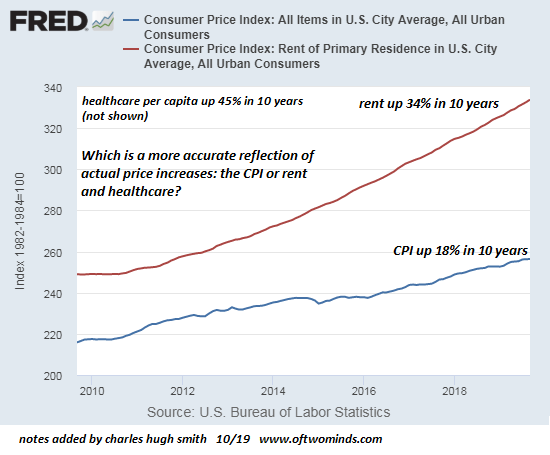
Meanwhile, we’re told inflation is less than 2% annually while rising costs have outpaced meager wage increases. What’s a more realistic measure of real-world inflation–the official Consumer Price Index (CPI) at 18% over ten years or rent and healthcare at 34% and 45%?

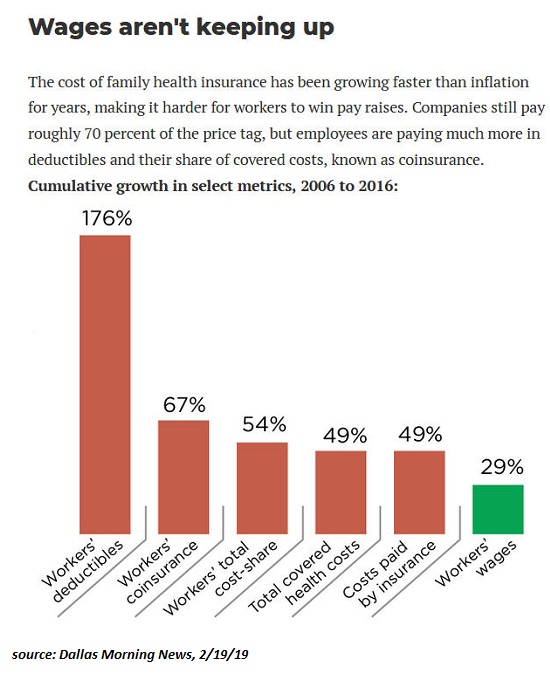
According to the Chapwood Index, real-world inflation in urban America is running 9% to 13% annually. This is more in line with reality than the bogus CPI, as evidenced by this chart of wages and healthcare costs:

Even if we don’t measure the erosion of intangible capital, the social and political consequences of this impoverishment are manifesting in all sorts of ways: large-scale social disorder is breaking out around the globe, and the political middle ground has completely vanished: no matter which way an issue is decided, one camp will refuse to accept the outcome.

The only way forward with any chance of success is to start by acknowledging the decay of our economy due to rampant financialization, legalized looting, the pathologies of “winner take most” speculation and the realities of a two-tiered system in which entrenched elites are “more equal” than the rest of us, economically, socially and politically. We have to accept the limits of technology to reverse the unraveling and assess the damage that’s already been done to our shared capital.

Acting as if the system is working just fine and the problem is perception/optics is accelerating the unraveling.

Alt Media was Exposing Epstein Corruption as ABC was Covering it Up—Who’s the Real Fake News?

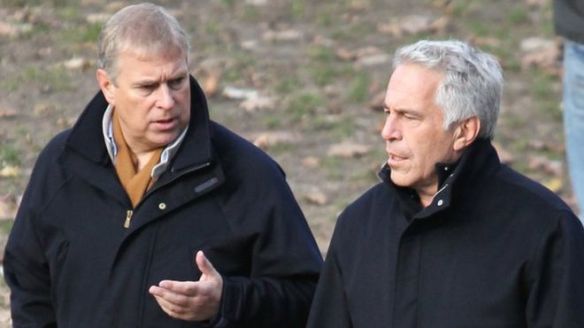
Prince Andrew with Jeffrey Epstein

By Matt Agorist

Source: Free Thought Project

One of the largest stories in the news this week was the ABC anchor who was recorded on a hot microphone ranting about how the network suppressed her story on Jeffrey Epstein and his ties to the elite — three years ago. While this admission was certainly noteworthy, it should come as no surprise. Over the past few years, the mainstream media, in general, has refused to report on any of Epstein’s ties to current and past government officials, Hollywood insiders, and even royalty. Now, as the “Epstein didn’t kill himself” memes storm the internet, it has all of the sudden become “cool” to finally talk about this insidious group of power elite predators. However, those of us in the alternative media have been talking about this stuff for years — before it was cool — and we were called conspiracy theorists for doing so.

In 2016, the Pizzagate conspiracy took the internet by storm and created a slew of unprovable theories that never materialized. While the mainstream media was shouting down the Pizzagate crowd, TFTP and others were reporting on the real child sex trafficking conspiracy involving Epstein and his friends like the Clintons. As we reported in 2016, flight logs showed that Bill Clinton allegedly took numerous flights on the “Lolita Express” (Epstein’s private jet) to “orgy island” (Epstein’s private island in the Caribbean) to engage in sex with underage girls.

Epstein is also tied to the current president Donald Trump. Indeed, prior to taking the White House, billionaire Donald Trump dished out praise for Epstein back in 2002, telling New York Magazine for an article, in hindsight, peculiarly titled, “Jeffrey Epstein: International Moneyman of Mystery,”

“I’ve known Jeff for 15 years. Terrific guy. He’s a lot of fun to be with. It is even said that he likes beautiful women as much as I do, and many of them are on the younger side. No doubt about it — Jeffrey enjoys his social life.”

When we were reporting on these provable facts years ago, the mainstream media was suppressing them. Even Prince Andrew was tied to this convicted pedophile. In fact, one piece of evidence submitted during a lawsuit against Epstein last year was a photo of Prince Andrew with his arm around the underage victim, Virginia Roberts who claims that was she was both forced to have sex with Epstein and that she was “loaned out” to perform sex acts on his friends.

The photo resurfaced last year during the trials, yet it was entirely ignored by the mainstream. Coincidentally, any ties to the Royal Family have been ignored by the mainstream despite the evidence.

Why is that?

“The Palace found out that we had her whole allegations about Prince Andrew and threatened us a million different ways,” Amy Robach, ‘Good Morning America’ Co-Host and Breaking News Anchor at ABC was recorded saying on a hot mic in the now viral video.

As ABC was taking marching orders from the Royal family to cover for a convicted pedophile, those of us in the trenches of alternative media were putting out reports left and right. The Miami Herald is arguably one of the largest purveyors and investigators in the Epstein corruption case, putting out bombshell after bombshell over the last few years. Sadly, however, most of it was ignored.

As TFTP has reported, Epstein is a convicted child molester and sexually abused no less than 40 underage girls. Despite this fact, Alexander Acosta protected him while serving as a U.S. Attorney in Florida.

Instead of going to prison for life, as he should’ve considering the evidence against him, Epstein only got 13 months and was allowed to stay in the Palm Beach County Jail in his own private cell where he was allowed to leave the prison six days a week for “work release.”

Instead of being investigated for letting this convicted pedophile off with a wrist slap, Acosta was appointed by Trump to Secretary of Labor. During his appointment hearing in 2017, Acosta defended the way he handled the Epstein case.

“At the end of the day, based on the evidence, professionals within a prosecutor’s office decide that a plea — that guarantees that someone goes to jail, that guarantees that someone register generally and that guarantees other outcomes — is a good thing,” he said.

As the Alternative Media was screaming from the rooftops — literally, we did a podcast on this last year —  that this man let a pedophile off with a wrist slap and was then appointed a high position in the government, the mainstream media ignored it once again. Only after Epstein was arrested did Acosta’s role become something the mainstream media would talk about. The coverage almost immediately led to this pedophile helper’s resignation.

When the Hollywood #metoo movement blew up, the mainstream media focused solely on a few people while ignoring Epstein’s ties to any of it. However, pining away with pertinent information were the folks at the Antimedia, showing the connections. 

When Epstein was being sued in Federal Court last year, the mainstream was again silent. But TFTP contributor, founder of the Conscience Resistance, and Houston mayoral candidate Derrick Broze was in Florida — standing in front of Epstein’s mansion — trying to get this information out to the public.

Yet again, the algorithms, the “fact checkers” and thought controllers acted almost in unison to silence these platforms. A month after TFTP published Broze’s extensive investigative work, our entire social media network across Facebook and Twitter, consisting of nearly 7 million followers, was surreptitiously wiped off the face of the internet. 

None of the information we have put out in regard to Epstein over the past few years has been wrong. Alternative media has had their finger on the pulse of the Epstein corruption for years, yet we have been shoved into the fringes by the mainstream. Coincidence?

Sadly, however, although it appears that they are finally reporting on the Epstein corruption, the mainstream media is still pussyfooting all over it. They are more concerned with Epstein’s death in jail than the actual connections to these elite child traffickers, many of whom are still free.

Whitney Webb with Mint Press News has been following the Epstein case down into the deepest crawls of the establishment and has been asking hard questions, like how the hell is Ghislaine Maxwell — who is alleged to have helped Epstein traffic these children — still walking around a free person? If you want a true glimpse into how deep the rabbit hole goes, you can take a look at their in depth coverage, here. 

The sleight of hand tactics employed by the mainstream are becoming more and more apparent as we progress through time. It is no surprise that they have earned the nickname “dinosaur media.” Let’s hope that those who help to protect society’s worst, who victimize and prey on innocent children, will one day find their platforms used for this protection, extinct, just like the dinosaurs.

It’s the DNC, Stupid: Democratic Party, Not Russia, Has Delegitimized the Democratic Process

By Elizabeth Vos

Source: Consortium News

Establishment Democrats and those who amplify them continue to project blame for the public’s doubt in the U.S. election process onto outside influence, despite the clear history of the party’s subversion of election integrity. The total inability of the Democratic Party establishment’s willingness to address even one of these critical failures does not give reason to hope that the nomination process in 2020 will be any less pre-ordained.

The Democratic Party’s bias against Sen. Bernie Sanders during the 2016 presidential nomination, followed by the DNC defense counsel doubling down on its right to rig the race during the fraud lawsuit brought against the DNC, as well as the irregularities in the races between former DNC Chairwoman Debbie Wasserman Schultz and Tim Canova, indicate a fatal breakdown of the U.S. democratic process spearheaded by the Democratic Party establishment. Influences transcending the DNC add to concerns regarding the integrity of the democratic process that have nothing to do with Russia, but which will also likely impact outcomes in 2020.

The content of the DNC and Podesta emails published by WikiLeaks demonstrated that the DNC acted in favor of Hillary Clinton in the lead up to the 2016 Democratic primary. The emails also revealed corporate media reporters acting as surrogates of the DNC and its pro-Clinton agenda, going so far as to promote Donald Trump during the GOP primary process as a preferred “pied-piper candidate.” One cannot assume that similar evidence will be presented to the public in 2020, making it more important than ever to take stock of the unique lessons handed down to us by the 2016 race.

Social Media Meddling

Election meddling via social media did take place in 2016, though in a different guise and for a different cause from that which are best remembered. Twitter would eventually admit to actively suppressing hashtags referencing the DNC and Podesta emails in the run-up to the 2016 presidential election. Additional reports indicated that tech giant Google also showed measurable “pro-Hillary Clinton bias” in search results during 2016, resulting in the alleged swaying of between 2 and 10 millions voters in favor of Clinton.

On the Republican side, a recent episode of CNLive! featured discussion of the Cambridge Analytica scandal, in which undecided voters were micro-targeted with tailored advertising narrowed with the combined use of big data and artificial intelligence known collectively as “dark strategy.” CNLive! Executive Producer Cathy Vogan noted that SCL, Cambridge Analytica’s parent company, provides data, analytics and strategy to governments and military organizations “worldwide,” specializing in behavior modification. Though Cambridge Analytica shut down in 2018, related companies remain.

The Clinton camp was hardly absent from social media during the 2016 race. The barely-legal activities of Clintonite David Brock were previously reported by this author to have included $2 million in funding for the creation of an online “troll army” under the name Shareblue. The LA Times described the project as meant to “to appear to be coming organically from people and their social media networks in a groundswell of activism, when in fact it is highly paid and highly tactical.” In other words, the effort attempted to create a false sense of consensus in support for the Clinton campaign.

In terms of interference in the actual election process, the New York City Board of Elections was shown to have purged over one hundred thousand Democratic voters in Brooklyn from the rolls before the 2016 primary, a move that the Department of Justice found broke federal law. Despite this, no prosecution for the breach was ever attempted.

Though the purge was not explicitly found to have benefitted Clinton, the admission falls in line with allegations across the country that the Democratic primary was interfered with to the benefit of the former secretary of state. These claims were further bolstered by reports indicating that voting results from the 2016 Democratic primary showed evidence of fraud.

DNC Fraud Lawsuit

The proceedings of the DNC fraud lawsuit provide the most damning evidence of the failure of the U.S. election process, especially within the Democratic Party. DNC defense lawyers argued in open court for the party’s right to appoint candidates at its own discretion, while simultaneously denying any “fiduciary duty” to represent the voters who donated to the Democratic Party under the impression that the DNC would act impartially towards the candidates involved.

In 2017, the Observer reported that the DNC’s defense counsel argued against claims that the party defrauded Sanders’ supporters by favoring Clinton, reasoning that Sanders’ supporters knew the process was rigged. Again: instead of arguing that the primary was neutral and unbiased in accordance with its charter, the DNC’s lawyers argued that it was the party’s right to select candidates.

The Observer noted the sentiments of Jared Beck, the attorney representing the plaintiffs of the lawsuit:

…“People paid money in reliance on the understanding that the primary elections for the Democratic nominee —nominating process in 2016 were fair and impartial, and that’s not just a bedrock assumption that we would assume just by virtue of the fact that we live in a democracy, and we assume that our elections are run in a fair and impartial manner. But that’s what the Democratic National Committee’s own charter says. It says it in black and white.”

The DNC defense counsel’s argument throughout the course of the DNC fraud lawsuit doubled down repeatedly in defense of the party’s right to favor one candidate over another, at one point actually claiming that such favoritism was protected by the First Amendment. The DNC’s lawyers wrote:

“To recognize any of the causes of action that Plaintiffs allege would run directly contrary to long-standing Supreme Court precedent recognizing the central and critical First Amendment rights enjoyed by political parties, especially when it comes to selecting the party’s nominee for public office.” [Emphasis added]

The DNC’s shameless defense of its own rigging disemboweled the most fundamental organs of the U.S. body politic.  This no indication that the DNC will not resort to the same tactics in the 2020 primary race,

Tim Canova’s Allegations

If Debbie Wasserman Schultz’s role as disgraced chairwoman of the DNC and her forced 2016 resignation wasn’t enough, serious interference was also alleged in the wake of two contests between Wasserman Schultz and professor Tim Canova in Florida’s 23rd congressional district. Canova and Wasserman Schultz first faced off in a 2016 Democratic primary race, followed by a 2018 general congressional election in which Canova ran as an independent.

Debacles followed both contests, including improper vote counts, illegal ballot destruction, improper transportation of ballots, and generally shameless displays of cronyism. After the controversial results of the initial primary race against Wasserman Schultz, Canova sought to have ballots checked for irregularities, as the Sun-Sentinel reported at the time:

“[Canova] sought to look at the paper ballots in March 2017 and took Elections Supervisor Brenda Snipes to court three months later when her office hadn’t fulfilled his request. Snipes approved the destruction of the ballots in September, signing a certification that said no court cases involving the ballots were pending.”

Ultimately, Canova was granted a summary judgment against Snipes, finding that she had committed what amounted to multiple felonies. Nonetheless, Snipes was not prosecuted and remained elections supervisor through to the 2018 midterms.

Republicans appear no more motivated to protect voting integrity than the Democrats, with The Nation reporting that the GOP-controlled Senate blocked a bill this week that would have “mandated paper-ballot backups in case of election machine malfunctions.”

Study of Corporate Power

A 2014 study published by Princeton University found that corporate power had usurped the voting rights of the public: “Economic elites and organized groups representing business interests have substantial independent impacts on U.S. government policy, while average citizens and mass-based interest groups have little or no independent influence.”

In reviewing this sordid history, we see that the Democratic Party establishment has done everything in its power to disrespect voters and outright overrule them in the democratic primary process, defending their right to do so in the DNC fraud lawsuit. We’ve noted that interests transcending the DNC also represent escalating threats to election integrity as demonstrated in 2016.

Despite this, establishment Democrats and those who echo their views in the legacy press continue to deflect from their own wrongdoing and real threats to the election process by suggesting that mere discussion of it represents a campaign by Russia to attempt to malign the perceptionof the legitimacy of the U.S. democratic process.

Hillary Clinton’s recent comments to the effect that Congresswoman Tulsi Gabbard is being “groomed” by Russia, and that the former Green Party Presidential candidate Dr. Jill Stein is a “Russian asset”, were soon echoed by DNC-friendly pundits. These sentiments externalize what Gabbard called the “rot” in the Democratic party outward onto domestic critics and a nation across the planet.

Newsweek provided a particularly glaring example of this phenomenon in a recent op-ed penned by columnist Naveed Jamali, a former FBI double agent whose book capitalizes on Russiagate. In an op-ed titled: Hillary Clinton Is Right. Tulsi Gabbard Is A Perfect Russian Asset – And Would Be A Perfect Republican Agent,” Jamali argued:

“Moscow will use its skillful propaganda machine to prop up Gabbard and use her as a tool to delegitimize the democratic process.” [Emphasis added]

Jamali surmises that Russia intends to “attack” our democracy by undermining the domestic perception of its legitimacy. This thesis is repeated later in the piece when Jamali opines: “They want to see a retreat of American influence. What better way to accomplish that than to attack our democracy by casting doubt on the legitimacy of our elections.” [Emphasis added]

The only thing worth protecting, according to Jamali and those who amplify his work (including former Clinton aide and establishment Democrat Neera Tanden), is the perception of the democratic process, not the actual functioning vitality of it. Such deflective tactics ensure that Russia will continue to be used as a convenient international pretext for silencing domestic dissent as we move into 2020.

Given all this, how can one expect the outcome of a 2020 Democratic Primary — or even the general election – to be any fairer or transparent than 2016?


Elizabeth Vos is a freelance reporter, co-host of CN Live! and regular contributor to Consortium News. 

The Key to a Sustainable Economy Is 5,000 Years Old

By Ellen Brown

Source: Truthdig

We are again reaching the point in the business cycle known as “peak debt,” when debts have compounded to the point that their cumulative total cannot be paid. Student debt, credit card debt, auto loans, business debt and sovereign debt are all higher than they have ever been. As economist Michael Hudson writes in his provocative 2018 book, “…and forgive them their debts,” debts that can’t be paid won’t be paid. The question, he says, is how they won’t be paid.

Mainstream economic models leave this problem to “the invisible hand of the market,” assuming trends will self-correct over time. But while the market may indeed correct, it does so at the expense of the debtors, who become progressively poorer as the rich become richer. Borrowers go bankrupt and banks foreclose on the collateral, dispossessing the debtors of their homes and their livelihoods. The houses are bought by the rich at distress prices and are rented back at inflated prices to the debtors, who are then forced into wage peonage to survive. When the banks themselves go bankrupt, the government bails them out. Thus the market corrects, but not without government intervention. That intervention just comes at the end of the cycle to rescue the creditors, whose ability to buy politicians gives them the upper hand. According to free-market apologists, this is a natural cycle akin to the weather, which dates all the way back to the birth of modern economics in ancient Greece and Rome.

Hudson counters that those classical societies are not actually where our financial system began, and that capitalism did not evolve from bartering, as its ideologues assert. Rather, it devolved from a more functional, sophisticated, egalitarian credit system that was sustained for two millennia in ancient Mesopotamia (now parts of Iraq, Turkey, Kuwait and Iran). Money, banking, accounting and modern business enterprise originated not with gold and private trade, but in the public sector of Sumer’s palaces and temples in the third century B.C. Because it involved credit issued by the local government rather than private loans of gold, bad debts could be periodically forgiven rather than compounding until they took the whole system down, a critical feature that allowed for its remarkable longevity.

The True Roots of Money and Banking

Sumer was the first civilization for which we have written records. Its notable achievements included the wheel, the lunar calendar, our numerical system, law codes, an organized hierarchy of priest-kings, copper tools and weapons, irrigation, accounting and money. It also produced the first written language, which took the form of cuneiform figures impressed on clay. These tablets were largely just accounting tools, recording the flow of food and raw materials in the temple and palace workshops, as well as IOUs (mainly to these large public institutions) that had to be preserved in writing to be enforced. This temple accounting system allowed for the coordinated flow of credit to peasant farmers from planting to harvesting, and for advances to merchants to engage in foreign trade.

In fact, it was the need to manage accounts for a large labor force under bureaucratic control that is thought to have led to the development of writing. The people willingly accepted this bureaucratic control because they viewed the gods as having decreed it. According to their cuneiform writings, humans were genetically engineered to work the fields and the mines after certain lower gods tasked with that hard labor rebelled.

Usury, or the charging of interest on loans, was an accepted part of the Mesopotamian credit system. Interest rates were high and remained unchanged for two millennia. But Mesopotamian scholars were well aware of the problem of “debts that can’t be paid.” Unlike in today’s academic economic curriculum, Hudson writes:

Babylonian scribal students were trained already c. 2000 BC in the mathematics of compound interest. Their school exercises asked them to calculate how long it took a debt at interest of 1/60th per month to double. The answer is 60 months: five years. How long to quadruple? 10 years. How long to multiply 64 times? 30 years. It must’ve been obvious that no economy can grow in keeping with this rate of increase.

Sumerian kings solved the problem of “peak debt” by periodically declaring “clean slates,” in which agrarian debts were forgiven and debtors were released from servitude to work as tenants on their own plots of land. The land belonged to the gods under the stewardship of the temple and the palace and could not be sold, but farmers and their families maintained leaseholds to it in perpetuity by providing a share of their crops, service in the military and labor in building communal infrastructure. In this way, their homes and livelihoods were preserved, an arrangement that was mutually beneficial, since the kings needed their service.

Jewish scribes, who spent time in captivity in Babylon in the sixth century B.C, adapted these laws in the year or jubilee, which Hudson argues was added to Leviticus after the Babylonian captivity. According to Leviticus 25:8-13, a Jubilee Year was to be declared every 49 years, during which debts would be forgiven, slaves and prisoners freed and their property leaseholds restored. As in ancient Mesopotamia, property ownership remained with Yahweh and his earthly proxies. The Jubilee law effectively banned the outright sale of land, which could only be leased for up to 50 years (Leviticus 25:14-17). The Levitican Jubilee represented an advance over the Mesopotamian “clean slates,” Hudson says, in that it was codified into law rather than relying on the whim of the king. But its proclaimers lacked political power, and whether the law was ever enforced is unclear. It served as a moral rather than a legal prescription.

Ancient Greece and Rome adopted the Mesopotamian system of lending at interest, but without the safety valve of periodic “clean slates,” since the creditors were no longer the king or the temple, but private lenders. Unfettered usury resulted in debt bondage and forfeiture of properties, consolidation into large landholdings, a growing wedge between rich and poor, and the ultimate destruction of the Roman Empire.

As for the celebrated development of property rights and democracy in ancient Greece and Rome, Hudson argues that they did not actually serve the poor. They served the rich, who controlled elections, just as rich donors do today. Taking power away from local governments by privatizing once-communal lands allowed private creditors to pass laws by which they could legally confiscate property when their debtors could not pay. “Free markets” meant the freedom to accumulate massive wealth at the expense of the poor and the state.

Hudson maintains that when Jesus Christ preached “forgiveness of debts,” he was also talking about economic debt, not just moral transgressions. When he overturned the tables of the money changers, it was because they had turned a house of prayer into “a den of thieves.” But creditors’ rights had by then gained legal dominance, and Christian theologians lacked the power to override them. Rather than being a promise of economic redemption in this life, forgiveness of debts thus became a promise of spiritual redemption in the next.

How to Pull Off a Modern Debt Jubilee

Such has been the fate of debtors in modern Western economies. But in some modern non-Western economies, vestiges of the debt write-off solution remain. In China, for instance, nonperforming loans are often carried on the books of state-owned banks or canceled rather than putting insolvent debtors and banks into bankruptcy. As Dinny McMahon wrote in June in an article titled “China’s Bad Data Can Be a Good Thing”:

In China, the state stands behind the country’s banks. As long as authorities ensure those banks have sufficient liquidity to meet their obligations, they can trundle along with higher delinquency levels than would be regarded safe in a market economy.

China’s banking system, like that of ancient Mesopotamia, is largely in the public sector, so the state can back its banks with liquidity as needed. Interestingly, the Chinese state also preserves the ancient Near Eastern practice of retaining ownership of the land, which citizens can only lease for a period of time.

In Western economies, most banks are privately owned and heavily regulated, with high reserve and capital requirements. Bad loans mean debtors are put into foreclosure, jobs and capital infrastructure are lost, and austerity prevails. The Trump administration is now aggressively pursuing a trade war with China in an effort to level the playing field by forcing it into the same austerity regime, but a more productive and sustainable approach might be for the U.S. to engage in periodic debt jubilees itself.

The problem with that solution today is that most debts in Western economies are owed not to the government but to private creditors, who will insist on their contractual rights to payment. We need to find a way to pay the creditors while relieving the borrowers of their debt burden.

One possibility is to nationalize insolvent banks and sell their bad loans to the central bank, which can buy them with money created on its books. The loans can then be written down or voided out. Precedent for this policy was established with “QE1,” the Fed’s first round of quantitative easing, in which it bought unmarketable mortgage-backed securities from banks with liquidity problems.

Another possibility would be to use money generated by the central bank to bail out debtors directly. This could be done selectively, by buying up student debt or credit card debt or car loans bundled as “asset-backed securities,” then writing the debts down or off, for example. Alternatively, debts could be relieved collectively with a periodic national dividend or universal basic income paid to everyone, again drawn from the deep pocket of the central bank.

Critics will object that this would dangerously inflate the money supply and consumer prices, but that need not be the case. Today, virtually all money is created as bank debt, and it is extinguished when the debt is repaid. That means dividends used to pay this debt down would be extinguished, along with the debt itself, without adding to the money supply. For the 80% of the U.S. population now carrying debt, loan repayments from their national dividends could be made mandatory and automatic. The remaining 20% would be likely to save or invest the funds, so this money too would contribute little to consumer price inflation; and to the extent that it did go into the consumer market, it could help generate the demand needed to stimulate productivity and employment. (For a fuller explanation, see Ellen Brown, “Banking on the People,” 2019).

In ancient Mesopotamia, writing off debts worked brilliantly well for two millennia. As Hudson concludes:

To insist that all debts must be paid ignores the contrast between the thousands of years of successful Near Eastern clean slates and the debt bondage into which [Greco-Roman] antiquity sank. … If this policy in many cases was more successful than today’s, it is because they recognized that insisting that all debts must be paid meant foreclosures, economic polarization and impoverishment of the economy at large.

How Real Mind Control Works

By Brandon Smith

Source: Alt-Market.com

When people are confronted with the idea of “mind control” they often think of something out of television or film media; a lone prisoner tortured, chemically dazed and conditioned into a hollow zombie as his captors squeeze information from him or use him to complete a task he would not normally do or morally accept. And while there is actually some truth to this kind of Hollywood depiction, as is evidenced in the exposure of government programs like MK Ultra, the most insidious forms of mind control are far more subtle.

Governments and the elitists behind them do not necessarily need to physically cage, drug and brutalize people in order to influence how they behave. All they need to do is manage their perceptions, expectation and assumptions. This can be accomplished with large portions of the public, rather than one person at a time.

The elites have always been fascinated with the idea of mass hypnotism. In the 18th century Franz Mesmer was famous for entertaining European royalty with displays of what he called “animal magnetism”, which included what we now know as hypnosis of individuals and groups. Mesmerism has since become synonymous with the attempt to befuddle people and dictate their actions while in a kind of trance. Hypnotism is still a very active subject in psychiatric circles and the US government took avid interest in hypnotism as a weapon during their MK Ultra experiments in the 1950s.

People involved in the field of hypnotism are quick to point out that a hypnotized person cannot be made to do something that goes against their code of ethics, but this is not exactly the whole story. A hypnotist makes suggestions that the subject chooses to follow (or refuses to follow) while in a trance state, however, what if they can be convinced (or fooled) through hypnosis into believing that a particular action is in their best interest in spite of their moral code or sense of self preservation?

This type of control over a subject can and has been accomplished in hypnotic therapy, and examples of “covert” hypnotherapy are also on record, including the example of an Ohio divorce attorney that used covert hypnotism against multiple female clients and is suspected of using it against some court employees to disarm their psyches and then rape them without memory of the incident.

About two thirds of any given population are capable of being hypnotized to varying degrees. Stanford University has been avidly searching for a brain pattern that acts as a fingerprint for those that are more prone to hypnotic influence, and they believe they have found certain factors involving areas of the brain that handle heightened focus and attention. Reduced peripheral awareness also helps to increase the subject’s vulnerability to hypnosis and vastly increases suggestibility.

These conditions can in fact be encouraged in large crowds of people. Consider this for a moment – What daily activity is the average person involved in that hyperfocuses their attention on a single point in space for long periods of time and removes almost all of their peripheral awareness? If you said “cell phone use” then you win a chicken dinner. Beyond creating an artificial and constant low dose of dopamine in the human brain leading to addiction, cell phones and other small electronic devices actually create the perfect conditions for a person to be hypnotized as they rip them away from all peripheral awareness and make them highly suggestible to those who know how to use covert methods.

To reiterate, a hypnotic state can be induced in large groups of people for extended periods of time with the correct long term stimulus. Watch here as mentalist Darren Brown hypnotizes or “brainwashes” an entire shopping mall of people into raising their hands exactly when he wants them to without them being aware of why they are doing it. Notice that around two thirds of the crowd complies.

Hypnotic suggestions last as long as the subjects continue to believe that the suggestions are correct. Hypnotism is essentially an agreement between the hypnotist and the persons being hypnotized that a particular belief is true (even if it is not). In the case of a victim of an attack, the person may want to believe that the traumatic event did not happen, and thus they can be convinced through hypnosis to forget it. In the case of a group of people, the hypnotist would have to identify an idea or fear that they all share and WANT to believe is real, and then exploit it.

I think some of the political applications of this are obvious.

The false left/right paradigm is a perfect Petri dish for obtaining or manufacturing the consent of the masses to be hypnotized. They WANT to believe that their team, which they have willingly joined, is the correct team and that the leadership of that team has their best interests at heart. They want to believe that the actions of their party, through legislation or direct means, are always rational and morally sound. And, even when the leaders of their party do things which are completely contrary to the beliefs and morals of the people who make up the party, those people still want to believe that there must be some logical reason behind these decisions that they do not yet grasp.

Beyond this, the threat of the “other party” or team is an ever constant stimulus in the form of fear.  We watch the scripted battles of these two fabricated teams play out in elaborate forms of Kabuki theater, yet nothing ever really changes except that the global elites grow more powerful.  Still, many people actually believe these battles to be real, and invest immense amounts of energy and focus into them as if the fate of the world is being decided within the antics of a political soap opera.

When people are afraid or hyperfocused on an outside threat, they once again become more suggestible. This is why mainstream political discussions focus less on understanding of the threat (the “How” and the “Why”) and more on perpetuating the threat.  With understanding of the enemy (or false enemy), the threat can be assessed and fear is reduced, even if the threat is real. Without understanding, fear only increases. Political powers seek to constantly remind us that threats exist without allowing us the benefit of context.  They do not want us to have an in-depth knowledge of the mechanics behind the threats.

We are told that our system works in a particular way that seems logical, but it only makes sense to us so long as we want to believe that the system functions as we were taught.  We have to have blind faith that what we were initially told was absolutely true.  The question is, why should we?  Isn’t it better to remain skeptical of most things and to study what is handed to us?  If we’re given a strange elixir by an utter stranger and we’re told to “drink up!”, would we not question what’s in the frothing brew and what it does?  Would we not investigate?

In the case of information and proclamations some people would not investigate, because it is more comfortable to believe the lies, or perhaps because they will be rewarded for going along with the status quo.  Only when we become willing to sacrifice comfort, when we stop wanting to accept everything we are told at face value and start questioning the reality that is handed to us, only then will the mass hypnosis we were once influenced by lose its power.

The hypnosis of the elites requires ever increasing forms of distraction and stimulation in order to keep the public entranced. The creation of fear and confusion is vital to the execution of mass mind control, and this is a factor that many people absolutely refuse to recognize or take into consideration. The idea that the elites would build a system only to then deliberately destroy it is just too much for many to fathom. But again, what better way to hyperfocus an entire population and make them malleable to suggestions that they would not normally consider otherwise?

In past articles I have outlined the incredible array of similarities between global elitist groups and the behaviors and character traits of narcissistic sociopaths (also known as narcopaths or psychopaths).  I have even theorized that globalists are actually a highly organized group of narcopaths who recruit other narcopaths into the fold. Many high-level narcopaths are intuitively knowledgeable on the dynamics of suggestibility and the human psyche. I would call this their primary survival trait.

Narcopaths are well known for creating confusion around them in order to gain control of the people in their lives or the people in a room. They are also known for being willing to build up certain routines and acclimating people around them to a particular environment, only to suddenly disrupt it all as a means to stun their victims and create subservience. It is important to realize that these people do NOT necessarily care about stability. In fact, they often will actively sabotage stability to obtain something they care about more – control.

The strategies that individual narcopaths exhibit on a small scale are simply magnified thousands of times when we talk about the behaviors of the global elitists. People who consider themselves rational are hard pressed to comprehend this kind of behavior, but there is a devious tactical logic to it. Mind control of others can be achieved by keeping those people infinitely off-balance. Conjuring moments of tenuous peace, and then striking with cycles of unpredictable crisis. Before we know it, many years of instability have gone by and the organized narcopaths in power have gained even more control.  We wonder where all that time went, and why we were not able to change things? It is because we have been hypnotized into inaction, or the wrong actions in the name of meaningless political stagecraft.

Real mind control and mass hypnosis requires, as already mentioned, our consent, but it is consent that is conned out of us. It is conned out of us by fake leaders with intentions and actions that do not match their promises. It is conned out of us by a system that breeds conformity of thought and tells us that those who think outside the widely accepted norm are aberrant and “crazy”. It is conned out of us by our own weaknesses – our desire to go along to get along, our fear of confronting the crowd and telling them they are wrong, our fear of losing what we think is stability, or our fear of being on our own.

Real mind control is not about torture and force, it is about quietly induced acceptance. We can remove our consent from the hypnotists anytime we wish, but we have to be willing to stop ignoring certain realities. We have to be willing to feel the pain that comes when we recognize we have been conned and controlled in the past, and we have to revel in our ability to refuse to conform. It must become a part of who we are – the people who do not take what we are told at face value. The people that question almost everything. The people who cannot be mesmerized.

The Pathocracy of the Deep State: Tyranny at the Hands of a Psychopathic Government

By John W. Whitehead

Source: The Rutherford Institute

Politicians are more likely than people in the general population to be sociopaths. I think you would find no expert in the field of sociopathy/psychopathy/antisocial personality disorder who would dispute this… That a small minority of human beings literally have no conscience was and is a bitter pill for our society to swallow — but it does explain a great many things, shamelessly deceitful political behavior being one.”—Dr. Martha Stout, clinical psychologist and former instructor at Harvard Medical School

Twenty years ago, a newspaper headline asked the question: “What’s the difference between a politician and a psychopath?

The answer, then and now, remains the same: None.

There is no difference between psychopaths and politicians.

Nor is there much of a difference between the havoc wreaked on innocent lives by uncaring, unfeeling, selfish, irresponsible, parasitic criminals and elected officials who lie to their constituents, trade political favors for campaign contributions, turn a blind eye to the wishes of the electorate, cheat taxpayers out of hard-earned dollars, favor the corporate elite, entrench the military industrial complex, and spare little thought for the impact their thoughtless actions and hastily passed legislation might have on defenseless citizens.

Psychopaths and politicians both have a tendency to be selfish, callous, remorseless users of others, irresponsible, pathological liars, glib, con artists, lacking in remorse and shallow.

Charismatic politicians, like criminal psychopaths, exhibit a failure to accept responsibility for their actions, have a high sense of self-worth, are chronically unstable, have socially deviant lifestyles, need constant stimulation, have parasitic lifestyles and possess unrealistic goals.

It doesn’t matter whether you’re talking about Democrats or Republicans.

Political psychopaths are all largely cut from the same pathological cloth, brimming with seemingly easy charm and boasting calculating minds. Such leaders eventually create pathocracies: totalitarian societies bent on power, control, and destruction of both freedom in general and those who exercise their freedoms.

Once psychopaths gain power, the result is usually some form of totalitarian government or a pathocracy. “At that point, the government operates against the interests of its own people except for favoring certain groups,” author James G. Long notes. “We are currently witnessing deliberate polarizations of American citizens, illegal actions, and massive and needless acquisition of debt. This is typical of psychopathic systems, and very similar things happened in the Soviet Union as it overextended and collapsed.”

In other words, electing a psychopath to public office is tantamount to national hara-kiri, the ritualized act of self-annihilation, self-destruction and suicide. It signals the demise of democratic government and lays the groundwork for a totalitarian regime that is legalistic, militaristic, inflexible, intolerant and inhuman.

Incredibly, despite clear evidence of the damage that has already been inflicted on our nation and its citizens by a psychopathic government, voters continue to elect psychopaths to positions of power and influence.

According to investigative journalist Zack Beauchamp, “In 2012, a group of psychologists evaluated every President from Washington to Bush II using ‘psychopathy trait estimates derived from personality data completed by historical experts on each president.’ They found that presidents tended to have the psychopath’s characteristic fearlessness and low anxiety levels — traits that appear to help Presidents, but also might cause them to make reckless decisions that hurt other people’s lives.”

The willingness to prioritize power above all else, including the welfare of their fellow human beings, ruthlessness, callousness and an utter lack of conscience are among the defining traits of the sociopath.

When our own government no longer sees us as human beings with dignity and worth but as things to be manipulated, maneuvered, mined for data, manhandled by police, conned into believing it has our best interests at heart, mistreated, jailed if we dare step out of line, and then punished unjustly without remorse—all the while refusing to own up to its failings—we are no longer operating under a constitutional republic.

Instead, what we are experiencing is a pathocracy: tyranny at the hands of a psychopathic government, which “operates against the interests of its own people except for favoring certain groups.”

Worse, psychopathology is not confined to those in high positions of government. It can spread like a virus among the populace. As an academic study into pathocracy concluded, “[T]yranny does not flourish because perpetuators are helpless and ignorant of their actions. It flourishes because they actively identify with those who promote vicious acts as virtuous.”

People don’t simply line up and salute. It is through one’s own personal identification with a given leader, party or social order that they become agents of good or evil.

Much depends on how leaders “cultivate a sense of identification with their followers,” says Professor Alex Haslam. “I mean one pretty obvious thing is that leaders talk about ‘we’ rather than ‘I,’ and actually what leadership is about is cultivating this sense of shared identity about ‘we-ness’ and then getting people to want to act in terms of that ‘we-ness,’ to promote our collective interests. . . . [We] is the single word that has increased in the inaugural addresses over the last century . . . and the other one is ‘America.’”

The goal of the modern corporate state is obvious: to promote, cultivate, and embed a sense of shared identification among its citizens. To this end, “we the people” have become “we the police state.”

We are fast becoming slaves in thrall to a faceless, nameless, bureaucratic totalitarian government machine that relentlessly erodes our freedoms through countless laws, statutes, and prohibitions.

Any resistance to such regimes depends on the strength of opinions in the minds of those who choose to fight back. What this means is that we the citizenry must be very careful that we are not manipulated into marching in lockstep with an oppressive regime.

Writing for ThinkProgress, Beauchamp suggests that “one of the best cures to bad leaders may very well be political democracy.”

But what does this really mean in practical terms?

It means holding politicians accountable for their actions and the actions of their staff using every available means at our disposal: through investigative journalism (what used to be referred to as the Fourth Estate) that enlightens and informs, through whistleblower complaints that expose corruption, through lawsuits that challenge misconduct, and through protests and mass political action that remind the powers-that-be that “we the people” are the ones that call the shots.

Remember, education precedes action. Citizens need to the do the hard work of educating themselves about what the government is doing and how to hold it accountable. Don’t allow yourselves to exist exclusively in an echo chamber that is restricted to views with which you agree. Expose yourself to multiple media sources, independent and mainstream, and think for yourself.

For that matter, no matter what your political leanings might be, don’t allow your partisan bias to trump the principles that serve as the basis for our constitutional republic. As Beauchamp notes, “A system that actually holds people accountable to the broader conscience of society may be one of the best ways to keep conscienceless people in check.”

That said, if we allow the ballot box to become our only means of pushing back against the police state, the battle is already lost.

Resistance will require a citizenry willing to be active at the local level.

Yet as I point out in my book Battlefield America: The War on the American People, if you wait to act until the SWAT team is crashing through your door, until your name is placed on a terror watch list, until you are reported for such outlawed activities as collecting rainwater or letting your children play outside unsupervised, then it will be too late.

This much I know: we are not faceless numbers. We are not cogs in the machine. We are not slaves.

We are human beings, and for the moment, we have the opportunity to remain free—that is, if we tirelessly advocate for our rights and resist at every turn attempts by the government to place us in chains.

The Founders understood that our freedoms do not flow from the government. They were not given to us only to be taken away by the will of the State. They are inherently ours. In the same way, the government’s appointed purpose is not to threaten or undermine our freedoms, but to safeguard them.

Until we can get back to this way of thinking, until we can remind our fellow Americans what it really means to be free, and until we can stand firm in the face of threats to our freedoms, we will continue to be treated like slaves in thrall to a bureaucratic police state run by political psychopaths.