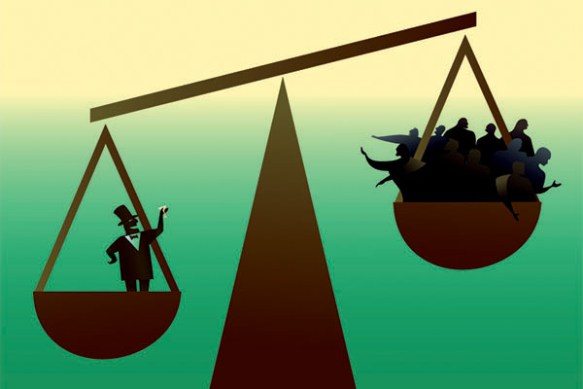
It’s time to call the housing crisis what it really is: the largest transfer of wealth in living memory

By Laurie Macfarlane

Source: OpenDemocracy.net

One of the basic claims of capitalism is that people are rewarded in line with their effort and productivity. Another is that the economy is not a zero sum game. The beauty of a capitalist economy, we are told, is that people who work hard can get rich without making others poorer.

But how does this stack up in modern Britain, the birthplace of capitalism and many of its early theorists? Last week, the Office for National Statistics (ONS) released new data tracking how wealth has evolved over time. On paper, the UK has indeed become much wealthier in recent decades. Net wealth has more than tripled since 1995, increasing by over £7 trillion. This is equivalent to an average increase of nearly £100,000 per person. Impressive stuff. But where has all this wealth come from, and who has it benefitted?

Just over £5 trillion, or three quarters of the total increase, is accounted for by increase in the value of dwellings – another name for the UK housing stock. The Office for National Statistics explains that this is “largely due to increases in house prices rather than a change in the volume of dwellings.” This alone is not particularly surprising. We are forever told about the importance of ‘getting a foot on the property ladder’. The housing market has long been viewed as a perennial source of wealth.

But the price of a property is made up of two distinct components: the price of the building itself, and the price of the land that the structure is built upon. This year the ONS has separated out these two components for the first time, and the results are quite astounding.

In just two decades the market value of land has quadrupled, increasing recorded wealth by over £4 trillion. The driving force behind rising house prices — and the UK’s growing wealth — has been rapidly escalating land prices.

For those who own property, this has provided enormous benefits. According to the Resolution Foundation, homeowners born in the 1940s and 1950s gained an unearned windfall of £80,000 between 1993 and 2014 alone. In the early 2000s, house price growth was so great that 17% of working-age adults earned more from their house than from their job.

Last week The Times reported that during the past three months alone, baby boomers converted £850 million of housing wealth into cash using equity release products – the highest number since records began. A third used the money to buy cars, while more than a quarter used it to fund holidays. Others are choosing to buy more property: the Chartered Institute of Housing has described how the buy-to-let market is being fuelled by older households using their housing wealth to buy more property, renting it out to those who are unable to get a foot on the property ladder. And it is here that we find the dark side of the housing boom.

As house prices have continued to increase and the gap between house prices and earnings has grown larger, the cost of homeownership has become increasingly prohibitive. Whereas in the mid-1990s low and middle income households could afford a first time buyer deposit after saving for around 3 years, today it takes the same households 20 years to save for a deposit. Many have increasingly found themselves with little choice but to rent privately. For those stuck in the private rental market, the proportion of income spent on housing costs has risen from around 10% in 1980 to 36% today. Unlike homeowners, there is no asset wealth to draw on to fund new cars or holidays.

In Britain, we have yet to confront the truth about the trillions of pounds of wealth amassed through the housing market in recent decades: this wealth has come straight out of the pockets of those who don’t own property.

When the value of a house goes up, the total productive capacity of the economy is unchanged because nothing new has been produced: it merely constitutes an increase in the value of the land underneath. We have known since the days of Adam Smith and David Ricardo that land is not a source of wealth but of economic rent — a means of extracting wealth from others. Or as Joseph Stiglitz puts it “getting a larger share of the pie rather than increasing the size of the pie”. The truth is that much of the wealth accumulated in recent decades has been gained at the expense of those who will see more of their incomes eaten up by higher rents and larger mortgage payments. This wealth hasn’t been ‘created’ – it has been stolen from future generations.

House prices are now on average nearly eight times that of incomes, more than double the figure of 20 years ago. It’s unlikely that house prices will be able to outpace incomes at the same rate for the next 20 years. The past few decades have spawned a one-off transfer of wealth that is unlikely to be repeated. While the main beneficiaries of this have been the older generations, eventually this will be passed on to the next generation via inheritance or transfer. Already the ‘Bank of Mum and Dad’ has become the ninth biggest mortgage lender. The ultimate result is not just a growing intergenerational divide, but an entrenched class divide between those who own property (or have a claim to it), and those who do not.

Misleading accounting and irresponsible economics have provided cover for this heist. The government’s national accounts record house price growth as new wealth, ignoring the cost it imposes on others in society – particularly young people and those yet to be born. Economists still hail house price inflation as a sign of economic strength.

The result is a world which is rather different to that described in economics textbooks. Most of today’s ‘wealth’ isn’t the result of entrepreneurialism and hard work – it has been accumulated by being idle and unproductive. Far from the positive sum game capitalism is supposed to be, we have a system where most wealth is gained at the expense of others. As John Stuart Mill wrote back in 1848:

“If some of us grow rich in our sleep, where do we think this wealth is coming from?  It doesn’t materialise out of thin air. It doesn’t come without costing someone, another human being. It comes from the fruits of others’ labours, which they don’t receive.”

Britain’s housing crisis is complicated mess. Fixing it requires a long-term plan and a bold new approach to policy. But in the meantime let’s start calling it what it really is: the largest transfer of wealth in living memory.

The social and economic roots of the attack on democratic rights

Inequality and the American oligarchy

By Eric London

Source: WSWS.org

A report published September 27 by the US Federal Reserve, the Survey of Consumer Finances, shows that the top 10 percent of Americans now own 77 percent of all wealth. The top 1 percent increased its share of wealth from 35.5 percent in 2013 to 38.5 in 2016. The share of the bottom 90 percent declined from 25 percent to 22.9 percent over the same period.

These percentages show a transfer of trillions of dollars from the working class to the rich and affluent in just three years.

The bottom three quarters of the population, some 240 million people, now own less than 10 percent of the wealth. That is, if the United States were a 10-storey apartment building with 100 people, the richest person would be living on the top four floors, the nine next wealthiest people on the next four floors, fifteen on the second floor, and 75 people cramped at the bottom level.

Wealth share by wealth decile, Credit: People’s Policy Project

The Federal Reserve data demonstrates, in empirical terms, profound changes in social relations that affect hundreds of millions of people, touching all aspects of political, cultural and intellectual life. The US is an oligarchy in which the government, trade unions, media, universities, and major political parties are instruments used by the ruling class to manipulate the population, mask its own wealth, and crush social opposition from below.

The figures expose the material basis for the emergence of a campaign in the ruling class to block access to the World Socialist Web Site and other left-wing sites in the guise of combatting “Russian aggression.”

In an oligarchy, social inequality is incompatible with democratic rights. Incapable of and unwilling to address the social needs of the masses of people, the government turns to censorship, surveillance, blacklisting, and violence as its preferred methods for defending unprecedented levels of wealth monopolized by the ruling class.

The data shows that the main dividing line is between the top 10 percent and the bottom 90 percent that comprise the working class. The Federal Reserve figures expose as lies the claims by politicians and media pundits that the bulk of the US population belongs to the “middle class.”

Below the aristocracy and the affluent—concentrated in certain neighborhoods of major centers like New York, the San Francisco Bay Area, Los Angeles, Chicago, Houston, and other cities—the United States is a country dominated by tremendous economic hardship. The data shows that while different strata of the population face economic insecurity at different levels of urgency, decades of social counterrevolutionary policies by both parties are bringing them closer together, marking all with the same scars of class exploitation.

The poorest ten percent of the population, some 32 million people, possess negative wealth. They include the homeless and the hopelessly in debt. For this section of the population, roughly equal to the populations of Texas and New York combined, life expectancy, disease rates, and living standards resemble third world conditions.

The next poorest ten percent have no wealth, between $0 and $5,000 per family, less than the value of a 10-year-old used car. The combined wealth possessed by this layer is not significant as a proportion of overall wealth.

Roughly the lower-middle third of the population, from the 20th to 50th percentile, control just 1.6 percent of total wealth. A family of four with two parents working full-time at the minimum wage with one average-priced vehicle and no other assets would fall in the middle of this broad category of workers.

The 64 million people in the 50 to 70 percent range control just 5.1 percent of the wealth. A family with a below average-priced home worth $150,000, plus a vehicle and $0 in savings would be above the 60th percentile in wealth. A family with two working adults making between $40,000 and $50,000 each would find itself in the 70 to 80 percentile, perhaps possessing two cars, a home valued just above the national average of $175,000, a life insurance policy and $10,000 in savings.

The 80 to 90th percentile owns 11.2 percent of the wealth. Two skilled workers with incomes of $60,000 to $80,000 each, one pension, a $300,000 home, and two vehicles would find themselves in this decile. This section is slightly more comfortable, but by no means financially secure.

The chasm separating the top 10 percent from the working class has widened in recent years. From 2004 to 2016, the working class saw its wealth decline precipitously across all strata. The median family in the poorest fifth lost 29.5 percent of its wealth over this period, followed by 24.7 percent for the median family in the 20th-39th percentile, 10.8 percent in the 40th-59th percentile, 17.3 percent in the 60th-79th percentile, and 1.3 percent in the 80th-89th percentile. This wealth went to the top 10 percent, where median family wealth rose by 38.7 percent over the same period.

As a result of this massive transfer of wealth, median family wealth in the top 10 percent is nearly triple that of the 80 to 90 percent, 20 times greater than a family in the 50th percentile, and 254 times more than the median family net worth in the poorest 20 percent.

The political establishment that has overseen this transfer systematically ignores and aggravates the urgent social problems confronting the vast majority of the population.

Footage of Trump flipping paper towel rolls to victims of the storm in Puerto Rico epitomizes the callous and insulting response of the oligarchy to the problems of the working class. But sanctimonious claims by Democrats that Trump’s actions were “insensitive” ignore the fact that the entire ruling class is responsible for the social catastrophe. After all, it was Barack Obama who travelled to Flint, Michigan and told a crowd of people to “drink the water.” Nobody in the Democratic or Republican parties has made any real effort to address the opioid crisis, homelessness, declining life expectancy, storm protection and disaster infrastructure, skyrocketing student debt and the health care crisis.

The three branches of government, largely comprised of millionaires and billionaires, focus exclusively on the interests and social demands of the top 1, and, more broadly, the top 10 percent of society. A key concern of the affluent 10 percent is blocking the growth of social opposition and protecting their own wealth and privileges. In recent years, the American ruling class has become more aware of the growth of social opposition within the population to war, inequality and poverty.

Fearful that the technological advances of the Internet and social media platforms can increase access to alternative political viewpoints, the oligarchy has initiated a campaign to censor left-wing websites and crack down on social media platforms in the name of blocking “Russian interference” in the US political system. Without a shred of credible evidence to back their claims, newspaper editors, TV talking heads, Senate and House committee members, corporate executives, trade union leaders and academics are engaged in a mad rush to censor the Internet and protect the population from “fake news.”

The anti-fake news censorship and blacklisting initiative is an escalation of a years-long campaign by the ruling class to create the framework for police state methods of rule. At the same time, the growth of social inequality revealed in the Federal Reserve figures points to the inexorable intensification of social and class conflict in the United States, the objective foundation for socialist revolution.

Revolutionary Terror: Mark Steven’s ‘Splatter Capital’

By Michael Grasso

Source: We Are the Mutants

Splatter Capital: The Political Economy of Gore Films
By Mark Steven
Repeater Books, 2017

“Splatter confirms and redoubles our very worst fears. It reminds us of what capital is doing to all of us, all of the time—of how predators are consuming our life-substances; of how we are gravely vulnerable against the machinery of production and the matrices of exchange; and of how, as participants of an internecine conflict, our lives are always already precarious.”

—from the Introduction to Splatter Capital

Political readings or interpretations of horror films are nothing new. But in Mark Steven’s 2017 study, Splatter Capital, an explicit connection is made between the bloody gore of what Steven terms “splatter” horror films and the dehumanizing, mutilative forces of global capitalism. Moreover, Steven posits the artistic motivation behind splatter horror as an explicit repudiation of this system: “It is politically committed and its commitment tends toward the anti-capitalist left.” In splatter films, Steven tells us, the images of gory dismemberment do double duty. They both offer a clear metaphor for capitalism’s cruelty, and act as a cathartic revenge in which the bloody legacy of capitalist exploitation is often visited upon its perpetrators and profiteers among the bourgeoisie.

Some definitions are in order here, given that Steven’s schema of genres—“splatter,” “slasher,” “extreme horror”—draws distinctions that might not be apparent even to horror fans. Splatter horror, according to Steven, is all about the violence that can be visited upon the human body and all the abjection that follows. It is machinery tearing apart flesh, blood, and guts: the moment a human body becomes meat. It differs from the personalized and often sexualized “hunt” of the slasher flick. The protagonist in a slasher movie is an individual (often female) resisting violent death at the hands of another individual (often male). In victory against Jason, Freddy, or Michael Myers, this protagonist, in Steven’s words, “restores a social order, which is all too regularly white, middle-class, and suburban.” Splatter horror not only expands the horizons of mutilation and violence allowable in a horror film but systematizes it. The splatter enemy is an implacable, impersonal force, full of shock and awe; its grudge is not personal, but instead overwhelming, inescapable, and, most importantly, class-based.

The language of violence and horror has been with Marxist thought from the beginning. Steven gives us a good précis of Marx’s use of explicitly Gothic (along with bloody and cannibalistic) imagery throughout his works, as well as a splatter-tastic explanation of the exploitation behind surplus value, using an imaginary case study in the manufacturing of chainsaws and knives. The October Revolution in Russia is viewed as a reaction to the inhuman mechanized slaughter of the first World War; Eisenstein’s early filmic paeans to the necessity of revolution such as Strike (1925) demonstrate, thanks to Eisenstein’s pioneering use of montage, capitalism’s role as butcher. Steven also discusses avowed leftist filmmakers from outside the Soviet Union such as Godard, Makavejev, and Pasolini—specifically their use of gore to embody the cruelty of the ruling classes.

As we enter the world of Hollywood film in Chapter Three, Steven examines splatter film as a specifically American reaction to the constant churning crisis of capitalism. Specifically, Steven looks at the two peaks of gore-flecked horror—the mid ’60s through the early ’80s, and the post-Cold War “torture porn” trend of the early ’00s—as expressions of two very important economic and political shifts. The first splatter peak in the ’70s is seen as a clear reaction to the slow, inexorable widening of neoliberal and globalist postindustrial economics and its impact on the American industrial worker. (The aftermath of this trend continues into the 1980s with the evaporation of industry and the establishment of a new information-and-finance-based economy.) The splatter/torture porn trend of the ’00s and beyond is a reaction to the crises of capitalism under a new world order of neocolonialist conflict: the War on Terror, the final disestablishment of the Western industrial base in favor of cheap labor in the developing world, and the new interconnected, networked world’s rulership by speculative capital in the form of the finance sector.

Steven cites too many splatter movies to cover in this review, but central to his thesis is the seminal 1974 Tobe Hooper film, The Texas Chain Saw Massacre. The death of local industry leads Leatherface and family to keep their slaughterhouse traditions alive by carving up and eating young people. These young people, Steven is quick to point out, are only here at all because they were unable to get gas for their car (thanks to the first of two 1970s oil crises). American decline is everywhere; betrayal by global economic forces are central to the trap that’s being laid by the cannibals. (Of course, the carnage of the Vietnam War can’t be overlooked here either, given the visual language of ambush, capture, and torture; Hooper himself has cited this in subsequent interviews.) Steven notes that the victims in The Texas Chain Saw Massacre are representative of a bourgeoisie who don’t know how the sausage is made. It’s important and vital, Steven says, that the cannibalistic side of splatter involves the bourgeoisie being forced to eat members of their own class. It’s Burroughs’s famous “naked lunch“: “the frozen moment when everyone sees what is at the end of every fork.”

As the neoliberal takeover of the world economy begins in earnest in the 1980s, as complex and largely ephemeral systems of mass media and finance take the place of the visceral, grinding monomania of industrial capitalism, splatter horror follows suit. Steven’s analysis of David Cronenberg’s Videodrome (1983) is especially sharp, examining the links between the body horror of the film and the Deleuzian body without organs. Max Renn’s body becomes an endlessly modular media node, able to accommodate video cassettes, to generate and fuse with phallic weapons (used to assassinate and destroy the media forces who’ve made him this way), to mesh and mold and mix with the hard plastic edges of media technology. By the end of the film, Renn is a weapon reprogrammed and re-trained on the very media-industrial complex that made him. More body horror: the cult classic Society (1989) and its shocking conclusion posits the ruling class as a cancerous monster, an amorphous leviathan straight out of a Gilded Age political cartoon, eating and fucking and vomiting, red in tooth and claw and pseudopod. Barriers between bodies break down; the system begins swallowing up all alternate possibilities.

By the time the Cold War is finished, the era of post-9/11 eternal war, of Abu Ghraib and Guantanamo, led to the popular new splatter sub-genre of “torture porn.” Steven identifies the genre’s distinguishing aesthetic feature: the indisputable, systematic, and worldwide victory of capitalism and the hypnotic Spectacle that accompanies it. In this era, there are no longer any alternatives. Everyone, rich and poor, is trapped in the system, and the system reintegrates torture into a worldwide video spectacle. This is embodied in both the global conspiracies of the wealthy in Roth’s Hostel series and in the Jigsaw Killer’s industrially-themed Rube Goldberg devices in the Saw franchise—devices of dismemberment explicitly linked to moral quandaries reminiscent of capitalism’s impossible everyday Hobson’s choices for the working class. The system will go on consuming you, whether you’re unlucky enough to be a splatter film’s victim, or “lucky” enough to wield the power to splatter (for example, Hostel: Part II‘s reversal of fate on the ultra-wealthy hunters, or the Jigsaw Killer’s death from cancer in Saw III—ultimately due to… a lack of health insurance).

Possibly the most intriguing aspect of this already very good book is Steven’s interspersing of personal anecdotes on when and where he discovered some of his favorite horror and genre films. By placing his personal and psychological experience of splatter films front and center, and linking it to his personal growth and increasing political maturity, he demonstrates the personal impact of the political, and the necessity of personal epiphany, mediated by culture, to achieve political awareness. Splatter Capital ultimately is not a book for the already-convinced and committed leftist, the Marxian thinker already well-versed in theory. (Another of Splatter Capital‘s very strong points is how Steven largely eschews jargon and obscurantism for an approachable tone and topic that laypeople can dive into easily.) It is for the fans of these films who’ve always wondered about the ineluctable appeal of visceral, shocking violence on screen, and perhaps why it all feels so strangely familiar.

Financialization, precarity and reactionary authoritarianism

By increasing global competition, the precariousness wrought by financialization has laid the foundations for reactionary authoritarianism around the world.

By Max Haiven

Source: ROAR

Financialization: Fictitious Capital in Popular Culture and Everyday Life, released last month in paperback from Palgrave Macmillan. The book argues that financialization is not just the increasing power and authority of speculative capital over the global economy, but also the way the it seems into and is reflected in politics, social institutions and the realm of cultural meaning.

This section comes at the end of a chapter on the ways financialization both drives onward and depends on the increasing precariousness of workers, putting us into global competition with one another and also infecting our sense of value and success. Haiven argues that this situation produces a tendency towards reactionary authoritarianism based on a “forgetting” and a loathing of our shared human condition of precariousness. He concludes by asking us to consider other models for thinking about debt and precarity that stress radical interdependence.

It is followed by a brief authors’ note reflecting on the piece four years since it was first penned in 2013.


Precarious fear and loathing

Today precariousness is the norm, not the exception. Our current precarious moment, one dominated by market and financial forces and manifesting itself as a violent form of hyper-neoliberal austerity (which is producing ever more and deeper economic precariousness), is only one particularly pernicious manifestation of an underlying ontological condition. It is worse than many such manifestations precisely because it is so successful in privatizing precariousness through the logic of individualism and competition.

We come to blame ourselves, rather than the system, for our precariousness, in part because, unlike some rigid caste-based system or a slave society, we are (most of us) legally and technically free to escape precariousness (though, ironically, to escape by embracing precarity, by using every skill, talent and asset we might possess to leverage ourselves into fabled prosperity). It is a system that works by promising that we can, each of us, alone, escape our existential condition of precariousness by getting rich, by obeying the system’s axiomatic dictates and playing our role.

The constant barrage of images and tales of the lifestyles of the rich and famous, of celebrities and of others who have “made it” do not exist (as they did in a previous era) to show us the right social order and the natural superiority of certain sorts of people. Rather, these ubiquitous dream-images promise each of us a life without precariousness or, more accurately (if we think about the cinematic depictions of the Wall Street predator) a life where precariousness is mastered and leveraged.

This helps explain the virulent disdain that grows and grows towards the poor, the refugee, the  (almost always racialized) populations deemed to be “at risk.” To the extent that we succeed in leveraging ourselves out of the total liquidation of our lives by building up a life of financial prosperity and (the illusion of) security, we are compelled to close ourselves off to what Judith Butler, drawing on the work of Emmanuel Levinas, calls the “face” of the other: the empathetic image of existential suffering. In fact, to the extent participation in financialization has come afford us the privilege of forgetting our inherent shared condition of precariousness, we come to loathe the face of precarity, loathe the way it calls us back into a fellow precarious human body.

The colors of risk

As a result, we should not expect that the almost universal adoption of the free market will lead to any sort of peace or cosmopolitanism in the world, as neoliberal thinkers like Fredrich Hayek or Francis Fukayama believed. Nor should we assume that the financialized age of austerity will prompt such a wave of popular discontent that radical social transformation is inevitable. To the extent that we are made more and more precarious, we brew an existential anger, a self-loathing that can easily be displaced onto convenient others.

Ironically, it is not easily displaced onto the architects and beneficiaries of financialized capitalism, but instead gravitates towards the more precarious, the more abject: they who call us back into the shared precarious what Marx called our “species being,” our shared precarious condition as imaginative cooperative animals dependent on one another for joy and survival. While this may or may not manifest itself in the form of new nationalisms, it will manifest itself in the form of hatred towards the homeless, towards refugees, towards welfare recipients and towards others.

It is vital to note that, in North America and Europe, and in different ways elsewhere, this precarious vitriol cannot be separated from the history of race and racism. Older modes of racial enslavement, apartheid and segregation served the same function, similarly allowing those read as “white” to posit a superior form of humanity which both occluded a shared precariousness and elevated the material wealth and security of whites at the expense of immiserated, exploited and impoverished non-whites (in different ways, in different times and places).

Indeed, earlier moments of capitalism explicitly mobilized whiteness and its real and perceived benefits vis-a-vis precariousness to divide workers along color lines, a condition that fed, and was fed by, the existential precariousness of non-whites who, as second-class citizens, slaves, migrant laborers or perpetual “outsiders,” were not afforded the same personal safety or security (neither de jure nor de facto).

The current reigning assumption is that we have entered a “post-racial” moment, that racism is merely a marginal anachronism, and that racialized people face no systemic barriers to achieving a non-precarious life like “everyone else” — in other words, they are as free to enter the market as anyone else, and the market does not “see” race. The opposite is, in fact, the case: racism and racial inequality towards non-white people persist and, in some ways, are even worse thanks to the mechanisms of financialized market which also works to make those inequalities functionally invisible.

Banking on resentment

On another level, we might speculate that precariousness, in both image and concept, is already racialized, that our understandings of what it means to be precarious, and the negative associations with which this term resonates, are already coded as non-white and call up a legacy and a present of racialized images of abjection, destitution, subservience and shiftlessness. Indeed, we might ask to what extent political systems in the West base their legitimacy on the invisiblized darkness of precariousness. The politically expedient citation of the disappearance of “hard-working Americans” and “the middle class” (both of which are imagined as white) into a dark miasma of economic depression is indelibly associated with popular depictions of ghettos and menial racialized workers.

Suffice it for now to say that we can certainly see these trends as played out in largely white backlash movements which have arisen to confront non-white peoples’ or groups’ claims to social and economic justice. From anti-Muslim organizing in Western Europe (framed in terms of defending a white national heritage and white workers), to anti-Black “whitelash” in the United States (from the Detroit Riots to Rodney King to Trevon Martin), to the anti-Indigenous vitriol in my home country of Canada, these seemingly spontaneous “social movements” speak not only to the politics of ignorance and fear, but also to the socio-economic conditions of precariousness, as well as the perceived failure of the state to live up to its promises to prevent precariousness for white people, all coupled with a history that locates precariousness along the axes of race and racialization.

This deeper existential and ontological crisis and anger is joined by another: the crisis of the middle class. Those professional or semi-professional workers who have been taught to expect middle-class incomes and job security are quickly finding themselves disposable in a vast pool of precarious workers, leading highly indebted, precarious lives with little hope for reprieve. In the coming years, increasingly fascistic political powers will gain ground by offering hollow promises to rebuild the middle class and to end precarity, through neocolonial geopolitical adventure or by creating or maintaining localized under-classes of hyper-precarious migrant or abject workers.

The cult of risk management

What would a politics look like that promised not to end but to embrace precariousness, not as an inescapable economic “reality” (which is what our current system of financialized austerity pledges) but as a socio-ontological sine qua non?

The answer is yet to be determined. But, ironically, an answer may be emerging out of the financialized paradigm that has driven precariousness to a new level of universality and acuity. The speculative ethos that animates financialization is one intimately and irreducibly acquainted with the ontological realities of precariousness. “Risk” and “risk management” are, underneath all their trappings of quantitative and scientistic rigour, mythological constructs for engaging with, navigating through and manipulating the cultural fabric of precariousness. Investments are, at a certain abstract level, attempts to leverage precarious life into more advantageous out- comes.

Finance, as a broad sphere of activities, is a mechanism by which individuals and society at-large seek to gain agency over the precariousness and contingency of the future. It is a particularly perverse mechanism, and one whose logic and mechanisms are either occluded from sight, or so complex, rapid or vast to be fully grasped, even by their primary engineers and agents in hedge funds and investment banks. Yet finance reproduces itself by cultivating and mobilizing the energies, creativity and hope of almost everyone in their attempts to thwart or diminish precarity, and aggregates all these individual and institutional actions into a system which, tragically, only drives greater and greater precariousness.

Generative debts?

The silver lining is perhaps this: what financialization reveals is the inherent futurity of precariousness. The word itself derives from the Latin prex or prayer, with strong connotations of begging or soliciting: yearning for future outcomes, throwing oneself on the mercy of fate or divine provenance. What our financialized moment might reveal is that our shared precariousness, which is the condition both of disastrous authoritarianism (including the disorganized and diffuse totalitarianism of finance capital itself) and of solidarity, does not only emerge from our shared material and ontological conditions; it is also a horizon of shared futurity. That is, precariousness carries encrypted within it a shared relationship with the future.

In this sense, nascent anti-debt organizing in the United States and elsewhere bears a great deal of potential. As Richard Dienst, David Graeber and Andrew Ross all affirm, the politics of debt, if they are to be a radical challenge to the financialized empire, cannot simply be a demand for some libertarian fantasy of complete individual freedom. Rather, they must embrace a broader, more capacious concept of the ontological wealth of social bonds that make life possible, that render all of us precariously reliant on one another. In this sense, they, each in their own way, encourage us to envision an expanded notion of (non-monetary) debt beyond as a grounds for crafting and building common futures through the entanglement of our social relationships.

Likewise, Angela Mitropoulos insists on the importance of moving beyond the limited concepts of financial debt and “debt servitude,” which depend upon and exalt the ideal of the individuated (white, masculine) self, the esteemed, contract-making personage at the heart of Western liberal political and economic philosophy and law. She notes that behind today’s politics of debt there reside the unacknowledged debts germane to the worlds of social reproduction and affective labor on which we all rely, which today are increasingly commodified in the so-called service sector. Indeed, the growth of precarious, feminized service-based labor over the past few decades cannot be separated from the rise of debt as a means to discipline workers and extract surplus value. Beyond the hollow promise of an ideal state of freedom from all obligations, radical potentialities might emerge from the affirmation and recognition of shared interdependency, of the shared need for what today is misrecognized as “service.” As she puts it:

The question it seems to me is not whether our debts can be erased, but what the lines of indebtedness are, how debt is defined, whether it takes the form of a financial obligation or some other consideration of relational inter-dependence, of the forms of life that the routine accounting of debts lets flourish or those that it obscures behind propositions of a seemingly more natural order of individuation, dependence, and obligation.

Beyond the colonial bond?

Glen Coulthard articulates a radical Indigenous reenvisioning of obligation that goes well beyond the Western philosophical canon:

Consider the following example from my people, the Dene Nations of what is now the Northwest Territories, Canada. In the Yellowknives Dene (or Weledeh) dialect of Dogrib, land (or dè) is translated in relational terms as that which encompasses not only the land (understood here as material), but also people and ani- mals, rocks and trees, lakes and rivers, and so on. Seen in this light, we are as much a part of the land as any other element. Furthermore, within this system of relations human beings are not the only constituent believed to embody spirit or agency. Ethically, this meant that humans held certain obligations to the land, animals, plants, and lakes in much the same way that we hold obligations to other people. And if these obligations were met, then the land, animals, plants and lakes would reciprocate and meet their obligations to humans, thus ensuring the survival and well-being of all over time.

Coulthard’s articulation of a broader field of grounded land-based obligation, reciprocity and care demonstrates the radical potentialities that might emerge from a reconsideration of the bonds of debt and the conditions of shared precarity, were we open to re-envision their meanings beyond the hollow promises of security proffered by capital and the state.


Since the publication of Cultures of Financialization I have felt unhappily vindicated in my suspicion that financialization would give right to revanchist authoritarianism. But were I to approach the topic of this excerpt again, I would take more care to locate the origins of the loathing of precariousness within the specific histories of anti-Black racism. I would approach this by making more explicit the origins of finance capital in the trans-Atlantic slave trade and slave economies in the Americas. I would follow this tendency through to the present-day ways that anti-Black racism and white-supremacy, as the template and operating condition of all forms of modern racism, is manifested again and again in the machinations of the financial empire, from the continued neocolonial pillage of Africa to the racialized dimension of the sub-prime loan crisis which led to the single largest theft of Black family wealth since Reconstruction.

Were I to approach this topic again I would also stress more centrally the ways in which settler colonialism destroys and denigrates a cooperative relationship with land, most horrifically by seeking the systematic elimination of autonomous Indigenous presence and power on land. I would seek to understand (as I have elsewhere) how settler colonialism has always been a financialized project, and how financialization has, historically and in the present, been enabled by settler colonialism.

I think that only with these in mind can we seek to understand how financialization has given rise not only to new forms of authoritarianism that promise (white people) respite from the precarity financialization has created, but which are fundamentally based on the acceleration and intensification of white supremacy and settler colonialism.

Finally, were I to approach this chapter again I would caution myself against a conclusion that could appear to call for a kind of new universalist embrace of shared precarity. I would have concerned myself with the way such a universalism, while noble in a certain abstract sense, can work to erase precisely the continued centrality of (anti-Black) racism and settler colonialism. Instead, I would have stressed that overcoming financialized precarity and these systems of oppression and exploitation will be based not only on high-minded virtues but meaningful relationships of militant solidarity and the collective invention of new forms of power, new institutions of care and new frames and practices of revolutionary thought and action.

Cause of USA Meltdown and Collapse of Civil Rights

By Denis Rancourt

Source: Dissident Voice

SUMMARY: Societies of social animals, including humans, are dominance hierarchies. Civil rights are codified in law to protect mechanisms of essential counter measures against excessive exploitation of the hierarchy by elite classes, which destabilizes the entire society. Systemic pathology arises when elite classes can change the regulatory codes themselves, including civil rights protections, with impunity. Laws that quash civil rights are pathological in that they impede the system-repair mechanisms that are: free expression, free association, class opposition, and negotiated structural adjustments (otherwise known as democracy). Present anti-speech laws are extreme examples of pathological laws, the application of which is a measure of the degree of totalitarianism in the society. The history of the USA of recent decades is an eminent illustration of the concepts.

*****

The USA meltdown has been decades in the making and is the collateral result of an elite predation that has degraded structural elements needed for a healthy and resilient nation.

The aftermath is “too much regulation at the bottom, not enough at the top”: a pathological legislative and institutional structure in which elite interests have too much freedom to challenge and exploit democratic nation states, whereas middle, working and professional class actors, including small and medium-size private business, are economically, ideologically and politically constrained and suppressed to an excessive degree.

It has been a class war in which the predatory classes have barricaded themselves while inflicting humiliating defeat and loss of power, purpose and identity on the lower-stratum classes, which are incited to fight among themselves within the confines of new rules and the guarded illusion that these rules are an actuation of natural order.

In this way, personal and community motivation and inventiveness are sapped. The very motor of a vibrant modern society is jammed and the entire system becomes a system of debt-ransom extraction and management of globalized exploitation for the benefit of a secluded elite.

In this emergent system of excessive class exploitation, civil rights that protect critics and organizers become a threat against the exploiters rather than needed protections of personal and community emancipation that sustains economic production and innovation.

Allow me to explain, starting from fundamental considerations.

Arguably, the most fundamental statement that a social scientist can make is that humans interact by both violent and non-violent means, both individually and as groups, to establish and maintain societal dominance hierarchies. Call it by any name (tribalism, capitalism, socialism, totalitarianism…) humans always establish, maintain and grow dominance hierarchies, using whatever technology of the day.

The political end-point concept of “anarchy” is the theoretical absence of dominance hierarchy, which has never been ideally achieved and which is evidently unstable against growth of and replacement by dominance hierarchy. The reality of social animals is dominance hierarchy, which spontaneously adapts itself to environmental conditions and to the population size, while integrating accumulated knowledge and technological advances.

Within a dominance hierarchy (within a society), the essential counter against destabilizing excesses of dominance is push-back from individuals and groups — engendered by the individual desire for life, freedom and local influence — which acts in every stratum of the hierarchy.

In historically recent human societies, essential push-back is formalized with written laws that protect the individual against dominance encroachments that would be so severe that they would threaten hierarchical stability by increasing the potential for rebellion. These laws were at times deemed to be God-given and are now referred to as “civil rights”. They include both: (1) protections of the individual and of the nuclear and extended family against arbitrary attacks by the state or by rogue elements, and (2) protections for the individual and groups to seek redress and express grievances.

All laws are evolving codes to organise, stabilize and enforce an ever changing (often growing and complexifying) dominance hierarchy. “Good” laws find a “balance” between the graded benefits of hierarchy and the stratified oppressions against individuals and groups, a balance which stabilizes the whole system against deterioration (“injustice”), complete overhaul (“revolution”), or extinction (“downfall”).

Predictably, the codes themselves are often “hacked” by upper-strata groups that are overly ambitious in seeking additional relative advantages. The hacking upper-strata groups will recklessly change the laws for their own advantage in ways that materially threaten overall stability. This produces “pathological” laws that destabilize the overall hierarchy by driving society towards an intolerable degree of totalitarianism.

A now recognized on-going example is the decades-long elite attack, by taxation and global-finance reforms, against the USA middle class, which has prematurely destabilized the USA-centered global empire and its domestic internal society. The blowback from and defences against the USA’s practice of aggressive global dominance has also contributed, where the latter practice is similarly enabled by hacked foreign-policy and global governance laws.

When law-makers themselves can be bought by selfish elites self-segregated from the broad or domestic society, it is a recipe for disaster. In the USA and Canada law-enactment errors are multiplying, and there are no substantial Senatorial safeguards. Law-makers are formed or trained into compliance by career-enabling elites, rather than informed, principled and concerned about public service. Political parties are systematically controlled and constrained by the highest hierarchical echelons, which control the economy and the media.

When the backbone structure of the dominance hierarchy is thus degraded, as with the present crisis of the middle class, there is an impulse for both societal groups and lawmakers to become frantic and for the barricaded elite to exploit and ride out the storm rather than participate in repair. Every new manifestation of rebellion is interpreted as a fire to be extinguished rather than as necessary pushback needing to be allowed to play out. Decades of built-up fuel in the underbrush and extended drought are conditions for a devastating inferno but our “representatives” are successfully goaded into superficially addressing every new spark and violently suppressing every outbreak rather than dealing with the fundamentals.

Over decades, a complete restructuring of the relation between the state and the economy has been engineered, which, in its oppressive excesses, has led to the present crisis. The assault was accompanied by massive propaganda campaigns regarding the security benefits of government control and the welfare benefits of corporate rule. For example, predatory corporate take-over “investment” in public-service infrastructure is now presented as a good thing that should be actively sought using public funds.

The restructuring included: rolling back taxation of the wealthy while maintaining taxation of the middle and working classes, reducing or eliminating corporate taxation, increasing capital mobility, allowing investment flight, allowing infiltration of government-oversight and regulatory agencies (especially in the finance sector), gutting corporate regulatory agencies while transferring to self-regulatory models, unprecedented ideological control of professional workers in the public service (teachers, police, scientists, public servants, judges…), unrestrained lobby and think-tank influence, and unprecedented limitations (regulatory burdens) imposed on small and medium-size private businesses.

Top-level elite desires and machinations have become embedded into the very institutional structure of the economy and of the “deep state” more than ever previously. This is the result of decadal erosion of democracy and continuous increase of integration of government itself into the hierarchical power structure. The global-scale project is enabled by owned military, surveillance, communication, transportation and resource-extraction technologies; and surveillance and projection-of-power capabilities are unprecedented in history.

The resulting decadal overhaul of Western nations — in the march towards USA-centered globalism and the neutralization of Western middle and professional classes — has built-in deleterious structural features, as follows.

Mega corporations and financiers and their deep-state partners have not only militarily and covertly occupied the exploitable globe, they have also installed predation against the Western middle classes and Western public infrastructures. They have gutted mass education and maintained only elite schools for their managers and engineers. And they have gutted the Western middle and professional class mind and ethos and replaced these with canned concepts devoid of emancipating political thrust. More importantly, the educational and societal-maintenance institutions themselves have been transformed by removing professional independence and responsibility and replacing them with ideological obedience and observance of dictated think-tank-produced mantras.

The consequential suicidal pathology of the system’s operational code is twofold.

First, the new freedom and power of the USA-centered mega entities are used to eviscerate the very nation state whose structure evolved to optimally stabilize the nation-based dominance hierarchy. Even the world structures of international relations are hijacked and eviscerated to a higher degree.

Second, the middle and professional classes palpably lose many of the benefits accrued from accepting hierarchical domination, including loss of influence, and consequently suffer a crisis of identity, meaning and outlook… driven by real economic threat (loss or degradation of job and home).

Macro-economic data reveal the decadal transformation since 1980 but do not explain its source or describe its cultural, psychological and class impact. The data are generally cast as the result of an accident that can be fixed by more of the same from one of the two front parties.1

In the real circumstances of the worsening middle-class crisis, it is natural that grievances are aired and solutions are sought to recover lost status. But at the same time, advocacy and the potential for an organized response are threats to the top-layer elites and embedded deep-state managers who have intentionally driven the system towards greater hierarchical control and increased upper-stratum gain.

That is why the system reacts by removing civil rights and sabotaging any technology or application venture that would enable communication and free association.

Whereas expression and grass-roots political response would repair the edifice, the needed remedy is aggressively quashed by those at the top who judge that the crisis is not one that can truly threaten them, is one that will dissipate with time or can be fixed synthetically, and that the distributed spontaneous solution is unacceptably risky in its potential to expose them.

There results the paradox that the system delays self-repair, builds up the pressure for repair, and creates worsening societal conditions rather than allow the proven natural remedy: free expression, free association, class opposition (based on the actual grievances rather than surrogates), and negotiated structural adjustments.

The pathology of the system in rejecting self-repair can be understood as follows.

Dominance hierarchies are both stable and evolutionarily advantageous only if effective balancing forces against creeping or runaway totalitarianism are admitted. A dominance hierarchy is doomed when its highest codes allow an elite class to have disproportionate power, including the power to modify the highest codes without restraint. In particular, in a society in which the state — controlled by an elite class — effectively has a technological monopoly on lethal force, the balancing mechanism of free expression, free association, and real influence — otherwise known as “democracy” — must be allowed.

It follows that any code that prevents free expression and free association is itself pathological. If all expression and all association are allowed, then the optimal conditions for self-repair are realized and a stable and resilient hierarchical structure will result. Since it is grounded in free expression and free association, then it will be optimally just. Justice is a thus self-organized and maintained hierarchy, not elite-given “equity” within a totalitarian matrix.

For free expression and free association to be meaningful many necessary conditions are implied: access to information, actual institutional transparency, access to the travel and communication infrastructures, absence of imposed barriers to association, absence of controls over personal choices, real opportunity for decent economic conditions that allow significant democratic participation, and the very novel concept of uniform application of just laws… Any rule that in-effect bars a necessary condition is also itself pathological.

I end this essay with a consideration of the special features that make anti-expression laws pathological, in the above sense of preventing self-repair of the societal dominance hierarchy.

The anti-speech laws, whether cast as “hate speech” criminal code provisions, or civil defamation law, or civility “codes of conduct” on campuses, have been manipulatively introduced by the elite because the elite are those most threatened by free speech and free association.

Speech is the means by which individuals use non-violent persuasion to acquire influence in society. It is the means that enables politics. In the USA, where citizens have a beneficial right even to bear arms for any required overthrow of the government2,3, freedom of expression was meant to be absolute, in that the USA constitution does not have a “balancing” clause as is common in other Western jurisdictions.4

Laws that enforce punishment for individual speech allegedly “causing” negative personal reactions in society at large are antithetical to democracy, and are immeasurably harmful to human emancipation and personal development. The above-mentioned examples are such anti-speech laws, notably including defamation law.5 They enforce punishments against individual speech that is alleged to “cause” an emotional or persuasive effect in others, which is deemed an unacceptable effect that must be targeted for elimination by state intervention against the presumed “cause”.

The said “emotional or persuasive effect” alleged to arise from the spoken words, in different laws, includes:

  • being induced to feel “hate” (anger, hostility, animosity) against a group in society
  • being induced to have a negative overall opinion about a specific person
  • being induced to adopt an ideology or political stance deemed impermissible (“hateful”)
  • being induced to commit suicide
  • being induced to participate in actuating a genocide
  • being induced to commit crimes of physical aggression or property damage

The underlying principle of these laws is that the person speaking words carries a punishable liability for what those words might induce in unspecified others, irrespective whether any actual physical crime occurs and irrespective of whether the words determinatively “cause” an actual physical crime. To be clear, under these laws, a judge arbitrarily (without needing evidence beyond the impugned words themselves and their method of delivery) decides whether the words induce deemed undesirable thoughts, opinions and attitudes in unspecified persons at large. Nothing else is required to establish liability or guilt, and by design it is impossible to disprove the charge, nor is an attempt to disprove admitted in court.

No matter how it may be masked with legalese or scholarly rationalization, this is precisely the nature of the anti-speech codes that are: “hate speech” criminal code provisions, anti-blasphemy laws, anti-historical-revisionism laws, anti-obscenity laws, the common law of civil defamation, and campus codes of conduct. One could add any “norms of expressive conduct” law.

For example, in defamation law, the impugned words are presumed to “cause” a low opinion of the plaintiff in the minds of unspecified others at large. In legalese: “general damage to reputation is presumed”. No causation proof is required of the claimant. Intent to harm is irrelevant (malice is presumed). No actual damage (loss of job, etc.) need be established. The words themselves as perceived by the judge are sufficient evidence. The judge must only opine, not on the intended meaning of the words, but on the meaning of the words in the mind of an imaginary listener. Such is civil defamation law, and there is no legal limit on the quantum of damages or the duration of gag orders that may be ordered under penalty of jail.5

These anti-speech laws, of course, are distinguished from laws that address harassment and intimidation of a specific target person (actual victim) or that address chain-of-command orders to commit crimes. They are also distinguished from the tort (law) of injurious falsehood, which “consists of the malicious publication of a falsehood concerning the plaintiff that leads other persons to act in a manner that causes actual loss, damage, or expense to the plaintiff,” irrespective of any effect on “reputation”.6

Thus, the anti-expression laws are eminently pathological from a systemic perspective. They directly impede repair of the dominance hierarchy, without providing any systemic benefit. They achieve this by suppressing the individual impulse to influence by communication, which is the elemental foundation of democracy.

As such, a study of the development of and pervasive use of anti-speech laws informs us both of the intensity of harmful elite efforts to protect illegitimate advantages and of the degree of totalitarianism in society. The present USA (civil) war on “hate expression” and its condoning by large swaths of society is a measure of a high degree of totalitarianism and a concomitant high degree of manipulation of public sentiment. It is an indicator of fundamental internal instability of the kind that accompanies the collapse of an empire.

  1. Our Broken Economy, in One Simple Chart”, by David Leonhardt, The New York Times, 2017-08-07. []
  2. Negroes with Guns”, by Robert F. Williams, 1962 (Martino Publishing, CT, 2013). []
  3. How Nonviolence Protects the State”, by Peter Gelderloos, 2007 (South End Press). []
  4. Towards a Rational Legal Philosophy of Individual Rights”, by Denis Rancourt, Dissident Voice, 2016-11-15. []
  5. Canadian defamation law is noncompliant with international law”, by Denis Rancourt, Ontario Civil Liberties Association, 2016-02-01. (And published in Dissident VoicePart-1Part-2). [] []
  6. Injurious Falsehood”, mcconchie law corporation (legal encyclopedia), accessed on 2017-09-06. []

Power Corrupts: A Culture of Compliance Breeds Despots and Predators

President Bill Clinton and Miramax Chief, Harvey Weinstein at Hillary Clinton’s Birthday Party at the Hudson Hotel in New York City. October 25, 2000 (Photo: Nick Elgar/ImageDirect)

By John W. Whitehead

Source: The Rutherford Institute

“All governments suffer a recurring problem: Power attracts pathological personalities. It is not that power corrupts but that it is magnetic to the corruptible.”― Frank Herbert

Power corrupts.

Worse, as 19th-century historian Lord Acton concluded, absolute power corrupts absolutely.

It doesn’t matter whether you’re talking about a politician, an entertainment mogul, a corporate CEO or a police officer: give any one person (or government agency) too much power and allow him or her or it to believe that they are entitled, untouchable and will not be held accountable for their actions, and those powers will eventually be abused.

We’re seeing this dynamic play out every day in communities across America.

A cop shoots an unarmed citizen for no credible reason and gets away with it. A president employs executive orders to sidestep the Constitution and gets away with it. A government agency spies on its citizens’ communications and gets away with it. An entertainment mogul sexually harasses aspiring actresses and gets away with it. The U.S. military bombs a civilian hospital and a school and gets away with it.

Abuse of power—and the ambition-fueled hypocrisy and deliberate disregard for misconduct that make those abuses possible—works the same whether you’re talking about sexual harassment, government corruption, or the rule of law.

For instance, 20 years ago, I took up a sexual harassment lawsuit on behalf of a young woman—a state employee—who claimed that her boss, a politically powerful man, had arranged for her to meet him in a hotel room, where he then allegedly dropped his pants, propositioned her and invited her to perform oral sex on him.

Despite the fact that this man had a well-known reputation for womanizing and this woman was merely one in a long line of women who had accused the man of groping, propositioning, and pressuring them for sexual favors in the workplace, she was denounced as white trash and subjected to a massive smear campaign by the man’s wife, friends and colleagues (including the leading women’s rights organizations of the day), while he was given lucrative book deals and paid lavish sums for speaking engagements.

William Jefferson Clinton eventually agreed to settle the case and pay Paula Jones $850,000.

Here we are 20 years later and not much has changed.

We’re still shocked by sexual harassment in the workplace, the victims of these sexual predators are still being harassed and smeared, and those who stand to gain the most by overlooking wrongdoing (all across the political spectrum) are still turning a blind eye to misconduct when it’s politically expedient to do so.

This time, it’s Hollywood producer Harvey Weinsteinlongtime Clinton associate and a powerhouse when it comes to raising money for Democrats—who is being accused of decades of sexual assaults, aggressively sexual overtures and harassment.

I won’t go into the nauseating details here. You can read them for yourself at the New York Times and the New Yorker.

Suffice it to say that it’s the same old story all over again: man rises to power, man abuses power abominably, man intimidates and threatens anyone who challenges him with retaliation or worse, and man gets away with it because of a culture of compliance in which no one speaks up because they don’t want to lose their job or their money or their place among the elite.

From what I’ve read, this was Hollywood’s worst-kept secret.

In other words, everyone who was anyone knew about it. They were either complicit in allowing the abuses to take place, turning a blind eye to them, or helping to cover them up.

It’s not just happening in Hollywood, however.

And it’s not just sexual predators that we have to worry about.

For every Harvey Weinstein (or Roger Ailes or Bill Cosby or Donald Trump) who eventually gets called out for his sexual misbehavior, there are hundreds—thousands—of others in the American police state who are getting away with murder—in many cases, literally—simply because they can.

The cop who shoots the unarmed citizen first and asks questions later might get put on paid leave for a while or take a job with another police department, but that’s just a slap on the wrist. The shootings and SWAT team raids and excessive use of force will continue, because the police unions and the politicians and the courts won’t do a thing to stop it. Case in point: The Justice Department will no longer attempt to police the police when it comes to official misconduct. Instead, it plans to give police agencies more money and authority to “fight” crime.

The war hawks who are making a profit by waging endless wars abroad, killing innocent civilians in hospitals and schools, and turning the American homeland into a domestic battlefield will continue to do so because neither the president nor the politicians will dare to challenge the military industrial complex. Case in point: Rather than scaling back on America’s endless wars, President Trump—like his predecessors—has continued to expand America’s military empire and its attempts to police the globe.

The National Security Agency that carries out warrantless surveillance on Americans’ internet and phone communications will continue to do so, because the government doesn’t want to relinquish any of its ill-gotten powers. Case in point: The USA Liberty Act, proposed as a way to “fix” all that’s wrong with domestic surveillance, will instead legitimize the government’s snooping powers.

Unless something changes in the way we deal with these ongoing, egregious abuses of power, the predators of the police state will continue to wreak havoc on our freedoms, our communities, and our lives.

Police officers will continue to shoot and kill unarmed citizens. Government agents—including local police—will continue to dress and act like soldiers on a battlefield.

Bloated government agencies will continue to fleece taxpayers while eroding our liberties. Government technicians will continue to spy on our emails and phone calls. Government contractors will continue to make a killing by waging endless wars abroad.

And powerful men (and women) will continue to abuse the powers of their office by treating those around them as underlings and second-class citizens who are unworthy of dignity and respect and undeserving of the legal rights and protections that should be afforded to all Americans.

As Dacher Keltner, professor of psychology at the at the University of California, Berkeley, observed in the Harvard Business Review, “While people usually gain power through traits and actions that advance the interests of others, such as empathy, collaboration, openness, fairness, and sharing; when they start to feel powerful or enjoy a position of privilege, those qualities begin to fade. The powerful are more likely than other people to engage in rude, selfish, and unethical behavior.”

After conducting a series of experiments into the phenomenon of how power corrupts, Keltner concluded: “Just the random assignment of power, and all kinds of mischief ensues, and people will become impulsive. They eat more resources than is their fair share. They take more money. People become more unethical. They think unethical behavior is okay if they engage in it. People are more likely to stereotype. They’re more likely to stop attending to other people carefully.”

Power corrupts.

And absolute power corrupts absolutely.

However, it takes a culture of entitlement and a nation of compliant, willfully ignorant, politically divided citizens to provide the foundations of tyranny.

As researchers Joris Lammers and Adam Galinsky found, those in power not only tend to abuse that power but they also feel entitled to abuse it: “People with power that they think is justified break rules not only because they can get away with it, but also because they feel at some intuitive level that they are entitled to take what they want.”

That sense of entitlement and immunity from charges of wrongdoing dovetails with Richard Nixon’s belief that “when the President does it, that means that it is not illegal.”

For too long now, America has played politics with its principles and allowed the president and his colleagues to act in violation of the rule of law.

“We the people” are paying the price for it now.

Americans have allowed Congress, the White House and the Judiciary to wreak havoc with our freedoms. They have tolerated an oligarchy in which a powerful, elite group of wealthy donors is calling the shots. They have paid homage to patriotism while allowing the military industrial complex to spread death and destruction abroad. And they have turned a blind eye to all manner of wrongdoing when it was politically expedient.

This culture of compliance must stop.

The empowerment of petty tyrants and political gods must end.

For starters, let’s go back to the basics: the Declaration of Independence, the U.S. Constitution and the Bill of Rights.

Let’s recommit to abiding by the rule of law.

Here’s what the rule of law means in a nutshell: it means that everyone is treated the same under the law, everyone is held equally accountable to abiding by the law, and no one is given a free pass based on their politics, their connections, their wealth, their status or any other bright line test used to confer special treatment on the elite.

Let’s demand scrutiny and transparency at all levels of government, which in turn will lead to accountability.

We need to stop being victimized by these predators.

As I point out in my book Battlefield America: The War on the American People, I’m not just talking about the political predators in office, but the ones who are running the show behind the scenes—the shadow government—comprised of unelected government bureaucrats whose powers are unaffected by elections, unaltered by populist movements, and beyond the reach of the law.

There is no way to erase the scars left by the government’s greed for money and power, its disregard for human life, its corruption and graft, its pollution of the environment, its reliance on excessive force in order to ensure compliance, its covert activities, its illegal surveillance, and its blatant disdain for the rule of law.

“We the people”—men and women alike— have been victims of the police state for so long that not many Americans even remember what it is to be truly free anymore. Worse, few want to shoulder the responsibility that goes along with maintaining freedom.

Still, we must try.

And empires die

Source: Intrepid Report

Nothing ever seems to last, everybody changes oh so fast,
promises made promises lost and pride is kept at any cost,
And flowers die, and children cry, and lonely people carry on.
—Palermo & Farruggio 1970

That was from the song And Flowers Die, by prolific composer Michael Palermo and this writer as lyricist. How appropriate to compare this song with the ‘death song’ of our Military-Industrial Amerikan Empire, now in only its 72nd year of prominence. How great and powerful our empire was for so long. We controlled the economies and governments of so many countries, even continents. Now it is the autumn of our status as Number One. The Asian rim, as many refer to it, being led by China and all those other nations in that region, will become the future economic powerhouse of this planet.

This writer will leave it to the many progressive scholars out there for the explanation of the how and why of this equation. Let me just say that we all, from grade school on, have been fed the pabulum of America as a democracy, benevolent to the entire world. Many sadly still believe that lie, and that strengthens the reason why this empire is in freefall.

Since we became the preeminent world empire at the end of WW2, two things held the greedy ones who run things in we’ll say half check: The progressive federal tax rate and the union movement. The top tax rate from 1953 to 1963 was 91%. Now, we know that the super rich did not pay at that rate, but even after their accountants sharpened a few pencils, many still had to pay at least 50%, for argument sake. Today’s top rate is 39.6%, meaning that folks like mega millionaire Mitt Romney pay at around 15%-20%. Do the math and see how much more went into the treasury then as opposed to now. The second factor that held this empire in half check was the stronger union movement in the ‘50s, ‘60s and ‘70s. In the 1950s, about 35% of American workers belonged to unions. In 1983, it went down to around 20%. Now, the percentage is around 12%. So, that means that three times more working stiffs in the recent past had the protection of a union, however weak or compliant that union may have been. Today, this empire can breathe easily as fewer and fewer working stiffs even have a union!

To this writer, with all the many factors that have contributed to the demise of our nation via this Military-Industrial Empire, the number one factor is our foreign policy. When over half of your spending goes for military reasons, how can a nation sustain itself at home? When you have over 1,000 military bases in over 100 countries, and you consistently are involved in these phony wars, the home front must feel the strain. Our myriad of domestic bleeding is so obvious . . . yet so few here will acknowledge it. Our infrastructure is crumbling, our health care is a mess, too many mediocre paying jobs (with too many being part time with NO benefits), our political system is controlled by Big Money, our media is controlled by the same Big Money . . . and the fools still fight amongst each other over the Two Party/One Party con job.

Let’s face it: All the major industrialized nations are controlled by their super rich. There are really few exceptions. Sadly, with over 99+ % of the populace in all these countries being just simple working stiffs, it is time for a change of mindset. The mindset must be simple: The super rich need to go back to paying their fair share, and government needs to become what Mark Twain prescribed: ‘To protect us from the crooks and scoundrels.’

5 Reasons why donations to the poor may bring bad results!

By John Hawthorne

Source: Business Connect

Does donating to poor countries actually help? Keep in mind there is a big difference between disaster response and longer term, more effective and sustainable development.  Much of the time outside assistance and donations do not have much impact and in the long term, can be harmful.

When people see images of impoverished countries and situation, our first thought is, I should donate something.

This is noble  and shouldn’t be dismissed. However, many people fail to realize that donating to the poor often makes them more poor. It creates a vicious, unintended cycle.

This isn’t an anecdotal argument either. More and more research is showing that donations have long term consequences that end up hurting more than helping.

In this post, we’re going to lay out five reasons why donating to the poor often hurts more than it helps, and then pose a possible solution. Our goal is to convince you that there is a better way.

Reason #1: The Communities Can’t Sustain The Things Donated To Them

It’s an idea that sounds great on paper and makes for ovation-garnering speeches. Go into an impoverished community, help them create life-giving resources (like a well), and then let the community reap the benefits.

It sounds so noble. Enlightened. The wealthy westerners coming into rescue the poor and the impoverished who can’t survive on their own. Knights in shining armor delivering those imprisoned by their own poverty.

This mentality is incredibly shortsighted and even insulting to the recipients of that charity.

It’s shortsighted because it fails to consider one massive problem: how will impoverished communities continue to support and maintain the created resources? A drilled well may function effectively for several years, but it won’t be long before it starts to break down.

Where will they get the parts to repair it? Will they have the necessary technical expertise to maintain the well? These aren’t hypothetical questions.

This does not mean you should do nothing. But it does mean that any solution must involve, at the minimum, the following components: time, education, partnership, a champion, and accountability.

As Jamie Skinner comments:

There is no point an external agency coming in, putting in a drill-hole and then passing it over to the local community if they can’t afford to maintain it over the next 10 or 20 years. There needs to be a proper assessment of just how much local people are able to finance these water points. It’s not enough to just drill and walk away.

What happens if this kind of support is not offered? Annie Kelly notes:

In 2007, before the African Medical and Research Foundation and Farm-Africa began their development work in Katine, worms were found in the polluted water supply at the village of Abia, next to the Emuru swamp. A badly constructed and poorly maintained shallow well, dug by a charity, was full of soil and animal faeces and was making local people sick.

That well that you helped dig on your church mission trip? How are they going to maintain that? Are you going back every three months to fix it? Are you going to stay in constant contact to make sure they always have the supplies they need? Those parts are probably only available in other countries, so how in the world are you going to get them to those who need them?

It’s easy to feel good about yourself but you probably just made things worse.

Reason #2: It’s Misguided And Doesn’t Solve The Problem

Too often, remedies and relief are donated without considering whether they solve the problem. Take water disinfection treatments. Many organizations and donors assume that supplying water treatments is an effective solution for polluted water.

And so they distribute water disinfectants in great number, feeling good about how they are fixing the problem.

But they’re NOT necessarily fixing the problem. In fact, there is debate over whether some of (not all) these disinfectants actually produce real, lasting change.

As microbiologist Paul Hunter notes:

Disinfection household water treatments don’t seem to have any public health benefit. I’d be more than happy to change my mind if someone comes up with some good evidence, but it would have to be a large double-blinded study.

In other words, a solution that is taken as gospel by many organizations may not add much benefit at all to impoverished communities.

Don’t assume that every solution is equally good. Sure, you paid for some malaria nets to be given to a village. Is that what they need? Will that solve the most pressing problems they have? It’s easy to feel good about yourself for donating something, but you may be trying to solve the wrong problem.

Reason #3: The Solutions Aren’t Fully Developed

More and more, tech companies are trying to step into underdeveloped countries and offer solutions that will “solve” all their problems. They distribute tablets and apps and internet kiosks, believing that these will help people elevate themselves out of poverty.

And while this is a noble notion, it fails the majority of the time. Why? Because the tech companies haven’t fully developed the solutions in conjunction with local governments and businesses. If the underlying infrastructure isn’t in place, these tech solutions are like a band aid on a cannon ball wound. They may stop the bleeding for a few minutes, but they don’t solve the problem.

One of the very first learnings a donor agency or new volunteer learns is that poverty issues are never in isolation. Everything is connected, integrated, and often, complex.  For example, lack of adequate income is tied to lack of education, poor infrastructure, public policy, access to capital, inferior quality water which means poor health, community loyalties, and on and on. Every initiative needs to be evaluated in terms of the multiple relationships between other issues.

Speaking of tech companies attempting to “upgrade” India, Eric Bellman writes:

A $40 tablet that was supposed to revolutionize education has not been getting the government orders it expected. The national networks of Internet kiosks that were supposed to empower farmers have largely shut down. The $2,000 Tata Nano minicar that was supposed to allow millions of people upgrade from the dangerous family motorcycle was not popular and anti-rape apps which were supposed to use mapping and automatic SMS to protect women were never connected to the country’s police force.

You simply can’t put high-tech equipment into a country that doesn’t have the infrastructure for it. It would be like giving the Pilgrims automatic machine guns or airplanes. All chaos would break loose.

Tech nonprofits are big these days. You donate some money and they import computers into impoverished countries. But can those computers even be used, or are they going to collect dust in a warehouse? Can the country even handle this type of computer? Can it be hooked up to the internet? This is a ready, fire, aim strategy that usually hits the wrong target.

Reason #4: Donors Don’t Have A Sustainable Plan

Too often, donors come into help without any real plan for how to sustain things after they’ve left. They assume that their work is done once they’ve implemented the initial solution, not realizing that without a plan for the future things will quickly fall apart.

Too often the support structures for success are not even considered whether it be government policies, ongoing encouragement, mentoring, or something as simple as adequate financial support.  Many of us live in the fantasy world that people who have lived their entire life surviving the harsh reality of poverty, doing what it takes to live with so little, suddenly can embrace and understand the values and resources that make the new intervention possible.

A prime example of this is World Bank’s billion dollar effort to bring improved water access to the country of Tanzania. While it was certainly a noble goal, it generated a stunning lack of success.

The Global Post reports:

In 2007 [before the project], only 54 percent of Tanzanians had access to what is called an improved water source — a water point, like a well or water pump, that is protected from contamination. By 2012, that figure had actually decreased to 53 percent, according to the latest available World Bank Data. Coupled with Tanzania’s rising population, 3.5 million more Tanzanians lacked access to improved water than did before the project began.

The problem? The lack of a sustainable plan. Over time, the water sources begin to fail and become polluted, and the local communities didn’t have the finances or resources to fix them. Suddenly, the communities are worse off than when they started.

Herbert Kashililah makes this damning statement: “If I am from the World Bank, it is easier to count new projects than try to ensure people are running their own systems.”

A problem is not a problem to be addressed by good hearted outsiders unless identified and owned by the local population, and there are champions, local people who are committed, to work and address it.

To put it into practical terms, maybe you financed a cow for a family through a charity. That’s great, but what will that cow actually do for the family? Do they even have the land necessary to pasture it? How will they afford the food? Do the people even know what’s required to raise a cow?

Reason #5: It Kills Local Economies

Several years ago, Jason Sadler had the idea to collect and donate 1 million t-shirts to Africa. Now, besides obvious questions like, “Is that what they really need?” Sadler failed to consider one enormous factor: the impact on the local economy.

What so many donors fail to realize is that their giving can actually kill a local business.

Disaster response efforts especially must be careful about destroying local businesses.  It would be so much wiser to further develop the capacity of local entrepreneurs to meet the local needs. This is also true when hunger is prevalent. Buy local food first, create initiatives to produce more, purchase relief supplies locally. Organizations need to deeply consider the economic impact of their actions. Will this help or hurt the economy? Will it create or kill jobs? Will it ultimately provide self-generated income for the residents? A failure to weigh these things results in the poor becoming poorer.

Let’s say an individual had a thriving t-shirt business. He makes his livelihood and supports his family by making and selling t-shirts. What happens when a million shirts are suddenly dropped into his country? No one will buy from him. Why would they? They can get shirts for free. Suddenly the t-shirt economy is destroyed and the business goes under.  What happens when the donated t-shirts wear out?  There is no local business to fill the void and another donation is needed; dependency is created.  All this because of the well-intentioned efforts of a donor.

The Solution?

Business Connect embraces the concept that self-sustaining business solutions will have more longer lasting impact for the alleviation of poverty than a thousand give away products. Every donation we receive or facilitate goes through a local entrepreneur, who then gets a commission of the sale. That entrepreneur is then there to support the product for its lifespan, including maintenance and parts.

By empowering entrepreneurs, we are lifting an entire economy and helping build strong local businesses where green, life-improving products can be purchased.  In the process we pay duties and the fees so that the entire economy is boosted.

This is our mission. We’re passionate about helping local communities thrive, rather than simply dropping supplies on them. It’s simply a better way.