I Participate

they-live-street-signs

By Jonathan Bessette

Source: Adbusters

Recall that you’re sitting in a rapid transit vehicle, carried along the sky-line above cement highways, paved in homage to the Romans, who designed a system of militarized paths stretching everywhere, causing everything to lead back to one place. Here we are everyone, the year of the Monkey, 2016, 98 years after The Great War … too bad it isn’t the year of the Dalmatians … Mickey Mouse recently Tweeted that Disney is working on buying the rights to the Chinese lunar calendar. Imagine 12 animated classics framing each and every year for the remainder of humanity’s existence. 

At this point human society is so vast, so complex, so multilayered, that it is impossible to stay updated, engaged, and participating in every area of local and global importance. Education takes us from a place of innocence, creativity and joy, forcing us to fall into the institutional lines of desks and faced forward attention. As a nodal point of knowledge each new person will be filled to the brim with information that makes them useful to the status quo.

Neuroscience now tells us that the brain has plasticity and the neurosynaptic networks that are created through nurturing, which become identity and personality, can be changed and overwritten. Newer pathways can be formed and strengthened and older ones can be reduced. Does this mean that our free-will has a physical manifestation as identity, as culture, and every choice affects the people, animals and objects around us? Everything we think and do reinforces everything we think and do, creating a strange logical loop which justifies our lives as ourselves. Without any major impetus, what reason do we have to change? Why compromise our internally consistent narrative and accept the narrative of someone else? What stands to be different?

Surreality is becoming a more constant state as life in the present starts to look like Science Fiction of the future from the past. The last historian wandering around Paris in the 21st Century, forgotten by a technologically advanced world that cares only for materialism. A beguiled Case, the lead character of Gibson’s Neuromancer, disenfranchised because he can no longer participate in the romance of cyberspace, looking something like a hacker barred by the law to approach or touch a computer. Of course cyborgs, robots, virtual reality and AI dance at the periphery, the momentum of current technological trends, yet we titillate ourselves with the practical possibility of these totems nearing our hearts and minds.

Information overflows like never before. Some cry Apocalypse! End Times! The Rapture! But most of the world is still filling up their gas tanks, believing that the day when Climate Change will actually affect them is the day that it will be clearly outlined in a power point presentation, at their offices or wherever they work, explaining the equity found in maintaining current profit margins while in the same breath rearranging the economic vehicle of prosperity.     

“Change without Changing!” might be the Party Slogan for whoever runs for the Presidency after Obama sputters to a close.

Take my hand and run through the ever-increasing fields of soya beans, where we can hear the Monsanto genetically-modified breeze blowing the answer in the wind, whispering corporate sonatas, proving that commercial capitalism is a system of religion. Faith in Profit! The Gospel of Endless Progress! Join our Church of Business! Maybe Monsanto can use its private militia to assassinate Thomas Piketty, because of the seeds he’s sowing about capitalism being a mechanical beast that needs regulation because its fuel is the disparity between rich and poor … the larger the gap the more efficacious the fuel.

Then I think whether or not you’ll be reading this on paper or a flat-screen … whether either will be made from recyclable resources, and the argument that the printed word is less sustainable than the digital, so let’s put them to the test, right here, right now:

What can you do with a single piece of printed paper? Read it, eat it, burn it, re-write on it, make origami, a paper airplane or a boat, use it as a funnel, snort powders with it, wipe our bums? What can we do with a tablet? Access every possible available medium via the Internet and software?

It takes at least a lumber, ink, metal, and print industry to create the basic elements to manufacture printed media on a large scale. The average printed matter, kept in modest condition, can last up to 100 years and still be usable. The space that a single printed work takes up is quite large, creating the need to provide space of the material itself. When recycling an old book there are few components to worry about, making it rather simple.

It takes at least most types of mining and the processing of raw materials (petroleum, silicon, zinc, aluminum), software and hardware development, manufacturing, and the assembly of components to create a tablet. The average tablet, kept in modest condition, can remain functional until it’s obsolete. It certainly will not last 100 years, and even if it did the components, chips and circuitry would be so worn down that anything you might have used it for would no longer be possible. Of course you can store a million, a billion, even a zillion books on a single tablet, but will everyone have equal access to it? Tablets are extremely difficult to recycle, their components don’t just make up another tablet. The loss from entropy alone assures destruction, and we cannot grow more zinc, petroleum, or aluminum.

But really none of this matters, we don’t have any control over what corporations choose to do with our futures, or what medium we will use. These new, futuristic developments, intended to define human culture, are being devised and formed inside of grand boardrooms, in tall skyscrapers, by CEOs and shareholders. They, the 1%, are only concerned with whether the product they create for us will become a necessary commodity, like food, like water, like shelter … like Subway, like Coke Cola, like Single Room Occupancies (SROs).

You hear someone talking about the protest on Burnaby Mountain. People don’t want Kinder-Morgan expanding the capacity of an already existent pipeline because it will significantly increase the traffic of oil tankers in the Burrard Inlet. Someone else discusses the unrest of activist groups in Vancouver; about the substandard living conditions; the war on the poor; the two new prisons … they care about housing those who arise from poverty and have been given nowhere else to go. Anger overtakes you for a moment and you think, I don’t like this, why is there so much injustice, maybe I can do something about it…

A flabbergasted voice backtracking intellectual missives comes on over the radio, you’re not sure if it’s in your head or not:
“Revolution is just going around and around, it’s a cycle, it begins with violence and it ends with violence and it only achieves the same power structure that precedes it.”

You think about the French Revolution, the Arab Spring, Anonymous, and realize grass-roots change can rise up from the ground, from the dirt, from the dust whence we came, to challenge the oligarchical deities of the political / corporate aristocracy. We can sell everything we own and buy whole streets collectively, live there together, change the land and what’s on it together. We can join all kinds of innovative communities. We can gather in massive groups and walk through the streets, calling attention to everything corruption has built up around us. We can participate in Civil Disobedience, because the obedience that is asked of us causes harm to someone or something that is alive and is not fairly allowed to defend itself.

No matter how much Ayn Rand and Alan Greenspan and Justin Trudeau tell you that the money will trickle down, no matter how much they tell you that they are the ones who created the railroads, produced the banks, developed the industries that sustain our economies … they didn’t do a damn thing. We laid the tracks, we hammered the spikes, we drove the trains, we maintained the services, we built the buildings, we painted the walls, we fitted the plumbing, we opened the doors, we mopped the floors, we surveyed the land, we mineral tested the rock, we operated the drills, we processed the crude and we shipped the products. None of these things that they presume to own did they make or build. They didn’t put one brick in the wall, they didn’t dig one trench, and they didn’t turn one switch. It’s all ours…

Now an unsettling feeling might skitter across you when you realize that you are implicated in this whole thing. Why do we feel so disenfranchised? Why does the 1% own so much more influence, so much more than we little peons? I feel powerless but every day I participate in the construction of human society. Every action contributes to a massive effect called the singularity of my life. Don’t fall into the kinds of aporia that Jacques Ellul observes in The Technological Society, where no one claims responsibility for the projects of technology. Who made this computer? Was it the engineers, or the design team, the software developers, the hardware makers? Or was it the companies who mined the silver, the petroleum, the zinc, the aluminum, the silicon? No single person in the process can take responsibility for the whole … so no one does, they just accept it, and its justification is its presence.

Well then … we are in a pickle aren’t we? But maybe revolution is the act of taking responsibility? Clips of revolution flicker through your mind-film, you see riots, Molotov cocktails, police lined up with transparent plastic shields. You realize you do not want to risk your comfort, your coziness, your conformity, so you fit in and play nice and salute whoever is in power. Or maybe you are just not interested, you have your soma, your serial monogamy, your fair trade Americano. Besides, you’re too busy, you’ve got kids, you work 60 hours a week, you recently bought a home in one of the most expensive housing markets in the world, you already have enough responsibilities …

The Problem With Progressives Defending What Clinton Said In Hacked Audio

DEM_2016_Clinton.JPEG-19e1f_c0-266-3500-2306_s885x516

By Kevin Gosztola

Source: ShadowProof

Early in the Democratic presidential primary, Hillary Clinton’s campaign, including her network of super political action committees, spread dishonest attacks about Bernie Sanders and his supporters routinely. Which is part of what makes the progressive response to the hacked audio of Clinton at a private fundraiser in February remarkable.

The fundraiser, as The Intercept reported, was hosted by “Beatrice Welters, the former U.S. ambassador to Trinidad and Tobago, and her husband Anthony Welters, the executive chairman of an investment consulting firm founded by former Clinton aide Cheryl Mills.” Clinton offered donors her thoughts on what made a “political revolution” appealing to millennials.

“Some are new to politics completely. They’re children of the Great Recession. And they are living in their parents’ basement. They feel they got their education and the jobs that are available to them are not at all what they envisioned for themselves,” Clinton suggested. “And they don’t see much of a future.”

Clinton maintained it was not a good idea to tell idealistic people, particularly young people, that they bought into a “false promise.” So, it was up to politicians like her to say there is another way to make progress that can actually produce achievements because Sanders doesn’t know how to achieve the plans he promoted.

What she said sparked a backlash on social media, particularly from supporters of Sanders who have not forgiven Clinton and the Democratic National Committee for how they conspired to rig the primary process against Sanders. But the campaign’s response to this backlash was swift.

Clinton spokesperson Glen Caplin told The Washington Post, “As Hillary Clinton said in those remarks, she wants young people to be idealistic and set big goals. She is fighting for exactly what the millennial generation cares most about – a fairer more equal, just world. She’s working to create new pathways to jobs and career opportunities, to build more inclusivity and community, and to ensure everyone gets a fair shot.”

“She believes that the most diverse, open-minded generation in history wants their voice heard in this election and that’s why she worked with Senator Sanders on a plan to provide students with debt-free college, and it’s why she’s traveling the country listening to their concerns and talking about not only what’s at stake in this election, but her plan for the generation.”

Sanders admitted he was “bothered” by Clinton’s remarks but stated on CNN, “I agree with her,” and, “There are young people who went deeply into debt, worked very hard to get a good education, and yet they are getting out of school, and they can’t find decent-paying jobs. And that’s a major problem. They are living in their parents’ basements.”

“We’re in the middle of a campaign. And I—trust me. If you go to some of the statements that I made about Hillary Clinton, you can see real differences. So we have differences. There’s nothing to be surprised about. That’s what a campaign is all about.”

Liberal pundit and Vox.com editor-in-chief Ezra Klein praised the comments as an example of the “audacity” of Clinton’s “political realism.”

“Her persistent theme is the danger of overpromising, and the difficult work of persuading voters — particularly young ones — to stick around for the slow, grinding work of change. Her rallying cry is that modest victories can add up, over time, to something much grander,” Klein argued.

One of the more obnoxious efforts to defend Clinton came from Michael Tomasky over at The Daily Beast. He was upset that he had to stop watching golf and football and write about this latest uproar among the “far left.”

“Of all the arrant bullshit I’ve seen on Twitter this election, this is easily the bullshittiest. She insulted no one,” Tomasky proclaimed. “In fact, quite the opposite—for someone speaking behind closed doors to ardent supporters, she was not only restrained, but she openly and directly asked her supporters to be patient with the impatient; that is, to understand the views and motivations of the younger people who wanted more radical change.”

According to Tomasky, people should celebrate Clinton for being “restrained” because the political class usually is less guarded when expressing contempt for the left. Except, it is not like Clinton made this statement because she is some kind of scholar interested in anthropology or social sciences. She wasn’t didactically exploring the finer points of what drives cultures or demographics to protest certain conditions in communities. She was speaking to a room full of rich people, probably from the top 15 percent, who were reasonably terrified at the time that Clinton would not be a strong enough candidate to survive an upswell of left-wing populist anger.

In February, when Clinton made these remarks to her donors, Sanders had raised more money than Clinton and the polls going into the Nevada caucus were close. The media’s major takeaway from that month’s debate was that Clinton painted  Sanders’ plans as unrealistic.

It simply is not true that she was not insulting anyone. If one listens to the recording, it is clear Clinton was working the room. “I mean, I’m still trying to understand the revolution part. Because here’s how I think about it,” she said. Donors giggled and chuckled. She played to them.

Clinton played to her rich donors again when she said:

…[T]here’s just a deep desire to believe that we can have free college, free healthcare, that what we’ve done hasn’t gone far enough, and that we just need to, you know, go as far as, you know, Scandinavia, whatever that means, and half the people don’t know what that means, but it’s something that they deeply feel.

A transcript does not communicate the sarcasm or derisiveness of Clinton’s comment, but when she said “whatever that means,” it was not an example of empathy and understanding. She wholly rejected the idea that the government should move toward social programs like Medicare For All and free public college tuition. She was engaged in a kind of humor that would go over well at the annual Conservative Political Action Conference or CPAC.

The same month Clinton made the recorded comments, her campaign recruited a black congressman, South Carolina Representative Jim Clyburn, to be the face of opposition to Sanders’ college plan and gin up controversy by suggesting it would doom historically black colleges.

Clyburn said, “[If] you start handing out two years of free college at public institutions are you ready for all the black, private HBCUs to close down? That’s what’s going to happen.”

The Democratic presidential nominee only worked with Sanders on a plan for “debt-free college” when her campaign and the Democratic National Committee were terrified Sanders supporters would not fall in line at the national convention in Philadelphia. Clinton’s campaign needed to support a few aspects of the “political revolution” to make it appear it was worthwhile to vote for her (even if she never meaningfully pursues these agenda items as president because she doesn’t really believe in them).

Is it really audacious to stand tall and insist the status quo is unalterable? Or to cast doubt whether Sanders and young people really have all the answers on how to transform the system to work for the 99 percent instead of only the top one percent?

Clinton wants people to be idealistic but not too idealistic. Her message is that older generations, who are part of the political class, need to determine what change is and is not achievable. Set the goals. Then, convince millennials these goals are achievable unlike their idealistic vision for revitalizing the country, which Sanders inspired them to support.

It makes little sense for Sanders or any of his supporters to say they agree with Clinton. Her assessment is not born out of a genuine interest in making the “political revolution” possible. It is born out of an interest in managing anger, co-opting energy, and steering action into policy plans that the Democrats are comfortable advancing for the purposes of pure politics—for touting during campaigns against Republicans.

That does not bode well for the Sanders agenda if she is elected president, but the bigger question is whether the coalition that made up the backbone of the “political revolution” will show enough solidarity and have the courage to make clear demands of Clinton as president.

It is one thing to encourage others to hold their nose and vote for Hillary Clinton because she is the lesser of two evils and Donald Trump is one massive evil that this country must not elect. It is quite another thing to downplay, misrepresent, justify, and ignore the truth of what Clinton stood for or pretend the fact Sanders and her are “collaborating” means she’s had some change of heart.

Clinton is still the same politician, who will not support a ban on fracking and who hawkishly supported bombing Libya. She is the same politician, who fervently opposed Medicare For All and still does not support a $15 federal minimum wage. Yet, it seems no matter how often corporate Democrats undermine progressive action or populist reforms, there are always enough progressives willing to excuse this action and even praise the calculated way in which Democrats play politics and punch down at the left.

Slowly, Then All at Once

imageedit_4850_9701377216

By James Howard Kunstler

Source: Clusterfuck Nation

The staggering incoherence of the election campaign only mirrors the shocking incapacity of the American public, from top to bottom, to process the tendings of our time. The chief tending is permanent worldwide economic contraction. Having hit the resource wall, especially of affordable oil, the global techno-industrial economy has sucked a valve in its engine.

For sure there are ways for human beings to inhabit this planet, perhaps in a civilized mode, but not at the gigantic scale of the current economic regime. The fate of this order has nothing to do with our wishes or preferences. It’s going down whether we like it or not because it was such a violent anomaly in world history and the salient question is: how do we manage our journey to a new disposition of things. Neither Trump or Clinton show that they have a clue about the situation.

The quandary I describe is often labeled the end of growth. The semantic impact of this phrase tends to paralyze even well-educated minds, most particularly the eminent econ professors, the Yale lawyers-turned-politicos, the Wall Street Journal editors, the corporate poobahs of the “C-Suites,” the hedge fund maverick-geniuses, and the bureaucratic errand boys (and girls) of Washington. In the absence of this “growth,” as defined by the employment and productivity statistics extruded like poisoned bratwursts from the sausage grinders of government agencies, this elite can see only the yawning abyss. The poverty of imagination among our elites is really something to behold.

As is usually the case with troubled, over-ripe societies, these elites have begun to resort to magic to prop up failing living arrangements. This is why the Federal Reserve, once an obscure institution deep in the background of normal life, has come downstage front and center, holding the rest of us literally spellbound with its incantations against the intractable ravages of debt deflation. (For a brilliant gloss on this phenomenon, read Ben Hunt’s essay “Magical thinking” at the Epsilon Theory website.)

One way out of this quandary would be to substitute the word “activity” for “growth.” A society of human beings can choose different activities that would produce different effects than the techno-industrial model of behavior. They can organize ten-acre farms instead of cell phone game app companies. They can do physical labor instead of watching television. They can build compact walkable towns instead of suburban wastelands (probably even out of the salvaged detritus of those wastelands). They can put on plays, concerts, sing-alongs, and puppet shows instead of Super Bowl halftime shows and Internet porn videos. They can make things of quality by hand instead of stamping out a million things guaranteed to fall apart next week. None of these alt-activities would be classifiable as “growth” in the current mode. In fact, they are consistent with the reality of contraction. And they could produce a workable and satisfying living arrangement.

The rackets and swindles unleashed in our futile quest to keep up appearances have disabled the financial operating system that the regime depends on. It’s all an illusion sustained by accounting fraud to conceal promises that won’t be kept. All the mighty efforts of central bank authorities to borrow “wealth” from the future in the form of “money” — to “paper over” the absence of growth — will not conceal the impossibility of paying that borrowed money back. The future’s revenge for these empty promises will be the disclosure that the supposed wealth is not really there — especially as represented in currencies, stock shares, bonds, and other ephemeral “instruments” designed to be storage vehicles for wealth. The stocks are not worth what they pretend. The bonds will never be paid off. The currencies will not store value. How did this happen? Slowly, then all at once.

We’re on a collision course with these stark realities. They are coinciding with the sickening vectors of national politics in a great wave of latent consequences built up by the sheer inertia of the scale at which we have been doing things. Trump, convinced of his own brilliance, knows nothing, and wears his incoherence like a medal of honor. Clinton literally personifies the horror of these coiled consequences waiting to spring — and the pretense that everything will continue to be okay with her in the White House (not). When these two gargoyle combatants meet in the debate arena a week from now, you will hear nothing about the journey we’re on to a different way of life.

But there is a clear synergy between the mismanagement of our money and the mismanagement of our politics. They have the ability to amplify each other’s disorders. The awful vibe from this depraved election might be enough to bring down markets and banks. The markets and banks are unstable enough to affect the election.

In history, elites commonly fail spectacularly. Ask yourself: how could these two ancient institutions, the Democratic and Republican parties, cough up such human hairballs? And having done so, do they deserve to continue to exist? And if they go up in a vapor, along with the public’s incomes and savings, what happens next?

Enter the generals.

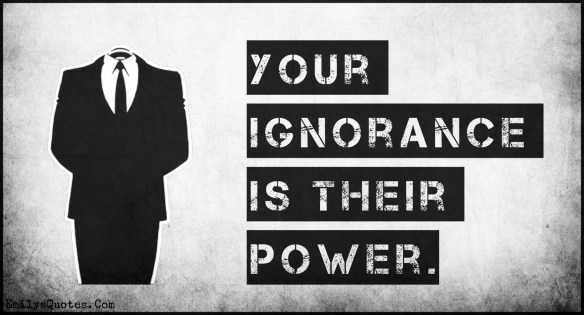
Thinking Dangerously in the Age of Normalized Ignorance

your-ignorance-is-their-power

By Henry Giroux

Source: CounterPunch

What happens to a society when thinking is eviscerated and is disdained in favor of raw emotion? [1] What happens when political discourse functions as a bunker rather than a bridge? What happens when the spheres of morality and spirituality give way to the naked instrumentalism of a savage market rationality? What happens when time becomes a burden for most people and surviving becomes more crucial than trying to lead a life with dignity? What happens when domestic terrorism, disposability, and social death become the new signposts and defining features of a society? What happens to a social order ruled by an “economics of contempt” that blames the poor for their condition and wallows in a culture of shaming?[2] What happens when loneliness and isolation become the preferred modes of sociality? What happens to a polity when it retreats into private silos and is no longer able to connect personal suffering with larger social issues? What happens to thinking when a society is addicted to speed and over-stimulation? What happens to a country when the presiding principles of a society are violence and ignorance? What happens is that democracy withers not just as an ideal but also as a reality, and individual and social agency become weaponized as part of the larger spectacle and matrix of violence?[3]

The forces normalizing and contributing to such violence are too expansive to cite, but surely they would include: the absurdity of celebrity culture; the blight of rampant consumerism; state-legitimated pedagogies of repression that kill the imagination of students; a culture of immediacy in which accelerated time leaves no room for reflection; the reduction of education to training; the transformation of mainstream media into a mix of advertisements, propaganda, and entertainment; the emergence of an economic system which argues that only the market can provide remedies for the endless problems it produces, extending from massive poverty and unemployment to decaying schools and a war on poor minority youth; the expanding use of state secrecy and the fear-producing surveillance state; and a Hollywood fluff machine that rarely relies on anything but an endless spectacle of mind-numbing violence. Historical memory has been reduced to the likes of a Disney theme park and a culture of instant gratification has a lock on producing new levels of social amnesia.

As we learned in the recent debate between Donald Trump and Hilary Clinton (a billionaire and millionaire), ignorance is the DNA of authoritarianism, serving to subvert the truth and obscure the workings of power. Willful ignorance has become a normalized political tool and form of public pedagogy that both provides the foundation for what Noam Chomsky labels as the rise of the “stupid party” and which works incessantly to create a “stupid nation.”[4]Trump, of course, proves that stupidity is in fashion and deeply entrenched within the larger culture while Hilary capitalizes on her penchant for disingenuousness by claiming support for policies she really disdains, i.e., stating she will raise taxes on her buddies from Goldman Sachs and other members of the financial elite. Hardly believable from a woman who “has earned millions of dollars from speeches to Wall Street banks and investment firms (and) was paid $675,000 for a series of speeches to Goldman Sachs.”[5] No hints of the radical imagination here, or the truth for that matter. Only the politics of stupidity and evasion and a media spectacle supporting the celebration of corrupted and limited and pathologized political horizons.

Manufactured ignorance also makes invisible the corruption of the financial elite, allowing them to plunder resources and define the accumulation of capital as a divine blessing. It gets worse. Manufactured ignorance aided by the voracious seductions of commodified corporate-driven disimagination machine that promotes a culture of empty pleasures through and endless regime of consuming and discarding. American society is now dominated by a pervasive commodified landscape of disimagination machines that extends from Hollywood movies and video games to mainstream television, magazines, news, and the social media. These mind-numbing desiring machines which thrive on speed and sensation function mostly as workstations of ignorance to create a fog of distractions that promote forms of social amnesia that erase from memory and public discourse the structural, systemic and social forces that reinforce what can be called organized powerlessness and massive human suffering. This is the stuff of a politics of disappearance that erases the presence of the poor, unemployed, the “approximately 11 million Americans cycle[d] through jails and prisons each year,” black youth, immigrants, ecological disasters, class warfare, acts of state sponsored terrorism, the rise of the police state, and the rise of the warfare state.[6] As the machinery of social death accelerates, America’s most precious investment, youth, also disappear. As neoliberal disimagination machines such as Fox News make clear youth as a social investment no longer count in a society that disdains long term investments and their messy calls for being included in the script of democracy. As such, the current war on youth is about erasing the future, at least any alternative future and any notion of imagination that might summon one into view.

When coupled with an age of precarity and endless uncertainty in which young people have few decent jobs, are strangulated by debt, face a future of career-less jobs, and isolation, young people have little room for politics because they are more concerned with trying to survive rather than engaging in political struggles, or imagining a different future. At the same time, armies of the unemployed or underemployed are caught in a spiral of receding wages, diminished social provisions, and increasingly find themselves paralyzed by anxiety and free-floating anger. In such situations, thinking and informed action become more difficult while a politics wedded to economic and social justice is eviscerated. Moreover, politics becomes toxic when dominated by unapologetic discourses of racism and hatred and is on full display in the Trump campaign. Tapping into such anger and redirecting away from the real problems that produce it has become the central script in the rise of the new authoritarians. This poisonous discourse gains momentum and accelerates as it moves between white supremacist incantations of Trump and his zealots and the deceptive vocabulary of Hillary Clinton and her financial elite backers who embrace a savage neoliberalism with its false claims to freedom, choice, and the virtues of militarization. Civic death is on full display as the ideals of democracy disappear in an election in which authoritarianism in its various forms rules without apology. As thinking dangerously and acting with civic courage wanes, state violence, disposability and voicelessness become the dominant registers of an authoritarian politics that has intensified in American life producing neo-fascist movements in American society that have moved from the fringes to the center of political life.

Tragedy looms large in American society as the forces that promote powerlessness and voicelessness intensify among those elements of the population struggling just to survive the symbolic violence of a culture of cruelty and the material violence of a punishing state. The issue of losing one’s voice either to the forces of imposed silencing or state repression weaken dissent and open the door to the seductions of a dogmatism that speaks in the language of decline, making America great again, while touting the coded vocabulary of white nationalism and racial purity. How else to explain Trump’s call for imposing racial profiling as a way to boost the notion of law and order.

Thinking undangerously is the first step in the triumph of formalism over substance, theater over politics, and the transformation of politics into a form of celebrity culture. The refusal to think works in the service of a form of voicelessness, which is another marker of what it means to be powerless. Within this moral and political vacuum, the codes, rhetoric, and language of white supremacy is on the rise wrapped in the spectacle of fear-mongering and implied threats of state repression. In this instance, emotion become more important than reason, ideas lose their grip on reality, and fashion becomes a rationale for discarding historical memory, informed arguments, and critical thought. Reflection no longer challenges the demands of commonsense. In the mainstream media, the endless and unapologetic proliferation of lies become fodder for higher ratings, informed by suffocating pastiche of talking heads, all of whom surrender to “the incontestable demands of quiet acceptance.”[7]Within such an environment, the truth of an event is not open to public discussion or informed judgment at least in the official media apparatuses producing, distributing and circulating ideas that parade as commonsense. As a result, all that remains is the fog of ignorance and the haze of political and moral indifference.

Americans occupy a historical moment in which it is crucial to think dangerously, particularly since such thinking has the power to shift the questions, provide the tools for offering historical and relational contexts, and “push at the frontiers…of the human imagination.”[8]Stuart Hall is right in insisting that thinking dangerously is crucial “to change the scale of magnification. … to break into the confusing fabric that ‘the real’ apparently presents, and find another way in. So it’s like a microscope and until you look at the evidence through the microscope, you can’t see the hidden relations.”[9] In this instance, the critical capacity for thinking becomes dangerous when it can intervene in the “continuity of commonsense, unsettle strategies of domination,” and work to promote strategies of transformation.[10]

As Adorno observes, such thinking “speaks for what is not narrow-minded—and commonsense most certainly is.”[11] As such, dangerous thinking is not only analytical in its search for understanding and truth, it is also critical and subversive, always employing modes of self and social critique necessary to examine its own grounds and those poisonous fundamentalisms in the larger society haunting the body politic. As Michael Payne observes, thinking dangerously (or critical theory in this instance) should be cast in the language of hints, dialogue, and an openness to other positions, rather than be “cast in the language of orders.”[12] Of course, this is not to suggest that thinking dangerously guarantees action, but at the same time, any action that distances itself from such thinking is bound to fail.

In an age when shouting, rage, and unchecked emotions shape public discourse, self-reflection becomes a liability and suppresses the axiom that critical thought should function to “lift…human beings above the evidence of our senses and sets appearances apart from the truth.”[13]   Salmon Rushdie is right in viewing thinking dangerously as a type of political necessity whose purpose is to “push boundaries and take risks and so, at times, to change the way we see the world.”[14] As Hannah Arendt noted, thoughtfulness, the ability to think reflectively and critically is fundamental to radical change and a necessity in a functioning democracy. Put differently, formative cultures that make such thinking possible along with the spaces in which dialogue, debate, and dissent can flourish are essential to producing critically literate and actively engaged citizens.

Unfortunately, thinking undangerously cuts across ideological and political divides. For instance, there is a new kind of historical and social amnesia overtaking some elements of resistance in the United States. Many progressives have forgotten the lessons of earlier movements for real change extending from the anti-Vietnam War and Black Freedom movements to the radical feminist and gay rights movements of the sixties. History as a repository of learning with vast resources to enable people to build on historical legacies, develop mass movements, and take seriously the pedagogical task of consciousness raising, is in decline. Too much of contemporary politics has become more personal, often reducing agency to the discourses and highly charged emotions of trauma. These historical legacies of resistance did not limit their politics to a call recognition and security within the confines of isolated political issues. Instead, they called for a radical transformation of capitalist and other authoritarian societies. Moroever, they understood that the truth of domination lie in understanding the totality of a society and how various issues were connected to each other. George Monbiot exemplifies this issue in arguing against responding to the varied crisis associated with neoliberalism as if they emerged in isolation—a response that contributes to neoliberalism’s anonymity. He writes:

Its anonymity is both a symptom and cause of its power. It has played a major role in a remarkable variety of crises: the financial meltdown of 2007?8, the offshoring of wealth and power, of which the Panama Papers offer us merely a glimpse, the slow collapse of public health and education, resurgent child poverty, the epidemic of loneliness, the collapse of ecosystems, the rise of Donald Trump. But we respond to these crises as if they emerge in isolation, apparently unaware that they have all been either catalyzed or exacerbated by the same coherent philosophy; a philosophy that has – or had – a name. What greater power can there be than to operate namelessly?[15]

This politics of the disconnect is exacerbated by the fact that mass social movements run the risk of undermining by a politics that has collapsed into the personal. For example, for too many progressives personal pain represents a retreat into an interiority that focuses on trauma. Robin Kelley provides a caveat here in pointing out that all too often “managing trauma does not require dismantling structural racism” and the larger issues of “oppression, repression, and subjugation” get replaced with “words such as PTSD, micro-aggressions, and triggers.” [16] Kelley is not suggesting that the pain of personal suffering be ignored. Instead, he warns “against … the consequences of framing all grievances in the ‘language of personaltrauma.’”[17]

Personal trauma in this case can begin with legitimate calls for spaces free of racism, sexual harassment, and various other forms of hidden but morally and politically unacceptable assaults. And at its best, such a politics functions as an entry into political activism; but when it becomes less a justifiable starting point than an endpoint it begins to sabotage any viable notion of radical politics. Kelley is right in insisting that “trauma can easily slip into thinking of ourselves as victims and objects rather than agents.”[18] Moreover, the language of safe spaces, personal trauma, and triggers can easily become a topsy-turvy discursive universe of trick mirrors and trapdoors that end up reproducing a politics of intimidation and conformity, while forgetting that pedagogical practices and a corresponding politics in the service of dramatic transformation are always unsettling and discomforting.

Progressives must avoid at all cost is the rebirth of a politics in which how we think and act is guaranteed by the discourses of origins, personal experience, and biology. When individuals become trapped within their own experiences, the political imagination weakens, and a politics emerges that runs the risk of inhabiting a culture of exclusion and hardness that shuts down dialogue, undermines compassion, kills empathy, makes it more difficult to listen to and learn from others. A politics that puts an emphasis on personal pain can become blind to its own limitations and can offer falsely a guaranteed access to the truth and a comforting embrace of a discourse of political certainty.

In such cases, the walls go up again as the discourses of biology and exclusion merge to guard the frontiers of moral righteousness and political absolutism. Put differently, the registers of militarization are on full display in such alleged sites of resistance such as higher education where a growing culture of political purity marks out a space in which the personal becomes the only politics there is housed within a discourse of “weaponized sensitivity” and “armed ignorance.”[19] The first causality of armed ignorance is a kind of thoughtfulness that embraces empathy for the other, a willingness to enter into public discussion, and dialogue with those who exist outside of the bunkers of imagined communities of exclusion. Leon Wieseltier is right in arguing that “grievance is sometimes the author of blindness, or worse.”[20]

Under such conditions, empathy wanes and only extends as far as recognizing those who mirror the self, one that endlessly narrates itself on the high ground of an unassailable moralism and stultifying orbits of self-interests. In addition, politics collapses into the privatized orbits of a crude essentialism that disdains forms of public discourse in which boundaries break down and the exercise of public deliberation is viewed as fundamental to a substantive democracy. Of course, there is more at work here than what might be called the atrophy of critical thought, self-reflection, and theory, there is also the degeneration of agency itself.

What does thinking look like when it is transformed into a pedagogical parasite on the body of democracy? At one level, it becomes toxic, blinding the ideological warriors to their own militant ignorance and anti-democratic rhetoric. At the same time, it shuts down any attempt to develop public spheres that connect rather than separate advocates of a politics walled in by suffocating notions of essentialism dressed up in the appeal to orthodoxy parading as revolutionary zeal. What must be remembered is that thinking undangerously mimics a pedagogy of repression that falsely assumes a revolutionary stance when in fact everything about it is counter-revolutionary. In the end this suggests a kind of theoretical helplessness, a replacing of the courage to think dangerously with the discourse of denunciation and a language overflowing with the comforting binary of good and evil.

There is more at risk here than legitimating the worse forms of thoughtlessness, there is also the intolerable potential for both the moral collapse of politics and the undermining of any vestige of democracy. Thinking dangerously as a critical enterprise is about both a search for the truth and a commitment to the recognition that no society is ever just enough and hence is fundamental to the always unfinished struggle, making the impossible all the more possible. Not one or the other but both. Such thinking should be used to both understand and engage the major upheavals people face and to connect such problems to larger political, structural, and economic issues.

Thinking dangerously can make the pedagogical more political by mapping the full range of how power is used and how it can be made accountable in all of its uses. Thinking dangerously is about more than doing a critical reading of screen culture and other texts, it is also about how knowledge, desire, and values become invaluable tools in the service of economic and political justice, how language provides the framework for dealing with power and what it means to develop a sense of compassion for others and the planet. Dangerous thinking is more than a mode of resistance, it is the basis for a formative and pedagogical culture of questioning and politics that takes seriously how the imagination can become central to the practice of freedom, justice, and democratic change.

Notes.

[1] This essay draws upon a number of ideas in Henry A. Giroux,Dangerous Thinking in the Age of the New Authoritarianism (New York: Routledge, 2015).

[2] I have borrowed this term from Jeffrey St. Clair, “The Economics of Contempt,” Counterpunch (May 23, 2014).

[3] Brad Evans and I have taken up the issue of violence in its various valences in Brad Evans and Henry A. Giroux, Disposable Futures: The Seduction of Violence in the Age of the Spectacle (San Francisco: City Lights Books, 2015). Also, see Henry A. Giroux, America’s Addiction to Terrorism (New York: Monthly Review Press, 2016).

[4] Noam Chomsky, “Corporations and the Richest Americans Viscerally Oppose the Common good,” Alternet (Sep9tember 29, 2014). Online: http://www.alternet.org/visions/chomsky-corporations-and-richest-americans-viscerally-oppose-common-good

[5] Chris Cillizza , “The New York Times just perfectly explained Hillary Clinton’s Goldman Sachs speech problem,” The WashingtonPost (February 26, 2016). Online:https://www.washingtonpost.com/news/the-fix/wp/2016/02/26/the-new-york-times-just-perfectly-explained-why-hillary-clintons-answers-on-her-paid-speeches-dont-work/

[6] Rebecca Gordon, “There Oughta Be a Law…Should Prison Really Be the American Way?,” TomDispatch.com (September 25, 2016). Online: http://www.tomdispatch.com/blog/176190/tomgram%3A_rebecca_gordon%2C_arresting_our_way_to_%22justice%22/

[7] Brad Evans and Julien Reid, “The Promise of Violence in the Age of Catastrophe,” Truthout (January 5, 2014. Online: http://truth-out.org/opinion/item/20977-the-promise-of-violence-in-the-age-of-catastrophe

[8] Arundhati Roy, Power Politics (Cambridge, Ma: South End Press, 2001), P. 1

[9] Stuart Hall and Les Back, “In Conversation: At Home and Not at Home”, Cultural Studies, Vol. 23, No. 4, (July 2009), pp. 664-665.

[10] I have taken this phrases from an interview with Homi Bhaba in Gary Olson and Lynn Worsham, “Staging the Politics of Difference: Homi Bhabha’s Critical Literacy JAC ((1999), p. 9.

[11] Zygmunt Bauman, Liquid Life (London: Polity Press, 2005), p.139.

[12] Michael Payne, “What Difference Has Theory Mad? From Freud to Adam Phillips,” College Literature 32:2 (Spring 2005), p. 7.

[13] Ibid., Bauman, Liquid Life, 151.

[14] Salman Rushdie, “Whither Moral Courage?” The New York Times, (April 28, 2013)

[15] George Monbiot, “Neoliberalism – the ideology at the root of all our problems,” The Guardian, (April 15, 2016) Online: http://www.theguardian.com/books/2016/apr/15/neoliberalism-ideology-problem-george-monbiot

[16] Robin D.G. Kelley, “Black Study, Black Struggle – final response,”Boston Review, (March 7, 2016). Online: http://bostonreview.net/forum/black-study-black-struggle/robin-d-g-kelley-robin-d-g-kelleys-final-response

[17] Ibid., Robin D.G. Kelley, “Black Study, Black Struggle – final response.” Boston Review.,

[18] Robin D.G. Kelley, “Black Study, Black Struggle,” Boston Review,(March 7, 2016) Online: https://bostonreview.net/forum/robin-d-g-kelley-black-study-black-struggle

[19] The notion of weaponized sensitivity is from Lionel Shriver, “Will the Left Survive the Millennials?” New York Times (September 23, 2016). Online. http://www.nytimes.com/2016/09/23/opinion/will-the-left-survive-the-millennials.html. Armed ignorance was coined by my colleague Brad Evans in a personal correspondence.

[20] Leon Wieseltier, “How voters’ personal suffering overtook reason – and brought us Donald Trump,” Washington Post, (June 22, 2016). Online: https://www.washingtonpost.com/posteverything/wp/2016/06/22/how-voters-personal-suffering-overtook-reason-and-brought-us-donald-trump/

 

Henry A. Giroux currently holds the McMaster University Chair for Scholarship in the Public Interest in the English and Cultural Studies Department and a Distinguished Visiting Professorship at Ryerson University. His most recent books are America’s Education Deficit and the War on Youth (Monthly Review Press, 2013) and Neoliberalism’s War on Higher Education (Haymarket Press, 2014). His web site is www.henryagiroux.com.

Electoral Politics and the Illusion of Control

what-corporate-america-wants

By William Hawes

Source: Dissident Voice

We have all been told a lie. The lie that says democracy can be maintained only through voting, through purely representative, parliamentarian means. When the founding fathers set up the Constitution and Bill of Rights, they were wary of any truly popular, working and middle class control of the United States. Our government was to be run as a republic, designed by elites, for the elites. Our three branches of government were not simply invented for checks and balances: another reason was to stymie any massively popular mandates that would go against the interests of the oligarchy.

Today, the checks and balances used ostensibly to prevent tyranny are being used against us: even though a high majority (65%) is against government surveillance which violates privacy, and 78% want Citizens United overturned, we are stuck with a broken system and statesmen bought off by corporations. Even though 80% of eligible citizens didn’t vote in the 2014 elections, this year our out-of-touch pundits and mass media puppets prattle on unceasingly about our democracy, still misguidedly believing these candidates represent the will of the people.

Just sixteen years ago, our very own electoral system, in the form of a gilded cage, shut down the popular will of the people, as Al Gore won about 500,000 more votes than George W. Bush, yet still lost. Although the decision was made over 200 years ago, we have decided that the antiquated Electoral College system should still be used today.

More broadly, our never-ending election cycle serves as a palliative for ordinary Americans, but does nothing to cure the underlying disease and rot within our political system. Progressive liberals can take pleasure in Sanders’ statements supporting a raise in the minimum wage, debt relief for students, fighting income inequality, etc. Yet Sanders has no broad coalition in Congress to advance his agenda and to fight his “revolution”. Isolationist, non-interventionist conservatives can take pride in Trump’s support of Russia’s fight against ISIS in Syria, and his token rhetoric towards re-working unfair free trade agreements and bringing back jobs. Yet Trump’s pandering towards racists and xenophobes will only accelerate the descent towards fascism that the US has been slipping into for decades.

The second lie we’ve been told, or assumed implicitly, is that we are in control of our national destiny. Through the vote, we can supposedly make a clean slate every four years, to make up for the misdeeds of our past political leaders. The truth is much murkier. Our national security state and intelligence services have been built up to Leviathan levels, and presidential candidates are instantly discredited and marginalized for suggesting even small decreases in military spending. Corporate lobbyists and the conglomerate multinationals control the political landscape, determining the limits of discourse and shutting down anyone who exceeds the boundaries. Absurdly, third party candidates, some of the only ones with fresh ideas to invigorate our democracy, are demonized. Mainstream media coverage reinforces these imaginary limits of discussion, and Independents, Greens, Socialists, and Libertarians are relegated to the sidelines.

As the neoliberal order reinforces and deepens material poverty and intellectual ignorance, public discourse narrows without totalitarian overt manipulation. This makes issues seem as if they are progressing naturally, when public debate and consent is in actuality homogenized and conformist. This is analogous to the concept known to scientists as “shifting baselines”: here it applies to a public that accepts deeper cuts to social services, increases in privatizations, and increased militarization and policing of the public sphere, because the momentum seems inexorable and immutable. The establishment uses rhetorical threats and excuses to further corporate agendas and destroy civil society, all in the name of maintaining “economic growth” and upholding “law and order”.

The truth is that only by staring into the abyss can we collectively begin to dig ourselves out of our self-dug graves. The US has been in an unofficial recession since 2008. Millions of Americans live paycheck to paycheck, with minimal society safety nets, leading to insecurity, uncertainty and cynicism towards the future, and crippling anxiety. Politicians routinely show they do not care about the working class and the poor when they speak to the “middle class”, whatever that means anymore. Our leaders are handpicked by Wall Street billionaires, and/or defense and fossil fuel industrialists. Abroad, covert war is ongoing in a dozen or more countries in Asia and North Africa.

With so many minds confined to the hypnotic and myopic gaze focused on high technology, mass media, and our official “leaders”, 21st century man falls further into enslavement every day. As Fromm would say, we Escape from Freedom into self-indulgence and apathy, leaving hard decisions to technocrats and oligarchs. Control over our food, medicine, intellectual property, and basic social and environmental rights are consolidated into a handful of multinational corporations who inundate us with false needs through advertising and propaganda. Computer algorithms tell us what to buy, and social media manipulates our emotions, fulfilling the preaching of techno-dystopian prophets who warn of non-human intelligence guiding humanity towards dark futures.

Revolutionary fervor lurks under the surface, yet whether a popular progressive movement can blossom remains to be seen. Conversely, a missed revolution could easily result in an authoritarian and fascist takeover by the reactionary far-right. One thing we know for certain is that continuing under this two-party charade will only lead us to our doom.

Average citizens have never had any control of the republic since its founding. A complete constitutional overhaul is needed, and forms of direct, consensus, and deliberative democracy must be woven into a hybrid system. Elections should be funded by the public, with no corporate money allowed, shorter election cycles, and no discrimination towards third parties, unlike the current Commission on Presidential Debates. State governments should gain power, and federal programs reigned in and redefined towards streamlined regulation and oversight. Tax subsidies should be stripped from the fossil fuel industries entirely and redirected towards the best scientists and engineers in the field of renewable energy.

What is desperately needed is a shift in worldview to promote government that sees its job as not simply to tax and legislate, but to also support healthy life-world systems. Also, promoting humble and dedicated leaders who are stewards of community and the Earth, who do not insist on blatant exploitation of distant nations and pillaging resources, would go a long way. This cannot be done within the confines of the Democratic and Republican parties, who thrive on domination, coercion, control, and manipulation of public interests.

To break the cycle, we must collectively embrace our frailties and limitations. The deadly, patriarchal energy technologies such as the petrochemical industries and nuclear energy must be shut down. We must learn from the man-made tragedies of Bhopal, Katrina, Chernobyl, and Fukushima, and dismantle dangerous plants and factories, and begin to move humanity away from areas susceptible to natural disasters and coastal flooding. The US, Russia, and the nuclear nations must formally apologize for the atmospheric nuclear testing in the fifties and sixties which will kill millions from cancer, and ban nuclear weapons for good.

Learning to relinquish control and learning to keep one’s ego in check are two of the ultimate tests our leaders must accept. As the Tao Te Ching says:

Therefore the sages:
Manage the work of detached actions
Conduct the teaching of no words
They work with myriad things but do not control
They create but do not possess
They act but do not presume
They succeed but do not dwell on success
It is because they do not dwell on success
That it never goes away.1

  1. Tao Te Ching: Annotated and Explained. Derek Lin. SkyLight Paths. 2006.  Translation by Derek Lin. [↩]


William Hawesis a writer specializing in politics and the environment. You can find his e-book of collected essays here. His articles have appeared online at Global Research, Countercurrents, Dissident Voice, and Counterpunch. You can email him at wilhawes@gmail.com Read other articles by William.

Living In A Van Down By The River – Time To Face The True State Of The Middle Class In America

maggie_smith_lives_on_alan_bennett_s_driveway_in_the_lady_in_the_van_trailer

By Michael Snyder

Source: InvestmentWatch

Do you remember the old Saturday Night Live sketches in which comedian Chris Farley portrayed a motivational speaker that lived in a van down by the river?  Unfortunately, this is becoming a reality for way too many Americans.  As the middle class has shrunk and the cost of living has increased, a lot of people have decided to quite literally “live on the road”.  Whether it is a car, a truck, a van, a bus or an RV, an increasing number of Americans are using their vehicles as their homes.  Just recently, someone that I know took a trip down the west coast of the United States and stayed at a number of campgrounds along the way.  What she discovered was that a lot of people were actually living at these campgrounds.  Of course there are some that actually prefer that lifestyle, but many others are doing it out of necessity.

Earlier this week, Circa.com posted a story about “the van life”.  One of the individuals that they featured was a recent graduate of the University of Southern California named Stephen Hutchins.  Without much of an income at the moment, he decided that the best way to cut expenses was to live in his van

“The main expenses are insurance for the van, which is like $60 a month,” said Hutchins. “Then, I have a storage unit for like $60.”

That puts his monthly rent at $120. The van cost him just $125 at an auction.

Living in a van is certainly not the most comfortable way to go, and many of you are probably wondering how he performs basic tasks such as cooking and bathing.  Well, it turns out that he makes extensive use of public facilities

He showers at the gym, cooks on a portable stove on a sidewalk (he stores his butane at his friends’ place nearby) and uses wifi at nearby coffeeshops.

For a while such a lifestyle may seem like “an adventure”, but after a while it will start to get really old.  And not a lot of women are going to be excited about dating a man that lives in a van, and you certainly wouldn’t want to raise a family in a vehicle.

Sadly, just like during the last economic crisis many Americans are getting to the point where staying in their homes may not be an option.  Just check out the following excerpt from a recent New York Post article entitled “The terrifying signs of a looming housing crisis“…

The number of New Yorkers applying for emergency grants to stay in their homes is skyrocketing — as the number of people staying in homeless shelters reached an all-time high last weekend, records show.

There were 82,306 applications for one-time emergency grants to prevent evictions in fiscal 2016, up 26 percent from 65,138 requests the previous year, according to the Mayor’s Management Report.

I put a couple of phrases in that quote in bold because I really wanted you to notice a couple of things.

First of all, it is very alarming to hear that the number of New Yorkers staying in homeless shelters “reached an all-time high” last weekend.  I thought that we were supposed to be in an “economic recovery”, but apparently things in New York are rapidly getting worse.

Secondly, the fact that applications for emergency grants are up 26 percent compared to last year is another indication of how rough things are right now for average families in New York.  We all remember what happened when millions of families lost their homes to foreclosure across the nation during the last financial crisis, and nobody should want to see a repeat of that any time soon.

During this election season, Barack Obama and Hillary Clinton would like all of us to believe that the economy is doing just fine, but that is not true at all.  Even using the doctored numbers that the government gives us, Barack Obama is solidly on track to be the only president in all of U.S. history to never have a single year of 3 percent GDP growth, and he has had two terms to try to do that.

Gallup CEO Jim Clifton is also quite skeptical of this “economic recovery”, and he recently authored an article on this subject that is receiving a tremendous amount of attention.  The following is how that article begins

I’ve been reading a lot about a “recovering” economy. It was even trumpeted on Page 1 ofThe New York Times and Financial Timeslast week.

I don’t think it’s true.

The percentage of Americans who say they are in the middle or upper-middle class has fallen 10 percentage points, from a 61% average between 2000 and 2008 to 51% today.

Other surveys have found that it is even worse than that.

For example, a Pew Research Center study from the end of last year discovered that the middle class in America has now actually become a minority in this country.

Here are some other numbers that Clifton included in his article

  1. According to the U.S. Bureau of Labor Statistics, the percentage of the total U.S. adult population that has afull-time job has been hovering around 48% since 2010this is the lowest full-time employment level since 1983.
  2. The number of publicly listed companies trading on U.S. exchanges has been cut almost in half in the past 20 years — from about 7,300 to 3,700. Because firms can’t grow organically — that is, build more business from new and existing customers — they give up and pay high prices to acquire their competitors, thus drastically shrinking the number of U.S. public companies. This seriously contributes to the massive loss of U.S. middle-class jobs.
  3. New business startups are at historical lows. Americans have stopped starting businesses. And the businesses that do start are growing at historically slow rates.

Once upon a time, America was the land of opportunity.

We were the place where anything was possible and where entrepreneurship was greatly encouraged.

But today we strangle small businesses to death with rules, regulations, red tape and taxes.

If we want a stronger middle class, we need to create a much better environment for the creation of small businesses.  Small business ownership often lifts individuals into the middle class, and small businesses have traditionally been the primary engine for the growth of good jobs in this country.

If the middle class continues to shrink, poverty will continue to rise.  Previously I have written about how the number of homeless children in the United States has shot up by 60 percent since the last economic crisis, and Poverty USA claims that a staggering 1.6 million children slept either in a homeless shelter or in some other form of emergency housing during 2015.

If you will be sleeping in a warm bed in a comfortable home tonight, you should be thankful.  An increasing number of Americans are sleeping in tent cities, in their vehicles or on the streets.  These hurting people deserve our love, our compassion and our prayers.


Cutting the Cords of Empire: The Spectacle of US Elections

the-powers-that-be-deep-state

By William Hawes

Source: Global Research

“The more powerful the class, the more it claims not to exist.” -Guy Debord, The Society of the Spectacle

It’s almost time for our quadrennial political distraction, masquerading as the US presidential election. As opposed to previous elections, this one feels quite different. Even with Obama/Romney in 2012, important, basic economic issues were discussed, health care reform was questioned, and foreign policy was given its due.

However, this time, the spectacle of the personalities seems to dominate the conversation: Mrs. Clinton is somehow on a feminist crusade, an inspiration for women everywhere. Going unmentioned are her irredeemable backers, such as the genocidal Henry Kissinger and Madeleine Albright. As for Trump, his version of America is as naïve, narrow-minded, and delusional as a Leave It to Beaver episode, or a Captain America comic book. In the background, the monstrosity of global capitalism goes unquestioned, and the cries from victims of US institutional racism and structural violence go unheard.

Global warming, broad economic policy, and nuanced foreign policy are simply too much to ask of these candidates. Their stupidity knows no end; their corruption and depravity know no bounds, and many of both of their supporters, as well as media, political, and corporate backers and sycophants can be considered “deplorable”. Many supporters of the two-party system do not bother to think about the damage either potential president would do to people outside the US. Many backers of Trump and Clinton have little to no basic knowledge of world cultures and history.

What are the cords that connect us to these “leaders”, to our American Empire? They are the same ones that the Industrial Revolution, the basis of our civilization, has implanted in each of us since birth, as Alvin Toffler explains in The Third Wave. As our social world became modeled on the factory floors developed in the 18th and 19th centuries, a set of unspoken principles were ironed out, and transferred to the political, social, and economic realms. (1)  As we shall see, these principles spread unchecked, and have infiltrated political discourse and social hierarchies. Toffler identifies these implicit rules as:

1) Standardization: Industry, production, and factory life revolved around endless loops and inputs of metals, fabrics, coal, oil, and specialized parts for trains, cars, etc. The simplification and standard mechanical parts used were mirrored and reflected in the culture at large: eventually, markets, the media, radio and TV, and even great art and literature succumbed to commoditization and homogenization. We now have mass marketing, public relations, and “electioneering”, where our duopoly controls all branches of government.

2) Specialization: With the explosion in the fields of science and engineering, specialized techniques were taught to develop, invent, and maintain mechanical and electric equipment. Yet again, this philosophy infected the general society:  only bureaucrats are able to work in the halls of power, only industrial experts are able to administer federal agencies, creating the disgraceful revolving door phenomena in Washington.

3) Synchronization: As more people flocked into cities with gleaming promises of steady, factory jobs, time and punctuality became of prime importance. Punching timecards and meeting quotas were necessary: there was no room for leeway, as assembly lines demanded strict timelines. The time demands of labor leaked into white-collar work as well: in banking and finance, railroads, time zones, and office jobs, advanced scheduling became the norm. Eventually, synchronization of the political system gained traction, and the imperial system came to resemble a deathly machine, marching in time to bloody footsteps: military, immoral diplomacy and ideology, and industry worked together to lord over Latin America with the Monroe Doctrine, annihilate Native Americans using Manifest Destiny, even as today, the excuse of the “War on Terror” is used to exterminate entire populations in Afghanistan, Iraq, Syria, Libya, and elsewhere.

4) Concentration: Think of the vast oil and coal stored underground for millions of years, only to be strip-mined, taken up by rigs, and transported by rail and tanker into vast refineries: concentration of energy. Further, every class of people became absorbed and intensified in the industrial system: workers into factories, children into schools, mentally ill into institutions, finance concentrated into New York, London, and Paris. Mega-mergers of corporations: today, it is the Apple, Google, Shell, and BP’s of the world who have coffers of blood money held tidily in banks throughout the world. Further, the concentration of technocrats who we supposedly need to run our societies: in the West, the military-industrialists, just as the Soviets were once told the nomenklatura was necessary.

5) Maximization: Firms were encouraged to grow as large as possible, and expand into as many fields as possible. Companies in Japan in the mid-twentieth century would actually have workers sing of the glory and greatness of their employer. Today, 62 people have the same wealth as half the world’s population. This is concentration and maximizing at its most obscene. Of course, you won’t hear Clinton, Trump, or anyone in Washington talking about this. Maximizing GDP, corporate profits, fossil fuel use, and flexing imperial muscle is what the Feds do best.

6) Centralization: Connected to the first five rules of empire stated above, centralizing power, wealth, and using knowledge for private gain is required to uphold the industrial state. Taxation, subsidies for industry, political debates via the sham Committee on Presidential Debates, the backroom shenanigans of the DNC and RNC, and cloak and dagger lobbying and bribery now dominate our system of government. Further, the Leviathan of state-sanctioned violence now lords over the world from the Pentagon and NATO, and the centralization of information runs through fiber-optic cables straight to the infernal, yet temperature-controlled offices of the CIA and NSA.

The elections have adopted all the patterns of the industrial, imperial state: we have standardized TV, scripted questions, airbrushed candidates, and childlike debates. We’ve seen specialized tactics of gerrymandering, vote-rigging, PR bullshit, and strategists whose careers accomplish nothing for the public good. We all know of the synchronization of Wall Street, defense and oil companies. The concentration of power in the hands of the few hardly needs mention: here’s the study by Princeton and Northwestern professors who conclude that the US is an oligarchy, not a democracy. We’ve witnessed the maximization of endless primaries, debates, press conferences, and town-hall meetings ad infinitum. The centralization of political ideology (triangulation in Clintonite terms, Machiavellian to a rational person) and the limitations of discourse that our candidates display are all too clear.

These are the iron chains holding us down, shackling us in Plato’s cave: our candidates are figureheads, shadows on the wall; they are puppets of the super-elite. The central position they carve out in the mainstream is really a pit, an abyss: one that we all find ourselves in, as we continue to vote for those who don’t fight for our interests.

The two best options for this election seem to be: voting for Jill Stein, or boycotting the election, as Joel Hirschhorn advocates. As for our obscene election cycles, I believe Zach de la Rocha summed it up best:

  A spectacle monopolized

The camera’s eyes on choice disguised

Was it cast for the mass who burn and toil?

Or for vultures who thirst for blood and oil?

William Hawes is a writer specializing in politics and environmental issues. His articles have appeared online at Global Research, Counterpunch, Dissident Voice, The World Financial Review, Gods & Radicals, and Countercurrents. He is author of the e-book Planetary Vision: Essays on Freedom and EmpireYou can reach him at wilhawes@gmail.com

Notes:

1.) Alvin Toffler. The Third Wave. Bantam, 1980. p. 46-60.


An Open Letter to the People of the United States: Election or Revolution?

votefornobody

(Editor’s note: While we do believe positive change is possible on a local level through grass-roots campaigns and voter initiatives, until major systemic changes are forced into existence we have no reason to expect anything from presidential politics other than what we’ve been subjected to for the past few decades.)

By Robert J. Burrowes

As citizens of the USA with a presidential election approaching you have a wonderful opportunity to ponder whether to participate in this election or to participate in the ongoing American Revolution.

Your first revolution might have overthrown the authority of the British monarchy and aristocracy but the one in progress must remove the US elite which has executed a political coup against your government. And you cannot remove elite coupmakers in a fraudulently conducted election in which the ‘choice’ is essentially between two violently insane individuals, each of whom represents the violently insane US elite. See ‘The Global Elite is Insane‘ and ‘Why Violence?

The real value of this second revolution, which moves along steadily with routine outbreaks over a multitude of peace, environmental and social justice issues and occasional ‘uprisings’, such as the Occupy Movement in 2011 which spawned a range of new and visionary initiatives, is that it could give citizens of your country the chance to finally reclaim the Republic for those people who genuinely care about ‘life, liberty and the pursuit of happiness’. And, just as importantly, have sufficient vision to regard these aspirations as something to be shared with the entire US population, starting with Native Americans, and even those of us in the rest of the world including those countries that are currently victims of US elite violence, whether it be wars, drone strikes, coups, economic exploitation or ecological destruction.

Such a revolution might rewrite your constitution and replace the second amendment ‘right of the people to keep and bear arms’ with the right to live free of the fear of gun violence. It might result in a form of social organization that distributes wealth equitably (perhaps by actually taxing the wealthy and outlawing the use of offshore tax havens) while reallocating the annual military (killing) budget to life-enhancing projects such as poverty alleviation, affordable housing, free education, free healthcare, clean water, renewable energy technologies, and a substantial budget for compensation to those countries that the US elite has systematically exploited or simply destroyed during the past 200 years. This would allow the 50 million US citizens who live in poverty, and another billion people around the world who also live in poverty, the chance to live a decent life.

Now, you might ask, ‘How are we, the ordinary citizens of the United States, even with our handguns, rifles and assault weapons, going to take on the US military and police to remove elite control of our government?’ Well, the answer is that you do not need even one weapon for this ongoing revolution and, in fact, you are vastly better off without them. Weapons have only one use – to kill people – and any revolution worth the name has a more profoundly ambitious aim than this.

What you need is intelligence, commitment, courage and a sound nonviolent strategy. The US elite controls your government and has crippled your republic because, over successive generations, you have let them. Every time you cooperate with the elite, because you are scared, by paying your taxes (more than 50% of which finances US wars and other military violence), putting your money into their corporate banks, shopping at their corporate shopping malls, buying and consuming the ‘news’ presented by their corporate media, rationalizing their policies as reasonable, participating in their unjust and violent legal system, fighting (as an enlisted person or as a mercenary) in their military forces, working in their prison system, accepting exploited employment of any kind, eating their poisoned and genetically mutilated foods (GMOs), going along with their endless attempts to divide you along racial, class, religious and other lines, you simply consent to their control. Why?

You have a simple alternative. Consciously and systematically participate in the ongoing nonviolent revolution that is already taking place and give it added life by your presence. Remake the US republic as you want it by withdrawing your cooperation with elite structures and processes while creating alternatives that meet your needs and the needs of those around you.

Join those US visionaries who are creating cooperatives where people are both managers and valued workers, take your money out of elite banks and put it into financial organizations that exist or which you create to serve the interests of their members (or, if you prefer, use LETSystems), refuse to participate in or pay for (with your taxes) US imperialism (and win friends all over the world), grow or buy healthy locally-grown organic/biodynamic (and, if you are concerned about the climate catastrophe as well, vegetarian) food, read progressive news outlets so that you know what is really going on in the USA and the world, read literature that deepens your understanding and concern for humanity and doesn’t just offer you a distraction from the horror in which you live, and support or even become one of those many fine nonviolent activists in your country who take personal risks in the struggle to create a better world.

If you want more of what you have, then you should vote and/or buy a gun. They have an equivalent outcome: they both legitimize elite violence and exploitation directed at you and those you love.

If you want to participate in this second and ongoing American revolution, then spend your time participating in the wholesome activities that many grassroots organizations already offer and in creating its next manifestations in your own neighborhood. It is the powerful conscience-based choices that you make as an individual that define your Self. And it is these choices that will have most impact on your family, neighborhood, community organization, trade union, religious organization and elsewhere and that will help decide the future of the USA and its role in the world.

Now you might say, I do some or even all of the sorts of things you mentioned above, so why not vote too? My answer is simply this: Voting is an act of disempowerment. It’s essential message is ‘I appoint you to govern for me’. I prefer to govern myself (both meanings intended). And you?

So what of those who present the ‘lesser evil’ argument: one candidate is so bad that it is better to have the other. This ‘argument’ is not worthy of scrutiny. If you are deceived by this argument, you will vote forever in the delusional hope that you will one day get a choice to vote for someone genuinely decent. In 2008, Barack Obama was supposed to be the candidate of hope and change. Did you get that hope and change? Are you going to get it with Clinton or Trump? Of course not. Elites simply ensure that change via the electoral system cannot happen; its function is to absorb and dissipate our dissent.

If you vote you are saying that you endorse this system of electoral exploitation. The tragedy is that even third-party candidates, who may be people of genuine principle, have no chance. Even worse, they add a veneer of legitimacy to your corrupt electoral system.

In essence, if you vote for the ‘lesser evil’ you are still voting for an ‘evil’ and, more importantly, you have participated in and endorsed an ‘evil’ system: one which denies you a genuine ‘free and fair’ choice to vote for a candidate who actually represents your interests and views and has a reasonable chance of winning. And, having won, is then able to actually implement their policies (rather than be stymied by a power structure that has no intention of letting this happen). Given your circumstances, ‘the only winning move is not to play’ their corrupt game and to put your energy into a genuinely winning move: working for the regeneration of American society.

Look at it this way. If there are two rotten eggs, would you choose the one that is less rotten and eat it? Presumably you would seek another option and only after you have identified and fixed what is causing the problem in the first place. The point is this: Unless you spend your time deeply contemplating the nature of the society in which you want to live and then devoting your time and energy into creating that society, you will never have it. And you have betrayed yourself.

The reality is that either Clinton or Trump is going to be president of the USA for the next four years and a lot of people (both in the US but particularly in foreign countries) are going to die because of it (through US military violence and corporate exploitation). What we can do is to invest our political energy into creating a United States in which, at some point in the future, the likes of Clinton and Trump, and those they represent, no longer drive outcomes in our world.

To reiterate: I am not saying ‘Don’t vote and do nothing’ (as so many people do already). I am suggesting that you ponder the dysfunctionality of your society, do some research into the secretive ‘deep state’ (or military-industrial complex or power elite or the 1% or however you wish to describe it) that controls your ‘republic’ with its electoral system designed to delude you into believing that you have a say in governing your nation, and then consider how you want to engage politically and act in accord with your conscience in doing so. It is only by doing this that we will have any chance of getting the society and the world that we want, even if it is beyond our lifetimes (and assuming we can avert extinction at our own hand in the meantime).

In summary, profound change only occurs from the ‘bottom up’ when enough ordinary people take the initiative to remake their own society. And if you are really interested in doing this, one important place to start is by reviewing the way in which you nurture children. See ‘My Promise to Children‘.

Other straightforward options, in addition to those mentioned above, include participation in ‘The Flame Tree Project to Save Life on Earth‘ and signing the online pledge of ‘The People’s Charter to Create a Nonviolent World‘.

But for those of you who are serious strategic thinkers, I have outlined a strategy for removing coupmakers on the website Nonviolent Defense/Liberation Strategy which is a straightforward presentation of the more detailed explanation offered in the book
The Strategy of Nonviolent Defense: A Gandhian Approach‘.

Is our destiny in our own hands? Only if we have enough people of courage to accept responsibility for it. Are you one of them?


Biodata: Robert J. Burrowes has a lifetime commitment to understanding
and ending human violence. He has done extensive research since 1966 in
an effort to understand why human beings are violent and has been a
nonviolent activist since 1981. He is the author of ‘Why Violence?
His email address is flametree@riseup.net
and his website is at http://robertjburrowes.wordpress.com


Robert J. Burrowes
P.O. Box 68
Daylesford
Victoria 3460
Australia
Email: flametree@riseup.net

Websites:
Nonviolence Charter
Flame Tree Project to Save Life on Earth
‘Why Violence?’
Nonviolent Campaign Strategy
Nonviolent Defense/Liberation Strategy
Anita: Songs of Nonviolence
Robert Burrowes
Global Nonviolence Network