Schrödinger’s War – And Orwell’s

By Raúl Ilargi Meijer

Source: The Automatic Earth

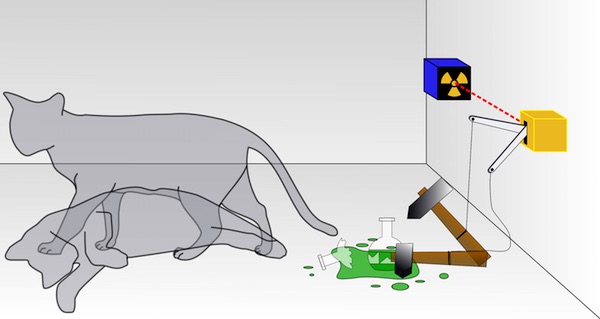
Physicist Erwin Schrödinger in 1935 tried to explain the (consequences of the) uncertainty principle, defined by Werner Heisenberg as a core theme of Albert Einstein’s view of quantum mechanics, to … Albert Einstein. The latter must have been thrilled. Even though he did not like the uncertainty principle (God does not play dice). The thought experiment became known as “Schrödinger’s cat”. Since you cannot know both a particle’s position and its speed -and that’s just one example-, you have to assume all possible outcomes are valid (superposition). Only when you “look” does one particular outcome become the “reality”. It’s all part of the subatomic “world”

Wikipedia: “In Schrödinger’s original formulation, a cat, a flask of poison, and a radioactive source are placed in a sealed box. If an internal monitor (e.g. a Geiger counter) detects radioactivity (i.e. a single atom decaying), the flask is shattered, releasing the poison, which kills the cat. The Copenhagen interpretation implies that, after a while, the cat is simultaneously alive and dead. Yet, when one looks in the box, one sees the cat either alive or dead, not both alive and dead. This poses the question of when exactly quantum superposition ends and reality resolves into one possibility or the other.”

As I’m trying to explain this, I very much have to wonder if I get it right. And I always thought that follows the uncertainty principle too: I can understand it and not understand it both at the same time. A physicist might fare a bit better, but it won’t come easy.

This is what I was thinking of with regards to the war in Ukraine. Before the fighting started, all possible outcomes seemed equally possible. If you did not look too closely at numbers of soldiers and weaponry, that is. But once it did start (when Schrödinger’s box was opened), it became clear very rapidly that Ukraine had no chance of winning. So why are we still acting as if the box remains closed? Because that way we get to spend billions more on armory, and we get western people to support Zelensky and his neo-nazis as those same people suffer from high prices for everything. Any outcome is still possible!

Take the Kakhovka dam narrative, or Nord Stream or any of the numerous other examples. When both sides accuse each other of perpetrating a certain event, Schrödinger’s box remains closed. Which is exactly what our politicians and arms makers desire. They don’t want us to know that they’ve been beaten by Russia, because you would no longer support their policies and their arms purchases. They want “superposition”. They can’t very well declare victory -though they try-, but they don’t need to either. They need uncertainty. Politicians, arms makers and media. They all profit from keeping you in the dark.

The best comment on Kakhovka I’ve seen perhaps comes from @CheburekiMan on Twitter: “Restoring water flow to the North Crimean Canal was top priority for Russia, the very first act of the SMO. Before Kiev shut off the flow in 2014, the canal was supplying 85% of Crimea’s water. So much depended on it, from crops to industry to drinking water, that’s how important it is. Now the pro-Ukraine bleating sheep want people to believe that Russia would wreck the dam, empty the reservoir and cause serious harm to its own people by running the canal dry. It’s so bonkers that one has to seriously consider such ideas are the result of brain damage, or perhaps fetal alcohol syndrome.”

Where Orwell comes in is in the terminology. Where “War equals Peace”. The EU pays its member states for the second hand weapons they “donate” to Kiev, through something called the European Peace Fund (aka Facility). Mass weapons deliveries that get huge numbers of people killed, are labeled “Peace”. Zelensky touts a plan labeled a Peace Plan, which demands Russia give back all territories, pay war reparations, deliver Putin et al to some international criminal court etc. The chance of that happening is of course zero, but as long as Schrödinger’s box remains closed, anything is possible. Still, it is a War Plan, not a Peace Plan.

Similarly, Zelensky and his international backers are organizing a Peace Summit, where everybody is invited except Russia. That makes it a War Summit. The suggestion made to westerners is that this is a globally supported initiative, but it is only a small part of the world population (10%?) that supports it. NATO+Japan+Australia. Did I leave anyone out? New Zealand? Ha ha ha, I read that Jacinda Ardern was made a dame. If you know a better illustration of how deep we’ve sunk, I’m game.

All the rest of the world is much more interested in the economic developments that involve BRICS+. 31 and counting nations have expressed interest in joining. And they’re not going to risk their potential role in that over a local fight far away that they know is long decided. US/NATO, in provoking this war, have lost not only the fight, but much more importantly, their economic power. Recently, the G7 were talking about what they were going to do in Central Asia. Which is basically all the “-Stans” left over after the Soviet Union dissolved. But the G7 is not going to do anything, it has no power there anymore. All these countries want to join the BRICS+. Why would you join a waning power if you have a shot at joining a power in its ascendancy, that all your neighbors are also joining?

The same attitude is prevalent in Africa, South America, East Asia, etc. Full of countries that remember how they were treated through the years by first Europe and then the US. The world has changed beyond recognition since the start of Russia’s SMO, and the “globalist west” is the only “region” that doesn’t recognize this. The USD won’t be replaced tomorrow as the reserve currency, but it doesn’t have to be. The process goes step by step, and is unstoppable. Hemingway’s famous words about how you go bankrupt (first gradually, then suddenly) have us on the wrong foot here. We only look at the “suddenly” part when it comes to the reserve currency, and ignore all the “gradually” steps. And then one day we will wake up and everything’s changed.

The rest of the world sees Schrödinger’s box as open. Only the west thinks that it’s still closed, and all possible outcomes are still viable.

‘Give War a Chance’ – A ‘War That Even Pacifists Can Get Behind’

By Alastair Crooke

Source: Strategic Culture Foundation

The West is now waking up to the reality of the emerging, polycentric and fluid global order, Alastair Crooke writes.

More than a year into Russia’s Special Operation, the initial burst of European excitement at western push-back on Russia has dissipated. The mood instead has turned to “existential dread, a nagging suspicion that [western] civilisation may destroy itself”, Professor Helen Thompson writes.

For an instant, a euphoria had coalesced around the putative projection of the EU as a world power; as a key actor, about to compete on a world scale. Initially, events seemed to play to Europe’s conviction of its market powers: Europe was going to bring down a major power – Russia – by financial coup d’état alone. The EU felt ‘six feet tall’.

It seemed at the time a galvanising moment: “The war re-forged a long-dormant Manichaean framing of existential conflict between Russia and the West, assuming ontological, apocalyptic dimensions. In the spiritual fires of the war, the myth of the ‘West’ was rebaptised”, Arta Moeini suggests.

After the initial disappointment at the lack of a ‘quick kill’, the hope persisted – that if only the sanctions were given more time, and made more all-embracing, then Russia surely would ultimately collapse. That hope has turned to dust. And the reality of what Europe has done to itself has begun to dawn – hence Professor Thomson’s dire warning:

“Those who assume that the political world can be reconstructed by the efforts of human Will, have never before had to bet so heavily on technology over [fossil] energy – as the driver of our material advancement”.

For the Euro-Atlanticists however, what Ukraine seemed to offer – finally – was validation for their yearning to centralise power in the EU, sufficiently, to merit a place at the ‘top table’ with the U.S., as partners in playing the Great Game.

Ukraine, for better or worse, underlined Europe’s profound military dependence on Washington – and on NATO.

More particularly, the Ukraine conflict seemed to open the prospect for consolidating the strange metamorphosis of NATO from military alliance to an enlightened, Progressive, peace alliance! As Timothy Garton Ash effused in the Guardian in 2002, “NATO has become a European peace movement” where one could watch “John Lennon meet George Bush”.

The Ukraine war is portrayed, in this vein, as the “war­ that even former pacifists can get behind. All its proponents seemed to be singing is “Give War a Chance””.

Lily Lynch, a Belgrade-based writer, argues that,

“…especially in the past 12 months, telegenic female leaders such as the Finnish Prime Minister, Sanna Marin, German Foreign Minister, Annalena Baerbock, and Estonian Prime Minister, Kaja Kallas, have increasingly served as the spokespersons of enlightened militarism in Europe … ”

“No political party in Europe better exemplifies the shift from militant pacifism to ardent pro-war Atlanticism than the German Greens. Most of the original Greens had been radicals during the student protests of 1968 … But as the founding members entered middle age, fissures began to appear in the party – that would one day tear it apart”.

“Kosovo then changed everything: The 78-day NATO bombing of what remained of Yugoslavia in 1999, ostensibly to halt war crimes committed by Serbian security forces in Kosovo, would forever transform the German Greens. NATO for the Greens became an active military compact concerned with spreading and defending values such as human rights, democracy, peace, and freedom – well beyond the borders of its member states”.

A few years later, in 2002, an EU functionary (Robert Cooper) could envisage Europe as a new ‘liberal imperialism’. The ‘new’ was that Europe eschewed hard military power, in favour of weaponising both a controlled ‘narrative’ and controlled participation in its market. He advocated for ‘a new age of empire’, in which Western powers no longer would have to follow international law in their dealings with ‘old fashioned’ states; they could use military force independently of the United Nations; and could impose protectorates to replace regimes which ‘misgovern’.

The German Greens’ Foreign Minister, Annalena Baerbock, has continued with this metamorphosis, scolding countries with traditions of military neutrality, and imploring them to join NATO. She has invoked Archbishop Desmond Tutu’s line: “If you are neutral in situations of injustice, you have chosen the side of the oppressor”. And the European Left has been utterly captivated. Major parties have abandoned military neutrality and opposition to war – and now champion NATO. It is a stunning reversal.

All this may have been music to the ears of the Euro-élites anxious for the EU to rise to Great Power status, but this soft-power European Leviathan was wholly underpinned by the unstated (but essential) assumption that NATO ‘had Europe’s back’. This naturally implied that the EU had to tie itself ever closer to NATO – and therefore to the U.S. which controls NATO.

But the flip-side to this Atlanticist aspiration – as President Emmanuel Macron noted – is its inexorable logic that Europeans simply end by becoming American vassals. Macron was trying rather, to rally Europe towards the coming ‘age of empires’,hoping to position Europe as a ‘third pole’ in a concert of empires.

The Atlanticists were duly enraged by Macron’s remarks (which nonetheless drew support of other EU states). It could even seem (to furious Atlanticists) that Macron actually was channelling General de Gaulle who had called NATO a “false pretence” designed to “disguise America’s chokehold over Europe”.

There are however, two related schisms that flowed out from this ‘re-imagined’ NATO: Firstly, it exposed the reality of internal European rivalries and divergent interests, precisely because the NATO lead in the Ukraine conflict sets the interests of the Central East European hawks wanting ‘more America, and more war on Russia’ up and against that of the original EU western axis which wants wanting strategic autonomy (i.e. less ‘America’, and a quick end to the conflict).

Secondly, it would be predominantly the western economies that would have to bankroll the costs and divert their manufacturing capacity towards military logistic chains. The economic price, non-military de-industrialisation and high inflation, potentially, could be enough to break Europe – economically.

The prospect of a pan-European cohesive identity might be both ontologically appealing – and be seen to be an ‘appropriate accessory’ to an aspiring ‘world actor’ – yet such identity becomes caricature when mosaic Europe is transformed into an abstract de-territorialised identity that reduces people to their most abstract.

Paradoxically, the Ukraine war – far from consolidating the EU ‘identity’, as first imagined – has fractured it under the stresses of the concerted effort to weaken and collapse Russia.

Secondly, as Arta Moeini, the director of the Institute for Peace and Diplomacy, has observed:

“The American push for NATO expansion since 1991 has enlarged the alliance by adding a host of faultline states from Central and Eastern Europe. The strategy, which began with the Clinton administration but was fully championed by the George W. Bush administration, was to create a decidedly pro-American pillar on the continent, centred on Warsaw – which would force an eastward shift in the alliance’s centre of gravity away from the traditional Franco-German axis”.

“By using NATO enlargement to weaken the old power centres in Europe that might have occasionally stood up to [Washington] such as in the run-up to the invasion of Iraq, Washington ensured a more compliant Europe in the short-term. The upshot, however, was the formation of a 31-member behemoth with deep asymmetries of power and low compatibility of interests” – that is much weaker and more vulnerable – than it believes itself to be”.

Here is the key: “the EU is much weaker than it believes it to be”. The outset of the conflict was defined by a cast of mind entranced by the notion of Europe as a ‘mover and shaker’ in world affairs, and mesmerised by Europe’s post-war prosperity.

EU leaders convinced themselves that this prosperity had bequeathed it the clout and the economic depth to contemplate war – and to weather its reversals – with panglossian sanguinity. It has produced rather, the converse: It has put its project in jeopardy.

In John Raply and Peter Heather’s The Imperial Life Cycle, the authors explain the cycle:

“Empires grow rich and powerful and attain supremacy through the economic exploitation of their colonial periphery. But in the process, they inadvertently spur the economic development of that same periphery, until it can roll back and ultimately displace its overlord”.

Europe’s prosperity in this post-war era, thus was not so much one of its own making, but drew benefit from the tail-end of accumulations hewn from an earlier cycle – now reversed.

“The fastest-growing economies in the world are now all in the old periphery; the worst-performing economies are disproportionately in the West. These are the economic trends that have created our present landscape of superpower conflict — most saliently between America and China”.

America may think of itself as exempt from the European colonial mould, yet fundamentally, its model is

“an updated cultural-political glue that we might call “neoliberalism, NATO and denim”, which follows in the timeless imperial mould: The great wave of decolonisation that followed WW2 was meant to end that. But the Bretton Woods system, which created a trading regime that favoured industrial over primary producers and enshrined the dollar as the global reserve currency – ensured that the net flow of financial resources continued to move from developing countries to developed ones. Even when the economies of the newly-independent states grew, those of the G7 economies and their partners grew more”.

A once-mighty empire is now challenged and feels embattled. Taken aback by the refusal of so many developing countries to join with isolating Russia, the West is now waking up to the reality of the emerging, polycentric and fluid global order. These trends are set to continue. The danger is that economically weakened and in crisis, western countries attempt to re-appropriate western triumphalism, yet lack the economic strength and depth, so to do:

“In the Roman Empire, peripheral states developed the political and military capacity to end Roman domination by force… The Roman Empire might have survived – had it not weakened itself with wars of choice – on its ascendant Persian rival”.

The final ‘transgressive’ thought goes to Tom Luongo: “Allowing the West to keep thinking they can win – is the ultimate form of grinding out a superior opponent”.

Interesting!

US Gov’t Remaining Silent on American Detained in Ukraine for His Political Views

Detained by Security Service of Ukraine (SBU) due to his political views on the conflict…

By Dave DeCamp

Source: The Free Thought Project

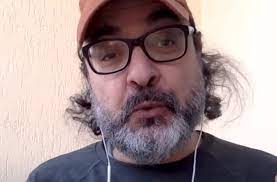
The State Department has refused to say if it’s engaging with the Ukrainian government over American citizen Gonzalo Lira, who was detained by the Security Service of Ukraine (SBU) due to his political views on the conflict with Russia.

Lira has a popular YouTube channel and a large following on Twitter and Telegram. He is also a writer who has contributed to several media outlets, including Business Insider. Lira was born in California and is a dual citizen of the US and Chile and had been living in Kharkiv, Ukraine, throughout the war.

Lira is a critic of the Ukrainian government and was arrested by the SBU on charges of justifying the Russian invasion. “After the start of the full-scale invasion, the blogger was one of the first to support the Russian invaders and glorify their war crimes,” the SBU said in a press release referring to Lira.

The SBU also accused Lira of “discrediting the top military and political leadership and the Defense Forces of our state.” He was charged under sections 2 and 3 of Article 436-2 of Ukraine’s criminal code, which outlaws the “distribution of materials” that justify Russia’s actions going back to 2014.

Epoch Times reporter Liam Cosgrove asked State Department spokesman Matthew Miller if the administration was aware of Lira’s detainment and how the US feels about Ukraine arresting an American for speech.

“So I will say in general that we’re aware of the report. We obviously support the exercise of freedom of speech anywhere in the world, and I’ll leave it at that,” Miller said.

When asked if the administration was working to secure Lira’s release, Miller said, “I’m going to leave my comments where I just left them.”

Cosgrove also asked Reps. Ted Lieu (D-CA) and Marjorie Taylor Greene (R-GA) about Lira’s detainment. Lieu said that he wasn’t aware of the case but said US citizens should “have the ability to express their thoughts and views” and that he would look into the arrest.

Responding to the news, Greene told Cosgrove: “America is providing weapons, equipment for the defense of their country, but the Ukrainian government is not going to defend any American’s freedom of speech, and that’s a real problem.”

Lira’s arrest received virtually no attention in Western media. One of the few outlets to cover it was the Daily Beast, which smeared the American instead of questioning the charges. According to the BeastLira is facing five to eight years in prison.

Conspirators for the Constitution: When Anti-Government Speech Becomes Sedition

By John & Nisha Whitehead

Source: The Rutherford Institute

“In a time of deceit telling the truth is a revolutionary act.”— George Orwell

Let’s be clear about one thing: seditious conspiracy isn’t a real crime to anyone but the U.S. government.

To be convicted of seditious conspiracy, the charge levied against Stewart Rhodes who was sentenced to 18 years in prison for being the driving force behind the January 6 Capitol riots, one doesn’t have to engage in violence against the government, vandalize government property, or even trespass on property that the government has declared off-limits to the general public.

To be convicted of seditious conspiracy, one need only foment a revolution.

This is not about whether Rhodes deserves such a hefty sentence.

This is about the long-term ramifications of empowering the government to wage war on individuals whose political ideas and expression challenge the government’s power, reveal the government’s corruption, expose the government’s lies, and encourage the citizenry to push back against the government’s many injustices.

This is about criminalizing political expression in thoughts, words and deeds.

This is about how the government has used the events of Jan. 6 in order to justify further power grabs and acquire more authoritarian emergency powers.    

This was never about so-called threats to democracy.

In fact, the history of this nation is populated by individuals whose rhetoric was aimed at fomenting civil unrest and revolution.

Indeed, by the government’s own definition, America’s founders were seditious conspirators based on the heavily charged rhetoric they used to birth the nation.

Thomas Jefferson, Thomas Paine, Marquis De Lafayette, and John Adams would certainly have been charged for suggesting that Americans should not only take up arms but be prepared to protect their liberties and defend themselves against the government should it violate their rights.

“What country can preserve its liberties if their rulers are not warned from time to time that their people preserve the spirit of resistance. Let them take arms,” declared Jefferson. He also concluded that “the tree of liberty must be refreshed from time to time with the blood of patriots and tyrants.”

“It is the duty of the patriot to protect his country from its government,” insisted Paine.

“When the government violates the people’s rights,” Lafayette warned, “insurrection is, for the people and for each portion of the people, the most sacred of the rights and the most indispensable of duties.”

Adams cautioned, “A settled plan to deprive the people of all the benefits, blessings and ends of the contract, to subvert the fundamentals of the constitution, to deprive them of all share in making and executing laws, will justify a revolution.”

Had America’s founders feared revolutionary words and ideas, there would have been no First Amendment, which protects the right to political expression, even if that expression is anti-government.

No matter what one’s political persuasion might be, every American has a First Amendment right to protest government programs or policies with which they might disagree.

The right to disagree with and speak out against the government is the quintessential freedom.

Every individual has a right to speak truth to power—and foment change—using every nonviolent means available.

Unfortunately, the government is increasingly losing its tolerance for anyone whose political views could be perceived as critical or “anti-government.”

All of us are in danger.

In recent years, the government has used the phrase “domestic terrorist” interchangeably with “anti-government,” “extremist” and “terrorist” to describe anyone who might fall somewhere on a very broad spectrum of viewpoints that could be considered “dangerous.”

The ramifications are so far-reaching as to render almost every American with an opinion about the government or who knows someone with an opinion about the government an extremist in word, deed, thought or by association.

You see, the government doesn’t care if you or someone you know has a legitimate grievance. It doesn’t care if your criticisms are well-founded. And it certainly doesn’t care if you have a First Amendment right to speak truth to power.

What the government cares about is whether what you’re thinking or speaking or sharing or consuming as information has the potential to challenge its stranglehold on power.

Why else would the FBI, CIA, NSA and other government agencies be investing in corporate surveillance technologies that can mine constitutionally protected speech on social media platforms such as Facebook, Twitter and Instagram?

Why else would the Biden Administration be likening those who share “false or misleading narratives and conspiracy theories, and other forms of mis- dis- and mal-information” to terrorists?

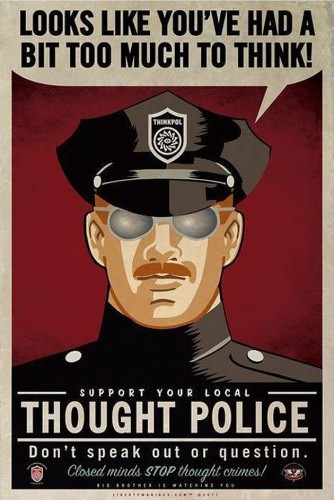
Why else would the government be waging war against those who engage in thought crimes?

Get ready for the next phase of the government’s war on thought crimes and truth-tellers.

For years now, the government has used all of the weapons in its vast arsenal—surveillance, threat assessments, fusion centers, pre-crime programs, hate crime laws, militarized police, lockdowns, martial law, etc.—to target potential enemies of the state based on their ideologies, behaviors, affiliations and other characteristics that might be deemed suspicious or dangerous.

For instance, if you believe in and exercise your rights under the Constitution (namely, your right to speak freely, worship freely, associate with like-minded individuals who share your political views, criticize the government, own a weapon, demand a warrant before being questioned or searched, or any other activity viewed as potentially anti-government, racist, bigoted, anarchic or sovereign), you could be at the top of the government’s terrorism watch list.

Moreover, as a New York Times editorial warns, you may be an anti-government extremist (a.k.a. domestic terrorist) in the eyes of the police if you are afraid that the government is plotting to confiscate your firearms, if you believe the economy is about to collapse and the government will soon declare martial law, or if you display an unusual number of political and/or ideological bumper stickers on your car.

According to one FBI report, you might also be classified as a domestic terrorism threat if you espouse conspiracy theories, especially if you “attempt to explain events or circumstances as the result of a group of actors working in secret to benefit themselves at the expense of others” and are “usually at odds with official or prevailing explanations of events.”

In other words, if you dare to subscribe to any views that are contrary to the government’s, you may well be suspected of being a domestic terrorist and treated accordingly.

There’s a whole spectrum of behaviors ranging from thought crimes and hate speech to whistleblowing that qualifies for persecution (and prosecution) by the Deep State.

Simply liking or sharing this article on Facebook, retweeting it on Twitter, or merely reading it or any other articles related to government wrongdoing, surveillance, police misconduct or civil liberties might be enough to get you categorized as a particular kind of person with particular kinds of interests that reflect a particular kind of mindset that might just lead you to engage in a particular kinds of activities and, therefore, puts you in the crosshairs of a government investigation as a potential troublemaker a.k.a. domestic extremist.

Chances are, as the Washington Post reports, you have already been assigned a color-coded threat score—green, yellow or red—so police are forewarned about your potential inclination to be a troublemaker depending on whether you’ve had a career in the military, posted a comment perceived as threatening on Facebook, suffer from a particular medical condition, or know someone who knows someone who might have committed a crime.

In other words, you might already be flagged as potentially anti-government in a government database somewhere—Main Core, for example—that identifies and tracks individuals who aren’t inclined to march in lockstep to the police state’s dictates.

As The Intercept reported, the FBI, CIA, NSA and other government agencies have increasingly invested in corporate surveillance technologies that can mine constitutionally protected speech on social media platforms such as Facebook, Twitter and Instagram in order to identify potential extremists and predict who might engage in future acts of anti-government behavior.

Where many Americans go wrong is in naively assuming that you have to be doing something illegal or harmful in order to be flagged and targeted for some form of intervention or detention.

In fact, all you need to do these days to end up on a government watch list or be subjected to heightened scrutiny is use certain trigger words (like cloud, pork and pirates), surf the internet, communicate using a cell phone, limp or stutterdrive a car, stay at a hotel, attend a political rally, express yourself on social mediaappear mentally ill, serve in the militarydisagree with a law enforcement officialcall in sick to work, purchase materials at a hardware store, take flying or boating lessons, appear suspicious, appear confused or nervous, fidget or whistle or smell bad, be seen in public waving a toy gun or anything remotely resembling a gun (such as a water nozzle or a remote control or a walking cane), stare at a police officer, question government authority, or appear to be pro-gun or pro-freedom.

And then at the other end of the spectrum there are those such as Julian Assange and Chelsea Manning, for example, who blow the whistle on government misconduct that is within the public’s right to know.

In true Orwellian fashion, the government would have us believe that it is Assange and Manning who are the real criminals for daring to expose the war machine’s seedy underbelly.

Since his April 2019 arrest, Assange has been locked up in a maximum-security British prison—in solitary confinement for up to 23 hours a day—pending extradition to the U.S., where if convicted, he could be sentenced to 175 years in prison.

This is how the police state deals with those who challenge its chokehold on power.

This is also why the government fears a citizenry that thinks for itself: because a citizenry that thinks for itself is a citizenry that is informed, engaged and prepared to hold the government accountable to abiding by the rule of law, which translates to government transparency and accountability.

After all, we’re citizens, not subjects.

For those who don’t fully understand the distinction between the two and why transparency is so vital to a healthy constitutional government, Manning explains it well:

When freedom of information and transparency are stifled, then bad decisions are often made and heartbreaking tragedies occur – too often on a breathtaking scale that can leave societies wondering: how did this happen? … I believe that when the public lacks even the most fundamental access to what its governments and militaries are doing in their names, then they cease to be involved in the act of citizenship. There is a bright distinction between citizens, who have rights and privileges protected by the state, and subjects, who are under the complete control and authority of the state.

This is why the First Amendment is so critical. It gives the citizenry the right to speak freely, protest peacefully, expose government wrongdoing, and criticize the government without fear of arrest, isolation or any of the other punishments that have been meted out to whistleblowers such as Edwards Snowden, Assange and Manning.

The challenge is holding the government accountable to obeying the law.

A little over 50 years ago, the U.S. Supreme Court ruled 6-3 in United States v. Washington Post Co. to block the Nixon Administration’s attempts to use claims of national security to prevent The Washington Post and The New York Times from publishing secret Pentagon papers on how America went to war in Vietnam.

As Justice William O. Douglas remarked on the ruling, “The press was protected so that it could bare the secrets of government and inform the people. Only a free and unrestrained press can effectively expose deception in government. And paramount among the responsibilities of a free press is the duty to prevent any part of the government from deceiving the people and sending them off to distant lands to die of foreign fevers and foreign shot and shell.”

Fast forward to the present day, and we’re witnessing yet another showdown, this time between Assange and the Deep State, which pits the people’s right to know about government misconduct against the might of the military industrial complex.

Yet this isn’t merely about whether whistleblowers and journalists are part of a protected class under the Constitution. It’s a debate over how long “we the people” will remain a protected class under the Constitution.

Following the current trajectory, it won’t be long before anyone who believes in holding the government accountable is labeled an “extremist,” relegated to an underclass that doesn’t fit in, watched all the time, and rounded up when the government deems it necessary.

We’re almost at that point now.

Eventually, as I point out in my book Battlefield America: The War on the American People and in its fictional counterpart The Erik Blair Diaries, we will all be seditious conspirators in the eyes of the government.

We would do better to be conspirators for the Constitution starting right now.

EU’s Voluntary Disinformation Code Is Compulsory: Obey or Die

By Declan Hayes

Source: Strategic Culture Foundation

Though Musk is still playing at being NATO’s token non-conformist, the EU is essentially telling him and all of us that any dissent from its Russophobic, Slavophobic and Sinophobic narratives will be severely punished.

The European Union’s enforcers have told Twitter owner Elon Musk that the EU’s voluntary information code is not voluntary and that the EU will fine the pants off Twitter if Musk does not play by NATO’s self-serving rules. Though Musk is still playing at being NATO’s token non-conformist, the EU is essentially telling him and all of us that any dissent from its Russophobic, Slavophobic and Sinophobic narratives will be severely punished.

From the point of view of von der Leyen and NATO’s other EU puppets, that makes absolutely perfect sense. As legacy media’s active shelf life is fast expiring, that just leaves the EU with alternative media to kill off with massive fines in Twitter’s case or, more generally, by crowding out and muzzling any and all truth tellers.

Look at the treatment being meted out to Pink Floyd’s Roger Waters, a life-long anti-fascist, whose father was killed in action fighting the Nazis but which the usual suspects, led as always by the BBC and the Guardian, are trying to ban for supposedly being a Jew-hating Nazi simply because of his support for Palestinian rights, for Julian Assange and for being stupid enough to still be doing live concerts with those unreconstructed views, as he touches 80 years of age.

The EU’s code Waters and Musk are falling foul of “aims to prevent profiteering from disinformation and fake news, as well as increasing transparency and curbing the spread of bots and fake accounts”.

By disinformation, in addition to Waters, von der Leyen’s thugs mean the work of folk like our own excellent Stephen Karganovic, who is not only a quality thinker and writer, but is on every EU and NATO hit list imaginable because he speaks his truths to their power. And others like Fyodor Lukyanov and Timur Fomenko, who file excellent analytical copy for Russia Today which, with this site, is subject to a string of sanctions and name-calling that are as libellous and ignorant as those these EU and NATO morons throw at Waters or any other of their betters.

The objective in labelling SCF, Russia Today, Waters and even Masha and Mishka as dis-information is to control the common space and not to give the ideas of heretics like Jeremy Corbyn, Robert F Kennedy Junior or their type space to survive.

With fake news, the EU is primarily concerned with folk who expose their crimes, family folk like Roger Waters and Julian Assange, who has now done the equivalent of a life tariff for exposing the tiniest fracton of the war crimes the Yanks committed in Iraq, crimes which, remember, included the gang rape of little girls by these harbingers of US-style democracy.

And then there is Gonzalo Lira, who is in the worst of all places, in Ukraine, whose soldiers rape corpses, and whose politicians ban all opposition parties, all opposition media and all religions that do not worship their utterly corrupt system but yet, as the corpse rapists do God knows what to Gonzalo Lira in God knows where, Ukraine has seen its ranking in NATO’s Press Freedom and Transparency Indexes soar like an American bald eagle that is oblivious to the stench below. The Nazi rump Reich is, the EU’s disinformation experts proclaim, the land of the free and the land of the brave, even as it is hell on earth for Lira and millions of Zelensky’s other victims.

The torture of Assange and Lira has silenced countless others and thereby made way for NATO’s own quack journalists to fill the void with their own fake news, which was presented to us up till recently by sexual predators like Philip Schofield, ITV’s equivalent of the BBC’s Jimmy Savile.

Not to put too fine a point on it, but corrupt countries and institutions that elevate Jimmy Saville, Philip Schofield, Ghislaine Maxwell, Lord BoothbyTom Driberg MP, Jeffrey Epstein, Sir Ted HeathCyril SmithKarim Ahmad KhanImran Ahmad Khan and Prince Andrew to positions of power and authority are not in a position to lecture to anyone on transparency or to spin their fake news line on their own terrorist attack on Nordstream.

As regards bots and fake accounts, that smear should have died a death with the end of Russiagate, one of a number of massive CIA/EU efforts to disseminate fake news and opaqueness through their own bots and fake accounts.

But why, the Clinton, Biden, Obama and other organised crime families would ask, re-invent the wheel, when the old smears NATO’s media spin work as well as ever?

What we have with all these rafts of EU laws, fines, sanctions, bluster and bluff is a sort of NATO Cosplay, where von der Leyen and her fellow Cosplay conspirators get to moralise, whilst the Biden, Kerry and Pelosi families get to sprinkle Ukraine with enough bio labs to take out half of Europe’s population, and the New York Post, the only media outlet that reported on the crimes Hunter Biden’s laptop revealed, gets banned and harassed by the FBI goon squads.

Von der Leyen’s Digital Services Act will further criminalise offensive humour such as comparing French dictator Macron to Hitler (though Waters will remain fair game). Some 19 companies, including Alphabet’s Google Maps, Google Play, Google Search, Google Shopping, YouTube, Meta’s Facebook and Instagram, Amazon’s Marketplace, Apple’s App Store, Twitter, Microsoft’s two units LinkedIn and Bing, booking.com, Pinterest, Snap Inc’s Snapchat, TikTok, Wikipedia, Zalando, and Alibaba’s AliExpress will all have to obey von der Leyen’s diktats “to make the internet safer” by erasing so-called disinformation in whatever way von der Leyen and her fellow plagiarists decide to define it from one moment to the next.

Not that war is their only earner needing the censor’s protection. Over 3,400 peer-reviewed papers questioning NATO’s Covid narrative have also been sidelined and ignored. Fake news, Russian propaganda, dis-information or some such stuff. I am one of many who did not take the vaccine von der Leyen’s husband made a fortune pimping. And I am glad I didn’t fall for their dancing nurses and their relentless marketing, irrespective of whether they were peddling fake news with their fake vaccines or not. I have no idea whether those vaccines are effective or not. I am not qualified to opine.

But what I do know is this. There are large groups of American and European politicians, like American fugitive Lindsey Graham who have been promoted because, thick as bricks though they are, they are sufficiently spineless to pimp the wars, vaccines and other societal wrecking balls those who fund and control them are selling.

Speaking of war, NATO and KFOR mercenaries have just slaughtered a bunch of Serbs in Zvecan (northern Kosovo). Though I look forward with interest to getting a proper analysis of this latest NATO war crime from Fyodor Lukyanov, Timur Fomenko and our own excellent Stephen Karganovic, I do know that not only will their take be totally at odds with that of the EU’s semi-literate fact-checkers but that Russia Today and Karganovic will be much nearer to the truth than any of von der Leyen’s minions could ever be because those EU yellow packs are groomed to paint over and hide the crimes against Serbs and Palestinians this article and a thousand others on this site draw attention to.

America’s Addiction to War Comes with a 15 Trillion Dollar Price Tag

To surmount the debt crisis, America needs to stop feeding the Military-Industrial Complex, the most powerful lobby in Washington.

By Jeffrey D. Sachs

Source: Information Clearing House

In the year 2000, the U.S. government debt was $3.5 trillion, equal to 35% of the Gross Domestic Product (GDP). By 2022, the debt was $24 trillion, equal to 95% of GDP. The U.S. debt is soaring, hence America’s current debt crisis. Yet both Republicans and Democrats are missing the solution: stopping America’s wars of choice and slashing military outlays.

Suppose the government’s debt had remained at a modest 35% of GDP, as in 2000. Today’s debt would be $9 billion, as opposed to $24 trillion. Why did the U.S. government incur the excess $15 trillion in debt?

The single biggest answer is the U.S. government’s addiction to war and military spending. According to the Watson Institute at Brown University, the cost of U.S. wars from fiscal year 2001 to fiscal year 2022 amounted to a whopping $8 trillion, more than half of the extra $15 trillion in debt. The other $7 trillion arose roughly equally from budget deficits caused by the 2008 financial crisis and the Covid-19 pandemic.

Facing down the military-industrial lobby is the vital first step to putting America’s fiscal house in order.

To surmount the debt crisis, America needs to stop feeding the Military-Industrial Complex (MIC), the most powerful lobby in Washington. As President Dwight D. Eisenhower famously warned on January 17, 1961, “In the councils of government, we must guard against the acquisition of unwarranted influence, whether sought or unsought, by the military-industrial complex. The potential for the disastrous rise of misplaced power exists and will persist.” Since 2000, the MIC led the U.S. into disastrous wars of choice in Afghanistan, Iraq, Syria, Libya, and now Ukraine.

The Military-Industrial Complex long ago adopted a winning political strategy by ensuring that the military budget reaches into every Congressional district. The Congressional Research Service recently reminded Congress that, “Defense spending touches every Member of Congress’s district through pay and benefits for military servicemembers and retirees, economic and environmental impact of installations, and procurement of weapons systems and parts from local industry, among other activities.” Only a brave member of Congress would vote against the military-industry lobby, yet bravery is certainly no hallmark of Congress.

America’s annual military spending is now around $900 billion, roughly 40% of the world’s total, and greater than the next 10 countries combined. U.S. military spending in 2022 was triple that of China. According to Congressional Budget Office, the military outlays for 2024-2033 will be a staggering $10.3 trillion on current baseline. A quarter or more of that could be avoided by ending America’s wars of choice, closing down many of America’s 800 or so military bases around the world, and negotiating new arms control agreements with China and Russia.

Yet instead of peace through diplomacy, and fiscal responsibility, the MIC regularly scares the American people with a comic-book style depictions of villains whom the U.S. must stop at all costs. The post-2000 list has included Afghanistan’s Taliban, Iraq’s Saddam Hussein, Syria’s Bashar al-Assad, Libya’s Moammar Qaddafi, Russia’s Vladimir Putin, and recently, China’s Xi Jinping. War, we are repeatedly told, is necessary for America’s survival.
 

A peace-oriented foreign policy would be opposed strenuously by the military-industrial lobby but not by the public. Significant public pluralities already want less, not more, U.S. involvement in other countries’ affairs, and less, not more, US troop deployments overseas. Regarding Ukraine, Americans overwhelmingly want a “minor role” (52%) rather than a “major role” (26%) in the conflict between Russia and Ukraine. This is why neither Biden nor any recent president has dared to ask Congress for any tax increase to pay for America’s wars. The public’s response would be a resounding “No!”

While America’s wars of choice have been awful for America, they have been far greater disasters for countries that America purports to be saving. As Henry Kissinger famously quipped, “To be an enemy of the United States can be dangerous, but to be a friend is fatal.” Afghanistan was America’s cause from 2001 to 2021, until the U.S. left it broken, bankrupt, and hungry. Ukraine is now in America’s embrace, with the same likely results: ongoing war, death, and destruction.

The military budget could be cut prudently and deeply if the U.S. replaced its wars of choice and arms races with real diplomacy and arms agreements. If presidents and members of congress had only heeded the warnings of top American diplomats such as William Burns, the U.S. Ambassador to Russia in 2008, and now CIA Director, the U.S. would have protected Ukraine’s security through diplomacy, agreeing with Russia that the U.S. would not expand NATO into Ukraine if Russia also kept its military out of Ukraine. Yet relentless NATO expansion is a favorite cause of the MIC; new NATO members are major customers of U.S. armaments.

The U.S. has also unilaterally abandoned key arms control agreements. In 2002, the U.S. unilaterally walked out of the Anti-Ballistic Missile Treaty. And rather than promote nuclear disarmament—as the U.S. and other nuclear powers are required to do under Article VI the Nuclear Non-Proliferation Treaty—the Military-Industrial Complex has sold Congress on plans to spend more than $600 billion by 2030 to “modernize” the U.S. nuclear arsenal.

Now the MIC is talking up the prospect of war with China over Taiwan. The drumbeats of war with China are stoking the military budget, yet war with China is easily avoidable if the U.S. adheres to the One-China policy that properly underpins U.S.-China relations. Such a war should be unthinkable. More than bankrupting the U.S., it could end the world.

Military spending is not the only budget challenge. Aging and rising healthcare costs add to the fiscal woes. According to the Congressional Budget Office, debt will reach 185 percent of GDP by 2052 if current policies remain unchanged. Healthcare costs should be capped while taxes on the rich should be raised. Yet facing down the military-industrial lobby is the vital first step to putting America’s fiscal house in order, needed to save the U.S., and possibly the world, from America’s perverse lobby-driven politics.

Bono Is Doing Illustrations For The Atlantic Now, Because Everything’s Fake And Stupid

By Caitlin Johnstone

Source: CaitlinJohnstone.com

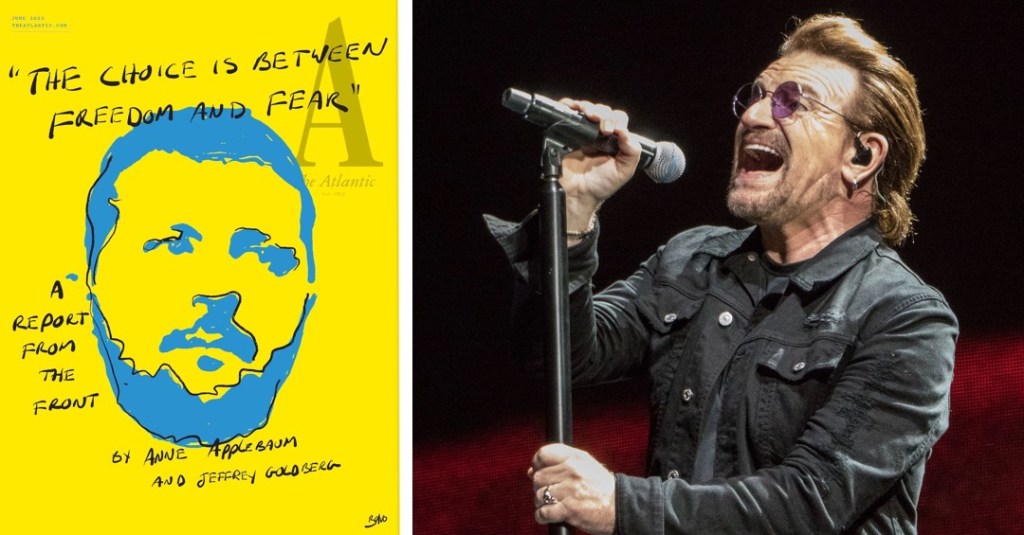
So U2 singer Bono is literally just doing illustrations for the imperialist propaganda rag The Atlantic now, because that’s the sort of thing that happens in a dystopian civilization during the death throes of a globe-spanning empire.

A Washington Post article titled “Bono likes to sketch Atlantic covers, so the magazine hired him” reports that “Bono is into Atlantic cover fanfic — so much so that he was invited to illustrate the magazine’s June cover featuring Ukrainian President Volodymyr Zelensky.” 

Bono’s latest contribution to the mountain of cringe-inducing Zelensky moments we’ve been seeing for the past year provides a cover image for an article by lifelong war propagandists Anne Applebaum and Jeffrey Goldberg. The article endorses a Ukrainian offensive to recapture Crimea, which experts largely agree would be the move most likely to trigger a nuclear war in this conflict.

Here’s a paragraph from Applebaum and Goldberg’s article, just to give you a taste of the infantile “Good Guys vs Bad Guys” framing that western liberals are being fed by mass media war propagandists these days:

“Sometimes, the war is described as a battle between autocracy and democracy, or between dictatorship and freedom. In truth, the differences between the two opponents are not merely ideological, but also sociological. Ukraine’s struggle against Russia pits a heterarchy against a hierarchy. An open, networked, flexible society—one that is both stronger at the grassroots level and more deeply integrated with Washington, Brussels, and Silicon Valley than anyone realized—is fighting a very large, very corrupt, top-down state. On one side, farmers defend their land and 20‑something engineers build eyes in the sky, using tools that would be familiar to 20‑something engineers anywhere else. On the other side, commanders send waves of poorly armed conscripts to be slaughtered—just as Stalin once sent shtrafbats, penal battalions, against the Nazis—under the leadership of a dictator obsessed with ancient bones. ‘The choice,’ Zelensky told us, ‘is between freedom and fear.’”

Many westerners felt their first stirrings of youthful rebellious passions while listening to U2 songs like “Sunday Bloody Sunday” and “Pride (In the Name of Love)”, but nowadays Bono’s voice is heard saying that he has “grown very fond” of war criminal George W Bush, praising capitalism at the World Economic Forum, teaming up with warmonger Lindsey Graham to promote US empire narratives about Syria, and  singing “Stand by Ukraine” in support of US empire narratives in a Kyiv subway. And just when it looks like he can’t become any more of a tool of the empire, he gets hired by one of the world’s worst militarist smut rags to draw a cover image of Zelensky.

Because that’s just how things go in a highly controlled society where mainstream culture is designed to serve the powerful. A society where the minds of the public are continually being shaped by mass-scale psychological manipulation to ensure that they keep thinking, speaking, working, consuming and voting in ways which serve the rich and powerful. Everything that gets elevated to the top of mainstream attention facilitates this agenda (or is at least harmless to it), and as soon as it becomes potentially threatening to this agenda it is either corrected or marginalized away from mainstream attention.

This dynamic can cause some truly jaw-dropping flotsam and jetsam to surface in the roilings of our cultural waters, like Simpsons characters waving Ukrainian flags, or an opera about a drone operator sponsored by General Dynamics.

Here’s Responsible Statecraft’s Connor Echols on that last one:

This fall, DC denizens will be treated to the world premiere of “Grounded,” an opera following an Air Force ace named Jess whose unexpected pregnancy forces her to leave behind her beloved F-16 and join the “chair force.”

Throughout the show, the “hot shot” pilot wrestles with the mental impact of firing rockets from a drone in Afghanistan from a trailer in Las Vegas. “As Jess tracks terrorists by day and rocks her daughter to sleep by night, the boundary between her worlds becomes dangerously permeable,” an ad tells us.

The production is brought to you by presenting sponsor General Dynamics, one of the world’s largest weapons companies (and, wouldn’t you know it, the maker of Jess’s favorite plane). Playwright George Brant wrote the libretto, which will be brought to life by mezzo-soprano Emily D’Angelo and Tony-winning composer Jeanine Tesori.

You’ll also see things like “humanitarian intervention” champion Samantha Power enthusiastically tweeting about the collaboration between the Sesame Street franchise and the CIA cutout USAID in Iraq:

You see things like this all the time under the shadow of the US empire, and individually they don’t look like much, but once you start noticing them you come to recognize them as symptoms of the profoundly diseased civilization that we are living in. One where our heart strings are pulled in the most obnoxious ways imaginable to get us to support capitalism, empire and oligarchy, where we are manipulated into espousing values systems which benefit powerful sociopaths under the cover of noble-sounding causes. Where we are trained like rats to support systems that are driving our species toward extinction because our rulers gave lip service to humanitarianism and waved a rainbow flag.

This is what dystopia looks like. Like a bunch of thought-controlled automatons mindlessly marching toward ecocide and omnicide to a beat played out by screens who tell them every day and in every way that there is no higher purpose than this. Like military industrial complex-funded feminist rock operas about drone operators and Cookie Monster helping Samantha Power psychologically colonize Iraqi children. Like Bono coming home from singing a heartfelt number about the assassination of Martin Luther King Jr to illustrate a cover for a war propaganda piece in The Atlantic.

It’s like they’re pouring concrete over our hearts. Sewing blindfolds over our souls. Numbing us, distracting us, sedating us, so that the local riff raff won’t interfere in the workings of the imperial machine. They’re killing off something beautiful and sacred in humanity, and they’re doing it to roll out some of the ugliest visions this planet has ever seen.

US Empire of Debt Headed for Collapse

By Pepe Escobar

Source: The Unz Review

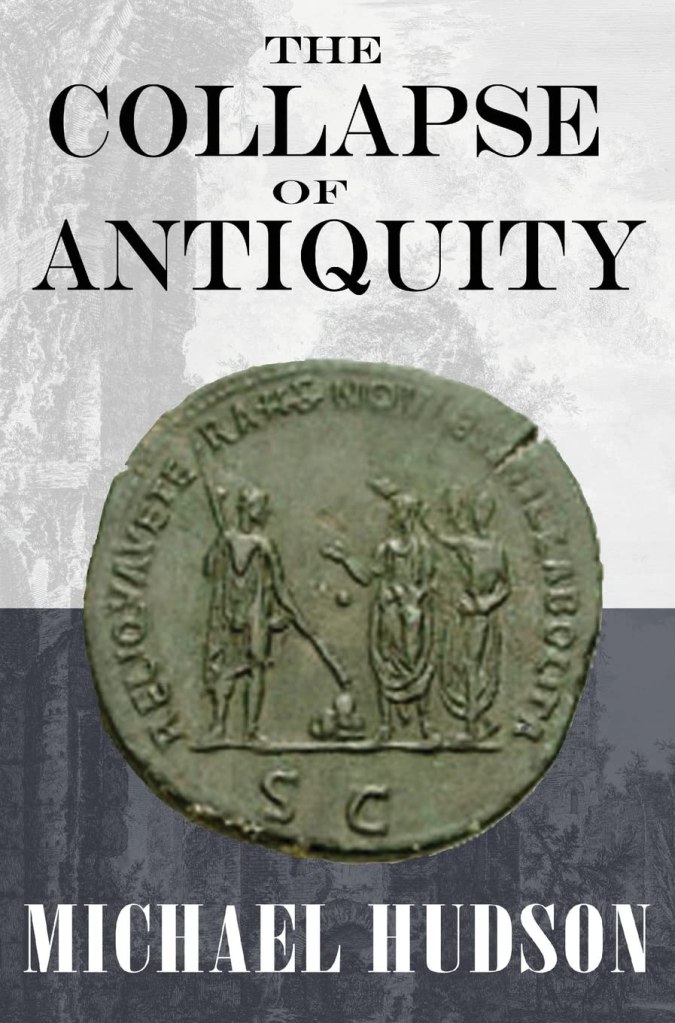
Prof. Michael Hudson’s new book, The Collapse of Antiquity: Greece and Rome as Civilization’s Oligarchic Turning Point is a seminal event in this Year of Living Dangerously when, to paraphrase Gramsci, the old geopolitical and geoeconomic order is dying and the new one is being born at breakneck speed.

Prof. Hudson’s main thesis is absolutely devastating: he sets out to prove that economic/financial practices in Ancient Greece and Rome – the pillars of Western Civilization – set the stage for what is happening today right in front of our eyes: an empire reduced to a rentier economy, collapsing from within.

And that brings us to the common denominator in every single Western financial system: it’s all about debt, inevitably growing by compound interest.

Ay, there’s the rub: before Greece and Rome, we had nearly 3,000 years of civilizations across West Asia doing exactly the opposite.

These kingdoms all knew about the importance of canceling debts. Otherwise their subjects would fall into bondage; lose their land to a bunch of foreclosing creditors; and these would usually try to overthrow the ruling power.

Aristotle succinctly framed it: “Under democracy, creditors begin to make loans and the debtors can’t pay and the creditors get more and more money, and they end up turning a democracy into an oligarchy, and then the oligarchy makes itself hereditary, and you have an aristocracy.”

Prof. Hudson sharply explains what happens when creditors take over and “reduce all the rest of the economy to bondage”: it’s what’s called today “austerity” or “debt deflation”.

So “what’s happening in the banking crisis today is that debts grow faster than the economy can pay. And so when the interest rates finally began to be raised by the Federal Reserve, this caused a crisis for the banks.”

Prof. Hudson also proposes an expanded formulation: “The emergence of financial and landholding oligarchies made debt peonage and bondage permanent, supported by a pro-creditor legal and social philosophy that distinguishes Western civilization from what went before. Today it would be called neoliberalism.”

Then he sets out to explain, in excruciating detail, how this state of affairs was solidified in Antiquity in the course of over 5 centuries. One can hear the contemporary echoes of “violent suppression of popular revolts” and “targeted assassination of leaders” seeking to cancel debts and “redistribute land to smallholders who have lost it to large landowners”.

The verdict is merciless: “What impoverished the population of the Roman Empire” bequeathed a “creditor-based body of legal principles to the modern world”.

Predatory oligarchies and “Oriental Despotism”

Prof Hudson develops a devastating critique of the “social darwinist philosophy of economic determinism”: a “self-congratulatory perspective” has led to “today’s institutions of individualism and security of credit and property contracts (favoring creditor claims over debtors, and landlord rights over those of tenants) being traced back to classical antiquity as “positive evolutionary developments, moving civilization away from ‘Oriental Despotism’”.

All that is a myth. Reality was a completely different story, with Rome’s extremely predatory oligarchies waging “five centuries of war to deprive populations of liberty, blocking popular opposition to harsh pro-creditor laws and the monopolization of the land into latifundia estates”.

So Rome in fact behaved very much like a “failed state”, with “generals, governors, tax collectors, moneylenders and carpet beggars” squeezing out silver and gold “in the form of military loot, tribute and usury from Asia Minor, Greece and Egypt.” And yet this Roman wasteland approach has been lavishly depicted in the modern West as bringing a French-style mission civilisatrice to the barbarians – while carrying the proverbial white man’s burden.

Prof. Hudson shows how Greek and Roman economies actually “ended in austerity and collapsed after having privatized credit and land in the hands of rentier oligarchies”. Does that ring a – contemporary – bell?

Arguably the central nexus of his argument is here:

“Rome’s law of contracts established the fundamental principle of Western legal philosophy giving creditor claims priority over the property of debtors – euphemized today as ‘security of property rights’. Public expenditure on social welfare was minimized – what today’s political ideology calls leaving matters to ‘the market’. It was a market that kept citizens of Rome and its Empire dependent for basic needs on wealthy patrons and moneylenders – and for bread and circuses, on the public dole and on games paid for by political candidates, who often themselves borrowed from wealthy oligarchs to finance their campaigns.”

Any similarity with the current system led by the Hegemon is not mere coincidence. Hudson: “These pro-rentier ideas, policies and principles are those that today’s Westernized world is following. That is what makes Roman history so relevant to today’s economies suffering similar economic and political strains.”

Prof. Hudson reminds us that Rome’s own historians – Livy, Sallust, Appian, Plutarch, Dionysius of Halicarnassus, among others – “emphasized the subjugation of citizens to debt bondage”. Even the Delphic Oracle in Greece, as well as poets and philosophers, warned against creditor greed. Socrates and the Stoics warned that “wealth addiction and its money-love was the major threat to social harmony and hence to society.”

And that brings us to how this criticism was completely expunged from Western historiography. “Very few classicists”, Hudson notes, follow Rome’s own historians describing how these debt struggles and land grabs were “mainly responsible for the Republic’s Decline and Fall.”

Hudson also reminds us that the barbarians were always at the gate of the Empire: Rome, in fact, was “weakened from within”, by “century after century of oligarchic excess.”

So this is the lesson we should all draw from Greece and Rome: creditor oligarchies “seek to monopolize income and land in predatory ways and bring prosperity and growth to a halt.” Plutarch was already into it: “The greed of creditors brings neither enjoyment nor profit to them, and ruins those whom they wrong. They do not till the fields which they take from their debtors, nor do they live in their houses after evicting them.”

Beware of pleonexia

It would be impossible to fully examine so many precious as jade offerings constantly enriching the main narrative. Here are just a few nuggets (And there will be more: Prof. Hudson told me, “I’m working on the sequel now, picking up with the Crusades.”)

Prof. Hudson reminds us how money matters, debt and interest came to the Aegean and Mediterranean from West Asia, by traders from Syria and the Levant, around 8th century B.C. But “with no tradition of debt cancellation and land redistribution to restrain personal wealth seeking, Greek and Italian chieftains, warlords and what some classicists have called mafiosi [ by the way, Northern European scholars, not Italians) imposed absentee land ownership over dependent labor.”

This economic polarization kept constantly worsening. Solon did cancel debts in Athens in the late 6th century – but there was no land redistribution. Athens’ monetary reserves came mainly from silver mines – which built the navy that defeated the Persians at Salamis. Pericles may have boosted democracy, but the eventful defeat facing Sparta in the Peloponnesian War (431-404 B.C.) opened the gates to a heavy debt-addicted oligarchy.

All of us who studied Plato and Aristotle in college may remember how they framed the whole problem in the context of pleonexia (“wealth addiction”) – which inevitably leads to predatory and “socially injurious” practices. In Plato’s Republic, Socrates proposes that only non-wealthy managers should be appointed to govern society – so they would not be hostages of hubris and greed.

The problem with Rome is that no written narratives survived. The standard stories were written only after the Republic had collapsed. The Second Punic War against Carthage (218-201 B.C.) is particularly intriguing, considering its contemporary Pentagon overtones: Prof. Hudson reminds us how military contractors engaged in large-scale fraud and fiercely blocked the Senate from prosecuting them.

Prof. Hudson shows how that “also became an occasion for endowing the wealthiest families with public land when the Rome state treated their ostensibly patriotic donations of jewelry and money to aid the war effort as retroactive public debts subject to repayment”.

After Rome defeated Carthage, the glitzy set wanted their money back. But the only asset left to the state was land in Campania, south of Rome. The wealthy families lobbied the Senate and gobbled up the whole lot.

With Caesar, that was the last chance for the working classes to get a fair deal. In the first half of the 1st century B.C. he did sponsor a bankruptcy law, writing down debts. But there was no widespread debt cancellation. Caesar being so moderate did not prevent the Senate oligarchs from whacking him, “fearing that he might use his popularity to ‘seek kingship’” and go for way more popular reforms.

After Octavian’s triumph and his designation by the Senate as Princeps and Augustus in 27 B.C., the Senate became just a ceremonial elite. Prof Hudson summarizes it in one sentence: “The Western Empire fell apart when there was no more land for the taking and no more monetary bullion to loot.” Once again, one should feel free to draw parallels with the current plight of the Hegemon.

Time to “uplift all labor”

In one of our immensely engaging email exchanges, Prof. Hudson remarked how he “immediately had a thought” on a parallel to 1848. I wrote in the Russian business paper Vedomosti: “After all, that turned out to be a limited bourgeois revolution. It was against the rentier landlord class and bankers – but was as yet a far cry from being pro-labor. The great revolutionary act of industrial capitalism was indeed to free economies from the feudal legacy of absentee landlordship and predatory banking — but it too fell back as the rentier classes made a comeback under finance capitalism.”

And that brings us to what he considers “the great test for today’s split”: “Whether it is merely for countries to free themselves from US/NATO control of their natural resources and infrastructure — which can be done by taxing natural-resource rent (thereby taxing away the capital flight by foreign investors who have privatized their natural resources). The great test will be whether countries in the new Global Majority will seek to uplift all labor, as China’s socialism is aiming to do.”

It’s no wonder “socialism with Chinese characteristics” spooks the Hegemon creditor oligarchy to the point they are even risking a Hot War. What’s certain is that the road to Sovereignty, across the Global South, will have to be revolutionary: “Independence from U.S. control is the Westphalian reforms of 1648 — the doctrine of non-interference in the affairs of other states. A rent tax is a key element of independence — the 1848 tax reforms. How soon will the modern 1917 take place?”

Let Plato and Aristotle weigh in: as soon as humanly possible.