In A Corporatist System Of Government, Corporate Censorship Is State Censorship

By Caitlin Johnstone

Source: CaitlinJohnstone.com

Last year, representatives of Facebook, Twitter, and Google were instructed on the US Senate floor that it is their responsibility to “quell information rebellions” and adopt a “mission statement” expressing their commitment to “prevent the fomenting of discord.”

“Civil wars don’t start with gunshots, they start with words,” the representatives were told. “America’s war with itself has already begun. We all must act now on the social media battlefield to quell information rebellions that can quickly lead to violent confrontations and easily transform us into the Divided States of America.”

Yes, this really happened.

Today [8/7] Twitter has silenced three important anti-war voices on its platform: it has suspended Daniel McAdams, the executive director of the Ron Paul Institute, suspended Scott Horton of the Scott Horton Show, and completely removed the account of prominent Antiwar.com writer Peter Van Buren.

I’m about to talk about the censorship of Alex Jones and Infowars now, so let me get the “blah blah I don’t like Alex Jones” thing out of the way so that my social media notifications aren’t inundated with people saying “Caitlin didn’t say the ‘blah blah I don’t like Alex Jones’ thing!” I shouldn’t have to, because this isn’t actually about Alex Jones, but here it is:

I don’t like Alex Jones. He’s made millions saying the things disgruntled right-wingers want to hear instead of telling the truth; he throws in disinfo with his info, which is the same as lying all the time. He’s made countless false predictions and his sudden sycophantic support for a US president has helped lull the populist right into complacency when they should be holding Trump to his non-interventionist campaign pledges, making him even more worthless than he was prior to 2016.

But this isn’t about defending Alex Jones. He just happens to be the thinnest edge of the wedge.

As of this writing, Infowars has been censored from Facebook, Youtube (which is part of Google), Apple, Spotify, and now even Pinterest, all within hours of each other. This happens to have occurred at the same time Infowars was circulating a petition with tens of thousands of signatures calling on President Trump to pardon WikiLeaks editor-in-chief Julian Assange, who poses a much greater threat to establishment narratives than Alex Jones ever has. Assange’s mother also reports that this mass removal of Infowars’ audience occurred less than 48 hours after she was approached to do an interview by an Infowars producer.

In a corporatist system of government, wherein there is no meaningful separation between corporate power and state power, corporate censorship is state censorship. Because legalized bribery in the form of corporate lobbying and campaign donations has given wealthy Americans the ability to control the US government’s policy and behavior while ordinary Americans have no effective influence whatsoever, the US unquestionably has a corporatist system of government. Large, influential corporations are inseparable from the state, so their use of censorship is inseparable from state censorship.

This is especially true of the vast megacorporations of Silicon Valley, whose extensive ties to US intelligence agencies are well-documented. Once you’re assisting with the construction of the US military’s drone program, receiving grants from the CIA and NSA for mass surveillance, or having your site’s content regulated by NATO’s propaganda arm, you don’t get to pretend you’re a private, independent corporation that is separate from government power. It is possible in the current system to have a normal business worth a few million dollars, but if you want to get to billions of dollars in wealth control in a system where money translates directly to political power, you need to work with existing power structures like the CIA and the Pentagon, or else they’ll work with your competitors instead of you.

And yet every time I point to the dangers of a few Silicon Valley plutocrats controlling all new media political discourse with an iron fist, Democratic Party loyalists all turn into a bunch of hardline free market Ayn Rands. “It’s not censorship!” they exclaim. “It’s a private company and can do whatever it wants with its property!”

They do this because they know their mainstream, plutocrat-friendly “centrist” views will never be censored. Everyone else is on the chopping block, however. Leftist sites have already had their views slashed by a manipulation of Google’s algorithms, and it won’t be long before movements like BDS and Antifa and skeptics of the establishment Syria and Russia narratives can be made to face mass de-platforming on the same exact pretext as Infowars.

This is a setup. Hit the soft target so your oligarch-friendly censorship doesn’t look like what it is, then once you’ve manufactured consent, go on to shut down the rest of dissenting media bit by bit.

Don’t believe that’s the plan? Let’s ask sitting US Senator Chris Murphy:

“Infowars is the tip of a giant iceberg of hate and lies that uses sites like Facebook and YouTube to tear our nation apart,” Murphy tweeted in response to the news. “These companies must do more than take down one website. The survival of our democracy depends on it.”

That sure sounds an awful lot like the warnings issued to the Silicon Valley representatives on the Senate floor at the beginning of this article, no? This is headed somewhere dark.

We’re going to have to find a way to keep the oligarchs from having their cake and eating it too. Either (A) corporations are indeed private organizations separate from the government, in which case the people need to get money out of politics and government agencies out of Silicon Valley so they can start acting like it, and insist that their owners can’t be dragged out on to the Senate floor and instructed on what they can and can’t do with their business, or (B) these new media platforms get treated like the government agencies they function as, and the people get all the First Amendment protection that comes with it. Right now the social engineers are double-dipping in a way that will eventually give the alliance of corporate plutocrats and secretive government agencies the ability to fully control the public’s access to ideas and information.

If they accomplish that, it’s game over for humanity. Any hope of the public empowering itself over the will of a few sociopathic, ecocidal, omnicidal oligarchs will have been successfully quashed. We are playing for all the chips right now. We have to fight this. We have no choice.

OUR NEW, HAPPY LIFE? THE IDEOLOGY OF DEVELOPMENT

By Charles Eisenstein

Source: Waking Times

In George Orwell’s 1984, there is a moment when the Party announces an “increase” in the chocolate ration – from thirty grams to twenty. No one except for the protagonist, Winston, seems to notice that the ration has gone down not up.

‘Comrades!’ cried an eager youthful voice. ‘Attention, comrades! We have glorious news for you. We have won the battle for production! Returns now completed of the output of all classes of consumption goods show that the standard of living has risen by no less than 20 percent over the past year. All over Oceania this morning there were irrepressible spontaneous demonstrations when workers marched out of factories and offices and paraded through the streets with banners voicing their gratitude to Big Brother for the new, happy life which his wise leadership has bestowed upon us.

The newscaster goes on to announce one statistic after another proving that everything is getting better. The phrase in vogue is “our new, happy life.” Of course, as with the chocolate ration, it is obvious that the statistics are phony.

Those words, “our new, happy life,” came to me as I read two recent articles, one by Nicholas Kristof in the New York Times and the other by Stephen Pinker in the Wall Street Journal, both of which asserted, with ample statistics, that the overall state of humanity is better now than at any time in history. Fewer people die in wars, car crashes, airplane crashes, even from gun violence. Poverty rates are lower than ever recorded, life expectancy is higher, and more people than ever are literate, have access to electricity and running water, and live in democracies.

Like in 1984, these articles affirm and celebrate the basic direction of society. We are headed in the right direction. With smug assurance, they tell us that thanks to reason, science, and enlightened Western political thinking, we are making strides toward a better world.

Like in 1984, there is something deceptive in these arguments that so baldly serve the established order.

Unlike in 1984, the deception is not a product of phony statistics.

Before I describe the deception and what lies on the other side of it, I want to assure the reader that this essay will not try to prove that things are getting worse and worse. In fact, I share the fundamental optimism of Kristof and Pinker that humanity is walking a positive evolutionary path. For this evolution to proceed, however, it is necessary that we acknowledge and integrate the horror, the suffering, and the loss that the triumphalist narrative of civilizational progress skips over.

What hides behind the numbers

In other words, we need to come to grips with precisely the things that Stephen Pinker’s statistics leave out. Generally speaking, metrics-based evaluations, while seemingly objective, bear the covert biases of those who decide what to measure, how to measure it, and what not to measure. They also devalue those things which we cannot measure or that are intrinsically unmeasurable. Let me offer a few examples.

Nicholas Kristof celebrates a decline in the number of people living on less than two dollars a day. What might that statistic hide? Well, every time an indigenous hunter-gatherer or traditional villager is forced off the land and goes to work on a plantation or sweatshop, his or her cash income increases from zero to several dollars a day. The numbers look good. GDP goes up. And the accompanying degradation is invisible.

For the last several decades, multitudes have fled the countryside for burgeoning cities in the global South. Most had lived largely outside the money economy. In a small village in India or Africa, most people procured food, built dwellings, made clothes, and created entertainment in a subsistence or gift economy, without much need for money. When development policies and the global economy push entire nations to generate foreign exchange to meet debt obligations, urbanization invariably results. In a slum in Lagos or Kolkata, two dollars a day is misery, where in the traditional village it might be affluence. Taking for granted the trend of development and urbanization, yes, it is a good thing when those slum dwellers rise from two dollars a day to, say, five. But the focus on that metric obscures deeper processes.

Kristof asserts that 2017 was the best year ever for human health. If we measure the prevalence of infectious diseases, he is certainly right. Life expectancy also continues to rise globally (though it is leveling off and in some countries, such as the United States, beginning to fall). Again though, these metrics obscure disturbing trends. A host of new diseases such as autoimmunity, allergies, Lyme, and autism, compounded with unprecedented levels of addiction, depression, and obesity, contribute to declining physical vitality throughout the developed world, and increasingly in developing countries too. Vast social resources – one-fifth of GDP in the US – go toward sick care; society as a whole is unwell.

Both authors also mention literacy. What might the statistics hide here? For one, the transition into literacy has meant, in many places, the destruction of oral traditions and even the extinction of entire non-written languages. Literacy is part of a broader social repatterning, a transition into modernity, that accompanies cultural and linguistic homogenization. Tens of millions of children go to school to learn reading, writing, and arithmetic; history, science, and Shakespeare, in places where, a generation before, they would have learned how to herd goats, grow barley, make bricks, weave cloth, conduct ceremonies, or bake bread. They would have learned the uses of a thousand plants and the songs of a hundred birds, the words of a thousand stories and the steps to a hundred dances. Acculturation to literate society is part of a much larger change. Reasonable people may differ on whether this change is good or bad, on whether we are better off relying on digital social networks than on place-based communities, better off recognizing more corporate logos than local plants and animals, better off manipulating symbols rather than handling soil. Only from a prejudiced mindset could we say, though, that this shift represents unequivocal progress.

My intention here is not to use written words to decry literacy, deliciously ironic though that would be. I am merely observing that our metrics for progress encode hidden biases and neglect what won’t fit comfortably into the worldview of those who devise them. Certainly, in a society that is already modernized, illiteracy is a terrible disadvantage, but outside that context, it is not clear that a literate society – or its extension, a digitized society – is a happy society.

The immeasurability of happiness

Biases or no, surely you can’t argue with the happiness metrics that are the lynchpin of Pinker’s argument that science, reason, and Western political ideals are working to create a better world. The more advanced the country, he says, the happier people are. Therefore the more the rest of the world develops along the path we blazed, the happier the world will be.

Unfortunately, happiness statistics encode as assumptions the very conclusions the developmentalist argument tries to prove. Generally speaking, happiness metrics comprise two approaches: objective measures of well-being, and subjective reports of happiness. Well-being metrics include such things as per-capita income, life expectancy, leisure time, educational level, access to health care, and many of the other accouterments of development.  In many cultures, for example, “leisure” was not a concept; leisure in contradistinction to work assumes that work itself is as it became in the Industrial Revolution: tedious, degrading, burdensome. A culture where work is not clearly separable from life is misjudged by this happiness metric; see Helena Norberg-Hodge’s marvelous film Ancient Futures for a depiction of such a culture, in which, as the film says, “work and leisure are one.”

Encoded in objective well-being metrics is a certain vision of development; specifically, the mode of development that dominates today. To say that developed countries are therefore happier is circular logic.

As for subjective reports of individual happiness, individual self-reporting necessarily references the surrounding culture. I rate my happiness in comparison to the normative level of happiness around me. A society of rampant anxiety and depression draws a very low baseline. A woman told me once, “I used to consider myself to be a reasonably happy person until I visited a village in Afghanistan near where I’d been deployed in the military. I wanted to see what it was like from a different perspective. This is a desperately poor village,” she said. “The huts didn’t even have floors, just dirt which frequently turned to mud. They barely even had enough food. But I have never seen happier people. They were so full of joy and generosity. These people, who had nothing, were happier than almost anyone I know.”

Whatever those Afghan villagers had to make them happy, I don’t think shows up in Stephen Pinker’s statistics purporting to prove that they should follow our path. The reader may have had similar experiences visiting Mexico, Brazil, Africa, or India, in whose backwaters one finds a level of joy rare amidst the suburban boxes of my country. This, despite centuries of imperialism, war, and colonialism. Imagine the happiness that would be possible in a just and peaceful world.

I’m sure my point here will be unpersuasive to anyone who has not had such an experience first-hand. You will think, perhaps, that maybe the locals were just putting on their best face for the visitor. Or maybe that I am seeing them through romanticizing “happy-natives” lenses. But I am not speaking here of superficial good cheer or the phony smile of a man making the best of things. People in older cultures, connected to community and place, held close in a lineage of ancestors, woven into a web of personal and cultural stories, radiate a kind of solidity and presence that I rarely find in any modern person. When I interact with one of them, I know that whatever the measurable gains of the Ascent of Humanity, we have lost something immeasurably precious. And I know that until we recognize it and turn toward its recovery, that no further progress in lifespan or GDP or educational attainment will bring us closer to any place worth going.

What other elements of deep well-being elude our measurements? Authenticity of communication? The intimacy and vitality of our relationships? Familiarity with local plants and animals? Aesthetic nourishment from the built environment? Participation in meaningful collective endeavors? Sense of community and social solidarity? What we have lost is hard to measure, even if we were to try. For the quantitative mind, the mind of money and data, it hardly exists. Yet the loss casts a shadow on the heart, a dim longing that no assurance of new, happy life can assuage.

While the fullness of this loss – and, by implication, the potential in its recovery – is beyond measure, there are nonetheless statistics, left out of Pinker’s analysis, that point to it. I am referring to the high levels of suicide, opioid addiction, meth addiction, pornography, gambling, anxiety, and depression that plague modern society and every modernizing society. These are not just random flies that have landed in the ointment of progress; they are symptoms of a profound crisis. When community disintegrates, when ties to nature and place are severed, when structures of meaning collapse, when the connections that make us whole wither, we grow hungry for addictive substitutes to numb the longing and fill the void.

The loss I speak of is inseparable from the very institutions – science, technology, industry, capitalism, and the political ideal of the rational individual – that Stephen Pinker says have delivered humanity from misery. We might be cautious, then, about attributing to these institutions certain incontestable improvements over Medieval times or the early Industrial Revolution. Could there be another explanation? Might they have come despite science, capitalism, rational individualism, etc., and not because of them?

The empathy hypothesis

One of the improvements Stephen Pinker emphasizes is a decline in violence. War casualties, homicide, and violent crime, in general, have fallen to a fraction of their levels a generation or two ago. The decline in violence is real, but should we attribute it, as Pinker does, to democracy, reason, rule of law, data-driven policing, and so forth? I don’t think so. Democracy is no insurance against war – in fact, the United States has perpetrated far more military actions than any other nation in the last half-century. And is the decline in violent crime simply because we are better able to punish and protect ourselves from each other, clamping down on our savage impulses with the technologies of deterrence?

I have another hypothesis. The decline in violence is not the result of perfecting the world of the separate, self-interested rational subject. To the contrary: it is the result of the breakdown of that story, and the rise of empathy in its stead.

In the mythology of the separate individual, the purpose of the state was to ensure a balance between individual freedom and the common good by putting limits on the pursuit of self-interest. In the emerging mythology of interconnection, ecology, and interbeing, we awaken to the understanding that the good of others, human and otherwise, is inseparable from our own well-being.

The defining question of empathy is, What is it like to be you? In contrast, the mindset of war is the othering, the dehumanization and demonization of people who become the enemy. That becomes more difficult the more accustomed we are to considering the experience of another human being. That is why war, torture, capital punishment, and violence have become less acceptable. It is not that they are “irrational.” To the contrary: establishment think tanks are quite adept at inventing highly rational justifications for all of these.

In a worldview in which competing self-interested actors is axiomatic, what is “rational” is to outcompete them, dominate them, and exploit them by any means necessary? It was not advances in science or reason that abolished the 14-hour workday, chattel slavery, or debtors’ prisons.

The worldview of ecology, interdependence, and interbeing offers different axioms on which to exercise our reason. Understanding that another person has an experience of being, and is subject to circumstances that condition their behavior, makes us less able to dehumanize them as a first step in harming them. Understanding that what happens to the world in some way happens to ourselves, reason no longer promotes war. Understanding that the health of soil, water, and ecosystems is inseparable from our own health, reason no longer urges their pillage.

In a perverse way, science & technology cheerleaders like Stephen Pinker are right: science has indeed ended the age of war. Not because we have grown so smart and so advanced over primitive impulses that we have transcended it. No, it is because science has brought us to such extremes of savagery that it has become impossible to maintain the myth of separation. The technological improvements in our capacity to murder and ruin make it increasingly clear that we cannot insulate ourselves from the harm we do to the other.

It was not primitive superstition that gave us the machine gun and the atomic bomb. Industry was not an evolutionary step beyond savagery; it applied savagery at an industrial scale. Rational administration of organizations did not elevate us beyond genocide; it enabled it to happen on an unprecedented scale and with unprecedented efficiency in the Holocaust. Science did not show us the irrationality of war; it brought us to the very extreme of irrationality, the Mutually Assured Destruction of the Cold War. In that insanity was the seed of a truly evolutive understanding – that what we do to the other, happens to ourselves as well. That is why, aside from a retrograde cadre of American politicians, no one seriously considers using nuclear weapons today.

The horror we feel at the prospect of, say, nuking Pyongyang or Tehran is not the dread of radioactive blowback or retributive terror. It arises, I claim, from our empathic identification with the victims. As the consciousness of interbeing grows, we can no longer easily wave off their suffering as the just deserts of their wickedness or the regrettable but necessary price of freedom. It as if, on some level, it would be happening to ourselves.

To be sure, there is no shortage of human rights abuses, death squads, torture, domestic violence, military violence, and violent crime still in the world today. To observe, in the midst of it, a rising tide of compassion is not a whitewash of the ugliness, but a call for fuller participation in a movement. On the personal level, it is a movement of kindness, compassion, empathy, taking ownership of one’s judgments and projections, and – not contradictorily – of bravely speaking uncomfortable truths, exposing what was hidden, bringing violence and injustice to light, telling the stories that need to be heard. Together, these two threads of compassion and truth might weave a politics in which we call out the iniquity without judging the perpetrator, but instead seek to understand and change the circumstances of the perpetration.

From empathy, we seek not to punish criminals but to understand the circumstances that breed crime. We seek not to fight terrorism but to understand and change the conditions that generate it. We seek not to wall out immigrants, but to understand why people are so desperate in the first place to leave their homes and lands, and how we might be contributing to their desperation.

Empathy suggests the opposite of the conclusion offered by Stephen Pinker. It says, rather than more efficient legal penalties and “data-driven policing,” we might study the approach of new Philadelphia District Attorney Larry Krasner, who has directed prosecutors to stop seeking maximum sentences, stop prosecuting cannabis possession, steer offenders toward diversionary programs rather than penal programs, cutting inordinately long probation periods, and other reforms. Undergirding these measures is compassion: What is it like to be a criminal? An addict? A prostitute? Maybe we still want to stop you from continuing to do that, but we no longer desire to punish you. We want to offer you a realistic opportunity to live another way.

Similarly, the future of agriculture is not in more aggressive breeding, more powerful pesticides, or the further conversion of living soil into an industrial input. It is in knowing soil as a being and serving its living integrity, knowing that its health is inseparable from our own. In this way, the principle of empathy (What is it like to be you?) extends beyond criminal justice, foreign policy, and personal relationships. Agriculture, medicine, education, technology – no field is outside its bounds. Translating that principle into civilization’s institutions (rather than extending the reach of reason, control, and domination) is what will bring real progress to humanity.

This vision of progress is not contrary to technological development; neither will science, reason, or technology automatically bring it about. All human capacities can be put into service to a future embodying the understanding that the world’s wellbeing, human and otherwise, feeds our own.


Saturday Matinee: Seam

A Synthetic Human Fights to Survive in Visually Stunning Scifi Short Seam 

By Cheryl Eddy

Source: io9

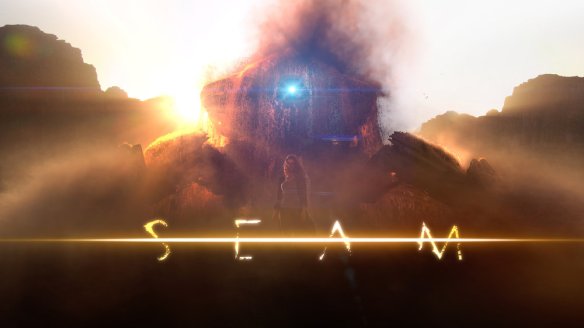
In the not-too-distant future, a tenuous peace between humans and remarkably humanlike “machines”—some don’t even know they’re not real—is tested when synthetics begin spontaneously exploding. A military-led search for these unwitting suicide bombers begins, sending a terrified machine woman and her human partner on the run.

Seam—named for a volatile border area sandwiched between the designated machine containment zone and the human world—borrows from some excellent inspirations, including Blade Runner. But the 20-minute short, made by twin brothers Rajeev and Elan Dassani, makes its mark with outstanding special effects and well-chosen location shooting. Though the film begins in sleek Hong Kong, its visual style is most unique when it contrasts the futuristic tech used by its characters with ancient settings, including a chase scene that winds through the narrow streets of Salt, Jordan. The climactic sequence takes place in Wadi Rum, the otherworldly desert last seen playing Jedha in Rogue One.

25 Families Own $1.1 Trillion Between Them as the Global Wealth Inequality Gap Grows

Using data from their list Forbes has produced a list of the top 25 richest families in the world. Together they are worth over $1.1 trillion, or the entire GDP of Indonesia.

By  Rosa Tressell and Dr. Leon Tressell

Source: SouthFront

Once a family-owned business Forbes is well known for producing their annual list of the world’s richest billionaires. Launched in 1982 the original list ranked the top 400 Americans by net worth. Only 13 billionaires were included in that list, and their combined worth was the equivalent of 2.8% of GDP. In an era where “Greed is Good”, the list became wildly popular, by 2000 the combined net worth of the top 400 equated to 12.2% of US GDP. So prestigious became the list that an ex-employee of Forbes has claimed that Donald J Trump inflated his personal wealth to be included.

This year more than 2,200 billionaires made the Forbes list with a combined value of $9.1 trillion, or half the GDP of the US. Amazon CEO, Jeff Bezos, topped the list this year as his fortune rose to £112 billion making him the first centi-billionaire. His wealth is now equal to that of 2.3 million Americans. This has allowed him to dethrone Bill Gates, founder of Microsoft, worth just $90 billion.

Using data from their list Forbes has produced a list of the top 25 richest families in the world. Together they are worth over $1.1 trillion, or the entire GDP of Indonesia. The richest clan is the Walton family who own the ubiquitous Walmart chain in America. They have a total family wealth of £152 billion and several family members are on the list of billionaires as individuals. The Koch Brothers, of Koch Industries, are ranked second with £98.7 billion. The third spot, with $90 billion to their name, is taken by another American family, the Mars family, known for their various sweet treats.

In comparison to the billionaires list this list is a measure of families who have inherited and grown their wealth over generations. The billionaires list is dominated by Americans in certain fields; technology, finance, entertainment and sport. It lauds entrepreneurism and promotes the self-made man (and small handful of women). The family fortunes list on the other hand reveals a more historical route for making money. Whilst Jeff Bezos has shot to the top of the list based largely on the astonishingly over valued share price of Amazon stock, the family fortunes are centered on the production and purveyance of goods.

Many of the families on the list started making their fortunes in the late nineteenth century. These are: Cargill Industries (agricultural conglomerate); Boehringer Ingelhelm (pharmaceuticals); Cox Enterprises (communications); Hyatt Hotels (hotels); SC Johnson (household goods); Roche (pharmaceuticals); and the Hearst Corporation (media). Meanwhile the Van Damme/De Spoelberch/De Mevius family (ranked fourth with a fortune of $54.1 billion) have been brewing quality Belgian beer, like Stella Artois, dating back centuries.

The production and purveyance of quality high end goods as a means to fortune is evident as BMW (the Quandt family), Chanel (the Wertheimer family) and Hermes (the Dumas family) find these families all ranked in the top ten.

Reliance Industries is the fist non-Western entry. A Mumbai-based energy conglomerate, it was founded by Dhirubhai Ambani in 1957 and is now worth $43.4 billion. It was his ambition to be the world’s richest man. However, following his untimely death there was a very public and acrimonious dispute between his two sons revolving around the inheritance. The widow eventually brokered a settlement and the family fortune goes on, but it does show how easily a family fortune can be dissipated.

In addition to Walmart there are two other families that have made their fortunes in retail. The Albrecht Brothers who founded Aldi are ranked 11th with a $38.8 billion fortune followed at twelfth by the Mulliez family who founded Auchan, France’s equivalent of Walmart. At thirteenth spot, with a fortune of £34 billion, is the Kwok family. They started in business as a grocery wholesaler but they really made their money when they moved into Hong Kong real estate in the 1970s. Similarly the Lee family from South Korea began as grocery exporters but have made their fortune as the worlds largest producers of smart phones with their company Samsung.

There is some methodology to the list that requires explanation. Bloomberg’s categorisation of family wealth is based on reliable, sourced documentation. They add up family members assets, including stakes in public and private companies, real estate, art and cash, and takes into account debts. It excludes first-generation fortunes and those in the hands of a single heir. It also excludes those who have derived their fortune from the state. This explains why there are no Chinese families on the list and only three from the Asian region. As newly found wealth is handed down this looks set to change.

The Forbes list also excludes members of royal families and dictators who derive their fortunes entirely as a result of their position of power. Nor do they value those holding fortunes in trust for their nations. So, despite being worth untold billions, families like the royal family of Brunei or the British monarchs are absent. Quantifying this wealth is difficult. For example, Buckingham Palace alone would be valued in excess of $5 billion, however there would certainly be conflict with Parliament if the Queen wanted to sell it!

Many billionaires positively don’t want to be on the list. They don’t want the publicity for their families with the increased risk of kidnapping, being hit up for money, questions from the tax man or even from law enforcement. Kenichi Shinoda, current Kingpin of the Yakuza, is rumoured to be worth billions but is known to keep a low financial profile. There is also plenty of Western media speculation that the President of Russia, Vladimir Putin, is actually the world’s richest man. The Bush family have amassed a vast fortune, and there are allegations that much of it has been amassed behind the political scenes in various CIA backed gun and drug running operations.

Calculations of wealth, for individuals or families, can be obfuscated by the numerous off shore arrangements that exist today. Historically, many of the world’s largest landowners are not officially registered as a result of having held title to the land for centuries. In addition trusts, foundations and “charities” allows for the ownership and management of assets in a more private manner. Wealthy families pay professionals a healthy wage to minimise their exposure to the taxman – especially avoidance of inheritance tax.

Absent from the list are the giant banking families, the Rockefellers, the Morgans and the Rothschilds; famed for being on every conspiracy theory list as powers behind the scene. The report says that their fortunes are too diffuse and diversified to correctly value. Other families suspected of wielding their riches for their own political and social agendas include the DuPonts, the Astors, the Bundys and the Freemans, to name a few. Families that like to keep their immense fortunes and their activities confidential.

To have such wealth is naturally to have much power. Certain families, like the Bushes and the Kennedys used their cash to enter politics. The Koch Brothers have already pledged $400 million to the Republicans for the 2018 mid-term elections and their support was seen as instrumental in securing Donald J Trump’s election victory. The Walmart Family Foundation is one of America’s largest political donors, and is described as a “heavy hitter” from the Centre of Responsive Politics. Economic advantage is translated into legislative favours via lobbying and campaign donations. For example, one Arkansas Congresswoman who supported the repeal of an estate tax received $83,650 from the Walton Family Foundation and  now works for them as a lobbyist. This exemplifies the corrupt relationship between economic and democratic inequality and is indicative of a system where the majority feel their voice is irrelevant.

Capitalism is built on an idea that a rising tide lifts all ships. We are supposed to look up to these rich families as examples of our betters. Underlying the lists that Forbes assembles is a worshiping of the rich. Underpinning the American dream is that its possible for anyone or any family to make it (onto the list). However, even Scrooge McDuck must be envious of the enormous fortunes of these families. As the wealth inequality gap grows within countries, especially the Western nations, there is the risk that the social fabric is coming apart at the seams. When 40% of Americans have less then $500 in savings the material basis for living the Dream is seriously compromised. Indeed, this could all turn just as easily into anger as people see that the six individual Walmart heirs alone have more wealth than the bottom 30% of the US population, and they ask themselves is this fair?

This report confirms accelerating trends towards further wealth disparity. Reports by Oxfam have shown a gaping chasm of global inequality. In 2017 3.7 billion people saw no increase in their wealth, whilst 82% of the wealth created went to the top 1%.

According to the World Inequality Report 2018:

If established trends in wealth inequality were to continue, the top 0.1% alone will own more wealth than the global middle class by 2050.

Donald Trump’s ambition to be included on the list displays his naked ambition for money, power and success. In his school of market economics, of dog eat dog, this trend is only the logic of the market. It is seen as aspirational by those at the top and by magazines like Forbes. However, even the 1% at Davos earlier this year had wealth inequality on the agenda. As the social fabric tears, political and social instability will increase. The Brexit vote, driven by the anger of the dispossessed English working class, for example, has turned the UK’s traditional stability on its head.  Anger is brewing below the surface everywhere and the probability of social and political uprisings throughout the globe are increasing.


Dismantling A Society: How Empires Feed Off the Republic

By RS Anthion

Source: CounterPunch

“It is patently ridiculous for the United Nations to examine poverty in America.”

-Nikki Haley (1)

Nikki Haley released a ferocious rebuke of a UN report detailing poverty in the United States. As if she could will away or dismiss its findings simply by how angry she denounced it. The life expectancy in the United States sits at 78.6 years (2) whilst Cubans can expect to live to 79.5 according to the World Health Organisation(3). Cuba is of course a country that has been economically embargoed by the United States for over half a century. Nikki Haleys ferocious retort comes amid a United Nations report examining poverty in the United States. 40 million Americans live in poverty, 18.5 million americans live in extreme poverty and 5.3million live in “third world conditions of absolute poverty” (4).

“The Special Rapporteur wasted the UN’s time and resources, deflecting attention from the world’s worst human rights abusers and focusing instead on the wealthiest and freestcountry in the world.”

-Nikki Haley.

It probably needs repeating that the United States imprisons more people (both total and as a percentage of their population) than anywhere else on the planet. Americans are 5 percent of the population whilst having 25 percent of the worlds prisoners. This doublespeak has become the norm. The US ambassador can say straight faced the US is the “freest country in the world” whilst having the highest percentage of its population in prison. Significantly higher than Russia, China or Iran.(7)

This is a myth of American empire, that freedom only exists in the United States. And if freedom exists elsewhere then the US is the “freest”.

The UN report does indeed paint a bleak picture for the average man or woman in the US and it’s no surprise that Nikki Haley has reacted with such venom at this UN report.

Because this strikes at the heart of one of the other ‘myths of American empire’. That each successive generation will live better than the previous one which fuelled the idea of ‘American exceptionalism’. That their form of government and ideology was something to be celebrated and even lifted up as the ‘messianic nation’ (ie. exported across the globe). But the precise definition of a nation in decline is when the generation after you lives worse than the previous generation. So the US ruling elite, a ruling class that has been doing victory laps since Reagan in removing workers rights/protections and labour laws, is caught in a dichotomy. A contradiction where they still try to propagandise their population into the messianic nation worthy of justifying imperialism (“bringing democracy” or “humanitarian intervention”) whilst the working class of the United States slips further into poverty.

“The United States is a land of stark contrasts. It is one of the world’s wealthiest societies, a global leader in many areas, and a land of unsurpassed technological and other forms of innovation. Its corporations are global trendsetters, its civil society is vibrant and sophisticated and its higher education system leads the world. But its immense wealth and expertise stand in shocking contrast with the conditions in which vast numbers of its citizens live. About 40 million live in poverty, 18.5 million in extreme poverty, and 5.3 million live in Third World conditions of absolute poverty.4 It has the highest youth poverty rate in the Organization for Economic Cooperation and Development (OECD), and the highest infant mortality rates among comparable OECD States. Its citizens live shorter and sicker lives compared to those living in all other rich democracies, eradicable tropical diseases are increasingly prevalent, and it has the world’s highest incarceration rate, one of the lowest levels of voter registrations in among OECD countries and

the highest obesity levels in the developed world. 5. The United States has the highest rate of income inequality among Western countries.5 The $1.5 trillion in tax cuts in December 2017 overwhelmingly benefited the wealthy and worsened inequality. The consequences of neglecting poverty and promoting inequality are clear. The United States has one of the highest poverty and inequality levels among the OECD countries, and the Stanford Center on Inequality and Poverty ranks it 18th out of 21 wealthy countries in terms of labour markets, poverty rates, safety nets, wealth inequality and economic mobility. But in 2018 the United States had over 25 per cent of the world’s 2,208 billionaires. 6 There is thus a dramatic contrast between the immense wealth of the few and the squalor and deprivation in which vast numbers of Americans exist. For almost five decades the overall policy response has been neglectful at best, but the policies pursued over the past year seem deliberately designed to remove basic protections from the poorest, punish those who are not in employment and make even basic health care into a privilege to be earned rather than a right of citizenship. 6. The visit of the Special Rapporteur coincided with the dramatic change of direction in relevant United States policies. The new policies: (a) provide unprecedentedly high tax breaks and financial windfalls to the very wealthy and the largest corporations; (b) pay for these partly by reducing welfare benefits for the poor; © undertake a radical programme of financial, environmental, health and safety deregulation that eliminates protections mainly benefiting the middle classes and the poor; (d) seek to add over 20 million poor and middle class persons to the ranks of those without health insurance; (e) restrict eligibility for many welfare benefits while increasing the obstacles required to be overcome by those eligible; (f) dramatically increase spending on defence, while rejecting requested improvements in key veterans’ benefits; (g) do not provide adequate additional funding to address an opioid crisis that is decimating parts of the country; and (h) make no effort to tackle the structural racism that keeps a large percentage of non-Whites 7 in poverty and near poverty”

Ultimately the empire “feeds off the republic” (to quote Michael Parenti). So when the US has spent an estimated either $3.6 trillion (based on a Brown University study) or $5.6 trillion (according to the associated press) on war in Afghanistan, Iraq, Pakistan and Syria(5). This money isn’t plucked from thin air. US tax payers have to pay that back and is the source of Americans increased poverty. The $2 trillion discrepancy between the associated press and the Brown university study is testament to the open corruption in military contracts. The money has been funnelled through so many private contractors looking to milk the tax payers for all their worth there’s a 2 trillion margin of error when estimating what has actually been spent.

Eisenhowers A Chance For Peace speech in 1953 seems more relevant than ever.

“Every gun that is made, every warship launched, every rocket fired signifies, in the final sense, a theft from those who hunger and are not fed, those who are cold and are not clothed.
This world in arms is not spending money alone. It is spending the sweat of its laborers, the genius of its scientists, the hopes of its children. The cost of one modern heavy bomber is this: a modern brick school in more than 30 cities. It is two electric power plants, each serving a town of 60,000 population. It is two fine, fully equipped hospitals. It is some fifty miles of concrete pavement. We pay for a single fighter with a half-million bushels of wheat. We pay for a single destroyer with new homes that could have housed more than 8,000 people. . . . This is not a way of life at all, in any true sense. Under the cloud of threatening war, it is humanity hanging from a cross of iron.”

The United States is currently at war with 7 different nations (Iraq, Syria, Afghanistan, Pakistan, Yemen, Somalia and Libya) all the while leaving it’s citizens to the ravages of the free market: whether that’s the burgeoning opiod crisis, the children drinking lead contaminated water or the 40 million Americans in poverty.

Alexander Zinoviev berating Gorbachev and Yeltsin on TV in 1990. His errily prophetic vision of Russia came true. When capitalism was restored to Russia under Yeltsin in the 90s Russia experienced what economists would later call the “Russian Cross” whereby the death rate shot up and the birth rate slowed to a crawl (creating a cross on a graph). The return of capitalism meant a death spiral of every social ill; alcoholism, domestic abuse, drug abuse and homelessness. The return of orthodox Christianity to fill the power void. The wholesale sell off of public services that had once been owned by the collective people to the fortune 500.

The brilliant thinker and Soviet dissident who later came to regret being a tool for western interest spoke in a brilliantly prophetic interview in 1999 in which he asserted the end of communism in the east meant the end of democracy in the west. That the glue for any kind of pluralism in media/politics etc. came from the united front against communism to the east. Since the fall of communism he asserts a kind of democratic totalitarianism has arisen. And who can argue it hasn’t? Voter turnout is worse each year as people realise no party in a First Past the Post system will represent their interests. Princeton University long released a peer review paper that the United States is an oligarchy. That the average person in the US has little to no effect on the policies and laws that are ratified by the courts. That’s perhaps why 54 percent of citizens in democracies believe their voice doesn’t have an impact on political decisions, and 64 percent think their government doesn’t act in their interest.

“Q: Don’t you think that people can have their own opinions, and that they can vote and thus express themselves?

ANSWER. First of all, even now people don’t vote that often, and they will vote even less in the future. With regard to public opinion in the West it is shaped by the media. Suffice it to recall the universal approval of the war in Kosovo. Remember the Spanish war! Volunteers from all over the world traveled to that country to fight on one side or the other. Remember the war in Vietnam. But these days, people are so well shepherded that they react only the way that the purveyors of propaganda want them to.

Q: So, the role of Gorbachev was not positive?

A: I look at things from a slightly different angle. Contrary to common belief, Soviet communism did not collapse because of internal reasons. Its collapse is certainly the greatest victory in the history of the West. An unheard of victory which, let me say it again, can establish a unitary power monopoly on a planetary scale. The end of communism also signalized the end of democracy. The modern epoch is not only post-communist, it is also post-democratic! Today we are witnessing the establishment of democratic totalitarianism, or, if you will, totalitarian democracy.

Q: Does not it all sound a little absurd?

A: Not at all. Democracy requires pluralism and pluralism implies an existence of at least two more or less equal forces which oppose each other and at the same time influence each other. During the Cold War there was world democracy, global pluralism, with two opposing systems: capitalist and communist, plus other countries with an amorphous system which belonged to neither. Soviet totalitarianism was sensitive to Western criticism. In turn, the Soviet Union influenced the West, in particular through the latter’s own communist parties. Today we live in a world dominated by one single force, one ideology and one pro-globalization party. All of this together began to take shape during the Cold War, when superstructures gradually appeared in various forms: commercial, banking, political and media organizations. Despite their different fields of activity, what they had in common was essentially their transnational scope. With the collapse of communism they began to rule the world. Thus, Western countries ended up in the dominant position, but at the same time they are now in a subordinate position as they gradually lose their sovereignty to what I call the supra-society. The planet-wide supra-society consists of commercial and non-commercial organizations whose influence extends far beyond individual states. Like other countries, the Western countries are subordinated to these supranational structures. This is despite the fact that the sovereignty of states was also an integral part of pluralism and hence of democracy on a global scale. Today’s ruling supra-power suppresses sovereign states. The European integration unfolding in front of our very eyes is also leading to the disappearance of pluralism within this new conglomerate in favor of supranational power.

Q: But do not you think that France and Germany remain democracies?

A: Western countries got to know true democracy during the Cold War. Political parties had genuine ideological differences and different political programs. The media also differed from each other. All this had an impact on the lives of ordinary people contributing to the growth of their wealth. Now this has come to an end. A democratic and prosperous capitalism with socially oriented laws and job security was in many ways thanks to a fear of communism. After the fall of communism in Eastern Europe, a massive attack on the social rights of citizens was launched in the West. Today the socialists who are in power in most European countries are pursuing policies of dismantling the social security system, destroying everything that was socialist in the capitalist countries. There is no longer a political force in the West capable of protecting ordinary citizens. The existence of political parties is a mere formality. They will differ less and less as time goes on. The war in the Balkans was anything but democratic. Nevertheless, the war was perpetrated by the socialists who historically have been against these kinds of ventures. Environmentalists, who are in power in some countries, welcomed the environmental catastrophe caused by the NATO bombings. They even dared to claim that bombs containing depleted uranium are not dangerous for the environment, even though soldiers loading them wear special protective overalls. Thus, democracy is gradually disappearing from the social structure of the West. Totalitarianism is spreading everywhere because the supranational structure imposes its laws on individual states. This undemocratic superstructure gives orders, imposes sanctions, organizes embargos, drops bombs, causes hunger. Even Clinton obeys it. Financial totalitarianism has subjugated political power. Emotions and compassion are alien to cold financial totalitarianism. Compared with financial dictatorship, political dictatorship is humane. Resistance was possible inside the most brutal dictatorships. Rebellion against banks is impossible.

Q: What about a revolution?

A: Democratic totalitarianism and financial dictatorship rule out the possibility of social revolution.

Q: Why?

A: Because they combine omnipotent military power with a financial stranglehold. All revolutions received support from outside. From now on this is impossible because there are no sovereign states, nor will there be. Moreover, at the lowest level the working class has been replaced with the unemployed class. What do the unemployed want? Jobs. Therefore, they are in a less advantageous position than the working class of the past.

Q: Would it be correct to say that the intensifying radicalization in the West will leads to its own destruction?

A: Nazism was destroyed during total war. The Soviet system was young and strong. It would have continued to thrive, had it not been destroyed by outside forces. Social systems do not destroy themselves. They can only be destroyed by an external force. It’s like a ball rolling on a surface: only the presence of an external obstacle could break its movement. I can prove it like a theorem. Today, we are dominated by a country with enormous economic and military superiority. The new emerging world order is drawn to unipolarity. If the supranational government manages to achieve this by eliminating all external enemies, then a unified social system can survive until the end of time. Only a person can die from their illness. But a group of people, even a small group, would try to survive through reproduction. Now imagine a social system comprising billions of people! Its capacity to anticipate and prevent self-destructive phenomena will be limitless. In the foreseeable future, the process of erasing differences across the world cannot be stopped, since democratic totalitarianism is the last phase of the development of Western society, which began with the Renaissance.” (6)

In a world where capitalist-liberalism is disintegrating right before our eyes; where ‘human rights’ are justified in bombing the poorest people on earth, that “humanitarian intervention” is used straight faced by world leaders and their sycophantic media cheerleaders in the mainstream media and a world where most of humanity only has debt peonage and decreased living standards to look forward to.

It certainly does look like humanity has been nailed to an iron cross.

The world is in desperate need of a liberating ideology, in which true media and political pluralism can thrive instead of the circus currently on offer. One where we’re not in thrall to capital or beholden to the fortune 500 who rule every aspect of our lives.

Notes.

(1) http://thehill.com/policy/international/un-treaties/393659-nikki-haley-ridiculous-for-un-to-analyze-poverty-in-america

(2) https://edition.cnn.com/2017/12/21/health/us-life-expectancy-study/index.html?no-st=1529923969

(3) http://www.who.int/countries/cub/en/

(4) United Nations Generaly Assembly, 4 May 2018 http://undocs.org/A/HRC/38/33/ADD.1

(5) http://www.newsweek.com/trump-says-us-spent-7-trillion-middle-east-mistake-iraq-cost-88-billion-804215

(6) https://russia-insider.com/en/history/russian-thinker-1999the-end-communism-russai-signalized-end-democracy-west-alexander

(7)https://www.washingtonpost.com/news/fact-checker/wp/2015/07/07/yes-u-s-locks-people-up-at-a-higher-rate-than-any-other-country/?utm_term=.ab39c81fabff

Invisible Architecture III: The Psychogeography of Hyperspace

By Rococo Modem Basilisk

Source: Modern Mythology

Ordinarily, when we discuss psychogeography, we operate at the scale of a city: we discuss how people are drawn through a walkable space, at a speed in which they can be affected by each piece of passing scenery and make a detour to examine it. But, at the same time the Lettrists were wandering Paris and laying the groundwork for Disneyland in the micro-scale, at the macro-scale holes were being punched through the fabric of the United States in the form of highways.

Habitual migration patterns break the close association between culture and geography. There’s a psychogeographic wormhole between Fairfield County, CT and south Florida, and used to be one between there and upstate NY. If you live in Fairfield County (or certain parts of NYC) you’re liable to be culturally closer to some parts of south Florida than to many points in-between, not because of natural rock formations or bodies of water, but because highways have made it possible to pass through the middle without interacting with it.

Areas of transience — the hyperspace of psychogeography — are not ‘non-places’ with ‘non-culture’. They have a uniquely warped kind of culture, in the same way tourist-dependent places do. Some people spend large amounts of their lives there: long-haul truckers, jet-setting businessmen, touring bands or comedians or authors. The attempt at producing a consistent experience across geography produces an experience that can only exist in hyperspace.

Our own psychogeographic hyperspace is not as psychedelic as the one in Cordwainer Smith’s A Game of Rat and Dragon, but it is stranger, in a Ligottian way.

Why do they have ice machines? Why do they have pools? Why are airplanes and airports trapped in a perpetual 1963 idea of what luxury looks like? Path dependence has made the culture of our hyperspace deeply strange: there are low upper limits on quality of manufacture and high lower limits on quality of service, and the assumed transitory state of most inhabitants means bonds cannot be formed.

When new ideas are integrated here at all, they slot into existing structures — structures that don’t exist outside, in the world that is normal for most of us. Wifi passwords come with the keycard; a robot kiosk in front of the check-in desk prints tickets, as the clerk who formerly printed tickets watches.

These liminal spaces are only forgettable for people who have destinations. They’re also populated by residents, or commuters from geographically — nearby places, who fill the service jobs. What’s it like to have a diner with no regulars? This situation is capitalism-optimized. If you are a resident of psychogeographic hyperspace — nomadic or not — you are dog-fooding the experience that Rand thought was natural to man: separation of orbits, mediated by impersonal monetary transactions. It looks like endless beige hotels with broken ice machines.

What are the attributes of this Randian New Man who lives as hyperspace nomad? Sleep deprivation, boredom, and a dependence on stimulants. Gas stations in hyperspace cater to truckers, abnormally large DVD and pornography selections and every variety of pick-me-up not yet banned. Airports, whose nomads are of a higher caste and have less private space or scheduling freedom, focus more on overpriced convenience food, mediocre reading material, and headphones, and pillows. A Cinnabon could not survive outside of hyperspace, even if it grew up in the shallows of the shopping mall, but in this ecosystem, sheltered from competitors and provided with a steady stream of easy prey, it thrives.

The culture of hyperspace is not a psychogeography, except in a fairly minor sense: everywhere is the same, or tries to be. The few deviations, like Denver International Airport, are notable because deviation is so rare. There is an international internet radio station specifically for airports, and I have heard it play the same playlist in three states. (It never played Brian Eno.) However, like the hyperspace of fiction, it is a strange world that fills the gaps as we jump from one point to another without travelling in-between.

Transit systems are not the only holes in psychogeography. Communications systems also create them. Just as the prevalence of snowbirds and Adirondack cottages make it possible for small segments of northern New York and southern Florida to influence Manhattan finance and vice versa, arbitrary decisions or early-mover advantages gave Los Angeles cultural power over film, Cleveland cultural power over radio, and Atlanta cultural power over podcasting.

Communications technologies have their own hyperspace-cultures, although the geographic centralization of the big players has a larger impact on how they manifest than in the case of hotels. Twitter is the internet equivalent of a trucker-optimized gas station, and caters to journalists — the long-haul truckers of the information landscape. Facebook is the internet equivalent of a Holiday Inn: a premium-mediocre imitation of homeyness that is endearing in its complete failure to be convincing but ultimately irritating if you try to stay too long. (Facebook’s ice machine is always broken, and always loud.) The film industry is a bit like any airport: perpetually stuck in a cheap imitation of an imagined luxurious past, adapting poorly to the cosmopolitanism produced by globalization while profiting through its monopoly on the means of that globalization.

The culture of any hyperspace, because the means of association are limited to the Randian, will be corporate in its manifestation: customer service, marketing, selection, returns, free coupons as a means of apology. It differs from non-hyperspace because these are the only forms of communication truly available. This diner has no regulars with whom the waitress can be frank, only strangers perpetually passing through. It can get away with being shallow and having nothing under its surface, because only very rarely will someone stay long enough to peel it back.

Another Reason Young Americans Don’t Revolt Against Being Screwed

By

Source: CounterPunch

8 Reasons Young Americans Don’t Fight Back: How the US Crushed Youth Resistance” was originally published in 2011, then republished on several Internet sites, and has become one of my most viewed articles. The eight reasons include: student-loan debt; various pacifying effects of standard schooling; the psychopathologizing and medicating of noncompliance; surveillance; television; and fundamentalist religion and fundamentalist consumerism. Over the last seven years, many young people have told me that they appreciate that article, but they have urged me to detail a hugely important pacifying source which I had not included.

First, to be clear, not all young people are completely broken. The general state of acquiescence by young people was recently interrupted by their short-lived burst of dissent in the form of large rallies for gun control, in reaction to fears of being murdered in their classrooms. But that was an exception to the general rule of resignation to eating shit.

A longer period of dissent occurred during Occupy, in which many young people protested against their financial subjugation by the 1%. However, one lesson that young people learned from Occupy is that their rulers only pay lip service to democracy—and so mere dissent has little impact. Young people today are correct to recognize the impotence of mere dissent if it is unaccompanied by a withdrawal of cooperation with the ruling class’s capacity to turn a profit. But because young people have been broken in so many ways, decreasing numbers of them have the individual strength, class consciousness, and group cohesiveness that is required to move beyond dissent to the kind of constructive disobedience (for example, a labor strike) that can create greater justice for them.

It’s not that young people in the United States are ignorant of the reality that they are being financially screwed; they know they have been screwed, they expect to be screwed even worse, and most of them passively accept this reality.

Young people are not ignorant of their increasingly crippling student-loan debt. At last look, 70% of college students graduate with significant debt; the average student-loan debt at $37,172, and the average monthly payment at $393 (and this doesn’t include their credit card debt). Add this to the reality that many young people with student-loan debt never even graduate college; and even among those who do graduate, many of them find only low-paying jobs.

The majority of young people feel so beaten down that they have also passively accepted that they will get screwed out of Social Security benefits. A 2015 Gallup poll asked “Do you think the Social Security system will be able to pay you a benefit when you retire?” Among those 18 to 29 years of age, 64% said no. Yet, most are resigned to having money deducted from their paychecks for benefits that they believe they will never receive.

Since my 2011 article was published, many millennials have informed me that they are being broken by something that I hadn’t originally included: the Internet, which many of them tell me is the most important aspect of their lives. From these young people, I have learned how the Internet creates fears, lowers self-esteem, and divides them—all of which weakens their capacity to resist injustices.

Fear is a great way to break people, and the Internet—similar to other areas that I had previously detailed—creates fear. Facebook, Twitter, Instagram, Tumblr, Snapchat, and other so-called “social media” create the fear of permanent shame and shunning. Millennials repeatedly see how a single error in judgment on social media will not be forgotten and can haunt forever—and destroy lives. While many young students voice concern about a shooting in their school, my experience is that they are more viscerally terrified of something being posted on social media by them or about them that can damage their attractiveness to their peers or to future employers. For young people, denial over their life being ruined on social media is impossible—most never unplug from it.

The Internet heightens a fear-based consciousness. People have different private fears and, as George Orwell detailed, their greatest fears can be exploited to break them. For many young people, their greatest fear is being “doxxed”—having private information about them published on the Internet so as to hurt them. For other young people, their greatest fear is “FoMo”—the fear of missing out—which is intensified on social media where they are constantly bombarded with images of others doing “cool” stuff. One young woman recently told me, “You don’t know how crazy we are. I saw a party on Instagram that looked really cool, and I had FoMo over it, even though I know the guy who posted it always makes parties look cooler than they really are.”

Many young people tell me that the constant barrage of their peers’ self-promotions on social media makes them feel inferior; and low self-esteem—like fear—debilitates the strength to resist. One young man recently explained to me that millennials are always aware of their “digital selves” which can be measured in metrics such as “likes”; and that comparing themselves to others routinely results in low self-esteem. Of course, some young people do attempt rebellion, but effective rebellion, they tell me, requires completely extricating from social media, which would be an extremely radical action.

Not only does the Internet create fear and low self-esteem but also divides, which of course allows the 1% to more easily conquer the 99%. The Gilded Age robber barron Jay Gould reportedly bragged, “I can hire one half of the working class to kill the other half.” Millenials have educated me on the various divides among the 99% that have been created and perpetuated on the Internet.

Every millennial young man tells be about the Internet war between “social justice warriors” and “red pillers.” Young people who care about justice for historically oppressed groups (such as women, people of color, and LGBT folks) are mocked as social justice warriors by those who call themselves red pillers who feel that, today, white males are the oppressed group. In an Internet world absent of face-to-face contact, there is only mutual venom. Absent is a mutual grasping that each side is in the 99%, that each side cares about injustice, and that the financial hell for all of them has been created by the 1%—not by each other.

Screen addiction subverts the in-person contact necessary for face-to-face dialogue and solidarity, and the Internet is even more addictive than television, as young people are virtually never away from their smart phones, laptops, or other screens. Walk into any coffee shop, and you’ll often see many young people in close proximity with one another but locked into their own screens and not looking at each other.

Several of my millennial young male informants tell me that they are afraid to risk face-to-face contact, afraid to be seen as violating a woman’s privacy, afraid to be viewed as a creep. I joked with one young guy, “Are you afraid that if you walk over to some pretty young woman in a coffee shop and tell her that you like her shoes, then you’ll be accused of ‘rape-staring’ and have your life ruined on the Internet, and end up being falsely labeled all over the Internet as a sex offender?” The young man laughed and said, “I know that you are exaggerating, but that’s the kind of shit that many of us millennial guys think about, as we have become pathetic.”

Having young men and young women in the 99% being afraid of one another may be even more of a coup for the 1% than their historical successes at getting ethnic and racial groups to hate one another. With this fear and hate among the 99%, it is impossible to have the solidarity and strength necessary to effectively revolt in an organized way against the 1%.

The Internet technology need not necessarily be a pacifying force as, for example, the Internet was effectively utilized during the Arab spring to foment rebellion and organize resistance. Similarly, some of the other pacifying forces that I originally detailed need not be pacifying. Teachers could inspire resistance against illegitimate authorities rather than indoctrinate compliance to any and all authorities. And my fellow mental health professionals could embrace liberation psychology rather than pathologize and medicate rebellion.

My experience is that young people, in general, are becoming increasingly pained and weakened by multiple oppressive forces, and older people who give a damn about them can help. The 1% will always attempt to seize powerful technologies and institutions to pacify all of us—especially young people. To manage these technologies and institutions, the 1% needs technocrats, administrators, and guards; thus, what would help is what Howard Zinn called a “revolt of the guards.” However, if technicians, teachers, mental health professionals, and other guards never even admit to ourselves our societal role—as guards who maintain the status quo—then we guards will never consider a revolt. Many older people are guards, and they can choose to revolt and help young people gain the strength necessary to resist injustices.


Bruce E. Levine, a practicing clinical psychologist often at odds with the mainstream of his profession, writes and speaks about how society, culture, politics and psychology intersect. His most recent book is Resisting Illegitimate Authority: A Thinking Person’s Guide to Being an Anti-Authoritarian―Strategies, Tools, and Models(AK Press, September, 2018). His Web site is brucelevine.net

Why America is the World’s First Poor Rich Country

Or, How American Collapse is Made of a New Kind of Poverty

By Umair Haque

Source: Eudaimonia

Consider the following statistics. The average American can’t scrape together $500 for an emergency. A third of Americans can’t afford food, shelter, and healthcare. Healthcare for a family now costs $28k — about half of median income, which is $60k.

By themselves, of course, statistics say little. But together these facts speak volumes. The story they are beginning to tell is this.

America, it seems, is becoming something like the world’s first poor rich country. And that is the elephant in the room we aren’t quite grasping. After all, authoritarianism and extremism don’t arise in prosperous societies — but in troubled ones, which are growing impoverished, like America is today. What do I mean by all that?

Let’s begin with what I don’t mean. I don’t mean absolute poverty. Americans are not living on a few dollars a day, by and large, like people in, for example, Somalia or Bangladesh. America’s median income is still that of a rich country, around $50k, depending on how it’s counted. Nor do I really mean relative poverty — people living below median income. While that’s a growing problem in America, because the middle class is imploding, that is not really the true problem these numbers hint at, either.

America appears to be pioneering a new kind of poverty altogether. One for which we do not yet have a name. It is something like living at the knife’s edge, constantly being on the brink of ruin, one small step away from catastrophe and disaster, ever at the risk of falling through the cracks. It has two components — massive inflation for the basics of life, coupled with crushing, asymmetrical risk. I’ll come to what those mean shortly.

The average American has a relatively high income, that of a person in a nominally rich country. Only his income does not go very far. Most of it is eaten up by attempting to afford the basics of life. We’ve already seen how steep healthcare costs are. But then there is education. There is transport. There is interest and rent. There is media and communications. There is childcare and elderly care. All these things reduce the average American to constantly living right at the edge of ruin — one paycheck away from penury, one emergency away from losing it all.

But this isn’t true for America’s peers. In Europe, Canada, and even Australia, society invests in all these things — and the costs of basic necessities societies don’t provide are regulated. For example, I pay $50 dollars for broadband and TV in London — but $200 for the same thing in New York — yet in London, I get vastly more and better media for my money (even including, yes, American junk like Ancient Aliens). That’s regulation at work. And when basic goods like healthcare or elderly care or education are provided and managed at a social scale, that is when they are cheapest, and often of the best quality, too. Hence, healthcare costs far less in London, Paris, or Geneva — and life expectancy is longer, too.

So if you are earning $50k in America, it is a very different thing than earning $50k in France, Germany, or Sweden — in America, you must pay steeply for the basics of life, for basic necessities. Thus, incomes stretch much further in other countries, which enjoy a vastly higher quality of life, even though people there earn roughly the same amount, because they pay vastly less for basic necessities. Americans are rich, but only nominally — their money doesn’t buy nearly as much as their peers does, where it matters and counts most, for the basics of life.

What happens when societies don’t understand all the above? Well, a strange thing has happened to the American economy. While it’s true that things like TVs and Playstations have gotten cheaper, the costs of the basics of life have skyrocketed. All the things that really elevate people’s quality of life — healthcare, finance, education, transport, housing, and so on — have come to consume such a large share of the average household’s income that they have little left to save, invest, or spend on anything else. And what’s worse, while the basics of life have seen massive inflation, wages and incomes (not to mention savings and benefits and safety nets and opportunities) for most have stagnated. The result is an economy — and a society — that’s collapsing.

Yet all that is the straightforward effect of giving, for example, hedge funds control over drugs, or speculators control over housing, healthcare, and education — they will of course maximize profits, whereas investing in these things socially, or at least regulating them, minimizes real costs, and maximizes accessibility, affordability, and quality.

So the average American, who is left high and dry, must borrow, borrow, borrow, just to maintain a decent quality of life — because handing capitalism control of the basics of life has caused massive, skyrocketing inflation in necessities, while flatlining his income. Healthcare didn’t used to cost half of median income even a decade ago, after all — but now it does. So what happens when, in a decade or two, healthcare costs all of median income? How can an economy — let alone a society — function that way?

Well, what happens if the average American steps over the line? Misses a mortgage payment, gets ill and is unable to pay a few bills on time, can’t pay the costs of healthcare? Then they are punished severely and mercilessly. Their “credit rating” (note how banks and hedge funds don’t have them) is ruined. They can easily find themselves out on the street, without finance, without a second chance, without access to any kind of redress or support . And then they are rejected, shunned, and ostracized. They might not have an address anymore — so who will hire them? They are no longer a part of society — they have fallen through the cracks, and finding one’s way back is often next to impossible. Asymmetrical risk — corporations and lobbies and banks bear no risk at all, precisely because the average American bears them all now.

So Americans aren’t just absolutely or relatively poor, but poor in a new way entirely. First, the basics of life exploded in price, to the point that they are now unaffordable for many, maybe most, households. Second, Americans bear the risks of paying those unaffordable costs to an extreme degree, bearing the risks that institutions should, and so those risks are now ruinously high. A bank or hedge fund or corporation might go bankrupt, and liquidate its assets, and its owners stay rich — but if an American’s credit rating is ruined, loses his job, cannot pay his bills, or even if he declares bankruptcy, he falls through the cracks, hounded, embattled, institutionally black-marked. He finds himself outside society, with little way to get back in. Little wonder then that Americans work so much harder than anywhere else — they are always one step away from losing it all, from genuine ruin, but their peers in truly rich countries aren’t.

Marx probably would have called this immiseration. Neo-Marxist theorists call it precarity. And while there’s truth in both those ideas and perspectives, I think they miss three vital points.

We don’t see America as a poor country, but we should begin to. Americans live fairly abysmal lives — short, lonely, unhappy, full of work and stress and despair, compared to their peers. That is because they cannot afford better ones — predatory capitalism coupled with total economic mismanagement of social investments has made the basics of life ruinously unaffordable. In this way, it’s effectively a poor country — yes, there’s a tiny number of ultra-rich, but they are outliers now, off the map of the normal. Because it’s not just any kind of poverty, yesterday’s poverty, or even poverty as we are used to thinking about it.

America is pioneering a new kind of poverty. The kind of poverty that’s developed in America isn’t just bizarre and gruesome — it’s novel and unseen. It isn’t something that we understand well, economists, intellectuals, thinkers, because we have no good framework to think about it. It’s not absolute poverty like Somalia, and it’s not just relative poverty, like in gilded banana republics. It’s a uniquely American creation. It’s extreme capitalism meets Social Darwinism by way of rugged self-reliance crossed with puritanical cruelty.

The kind of poverty America’s pioneering today isn’t absolute, or even relative , but something more like perfectly tuned poverty, strategic poverty, basic poverty— nominally well-off people whose money doesn’t go far enough to make them actually live well, constantly living at the edge of ruin, and thus forced to choke down their bitter anger and serve the very systems which oppress and subjugate with more and more indignity and fear and servility by the year.

America’s still an innovator today. Unfortunately, what it’s innovating now is a new kind of poverty. Yet poverty is poverty. What happens in societies where poverty is growing? Authoritarianism rises, as people lose faith in democracy, which can’t seem to offer them working social contracts. Authoritarian soon enough becomes fascism — “this country, this land, its harvest — it is only for the true volk!”, the cry goes up, when there is not enough to go around. And the rest of the dark and grim story of the fall into the abyss you should know well enough by now. It ends in words we do not say.

Still, history, laughing, has told this tale to us many times. And it is telling it to tomorrow, again, in the tale of American collapse.