
HOW TO DISCOVER YOURSELF THROUGH YOUR OWN PHILOSOPHY

By Mickey Z.

Source: Waking Times

“Be yourself; everyone else is already taken.” ~Oscar Wilde

There are now over eight billion people on the planet. We each have a different psychophysiological reaction to any given stimuli, no matter how minute the difference. From forks to forklifts, spoons to spoonerisms, folklore to philosophy. Every single one of us perceives everything differently.

The way I perceive the concept of something as simple as a tree is fundamentally different than the way every single other person perceives the “same” concept. This is due to our historically unique experiences with “trees.”

The memories we form influence our experience of perceiving trees. I may have fallen out of a tree and broken my arm. You may be blind and can only touch or smell a tree. I may have chopped down twenty trees to build a house. You may have crashed into a tree and totaled your car. The point is, every single historical interaction with a tree has formed a unique interpretation of “tree” in our psychophysiology.

The same thing applies to abstract concepts such as love, God, and philosophy. We each have historically unique experiences regarding these abstract concepts as well.

Which brings me to the point of this article: we should own up to the fact that we each have a devastatingly unique perception of all things, including philosophy. And rather than merely piggyback, kowtow, or place all our eggs into a single historical philosophy forsaking our individuality, we should make our individuality foremost and create our own philosophy out of the mulch, fodder, and compost of past philosophies.

We should double down on our uniqueness and fatten our individuality on the food of philosophies past.

Most people settle upon one established philosophy (religion, ideology, worldview), unaware that they have a unique perception of what that philosophy is. It is already the case that we perceive the concept of philosophy in a fundamentally different way than others do even within the same philosophy. Developing our own unique philosophy is simply becoming aware and honoring our unique perception.

It’s a matter of awareness and honor. Becoming aware of our unique perception of all things puts us into an existential pickle: We either admit it and honor it, or we deny it and dishonor it. If you choose the former, read on. If you choose the latter, not even the one-dimensional philosophy you lean on like a cripple can save you from yourself.

Here are five ways to discover yourself through your own philosophy…

1.) Practice self-inflicted philosophy:

“To go wrong in one’s own way is better than to go right in someone else’s.” ~Dostoevsky

What does it mean to inflict yourself with philosophy? It means being ruthless with your perception of reality. No excuses. No mercy. No self-pity. It means forcing your head over the edge of the abyss. No rose-colored glasses. No pie-in-the-sky delusions. No safety nets. Just you and the eternal darkness. Just you and the rawness of nihilism. Just you and the existential angst.

You’re faced with the bleeding-meat realness of reality, a snarling darkness puking up all things. It forces you into a vital confrontation, demanding you think rather than believe. Full-frontal, no punches pulled, it grabs you by the throat and asks you, point blank, “Are you ready to accept that everything you believed was a lie?”

Self-inflicted philosophy forces you to perceive reality with a clean slate. It gets down to brass tacks. It’s philosophy in action. It digs down to the roots of the human condition. It cuts deep into the pulsing blister of the mortal wound. It reveals the lodestone. It’s your ticket to staying ahead of the curve because it exposes how everything is on the curve. No exceptions.

As Marcus Aurelius said, “All that exists is the seed of what will emerge from it. You think the only seeds are the ones that make plants or children? Go deeper.”

2.) See the world from the shoulders of multiple giants:

“If I have seen further, it is by standing on the shoulders of giants.” ~Isaac Newton

Don’t be afraid of becoming an autodidact. Read a lot. Connect the dots. Stay curious. Seek the shoulders of giants. Seek help, expertise, guidance, and wisdom from others. Become a sponge for higher knowledge. Soak it up. Ring it out. Repeat. Learn; unlearn; relearn.

Don’t cling. Never settle. Putting down roots on a giant’s shoulder is a death knell for your uniqueness. Jump! Take a leap of courage out of faith. Stay loose. Stay flexible. Create a scaffolding between giants. Keep your curiosity ahead of your certainty.

Don’t get caught up in the hype. Don’t allow their destiny to prevent your own. Rather, use their destiny to invigorate your own hero’s journey.

What does this mean? It means staying out of your own way. It means allowing for guideposts, other points of view, and a healthy sense of detachment. It means sojourning, not standing, on the shoulders of multiple giants to see further than they did. It means employing self-interrogation strategies as pivot points in order to better navigate the labyrinth of life.

When you sojourn on the shoulders of giants, you are effectively building a bridge to the Overman. You rise above the outdated past to embrace the updated future.

3.) Interrogate the knowledge:

“As anywhere else in the world, the unwritten law defeated the written one.” ~Herman Hesse

The flipside of sojourning on the shoulders of giants is the ability to be circumspect with the knowledge gained. To truly be original one must be able to “entertain a thought without accepting it (Plato).” This means you must take the knowledge gained and interrogate your perception of it lest you become stuck in a belief.

Human ingenuity, like human evolution, is a flowing process of change and mutation. The key to maintaining the process is to allow reimagination despite past imaginings.

The stale and outdated past must give way to a fresh and updated future. Otherwise, there is only stagnation, devaluation, and de-evolution. Therefore, you must have the wherewithal to question everything you’ve learned to the nth degree.

The best way to do this is to honor what validates Universal Law and discard what doesn’t. A deep enough interrogation of the knowledge you gained from sojourning on the shoulders of giants should reveal its validity in relation to the benchmark of health.

When you use health as a benchmark, you realize that health is not a matter of opinion. Rather, it is dictated by an indifferent universe with universal laws that apply to everyone, despite our interests, biases, opinions, or beliefs. And this applies to everyone not only physically, but mentally and spiritually as well.

But health will only get you so far. It can teach you moderation and temperance. But it won’t get you outside the box, the comfort zone, the domesticated bliss, the indoctrination, the cultural conditioning, or the dogmatic mental paradigm. Only audacity and courage can do that.

It doesn’t take courage to blindly follow the dictates of the giants who came before you (manmade laws), but it does take courage to question them (using universal laws). Be audacious. Be courageous. Interrogate your knowledge.

4.) Blend it all together with your unique soul-signature imagination:

“Your time is limited, don’t waste it living someone else’s life.” ~Steve Jobs

If given a choice between the path most travelled and the path least travelled, choose neither. Choose your own path instead.

Don’t fall into the trap of following someone else’s plan. Deconstruct, analyze, and scrutinize their plan, then improvise it. Infuse it with your own essence. Take the knowledge gained from standing on the shoulders of giants and run it through the sieve of your imagination. Customize your life to your own fitting.

Take this piece from this ideology and that piece from that ideology, but then connect it all to your own unique perspective. Be creative. Think outside the box. Push your culturally prescribed comfort zone as far as it will go. It’s all yours for the making.

You are a pivot with a point of view. You are a wave crashing onto the shores of eternity. You are a unique emergence from the universal interdependent spirit molecule. You are the cosmos becoming aware of itself. And you are vital for the progressive evolution of the interconnectedness of all things, whether you realize it or not.

Don’t let anything else lay your uniqueness low, whether spiritually or psychologically. This is your life. This is your story to tell. As Nietzsche said, “The individual has always had to struggle to keep from being overwhelmed by the tribe. If you try it, you will be lonely often, and sometimes frightened. But no price is too high to pay for the privilege of owning yourself.”

Indeed. No price is too high to pay for the privilege of discovering yourself through your own philosophy. No price is too high to pay for the privilege of self-mastery.

5.) Recycle the mastery:

“To attain knowledge, add things every day. To attain wisdom, remove things every day.” ~Lao Tzu

When it’s all said and done, mastery is just as illusory is it is useful. Don’t allow it to kill your quest for truth. Let the life-death-rebirth process come alive inside you. Resurrect Beginner’s Mind. Keep the flow state flowing. Keep the fountainhead resonating. Keep the Truth Quest always ahead of the “truth.”

As Scott Adams said, “Awareness is about unlearning. It is the recognition that you don’t know as much as you thought you knew.”

For a true seeker there is no settled state, there is no final stage. There is always something more to learn. There is always an answer to question. Mastery is always recyclable. The journey is always the thing, or it is nothing. The sword is always sharpened dullness. The diamond is always pressurized coal. As James Hillman said, “the pearl is also always grit, an irritation as well as a luster.”

Mastery must be discarded on the funeral pyre of muscle memory lest it become the dogma that kills your journey. Feel the mastery, love it, relish being in awe and overwhelmed with gratitude for it. Then let it go. Surrender “mastery” to Cosmos. Practice detachment. When you’re attached to nothing, you’re connected to everything.
Saturday Matinee: The Girl With All the Gifts

By Brian Tallerico

Source: RogerEbert.com

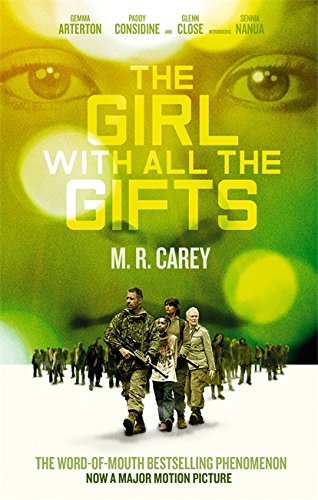
In many ways, Melanie (Sennia Nanua) is just another ordinary girl. She goes to school every day, where she’s grown affection for her teacher Ms. Justineau (Gemma Arterton). And she’s at that age where she’s figuring out what’s important to her, and how to navigate through the world of adults around her. But Melanie is not an ordinary girl. She will soon be a mindless, soulless zombie, a braindead creature who responds only to a desire to kill and eat people around her. In fact, with the right triggers—like if the adults around her forget to wear their scent-disguising lotion—she could become that right now. Just when you thought the zombie genre was out of ideas, along comes Colm McCarthy’s smart and engaging “The Girl with All the Gifts,” a film with echoes of George A. RomeroDanny Boyle, and Robert Kirkman but one that also feels confidently its own creation, a unique take on responsibility, adulthood, and a new chapter in evolution.

Melanie isn’t alone. She lives with a number of other zombie-children like her in a bunker beneath a military facility, where she’s being studied and experimented on by Dr. Caroline Caldwell (Glenn Close), in the hope that they could provide the antidote for what has essentially ended normal human existence. Melanie is one of several second-generation flesh-eaters called “hungries,” babies who literally ate their way out of their parents but are not behaving in precisely the same way as the brain-dead speedsters that have destroyed humanity. Whenever a child is found in the wild, they’re taken to this facility, where Dr. Caldwell can experiment on them and Sgt. Eddie Parks (Paddy Considine) can work to control them. Said control involves leg, arm and head restraints whenever the children are anywhere near that oh-so-enticing human flesh.

But Melanie seems so normal and is clearly learning empathy. The good doctor sees that as well, and even starts to loosen some of the restraints keeping Melanie more of an object than a person. Then one day Dr. Caldwell comes for Melanie, ready to dissect her and see exactly what she can learn from this unique child the hard way. Before Dr. Justineau can save her, all hell breaks loose and the facility is overrun. A small group of survivors is forced to travel to another sanctuary city in the hope that it’s still being run by people who don’t eat flesh. Melanie goes with them, and proves to be pretty useful.

One of the major strengths of “The Girl with All the Gifts” is evident early in McCarthy’s tactile, believable world-building. Much as Romero paid close attention to such details, the set design, costumes, and the world of “Gifts” feels lived-in and genuine. And it’s a nature-based aesthetic (dirt on walls, costumes that look worn, etc.) that continues and even strengthens once this ragtag crew is forced from safety and into the dangerous world. There’s a visceral, emotional impact to the horror and action of “The Girl with All the Gifts” that resonates because the characters and the world they live in feels real to us. It’s hard to overstate how important this to a horror movie, especially one set in a post-apocalyptic world. If we don’t believe the world is genuine, we won’t care what happens in it.

Of course, performance goes a long way to amplify this believability as well, and it’s not often you see a horror film with a cast this strong. Close could have gone showy with her doctor with a heart of ice but she plays it straight, again conveying the believability of the moment more than the B-movie archetype this character could have become. Considine and Arterton perfectly convey authority and warmth, respectively, although they’re good enough to make these people into more than mere plot devices. And Nanua is a find, again never giving her performance with a knowing wink. So she’s a zombie child who could be the evolutionary key to the future—this just happens to be her reality.

The traveling band aspect of “The Walking Dead,” the cities and landscapes empty of human existence of “28 Days Later,” the military aspect of “Day of the Dead”—it’s easy to pick apart the influences of “The Girl with All the Gifts.” But just as Melanie marks something altogether new in this world—a zombie with a conscience—the film about her feels inspired by what came before but also good enough to inspire those that come after.

Sy Hersh and The Way We Live Now

By Craig Murray

Source: Craig Murray Blog

It is a clear indicator of the disappearance of freedom from our so-called western democracies, that Sy Hersh, arguably the greatest living journalist, cannot get this monumental revelation on the front of the Washington Post or New York Times, but has to self-publish on the net.

Hersh tells the story of the US destruction of the Nordstream pipelines in forensic detail, giving dates, times, method and military units involved. He also outlines the importance of the Norwegian armed forces working alongside the US Navy in the operation.

One point Sy does not much stress, but it is worth saying more about, is that Norway and the USA are of course the two countries who have benefitted financially, to an enormous degree, from blowing up the pipeline.

Both not only have gained huge export surpluses from the jump in gas prices, but Norway has directly replaced Russian gas to the tune of some $40 billion per year. From 2023 the United States will appear in that list in second place behind Norway, following the opening in the last two months of two new Liquefied Natural Gas terminals in Germany, built to replace Russian gas with US and Qatari supplies.

So Russia lost out massively financially from the destruction of Nordstream and who benefited? The USA and Norway, the two countries who blew up the pipeline.

But of course, this war is nothing to do with money or hydrocarbons and is all about freedom and democracy…

To return to Hersh’s account, particularly interesting are the series of decisions taken to avoid classification of the operation in various ways which would require it to be reported to Congress. In terms of United States history, this ought to be a big deal.

For the Executive to commit what is an act of war without the approval of the Legislature is fundamentally unconstitutional. But that is one of those quaint remnants of democracy that the neo-liberal elite consensus can quietly sidestep nowadays.

Hersh sets out the well known background in compelling detail,  including the fact that, from Biden down, the Americans effectively announced what they were going to do, openly.

But what most worries me about the entire story is the unanimous complicity of the mainstream media in ignoring the completely obvious.

The media line, parroted here relentlessly by the BBC and corporate media, was  that the Russians had probably themselves blown up the pipeline on which they had expended such great resources and three decades of intense diplomatic activity, and which was to be the key to Russia’s single most valuable source of income for the next 40 years.

This was always quite literally incredible. You would have to be deranged to believe it.

It actually taught me not just that we truly are in the realm of totalitarianism and the Big Lie, but I learnt something very important about how the Big Lie works.

The secret is not that people genuinely believe an outrageous claim. The secret is that people do genuinely believe that they are in a battle of good against evil, and it is necessary to accept the narrative being promoted, in the interests of fighting evil.

Don’t question, just follow. If you do question, you are promoting evil.

I am sure that is how it works.

State and corporate stenographer journalists are actually intelligent individuals. If they thought about it, they would realise that the narrative that Russia blew up its own pipeline is obvious nonsense.

But they are convinced it is morally wrong to think about it.

Which is why none of them challenged the equally mad claims that Russia was repeatedly shelling its own forces occupying the Zaporizhzhia nuclear power station, and indeed is why none of them challenged the utterly risible official version of the Skripal story.

I previously told the anecdote from when I worked in the Foreign and Commonwealth Office and asked a good friend if he really believed the misinformatioin on Iraqi WMD with which he was involved.

He replied by referring to the video game Championship Manager (now renamed Football Manager), which we used to play together. He said when he was in the game, it was immersive, he was manager of Liverpool, and it fully absorbed him.

Similarly, when he walked through the FCO gates, the world of the intelligence reports was immersive and Iraq did have these WMDs inside that world. He worked in the “reality” of the FCO. Once he left in the evening, he lived in a different reality, the world of us in the pub.

I do know of one or two journalists bright enough to detach their professional output from what they really think, in a similar way. (I once had a conversation along these lines with Jeremy Bowen in Tashkent.)

Most however don’t think like this. They simply think that all right thinking people support the historic struggle against the evil Russians, so it must be right to read out the propaganda without thinking too much about it.

Those of us critical of the aggressive promotion of war in Europe, are not only barred from all mainstream media and confined to corners of the internet, and even then heavily suppressed on social media (which is why Sy Hersh’s article does not have the scores of millions of readers it merits).

We can’t even obtain freedom of assembly.

Two established left wing venues have cancelled the No 2 Nato meeting I am addressing in London on 25 February. Conway Hall’s reasons for cancellation included threats to funding and fears for the safety of staff.

We are now reduced to a guerrilla meeting, the Central London venue for which will not be announced until the evening before.

Is this really a democracy, where it is not possible for dissidents to hold a public meeting without secrecy, subterfuge and hiding from supporters of the state?

I do urge you to come along on the day, whatever your views on the subject, to support the right to freedom of speech.

I have a different view from perhaps all of the other speakers, on the legitimacy of Russia’s invasion of Ukraine, which I oppose.

But I also oppose NATO expansion which is an underlying cause of the war, and indeed oppose the existence of NATO itself.

NATO is a war machine which sucks resources from working people to benefit the military industrial complex, and unleashes devastating destruction on developing states which do not make their natural resources available to western billionaire elites.

It is also a fundamental node of the propaganda apparatus which manipulates and controls our society, particularly as counter narrative and dissident thought is now rigorously and systematically excluded.

There is no longer an Overton window of permitted debate. It has narrowed and should be renamed the Overton letterbox.

One of those small difficult ones right down at the bottom of the door.  With a very fierce spring, and snarling dogs guarding it.

Don’t Bow Down to a Dictatorial Government. America Is a Prison Disguised as Paradise

By John & Nisha Whitehead

Source: The Rutherford Institute

“If all that Americans want is security, they can go to prison. They’ll have enough to eat, a bed and a roof over their heads. But if an American wants to preserve his dignity and his equality as a human being, he must not bow his neck to any dictatorial government.”— President Dwight D. Eisenhower

The government wants us to bow down to its dictates.

It wants us to buy into the fantasy that we are living the dream, when in fact, we are trapped in an endless nightmare of servitude and oppression.

Indeed, with every passing day, life in the American Police State increasingly resembles life in the dystopian television series The Prisoner.

First broadcast 55 years ago in the U.S., The Prisonerdescribed as “James Bond meets George Orwell filtered through Franz Kafka”—confronted societal themes that are still relevant today: the rise of a police state, the loss of freedom, round-the-clock surveillance, the corruption of government, totalitarianism, weaponization, group think, mass marketing, and the tendency of human beings to meekly accept their lot in life as prisoners in a prison of their own making.

Perhaps the best visual debate ever on individuality and freedom, The Prisoner centers around a British secret agent who abruptly resigns only to find himself imprisoned in a virtual prison disguised as a seaside paradise with parks and green fields, recreational activities and even a butler.

While luxurious, the Village’s inhabitants have no true freedom, they cannot leave the Village, they are under constant surveillance, all of their movements tracked by militarized drones, and stripped of their individuality so that they are identified only by numbers.

“I am not a number. I am a free man,” is the mantra chanted in each episode of The Prisoner, which was largely written and directed by Patrick McGoohan, who also played the title role of Number Six, the imprisoned government agent.

Throughout the series, Number Six is subjected to interrogation tactics, torture, hallucinogenic drugs, identity theft, mind control, dream manipulation, and various forms of social indoctrination and physical coercion in order to “persuade” him to comply, give up, give in and subjugate himself to the will of the powers-that-be.

Number Six refuses to comply.

In every episode, Number Six resists the Village’s indoctrination methods, struggles to maintain his own identity, and attempts to escape his captors. “I will not make any deals with you,” he pointedly remarks to Number Two, the Village administrator a.k.a. prison warden. “I’ve resigned. I will not be pushed, filed, stamped, indexed, debriefed or numbered. My life is my own.”

Yet no matter how far Number Six manages to get in his efforts to escape, it’s never far enough.

Watched by surveillance cameras and other devices, Number Six’s attempts to escape are continuously thwarted by ominous white balloon-like spheres known as “rovers.”

Still, he refuses to give up.

“Unlike me,” he says to his fellow prisoners, “many of you have accepted the situation of your imprisonment, and will die here like rotten cabbages.”

Number Six’s escapes become a surreal exercise in futility, each episode an unfunny, unsettling Groundhog’s Day that builds to the same frustrating denouement: there is no escape.

As journalist Scott Thill concludes for Wired, “Rebellion always comes at a price. During the acclaimed run of The Prisoner, Number Six is tortured, battered and even body-snatched: In the episode ‘Do Not Forsake Me Oh My Darling,’ his mind is transplanted to another man’s body. Number Six repeatedly escapes The Village only to be returned to it in the end, trapped like an animal, overcome by a restless energy he cannot expend, and betrayed by nearly everyone around him.”

The series is a chilling lesson about how difficult it is to gain one’s freedom in a society in which prison walls are disguised within the seemingly benevolent trappings of technological and scientific progress, national security and the need to guard against terrorists, pandemics, civil unrest, etc.

As Thill noted, “The Prisoner was an allegory of the individual, aiming to find peace and freedom in a dystopia masquerading as a utopia.”

The Prisoner’s Village is also an apt allegory for the American Police State, which is rapidly transitioning into a full-fledged Surveillance State: it gives the illusion of freedom while functioning all the while like a prison: controlled, watchful, inflexible, punitive, deadly and inescapable.

The American Surveillance State, much like The Prisoner’s Village, is a metaphorical panopticon, a circular prison in which the inmates are monitored by a single watchman situated in a central tower. Because the inmates cannot see the watchman, they are unable to tell whether or not they are being watched at any given time and must proceed under the assumption that they are always being watched.

Eighteenth century social theorist Jeremy Bentham envisioned the panopticon prison to be a cheaper and more effective means of “obtaining power of mind over mind, in a quantity hitherto without example.”

Bentham’s panopticon, in which the prisoners are used as a source of cheap, menial labor, has become a model for the modern surveillance state in which the populace is constantly being watched, controlled and managed by the powers-that-be while funding its existence.

Nowhere to run and nowhere to hide: this is the mantra of the architects of the Surveillance State and their corporate collaborators.

Government eyes are watching you.

They see your every move: what you read, how much you spend, where you go, with whom you interact, when you wake up in the morning, what you’re watching on television and reading on the internet.

Every move you make is being monitored, mined for data, crunched, and tabulated in order to amass a profile of who you are, what makes you tick, and how best to control you when and if it becomes necessary to bring you in line.

When the government sees all and knows all and has an abundance of laws to render even the most seemingly upstanding citizen a criminal and lawbreaker, then the old adage that you’ve got nothing to worry about if you’ve got nothing to hide no longer applies.

Apart from the obvious dangers posed by a government that feels justified and empowered to spy on its people and use its ever-expanding arsenal of weapons and technology to monitor and control them, we’re approaching a time in which we will be forced to choose between bowing down in obedience to the dictates of the government—i.e., the law, or whatever a government official deems the law to be—and maintaining our individuality, integrity and independence.

When people talk about privacy, they mistakenly assume it protects only that which is hidden behind a wall or under one’s clothing. The courts have fostered this misunderstanding with their constantly shifting delineation of what constitutes an “expectation of privacy.” And technology has furthered muddied the waters.

However, privacy is so much more than what you do or say behind locked doors. It is a way of living one’s life firm in the belief that you are the master of your life, and barring any immediate danger to another person (which is far different from the carefully crafted threats to national security the government uses to justify its actions), it’s no one’s business what you read, what you say, where you go, whom you spend your time with, and how you spend your money.

Unfortunately, George Orwell’s 1984—where “you had to live—did live, from habit that became instinct—in the assumption that every sound you made was overheard, and, except in darkness, every movement scrutinized”—has now become our reality.

We now find ourselves in the unenviable position of being monitored, managed, corralled and controlled by technologies that answer to government and corporate rulers.

Consider that on any given day, the average American going about his daily business will be monitored, surveilled, spied on and tracked in more than 20 different ways, by both government and corporate eyes and ears.

A byproduct of this new age in which we live, whether you’re walking through a store, driving your car, checking email, or talking to friends and family on the phone, you can be sure that some government agency is listening in and tracking your behavior.

This doesn’t even begin to touch on the corporate trackers that monitor your purchases, web browsing, Facebook posts and other activities taking place in the cyber sphere.

Stingray devices mounted on police cars to warrantlessly track cell phones, Doppler radar devices that can detect human breathing and movement within in a home, license plate readers that can record up to 1800 license plates per minutesidewalk and “public space” cameras coupled with facial recognition and behavior-sensing technology that lay the groundwork for police “pre-crime” programspolice body cameras that turn police officers into roving surveillance cameras, the internet of things: all of these technologies (and more) add up to a society in which there’s little room for indiscretions, imperfections, or acts of independence—especially not when the government can listen in on your phone calls, read your emails, monitor your driving habits, track your movements, scrutinize your purchases and peer through the walls of your home.

As French philosopher Michel Foucault concluded in his 1975 book Discipline and Punish, “Visibility is a trap.”

This is the electronic concentration camp—the panopticon prison—the Village—in which we are now caged.

It is a prison from which there will be no escape. Certainly not if the government and its corporate allies have anything to say about it.

As Glenn Greenwald notes:

“The way things are supposed to work is that we’re supposed to know virtually everything about what [government officials] do: that’s why they’re called public servants. They’re supposed to know virtually nothing about what we do: that’s why we’re called private individuals. This dynamic – the hallmark of a healthy and free society – has been radically reversed. Now, they know everything about what we do, and are constantly building systems to know more. Meanwhile, we know less and less about what they do, as they build walls of secrecy behind which they function. That’s the imbalance that needs to come to an end. No democracy can be healthy and functional if the most consequential acts of those who wield political power are completely unknown to those to whom they are supposed to be accountable.”

None of this will change, no matter which party controls Congress or the White House, because despite all of the work being done to help us buy into the fantasy that things will change if we just elect the right candidate, we’ll still be prisoners of the Village.

So how do you escape? For starters, resist the urge to conform to a group mind and the tyranny of mob-think as controlled by the Deep State.

Think for yourself. Be an individual.

As McGoohan commented in 1968, “At this moment individuals are being drained of their personalities and being brainwashed into slaves… As long as people feel something, that’s the great thing. It’s when they are walking around not thinking and not feeling, that’s tough. When you get a mob like that, you can turn them into the sort of gang that Hitler had.”

You want to be free? Remove the blindfold that blinds you to the Deep State’s con game, stop doping yourself with government propaganda, and break free of the political chokehold that has got you marching in lockstep with tyrants and dictators.

As I make clear in my book Battlefield America: The War on the American People and in its fictional counterpart The Erik Blair Diaries, until you come to terms with the fact that the government is the problem (no matter which party dominates), you’ll never stop being prisoners.

The New Normal: Death Spirals and Speculative Frenzies

By Charles Hugh Smith

Source: Of Two Minds

There is an element of inevitability in play, but it isn’t about central bank bailouts, it’s about Death Spirals and the collapse of unsustainable systems.

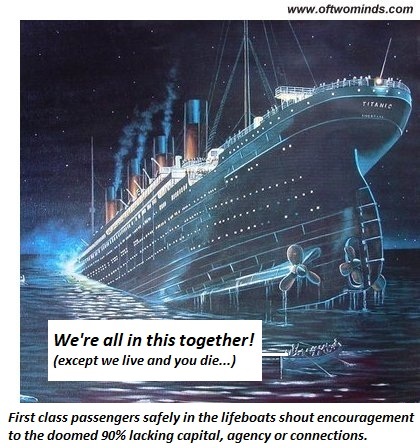
The vapid discussions about “soft” or “hard” landings for the economy are akin to asking if the Titanic’s encounter with the iceberg was “soft” or “hard:” either way, the ship was doomed, just as the global economy is doomed by The New Normal of Death Spirals and Speculative Frenzies.

Death Spirals are the inevitable result of entrenched interests clinging on to the status quo and thwarting any adaptation or evolution that might threaten or diminish their share of the swag–and that includes any real change because any consequential modification has the potential to upset the gravey train.

The status quo “solution” is to borrow and blow whatever sums are needed to satisfy every entrenched interest. Filling the federal slop-trough for all the hogs now requires borrowing a staggering $1.4 trillion every year, and billions more in municipal, county and state bonds (borrowing money via selling bonds) on the local level.

This borrow and blow strategy avoids any uncomfortable discipline and difficult trade-offs: everybody gets everything they demand.

This strategy looks “unsinkable” until the iceberg looms dead ahead. History suggests that fiscal and political discipline is eventually imposed by the real world in one fashion or another when diminishing returns enter a Death Spiral.

Any limit on debt is of course “impossible,” just as it was “impossible” for the Titanic to sink. But history is rather implacable in this regard. The self-serving hubris of “impossible” limits on largesse tend to collapse on contact with currency devaluation, structural inflation or a systemic crisis of legitimacy that sweeps away the entire worm-eaten facade of stability.

In other words, the entrenched interests benefitting from the status quo will continue to do what worked in the past until it all implodes. The pain of discipline and modest sacrifices is too great to bear, so let’s collapse the entire system.

Autocracies excel at Death Spirals because they eliminate dissent, transparency and competing nodes of power. Nobody’s left to push back on disastrous policy decisions, so autocratic regimes race toward the iceberg at full speed.

Rather than invest in real long-term solutions, everyone is in the casino, buying options that expire in a few hours. Rather than invest for an entire quarter–whew, three whole months!–speculators now consider a week an unbearably long time to hold a trade.

Speculative frenzies create their own Death Spirals, as gamblers front-run the “guaranteed” bailout of speculators by central banks. This is the consequence of moral hazard being elevated to “guaranteed”: there is no need to actually wait for the inevitable central bank bailout of bets gone bad, we can place bets before the bailout because we know it’s as assured as the sun rising tomorrow morning.

Nice, except central banks and bailouts also reach diminishing returns and enter Death Spirals. Doing more of what’s failed seems to work once, then twice, if you give it enough juice, but the third time is iffy and the fourth time collapses the speculative casino that the status quo was trying to save.

No one who benefits from the Moral Hazard Casino Economy believes it’s no longer sustainable. All the gamblers, big and small, are confident the Federal Reserve and other central banks can cover any losses and make good whatever befalls the casino. The hubris of the punters, big and small, is essentially infinite.

I’ll get out before the house of cards collapses, everyone tells themselves. In the meantime, I’m going to front-run the inevitable bailout of this speculative frenzy.

There is an element of inevitability in play, but it isn’t about central bank bailouts, it’s about Death Spirals and the collapse of unsustainable systems. Death Spirals and speculative frenzies have now been completely normalized. We can’t imagine any other way to operate. But this New Normal won’t last as long as punters believe. Doing more of what worked in the past is only accelerating the casino’s demise.

Signs of Early Onset Activist Syndrome

By Mickey Z.

Source: Dissident Voice

In my very young days, I lived in a fourth-floor apartment in a five-story, pre-war, walk-up building. On the second floor, you’d find an older Italian couple: Mr. and Mrs. Larucci. (I say “older” because that’s how they appeared to me at the time. I’m probably older now than they were then.)

Anyway, the two Laruccis were the first cat people I had ever encountered. They religiously fed the local strays — rain or shine, in sickness and in health — in an alcove behind the building. Their diligence, effectiveness, and focus clearly inspired my mother and sister to become cat ladies/animal lovers for life. To a slightly lesser degree, both me and my Dad were influenced by witnessing all this animal-based altruism.

It was while dwelling in that building that I first showed signs of Early Onset Activist Syndrome. To follow are but two of many symptoms.

Even as a very young child, I understood:

1. The war in Vietnam was becoming increasingly unpopular

2. Being on TV is a really big deal to most people

So, it was while hanging out on the stoop with my grade school friends — not far from the 59th Street Bridge, connecting Queens to the east side of Manhattan — that I hatched a cynical scheme to allegedly capitalize on the above two facts.

About six of us staged our very own anti-war protest amidst the high volume of motor vehicles streaming down Crescent Street on their way to the city (Queens may be one of New York’s five boroughs but for us, only Manhattan is and will ever be “the city”).

Mimicking the images we saw nightly on our black-and-white TV sets, we made rudimentary signs and posters. One of my fellow subversives wasn’t a regular on the block. He was a little older than me, perhaps a classmate of my big sister. I can’t remember his full name but I do recall that his last name was Castro and that he later became notorious for ending up in the hospital after attempting to ride a motorized mini-bike down a flight of concrete steps.

By the time I was in my teens, I heard a rumor that Castro had died during the commission of a crime. Considering how many of my childhood friends ended up in jail or dying young, this was a rumor to be taken at face value.

Anyway, I can still see Castro’s chastened expression when I scolded him for a misspelling on his sign: “SPOT THE WAR!” it read. I insisted that he correct it.

With or without proofreading, we enthusiastically held up our protest posters to passing cars and trucks and yelled “stop the war” until our pre-pubescent voices grew hoarse. “Someone will call the news,” I promised, “and we’ll all be on TV tonight.”

Our children’s crusade lasted maybe 20 minutes. When it neither ended the war nor landed us on TV, we got bored. One by one, we heard our mothers’ voices calling us to dinner from different windows of the tenement buildings looming above us. Hunger trumped revolution, and the experiment was over. I don’t believe any of us ever mentioned it again.

Today, that same anti-war demo or rally or protest or march or whatever would’ve had its own social media event page. It would’ve been live-streamed. And it would’ve been deemed a “success” if it garnered even just one of us a kick-ass Facebook profile pic for which we could use the caption: #warrior.

Speaking of “anti-war,” a few years after I organized that futile demonstration, I first saw Duck Soup on TV. Instantly, I was hooked on the Marx Brothers… but I had a problem. You see, this was long before YouTube and free streaming services. It was also before VHS players and video stores.

To see more of the Marx Brothers, I had to hope that one of the local NYC channels (5, 9, 11) would randomly show one of their 13 films (12 actually, because Animal Crackers was in the midst of a legal battle at that time).

After catching a couple more of the Marxster’s movies, I grew tired of waiting for the rest so I hatched a plan. With help from my Mom, I found the names and addresses of the directors of programming of the local channels (easier said than done in the pre-Google days of yore).

I hand-wrote three passionate petitions — requesting/demanding more Marx Brothers movies be shown on their stations — and brought the documents to my Catholic grammar school.

I was popular enough and cool enough to convince, cajole, or coerce all my classmates to sign. Feeling mighty proud of myself, I mailed off all three petitions and sat back to wait for a steady supply of Harpo, Chico, Zeppo, and Groucho.

The weeks and months passed with a) no change in local programming and b) no reply from any of the stations. All the necessary lessons about “activism” were right there in front of me, but I wasn’t yet ready to learn. Not even close.

Nope, that part would only happen after decades had passed, and — through personal experience — I could finally recognize activism for what it is. And what it could potentially be.

This brings me back to Mr. and Mrs. Larucci. While I was trying to “spot” the war and spread “Marxism” on TV, my cat-loving neighbors just kept feeding and caring for the local strays. Regardless of weather or personal issues, they fulfilled their chosen mission.

Cat ladies get results.

A cat lady understands urgency when she encounters it. She also accepts her limitations and works around them. From there, she basically behaves like a triage nurse. As a result, she gets results. Day after day, felines within her reach are fed and have safe havens in which to hide. If they fall ill or are injured, they will be promptly cared for with dignity.

When others in the general area see a hungry, sick, injured, or threatened cat, they know who to contact: the local cat lady. No delusions of grandeur about shifting global conditions or ‘changing the conversation.’ No social media fame. Just results.

Finally, lessons learned.

So, to all the #woke activists still out there virtue signaling their way onto my news feed, I have this message from a song by Groucho:

“I don’t know what you have to say. 

It makes no difference anyway. 

Whatever it is, I’m against it!”

Saturday Matinee: Alphaville

GODARD’S SCI-FI/NOIR ALPHAVILLE’ IS WITTY AND SUBVERSIVE

Alphaville‘s pulpy sci-fi plot acts as a warm coat of familiarity as Godard slyly subverts one genre trope after another.

By Brian Holcomb

Source: PopMatters

In Oliver Stone’s The Doors (1992) Ray Manzarek (Kyle MacLachlan) tells Jim Morrison (Val Kilmer) a story about his experiences working in the Hollywood of the late 1960s. He says he told a studio executive that he did not need a script to make a film. “Godard doesn’t use one,” Manzarek claimed. The executive replied, “That’s great… Who’s Godard?”

By the late ’60s, Jean-Luc Godard was a legend among young cinephiles. Beginning with Breathless in 1960 and ending with Weekend just eight years later, the caustic former Cahiers Du Cinema film critic made 15 films which can only be described as revolutionary. Both in terms of cinematic form as well as political and personal content, these films broke the old rules while inventing new ones. The use of handheld cameras, jump-cuts, natural light, and improvisation were both old and new things he popularized. Many of these ideas were used during the freewheeling days of silent cinema before filmmaking was industrialized and, in the mind of Godard and his “New Wave” colleagues, fossilized.

Godard wanted to provoke. But unlike some of his more didactic later work, these initial films are playfully provocative. Most of them are defined by their adversarial relationship to popular movie genres. Breathless is Godard’s deconstructed take on the crime film. A Woman is a Woman (1961) is his musical comedy.

Alphaville (une étrange aventure de Lemmy Caution) (1965) is two genres for the price of one: science fiction and noir. Maybe it’s even a third genre as well. It can be argued that the film is just another Eddie Constantine “Lemmy Caution” flick. “Lemmy Caution” flicks were big business in France since the ’50s, and Constantine played the role in over a dozen of them. Created by British pulp novelist Peter Cheyney, Caution is either an FBI agent or a private detective, depending on which novel you read, but it doesn’t really matter. He’s less a character than a genre archetype and it’s the archetype that Godard wanted. Especially one that was already lost in translation: British novels about an American detective adapted into French films starring an American actor speaking French.

Constantine was synonymous with the role, so Godard simply dropped him like a found object into his dystopian science fiction plot. The old fashioned tough guy Lemmy Caution does not belong here. His simple macho values and violent responses are hilarious when placed into this new context. In one scene, he shoots and kills a man then attempts to question him. Caution appears to have no idea what question to ask anyway, as his bizarre mission pits him against a fascist sentient computer called Alpha-60, which rules Alphaville and forbids any expression of emotion. Caution is deadpan but filled with primitive emotions both violent and romantic. It’s no surprise that Godard considered calling the film “Tarzan Versus IBM”.

By the end of the film, Caution gives up trying to understand the computer’s semantic games and resorts to his base instincts to bring Alphaville down. Along with using his fists and a .45 automatic, Caution expresses love for Natacha Von Braun (Anna Karina), the daughter of Professor Von Braun aka Leonard Nosferatu (Howard Vernon) — the man who built Alpha-60. Natacha grew up in Alphaville and does not know the meaning of words like “Love”. Caution challenges her to understand the meaning and challenges Alpha-60 by telling it a riddle that it cannot possibly comprehend.

From this description, the film may seem like a cold intellectual exercise. A film made by Alpha-60 itself. But this isn’t the case. I find Ridley Scott’s Blade Runner (1982), which is obviously inspired by this movie, to be a much colder experience. Alphaville is one of Godard’s wittiest and most emotionally moving. The pulpy sci-fi plot acts as a warm coat of familiarity as Godard slyly subverts one genre trope after another. Godard never really stopped being a film critic. His films were as much essays on how films worked as they were films themselves.

So Godard reveals the artificiality of B-movie fight scenes by presenting them as a series of posed comic book stills and gives Caution melodramatic theme music, which turns abruptly on and off at the most dramatically incorrect and hilarious moments. The excellent score by Paul Misraki shifts from this intentionally clichéd thriller music to beautiful and haunting pieces full of romantic longing.

This romantic theme is used most effectively at the end of the film, a scene which is a perfect example of what fellow French New Wave director Francois Truffaut called a “privileged moment”; brief moments in cinema when the film captures something intangible in a way no other art form could. As Misraki’s score builds, Godard holds on a lengthy closeup of Anna Karina, whose eyes are as hypnotic as any performer in film history. Karina’s expression slowly and subtly shifts from cold to warm and she ends the film by speaking the words she could not comprehend earlier: “Je vous aime…”

____________________

Watch Alphaville on Hoopla here: https://www.hoopladigital.com/title/15675583