On the Meaning of “Middle Class” and the State of the Middle Class

and_wearing_shoes_middle_class_k_750725

By Dr. Nicholas Partyka

Source: The Hampton Institute

When politicians talk, one of the recurring themes about which they spew platitudes is the economy. It would be the subject of another essay to unpack what is meant by “the economy” when politicians and other capitalist elements use that term. This aside, in discussing the economy there is a phrase that politicians use with such alacrity that it has become trite. This phrase is, “middle class”. Politicians, pundits, and social commentators deploy this term in many contexts, but almost always appealing to its ubiquity of membership, critical role in democracy, and moral virtue in their speeches. These constant references to the middle class in the popular political discourse have rendered this term impenetrably vague. If we listen to politicians then one would be led to believe that most Americans are members of this middle class, whose health and prosperity the politicians never tire of proclaiming as their highest priority. Speeches are one thing, reality another. Let us interrogate this concept of the “middle class”, and see what to make of this notion that plays such a prominent role in American political discourse on the economy.

With an election year looming, and a Presidential election at that, with their seemingly always lengthening election cycle, the phrase “middle class” will only be heard more and more frequently from now until after November 2016. The President’s recent invocation of the phrase “middle class economics” is only the latest salvo between the two dominant capitalist political parties, as they try to position themselves in the public’s mind as the true defender of – the almost apotheosized- middle class. Candidates and their supporters will be arguing more and more vigorously about which party, or which policies, will do more to help this middle class. About the only thing that candidates from both parties will agree on is that the middle class is in trouble, and that economic policies should be designed which maximally promote the welfare of this class. The two major political parties in this country have divergent views about what kinds of policies best aid this alleged middle class. However, both parties are attempting to win votes by claiming to be champions of the middle class, a class with which a great many Americans still continue to identify themselves.

We’re going to explore two distinct, but interrelated questions in what follows. First, we’ll want to know, Who and how many, people are middle class? Second, we’ll want to ask, What does it mean to be middle class? The answers to these questions will likely have to be made relative to particular societies at particular times; though some generalization is possible. To begin we’ll look at what it has meant historically to be middle class. Then we’ll look more in depth into the meaning of being middle class in the contemporary American context. What we will find is a great deal more confusion and ambiguity about this notion of a “middle class”. So much so that we should start to wonder if this notion retains any usefulness.
The Middle Classes, Historically

For most of history being middle class simply meant occupying, however tenuously, a social status that was between that of a slave and that of a noble. Basically, the middle class was composed of everyone who was not technically a chattel slave, and lacking the noble pedigree of a true aristocrat. In most societies of the ancient world this simple definition would indeed make most people middle class. However, this understanding glosses over the highly variegated nature of socio-economic positions possible between technical chattel slavery and blue-blooded nobility. For instance, debt bondage and serfdom, both forms of un-free labour, would not cause one to be dropped from the middle class on this accounting. For example, in the ancient world slaves were often employed as overseers, that is in a management capacity. It would not have been uncommon for slave overseers to sometimes direct the labour of technically free men.

We can see in certain socio-political cleavages that splits have occurred in many contexts between the lower ranks of these middle classes and the higher elements of this class. Middle classes have struggled against entrenched aristocracy and nobility at many points in history for social advancement and political inclusion. However, almost always, in the critical moment, the higher elements of these middle classes would betray the interests of the lower elements, whose bodies, blood and ballots had been used to gain them inclusion. Marx would come to call these “higher elements” of the middle classes petit-bourgeoisie, signifying the much greater material, and indeed much more importantly, aspirational affinity with the bourgeoisie than the proletariat.

Two examples will suffice here. In ancient Greece we see the demos, or “the people” engaging in political struggle for inclusion in the political life of the polis. But who is this demos? First, Greeks used the word demos in two distinct ways. In one sense, we might call the wide sense, it meant the whole citizen body of city-state in general. In the narrow sense, on the other hand, the demos meant the ‘common people’, the ‘lower classes’, the aporoi, the propertyless. This group included a very wide range of socio-economic and political situations, and certainly contained an upper and lower group. The main cleavage within the ranks of the demos is between the better off elements and those struggling to get by. It goes without saying that slaves would not be counted among the demos. Those who are struggling are more, or in worst case entirely, dependent on others for their livelihood. The Greeks called Thetes and Banausoi. The former we might call day-labourers or wage earners, the latter we could translate loosely as artisans. These were the lowest two of Solon’s five social classes, and while not slaves, were subject to various kinds of forced labour. Though some artisans and merchants could be quite wealthy, most were not. Most merchants, as opposed to retailers, though were likely to be foreigners, and thus not eligible for citizenship.

When we focus on the internal political conflicts of the Greek polis of the Classical period (roughly the 5th and 4th centuries BC), what we see is a struggle over citizenship, that is over access to political participation in government. While the socio-economic and political realities of the ancient world are complex, in the main the conflicts were between an urban middle class of mainly artisans and middling farmers on the one hand, and the traditional land-owning oligarchy which monopolized political power on the other.[1] The political struggles over demokratia in this period revolved mainly around whether or not the banausoi and thetes should be given citizenship rights. Chiefly important among the rights of citizens were the right to vote in the Assembly, to hold public office, the serve as a juror in the dikasteria, to bring matters before the courts; at Athens in particular, citizens would be entitled to receive a share in any disbursement of the polis‘s dividends from the proceeds of the Laurium silver mines.

The demos was the main agent of social change in the ancient Greek polis, the traditional aristocracy certainly saw it this way. They saw “middle class” elements as being too politically ambitious, which is in part why they deploy the term pejoratively. By “middle class elements” the traditional aristocracy would have lumped together both very wealthy artisans, and much more humble enterprises, all of whom were united in not being aristocrats by blood lineage. Wealthy merchants and artisans might themselves employ slaves both for carrying out production, as well as the overseeing of this work, but they lacked the “best” kind of background. This made them unsuitable for political participation in the eyes of established elites. Smaller artisans and merchants, who didn’t have exorbitant wealth to recommend them, would have been thought only the more unsuited to political life.

All of the main institutions of Classical Greek demokratia were devices designed to help poor and working-class free men defend themselves from the depredations of their richer counterparts. Rule by majority vote in an Assembly, ekklesia, open to all citizens; freedom of speech, parrhesia, in the assembly; large popular courts of law, dikasteria, composed of fellow citizens; rule of law, isonomia, as passed by the Assembly and administered in the courts; the belief that political power should be scrutinized, subject to euthyna, are all practices that helped the aporoi defend their highly precarious social position from the predatory behavior of wealthy citizens. As one eminent scholar describes, “Since the majority of citizens everywhere owned little or no property, the propertied class complained that demokratia was the rule of demos in the narrower sense and in effect the domination of the poor over the rich.”[2]

In the ancient Greek polis political participation was usually restricted to those native adult men who could meet a certain property qualification. In the main, in order to be a citizen one had to possess enough wealth to afford to outfit themselves with the hoplite panopoly. This was the complete set of armaments associated with the heavy armed infantry. If one could afford to buy one’s own armor, and afford the leisure time to learn to fight as part of a phalanx formation, then one was considered worthy to participate in the political life of the polis. The idea being that if one was wealthy enough to afford the hoplite panopoly then one had enough of a stake in the success and survival of the polis to be entitled to a role in the government of the city-state. Those “old money” and nouveau riche aristocrats who were wealthy enough could afford to outfit themselves with horses as well as more ornate armor and weapons, and thus the traditional prestige associated with the cavalry. The question of democracy in the ancient Greek world, was thus a struggle over the inclusion of those who could not afford the traditional citizenship qualification based on the connection of wealth and military service, and who because they were not slaves could make legitimate claims to be entitled to such inclusion.

Renaissance Italy serves as another great example. In the rise of the classic northern Italian city-state podestaral form of communal government there was employed in the popular political discourse a term, the popolo. Loosely translated, it means the people. However, once again we’ll see that this notion of the people actually covers over a major divergence within between well-off members and working-class members. As one scholar claims, “When, therefore, the long and venomous struggle broke out between the popolo (the “people”) and the nobility, the popular movement drew its force and numbers from the middle classes, not from the poor, the day labourers, or the unskilled”.[3]

The political conflict in 13th century northern Italian city-states was, much like in the ancient Greek world, fundamentally about participation. Beginning in the 12th century, a political conflict between church and secular authorities saw the rise of communal governments in all the major Renaissance city-states in northern Italy. At the time, this form of government was identified with the self-government of local magnates and aristocrats instead of more alien authorities imposed by church leaders in Rome. In this early phase of commune government, “The nobility dominated the consulate, manipulated the general assembly, and ruled the city, except where the emperor successfully intervened, as at Vicenza, Siena, and Volterra, or where the political power of the Bishop persisted.”[4]

It was against this restricted form of government that the political forces of the popolo were arrayed in the 13th century. By organizing for combat against the military forces of the nobility, the popolo was able to seize power in the commune and change the structure of commune government, in that it was able to secure more participation for those in its ranks; or more correctly, some of those in its ranks. The popolo, much like the demos, was a class composed of better off artisans, tradesman, merchants, et cetera. It was a class of persons who had to work for a living, that is they had to do physical labour themselves to achieve their subsistence. These people were free, in that they were not slaves or serfs, but were not aristocrats, they did not possess the right kind of lineage. Political participation was at this time still restricted to those who did have the proper kind of aristocratic genealogy.

Much as in the case of the ancient Greek world, the main political cleavage in the Renaissance northern Italian city-state between the popolo and nobilitas largely concerned the way individuals made a living. Nobles owned large landed estates, and derived their wealth and status from being able to control the labour of others, i.e. vassals and serfs. Those who were not aristocrats could be wealthy, could own land, but typically had to work themselves. That is, the typical member of the popolo could not control the labour of others to the same extent that a noble could. The political conflicts of the 13th century were not simplistic conflicts between land owners and merchants, the reality was much more complicated than that.

Both popolo and nobilitas would be distinguished from a day-labourer in that they would be considered independent in the right sort of way, they would be considered the people who had real freedom. What distinguishes the position of the poorest classes is that they are dependent on others for their livelihood. Thus, for example, the serf is dependent on the lord, the tenant farmer on the land-owner, and the day-labourer on the employer who pays him. These kinds of people would have been considered not really free in the right way, especially politically. Though all God’s children would have been understood to be free, some were not considered free enough to be worthy of inclusion in government.

In what would become an unfortunate recurring tendency, once the leading – i.e. the wealthiest- elements in the “middle class”, the popolo, achieved inclusion in communal government, they allied with the old aristocracy and turned against the lower, more ‘middling’ elements in the popolo to suppress their continued agitations for further liberalization of political participation. Thus, as one scholar puts it,

“Up to about the middle of the thirteenth century, it was in the interest of bankers and -long-distance traders to batter the entrenched communal oligarchy with an eye to loosening the political monopoly of the old consular families, mostly of noble lineage… But after about 1250 or 1260, having fully achieved their aims and in fact now menaced by the political ambitions of the middle classes, they broke with the popolo, thereby dividing and undermining the popular movement”.[5]

With the erosion of nobility and its traditional privileges across Europe and North America from the 17th century onward, as well as the formal abolition of chattel slavery in these societies, this traditional understanding of middle classes is not sufficient for the world we inhabit. Being neither a slave nor a noble will not help many locate their social position in contemporary societies, when these societies do not formally legally recognize slavery or nobility. As capitalism remade societies across western Europe and North America in this same period, it reshaped the nature of the classes that composed those societies. Thus, a new way to understand what the middle-class is will be needed.
The Idea of the Middle Class in Post-WWII America

There are some who are reluctant to define the middle class using income measurements. The alternative proposed by many of these critics is a more aspirational definition based on consumption. This definition is based on both the level and the kind of consumption desired by individuals who aspire to be middle-class, ie. who desire to live what is deemed a middle-class lifestyle. Most of the essential features of this conception of the middle class are derived from the experience of Americans post WWII. The vast pool of purchasing power accumulated by US citizens during the war led in the post-war period to rising standards of living for a wide swath of the population. The patterns of consumption, the norms and values, of what we today consider definitional of the middle class in America were originated to a large extent in this period.

It was in this period that the idea of the “American Dream”, as it is currently understood, originates. This post-war vision of increasingly wealthy Americans achieving higher material standards of living is the well-spring of many of the elements of middle-class-ness that we take for granted. The conception of middle-class-ness as consisting of things like widespread home ownership, ownership of a motor vehicle or vehicles, stable long-term employment, ability to send children to college, take a family vacation, et cetera, was born during this era.

If we try to understand the middle class this way, we should investigate what the patterns of consumption for a middle-class individual, or family, today requires in terms of income, and how many Americans actually possess the financial means to afford this lifestyle. According to one recent report, it was estimated that a middle-class “American dream” lifestyle would cost $130,000 a year for a family of four.[6] The median income for individual income-earners in the US in 2013 was around $52,000, not even half of that estimated cost. According to a 2010 study by the Commerce Department only a family with two income-earners in the 75th percentile or above could afford the middle-class lifestyle described in the previous report. [7] According to data from a 2014 report by the Congressional Research Service only around 20% of American household could afford this price tag of a “middle-class” lifestyle.

If one takes only the items listed as “essential” in the report cited in the previous paragraph the total cost of a middle-class lifestyle, which is still above the current median income. This accounting clearly leaves out other important expenses, like taxes, that one will incur, as well as makes impossible any expenditure on important items like savings, and recreation. Now, of course food prices change, and fuel prices change, and these effect how wealthy consumers feel, as decreases in food and fuel costs can be transferred to increase consumption of “extras” like college savings for children, or family vacations. One should also note that this report categorized cell phone and internet expenditure as an “extra”. In today’s world these things are properly considered more akin to utilities, they are essentials for living.

Clearly, the level of income needed for achievement of a characteristically middle-class, or “American dream”, lifestyle is out of reach for a great many individuals and families. This is likely part of why the percentage of those identifying themselves as lower-class, or lower-middle class in recent surveys has increased.[8] Indeed, even a family with two income-earners, in the 25th percentile only has an income about equivalent to the median. Meanwhile, as of 2010, an individual income-earner in the 50th percentile only made around $25,000. The rising costs of college, the continued stagnation of wages – especially at the lowest ends of the labour market – as well as the reductions in employer-based pension and benefit programs for most workers have a contributed to making the mid-twentieth century American vision of middle-class existence more and more out of reach for large swaths of Americans.

The post-war American experience, if put in proper context, is the product of a historically unprecedented epoch. According to the research presented by Thomas Piketty in his book Capital in the Twenty-First Century, the middle part of the twentieth century was the only time in the last 300 years that his law of capital (r>g) was reversed.[9] This was a special period in which the growth rate exceeded the return to capital, and thus workers received increasing wages, and increasing purchasing power. It was in this historically unique period that the main expectations, norms, values, and status symbols of modern American “middle-class” lifestyle were born.

If we look the heyday of the American middle class in the 1950s and 1960s what we see is a transformation of American society born of a historical accident. Piketty’s research demonstrates that income inequality in the US basically plateaued over these decades, after decreasing sharply during the period from 1913-1945, that is the period of the World Wars and the Great Depression. What the French call “les trente glorieuses”, and others have called a pax Americana, was the direct result of the tumult of the wars and economic crises of the first half of the twentieth century. Workers in the western world generally experienced a boom, in that they experienced rising living standards, wages, and benefits. In Europe these benefits often took the form of national programs, while in America they were largely employer-based; healthcare and retirement are good examples. It was in this environment of rising levels of access to material consumption that the dominant aspects of the outlook of the middle class in America took shape.

Without the devastating effects of two world wars and an economic depression of immense scale, governments, especially in the US, would not have made the concessions that they did to workers, to organized labour in particular. The need to secure consistent, reliable production of vital war supplies, which might be disrupted by labour agitation, inclined the US government to enter the fray of industrial warfare on the side of workers during the First World War; at least to the extent required to ensure production for war. The Great Depression was an important cause of the establishment of the main pillars of the American welfare system in the 1930s. Labour unions achieved even greater privileges during the Second World War, as the leadership of organized labour organizations were increasingly co-opted by the corporate interests they were supposed to oppose. As a result of the need to take sometimes drastic measures to fight two wars and a titanic economic depression the US government enacted policies which resulted in a reduction in income inequality. This reduction in inequality combined with rising levels of material consumption, due to workers increased ability to bargain collectively with the support of the legal apparatus of the state, define this unprecedented period in economic history.
Middle Class Confusion

Clarification about the meaning of “middle class” is especially important because Americans seem to be confused about this notion of “middle class”, about who is in it, and what it means to be in it. It is a well-know and, much commented on, phenomenon in American political culture that almost everyone tends to perceive themselves as “middle-class”. What makes this fact interesting, and thus worthy of the decades of commentary and analysis it has received, is the startling economic inequality that coexists with this perception.

Though the rates of self-identification with being middle-class have varied over time, a healthy portion of Americans still identify as being middle class. Even now, after decades of erosion in the position of workers due to stagnating wages, reductions in benefits, cuts to social programs and education, increasing international competition, and the shifting of various kinds of work to the global south and other peripheral economies, as well as more recently the effects of the 2008 financial crisis, 44% of people surveyed in one recent survey self-identified as being middle-class. [10] Indeed this figure has fallen over the years of the Great Recession, self-identification as middle-class fell from 53% in 2008, to 49% in 2012, and then to 44% in 2014. Thus, even in bad times, as a great many people are still struggling, a great many people continue to perceive themselves as middle-class.

There is no one universally accepted way to define the middle-class. Perhaps this is part of the reason why politicians are able to make so much political hay with it. This is also part of how it is possible for a great many rather wealthy see themselves as middle-class at the same time as many of the working poor. It is also part of how many super-wealthy individuals come to perceive others less wealthy than themselves, though still obscenely wealthy, as ‘merely’ middle-class.[11] This lack of a consensus about a definition is certainly one of the reasons there is so much confusion about the middle-class, and who belongs to it, and how one belongs to it.

Conventionally, the middle is understood as everyone in the second, third, and fourth income quintiles. Basically, everyone who is not in the top-fifth or the bottom-fifth of income earners is defined as middle-class. In America today this definition of middle-class is roughly equivalent to those earning between $30,000 and $80,000 a year.[12] This is quite a large middle-class. One might think that it is rather too large. Indeed, how can one assimilate the experiences of an individual, or even more a family, living on $30,000 to one making $80,000? One could, I think quite properly, say that these two sets of experiences are so incommensurable materially as to make them awkward members of a common middle-class. Let us note in this connection that the federal government defines the poverty threshold for a family of four as a bit less than $24,000 a year. So, it would seem hard to think the experiences of family living on about 25% more than the poverty level would be anything like those of a family making more than two and a half times that amount.

That this conception is too wide to be very useful, and for the reasons I alluded to, is admitted by the fact that, at least colloquially, we have adopted the distinctions between ‘upper’ and ‘lower’ middle class. This distinction testifies to the difference in material position of individuals, or families, in the upper and lower ends of the middle. The lifestyle, the patterns of consumption, level of access to opportunity, and much else, varies so much between these groups that the distinction suggests itself, and is so patently apparent that no one questions its propriety.

Perhaps then we should narrow our definition of middle-class to only the third income quintile. This understanding of middle-class would include those making roughly $40,000 to $65,000. Even the top end of this range would still be half of what one estimate suggests a middle-class lifestyle would cost. Moreover, only about 15% of income earners would count as middle-class on this way of understanding the middle class. [13] This fact would certainly seem inconsistent with the widespread perception that the middle-class is the numerically largest class. Even if we expand back to our original range of $30-80,000, only about 40% of income earners would be middle-class. While this figure has the virtue of appearing to match up quite closely with the level of self-reported identification as being middle-class, it suffers from the vagueness we noted above. The upper limit of the 4th income quintile is north of $100,000. I do not think it is a stretch to say the material circumstances of a “middle-class” family making anywhere from the median to the upper limit has much in common with those families earning closer to the lower threshold of “middle class”.

By several ways of trying to understand the middle class we come up with results that fall short of matching our expectations and common perceptions. We seem to end up with either an unhelpfully expansive notion of the middle-class that encompasses individuals and families with greatly divergent material circumstances. Or, one ends up with a more precise statistical conception of the middle class, but wherein fewer persons are understood to be middle-class than commonly report being so in surveys. Part of explaining this confusion about the middle-class is the fact that Americans are either unaware or deeply confused about the nature of the distribution of wealth in this country. Many people report feeling like they are middle-class, but only as a result of ignorance or confusion about the nature of wealth inequality in America. Indeed, it would be crazy to deny that part of one’s perception of class position is the relative position of others. Were more Americans aware of the real nature of the distribution of wealth they would likely feel less middle-class, and more lower-class. According to the results of one recent research study, a representative sample of Americans reported thinking that the share of total income possessed by the middle class in America, i.e. the second through fourth income quintiles, was just north of 40%. Respondents also reported thinking the third income quintile alone possesses over 10% of total national wealth. In fact, the real share possessed by the first through fourth income quintiles combined is less than 20%, and the third quintile alone possesses closer to 5% than greater than the 10% that was reported.[14]

Another important aspect of the explanation for why there is so much confusion about the middle class is the confusion individuals face given their precarious position in the socio-economic hierarchy. Given how much inequality has risen over the last few decades there has been an increase in the perception that the post-war American middle-class lifestyle is out of reach for a great many hard-working people. Rising inequality combined with the effects of a calamitous financial crises, followed by years of recession, caused many to report falling in social class. The youngest cohort especially was hard hit, with now 49% reporting being in the lower or lower-middle class. It also caused many who identify as middle-class to feel this status increasingly precarious. Indeed, according to a Pew Research study from 2014 almost as many Americans reported being lower-class as middle-class, and the spread between the two was a mere 4%.[15]
The Working Class

We have seen now that this notion of the “middle class” is highly problematic. When we attempt a rational accounting of it, what we find is that our social reality confounds many of the expectations that most Americans have when they talk about the middle class. We find that though many Americans report in surveys that they are middle-class, the middle class is small, and shrinking. Once we distinguish upper from lower in the middle class, the true middle is really a small part of the income spectrum. One cannot get too far below the median income for one to be more lower class than middle class, nor can one get too far above without becoming upper-middle, or even elite. For instance, $100,000 in income would put one at the upper limit of the fourth income quintile, while an income at or above $150,000 would place one among the top 10% of income-earners. One cannot thus get too far beyond the $80,000 average income of the fourth income quintile without ending up less middle class than upper class.

If we judge belonging to the middle class as a function of ability to consume, then again we find that the traditional middle-class lifestyle ideal is increasingly out of reach for large swaths of the American population. What we see now is that we need a new way to think about class, about the socio-economic positions that people occupy and how these are best described. Getting a handle on what class one belongs to is important, especially in these election cycles, as appeals for votes are made to members of the various social classes that compose the electorate. How is one to know which kind of candidate or policy to vote for if one does not know what candidates or policies will advance their interests? And how is one to know what will advance one’s interests if one does know have an accurate understanding of their own socio-economic reality?

Rather than muddle on with this vague notion of a middle class, we should substitute a new understanding of class and class relations. This understanding of class should emphasize the role that working conditions play in determining socio-economic position, or class. This understanding will of course have much overlap with the dominant income-based understanding. For indeed, working conditions and wage rates are often highly correlated in market economies, that is, typically the lower the pay the worse the working conditions (in one form or another) and vice versa. When we take the kinds of jobs people work into account, the picture that emerges is one which demonstrates the importance of thinking in terms of a working class rather than a middle class. When we start putting working conditions in the forefront of our conception of social class we gain a much accurate, and explanatory conception of class.

One example that helps demonstrate this need for an understanding of class based on working conditions is the practice of “flex-time”. In the upper end of the labour market this concept is instantiated by programs that allow workers to do their work on their own schedule, freeing workers of the need to always be in the office during the traditional working day. This allows workers to achieve a better work-life balance, by having more flexibility with the time they need to devote to work. On the lower end of the labour market flex-time typically takes the form of on-call forms of scheduling. This is an extension of the logic of the “just-in-time” inventory management systems that have come to dominate manufacturing industries, and applied to the labour force of a variety of businesses, but especially retail firms. The idea, in both cases, is to only have as much as it needed of both on hand at any one time, so as to free up capital from unnecessary investment in extra stock or extra labour.
Conclusion

Have middle classes existed in history, yes. Did a middle class exist in the US during the middle part of the twentieth century, yes. However, in both cases these answers must be qualified, if the nuance of reality is not to be lost. Yet, in appending these qualifications we change the nature of the answers, and thus must come to see the original answer as importantly flawed. In both cases we find the reality of the middle class(es) does not match up with our modern expectations and perceptions about the middle class. In the first case, one might be subject to various forms of un-free labour despite still being technically not a slave, and thus free but by no means rich, or even independent. In the latter case, we find that this ideal of the middle class was quite restricted, and the alleged golden age of its reign was certainly not seen as such by the many marginalized groups of that era. We also see that its very existence occurs because of the confluence of historical circumstances that would be near impossible to re-create.

The idea of being “middle class” is also a source of confusion when compared to modern thinking about the middle class, and its role in society. Indeed, much of the meaning of being “middle class” has always involved poor people, those who work for wages for a living, aping the consumption trends of their ‘social betters’. Thus, even while during the classic 19th century hay-day of industrialization the middle class, ie. the petit bourgeoisie, was fairly small it nonetheless transmitted its social norms, consumption patterns, taste in art and décor, to those below them on the social ladder. It was not this middling class, but rather the working class, the proletariat, whose consumption, aping the middle class above them, drove the rise of a “middle class society”. This process of transmittal of social norms, values, and patterns of consumption is eloquently detailed by Thorsten Veblen in his Theory of the Leisure Class.

Today, this notion of the middle class, a remnant of the mid-century post-war Pax Americana, stands in the way of proper thinking about the role of class in society and the role of class in individuals’ lives. We need to be free of this notion if we’re going to able to correctly perceive how class works, and how it has changed. Remember that this notion of the middle class in post-war America was built on stable, long-term employment, with benefits, and pension plans, that paid enough to own a home, buy a car, household appliances, vacations, college educations, and more. In today’s economy these kinds of employment features of increasingly harder to come by for increasingly large segments of the labour market.

What one finds is that as automation increases, and as services increasingly dominate over production, more and more workers are forced into ever more precarious forms of employment. These tenuous relationships serve employers desire for flexibility, ie. ability to (re)move capital quickly, but increase burdens on working class people; especially on their time. Instead of thinking of themselves as “middle class”, these workers should more correctly perceive themselves to be part of what Guy Standing calls the Precariat[16]. The Precariat is already a class in-itself, but the ideology of the middle class in the US prevents it to a great extent from developing into a class for-itself. Opposed to this class is what Standing calls the Salariat, that is, the minority of a firms’ workers who are central to operations. These are core workers who typically earn a salary, have benefits, sick time, vacation days, and many of the other trappings of the fabled American middle class lifestyle.

Politicians will continue to talk in speeches, interviews, and the like about a middle class that supposedly exists in America, and how they will do the most to help it, typically by enacting the policies that will allow it to flourish. From what we have seen here working class people should no longer be duped into thinking that those politicians are addressing them. The rhetoric that dominates our politics simply does not match the reality of the contemporary economy, in particular the labour market. When we adopt a more appropriate view of class we see an economy characterized not by a broad-based and prosperous middle class, but rather by increasing inequality. We see a labour market where trends in job conditions and benefits very much resemble those in real wages. When we adopt a different view of class we see a very different answer to the question, Is there a middle class in America? No, not in a way that matches the mid-century American ideal.

Notes

[1] For a thorough analysis of the political and social conflict in the ancient Greek world see, G.E.M. de Ste. Croix’s The Class Struggle in the Ancient Greek World. 1981. Cornell University Press, 1998.

[2] De Ste. Croix 1998, 284

[3] Martines, Lauro. Power and Imagination; City-States in Renaissance Italy. 1979. Vintage Books, 1980; 40.

[4] Martines 1980, 29.

[5] Martines 1980, 61

[9] In Piketty’s equation (r) = after tax rate of return to capital, and (g) = the rate of growth of per capita income, a proxy for economic growth. For further information about Piketty’s research see my review of his book for The Hampton Institute.

[16] See his book, The Precariat: The New Dangerous Class. Bloomsbury Academic; 2011.
Ex Machina, et al, and the Metaphysics of Computer Consciousness

ex_machina_2015_movie-wide

By Steven Harp

Source: Reality Sandwich

( ex machina from the phrase “deus ex machina” meaning “god from the machine”)

It seems unquestioned in the world today that science is on the verge of creating consciousness with computers. In a Promethean rapture inspired by its enormous technological success, science aspires now to seize control of fundamental powers at the very heart of the universe.

With the advent of modern science the reality of human consciousness has come to be regarded as physical alone.  A caricature of consciousness has been compounded from such disparate elements as digital code, speculative evolutionary psychology, and a “neuro-phrenology” derived from colorized brain imaging. This caricature from scientists and engineers has gone into public circulation with the help of the media and it has become an acceptable counterfeit currency. And with cinematic virtuosity it has been made plausible by representations in the movies.

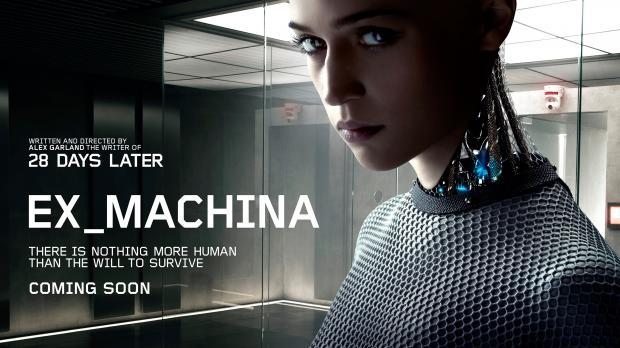
In the movie, Ex Machina we see another recycling of the classic Frankenstein story: Life is created from nonliving materials. A lone genius in an isolated laboratory, using the mysterious powers of science, creates new life. In the original Frankenstein story we have a dead body made alive by electricity. In Ex Machina we have a non-living “wetware” circuit given a mechanical body and made conscious by electricity.

This takes the story to a whole new level. Here the scientist is creating the very roots of being. To create consciousness-itself is equivalent to creating de novo cosmic absolutes such as space, matter, or light. It would be equivalent to creating a spectrum of color, a scale of tones, entire ranges of emotion, thought, pain, pleasure, and the entire dictionary of the contents of consciousness, all from the dark and silent abyss of nothingness.

How can something with neither mass nor dimension arise from that which has mass and dimension? How can that which has subjectivity and intentionality arise from that which has objectivity and has no intentionality?  This is the magisterial conundrum and is recognized as the greatest mystery in science.  No one, neither philosopher nor scientist, has a clue to the answer. It has famously been labeled the “hard problem of consciousness” by David Chalmers.

In both cases we see technology extrapolated to the creation our most fundamental being in which man becomes the maker of his most central essence, of what he is himself. The creation becomes the creator, the hand that draws itself.

This year alone has seen 8 major movies featuring synthetic or digital consciousness: Transcendence, Her, Chappie, Ex Machina, Lucy, Extant, Tomorrowland, and Terminator again.  One has to ask, is there something more than a good story line here?

The claim that technology will give birth to consciousness itself within a computer is entirely based on implicit assumptions about the nature of consciousness and reality. The often made assumption that the brain is like a computer and that nerve impulses are like digital code has no direct experimental foundation and is based on superficial resemblances only. There is no real scientific basis for the claim that the digital processing of symbols should somehow be accompanied by inner experience, that is, by consciousness, awareness, qualia, feeling, sentience, etc. 

A computer simulation of brain function is not going to produce consciousness any more than a computer simulation of kidney function is going to produce urine. There is no magic in computation. No amount of digital processing alone is ever going to produce a color. Without consciousness a computer program is a flow of electrons as meaningless and non-referential as those flowing in a wall.

Despite the flagrant and unbridgeable abyss between mind and matter it is the modern claim that if one can set up the right connections and run some electricity through it, a` la Frankenstein, consciousness will arrive on schedule from nonexistence. When undressed from the bewitching technical language this seems to be an equivalent in science of the Immaculate Conception. Or, in the current philosophical language we would call it the Immaculate Emergence. But perhaps Particle Parthenogenesis would be more accurate.

“We are on the edge of change comparable to the rise of human life on earth.” -Vernon Vinge

For materialists the arrival of artificial intelligence and machine consciousness is inevitable and only a matter of time. We have two main schools of thought developing on how to meet the coming technological tsunami – those who fear it and those who embrace it. We have on the fear side the notion that we are headed toward a near future where artificial intelligence or machine consciousness presents a danger to mankind (à la Stephen Hawking, Elon Musk, Nick Bostrom, etc.)

How this danger will manifest is the great unknown. There are countless possibilities. An embryonic AI lurking in the internet could suddenly cross the threshold into self-awareness and seize control of the world’s nuclear arsenals and missiles and demand surrender.  Or, a self-aware internet could lay low and send out brain wave controlling vibrations through WIFI and the background hum of our electrical circuitry to enslave humankind in order to advance technology sufficiently to develop the body or bodies necessary for a now paralyzed internet consciousness. This may have already happened.

And for those who embrace the change we have the Kurzwellians’ vision of the very technological replacement of humanity. This scenario will begin when computers begin to learn and thus redesign themselves. At this point the computer, or computer network, or robot would be capable of designing computers or robots better than itself. Repetitions of this cycle would result in an intelligence explosion resulting in a superintelligence which may be beyond human comprehension. This has been called the technological singularity and could begin as early as 2040, although the date keeps getting pushed further into the future.

In this process consciousness will transcend the hazards and horrors of warm-blooded protoplasmic existence. The machine descendants of man will transcend our obsolete and obscene modules of flesh. They shall put away the sweaty, smelly, hairy, warty, fatty, itchy, scarred, flawed, urinating, shitting, hurting, needy, conflicted, misshapen sac of meat and gristle and the gravity-enslaved earthly existence to become ascended silicon masters and rule like gods in a heavenly cyberspace and perhaps even reconfigure the universe itself. “We shall be as gods!” is a not so hidden background thought.

Consciousness will emerge like a butterfly from its earthbound caterpillar stage and fly freely in the new digital noosphere of a virtual reality (à la Kurzweil, Moravec, Fredkin).  The mortal human self will be subsumed like mitochondria in a giant computational eukaryote.  Our evolutionary period will expire like the dinosaurs’ and we will become a symbiont in the superior host technology. We have been upgraded by Google! All hail Google! Superintelligence is all! Praise Intelligence!

For artificial intelligence enthusiasts this will be good news for mankind. Maintaining mortal human flesh is a logistical nightmare. It requires very specific atmospheric conditions, it requires a very limited temperature range, it requires a vast range of chemical and energy inputs, it requires specific social and sexual connections, it even requires entertainment. Not meeting even one of these requirements could result in the entire operating system crashing and all the data lost (you).  Our wetware obviously makes for an inferior product when compared to a silicon based circuitry which could just as well exist in the vacuum of space with just a single source of electricity.

We shall put aside our earthly raiment of mortal skin and bone and be arrayed in the finest of indestructible metals, plastics, and silicons. We shall be free at last of nature and its’ inconveniences.  All the wealth and riches of the imagination will be at the tip of our cursor.  A million movie channels will be available and we will have an unbreakable silicon heart. We can even have our heart amputated like an infected appendix.  After all it is only pixels!  It is the next stage of evolution! Rejoice in the in the wonderful future of technology! Praise Evolution!

The notion that mind can be uploaded into a computer (Transcendence, Her, Chappie), if not completely loco, is radical in the extreme. But given the hubris of technological success and the realism of movie depictions, it has been made believable and in mainstream scientific circles it is near heresy to doubt the materialist premise of consciousness synthesis from raw physical materials. 

However there is a curiosity in the movie, Ex Machina, that perhaps reveals a crack in the technological juggernaut.  In the movie, Nathan, the techno-wizard internet mogul, has just created the most extraordinary technology in the history of science, a technology that would revolutionize the world and beyond. With Promethean daring he has just robbed the very cradle of consciousness and created Ava, a conscious robot that passes every Turing test.  It would seem that he would be in a state of elation and brimming with fulfillment.  Instead he is getting drunk at every opportunity. Alcohol is featured in almost every scene in which he appears.  One must ask the question, what has gone wrong with Nathan?    

Is this just an iniquitous twist of character?  Or could he be plain old lonely? Or is it a metaphysical crisis?  He lives like a hermit in a remote and isolated Northern region, but he has a retinue of very lovely synthetic ladies waiting for him in closets. And he has a beautiful and near mindless female companion and assistant that likes to dance. And then, he has the mysterious and unknown otherness of Ava. That should be adequate companionship.

But he has just synthesized consciousness. He has dramatically and inescapably demonstrated that life and consciousness are a merely physical phenomena that have no more meaning than electricity passing through a copper wire. He has shown that he himself is not much more than the ionic exchanges occurring through a polarized lipid membrane in a cranial bone flask.  And when the switch is turned off he dissolves into nothingness.

Our lone genius clearly has grounds for a metaphysical crisis.  He has experimentally proven a deeper isolation:  That is the isolation that the vision of materialism prescribes for man – as a spark of consciousness in a meaningless void. There is no wider mystery in being alive… he is all there is… a pathetic lonely little god… isolated in time as well as space with a separation that he cannot mitigate, even with the agreeable companionship of his ersatz bitches.

It is more than ironic that our synthesizer of new consciousness is intent on anaesthetizing his own.  But is this not also modern man? Alcohol is the universal drug of the world today. Nathan here is materialist everyman rather than the oversensitive genius. Modern man closes the door on his personal consciousness while aspiring to extend consciousness through external technological means. It seems modern man shares the same metaphysical disturbance as our techno-wizard, Nathan.

The materialist everyman has fixated on a physical literalism that excludes the meaningfulness inherent within every conscious experience. He has radically reduced the ontological range of life. Life has been stripped of inner meaning. He is abandoned to a complete separation and isolation in both time and space.

He has embraced the lawful Stalinesque reality of materialism as a total explanation for consciousness. He has embraced the scientific fundamentalism of consilience. And total explanations produce repressive states, both political and personal. However, modern man, like an eviscerated organism continues to live… even though partially.

The Frankenstein of today is more than an out-of-control technology. Our Frankenstein monster is the story that science has authority over all other interpretations of life and has replaced them with a grim and desolate paradigm about the nature of the universe and our place in it. Technology has come to shape the imagery by which the world is depicted and to affirm the underlying metaphysics of materialism. We have shaped our reality and now it shapes us. It is only natural then that Ava, the beautiful and sexy creature in Ex Machina kills her creator, Nathan. But modern man cannot kill his own soul so he must anaesthesize it.

But, exercising our imagination, let us suppose that consciousness, rather than being proven physically dependent is proven physically independent. Materialism, irrespective of technological successes, would be shown wrong and suggest that we have been living in the dark ages of a materialist ideology. And it would reveal the present day metaphysics of consciousness at the heart of a dysfunctional civilization.

Saturday Matinee: Pan’s Labyrinth

pans_labyrinth-t2

“Pan’s Labyrinth” (2006) is a modern parable written and directed by Guillermo del Toro. The film’s narrative seamlessly interweaves the horrors of the Franco regime with a coming of age story in which a young girl’s interactions with creatures in a parallel world teach her the importance of moral choices.

http://www.dailymotion.com/video/x2dyo75_pan-s-labyrinth-2006-with-english-subtitle_shortfilms

The Superpower Conundrum

The Rise and Fall of Just About Everything

By Tom Engelhardt

Source: TomDispatch.com

The rise and fall of great powers and their imperial domains has been a central fact of history for centuries.  It’s been a sensible, repeatedly validated framework for thinking about the fate of the planet.  So it’s hardly surprising, when faced with a country once regularly labeled the “sole superpower,” “the last superpower,” or even the global “hyperpower” and now, curiously, called nothing whatsoever, that the “decline” question should come up.  Is the U.S. or isn’t it?  Might it or might it not now be on the downhill side of imperial greatness?

Take a slow train — that is, any train — anywhere in America, as I did recently in the northeast, and then take a high-speed train anywhere else on Earth, as I also did recently, and it’s not hard to imagine the U.S. in decline.  The greatest power in history, the “unipolar power,” can’t build a single mile of high-speed rail?  Really?  And its Congress is now mired in an argument about whether funds can even be raised to keep America’s highways more or less pothole-free.

Sometimes, I imagine myself talking to my long-dead parents because I know how such things would have astonished two people who lived through the Great Depression, World War II, and a can-do post-war era in which the staggering wealth and power of this country were indisputable.  What if I could tell them how the crucial infrastructure of such a still-wealthy nation — bridges, pipelines, roads, and the like — is now grossly underfunded, in an increasing state of disrepair, and beginning to crumble?  That would definitely shock them.

And what would they think upon learning that, with the Soviet Union a quarter-century in the trash bin of history, the U.S., alone in triumph, has been incapable of applying its overwhelming military and economic power effectively?  I’m sure they would be dumbstruck to discover that, since the moment the Soviet Union imploded, the U.S. has been at war continuously with another country (three conflicts and endless strife); that I was talking about, of all places, Iraq; and that the mission there was never faintly accomplished.  How improbable is that?  And what would they think if I mentioned that the other great conflicts of the post-Cold-War era were with Afghanistan (two wars with a decade off in-between) and the relatively small groups of non-state actors we now call terrorists?  And how would they react on discovering that the results were: failure in Iraq, failure in Afghanistan, and the proliferation of terror groups across much of the Greater Middle East (including the establishment of an actual terror caliphate) and increasing parts of Africa?

They would, I think, conclude that the U.S. was over the hill and set on the sort of decline that, sooner or later, has been the fate of every great power. And what if I told them that, in this new century, not a single action of the military that U.S. presidents now call “the finest fighting force the world has ever known” has, in the end, been anything but a dismal failure?  Or that presidents, presidential candidates, and politicians in Washington are required to insist on something no one would have had to say in their day: that the United States is both an “exceptional” and an “indispensible” nation? Or that they would also have to endlessly thank our troops (as would the citizenry) for… well… never success, but just being there and getting maimed, physically or mentally, or dying while we went about our lives? Or that those soldiers must always be referred to as “heroes.”

In their day, when the obligation to serve in a citizens’ army was a given, none of this would have made much sense, while the endless defensive insistence on American greatness would have stood out like a sore thumb. Today, its repetitive presence marks the moment of doubt. Are we really so “exceptional”? Is this country truly “indispensible” to the rest of the planet and if so, in what way exactly? Are those troops genuinely our heroes and if so, just what was it they did that we’re so darn proud of?

Return my amazed parents to their graves, put all of this together, and you have the beginnings of a description of a uniquely great power in decline. It’s a classic vision, but one with a problem.

A God-Like Power to Destroy

Who today recalls the ads from my 1950s childhood for, if I remember correctly, drawing lessons, which always had a tagline that went something like: What’s wrong with this picture?  (You were supposed to notice the five-legged cows floating through the clouds.)  So what’s wrong with this picture of the obvious signs of decline: the greatest power in history, with hundreds of garrisons scattered across the planet, can’t seem to apply its power effectively no matter where it sends its military or bring countries like Iran or a weakened post-Soviet Russia to heel by a full range of threats, sanctions, and the like, or suppress a modestly armed terror-movement-cum-state in the Middle East?

For one thing, look around and tell me that the United States doesn’t still seem like a unipolar power.  I mean, where exactly are its rivals?  Since the fifteenth or sixteenth centuries, when the first wooden ships mounted with cannons broke out of their European backwater and began to gobble up the globe, there have always been rival great powers — three, four, five, or more.  And what of today?  The other three candidates of the moment would assumedly be the European Union (EU), Russia, and China.

Economically, the EU is indeed a powerhouse, but in any other way it’s a second-rate conglomeration of states that still slavishly follow the U.S. and an entity threatening to come apart at the seams.  Russia looms ever larger in Washington these days, but remains a rickety power in search of greatness in its former imperial borderlands.  It’s a country almost as dependent on its energy industry as Saudi Arabia and nothing like a potential future superpower.  As for China, it’s obviously the rising power of the moment and now officially has the number one economy on Planet Earth.  Still, it remains in many ways a poor country whose leaders fear any kind of future economic implosion (which could happen).  Like the Russians, like any aspiring great power, it wants to make its weight felt in its neighborhood — at the moment the East and South China Seas.  And like Vladimir Putin’s Russia, the Chinese leadership is indeed upgrading its military.  But the urge in both cases is to emerge as a regional power to contend with, not a superpower or a genuine rival of the U.S.

Whatever may be happening to American power, there really are no potential rivals to shoulder the blame.  Yet, uniquely unrivaled, the U.S. has proven curiously incapable of translating its unipolar power and a military that, on paper, trumps every other one on the planet into its desires.  This was not the normal experience of past reigning great powers.  Or put another way, whether or not the U.S. is in decline, the rise-and-fall narrative seems, half-a-millennium later, to have reached some kind of largely uncommented upon and unexamined dead end.

In looking for an explanation, consider a related narrative involving military power.  Why, in this new century, does the U.S. seem so incapable of achieving victory or transforming crucial regions into places that can at least be controlled?  Military power is by definition destructive, but in the past such force often cleared the ground for the building of local, regional, or even global structures, however grim or oppressive they might have been.  If force always was meant to break things, it sometimes achieved other ends as well.  Now, it seems as if breaking is all it can do, or how to explain the fact that, in this century, the planet’s sole superpower has specialized — see Iraq, Yemen, Libya, Afghanistan, and elsewhere — in fracturing, not building nations.

Empires may have risen and fallen in those 500 years, but weaponry only rose. Over those centuries in which so many rivals engaged each other, carved out their imperial domains, fought their wars, and sooner or later fell, the destructive power of the weaponry they were wielding only ratcheted up exponentially: from the crossbow to the musket, the cannon, the Colt revolver, the repeating rifle, the Gatling gun, the machine gun, the dreadnaught, modern artillery, the tank, poison gas, the zeppelin, the plane, the bomb, the aircraft carrier, the missile, and at the end of the line, the “victory weapon” of World War II, the nuclear bomb that would turn the rulers of the greatest powers, and later even lesser powers, into the equivalent of gods.

For the first time, representatives of humanity had in their hands the power to destroy anything on the planet in a fashion once imagined possible only by some deity or set of deities.  It was now possible to create our own end times.  And yet here was the odd thing: the weaponry that brought the power of the gods down to Earth somehow offered no practical power at all to national leaders.  In the post-Hiroshima-Nagasaki world, those nuclear weapons would prove unusable.  Once they were loosed on the planet, there would be no more rises, no more falls.  (Today, we know that even a limited nuclear exchange among lesser powers could, thanks to the nuclear-winter effect, devastate the planet.)

Weapons Development in an Era of Limited War

In a sense, World War II could be considered the ultimate moment for both the narratives of empire and the weapon.  It would be the last “great” war in which major powers could bring all the weaponry available to them to bear in search of ultimate victory and the ultimate shaping of the globe.  It resulted in unprecedented destruction across vast swathes of the planet, the killing of tens of millions, the turning of great cities into rubble and of countless people into refugees, the creation of an industrial structure for genocide, and finally the building of those weapons of ultimate destruction and of the first missiles that would someday be their crucial delivery systems.  And out of that war came the final rivals of the modern age — and then there were two — the “superpowers.”

That very word, superpower, had much of the end of the story embedded in it.  Think of it as a marker for a new age, for the fact that the world of the “great powers” had been left for something almost inexpressible.  Everyone sensed it.  We were now in the realm of “great” squared or force raised in some exponential fashion, of “super” (as in, say, “superhuman”) power.  What made those powers truly super was obvious enough: the nuclear arsenals of the United States and the Soviet Union — their potential ability, that is, to destroy in a fashion that had no precedent and from which there might be no coming back.  It wasn’t a happenstance that the scientists creating the H-bomb sometimes referred to it in awestruck terms as a “super bomb,” or simply “the super.”

The unimaginable had happened.  It turned out that there was such a thing as too much power.  What in World War II came to be called “total war,” the full application of the power of a great state to the destruction of others, was no longer conceivable.  The Cold War gained its name for a reason.  A hot war between the U.S. and the USSR could not be fought, nor could another global war, a reality driven home by the Cuban missile crisis.  Their power could only be expressed “in the shadows” or in localized conflicts on the “peripheries.”  Power now found itself unexpectedly bound hand and foot.

This would soon be reflected in the terminology of American warfare.  In the wake of the frustrating stalemate that was Korea (1950-1953), a war in which the U.S. found itself unable to use its greatest weapon, Washington took a new language into Vietnam. The conflict there was to be a “limited war.”  And that meant one thing: nuclear power would be taken off the table.

For the first time, it seemed, the world was facing some kind of power glut.  It’s at least reasonable to assume that, in the years after the Cold War standoff ended, that reality somehow seeped from the nuclear arena into the rest of warfare.  In the process, great power war would be limited in new ways, while somehow being reduced only to its destructive aspect and nothing more.  It suddenly seemed to hold no other possibilities within it — or so the evidence of the sole superpower in these years suggests.

War and conflict are hardly at an end in the twenty-first century, but something has removed war’s normal efficacy.  Weapons development has hardly ceased either, but the newest highest-tech weapons of our age are proving strangely ineffective as well.  In this context, the urge in our time to produce “precision weaponry” — no longer the carpet-bombing of the B-52, but the “surgical” strike capacity of a joint direct attack munition, or JDAM — should be thought of as the arrival of “limited war” in the world of weapons development.

The drone, one of those precision weapons, is a striking example.  Despite its penchant for producing “collateral damage,” it is not a World War II-style weapon of indiscriminate slaughter.  It has, in fact, been used relatively effectively to play whack-a-mole with the leadership of terrorist groups, killing off one leader or lieutenant after another.  And yet all of the movements it has been directed against have only proliferated, gaining strength (and brutality) in these same years.  It has, in other words, proven an effective weapon of bloodlust and revenge, but not of policy.  If war is, in fact, politics by other means (as Carl von Clausewitz claimed), revenge is not.  No one should then be surprised that the drone has produced not an effective war on terror, but a war that seems to promote terror.

One other factor should be added in here: that global power glut has grown exponentially in another fashion as well.  In these years, the destructive power of the gods has descended on humanity a second time as well — via the seemingly most peaceable of activities, the burning of fossil fuels.  Climate change now promises a slow-motion version of nuclear Armageddon, increasing both the pressure on and the fragmentation of societies, while introducing a new form of destruction to our lives.

Can I make sense of all this?  Hardly.  I’m just doing my best to report on the obvious: that military power no longer seems to act as it once did on Planet Earth.  Under distinctly apocalyptic pressures, something seems to be breaking down, something seems to be fragmenting, and with that the familiar stories, familiar frameworks, for thinking about how our world works are losing their efficacy.

Decline may be in the American future, but on a planet pushed to extremes, don’t count on it taking place within the usual tale of the rise and fall of great powers or even superpowers. Something else is happening on Planet Earth. Be prepared.

Tom Engelhardt is a co-founder of the American Empire Project and the author of The United States of Fear as well as a history of the Cold War, The End of Victory Culture. He is a fellow of the Nation Institute and runs TomDispatch.com. His latest book is Shadow Government: Surveillance, Secret Wars, and a Global Security State in a Single-Superpower World.


American Politics: A House of Mirrors

the-circus-fun-house-mirrors

By Ulson Gunnar

Source: Land Destroyer

A house of mirrors is an immersive, highly distorted and intentionally confusing version of reality. Those walking its corridors are sometimes amused and sometimes frightened by the disorienting experience, but luckily for them, it is only temporary. There is an exit, and they will walk through it, back to reality.

But what if one existed their entire lives in such a distorted reality and knew of no exits? Would they convince themselves that these distorted images reflected back at them were in fact reality no matter how unnatural they appeared? Could they convince themselves to enjoy and even embrace this distorted reality?

One ponders such questions when looking from the outside-in on American politics. It too is a house of mirrors reflecting back a reality entirely distorted. Also like a house of mirrors, American politics have been intentionally constructed this way, to confuse, disorient and even frighten the American people when necessary to exercise mass persuasion over them. The final result is perpetual impunity granted to the powers that truly be, hiding behind the powers that allegedly were “elected,” and powers whose authority only exists in this house of mirrors and no further.

New Leaders, Old Wars 

Consider US President George Bush Sr. He launched the inaugural war of what he himself called a “New World Order.” Operation Desert Storm included multiple nations comprising of nearly a million soldiers who swept from the map one of the largest conventional armies (4th largest) in the world. Bush Sr., however, paused just ahead of sweeping the Iraqi leader Saddam Hussein from power. His successor, US President William Jefferson Clinton would keep Iraq subdued with periodic bombing campaigns and the imposition of both crippling sanctions and no-fly zones in the north and south of Iraq.

Clinton would serve 8 years in office and lock horns with Russia in Serbia in a proto-Ukraine-style conflict. In 2000, we should remember that George Bush Jr. ran on a platform opposed to global interventionism. For those trapped in the house of mirrors, this distortion of reality seemed very convincing. For those who understood the hegemonic mission of America’s special interests, those that transcend elections and political parties, they knew Bush Sr.’s desires for a “New World” endured and would manifest themselves in a yet revealed, muscular foreign policy that only needed the right impetus to be justified in the eyes of the American people.

Conveniently, the events of September 11, 2001 delivered just that. So began the 8 year “War on Terror.” So sick of wars were Americans at the end of those 8 years, that anyone promising to end them would likely win the 2008 elections. And so Barack Obama did and thus became “US President.” However, not only did the wars not end, and not only were they in fact expanded, new wars were begun. In fact, these new wars were all the planned wars Bush Sr., Clinton and Bush Jr. never got around to fighting.

Yet, no matter how unnatural this distorted reflection appeared in the American politics house of mirrors, those trapped perpetually within its mirrored walls found it perfectly acceptable for a Democratic president to continue Republican wars and start new wars the Republicans could only have dreamed of starting but couldn’t because of left-wing anti-war movements now silent because “their guy” was in office.

Hillary = Obama = Bush Jr. = Clinton = Bush Sr.  

With Hillary Clinton’s announcement that she is running for office in 2016 with President Obama’s full endorsement, those infected with neo-liberalism and wandering the corridors of this house of mirrors see yet another distorted, ghoulish image staring back, but one they are yet again ready to embrace.

Here is a woman who as US Secretary of State laughed and mocked the Libyan people upon hearing their leader had been murdered by terrorists in what constituted by all accounts a war crime. Before that, she played an active role in selling the war upon Libya in 2011 to the American left (as the American right had already desired such a war for years and needed no convincing). By 2016 we may have yet another Clinton in office, and a Clinton fully dedicated to carrying on the wars of both the Democrats and Republicans that came before her.

To say this is continuity of agenda is a bit of an understatement. American foreign policy has been so singular in purpose and focus for the past several decades that it is clear that behind the distortions of this house of mirrors, something singular and very nasty has been there the entire time. Who or what could it be?

The Real President of the United States Lives on Wall Street, not Pennsylvania Avenue 

How about we look at the people who pay for the political campaigns to put these various spokesmen and women-in-chiefs into office in the first place? Or the immense interests driving lobbying efforts that target and control both sides of the political aisle in American politics? A single Fortune 100 corporation has enough money to buy out every relevant politician on Capital Hill and still finish up the fiscal year bloated with billions in profits. And what happens when these interests converge across various think-tanks they themselves have set up and created to generate the singular foreign and domestic policies we see carried forward from presidency to presidency, from congressional session to session?

We see complete control exerted over American politics as well as across the media, allegedly charged to serve as watchdogs and a check and balance, but instead turned into an echo chamber and instrument of mass persuasion by those who have clearly consolidated the summation of American politics in their pockets.

While policy might be debated over by these special interests, and groups moved in one direction or another to exert influence against competing special interests among this exclusive club, one thing is for sure, the American voter is the last voice considered in this process.

Since the American voter is incapable of seeing that they are in fact in a house of mirrors to begin with, and think they are “outside” in reality making real decisions, their decisions are completely irrelevant to those who really do live outside in reality and are actually making real decisions.

We must understand that for special interests that collectively control trillions of dollars in assets, profits and infrastructure all over the planet, the last thing they are willing to do is allow for the existence of a system that might actually put into power a form of authority above their own, that would set policy predicated upon the interests of the people, rather than their own. They have the money, the power and the ability to ensure policy is set to suit them, and them alone, and they clearly have done just that.

This is why US troops are still in Afghanistan and Iraq, wars are still being waged either directly or indirectly against Libya, Syria, Yemen, Iran and Russia and destabilization targeting China and other targets of Washington and Wall Street’s special interests continues unabated, albeit distorted within the house of mirrors, regardless of who is president.

So Americans may think they are voting for Hillary Clinton in 2016, and those infected with neo-liberalism the world over may think another enlightened champion of their progressive cause has taken the reins of the free world, but they might as well have voted for another Bush. The reality is, that as along as Americans and those who look to America from abroad for leadership dwell in this house of mirrors, the special interests that intentionally built this carnival called “democracy” will have their way back in actual reality.

Instead of fumbling through another four years trapped inside this carnival attraction, let’s find the exits. Let’s leave this house of mirrors and breathe a breath of fresh air. Are we really going to listen to another round of campaign promises, holding our breath hoping that this time they mean it? Or will we begin divesting from this system and building our own, one that might actually truly represent us this time, far from the mirrored walls that held us for so long?

The Asshole Factory

index

Our economy doesn’t make stuff anymore. So what does it make?

By Umair Haque

Source: Medium

My good friend Mara has not one but two graduate degrees. From fine, storied universities. Surprise, surprise: the only “job” she was able to find was at a retail store.

Hey—it’s only minimum wage, but at least she’s working, right? And at a major-league, blue-chip company, An American icon; an institution; a name every man, woman, and child in this country knows; an historic company that rings of the American Dream the world over, besides. Surely, if nothing else, it’s a start.

Perhaps you’re right. Maybe it isn’t the start she always dreamed of…but at least it is one. If so…then awaits her at the finish?

What is Mara’s job like? Her sales figures are monitored…by the microsecond. By hidden cameras and mics. They listen to her every word; they capture her every movement; that track and stalk her as if she were an animal; or a prisoner; or both. She’s jacked into a headset that literally barks algorithmic, programmed “orders” at her, parroting her own “performance” back to her, telling her how she compares with quotas calculated…down to the second…for all the hundreds of items in the store…which recites “influence and manipulation techniques” to her…to use on unsuspecting customers…that sound suspiciously like psychological warfare. It’s as if the NSA was following you around……and it was stuck in your head…telling you what an inadequate failure you were…psychologically waterboarding you…all day long…every day for the rest of your life.

Mara’s boss sits in the back. Monitoring all twelve, or fifteen, or twenty people that work in the store. On a set of screens. Half camera displays, half spreadsheets; numbers blinking in real-time. Glued to it like a zombie. Chewing slowly with her mouth open. Jacked into a headset. A drone-pilot… piloting a fleet of human drones…pressure-selling disposable mass-made shit…as if it were luxury yachts…through robo-programmed info-warfare…like zombies…to other zombies…who look stunned…like they just got laser blasted, cluster-bombed, shock-and-awed…

WTF?

It’s bananas. The whole scene is like a maximum-security mental asylum designed by sadomasochists in a sci-fi movie. If Jeffrey Dahmer, Rasputin, and Michael Bay designed a “store” together, they couldn’t do any better. Her “job” will begin to drive her crazy—paranoid, depressed, deluded—in a matter of years if she continues doing it. No human psyche can bear that kind of relentless, systematic abuse.

Now. Note what all the technology and bureaucracy that wonderful, noble company has invested hundreds of millions in doesn’t ask her to do. Learn. Think. Reflect. Teach. Inspire. Lead. Connect. Imagine. Create. Grow. Dream. Actually…serve customers. Heaven forbid. It just beats her over the head, over and over again, three times a minute, every twenty seconds, with how much she hasn’t sold; hasn’t made; hasn’t produced. For her shitty .0003% commission. According to the quota that’s been set for her. By her boss. For his boss. For their boss. And so on all the way up the food chain.

See my point? Mara’s job isn’t to benefit customers. It isn’t to educate, understand, listen to, or even to chat with them. It isn’t to stop them from buying what they don’t want; to help them find what they might need; to match them with the right stuff. Nope. It’s merely to push more and more and more and more shit at them…faster, meaner, and dumber than any sane person would think is humanly possible…using advanced military technology and techniques… programmed to abuse her…so she can wage advanced psychological warfare…on her customers. And they were just suckers, gaping maws, fools, marks. And be yelled at…by a robot…if she doesn’t.

Really? This is the best our economy can do? To take the stuff of 21st century warfare and use them them to…rack up the profit? To turn a bright young woman with two grad degrees…into a Superprofitable Human Weapon of Mass Consumption…a half-crazed algorithmically-programmed asshole…a human drone…so even bigger, actually crazy assholes…can get super-rich…by slinging entire supertankers full of junk…at people getting poorer at four thousand percent interest a year…by using drones and bots to wage psy-warfare against them…so they’re conned into buying too much?

The economy doesn’t make stuff anymore. That much you know. So what does it make?

It makes assholes.

The Great Enterprise of this age is the Asshole Industry.

And that’s not just a tragedy. It is something approaching the moral equivalent of a crime. For it demolishes human potential in precisely the same way as locking someone innocent up, and throwing away the key.

Consider Mara again. Who in Christ’s name would design such an inhuman system? Whose sick joke of an idea is a “store” like that? What do you even call it? Because it’s surely not a “store”.

Only a monstrous asshole of the highest order could assemble such a demonically vampiric bullshit machine to prey on…everyone. Customers, managers, workers alike. Such a carefully sophisticated engine of human misery; of finessed cruelty; all to rake in a few extra pennies an hour, at the expense of dignity, intelligence, creativity, commitment, fairness, craft, service, sovereignty…sanity.

The store is an Asshole Factory.

Allow me to explain.

What happens to Mara when she’s “doing her job”? Think about it for a second. She turns into precisely the kind of asshole that the heartless dweebs who thought up this infernal torture-machine no doubt already are. Not because she wants to. But because she has to.

That’s exactly what the store was designed to do. Turn everyone into the same kind of asshole as the assholes that made it, run it, and benefit from it…want everyone to be.

The store is an Asshole Factory.

Our world is now full of Asshole Factories. That’s what the stores, offices, industrial parks, skyscrapers, malls, low-rise blocks, gleaming headquarters, whimsically designed corporate campuses, really are.

It’s the grand endeavor of today. We don’t make stuff anymore. We make assholes. The Great Enterprise of this age is the Asshole Industry.

Consider, for a moment, my tiny hypothesis.

Have you noticed, lately, that people seem to be more, well, assholish…than before? That everywhere you go, people seem to be meaner, nastier, dumber, angrier, more brutish?

Why?

It is the last and greatest industry left in an economy that has been impoverished, emptied, hollowed out, drained.

The Great Enterprise of the Age of Stagnation is the wholesale manufacture not of great, world-shaking, ground-breaking ideas, inventions, concerns…but of bigger and bigger assholes.

The chain-store; the mall; the hypermarket. The corporation; the firm; the partnership. B-school; law school; med school. The boardroom; the backroom; the trading floor.

These are, by and large, Asshole Factories. They don’t make people. Capable of great things. Who create and build and touch and soar. They make assholes.

They are designed to disinfect us of our fragility. To cleanse us of our flaws. To disinfect us of weakness. Love, grace, mercy, longing, forgiveness, passion, truth, nobility, dreams. Their objective is to stamp all that out; to eradicate it; to erase it. To replace it with calculation, ruthlessness, self-concern; gluttony; cruelty; anxiety, despair. By using the most sophisticated technology ever made to subjugate, oppress, and goad us into being little torturers ourselves.

And in so doing, they emotionally sterilize us. They psychically traumatize us. They intellectually castrate us. They socially neuter us. They cheat us of greatness. That is how they turn us into assholes.

They are designed to deprive us into depriving everyone else of the lives we could and have, at our highest and truest and noblest.

The assholes haven’t just taken our incomes, our savings, our careers, our educations. They’ve taken something far more precious; something priceless. It is our lives—the full, true lives we should be living—that have been taken from us. And in the gaping void where the lives we should be living are, the assholes have deftly inserted carbon copies of…themselves.

When you think about it that way…is it any wonder that society seems to be stuck? That the economy seems headed into oblivion? That life for so pretty much anyone under the age of 35 and/or worth less than $20 million or so appears to be going…nowhere?

Remember my friend Mara? She’s probably being piloted like a drone…yelled at by a bot…three times a minute…into waging advanced techniques of psycho-war…designed to traumatize prisoners…over and over and over again…right this very second…

Until she’s cleansed. Perfect. Flawless. Pure. Another gleaming, brand-new asshole, rolling proudly off the assembly line of the Asshole Factory.

We’re obedient constructivists. Pragmatists. Rationalists. So you probably want to know: what can we do about it?

It’s pretty simple.

Don’t be an asshole. Remember the Asshole Factories? Here’s a secret: they’re churning out assholes by the millions. And so should you bravely decide to be an asshole, what you’ll really be is just another interchangeable, forgettable, rapidly depreciating commodity.

So who should you be?

Be yourself. The person you were meant to be. Whether you believe in heaven or the inferno, freedom or fate, the simple fact is: each and every one of us was put here to be something greater than Just Another Asshole stealing pennies from his neighbors to pay off Even Bigger Assholes.

So let me say it again. Don’t be an asshole. Be yourself. The miracle of being that you were meant to be. A person that, consumed with passion, seared with happiness, aglow with meaning, brings forth all that is great, noble, and true in the world, and so, with love, mercy, and wisdom, lifts every life that you meet into the light.

Thank you and goodbye.

Our Spoiled-Brat Economy

f418a7472f5783aa8fcf04d0d72e443140b9e2325a6cf04371d142e41c4827e0

By Charles Hugh Smith

Source: Of Two Minds

By insuring spoiled brats/vested interests never face the consequences of their actions and choices, we guarantee failure of the entire system.

Spoiled brats do not take kindly to being called out as spoiled brats. Since economies are aggregates of individuals, we can anticipate howls of outraged denial at our economy being identified as spoiled rotten.


The two essential characteristics of spoiled brats are 1) a complete disregard for the burdens of those paying the bills and 2) a childishly self-absorbed sense of overweening entitlement. Spoiled brats have no sense of fiscal discipline. Indeed, it is their defining characteristic. They want what they want, and they want it now, regardless of the cost to others or the system as a whole.

In America’s Spoiled Brat Economy, no vested interest is ever allowed to fail. Lost billions gambling with borrowed money? Just throw a K Street temper tantrum and threaten to close all the ATMs when you go broke, and voila, Mommy and Daddy (the federal government and Federal Reserve) come rushing with trillions of dollars to make all the bad things like well-deserved bankruptcy go away.

That tens of millions of savers must be robbed of hundreds of billions of dollars in lost interest to rebuild your banks’ profits and balance sheets–the sacrifices of others are of no concern to spoiled brats.

What does not allowed to fail bring to mind? How about coddled children who are crippled by helicopter parents who do their homework for them and schools that give everybody passing grades and gold stars?

A system that doesn’t allow individuals and enterprises to fail is a system that is simply taking another path to failure. Students who are given gold stars and 9th place ribbons (Meet the Fockers) cannot possibly establish a real sense of accomplishment or learn how to make a realistic assessment of their deficiencies or strengths. They are crippled by all the “help” enablers press on them.

The same is true of spoiled-brat economies. Enterprises that are never allowed to fail (for example, too big to fail banks, bankrupt cities, counties and states, defense contractors who produce failed weapons systems, healthcare organizations that cheat the government and patients, etc. etc. etc.) become deadwood that saps the vitality of the economy, dragging down the few productive sectors.

The “help” lavished on vested interests include sweetheart contracts, direct subsidies, tax credits, lines of credit, zero interest rates and a vast range of other subsidies. The entire point of the vast lobbying machine that funnels federal and Federal Reserve largesse to vested interests is about staving off the very failure that keeps economies from imploding (creative destruction).

The Yellowstone Analogy and The Crisis of Neoliberal Capitalism (May 18, 2009)

Innovation, Risk and the Forest Fire Analogy (July 2, 2010)

By insuring spoiled brats/vested interests never face the consequences of their actions, choices and self-absorbed greed, we guarantee failure of the entire system. So by all means, keep passing out subsidies to too big to fail banks and 9th-place ribbons, and give the brats whatever they want as soon as they start wailing, regardless of the cost to the system itself.