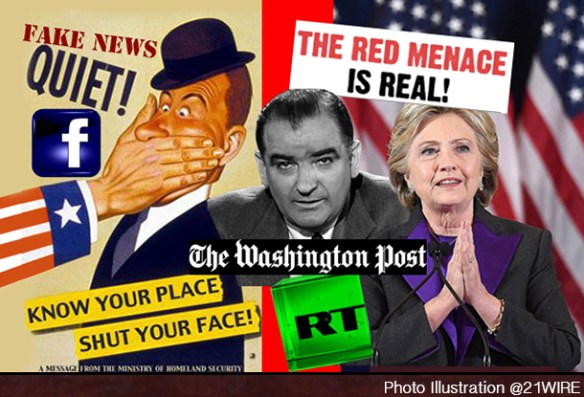
Alex Jones and the Rise of Corporate Censorship

By Brendan O’Neill

Source: Strategic Culture Foundation

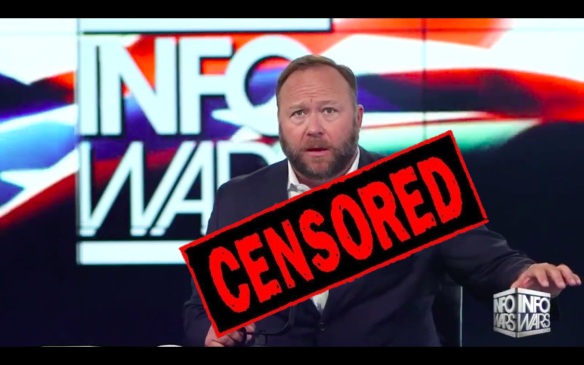
So we’re now trusting the capitalist class, massive, unaccountable corporations, to decide on our behalf what we may listen to and talk about? This is the take-home message, the terrible take-home message, of the expulsion of Alex Jones’ Infowars network from Apple, Facebook and Spotify and of the wild whoops of delight that this summary banning generated among so-called liberals: that people are now okay with allowing global capitalism to govern the public sphere and to decree what is sayable and what is unsayable. Corporate censorship, liberals’ new favourite thing – how bizarre.

We live in strange times. On one hand it is fashionable to hate capitalism these days. No middle-class home is complete without a Naomi Klein tome; making memes of Marx is every twentysomething Corbynistas’ favourite pastime. But on the other hand we seem content to trust Silicon Valley, the new frontier in corporate power, to make moral judgements about what kind of content people should be able to see online. Radicals and liberals declared themselves ‘very glad’ that these business elites enforced censorship against Jones and Infowars. We should be ‘celebrating the move’, said Vox, because ‘it represents a crucial step forward in the fight against fake news’. Liberals for capitalist censorship! The world just got that bit odder, and less free.

Over the past 24 hours, Jones and much of his Infowars channel has been ‘summarily banned’ – in the excitable words of Vox – from Apple, Facebook, Spotify and YouTube. Initially, Facebook and YouTube had taken only selective measures against Jones. In response to a Twitterstorm about his presence on these platforms, they took down some of his videos. But then Apple decided to ban Jones entirely – removing all episodes of his podcast from its platform – and the other online giants followed suit. Or as the thrilled liberal commentary put it: ‘The dominoes started to fall.’ Despite having millions of subscribers, despite there being a public interest in what he has to say, Jones has been cast out of the world of social media, which is essentially the public square of the 21st century, on the basis that what he says is wicked.

This is censorship. There will of course be apologists for the corporate control of speech, on both the left and right, who will say, ‘It’s only censorship when the government does it!’. They are so wrong. When enormous companies that have arguably become the facilitators of public debate expel someone and his ideas because they find them morally repugnant, that is censorship. Powerful people have deprived an individual and his network of a key space in which they might propagate their beliefs. Aka censorship.

It doesn’t matter what you think of Jones. It doesn’t matter if you think he is mad, eccentric, and given to embracing crackpot theories about school shootings being faked. You should still be worried about what has happened to him because it confirms we have moved into a new era of outsourced censorship. It shows that what was once done by the state is now done by corporations. The illiberal, intolerant cleansing from public life of ideas judged to be offensive or dangerous has shifted from being the state’s thing to being the business elite’s thing. Witness how many campaigners for censorship now seek to marshal capitalist power to the end of erasing voices they don’t like – from the Dump Farage campaign that wants corporations to withdraw their advertising from LBC until it dumps Nigel Farage as a presenter to the calling on Silicon Valley to deprive the oxygen of publicity to offensive broadcasters.

In essence, so-called liberals and sections of the political class now want corporations to do their dirty work for them. They want the capitalist elites to do what it has become somewhat unfashionable for the state to do: ban controversial political speech. What an extraordinary folly this is. To empower global capitalism to act as judge, jury and executioner on what may be said on social-media platforms, in the new public square, is to sign the death warrant of freedom of speech. What if these bosses decide next that Marxist speech is unacceptable? Or that Zionist speech is dangerous? In green-lighting the censorship of Jones, we grant corporate suits the moral authority to censor pretty much anything else, too.

People on both the liberal left and the libertarian right argue that what has been done to Jones is acceptable because this is simply a case of businesses deciding freely who they should associate with or provide platforms to. This is disingenuous. This was not a clean, independent business decision – it was a rash act of silencing carried out under pressure from a moralised mob that insisted Jones’ words are too wicked for public life. This isn’t the free market in action – it’s the bending of capitalist power to the end of enforcing moral controls on speech. There is one very interesting thing that will spring from this incident: we will witness the severe limitations of right-wing libertarianism. Libertarians’ obsession with the state, their belief that things are only bad if the state does them, means they are incapable of arguing against capitalist authoritarianism, and in fact even support it on the basis that this is the free market being the free market (even though it isn’t). Libertarianism is devastatingly ill-prepared for the new authoritarianism, for tackling the rise of outsourced censorship and informal intolerance.

For good or ill, the social-media sphere is the new public sphere. The expulsion of people from these platforms is to 2018 what a state ban on the publication or sale of certain books was to 1618. How can we convince the owners of social media to permit the freest speech possible and to trust their users to negotiate the world of ideas for themselves? This is the question we should be asking ourselves, rather than concocting more ways to encourage these corporate overlords to censor and blacklist.

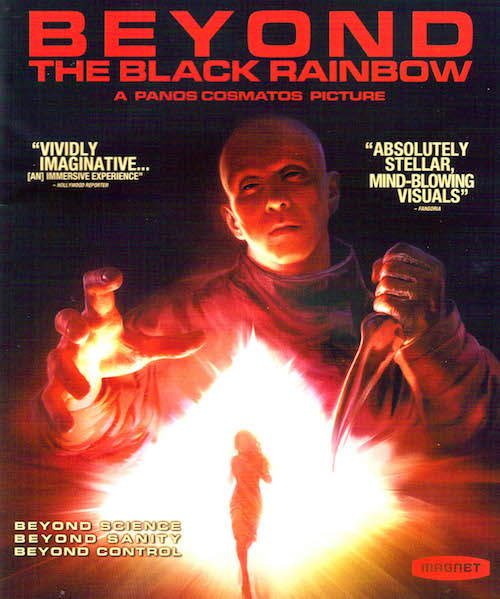
Saturday Matinee: Beyond the Black Rainbow

“Beyond the Black Rainbow” (2010) is a Canadian experimental sci-fi film written and directed by Panos Cosmatos. The Cronenberg-esque plot focuses on Elena, a test subject with ESP abilities, who struggles to escape a New Age lab facility called the Arboria Institute headed by the psychopathic Dr. Nyle. Set in 1983, the film is infused with a retro aesthetic heavily influenced by the director’s childhood experiences and recent tragedies as described in the following passage from Wikipedia about the film’s development:

As a child, Cosmatos frequented a video store named Video Addict. During these trips he would browse the horror film section looking at the boxes although he was not allowed to watch such films. During such times he would instead imagine what the film was. He would later reflect upon this experience when making Black Rainbow where one of his goals was “to create a film that is a sort of imagining of an old film that doesn’t exist.” The year 1983 was chosen for the story as it’s the first year he went to Video Addict. Additionally he thought the idea of setting such a film one year before 1984 was funny. The film’s genesis was an overlap between two projects Cosmatos wanted to do. One of these was a film about a girl trapped in an asylum while the other was an installation promoting a research facility that didn’t exist. Eventually Cosmatos realized that he could use both ideas in the same project.

The presence of his parents haunts “every frame of this film”, said the Rome-born filmmaker. His father was film director George P. Cosmatos (whose credits include Rambo: First Blood Part II and Cobra), deceased in April 2005, and his mother Swedish sculptor Birgitta Ljungberg-Cosmatos, who died in July 1997 after a lengthy battle with cancer. Unable to deal with his mother’s death, Panos “drifted into a slow motion mode of self-destruction and binge drinking”. When elder Cosmatos died, the grief he felt compounded. After that the aspiring writer/director started therapy and decided he wanted to make a film as part of the healing process. Cosmatos felt that his “filmmaking sensibility is a weird hybrid of both of them” – his father’s “popcorn movies” and his mother’s haunting, experimental art.

Beyond the Black Rainbow was financed by DVD residuals from Tombstone (1993), directed by Panos’ father. The film was shot in three weeks using a modified Panavision35 mm camera. This was suggested by cinematographer Norm Li, for he noted that Panos’ references – mostly films from the ’70s and ’80s – “were all grainy, colorful, and full of texture”, and he felt the 35 mm format was “the only way to shoot.”

Borrow and view the film from Hoopla here: https://www.hoopladigital.com/title/11910372

The Utility of the RussiaGate Conspiracy

New McCarthyism allows corporate media to tighten grip, Democrats to ignore their own failings

By Alan MacLeod

Source: FAIR

To the shock of many, Donald Trump won the 2016 presidential elections, becoming the 45th president of the United States. Not least shocked were corporate media, and the political establishment more generally; the Princeton Election Consortium confidently predicted an over 99 percent chance of a Clinton victory, while MSNBC’s Rachel Maddow (10/17/16) said it could be a “Goldwater-style landslide.”

Indeed, Hillary Clinton and her team actively attempted to secure a Trump primary victory, assured that he would be the easiest candidate to beat. The Podesta emails show that her team considered even before the primaries that associating Trump with Vladimir Putin and Russia would be a winning strategy and employed the tactic throughout 2016 and beyond.

With Clinton claiming, “Putin would rather have a puppet as president,” Russia was by far the most discussed topic during the presidential debates (FAIR.org, 10/13/16), easily eclipsing healthcare, terrorism, poverty and inequality. Media seized upon the theme, with Paul Krugman (New York Times, 7/22/16) asserting Trump would be a “Siberian candidate,” while ex-CIA Director Michael Hayden (Washington Post, 5/16/16) claimed Trump would be Russia’s “useful fool.”

The day after the election, Jonathan Allen’s book Shattered detailed, Clinton’s team decided that the proliferation of Russian-sponsored “fake news” online was the primary reason for their loss.

Within weeks, the Washington Post (11/24/16) was publicizing the website PropOrNot.com, which purports to help users differentiate sources as fake or genuine, as an invaluable tool in the battle against fake news (FAIR.org, 12/1/16, 12/8/16). The website soberly informs its readers that you see news sources critiquing the “mainstream media,” the EU, NATO, Obama, Clinton, Angela Merkel or other centrists are a telltale sign of Russian propaganda. It also claims that when news sources argue against foreign intervention and war with Russia, that’s evidence that you are reading Kremlin-penned fake news.

PropOrNot claims it has identified over 200 popular websites that “routinely peddle…Russian propaganda.” Included in the list were Wikileaks, Trump-supporting right-wing websites like InfoWars and the Drudge Report, libertarian outlets like the Ron Paul Institute and Antiwar.com, and award-winning anti-Trump (but also Clinton-critical) left-wing sites like TruthDig and Naked Capitalism. Thus it was uniquely news sources that did not lie in the fairway between Clinton Democrats and moderate Republicans that were tarred as propaganda.

PropOrNot calls for an FBI investigation into the news sources listed. Even its creators see the resemblance to a new McCarthyism, as it appears as a frequently asked question on their website. (They say it is not McCarthyism, because “we are not accusing anyone of lawbreaking, treason, or ‘being a member of the Communist Party.’”) However, this new McCarthyism does not stem from the conservative right like before, but from the establishment center.

That the list is so evidently flawed and its creators refuse to reveal their identities or funding did not stop the issue becoming one of the most discussed in mainstream circles. Media talk of fake news sparked organizations like Google, Facebook, Bing and YouTube to change their algorithms, ostensibly to combat it.

However, one major effect of the change has been to hammer progressive outlets that challenge the status quo. The Intercept reported a 19 percent reduction in Google search traffic, AlterNet 63 percent and Democracy Now! 36 percent. Reddit and Twitter deleted thousands of accounts, while in what came to be called the “AdPocalypse,” YouTube began demonetizing videos from independent creators like Majority Report and the Jimmy Dore Show on controversial political topics like environmental protests, war and mass shootings. (In contrast, corporate outlets like CNN did not have their content on those subjects demonetized.) Journalists that questioned aspects of the Russia narrative, like Glenn Greenwald and Aaron Maté, were accused of being agents of the Kremlin (Shadowproof, 7/9/18).

The effect has been to pull away the financial underpinnings of alternative media that question the corporate state and capitalism in general, and to reassert corporate control over communication, something that had been loosened during the election in particular. It also impels liberal journalists to prove their loyalty by employing sufficiently bellicose and anti-Russian rhetoric, lest they also be tarred as Kremlin agents.

When it was reported in February that 13 Russian trolls had been indicted by a US grand jury for sharing and promoting pro-Trump and anti-Clinton memes on Facebook, the response was a general uproar. Multiple senior political figures declared it an “act of war.” Clinton herself described Russian interference as a “cyber 9/11,” while Thomas Friedman said that it was a “Pearl Harbor–scale event.” Morgan Freeman’s viral video, produced by Rob Reiner’s Committee to Investigate Russia, summed up the outrage:  “We have been attacked,” the actor declared; “We are at war with Russia.” Liberals declared Trump’s refusal to react in a sufficiently aggressive manner further proof he was Putin’s puppet.

The McCarthyist wave swept over other politicians that challenged the liberal center. Green Party presidential candidate Jill Stein refused to endorse the Russia narrative, leading mainstream figures like Rachel Maddow to insinuate she was a Kremlin stooge as well. After news broke that Stein’s connection to Russia was being officially investigated, top Clinton staffer Zac Petkanas announced:

Jill Stein is a Russian agent.

Jill Stein is a Russian agent.

Jill Stein is a Russian agent.

Jill Stein is a Russian agent.

Jill Stein is a Russian agent.

Jill Stein is a Russian agent.

Jill Stein is a Russian agent.

Jill Stein is a Russian agent.

“Commentary” that succinctly summed up the political atmosphere.

In contrast, Bernie Sanders has consistently and explicitly endorsed the RussiaGate theory, claiming it is “clear to everyone (except Donald Trump) that Russia was deeply involved in the 2016 election and intends to be involved in 2018.” Despite his stance, Sanders has also been constantly presented as another Russian agent, with the Washington Post (11/12/17) asking its readers, “When Russia interferes with the 2020 election on behalf of Democratic nominee Bernie Sanders, how will liberals respond?” The message is clear: The progressive wave rising across America is and will be a consequence of Russia, not of the failures of the system, nor of the Democrats.

It is not just politicians who have been smeared as Russian agents, witting or unwitting; virtually every major progressive movement challenging the system is increasingly dismissed in the same way. Multiple media outlets, including CNN (6/29/18), Slate (5/11/18), Vox (4/11/18) and the New York Times (2/16/18), have produced articles linking Black Lives Matter to the Kremlin, insinuating the outrage over racist police brutality is another Russian psyop. Others claimed Russia funded the riots in Ferguson and that Russian trolls promoted the Standing Rock environmental protests.

Meanwhile, Democratic insider Neera Tanden retweeted a description of Chelsea Manning as a “Russian stooge,” writing off her campaign for the Senate as “the Kremlin paying the extreme left to swing elections. Remember that.” Thus corporate media are promoting the idea that any challenge to the establishment is likely a Kremlin-funded astroturf effort.

The tactic has spread to Europe as well. After the poisoning of Russian double agent Sergei Skripal, the UK government immediately blamed Russia and imposed sanctions (without publicly presenting evidence). Jeremy Corbyn, the pacifist, leftist leader of the Labour Party, was uncharacteristically bellicose, asserting, “The Russian authorities must be held to account on the basis of the evidence and our response must be both decisive and proportionate.”

The British press was outraged—at Corbyn’s insufficient jingoism. The Sun‘s front page (3/15/18) attacked him as “Putin’s Puppet,” while the Daily Mail (3/15/18) went with “Corbyn the Kremlin Stooge.” As with Sanders, the fact that Corbyn endorsed the official narrative didn’t keep him from being attacked, showing that the conspiratorial mindset seeing Russia behind everything has little to do with evidence-based reality, and is increasingly a tool to demonize the establishment’s political enemies.

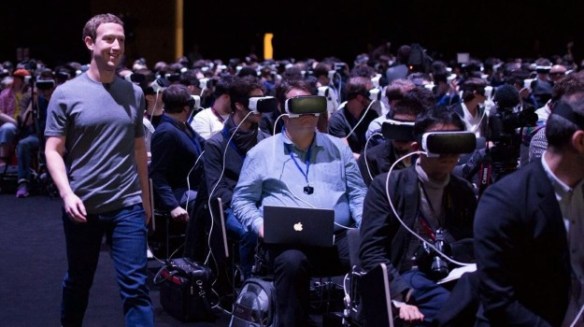
The Atlantic Council published a report claiming Greek political parties Syriza and Golden Dawn were not expressions of popular frustration and disillusionment, but “the Kremlin’s Trojan horses,” undermining democracy in its birthplace. Providing scant evidence, the report went on to link virtually every major European political party challenging the center, from right or left, to Putin. From Britian’s UKIP to Spain’s Podemos to Italy’s Five Star Movement, all are charged with being under one man’s control. It is this council that Facebook announced it was partnering with to help promote “trustworthy” news and weed out “untrustworthy” sources (FAIR.org, 5/21/18), as its CEO Mark Zuckerberg met with representatives from some of the largest corporate outlets, like the New York Times, CNN and News Corp, to help develop a system to control what content we see on the website.

The utility of this wave of suspicion is captured in Freeman’s aforementioned video. After asserting that “for 241 years, our democracy has been a shining example to the world of what we can all aspire to”—a tally that would count nearly a century of chattel slavery and almost another hundred years of de jure racial disenfranchisement—the actor explains that “Putin uses social media to spread propaganda and false information, he convinces people in democratic societies to distrust their media, their political process.”

The obvious implication is that the political process and media ought to be trusted, and would be trusted were it not for Putin’s propaganda. It was not the failures of capitalism and the deep inequalities it created that led to widespread popular resentment and movements on both left and right pressing for radical change across Europe and America, but Vladimir Putin himself. In other words, “America is already great.”

For the Democrats, Russiagate allows them to ignore calls for change and not scrutinize why they lost to the most unpopular presidential candidate in history. Since Russia hacked the election, there is no need for introspection, and certainly no need to accommodate the Sanders wing or to engage with progressive challenges from activists on the left, who are Putin’s puppets anyway. The party can continue on the same course, painting over the deep cracks in American society. Similarly, for centrists in Europe, under threat from both left and right, the Russia narrative allows them to sow distrust among the public for any movement challenging the dominant order.

For the state, Russiagate has encouraged liberals to forego their faculties and develop a state-worshiping, conspiratorial mindset in the face of a common, manufactured enemy. Liberal trust in institutions like the FBI has markedly increased since 2016, while liberals also now espouse a neocon foreign policy in Syria, Ukraine and other regions, with many supporting the vast increases in the US military budget and attacking Trump from the right.

For corporate media, too, the disciplining effect of the Russia narrative is highly useful, allowing them to reassert control over the means of communication under the guise of preventing a Russian “fake news” infiltration. News sources that challenge the establishment are censored, defunded or deranked, as corporate sources stoke mistrust of them. Meanwhile, it allows them to portray themselves as arbiters of truth. This strategy has had some success, with Democrats’ trust in media increasing since the election.

None of this is to say that Russia does not strive to influence other countries’ elections, a tactic that the United States has employed even more frequently (NPR, 12/22/16). Yet the extent to which the story has dominated the US media to the detriment of other issues is a remarkable testament to its utility for those in power.

The Satanic Nature of the Atomic Bombings of Hiroshima and Nagasaki

By Edward Curtain

Source: Dissident Voice

Ahab is forever Ahab, man.  This whole act’s immutably decreed.  ‘Twas rehearsed by thee and me billion years before this ocean rolled.  Fool!  I am the Fates’ lieutenant; I act under orders.

— Herman Melville, Moby Dick

The greatest evil is not now done in those sordid ‘dens of crime’ that Dickens loved to paint…But it is conceived and ordered (moved, seconded, carried, and minuted) in clean, carpeted, warmed, and well-lighted offices, by quiet men with white collars and cut fingernails and smooth-shaven cheeks who do not need to raise their voice.

— C. S. Lewis, author’s preface, 1962, The Screwtape Letters

American history can only accurately be described as the story of demonic possession, however you choose to understand that phrase.  Maybe radical “evil” will suffice.  But right from the start the American colonizers were involved in massive killing because they considered themselves divinely blessed and guided, a chosen people whose mission would come to be called “manifest destiny.”  Nothing stood in the way of this divine calling, which involved the need to enslave and kill millions and millions of innocent people that continues down to today.  “Others” have always been expendable since they have stood in the way of the imperial march ordained by the American god. This includes all the wars waged based on lies and false flag operations. It is not a secret, although most Americans, if they are aware of it, prefer to see it as a series of aberrations carried out by “bad apples.”  Or something from the past.

Our best writers and prophets have told us the truth: Thoreau, Twain, William James, MLK, Fr. Daniel Berrigan, et al.: we are a nation of killers of the innocent.  We are conscienceless.  We are brutal.  We are in the grip of evil forces.

The English writer D. H. Lawrence said it perfectly in 1923, “The American soul is hard, isolate, stoic and a killer.  It has never yet melted.”  It still hasn’t.

This August 6, 1945 file photo shows the destruction from the explosion of an atomic bomb in Hiroshima Japan AP-Photo-File

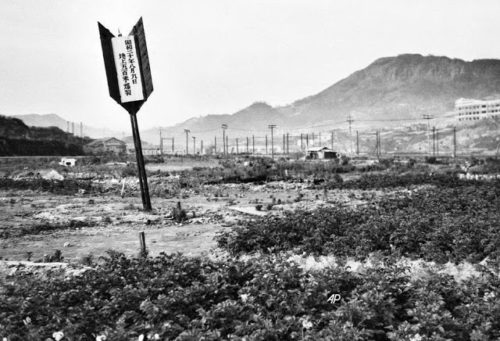
August 10, 1945: Arrow marks the spot where the atomic bomb hit in Nagasaki. Photo by AP

When on August 6 and 9, 1945 the United States killed 200-300 thousand innocent Japanese civilians with atomic bombs in Hiroshima and Nagasaki, they did so intentionally.  It was an act of sinister state terrorism, unprecedented by the nature of the weapons but not by the slaughter. The American terror bombings of Japanese cities that preceded the atomic bombings of Hiroshima and Nagasaki – led by the infamous Major General Curtis LeMay – were also intentionally aimed at Japanese civilians and killed hundreds of thousands of them.

Is there an American artist’s painting of Tokyo destroyed by the firebombing to go next to Picasso’s Guernica, where estimates of the dead range between 800 and 1,600?  In Tokyo alone more than 100,000 Japanese civilians were burnt to death by cluster bombs of napalm.  All this killing was intentional. I repeat: Intentional.  Is that not radical evil?  Demonic?  Only five Japanese cities were spared such bombing.

The atomic bombings were an intentional holocaust, not to end the war, as the historical record amply demonstrates, but to send a message to the Soviet Union that we could do to them what we did to the residents of Japan.  President Truman made certain that the Japanese willingness to surrender in May 1945 was made unacceptable because he and his Secretary-of-State James Byrnes  wanted to use the atomic bombs – “as quickly as possible to ‘show results’” in Byrnes’ words – to send a message to the Soviet Union.  So “the Good War” was ended in the Pacific with the “good guys” killing hundreds of thousands Japanese civilians to make a point to the “bad guys,” who have been demonized ever since.  Russia phobia is nothing new.

Satan always wears the other’s face.

Many Baby Boomers like to say they grew up with the bomb.  They are lucky. They grew up.  They got to be scared.  They got to hide under their desks and wax nostalgic about it.  Do you remember dog tags?  Those 1950s and 1960s?  The scary movies?

The children of Hiroshima and Nagasaki who died under our bombs on August 6 and 9, 1945 didn’t get to grow up.  They couldn’t hide.  They just went under. To be accurate: we put them under. Or they were left to smolder for decades in pain and then die.  But that it was necessary to save American lives is the lie. It’s always about American lives, as if the owners of the country actually cared about them.  But to tender hearts and innocent minds, it’s a magic incantation.  Poor us!

Fat Man, Little Boy – how the words echo down the years to the now fat Americans who grew up in the 1950s and who think like little boys and girls about their country’s demonic nature.  Innocence – it is wonderful!  We are different now. “We are great because we are good,” that’s what Hillary Clinton told us.  The Libyans can attest to that.  We are exceptional, special.  The next election will prove we can defeat Mr. Pumpkin Head and restore America to its “core values.”

Perhaps you think I am cynical.  But understanding true evil is not child’s play.  It seems beyond the grasp of most Americans who need their illusions.  Evil is real.  There is simply no way to understand the savage nature of American history without seeing its demonic nature.  How else can we redeem ourselves at this late date, possessed as we are by delusions of our own God-blessed goodness?

But average Americans play at innocence.  They excite themselves at the thought that with the next election the nation will be “restored” to the right course.  Of course, there never was a right course, unless might makes right, which has always been the way of America’s rulers.  Today Trump is viewed by so many as an aberration.  He is far from it.  He’s straight out of a Twain short story.  He’s Vaudeville. He’s Melville’s confidence man.  He’s us. Did it ever occur to those who are fixated on him that if those who own and run the country wanted him gone, he’d be gone in an instant?  He can tweet and tweet idiotically, endlessly send out messages that he will contradict the next day, but as long as he protects the super-rich, accepts Israel’s control of him, and allows the CIA-military-industrial complex to do its world-wide killing and looting of the treasury, he will be allowed to entertain and excite the public – to get them worked up in a lather in pseudo-debates.  And to make this more entertaining, he will be opposed by the “sane” Democratic opposition, whose intentions are as benign as an assassin’s smile.

Look back as far as you can to past U.S. presidents, the figureheads who “act under orders” (whose orders?), as did Ahab in his lust to kill the “evil” great white whale, and what do you see?  You see servile killers in the grip of a sinister power.  You see hyenas with polished faces. You see pasteboard masks.  On the one occasion when one of these presidents dared to follow his conscience and rejected the devil’s pact that is the presidency’s killer-in-chief role, he – JFK – had his brains blown out in public view.  An evil empire thrives on shedding blood, and it enforces its will through demonic messages.  Resist and there will be blood on the streets, blood on the tracks, blood in your face.

Despite this, President Kennedy’s witness, his turn from cold warrior to an apostle of peace, remains to inspire a ray of hope in these dark days. As recounted by James Douglass in his masterful JFK and the Unspeakable, Kennedy agreed to a meeting in May 1962 with a group of Quakers who had been demonstrating outside the While House for total disarmament.  They urged him to move in that direction.  Kennedy was sympathetic to their position.  He said he wished it were easy to do so from the top down, but that he was being pressured by the Pentagon and others to never do that, although he had given a speech urging “a peace race” together with the Soviet Union. He told the Quakers it would have to come from below.  According to the Quakers, JFK listened intently to their points, and before they left said with a smile, “You believe in redemption, don’t you?”  Soon Kennedy was shaken to his core by the Cuban missile crisis when the world teetered on the brink of extinction and his insane military and “intelligence” advisers urged him to wage a nuclear war.  Not long after, he took a sharp top-down turn toward peace despite their fierce opposition, a turn so dramatic over the next year that it led to his martyrdom.  And he knew it would.  He knew it would.

So hope is not all lost.  There are great souls like JFK to inspire us. Their examples flash here and there. But to even begin to hope to change the future, a confrontation with our demonic past (and present) is first necessary, a descent into the dark truth that is terrifying in its implications.  False innocence must be abandoned.  Carl Jung, in “On the Psychology of the Unconscious,” addressed this with the words:

It is a frightening thought that man also has a shadow side to him, consisting not just of little weaknesses – and foibles, but of a positively demonic dynamism. The individual seldom knows anything of this; to him, as an individual, it is incredible that he should ever in any circumstances go beyond himself. But let these harmless creatures form a mass, and there emerges a raging monster; and each individual is only one tiny cell in the monster’s body, so that for better or worse he must accompany it on its bloody rampages and even assist it to the utmost. Having a dark suspicion of these grim possibilities, man turns a blind eye to the shadow-side of human nature. Blindly he strives against the salutary dogma of original sin, which is yet so prodigiously true. Yes, he even hesitates to admit the conflict of which he is so painfully aware.

How can one describe men who would intentionally slaughter so many innocent people?  American history is rife with such examples up to the present day.  Iraq, Afghanistan, Libya, Syria, etc. – the list is very long.  Savage wars carried out by men and women who own and run the country, and who try to buy the souls of regular people to join them in their pact with the devil, to acquiesce to their ongoing wicked deeds.  Such monstrous evil was never more evident than on August 6 and 9, 1945.

Unless we enter into deep contemplation of the evil that was released into the world with those bombings of Hiroshima and Nagasaki, we are lost in a living hell without escape.  And we will pay.  Nemesis always demands retribution.  We have gradually been accepting rule by those for whom the killing of innocents is child’s play, and we have been masquerading as innocent and good children for whom the truth is too much to bear.  “Indeed, the safest road to Hell is the gradual one,” Screwtape the devil tells his nephew, Wormwood, a devil in training, “the gentle slope, soft underfoot, without sudden turnings, without milestones, without signposts.”  That’s the road we’ve been traveling.

The projection of evil onto others works only so long.  We must reclaim our shadows and withdraw our projections.  Only the fate of the world depends on it.


Related Article:

Barbarians at the Helm (Cindy Sheehan’s Speech in Hiroshima August 6th 2018)

In A Corporatist System Of Government, Corporate Censorship Is State Censorship

By Caitlin Johnstone

Source: CaitlinJohnstone.com

Last year, representatives of Facebook, Twitter, and Google were instructed on the US Senate floor that it is their responsibility to “quell information rebellions” and adopt a “mission statement” expressing their commitment to “prevent the fomenting of discord.”

“Civil wars don’t start with gunshots, they start with words,” the representatives were told. “America’s war with itself has already begun. We all must act now on the social media battlefield to quell information rebellions that can quickly lead to violent confrontations and easily transform us into the Divided States of America.”

Yes, this really happened.

Today [8/7] Twitter has silenced three important anti-war voices on its platform: it has suspended Daniel McAdams, the executive director of the Ron Paul Institute, suspended Scott Horton of the Scott Horton Show, and completely removed the account of prominent Antiwar.com writer Peter Van Buren.

I’m about to talk about the censorship of Alex Jones and Infowars now, so let me get the “blah blah I don’t like Alex Jones” thing out of the way so that my social media notifications aren’t inundated with people saying “Caitlin didn’t say the ‘blah blah I don’t like Alex Jones’ thing!” I shouldn’t have to, because this isn’t actually about Alex Jones, but here it is:

I don’t like Alex Jones. He’s made millions saying the things disgruntled right-wingers want to hear instead of telling the truth; he throws in disinfo with his info, which is the same as lying all the time. He’s made countless false predictions and his sudden sycophantic support for a US president has helped lull the populist right into complacency when they should be holding Trump to his non-interventionist campaign pledges, making him even more worthless than he was prior to 2016.

But this isn’t about defending Alex Jones. He just happens to be the thinnest edge of the wedge.

As of this writing, Infowars has been censored from Facebook, Youtube (which is part of Google), Apple, Spotify, and now even Pinterest, all within hours of each other. This happens to have occurred at the same time Infowars was circulating a petition with tens of thousands of signatures calling on President Trump to pardon WikiLeaks editor-in-chief Julian Assange, who poses a much greater threat to establishment narratives than Alex Jones ever has. Assange’s mother also reports that this mass removal of Infowars’ audience occurred less than 48 hours after she was approached to do an interview by an Infowars producer.

In a corporatist system of government, wherein there is no meaningful separation between corporate power and state power, corporate censorship is state censorship. Because legalized bribery in the form of corporate lobbying and campaign donations has given wealthy Americans the ability to control the US government’s policy and behavior while ordinary Americans have no effective influence whatsoever, the US unquestionably has a corporatist system of government. Large, influential corporations are inseparable from the state, so their use of censorship is inseparable from state censorship.

This is especially true of the vast megacorporations of Silicon Valley, whose extensive ties to US intelligence agencies are well-documented. Once you’re assisting with the construction of the US military’s drone program, receiving grants from the CIA and NSA for mass surveillance, or having your site’s content regulated by NATO’s propaganda arm, you don’t get to pretend you’re a private, independent corporation that is separate from government power. It is possible in the current system to have a normal business worth a few million dollars, but if you want to get to billions of dollars in wealth control in a system where money translates directly to political power, you need to work with existing power structures like the CIA and the Pentagon, or else they’ll work with your competitors instead of you.

And yet every time I point to the dangers of a few Silicon Valley plutocrats controlling all new media political discourse with an iron fist, Democratic Party loyalists all turn into a bunch of hardline free market Ayn Rands. “It’s not censorship!” they exclaim. “It’s a private company and can do whatever it wants with its property!”

They do this because they know their mainstream, plutocrat-friendly “centrist” views will never be censored. Everyone else is on the chopping block, however. Leftist sites have already had their views slashed by a manipulation of Google’s algorithms, and it won’t be long before movements like BDS and Antifa and skeptics of the establishment Syria and Russia narratives can be made to face mass de-platforming on the same exact pretext as Infowars.

This is a setup. Hit the soft target so your oligarch-friendly censorship doesn’t look like what it is, then once you’ve manufactured consent, go on to shut down the rest of dissenting media bit by bit.

Don’t believe that’s the plan? Let’s ask sitting US Senator Chris Murphy:

“Infowars is the tip of a giant iceberg of hate and lies that uses sites like Facebook and YouTube to tear our nation apart,” Murphy tweeted in response to the news. “These companies must do more than take down one website. The survival of our democracy depends on it.”

That sure sounds an awful lot like the warnings issued to the Silicon Valley representatives on the Senate floor at the beginning of this article, no? This is headed somewhere dark.

We’re going to have to find a way to keep the oligarchs from having their cake and eating it too. Either (A) corporations are indeed private organizations separate from the government, in which case the people need to get money out of politics and government agencies out of Silicon Valley so they can start acting like it, and insist that their owners can’t be dragged out on to the Senate floor and instructed on what they can and can’t do with their business, or (B) these new media platforms get treated like the government agencies they function as, and the people get all the First Amendment protection that comes with it. Right now the social engineers are double-dipping in a way that will eventually give the alliance of corporate plutocrats and secretive government agencies the ability to fully control the public’s access to ideas and information.

If they accomplish that, it’s game over for humanity. Any hope of the public empowering itself over the will of a few sociopathic, ecocidal, omnicidal oligarchs will have been successfully quashed. We are playing for all the chips right now. We have to fight this. We have no choice.

Building a Cooperative Economy

By Oliver Sylvester-Bradley

Source: Resilience

In permaculture terms the economy sometimes feels like a segregated monoculture planted with terminator seeds, sprayed with patented pesticides on venture capital backed farms designed to maximise profits in an unsustainable market place full of thieves and cheats. No wonder people prefer to potter in their gardens and allotments – and try to forget the craziness of corporate capitalism!

But no matter how much we try to ignore the corporate machine it ploughs on regardless and at various points in all of our lives we are forced to interact with the unsustainable, greed-based economy whether we like it or not. We all need to travel, buy energy, we like presents and holidays and now we are buying more and more of these goods and services online, from people we do not know.

As local banks close in favour of apps, local taxis are driven out by Uber and the likes of Airbnb and other holiday and comparison websites offer us ‘guaranteed savings’ – the brave new world of digital platforms is being thrust upon us, whether we like it or not.

The dominant form of business in our economy has not changed, but the method of delivery has. Platform businesses which reach further and wider than conventional ‘bricks and mortar’ businesses, that are able to ‘scale up’ and attract customers in their millions are forcing out the smaller players, just like supermarkets killed the traditional garden market. Except these “platform monopolies” are taking things to a new level – often unbeknown to us they’re gathering our data and using sophisticated algorithms to work out how to sell us more things, that quite often we don’t need or want. They’re aggregating data and dissintermediating in ways that we never knew were possible. Uber is valued at over 60 billion dollars but does not own a single taxi…

From monoculture to platform co-ops

To someone practicing permaculture, there is something almost offensive about vast fields where businesses cultivate the same single crop and, in a similar way, the exponents of ‘peer to peer’ and ‘open source’ technologies get equally offended by monolithic platforms that dominate the digital landscape.

Peer to peer, (where individuals share content with other people, rather than relying on centralised servers) and open source software (which is free to use and adapt, without requiring a licence fee) are like the digital community’s own versions of permaculture. They provide a pathway to greater independence, autonomy, diversity and resilience than is offered by the dominant system.

David Holmgreen’s ideas about creating small scale, copyable, adaptable solutions which have the power to change the world by creating decentralised, diverse, and more resilient systems have huge parallels with open source, collaborative software projects, which are developing as a response to the monolithic, proprietary and profit driven enclosures that dominate today’s Internet.

The end goal of this work is to create ‘platform cooperatives’, as alternatives to the venture capital backed platforms. Platform cooperatives that are member owned and democratically controlled – allowing everyone that is affected by the business, be they customers, suppliers, workers or investors, a say in how the business is run and managed. Co-ops are an inherently different form of organisation than Limited or Public companies, which place community before profit, hence have entirely different principles than their corporate rivals. For this reason they are more resilient in downturns, more responsible to their communities and environments and more effective at delivering real (not just financial) value to everyone they interact with.

Platform co-ops provide a template for a new kind of economy built on trust, mutual aid and respect for nature and community. By placing ownership firmly in the hands of the people and applying democratic forms of governance they offer a legitimate alternative to the defacto form of business. There are several platform co-ops that already provide comparable, and often better services than their corporate rivals and with more support others will continue to develop.

On 26 and 27 July the OPEN 2018 conference at Conway Hall in London will showcase platform co-ops such as The Open Food Network – which is linking up local food producers and consumers through Europe, Resonate – the music streaming co-op, and SMart from Belgium which provides support for a network of thousands of freelancers throughout Europe. The beginnings of a viable, self-supporting and sustainable economy are stating to emerge and OPEN 2018, along with similar events in the US and across Europe, is bringing together the people with the ideas, the tech developers and the legal experts to help catalyse the transition.

Shared values and the network effect

There are so many similarities between permaculture’s philosophy and principles and the works of other progressive groups that hope to encourage a more sustainable, more resilient and equitable future. From Occupy to Open source, Permaculture to Peer to Peer and Collaborative Technology to the Commons Transition groups there are clearly overlapping values.

David Bollier, writing on the Peer to Peer Foundation blog has suggested that “…permaculturists and commoners need to connect more and learn from each other…” and the idea that these communities are ultimately working towards the same objective seems especially important to recognise if we are to accelerate the development of a more sustainable world.

There is already an evolving “shared narrative” between these various, disparate initiatives, but it is often sidelined by our self-selecting filters which lead us back into the communities we know and trust. Collaboration and cooperation can be hard work and as groups get bigger they can become harder still but that’s no reason not to try. The fact that Wikipedia provides a better encyclopaedia for free in more languages than Britannica ever managed proves that online, open source collaboration can deliver greater value than proprietary, closed source systems.

The true value of a collaborative, open networks only really manifests when its members communicate, and work together, through connected systems. Sharing ideas, discussing problems and addressing challenges in larger networks creates positive feedback loops via the network effect – a term which describes how the value of something increases in proportion to the number of people using it (like a phone, or social media network) – something all the various ethical and progressive networks could benefit from enormously.

Parallels between collaborative, open source software development and permaculture principles:

1. Observe and interact

Progressive software projects often utilise ‘user focused’ design strategies to ensure they meet people’s needs. Taking time to understand how users interact with software systems via user experience testing groups and an ongoing, iterative design processes are recognised to deliver higher quality solutions which suit specific user needs.

2. Catch and store energy

Peer to peer networks don’t rely on centralised servers but instead make use of the latent capacity of other user’s machines. Imagine how much more efficient it would be than deploying huge server farms if our computers were not shut off at night, or left idle, when they could be providing valuable processing power for others. The Holochain project aims to make it simple and secure for anyone to join a truly peer to peer network and to share files and processing power in this way – and to even earn credits for hosting other people’s files and applications.

3. Obtain a yield

The Peer Production License provides a means by which open source developers can make the code they develop available for free and still benefit from it’s use. Sites like the Internet of Ownership, which contains a directory of cooperative platforms use the PPL to “permit reuse exclusively for non-commercial and worker-owned enterprises” thereby helping to grow the commons. The ultimate goal of the PPL is to enable mechanisms so commoners can support themselves and ensure their own social reproduction without resorting to capitalism.

4. Apply self-regulation and accept feedback

This principle is particularly integral to open source development since the concepts of ‘user focussed’ and ‘agile development’, ‘branching’ and ‘forking’ are all designed to ensure that software projects are self-regulating by listening to the users needs, driven by user feedback and that they are able to be adapted to changing needs.

5. Use and value renewable resources and services

Open source technology is inherently more renewable in the way it enables the reuse and repackaging of code for new purposes. Ethically minded hosts and developers such as Green Net power their servers with renewable energy.

6. Produce no waste

As above, open source code is often re-used and repurposed but progressive developers still have a lot to gain from better collaboration. There are often multiple teams working on identical problems and ideas and whilst this has benefits in terms of developing strength and resilience through diversity it also leads to waste, mainly in terms of time. At least the waste ‘product’ of web development is only digital and so old technology and code doesn’t littler the streets or pollute the environment as much as physical products can, especially if archives are stored on renewably powered servers.

7. Design from patterns to details

Genuine online collaboration has been slow to evolve, with the best examples being Linux (the open source operating system), Firefox, the open source web browser and Wikipedia, the open source encyclopaedia. It is only recently, with the rise of monolithic capitalist gardens such as Google and Facebook and Amazon that the hive mind of the internet is recognising the need to step back and redesign its systems according to new patterns. The push for “Net neutrality” and Tim Berners-Lee’s Solid project are examples of this in action as is the Holo project, a very exciting and truly peer to peer “community of passionate humans building a distributed cloud, owned and run by users like you and me.”

8. Integrate rather than segregate

The move from centralised to decentralised, to distributed and federated technology is a a key element of open source and collaborative technology design. The entire Peer to Peer philosophy is based on the recognition that the connections and relationships between nodes (people or computers) in a network is what gives it strength and value. Collaborative technologists still have a lot to gain from developing deeper and wider integrations, like we see in nature, and which permaculturists know so well.

9. Use small and slow solutions

Designing a computer system to be slow is not something you will normally (ever?) hear a programmer talk about but they often talk about small, in many guises. Small packages (of code), small apps, “minified” (meaning compressed) code and even small computers, like the Raspberry Pi are key features of collaborative technology which all aim for increased efficiency.

10. Use and value diversity

Diversity is intrinsic to open source and collaborative technology. The plurality and adaptability of open source solutions ensures a highly diverse ecosystem. Users are free to adapt open source code to their needs and the open nature of most open source projects values contributions from anyone, irrespective of race, gender, age or any other factor. It is true that the majority of contributors to open source projects are normally young, white and male but the reasons for that seem more to do with societal inequalities and stereotypes rather than any specific prejudices or practices.

11. Use edges and value the marginal

The explanation of this principle places most value on “the interface between things…” and this is a central component of web design. Web services have now realised the necessity of providing intuitive user interfaces, to allow users to navigate complex data and to investigate deeper informational relationships but, more interestingly the latest developments in linked open data enable users to interface with more specific, more granular and more timely data to provide increase value. The Internet Of Things will facilitate a massive increase in the number and type of products which can interact over the internet. Whilst it is not the norm, drawing diverse information from the edges and valuing the marginal is something the open internet can really facilitate.

12. Creatively use and response to change

Most open source, collaborative projects use some kind of agile development, which advocates adaptive planning, evolutionary development, early delivery, and continuous improvement, and encourages rapid and flexible response to change. Permaculture and open source see eye to eye on this principle which bodes very well for a growing, symbiotic relationship in our rapidly evolving world.

The Bizarre Facebook Path to Corporate Fascism

By Glen Ford

Source: Black Agenda Report

“The Facebook intervention is a qualitative escalation of the McCarthyite offensive.”

Facebook has assumed additional political police powers, disrupting a planned counter-demonstration against white supremacists, set for August 12th in Washington, on the grounds that it was initiated and inspired by “Russians” as part of a Kremlin campaign to “sow dissention” in the U.S. The Facebook intervention is a qualitative escalation of the McCarthyite offensive launched by the Democrat Party and elements of the national security state, and backed by most of the corporate media, initially to blame Hillary Clinton’s 2016 defeat on “collusion” between Wikileaks, “the Russians” and the Trump campaign to steal and publicize embarrassing Clinton campaign emails.

After failing to produce one shred of hard evidence to support their conspiracy theory, the anti-Russia hysteria mongers switched gears, focusing on the alleged purchase of about $100,000 in Facebook ads by the Internet Research Agency (IRA), a St. Petersburg-based Russian company, over a multi-year period. The problem was, most of the ads had no direct connection to the presidential contest, or were posted after the election was over, and many had no political content, at all. The messages were all over the place, politically, with the alleged Russian operatives posing as Christian activists, pro- and anti-immigration activists, and supporters of the Black Lives Matter Movement. Special prosecutor Robert Mueller was forced to flip the script, indicting 13 Russians for promoting general “discord” and undermining “public confidence in democracy” in the United States – thus creating a political crime that has not previously been codified in the United States.

In doubling down on an unraveling conspiracy tale, the Mueller probe empowered itself to tar and feather all controversial speech that can be associated with utterances by “Russians,” even if the alleged “Russians” are, in fact, mimicking the normal speech of left- or right-wing Americans — a descent, not into Orwell’s world, but that of Kafka (Beyond the Law) and Heller (Catch-22).

Facebook this week announced that it had taken down 32 pages and accounts that had engaged in “coordinated and inauthentic behavior” in promoting the August 12 counter-demonstration against the same white supremacists that staged the fatal “Unite the Right” demonstrations in Charlottesville, Virginia, a year ago. Hundreds of anti-racists had indicated their intention to rally against “Unite the Right 2.0” under the banner of Shut It Down DC, which includes D.C. Antifascist Collective, Black Lives Matter D.C., Hoods4Justice, Resist This, and other local groups.

Facebook did not contend that these anti-racists’ behavior was “inauthentic,” but that the first ad for the event was purchased by a group calling itself “Resisters” that Facebook believes were behaving much like the Internet Research Agency. “At this point in our investigation, we do not have enough technical evidence to state definitively who is behind it,” said Nathaniel Gleicher, Facebook’s head of cybersecurity policy . “But we can say that these accounts engaged in some similar activity and have connected with known I.R.A accounts.”

Chelsea Manning, whose prison sentence for sending secret documents to Wikileaks was commuted by President Obama, said the counter-protest was “organic and authentic”and that activists had begun organizing several months ago. “Folks from D.C. and Charlottesville have been talking about this since at least February,” Manning told The New York Times.

“This was a legitimate Facebook event that was being organized by Washington, D.C. locals,” says Dylan Petrohilos, of Resist This. Petrohilos was one of the defendants in the Trump inauguration “riot” prosecutions. He protested Facebook’s disruption of legitimate free speech and assembly. “DC organizers had controlled the messaging on the no UTR fb page and now FB made it harder for grassroots people to organize,” he tweeted. The organizers insist the August 12 counter-demonstration — “No Unite the Right 2 – DC” — is still a go, as is the white supremacist rally.

Whoever was first to buy a Facebook ad — the suspected Russian “Resisters,” or Workers Against Racism, who told the Daily Beast they decided to host their own anti-“Unite the Right 2.0” event because they thought “Resisters” was an “inexperienced liberal organizer” – there was no doubt whatsoever that the white supremacists would be confronted by much larger numbers of counter-demonstrators, in Washington. Nobody in Russia needed to tell U.S. anti-racists to shut the white supremacists down, or vice versa. The Russians didn’t invent American white supremacy, or the native opposition to it. Even if Mueller, Facebook, the Democratic Party and the howling corporate media mob are to be believed, the “Russians” are simply mimicking U.S. political rhetoric and sloganeeriing – and weakly, at that. The Workers Against Racism thought the “Resisters” weren’t worth partnering with, but that the racist rally must be countered. The Shut It Down DC coalition didn’t need the “Resisters” to crystallize their thinking on white supremacism.

The Democratic Party and corporate media, speaking for most of the U.S. ruling class — and actually bullying one of its top oligarchs, Mark Zuckerberg — is on its own bizarre and twisted road to fascism. (Donald Trump’s proto-fascism is the old fashioned, all-American type that the white supremacists want to celebrate on August 12.) With former FBI Director Robert Mueller at the head of the pack, they have created a pseudo legal doctrine whereby “Russians” (or U.S. spooks pretending to be Russians) can be indicted for launching a #MeToo campaign of mimicry, echoing the rhetoric and memes indigenous to U.S. political struggles, while the genuine, “authentic” American political voices — the people who are being mimicked — are labeled co-conspirators in a foreign-based “plot,” and their rights to speech and assembly are trashed.

That’s truly crazy, but devilishly clever, too. If “Russian” mimics (or cloaked spooks) can reproduce the vocabulary and political program of U.S. dissent, then all of us actual U.S. lefties can be dismissed as “dupes of the Russians” or “co-conspirators” in the speech crimes of our mimics — for sounding like ourselves.


BAR executive editor Glen Ford can be contacted at Glen.Ford@BlackAgendaReport.com.