Lessons from George Orwell’s ‘1984’

1984

By Ethan Indigo Smith

Source: Waking Times

“Political language is designed to make lies sound truthful and murder respectable, and to give an appearance of solidity to pure wind.” — George Orwell

Some fictional literature is so profound as to be relevant for decades. George Orwell’s timeless 1984 is one such literary work. One of the most influential books of our time, its message resonates today as much as it did when it was first published over 65 years ago — as shown by its recent surge to the #1 spot on Amazon’s bestseller list.

So what can 1984 teach us about the modern day?

At its core, 1984 is a post-WWII interpretation of the relationship between individuals and institutions. It changed the course of social history by spawning new language relating to the structure and mechanisms of our society, expanding the scope of human language and thought, and therefore, humanity’s understanding of itself. And that legacy seems perfectly fitting, for in the story of 1984, the world is controlled by so many restrictions that even the expressiveness of the official language, “Newspeak”, is deliberately narrowed by the ruling institutions in a way that limits the ability of individuals to express “thoughtcrime” — that which is deemed illegal by the “Inner Party”, the State.

As a work of fiction, 1984 provides a stark view of a burgeoning culture of totalitarianism. As a work of symbolism, however, it stands as a reflection of modern fact in The U.S.A. and the world today. Within its narrative, the five freedoms of the First Amendment of the United States Constitution were infringed and removed; in particular, the freedom of speech was so restricted that there was only one source of news operated by the official governing body and an entire branch of government was dedicated to steadily eliminating language deemed detrimental to the State.

Orwell created new phrases like “Newspeak” (the official, limited language) and its antonym “Oldspeak”, “Goodthink” (thoughts that are approved by the Party) and its antonym “Crimethink”, and “Doublethink” (the normalized act of simultaneously accepting two contradictory beliefs). The new language allowed his narrative to portray and expose age-old structures of thought and language manipulation – structures that have exponentially escalated in the modern day.

In 1984 all opposition is controlled and absorbed into the background. ‘Big Brother’ is the human image that represents The Inner Party (and the Party line) via the Telescreen providing an ‘official’ narrative while appropriating and misrepresenting the notion of brotherhood and unity into a ‘brand name’ — one that actually instills a psychology of collectivism, not brotherhood, just as the controllers in our own world instill nationalism and war-mindedness in the name of “freedom” and “liberty”. Indeed, the Telescreen is the primary means through which norms were forced on the society and false imagery and narratives embedded in its collective consciousness. Totally transfixed on the Party line, as told by the Telescreen, the fictional society of 1984 has lost the ability to think such that it will believe two plus two is five, as the saying goes, as long as it is presented as such on the Telescreen. They have been captive to this set up their entire lives, and, with language and thought restricted and outlawed, they are blind to their own captivity, unable to discern for themselves. Thus, lies are made to be “truths” using logic so distorted that it not only convinces the masses that two plus two equal five, but that war is peace, freedom is slavery, and ignorance is strength.

In reality, individual ignorance is strength to institutions. Such distortions of language and thought (and, incidentally, history) are the perfect means by which to disempower and co-opt an entire society — means that are not limited to the works of fiction. Orwell knew that ideas do not exist separately from language. Language, in both spoken and written forms, is essential to our ability to form and communicate thoughts and ideas. That is why today the United States government, the shadow powerbrokers that control it, and the mainstream media that support it (the entirety of which is owned by only 6 corporations) continue their war on “fake news” — i.e. ideas that are skeptical of government pronouncements, and information that proves them to be false — taking aim not just at independent journalism but independent thought itself. While government surveillance of its own people continues to increase, government secrecy is at an all-time high, the sharing of ideas that challenge the status quo is becoming more heavily censored, releasing information on institutional and State activity is now punishable by law, and whistleblowers from inside the State are systematically destroyed. If that wasn’t Orwellian enough, Donald Trump’s advisors have begun coining phrases like “alternative facts”, and we have even seen the creation of an Orwellian “Ministry of Truth”, an “international fact-checking network” charged with deciding what is “truth” and what is “fake news”.

If the events of 1984 continue to hold true, and the ruling Party of today gets its way, words and ideas will soon become not only censored, but illegal and eliminated altogether, controlled by increasingly totalitarian governments steering our society down a dystopian path of censorship, blind belief, and misinformation — all in the name of the State. However, as our minds are freed, one at a time, we are ultimately finding that our society is heavily embedded with such norms and structures that perpetuate false imagery, preserving the status quo of the State from the ‘threat’ of individual thinking — hence the modern war on “fake news”. We are beginning, as a society, to question such falsehood, and exercise our inherent freedom to expose it.

“Freedom is the freedom to say that two plus two make four. If that is granted, all else follows”. ~ George Orwell

The Last Man in Europe

The original working title to 1984 was ‘The Last Man in Europe.’ This descriptive and evocative title idea provides a clear glimpse into George Orwell’s intent, and encapsulates a main point of 1984, a title perhaps too revealing to be anything but a working title. Certainly, that is the way many of us feel when we first become aware of lies and partial-truths that are presented as reality by those in control of our society today, and accepted in totality by seemingly everyone else – it is as if we are the last lone person. Indeed, the road of the freethinker can be a lonely one, and the story’s protagonist, patriot Winston Smith, is made to believe he is the last person who questions, who looks, listens and speaks.

In a totalitarian society — be it Orwell’s fictional world or the increasingly authoritarian political regimes of today — the official narratives portrayed by the “official” media portray that a society is in consensus with the State, and that those engaged in Thoughtcrime (whether or not it is legally a crime) are isolated social outcasts and lunatics, and demeaned as “rebels” and “conspiracy theorists” (despite the existence of actual conspiracy, against which the truly conscious mind must inevitably rebel.) Yet in reality, Crimethink is what differentiates we freethinkers from those who are lost in the spell of societal illusion and, therefore, pose a threat to the status quo of the State. But this is part of the trap of Goodthink — it creates the illusion of consensus, and therefore, engenders isolation in those who do not concede.

As a master of his craft, nothing Orwell wrote was off the cuff. Now it is not overtly spoken in the book, but there are four types of people in the fictional realm of 1984. There are three described classes and a suggested fourth, only later is it implied that the Brotherhood, anti-establishment rebels — has been eliminated from the narrative jut as those in power sought to eliminate them from the society.

The Secret to 1984 is ‘4’

1984 is in part an expose on the four basic types of people in a society, the four types of institutions and the four types of institutional lies that enable them.

Characterized by how they respond to information, modern societies are made up of four archetypes of people — idiots, zealots, elitists and patriots. Idiots refuse information, zealots blindly refute information, elitists misuse information, and patriots seek and distribute information. Despite dramatic alterations in the world’s geopolitical landscape, and some fluctuation of individuals from one group/role to another over time, the dynamic between these groups has historically remained the same, and are inevitably intertwined: Idiots avoid all new pertinent information in order to maintain their perspective, never questioning the status quo. Zealots ask certain questions of certain information, ignoring unaligned information in order to maintain their perspective, supporting the status quo at all costs. Elitists question information in order to manipulate and reap gains off those who don’t know, benefiting from the status quo. Patriots question information to educate themselves and share it with others, in order that we might enhance our lives and progress beyond the status quo.

It is no wonder, then, that the patriot has been all but deleted from today’s socio-political landscape, with those acting as true patriots being demonized by the State, and the meaning of the word “patriot” distorted and confused (by the likes of George W. Bush Jr.) to mean an unquestioning, flag-waving, with-us-or-against-us brand of nationalistic idiocy. (Check out my article, The First Amendment – The REAL Patriot Act for a deeper discussion of this.) Using a practice so well-defined by Orwell that it is known today as Orwellian speak, institutions transfer and confuse words and ideas by mixing up themselves, their policies and their products with patriotic ideas and words. They take the meaning of words and archetypes, and flip them on their heads: War is peace, freedom is slavery, ignorance is strength, and true patriotism (such as that shown by government whistleblowers) is traitorous.

In reality, the true patriots, the rebels who see through the lies of institutions and act accordingly, are removed from public consciousness in exactly the same way. In “Orwellian” fashion, the fourth deleted class of people in 1984, the Brotherhood, who are working to bring down the fascist Inner Party, are deleted through the admission of language. The other three types, which are specifically mentioned in the-book-within-the-book, the fictional The Theory and Practice of Oligarchical Collectivism, are the High, the Middle and the Low castes. Similarly, the other three types of people depicted in the society of Oceania are the Inner Party, the Outer Party and the Proles. The social classes interact very little.

The Inner Party and Outer Party make up 2% of the population, and are the institutionalized controllers of Oceania. They are akin to modern politicians and the financial elite, working with and against one another, and clamoring to gain and maintain power. They have privileges the other castes do not, including being able to (temporarily) turn off the propaganda-spewing Telescreens.

However, there is a pecking order within the Party. The Outer Party are given state administrative jobs and are composed of the more educated members of society. They are responsible for the direct implementation of the Party’s policies but have no say in decision making. They are the “artificial middle class” and as such, have strict rules applied to them. They are allowed “no vices other than cigarettes and Victory Gin”, are spied on via their Telescreens, and are encouraged to spy on each other, and to report suspicious activities to Big Brother.

The lower class of workers that perform the majority of menial tasks and labors are known as the Proles. They live in the poorest of conditions, are not educated, and instead are kept entertained with alcohol, gambling, sports, fiction and pornography (called “prolefeed”) — the 1984 equivalent of “bread and circus”.

According to the Inner Party and the Telescreen it controls, those who might challenge the system – the important fourth type of person – simply do not exist. The Brotherhood, the organization of patriots, are portrayed by the controlling ‘Inner Party’ as only a rumor, and the notion of their existence is belittled by the Inner Party, via the Telescreen. In Oceania, if the Telescreen is t be believed, there are no patriots, nor is such action allowed — and any who think that way are isolated by the divide-and-conquer tactic used by empires past and present. Thus, like so many in our failing society, Smith believes himself to be ‘The Last Man in Europe’…

“During times of universal deceit, telling the truth becomes a revolutionary act.” – George Orwell

And yet, as the character of Winston Smith accurately observes in his diary, “If there is any hope, it lies with the Proles” — just as our hope for today lies with the so-called “99%”. The “proles” in our society must begin to look beyond the bread and circus, beyond the prolefeed, and become a true brotherhood, and sisterhood, by questioning information, educating themselves, and sharing what they learn with others in order that we might overcome institutional oppression and finally create the ‘golden age’ that is our combined potential.

God and Gold is Within

“We shall meet in the place where there is no darkness.” — George Orwell, 1984

Nothing Orwell wrote was by accident. The name of the character who leads the Brotherhood rebellion is named Emmanuel Goldstein, a name that translates roughly to mean God (Emmanuel) and gold are within (Goldstein). The use of this character name by Orwell asserts a developed, even transmuted human being, who has transcended the imposed limitations of the system he is opposed to, and grown from dull to refined, disempowered to empowered. It also reveals Orwell’s knowledge of how such patriotism and rebellion can become revolution.

The word “prole” is short for prolétariat, a French word derived from the Latin proletarius, meaning “a man whose only wealth is his offspring, or whose sole service to the state is as father”. A word evoking pure institutionalized collectivism, it suggests that the individual has no value other than the labor and progeny he provides to the State. (If you’re only value to the state is as a breeder and consumer, well what kind of world does, sorry, would that result in??) Now compare that definition to the name Emmanuel Goldstein, Golden Godliness is Within. In complete contrast, it is a statement of inner development, of individual enlightenment and empowerment — which, as Orwell knew, are the only forces that can successfully lead a rebellion against the institutional oppression of both fiction and reality.

So, you see, the secret to 1984 is ‘4’. Its most powerful message is in its omissions: in the omission of information, which is the only way the Party/State can maintain authoritarian control, and in the deliberately-omitted fourth human archetype, the righteous rebel, the marginalized voice of descent who is led to believe he is the “last man in Europe”. But in fact, the last man in Europe is you and I. We are everywhere. And, as we open our minds and our mouths, and embrace the gold within, we re-tell the lost narrative of the Brotherhood, and turn our Proles into our Brothers.
The Deep State’s Dominant Narratives and Authority Are Crumbling

By Charles Hugh Smith

Source: Of Two Minds

This is why the Deep State is fracturing: its narratives no longer align with the evidence.

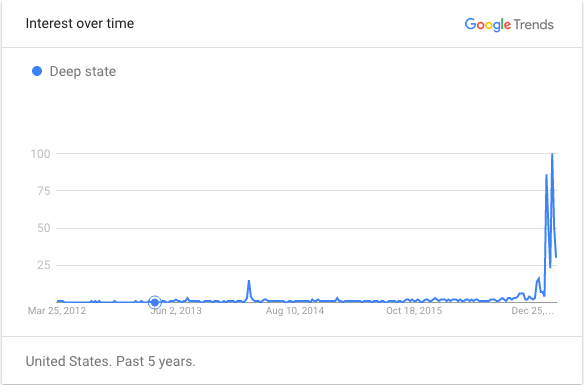
As this chart from Google Trends illustrates, interest in the Deep State has increased dramatically in 2017. The term/topic has clearly moved from the specialist realm to the mainstream. I’ve been writing about the Deep State, and specifically, the fractures in the Deep State, for years.

Amusingly, now that “Progressives” have prostituted themselves to the Security Agencies and the Neocons/Neoliberals, they are busy denying the Deep State exists. For example, There is No Deep State (The New Yorker).

In this risible view, there is no Deep State “conspiracy” (the media’s favorite term of dismissal/ridicule), just a bunch of “good German” bureaucrats industriously doing the Empire’s essential work of undermining democracies that happen not to prostrate themselves at the feet of the Empire, murdering various civilians via drone strikes, surveilling the U.S. populace, planting bugs in new iPhones, issuing fake news while denouncing anything that questions the dominant narratives as “fake news,” arranging sweetheart deals with dictators and corporations, and so on.

The New Yorker is right about one thing–the Deep State is not a “conspiracy:” it is a vast machine of control that is largely impervious to the views or demands of elected representatives or the American people. The key to understanding this social-political-economic control is to grasp that control of the narratives, expertise and authority is control of everything. Allow me to illustrate how this works.

The typical politician has a busy daily schedule of speaking at the National Motherhood and Apple Pie Day celebration, listening to the “concerns” of important corporate constituents, attending a lunch campaign fundraiser, meeting with lobbyists and party committees, being briefed by senior staff, and so on.

Senior administrators share similarly crowded schedules, minus the fundraising but adding budget meetings, reviewing employee complaints and multiple meetings with senior managers and working groups.

Both senior elected officials and senior state administrators must rely on narratives, expertise and authority because they have insufficient time and experience to do original research and assessment.

Narratives create an instant context that “makes sense” of various data points and events. Narratives distill causal factors into an explanatory story with an implicit teleology–because of this and that, the future will be thus and so.

For example: because Iraq has weapons of mass destruction (WMD), the future promises the terrible likelihood (more than a possibility, given Iraqi deployment of poison gas in the Iraq-Iran War) that America or its allies will be devastated by Iraqi weapons of mass destruction. This teleology leads to the inescapable need to eliminate Iraq’s weapons of mass destruction by any means necessary, and remove the political will to use them by removing Iraq’s leader from power.

Politicos and senior administrators rely on expertise and authority as the basis of deciding whether something is accurate and actionable. Professional specialists are assumed to have the highest available levels of expertise, and their position in institutions that embody the highest authority give their conclusions the additional weight of being authoritative. The experts’ conclusion doesn’t just carry the weight of expertise, it has been reviewed by senior officials of the institution, and so it also carries the weight of institutional authority.

So when the C.I.A. briefing by its experts claims Iraq has WMD, and the briefing includes various threads of evidence that the institution declares definitive, who is a non-expert to challenge this conclusion and teleology? On what technical basis does the skeptic reject the expertise and authority of the institution?

We can now define the Deep State with some precision. The Deep State is fundamentally the public-private centralized nodes that collect, archive and curate dominant narratives and their supporting evidence, and disseminate these narratives (and their implicit teleologies) to the public via the media and to the state agencies via formal and informal inter-departmental communication channels.

By gaining control of the narratives, evidence, curation and teleology, each node concentrates power. the power to edit out whatever bits contradict the dominant narrative is the source of power, for once the contradictory evidence is buried or expunged, it ceases to exist.

For example, the contradictory evidence in the Pentagon Papers was buried by being declared Top Secret. The bureaucratic means to bury skeptical (i.e. heretical) views or evidence are many. Sending the authors to figurative Siberia is remarkably effective, as is burying the heretical claims in a veritable mountain of data that few if any will ever survey.

Curation is a critical factor in maintaining control of the narrative and thus of control; the evidence is constantly curated to best support the chosen narrative which in turn supports the desired teleology, which then sets the agenda and the end-game.

The senior apparatchiks of the old Soviet Union were masters of curation; when a Soviet leader fell from favor, he was literally excised from the picture–his image was erased from photos.

This is how narratives are adjusted to better fit the evidence. Thus the accusation that “the Russians hacked our election” has been tabled because it simply doesn’t align with any plausible evidence. That narrative has been replaced with variants, such as “the Russians hacked the Democratic National Committee.” Now that this claim has also been shown to be false, new variants are popping up weekly, with equally poor alignment with evidence.

The primary claim of each Deep State node is that its expertise and authority cannot be questioned. In other words, while the dominant narrative can be questioned (but only cursorily, of course), the expertise and authority of the institutional node cannot be questioned.

This is why the Deep State is fracturing: the expertise and authority of its nodes are delaminating because its narratives no longer align with the evidence. If various Security Agencies sign off on the narrative that “Russia hacked our election” (a nonsense claim from the start, given the absurd imprecision of the “hacking”–hacking into what? Voting machines? Electoral tallies?), and that narrative is evidence-free and fact-free, i.e. false, then the expertise and authority of those agencies comes into legitimate question.

Once the legitimacy of the expertise and authority is questioned, control of the narrative is imperiled. The control of the narrative is control of the teleology, the agenda and the end-game–in other words, everything. If the institution loses control of the dominant narrative, it loses its hold on power.

This is why the Deep State is in turmoil–its narratives no longer make sense, or are in direct conflict with other nodes’ narratives or have been delegitimized by widening gaps between “definitive” claims and actual evidence.

There is indeed a Deep State, but its control of dominant narratives, and thus its source of control and power, is crumbling. The gap between the narratives and the evidence that supports them has widened to the point of collapse.


The U.S. Deep State Rules – On Behalf of the Ruling Class

By Glen Ford

Source: Black Agenda Report

“The U.S. Deep State is unlike any other, in that there is no other global superpower bent on world domination.”

The Deep State is busy denying that it exists, even as it savages a sitting president and brutally bitch-slaps its host society, demanding the nation embrace its role as global psycho thug and kick some Russian ass. The New York Times, always available to divert attention from the essential facts of who rules America, points to Egypt, Turkey and Pakistan as the natural habitats of Deep States. Apparently, Deep State-infected countries tend to be nations with majority Muslim populations, whose military-intelligence apparatus hovers over society and periodically seizes control of the civil government.

The Times quoted high-ranking operatives of the Deep State to prove that such structures are alien to the U.S. Michael V. Hayden, who ran the CIA under Democratic President Obama and Republican George Bush, recoiled at the term. He “would never use” the words Deep State in connection with his own country. “That’s a phrase we’ve used for Turkey and other countries like that, but not the American republic.”

Loren DeJonge Schulman, a former Obama National Security Council official, claimed to be repelled by the very idea of an American Deep State. “A deep state, when you’re talking about Turkey or Egypt or other countries, that’s part of government or people outside of government that are literally controlling the direction of the country no matter who’s actually in charge, and probably engaging in murder and other corrupt practices,” she said.

Apparently, Ms. Schulman did not consider it murder when Obama and his top national security advisors met every Tuesday at the White House to decide who would be assassinated by drone or other means. But she is “shocked” to hear “that kind of [Deep State-phobic] thinking from” President Trump “or the people closest to him.”

Once the Times had located the nexus of Deep Statism in the Muslim world, the lesser lights at The New Yorker endorsed the corporate media consensus that the U.S. is Deep State-free. Staff writer David Remnick admits that U.S. presidents “have felt resistance, or worse, from elements in the federal bureaucracies,” citing Eisenhower’s warnings against the military-industrial complex, Lyndon Johnson’s “pressure from the Pentagon,” and the “rebuke” of Obama’s Syria policy through the State Department’s “dissent channel.” However, he denies that any “subterranean web of common and nefarious purpose” threatens the orderly and transparent processes of the U.S. political system.

In reality, the U.S. Deep State is by far the world’s biggest and most dangerous version of the phenomenon; a monstrous and not-so subterranean “web of common and nefarious purpose” that is, by definition, truly global, since its goal is to rule the planet. Indeed, the Deep States of Turkey, Egypt and Pakistan — all nominal U.S. allies – are midgets in comparison and must operate in a global environment dominated by Washington’s Deep State apparatus. So vast is the imperial Deep State, that its counterparts in other nations exist largely to collaborate with, resist, or keep tabs on the U.S. behemoth, the predator that seeks to devour all the rest.

What is a Deep State? The U.S. Deep State is unlike any other, in that there is no other global superpower bent on world domination. (Washington’s political posture is also unique; no other nation claims to be “exceptional” and “indispensable” and thus not subject to the constraints of international law and custom.) Indeed, the U.S. is so proudly and publicly imperialist that much of what should be secret information about U.S. military and other capabilities is routinely fed to the world press, such as the 2011 announcement that the U.S. now has a missile that can hit any target on the planet in 30 minutes, part of the Army’s “Prompt Global Strike” program. Frightening the rest of the world into submission — a form of global terrorism — is U.S. public policy.

However, arming and training Islamic jihadist terrorists to subvert internationally recognized governments targeted by the U.S. for regime change is more than your usual variety of covert warfare: It is a policy that must forever be kept secret, because U.S. society would suffer a political breakdown if the facts of U.S. and Saudi nurturing of the international jihadist network were ever fully exposed. This is Deep State stuff of the highest order. The true nature of U.S. foreign policy in the 21st century, and the real character of the current wars in Syria and Iraq, must be hidden from the U.S. public at all cost. An alternative reality must be presented, through daily collaboration between corporate media, corporate universities, and the public and covert organs of the U.S. State.

What part of the New York Times coverage of the war against Syria is a lie? Damn near all of it. What role does the Deep State play in crafting the lies dutifully promulgated by the corporate media? That’s impossible to answer, because the Deep State is a network of relationships, not a clearly delineated zone or space or set of organizations. The best way to describe the imperial Deep State is: those individuals and institutions that are tasked with establishing the global supremacy of the corporate ruling class. Such activities must be masked, since they clash with the ideological position of the ruling class, which is that the bourgeois electoral system of the United States is the world’s freest and fairest. The official line is that the U.S. State is a work of near-perfection, with checks and balances that prevent any class, group or section from domination over the other. The truth is that an oligarchy rules, and makes war on whomever it chooses — internationally and domestically — for the benefit of corporate capital.

The Deep State and its corporate imperatives manifestly exists when corporate lobbyists and lawyers are allowed to draw up the Trans Pacific Partnership global “trade” agreement, but the contents are kept secret from the Congresspersons whose duty is to vote on the measure. The Deep State is where corporate power achieves its class aims outside the public processes of government. It’s where the most vicious class warfare takes place, whether on a foreign killing field, or in the corporate newsroom that erases or misrepresents what happened on that battlefield.

At this stage of capitalism, the U.S. ruling class has less and less use for the conventional operations of the bourgeois state. It cannot govern in the old way. More and more, it seeks to shape events through the levers of the collaborating networks of the Deep State. It’s number one global priority is to continue the military offensive begun in 2011, and to break Russia’s resolve to resist that offensive. The ruling class and its War Party, now consolidated within the Democratic Party and regrouping among Republicans, have effectively neutralized a sitting president whose party controls both Houses of Congress, less than two months into his term.

Only a Deep State could pull that off.


BAR executive editor Glen Ford can be contacted at Glen.Ford@BlackAgendaReport.com.

Glen Ford’s blog

The Democrats’ Dangerous Diversion

By Nicolas J S Davies

Source: Consortium News

The current debate over “fake news” has reminded me of a conversation I had several years ago with a former citizen of East Germany, now living in the United States. He explained that, in East Germany, everybody knew that what the media told them about their own country was a bunch of lies and propaganda. So they assumed that what the media told them about the West was just propaganda, too.

Now living in the U.S., he had come to realize that a lot of what the East German media said about life in the U.S. was actually true. There really are people living on the street, people with no access to healthcare, widespread poverty, a lack of social welfare and public services, and many other problems, as the East German media accurately reported, and as the Chinese government also noted in its latest report on human rights in the U.S.

My friend wished he and his countrymen had understood the difference between what their media told them about their country and what they reported about the West. Then they could have made more intelligent choices about which aspects of life in the West to adopt, instead of allowing Western experts to come in and impose the entire neoliberal model on their country.

In the West, of course, the state media of East Germany and other Communist countries were held up to ridicule. I remember hearing that people in the U.S.S.R. would open their newspapers in the morning and have a good laugh at the latest “fake news” in Pravda. But, as my German friend eventually understood, there was some truth amongst the propaganda, and the hidden danger of such a corrupted media system is that people end up not knowing what to believe, making informed democratic choices almost impossible.

In the end, people all over Eastern Europe were cornered into a false choice between two ideological systems that both came as top-down package deals, instead of being able to take charge of their own societies and democratically decide their own future.

In the U.S., we live under a two-party political system, not a one-party system as in East Germany, and our media reflect that. As each of our two main political parties and our media have fallen more totally under the sway of unbridled plutocratic interests, our mass media has devolved into a bifurcated version of what my friend observed in East Germany, triply corrupted by commercial interests, partisan bias and ideological and nationalist propaganda.

Down the Rabbit Hole 

Since the 2016 election campaign, our political system seems to have devolved into something like the nonsense world of Lewis Carroll’s Alice In Wonderland, with Donald Trump as the Queen of Hearts, Hillary Clinton as Humpty Dumpty, the Republicans and Democrats as Tweedledum and Tweedledee, the election as the Caucus Race (which Lewis Carroll based on U.S. political caucuses) and the whipsawed American public as the permanently baffled Alice.

In Lewis Carroll’s Caucus Race, an assortment of creatures ran randomly around a racetrack with no start or finish line, until the Dodo called the race over, declared them all winners and told Alice (the public?) she had to give them all prizes.

In similar fashion, the 2016 election between two of the most unpopular presidential candidates in U.S. history seems to have no finish line, but to live on in round-the-clock campaigns to corral the public into one of its two camps. The artificial, top-down nature of both these campaigns should be a warning that, like the election campaigns they grew out of, they are designed to corral, control and direct masses of people, not to offer real solutions to any of the serious problems facing our country and the world.

On one hand, we have President Trump, Republican Congressional leaders, Breitbart, Fox News and Rush Limbaugh, spouting nonsense worthy of Lewis Carroll, even in major presidential speeches, while dismissing criticism as “fake news.”

The Trump camp will never acknowledge that only a quarter of voting-age Americans voted for him, nor that even less of us share his views or the interests he represents. In this corrupt two-party system, no effort or expense is spared to persuade the public that we must vote for one of the two major party presidential candidates, whether we agree with either of them or not. But that cuts both ways, leaving most of the public unrepresented no matter who wins, and depriving any new government of a genuine popular mandate.

But Republican leaders play a more straightforward winner-take-all game than the Democrats. So they will try to ride Trump’s victory and their Congressional majorities as far as they will take them on all fronts: more tax breaks for the wealthy and corporations; more draconian cuts in social spending; more privatization of healthcare, education and other public services; more detention and deportation of immigrants; a more aggressive police response to social problems and public protest; more destruction of the natural world and the climate; and more increases in a military budget that already broke post-WWII records under Bush and Obama, to fuel a more openly aggressive and dangerous war policy – in other words, more of all the things that most Americans would agree we have already had too much of.

On the other side, Democratic Party leaders and the CIA, supported by the New York Times, the Washington Post, CNN and MSNBC, have conjured up unproven charges that Russia stole the election for Trump as the heart of their campaign against him. In Trump, history has handed them a political opponent with a piñata of vulnerabilities, from unprecedented conflicts of interest to policies that benefit only his own wealthy class to willful ignorance of how almost everything he is responsible for as president really works.

And yet the cabal formerly known as the Clinton campaign shows little interest in pointing out that our new Emperor has no clothes on, let alone in seriously resisting his repressive, plutocratic policies, and is instead obsessed with convincing the public that a birthmark on his naked bum looks like a hammer and sickle.

A Saving Grace?

Paradoxically, if Trump really reduced tensions between the U.S. and Russia, as his hawkish Democratic opponents fear, that could be the saving grace of his entire presidency. George W. Bush’s and Barack Obama’s regime change wars, NATO expansion and the U.S.-backed coup in Ukraine have ignited a new Cold War that many respected scientists believe has raised the risk of human mass extinction to its highest level since the 1950s.

In the pursuit of false security based on post-Cold War triumphalism and a fleeting mirage of military supremacy, our corrupt leaders have jeopardized not just our security but our very existence, leaving us at two and a half minutes to midnight on the Bulletin of the Atomic Scientists (BAS)Doomsday Clock.

As Jonathan Marshall at Consortiumnews.com reported on March 10, experts from the Federation of American Scientists, the Natural Resources Defense Council and MIT wrote in a recent BAS article that new “super-fuzes” installed on U.S. nuclear warheads since 2009 have significantly increased the danger of nuclear war by giving the U.S. the ability to destroy all Russia’s fixed land-based nuclear missiles with only a fraction of U.S. own weapons.

Coupled with President Obama’s deployment of a formerly illegal ABM (anti-ballistic missile) system on Aegis missile destroyers and at bases in Eastern Europe, the authors wrote that this upgrade to U.S. nuclear warheads is “exactly what one would expect to see if a nuclear-armed state were planning to have the capacity to fight and win a nuclear war by disarming enemies with a surprise first strike.” They concluded that “Russian planners will almost surely see the advance in fuzing capability as empowering an increasingly feasible U.S. preemptive nuclear strike capability.”

In the case of a suspected Russian nuclear missile launch, the U.S. satellite-based early warning system can give President Trump 30 minutes to judge whether we are really facing a nuclear attack or not. But Russia’s land-based early warning system is not so generous. In the case of a suspected U.S. nuclear launch targeting Russia, President Putin would have as little as 7 to 13 minutes to decide whether Russia was really under nuclear attack and whether to retaliate.

In the midst of escalating tensions over Syria, Ukraine, Iran or some other new crisis, a realistic fear of a U.S. first strike could force a hasty decision by Russian officials and seal the fate of humanity. The BAS authors believe that this predicament leaves Russia little choice but to pre-delegate its nuclear launch authority to lower levels of command, increasing the risk of an accidental or mistaken launch of nuclear weapons.

In an epitome of understatement, they point out that, “Forcing this situation upon the Russian government seems likely to be detrimental to the security interests of the United States and its Western allies.”

While U.S. officials are largely silent about the dangers of these developments in U.S. nuclear weapons policy, President Putin has spoken frankly about them and expressed dismay that the U.S. has rejected every Russian offer of cooperation to reduce these risks. Talking to a group of journalists at the St. Petersburg International Economic Forum in June 2016, he concluded, “I don’t know how this is all going to end. … What I do know is that we will need to defend ourselves.”

But despite the existential dangers of deteriorating relations with Russia, Democratic Party leaders have grasped the CIA’s unproven “assessments” that Russia may have tried to influence the outcome of the U.S. election as a lifeline by which to salvage their positions of power after their party’s electoral implosion.

Since the leadership of the Democratic Party was taken over by the corporate-backed Democratic Leadership Council (DLC) a generation ago, it has followed an unwritten rule that it must never accept responsibility for losing an election, nor respond to signs of public disaffection with any weakening of its commitment to pro-corporate, neoliberal policies. In its desperation to prevent the democratic reform of the Democratic Party, it is aggressively tarring nuclear-armed Russia with the same brush it used to tar and feather Ralph Nader after the 2000 election.

The mortal aversion of Democratic Party leaders to progressive reform suggests that they prize their own control of the party even above winning elections, the rational purpose of any political party. Their ugly smear campaign against Keith Ellison, the progressive candidate for Democratic National Committee (DNC) chair, mirrored the DNC’s corrupt campaign to undermine Sen. Bernie Sanders in the Democratic primaries and the DLC cabal’s bare-knuckles response to progressive challengers for the past 30 years.

For the DLC Democrats to snatch defeat from the jaws of the long-term victory that the country’s shifting demographics seem to guarantee their party requires a truly historic level of corruption.

Their unshakable commitment to fight tooth and nail for the interests of their wealthy campaign contributors over those of poorer, younger and darker-skinned voters in every election, every national, state and local party committee and on every issue, even as they pretend they are doing the exact opposite, could only be a viable political strategy in Lewis Carroll’s Wonderland. In the real world, their demonstrated disdain for the people from whose votes they derive their power is a strategy for political suicide.

Different Kind of Politics

These corrupt party leaders and their corporate media cheerleaders dare not remind us that Bernie Sanders’s candidacy for president inspired more enthusiasm and drew bigger crowds than Trump’s or Clinton’s, despite one eightieth of the early media promotion lavished on Trump by some corporate media and the fact that almost the entire Democratic Party establishment lined up against him.

For decades, DLC Democrats have run on vague messages about “values” to avoid being cornered into explicit progressive policy positions that might alienate their wealthy patrons. Sanders was greeted with open arms by younger voters ready for a renaissance of real politics based on actual policies that solve real problems, like universal healthcare, free college tuition, progressive taxation to pay for it all and a more cautious approach to U.S.-backed “regime change” in other countries.

By contrast, an analysis of campaign messaging by the Wesleyan Media Project found that “Clinton’s message was devoid of policy discussions” when compared to other recent presidential campaigns, including even Trump’s, and that this was a critical factor in her failure.

According to opinion polls, Bernie Sanders may now be the most popular politician in America. Polls consistently showed that Sanders was likely to beat Trump in the general election if the Democratic Party allowed him to get that far, but the DNC fundraising machine pulled out every trick in the book to make sure that didn’t happen. If truth be told, Sanders’s success was probably a more accurate reflection of the evolving political views of a majority of Americans in 2016 than the billion-dollar auction of the presidency between the Game Show King and the Queen of Chaos.

These two camps represent factions of the powerful interests that have controlled American politics for decades, from the military-industrial complex and the CIA to the dirty energy and for-profit “healthcare” industries, to say nothing of the commercial media industry itself, which covered this election all the way to the bank and for whom the show must go on and on and on … and on.

Lies of Both Sides.

Like the people of East Germany in the 1980s, we now face the challenge of a society in crisis, compounded by a treacherous media environment, with not just one, but two competing camps presenting us with false, self-serving interpretations of the multi-faceted crisis their corruption has spawned. While they compete for our trust, they share a common interest in insisting that one of the two mythological worldviews they have staked out must be right.

But as Cornel West recently told the students at my local high school in Miami in a Black History Month speech, “You don’t have to choose between the lies on one side and the lies on the other side.” So the question becomes where to turn for something other than lies, and how to recognize the truth when we stumble across it.

The paradox of our Internet age is that we nearly all have access to a wider range of media than ever before, yet we are still exposed and susceptible to corporate, partisan and ideological propaganda. In theory, we no longer have to be victims of for-profit media whose business models prioritize their profits over their duty to inform the public. But in reality, we do not form our views of the world as independently as we think we do.

This is easier to grasp in the case of commercial advertising than in the arena of political or ideological indoctrination. There is a well-known dictum in the business world that goes, “I know that half the money we spend on advertising is wasted. I just don’t know which half.” The flip-side of this is that the other half is not wasted.

So the advertising industry in the United States spends $220 billion per year, $700 for each man, woman and child in the country, to sell us products and services. And yet we still like to think that we make independent, rational choices about our spending, based on enlightened self-interest and cultivated tastes, not on the work of copywriters churning out pitches, images and jingles in ad agency cubicles.

One of the by-products of the mass monetization of American politics since the 1980s is that politics has become a profitable new arena for advertising, marketing and public relations firms. Its practitioners apply the techniques and experience they’ve developed in other areas to the world of politics, helping politicians and parties to convert the money they raise from wealthy campaign contributors into votes, and ultimately into power over all our lives. So we should be just as wary of political marketing and advertising as of the commercial variety. We should also be more humble in recognizing our own vulnerability to these profitable forms of persuasion and deception.

My copy of Alice in Wonderland has a quotation from James Joyce in the front of the book: “Wipe your glasses with what you know.” What we know is often our best protection against being misled by advertisers, politicians and pundits, if we will only remember what we know and trust it over the misinformation that surrounds us.

“Wiping our glasses with what we know” can provide a reality check on the current Russophobia campaign. We know very well that the U.S. and Russia possess the bulk of the world’s nuclear weapons, and that war between our two countries would likely mean death for ourselves and our families and the end of life as we know it for people everywhere.

We also know that it is our country and its allies, not Russia, that have launched invasions, military occupations, bombing campaigns, coups and drone wars against at least ten countries in the past 20 years, while Russia only recently become engaged in two of these conflict zones when its interests were directly impacted by our actions.

So we can see that the greatest danger in this relationship is not the threat of some unprovoked and unprecedented act of Russian aggression. The more real and serious danger is that a confrontation with Russia over one of the hot spots we have ignited will lead to an escalation of tensions in which a mistake, a misunderstanding, a miscalculation, a bluff called, a “red line” crossed or some other kind of failed brinksmanship will trigger a war that will escalate to the use of nuclear weapons, and from there to Armageddon.

Even with the lines of communication set up after the Cuban missile crisis and the stabilization of the Cold War balance of terror by the principle of Mutually Assured Destruction (MAD), we now know that we came very close to Armageddon many times, including simply by accident.

Instead of being corralled by either side in the “Russia did it” campaign, we should be urging our leaders to sit down and talk seriously with Russia’s leaders, to stop taking dangerous actions that exacerbate tensions, uncertainties and mutual isolation, and to return to serious negotiations to leave our children and grandchildren a peaceful world, free of nuclear weapons, where these dangers will no longer threaten them.

Amid lies and distortions on all sides, the corruption of politics and media by commercial interests and the billion dollars per year our government spends directly on public relations and propaganda, James Joyce’s advice can still serve us well. Make sure to wipe your glasses with what you know as you read or watch “news” from any source or listen to politicians of any party, and we may just find a way out of this rabbit hole before the roof crashes in on us.


Nicolas J S Davies is the author of Blood On Our Hands: the American Invasion and Destruction of Iraq.  He also wrote the chapters on “Obama at War” in Grading the 44th President: a Report Card on Barack Obama’s First Term as a Progressive Leader.

The New Media World Order

By Thierry Meyssan

Source: Voltairenet.org

In only a few months, the content of the Western national and international medias has undergone profound change. We are witnessing the birth of an Entente about which we know almost nothing – neither the real initiators, nor the real objectives – but whose direct anti-democratic consequences can be noticed immediately.

The West is currently going through an unprecedented systemic change – powerful forces are progressively orienting the totality of medias in a single direction. At the same time, the content of the medias is mutating– only last year, they were still logical, and tended towards objectivity. They offered one other mutual contradiction in a spirit of healthy competition. Now they act in gangs, basing their coherence on emotions, and becoming vicious when they are facing people they condemn.

The idea of an Entente between the medias is an extension of the experience of the International Consortium for Investigative Journalism (ICIJ), which does not unite the medias, but only individual journalists. It made itself famous by publishing information stolen from the accounts of two law firms in the British Virgin Islands, and from PricewaterhouseCoopers (PwC), the bank HSBC, and the Panamanian firm Mossack Fonseca. These revelations were mainly used to discredit the Russian and Chinese leaders, but also, once in a while, to shine some light on genuine offences committed by the Westerners. Above all, under the honourable pretext of the struggle against corruption, the violation of the confidentiality of lawyers and banks seriously damaged thousands of their honest clients without any reaction from public opinion.

Over a period of approximately forty years, we have been witnessing the progressive grouping of medias within certain international trusts. Currently, 14 groups share more than two thirds of the western Press (21st Century Fox, Bertelsmann, CBS Corporation, Comcast, Hearst Corporation, Lagardere Group, News Corp, Organizações Globo, Sony, Televisa, The Walt Disney Company, Time Warner, Viacom, Vivendi). From now on, the alliance operated by Google Media Lab and First Draft is forging links between these groups, which already enjoyed a dominant position. The presence in this Entente of the three most important Press agencies on the planet (Associated Press, Agence France-Presse, Reuters) guarantees it hegemonic power. This is without any doubt an «illicit entente», established not with the goal of price-setting, but mind-setting, the imposition of an already dominant thought.

We may have noticed that all the members of the Google Entente – without exception – have already, over the last six years, given unequivocal visions of the events that occurred in the Greater Middle East. And yet there had been no prior agreement between them, or at least, none of which we were aware. It is intriguing to note that five of the six international television channels which participated in the NATO propaganda cell are part of this Entente (Al-Jazeera, BBC, CNN, France24, Sky, but apparently not al-Arabiya).

In the United States, France and Germany, Google and First Draft assembled the medias present locally in the countries concerned, and others present on the international scale, to check the veracity of certain arguments. Besides the fact that we do not know who is hiding behind First Draft, and what political interests may have influenced a commercial company specialised in computer science to finance this initiative, the results achieved have little to do with a return to objectivity.

First of all because the allegations are not chosen for the place they occupy in the public debate, but because they have been quoted by individuals that the media Entente intends to vilify. We might imagine that these verifications enable us to get a little closer to the truth, but that is not the case at all – they reassure the citizen in the idea that the medias are honest, while the people they are condemning are not. This approach is not aimed at better understanding the world, but at beating down the people to be sacrificed.

Next, because an unwritten rule of this media Entente stipulates that only allegations from sources outside the Entente should be checked. The members agree not to use any critical faculty in the mutual appreciation of their work. They agree to reinforce the idea that the world is divided in two – «we» who tell the truth, and «the others» who are liars. This approach is damaging for the principle of pluralism, a precondition for democracy, and opens the way to a totalitarian society. This is not a new phenomenon, because we saw it at work during the coverage of the Arab Springs and the wars against Libya and Syria. But for the first time, it is aimed at a Western line of thought.

Finally, because the allegations that have been qualified as «false» will never be envisaged as errors, but always as lies. The point is to charge the «others» with Machiavellian intentions in order to discredit them. This approach damages the presumption of innocence.

That is why the functioning of the ICIJ and the Entente created by Google and First Draft violates the Munich Charter adopted by the International Federation of Journalists (IFJ) (Title II, articles 2, 4, 5 and 9).

It is no coincidence that certain absurd legal actions have developed against the same targets as those in the sights of the media Entente. In the United States, the Hogan Law has been dragged out for use against the Trump team, despite the fact that this text has never, absolutely never, been applied since its promulgation two centuries ago. And in France, the Jolibois Law has been revived for use against the political tweets of Marine Le Pen, despite the fact that jurisprudence had limited the application of that law to the distribution of a few ultra-pornographic magazines lacking a plastic wrapping. Since the principle of the presumption of innocence for scapegoats has been eradicated, it is now possible to put anyone on trial for any legal pretext. Furthermore, the legal actions mounted against the Trump team and Marine Le Pen, in the name of the laws named above, should also be be brought against a great number of other people – but they are not.

Moreover, citizens no longer react when the media Entente itself broadcasts false allegations. Thus, in the United States, they imagined that the Russian secret services had a compromising dossier on Donald Trump and were blackmailing him. Or, in France, this Entente invented the idea that it is possible to employ a fictitious parliamentary assistant, and went on to accuse François Fillon.

In the United States, the large and small medias which are members of the Entente went after the President. They garnered their own information from the wire-tapping of the Trump team which had been illegally ordered by the Obama administration. They work in coordination with the magistrates, who are using them to block the actions of the present government. This is without doubt a Mafia system.

The same US and French medias are attacking two candidates for the French Presidential election – François Fillon and Marine Le Pen. To the general problem of the media Entente is added the false impression that these targets are victims of a Franco/French conspiracy, whereas in fact, the instigator is a US citizen. The French notice that their medias are rigged, wrongly interpret the conspiracy as being directed against the right wing, and continue erroneously seeking the manipulators in their own country.

In Germany, the Entente is not yet effective, and probably will not be until the general elections.

During Watergate, the medias claimed to represent a «Fourth Estate», after the Executive, the Legislative, and the Judiciary. They affirmed that the Press exercised a function of control over the government in the name of the People. We can ignore for a moment the fact that President Nixon was charged with a similar offense to that of President Obama – bugging his opponent. We know today that the Watergate source, «Deep Throat», far from being a «whistle-blower», was in reality the Director of the FBI, Mark Felt. The treatment of this affair was a battle between a part of the administration and the White House, in which the electors were manipulated by both sides at once.

The idea of a «Fourth Estate» supposes that we recognise the same legitimacy for the 14 corporate trusts which own the great majority of the Western medias as for the citizens. This is to affirm the substitution of an oligarchy for democracy.

The remains one point which needs clarification – how have the targets of the Entente been chosen? The only obvious link between Donald Trump, François Fillon and Marine Le Pen is that all three hope to re-establish contacts with Russia, and fight with her against the breeding ground of jihadism – the Muslim Brotherhood. Although François Fillon was the Prime Minister of the goverment implcated in these events, all three of them represent the train of thought which contests the dominant vision of the Arab Springs and the wars against Libya and against Syria.

Aristocracy Deceives Public about the Deep State

deep_state_gears_1088x725

By Eric Zuesse

Source: Strategic Culture Foundation

The «deep state» is the aristocracy and its agents. Wikispooks defines it as follows:

The deep state (loosely synonymous with the shadow government or permanent government) is in contrast to the public structures which appear to be directing individual nation states. The deep state is an intensely secretive, informal, fluid network of deep politicians who conspire to amplify their influence over national governments through a variety of deep state milieux. The term «deep state» derives from the Turkish »derin devlet», which emerged after the 1996 Susurluk incident so dramatically unmasked the Turkish deep state.

Their article is so honest that it continues from there, directly to:

Official Narrative

The official narrative of deep states used to be that they simply do not exist. This position was modified in the last few years to the claim that they don’t exist here. In 2013 the New York Times defined the deep state as «a hard-to-perceive level of government or super-control that exists regardless of elections and that may thwart popular movements or radical change. Some have said that Egypt is being manipulated by its deep state». [1] Since the Times (like the rest of the commercially-controlled media) is more or less a under the control of the deep state, such a mention is very interesting.

However, one of the deep state’s many agents, Marc Ambinder, came out with a book in 2013, Deep State: Inside the Government Secrecy Industry, much praised by others of the deep state’s agents, such as Martha Raddatz, Jeremy Scahill, and Peter Bergen; and it pretends that the ‘deep state’ is only within the official government, not above it and controlling it — not what has been called by some «the money power,» and by others «the aristocracy» (or the «oligarchy» as it was termed — though even that, only indirectly — by the only people who have scientifically established that it exists in America and controls this country: to acknowledge publicly that the U.S. is controlled by an «aristocracy» is prohibited in scholarly publications; it’s too ‘radical’ a truth to allow in print; it is samizdat).

On its third page, Ambinder’s piece of propaganda make clear what he means by ‘deep state’:

This book is about government secrets — how they are created, why they get leaked, and what the government is currently hiding. We will delve into the key elements of the American secrecy apparatus, based on research and unprecedented access to lawmakers, intelligence agency heads, White House officials, and program managers. …

That piece of trash failed even to discuss George W. Bush’s lies in which Bush stated during 2002 and 2003 that he possessed conclusive proof that Saddam Hussein was reconstituting his WMD (weapons of mass destruction) program — what America’s aristocratically controlled ‘news’ media attributed instead to ‘failures of intelligence’ by the Bush Administration — which had supposedly caused the Bush regime to invade Iraq in 2003. That was supposedly an enormous ‘failure of intelligence’, but Ambinder’s book ignored it entirely — and yet there are still suckers who buy that and the aristocracy’s other propaganda (and so who misunderstand even such a basic concept as «the deep state» or «the aristocracy»).

One of the biggest indicators that one is reading propaganda from the deep state is that the government’s lies are not being called »lies» (unless the deep state is losing control over the government, which rarely happens). Instead, they are called by such phrases as ‘failures of intelligence’. But what about when the people who control the government misrepresent what their ‘intelligence’ actually shows and doesn’t show? Lying is attributed, in the ‘news’ media, only to the aristocracy’s enemies. After all: the aristocracy’s enemies can be acknowledged to exist, even if the existence of an aristocracy isn’t being acknowledged.

Another mouthpiece of the deep state is (like virtually all magazines) The Nation magazine, which headlined on 17 February 2017, «What Is the Deep State? Even if we assume the concept is valid, surely it’s not useful to think of the competing interests it represents as monolithic.» Their propagandist, Greg Grandin, asked «What is the ‘deep state’?» and he ignored what wikispooks said, and he asserted, instead, «The problem with the phrase ‘deep state’ is that it is used to suggest that dishonorable individuals are subverting the virtuous state for their private ambitions.» Aside from propagandist Grandin’s having merely assumed there ‘the virtuous state’, which might not even exist at all, in this country, or perhaps in any other, he was trying to, as he said, get «beyond the binds of conspiracy theory,» as if any hierarchical social structure, corporate or otherwise, doesn’t necessarily and routinely function by means of conspiracies — some of which are nothing more than entirely acceptable competitive strategies, often entirely legal. He wants to get beyond accepting that reality? Why would anyone wish to read such absurd, anti-factual, writings as that? Why would anyone hire such deceptive writers as that? Perhaps the answer to the latter question (which raises the problem here to being one about the aristocracy, since this is about the ‘news’ media, which in every aristocratically controlled country are controlled by its aristocracy) is that only writers such as that will pump their propaganda, and will hide such realities as are here being discussed (and, via links, documented).

Nothing that’s alleged here is denying that there are divisions within the aristocracy (or «deep state»). Nothing is alleging that the aristocracy are «monolithic.» It’s instead asserting that, to the extent the aristocracy are united around a particular objective, that given objective will likely become instituted, both legally and otherwise, by the government — and that, otherwise, it simply won’t be instituted at all. This is what the only scientific analysis that has ever been done of whether or not the U.S. is controlled by an aristocracy found definitely to be the case in the U.S.

(And, of course, that’s also the reason why this momentous study was ignored by America’s ‘news’ media, except for the first news-report on it, mine at the obscure site Common Dreams, which had 414 reader-comments within just its first four months, and then the UPI’s report on it, which, like mine, was widely distributed to the major ‘news’ media and rejected by them all — UPI’s report was published only by UPI itself, and elicited only two reader-comments there. Then came the New Yorker’s pooh-poohing the study, by alleging «the politicians all know this, and we know it, too. The only debate is about how far this process has gone, and whether we should refer to it as oligarchy or as something else.» Their propagandist ignored the researchers’ having noted, in their paper, that though their findings were extremely inconsistent with America’s being a democracy, the problem was almost certainly being understated in their findings: «The failure of theories of Majoritarian Electoral Democracy is all the more striking because it goes against the likely effects of the limitations of our data,» and, especially, «our ‘affluent’ proxy is admittedly imperfect,» and so, «interest groups and economic elites actually wield more policy influence than our estimates indicate.»

In fact, their «elite» had consisted not of the top 0.1% as compared to the bottom 50%, but instead of the top 10% as compared to the bottom 50%, and all empirical evidence shows that the more narrowly one defines «the aristocracy,» the more lopsidedly dominant is the ‘elite’s relative impact upon public policies. Then, a month after the press-release on their study was issued, the co-authors were so disappointed with the paltry coverage of it that had occurred in America’s ‘news’ media, so that they submitted, to the Washington Post, a reply to their study’s academic critics, «Critics argued with our analysis of U.S. political inequality. Here are 5 ways they’re wrong.» It was promptly published online-only, as obscurely as possible, so that there are also — as of the present date — only two reader-comments to that public exposure. This is typical news-suppression in America: essentially total suppression of samizdat information — not merely suppression of the officially top-secret information, such as propagandists like Ambinder focus upon. It’s deeper than the state: it is the deep state, including far more than just the official government.)

Another matter that America’s press has covered-up is the extreme extent to which the only scientific analysis of whether America is a democracy or instead an aristocracy, had found it to be an aristocracy; so, here in closing will be directly quoted the least-obscurantist statement of this fact, in the study itself:

The picture changes markedly when all three independent variables are included in the multivariate Model 4 and are tested against each other. The estimated impact of average citizens’ preferences drops precipitously, to a non-significant, near-zero level. Clearly the median citizen or «median voter» at the heart of theories of Majoritarian Electoral Democracy does not do well when put up against economic elites and organized interest groups. The chief predictions of pure theories of Majoritarian Electoral Democracy can be decisively rejected. Not only do ordinary citizens not have uniquely substantial power over policy decisions; they have little or no independent influence on policy at all.

By contrast, economic elites are estimated to have a quite substantial, highly significant, independent impact on policy.

They weren’t allowed to say «aristocracy», nor even directly to say «oligarchy», but they were allowed to say this. So: now, you’ve seen it. But the secret is still a secret; what’s samizdat, stays samizdat (so long as the government isn’t overthrown and replaced — and maybe even after the existing regime does become replaced).

‘Conspiracy Theories’ and Clandestine Politics

MarkLombardi

By Jeffrey M. Bale

Source: Lobster Magazine

Very few notions generate as much intellectual resistance, hostility, and derision within academic circles as a belief in the historical importance or efficacy of political conspiracies. Even when this belief is expressed in a very cautious manner, limited to specific and restricted contexts, supported by reliable evidence, and hedged about with all sort of qualifications, it still manages to transcend the boundaries of acceptable discourse and violate unspoken academic taboos. The idea that particular groups of people meet together secretly or in private to plan various courses of action, and that some of these plans actually exert a significant influence on particular historical developments, is typically rejected out of hand and assumed to be the figment of a paranoid imagination. The mere mention of the word ‘conspiracy’ seems to set off an internal alarm bell which causes scholars to close their minds in order to avoid cognitive dissonance and possible unpleasantness, since the popular image of conspiracy both fundamentally challenges the conception most educated, sophisticated people have about how the world operates and reminds them of the horrible persecutions that absurd and unfounded conspiracy theories have precipitated or sustained in the past. So strong is this prejudice among academics that even when clear evidence of a plot is inadvertently discovered in the course of their own research, they frequently feel compelled, either out of a sense of embarrassment or a desire to defuse anticipated criticism, to preface their account of it by ostentatiously disclaiming a belief in conspiracies. (1)

They then often attempt to downplay the significance of the plotting they have uncovered. To do otherwise, that is, to make a serious effort to incorporate the documented activities of conspiratorial groups into their general political or historical analyses, would force them to stretch their mental horizons beyond customary bounds and, not infrequently, delve even further into certain sordid and politically sensitive topics. Most academic researchers clearly prefer to ignore the implications of conspiratorial politics altogether rather than deal directly with such controversial matters.

A number of complex cultural and historical factors contribute to this reflexive and unwarranted reaction, but it is perhaps most often the direct result of a simple failure to distinguish between ‘conspiracy theories’ in the strict sense of the term, which are essentially elaborate fables even though they may well be based upon a kernel of truth, and the activities of actual clandestine and covert political groups, which are a common feature of modern politics. For this and other reasons, serious research into genuine conspiratorial networks has at worst been suppressed, as a rule been discouraged, and at best been looked upon with condescension by the academic community. (2) An entire dimension of political history and contemporary politics has thus been consistently neglected. (3)

For decades scholars interested in politics have directed their attention toward explicating and evaluating the merits of various political theories, or toward analyzing the more conventional, formal, and overt aspects of practical politics. Even a cursory examination of standard social science bibliographies reveals that tens of thousands of books and articles have been written about staple subjects such as the structure and functioning of government bureaucracies, voting patterns and electoral results, parliamentary procedures and activities, party organizations and factions, the impact of constitutional provisions or laws, and the like. In marked contrast, only a handful of scholarly publications have been devoted to the general theme of political conspiracies–as opposed to popular anti-conspiracy treatises, which are very numerous, and specific case studies of events in which conspiratorial groups have played some role — and virtually all of these concern themselves with the deleterious social impact of the ‘paranoid style’ of thought manifested in classic conspiracy theories rather than the characteristic features of real conspiratorial politics. (4)

Only the academic literature dealing with specialized topics like espionage, covert action, political corruption, terrorism, and revolutionary warfare touches upon clandestine and covert political activities on a more or less regular basis, probably because such activities cannot be avoided when dealing with these topics. But the analyses and information contained therein are rarely incorporated into standard works of history and social science, and much of that specialized literature is itself unsatisfactory. Hence there is an obvious need to place the study of conspiratorial politics on a sound theoretical, methodological, and empirical footing, since ignoring the influence of such politics can lead to severe errors of historical interpretation.

This situation can only be remedied when a clear-cut analytical distinction has been made between classic conspiracy theories and the more limited conspiratorial activities that are a regular feature of politics. ‘Conspiracy theories’ share a number of distinguishing characteristics, but in all of them the essential element is a belief in the existence of a ‘vast, insidious, preternaturally effective international conspiratorial network designed to perpetrate acts of the most fiendish character’, acts which aim to ‘undermine and destroy a way of life.’ (5)

Although this apocalyptic conception is generally regarded nowadays as the fantastic product of a paranoid mindset, in the past it was often accepted as an accurate description of reality by large numbers of people from all social strata, including intellectuals and heads of state. (6) The fact that a belief in sinister, all-powerful conspiratorial forces has not been restricted to small groups of clinical paranoids and mental defectives suggests that it fulfills certain important social functions and psychological needs.(7)

First of all, like many other intellectual constructs, conspiracy theories help to make complex patterns of cause-and-effect in human affairs more comprehensible by means of reductionism and oversimplification. Secondly, they purport to identify the underlying source of misery and injustice in the world, thereby accounting for current crises and upheavals and explaining why bad things are happening to good people or vice versa. Thirdly, by personifying that source they paradoxically help people to reaffirm their own potential ability to control the course of future historical developments. After all, if evil conspirators are consciously causing undesirable changes, the implication is that others, perhaps through the adoption of similar techniques, may also consciously intervene to protect a threatened way of life or otherwise alter the historical process. In short, a belief in conspiracy theories helps people to make sense out of a confusing, inhospitable reality, rationalize their present difficulties, and partially assuage their feelings of powerlessness. In this sense, it is no different than any number of religious, social, or political beliefs, and is deserving of the same serious study.

The image of conspiracies promoted by conspiracy theorists needs to be further illuminated before it can be contrasted with genuine conspiratorial politics. In the first place, conspiracy theorists consider the alleged conspirators to be Evil incarnate. They are not simply people with differing values or run-of-the-mill political opponents, but inhuman, superhuman, and/or anti-human beings who regularly commit abominable acts and are implacably attempting to subvert and destroy everything that is decent and worth preserving in the existing world. Thus, according to John Robison, the Bavarian Illuminati were formed ‘for the express purpose of ROOTING OUT ALL THE RELIGIOUS ESTABLISHMENTS, AND OVERTURNING ALL THE EXISTING GOVERNMENTS IN EUROPE.’ (8)

This grandiose claim is fairly representative, in the sense that most conspiracy theorists view the world in similarly Manichean and apocalyptic terms.

Secondly, conspiracy theorists perceive the conspiratorial group as both monolithic and unerring in the pursuit of its goals. This group is directed from a single conspiratorial centre, acting as a sort of general staff, which plans and coordinates all of its activities down to the last detail. Note, for example, Prince Clemens von Metternich’s claim that a ‘directing committee’ of the radicals from all over Europe had been established in Paris to pursue their insidious plotting against established governments. (9)

Given that presumption, it is no accident that many conspiracy theorists refer to ‘the Conspiracy’ rather than (lower case)conspiracies or conspiratorial factions, since they perceive no internal divisions among the conspirators. Rather, as a group the conspirators are believed to possess an extraordinary degree of internal solidarity, which produces a corresponding degree of counter solidarity vis-a-vis society at large, and indeed it is this very cohesion and singleness of purpose which enables them to effectively execute their plans to destroy existing institutions, seize power, and eliminate all opposition.

Thirdly, conspiracy theorists believe that the conspiratorial group is omnipresent, at least within its own sphere of operations. While some conspiracy theories postulate a relatively localized group of conspirators, most depict this group as both international in its spatial dimensions and continuous in its temporal dimensions. ‘[T]he conspirators planned and carried out evil in the past, they are successfully active in the present, and they will triumph in the future if they are not disturbed in their plans by those with information about their sinister designs.’(10)

The conspiratorial group is therefore capable of operating virtually everywhere. As a consequence of this ubiquitousness, anything that occurs which has a broadly negative impact or seems in anyway related to the purported aims of the conspirators can thus be plausibly attributed to them.

Fourthly, the conspiratorial group is viewed by conspiracy theorists as virtually omnipotent. In the past this group has successfully overthrown empires and nations, corrupted whole societies, and destroyed entire civilizations and cultures, and it is said to be in the process of accomplishing the same thing at this very moment. Its members are secretly working in every nook and cranny of society, and are making use of every subversive technique known to mankind to achieve their nefarious purposes. Nothing appears to be able to stand in their way–unless the warnings of the conspiracy theorists are heeded and acted upon at once. Even then there is no guarantee of ultimate victory against such powerful forces, but a failure to recognize the danger and take immediate countervailing action assures the success of those forces in the near future.

Finally, for conspiracy theorists conspiracies are not simply a regular feature of politics whose importance varies in different historical contexts, but rather the motive force of all historical change and development. The conspiratorial group can and does continually alter the course of history, invariably in negative and destructive ways, through conscious planning and direct intervention. Its members are not buffeted about by structural forces beyond their control and understanding, like everyone else, but are themselves capable of controlling events more or less at will. This supposed ability is usually attributed to some combination of demonic influence or sponsorship, the possession of arcane knowledge, the mastery of devilish techniques, and/or the creation of a preternaturally effective clandestine organization. As a result, unpleasant occurrences which are perceived by others to be the products of coincidence or chance are viewed by conspiracy theorists as further evidence of the secret workings of the conspiratorial group. For them, nothing that happens occurs by accident. Everything is the result of secret plotting in accordance with some sinister design.

This central characteristic of conspiracy theories has been aptly summed up by Donna Kossy in a popular book on fringe ideas:

Conspiracy theories are like black holes–they suck in everything that comes their way, regardless of content or origin…Everything you’ve ever known or experienced, no matter how ‘meaningless’, once it contacts the conspiratorial universe, is enveloped by and cloaked in sinister significance. Once inside, the vortex gains in size and strength, sucking in everything you touch. (11)

As an example of this sort of mechanism, one has only to mention the so-called ‘umbrella man’, a man who opened up an umbrella on a sunny day in Dealey Plaza just as President John F. Kennedy’s motorcade was passing. A number of ‘conspiracy theorists’ have assumed that this man was signalling to the assassins, thus tying a seemingly trivial and inconsequential act into the alleged plot to kill Kennedy. It is precisely this totalistic, all-encompassing quality that distinguishes ‘conspiracy theories’ from the secret but often mundane political planning that is carried out on a daily basis by all sorts of groups, both within and outside of government. It should, however, be pointed out that even if the ‘umbrella man’ was wholly innocent of any involvement in a plot, as he almost certainly was, this does not mean that the Warren Commission’s reconstruction of the assassination is accurate.

However that may be, real covert politics, although by definition hidden or disguised and often deleterious in their impact, simply do not correspond to the bleak, simplistic image propounded by conspiracy theorists. Far from embodying metaphysical evil, they are perfectly and recognizably human, with all the positive and negative characteristics and potentialities which that implies. At the most basic level, all the efforts of individuals to privately plan and secretly initiate actions for their own perceived mutual benefit –insofar as these are intentionally withheld from outsiders and require the maintenance of secrecy for their success–are conspiracies. Moreover, in contrast to the claims of conspiracy theorists, covert politics are anything but monolithic. At any given point in time, there are dozens if not thousands of competitive political and economic groups engaging in secret planning and activities, and most are doing so in an effort to gain some advantage over their rivals among the others. Such behind-the-scene operations are present on every level, from the mundane efforts of small-scale retailers to gain competitive advantage by being the first to develop new product lines to the crucially important attempts by rival secret services to penetrate and manipulate each other. Sometimes the patterns of these covert rivalries and struggles are relatively stable over time, whereas at other times they appear fluid and kaleidoscopic, as different groups secretly shift alliances and change tactics in accordance with their perceived interests. Even internally, within particular groups operating clandestinely, there are typically bitter disagreements between various factions over the specific courses of action to be adopted. Unanimity of opinioon historical judgements. There is probably no way to prevent this sort of unconscious reaction in the current intellectual climate, but the least that can be expected of serious scholars is that they carefully examine the available evidence before dismissing these matters out of hand.


Footnotes

1. Compare Robin Ramsay, ‘Conspiracy, Conspiracy Theories and Conspiracy Research’, Lobster 19 (1990), p. 25: ‘In intellectually respectable company it is necessary to preface any reference to actual political, economic, military or paramilitary conspiracies with the disclaimer that the speaker “doesn’t believe in the conspiracy theory of history (or politics)”.’This type of disclaimer quite clearly reveals the speaker’s inability to distinguish between bona fide conspiracy theories and actual conspiratorial politics.

2. The word ‘suppress’ is not too strong here. I personally know of at least one case in which a very bright graduate student at a prestigious East Coast university was unceremoniously told by his advisor that if he wanted to write a Ph.D. thesis on an interesting historical example of conspiratorial politics he would have to go elsewhere to do so. He ended up leaving academia altogether and became a professional journalist, in which capacity he has produced a number of interesting books and articles.

3. Complaints about this general academic neglect have often been made by those few scholars who have done research on key aspects of covert and clandestine politics which are directly relevant to this study. See, for example, Gary Marx, ‘Thoughts on a Neglected Category of Social Movement Participant: The Agent Provocateur and the Informant’, American Journal of Sociology 80:2 (September 1974), especially pp. 402-3. One of the few dissertations dealing directly with this topic, though not in a particularly skilful fashion, is Frederick A. Hoffman, ‘Secret Roles and Provocation: Covert Operations in Movements for social Change’ (Unpublished Ph.D. Dissertation: UCLA Sociology Department, 1979). There are, of course, some excellent academic studies which have given due weight to these matters–for example, Nurit Schleifman, Undercover Agents in the Russian Revolutionary Movement: The SR Party, 1902-1914 (Basingstoke: Macmillan/ St. Anthony’s College, 1988); and Jean-Paul Brunet, La police de l’ombre: Indicateurs et provocateurs dans la France contemporaine (Paris: Seuil, 1990)–but such studies areunfortunately few and far between.

4. The standard academic treatments of conspiracy theories are Richard Hofstadter, ‘The Paranoid Style in American Politics’, in Hofstadter, The Paranoid Style in American Politics and Other Essays (New York: Knopf, 1966), pp. 3-40; Norman Cohn, Warrant for Genocide: The Myth of the Jewish World-Conspiracy and the Protocols of the Elders of Zion (Chico, CA: Scholars, 1981 [1969]); J. M. Roberts, The Mythology of the Secret Societies (London: Secker & Warburg, 1972); Johannes Rogallavon Bieberstein, Die These von der Verschwrung, 1776-1945: Philosophen, Freimaurer, Juden, Liberale und Sozialisten als Verschwrergegen die Sozialordnung (Frankfurt am Main: Peter Lang, 1976); and Carl F. Graumann and Serge Moscovici, eds., Changing Conceptions of Conspiracy (New York: Springer, 1987). See also the journalistic studies by George Johnson, Architects of Fear: Conspiracy Theories and paranoia in American Politics (Los Angeles: Tarcher, 1983); and Jonathan Vankin, Conspiracies, Cover-Ups, and Crimes: Political Manipulation and Mind Control in America (New York: Paragon House, 1992).

5. See Hofstadter, ‘Paranoid Style’, pp. 14, 29.

6. Although conspiracy theories have been widely accepted in the most disparate eras and parts of the world, and thus probably have a certain universality as explanatory models, at certain points in time they have taken on an added salience due to particular historical circumstances. Their development and diffusion seems to be broadly correlated with the level of social, economic, and political upheaval or change, though indigenous cultural values and intellectual traditions determine their specific form and condition their level of popularity.

7. As many scholars have pointed out, if such ideas were restricted to clinical paranoids, they would have little or no historical importance. What makes the conspiratorial or paranoid style of thought interesting and historically significant is that it frequently tempts more or less normal people and has often been diffused among broad sections of the population in certain periods. Conspiracy theories are important as collective delusions, delusions which nevertheless reflect real fears and real social problems, rather than as evidence of individual pathologies. See, for example, Hofstadter,’Paranoid Style’, pp. 3-4.

8. See his Proofs of a Conspiracy Against All the Religions and Governments of Europe, Carried on in the Secret Meetings of free Masons, Illuminati, and Reading Societies, Collected from Good Authorities (New York: G. Forman, 1798), p. 14. This exhibits yet another characteristic of ‘conspiracy theorists’–the tendency to over-dramatize everything by using capital letters with reckless abandon.

9. See his ‘Geheime Denkschrift nber die Grundung eines Central-Comites der nordischen Machte in Wien’, in Aus Metternichs nachgelassenen Papieren, ed. by Richard Metternich-Winneburg (Vienna: 1881),vol. 1, p. 595, cited in Rogalla von Bieberstein, These von der Verschwrung, pp. 139-40.

10. Dieter Groh, ‘Temptation of Conspiracy Theory, Part I’, in Changing Conceptions of Conspiracy, p. 3. A classic example of conspiratorial works that view modern revolutionary movements as little more than the latest manifestations of subversive forces with a very long historical pedigree is the influential book by Nesta H. Webster, Secret Societies and Subversive Movements (London: Boswell, 1924). For more on Webster’s background, see the biographical study by Richard M. Gilman, Behind World Revolution: The Strange Career of Nesta H. Webster (Ann Arbor: Insight, 1982), of which only one volume has so far appeared.

11. Kooks: A Guide to the Outer Limits of Human Belief (Portland: Feral House, 1994), p. 191.

12. For more on P2, see above all the materials published by the Italian parliamentary commission investigating the organization, which are divided into the majority (Anselmi) report, five dissenting minority reports, and over one hundred thick volumes of attached documents and verbatim testimony before the commission. Compare also Martin Berger, Historia de la loggia masonica P2 (Buenos Aires: El Cid, 1983); Andrea Barbieri et al, L’Italia della P2 (Milan: Mondadori, 1981); Alberto Cecchi, Storia della P2 (Rome: Riuniti, 1985); Roberto Fabiani, I massoni in Italia (Milan: L’Espresso, 1978); Gianfranco Piazzesi, Gelli: La carriere di un eroe di questa Italia (Milan: Garzanti, 1983); Marco Ramat et al, La resistabile ascesa della P2: Poteri occulti e stato democratico (Bari: De Donato, 1983); Renato Risaliti, Licio Gelli, a carte scoperte (Florence: Fernando Brancato, 1991); and Gianni Rossi and Franceso Lombrassa, In nome della ‘loggia’: Le prove di come lamassoneria segreta ha tentato di impadronarsi dello stato italiano. Iretroscena della P2 (Rome: Napoleone, 1981). Pro P2 works include those of Gelli supporter Pier Carpi, Il caso Gelli: La verita sulla loggia P2 (Bologna: INEI, 1982); and the truly Orwellian work by Gelli himself, La verita (Lugano: Demetra, 1989), which in spite of its title bears little resemblance to the truth.

13. For the AB, see Ivor Wilkins and Hans Strydom, The Super-Afrikaners: Inside the Afrikaner Broederbond (Johannesburg: Jonathan Ball, 1978); and J.H.P.Serfontein, Brotherhood of Power: An Expose of the Secret Afrikaner Broederbond (Bloomington and London: Indiana University, 1978).Compare also B. M. Schoeman, Die Broederbond in die Afrikaner-politiek (Pretoria: Aktuele, 1982); and Adrien Pelzer, Die Afrikaner-Broederbond: Eerste 50 jaar (Cape Town: Tafelberg, 1979).

14. See his Historians’ Fallacies: Toward a Logic of Historical Thought (New York: Harper & Row, 1970), pp. 74-8.

Let’s Give the CIA the Credit It Deserves

By Norman Solomon

Source: OpEdNews.com

For months now, our country has endured the tacit denigration of American ingenuity. Countless statements — from elected officials, activist groups, journalists and many others — have ignored our nation’s superb blend of dazzling high-tech capacities and statecraft mendacities.

Fortunately, this week the news about release of illuminating CIA documents by WikiLeaks has begun to give adequate credit where due. And not a moment too soon. For way too long, Russia has been credited with prodigious hacking and undermining of democracy in the United States.

Many Americans have overlooked the U.S. government’s fantastic hacking achievements. This is most unfair and disrespectful to the dedicated men and women of intelligence services like the CIA and NSA. Far from the limelight, they’ve been working diligently to undermine democracy not just overseas but also here at home.

Today, the massive new trove of CIA documents can help to put things in perspective. Maybe now people will grasp that our nation’s undermining of democracy is home-grown and self-actualized. It’s an insult to the ingenious capacities of the United States of America to think that we can’t do it ourselves.

Contrary to all the public relations work that U.S. intelligence agencies have generously done for them, the Russians don’t even rank as peripheral to the obstacles and prospects for American democracy. Rest assured, throughout the long history of the United States, we haven’t needed foreigners to get the job done.

In our current era, can Vladimir Putin take any credit for purging huge numbers of African Americans, Latinos and other minority citizens from the voter rolls? Of course not.

Did Putin create and maintain the barriers that prevented many low-income people from voting on November 8? Only in his dreams.

Can the Kremlin hold a candle to the corporate-owned cable TV channels that gave Donald Trump umpteen free hours of uninterrupted air time for speeches at his campaign rallies? Absolutely not.

Could any Russian operation claim more than a tiny sliver of impact compared to the handiwork of FBI Director James Comey as he boosted Donald Trump’s prospects with a pair of gratuitous announcements about a gratuitously re-opened probe of Hillary Clinton’s emails during the last days of the 2016 campaign? No way.

Is Putin anything but a miniscule lightweight in any efforts to manipulate the U.S. electorate compared to “dark money” American billionaires like the Koch brothers? Give us a break.

And how about the Fourth Amendment of the U.S. Constitution? The Kremlin can only marvel at the way that the CIA, the NSA and the bipartisan leadership in Washington have shredded the Fourth Amendment while claiming to uphold it.

To sum up: The CIA’s efforts to tout Russia add up to jaw-dropping false modesty! The humility of “deep state” leaders in Langley is truly awesome.

Let’s get a grip. Overwhelmingly, the achievements of thwarting democracy in America have been do-it-yourself operations. It’s about time that we give adequate credit to the forces perpetuating this country’s self-inflicted wounds to American democracy.

To loosely paraphrase the beloved comic-strip character Pogo, when the subject is grievous damage to democracy at home, “We have met the ingenuity and it is U.S.” But we’re having a terrible time recognizing ourselves.