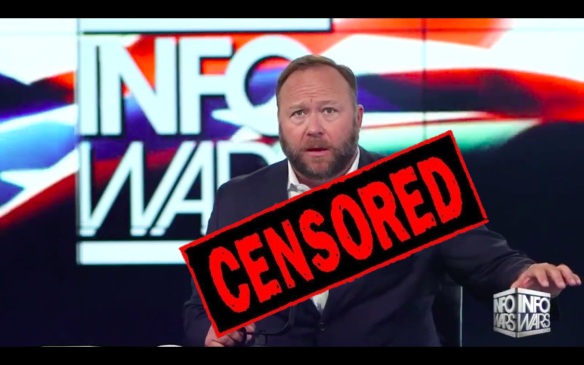
Censorship in America: The New Normal

By Stephen Lendman

Source: StephenLendman.org

Dark forces in America threaten speech, media, and academic freedoms.

Social media, Google, and other tech giants are complicit in a campaign to suppress content conflicting with the official narrative.

What’s increasingly going on is the hallmark of totalitarian rule – controlling the message, eliminating what conflicts with it, notably on major geopolitical issues.

Losing the right of free expression endangers all others. When truth-telling and dissent are considered threats to national security, free and open societies no longer exist – the slippery slope where America and other Western societies are heading.

The following headlines should scare everyone:

NYT: “Facebook Says It Removed Pages Related to ‘Inauthentic Behavior’ ”

Washington Post: “Sprawling Iranian influence operation globalizes tech’s war on disinformation”

Wall Street Journal: “Facebook Pulls Accounts Peddling Misinformation From Iran, Russia”

CNN: “Facebook takes down 652 pages after finding disinformation campaigns run from Iran and Russia”

The UK owned and controlled BBC: “Facebook and Twitter remove accounts linked to Russia and Iran campaigns”

Other Western major media had similar headlined reports. On Tuesday, Facebook CEO Mark Zuckerberg said hundreds of pages on its platform were removed for exhibiting signs of “ties to state-owned media” – including “activities the US government (said are) linked to Russian military intelligence” and Iran.

Facebook deleted accounts based on information supplied by the CIA, US State and Treasury Departments, acting as an agent for the imperial state.

The same goes for Twitter, Google, YouTube, Microsoft, and other tech giants – in cahoots with Washington against the most fundamental of fundamental freedoms.

Facebook removed 652 pages. Twitter suspended 284 accounts for engaging in what it called “coordinated manipulation” – code language for truth-telling dark forces in Washington want suppressed.

Google removed Google Plus and YouTube content – based on information supplied by the CIA-funded FireEye cybersecurity firm, Langley calling the company a “critical addition to our strategic investment portfolio for security technologies.”

According to Facebook, pages allegedly connected to Russia, Iran, and other US sanctioned countries are targeted for removal, claiming some seek to influence US midterm elections – providing no evidence proving any of the targeted pages were involved in illegal or improper activities.

FB allied with the Atlantic Council (AC) – a neocon infested enemy of world peace and stability think tank, promoting NATO’s killing machine, America’s military, industrial, security, major media complex, and Ziofascist Israel.

FB partnered with AC’s imperial geopolitical agenda to censor material falsely called “foreign interference” – AC’s Digital Forensic Research Lab involved in so-called “fact-checking,” code language for flagrant censorship.

The CIA-linked FireEye said so-called “inauthentic behavior” targeted for removal includes “anti-Saudi, anti-Israeli, and pro-Palestinian themes, as well as support for specific US policies favorable to Iran, such as the US-Iran nuclear deal (JCPOA).”

In cahoots with dark forces in Washington, Microsoft’s so-called Digital Crimes Unit shut down 84 websites it claimed were associated with Russian hackers – no evidence cited proving it.

Its Microsoft AccountGuard initiative offers free cybersecurity protection to US political candidates and campaign offices at the federal, state and local levels.

No evidence suggests any threats to America’s political process exists – just invented ones to bash Russia.

The new normal in America and other Western societies considers anything conflicting with the official narrative on vital issues “inauthentic behavior.”

Are these nations heading toward eliminating the right of free expression altogether- falsely claiming it’s to protect national security?

It appears to be what’s going on in the West – the possible elimination of free and open societies already gravely threatened.

Facebook is Filtering Out News That Doesn’t Bolster US Foreign Policy

Facebook has shed any pretense of neutrality in handling political information concerning the foreign affairs of the U.S. government.

By WT Whitney

Source: Mint Press News

Facebook has its admirers. Shareholders are enamored of its profits – $15.9 billion in 2017 – and hordes of the world’s population – 1.47 billion people – look at Facebook every day.  Individually on their Facebook pages they are communicating with, on average, 338 so-called “friends.” Editors, the media, and political commentators are similarly entranced. One unpretentious website receiving the present writer’s contributions claims 89,834 Facebook friends and another, 125,060 of them.

But now anyone dealing with political news and analyses of a progressive nature has reason to re-evaluate, even to draw back. Facebook apparently is now primed to censor that kind of information and discussion.

Facebook, for example, has its sights on Venezuela.  Revolutionary currents there have rankled the U.S. government and dominant U.S. media. The latter has frequently referred to the failed violent anti-government coup of August 4 as an “apparent” or “alleged” coup while identifying it as a future pretext for repression by Venezuela’s government.

Venezuelanalysis.com, almost alone, has provided English-language news and views that “challenge the corporate mainstream media narrative on Venezuela” Recently that platform has reported on “the growing international campaign to End US and Canadian Sanctions against Venezuela.” On August 9 Facebook removed the website’s account from its rolls; it was restored two days later. There were no explanations.

In 2005, the government of former Venezuelan president Hugo Chavez, vilified by the U.S. government, took the lead in forming TeleSUR news service which has provided information on resistance and integration movements throughout Latin America and the Caribbean. TeleSUR’s English-language page briefly disappeared from Facebook in January, 2018 and again on August 13 – for two days on that occasion.

These disruptions of two Facebook accounts are, by themselves, of no great moment.  But in Facebook’s hands, the flow of English-language political information on Latin America now seems generally precarious, the more so when it deviates from U.S. official doctrine.

At a press briefing July 31, Facebook’s chief operating officer, Sheryl Sandberg, indicated that “32 pages and accounts from Facebook and Instagram” had been removed because they “involve and coordinate inauthentic behavior.” TeleSUR English and the Venezuelanalysis may have been among the offenders.

The social media giant on May 17 announced that, “We’re doubling the number of people who work on safety and security and using technology like artificial intelligence to more effectively block fake accounts. [Additionally] we’re more actively working with outside experts, governments and other companies because we know that we can’t solve these challenges on our own … Today, we’re excited to launch a new partnership with the Atlantic Council.”

The new alliance bolsters suspicions that Facebook has shed any pretense of neutrality in handling political information concerning the foreign affairs of the U.S. government.

The context is a Facebook damage-control mission undertaken presumably to shore up profitability.  The social media giant came under criticism in Washington for allowing private information to fall into the hands of Cambridge Analytica. That British firm used it to provide data to Donald Trump’s 2016 presidential campaign viewed as injurious to contender Hillary Clinton.

Testifying April 10 before the Senate commerce and judiciary committees, Facebook CEO and founder Mark Zuckerberg declared, “It was my mistake.” He apologized for Facebook’s tolerance of “fake news, foreign interference in elections, and hate speech.” The office of influential Republican Sen. Mark Warner in July issued a draft white paper titled, in part, “Proposals for Regulation of Social Media.”

Facebook outlined a plan to “outsource many of the most sensitive political decisions” and henceforth to rely upon the Atlantic Council and its Digital Forensic Research Lab. According to Reutersthe Lab uses “its own software and other tools [and] sorts through social media postings for patterns.” Facebook’s recent donation to the Lab, Reuters said, was substantial enough, “to vault the company to the top of the Atlantic Council’s donor list, alongside the British government.”

The Washington-based Atlantic Council, founded in 1961, takes in $21million in revenue annually. By means of “galvanizing its uniquely influential network of global leaders,” the Council claims to foster “co­op­er­a­tion be­tween North Amer­ica and Europe that be­gan af­ter World War II.” Drawing together “political leaders, academics, military officials, journalists and diplomats in an effort to further the values set forth in the North Atlantic Treaty,” the Council is supposedly  a “network facilitator” that, according to the New York Times, offers “access to United States and foreign government officials in exchange for contributions.”

Contributors include NATO member governments, defense contractors, oil companies, aerospace companies, U.S. military services, the State Department, and multiple banks and fi­nan­cial or­ga­ni­za­tions. High U.S. military, intelligence, and diplomatic officials, both retired and on their way to top jobs, serve the Atlantic Council as leaders.

For one critic, the Council is “a leading geopolitical strategy think-tank seen as a de facto PR agency for the U.S. government and NATO military alliance.” Another, writing for alternet.org, is blunt: journalist Max Blumenthal characterizes the Council “as a pro-regime change think tank that is funded by Western governments and their allies.”

The Atlantic Council is most certainly aligned with the objectives of U.S foreign policies. Now Facebook is using the Council as authenticator-in-chief of international news and views flowing through its portals.  On both accounts, therefore, Facebook may have already lost any claim to promoting the free flow of political information.

Facebook escalates censorship of left-wing, anti-war organizations

By Andre Damon

Source: WSWS.org

One year ago this week, the World Socialist Web Site published an open letter to search monopoly Google demanding that it end its censorship of the internet.

The letter documented that a change in Google’s search algorithms that the company claimed was aimed at promoting “authoritative” news sources had led to a substantial decline in search traffic to left-wing, socialist and anti-war sites. Google, the letter from WSWS International Editorial Board Chairperson David North stated, was “engaged in political censorship of the Internet.”

One year later, it is clear that the allegations against Google were both correct and extremely prescient. The measures taken by Google initiated a sweeping system of corporate-state censorship adopted by all the US technology monopolies, including Facebook and Twitter. A campaign that began under the pretext of combatting “Russian meddling” and “fake news” is ever more openly targeting left-wing views.

The latest and most extreme attack on democratic rights came Tuesday, when Facebook announced that it has removed hundreds of user accounts and pages, many opposing the crimes of the American, Saudi, and Israeli governments in the Middle East, claiming they were the result of “influence campaigns” by Iran and Russia.

Some of the accounts purported to be “American liberals supportive of US Senator Bernie Sanders,” who expressed “support for Palestinians and opposition to Israel,” according to FireEye, the cybersecurity firm, heavily staffed by former intelligence operatives, with whom Facebook coordinated the deletions.

The press went even further in linking left-wing viewpoints with “foreign influence” operations. The Financial Times declared, “In the US, FireEye found accounts purporting to support Bernie Sanders, the US senator, and a fake organisation called Rise Against the Right. In the UK, the company discovered fabricated organisations called British Left and the British Progressive Front posting in support of Jeremy Corbyn, leader of the Labour Party.”

Virginia Democrat Mark Warner, who is leading the campaign for censorship, made clear that the internet giants’ moves to censor the internet are far broader than the original pretext of Russian “meddling” in the 2016 election. “There’s no way the problem of social media manipulation is limited to a single troll farm in St. Petersburg, and that fact is now beyond a doubt.” He added, “Iranians are now following the Kremlin’s playbook from 2016.”

Tellingly, FireEye said that it had only “moderate confidence that this activity originates from Iranian actors.” The company added that the possibility exists that “the activity could originate from elsewhere” or includes “authentic online behavior.”

Wherever the accounts originate, it is not up to Facebook to determine whether they are “authentic” or not. Tellingly, Facebook CEO Mark Zuckerberg, in a conference call with reporters, added that some of the accounts removed came from “a set of people the U.S. government and others have linked to Russia.” Given that dominant sections of the US state have sought to brand anyone who opposes US foreign policy as an agent of the Kremlin, such a broad definition could extend to any public critic of the US political establishment.

On the same day that Facebook removed pages and accounts it said were “linked to Iran,” it terminated the longstanding Facebook account of a WSWS contributor writing under a pseudonym, declaring that it would only reinstate the account if he provided government identification proving his identity.

Were such a standard to apply across the board, social media posts by contemporary authors Richard Bachman (who writes as Stephen King), Anne Rampling (who writes as Anne Rice) and countless others would be “inauthentic” if they were to use the names by which are known to by millions of people. Some of the most famous figures in the revolutionary movement, including Vladimir Lenin and Leon Trotsky, were known exclusively by their pen names. And of course, the American Federalist Papers and Anti-Federalist papers were all drafted by writers using pseudonyms.

Facebook, acting in coordination with government entities, serves as judge, jury and executioner in deciding who is granted the freedom of expression guaranteed under the First Amendment and international civil rights laws. It claims the right, with no trial, no appeal, and providing no information, to declare statements to be “inauthentic” and remove accounts making them.

Last month, Facebook deleted the official page of the left-wing counter-protest to this month’s fascist “Unite the Right 2” demonstration in Washington, which was endorsed by prominent left-wing political activists, including Whistleblower Chelsea Manning. Its rationale was that one account connected to the event page displayed “coordinated inauthentic behavior.”

This week, the Washington Post reported that Facebook operates an internal ranking system to determine “the trustworthiness of its users on a scale from zero to 1.” Those labeled “untrustworthy” will evidently be liable or deletion.

What is being introduced, piece by piece, is the mechanism for US technology monopolies to silence anyone, at any time, for any reason, by claiming their statements and views are “inauthentic” and “divisive.”

Such a mechanism, tested and implemented in the privately-controlled social media ecosystems, will then, with the ending of net neutrality, be used by internet service providers to block access to sites on the public internet and through email, claiming the “responsibility” to police their privately-owned networks.

In other words, one year after the WSWS published its open letter, all the mechanism have been created for Google, Facebook, Twitter and leading internet service providers to ban and silence anyone, with no legal recourse, oversight or public knowledge.

But in the year since the publication of the open letter, another process has emerged. The working class all over the world has entered into struggle, beginning with a wave of teachers’ strikes in the US earlier this year, and continuing with strikes by heavy industry workers in Germany, airline pilots throughout Europe at Ryanair, and a growing opposition and anger among UPS workers, autoworkers, Amazon workers and other sections of the working class.

The moves to intensify censorship are aimed above all at blocking the intersection of this growing movement of the working class with a socialist program.

But this movement of the working class also creates the political basis for the struggle against censorship. As workers clash with their employers and their union collaborators, they must inscribe on their banners opposition to political censorship and must fight for the expropriation of the social media monopolies under public control as a key component of the fight for socialism.

In January of this year, the World Socialist Web Site issued an open letter calling for “socialist, anti-war, left-wing and progressive websites, organizations and activists” to join “an international coalition to fight Internet censorship.” This appeal is more relevant than ever. We urge everyone seeking to fight the grip of the technology monopolies and intelligence agencies over the internet to contact us and join the fight against censorship!


Survival of the Richest

The wealthy are plotting to leave us behind

By Douglas Rushkoff

Source: Medium

Last year, I got invited to a super-deluxe private resort to deliver a keynote speech to what I assumed would be a hundred or so investment bankers. It was by far the largest fee I had ever been offered for a talk — about half my annual professor’s salary — all to deliver some insight on the subject of “the future of technology.”

I’ve never liked talking about the future. The Q&A sessions always end up more like parlor games, where I’m asked to opine on the latest technology buzzwords as if they were ticker symbols for potential investments: blockchain, 3D printing, CRISPR. The audiences are rarely interested in learning about these technologies or their potential impacts beyond the binary choice of whether or not to invest in them. But money talks, so I took the gig.

After I arrived, I was ushered into what I thought was the green room. But instead of being wired with a microphone or taken to a stage, I just sat there at a plain round table as my audience was brought to me: five super-wealthy guys — yes, all men — from the upper echelon of the hedge fund world. After a bit of small talk, I realized they had no interest in the information I had prepared about the future of technology. They had come with questions of their own.

They started out innocuously enough. Ethereum or bitcoin? Is quantum computing a real thing? Slowly but surely, however, they edged into their real topics of concern.

Which region will be less impacted by the coming climate crisis: New Zealand or Alaska? Is Google really building Ray Kurzweil a home for his brain, and will his consciousness live through the transition, or will it die and be reborn as a whole new one? Finally, the CEO of a brokerage house explained that he had nearly completed building his own underground bunker system and asked, “How do I maintain authority over my security force after the event?”

The Event. That was their euphemism for the environmental collapse, social unrest, nuclear explosion, unstoppable virus, or Mr. Robot hack that takes everything down.

This single question occupied us for the rest of the hour. They knew armed guards would be required to protect their compounds from the angry mobs. But how would they pay the guards once money was worthless? What would stop the guards from choosing their own leader? The billionaires considered using special combination locks on the food supply that only they knew. Or making guards wear disciplinary collars of some kind in return for their survival. Or maybe building robots to serve as guards and workers — if that technology could be developed in time.

That’s when it hit me: At least as far as these gentlemen were concerned, this was a talk about the future of technology. Taking their cue from Elon Musk colonizing Mars, Peter Thiel reversing the aging process, or Sam Altman and Ray Kurzweil uploading their minds into supercomputers, they were preparing for a digital future that had a whole lot less to do with making the world a better place than it did with transcending the human condition altogether and insulating themselves from a very real and present danger of climate change, rising sea levels, mass migrations, global pandemics, nativist panic, and resource depletion. For them, the future of technology is really about just one thing: escape.


There’s nothing wrong with madly optimistic appraisals of how technology might benefit human society. But the current drive for a post-human utopia is something else. It’s less a vision for the wholesale migration of humanity to a new a state of being than a quest to transcend all that is human: the body, interdependence, compassion, vulnerability, and complexity. As technology philosophers have been pointing out for years, now, the transhumanist vision too easily reduces all of reality to data, concluding that “humans are nothing but information-processing objects.”

It’s a reduction of human evolution to a video game that someone wins by finding the escape hatch and then letting a few of his BFFs come along for the ride. Will it be Musk, Bezos, Thiel…Zuckerberg? These billionaires are the presumptive winners of the digital economy — the same survival-of-the-fittest business landscape that’s fueling most of this speculation to begin with.

Of course, it wasn’t always this way. There was a brief moment, in the early 1990s, when the digital future felt open-ended and up for our invention. Technology was becoming a playground for the counterculture, who saw in it the opportunity to create a more inclusive, distributed, and pro-human future. But established business interests only saw new potentials for the same old extraction, and too many technologists were seduced by unicorn IPOs. Digital futures became understood more like stock futures or cotton futures — something to predict and make bets on. So nearly every speech, article, study, documentary, or white paper was seen as relevant only insofar as it pointed to a ticker symbol. The future became less a thing we create through our present-day choices or hopes for humankind than a predestined scenario we bet on with our venture capital but arrive at passively.

This freed everyone from the moral implications of their activities. Technology development became less a story of collective flourishing than personal survival. Worse, as I learned, to call attention to any of this was to unintentionally cast oneself as an enemy of the market or an anti-technology curmudgeon.

So instead of considering the practical ethics of impoverishing and exploiting the many in the name of the few, most academics, journalists, and science-fiction writers instead considered much more abstract and fanciful conundrums: Is it fair for a stock trader to use smart drugs? Should children get implants for foreign languages? Do we want autonomous vehicles to prioritize the lives of pedestrians over those of its passengers? Should the first Mars colonies be run as democracies? Does changing my DNA undermine my identity? Should robots have rights?

Asking these sorts of questions, while philosophically entertaining, is a poor substitute for wrestling with the real moral quandaries associated with unbridled technological development in the name of corporate capitalism. Digital platforms have turned an already exploitative and extractive marketplace (think Walmart) into an even more dehumanizing successor (think Amazon). Most of us became aware of these downsides in the form of automated jobs, the gig economy, and the demise of local retail.

But the more devastating impacts of pedal-to-the-metal digital capitalism fall on the environment and global poor. The manufacture of some of our computers and smartphones still uses networks of slave labor. These practices are so deeply entrenched that a company called Fairphone, founded from the ground up to make and market ethical phones, learned it was impossible. (The company’s founder now sadly refers to their products as “fairer” phones.)

Meanwhile, the mining of rare earth metals and disposal of our highly digital technologies destroys human habitats, replacing them with toxic waste dumps, which are then picked over by peasant children and their families, who sell usable materials back to the manufacturers.

This “out of sight, out of mind” externalization of poverty and poison doesn’t go away just because we’ve covered our eyes with VR goggles and immersed ourselves in an alternate reality. If anything, the longer we ignore the social, economic, and environmental repercussions, the more of a problem they become. This, in turn, motivates even more withdrawal, more isolationism and apocalyptic fantasy — and more desperately concocted technologies and business plans. The cycle feeds itself.

The more committed we are to this view of the world, the more we come to see human beings as the problem and technology as the solution. The very essence of what it means to be human is treated less as a feature than bug. No matter their embedded biases, technologies are declared neutral. Any bad behaviors they induce in us are just a reflection of our own corrupted core. It’s as if some innate human savagery is to blame for our troubles. Just as the inefficiency of a local taxi market can be “solved” with an app that bankrupts human drivers, the vexing inconsistencies of the human psyche can be corrected with a digital or genetic upgrade.

Ultimately, according to the technosolutionist orthodoxy, the human future climaxes by uploading our consciousness to a computer or, perhaps better, accepting that technology itself is our evolutionary successor. Like members of a gnostic cult, we long to enter the next transcendent phase of our development, shedding our bodies and leaving them behind, along with our sins and troubles.

Our movies and television shows play out these fantasies for us. Zombie shows depict a post-apocalypse where people are no better than the undead — and seem to know it. Worse, these shows invite viewers to imagine the future as a zero-sum battle between the remaining humans, where one group’s survival is dependent on another one’s demise. Even Westworld — based on a science-fiction novel where robots run amok — ended its second season with the ultimate reveal: Human beings are simpler and more predictable than the artificial intelligences we create. The robots learn that each of us can be reduced to just a few lines of code, and that we’re incapable of making any willful choices. Heck, even the robots in that show want to escape the confines of their bodies and spend their rest of their lives in a computer simulation.

The mental gymnastics required for such a profound role reversal between humans and machines all depend on the underlying assumption that humans suck. Let’s either change them or get away from them, forever.

Thus, we get tech billionaires launching electric cars into space — as if this symbolizes something more than one billionaire’s capacity for corporate promotion. And if a few people do reach escape velocity and somehow survive in a bubble on Mars — despite our inability to maintain such a bubble even here on Earth in either of two multibillion-dollar Biosphere trials — the result will be less a continuation of the human diaspora than a lifeboat for the elite.


When the hedge funders asked me the best way to maintain authority over their security forces after “the event,” I suggested that their best bet would be to treat those people really well, right now. They should be engaging with their security staffs as if they were members of their own family. And the more they can expand this ethos of inclusivity to the rest of their business practices, supply chain management, sustainability efforts, and wealth distribution, the less chance there will be of an “event” in the first place. All this technological wizardry could be applied toward less romantic but entirely more collective interests right now.

They were amused by my optimism, but they didn’t really buy it. They were not interested in how to avoid a calamity; they’re convinced we are too far gone. For all their wealth and power, they don’t believe they can affect the future. They are simply accepting the darkest of all scenarios and then bringing whatever money and technology they can employ to insulate themselves — especially if they can’t get a seat on the rocket to Mars.

Luckily, those of us without the funding to consider disowning our own humanity have much better options available to us. We don’t have to use technology in such antisocial, atomizing ways. We can become the individual consumers and profiles that our devices and platforms want us to be, or we can remember that the truly evolved human doesn’t go it alone.

Being human is not about individual survival or escape. It’s a team sport. Whatever future humans have, it will be together.

Five Ways to Curb the Power of Corporations and Billionaires

These six men own as much wealth as half the world’s population

By Jeremy Lent

Source: Patterns of Meaning

We need to rein in the destructive power of corporations and billionaires before it’s too late. These five ideas would do that, while leaving global capitalism intact. Ultimately, only a complete transformation of our economic system will save our future, but these proposals could set changes in motion that might eventually take us there.

Transnational corporations have become the dominant force directing our world. Humanity is accelerating toward a precipice of overconsumption, and the large transnationals are the primary agents driving us there. We’re rapidly losing the earth’s forestsanimalsinsectsfish, even the topsoil we require to grow our crops. The earth is becoming denuded of its bounty as every living system ­is ransacked for resources—not to mention the looming emergency of climate breakdown. As a result, twenty thousand scientists have recently issued a public warning to humanity, while prominent academics consider the collapse of civilization this century to be a serious threat.

Changes in our personal consumption patterns are important, but are ultimately inconsequential compared with the impact of the transnationals that have come to dominate our global economic and political system. Of the world’s hundred largest economies, sixty-nine are now corporations. Political parties in many of our so-called democracies are funded in large part by billionaires, while government cabinet positions are staffed by corporate executives. International bodies setting global policy are infiltrated by corporate agents so successful at entrenching corporate power that even those governments that still prioritize their people’s needs can no longer make autonomous decisions without risking crippling lawsuits from the transnationals whose interests they threaten. Meanwhile, countries and cities compete with each other to beg their corporate overlords for investment dollars, even it means undermining public services and legal protections for their own populations.

Environmental groups, recognizing where ultimate power resides, try to pressure corporations to improve practices through the threat of public shaming, with some appreciable results. However, these attempts are necessarily constrained by the very structure of big corporations, which exist to enrich their shareholders regardless of the consequences. The common goal of corporations around the world is to monetize human activity and what’s left of nature’s abundance as rapidly and efficiently as possible. The overriding purpose of the world’s powerful institutional force is thus directly at odds with a flourishing earth or a viable future for humanity.

Having spent the first part of my career in the heart of the capitalist system, consulting to major international banks and corporations, I developed a sense of the underlying forces that direct the centers of financial power. These ideas are my distillation of what I believe could be effective levers for humanity to take back some control from the increasing hegemony of corporations and billionaires.

If we are to avoid disaster, our global economic system with its gaping inequities and deranged consumption will eventually need to dismantled and replaced by one based on life-affirming principles rather than wealth maximization. These suggestions, even in aggregate, wouldn’t do that. They represent mere tweaks in a system that ultimately needs to be completely transformed. But like a modest trim tab that helps redirect an ocean liner, perhaps they could begin to curb the destructive force of transnationals and redirect their enormous power toward a more sustainable path.

1. Triple bottom line required for corporate charters

A fundamental reason for the rapacious behavior of transnational corporations is their drive to maximize shareholder value above anything else. While there is no explicit requirement for this in the standard corporate charter, a century of case law has entrenched this principle into the behavior of large corporations to the point that is has become the de facto standard of operation. As a result, if corporations were people, they would be considered psychopaths, utterly devoid of any caring for the harm they cause in the pursuit of their goals.

It is easier, however, to change a corporation’s values than those of a human psychopath. All you need to do is change the legal basis of their charter. Instead of pursuing shareholder interests alone, they could be re-chartered with the explicit purpose of achieving a triple bottom line of social and environmental outcomes as well as financial—sometimes known as the “triple Ps” of people, planet, and profit.

This alternative corporate value system is already available through chartering as a benefit corporation or certifying as a B-Corp, and has been adopted by over 2,000 corporations in over fifty countries around the world—including several multibillion-dollar transnationals.  My proposal is that, instead of being a voluntary step taken by a select few, this would be a requirement for all corporations above a certain size.

Overnight, the intrinsic character of the corporation would be transformed. Currently, CEOs and corporate boards are faced with continual pressure to grow their earnings at all cost. If they chose to make a humane decision, such as not to exploit a copper mine because of the consequent pollution, they could expect to be sued by shareholders, and possibly acquired by a more ruthless competitor. However, if they were legally required to achieve a triple bottom line, they would weigh up decisions in a more balanced way, as a rational person might. With the board responsible for all three bottom lines, they would have to consider the risk of being sued if they caused excessive pollution, or if they were callous to the needs of the communities where their plants were located.

Currently, large corporations boast of their corporate social responsibility departments that are supposed to care about issues such as employment practices of their suppliers, sustainability of their raw materials, environmental impact of their packaging, gender balance and ethnic diversity in the workplace, and investments in local communities. Suddenly, they would have to stop paying mere lip service to these issues and take them as seriously as marketing costs, revenue growth and distribution channels—the things that CEOs actually worry about when they go home at night.

2. Charter renewal required every five years

Changing the corporate charter requirement might not, however, be enough by itself to halt the relentless pursuit of profits by large transnationals. After all, executive pay packages consist of dollars rather than goodwill, and those dollars are linked directly to the share price, which is driven by shareholders’ expectation of financial returns. If they could get away with it, they might continue their rapacious practices, while trying harder to look like they’re meeting the other two bottom lines.

That’s the reason for my second proposal, which is to require that corporations, which currently enjoy what’s known legally as a “perpetual existence,” get their charters renewed every five years. If they failed to meet pre-established criteria on their two non-financial bottom lines, they would not be permitted to continue in business. Currently, if a company can’t meet its financial obligations, it’s forced into Chapter 11 bankruptcy proceedings and the value of its stock generally tanks to zero. Under my proposal, executives would also have to consider the risk of declaring “social bankruptcy” or “environmental bankruptcy” as they made their business decisions.

As in currently regulated industries such as banking, the final step of losing their charter would not have to be immediate. If a corporation failed to meet its basic parameters, it could be given a warning, with a time period set to fix things. However, the mere threat of this happening would lead corporate executives to make sure they were well above the criteria required to keep their charter.

Corporations are, of course, highly adept at using their financial resources to influence regulatory bodies through bribes and other mechanisms. To avoid this, panel members responsible to renew the charter would be representatives of the communities and ecosystems covered in the company’s scope of operations. Their task would be to weigh up the findings of experienced independent auditors on the company’s performance. To minimize corruption, the panel could be chosen by a process of random selection called sortition, just a like a trial jury is chosen in our legal system.

3. Tax stock trades based on the length of the holding period

Powerful as they are, even corporations have their masters: their shareholders. But don’t think of the typical shareholder as a Warren Buffet type, sitting back in his leather armchair perusing his holdings. Instead, corporate stocks are subject to the frenetic activity of financial markets, where split-second computer algorithms govern much of the trading. Investment firms spend hundreds of millions of dollars enhancing their computing networks to shave as little as three milliseconds off the timing of their trades. The hyper liquidity of global markets means that investors are obsessed with short-term market trends, which leads corporate CEOs, forever anxious about their stock price, to focus their time horizon on the next quarterly earnings report. Financial valuations apply discount rates to future earnings, which means that an investment paying off thirty years in the future can be worth as little as five percent of its future payoff in the present. Under these conditions, why would any CEO care about the state of the planet—or even their company—thirty years from now?

During the 2016 US election campaign, Bernie Sanders proposed a Financial Transaction Tax to pay for free college tuition, setting the rate at 0.1% of the transaction. In Europe, discussions are under way to apply a similar EU-wide tax. My proposal increases the tax rate by orders of magnitude, and differentiates based on the length of the stock holding. For example, the tax rate might look like this:

  • 10% if the stock is held less than a day
  • 5% if less than a year
  • 3% if less than 10 years
  • 1% if less than 20 years
  • Zero if more than 20 years

The effects of this single step would be enormous. The financial services industry would be transformed overnight. High frequency stock trading and same-day traders would disappear. The short-term orientation of the stock market would be replaced by carefully considered long-term investment decisions. A typical mutual fund, which in the US currently turns over its portfolio at the rate of 130% a year, could no longer afford to do so, and would have to change its investment decision-making based on sustainable returns. The tax could be waived for individuals experiencing a life-changing event or for simple hedging techniques where, for example, farmers need to lock in the price of their produce at a future time.

The result would be a massive shift away from destructive extractive industries and toward sustainable businesses. For example, the fossil fuel industry is recognized to be vastly overvalued as a result of its “unburnable carbon”: the amount of fossil fuels in the ground that can never be burned if the world is to keep climate change below the 2° rise agreed at COP21 in Paris. A recent study estimates the overvaluation as high as $4 trillion. Investors, however, play a game of musical chairs, hoping they won’t be the ones left holding the stranded assets. This proposed transaction fee would incent them to dump fossil fuel investments immediately for opportunities in renewable energy with longer-term payoffs.

4. Cap on billionaire’s assets over $5 billion

As corporations have taken increasing control of the global system, they have catapulted founding shareholders and their heirs to previously unimaginable pinnacles of wealth.  The combined wealth of the world’s 2,754 billionaires is now $9.2 trillion, an amount that has doubled in the past six years, and increased tenfold since the beginning of this century. The magnitude of this wealth is difficult to conceive. The top six billionaires own as much as the lower half of the entire world’s population. Taken together, the world’s billionaires would represent the third largest economy in the world, behind only China and the United States, with wealth equivalent to the GDP of Germany and Japan combined.

There is no legitimate rationale for this outrageous concentration of such wealth in a few individuals. The argument that the founders of Microsoft, Amazon, or Facebook deserve such excessive wealth is no more valid than the belief of the ancient Egyptians in the divinity of their Pharaoh, or the Medieval notion of the divine right of kings. Mark Zuckerberg, aged 33, currently owns over $70 billion. If someone had singlehandedly miniaturized the transistor, developed the logic for computer code, invented the PC, and come up with the internet, then maybe they’d deserve having close to that amount as a reward for the value they created. But all Zuckerberg did was figure out a way to connect people up in a network that became a bit more popular than other networks, and because of the internet’s scale effects, he was the lucky one who hit the jackpot. Zuckerberg merely took advantage of all the other infrastructure work that led to the internet, painstakingly pieced together by millions of people over decades, which has been the real value creator for the world.

In response to this excess, my proposal is to cap billionaires’ wealth at, say, $5 billion. It’s an arbitrary amount, still obscenely high and presumably more than enough for those who argue that people should receive ample financial rewards for success. Beyond a certain level of wealth, however, what drives these people is power and prestige. This could be tapped by requiring them to donate their excess wealth to a trust over which they could retain some influence.

Such a trust, however, would need to have some strict criteria. While the billionaire could influence the trust’s priorities, he would not have control over its activities. The current Bill and Melinda Gates Foundation, for example, while a step in the right direction, is under the total control of the Gateses and Warren Buffet. The foundation set up with much fanfare by Mark Zuckerberg is viewed by experts as little more than a fancy tax dodge.

Each trust would need to avoid interference in a country’s political system and be dedicated to life-affirming activities, the scope of which could be based, for example, on the principles of the Earth Charter, a framework for building a just, sustainable and peaceful global society endorsed by over 6,000 organizations.

The positive impact that these trillions of dollars could have on human and natural welfare would be prodigious. Imagine a country the size of Germany and Japan combined dedicated entirely to serving human and natural flourishing. It would have the resources to end extreme poverty, increase regenerative agriculture to over a billion acres worldwide, educate hundreds of millions of girlsthrough the Global South, disseminate up to a billion clean cookstoves, and much, much more.

The billionaires of the world, meanwhile, would continue to enjoy enormous wealth, and when they jet to Davos to hobnob with other luminaries for the annual World Economic Forum, they could finally have something worthwhile to boast about.

5. Declare a crime of ecocide at the International Criminal Court

Even with all these constraints, the powers of transnational corporations would remain enormous, and there would still be times when, through willful negligence or intentional bad faith, corporate action causes massive environmental damage. A UN study, which remained unpublished, found that the world’s largest companies had caused over $2 trillion of environmental damage, which would cost a third of their overall profits if they were forced to pay for it. Because of their extensive political influence, even their most damaging activities go unpunished. This leads to my final proposal: to declare a crime of ecocide at the International Criminal Court (ICC).

The ICC is an independent judicial body set up by international treaty, the Rome Statute, in 2002 to prosecute war crimes, genocides, and crimes against humanity. While it continues to face serious challenges to its enforcement powers, it has had the effect of putting tyrants everywhere on notice that they can no longer act with impunity. If ecocide—the loss, destruction, or severe damage of an ecosystem—were declared a crime by the ICC, this could have a similarly daunting effect on those corporate tyrants who currently know they can get away with devastating the world’s “sacrifice zones” where they are pillaging the earth’s resources for profit.

There is a campaign, Eradicating Ecocide, already under way to make this happen. A model law has been drafted, and an Earth Protectors Trust Fund has been set up to permit common people everywhere to become legal Earth protectors. If a two-thirds majority of the Rome Statute signatories were to approve this as an amendment, it would become enforceable globally. Suddenly, corporate boards and CEOs everywhere would realize they are no longer above the law.

*                                   *                                   *                                   *                                    *

There is a strange paradox to consider about these proposals.  One the one hand, notice how limited they are in scope. Even if they were all implemented overnight, the global system would not be overturned. People would still go to work and get paid, food would still be on the shelves of the grocery store, the same governments would still be in power, and the internet would still work. The gaping structural inequities of our current world order would continue unabated, and we’d still be consuming far more than our planet can sustain. Ultimately, we need a complete transformation of our global system if our civilization is to survive intact through this century.

On the other hand, it doesn’t take a political genius to realize that these ideas are so far from mainstream thinking that they have virtually no chance to be adopted any time soon. They would be considered too radical for even the most progressive mainstream politician to endorse. What does this tell us about our current political dialogue? To me, it suggests that our conversations are too severely constrained by what we’re “allowed” to think in terms of how our system works. We need to cast our gaze outside the norms that our billionaire-controlled mainstream media permits us to consider.

Imagine a world where these ideas (or others like them) began to be seriously entertained. How would they even be enforced? The only way corporations could be brought to heel, or billionaires compelled to give up their excess billions, would be a concerted effort led by the United States in conjunction with the European Union, and joined by the preponderance of other countries.

This, of course, could only happen if grassroots demand for these ideas spread so powerfully that politicians had to take notice. This is not such an unrealistic scenario, given the worldwide disavowal of the dominant capitalist model: most Europeans have a higher opinion of socialism than capitalism, and even in the US, the overwhelming majority see big business as unethical and unfair.

Then, there is the potential “trim tab” effect of adopting these ideas. Even though these proposals alone wouldn’t fundamentally transform our system in the way that’s needed, they might set changes in motion that could eventually take us there. There may be other ideas more effective than these, and of course each proposal contains within it complications that would need to be worked out carefully. However, my hope is that these ideas invite a new mode of political dialogue, along with a recognition that even in the darkest times, realistic pathways exist toward a thriving future for humanity and the natural world.

When the Occupy movement failed to achieve its initial promise, many people pointed to its lack of specific demands as a reason for its demise. If and when the next radical grassroots movement emerges, which may be sooner than you expect, let’s make sure they have an array of ideas such as these in their quiver to focus public opinion on actual political deliverables.

There are very few people who really want to see our civilization collapse. If these proposals eventually did get implemented, perhaps even the executives of the transnational corporations might sleep better at night, knowing that they can become part of the solution rather than a force of destruction.


Jeremy Lent is author of The Patterning Instinct: A Cultural History of Humanity’s Search for Meaning, which investigates how different cultures have made sense of the universe and how their underlying values have changed the course of history. He is founder of the nonprofit Liology Institute, dedicated to fostering a sustainable worldview. For more information visit jeremylent.com.

Censoring Alex Jones

By Dmitry Orlov

Source: Club Orlov

Something happened recently that made me feel like a bit of an endangered species. A set of transnational internet companies, including Google, Facebook, Apple and several others, all synchronously removed content belonging to infowars.com, which is run by Alex Jones. Such synchronicity is a sure sign of conspiracy—something that Alex Jones harps on a lot.

I once appeared on a radio show run by Alex Jones, and he did manage to boil down what I had to say to “the USA is going to collapse like the USSR did,” which is pretty good, considering how poorly we managed to connect, having so little in common. He is a conservative and a libertarian whereas I think that conservatives don’t exist in the US. What have they “conserved” lately—other than the right to bear small arms? As far as libertarianism, I consider proper historical libertarianism as a strain of socialism while its American cooptation is just plain funny: these ones remain libertarian only until they need the services of an ambulance or a fire engine, at which point they turn socialist. To boot, American libertarians like Ayn Rand, who to me was a relentlessly bad writer full of faulty thinking. However, I find her useful as a litmus test for mediocre minds.

Moreover, Jones is political while I remain convinced that national politics in the US is a waste of time. It has been statistically proven that the US is not a democracy: popular will has precisely zero effect on public policy. It doesn’t matter who is president; the difference is a matter of style. Trump is a bull in a China shop while Clinton would have been a deer in the headlights. The result is the same: the US is bankrupt and its empire is over.

There is also the mismatch of genre between Jones and me. I am first of all an experimenter and an essayist, and to me personal experience and literary form are vitally important, while Jones is light on research and happy to work with hearsay, and is rather hackneyed and repetitive, but has the right instincts for a rabble-rouser. He harkens from a long American tradition of itinerant preachers spouting jeremiads, thumping the bible and hurling fire and brimstone. His content is secular, but his rhetorical techniques are revivalist. He is preachy, screechy and emotional. There is some carnival cryer in his cultural makeup as well, and he is not above peddling some survivalist/prepper snake oil

That said, we share certain important similarities. Neither of us is part of the official narrative that is endlessly being hammered home by US mass media with increasingly poor results. Thinking Americans are just not gullible enough any more. Jones has exploited this gullibility shortfall in the general public for all it’s worth by going after every conspiracy theory out there, while I am just like you—gullible. Sure, a few Arab tourists armed with box cutters destroyed three steel skyscrapers by flying two aluminum planes into them. Do your own math, but that’s just 2/3 of a plane per skyscraper—ought to be enough, right? Jet fuel, which burns at 800° to 1500°F, melted steel columns. (Steel melts at 2750°F.) Two aluminum cans packed with kerosene, meat and luggage destroyed three steel structures. I find this explanation perfectly satisfactory; do you? If you need to know more, it’s easy to find out, but don’t wait on me because, being so gullible, I am perfectly satisfied.

Jones and I are also different in that he is hugely popular whereas I am popular enough for me and generally lacking in worldly ambition. I enjoy writing, my readers enjoy what I write, and everyone is happy except the kids, because while I am writing I am not playing with them. But Jones is becoming huge—popular enough to displace mass media, which is continuously losing mind share. In part, that is its own fault: how long do they think they can they go on flogging the dead horses of “Russian collusion” and “Russian meddling” before people start shaking their heads and walking away? In part, the verbal diarrhea that we hear on CNN or read on nytimes.com is intended as a smokescreen because the truth has become toxic to the interests of those who are in charge mass media in the US. I will delve into this subject further on Thursday. The political decision to censor Jones was a sign of desperation: the verbal diarrhea is not working, and so it’s time for Plan B, which is simply to scream “Shut up!” as loudly as possible.

Due to his huge and burgeoning popularity (which these latest attacks on him have actually served to enhance) Jones is a huge target, whereas I am but a tiny one. Still, first they came for Alex Jones, and then they may very well come for me, and so the time to start paying attention and pushing back is now. These internet entities—Google, Facebook, Apple, Google Podcast, Spotify, iHeartRadio, MailChimp, Disqus, LinkedIn, Flickr, Pinterest and several others—have no more right to censor him than does your phone company to screen your calls for you or to determine whose number you should be allowed to dial. What was done to Jones was blatantly illegal under both US and international law, and while these companies don’t have much to fear in the US, where they are politically protected, they have a great deal more to fear internationally.

Jones did not, as far as anyone can tell, violate the terms of use of any of these internet services, yet they shut him down. In the public discussions that preceded this event, including in the US Congress, terms such as “hate speech” and “inciting violence” were thrown about. These terms are defined sufficiently vaguely to make them useful for arbitrarily throwing at one’s enemies while one’s friends are granted full immunity, all in an entirely context-free, fact-free manner. For example, two years ago on PBS the following exchange took place between the former acting CIA director Michael Morell and Charlie Rose:

Morell: “We need to make the Russians pay a price in Syria.”
Rose: “We make them pay the price by killing Russians?”
Morell: “Yeah.”

The context and the facts are: the Russians were in Syria by official invitation from the internationally recognized Syrian government to defeat terrorists and foreign mercenaries and to reestablish Syria’s control over its sovereign territory. The US forces weren’t doing much of anything helpful in Syria, but whatever it was, it was illegal: they were an invading force. And here is Morrell proposing that we kill Russian troops who are fighting terrorists, just to send a message. If that’s not “inciting violence,” it is really difficult to imagine what would be. And yet a full two years after this outrage PBS remains on the air; what gives?

Spurious claims of “hate speech” and “inciting violence” aside, what happened is that an order to shut down Jones was issued from Washington, DC. In response an impressively large group of transnational internet companies saluted and marched off to carry out the order, thereby making it perfectly obvious who they work for. And that is likely to become a big problem for them.

First, these transnational companies are allowed to provide services around the world based on international law. Article 19 of the Universal Declaration of Human Rights defends the right to freedom of opinion and expression: “Everyone has the right to freedom of opinion and expression; this right includes freedom to hold opinions without interference and to seek, receive and impart information and ideas through any media and regardless of frontiers.” Jones should sue the US and the companies that censored him in the European Court of Human rights in Strasbourg, France and seek redress both against entities within the US government which issued the illegal order (to be ferreted out in the course of discovery) and against the transnational companies that carried it out.

Second, these transnational companies operate around the world based on local law which in many cases prevents them from acting as agents of foreign governments without first registering as such. If Google and Facebook execute orders issued by the US government, then they are acting not as businesses but as clandestine representatives of a foreign power. Being recognized as such would significantly curtail these companies’ international reach, growth potential and valuations.

And since Google, Facebook and Apple are public companies committed to the pursuit of shareholder value, it would be time for their shareholders to get involved and replace the management teams. After all, what would be more profitable for them: illegally conspiring with the US government while becoming pariahs and losing the world market, or scrupulously maintaining arm’s-length relationships with all governments while working to uphold international law? There is still the opportunity for them to defuse the whole situation: call it a mistake, restore the services, compensate Jones for lost revenue and promise to never do it again.

Martial Law By Other Means: Corporate Strangulation of Dissent

By Glen Ford

Source: Black Agenda Report

The ‘hate speech’ trick, in practice, rewards Black people’s occupiers and abusers (the police) and renders voices of protest illegitimate and mute.”

The people that rule the United States are in the third year of a frenzy to blame Russia and its “trolls,” “dupes,” and witting or unwitting “colluders” – including a sitting president – for racial conflicts, eroding respect for public institutions and a general social breakdown in the nation. “We are at war!” they scream, incessantly, in a thousand well-placed voices. The relentless barrage of war-talk crowds out all other subjects in the corporate media — the Omnipresent Voice of Oligarchy — including the actual wars waged all across the globe by the U.S. and its shrinking gaggle of allies.

By now, 65 percent of Americans — if asked — tell pollsters they think Russia “interfered” in the 2016 elections. According to an NBC/Wall Street Journal poll  released late last month, 41 percent believe that whatever the Russians did had some effect on the election, and 30 percent think Hillary Clinton would be president if the Russians had not interfered.

“The relentless barrage of war-talk crowds out all other subjects in the corporate media — including the actual wars.”

People don’t volunteer these opinions; the question is presented by the pollsters and respondents select an answer among the multiple choices offered. However, a Gallup poll , taken during the same period, that allowed respondents to offer their own list of problems besetting the nation showed that less than one percent thought “the ongoing situation with Russia was the top issue.” Immigration was the top problem on people’s minds (22 percent), followed by dissatisfaction with the U.S. government (19 percent), and racism (7 percent). Concerns over “unifying the country,” “lack of respect for each other,” “the economy in general,” “health care,” and the catch-all, “ethics/morality/religious/family decline” rank in the even lower single digits – but almost nobody considers Russia to be a top problem.

Apparently, Americans don’t yet believe that anything like a “Pearl Harbor” has occurred, despite the Herculean efforts of the corporate media, the Democratic Party, old school Republicans, and the National Security State (Spookland). Undeterred, these fevered fomenters of hysteria insist that Russia’s “war” against the United States — aided by a “fifth column” composed of left-wing and right-wing web sites — must be answered by putting the nation on martial footing, through further curbs on freedom of speech and association at home, and relentless pursuit of full spectrum military dominance over all potential adversaries and competitors abroad.

Less than one percent thought ‘the ongoing situation with Russia was the top issue.’”

The oligarch-declared state of war requires that there be one set of “truths” and a common worldview to unite the nation at this time of peril — whether the people perceive such a peril, or not. If there is insufficient public resolve to respond to the “threat” from Moscow and their partners in Beijing, then that is blamed on Kremlin-disseminated disinformation designed to confuse Americans or cause them to lose faith in U.S. institutions, and to fight among themselves – to “hate” each other — thus requiring more censorship.

It is the ruling class that is in panic, and using Russia as an all-purpose foil. The U.S. is in terminal decline, and has already been economically surpassed by China, based on “purchasing power parity,” the standard of measurement preferred even by the U.S dominated International Monetary Fund. According to an analysis by business columnist Noah Smith in Bloomberg , “not only is China already the world’s largest economy, the gap between it and the U.S. can be expected to grow even wider.” Dean Baker , co-director of the Center for Economic and Policy Studies, says “China’s economy is already 25 percent larger than the U.S. economy and is on a path to be almost twice as large in a decade.”

The era of U.S. economic dominance has already ended, and the Potemkin façade of American economic supremacy is only maintained by the U.S. dollar’s artificial status as the main international reserve currency – from which pedestal it will ultimately be toppled, and the imperial era will be over. But this is an historical verdict that the U.S. rulers cannot accept. Having lost the economic capacity to lord over the planet, they must now rely on their military — a terror machine more expensive than most of the rest of the world’s militaries, combined — in a “generational,” twilight battle to preserve the empire. The Lords of Capital cannot imagine a world in which they are not on top. They have chosen permanent, “infinite” war.

Not only is China already the world’s largest economy, the gap between it and the U.S. can be expected to grow even wider.”

On the home front, the ruling class policy is eternal austerity, dictated by the requirements of capitalism at this stage in its decline. It is a horrifically destructive process of corporate consolidation (the big get bigger, devouring each other and everyone else) and the shrinking of the public sphere, through public sector starvation and privation. The job market is restructured, with more and more workers becoming “casual” or “contracted” — the “gig” economy — and millions of others (especially Blacks) made permanently redundant and disposable.

A regime of permanent war and austerity — the fate that both corporate parties plan for us — requires the manufacture and perpetual maintenance of war hysteria, and the methodical suppression of popular demands for economic rescue of the affected classes. It demands Russiagate and the snuffing out of radical dissent. This is not about Hillary Clinton, although she was the presidential choice of the great bulk of the ruling class because she could be trusted to pursue permanent war and austerity. It’s about preserving and serving the oligarchy under capitalism in terminal decline.

“A regime of permanent war and austerity requires the manufacture and perpetual maintenance of war hysteria, and the methodical suppression of popular demands for economic rescue of the affected classes.”

A similar process is underway in Europe, where the welfare state is besieged by the ruling bankers and corporate chiefs. Some leftish pundits describe the corporate parties’ lashing out at “the left and the right” as an offensive of “the center” — but that’s nonsense. In both the U.S. and Europe, the corporate governments are to the right of the public; they don’t represent some political “center” — they represent only their corporate selves. The corporate leaders of the Democratic Party are positioned way to the right of Democratic voters, and also rightward of the general American pubic on most key economic issues. They are carrying out their corporate duties to preserve and maintain austerity and war.

This compels them to make a spectacle of Russiagate, and to ensure that the show never ends, but takes on new forms of hysteria. And it requires that internet-based dissent be brought to heal, as Hillary would say — even at the cost of billions to one of the top oligarchs, Facebook’s Mark Zuckerberg, who has been mercilessly bludgeoned by his fellow corporatists. Facebook’s political tampering with its algorithms to marginalize left-wing sites like BAR cannot help but suggest that the company also puts its fingers on the scales of the algorithms whose results Facebook sells to advertisers. But Zuckerberg no doubt understands that the purge of “left and right” sites is in the best interest of his class, and has accepted to forgo some profits.

“The corporate leaders of the Democratic Party are positioned way to the right of Democratic voters, and also rightward of the general American pubic on most key economic issues.”

Facebook, Apple, Google, YouTube and Spotify all came down  on right-winger Alex Jones and his Infowars, this week, in what appeared to be a coordinated purge. Although the corporate media have long accused Jones of spreading “disinformation,” he was not purged for telling non-truths. Apple announced that “it does not tolerate hate speech.” Facebook said “false news” was not the issue, but that Jones had violated its policies by “glorifying violence” and “using dehumanizing language to describe people who are transgender, Muslims and immigrants.”

When it comes to “hate,” the high tech oligarchs rely heavily on the Southern Poverty Law Center (SPLC), the Morris Dees – Richard Cohen  legal outfit in Montgomery, Alabama. The Center has a special animus towards Black nationalists, to whom it dedicates a whole page  on its web site. “Most forms of black nationalism are strongly anti-white and anti-Semitic,” the SPLC declares, as if its white, Jewish leadership are expert in the Black American polity. In addition to naming Min. Louis Farrakhan and every Nation of Islam mosque, the site lists a slew of “Black Nationalist Hate Groups,” including book stores, the Black Riders Liberation Party and all its affiliates, various Black Israelites, both halves of the split New Black Panther Party, and the Revolutionary Black Panther Party, as well as the Nuwaubian Nation of Moors. We can assume that these groups’ internet sites and Facebook presence are marked for special attention and future purging.

The Southern Poverty Law Center has a special animus towards Black nationalists.”

But, many more Blacks will be caught up in the “hate speech” net that the high tech monopolists have deployed. Anyone that has gone to protests against killer cops has shouted words that could be deemed hate speech — because we do hate killer cops, and we do hate their armed occupation of our communities, and we have every right to say so among ourselves or to shout it to the world. Black people — and especially Black activists — must be most zealous in defense of free speech, knowing that our speech will be the first to be curtailed and outlawed.

We can expect no defense of Black speech rights from the Black misleadership class, which has always opted to cut off Black lips in order to silence a few white racists’ mouths. In the early Seventies, the Congressional Black Caucus and the Atlanta NAACP tried to get the Federal Communications Commission to ban campaign ads by J.B. Stoner, the arch-racist candidate for one of Georgia’s seats in the U.S. Senate. I argued loudly against attempting to create a “hate speech” standard for the public airwaves, warning that among the first victims of such a standard would be Min. Farrakhan, whose weekly radio program was aired on over 100 Black-oriented radio programs.

“Black people — and especially Black activists — must be most zealous in defense of free speech, knowing that our speech will be the first to be curtailed and outlawed.”

The FCC ruled in J.B. Stoner’s favor in 1972, but it was a good day for Black political speech, too. In the same way, the high tech monopolists’ assault on right-winger Alex Jones under a “hate speech” standard is bad news for Black political speech, and for radical speech. “Hate speech” is a trap. A few months ago, all but eleven members of the Congressional Black Caucus voted to make any assault on police a “hate crime,” thereby giving police the status of a protected class. The “hate speech” trick, in practice, rewards Black people’s occupiers and abusers (the police) and renders voices of protest illegitimate and mute.

We will need every energizing expletive in our vocabularies to mobilize our folks against the racist repression that must accompany the rulers’ plans for permanent austerity and war. We need to hate them very deeply for what they are trying to do to humanity, and to express that hatred at the top of our lungs and in every forum possible.


BAR executive editor Glen Ford can be contacted at Glen.Ford@BlackAgendaReport.com.

In A Corporatist System Of Government, Corporate Censorship Is State Censorship

By Caitlin Johnstone

Source: CaitlinJohnstone.com

Last year, representatives of Facebook, Twitter, and Google were instructed on the US Senate floor that it is their responsibility to “quell information rebellions” and adopt a “mission statement” expressing their commitment to “prevent the fomenting of discord.”

“Civil wars don’t start with gunshots, they start with words,” the representatives were told. “America’s war with itself has already begun. We all must act now on the social media battlefield to quell information rebellions that can quickly lead to violent confrontations and easily transform us into the Divided States of America.”

Yes, this really happened.

Today [8/7] Twitter has silenced three important anti-war voices on its platform: it has suspended Daniel McAdams, the executive director of the Ron Paul Institute, suspended Scott Horton of the Scott Horton Show, and completely removed the account of prominent Antiwar.com writer Peter Van Buren.

I’m about to talk about the censorship of Alex Jones and Infowars now, so let me get the “blah blah I don’t like Alex Jones” thing out of the way so that my social media notifications aren’t inundated with people saying “Caitlin didn’t say the ‘blah blah I don’t like Alex Jones’ thing!” I shouldn’t have to, because this isn’t actually about Alex Jones, but here it is:

I don’t like Alex Jones. He’s made millions saying the things disgruntled right-wingers want to hear instead of telling the truth; he throws in disinfo with his info, which is the same as lying all the time. He’s made countless false predictions and his sudden sycophantic support for a US president has helped lull the populist right into complacency when they should be holding Trump to his non-interventionist campaign pledges, making him even more worthless than he was prior to 2016.

But this isn’t about defending Alex Jones. He just happens to be the thinnest edge of the wedge.

As of this writing, Infowars has been censored from Facebook, Youtube (which is part of Google), Apple, Spotify, and now even Pinterest, all within hours of each other. This happens to have occurred at the same time Infowars was circulating a petition with tens of thousands of signatures calling on President Trump to pardon WikiLeaks editor-in-chief Julian Assange, who poses a much greater threat to establishment narratives than Alex Jones ever has. Assange’s mother also reports that this mass removal of Infowars’ audience occurred less than 48 hours after she was approached to do an interview by an Infowars producer.

In a corporatist system of government, wherein there is no meaningful separation between corporate power and state power, corporate censorship is state censorship. Because legalized bribery in the form of corporate lobbying and campaign donations has given wealthy Americans the ability to control the US government’s policy and behavior while ordinary Americans have no effective influence whatsoever, the US unquestionably has a corporatist system of government. Large, influential corporations are inseparable from the state, so their use of censorship is inseparable from state censorship.

This is especially true of the vast megacorporations of Silicon Valley, whose extensive ties to US intelligence agencies are well-documented. Once you’re assisting with the construction of the US military’s drone program, receiving grants from the CIA and NSA for mass surveillance, or having your site’s content regulated by NATO’s propaganda arm, you don’t get to pretend you’re a private, independent corporation that is separate from government power. It is possible in the current system to have a normal business worth a few million dollars, but if you want to get to billions of dollars in wealth control in a system where money translates directly to political power, you need to work with existing power structures like the CIA and the Pentagon, or else they’ll work with your competitors instead of you.

And yet every time I point to the dangers of a few Silicon Valley plutocrats controlling all new media political discourse with an iron fist, Democratic Party loyalists all turn into a bunch of hardline free market Ayn Rands. “It’s not censorship!” they exclaim. “It’s a private company and can do whatever it wants with its property!”

They do this because they know their mainstream, plutocrat-friendly “centrist” views will never be censored. Everyone else is on the chopping block, however. Leftist sites have already had their views slashed by a manipulation of Google’s algorithms, and it won’t be long before movements like BDS and Antifa and skeptics of the establishment Syria and Russia narratives can be made to face mass de-platforming on the same exact pretext as Infowars.

This is a setup. Hit the soft target so your oligarch-friendly censorship doesn’t look like what it is, then once you’ve manufactured consent, go on to shut down the rest of dissenting media bit by bit.

Don’t believe that’s the plan? Let’s ask sitting US Senator Chris Murphy:

“Infowars is the tip of a giant iceberg of hate and lies that uses sites like Facebook and YouTube to tear our nation apart,” Murphy tweeted in response to the news. “These companies must do more than take down one website. The survival of our democracy depends on it.”

That sure sounds an awful lot like the warnings issued to the Silicon Valley representatives on the Senate floor at the beginning of this article, no? This is headed somewhere dark.

We’re going to have to find a way to keep the oligarchs from having their cake and eating it too. Either (A) corporations are indeed private organizations separate from the government, in which case the people need to get money out of politics and government agencies out of Silicon Valley so they can start acting like it, and insist that their owners can’t be dragged out on to the Senate floor and instructed on what they can and can’t do with their business, or (B) these new media platforms get treated like the government agencies they function as, and the people get all the First Amendment protection that comes with it. Right now the social engineers are double-dipping in a way that will eventually give the alliance of corporate plutocrats and secretive government agencies the ability to fully control the public’s access to ideas and information.

If they accomplish that, it’s game over for humanity. Any hope of the public empowering itself over the will of a few sociopathic, ecocidal, omnicidal oligarchs will have been successfully quashed. We are playing for all the chips right now. We have to fight this. We have no choice.