Political Collapse: The Center Cannot Hold

By Kirkpatrick Sale

Source: CounterPunch

Have you noticed? From Hong Kong to Baghdad, Paris to Tehran, 2019 is shaping up to be, as the New York Times dubbed it, “the year of the protest.” Violent—and often deadly—anti-government protests are breaking out throughout the world in an unprecedented fashion, in rich countries as well as poor, as people everywhere are expressing their anger at corrupt, inefficient, brutal, and unresponsive regimes.

But what isn’t so much in the news is worse—worse enough that they don’t want to tell you. At the moment, there are no less than 65 countries are now fighting wars—there are only 193 countries recognized by the United Nations, so that’s a third of the world. These are wars with modern weapons, organized troops, and serious casualties—five of them, like Afghanistan, Libya, Syria, Somalia, and Yemen, with 10,000 or more deaths a year, another 15 with more than 1,000 a year—all of them causing disruptions and disintegrations of all normal political and economic systems, leaving no attacked nation in a condition to protect and provide for its citizens. From 2015 to 2019 more state-based conflicts were engaged in than at any time since World War II, with an estimated 1 million deaths in all.

In addition, there are at least 638 other conflicts between various insurgent and separatist militias, armed drug bands, and terrorist organizations, increasing each year as states fail or collapse completely.

What has made the wars and internal disputes even more egregious as the years go on is that chaotic weather has a direct effect on how societies function. Agriculture, of course, is impacted by higher temperatures, lack of rain, droughts, and wildfires, and crops have failed in many places over the last five years, including North and Central Africa, the Middle East, India, Pakistan, northern China, northern Europe, Argentina, Brazil, Central America, and even parts of North America. The collapse of Syria, for example, and subsequent civil wars were made more devastating if not directly caused by the drought of 2006-2011, in which 75 per cent of the farms failed and 85 per cent of the livestock died. And an official United Nations report in 2019, by 100 experts from 52 countries, warned that things will only get worse, with the world’s land and water resources exploited at “unprecedented rates,” threatening “the ability of humanity to feed itself.”

One obvious consequence, beyond death, famine, disease and starvation, is, as the U.N. report’s lead author says, “a massive pressure for migration,” a desperate attempt to find some refuge and relief when homes have been destroyed and families are uprooted. According to the United Nations, in what I regard as a certain undercount, in 2019 there were 272 million migrants worldwide, up from 258 million in 2017, with the weather in 2019 causing more refugees even than warfare. (The unprecedented crisis at the U.S. southern border in 2019 is only one manifestation of the porous and chaotic collapse of boundaries across the Americas, Africa, and most of Asia.) And meanwhile, the International Committee of the Red Cross in 2018 estimated that more than 100,000 people are simply “missing,” a figure it admits “represents only a fraction” of those who are unaccounted for by any government or organization.

Given the turmoil over wars and immigration threats, it is not surprising that half the world is without coherent government.

Organizations that track these things say that of the 174 covered nations, 76 are in various stages of collapse—that would be 43 per cent—and that excludes a dozen smaller nations that are locked into autocracy and poverty. These include seven completely failed states—Congo-Brazzaville, Central African Republic, Syria, Yemen, Somalia, South Sudan, and Venezuela—and another seven that are on the edge—Guinea, Haiti, Iraq, Zimbabwe, Afghanistan, Chad, and the Sudan—plus 19 that are in an “alert” category, meaning that some but not all government functions have failed, 15 in Africa and 4 in Asia.

In other words, many political systems in the world have effectively collapsed, people are dispossessed and without governments, and almost everywhere else, including the U.S. and Europe, governments are severely strained and political rifts abound. The vote for Brexit in the U.K., the election of Donald Trump (and the subsequent attempts to overturn it), the turmoil that erupted in December 2018 in France and Belgium, the continued protests in Poland were all examples of the population of developed nations coming to see that the attempt to establish capitalist-led democracies in an internationalist arrangement of benefit to corporate and banking interests just was not working, and a rising segment of what were called “deplorables” in America did not want any longer to be powerless, manipulated, and disdained. These turmoils also demonstrated that the established powers in these countries, especially the U.S. and Britain, resisted all of these attempts to change the status quo and in effect ignored or tried to thwart the popular will (cf. the “impeachment” farce)—the developed world’s form of the failed state. Those fissures have widened as the years have worn on, and as one astute observer, James Kunstler, put it in 2019, “The West is enduring paroxysms of political uproar and disenchantment.”

And here’s something weird that sums it all up. It is the opinion of two recent political scientists that “the state system seems to be failing all over the world,” and they have proposed a new study called “archy” to examine how to grow, maintain, and fund states so as to avert their collapse. No better evidence of the seriousness of the world’s “uproar and disenchantment” can there be when academics need to create a discipline to overcome it.

Yeats summed it up some years ago: “The center cannot hold. Mere anarchy is loosed upon the world.”


Kirkpatrick Sale’s new book The Collapse of 2020 will be published in January.

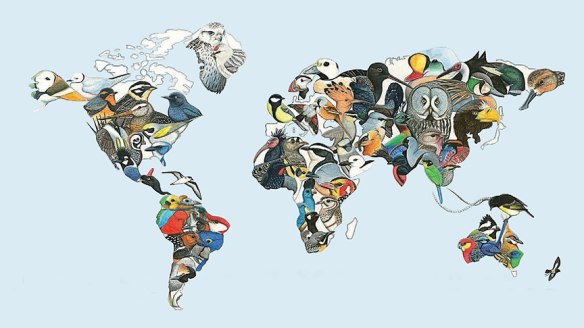
Our Vanishing World: Birds

Illustration by Luke Seitz

By Robert J. Burrowes

At the beginning of the nineteenth century, it is estimated that the total number of passenger pigeons in the United States was about three billion birds. The bird was immensely abundant, as illustrated by this passage written by the famous ornithologist, naturalist and painter John James Audubon:

‘I dismounted, seated myself on an eminence, and began to mark with my pencil, making a dot for every flock that passed. In a short time finding the task which I had undertaken impracticable, as the birds poured in countless multitudes, I rose, and counting the dots then put down, found that 163 had been made in twenty-one minutes. I traveled on, and still met more the farther I proceeded. The air was literally filled with Pigeons; the light of noon-day was obscured as by an eclipse, the dung fell in spots, not unlike melting flakes of snow; and the continued buzz of wings had a tendency to lull my senses to repose… Before sunset I reached Louisville, distance from Hardensburgh fifty-five miles. The Pigeons were still passing in undiminished numbers, and continued to do so for three days in succession.’ See ‘Passenger Pigeon’.

So numerous was this bird that, in the nineteenth century, the passenger pigeon was one of the most abundant birds on Earth.

In 1914 it was extinct.

While new settlements kept reducing the bird’s habitat, more importantly, it was literally hunted from the sky. Shot for its meat.

So I have two questions for you? When is the last time that you saw a flock of birds so vast that ‘the light of noon-day was obscured as by an eclipse’? And when did you last see a flock of just 20 birds?

Sobering to ponder, isn’t it?

The origin of birds

Birds evolved from small carnivorous dinosaurs of the Late Jurassic and in the 65 million years since the extinction of the rest of the dinosaurs, this ancestral lineage diversified into the major groups of birds alive today. See ‘The origin of birds’.

Because they did not exist during the first five mass extinction events on Earth, birds have been spared the widespread extinctions suffered by those species that did exist in earlier eras.

Extinctions of birds in prehistory and history

Nevertheless, the fossil record tells us of the existence of prehistoric birds that became extinct before the Late Quaternary (that is, the past half to one million years) and thus occurred in the absence of significant human interference – see ‘List of fossil bird genera’ – while various sources tell us of both prehistoric and historic bird species, including flightless megafauna birds, that became extinct between 40,000 BCE and 1500 AD and ‘was coincident with the expansion of Homo sapiens beyond Africa and Eurasia, and in most cases, anthropogenic factors played a crucial part in their extinction, be it through hunting, introduced predators or habitat alteration’. See ‘List of Late Quaternary prehistoric bird species’.

Of course, there is an even wider range of evidence of bird extinctions since 1500. See ‘List of recently extinct bird species’. Most notably perhaps, given the symbolism it has since acquired, the dodo, a flightless bird of Mauritius, was driven to extinction by 1681 but not before it was carefully drawn. See ‘Dodo’.

How many bird species are there on Earth now?

While one recent estimate – see ‘Scaling laws predict global microbial diversity’ – indicates that Earth may be the home to one trillion species (the vast bulk of which are microorganisms such as bacteria, archaea and microscopic fungi), of which only an estimated 8.7 million species fall into the usual and simpler categories of plants, birds, animals, fish, amphibians, insects and reptiles, the most recent research conducted by George F. Barrowclough, Joel Cracraft, John Klicka and Robert M. Zink and published in 2016 indicated that there are just 18,043 species of birds worldwide. See ‘How Many Kinds of Birds Are There and Why Does It Matter?’

Somewhat controversially – see ‘New Study Doubles the World’s Number of Bird Species By Redefining “Species”’ – this figure is nearly twice as many as previously thought because the study focused on ‘hidden’ avian diversity: birds that look similar to one another or were thought to interbreed but are actually different species. In any case, whether there are just 10,000 species of birds, 11,000+ as estimated by the recognized international authority BirdLife International – see ‘Introducing the IUCN Red List’ – or even18,000, just like other species of life on Earth, birds are now under siege in a way they have never been before.

Killing birds in the late twentieth and early twenty-first centuries

More than 100 years have passed since the passenger pigeon became extinct. However, while one might have hoped that humans had become more adept at nurturing populations of birds, the reality is that we are continuing to drive bird populations to extinction. Moreover, we are now doing this with breathtaking efficiency, slaughtering birds by the millions in ever-shortening timeframes.

As a result, the fate of the passenger pigeon has been replicated many times over with a vast number of bird species passing through the International Union for Conservation of Nature’s eight preliminary categories – Not Evaluated, Data Deficient, Least Concern, Near Threatened, Vulnerable, Endangered, Critically Endangered, Extinct in the Wild – before reaching the ninth and final category: Extinct. See ‘IUCN Red List Categories and Criteria’. At the moment, the ‘IUCN Red List of Threatened Species’ identifies 14% of remaining bird species as ‘threatened with extinction’. Also see ‘Introducing the IUCN Red List’.

Of course, this ongoing assault on birds is well documented in the scientific literature, along with descriptions of long-standing causes as well as those that are more recent.

In recently published research on the status of birds in North America, Dr. Kenneth V. Rosenberg led an international team of scientists from seven institutions in analyzing the population trends of 529 bird species on the North American continent. Their study quantified, for the first time, the total decline in bird populations in the continental U.S. and Canada: a loss of 2.9 billion breeding adult birds, with devastating losses among birds in every biome, since 1970. Moreover, their research revealed that ‘declines are not restricted to rare and threatened species – those once considered common and widespread are also diminished’. See ‘Decline of the North American avifauna’ and ‘Vanishing: More Than 1 in 4 Birds Has Disappeared in the Last 50 Years’.

Like scholars researching dramatic declines and extinctions of other species, such as insects, Rosenberg and his colleagues stress that their results have ‘major implications for ecosystem integrity, the conservation of wildlife more broadly, and policies associated with the protection of birds and native ecosystems on which they depend’. While species extinctions ‘have defined the global biodiversity crisis’, extinction ‘begins with loss in abundance of individuals that can result in compositional and functional changes of ecosystems’. Hence, the staggering loss of bird abundance ‘signals an urgent need to address threats to avert future avifaunal collapse and associated loss of ecosystem integrity, function, and services’. See ‘Decline of the North American avifauna’.

In more blunt language ‘the most comprehensive inventory ever done for North American birds, points to ecosystems in disarray because of habitat loss and other factors that have yet to be pinned down’. See ‘Billions of North American birds have vanished’. And, yet more bluntly: ‘The scale of loss portrayed in the [Rosenberg et.al.] study is unlike anything recorded in modern natural history.’ See ‘Vanishing: More Than 1 in 4 Birds Has Disappeared in the Last 50 Years’.

Even more importantly, however, pointing out that the study results ‘transcend the world of birds’, Rosenberg explained that ‘These bird losses are a strong signal that our human-altered landscapes are losing their ability to support birdlife’ and ‘that is an indicator of a coming collapse of the overall environment.’ See ‘Vanishing: More Than 1 in 4 Birds Has Disappeared in the Last 50 Years’.

Is North America alone in its decimation of bird populations? Far from it. Other research and data have revealed that ‘farmland birds in Europe have declined by over 50 per cent collectively in the last 30 or 40 years’ according to Professor Richard Gregory, head of species monitoring and research at the Royal Society for the Protection of Birds (RSPB) in the UK where, according to Martin Harper, director of conservation at the RSPB, ‘Our beleaguered farmland birds have declined by 56 per cent between 1970 and 2015 along with declines in other wildlife linked to changes in agricultural practices, including the use of pesticides’.

And, Professor Romain Julliard, a conservation biologist at France’s National Museum of Natural History, confessed his ‘shock’ when the latest research revealed that France has lost one-third of its birds in the past 15 years in what is being labeled a ‘dramatic collapse’ and ‘ecological catastrophe’ particularly because the decline has accelerated dramatically in recent years. See ‘“Shocking” decline in birds across Europe due to pesticide use, say scientists’.

In Germany, bird populations are vanishing with scientists using words like ‘decimated’ and ‘collapse’ to describe the enormity of the problem. In a recent study of government data, the German environmental organization Nature And Biodiversity Conservation Union (NABU) estimated ‘that more than 25 million birds [15% of the country’s total bird population] disappeared from Germany over the past 12 years’. See ‘Über zwölf Millionen Vogelbrutpaare weniger in Deutschland’, ‘Insect and bird populations declining dramatically in Germany’ and ‘“Decimated”: Germany’s birds disappear as insect abundance plummets 76%’. But why?

While habitat destruction and other factors played roles, scientists have also long linked pesticide use to insect decline – a reasonable assumption given that killing insects is the purpose of pesticides – and research clearly demonstrates that pesticides are killing more than target insects. For instance, a 2008 study demonstrated low but persistent levels of a common neonicotinoid pesticide in aquatic ecosystems can kill off or reduce the growth of insects (such as mosquitoes) that have an acquatic phase. See ‘Acute and Chronic Toxicity of Imidacloprid to the Aquatic Invertebrates Chironomus tentans and Hyalella azteca under Constant- and Pulse-Exposure Conditions’ and ‘“Decimated”: Germany’s birds disappear as insect abundance plummets 76%’.

In essence, the problem is that killing the insects is tantamount to killing the birds that feed on them.

Another recent study came to the same conclusion. The study, conducted in the Lake Constance area in southern Germany, found that the population of six of the most common birds had ‘declined massively’. According to Hans-Guenther Bauer of the Max Planck Institute for Behavioral Biology: ‘These are truly shocking figures, especially when you consider that the decline in birds began decades before our first data collection in 1980.’ Why is it happening? According to Bauer, a key reason for the decline is the loss of food. ‘This confirms what we have long suspected. The death of insects caused by humans has a massive impact on our birds.’ To stem the tide of losses, scientists are calling for a rethink in agricultural and forestry policy including ‘drastic restrictions on insecticides and herbicides in agriculture, forestry, public areas and private gardens’ and significantly less fertilization. See ‘Scientists fear “collapse” of bird populations in Germany’.

As is the case elsewhere around the world, birds in Africa also face a wide variety of threats, the most significant of which are habitat fragmentation, degradation and destruction as well as direct impacts including hunting and trapping (mainly for meat and trafficking). See ‘Multiple threats are driving threatened birds towards extinction in Africa’.

But nowhere is safe with the killing of migratory birds in China – see Market trade is fuelling the killing of migratory birds in Northern China – and various factors adversely impacting penguins in Antarctica – see ‘Climate-driven reductions in krill abundance have caused Adélie penguin declines’ – just two more of many examples that could be cited.

Illegal hunting and trapping of birds

According to Birdlife International, the organization responsible for monitoring the welfare of birds for the IUCN’s Red List, ‘The illegal killing and taking of wild birds remains a major threat on a global scale’ with recent examples including the illegal poisoning of vultures in Sub-Saharan Africa, the illegal shooting of raptors in Europe and North America, the illegal trapping of passerines (perching birds) in Asia and the illegal capture for the bird trade in South America.

For example, based on extensive research over many years in relation to bird killing during migratory flights across the Mediterranean and through Northern and Central Europe and the Caucasus, BirdLife International has compiled a series of reports. These reports document massive illegal killing of birds, often in ways that constitute torture, and totaling in excess of 25 million birds annually, including birds of species that are threatened with extinction. For recent reports, see ‘The Killing 2.0: A View to a Kill’, ‘Assessing the scope and scale of illegal killing and taking of birds in the Mediterranean, and establishing a basis for systematic monitoring’ and ‘Review of illegal killing and taking of birds in Northern and Central Europe and the Caucasus’. For a more detailed scientific report on this issue, see ‘Preliminary assessment of the scope and scale of illegal killing and taking of birds in the Mediterranean’.

But if you would simply prefer to be revolted, then watch BirdLife’s one minute video: Help us STOP illegal #birdkilling’. Or read a straightforward account of how ‘innocent’ human behaviours can be deadly for birds, in this case by ‘vacuuming’ millions of sleeping birds into oblivion each year during olive harvesting at night. See ‘Millions of Birds Killed by Nighttime Harvesting in Mediterranean’.

Unfortunately, if you think the descriptions and video of birdkilling above are bad, you won’t be impressed with the sheer insanity that militarized humans can display: ‘The Farmagusta area of Cyprus comes out as the worst place for illegally killing birds in the Mediterranean, while the British Territory in Cyprus is also affected, with the Dhekelia UK military base seeing hundreds of thousands of birds killed each autumn. The Ministry of Defence has started a programme to remove illegally planted trees and shrubs in the area, which trappers use for cover and to lure birds in.’ See ‘Millions of Birds Killed in the Mediterranean’. So, instead of ordering soldiers to stop shooting birds while using a combination of education and law enforcement measures to prevent civilians doing so, they removed ‘illegally planted trees and shrubs’!

Wild Bird trafficking

Another major killer of birds is the wildlife trade. Birds are often killed as a ‘byproduct’ of the trade in exotic birds, most of which is illegal, but which is a multi-billion dollar a year industry along with human, weapons, currency and drug trafficking. Equally importantly, however, once traded, birds no longer form part of their original habitat and hence they are lost as contributing and breeding members of that ecosystem. According to the Convention on International Trade in Endangered Species of Wild Fauna and Flora (CITES), species listed in Appendix I of the Convention are considered to be threatened with extinction and are not allowed to be traded commercially. There are currently 161 bird species on Appendix I. However, birds included on Appendix II are allowed to enter international trade ‘under specific controlled circumstances’; there are 1,300 bird species on this appendix. See ‘Wild Bird Trade and CITES’ and ‘CITES Appendices I, II and III’.

In theory, state parties are obliged to develop national legislation effectively implementing the obligations of the Convention including setting sustainable quotas for Appendix II species. But I am sure that you can imagine how well this regime works given the incredibly profitable wildlife trafficking industry, in which birds are a crucial component. In fact, ‘one third (3,337) of living bird species [that is, 2,000 species more than those that are “legal”] have been recorded as traded internationally for the pet trade and other purposes’. Of these species, 266 (that is, 8% of those internationally traded) are considered globally threatened. See ‘The Red List Index for internationally traded bird species shows their deterioration in status’.

And if the domestic trade in birds is taken into account as well, then ‘Nearly 4,000 bird species involving several million individuals annually are subject to domestic or international trade with finches, weavers, parrots and raptors being some of the most heavily affected groups.’ See ‘Wild Bird Trade and CITES’.

For a candid account of bird trafficking at its origin which describes the fate of macaw chicks being stolen from their forest nests in Ecuador, see ‘Wildlife Trafficking’.

Seabirds

In relation to seabirds, one recent study found that the global population of these birds declined by 70% between 1950 and 2010 as a result of a multiplicity of threats. These threats included ‘entanglement in fishing gear, overfishing of food sources, climate change, pollution, disturbance, direct exploitation, development, energy production, and introduced species (predators such as rats and cats introduced to breeding islands that were historically free of land-based predators)’. See ‘Population Trend of the World’s Monitored Seabirds, 1950-2010’.

Another study concluded just recently, was ‘the first objective quantitative assessment of the threats to all 359 species of seabirds’ and identified the main threats to their survival while outlining priority actions for their conservation. Using the standardized ‘Threats Classification Scheme’ developed for the IUCN Red List to objectively assess threats to each species, a team of ten scientists identified the top three threats to seabirds – in terms of number of species affected and average impact – to be as follows: invasive alien species (particularly rats and cats) which affected 165 species across all of the most threatened groups; bycatch in fisheries which ‘only’ affected 100 species but with the greatest average impact; and the climate catastrophe which affected 96 species. ‘Overfishing, hunting/trapping and disturbance were also identified as major threats to seabirds.’ The study emphasized that 70% of seabirds, especially those that are globally threatened, face multiple threats. For the three most threatened groups of seabirds – albatrosses, petrels and penguins – it is essential to tackle both terrestrial and marine threats to reverse declines. See ‘Threats to seabirds: A global assessment’.

In addition, however, another problem that has been getting insufficient attention is the result of the expanding impacts of the rapidly increasing levels of ocean acidification, ocean warming, ocean carbon flows and ocean plastics. Taken in isolation each of these changes clearly has negative consequences for the ocean. All these shifts taken together, however, result in a rapid and serious decline in ocean health and this, in turn, adversely impacts all species dependent on the ocean, including seabirds. Moreover, on top of these problems is the issue of oxygen availability given that oxygen in the air or water is of paramount importance to most living organisms. As the recently released report ‘Ocean deoxygenation: Everyone’s problem. Causes, impacts, consequences and solutions’ describes in some detail, oxygen levels are currently declining across the ocean.

But to graphically illustrate just one of the threats to seabirds, consider the impact of our chronic overfishing which is depleting the oceans of fish. In November 2019, thousands of short-tailed shearwater birds migrating from Alaska were washed up dead on Sydney’s iconic beaches in Australia. Moreover, thousands more shearwaters died out at sea in clear confirmation of the incredible fish shortages in the Pacific Ocean. After spending the summer in Alaska, the shearwaters were migrating back to southern Australia to breed: a 14,000km trip over the Pacific that requires the birds to be at full strength.

Unfortunately, vast numbers died due to lack of food because the krill and other fish they feed on have vanished. But if you think the problem only occurred along or at the end of their journey, in fact there had been ‘a series of catastrophic die-offs’ before and shortly after the birds departed to head south with thousands of shearwaters (along with puffins, murres and auklets too) lying dead from starvation on the beaches of Alaska and on Russia’s Chukotka Peninsula back in mid-year as well. The overall ‘large die-off’ pattern has been repeating since 2015 with little knowledge of the full extent of the crisis because millions of the birds ‘die at sea’. See ‘Fish all gone!… Millions of small sea birds died since 2015’.

Tragically though, as touched on above, an ocean emptied of fish is not the only hazard that seabirds have no choice but to attempt to navigate. An ocean full of plastic – with concentrations up to 580,000 pieces per square kilometer – is also deceiving many seabirds into attempting to eat pieces of plastic and this only complicates efforts by seabirds to get adequate nutrition. See ‘Threat of plastic pollution to seabirds is global, pervasive, and increasing’ and ‘Nearly Every Seabird on Earth Is Eating Plastic’. This is graphically illustrated in this photo of a dead albatross – see ‘Laysan Albatrosses’ Plastic Problem’ – although, tragically, plastic is not the only non-food item that is consumed by and is killing these majestic birds, with an abandoned US military base on Midway Atoll – where 65% of the global albatross population breeds – playing a vital role too. See ‘Study shows lead-based paint is poisoning albatross chicks at Midway Atoll National Wildlife Refuge’.

But why do seabirds eat plastic instead of correctly identifying food? Well, one recent research project provided ‘the first evidence that, in addition to looking like food, plastic debris may also confuse seabirds that hunt by smell’. See ‘Marine plastic debris emits a keystone infochemical for olfactory foraging seabirds’ and ‘The oceans are full of plastic, but why do seabirds eat it?’

Other threats to birds

Another threat faced by birds in the nuclear age is the outcome of the radioactive contamination of the Earth in many places. For example, while there are ‘severe reductions in species richness and density’ in the regions surrounding the sites of the Chernobyl and Fukushima nuclear catastrophes, surviving birds display a wide range of deformities and dysfunctionalities, notably including impaired brain development as reflected by head volume with its negative implications for cognitive ability and hence viability. See Chernobyl Birds Have Smaller Brains’ and ‘Bird populations near Fukushima are more diminished than expected’.

Yet another threat to birds is posed by the deployment of 5G. ‘Typical effects of radiation from cellular communication antennas on resident, breeding, and migratory birds [include] site abandonment, feather deformation, locomotion problems, weight loss, weakness, reduced survivorship and death.’ Moreover, it can ‘blot out a bird’s perception of the earth’s field, causing the bird to fly in the wrong direction, and also disrupt a bird’s internal clock based on the sun’s changing position’. See ‘5G to Kill the Birds, Bees and Your Loved Ones?’ and ‘Western Insanity and 5G Electromagnetic Radiation’.

Finally, without elaboration, vast numbers of birds are also killed each year by warfare and other military activities – see, for example, ‘The impact of the 1991 Gulf War oil spill on bird populations in the northern Arabian Gulf – a review’ – by industrial activity and accidents – see, for example, ‘Effects of the Exxon Valdez Oil Spill on Birds: Comparisons of Pre- and Post-spill Surveys in Prince William Sound, Alaska’ – by road and air traffic, the spread of certain avian diseases to previously unaffected species – see ‘Avian diseases are spreading to impact hitherto unaffected populations’ – wind turbines, cats, windows and communication towers, with 7 million birds losing their lives each year in the United States alone to the ‘web-like traps of wire and metal’ used for communication. See ‘Communication Towers Are Death Traps for Threatened Bird Species’. Other birds are now being killed in response to conflict generated between birds. See ‘Climate Change Leading to Fatal Bird Conflicts’. And, of course, ‘domesticated’ birds such as chickens and turkeys are farmed and consumed in prodigiously huge quantities, including for Christmas.

Sadly, too, millions of birds of many species are imprisoned in cages as ‘pets’ denied the freedom that all humans crave for themselves.

So, in essence, if you were a bird, here is a survival strategy that should work. Only live in a habitat that will not be impacted, in any way, by human beings and their activities. That is, don’t live on Earth.

Saving the birds

Given the vast range of threats posed to birdlife by humans – see a straightforward summary of ‘The greatest threats facing Important Bird & Biodiversity Areas today’ which doesn’t mention all threats and those that are emerging – it is clearly going to take a monumental effort on many fronts to contain the killing of birds and avert the ongoing extinction of bird species on Earth.

And, unless you are naive enough to believe that elite-controlled governments or international organizations and processes are going to do something that is actually effective – see ‘The Global Elite is Insane Revisited’ – then it is up to us to make the difference. Of course, we can do a few things that are specific to saving birds but the bulk of what must happen is really about saving the biosphere (which includes birds) generally. The biosphere is, after all, one deeply-interconnected living entity.

This is why, according to some biologists, laws that focus on the protection of rare species miss the big picture. Joel Cracraft, for example, argues that ‘We’re losing the battle because we’re fighting over single endangered species’. Species protection tends to focus on charismatic species – beautiful birds and mammals – and doesn’t value rare ecosystems or collections of species. See ‘New Study Doubles the World’s Number of Bird Species By Redefining “Species”’. Nor does it value the biosphere as a whole.

Still, some superlative efforts have been made on behalf of birds. For example, you can read some inspirational success stories by BirdLife International: ‘10 vital bird habitats saved through conservation action’.

And for one man’s initiative 120 years ago that is having ongoing impact, see ‘How one man changed a Christmas tradition forever – to save birds’.

So you can, of course, support the efforts of Birdlife International and the local, national and other organizations like it. See Welcome to BirdLife’s Globally Threatened Bird Forums’ and, for example, ‘Stop Wildlife Trafficking’.

Separately from initiatives that focus specifically on birds, if you wish to fight powerfully to save Earth’s biosphere consider joining those participating in The Flame Tree Project to Save Life on Earth which outlines a simple program to systematically reduce your consumption and increase your local self-reliance over a period of years. Among many other beneficial environmental outcomes, this will reduce the ongoing destruction of bird habitat to produce the products we all consume.

But given the fear-driven violent parenting and education models that drive all violence in our world and which, among a multitude of other adverse outcomes, generates the addiction of most people in industrialized countries to the over-consumption that is destroying Earth’s biosphere – see ‘Love Denied: The Psychology of Materialism, Violence and War’ – then consider addressing this directly starting with yourself – see ‘Putting Feelings First’ – and by reviewing your relationship with children. See ‘My Promise to Children’ and ‘Nisteling: The Art of Deep Listening’. For fuller explanations, see Why Violence?’ and Fearless Psychology and Fearful Psychology: Principles and Practice.

If you wish to campaign strategically to defend birds against particular threats, such as the climate catastrophe, military violence or the deployment of 5G, for example, consider joining those campaigning to halt these and other threats as well. See Nonviolent Campaign Strategy which already includes a comprehensive list of strategic goals necessary to achieve these outcomes in two key contexts in ‘Strategic Aims’.

But, whatever you do, don’t fall into the trap of fearfully begging elites to act on your behalf as, for example, the antiwar and climate movements are doing (with climate ‘activists’ marginalized at the latest COP25 gathering in Madrid). If we do not focus our efforts on engaging all people who are powerful enough to do so to respond strategically, then we will fail. And our failure will not only be the result of the elite refusing to take the requisite action despite your entreaties but also because the elite, as a group, is powerless to make sufficient difference: only a massive response from the wider population can produce the outcome we now need. For explanations of this, see ‘Why Activists Fail’, ‘The Global Climate Movement is Failing: Why?’ and ‘The War to End War 100 Years On: An Evaluation and Reorientation of our Resistance to War’.

Moreover, in those cases where corrupt or even electorally unresponsive governments are leading the destruction of the biosphere – by supporting, sponsoring and/or engaging in environmentally destructive practices – it might be necessary to remove these governments as part of the effort. See Nonviolent Defense/Liberation Strategy.

You might also consider joining the global network of people resisting violence in all contexts, including against the biosphere, by signing the online pledge of The Peoples Charter to Create a Nonviolent World.

Or, if none of the above options appeal or they seem too complicated, consider committing to:

The Earth Pledge

Out of love for the Earth and all of its creatures, and my respect for their needs, from this day onwards I pledge that:

  1. I will listen deeply to children (see explanation above)
  2. I will not travel by plane
  3. I will not travel by car
  4. I will not eat meat and fish
  5. I will only eat organically/biodynamically grown food
  6. I will minimize the amount of fresh water I use, including by minimizing my ownership and use of electronic devices
  7. I will not buy rainforest timber
  8. I will not buy or use single-use plastic, such as bags, bottles, containers, cups and straws
  9. I will not use banks, superannuation (pension) funds or insurance companies that provide any service to corporations involved in fossil fuels, nuclear power and/or weapons
  10. I will not accept employment from, or invest in, any organization that supports or participates in the exploitation of fellow human beings or profits from killing and/or destruction of the biosphere
  11. I will not get news from the corporate media (mainstream newspapers, television, radio, Google, Facebook, Twitter…)
  12. I will make the effort to learn a skill, such as food gardening or sewing, that makes me more self-reliant
  13. I will gently encourage my family and friends to consider signing this pledge.

Do all these options sound unpalatable? Prefer something requiring less commitment? You can, if you like, do as most sources suggest: nothing (or its many tokenistic equivalents). I admit that the options I offer are for those powerful enough to comprehend and act on the truth. Why? Because there is so little time left and I have no interest in deceiving people or treating them as unintelligent and powerless. See ‘Human Extinction by 2026? A Last Ditch Strategy to Fight for Human Survival’ and ‘Doomsday by 2021?’

Conclusion

Birds are being killed with ruthless efficiency by human beings and their activities all over the world. Obviously, this is an unmitigated tragedy for Earth’s birds, the biosphere as a whole and those humans who love life generally. But what are the practical implications of this ongoing bird killing for us?

Well just as the death of one canary in a coal mine warned miners about their dangerous environment, the mass death of birds is yet another warning that we are destroying the planetary biosphere.

However, in this case, we are not treating the canary’s death as a warning and, even if we were, it does not mean that we can escape because there is nowhere else to go.

In short, if we don’t save the birds, we won’t save ourselves.


Biodata: Robert J. Burrowes has a lifetime commitment to understanding and ending human violence. He has done extensive research since 1966 in an effort to understand why human beings are violent and has been a nonviolent activist since 1981. He is the author of Why Violence? His email address is flametree@riseup.net and his website is here.

The Economic Crash So Far: A Look At The Real Numbers

By Brandon Smith

Source: Alt-Market.com

There are many problems when attempting to track a faltering economy. For one, the people in government generally do not want the public to know when the system is in decline because this looks bad for them. They prefer to rig statistical indicators as much as possible and hope that no one notices. When the crash occurs, they then claim that “no one saw it coming” and the disaster “came out of nowhere”, so how could they be to blame?

I have even heard it argued that political leaders, including the president, have a “duty” to lie about the state of the economy because once they admit to the decline they will cause a panic and perpetuate the crisis. This is stupidity. If an economic system is in disrepair and is built on a faulty foundation, then the problems should be identified and fixed immediately. The weak businesses should be culled, not bailed out. The wasteful government spending should be cut, not increased. The downturn should not be hidden and prolonged for years or decades. In most cases, this only makes the inevitable crash far worse and more damaging.

Another factor, which some people might call “conspiracy theory” – but it has been proven time and time again in history – is that the money elites have a tendency to engineer economic disasters while deliberately hiding the real statistics from the public. Why? Well, if the real data was widely disseminated, then a crash would not be much of a surprise and the populace could be prepared for it. I suspect the elites hide the data because they WANT the crash to be a surprise. The bigger the shock, the bigger the psychological effect on the masses. This fear and confusion allows them to make changes in the power structure of a nation or of the entire world that they would not be able to accomplish otherwise.

The most rigged statistics tend to be the least important overall in analysis, but this does not stop the mainstream media and investors from hyper focusing on them. How many times have you told friends and family about the collapse in manufacturing or the explosion in consumer and corporate debt, only to hear them say, “But the stock market is at all-time highs!” Yes, even though stock markets are a meaningless trailing indicator, even though GDP stats are a complete fallacy, and even though jobless numbers do not include tens of millions of people out of work, these are the stats that the average person takes mental note of when consuming their standard 15 minutes of news per day.

While the issue of rigged statistics makes analysis of a crash difficult, a willfully ignorant citizenry makes reporting on the real data almost impossible. It’s sad to say, but a large number of people do not want to hear about negative information. They want to believe that all is well, and will delude themselves with fantasies of blind optimism and endless summers. Like the tale of “The Ant And The Grasshopper”, they are grasshoppers and they see anyone who focuses on the negative as “chicken littles” and “doom mongers”. In their minds they have all the time in the world, until they freeze and starve when winter comes.

When I encounter people who actually believe the manipulated numbers or buy into the stock market farce or simply don’t want to accept that a crash could happen in their lifetime, I always ask them to consider these questions: If the global economy is not on the verge of collapse, then why did central banks keep propping it up for the past ten years? And if central banks have been propping up the system, how much longer do you think they can do this? How much longer do you think they want to do it? What if one day they decide to let the entire house of cards tumble? What if such an event actually benefits them?

We’ve seen that a broken economy can be technically held together for a decade, but under the surface, the structure continues to rot. The bottom line is that even if the elites wanted to keep the system going for another ten years, and even if politicians continued to help them by pumping out false statistics, there is no way to hide the effects of crumbling fundamentals. We saw this during the crash of 2008, and now we’re seeing it again.

After nearly ten years of stimulus inflated the largest financial bubble in history (the Everything Bubble), the Federal Reserve and other central banks halted stimulus measures and tightened global liquidity. By the end of 2018, a new crash began, the implosion of the Everything Bubble had been triggered. All of this is still just an extension of the crash of 2008, which never really subsided; it was only slowed down through tens of trillions of dollars in central bank intervention. Now, the central banks have started an avalanche that cannot be stopped. But the fact of the matter is, they don’t really want to stop it.

Here are the indicators so far that prove a crash is happening in the U.S. while a majority of the public is oblivious:

GDP numbers are completely manipulated. Government spending of taxpayer dollars on a number of inflated programs, including continued spending on Obamacare, is added to GDP calculations. Without this fancy accounting, U.S. GDP growth would actually be negative, according to ShadowStats. But even with the juiced data, official GDP growth is still in decline, falling to 1.9% and well below the 3% growth we were supposed to see this year.

Official unemployment stats remain at all-time lows, which is commonly cited by the mainstream media, Donald Trump (he used to argue the opposite three years ago), and even the Federal Reserve in reference to the health and stability of the economy. What they do not mention much is the 95 million people not in the labor force and not counted because they have been unemployed for so long. When the media does mention this fact, they claim the number is “misleading”, that most of these people are students or retired, that the retirement age is decreasing and Baby Boomers are leaving the workforce sooner, and that the people who don’t have jobs are simply “not interested” in working. None of this is true.

The retirement age is increasing in the U.S., not decreasing, according the SS Administration. Current average retirement age is now 67, up from 65, almost the same as it was during the Great Depression.

Baby Boomers are not retiring at rates similar to ten years ago, and are in fact attempting to stay in the workforce due to the poor economy. Many of them are trying to come OUT of retirement just to make ends meet.

The labor participation rate remains near record lows.

Interestingly, the Bureau of Labor Statistics (BLS) house survey that is used to determine if people “want a job” assumes that if you are near retirement age and do not have a job, you are simply not interested in a job, and they count you as “non-participating”. However, if you DO have a job and you are near retirement age, they count you as participating. It’s a rather convenient assumption on the government’s part to claim that just because an unemployed person is near retirement age, that means they “don’t want a job”.

While there is surely a small percentage of the 95 million people not counted in the labor force that do not want a job, if unemployment stats counted U-6 measurements as they used to, the unemployment rate would be closer to 20%.

Another problem is the quality of jobs being created. U.S. manufacturing jobs, as well as higher wage jobs, are in steep decline. They have been replaced with low paying jobs in the service sector.

Real wages in the U.S. have not kept up with inflation. The average worker is now losing money overall as prices rise beyond the pace of their incomes.

As more and more Millennials say they cannot afford to buy a home, rental prices have skyrocketed in the past several years. The home ownership rate plunged starting in 2006 and has not recovered since.

U.S. manufacturing has fallen to levels not seen since the crash of 2008. U.S. factory orders have slumped in 2019.

U.S. Services PMI continues to falter since spring of this year. Job growth is now slowing and over 8,500 retail stores have been closed down already in 2019. Web-based retail is not picking up the slack, as online sellers like Amazon are suffering from falling profits.

Corporate profits overall have tumbled this year and projected future profits have been drastically adjusted to the downside.

Corporate debt, consumer debt and national debt are all at historic highs. Corporate cash flow is so tight that Federal Reserve repo purchases continue to run into high demand. This debt signal is one we saw in 2007, just before the credit crisis.

U.S. trucking and railroad freight continue to log steep declines in traffic and goods. This tells us what we already know: Even though consumer spending has increased recently, this does not mean people are buying more stuff or have more disposable income. What is really happening is inflation, or stagflation. Cost of living is going up. Debt payments are going up. Consumers are spending more on the same amount of stuff, or less stuff, and have less expendable income. U.S. consumers are being bled dry.

All of these factors and more show an economy in recession or depression (depending on what historic standards you use). In the darker corners of the investment world, the great hope is that the central banks will return to pumping trillions into the banking sector ($16 trillion during the TARP bailout dwarfs the $250 billion the Fed has recently pumped out in their repo markets). They hope that this will free up even more credit. Meaning, they believe only more debt will save the system from suffering.

I say, time is up on the debt party. More stimulus will not stall the crash that is already happening, and the Fed does not appear poised to print anywhere near what it did during the credit crisis, at least not in time to change the trend. The can has been kicked for the last time. The grasshopper mentality will not save people from the clear reality. Only preparation and planning will.

Establishment media’s mass deception

By Stephen Lendman

Source: Intrepid Report

On major geopolitical and other issues, mass deception overrides truth and full disclosure in establishment media print editions and daily broadcasts—wealth, power and privileged interests served over peace, equity and justice.

The NYT is Exhibit A. Its Friday edition featured Iran-bashing disinformation, saying the following: “Iran has used the continuing chaos in Iraq to build up a hidden arsenal of short-range ballistic missiles in Iraq [sic], part of a widening effort to try to intimidate the Middle East and assert its power [sic]”—citing unnamed US intelligence and Pentagon officials,” adding that the US built up “its military presence in the Middle East to counter emerging threats to American interests [sic], including attacks on oil tankers and facilities that intelligence officials have blamed on Iran [sic].”

Iranian missiles “pose a threat to American allies and partners in the region, including Israel and Saudi Arabia, and could endanger American troops…”

Fact: Iranian Foreign Ministry Spokesman Bahram Qassemi debunk phony claims about IRGC missiles in Iraq, saying that the accusations are “false, meaningless and ludicrous. What has been raised and published by some infamous cells and certain media about the transfer of Iranian missiles to Iraq is a nonsensical statement and sheer lie.”

They’re all about maliciously vilifying Iran to create a nonexistent threat, wanting its Iranian relations with neighboring countries undermined.

Iranian military advisors are in Iraq and Syria at the behest of their governments, Tehran’s Supreme National Security Council Secretary Ali Shamkhani earlier explained—adding that they’re there to help combat US-supported terrorism.

The US and its key allies are “the main creators and sponsors of takfiri terrorists,” he earlier stressed.

Fact: Iran was falsely blamed earlier for attacks on regional oil tankers and facilities it had nothing to do with—no evidence suggesting otherwise. The incidents were false flags staged to wrongfully blame Iran for what happened.

Fact: Iran threatens no other countries. Claims otherwise are bald-faced Big Lies, part of establishment media supported US propaganda.

Fact: The US and its imperial allies threaten humanity. Needing enemies to unjustifiably justify its imperial agenda, they’re invented because no real ones exist—none since WW II ended.

Fact: Iran’s nuclear program has no military component, never did in a nation abhorring these weapons, wanting them eliminated everywhere.

Fact: Iranian defense spending is solely for self-defense, its legal right under international law. It’s ruling authorities haven’t attacked another nation in centuries—what US-dominated NATO and Israel do repeatedly, their hostile actions supported by the Times and other establishment media.

Instead of reporting “all the news that’s fit to print,” Times’ editions feature managed news misinformation and disinformation.

Times and other establishment media columnists are what famed journalist George Seldes (1890 – 1995) called “prostitutes of the press.”

They’re propagandists, scam artists and charlatans—paid to lie, distort, misinform, and blame victims for US high crimes committed against them, while supporting monied interests over popular ones.

In his latest disinformation piece, Times columnist David Brooks “cheer[ed] (predatory) capitalism, now and forever,” adding, “I came to realize that capitalism is really good at doing the one thing socialism is really bad at: creating a learning process to help people figure stuff out… It has a competitive profit-driven process to motivate you to learn and innovate, every single day.”

Fact: Diogenes called education “the foundation of every state.” Horace Mann said: “The common [public] school (socialized education) is the greatest discovery ever made by man”—calling it the “great equalizer” that was “common” to all.

In 1862, the Morrill Act established land-grant public colleges and universities on a tuition-free basis.

For the next century, many US state and other public colleges and universities charged no or nominal tuition and other fees to attend—socialized higher education, affordable to millions that worked as intended.

Attending today entraps millions of students into debt bondage because of exorbitantly higher education costs—at a time when career opportunities are a shadow of what they were post-WW II

Fact: New Deal, Fair Deal, and Great Society program helped millions of Americans avoid poverty—social programs that worked, eroding and disappearing today.

FDR’s Great Depression social programs built or renovated 700,000 miles of roads, 7,800 bridges, 45,000 schools, 2,500 hospitals, 13,000 parks and playgrounds, 1,000 airfields, and other infrastructure projects—including much of Chicago’s lakefront.

Fact: The post-WW II (GI Bill) Servicemen’s Readjustment Act provided college or vocational education for 7.8 million returning vets.

Fact: Another 2.4 million got VA-backed low-interest, no down payment home loans at a time when their average cost was under $5,000—letting millions of families afford them.

Studies later showed the GI Bill was one of America’s soundest investments. It paid for itself seven times over. It also helped millions readjust successfully to civilian life.

The State University of New York (SUNY) system, the nation’s largest, was tuition-free until 1963. The University of California system had free tuition until the 1980s.

Today, SUNY tuition, room, board and fees are around $14,000 annually. At UCLA, it’s around $34,000 annually for state residents, at UC Berkeley over $36,000, for non-state residents about $63,000 annually.

Facilitating free or low-cost higher education and home ownership in the US post-WW II with VA-backed low-interest loans helped created post-war prosperity.

In the 1940s and 50s, strong unions and well-paid factory jobs elevated millions of Americans to middle-class status, what’s fast eroding today.

The economy then grew annually at around 3.5%. By 1960, blue-collar workers were the biggest buyers of many luxury goods and services, including homes and autos.

Socialism works as intended when unobstructed by foreign interference. Under Hugo Chavez, Venezuela was Latin America’s fastest growing economy.

The country prospered until devastated by US economic terrorism, harming the nation and its people.

According to the Times’ resident neocon Bret Stephens, “NATO is full of freeloaders [sic],” falsely adding the alliance is “how we defend the free world. Europe without American protection is a continental disaster waiting to happen.”

Fact: US-dominated NATO threatens world peace and humanity’s survival. After Soviet Russia dissolved in December 1991, NATO became an alliance for aggression, not deterrence, its current US-controlled mission.

As long as NATO exists, endless US-led wars will continue, world peace and stability remaining unattainable—the ominous threat of nuclear war by accident or design possible.

Social Media Censorship Reaches New Heights as Twitter Permanently Bans Dissent

Mnar Muhawesh speaks with journalist Daniel McAdams about being permanently banned from Twitter, social media censorship and more.

By Mnar Muhawesh

Source: Mint Press News

It’s an open secret. The deep state is working hand in hand with Silicon Valley social media giants like Twitter, Facebook and Google to control the flow of information. That includes suppressing, censoring and sometimes outright purging dissenting voices – all under the guise of fighting fake news and Russian propaganda.

Most recently, it was revealed that Twitter’s senior editorial executive for Europe, the Middle East and Africa is an active officer in the British Army’s 77th Brigade, a unit dedicated to online warfare and psychological operations.

In other words: he specializes in disseminating propaganda.

The news left many wondering how a member of the British Armed Forces secured such an influential job in the media.

The bombshell that one of the world’s most influential social networks is controlled in part by an active psychological warfare officer was not covered at all in the New York Times, CNN, CNBC, MSNBC or Fox News, who appear to have found the news unremarkable.

But for those paying attention and for those who have been following ’MintPress News’ extensive coverage of social media censorship, this revelation was merely another example of the increasing closeness between the deep state and the fourth estate.

Amazon owner, and world’s richest man, Jeff Bezos was paid $600 million by the CIA to develop software and media for the agency, that’s more than twice as much as Bezos bought the Washington Post for, and a move media critics warn spells the end of journalistic independence for the Post.

Meanwhile, Google has a very close relationship with the State Department, its former CEO Eric Schmidt’s book on technological imperialism was heartily endorsed by deep state warmongers like Henry Kissinger, Hillary Clinton and Tony Blair.

In their book titled, The New Digital Age: Reshaping the Future of People, Nations and Business, Eric Schmidt and fellow Google executive Jared Cohen wrote:

What Lockheed Martin was to the twentieth century…technology and cyber-security companies [like Google] will be to the twenty-first.”

Another social media giant partnering with the military-industrial complex is Facebook. The California-based company announced last year it was working closely with the neoconservative think tank, The Atlantic Council, which is largely funded by Saudi Arabia, Israel and weapons manufacturers to supposedly fight foreign “fake news.”

The Atlantic Council is a NATO offshoot and its board of directors reads like a rogue’s gallery of warmongers, including the notorious Henry Kissinger, Bush-era hawks like Condoleezza Rice, Colin Powell, James Baker, the former head of the Department of Homeland Security and author of the PATRIOT Act, Michael Chertoff, a number of former Army Generals including David Petraeus and Wesley Clark and former heads of the CIA Michael Hayden, Leon Panetta and Michael Morell.

39 percent of Americans, and similar numbers of people in other countries, get their news from Facebook, so when an organization like the Atlantic Council is controlling what the world sees in their Facebook news feeds, it can only be described as state censorship on a global level.

After working with the council, Facebook immediately began banning and removing accounts linked to media in official enemy states like Iran, Russia and Venezuela, ensuring the world would not be exposed to competing ideas and purging dissident voices under the guise of fighting “fake news” and “Russian bots.”

Meanwhile, the social media platform has been partnering with the U.S. and Israeli governments to silence Palestinian voices that show the reality of life under Israeli apartheid and occupation. The Israeli Justice Minister proudly revealed that Facebook complied with 95 percent of Israeli government requests to delete Palestinian pages. At the same time, Google deleted dozens of YouTube and blog accounts supposedly connected to the government of Iran.

In the last week alone, Twitter has purged several Palestinian news pages, including Quds News Network — without warning or explanation.

Electronic Intifada co-founder Ali Abunimah wrote, 

This alarming act of censorship is another indication of the complicity of major social media firms in Israel’s efforts to suppress news and information about its abuses of Palestinian rights.”

Alternative voices not welcome

The vast online purge of alternative voices has also been directed at internal “enemies.”

Publishers like Julian Assange and whistleblowers like Chelsea Manning are still being held in solitary confinement in conditions that international bodies and human rights groups call torture, for their crime of revealing the extent of the global surveillance network and the control over the media that Western governments have built.

As attempts to re-tighten the state and corporate grip over our means of communication increases, high-quality alternative media are being hit the hardest, as algorithm changes from the media monoliths have deranked, demoted, deleted and disincentivized outlets that question official narratives, leading to huge falls in traffic and revenue.

The message from social media giants is clear: independent and alternative voices are not welcome.

One causality in this propaganda war is Daniel McAdams, Executive Director of the Ron Paul Institute for Peace and Prosperity, a public advocacy group that argues that a non-interventionist foreign policy is crucial to securing a prosperous society at home. McAdams served as Senator Paul’s foreign affairs advisor between 2001 and 2012. Before that, he was a journalist and editor for the Budapest Sun and a human rights monitor across Eastern Europe.

McAdams, who spent much of his time on Twitter calling out the war machine supported by both parties, was recently permanently banned from the platform for so-called “hateful conduct.” His crime? Challenging Fox News anchor Sean Hannity over his hour-long segment claiming to be against the “deep state,” while simultaneously wearing a CIA lapel pin. In the exchange, McAdams called Hannity “retarded,” claiming he was becoming stupider every time he watched him.

Yes, despite that word and its derivatives having been used on Twitter over ten times in the previous minute, and often much more aggressively than McAdams used it – only McAdams fell victim to Twitter’s ban hammer. Something didn’t make sense about this ban. One only needs to read the replies under any of President Trump’s tweets to see far more hateful speech than what McAdams displayed to suspect foul play.

I spoke with McAdams about the ban and began by asking him if he accepts the premise of the ban, or if he believes something else was afoot.

The Need for a Greater Vision: Recognizing Reality

By Jennifer Ladd

Source: Resilience

Question Beliefs

We live in a culture that is embedded in unquestioned beliefs passing as truth. These beliefs are the source of our current crisis. We attempt to solve the problems of degradation of our environment and climate disruption, but we do not look at these core beliefs. We hold on to the idea that capitalism is the only right way to organize an economy, that democracy is essential to our freedom, that freedom itself is a core ingredient to our happiness. We believe corporate slogans such as “Progress is our most important product” (General Electric), and subscribe to the belief that technology will solve whatever problems we have, even the ones caused by technology.

Grasp the Scope of the Crisis

Most of us are unable to back away far enough to grasp the whole picture. We are like a tourist with a flashlight trying to get a view of a huge mural that covers a block-long wall. The news media can only focus our attention on a tiny fraction of the image at any one time. We read daily reports of record temperatures in the arctic, of ice sheets melting in the Antarctic, of floods, forest fires all over the world, political gridlock, and recession fears. We are deluged with information. Most of us have been touched directly by at least one aspect of the crisis. Today I am breathing the smoke of fires in British Columbia and Alaska hundreds of miles away. These are direct experiences, yet there are still those who deny that climate change is real or that it is a problem. And worse yet we do not have the political will or mechanism to respond. Many scientists clam we are beyond the tipping point. They say the damage done to the ecosystem is so great that further decline is assured, even if we drastically reduce our impact in the next 5 years.

We are confronting a confluence of issues – environmental degradation, climate disruption, political tension and economic instability – that create an unprecedented risk to future generations. Climate disruption is getting all the headlines, but talk to a fisherman anywhere on the coast and he will point to depleted fish stocks making it impossible to earn a living fishing. Some of that is due to climate, but over-fishing, water pollution and destruction of spawning grounds also play major roles. Agricultural runoff is creating large dead zones at the mouths of rivers, areas that used to be some of the most productive.

Insect populations are plummeting with some reports of 75% loss in the last 50 years1.Insects are the base of the food chain for many creatures. If they die off then we will all go. The cause is not simple but insecticides on farm land and habitat destruction are major factors.

Fresh water is another resource in critical decline. We have been pumping water from aquifers at rates that far exceed the rate of recharge. Worldwide, 40% of our food grown on irrigated land.2 Without irrigation we will face severe food shortages. In addition, much of the remaining irrigated land is dependent on snowpack that feeds reservoirs in the mountains. As the climate warms there is less snow and it melts sooner, reducing the amount of stored water available.

If we listen to the economic news we cannot help but be aware of the rapid increase in the US national debt. Politicians seem incapable of holding the debt in check, especially the Trump administration that established policies and tax cuts that have dramatically increased the debt at a time when the economy is doing relatively well and we should be reducing the debt. Despite the ignorance of some lawmakers, debt cannot continue to rise indefinitely. Many countries have tried that. In the end it leads to hyper inflation, and in extreme cases, a collapse of the government.

A more subtle and less talked about issue is that of resource depletion. True, Malthus warned the world of this 200 years ago during a time when energy resources in the form of wood were being depleted.Then we discovered coal, then oil, and the industrial revolution sparked a new level of development and environmental destruction on a level Malthus could never have foreseen. The issue is that while technology has kept the price of raw materials from increasing dramatically, metals like copper, and energy sources like oil and gas are finite. The deeper we have to mine or drill and the more complex the extraction process, the smaller the final product derived from the energy expended to get the material. When oil was first discovered it took roughly one barrel of oil’s worth of energy to extract 100 barrels. Now that one barrel might get us 10 barrels. The costs are multiplied throughout the system. In other words if it now takes 3 times as much energy to mine a ton of copper as it did 50 years ago, because the high quality and easily extracted ore are gone, and that energy is derived from oil which itself requires 10 times more energy to extract, then the two factors multiply the real cost of the copper. In our example it now “costs” the equivalent of 30 times more oil to produce a ton of copper. Again, we run into limits.

I am proposing that the solution is a radical redesign of our civilization based on a more sustainable model. To do that we need to examine the core beliefs of our society to see which ones are compatible with a new vision and which ones need to be abandoned. This requires that we face our fear of change, grieve for the losses, clear our nervous systems of intergenerational trauma that blinds us to seeing the reality of our time and open our hearts to living in connection. This cannot come about by any rational decision by a governing body. Those in power have a vested interest in keeping the current system alive as long as possible. Call it a form of corruption, but it is also simply a matter of self preservation. We can, however, make changes on a personal and local level. We can have working models established on a small scale that can replace systems on a national level as they fail. We either cling to the existing paradigm as it implodes, or we can place our attention and focus our energy on creating new systems that support life in harmony on the planet.

Look Below the Symptoms

A partial list of these beliefs was mentioned already – that our prosperity depends on capitalism, democracy, and progress through technology. Let’s go deeper to see how these structures of society evolved, and how they affect us today. The core belief that underlies our current civilization is the idea that we are separate from nature and superior to other creatures and even other races of human beings. It leads to a distrust of nature which shows up even in the fables we tell our children, which are filled with images of the dark and dangerous forest and the merciless ocean depths.

Another belief is that security consists of having enough food or money stored away to last through hard times. In itself the belief is true, but it becomes dysfunctional in a world of finite resources when each person is focused on maximizing their own resources without consideration for the whole. To justify our actions we convince ourselves that there are no limits, we can have it all and, through technology, everyone can be raised up to the lifestyle we enjoy in the USA.

We are embedded in the psychology of capitalism, and we live in a world shrouded in fear. The combination is lethal. Fear leads to contraction and thinking only of one’s own survival. Capitalism promotes the value of gathering resources for our own use and enjoyment. When capitalism is combined with the Puritan work ethic, it allows us to justify income inequality because of the unspoken belief that if we have more than our neighbor it is because we worked harder or smarter and therefore deserve the rewards. We may feel no obligation to share our good fortune because those who are less well off obviously did not work hard enough. The result is a society that is fundamentally adversarial, pitting the wealthy against the poor, those in power against those who would like to be in control.

That leads to us versus them thinking that pervades our culture and shows up on all levels, particularly in public arenas like politics. The two party system has devolved into two conflicting ideologies that feel irreconcilable. Each party has become more isolated and rigid in their doctrine to the point that many people only listen to information that supports their point of view or their party’s view. Where is the middle ground that allows for a cooperative solution? Problems that require dramatic solutions like climate disruption cannot be effectively addressed.

Capitalism has been the driving force behind the industrial age. It has brought us technology that was unimaginable 200 years ago.  The problem is that it is fundamentally incompatible with a sustainable world. The core precepts – private ownership of goods and land, a competitive market for labor and materials, emphasis on capital accumulation – lead to a society that is made up of a few wealthy “owners” and a large number of “workers”. The system is dependent on keeping the wages paid to labor low enough that the owners can produce products that are competitive in the market place. When labor unions were strong there was a balance of power, but the advent of free trade and multinational corporations has robbed labor unions of their bargaining power because of the availability of cheap labor in the developing world. The result is an ever increasing disparity of wealth between the owners and the workers, and an ever increasing number of workers at the lowest level of the economy. Until the last 10 years, this has been partly disguised by an overall improvement in living standards through technology, but when one compares the hours worked in 1950 to support a family, when one person’s income was adequate, compared to the present when both adults of the family have to work, it’s clear that the average working family has to work harder simply to pay for the necessities of life. Free time to enjoy life has evaporated. We do not account for that in the statistics of progress like GDP.

To facilitate the transactions of a capitalistic economy we invented money and a banking system to manage the creation of money. In our system, money is created by the banks in an equal amount to the loans they make. In other words the creation of money is dependent on the creation of debt. Debt, however, once created, tends to grow faster than the money supply because of the effect of compounding interest. Debt will tend to accumulate with those members of society that are unable to pay it off, and capital will accumulate to those who have wealth already and are free from debt. At first it works well, but as debt accumulates to the workers, they have less money to buy the goods produced by the owners and the economy goes into recession. Debt is reduced through bankruptcies and foreclosures. Capital is reduced by the downsizing and failure of businesses. Eventually a new cycle begins. Historically, the cycle often becomes extreme and outcome is revolution as the tension between the wealthy and the poor becomes intolerable.

Capitalism is a natural outgrowth of our survival instinct in disconnected world. If we do not feel supported by our fellow humans, by the natural world, and by a greater presence, then there is a level of insecurity that we continually try to appease by building protective shells around us. In modern times this translates into ownership of land, house, and enough money and other resources to allow us to feel secure. Unfortunately in the rush to acquire these items we have sold our soul to the banks which in effect own our homes and often our cars. We end up feeling even less secure because we now have even more to lose if the economy turns down and we lose our job. We crave a sense of control over our lives, but we can no longer hunt for our food or harvest it directly from the earth so even to eat we are dependent on a complex web of corporate-run systems of transportation and production that we do not control or even understand.

Healing the Wound Of Separation

In order to live in harmony with each other and with the earth we need to heal the core wound of separation from a close community, separation from the earth and the natural world, and separation from the spiritual ground from which all of this manifested world arises. Without resolving all three levels of separation we will continue to live in fear and grief, maybe depression. It is that core sense of not enough that drives the Euro-American addiction to doing, to trying to get somewhere or get something that we think will cure that sense of not enough. We invent better technology, more powerful machines to get us there faster, but the result is that we find out ever sooner that the goal we had set is not going to satisfy the sense of lack. We may accumulate more wealth at the expense of the community around us and defend that wealth with all our strength, but it does not bring us the security we seek.

In order to heal, let us acknowledge the true state of our own life and of the world. Let us fully feel the grief of the separation and fully feel the rage that lies hidden. We may have a sense of being betrayed by the society that we were taught to trust as a child. We accepted the promise of perpetual progress and came to expect that we should have a better life than our parents.

On a global level, can we feel the pain and destruction this has caused to the earth? Can we acknowledge and feel the horrors of genocide against the native population of this country and other colonized places in the world? Can we feel the full impact of enslaving millions of African natives to work our fields? The grief is immense. We have kept it suppressed for centuries, but it must be felt. Let us clear the intergenerational trauma so we can come into our hearts and truly feel the connection with the earth and with each other.

Only then, free from clinging to a failing system, in the hope of preserving the status quo, can we reconnect with source and make the leap to a new way of living. We do not have to invent better ways of living on this planet. There are models of aboriginal societies that have lived here for more than 10,000 years without destroying their environment or collapsing from internal dysfunction. They have evolved sophisticated systems of government and economic systems that allowed the wealth that was accumulated to be redistributed to those in need. They held their land in common for the benefit of the whole tribe. We have much to learn from their societies.

1. In 2017, scientists reported a decline of more than 75 percent in insect biomass across 63 nature areas in Germany between 1989 and 2016. https://www.scientificamerican.com/article/as-insect-populations-decline-scientists-are-trying-to-understand-why/

2 .http://www.fao.org/nr/water/aquastat/infographics/Irrigated_eng.pdf

The Tech Giants Are a Conduit for Fascism

By Michael Krieger

Source: Liberty Blitzkrieg

A second former Amazon employee would spark more controversy. Deap Ubhi, a former AWS employee who worked for Lynch, was tasked with gathering marketing information to make the case for a single cloud inside the DOD. Around the same time that he started working on JEDI, Ubhi began talking with AWS about rejoining the company. As his work on JEDI deepened, so did his job negotiations. Six days after he received a formal offer from Amazon, Ubhi recused himself from JEDI, fabricating a story that Amazon had expressed an interest in buying a startup company he owned. A contracting officer who investigated found enough evidence that Ubhi’s conduct violated conflict of interest rules to refer the matter to the inspector general, but concluded that his conduct did not corrupt the process. (Ubhi, who now works in AWS’ commercial division, declined comment through a company spokesperson.)

Ubhi worsened the impression by making ill-advised public statements while still employed by the DOD. In a tweet, he described himself as “once an Amazonian, always an Amazonian.”

– From the must read ProPublica expose: How Amazon and Silicon Valley Seduced the Pentagon

That U.S. tech giants are willing participants in facilitating mass government surveillance has been widely known for a while, particularly since whistleblower Edward Snowden risked his life and liberty to tell us about it six years ago. We also know what happens to executives who don’t play ball.

Perhaps the most high profile example relates to Joseph Nacchio, CEO of telecom company Qwest in the aftermath of 9/11. Courageously, he was the only executive who pushed back against government attempts to violate the civil liberties of his customers. A few years later, he was thrown in jail for insider trading and stayed locked up for four years. He claimed his incarceration was retaliation for not bending the knee to government, which seems likely.

Charges his defense team claimed were U.S. government retaliation for his refusal to give customer data to the National Security Agency in February, 2001. This defense was not admissible in court because the U.S. Department of Justice filed an in limine motion, which is often used in national security cases, to exclude information which may reveal state secrets. Information from the Classified Information Procedures Act hearings in Nacchio’s case was likewise ruled inadmissible

Fast forward to today, and the tech giants have willingly and enthusiastically transformed themselves into compliant organs of the national security state. Big tech executives have by and large embraced this extremely lucrative and powerful role rather than push back against it. There’s simply too much money at stake, and nobody wants to go to the big house like Joe Nacchio. There is no resistance.

Just yesterday, we learned that Twitter’s executive for the Middle East is an actual British Army ‘psyops’ soldier. Unfortunately, this is not a joke.

As reported by Middle East Eye:

The senior Twitter executive with editorial responsibility for the Middle East is also a part-time officer in the British Army’s psychological warfare unit, Middle East Eye has established.

Gordon MacMillan, who joined the social media company’s UK office six years ago, has for several years also served with the 77th Brigade, a unit formed in 2015 in order to develop “non-lethal” ways of waging war.

The 77th Brigade uses social media platforms such as Twitter, Instagram and Facebook, as well as podcasts, data analysis and audience research to wage what the head of the UK military, General Nick Carter, describes as “information warfare”.

Here’s how Twitter responded to the revelation…

Twitter would say only that “we actively encourage all our employees to pursue external interests.”

They don’t even care.

While that’s troubling enough, I want to focus your attention on a brilliant and extremely important piece published a couple of months ago at ProPublica, which many of you may have missed. It details the troubling and incestuous relationship between Amazon and Google executives with the Department of Defense. A relationship which virtually guarantees these CEOs immunity as long as they play ball. It’s impossible to read this piece and come away thinking these are “just private companies.” They demonstrably are not.

In the case of Amazon, a Pentagon whistleblower named Roma Laster grew uncomfortable with the cozy relationship Jeff Bezos had with DOD leaders.

We learn:

On Aug. 8, 2017, Roma Laster, a Pentagon employee responsible for policing conflicts of interest, emailed an urgent warning to the chief of staff of then-Secretary of Defense James Mattis. Several department employees had arranged for Jeff Bezos, the CEO of Amazon, to be sworn into an influential Pentagon advisory board despite the fact that, in the year since he’d been nominated, Bezos had never completed a required background check to obtain a security clearance.

Mattis was about to fly to the West Coast, where he would personally swear Bezos in at Amazon’s headquarters before moving on to meetings with executives from Google and Apple. Soon phone calls and emails began bouncing around the Pentagon. Security clearances are no trivial matter to defense officials; they exist to ensure that people with access to sensitive information aren’t, say, vulnerable to blackmail and don’t have conflicts of interest. Laster also contended that it was a “noteworthy exception” for Mattis to perform the ceremony. Secretaries of defense, she wrote, don’t hold swearing-in events…

The swearing-in was canceled only hours before it was scheduled to occur.

Bezos would’ve certainly been sworn into that board had Laster not had the courage to speak up. She later received her reward.

Laster did her best to enforce the rules. She would challenge the Pentagon’s cozy relationship not only with Bezos, but with Google’s Eric Schmidt, the chairman of the defense board that Bezos sought to join. The ultimate resolution? Laster was shunted aside. She was removed from the innovation board in November 2017 (but remains at the Defense Department). “Roma was removed because she insisted on them following the rules,” said a former DOD official knowledgeable about her situation.

Real whistleblowers are never celebrated by mass media and are always punished. That’s how you distinguish a real whistleblower from a fraud.

As mentioned above, Laster also called out and angered Eric Schmidt who, as chairman of Alphabet (Google, Youtube, etc), was trying to sell services to the Pentagon while at the same time serving as Chairman of the Department of Defense’s Innovation Board. That’s about as incestuous and corrupt as it gets.

Schmidt, the chairman of the innovation board, embraced the mission. In the spring and summer of 2016, he embarked, with fellow board members, on a series of visits to Pentagon operations around the world. Schmidt visited a submarine base in San Diego, an aircraft carrier off the coast of the United Arab Emirates and Creech Air Force Base, located deep in the Nevada desert near Area 51.

Inside the drone operations center at Creech, according to three people familiar with the trip, Schmidt observed video as a truck in a contested zone somewhere was surveilled by a Predator drone and annihilated. It was a mesmerizing display of the U.S. military’s lethal reach…

A little more than a year after Schmidt’s visit, Google won a $17 million subcontract in a project called Maven to help the military use image recognition software to identify drone targets — exactly the kind of function that Schmidt witnessed at Creech…

Schmidt’s influence, already strong under Carter, only grew when Mattis arrived as defense secretary. Schmidt’s travel privileges at the DOD, which required painstaking approval from the agency’s chief of staff for each stop of every trip, were suddenly unfettered after Schmidt requested carte blanche, according to three sources knowledgeable about the matter. Mattis granted him and the board permission to travel anywhere they wanted and to talk to anyone at the DOD on all but the most secret programs.

Such access is unheard-of for executives or directors of companies that sell to the government, say three current and former DOD officials, both to prevent opportunities for bribery or improper influence and to ensure that one company does not get advantages over others. “Mattis changed the rules of engagement and the muscularity of the innovation board went from zero to 60,” said a person who has served on Pentagon advisory boards. “There’s a lot of opportunity for mischief”…

Over the next months, Schmidt and two other board members with Google ties would continue flying all over the country, visiting Pentagon installations and meeting with DOD officials, sessions that no other company could attend. It’s hard to reconstruct what occurred in many of those meetings, since they were private. On one occasion, Schmidt quizzed a briefer about which cloud service provider was being used for a data project, according to a memo that Laster prepared after the briefing. When the briefer told him that Amazon handled the business, Schmidt asked if they’d considered other cloud providers. Laster’s memo flagged Schmidt’s inquiry as a “point of concern,” given that he was the chairman of a major cloud provider.

The DOD became unusually deferential to Schmidt. He preferred to travel on his personal jet, and he would ferry fellow board members with him. But that created a problem for his handlers: DOD employees are not permitted to ride on private planes. Still, the staff at the board didn’t want to inconvenience Schmidt by making him wait for his department support team to arrive on commercial flights. So, according to a source knowledgeable about the board’s spending, on at least one occasion the department requisitioned military aircraft at a cost of $25,000 an hour to transport its employees to meet Schmidt on his tour. (The DOD’s spokesperson said employees did this because “there were no commercial flights available.”)

Similar to the situation with Bezos, Roma Laster started asking questions, which angered master of the tech and military-industrial-complex universe Eric Schmidt.

Schmidt responded by threatening to go over her head to Mattis, according to her grievance. She was told to stand down and never again speak to Schmidt. According to the grievance, her boss told her, “Mr. Schmidt was a billionaire and would never accept pushback, warnings or limits.”

There’s so much more in this excellent article, but the key takeaway is the troubling extent of the existing merger between tech giants and the national security state. Disturbingly, this appears to have become even worse in the aftermath of the Snowden revelations, and the reasons why are clear. First, there are billions upon billions of dollars to be made. Second, nobody from the private sector ever gets punished for violating the civil liberties of the American public on behalf of the government and intelligence agencies. On the contrary, the only people who ever lose their freedoms and livelihoods are those who blow the whistle on government criminality (Thomas Drake, John Kiriakou, Chelsea Manning, Edward Snowden and Julian Assange, just to name a few).

Which brings up a very uncomfortable, yet fundamental question. How dangerous are tech giants that have near monopoly level power in core areas such as communications and online retail and also enjoy state sponsorship and the total immunity that comes with it? Add to the equation the enormous amount of money up for grabs provided you play ball with the national security state and you have a very precarious situation. This isn’t a hypothetical future dystopian scenario. It’s where we stand today. 

Facebook and Google are two companies with known ties to the national security state that together have enormous control over who, for all practical purposes, gets to speak in the modern online public square. Then consider that the tech giants represent a perfect vehicle for the national security state to censor or disappear from the conversation those deemed problematic to imperial narratives.

The U.S. government cannot explicitly restrict most kinds of speech, but tech giants can do whatever they please and don’t even need to provide a reasonable justification. This means any relationship between companies with this sort of online speech-policing power and the national security state is extremely dangerous. It’s a conduit for fascism.

Then there’s Amazon. A company that has a $600 million contract with the CIA, has used questionable practices in attempts to secure a $10 billion JEDI cloud deal with Pentagon, is aggressively marketing its facial recognition software to police departments across the country, and is coaching cops on how to obtain surveillance footage from its Ring doorbell camera without a warrant. But it gets even worse.

In light of recent public concerns around facial recognition, Bezos and his company are actively writing legislation for Congress on the issue.

We learn:

Amazon CEO Jeff Bezos says his company is developing a set of laws to regulate facial recognition technology that it plans to share with federal lawmakers.

In February, the company, which has faced escalating scrutiny over its controversial facial recognition tech, called Amazon Rekognition, published guidelines it said it hoped lawmakers would consider enacting. Now Amazon is taking another step, Bezos told reporters in a surprise appearance following Amazon’s annual Alexa gadget event in Seattle on Wednesday.

“Our public policy team is actually working on facial recognition regulations; it makes a lot of sense to regulate that,” Bezos said in response to a reporter’s question.

The idea is that Amazon will write its own draft of what it thinks federal legislation should look like, and it will then pitch lawmakers to adopt as much of it as possible…

In a statement, ACLU Northern CA Attorney Jacob Snow said:

“It’s a welcome sign that Amazon is finally acknowledging the dangers of face surveillance. But we’ve seen this playbook before. Once companies realize that people are demanding strong privacy protections, they sweep in, pushing weak rules that won’t protect consumer privacy and rights. Cities across the country are voting to ban face surveillance, while Amazon is pushing its surveillance tech deeper into communities.”

Meanwhile, Amazon is now using mafia tactics to pressure retailers who feel forced to use the platform given its dominance in online retail, to pay for advertising. It’s not just small brands under the gun, even large companies with high name recognition like Samsonite are being twisted via increasingly unethical practices.

Via Vox:

As Recode’s Jason Del Rey explored in his Land of the Giants podcast about the rise of Amazon, companies that sell on Amazon are increasingly having to pay to show up in search results — even when people are searching for their specific brands.

Case in point: the luggage brand Samsonite, which has to pay for sponsored ads in order to be the top result when you search “Samsonite” on Amazon.

As Samsonite’s Chief E-commerce Officer Charlie Cole told Del Rey, “Amazon is making money off your products, making money off your data by creating brands, and Amazon is making money off the privilege of being on their platform by selling you advertising to protect your brand.”

“It’s been a tough relationship,” he added.

Think about how completely insane that is, yet it’s also exactly what you’d expect to happen when one company comes to completely dominate a space as fundamental to the modern economy as online shopping.

Naturally, there’s more. It’s been well documented how Amazon uses its knowledge of product sales on its platform to then rip off existing brands by copying them and making its own version.

The more connected these tech giants are to the national security state, the more dangerous and unassailable they become. A destructive process which is already very much underway.

Centralized and unaccountable government power is alway an existential threat to human liberty, but centralized and unaccountable government power exercised via tech behemoths which aren’t restrained by the Constitution is even worse. This is the world being built around us, and we’d be wise to address it soon.

Our Vanishing World: Wildlife

By Robert J. Burrowes

Throughout its history, Earth has experienced five mass extinction events. See, for example, ‘Timeline Of Mass Extinction Events On Earth’. It is now experiencing the sixth.

  1. The Ordovician-Silurian Extinction, which occurred about 439 million years ago, wiped out 86% of life on Earth at the time. Most scientists believe that this mass extinction was precipitated by glaciation and falling sea levels (possibly a result of the Appalachian mountain range forming), catastrophically impacting animal life which lived largely in the ocean at the time.
  2. The Late Devonian Extinction happened about 364 million years ago and destroyed 75% of species on Earth. Possibly spread over hundreds of thousands of years, a sequence of events that depleted the oceans of oxygen and volcanic ash that cooled the Earth’s surface are believed to have driven the extinctions. It was to be 10 million years before vertebrates again appeared on land. ‘If the late Devonian extinction had not occurred, humans might not exist today.’
  3. The Permian-Triassic extinction, which occurred 251 million years ago, is considered the worst in all history because around 96% of species were lost. ‘The Great Dying’ was precipitated by an enormous volcanic eruption ‘that filled the air with carbon dioxide which fed different kinds of bacteria that began emitting large amounts of methane. The Earth warmed, and the oceans became acidic.’ Life today descended from the 4% of surviving species.
  4. The Triassic-Jurassic extinction happened between 214 million and 199 million years ago and, as in other mass extinctions, it is believed there were several phases of species loss. The blame has been placed on an asteroid impact, climate disruption and flood basalt eruptions. This extinction laid the path that allowed for the evolution of dinosaurs which later survived for about 135 million years.
  5. The Cretaceous-Paleogene extinction, best known of ‘the Big 5’ mass extinctions, occurred 65 million years ago, ending 76% of life on Earth including the dinosaurs. A combination of volcanic activity, asteroid impact, and climate disruption are blamed. This extinction period allowed for the evolution of mammals on land and sharks in the sea.
  6. The sixth mass extinction event in Earth’s history is the one that is being experienced now. Unlike earlier mass extinctions, which helped to pave the way for the evolution of Homo sapiens, the precipitating cause of this extinction event is Homo sapiens itself and, moreover, Homo sapiens is slated to be one of the species that becomes extinct.

Let me explain why this is so by touching on the diverse range of forces driving the extinctions, concepts such as ‘co-extinction’, ‘localized extinctions’ and ‘extinction cascades’, the ways in which extinction impacts are often ‘hidden’ in the short term, thus masking the true extent of the destruction, and the implications of all this for life on Earth, including Homo sapiens, in the near term.

But before I do this, consider this excerpt from the book Sapiens: A Brief History of Humankind written by Yuval Noah Harari, commenting on the expansion of ancient humans out of Africa:

‘If we combine the mass extinctions in Australia and America, and add the smaller-scale extinctions that took place as Homo sapiens spread over Afro-Asia – such as the extinction of all other human species – and the extinctions that occurred when ancient foragers settled remote islands such as Cuba, the inevitable conclusion is that the first wave of Sapiens colonisation was one of the biggest and swiftest ecological disasters to befall the animal kingdom. Hardest hit were the large furry creatures. At the time of the Cognitive Revolution [which Harari argues occurred during the period between 70,000 and 30,000 years ago and probably involved an internal restructuring of the Sapiens brain to facilitate learning, remembering, imagining and communicating while also, in the case of the earlier date, coinciding with the time when Sapiens bands started leaving Africa for the second time], the planet was home to about 200 genera of large terrestrial mammals weighing over fifty kilograms. At the time of the Agricultural Revolution [about 12,000 years ago], only about a hundred remained. Homo sapiens drove to extinction about half of the planet’s big beasts long before humans invented the wheel, writing or iron tools.

‘This ecological tragedy was restaged in miniature countless times after the Agricultural Revolution’ with mammoths, for example, vanishing from the Eurasian and North American landmasses by 10,000 years ago as Homo sapiens spread. Despite this, mammoths thrived until just 4,000 years ago on a few remote Arctic islands, most conspicuously Wrangel, then suddenly disappeared with the arrival of humans.

While there has been some debate about the full extent of the human impact compared to, say, climate and environmental changes including ice age peaks – see, for example, ‘What killed off the giant beasts – climate change or man?’ and ‘What Killed the Great Beasts of North America?’ – the archeological record provides compelling evidence of the role of Homo sapiens as, in Harari’s words, ‘an ecological serial killer’. There is further well-documented evidence in Professor Tim Flannery’s The Future Eaters: An Ecological History of the Australasian Lands and People an excerpt of which in relation to New Zealand, where the megafauna survived until Maoris arrived just 800 years ago and then rapidly vanished, can be read here: ‘The Future Eaters’.

And the onslaught has never ended as the inexorable encroachment of Homo sapiens to the remotest corners of the Earth (including virtually all of the thousands of islands of the Atlantic, Indian and Pacific Oceans) has inevitably led to the extinction of myriad local species including birds, insects and snails. In fact, following the Industrial Revolution about 270 years ago which enabled the development of killing technologies on a scale unheard of previously, the human assault on life on Earth has accelerated so effectively that 200 species of life are now driven to extinction daily.

Whatever other claims they might make about themselves, human beings are truly the masters of death.

So where do we stand today?

According to one recent report, the Earth is experiencing what could be described as ‘just the tip of an enormous extinction iceberg’. See ‘Co-extinctions annihilate planetary life during extreme environmental change’. ‘Just the tip?’, you might ask.

Extinction-causing Behaviours

The primary human behaviours that are modifying Earth’s biosphere, with catastrophic outcomes for many species, are readily apparent and well-described in the scientific literature: destruction of habitat (such as oceans, rainforests, grasslands, wetlands, mangroves, lakes and coral reefs) whether through military violence, radioactive contamination, industrial activities (including ecosystem destruction to build cities, roads and railroads but a vast range of other activities besides), chemical poisoning or other means; over-exploitation; biotic invasion and the effects of environmental modification, including climatic conditions, leading to temperature rise, more frequent droughts, ocean acidification and other impacts which so alter a locality’s environmental conditions that tolerance limits for inhabiting species are breached causing localized extinctions. Unfortunately, however, there are other, more complicated, mechanisms that can exacerbate species loss.

‘In particular, it is becoming increasingly evident how biotic interactions, in addition to permitting the emergence and maintenance of diversity, also build up complex networks through which the loss of one species can make more species disappear (a process known as ‘co-extinction’), and possibly bring entire systems to an unexpected, sudden regime shift, or even total collapse.’ In simple language, a species cannot survive without the resources (the other species) on which it depends for survival and the accelerating loss of species now threatens ‘total collapse’ of ‘entire systems’.

This is because resource and consumer interactions in natural systems (such as food webs) are organized in various hierarchical levels of complexity (including trophic levels), so the removal of resources can result in the cascading (bottom-up) extinction of several higher-level consumers.

Summarizing the findings of several studies based on simulated or real-world data, Dr. Giovanni Strona and Professor Corey J. A. Bradshaw explain why ‘we should expect most events of species loss to cause co-extinctions, as corroborated by the worrisome, unnatural rate at which populations and species are now disappearing, and which goes far beyond what one expects as a simple consequence of human endeavour. In fact, even the most resilient species will inevitably fall victim to the synergies among extinction drivers as extreme stresses drive biological communities to collapse. Furthermore, co-extinctions are often triggered well before the complete loss of an entire species, so that even oscillations in the population size of a species could result in the local disappearance of other species depending on the first. This makes it difficult to be optimistic about the future of species diversity in the ongoing trajectory of global change, let alone in the case of additional external, planetary-scale catastrophes.’

In an attempt to emphasize the importance of this phenomenon, Strona and Bradshaw note that ‘As our understanding of the importance of ecological interactions in shaping ecosystem identity advances, it is becoming clearer how the disappearance of consumers following the depletion of their resources – a process known as “co-extinction” – is more likely the major driver of biodiversity loss’ [emphasis added] and that ‘ecological dependencies amplify the direct effects of environmental change on the collapse of planetary diversity by up to ten times.’ See ‘Co-extinctions annihilate planetary life during extreme environmental change’.

In their own recently published scientific study ‘Biological annihilation via the ongoing sixth mass extinction signaled by vertebrate population losses and declines’ the authors Professors Gerardo Ceballos, Paul R. Ehrlich and Rodolfo Dirzo document another frequently ignored element in understanding the accelerating nature of species extinctions.

‘Earth’s sixth mass extinction is more severe than perceived when looking exclusively at species extinctions…. That conclusion is based on analyses of the numbers and degrees of range contraction … using a sample of 27,600 vertebrate species, and on a more detailed analysis documenting the population extinctions between 1900 and 2015 in 177 mammal species.’ Their research found that the rate of population loss in terrestrial vertebrates is ‘extremely high’, even in ‘species of low concern’.

In their sample, comprising nearly half of known vertebrate species, 32% (8,851 out of 27,600) are decreasing; that is, they have decreased in population size and range. In the 177 mammals for which they had detailed data, all had lost 30% or more of their geographic ranges and more than 40% of the species had experienced severe population declines. Their data revealed that ‘beyond global species extinctions Earth is experiencing a huge episode of population declines and extirpations, which will have negative cascading consequences on ecosystem functioning and services vital to sustaining civilization. We describe this as a “biological annihilation” to highlight the current magnitude of Earth’s ongoing sixth major extinction event.’

Illustrating the damage done by dramatically reducing the historic geographic range of a species, consider the lion. Panthera leo ‘was historically distributed over most of Africa, southern Europe, and the Middle East, all the way to northwestern India. It is now confined to scattered populations in sub-Saharan Africa and a remnant population in the Gir forest of India. The vast majority of lion populations are gone.’

Why is this happening? Ceballos, Ehrlich and Dirzo tell us: ‘In the last few decades, habitat loss, overexploitation, invasive organisms, pollution, toxification, and more recently climate disruption, as well as the interactions among these factors, have led to the catastrophic declines in both the numbers and sizes of populations of both common and rare vertebrate species.’

Further, however, the authors warn ‘But the true extent of this mass extinction has been underestimated, because of the emphasis on species extinction.’ This underestimate can be traced to overlooking the accelerating extinction of local populations of a species.

‘Population extinctions today are orders of magnitude more frequent than species extinctions. Population extinctions, however, are a prelude to species extinctions, so Earth’s sixth mass extinction episode has proceeded further than most assume.’ Moreover, and importantly from a narrow human perspective, the massive loss of local populations is already damaging the services ecosystems provide to civilization (which, of course, are given no value by government and corporate economists and accountants).

As Ceballos, Ehrlich and Dirzo remind us: ‘When considering this frightening assault on the foundations of human civilization, one must never forget that Earth’s capacity to support life, including human life, has been shaped by life itself.’ When public mention is made of the extinction crisis, it usually focuses on a few (probably iconic) animal species known to have gone extinct, while projecting many more in future. However, a glance at their maps presents a much more realistic picture: as much as 50% of the number of animal individuals that once shared Earth with us are already gone, as are billions of local populations.

Furthermore, they claim that their analysis is conservative given the increasing trajectories of those factors that drive extinction together with their synergistic impacts. ‘Future losses easily may amount to a further rapid defaunation of the globe and comparable losses in the diversity of plants, including the local (and eventually global) defaunation-driven coextinction of plants.’

They conclude with the chilling observation: ‘Thus, we emphasize that the sixth mass extinction is already here and the window for effective action is very short.’

Another recent study examined ‘Experimental Evidence for the Population-Dynamic Mechanisms Underlying Extinction Cascades of Carnivores’, and was undertaken by Dr. Dirk Sanders, Rachel Kehoe & Professor F.J. Frank van Veen who sought to understand ‘extinction cascades’. Noting that ‘Species extinction rates due to human activities are high’, they investigated and documented how ‘initial extinctions can trigger cascades of secondary extinctions, leading to further erosion of biodiversity.’ This occurs because the diversity of consumer species is maintained due to the positive indirect effects that these species have on each other by reducing competition among their respective resource species. That is, the loss of one carnivore species can lead to increased competition among prey, leading to extinctions of those carnivore species dependent on prey that loses this competition.

Another way of explaining this was offered by Dr. Jose M. Montoya: ‘Species do not go extinct one at a time. Instead… ecosystems change in a kind of chain reaction, just like in bowling. The impact of the ball knocks down one or two pins, but they hit other pins and this ultimately determines your score. Likewise, when in an ecosystem one species goes extinct many others may follow even if they are not directly affected by the initial disturbance. The complex combination of direct and indirect effects resulting from species interactions determines the fate of the remaining species. To predict the conditions under which extinctions beget further extinctions is a major scientific and societal challenge under the current biodiversity crisis…. Sanders and colleagues… show how and why initial extinctions of predators trigger cascades of secondary extinctions of the remaining predators.’ See ‘Ecology: Dynamics of Indirect Extinction’.

To fully grasp the extent of the crisis in our biosphere, we must look well beyond Earth’s climate: There are a great many variables adversely impacting life on Earth, many of which individually pose the threat of human extinction and which, synergistically, now virtually guarantee it absent an immediate and profound response. As reported in the recent Global Assessment Report on Biodiversity and Ecosystem Services researched and published by the Intergovernmental Science-Policy Platform on Biodiversity and Ecosystem Services (IPBES) – the scientific body which assesses the state of biodiversity and the ecosystem services this provides to society – ‘Nature is declining globally at rates unprecedented in human history. The IPBES Global Assessment ranks, for the first time at this scale, the 5 direct drivers of change in nature with the largest global impact. So what are the culprits behind nature’s destruction?’ Number 1. on the IPBES list is ‘Changes in land and sea use, like turning intact tropical forests into agricultural land’ but, as noted, there are four others. According to this report: one million species of life on Earth are threatened with extinction.

And in their latest assessment of 100,000 species, the International Union for the Conservation of Nature (IUCN) concluded that not one species had improved prospects of averting extinction since their previous ‘Red List’ report. See ‘News Release’ and ‘From over 100,000 species assessments in IUCN update, zero improvements.

Of course, separately from the systemic extinction drivers noted above, including the unmentioned destruction of Earth’s oceans through its absorption of carbon dioxide, pollution with everything from pesticides to plastic, and chronic overfishing which is pushing many ocean species to, or over, the brink of extinction as well, humans also engage in yet other activities that drive the rush to extinction. Hunting wildlife to kill it for trophies or pet food – see ‘Killing Elephants “for Pet Food” Condemned’ – and trafficking wildlife: a $10-20 billion-a-year industry involving illegal wildlife products such as jewelry, traditional ‘medicine’, clothing, furniture, and souvenirs, as well as exotic pets – see ‘Stop Wildlife Trafficking’ and ‘China must lead global effort against tiger trade’ – play vital roles as well.

In summary, the tragedy of human existence is that the Cognitive Revolution gave Homo sapiens the capacity to plan, organize and conduct an endless sequence of systematic massacres all over the planet but, assuming that we have the genetic capacity to do so, our parenting and education models since that time have ensured that we have been denied the emotional and intellectual capacities to fight, strategically, for our own survival. And the time we have left is now incredibly short.

So what can we do?

Given that the ongoing, systematic industrial-scale destruction of Earth’s wildlife has its origin in evolutionary events that took place some 70,000 years ago but which probably had psychological origins prior to this, it is clearly a crisis that is not about to be resolved quickly or easily.

‘Why the mention of psychology here?’ you might ask. Well, while many other factors have obviously played a part – for example, abundance of a species in a particular context might mean that the issue of killing its individual members for food does not even arise, at least initially – it is clear that, given the well-documented multifaceted crisis in which human beings now find themselves, only a grotesquely insufficient effort is being put into averting the now imminent extinction of our own species which critically requires us to dramatically stem (and soon halt) the tide of wildlife extinctions, among many other necessary responses. See, for example, ‘Human Extinction by 2026? A Last Ditch Strategy to Fight for Human Survival’ and ‘Doomsday by 2021?’

It is psychologically dysfunctional, to put it mildly, to participate in or condone by our silence and inaction, activities that will precipitate our own extinction, whether these are driven by the insane global elite – see ‘The Global Elite is Insane Revisited’ – or by our own dysfunctional overconsumption. See ‘Love Denied: The Psychology of Materialism, Violence and War’.

For that reason, after 70,000 years, we must finally ask ‘Why?’ so that we can address the fundamental drivers of our extinction-threatening behaviour as well the several vital symptoms that arise from those drivers. Let me explain what I mean.

The fundamental question is this: Why are humans behaving in a way that will precipitate our own extinction in the near term? Surely, this is neither sensible nor even sane. And anyone capable of emotional engagement and rational thinking who seriously considers this behaviour must realize this. So why is it happening?

Fundamentally it is because our parenting and education models since the Cognitive Revolution 70,000 years ago have failed utterly to produce people of conscience, people who are emotionally functional and capable of critical analysis, people who care and who can plan and respond to crises (or even problems) strategically. Despite this profound social shortcoming, some individuals have nevertheless emerged who have one or more of these qualities and they are inevitably ‘condemned’ to sound the alarm, in one way or another, and to try to mobilize an appropriate response to whatever crisis or problem confronts them at the time.

But, as is utterly obvious from the state of our world, those with these capacities have been rare and, more to the point, they have had few people with whom to work. This is graphically illustrated by the current failure to respond strategically to the ongoing climate catastrophe (with most effort focused on lobbying elite-controlled governments and international organizations), the elite-driven perpetual (and ongoing threat of nuclear) war as well as the other issues, such as the use of geoengineering and the deployment of 5G, that threaten human survival. See ‘The Global Climate Movement is Failing: Why?’, ‘The War to End War 100 Years On: An Evaluation and Reorientation of our Resistance to War’ and ‘Why Activists Fail’.

Given the preoccupation of modern society with producing submissively obedient students, workers, soldiers, citizens (that is, taxpayers and voters) and consumers, the last thing society wants is powerful individuals who are each capable of searching their conscience, feeling their emotional response to events, thinking critically and behaving strategically in response. Hence our parenting and education models use a ruthless combination of visible, ‘invisible’ and ‘utterly invisible’ violence to ensure that our children become terrified, self-hating and powerless individuals like virtually all of the adults around them.

This multifaceted violence ensures that the adult who emerges from childhood and adolescence is suppressing awareness of an enormous amount of fear, pain and anger (among many other feelings) and must live in delusion to remain unaware of these suppressed feelings. This, in turn, ensures that, as part of their delusion, people develop a strong sense that what they are doing already is functional and working (no matter how dysfunctional and ineffective it may actually be) while unconsciously suppressing awareness of any evidence that contradicts their delusion. See Why Violence?, Fearless Psychology and Fearful Psychology: Principles and Practice, ‘Do We Want School or Education?’ and ‘Love Denied: The Psychology of Materialism, Violence and War’.

So if we are going to address the fundamental driver of both the destruction of Earth’s wildlife and the biosphere generally, we must address this cause. For those adults powerful enough to do this, there is an explanation in Putting Feelings First’. And for those adults committed to facilitating children’s efforts to realize their potential and become self-aware (rather than delusional), see ‘My Promise to Children’ and ‘Nisteling: The Art of Deep Listening’.

Beyond this cause, however, we must also resist, strategically, the insane elite-controlled governments and corporations that are a key symptom of this crisis – see ‘The Global Elite is Insane Revisited’ – by manufacturing and marketing a vast range of wildlife (and life)-destroying products ranging from weapons (conventional and nuclear) and fossil fuels to products made by the destruction of habitat (including oceans, rainforests, grasslands, wetlands, mangroves, lakes and coral reefs) and the chemical poisoning of agricultural land (to grow the food that most people eat) while also using geoengineering and deploying 5G technology worldwide. See Nonviolent Campaign Strategy.

But we can also undermine this destruction, for example, by refusing to buy the products provided by the elite’s corporations (with the complicity of governments) that fight wars (to enrich weapons corporations) to steal fossil fuels (to enrich energy, aircraft and vehicle-manufacturing corporations) or those corporations that make profits by destroying habitats or producing poisoned food, for example. We can do this by systematically reducing and altering our consumption pattern and becoming more locally self-reliant as outlined in The Flame Tree Project to Save Life on Earth or, even more simply, by committing to The Earth Pledge (below).

In a nutshell, for example, if we do not travel by car or aircraft, NATO governments will have much less incentive to invade and occupy resource-rich countries to steal their resources and corporations will gain zero profit from destroying wildlife habitat as they endlessly seek to extract the resources necessary to manufacture and fuel these commodities thus saving vast numbers of animals (and many other life forms besides) and easing pressure on the biosphere generally.

You can also consider joining those working to end violence in all contexts by signing the online pledge of The Peoples Charter to Create a Nonviolent World.

The Earth Pledge

Out of love for the Earth and all of its creatures, and my respect for their needs, from this day onwards I pledge that:

  1. I will listen deeply to children (see explanation above)
  2. I will not travel by plane
  3. I will not travel by car
  4. I will not eat meat and fish
  5. I will only eat organically/biodynamically grown food
  6. I will minimize the amount of fresh water I use, including by minimizing my ownership and use of electronic devices
  7. I will not buy rainforest timber
  8. I will not buy or use single-use plastic, such as bags, bottles, containers, cups and straws
  9. I will not use banks, superannuation (pension) funds or insurance companies that provide any service to corporations involved in fossil fuels, nuclear power and/or weapons
  10. I will not accept employment from, or invest in, any organization that supports or participates in the exploitation of fellow human beings or profits from killing and/or destruction of the biosphere
  11. I will not get news from the corporate media (mainstream newspapers, television, radio, Google, Facebook, Twitter…)
  12. I will make the effort to learn a skill, such as food gardening or sewing, that makes me more self-reliant
  13. I will gently encourage my family and friends to consider signing this pledge.

Conclusion

Perhaps the key point to be learned from the evidence cited above is that just as we have triggered a series of self-reinforcing feedback loops that ‘lock in’ an ongoing deterioration of Earth’s climate which we are now virtually powerless to halt (if we were even trying to do so), we have also precipitated a biodiversity crisis that is self-reinforcing because the loss of each and every species has an impact on those species that are dependent on it, precipitating chains of events that make further extinctions inevitable. This is one of the ‘negative synergies’, for example, contributing to the Amazon rainforest’s rapid approach to the tipping point at which it will collapse. See ‘Amazon Tipping Point’.

Hence, we are approaching the final act of a tragedy that had its origins in the Cognitive Revolution some 70,000 years ago and which we have not been able to contain in any way. The earlier acts of this tragedy were the countless species of plants, birds, animals, fish, amphibians, insects and reptiles that Homo sapiens has driven to extinction.

Now, in the final act, we will drive to extinction 200 species today. 200 species tomorrow. 200 species the day after….

Until, one day very soon now, unless you and those you know are willing to commit yourselves wholly to the effort to avert this outcome, the human assault on life on Earth will reach its inevitable conclusion: the extinction of Homo sapiens.


Biodata: Robert J. Burrowes has a lifetime commitment to understanding and ending human violence. He has done extensive research since 1966 in an effort to understand why human beings are violent and has been a nonviolent activist since 1981. He is the author of Why Violence? His email address is flametree@riseup.net and his website is here.