Slow suicide and the abandonment of the world

By Edward Curtin

Source: Intrepid Report

“The condition of alienation, of being asleep, of being unconscious, of being out of one’s mind, is the condition of the normal man. Society highly values its normal man. It educates children to lose themselves and to become absurd, and thus to be normal. Normal men have killed perhaps 100,000,000 of their fellow normal men in the last fifty years. Our behavior is a function of our experience. We act the way we see things. If our experience is destroyed, our behavior will be destructive. If our experience is destroyed, we have lost our own selves.”—R.D. Laing, The Politics of Experience, 1967

“The artist is the man who refuses initiation through education into the existing order, remains faithful to his own childhood being, and thus becomes ‘a human being in the spirit of all times, an artist.’”—Norman O. Brown, Life Against Death

Most suicides die of natural causes, slowly and in silence.

But we hear a lot about the small number of suicides, by comparison, who kill themselves quickly by their own hands. Of course their sudden deaths elicit shock and sadness since their deaths, usually so unexpected even when not a surprise, allow for no return. Such sudden once-and-for-all endings are even more jarring in a high-tech world where people are subconsciously habituated to thinking that everything can be played back, repeated, and rewound, even lives.

If the suicides are celebrities, the mass media can obsess over why they did it. How shocking! Wasn’t she at the peak of her career? Didn’t he finally seem happy? And then the speculative stories will appear about the reasons for the rise or fall of suicide rates, only to disappear as quickly as the celebrities are dropped by the media and forgotten by the public.

The suicides of ordinary people will be mourned privately by their loved ones in their individual ways and in the silent recesses of their hearts. A hush will fall over their departures that will often be viewed as accidental.

And the world will roll on as the earth absorbs the bodies and the blood. “Where’s it all going all this spilled blood,” writes the poet Jacques Prévert. “Murder’s blood . . . war’s blood . . . blood of suicides . . . the earth that turns and turns with its great streams of blood.”

Of such suicides Albert Camus said, “Dying voluntarily implies you have recognized, even instinctively, the ridiculous character of that habit [of living], the absence of any profound reason for living, the insane character of that daily agitation, and the uselessness of suffering.” He called this feeling the absurd, and said it was widespread and involved the feeling of being an alien or stranger in a world that couldn’t be explained and didn’t make sense. Assuming this experience of the absurd, Camus wished to explore whether suicide was a solution to it. He concluded that it wasn’t.

Like Camus, I am interested in asking what is the meaning of life. “How to answer it?” he asked in The Myth of Sisyphus. He added that “the meaning of life is the most urgent of questions.” But I don’t want to explore his line of reasoning to his conclusions, whether to agree or disagree. I wish, rather, to explore the reasons why so many people choose to commit slow suicide by immersing themselves in the herd mentality and following a way of life that leads to inauthenticity and despair; why so many people so easily and early give up their dreams of a life of freedom for a proverbial mess of pottage, which these days can be translated to mean a consumer’s life, one focused on staying safe by embracing conventional bromides and making sure to never openly question a system based on systemic violence in all its forms; why, despite all evidence to the contrary, so many people embrace getting and spending and the accumulation of wealth in the pursuit of a chimerical “happiness” that leaves them depressed and conscience dead. Why so many people do not rebel but wish to take their places on this ship of fools.

So what can we say about the vast numbers of people who commit slow suicide by a series of acts and inactions that last a long lifetime and render them the living dead, those whom Thoreau so famously said were the mass of people who “lead lives of quiet desperation”? Is the meaning of life for them simply the habit of living they fell into at the start of life before they thought or wondered what’s it all about? Or is it the habit they embraced after shrinking back in fear from the disturbing revelations thinking once brought them? Or did they ever seriously question their place in the lethal fraud that is organized society, what Tolstoy called the Social Lie? Why do so many people kill their authentic selves and their consciences that could awaken them to break through the social habits of thought, speech, and action that lead them to live “jiffy lube” lives, periodically oiled and greased to smoothly roll down the conventional highway of getting and spending and refusing to resist the murderous actions of their government?

An unconscious despair rumbles beneath the frenetic surface of American society today. An unspoken nothingness. I think the Italian writer Robert Calasso says it well: “The new society is an agnostic theocracy based on nihilism.” It’s as though we are floating on nothing, sustained by nothing, in love with nothing—all the while embracing any thing that a materialistic, capitalist consumer culture can throw at us. We are living in an empire of illusions, propagandized and self-deluded. Most people will tell you they are stressed and depressed, but will often add—“who wouldn’t be with the state of the world”—ignoring their complicity through the way they have chosen compromised, conventional lives devoid of the spirit of rebellion.

I keep meeting people who, when I ask them how they are, will respond by saying, “I’m hanging in there.”

Don’t common sayings intimate unconscious truths? Hang—among its possible derivatives is the word “habit” and the meaning of “coming to a standstill.” Stuck in one’s habits, dangling over nothing, up in the air, going nowhere, hanging by a string. Slow suicides. The Beatles’ sang it melodically: “He’s a real nowhere man/Sitting in his nowhere land/Making all his nowhere plans for nobody/Doesn’t have a point of view/Knows not where he’s going to/Isn’t he a bit like you and me.” It’s a far cry from having “the world on a string,” as Harold Arlen wrote many years before.

Maybe if we listen to how people talk or what popular culture throws up, we will learn more through creative associations than through all the theories the experts have to offer.

There have been many learned tomes over the years trying to explain the act of suicide, an early and very famous one being Emile Durkheim’s groundbreaking sociological analysis Suicide (1897). In thousands of books and articles other thinkers have approached the subject from various perspectives—psychological, philosophical, biological, etc. They contain much truth and a vast amount of data that appeal to the rational mind seeking general explanations. But in the end, general explanations are exactly that—general—while a mystery usually haunts the living whose loved ones have killed themselves.

But what about the slow suicides, those D. H. Lawrence called the living dead (don’t let “the living dead eat you up”), those who have departed the real world for a conscienceless complacency from which they can cast aspersions on those whose rebellious spirits give them little rest. Where are the expert disquisitions about them?

We’ve had more than a century of pseudo-scientific studies of suicide and the world has gotten much worse. More than a century of psychotherapy and people have grown progressively more depressed. Large and increasing numbers are drugged to the teeth with pharmaceutical drugs and television and the Internet and cell phones and shopping and endless talk about food and diets and sports and nothing. Talk to talk, surface to surface. Pundits pontificate daily in streams of endless bullshit for which they are paid enormous sums as they smile with their fake whiter-than-white teeth flashing from their makeup masks. People actually listen to these fools to “inform” themselves. They even watch television news and think they know what is happening in the world. We are drowning in a “universe of disembodied data,” as playwright John Steppling has so aptly phrased it. People obsessively hover over their cell phones, searching for the key that will unlock the cells they have locked themselves in. Postliteracy, mediated reality, and digital dementia have become the norm. Minds are packaged and commodified. Perhaps you think I exaggerate, but I feel that madness is much more the norm today than when Laing penned his epigraphic comment.

Not stark raving screaming madness, just a slow, whimpering acceptance of an insane society whose very fabric is toxic and which continues its God-ordained mission of spreading death and destruction around the world in the name of freedom and democracy, while so many of its walking dead citizens measure out their lives with coffee spoons. A nice madness, you could say, a pleasant, depressed and repressed madness. A madness in which people might say with T. S. Eliot’s J. Alfred Prufrock (if they still read or could remember): “I have measured out my life with coffee spoons . . . And I have seen the eternal Footman hold my coat, / and snicker, / And in short, I was afraid.”

But why are so many so afraid? Everyone has fears, but so many normal people seem extremely fearful, so fearful they choose to blend into the social woodwork so they don’t stand out as dissenters or oddballs. They kill their authentic selves; become conscience-less. And they do this in a society where their leaders are hell-bent on destroying the world and who justify their nuclear madness at every turn. I think Laing was right that this goes back to our experience. When genuine experience is denied or mystified (it’s now disappeared into digital reality), real people disappear. Laing wrote:

In order to rationalize our industrial-military complex, we have to destroy our capacity to see clearly any more what is in front of, and to imagine what is beyond, our noses. Long before a thermonuclear war can come about, we have had to lay waste our sanity. We begin with the children. It is imperative to catch them in time. Without the most thorough and rapid brainwashing their dirty minds would see through our dirty tricks. Children are not yet fools, but we shall turn them into imbeciles like ourselves, with high I. Q.s if possible. From the moment of birth, when these forces of violence, called love, as its mother and father, as their parents and their parents before them, have been. These forces are mainly concerned with destroying most of it potentialities, and on the whole this enterprise is successful. By the time the new human is fifteen or so, we are left with a being like ourselves, a half-crazed creature more or less adjusted to a mad world. This is normality in our present age. Love and violence, properly speaking, are polar opposites. Love lets the other be, but with affection and concern. Violence attempts to constrain the other’s freedom, to force him to act in the way we desire, but with ultimate lack of concern, with indifference to the other’s own existence or destiny. We are effectively destroying ourselves by violence masquerading as love . . . We live equally out of our bodies and out of our minds.

So yes, I do think most people are victims. No one chooses their parents, or to be born into poverty, or to be discriminated against for one’s race, etc. No one chooses to have their genuine experience poisoned from childhood. No one chooses to be born into a mad society. This is all true. Some are luckier than others. Suicides, fast and slow, are victims. But not just victims. This is not about blame, but understanding. For those who commit to lives of slow suicide, to the squelching of their true selves and their consciences in the face of a rapacious and murderous society, there is always the chance they can break with the norm and go sane. Redemption is always possible. But it primarily involves overcoming the fear of death, a fear that manifests itself in the extreme need to preserve one’s life, so-called social identity, and sense of self by embracing social conventions, no matter how insane they may be or whether or not they bring satisfaction or fulfillment. Whether or not they give life a meaning that goes deep.

But for those who have taken their lives and are no longer among us, hope is gone. But we can learn from their tragedies if we are truthful. For them the fear of life was primary, and death seemed like an escape from that fear. Life was too much for them. Why? We must ask. So they chose a life-in-death approach through fast suicide. Everyone is joined to them in that fear, just as everyone is joined by the fear of death. It is a question of which dominates, and when, and how much courage we can muster to live daringly. The fear of death leads one to constrict one’s life in the safe surround of conventional society in the illusion that such false security will save one in the end. Death is too much for them. So they accept a death-in-life approach that I call slow suicide.

But in the end as in the beginning and throughout our lives, there is really no escape. The more alive we are, the closer death feels because really living involves risks and living outside the cocoon of the social lie. Mr. Pumpkin Head might seize you, whether he is conceived as your boss, an accident, disease, social ostracism, or some government assassin. But the deader we feel, the further away death seems because we feel safe. Pick your poison.

But better yet, perhaps there is no need to choose if we can regain our genuine experience that parents and society, for different reasons, conspire to deny us. Could the meaning of our lives be found, not in statements or beliefs, but in true experience? Most people think of experience as inner or outer. This is not true. It is a form of conventional brainwashing that makes us schizoid. It is the essence of the neuro-biological materialism that reduces humans to unfree automatons. Proffered as the wisdom of the super intelligent, it is sheer stupidity.

All experience is in-between, not the most eloquent of phrasing, I admit, but accurate. Laing, a psychiatrist, puts it in the same way as do the mystics and those who embrace the Tao. He says, “The relation of my experience to behavior is not that of inner to outer. My experience is not inside my head. My experience of this room is outside in this room. To say that my experience is intrapsychic is to presuppose that there is a psyche that my experience is in. My psyche is my experience, my experience is my psyche.” Reverie, imagination, prayer, dream, etc., are as much outer as inner, they are modalities of experience that exist in-between. We live in-between, and if we could experience that, we would realize the meaning of life and our connection to all living beings, including those our government massacres daily, and we would awaken our consciences to our complicity in the killing. We would realize that the victims of the American killing machine are human beings like us; are us, and we, them. We would rebel.

Thoreau said a life without principle was not worth living. Yet for so many of the slow suicides the only principals they ever had were those they had in high school. Such word confusion is understandable when illiteracy is the order of the day and spelling passé. Has anyone when in high school ever had Thoreau’s admonition drummed into his head: “The ways by which you may get money almost without exception lead downward. To have done anything by which you earned money merely is to have been truly idle or worse.” Of course not, since getting a “good” living is never thought to involve living in an honest, inviting, and honorable way. It is considered a means to an end, the end being a consumer’s paradise. “As for the means of living,” Thoreau added, “it is wonderful how indifferent men of all classes are about it, even reformers, so called—whether they inherit, or earn, or steal it.” Is it any wonder so many people end up committing slow suicide? “Is it that men are too much disgusted with their own experience to speak of it?”

What the hell–TGIH!

I believe the story has it that when he was in jail for refusing the poll tax that supported slavery and the Mexican-American war, Thoreau was visited by his friend Ralph Waldo Emerson, who asked him, “Henry, what are you doing in there?” To which Thoreau responded, “Ralph, what are you doing out there?” Today, however, most folks don’t realize that being outside their cells is being in them, and such imprisonment is far from principled. That’s not a text message they’re likely to receive.

I recently met a woman, where or when I can’t recall. It might have been when walking on the open road or falling in a dreaming hole. She told me “if you look through a window, you can see the world outside. If you look in a mirror, you can see yourself outside. If you look into the outside world, you can see everyone inside out. When the inside is seen outside and the outside is seen inside, you will know what you face. Everything becomes simple then,” as she looked straight through me and my face fell off.
Invisible Architecture III: The Psychogeography of Hyperspace

By Rococo Modem Basilisk

Source: Modern Mythology

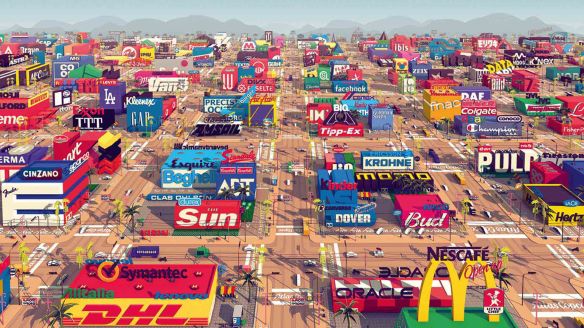
Ordinarily, when we discuss psychogeography, we operate at the scale of a city: we discuss how people are drawn through a walkable space, at a speed in which they can be affected by each piece of passing scenery and make a detour to examine it. But, at the same time the Lettrists were wandering Paris and laying the groundwork for Disneyland in the micro-scale, at the macro-scale holes were being punched through the fabric of the United States in the form of highways.

Habitual migration patterns break the close association between culture and geography. There’s a psychogeographic wormhole between Fairfield County, CT and south Florida, and used to be one between there and upstate NY. If you live in Fairfield County (or certain parts of NYC) you’re liable to be culturally closer to some parts of south Florida than to many points in-between, not because of natural rock formations or bodies of water, but because highways have made it possible to pass through the middle without interacting with it.

Areas of transience — the hyperspace of psychogeography — are not ‘non-places’ with ‘non-culture’. They have a uniquely warped kind of culture, in the same way tourist-dependent places do. Some people spend large amounts of their lives there: long-haul truckers, jet-setting businessmen, touring bands or comedians or authors. The attempt at producing a consistent experience across geography produces an experience that can only exist in hyperspace.

Our own psychogeographic hyperspace is not as psychedelic as the one in Cordwainer Smith’s A Game of Rat and Dragon, but it is stranger, in a Ligottian way.

Why do they have ice machines? Why do they have pools? Why are airplanes and airports trapped in a perpetual 1963 idea of what luxury looks like? Path dependence has made the culture of our hyperspace deeply strange: there are low upper limits on quality of manufacture and high lower limits on quality of service, and the assumed transitory state of most inhabitants means bonds cannot be formed.

When new ideas are integrated here at all, they slot into existing structures — structures that don’t exist outside, in the world that is normal for most of us. Wifi passwords come with the keycard; a robot kiosk in front of the check-in desk prints tickets, as the clerk who formerly printed tickets watches.

These liminal spaces are only forgettable for people who have destinations. They’re also populated by residents, or commuters from geographically — nearby places, who fill the service jobs. What’s it like to have a diner with no regulars? This situation is capitalism-optimized. If you are a resident of psychogeographic hyperspace — nomadic or not — you are dog-fooding the experience that Rand thought was natural to man: separation of orbits, mediated by impersonal monetary transactions. It looks like endless beige hotels with broken ice machines.

What are the attributes of this Randian New Man who lives as hyperspace nomad? Sleep deprivation, boredom, and a dependence on stimulants. Gas stations in hyperspace cater to truckers, abnormally large DVD and pornography selections and every variety of pick-me-up not yet banned. Airports, whose nomads are of a higher caste and have less private space or scheduling freedom, focus more on overpriced convenience food, mediocre reading material, and headphones, and pillows. A Cinnabon could not survive outside of hyperspace, even if it grew up in the shallows of the shopping mall, but in this ecosystem, sheltered from competitors and provided with a steady stream of easy prey, it thrives.

The culture of hyperspace is not a psychogeography, except in a fairly minor sense: everywhere is the same, or tries to be. The few deviations, like Denver International Airport, are notable because deviation is so rare. There is an international internet radio station specifically for airports, and I have heard it play the same playlist in three states. (It never played Brian Eno.) However, like the hyperspace of fiction, it is a strange world that fills the gaps as we jump from one point to another without travelling in-between.

Transit systems are not the only holes in psychogeography. Communications systems also create them. Just as the prevalence of snowbirds and Adirondack cottages make it possible for small segments of northern New York and southern Florida to influence Manhattan finance and vice versa, arbitrary decisions or early-mover advantages gave Los Angeles cultural power over film, Cleveland cultural power over radio, and Atlanta cultural power over podcasting.

Communications technologies have their own hyperspace-cultures, although the geographic centralization of the big players has a larger impact on how they manifest than in the case of hotels. Twitter is the internet equivalent of a trucker-optimized gas station, and caters to journalists — the long-haul truckers of the information landscape. Facebook is the internet equivalent of a Holiday Inn: a premium-mediocre imitation of homeyness that is endearing in its complete failure to be convincing but ultimately irritating if you try to stay too long. (Facebook’s ice machine is always broken, and always loud.) The film industry is a bit like any airport: perpetually stuck in a cheap imitation of an imagined luxurious past, adapting poorly to the cosmopolitanism produced by globalization while profiting through its monopoly on the means of that globalization.

The culture of any hyperspace, because the means of association are limited to the Randian, will be corporate in its manifestation: customer service, marketing, selection, returns, free coupons as a means of apology. It differs from non-hyperspace because these are the only forms of communication truly available. This diner has no regulars with whom the waitress can be frank, only strangers perpetually passing through. It can get away with being shallow and having nothing under its surface, because only very rarely will someone stay long enough to peel it back.

Monuments to the Ego

By

Source: CounterPunch

Some rich bourgeoisie newcomers have perpetrated yet the latest in a series of atrocities upon the small valley where we live, entailing an assault on the sensibilities of virtually everyone and everything living there. Adding insult to injury, this has all been done with apparent utter disregard for us, our neighbors, our dirt road, the wildlife, the native vegetation, and everything sacred and beautiful.

The newcomers scalped the hillside they’ve occupied, smoothed out the offending topographic wrinkles, tore up all the untidy native shrubs, hacked a bench in the slope, erected a large garish pole barn, chiseled out an impractically steep access road, covered every flat or otherwise traversed surface with thick coats of coarse and fine gravel, revegetated the raw soil with non-native plants, propagated massive amounts of weeds, and displaced the deer and elk…meanwhile afflicting all of the neighbors below their lofty perch with the endless noise of heavy equipment suited for construction of interstate highways and a ceaseless caravan of over-sized dump trucks kicking up billowing clouds of dust while assaulting us with their jake brakes. And, no doubt, these naïve newcomers will panic when they realize that mountain lions and bears prowl the ridge where they live, with resulting fatal consequences for any large carnivore ranging nearby.

Perhaps not surprisingly, one of the favorite pastimes among us and other long-term residents is grousing about the rich newcomers, especially the ugly monstrosities they’ve built in highly-visible places. Our nearest neighbor, a salt-of-the earth kind of guy, has a talent for naming the $1 million-plus edifices, including The Ugly House, The Chicken Coop, The Atrocity, and, most recently, The Abortion Clinic.  But the most compelling comment was delivered by yet another long-time neighbor, who billed all of these overbuilt ugly piles with-a-view as simply “monuments to the ego.”

Ego and Egotism…

Ego is an interesting concept upon which to hang the rapine pillaging in our little valley…as well as throughout the human-occupied world. Freud and Buddha would have us believe that all humans have an ‘ego’ (Anatta to the Buddhists), whether as a literal reality or simply as a useful partitioning of the psyche. By these conceptions, ego entails a way of orienting to the world that engenders survival and practical action by the ‘self’.

But, importantly, Freud allows for a curbing effect of the super-ego that embodies ethical concerns and cultural constraints, usually in service of some greater collective good. Likewise, Buddhists distinguish between the Small Self, entailing ego-based motivations, and the Greater Self that, like the super-ego, embodies evolution towards a maturity manifesting compassion and cognizance of connection with other beings. In both instances, ego unchecked by the super-ego or by evolution towards a Greater Self manifests as greed, selfishness, arrogance, fear, and hedonism, with resulting indifference, dishonesty, ruthlessness, and even cruelty exhibited towards others—especially others who are alien or otherwise different.

And Our Moral Universe

Another way of framing all of this is through the lens of moral universes. A person driven wholly by crass motivations originating in the brainstem and ego has a moral universe collapsed into the cesspit of Small Self. This is to say, essentially no moral universe. Expanding outward from this problematic condition are those who deploy notions of fairness, obligation, concern, and benevolence only to family members—as in the Mafia. Next beyond are those with a moral orientation that additionally encompasses those who are of identical or similar identity—national, tribal, ethnic, racial, gender, or the like. And, at the doorstep of enlightenment and transcendence, are those who extend moral concerns and deportment towards all humans—even towards non-human sentient beings.

Scholars such as Peter Singer and Shalom Schwartz have expounded on the importance of an every-expanding moral universe to the welfare and dignity of all humans, even of non-humans with varying degrees of manifest sentience. A world comprised solely of ego-driven humans operating with little restraint or related regard for the effects of their actions on others would be a truly horrific, eventually uninhabitable, place. As Steven Pinker has argued, our small Earth has become a more hospitable and charitable place largely because ever more people are regarding ever more beings of ever greater difference with ever more benevolence, despite what one might think reading vitriolic trash published in outlets such as Breitbart.

The Larger Psycho-Sociological Context

In the end, though, unchecked egotism and all the ills that flow from it flourishes only to the extent that such a condition is sanctioned, even encouraged, by culture, society, and institutions. People obviously shape all of these derivations of basic human behaviors, but human behaviors are in turn powerfully shaped by the higher-order social-psychological phenomena within which they are embedded, creating the potential for powerfully wicked—or powerfully benevolent—synergies.

Of relevance here, culture, society, and institutions ineluctably invoke the nature of our somewhat benighted nation and the more overtly benighted nature of the individualistic capitalist enterprise we have so enthusiastically embraced and codified.

Contradictions of Capitalism

Neoconservatives and their lapdog economists would have us believe that unchecked unfettered capitalism under-girds the best of all possible worlds. Moreover, freely but selectively quoting the likes of John Locke and Adam Smith, they would further have us believe that unbridled greed and unqualified self-interest, channeled by the invisible hand of free markets, is the surest means of furthering the well-being of all humans. Indeed, the Princes of Capitalism who run amuck on Wall Street proudly and unabashedly profess their greed and fundamental disregard for others, assuming that we who hear such professions somehow know it ends well for the rest of us due to the transformative magic of markets.

Never mind peoples’ unequal access to markets. Never mind inequalities in power and privilege. Never mind unequal access to information. Never mind the fundamentally irrational behavior of humans. Never mind the distorting effects of artificial demand created by manipulative advertising. Never mind the chronic gross distortion of markets by hidden (or not so hidden) subsidies created by power elites beholden to wealth elites. Never mind…ad nauseam. We have no free markets.

Despotism…

In the end, people who are wealthy or powerful become ever more wealthy and powerful at the expense of everyone else. Despotism reigns in the sense that an ever smaller minority of people amass an ever greater portion of values, while everyone else becomes comparatively more impoverished. It is no coincidence that we have seen a trend, not only in the United States, but in most developed or developing countries, towards the amassing of more and more wealth in the hands of a mere 1%—even 0.1%—of the populace.

As the radical thinker and economist Charles Eisenstein pithily observed, the modern business enterprise operates on the basis of shifting costs onto others as a normal part of making profits; in other words, by privatizing profits while socializing costs. Put another way, profits—the fundamental underpinning of the capitalist enterprise—are axiomatically created by passing as many costs as possible onto the affected human community, the natural environment, and future generations, often in ways that are fundamentally destructive. The French economist Thomas Piketty offered a complementary argument in his book Capital in the Twenty-First Century, holding that ‘trickle down’ from wealth elites to the comparatively impoverished masses is, in reality, inconsequential and little more than cover for this despotic capitalist enterprise.

And the Problem of Externalities

But concern about the imperfections and problematics of capitalism are not limited to radical or revisionary economists. Indeed, the likes of John Locke and Adam Smith were acutely aware that, despite the hidden hand of markets, the monetary capitalist systems they championed would generate social costs and income inequalities that required rectification by governments.

Some of these social costs have been termed ‘externalities’ by succeeding generations of economists—an externality being a cost or benefit generated by a private economic transaction or activity, but incurred by those who did not chose to partake of the outcome. Classic examples of such externalities include air and water pollution, spillover effects of development on surrounding property values, and the loss of finite biota caused by profit-making enterprises.

Our society has, reasonably enough, responded to these sorts of externalities with laws that zone development, control pollution, and protect endangered species. Whether overtly or tacitly, most people realize that we do, in fact, live in community where considerations of the commonwealth occasionally weigh heavily in the scale of considerations. Indeed, every credible economic or political philosopher or theorist since Locke and Smith and afterwards, Marx, has viewed capitalism and property, not as ends in themselves, but rather as candidate means (dubious means, in the case of Marx) of uplifting humanity and enhancing the well-being and dignity of all—of promoting a flourishing commonwealth; something that many contemporary politicians, economists, and bourgeois capitalists seem to miss.

As it is, the pervasive systemic problem of privatized profits and socialized costs remains, especially in a society such as ours that is wedded to the justifying myth of capitalism and, in the minds of some, the virtues of unchecked greed and individualism—and where those who profit so much from displacing the costs of their activities onto society hold such sway over politicians. This insidious system continues to spawn the sorts of people who show up in our little valley with ill-gotten (by definition) wealth to manifest their ego in various physical obscenities.

Property…

The notion of ‘property’ is yet another pillar of Smith’s capitalism that factors into on-going devastation of the natural world by societies that have succumbed to the capitalist premise. More to the point, private property rights plays a central role in not only the unfolding ecological holocaust, but also in simultaneously catalyzing and justifying damage to human communities.

On the face of it, ‘property’ seems a benign or even beneficial concept. The term is generally understood in reference to anything owned or possessed by someone. Adam Smith even advanced the notion that one’s own labor and physical body are property held, by right of ‘natural law’, exclusively by the salient embodied person. Yet the notion of property has, in fact, been extended to possession of one human by another, most egregiously in the form of overt slavery, but historically (and, in places, still) even in application to dependent children and adult women.

And Its Problems

These latter extensions to other humans highlight an intrinsic, even potentially fatal, problem with the notion of ‘property’. Relegation of anything to the category of property constitutes the ultimate instrumentalization and related erasure of intrinsic worth. Through this, property has no rights, no prerogatives, and no claim to considerations of well-being and health.

Relegation of inanimate physical objects to the category of property is perhaps not problematic, but any application to another life form, especially one with plausible sentience immediately raises moral questions. Does a dog deserve consideration of its health and well-being, despite being property? Some people would say ‘no’, but our society has answered a resounding ‘yes’ through the passage, for example, of animal welfare laws and even serious consideration of whether chimpanzees deserve rights. But, then, do elk and bears and lions deserve consideration of their welfare? Do ecosystems have ‘health’ and, if so, do even these abstract entities warrant moral concern, especially when it comes to fostering and preserving ‘health’?

I hold that the manner in which a person orients to such issues offers a profound commentary on their ego maturity and moral universe—Small versus Greater. And, in fact, orientations towards living property end up being entangled with precepts of capitalism and consideration of ‘the other’ in choices people make regarding their use of property, specifically whether they care at all about the negative impacts their choices may have on others, whether human, animal, vegetal, or even spiritual. People with small souls and a small moral universe will probably not give a damn, and even actively resist any societal requirements that they be held accountable for the harm they cause, often by deploying the justifying rhetoric of libertarianism and the primacy of individual freedom.

Inanities of Property Rights

All of this comes to a head in considerations of private property rights, although it is worth first noting that property can be held privately, publicly, or communally, and also simply by societal consent without rising to the level of a ‘right’. But there are some ideologues and yahoos (not mutually exclusive) who hold that the only credible sort of property is private, and that all private property is axiomatically held by the owner as a ‘right’.

Such simple-minded constructions hardly pass the laugh test. On the face of it, public property has more intrinsic merit than private property simply because it is held in trust to explicitly serve the greater good of society. The same could be said for communal property, but with ‘the greater good’ reckoned at the scale of a given community.

Insofar as being a ‘right’ is concerned, Debbie Becher cogently observed in a 2015 article that “…social theorists have long understood that property is not the ownership of a thing or a set of individual rights, but a set of social agreements about what ownership entails…Property rules involve government intimately not only in creating value but also in determining who deserves which valuable resources.”

Notice ‘social agreements’, the role of ‘government’, and the invocation of ‘deserve’. None of this bespeaks a ‘right’ in the conventional sense that we think of such things, especially in application to human health and happiness (see my article on Human Dignity and Micheline Ishay’s book The History of Human Rights), although our society paradoxically—even perversely—holds that rights attach to our property but not to our health. In fact, property is held solely by the consent of society and ultimately (whether acknowledged or not) in service of promoting the commonwealth of human well-being and dignity.

Rich and Not-So-Rich Yahoos

Yet our country is filled with people who think that they not only have an absolute right to their property, but that this supposed ‘right’ gives them the prerogative to mete out use, abuse, destruction, and harm without restraint or consideration of impacts on other humans—much less impacts on other sentient beings, and certainly not impacts on the health and wholeness of the ecosystems they exploit.

Such seems to be the case with our new neighbors wreaking havoc upstream in yet the latest exhibition of stunted moral development by newly-arrived rich folk. Although these people are by no means the only ones.

Metamorphosis?

We all suffer sooner or later living in a world of unchecked greed, selfishness, and self-centeredness—understood by some to be the equivalent of ‘individualism’. This is especially true in a country such as ours where simple-minded conceptions of capitalism and private property encourage, if not sanctify, abusive relations with the land, other people, and other life forms. Under such auspices, people are prone to the fallacy of conflating ‘freedom’ with possession, which can never lead to contentment.

No doubt, most of us want the greatest scope of free choice possible, as well as assurance that the physical goods we depend upon and hold dear will be secure from depredation. Yet, more assuredly, I would hold that most of us—albeit inchoately—want to be part of a commonwealth of human dignity. Inescapably, such a commonwealth requires that we curb our actions out of respect for others and with due consideration of harm we may cause. Sadly, our society seems to be exhibiting less rather than more of such dignified self-restraint.

There are perhaps only a few ways that the current death spiral of our living Earth can be checked. The spiritually dead look to technological fixes. A highly virulent and contagious disease specific to humans might save the rest of life on this planet, but only through erasure of our species. More hopefully, we humans might evolve towards greater benevolence, generosity, and concern, not only for other humans, but for all of life.

But such evolution depends on the rapid expansion of our collective moral universe beyond the frontiers of humankind. To do so, though, requires that we transcend our delusional fixation with patently destructive ideologies, of which capitalism and private property rights are currently one of the most potent. Closer to home for me, I hope to live long enough to see the end of people scraping, gouging, chiseling, hacking, tearing, and uprooting the naked living Earth simply to build yet another monument to their ego.

Conflict Theory and Biosphere Annihilation

By Robert J. Burrowes

In a recent article titled Challenges for Resolving Complex Conflicts’, I pointed out that existing conflict theory pays little attention to the extinction-causing conflict being ongoingly generated by human over-consumption in the finite planetary biosphere (and, among other outcomes, currently resulting in 200 species extinctions daily). I also mentioned that this conflict is sometimes inadequately identified as a conflict caused by capitalism’s drive for unending economic growth in a finite environment.

I would like to explain the psychological origin of this biosphere-annihilating conflict and how this origin has nurtured the incredibly destructive aspects of capitalism (and socialism, for that matter) from the beginning. I would also like to explain what we can do about it.

Before I do, however, let me briefly illustrate why this particular conflict configuration is so important by offering you a taste of the most recent research evidence in relation to the climate catastrophe and biosphere annihilation and why the time to resolve this conflict is rapidly running out (assuming, problematically, that we can avert nuclear war in the meantime).

In an article reporting a recent speech by Professor James G. Anderson of Harvard University, whose research led to the Montreal Protocol in 1987 to mitigate CFC damage to the Ozone Layer, environmental journalist Robert Hunizker summarizes Anderson’s position as follows: ‘the chance of permanent ice remaining in the Arctic after 2022 is zero. Already, 80% is gone. The problem: Without an ice shield to protect frozen methane hydrates in place for millennia, the Arctic turns into a methane nightmare.’ See ‘There Is No Time Left’.

But if you think that sounds drastic, other recent research has drawn attention to the fact that the ‘alarming loss of insects will likely take down humanity before global warming hits maximum velocity…. The worldwide loss of insects is simply staggering with some reports of 75% up to 90%, happening much faster than the paleoclimate record rate of the past five major extinction events’. Without insects ‘burrowing, forming new soil, aerating soil, pollinating food crops…’ and providing food for many bird species, the biosphere simply collapses. See Insect Decimation Upstages Global Warming’.

So, if we are in the process of annihilating Earth’s biosphere, which will precipitate human extinction in the near term, why aren’t we paying much more attention to the origin of this fundamental conflict? And then developing a precisely focused strategy for transcending it?

The answer to these two questions is simply this: the origin of this conflict is particularly unpalatable and, from my careful observation, most people, including conflict theorists, aren’t anxious to focus on it.

So why are human beings over-consuming in the finite planetary biosphere? Or more accurately, why are human beings who have the opportunity to do so (which doesn’t include those impoverished people living in Africa, Asia, Central/South America or anywhere else) over-consuming in the finite planetary biosphere?

They are doing so because they were terrorized into unconsciously equating consumption with a meaningful life by parents and other adults who had already internalized this same ‘learning’.

Let me explain how this happens.

At the moment of birth, a baby is genetically programmed to feel and express their feelings in response to the stimuli, both internal and external, that the baby registers. For example, as soon after birth as a baby feels hungry, they will signal that need, usually by crying or screaming. An attentive parent (or other suitable adult) will usually respond to this need by feeding the baby and the baby will express their satisfaction with this outcome, perhaps with a facial expression, in a way that most aware parents and adults will have no difficulty identifying. Similarly, if the baby is cold, in pain or experiencing any other stimulus, the baby will express their need, probably by making a loud noise. Given that babies cannot immediately use a cultural language, they use the language that was given to them by evolution: particularly audibly expressed noise of various types that an aware adult will quickly learn to interpret.

Of course, from the initial moments after birth and throughout the next few months, a baby will experience an increasing range of stimuli – including internal stimuli such as the needs for listening, understanding and love, as well as external stimuli ranging from a wet nappy to a diverse set of parental, social, climate and environmental stimuli – and will develop a diverse and expanding range of ways, now including a wider range of emotional expression but eventually starting to include spoken language, of expressing their responses, including satisfaction and enjoyment if appropriate, to these stimuli.

At some vital point, however, and certainly within the child’s first eighteen months, the child’s parents and the other significant adults in the child’s life, will start to routinely and actively interfere with the child’s emotional expression (and thus deny them satisfaction of the unique needs being expressed in each case) in order to compel the child to do as the parent/adult wishes. Of course, this is essential if you want the child to be obedient – a socially compliant slave – rather than to follow their own Self-will.

One of the critically important ways in which this denial of emotional expression occurs seems benign enough: Children who are crying, angry or frightened are scared into not expressing their feelings and offered material items – such as food or a toy – to distract them instead. Unfortunately, the distractive items become addictive drugs. Unable to have their emotional needs met, the child learns to seek relief by acquiring the material substitutes offered by the parent. But as this emotional deprivation endlessly expands because the child has been denied the listening, understanding and love to develop the capacity to listen to, love and understand themself, so too does the ‘need’ for material acquisition endlessly expand.

As an aside, this explains why most violence is overtly directed at gaining control of material, rather than emotional, resources. The material resource becomes a dysfunctional and quite inadequate replacement for satisfaction of the emotional need. And, because the material resource cannot ‘work’ to meet an emotional need, the individual is most likely to keep using direct and/or structural violence to gain control of more material resources in an unconscious and utterly futile attempt to meet unidentified emotional needs. In essence, no amount of money and other assets can replace the love denied a child that would allow them to feel and act on their feelings.

Of course, the individual who consumes more than they need and uses direct violence, or simply takes advantage of structural violence, to do so is never aware of their deeply suppressed emotional needs and of the functional ways of having these needs met. Although, I admit, this is not easy to do given that listening, understanding and love are not readily available from others who have themselves been denied these needs. Consequently, with their emotional needs now unconsciously ‘hidden’ from the individual, they will endlessly project that the needs they want met are, in fact, material.

This is the reason why members of the Rothschild family, Jeff Bezos, Bill Gates, Warren Buffett, Amancio Ortega, Mark Zuckerberg, Carlos Slim, the Walton family and the Koch brothers, as well as the world’s other billionaires and millionaires, seek material wealth and are willing to do so by taking advantage of structures of exploitation held in place by the US military. They are certainly wealthy in the material sense; unfortunately, they are emotional voids who were never loved and do not know how to love themself or others now.

Tragically, however, this fate is not exclusive to the world’s wealthy even if they illustrate the point most graphically. As indicated above, virtually all people who live in material cultures have suffered this fate and this is readily illustrated by their ongoing excessive consumption – especially their meat-eating, fossil-fueled travel and acquisition of an endless stream of assets – in a planetary biosphere that has long been signaling ‘Enough!’

As an aside, governments that use military violence to gain control of material resources are simply governments composed of many individuals with this dysfunctionality, which is very common in industrialized countries that promote materialism. Thus, cultures that unconsciously allow and encourage this dysfunctional projection (that an emotional need is met by material acquisition) are the most violent both domestically and internationally. This also explains why industrialized (material) countries use military violence to maintain political and economic structures that allow ongoing exploitation of non-industrialized countries in Africa, Asia and Central/South America.

In summary, the individual who has all of their emotional needs met requires only the intellectual and few material resources necessary to maintain this fulfilling life: anything beyond this is not only useless, it is a burden.

If you want to read (a great deal) more detail of the explanation presented above, you will find it in Why Violence?’ and Fearless Psychology and Fearful Psychology: Principles and Practice.

So what can we do?

Well, I would start by profoundly changing our conception of sound parenting by emphasizing the importance of nisteling to children – see Nisteling: The Art of Deep Listening’ – and making ‘My Promise to Children’.

For those adults who feel incapable of nisteling or living out such a promise, I encourage you to consider doing the emotional healing necessary by ‘Putting Feelings First’.

If you already feel capable of responding powerfully to this extinction-threatening conflict between human consumption and the Earth’s biosphere, you are welcome to consider joining those who are participating in the fifteen-year strategy to reduce consumption and achieve self-reliance explained in ‘The Flame Tree Project to Save Life on Earth’ and/or to consider using sound nonviolent strategy to conduct your climate or environment campaign. See Nonviolent Campaign Strategy.

You are also welcome to consider signing the online pledge of The Peoples Charter to Create a Nonviolent World.

As the material simplicity of Mohandas K. Gandhi demonstrated: Consumption is not life.

If you are not able to emulate Gandhi (at least ‘in spirit’) by living modestly, it is your own emotional dysfunctionality – particularly unconscious fear – that is the problem that needs to be addressed.

Biodata: Robert J. Burrowes has a lifetime commitment to understanding and ending human violence. He has done extensive research since 1966 in an effort to understand why human beings are violent and has been a nonviolent activist since 1981. He is the author of ‘Why Violence?’ http://tinyurl.com/whyviolence His email address is flametree@riseup.net and his website is here. http://robertjburrowes.wordpress.com

Robert J. Burrowes
P.O. Box 68
Daylesford, Victoria 3460
Australia

Email: flametree@riseup.net

Websites:
Nonviolence Charter
Flame Tree Project to Save Life on Earth
‘Why Violence?’
Feelings First
Nonviolent Campaign Strategy
Nonviolent Defense/Liberation Strategy
Anita: Songs of Nonviolence
Robert Burrowes
Global Nonviolence Network

Identity Theft and the Body’s Disappearance

By Robert Bohm

Source: The Hampton Institute

“What sphinx of cement and aluminum bashed open their skulls and ate up their brains and imagination?”

– Allen Ginsberg from his poem “ Howl

Identity theft, at least the most familiar type, is possible because today the individual exists not merely as flesh and blood, but as flesh and blood spliced with bank account numbers, user names, passwords, credit card chips, etc. These added parts aren’t secondary to the individual’s overall identity, they’re central to it. Sometimes they’re all there is of it, as in many banking and purchasing transactions. In such instances, the data we’ve supplied to the relevant institutions doesn’t merely represent us, it is us. Our bodies alone can’t complete transactions without the account numbers, user names, passwords, credit card numbers, and ID cards which have become our identity’s essence. Without them, in many ways, we don’t exist.

In a worst case scenario, if someone gets hold of this private data, they can become us by possessing the data that is us. Following this, who or what we are is no longer a question. We don’t exist, except in the form of a stolen dataset now under someone else’s control.

In such a case, an unknown proxy has eliminated us and become who we once were.

Although problematic, the above form of identity theft is relatively minor. A worse form is one we all know about, yet chronically underestimate because we think of ourselves as too canny to be conned. Nonetheless, this other form of identity theft frames and limits everything we do. In the process, it fleeces us of the fullness of our identities and subjects our lives to a type of remote control. This remote control consists of the combined influence on us, from childhood onward, of society’s major institutions and dominant activities, which seed us with a variety of parameters for how to acceptably navigate society and and its particular challenges.

This process is usually called “socialization.” However, it’s better seen as a sorting procedure in which society sifts us through a citizenship sieve in order to eliminate supposed defects, thereby guaranteeing that, despite each of us possessing unique characteristics, we share an underlying uniformity. Ultimately, this process is a kind of identity eugenics which strives to purify the population by eliminating or weakening troublesome qualities – e.g., an overly questioning attitude, chronic boundary-testing, a confrontational stance toward authority, a fierce protectiveness toward whatever space the body inhabits, etc. Such traits are frowned upon because they’re seen by the status quo as a likely threat to society’s stability.

Such indoctrination is much subtler yet, in many ways, more pervasive than outright propaganda. Its theater of operations is everywhere, taking place on many fronts. Public and private education, advertising, mass culture, government institutions, the prevailing ideas of how to correct socioeconomic wrongs (this is a “good” form of protest, this a “bad” one), the methods by which various slangs are robbed of their transgressive nature through absorption into the mainstream, the social production of substitute behaviors for nonconformity and rebellion – each of these phenomena and others play a role in generating the so-called “acceptable citizen,” a trimmed down (i.e., possesses reduced potential) version of her or his original personality.

Make no doubt about it, this trimming of the personality is a form of identity theft. It is, in fact, the ultimate form. Take as an example the African slave in the U.S.: abducted from her or his homeland, forbidden from learning to read or write, denied legal standing in the courts, given no say over whether offspring would be sold to another owner or remain with them. The slave was robbed of her/his most essential identity, their status as a human being.

In his book, The Souls of Black Folk , W.E.B. Du Bois described this theft in terms of how slavery reduces the slave to a person with “no true self-consciousness” – that is, with no stable knowledge of self, no clear sense of who she or he is in terms of culture, preceding generations, rituals for bringing to fruition one’s potential to create her or his own fate. As Du Bois correctly argued, this left the slave, and afterwards the freed Black, with a “longing to attain self-conscious manhood,” to know who she or he was, to see oneself through one’s own eyes and not through the eyes of one’s denigrators – e.g., white supremacists, confederate diehards, “good” people who nonetheless regarded Blacks as “lesser,” etc. Du Bois understood that from such people’s perspectives, Blacks possessed only one identity: the identity of being owned, of possessing no value other than what its owner could extract from them. Without an owner to extract this value, the slave was either identity-less or possessed an identity so slimmed and emaciated as to be a nothing.

The point here isn’t that today socialization enslaves the population in the same way as U.S. slavery once enslaved Blacks, but rather that identity theft is, psychologically and culturally speaking, a key aspect of disempowering people and has been for centuries. Today, because of mass culture and new technologies, the methods of accomplishing it are far more sophisticated than during other eras.

How disempowerment/identity theft occurs in contemporary society is inseparable from capitalism’s current state of development. We long ago passed the moment (after the introduction of assembly line production in the early 20th century) when modern advertising started its trek toward becoming one of the most powerful socialization forces in the U.S. As such, it convinces consumers not only to purchase individual products but, even more importantly, sells us on the idea that buying in general and all the time, no matter what we purchase, is proof of one’s value as a person.

To accomplish this end, modern advertising was molded by its creators into a type of PSYOP designed for destabilizing individuals’ adherence to old saws like “a penny saved is a penny earned” and “without frugality none can be rich, and with it very few would be poor.” Once this happened, the United States’ days of puritan buying restraint were over. However, modern advertising was never solely about undermining personal fiscal restraint. It was also about manipulating feelings of personal failure – e.g., dissatisfaction with lifestyle and income, a sense of being trapped, fear of being physically unappealing, etc. – and turning them not into motives for self-scrutiny or social critiques, but into a spur for commodity obsession. This wasn’t simply about owning the product or products, but an obsessive hope that buying one or more commodities would trigger relief from momentary or long-term anxiety and frustration related to one’s life-woes: job, marriage, lack of money, illness, etc.

Helen Woodward, a leading advertising copywriter of the early decades of the 20th century, described how this was done in her book, Through Many Windows , published in 1926. One example she used focused on women as consumers:

The restless desire for a change in fashions is a healthy outlet. It is normal to want something different, something new, even if many women spend too much time and too much money that way. Change is the most beneficent medicine in the world to most people. And to those who cannot change their whole lives or occupations, even a new line in a dress is often a relief. The woman who is tired of her husband or her home or a job feels some lifting of the weight of life from seeing a straight line change into a bouffant, or a gray pass into a beige. Most people do not have the courage or understanding to make deeper changes.

Woodward’s statement reveals not only the advertising industry’s PSYOP characteristic of manipulating people’s frustrations in order to lure them into making purchases, but also the industry’s view of the people to whom it speaks through its ads. As indicated by Woodward’s words, this view is one of condescension, of viewing most consumers as unable to bring about real socioeconomic change because they lack the abilities – “the courage or understanding” – necessary to do so. Consequently, their main purpose in life, it is implied, is to exist as a consumer mass constantly gorging on capitalism’s products in order to keep the system running smoothly. In doing this, Woodward writes, buyers find in the act of making purchases “a healthy outlet” for troubled emotions spawned in other parts of their lives.

Such advertising philosophies in the early 20th century opened a door for the industry, one that would never again be closed. Through that door (or window), one could glimpse the future: a world with an ever greater supply of commodities to sell and an advertising industry ready to make sure people bought them. To guarantee this, advertisers set about creating additional techniques for reshaping public consciousness into one persuaded that owning as many of those commodities as possible was an existential exercise of defining who an individual was.

In his book The Consumer Society , philosopher Jean Baudrillard deals with precisely this process. He writes that such a society is driven by:

the contradiction between a virtually unlimited productivity and the need to dispose of the product. It becomes vital for the system at this stage to control not only the mechanism of production, but also consumer demand.

“To control … consumer demand.” This is the key phrase here. Capitalist forces not only wanted to own and control the means of production in factories, it also wanted to control consumers in such a way that they had no choice but to buy, then buy more. In other words, capitalism was in quest of a strategy engineered to make us synch our minds to a capitalism operating in overdrive (“virtually unlimited” production).

The way this occurs, Baudrillard argues, is by capitalism transforming (through advertising) the process of buying an individual product from merely being a response to a “this looks good” or “that would be useful around the house” attitude to something more in line with what psychologists call “ego integration.” It refers to that part of human development in which an individual’s various personality characteristics (viewpoints, goals, physical desires, etc.) are organized into a balanced whole. At that point, what advertising basically did for capitalism was develop a reconfigured ego integration process in which the personality is reorganized to view its stability as dependent on its life as a consumer.

Advertisers pulled this off because the commodity, in an age of commodity profusion, isn’t simply a commodity but is also an indicator or sign referring to a particular set of values or behavior, i.e. a particular type of person. It is this which is purchased: the meaning, or constellation of meanings, which the commodity indicates.

In this way, the commodity, once bought, becomes a signal to others that “I, the owner, am this type of person.” Buy an Old Hickory J143 baseball bat and those in the know grasp that you’re headed for the pros. Sling on some Pandora bling and all the guys’ eyes are on you as you hip-swing into the Groove Lounge. Even the NY Times is hip to what’s up. If you want to be a true Antifa activist, the newspaper informed its readers on Nov. 29, 2017, this is the attire you must wear:

Black work or military boots, pants, balaclavas or ski masks, gloves and jackets, North Face brand or otherwise. Gas masks, goggles and shields may be added as accessories, but the basics have stayed the same since the look’s inception.

After you dress up, it’s not even necessary to attend a protest and fight fascists to be full-blown Antifa. You’re a walking billboard (or signification) proclaiming your values everywhere. Dress the part and you are the part.

Let’s return to Baudrillard, though. In The System of Objects , another of his books, he writes about how the issue of signification, and the method by which individuals purchase particular commodities in order to refine their identity for public consumption, becomes the universal mass experience:

To become an object of consumption, an object must first become a sign. That is to say: it must become external, in a sense, to a relationship that it now merely signifies … Only in this context can it be ‘personalized’, can it become part of a series, and so on; only thus can it be consumed, never in its materiality, but in its difference.

This “difference” is what the product signifies. That is, the product isn’t just a product anymore. It isn’t only its function. It has transitioned into an indicator of a unique personality trait, or of being a member of a certain lifestyle grouping or social class, or of subscribing to a particular political persuasion, Republican, anarchist, whatever. In this way, choosing the commodities to purchase is essential to one’s self-construction, one’s effort to make sure the world knows exactly who they are.

The individual produced by this citizen-forming process is a reduced one, the weight of her/his full personality pared down by cutting off the unnecessary weight of potentials and inclinations perceived as “not a good fit” for a citizen at this stage of capitalism. Such a citizen, however, isn’t an automaton. She or he makes choices, indulges her or his unique appetites, even periodically rebels against bureaucratic inefficiency or a social inequity perceived to be particularly stupid or unfair. Yet after a few days or few months of this activity, this momentary rebel fades back into the woodwork, satisfied by their sincere but token challenge to the mainstream. The woodwork into which they fade is, of course, their home or another favorite location (a lover’s apartment, a bar, a ski resort cabin, a pool hall, etc.).

From this point on, or at least for the foreseeable future, such a person isn’t inclined to look at the world with a sharp political eye, except possibly within the confines of their private life. In this way, they turn whatever criticism of the mainstream they may have into a petty gripe endowed with no intention of joining with others in order to fight for any specific change(s) regarding that political, socioeconomic or cultural phenomenon against which the complaint has been lodged. Instead, all the complainer wants is congratulations from her or his listener(s) about how passionate, on-target, and right the complaint was.

This is the sieve process, identity eugenics, in action. Far more subtle and elastic than previous methods of social control, it narrows what we believe to be our options and successfully maneuvers us into a world where advertising shapes us more than schools do. In this mode, it teaches us that life’s choices aren’t so much about justice or morality, but more about what choosing between commodities is like: which is more useful to me in my private life, which one better defines me as a person, which one makes me look cooler, chicer, brainier, hunkier, more activist to those I know.

It is in this context that a young, new, “acceptable” citizen enters society as a walking irony. Raised to be a cog in a machine in a time of capitalistic excess, the individual arrives on the scene as a player of no consequence in a game in which she or he has been deluded that they’re the game’s star. But far from being a star, this person, weakened beyond repair by the surrender of too much potential, is so without ability that she or he has no impact whatsoever on the game. Consequently, this individual is, for all practical purposes, an absence. The ultimate invisible person, a nothing in the midst of players who don’t take note of this absence at all. And why should they? The full-of-potential individual who eventually morphed into this absence is long gone, remembered by no one, except as a fading image of what once was.

This process of reducing a potentially creative person into a virtual non-presence is a form of ideological anorexia. Once afflicted, an individual refuses nourishment until they’re nothing but skin and bones. However, the “weight” they’ve lost doesn’t consist of actual pounds. Instead, it involves a loss of the psychological heftiness and mental bulk necessary to be a full human being.

One can’t lose more weight than that.

Human life as we once knew it is gone, replaced by the ritual of endless purchasing. This is existence in what used to be called “the belly of the beast.” Our role in life has become to nourish capitalism by being at its disposal, by giving of ourselves. Such giving frequently entails self-mutilation: the debt, credit card and otherwise, that bludgeons to death the dreams of many individuals and families.

This quasi-religious self-sacrifice replicates in another form: the Dark Ages practice employed by fanatical monks and other flagellants who lashed themselves with whips made from copper wires, thereby ripping their flesh and bleeding until they descended into a state of religious hysteria. The more we give of ourselves in this way, the thinner and more weightless we become. Meanwhile, the god whom Allen Ginsberg called Moloch grows more obese day after day, its belly is filled with:

Robot apartments! invisible suburbs! skeleton treasuries! blind capitals! demonic industries! spectral nations! invincible madhouses! granite cocks! monstrous bombs!…

Dreams! adorations! illuminations! religions! the whole boatload of sensitive bullshit!

What capitalism wants from us, of course, isn’t merely self-sacrifice, it’s surrender. Hunger for life is viewed negatively by the status quo because it nourishes the self, making it stronger and more alert and, therefore, better prepared to assert itself. The fact that such an empowered self is more there (possesses more of a presence) than its undersized counterpart makes the healthier self unacceptable to the powers that be. This is because there-ness is no longer an option in our national life. Only non-there-ness is. If you’re not a political anorexic, you’re on the wrong side.

Wherever we look, we see it. Invisibility, or at least as much of it as possible, is the individual’s goal. It’s the new real. Fashion reveals this as well as anything. It does so by disseminating an ideal of beauty that fetishizes the body’s anorexic wilting away. Not the body’s presence but its fade to disappearance is the source of its allure. The ultimate fashion model hovers fragilely on the brink of absence in order not to distract from the only thing which counts in capitalism: the commodity to be sold – e.g., the boutique bomber jacket, the shirt, the pantsuit, the earrings, the shawl, the stilettos, the iPhone, the Ferrari, and, possibly most of all, the political passivity intrinsic to spending your life acquiring things in order to prove to others and ourselves that we’ve discovered in these things something more useful than Socrates’ goal of knowing thyself or Emma Goldman’s warning , “The most unpardonable sin in society is independence of thought.”

What is true on the fashion runway is also true in politics. Just as the best model is one thin enough to fade into non-presence, so our democracy, supposedly ruled “by and for the people,” has thinned down so much that “the people” can’t even be seen (except as stage props), let alone get their hands on democracy except in token ways. No matter how often we the people are praised rhetorically by politicians, we aren’t allowed as a group to get in the way of the capitalist system’s freedom to do whatever it wants in order to sustain commodity worship and guarantee capital’s right to permanent rule. If the military-industrial complex needs another war in order to pump out more profits, then so be it. We have no say in the matter. The identity theft built into society’s structure makes sure of this. It’s stripped us of our “weight” – our creativity, our willingness to take political risks, our capacity to choose action over posturing. After this forced weight loss, what’s left of us is a mess. Too philosophically and psychologically anemic to successfully challenge our leaders’ decisions, we, for all practical purposes, disappear.

As a reward for our passivity, we’re permitted a certain range of freedom – as long as “a certain range” is defined as “varieties of buying” and doesn’t include behavior that might result in the population’s attainment of greater political power.

So, it continues, the only good citizen is the absent citizen. Which is to say, a citizen who has dieted him or herself into a state of political anorexia – i.e., that level of mental weightlessness necessary for guaranteeing a person’s permanent self-exclusion from the machinery of power.

***

Our flesh no longer exists in the way it once did. A new evolutionary stage has arrived.

In this new stage, the flesh isn’t merely what it seems to be: flesh, pure and simple. Instead, it’s a hybrid. It’s what exists after the mind oversees its passage through the sieve of mass culture.

After this passage, what the flesh is now are the poses it adopts from studying movies, rappers, punk rockers, fashionistas of all kinds, reality TV stars, football hunks, whomever. It’s also what it wears, skinny jeans or loose-fitting chinos, short skirt or spandex, Hawaiian shirt or muscle tank top, pierced bellybutton, dope hiking boots, burgundy eyeliner. Here we come, marching, strolling, demon-eyed, innocent as Johnny Appleseed. Everybody’s snapping pics with their phones, selfies and shots of others (friends, strangers, the maimed, the hilarious, the so-called idiotic). The flesh’s pictures are everywhere. In movie ads, cosmetic ads, suppository ads, Viagra ads. This is the wave of the already-here but still-coming future. The actual flesh’s replacement by televised, printed, digitalized and Photoshopped images of it produces the ultimate self-bifurcation.

Increasingly cut off from any unmediated life of its own, the flesh now exists mostly as a natural resource for those (including ourselves) who need it for a project; to photograph it, dress it up, pose it in a certain way, put it on a diet, commodify/objectify it in any style ranging from traditional commodification to the latest avant-garde objectification.

All these stylings/makeovers, although advertised as a form of liberation for the flesh (a “freeing” of your flesh so you can be what you want to be), are in fact not that. Instead, they are part of the process of distancing ourselves from the flesh by always doing something to it rather than simply being it.

When we are it, we feel what the flesh feels, the pain, the joy, the satisfaction, the terror, the disgust, the hints of hope, a sense of irreparable loss, whatever.

When we objectify it, it is a mannequin, emotionless, a thing that uses up a certain amount of space. As such we can do what we want with it: decorate it, pull it apart, vent our frustrations on it, starve it, practice surgical cuts on it, put it to whatever use we like. It isn’t a person. It is separate from our personhood and we own it.

In fact we own all the world’s flesh.

We live, after all, in the American Empire, and the Empire owns everything. As the Empire’s citizens, we own everything it owns. Except for one thing: ourselves.

***

The flesh is both here and not here. Increasingly, it is more an object that we do things to – e.g., bulk it up, change its hair color, mass-kill it from a hotel window on the 32nd floor, view in a porno flick – than a presence in its own right (i.e., self-contained, a force to be reckoned with). In this sense, it is a growing absence, each day losing more of its self-determination and becoming more a thing lost than something that exists fully, on its own, in the here and now. Given this, the proper attitude to have toward the flesh is one of nostalgia.

Of course, the flesh hasn’t really disappeared. What has disappeared is what it once was, a meat-and-bones reality, a site of pleasure and injury. Now, however, it’s not so valuable in itself as it is in its in its role as a starting-off point for endless makeovers.

These makeover options are arrayed before the consumer everywhere: online, in big box stores, in niche markets and so on. Today, it is in these places, not at birth, that the flesh starts its trek toward maturation. It does this by offering itself up as a sacrifice to be used as they see fit by the fashion industry, the gym industry, the addiction-cure industry, the diet industry, the pharmaceutical industry, the education industry, etc. Each body in the nation reaches its fullest potential only when it becomes a testing site to be used by these industries as they explore more and better ways to establish themselves as indispensable to capitalism’s endless reproduction.

In the end, the flesh, the target of all this competition for its attention, has less of a life on its own than it does as the object of advertisers’ opinions about what can be done to improve it or to reconstruct it. Only to the extent that the flesh can transcend or reconstitute itself can it be said to be truly alive.

This last fact – about aliveness – represents the culmination of a process. This process pertains to the visualization and digitalization of everything and the consequent disappearance of everything behind a wall of signification.

A televised or computerized image, discussion, commentary, conjecture, etc., becomes the thing it meditates on, depicts or interprets. This happens by virtue of the fact that the thing itself (the real flesh behind the televised or computerized image, discussion, commentary, conjecture, etc.) has disappeared into the discussion or into the image of it presented on the computer or TV screen.

In the same way, an anorexic model (her/his flesh and blood presence) disappears into the fashions she or he displays for the public.

In each instance the thing (the flesh) now no longer exists except in other people’s meditations on it; it has become those other people’s meditations. The ultimate anorexic, it (the thing) has lost so much weight it’s no longer physically there except as an idea in someone else’s mind or in a series of binary codings inside computers.

This is the final victory of absence over there-ness, of the anorexic ideal over the idea of being fully human (i.e., “bulging with existence,” “fat with life”). The self has been successfully starved to the point of such a radical thinness that it can no longer stand up to a blade of grass, let alone make itself felt by the powers that be.

No Need To Wait – Dystopia Is Almost Upon Us

Source: TruePublica

Microsoft’s CEO has warned the technology industry against creating a dystopian future, the likes of which have been predicted by authors including George Orwell and Aldous Huxley. Satya Nadella kicked off the the company’s 2017 Build conference with a keynote that was as unexpected as it was powerful. He told the developers in attendance that they have a huge responsibility, and that the choices they make could have enormous implications.

They won’t listen of course. The collection of big data along with management, selling and distribution and the systems architecture to control it is now worth exactly double global military defence expenditure. In fact, this year, the big data industry overtook the worlds most valuable traded commodity – oil.

The truth is that the tech giants have already captured us all. We are already living in the beginnings of a truly dystopian world.

Leaving aside the endemic surveillance society our government has chosen on our behalf with no debate, politically or otherwise, we already have proof of the now and where it is leading. With fingerprint scanning, facial recognition, various virtual wallets to pay for deliveries, some would say your identity is as good as stolen. If it isn’t, it soon will be. That’s because the hacking industry, already worth a mind blowing $1trillion annually is expected to reach $2.1 trillion in just 14 months time.

The reality of not being able to take public transportation, hire a car, buy a book, or a coffee – requiring full personal identification is almost upon us. Britain even had an intention to be completely cashless by 2025 – postponed only by the impact of Brexit.

Alexa, the Amazon home assistant listens to everything said in the house. It is known to record conversations. Recently, police in Arkansas, USA demanded that Amazon turn over information collected from a murder suspect’s Echo — the speaker that controls Alexa, because they already knew what information could be extracted from it.

32M is the first company in the US that provides a human chip, allowing employees “to make purchases in their break-room micro market, open doors, login to computers, use the copy machine.” 3M also confirmed what the chip could really do – telling employees to “use it as your passport, public transit and all purchasing opportunities.”

Various Apps now locate people you may know and your own location can be shared amongst others without your knowledge and we’ve known for years that governments and private corporations have access to this data, whether you like it not.

Other countries are providing even scarier technologies.  Hypebeast Magazine reports that  Aadhaar is a 12-digit identity number issued to all Indian residents based on their biometric and demographic data. “This data must be linked to their bank account or else they’ll face the risk of losing access to their account. Folks have until the end of the year to do this, with phone numbers soon to be connected through the 12 digits by February. Failure to do so will deactivate the service. ” The technology has the ability to refuse access to state supplied services such as healthcare.

Our article “Insurance Industry Leads The Way in Social Credit Systems” also highlights what the fusion of technology and data is likely to end up doing for us. An astonishing 96 per cent of insurers think that ecosystems or applications made by autonomous organisations are having a major impact on the insurance industry. The use of social credit mechanisms is being developed, some already implemented, which will determine our future behaviour, which will affect us all – both individually and negatively.”

The Chinese government plans to launch its Social Credit System in 2020. Already being piloted on 12 million of its citizens, the aim is to judge the trustworthiness – or otherwise – of its 1.3 billion residents. Something as innocuous as a person’s shopping habits become a measure of character. But the system not only investigates behaviour – it shapes it. It “nudges” citizens away from purchases and behaviours the government does not like. Friends are considered as well and individual credit scores fall depending on their trustworthiness. It’s not possible to imagine how far this will go in the end.

However to get us all there, to that situation, we need to be distracted from what is going on in the background. Some, are already concerned.


Distraction – detaching us from truth and reality

The Guardian wrote an interesting piece recently which highlighted some of the concerns of those with expert insider knowledge of the tech industry. For instance, Justin Rosenstein, the former Google and Facebook engineer who helped build the ‘like’ button –  is concerned. He believes there is a case for state regulation of smartphone technology because it is “psychologically manipulative advertising”, saying the moral impetus is comparable to taking action against fossil fuel or tobacco companies.

If we only care about profit maximisation,” he says, “we will go rapidly into dystopia.” Rosenstien also makes the observation that after Brexit and the election of Trump, digital forces have completely upended the political system and, left unchecked, could render democracy as we know it obsolete.

Carole Cadwalladre’s recent Exposé in the Observer/Guardian proved beyond doubt that democracy has already departed.  Here we learn about a shadowy global operation involving big data and billionaires who influenced the result of the EU referendum. Britain’s future place in the world has been altered by technology.

Nir Eyal 39, the author of Hooked: How to Build Habit-Forming Products writes: “The technologies we use have turned into compulsions, if not full-fledged addictions.” Eyal continues: “It’s the impulse to check a message notification. It’s the pull to visit YouTube, Facebook, or Twitter for just a few minutes, only to find yourself still tapping and scrolling an hour later.” None of this is an accident, he writes. It is all “just as their designers intended”.

Eyal feels the threat and protects his own family by cutting off the internet completely at a set time every day. “The idea is to remember that we are not powerless,” he said. “We are in control.”

The truth is we are no longer in control and have not been since we learned that our government was lying to us with the Snowden revelations back in 2013.

Tristan Harris, a 33-year-old former Google employee turned vocal critic of the tech industry agrees about the lack of control. “All of us are jacked into this system,” he says. “All of our minds can be hijacked. Our choices are not as free as we think they are.” Harris insists that billions of people have little choice over whether they use these now ubiquitous technologies, and are largely unaware of the invisible ways in which a small number of people in Silicon Valley are shaping their lives.

Harris is a tech whistleblower. He is lifting the lid on the vast powers accumulated by technology companies and the ways they are abusing the influence they have at their fingertips – literally.

“A handful of people, working at a handful of technology companies, through their choices will steer what a billion people are thinking today.”

The techniques these companies use such as social reciprocity, autoplay and the like are not always generic: they can be algorithmically tailored to each person. An internal Facebook report leaked this year, ultimately revealed that the company can identify when teenagers feel “worthless or “insecure.” Harris adds, that this is “a perfect model of what buttons you can push in a particular person”.

Chris Marcellino, 33, a former Apple engineer is now in the final stages of retraining to be a neurosurgeon and notes that these types of technologies can affect the same neurological pathways as gambling and drug use. “These are the same circuits that make people seek out food, comfort, heat, sex,” he says.

Roger McNamee, a venture capitalist who benefited from hugely profitable investments in Google and Facebook, has grown disenchanted with both of the tech giants. “Facebook and Google assert with merit that they are giving users what they want,” McNamee says. “The same can be said about tobacco companies and drug dealers.”

James Williams ex-Google strategist who built the metrics system for the company’s global search advertising business, says Google now has the “largest, most standardised and most centralised form of attentional control in human history”. “Eighty-seven percent of people wake up and go to sleep with their smartphones,” he says. The entire world now has a new prism through which to understand politics, and Williams worries the consequences are profound.

Williams also takes the view that if the attention economy erodes our ability to remember, to reason, to make decisions for ourselves – faculties that are essential to self-governance – what hope is there for democracy itself?

“The dynamics of the attention economy are structurally set up to undermine the human will,” he says. “If politics is an expression of our human will, on individual and collective levels, then the attention economy is directly undermining the assumptions that democracy rests on. If Apple, Facebook, Google, Twitter, Instagram and Snapchat are gradually chipping away at our ability to control our own minds, could there come a point, I ask, at which democracy no longer functions?”

“Will we be able to recognise it, if and when it happens?” Williams says. “And if we can’t, then how do we know it hasn’t happened already?”


The dystopian arrival

Within ten years, some are speculating that many of us will be wearing eye lenses. Coupled with social media, we’ll be able to identify strangers and work out that a particular individual, in say a bar, has a low friend compatibility, and data shows you will likely not have a fruitful conversation. This idea is literally scratching the surface of the information overload en-route right now.

It is not at all foolish to think that in that same bar a patron is shouting at the bartender, who refuses to serve him another drink because the glass he was holding measured his blood-alcohol level through the sweat in his fingers. He’ll have to wait at least 45 minutes before he’ll be permitted to order another scotch. You might even think that is a good idea – it isn’t.

Google’s Quantum Artificial Intelligence  Lab, already works with other organisations associated with NASA. Google’s boss sits on the Board of the Pentagon with links plugged directly into the surveillance architecture of the NSA in the USA and GCHQ in Britain. This world, where artificial intelligence makes its mark, as Williams mentions earlier, will deliberately undermine the ability to think for yourself.

In the scenario of the eye lenses, you might even have the ability to command your eyewear to shut down. But when you do, suddenly you are confronted with an un-Googled world. It appears drab and colourless in comparison. The people before you are bland, washed out and unattractive. The art, plants, wall paint, lighting and decorations had all been shaped by your own preferences, and without the distortion field your wearable eyewear provided, the world appears as a grey, lifeless template.

You find it difficult to last without the assistance of your self imposed augmented life, and accompanied by nervous laughter you switch it back on. The world you view through the prism of your computer eyewear has become your default setting. You know you have free will, but don’t feel like you need it. As Marcellino says the same neurological pathways as gambling and drug use drive how you choose to see the world.

This type of technology will be available and these types of scenario’s will become real, sooner than you think.

Our governments, allied with the tech giants are coercing us into a place of withering obedience with the use of 360 degree state surveillance. New technology, which is somehow seen as the road to liberty, contentment and prosperity, is really our future being shaped by a system that will destroy our civil liberties, crush our human rights and it will eventually ensnare and trap us all. This much they are already attempting in China and Japan with social credit mechanisms and pre-crime technology which is a truly frightening prospect. Without debate or our knowledge, here in western democracies, these technologies are already in use.


Saturday Matinee: How to Get Ahead in Advertising

“How to Get Ahead in Advertising” (1989) is a British comedy written and directed by Bruce Robinson (Withnail and I) and starring Richard E. Grant and Rachel Ward.  Grant plays Denis Dimbleby Bagley, a cold but effective ad executive who suffers a nervous breakdown due to a crisis of conscience while brainstorming a promotional campaign for acne cream.  His anxiety manifests in a boil which escalates the breakdown as it increases in size. Rachel Ward stars as Julia, Denis’ long-suffering wife who becomes increasingly alarmed by the sudden and drastic changes his personality undergoes.

Watch the full film here.

The Global Elite is Insane Revisited

By Robert J. Burrowes

In 2014 I wrote an article titled ‘The Global Elite is Insane’. I want to elaborate what I explained in the earlier article so that people have a clearer sense of what we are up against in our struggle to create a world of peace, justice and ecological sustainability.

Of course, as I explained previously, it is not just the global elite that is insane. All those individuals – politicians, businesspeople, academics, corporate media editors and journalists, judges and lawyers, bureaucrats…. – who serve the elite, including by not exposing and resisting it, are also insane. And it is important to understand this if we are to develop and implement effective strategies to resist elite violence, exploitation and destruction but also avert the now-imminent human extinction driven by their insane desire for endless personal privilege, corporate profit and political control whatever the cost to Earth’s biosphere and lifeforms (human and non-human alike).

But first, who constitutes the global elite? Essentially, it is those extremely wealthy individuals – notably including the Rothschild family, Jeff Bezos, Bill Gates, Warren Buffett, Amancio Ortega, Mark Zuckerberg, Carlos Slim, the Walton family and the Koch brothers – as well as the world’s other billionaires and millionaires. See ‘Bloomberg Billionaires Index’.

Testament to their secretly and long-accumulated wealth and power, a 2012 investigation concluded that rich individuals and their families have as much as $32 trillion of hidden financial assets – which excludes non-financial assets such as real estate, gold, yachts and racehorses – in offshore tax havens. See the Tax Justice Network.

If this sum was devoted to programs of social uplift then starvation, poverty, homelessness and other privations would vanish immediately and environmental restoration projects as well as research, development and implementation of visionary sustainability initiatives would flourish instantly. The idea of an ‘underdeveloped’ or ‘developing’ national economy would vanish from the literature on Africa, Asia and Central/South America.

In addition to these individuals, however, the global elite includes the major multinational corporations, particularly including the following – although, it should be noted, this list simplifies the picture considerably by ignoring the conglomerate nature of many of these corporations and not including many of the (more difficult to identify) private corporations that should be listed in any comprehensive presentation:

* the major weapons manufacturers (such as Lockheed Martin, Boeing, BAE Systems, Raytheon, Northrop Grumman and General Dynamics)

* the major banks (including Industrial & Commercial Bank of China, China Construction Bank, HSBC Holdings, JPMorgan Chase, Mitsubishi UFJ Financial Group and Bank of America) and their ‘industry groups’ like the International Monetary Conference

* the major investment companies (including BlackRock, Capital Group Companies, FMR, AXA, and JP Morgan Chase)

* the major financial services companies (including Berkshire Hathaway, AXA, Allianz and BNP Paribas)

* the major energy corporations including coal companies (such as Coal India, Adani Enterprises, China Shenhua Energy, China Coal Energy, Mechel, Exxaro Resources, Public Power, Glencore and Peabody Energy) as well as the oil and gas corporations (such as Saudi Aramco, Gazprom, Rosneft, PetroChina, ExxonMobil, Lukoil, BP, Royal Dutch Shell, Petrobras, Chevron, Novatek, Total S.A. and Eni)

* the major media corporations (including Alphabet [Google owner], Comcast, Disney, AT&T, News Corporation, Time Warner, Fox, Facebook, Bertelsmann and Baidu)

* the major marketing and public relations corporations (including Edelman, W2O Group, APCO Worldwide, Deksia, BrandTuitive, Fearless Media, and Citizen Group)

* the major agrochemical (pesticides, seeds, fertilizers) giants (including Bayer, Syngenta, Dow, Monsanto and DuPont)

* the major pharmaceutical corporations (including Johnson & Johnson, Roche, Pfizer, Novartis, Sanofi and GlaxoSmithKline)

* the major biotechnology (genetic mutilation) corporations (again including Johnson & Johnson, Roche, Pfizer and Novartis)

* the major mining corporations (including Glencore Xtrata, BHP Billiton, Rio Tinto, Vale, Anglo American, China Shenhua Energy, Freeport McMoRan Copper & Gold, and Barrick Gold)

* the major nuclear power corporations (including Areva, Rosatom, General Electric/Hitachi, Kepco, Mitsubishi, Babcock & Wilcox, BNFL, Duke Energy, McDermott International, Southern, NextEra Energy, American Electric Power, and Westinghouse)

* the major food multinationals (including Cargill, Archer Daniels Midland Company [ADM], Nestlé, PepsiCo, Coca-Cola, Unilever, Danone, General Mills, Kellogg’s, Mars, Associated British Foods and Mondelez)

* the major water corporations (including Veolia, Suez Environnement, ITT Corporation, United Utilities, Severn Trent, Thames Water, American Water Works).

Of course, the global elite also includes elite fora where various combinations of elite individuals from the corporate, political, media and academic worlds gather to plan their continuing violence against, and exploitation of, the Earth and its inhabitants. This is intended to consolidate and extend t heir control over populations, markets and resources to maximize their privilege, profit and power at the expense of the rest of us and life generally. Among intergovernmental organizations, it includes the United Nations, the World Bank and the International Monetary Fund.

A quick perusal of the agenda of such elite gatherings – including the World Economic Forum, the Bilderberg Group and the Trilateral Commission – reveals a comprehensive lack of interest, despite rhetoric and the occasional token mention, of pressing issues ranging from the threat of nuclear war and the climate catastrophe to the many ongoing wars, deepening exploitation within the global economy, extensive range of environmental threats and the refugee crisis, each of which they generated and now continue to deliberately exacerbate. See, for example, the agenda of the recent WEF meeting in Davos.

Primary servants of the global elite include political leaders in major industrialized countries (who legislate to progressively expand elite power, profit and privilege, such as Donald Trump’s recent tax cuts for the wealthy at the expense of social programs), the judges and lawyers (who defend elite power using the elite-designed and manipulated legal system: ever heard of a wealthy individual convicted in court and given any serious punishment or of any major corporation genuinely held to legal account for its exploitation of indigenous peoples or destruction of the natural environment?), as well as corporate media editors and journalists, entertainment industry personnel, academics, industry organizations (such as the European Round Table of Industrialists) that represent the interests of major corporations, so-called ‘think tanks’ (such as the Council on Foreign Relations and the Brookings Institution) and ‘philanthropic trusts’ (such as the Rockefeller, Carnegie and Ford foundations) all of which justify, ignore or divert attention from elite violence and exploitation.

Importantly too, primary servants of the global elite include those who work within elite-directed agencies, notably including those in the so-called ‘intelligence community’ (such as the US CIA, British MI6, Russian SVR RF, Chinese Ministry for State Security and Israeli Mossad), who perform elite functions in relation to spying, surveillance and secret assassinations (particularly of grassroots activists), ostensibly under the direction of national governments. But it also includes many lower-level servants such as those who work as political lobbyists or in the bureaucracy as well as the education, police and prison systems.

So why do I claim that the elite and those who serve them are insane?

Any dictionary will offer a simple definition of ‘sanity’ along the lines of ‘soundness of judgment or reason’ and ‘the ability to think and speak in a reasonable way and to behave normally’.

But if we use this definition of sanity then, obviously, ‘sanity’ must be interpreted to mean that it is ‘sound judgment, reasonable and normal’ to further perpetrate the violence and exploitation that are overwhelmingly characteristic of our world. After all, most people powerlessly accept this incredibly violent state of affairs and, if they discuss it, do so in terms of its merits, politically, economically, morally or otherwise. Few people argue, simply, that violence is just insane.

So I would like to propose a more rigorous definition of sanity: Sanity is the capacity to consider a set of circumstances, to carefully analyze the evidence pertaining to those circumstances, to identify the cause of any conflict or problem, and to respond appropriately, both emotionally and intellectually, to that conflict or problem with the intention of resolving it, preferably at a higher level of need satisfaction for all parties (including those of the Earth and all of its living creatures).

Clearly, my proposed definition of sanity is designed to imply that any conceptions we have of ‘sound judgment’, ‘reasonable’ and ‘normal’ mean that they are qualities we associate with individuals who possess the desirable capacity to improve the overall state of human affairs, whether an interpersonal relationship or geopolitically. This means, as an absolute minimum, the capacity to reduce violence or exploitation in one context or another.

You might, of course, accuse me of writing a definition of ‘sanity’ that serves my agenda to dramatically improve world order in the direction of peace, justice and sustainability. And you are right! But whose interest does it serve to have sanity defined as behavior that involves ‘sound judgment’ and is considered ‘reasonable and normal’ in the context of perpetuating extraordinary violence?

Alternatively, you might argue that my definition of insanity is too broad. Surely, you might say, we can account for many of the behaviors outlined above in terms of different belief systems, ideologies and religions. Doesn’t a person who believes in killing people to win wars (or for other reasons) just have a worldview different from those who believe that people should resolve conflict nonviolently? Doesn’t a capitalist just have a worldview different from those who believe that people should share resources equally? Doesn’t a person who believes in the unlimited accumulation of wealth just have a worldview different from those who believe in ecological sustainability?

But there is a more fundamental issue here. As I explained in my original article, cited at the beginning of this one: Do you really believe that someone who is capable of perpetrating extraordinary violence, inequity and biosphere-threatening behavior – and thus clearly incapable of experiencing and expressing the love, compassion, empathy and sympathy that would drive a nonviolent approach to the world – is sane? Given that emotional qualities such as love, compassion, empathy and sympathy are an evolutionary gift to those not seriously damaged during childhood, what happened to those individuals who do not possess them? See Why Violence?’ and Fearless Psychology and Fearful Psychology: Principles and Practice.

Or, to explain it based on my longer definition of sanity highlighted above: Casual observation of the state of our world, including the primary threat of near-term human extinction through climate catastrophe or nuclear war – see ‘On Track for Extinction: Can Humanity Survive?’ – clearly reveals that none of the elite is paying considered attention to the perilous state of our world, analyzing the evidence in relation to it, identifying the cause(s) driving it or responding powerfully to end it. Why is this?

In essence, it is because one manifestation of their insanity drives them to deny reality to make huge profits from weapons production used to kill people, the burning of climate-destroying fossil fuels, environmental destruction (through, for example, mining and rainforest logging), commercial farming based on the poisoning and genetic mutilation of foods, the mass production and sale of poisoned, processed and nutritionally-depleted foods, the consumption of health-destroying and dependency-creating drugs, and control over the sale of water, once considered a human right. Moreover, insanity makes the elite do everything in its power to maintain this highly profitable state of affairs. See ‘Profit Maximization is Easy: Invest in Violence’.

Moreover, of course, there is no evidence of committed elite engagement in efforts to end the many local wars (from which they make huge profits), end corporate exploitation of human beings (which kills, through starvation alone, 100,000 people every day but from which they make huge profits) and nonhuman beings (which drives 200 species of life to extinction daily but from which they make huge profits) or end local environmental destruction in a myriad ways (from which they make huge profits).

So, in summary, given our ongoing rush to extinction, it is clear that those who exacerbate this threat through failure to consider and act with awareness (as well as encourage aware action by others) fail to satisfy the definition of sanity that I offered above. In short: Gambling on the future of humanity is not sane.

As an aside, it should be noted: Often enough too, the elite can rely on a largely insane population to mindlessly consume the latest consumer product, no matter how unnecessary, or they can rely on their marketing and advertising agents to persuade those of us who show the slightest reluctance to buy the latest inanity.

So with an insane global elite and its many insane servants as well as a largely insane consumer population, what can those of us who have the sanity to respond powerfully to the many threats to our survival do?

Well, if you want a child who is emotionally and intellectually engaged with the world and therefore capable of responding powerfully to their circumstances (which includes being able to resist the lure of serving the elite and being suckered by its marketing), then terrorizing the child into obedience is not the way to go about it. So, you might like to consider making ‘My Promise to Children’.

If you are sane enough to investigate the evidence and to act intelligently and powerfully in response to it, I encourage you to do so. One option you have if you find the evidence in relation to one or more of the threats mentioned above compelling, is to join those participating in ‘The Flame Tree Project to Save Life on Earth’.

If you are self-aware enough to know that you are inclined to avoid ‘difficult issues’ and to take the action that these require, then perhaps you could tackle this problem at its source by ‘Putting Feelings First’. Unfortunately, as mentioned above, few of us had a childhood that nurtured our sanity.

If you want to mobilize people to campaign effectively on the climate, war, rainforest destruction or any other elite-driven violence that threatens our future, consider developing a comprehensive nonviolent strategy to do so. See Nonviolent Campaign Strategy.

And if you want to participate in the worldwide effort to end the insanity we call violence in all of its manifestations, you are welcome to consider signing the online pledge of The Peoples Charter to Create a Nonviolent World.

Elite insanity, if not stopped, will drive us out of existence. If you believe that the elite and their servants will ‘see the light’ before it is too late, I invite you to seek out the evidence to justify your belief. I have found none.

I also see no evidence that individual members of the elite will do the emotional healing necessary to be able to act sanely in response to the extinction-threatening crisis it has generated.

So it is up to those of us who can think and act sanely to stop the rush to extinction before it is too late.

Are you one of those people?


Biodata: Robert J. Burrowes has a lifetime commitment to understanding and ending human violence. He has done extensive research since 1966 in an effort to understand why human beings are violent and has been a nonviolent activist since 1981. He is the author of Why Violence? His email address is flametree@riseup.net and his website is here.

Robert J. Burrowes
P.O. Box 68
Daylesford, Victoria 3460
Australia

Email: flametree@riseup.net

Websites:
Nonviolence Charter
Flame Tree Project to Save Life on Earth
‘Why Violence?’
Feelings First
Nonviolent Campaign Strategy
Nonviolent Defense/Liberation Strategy
Anita: Songs of Nonviolence
Robert Burrowes
Global Nonviolence Network