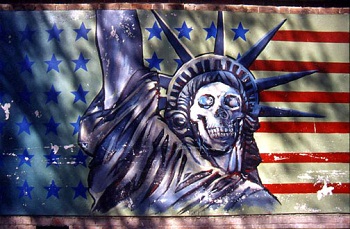
Counterculture: The Rebel Commodity

Screen-Shot-2013-09-23-at-2.48.39-PM

By James Curcio

Source: Rebel News

Let’s talk about being a rebel.

Everyone seems to want to be one. But it’s not entirely clear what it means. Does it take camo- pants? A Che T-shirt? A guitar? Is it just doing the opposite of whatever your parents did? “Be an individual, a rebel, innovate,” so many advertisements whisper. They’d have us believe that True Revolutionaries think different. They use Apple, or drink Coke. We signal our dissent to one another with the music we listen to and the cars we drive.

There’s something very peculiar going on here, something elusive and deeply contentious.

In the 1997 book, Commodify Your Dissent, Thomas Frank laid out a thesis that may appear common sense to those that have watched or lived in the commodified subcultures of the 90s, 00s, and beyond. A New York Times review comments,

… business culture and the counterculture today are essentially one and the same thing. Corporations cleverly employ the slogans and imagery of rebellion to market their products, thereby (a) seizing a language that ever connotes “new” and “different,” two key words in marketing, and (b) coaxing the young effortlessly into the capitalist order, where they will be so content with the stylishly packaged and annually updated goods signifying nonconformity they’ll never so much as consider real dissent — dissent against what Frank sees as the concentrated economic power of the “Culture Trust,” those telecommunications and entertainment giants who, he believes, “fabricate the materials with which the world thinks.” To have suffered the calculated pseudo-transgressions of Madonna or Calvin Klein, to have winced at the Nike commercial in which the Beatles’ “Revolution” serves as a jingle, is to sense Frank is on to something. (After reading Frank, in fact, you’ll have a hard time using words like “revolution” or “rebel” ever again, at least without quotation marks.)

The urge to rebel fuels the same system they ostensibly oppose. Whether it’s in arms trade, or far less ominously, manners of dress and behavior, there are dollars to be made fighting “The Man.” And maybe making money isn’t always an altogether bad thing. But it is certainly a complication, especially for those espousing neo-Marxists ideals.

As Guy Debord observed, “revolutionary theory is now the enemy of all revolutionary ideology and knows it.” Rebel movements are a counterculture, regardless of what they call themselves.

Rebellion is Cool

We’ll begin with a quintessential icon of the branded, shiny counterculture. The Matrix. We’ve probably all seen it. Even as an example it’s a cliché, and that’s part of the point. Here’s a framed sketch of the first movie, for those that haven’t: when it first ran, it was a slick take on the alienation most suburban American youth feel, packaged within the context of the epistemological skepticism Descartes wrestled with in the 17th century. Taken out of the cubicle and into the underworld, we witness the protagonist “keeping it real” by eating mush, donning co-opted fetish fashion, and fighting an army of identical men in business suits in slow motion. The movie superimposes the oligarchic and imperialist powers-that-be atop Neo’s quest of adolescent self-mastery. A successful piece of marketing — you can be sure no one collecting profits or licensing deals let their misgivings about “the Man” keep them from paying the rent.

This is not to point an accusatory finger, but rather to show the essential dependence of the counterculture upon the mainstream, because counter-cultures are not self-sustaining, and every culture produces a counter-culture in its shadow, just as every self produces an other. Any counterculture. Punk, mod, beatnik, romantic, hippy, psychedelic, straight edge, or occult. Even the early adopters of Internet culture started a group of outsiders that shared a collective vision,

The computer enthusiasts who could only dream of an open, global network in 1990 would go on to staff the dot-coms of the next decade. The closed networks that once guarded forbidden knowledge quickly fell by the wayside, and curiosity about computers could no longer be imagined a crime.

Our cyberspace today has its share of problems, but it is no dystopia — and for that, we must acknowledge the key part played by the messy collision of table-top games, computer hacking, law enforcement overreach and cyberpunk science fiction in 1990.

This article explores the strange history of Peter Jackson games, TSR, and the FBI. But it wasn’t the only one. Shadow Run, another popular cyberpunk RPGs of the 1990s, presented one of the more seemingly-improbable of cyberpunk futures, where you could play a freelancing mutant scrambling to survive in an ecosystem of headless corporations connected through cyberspace. Sound familiar? The Matrix just represented the final translation of these and similar fringe narratives into the mainstream.

Future vision has some effect on future reality, both in the identities we imagine for ourselves and the technologies we choose to explore. They almost always have unexpected consequences. Now we carry the networked planet in our palms, granting near instant communication with anyone, anywhere and anytime, and your intended subject isn’t always the only one listening.

We shouldn’t be surprised by this feedback loop. Without laying the material, mythic, and social groundwork for a new society, counterculture cannot be a bridge; it almost invariably leads back to the mainstream, though not necessarily without first making its mark and pushing some new envelope.

This even presents something of a false dichotomy — that old models of business can’t themselves be co-opted by countercultural myths. Yesterday’s counterculture is today’s mainstream. What better way to understand the so-called revolution of iPads or social media?

Our cultural symbols and signifiers are never static. Psychedelic and straight edge can share the same rack in a store if the store owner can co-brand the fashions, and people can brand themselves “green” through their purchasing power without ever leaving those boxes or worrying about the big picture. AdBuster’s Buy Nothing Day still capitalizes on the “rebel dollar.”

Rebellion is cool.  “Cool” is what customers pay a premium for, along with the comfort of a world with easy definitions and pre-packaged cultural rebellions. This process itself isn’t new. The rebel or nonconformist is probably a constitutive feature of the American imagination: original colonies were religious non-conformist, the country was founded by rebellion, the frontier, the civil war, the swinging 20s, Jazz, James Dean, John Wayne, Elvis, the list goes on. The non-conformist imagination is as paradoxically and problematically American as cowboys and indians, apple pie and racism.

The territory between aesthetic, ideals, and social movement is blurry at best. But the most well-known expression of this trend in recent history is the now somewhat idealized 1960s, a clear view of which has been obscured through a haze of pot-smoke and partisan politics. Though this revolution certainly didn’t start in the 1960s, there we have one of the clearest instances of what good bed-fellows mass advertising and manufacturing make when branded under the zeitgeist of the counterculture.

When people bought those hip clothes to make a statement, whose pockets were they lining? It’s a revolving door of product tie-ins, and it all feeds on the needs of the individual, embodied in a sub-culture. The moment that psychedelic culture gained a certain momentum, Madison Avenue chewed it up and spit it back out in 7up ads. That interpretation of what it meant to be a hippie, a revolutionary, became an influence on the next generation. The rise of Rolling Stone magazine could also be seen as an example of this — a counterculture upstart turned mainstream institution.

While advertising and counterculture get along just fine, authenticity and profit often make strange bedfellows. But they aren’t necessarily diametric opposites, either. As movements gain momentum, they present a market, and markets are essentially agnostic when it comes to ideals.

There are many examples of how troubled that relationship can be. The Grunge movement in the 90s, before it was discovered, was just a bunch of poor ass kids playing broken ass instruments in the Pacific Northwest. This was the very reason it struck disenfranchised youth — the relationship between those acts and the aging record industry in many ways seemed to reflect the relationship of adolescent Gen Xers with their Boomer parents. They retained the desire to “drop out,” as Timothy Leary had preached to the previous counterculture generation of Laguna Beach and Haight Ashbury, but without the mystical optimism of “tuning in.” Hunter S Thompson maybe presaged this transition in the quotation from Fear and Loathing In Las Vegas that’s now rendered famous to the kids of 90s thanks to Terry Gilliam’s film adaptation,

We are all wired into a survival trip now. No more of the speed that fueled that 60’s. That was the fatal flaw in Tim Leary’s trip. He crashed around America selling “consciousness expansion” without ever giving a thought to the grim meat-hook realities that were lying in wait for all the people who took him seriously… All those pathetically eager acid freaks who thought they could buy Peace and Understanding for three bucks a hit. But their loss and failure is ours too. What Leary took down with him was the central illusion of a whole life-style that he helped create… a generation of permanent cripples, failed seekers, who never understood the essential old-mystic fallacy of the Acid Culture: the desperate assumption that somebody… or at least some force – is tending the light at the end of the tunnel.

I don’t think it’s a great stretch to imagine the suddenly-famous bands of the Grunge era as a part of this same legacy. Alice In Chains or Nirvana songs about dying drugged out and alone weren’t oracular prophecy, they were journal entry. And it became part of the allure, because it too was “authentic.” The greatest irony of all was that the tragic meltdowns and burn outs that followed on fame’s heels became part of the commodity. (Not that this vulture economy is new to tabloids).

Our narratives about authentic moments of aesthetic expression or innovation often depict them like volcanic eruptions: they build up and acquire force in subterranean and occluded environments, before erupting in a momentary and spectacular public display of creativity. It is telling that this quote from On The Road has become so popular, very likely cited in the papers and journals of more rebellion-minded American teens than any other from that book, “… The only people for me are the mad ones, the ones who are mad to live, mad to talk, mad to be saved, desirous of everything at the same time, the ones who never yawn or say a commonplace thing, but burn, burn, burn like fabulous yellow roman candles exploding like spiders across the stars.”

Hendrix, Joplin, Morrison, Cobain… the 27 Club is big. And quite a few more could be added if it was “the 20-something club.” Are the public self destructions of so many young, creative minds informed by this myth, or do they create it?

Maybe a bit of both. The Spectacle, in the sense Guy Debord uses it, disseminates its sensibilities, styles — a version of the truth. The particular moves ever toward the general, as facts gradually turn to legend and, eventually, myth. Mainstream appropriation is the process in which aesthetic movements affect broader society and culture. The ideals need a pulpit to reach the people, even if invariably it is fitted with guillotines for the early adopters once that message has been heard.

YOUR FATASS DIRTY DOLLAR

A message is a commodity, or it is obscure. Capitalism survives so well, in part, because it adapts to any message. If we instead think counterculture is an ideal that exists somehow apart from plebeian needs like making money, then countercultures will forever hobble itself. It doesn’t matter that these ideologies have little in common. It is the fashion or mystique that gets sold. Anti-corporate ideology sells as well as pro-. When all an ideology really boils down to is an easy to replicate aesthetic, how could they not?

Where do we draw the line between idealism and profit? The question is how individuals utilize or leverage the potential energy represented by that currency, and what ends it is applied to. Hard nosed books on business by the old guard, such as Drucker’s Management: Tasks, Responsibilities, Practices say exactly the same thing, in a less epigrammatic, Yoda-like way: profit is not a motive, it is a means. This much, at least, doesn’t change with the changing of the (sub)cultural tides. Within our present economic paradigm, without profit, nothing happens. Game over.

Those who position themselves as extreme radicals within the counterculture framework just  disenfranchise themselves through an act of inept transference, finding anything with a dollar sign on it questionable. To this view, anyone that’s made a red cent off of their work is somehow morally bankrupt. This mentality generally ends one way: howling after the piece of meat on the end of someone else’s string, working by day for a major corporation, covering their self-loathing at night in tattoos, and body-modifications they can hide. That is, unless they lock themselves in a cave or try to start an agrarian commune. None of this posturing is in any way necessary, since business rhetoric itself has long since co-opted the countercultural message. For instance, this passage from Commodify your Dissent,

Dropping Naked Lunch and picking up Thriving on Chaos, the groundbreaking 1987 management text by Tom Peters, the most popular business writer of the past decade, one finds more philosophical similarities than one would expect from two manifestos of, respectively, dissident culture and business culture. If anything, Peters’ celebration of disorder is, by virtue of its hard statistics, bleaker and more nightmarish than Burroughs’. For this popular lecturer on such once-blithe topics as competitiveness and pop psychology there is nothing, absolutely nothing, that is certain. His world is one in which the corporate wisdom of the past is meaningless, established customs are ridiculous, and “rules” are some sort of curse, a remnant of the foolish fifties that exist to be defied, not obeyed. We live in what Peters calls “A World Turned Upside Down,” in which whirl is king and, in order to survive, businesses must eventually embrace Peters’ universal solution: “Revolution!”

“To meet the demands of the fast-changing competitive scene,” he counsels, “we must simply learn to love change as much as we have hated it in the past.” He advises businessmen to become Robespierres of routine, to demand of their underlings, “‘What have you changed lately?’ ‘How fast are you changing?’ and ‘Are you pursuing bold enough change goals?’” “Revolution,” of course, means for Peters the same thing it did to Burroughs and Ginsberg, Presley and the Stones in their heyday: breaking rules, pissing off the suits, shocking the bean-counters: “Actively and publicly hail defiance of the rules, many of which you doubtless labored mightily to construct in the first place.”

Growth on its own is never a clear indicator that the underlying ideals of a movement will remain preserved. If history has shown anything, it is that successful movements spread until core message becomes an empty, parroted aesthetic, as with most musical scenes and their transition from content to fashion; or that core is otherwise so emphasized that the meaning within is lost through literalism, as we can see in the history of the world’s major religions. One version of early Christian Gnostic history — of “love thy neighbor,” “all is one,” and scurrilous rumors of agape orgies — were replaced by the Roman Orthodoxy and the authority provided through the ultimate union of State and Religion. The hippies traded in their sandals and beat up VWs for SUVs and overpriced Birkenstocks. The relationship between ideology and act is far to complicated to enter into here, but the counter-history of Communism when viewed against the backdrop of Marxist ideals is perhaps equally insightful.

Enantiodromia, the tendency of things to turn into their opposites, is as much social observation as psychological. It oftentimes seems that succeeding too well can be the greatest curse to befall a movement. When the pendulum swings far in one direction, it often turns into its opposite without having the common decency to wait to swing back the other way.

As we’ve seen, this was part of the supposed downfall of counterculture in capitalism: “suits” decided they could deconstruct an organic process and manufacture it. They could own it from the ground up.

But this isn’t necessarily so. The branding of Cirque Du Soleil points toward a third option — arts movements will be dissected in the jargon of marketing, and they must succeed on those grounds to be taken seriously or accomplish anything.

Burning Man isn’t suddenly opening its gates to the wealthy. Yacht Communism has been a part of that movement ever since it gained some mainstream appeal, likely before. Seen as an arts and cultural movement, it has been vastly successful. Seen as an example of how to create a true egalitarian society, it would be an utter failure. But that was never the point.

Two weeks at Burning Man might be fun, even transformative, but spend two years there and you’d find out what hell is like.

To France from a Post-9/11 America: Lessons We Learned Too Late

us-imperialism-nepal-south-asia-revolution

By John W. Whitehead

Source: The Rutherford Institute

“They that can give up essential liberty to obtain a little temporary safety deserve neither liberty nor safety.” ― Benjamin Franklin

“Voice or no voice, the people can always be brought to the bidding of the leaders. All you have to do is tell them they are being attacked and denounce the pacifists for lack of patriotism and exposing the country to danger. It works the same in any country.”—Hermann Goering, German military commander and Hitler’s designated successor

For those who remember when the first towers fell on 9/11, there is an unnerving feeling of déjà vu about the Paris attacks.

Once again, there is that same sense of shock. The same shocking images of carnage and grief dominating the news. The same disbelief that anyone could be so hateful, so monstrous, so evil as to do this to another human being. The same outpourings of support and unity from around the world. The same shared fear that this could easily have happened to us or our loved ones.

Now the drums of war are sounding. French fighter jets have carried out a series of “symbolic” air strikes on Syrian targets. France’s borders have been closed, Paris has been locked down and military personnel are patrolling its streets.

What remains to be seen is whether France, standing where the United States did 14 years ago, will follow in America’s footsteps as she grapples with the best way to shore up her defenses, where to draw the delicate line in balancing security with liberty, and what it means to secure justice for those whose lives were taken.

Here are some of the lessons we in the United States learned too late about allowing our freedoms to be eviscerated in exchange for the phantom promise of security.

Beware of mammoth legislation that expands the government’s powers at the citizenry’s expense. Rushed through Congress a mere 45 days after the 9/11 attacks, the USA Patriot Act drove a stake through the heart of the Bill of Rights, undermined civil liberties, expanded the government’s powers and opened the door to far-reaching surveillance by the government on American citizens.

Pre-emptive strikes will only lead to further blowback. Not content to wage war against Afghanistan, which served as the base for Osama bin Laden, the U.S. embarked on a pre-emptive war against Iraq in order to “stop any adversary challenging America’s military superiority and adopt a strike-first policy against terrorist threats ‘before they’re fully formed.’” We are still suffering the consequences of this failed policy, which has resulted in lives lost, taxpayer dollars wasted, the fomenting of hatred against the U.S. and the further radicalization of terrorist cells.

War is costly. There are many reasons to go to war, but those who have advocated that the U.S. remain at war, year after year, are the very entities that have profited most from these endless military occupations and exercises. Thus far, the U.S. taxpayer has been made to shell out more than $1.6 trillion on “military operations, the training of security forces in Afghanistan and Iraq, weapons maintenance, base support, reconstruction, embassy maintenance, foreign aid, and veterans’ medical care, as well as war-related intelligence operations not tracked by the Pentagon” since 2001. Other estimates that account for war-related spending, veterans’ benefits and various promissory notes place that figure closer to $4.4 trillion. That also does not include the more than 210,000 civilians killed so far, or the 7.6 million refugees displaced from their homes as a result of the endless drone strikes and violence.

Advocating torture makes you no better than terrorists. The horrors that took place at Abu Ghraib, the American-run prison in Iraq, continue to shock those with any decency. Photographs leaked to the media depicted “US military personnel humiliating, hurting and abusing Iraqi prisoners in a myriad of perverse ways. While American servicemen and women smiled and gave thumbs up, naked men were threatened by dogs, or were hooded, forced into sexual positions, placed standing with wires attached to their bodies, or left bleeding on prison floors.” Adding to the descent into moral depravity, the United States government legalized the use of torture, including waterboarding, in violation of international law and continues to sanction human rights violations in the pursuit of national security. The ramifications have been far-reaching, with local police now employing similar torture tactics at secret locations such as Homan Square in Chicago.

Allowing the government to spy on the citizenry will not reduce acts of terrorism, but it will result in a watched, submissive, surveillance society. A byproduct of this post 9/11-age in which we live, whether you’re walking through a store, driving your car, checking email, or talking to friends and family on the phone, you can be sure that some government agency, whether the NSA or some other entity, is listening in and tracking your behavior. This doesn’t even begin to touch on the corporate trackers such as Google that monitor your purchases, web browsing, Facebook posts and other activities taking place in the cyber sphere. We are all becoming data collected in government files. The chilling effect of this endless surveillance is a more anxious and submissive citizenry.

Don’t become so distracted by the news cycle that you lose sight of what the government is doing. The average American has a hard time keeping up with and remembering all of the “events,” manufactured or otherwise, which occur like clockwork and keep us distracted, deluded, amused, and insulated from the reality of the American police state. Whether these events are critical or unimportant, when we’re being bombarded with wall-to-wall news coverage and news cycles that change every few days, it’s difficult to stay focused on one thing—namely, holding the government accountable to abiding by the rule of law—and the powers-that-be understand this. In this way, regularly scheduled trivia and/or distractions that keep the citizenry tuned into the various breaking news headlines and entertainment spectacles also keep them tuned out to the government’s steady encroachments on their freedoms.

If you stop holding the government accountable to the rule of law, the only laws it abides by will be the ones used to clamp down on the citizenry. Having failed to hold government officials accountable to abiding by the rule of law, the American people have found themselves saddled with a government that skirts, flouts and violates the Constitution with little consequence. Overcriminalization, asset forfeiture schemes, police brutality, profit-driven prisons, warrantless surveillance, SWAT team raids, indefinite detentions, covert agencies, and secret courts are just a few of the egregious practices carried out by a government that operates beyond the reach of the law.

Do not turn your country into a battlefield, your citizens into enemy combatants, and your law enforcement officers into extensions of the military. A standing army—something that propelled the early colonists into revolution—strips the citizenry of any vestige of freedom. How can there be any semblance of freedom when there are tanks in the streets, military encampments in cities, Blackhawk helicopters and armed drones patrolling overhead? It was for this reason that those who established America vested control of the military in a civilian government, with a civilian commander-in-chief. They did not want a military government, ruled by force. Rather, they opted for a republic bound by the rule of law: the U.S. Constitution. Unfortunately, we in America now find ourselves struggling to retain some semblance of freedom in the face of police and law enforcement agencies that look and act like the military and have just as little regard for the Fourth Amendment, laws such as the NDAA that allow the military to arrest and indefinitely detain American citizens, and military drills that acclimate the American people to the sight of armored tanks in the streets, military encampments in cities, and combat aircraft patrolling overhead.

As long as you remain fearful and distrustful of each other, you will be incapable of standing united against any threats posed by a power-hungry government. Early on, U.S. officials solved the problem of how to implement their authoritarian policies without incurring a citizen uprising: fear. The powers-that-be want us to feel threatened by forces beyond our control (terrorists, shooters, bombers). They want us afraid and dependent on the government and its militarized armies for our safety and well-being. Most of all, they want us distrustful of each other, divided by our prejudices, and at each other’s throats.

If you trade your freedom for security, the terrorists win. We’ve walked a strange and harrowing road since September 11, 2001, littered with the debris of our once-vaunted liberties. We have gone from a nation that took great pride in being a model of a representative democracy to being a model of how to persuade a freedom-loving people to march in lockstep with a police state. And in so doing, we have proven Osama Bin Laden right. He warned that “freedom and human rights in America are doomed. The U.S. government will lead the American people in — and the West in general — into an unbearable hell and a choking life.”

To sum things up, the destruction that began with the 9/11 terror attacks has expanded into an all-out campaign of terror, trauma, acclimation and indoctrination aimed at getting Americans used to life in the American Police State. The bogeyman’s names and faces change over time, but the end result remains the same: our unquestioning acquiescence to anything the government wants to do in exchange for the phantom promise of safety and security has transitioned us to life in a society where government agents routinely practice violence on the citizens while, in conjunction with the Corporate State, spying on the most intimate details of our personal lives.

The lesson learned, as I document in my book Battlefield America: The War on the American People, is simply this: once you start down the road towards a police state, it will be very difficult to turn back.

A New Lost Generation: Student Loans, Wage Slavery, and Debt Peonage

Dr. Nicholas Partyka

Source: The Hampton Institute

In literature, the term “lost generation” refers to a cohort of authors whose work defines the post-First World War era. This group includes literary notables like Ernest Hemingway and F. Scott Fitzgerald, among others. According to the dominant understanding, what made this group of expatriate writers, centered in Paris, ‘lost’ was not a sense of geographic dislocation, but rather one of spiritual or moral dislocation. Their experiences in or with the war led them to question, even to abandon, the systems of values that they had held prior to the war. This kind of sentiment, and experience, was not uncommon in society at large. This is likely part of why these authors’ work achieved such prominence in this period. Many people felt lost in this era, even before the onset of the Great Depression.

The project of liberalism had been brought into serious question by the First World War. According to liberals, as society embraces the philosophical tenets, the economic and political institutions, the social and economic practices, as well as political values of liberalism, greater social peace and stability would arise. This would occur both nationally, as society came more and more to resemble the liberal ideal, and internationally, as liberal states cooperated and traded rather than fought with each other. Up to the time of the First World War liberals retained their faith in the idea, rooted in the Enlightenment, of ‘Progress’. The reality of the war shattered these comforting illusions. Indeed, since the Napoleonic defeat, with some exceptions largely in their colonial possessions, liberal states had not gone to war with each other. This made it easy for some, based on an argument from Kant, to believe in an idea like the liberal, or democratic, peace.

Being ‘lost’ in this fashion was to experience a form of social disorientation resulting from a sense of, what Durkheim called, anomie. Having lost the easy faith in liberalism, many in this generation found themselves without the traditional moral framework, or social guidelines around which most people construct their lives, and their life trajectories. The fact that war occurred; that the introduction of modern industrial technology on an unprecedented scale caused such unfathomable carnage; that modern communications technology was advanced enough for the people on the home front to see, and to understand the reality of the war; the ever increasing heights of wealth and opulence enjoyed alongside crushing poverty; the continuing rapid pace of industrial and technological, as well as social change. All these contributed to the feeling of anomie, and even ennui, that made so many in this generation feel ‘lost’, or disoriented.

The term “lost generation” also has a usage in political-economy. There are some interesting similarities in the experience of being ‘lost’, of social disorientation, between the two different usages here. In political-economy, the notion of a ‘lost generation’ refers to a cohort of workers adversely impacted by a persistently weak labor market. A generation of workers can be lost to the impact of poor macro-economic conditions in several ways. From the point of view of society, this generations’ labor is lost, and the material progress of society delayed, in that it is never deployed in its most productive use, or at its full potential. This generation, and the next, can be lost in that their progress on the ladder of social mobility, assuming that such a thing existed, can be slowed by the practical limitations imposed by economic constraints. Most mainstream capitalist economists understand the notion of a “lost generation” as a cohort of workers whose lifetime earnings are likely to be less than they otherwise would have likely been, due to the poor performance of the macro-economy.

A lost generation is a serious matter, because it will have a significant, widespread, and multifaceted impact on society. A potential lost generation will impact not only the individual workers, but also their families and their communities. Workers who make less are not able to invest in important resources and opportunities for themselves, and for their families, especially their children. The diminished capacity of the majority of workers to invest in the personal development of themselves, and importantly, of their children, will have important consequences for the health of workers’ democracy. In a heavily stratified form of society, such as capitalism, the effects of a potential lost generation will be different in specific segments of the labor market, and income spectrum. Those higher up may be able to avoid to worst of the negative effects of the kind of poor economic climate that produces a lost generation. Those lower down may end up being crushed under the weight of the forces causing the disruption. Suicide, lack of adequate medical attention, lack of adequate housing, lack of sufficient food, all take the lives of people forced onto the margins of a commercial, capitalist society. Workers are also ‘lost’ in these latter ways during periods of economic turbulence and distress.

It is the specter of exactly such a lost generation of students and workers that haunts many economies in the Euro-Atlantic world, especially including the US. The dominance of neo-liberal austerity policies only further exacerbates this problem of a potential lost generation. As social programs are increasingly defunded, or even privatized, workers and the poor face increasing pressure to make ends meet, that is, to obtain basic subsistence goods. And when crisis is combined with austerity these pressures only multiply, causing many on the margins to crack under the pressure. The neo-liberal response to the crisis in the US, and even the job-less recovery, further increased these pressures on the most vulnerable, which has caused widespread social dislocation in many countries. Though every country has a unique experience, some of the main symptoms are the same; higher unemployment and underemployment, especially among youth; increases in the ranks of the long-term unemployed; increases in homelessness; increases in suicides; increases in premature deaths due to inadequate medical care, shelter, and nutrition; increases in drug and alcohol abuse. The social dislocation resulting from the fallout of the 2008 global financial crisis, and its aftermath, has so disrupted the pre-crisis status quo that many, especially young people, increasingly feel a kind of anomie, like that which animated the literary Lost Generation of the 1920s.
Austerity & Social Dislocation in Greece

To see what a lost generation can look like, and what its social consequences can be, Greece offers a striking case study. Since the 2008 global financial crisis, and the Euro crisis which followed, Greece has been at the center of the action. Indeed, it was exposure to Greek debt which was, and still is, the major fault-line of the Eurozone crisis. In order to save the Eurozone, creditor nations, and international financial institutions, have intervened on more than one occasion to provide Greece with “bailouts” and rescue loans to prevent a default on their debt; which many fear would trigger a collapse of the entire Eurozone. The unrelenting austerity measures imposed on Greece since 2010 have taken a massive toll on the Greek population. As the drama of the negations between the new SYRIZA-led Greek government and its creditors unfolds, it continues to be the Greek people, especially the most vulnerable, who bear the costs of neo-liberal prescribed austerity policies.

Right now, Greece is in the process of being the victim of what gangsters of another era would call a “shake-down”. That is ultimately what the negotiations with its creditors are. And, in light of how the creditors have acted toward Greece, this appearance has hardly been dispelled . Those to whom the Greeks owe money are insisting on full repayment, and have a clear policy agenda for how to get it, and have thus far steadfastly refused to engage in any discussion of a pro-growth policy programme. Greece is begin held-up by European financial elites by using access to credit and bond markets -indispensible tools for all modern governments- to coerce Greece into compliance. Being cut-off from these markets would make it harder for Greek businesses to do business with the rest of the world, it would also hamper the efforts of the Greek government to achieve its political and economic objectives. In order to pay back what they owe, creditors are and have been demanding the Greeks “privatize”, i.e. sell to the highest bidder, state assets, raise more tax revenue, and spend less on social programs. This is the general policy prescription the troika has consistently applied to Greece. The international creditors, just like Shakespeare’s famous Shylock, are in essence demanding their pound of flesh from Greece.

The affects of these policies has been utterly devastating on Greek society. By 2012, the enormous scale of the economic and social crisis brought on by neo-liberal austerity policies was abundantly clear. The main results of austerity for Greek workers and families have been; around 25% unemployment, and the rate for youth under twenty-four is double the overall rate; near 20% decline in wages across the board; about 30% of the population living below the poverty line, and have no access to affordable healthcare; the average family income in Greece has fallen back to its 2003 level; 40% of Greek children are growing up below the poverty line; 45% of Greek pensioners living below the poverty line; 58% of the unemployed live below the 2009 poverty line; a 25% increase in homelessness just between 2009 and 2011; a dramatic rise in personal bankruptcy filings. Meanwhile the tax increases, as well as wage and pension cuts, in addition to cuts to social services, demanded by the troika have resulted, according to one study, in the poorest households in Greece losing 86% of their pre-crisis income. The wealthiest by contrast have lost an estimated 20%, and this is at the upper end of estimates.

Steep declines in wages, deep cuts to social services, rises in unemployment, and tax increases, have all combined to put brutal pressure on 3 million Greeks living on or close to the edges of subsistence. The tumult created by the economic fallout of the austerity agenda imposed on Greece has resulted in a humanitarian crisis of immense scale. As Greece has been forced to spend less on hospitals, for example, the social effects have been dire . Greece has seen rises in infant mortality, a return of malaria, rising rates of HIV among drug users, limited access to important pharmaceuticals, and a dramatic spike in suicides and incidents of major depression. These are the results of Greece now spending less on healthcare than any pre- 2004 EU member state. With the severe wage and pension cuts, food insecurity has also exploded, as nearly three million Greeks do not have enough food to eat.

One of the major trends to emerge from this social catastrophe is the large-scale emigration of Greek youth. Given the unemployment picture, the continued recession, the deterioration or privatization of social welfare programs, many young Greeks see no option but to leave their home country to seek work abroad. This unfortunate trend is leading to what some call a “brain drain” effect as the most educated, the most talented young Greeks leave the country, thus depriving the nation of the type of talent necessary to lift it out of its economic malaise. This growing Greek austerity-fueled diaspora, lack of investment in social programs like health and education, increasing poverty and desperation, all combine to produce the conditions for a lost generation. After more than a half-decade of recession and austerity, the costs of the Eurozone crisis have been largely foisted upon the Greek people, and especially the most vulnerable among them.

The continued imposition of economic austerity policies on Greece will only produce more of what we have already seen, it will only deepen the social and humanitarian crisis in Greece. This brain-drain from a large-scale emigration of Greek youth would only compound Greece’s financial problems, as it shifts the composition of the population, skewing it much older. This youth diaspora issue is a problem that Cuba, for example, is now confronting, as the economic effects of the US blockade continue to fuel the emigration of young Cubans for employment opportunities. Austerity and recession are choking the life out of the Greek economy, and the Greek people, just as the US blockade is meant to do to Cuba. Austerity is a political choice, it is a policy programme, and it is thus that a lost generation is being imposed on Greeks by the creditors, by the troika.

The other major trend to emerge from the crisis is a flourishing of truly grass-roots solidarity movements and projects. Soup-kitchens, free schools, and clinics, among other social-welfare and relief-oriented initiatives, have proliferated in Greece as communities and activist groups- especially anarchists- organizes themselves to help provide for those being deprived, those being starved, so that European banks and other creditors can be repaid on the terms they demand. This amazing social solidarity response is an optimistic sign of a flourishing anti-austerity, anti-neoliberal, anti-capitalist resistance movement in Greece. Indeed, the many protest marches, strikes, and occupations of public spaces and buildings shows this movement is very healthy, and has widespread support. The repeated and deep wage and pension cuts, the draconian cuts to social programs, the continued recession, and the loss of labor rights and even collective bargaining rights have severely affected so many people in Greece that radical (from the point of view of mainstream capitalist political parties) SYRIZA party won snap-elections earlier this year.

Despite the July 5th referendum, Greece’s situation remained highly precarious. By returning a decisive victory for the anti-austerity “no” option, the Greeks not only displayed their pride and independence, but also gave some indication of the depth and breadth of the anti-austerity, and anti-troika sentiment in Greece. On the other hand, the results of the referendum have seemed to have embolden the creditors, and indeed, they appeared to dig in their heels even before the ballots were cast; that is, if one is to judge from the public pronouncements in the days preceding the referendum. The situation in Greece is dire, and deteriorating. As financial panic and bank runs became more intense, they compounded Greece’s already significant social woes. It appears that fears of a much worse social and economic crisis, should Greece exit the Eurozone and re-institute the Drachma, are what led Prime Minister Tsipras and his government to capitulate to the creditor’s demands. And also what led him to accept a new bailout agreement, with even more draconian austerity conditions than the agreement the Greeks ostensibly rejected in the July 5th referendum. The creditors decided they were prepared to financially strangle Greece, and allow its banks to collapse, if their terms were not accepted. In essence, the Greek government was forced to choose between being strangled and slowly suffocated, and in the end they chose the latter.
The Student-Loan Debt Crisis: The Making of a Lost Generation in the US ?

The main outlines of a potential lost generation are already becoming clear. A great many young workers today find themselves over-educated , over-qualified, un- or under-employed, living with roommates or back with parents, working jobs well beneath their educational level, and in debt for the education they hoped would lead them out of the lower ends of the labor market. One finds that this group has been delaying family formation, and delaying major purchases like houses, automobiles, and other “consumer durables”. This is often attributed to this group typically paying off their loans over a much longer period of time than previous cohorts, which is itself attributed to the poor economic situation of the cohort of graduates that came into the labor market in and around the time of the financial crisis and the onset of the Great Recession. The unemployment rate among youth, as well as among college graduates, and the large increase in the rates of default on student loans gives some measure of the troubled economic situation many recent graduates face. The rise in forbearances, and Income-Based Repayment ( IBR) enrollments, because they deflate the default rate, offers an important insight into the poor situation recent graduate face after they leave school.

Many factors contribute to creating this student loan crisis and a potential lost generation. The first factor to notice is the increasing democratization of college and the college culture beginning with the mid-20th century middle class. Following Thomas Piketty’s analysis, one should see the period after the World Wars and the Great Depression as a historically unique, and unprecedented epoch. In Piketty’s terms, this was the first epoch in which the rate of return to labor was higher than the rate of return to capital. That is, for Piketty, this was a period in which the fundamental law of capital, as had been observed for several centuries, was reversed. This happened, Piketty argued, because of the dramatic, indeed unprecedented, social, political, and economic changes made necessary or expedient by the upheavals of the 1914-1945 period. In order to win the wars and combat the depression, governments across the capitalist world made concession to the workers movements which had been gathering momentum since the late 19th century. These accommodations, and the government intervention needed to achieve them, resulted in the reversal of Piketty’s historical law of capital.

In practical terms, these policies left workers, especially those in the US with much more disposable income than ever before. The Baby Boom generation was thus able to go to college in record numbers, and achieve extraordinary social mobility because of a fortuitous confluence of historical circumstances. The parents of the Baby Boomers enjoyed the kinds of economic conditions that allowed them to afford the things which came to characterize the American middle class lifestyle; suburban houses, multiple automobiles, family summer vacations, college educations for children, retirement savings, et cetera. Because the Baby Boom generation was able to go to college, and as a result, attain professional success, and therewith social mobility, they quite naturally passed on these lived experiences as expectations for their children.

And for a generation or so this pattern worked. Young middle class-ish people graduated from high school, went to college, got jobs, moved out on their own, got married, bought houses, had children, and reinforced for those children the importance of going to college. Yet, as macro-economic change occurred, driven by neo-liberalism, and as the labor market came to contain more and more workers with college degrees, the pecuniary advantages attached to college degrees began to erode. Yet, as the economic advantages of a college education diminish, the dominant cultural narrative, at least for the “middle class” and those who aspire to it, is that the path to a good life runs through a good job with a high salary, and one gets this by having the right skills, and these one acquires in college. So, whether it is necessarily a good idea or not, millions of young Americans aspire to, apply to, and enroll in American colleges. Most do this in the hope of being able to get a job which will pay them enough to live a comfortable life.

Also contributing to this crisis is the rapidly rising costs of college. As more and more students were able to muster the financial means, largely due to continued access to “easy money”, that is an excess of cheap credit in the financial system, to register effective demand on the market college became a big business. As enrollments continued to grow, this business grew. There emerged an arms-race dynamic among colleges, which has only intensified, and spread over time. This arms race is based on the need for colleges to attract students, and involves spending money on buildings, facilities, amenities, technologies, events, and more to attract students. At the same time as this arms race drives up costs, so too do the ever inflating salaries of the typically expanding ranks of college administrators. Making the situation even worse is the fact that concurrently with the latter two sources of cost inflation, is the fact that state financial support for public education, on all levels, not just higher education, has deceased markedly over recent decades. Thus, as a result of neoliberal efforts to decrease taxes on the wealthy, the costs of education are being born more and more by students and families, driving many of them into debt, or deeper into debt, in search of the prospect of the social mobility they think a college education can provide.

The reality of the present situation is that the labor market that many post-crisis graduates have found themselves in is decidedly not favorable. The macro-economic shift in employment in the US predominantly to the service sector, and systemic forces inherent in capitalism that produce persistent pressures toward automation, have combined to create a labor market in which job growth is concentrated in the high and low end segments. Computer and internet technologies have facilitated a great deal of further redundancy of human labor in the production process for many manufactured goods. They have also rendered large amounts of human labor unnecessary in other sectors by automating via digitization, various customer service operations or routine business functions. Globalization has also helped hollow out the old middle class by moving out of the country the kinds of skilled and semi-skilled manufacturing jobs that did not require college education.

In 2011 the Occupy Wall-Street movement burst dramatically onto the scene in America. This movement gave voice to the first stirrings of large-scale anti-austerity sentiment in the US. Many graduates who entered the labor market at the time of the crisis and its immediate aftermath, had by 2011 experienced the effects of the economic crunch. This movement brought many of these people together through their shared experience of disillusionment, and social as well as economic dislocation. The recent emergence of the Corintian15, which very quickly became the Corinthian100, and the student-loan debt-strike movement, shows that this movement is not dead. Instead, this movement is gaining momentum as the economic situation for more and more young workers becomes more and more desperate. As the student loan crisis continues to build, and as austerity and neo-liberalism dominate the policy response, the resistance movement will only spread. Though capitalist elites, through municipal governments nation-wide, were able to suppress the initial incarnation of the Occupy Wall-Street movement, the basic social, political, and economic conditions that created it remain.

If the austerity-driven response continues, a lost generation is exactly what could emerge in the US. The impact of the most recent crisis is still being felt, and little in the way of recovery has trickled down to many of those displaced by the crisis, or the Great Recession which followed it. And there are other groups besides young graduates who face uncertain economic futures. Older workers pushed into early retirements despite smaller pensions and rising costs. Pensioners and the elderly, who are already largely marginalized in society, also suffer. Middle-aged workers displaced from their jobs during this past crisis have had a quite difficult time finding new employment, at least at the level of their previous job. This is exactly the broad base of suffering that unites many in Greece against neo-liberalism. The young, and recent graduates, are not the only ones to suffer, nor are they the ones who suffer the most, just as in Greece.

However, the current cohort of young Americans is the most well-educated in the nation’s history, indeed, college degrees are more abundant than ever. Every social group seems to be experiencing growth in the rate of college degrees; though disparities between racial groups persist, and indeed increase. The current narrative in the dominant culture about how to achieve “middle class” social mobility, is still to get and education, i.e. go to college. Throughout the post-war period, in order to facilitate economic growth, by way of personal development through education, the US government increasingly helped make money available to help more and more people attend college; this, of course, began to change with the rise of the ideological hegemony of neo-liberalism. There is thus a sinister bait and switch at play between the narrative about college and mobility, and the social reality of these. Students are encouraged to take out increasingly more in loans, so as to afford to go to college, in the hopes of getting a job that pays enough to live on. When graduates emerge from colleges, what they find is a labor market overflowing with college graduates all seeking employment in the fewer and fewer good jobs, for which they are all qualified, as well as for the growing number of low-paying jobs for which they are all over-qualified. Stultified by low wages, abusive scheduling, and a polarized labor market, this lost generation is already delaying family formation, and may in the future be marked by the kinds of increases in depression and suicide that we have already seen in Greece.

This post-crisis generation of graduates, which is still emerging into fuller maturity, has been set up to become a lost generation. They are likely, unless drastic policy changes occur, to endure economic lives in which they make less money on average over their working lives, have less secure employment, less secure access to healthcare for their families, less access to or lower quality of education for their children, less ability to afford to retire, and many other of the same forms of social and economic dislocation being experienced by workers in Greece. The social realty this post-crisis generation confronts can only serve to disillusion and disenchant, as it disenfranchises through poverty, austerity, and inequality. This post-crisis generation is well placed by socio-economic circumstance to experience the social, moral, economic, and political confusion and disorientation that characterizes a lost generation.

Bound to jobs that don’t engage the talents cultivated by education, and that impose abusive workplace practices, in order to pay back student loans, this post-crisis generation is being groomed to become a dependent, and hence docile one politically. Given the poor state of the labor market, the rising costs of a college education, and the diminishing return on a college education, student loans are taking longer and longer to pay off. In many cases this process can stretch out for decades, becoming in essence life-long debts; or, at least, debts that will require the bulk of one’s working life to discharge. These student loan obligations thus keep young workers feeling insecure, and beholden to their employers, if they’re lucky enough to have jobs.

From the point of view of elites, of entrenched powers, education has always been a double-edged sword. On the one hand, one wants the fruits of scientific, philosophical, and artistic discovery and achievement. For, indeed, these are the hallmarks of civilization, of progress, and of enlightenment. On the other hand, the more education is allowed to be received by more and more “lower” ranks of society, the more questions start being asked about the nature of the social order, and about potential changes. Education is a pandora’s box in this way. Once people acquire education, it can’t be repossessed, and there is little way to stop people from passing it on to others. For example, once a person learns to read, there is often little authorities can do to stop people from reading subversive material. The long history of underground, or samizdat, literature, especially of a political nature, in most Euro-Atlantic societies evidences this. Thus, while the increased access to education, especially higher education, for the Baby Boomers, and their children, is great for those individuals, from the point of view of elites, this educational democratization was lamentable. Indeed, the revolutionary 1960s and 1970s were to some degree enabled by high levels of access to higher education, but on affordable terms, that is, without high levels of debt. Even though this was the tail end, this was still an era of social investment in education.

With the rise of neo-liberalism beginning in the mid-1970s, came continuing waves social dis-investment in education on all levels. Along with rising costs, shifts in the tax burden and stagnant wages led many working-class and poor families to bear more and of more the costs of education, particularly higher education. This served to price some out of the market, however the decline in government support for education was replaced by the increased availability of loans. This is in some measure due to the re-rise to dominance of finance capital, and the need for monopoly capitalism to generate bubbles in order to spark growth. In any event, more and more working-class and poor individuals and families took on increasing amounts of debt in order to acquire college educations.

However, rather than achieving the same kind of easy mobility their parents did, this first generation under neo-liberalism was marked by the effects of stagflation and austerity, multiple recessions and stock market collapses, and the Savings & Loan Crisis. Thus, in the early 1990s, one sees this generation become “Gen X”, the cultural emblem of which became the un – or under-employed, aimless and cynical, “slacker”. Before the unbridled optimism and euphoria of the Dot Com Bubble set in, Gen X was a potential lost generation. The apathy, dislocation, disillusionment that characterize the artistic and cultural products of this generation showcase the sense of being lost, of lacking grounding and guidelines that mark the experience of lost generations. By the mid-1990s however, the economy began to pick up, eventually becoming the tech, or dot com, bubble, and many former slackers and “grunge” kids became successful professionals in a suddenly more hospitable labor market.

Between the mid-1990s and 2007-2008 the US economy was buoyed by a succession of asset prices bubbles, or episodes of speculative mania. These bubbles prevented a lost generation from emerging beyond the early 1990s. Moreover, the effects of neo-liberalism had a beneficial effect on working-class and poor households in the form of cheap goods, particularly textiles, from Asia. Cheaper basic goods, like food and clothing, imported from the Third World had a wealth effect on many American households. A rising stock market also contributed to this feeling as well, for those who owned stock, which was increasingly many. This continued to allow many working-class families to send their children to college, and with a booming economy many were able to get good jobs and achieve social mobility. However, a lingering specter of the potential lost generation of the early 1990s was the emergence in the late 1990s of the anti-globalization movement, announced forcefully by the 1999 anti-WTO protests in Seattle.

When the economy was rising, young workers could be bribed into being politically neutral through jobs that pay enough to afford “middle class” luxuries. Individuals become bound to their jobs in order to pay for the things that they own. The price of material comfort and convenience is thus obedience and passivity, it is the faux choice to be a consumer rather than a citizen. In a rising economy, debt, especially for education, can be seen as an investment in oneself, in one’s own future. Since an expanding labor market is likely to provide one with a salary that enables one to repay the loans in a reasonable period of time, this investment can often be a good one. When, however, the economy turns from boom to bust, debt serves as a set of financial shackles. Whether in boom or bust, capitalism requires that workers be bound to their jobs, i.e. be dependent on their employer and the wages he or she pays. Thus, either preparing the way for entrance into a gilded cage, or confining one to an only quasi-metaphorical chain-gang, student debt serves the interests of capital. Some, capitalism rewards with high salaries, their obedience and loyalty is bought and paid for, since the employees material position is dependent on the employers’ wages. Others capitalism condemns to various forms of forced labor in order to enforce obedience to its regime of surplus-extraction, and to stifle much revolutionary activity.
Slavery, Debt, & Peonage

Debt has been used by societies throughout history in order to coerce some people into performing coerced, that is, un-free, forms of labor for others. This is the history of class society, debt is the mechanism by which workers are incorporated into the apparatus of exploitation, that is, of forced labor. This is something which David Graeber is keen to point out throughout his book, “Debt: The First 5,000 Years”. The basic point of debt is to control the labor of others. Once one controls the labor of others, one can use it to one’s own advantage, to increase one’s own position. This fundamental tenet remains true today, debt is used as leverage to achieve control of others’ labor, and therewith their lives and their futures. Young people today, who want to go to college, are being forced to mortgage their future betting that their college degree will help them secure a job with a high, or perhaps just stable, income. Coming out of school in debt ensures that graduates must seek wage employment to repay their loans, that is they must remain politically neutral; or at least confine their activism to the bourgeois-approved, “democratic” methods of protest.

The reliance of class society on un-free labor can be seen even in its most liberal moments, for example, the various times when slavery has been “abolished”. The formal abolition of chattel slavery, or simply its disappearance, may seem to evidence a rising tide of liberalization, however, in most cases slavery is simply replaced by a new form un-free labor. Class society is a mechanism for extracting un-free labor from some for the benefit of others. So, for example, upon the abolition of slavery one very commonly sees the institution of various forms of serfdom, share-cropping, and tenancy relations between former slaves and former masters. In practice these systems perpetuate the social, political, and economic dominance of the former elites, as well as the subjugation and servility of the former slaves. One sees this process unfold time and time again. From the disappearance of slavery after the collapse of the Western Roman Empire, to the abolition of slavery by British in early 19th century, or to the abolition of slavery by the Americans in the middle of the same century, the ostensible rise in social status by former slaves was undercut by the imposition of new forms of coerced labor.

Central to this process is debt, that is, the creation of debts, which once acquired will serve to bind former slaves or serfs to their former owners, and former occupations. Since salves come into the society with no possessions, or at least little to no savings, they quickly find the need to take on debt to get by, and thus become locked into a cycle of debt and dependence whereby their labor and lives are largely controlled by the obligation to repay the debt. Necessities like food must be bought, and once slavery was abolished former slaves were no longer provided with food, however meager and putrid it often was. Former owners readily offered employment to their former slaves, because they were already familiar with the routines of the particular labor process, not to mention already physically present. Cash advances on the wages employers were now required to pay legally free workers was a very common way of creating initial debts, which would routinely spiral into large debts; debts of a size that turned formerly free persons, even if only nominally so, into debt-peons, i.e. un-free, or bonded, laborers.

In America, the transition from slavery to share-cropping in the post-Civil War period is a very clear example of this process of creating debt-peons. After the war, and even after the so-called Reconstruction era, former slaves were returned to a condition not much different from that which they suffered under slavery.[1] This was done by imposing on former slaves a vicious cycle of debt, poverty and dependence, which economically and politically disenfranchised them. For example, see the ubiquitous “black codes” that arose during Reconstruction. These were as much about enforcing social norms, but also, and equally importantly, they regulated labor in the post-war South. [2] Since, due to the economic effects of the war and of emancipation, most southern farmers could not afford to re-employ their former slaves as wage-workers because they lacked sufficient capital; that is, even if the recently freed slaves were willing to go back to work, which many were not. Thus, sharecropping was the expedient that was resorted to most often. Through the law, and other legal devices, white southerners shifted all, or the proverbial lion’s share of the risk, onto what were, ostensibly, their new business partners. The black codes, also, through criminalization of vagrancy, always disproportionately enforced on blacks, forced many former slaves back into their old jobs.

This latter leaves out the effects of the rampant, naked, and direct white-supremacist violence perpetrated against the newly liberated African-American population. Thus it was, through debt and violence, that the newly freed African-Americans were bound to their former masters, and thus forced to continue to work at their former occupation, cotton farming. The historical experience of many coal miners, and other industrial workers, especially those having lived in company towns in America, also very clearly displays the process whereby workers’ debt are used to entrap workers, and force them into a condition very much like slavery. Most newly freed slaves ended up facing a choice, especially after the end of Reconstruction, between working their old jobs as sharecroppers, or being arrested for vagrancy and being sentenced to forced labor. In either case, the newly liberated slaves were forced back to work, often for their former masters.

The same process of creating debt-peons observed in the American South after the Civil War, in the main outlines, occurred earlier in the 19th century after the British abolished slavery. Outside of those in the actual slave trade itself, this policy change primarily affected the British sugar industry in the Caribbean.[3] Former slaves were very commonly re-employed as wage laborers on sugar plantations, typically for very low wages. After cheap African slaves could no longer be acquired, plantation owners began to import cheap laborers from other parts of the world, primarily East Asia and the Sub-Continent. These laborers were routinely entrapped after arrival in the Caribbean owing the company, or perhaps some type of agent or broker, for transport and provision, as well as the very common cash advance. Cash advances were very often quickly spent, either through consuming necessaries like food, through dissipation, or through being hoodwinked. In many cases cash advances would be handed over to family in the locality where the laborer was recruited. This process of controlling cheap foreign workers through debt, and draconian repayment conditions, can be seen clearly in Qatar, particularly with regard to the building programme related to the World Cup tournament it will host in 2022.

Wage labor is also a form of slave labor, though more similar to debt-peonage than chattel slavery. If a rose by any other name would smell as sweet, then slavery by any name is always odious, and the opposite of liberty. Wage laborers in liberal-democratic regimes may have more social and political privileges than serfs or slaves, but they are in no wise the free laborers economic theory posits them to be. Wage labor is just another form of un-free labor. Workers, i.e. former serfs and peasants, were coerced into adopting the forms and routines of industrial life because they were forcibly deprived of, eventually, all means of sustaining themselves without recourse to wage-paying employment. The social, economic, and political transition from feudalism and mercantilism, to commercial and industrial capitalism created an industrial proletariat, a working-class, where none existed previously. This was a violent, disruptive, and often chaotic experience for these people, who in this fashion bore the brunt of the costs of the process of creating liberal-democratic, capitalist regimes.

Just as it was thousands of years ago, debt works to keep poor people working for rich people, who can then accumulate great wealth as a result, which is the ultimate goal. David Graeber describes how debt functioned in ancient Sumer to bring poor farmers, and their produce, under the control of the temple-industrial complex. The fastest and easiest way to create debts would be, of course, to levy a tax, which could be paid in kind rather than in coin; the requirement to pay in coin was related, as Graeber shows to the desire of early states to equip and provision armies. Thus, debt, along with military force, allowed the palace-temple complexes to accumulate the provisions that sustained its inhabitants and the raw materials its artisans required. So it is still today, debt continues to work to bind the working-classes to occupations that further the accumulation of wealth by the elites, social, political, and economic, of a society.

Young people across the US, and around the developed world, have been sold a narrative, for more than one generation now, that led them to believe that higher education was the path to social mobility and economic prosperity. In order to roll the dice and take their chance, a great many working-class and poor families and individuals have take on more and more debt so as to pursue education, higher education in particular. Now, in a post-crisis, recessionary environment, what was years ago an investment, is now increasingly an economic albatross. Left largely to fend for themselves in a confusing, and unfavorable labor market, wherein they are often over-qualified for the kinds of jobs which are available, young people across the US, and indeed across the industrialized world, are at grave risk of becoming a lost generation by way of becoming, in essence, debt-peons as a result of their getting an education in attempt to better themselves.

This latter fate excludes those graduates who are lucky enough, through circumstance or planning, to be educated in highly in-demand and thus highly remunerated subject areas. If one, either by personal proclivity or cunning strategy, desires to be an investment banker, and one is good at it, then the rewards can be unfathomably large. If one can do well something the market highly rewards, then one can find their pursuit of an education in this subject profitable indeed. And if one is unfortunate enough to be interested in a subject, for which there is not great demand by capitalists, or the state, then one’s pursuit of an education will likely be unprofitable, and result in a condition essentially the same as debt-peonage. Of course, in capitalism, the structure of outcomes in the labor market in regards to pecuniary rewards is colored to a great extent by personal connections, nepotism, cronyism, “inside baseball”, “old-boys clubs”, et cetera. Social class matters very much in the real-world sorting process in the labor market after college. Who gets what position, and for how much salary, is in many ways a heavily rigged game, especially now, as more and more, years and years of un-paid, or lowly paid, internships stand between new graduates and entrance into the professions they desire.
Avoiding a Lost Generation

The macro-level indicators, and general economic and social statistics at present are not positive, and the initial outlines of a crisis in the US are only now beginning to emerge. We are very much still in the early stages of this unfolding crisis, and there are still many possible lines of development, depending on the actions of various actors, e.g. labor, capital, and the state. On one, perhaps extremely pessimistic view, this potential lost generation could end up being a multi-generational crisis, that has a wide array of effects that form, develop, and blossom over several decades. On a more optimistic view, this “crisis” might amount to no more than a lost decade. Sure the labor market might be bad now, but that could change the next time the economy picks up. The important point to keep in mind is that the shape and scope of the crisis to emerge can be changed by conscious and deliberate action. Though a lost generation is looming, it is by no means inevitable.

One promising line of resistance to a potential lost generation is the debt strike being organized by the Strike Debt! collective around the Corinthian100. These students, defrauded by the predatory practices of the Corinthian for-profit college network, banded together in protest to declare that they would not repay their loans, deeming them to be immorally acquired, and thus illegitimate. Despite a negotiated settlement in March of this year, some former Corinthian students judged, and not unreasonably so, the terms to be insufficient, given the scale and scope of Corinthian’s fraud, of which they were the victims. The rapidity with which the Corinthian15 became the Corinthian100 shows how wide the appeal of the original message was, and how deep is the feeling of betrayal an injustice felt by these students. The highly conscious predatory behavior engaged in by for-profit colleges like Corinthian makes the moral argument for a debt amnesty in this case particularly strong. The debt strike currently being organized may indeed by successful at provoking the state into taking precisely this action.

It is important to note that the amount of privately-held student debts is a small fraction of the total amount of outstanding student debt. Even an unconditional debt forgiveness for all Corinthian students, as well as for all other students at for-profit colleges, would not do very much to avert a lost generation. A debt strike could, however, do much to raise revolutionary consciousness among the strikers. Some who might otherwise never have been radicalized, or even exposed to radical ideas, can engage with them as a result of their personal experience. If the movement is successful in winning total debt forgiveness for Corinthian students, this will undoubtedly be a great boon to those who would be freed from those debts. This is no insignificant achievement. But, since most student debt is owned or backed by the government, and cancelling this debt as yet has no movement behind it, this post-crisis generation may very well end up knowing the experience of being lost.

One potential solution to the crisis would be some variety of Keynesian stimulus plan, or a 21st century New Deal. This would, quite naturally, require a great deal of state intervention in the economy. This latter is heresy to the current orthodoxy in economics, and moreover, there is a lack of political will to enact such a program. Yet, the logic remains as sound as it ever was, money spent on wages will have multiplier effects that work to increase output and employment. When workers get paid, they spend. This spending stimulates the economy by raising aggregate demand. Whether the private sector or public sector, wages are wages to workers, and the workers’ expenditure is the income of the retailers, and their suppliers. America does not lack for significant projects, whether infrastructure, social services, or others, worth spending money on which could improve the quality of public life, and provide the kinds of opportunity and mobility that we saw in the mid-twentieth century.

The bourgeois-democratic state itself can take, and has taken, steps to blunt some of the worst effects of the student loan crisis, and the burgeoning lost generation. In 2013 Congress acted to lower interest rates on student loans, after the rate had risen earlier in the year. While this was no doubt a boon to many, it remained the case that students pay much more to be able to afford to go to school than do the biggest banks to borrow from the federal government. It remained the case that the federal government is attempting to make money from student borrowers. Moreover, it remained the case that US students take on a higher debt burden than students in other countries. Recently, President Obama took action to help ease some of the problems associated with student loans, especially in the repayment of these loans. His action this year follows another step he took last year to help student borrowers by limiting the percentage of their income that creditors could demand as monthly payments. Needless to say, these measure are good for the people they help, to the extent they actually work to reduce the financial burden student borrowers face in the repayment phase of their loans.

However, such measures, by blunting the most severe effects of the student loan crisis, serve to forestall any larger economic or social crisis emerging out of the student loan crisis. These policies also work to forestall the worst, but also potentially most politically radicalizing, effects of the experience of being in a lost generation. Thus, the action of the bourgeois-democratic state is a double-edges sword. While the amelioration of financial hardship is good for those suffering under them, it is also bad in that it forestalls the development of the revolutionary consciousness that is necessary to provoke radical social change. Just as in Greece, as elsewhere today and in numerous historical examples, the hardships and sufferings imposed by economic crisis would generate much solidarity and revolutionary working-class consciousness, and activism. Though this kind of radicalization is still happening because of the student loan crisis, it is at a much slower pace.
Conclusion

In some discussions of the student loan debt crisis the word “bubble” is used to describe the crisis. And, indeed, in the wake of the 2008 financial crisis it was fashionable for a time to attempt to predict the next bubble, especially after two successive bubbles were largely ignored until they popped. The comparison to a speculative “bubble” is an inaccurate characterization of the student loan debt crisis in some respects. It is inaccurate in that the student loan crisis lacks some of the important features of traditional economic crises associated with the collapse of an artificially inflated asset price. Instead, the collapse of the student loan “bubble”, rather than causing an economic crisis akin to the collapse of the housing bubble, is likely to take the form of a lost generation.

The fallout of this crisis will be borne by young graduates and workers in the form of diminished lifetime earnings, chronic under-employment, delayed household formation, and increased dependence on employers and attendant political passivity. In this way, the comparison to speculative bubbles is correct, in that, just as has been the case with bubbles throughout history, it will be the smallest investors, the working-class people who buy into the market at the end of the boom period who bear the bulk of the costs of the collapse.

Despite record high levels of outstanding student debt, the crisis is not likely to cause widespread economic chaos as it erupts. First, historically, bubbles have typically arisen in the asset price of private, as opposed to public, goods. Because the US government and its immense financial resources backs the large majority of student loans, either by originating the loans in a federal agency or by guaranteeing payment to issuing private banks, there is unlikely to be a collapse in the asset price. Asset price bubbles collapse largely because investors lose faith in the future solvency of an enterprise, thus the backing of the government of the world’s largest economy removes this latter fear in the case of inventors in student loan debt.

Even a debt strike by the whole population of student borrowers in the US would not necessarily work to burst this alleged bubble. Moreover, as was seen in the 2008 financial crisis, even when bubbles do burst bourgeois-democratic regimes often bail-out the wealthiest owners of the formerly valuable asset. Second, given that student loan debt totals just about 7% of US GDP, even a collapse of this alleged bubble would be unlikely to cause a large-scale economic crisis like the one seen as a result of the 2007-2008 collapse. While still an important drag on the macro-economy, the student loan crisis is not likely to be the epicenter of a future economic earthquake.

Not mentioned at all yet in this discussion are those students who take on debt to attend college but do not graduate. This group faces the same poor labor that market graduates do, remain saddled with the financial burden of student debt like graduates, however, dropouts lack a degree, that is, the credential that largely governs access to the higher paying segments of the labor market. Though it remains true that college graduate tend to earn more over their lifetime than non-college graduates, college dropouts combine the worst of both worlds; the debt of college attendance, and the diminished economic prospects of non-graduates.

Notes

[1] For an excellent discussion of this see Zinn, Howard. “Slavery Without Submission, Emancipation without Freedom”. A People’s History of the United States: 1492-Present. 1980. Harper Perennial, (2003): 171-210.

[2] See Brands, H.W. “The Conquest of the South”. American Colossus. Anchor Books (2010): 135-166.

[3] For an excellent description of this process see, Abbott, Elizabeth. Sugar: A Bittersweet History. Duckworth Overlook: 2010.

Militarization of the Police: A Reflection of United States Foreign Policy

By Abayomi Azikiwe

Source: Global Research

Over the last 14 months the notion of the United States as a bastion of human rights and democracy has been further shattered.

With the police killing of 18-year-old Michael Brown in Ferguson, Missouri, it set off not only a rebellion in this St. Louis County suburb but nationwide demonstrations across the country. The rebellion in Ferguson forced the Obama administration to pay some symbolic attention to the plight of African American people who have been largely ignored as it relates to domestic policy over the last several decades.

In fact when it comes to Civil Rights and Human Rights, there has only been regressive legislation and “benign neglect” since the late 1960s. Realizing the complexity of the crisis facing the African American people, other people of color communities and working people in general, the system would rather ignore the problems rather pay any attention to them.

Nonetheless, Ferguson proved to be a turning point in U.S. history. Periodicals published in states that are aligned with Washington issued editorial questioning the domestic and foreign policy posture of the administration of President Barack Obama.

Even though the Justice Department was sent into to St. Louis County to investigate the circumstances surrounding the killing of Michael Brown, no federal charges were ever filed against Darren Wilson or anyone else within the law-enforcement, judicial and municipal systems in the area. The lack of critical response by the Obama administration compounded the discontent after the local authorities decided that there was no probable cause for charges to be brought against Wilson and others in Ferguson.

The report issued by the Justice Department Civil Rights Division did demonstrate clearly that collusion was rampant within these various departments in St. Louis County. Electronic communications were retrieved which illustrated that the African American community was being grossly exploited through traffic stops, citations, questionable arrests and prosecutions.

Many of the suburban municipalities within St. Louis County are economically unviable and consequently utilized racial profiling and targeting as a means of generating revenue. The New York Times reported several weeks after the rebellion and mass demonstrations began in Ferguson that over 12,000 outstanding warrants existed in the small city of barely over 20,000 residents. This came out to approximately two warrants per household in Ferguson.

Residents with outstanding warrants were subjected to immediate arrests and even higher fines or possible jail terms. Such legal problems hampered people’s abilities to find and retain employment as well as maintain a stable family life.

What appears to have happened in regard to the situation in Ferguson and St. Louis County is there was an apparent agreement that Wilson and other officials would resign their positions in exchange for not being pursued further by the federal government. It was also announced that some form of amnesty would be granted for residents facing high fines and jail time after being systematically targeted by the police throughout the County.

Such a compromise does not approach the resolution of the deeper problems of national oppression and racism so prevalent within law-enforcement culture. High rates of unemployment and poverty are by-products of national oppression and class exploitation which the American system is built upon.

Militarization Unveiled in Ferguson

Rather than examine the causes behind the explosion in Ferguson, the response of the political superstructure and the law-enforcement agencies was to put down the rebellion with a vengeance. Police came on the scene with armored vehicles, batons, rubber bullets, tear gas, pepper spray, long range acoustic devices (LRAD) and other forms of highly-sophisticated and deadly weaponry.

Numerous law-enforcement departments were deployed in Ferguson along with the National Guard. Missouri Governor Jay Nixon declared a “state of emergency” while law-enforcement implemented a “no-fly zone” over the region.

The youth and workers who took to the streets both violently and non-violently were immediately criminalized. Journalists seeking to cover the story were attacked and arrested.

Corporate media pundits took to the airwaves over cable television networks to put their own spin on developments surrounding the mass demonstrations and rebellions. Those who fought back against the police and destroyed private property were labeled as criminals and thugs. These characterizations provided a rationale for the use of deadly force and the denial of basic democratic rights of due process.

Governor Nixon and local authorities blamed the unrest on “outside agitators” seeking to deflect attention away from the exploitative and repressive conditions so widespread in St. Louis County. President Obama and former U.S. Attorney General Eric Holder sought to define the forms of dissent that were acceptable those that were not.

Moreover, the question becomes: where did these weapons, tanks, noxious gases and sound devices come from? These are the same weapons that have been used against the people of Afghanistan, Iraq, Libya, Syria, Palestine, Lebanon, Yemen and other geo-political regions over the last several decades.

The federal government through the Pentagon supplies these armaments through grants to local law-enforcement agencies. Are these the best tools to fight street crime? Or are these weapons supplied to fight existing unrest and more violent rebellions and revolts that are bound to come in the future?

We Can’t Breathe: Eric Garner and the Impunity of the State

In Staten Island New York the police killing of Eric Garner provided additional lessons in our understanding of the current character of state repression. Garner’s encounter with the police was caught on a cellphone video and transmitted worldwide. His last words gasping “I Can’t Breathe” became a rallying cry for those who went into the streets by the tens of thousands in New York and across the country.

Apparently recording of this crime did not matter to the grand jury that acquitted the only police officer investigated in the killing. The billions around the world who saw the video knew that there were many officers who were involved in Garner’s death by holding him down, applying pressure to his vital areas and refusing to provide any medical attention while he lay dying.

The youth who videoed the killing was himself targeted for prosecution and jailed. Once again the Justice Department did not take any action against the cops or the grand jury which allowed the police and emergency medical technicians to walk free.

In response to the grand jury decision, tens of thousands of people went out in protest in Manhattan and other areas of New York City. They blocked streets, expressways, businesses and bridges. The city had not seen such an outpouring of spontaneous demonstrations in many years.

New York City has been notorious for its “stop and frisk” and “broken windows” theory of policing. This style of law-enforcement conduct rides the waves of gentrification and forced removals of African Americans, Latinos and working class people in general throughout the municipality.

Obviously there is a concerted effort to drive millions of oppressed, working class and poor people out of the cities throughout the U.S. In New York, despite claims by officials that crime has been reduced by 80 percent, the plight of marginalized working class has worsened.

The homeless problem in New York is worse than it has ever been in the city’s history. A recent front-page article in the Sunday New York Times published on August 29 exposed the plight of those living in homeless shelters.

Those are the ones who are inside although living with bed bugs and other vermin in over-crowded buildings. Others are unfortunately sleeping on the streets in subways, storefronts, in Times Square and other areas.

Nonetheless, the liberal administration of De Blassio has no program for providing decent housing to those who need it. Wall Street with all of its propaganda about an economic recovery ignores the conditions of the most vulnerable and miserable.

Baltimore: A Flashpoint for Repression and Impoverishment

Just earlier this year in late April young Freddie Grey was killed by the Baltimore Police Department. This was by no means an isolated incident since the city has a long tradition of systematic racism in housing and police-community relations.

However, after the killing of Grey who died in police custody, the community rose up in rebellion. Immediately the Governor declared yet another “state of emergency” moving into Baltimore personally and effectively taking control of the city from its African American woman Mayor Stephanie Rawlings-Blake.

What was interesting about the rebellion in Baltimore was the more developed counter-insurgency strategy and tactics implemented. Thousands of police officers from various agencies were deployed from across the state as was the case in Ferguson, along with thousands more National Guard troops.

Nonetheless, the authorities utilized a cadre of so-called “community groups” including churches, gang members, elected officials, and other operatives to come into the unrest areas encouraging youth and workers to leave the streets and go home. They were told by these “community activists” to abide by an unjust curfew and to work with the cops and the National Guard.

Tactically they were also covered by the corporate and government-controlled media to present another face of the community to the public. After the first three days of demonstrations and unrest, the media portrayed the community as being hostile to law-enforcement and private property. Suddenly by the time the National Guard and Governor had entered the city, the people who were presented to the press were residents opposed to the unrest and working towards “restoring order”, or we should say restoring the existing order.

Hundreds of these “community activists” stood between the crowds and the police with their backs to the law-enforcement agents and their faces towards the people. This was quite a symbolic effort to turn a section of the city against those who were fed up with the repression and exploitation.

Baltimore, like Detroit, has been hit over the last decade by massive home foreclosures and neighborhood blight. Hundreds of thousands have been forced out of their neighborhoods in East and West Baltimore to make room for the “developers and investors.” The banks were at the root cause of this displacement.

Also in Baltimore, it was announced during the spring that 25,000 households would be subjected to water shut-offs as what has been happening here since the imposition of emergency management and bankruptcy in 2013-2014. Although the emergency managers are being ostensibly withdrawn in Michigan, those who are the purported “elected officials” are carrying out the same draconian program of forced removals and benign neglect of the masses.

The lessons of Baltimore, Ferguson, New York and here in Detroit is that the workers and oppressed must be organized independently of the established two-party system. There must be a link drawn between law-enforcement repression, economic deprivation, gentrification and the denial of public services. The militarization of the police is designed to reinforce the system of oppression. All of these variables must be taken into consideration in any program of resistance and fightback against the structures of exploitation and political repression.

Militarization: From the 1960s to 2015

The militarization of U.S. society is as old as the American system itself. However, for the purpose of this discussion tonight we must look to events of the 1960s when cities exploded from Watts to Detroit during the period of 1965-1968.

Detroit proved to be a turning point in the militarization of the U.S. police when thousands of National Guard and federal troops were deployed to put down the rebellion in July 1967. The National Advisory Commission on Civil Disorder found in its report that the police played an integral part in sparking urban rebellions.

Rather than heed to a program of reform, the society became more militarized and repressive. Under the presidential administration of Lyndon B. Johnson an Office of Law Enforcement Assistance was created.

According to a website entitled “What-When-How”, it says that “In 1965, the Office of Law Enforcement Assistance was created in the U.S. Department of Justice. This was the predecessor to the Law Enforcement Assistance Administration (LEAA), which was established as a result of the work of the President’s Commission on Law Enforcement and Administration of Justice.”

By 1968, as a result of a Congressional Commission on crime in the streets, the Law-Enforcement Assistance Administration (LEAA) was created continuing to the early 1980s. This same above-mentioned website notes that to ostensibly achieve the aims of reducing crime in the cities:

“To achieve this objective, the notion of criminal justice planning was introduced to the country. Heretofore, planning in criminal justice was virtually nonexistent. With the passage of the Omnibus Crime Control and Safe Streets Act (1968), LEAA was authorized to provide funds to create a ‘state planning agency’ in each state that would have as its primary function the responsibility to develop a comprehensive statewide plan for the improvement of law enforcement throughout the state. The act also authorized the states to make grants from a population-based block grant allocation to units of local government to carry out programs and projects in accordance with the planning effort to improve law enforcement.”

By the early 1980s the further criminalization of African American and other oppressed communities was well underway. We have witness the growth in the prison-industrial-complex with a rise in the incarcerated population by 500 percent over the last three decades. The “school to prison pipeline” is a reality for the majority of the African American people.

A recent article in Atlantic magazine looks at this phenomena through the experiences of former inmates and the families whose loved ones have been incarcerated. With no real jobs program on a federal level and the rising rates of poverty and marginalization, this problem will not be solved short of drastic and sweeping policy initiatives that are well beyond anything that is being advocated by the White House, Congress and the corporate community.

Therefore, the struggle for justice in the U.S. is up to the people themselves. The organized masses working in solidarity with the oppressed and working people around the globe are the remedies to seriously address these concerns.

This is the charge of the labor movement and the international solidarity struggle. We are part of both and will work with any and every one to achieve total freedom.

Abayomi Azikiwe is the editor of Pan-African News Wire.

Note: This address was delivered on October 7, 2015 before the UAW Local 140 School of the Americas Watch (SOAW) Labor Caucus mobilization and recruitment meeting held at the union hall in Warren, Michigan right outside of Detroit.

The meeting entitled “Resisting Oppression: Reflecting on Our Communities a Global and Local Perspective,” also featured Maria Luisa Rosal, Field Organizer for SOA Watch, who presented a historical review of the SOA in Latin America. Jerry and Laronda King of the Civil and Human Rights Committee co-chaired the meeting. Azikiwe began his talk with expressions of solidarity with the UAW members at Fiat Chrysler who were just hours away from a possible strike that would have shut down auto production. Another tentative deal was reached prior to the Midnight deadline at least temporarily averting a strike. This tentative deal like the first one will have to be voted on by the rank and file workers.

Why the Darknet Matters

shutterstock_251313145-650

By Luther Blissett and J. F. Sebastian of Arkesoul

In February 2015 Ross Ulbricht was convicted of money laundering, computer hacking and conspiracy to traffic narcotics for his role (either with or as Dread Pirate Roberts) in creating and administrating the darknet market Silk Road. For this, U.S. District Judge Katherine Forrest sentenced Ulbricht to life in prison without possibility for parole. Why was Ulbricht treated more severely than most murderers and child molesters (not to mention wall street and state criminals who do far more societal harm than all others combined)? The only logical explanation is that they needed to make an example out of him not just for his actions but for what he represented. The draconian sentence sends a message that the government is doubling down on its destructive and wasteful war on drugs and is clearly threatened by agorists (ie. those advocating for a society of voluntary exchanges and counter-economics without violence or authority) who utilize the darknet to make their ideas manifest. To understand the scope of the threat this poses to governments one must understand what the darknet is.

The darknet is an anonymous overlay network accessed through special software, configurations and/or protocols. It was created in the 1970s to designate anonymous networks isolated from ARPANET (an early form of the internet) which, for security purposes, had addresses hidden from network lists and were unresponsive to pings or other inquiries. The World Wide Web content that exists on darknets (known as the dark web) can only be accessed through anonymous browsers such as the Freenet or TOR Browser Bundle. The darknet and dark web are part of the deep web, the content of the World Wide Web not discoverable by means of standard search engines.

Interest in and use of the darknet has grown dramatically since TOR was released to the public in 2003. Much like when the internet was new, the darknet is often slow, though it has more to do with the complex random rerouting necessary for anonymity than the hardware or infrastructure. And like the early internet, the darknet is widely viewed as the new “wild west”. The darknet does attract its share of fringe subcultures including cryptoanarchists, transhumanists, digital pirates, sexual fetishists, drug users and dealers of different types, etc., but the groups that have arguably been the most empowered by the technology are political dissidents such as whistleblowers and activists.

As governments and corporations gain increasing power over the physical realm through laws, economics, violence and surveillance, one of the few remaining options for anyone wanting to bring about systemic change without fear of retribution, is the darknet. The government would of course never openly admit their fear of such a threat, though it’s apparent that law enforcement and intelligence agencies (who behave as if they’re entitled to the right to monitor all activity) are threatened enough even by less overtly political darknet sites such as Silk Road. They may claim concern over drug gang violence and addiction justifies the crackdown, but if that were actually the case they would have ended the war on (some) drugs years ago when more than enough data was available proving harm reduction to be a more humane and effective strategy.

Of course violent and cruel behavior can be found on the darknet, just as it exists offline. One could argue such cases should be investigated in ways that don’t jeopardize the anonymity of all users. What about the safety of victims attempting to evade dangerous individuals and groups? Whistleblowers need anonymity as well if releasing information on crimes committed by people in power.

As law enforcement struggles to defeat darknet anonymity with new tools such as Memex (a data-trawling program), programmers innovate to make darknet sites more decentralized, private, secure, and user friendly. Improved user interface will draw more users to the darknet, especially as awareness of internet privacy and security issues increase. Government efforts to police and regulate the darknet will also increase further as aspects of the darknet become both more mainstream and fringe, the darknet marketplace expands exponentially and improved cryptocurrencies are developed to meet demand.

As is, the Darknet is a system that is continually evolving. And, inasmuch as it poses a threat and a risk to authority, there is friction between the two. On the one hand, there is the axiom for control and security, which often times conflates manipulation with exploitation. On the other, freedom and liberty of expression, which often times conflates a lack of cohesion with relativism.

Regarding the first side of the debate, it’s a natural product of strategic rationality to calculate safe scenarios as to ensure survival. Vertical hierarchies often times result in perverse agendas that funnel the interests of the few on the top. However, these exist to ensure safety for a particular collective. That is the very paradox of government: The criterion for peace, however illusory, is to make up a contract with the State and its people. “I give up certain rights in exchange of safety”. This is game theory: Predict the behavior of others so as to ensure safety. The government fulfills this need through law and order. Let’s minimise risk, and up control as well as safety, which produces a space to live and grow. In this model, the assumption is to always expect the worst, while paradoxically ensuring productivity through an illusory cohesion and identity. In a collective that is afraid of itself, everybody is “doing their part”, but as well miss out on having a say on the big issues. Government is a fail switch for everything absurd, illogical, and different. The infamous saying applies: “Fear what you don’t understand”.

On the other side of the debate, the inverse is suiting. Greater freedom involves having a voice. The trade off is becoming segregated as an outsider, because having an opinion comes with a price. Refusing to accept the “game rules” of “law and order”, is anathema to cohesion and identity. This philosophy is natural to fringe culture, because often times fringe culture is made up of victims of a system that doesn’t respond to the needs and demands of its people. That’s the problem: If everybody played by the rules, including those at the top, then the big illusion would make sense. There’d be intrinsic justice to the operational structures of society. That’s another paradox, power perverts when it should essentially allow and protect human flourishing and expression. That’s what we are taught, right? Civilization is supposed to be good. But it seems more and more evident that we haven’t yet learnt how to keep our governments at bay and working for the people. Because ideas fracture models by confronting power structures of domination and corruption, we essentially have a duty to be creative and protect what we rightfully are as a species. Ideas are revolutionary, because they add to the frame of possibilities and suggest ways in which the old modes of thinking are outdated. They pose a danger for the status quo, insofar as they fragment cultural psyches. They allow people to think. This is not what Government wants. Our freedom in exchange for safety. Censorship in exchange for control. Our voices in exchange for capital.

At odds, therefore, is the fear for different things versus the need for expression. The Darknet is an idea. It’s not perfect. It fails in many ways, particularly in allowing terrible transactions to happen. However, these are already there with or without the Darknet. If the government was smarter, it would learn to cooperate with the Darknet. It would stop trying to silence voices by hammering the stick. It would offer incentives for creativity and solutions. Yes, the Darknet might be a channel for people to do bad things. But it also allows for new and positive changes. Change is good. Change is evolution. We move forward as we learn. At some point, the Darknet will learn how to push the bad and to cohere the good. If we admonish the Darknet we also chastise our right to expression. We need to challenge our governments, and the Darknet meets that demand. One could argue there’s many pressing problems as important (if not more so) as electronic freedom, but few could have as much of an effect on the outcome of every other struggle. Government can’t silence our voices, it must adapt to them. The battle over the Darknet symbolizes a crossroads in history where decisions made now will have an increasingly large impact on our lives in the future. If freedom prevails, we have an opportunity to make a great idea function for an even greater and much more illuminating goal.


Some day, we could be a shining beacon of hope for the oppressed people of the world just as so many oppressed and violated souls have found refuge here already. Will it happen overnight? No. Will it happen in a lifetime? I don’t know. Is it worth fighting for until my last breath. Of course. Once you’ve seen what’s possible, how can you do otherwise? How can you plug yourself into the tax eating, life sucking, violent, sadistic, war mongering, oppressive machine ever again? How can you kneel when you’ve felt the power of your own legs? Felt them stretch and flex as you learn to walk and think as a free person? I would rather live my life in rags now than in golden chains. And now we can have both! Now it is profitable to throw off one’s chains, with amazing crypto technology reducing the risk of doing so dramatically. How many niches have yet to be filled in the world of anonymous online markets? The opportunity to prosper and take part in a revolution of epic proportions is at our fingertips!

I have no one to share my thoughts with in physical space. Security does not permit it, so thanks for listening. I hope my words can be an inspiration just as I am given so much by everyone here.
Dread Pirate Roberts  [3/20/2012]

Saturday Matinee: The Internet’s Own Boy

internetsownboyEditor’s Note: Tomorrow marks the birthday of Aaron Swartz. Had the government not driven him to an early death he would have been 29.

Synopsis by TakePart.com

The Internet’s Own Boy follows the story of programming prodigy and information activist Aaron Swartz. From Swartz’s help in the development of the basic internet protocol RSS to his co-founding of Reddit, his fingerprints are all over the internet. But it was Swartz’s groundbreaking work in social justice and political organizing combined with his aggressive approach to information access that ensnared him in a two-year legal nightmare. It was a battle that ended with the taking of his own life at the age of 26. Aaron’s story touched a nerve with people far beyond the online communities in which he was a celebrity. This film is a personal story about what we lose when we are tone deaf about technology and its relationship to our civil liberties.

Full Text of TPP Released to Public… And It’s Horrible

TPP-protest-sign-from-Petrovich-lawn1-e1384352291139

‘We now have concrete evidence that the Trans-Pacific Partnership threatens our families, our communities, and our environment.’

By Jon Queally

Source: Commondreams

It’s a disaster for people, the planet, democracy, and the future of the global economy.

That was the immediate assessment of informed critics as world governments, including the United States, on Thursday morning made the full text of the controversial Trans Pacific Partnership Agreement (TPP) available to the public for the first time.

Though a tightly held secret throughout the years-long negotiating process, publication of the entire text (available online here) confirms the deal’s many woeful inadequacies which had been gleaned from leaked drafts and public statements by those privy to its contents.

“The TPP is a disaster for jobs, and environment and our democracy. It is the latest stage in the corporate capture of our society,” said Nick Dearden, executive director of Global Justice Now, in response to the full text.

The enormous so-called “free trade” deal between 12 Pacific Rim nations, he continued, “has less to do with selling more goods, than with rewriting the rules of the global economy is favor of big business. Like the North American Free Trade Agreement (NAFTA), 20 years ago, it will be very good for the very richest, and a disaster for everything and everyone else. NAFTA entrenched inequality and caused massive job losses in the USA, and TPP is turbo-charged NAFTA.”

Based on its initial assessment of the text, Sierra Club said—just as predicted—the TPP would threaten the health of communities, the environment, and global climate.

“We now have concrete evidence,” said Michael Brune, the group’s executive director, “that the Trans-Pacific Partnership threatens our families, our communities, and our environment. It’s no surprise that the deal is rife with polluter giveaways that would undermine decades of environmental progress, threaten our climate, and fail to adequately protect wildlife because big polluters helped write the deal.”

Now parked for all to see and review on the website of the U.S. Trade Representative, the deal itself is over 2,000 pages long, broken into 30 separate chapters and various indexes and appendixes.

Released one month after the final deal was secured at a final negotiating meeting in Atlanta, Georgia, the publication of the text in the U.S. begins a 90-day review period before Congress.

The good news, said Dearden, is that the TPP can still be stopped and that civil society groups in all of the countries involved will use the coming weeks and months to mobilize against its passage. “We’ll be doing all we can to support the huge swathe of trade unions, campaigners, activists and consumer groups  in all those countries fighting TPP in the coming months.”

In the U.S., said Brune, environmental groups like his will be marching and lobbying alongside allies from labor and economic justice groups to make sure lawmakers vote the deal down. “Congress must stand up for American jobs, clean air and water, and a healthy climate by rejecting the toxic Trans-Pacific Partnership.”

Cult Movie Inspires Global Protest Against Internet Censorship

anonymous_telecomix_2012_5_31

Anonymous to Commemorate Guy Fawkes Day with Hundreds of Events

By Klaus Marre

Source: WhoWhatWhy.org

Here’s something sure to raise “hackles” in corporate boardrooms everywhere: The hacker collective Anonymous is marching in cities around the world today in the name of a free Internet.

The more than 600 events scheduled coincide with Guy Fawkes Day, an English holiday that animates the plot of the popular anti-tyranny movie V for Vendetta. Guy Fawkes was a notorious rebel who tried to blow up the English Parliament in 1605.

The Free Flow of Information: Unstoppable

“This year you are invited to stand against censorship and tyranny, corruption, war, poverty,” Anonymous said in a video on the Million Mask March website. “Millions will unite around the globe on the 5th of November to make their voices heard and let the various governments of the world know that they’ll never stop the free flow of information.”

Most of the events will be held in the US and Europe. In London protesters will gather outside the Ecuadorian embassy, where Wikileaks founder Julian Assange has found temporary refuge from prosecution. Hacktivists see his prosecution as payback for his making public vast numbers of top-secret files. Another major demonstration is planned for Washington, DC.

Others actions are scheduled for remote areas like Greenland and even, purportedly, scientific stations in Antarctica.

Only a handful of events are planned in countries like Russia and China, which have a history of dealing harshly with protesters.

The Million Mask March website warns marchers to be prepared for government counter-measures.

“Don’t risk your safety. Depending upon your country, if you believe you must go with superhero costumes, flowers, peace signs and pink sunglasses, do it,” the site states. “Go with a buddy. Keep your cameras on, and never surrender your camera.”

“Governments Don’t Work for the Interest of the People”

While advising caution, Anonymous frames the rationale for the Million Mask March in the starkest terms.

“It must be clear by now that governments don’t work for the interest of the people, but for big banks and corporations,” the hacker collective says in the video. “Do you or your children really want to live in a world where the government spies on its own citizens and sees you as a potential terrorist or criminal?”

Anonymous also announced that it would release today the names of KKK members that it gathered from hacked websites and databases. This would be the group’s latest high-profile action.

Anonymous is credited with dozens of “hacktivist” activities — against a wide range of government and private entities that rouse its ire. Previous targets have included the governments of the US and Israel, the Church of Scientology, child pornography sites, major corporations and the rabidly anti-gay Westboro Baptist Church.

The hacker collective sees the Internet as “one of the last truly free vessels that we the citizens have access to” and it has come out against what they view as harmful to that freedom. This includes government initiatives such as the Stop Online Privacy Act, the Cyber Intelligence Sharing and Protection Act, and the Trans-Pacific Partnership.