DNC Completely Loses Public Trust In Its Primary Process On Very First Day

By Caitlin Johnstone

Source: CaitlinJohnstone.com

After a 2016 presidential primary race riddled with scandals, all of which worked against Bernie Sanders to the advantage of anointed establishment favorite Hillary Clinton, the 2020 Democratic presidential primary elections officially began with a massive scandal working against Bernie Sanders to the advantage of an establishment favorite.

The 2020 Iowa caucuses turned out to have been designed to depend on the use of a new, untested app with extensive ties to establishment insiders and to the Pete Buttigeig campaign, and because of problems using this app as of this writing we are still waiting on the full results of the election. The Iowa Democratic Party has bizarrely released a partial result with 62 percent of 99 counties reporting, which just so happens to have favored the campaign of a Mr Peter Buttigeig, who in the sample came out on top in delegates despite coming in second in votes.

A popular “gold standard” poll by the Des Moines Register that is normally released shortly before the Iowa caucuses had Sanders comfortably in first place. The results of the poll were instead left unpublished this time until after elections were underway due to a complaint by the campaign of, you guessed it, Pete Buttigeig. This would be the same Pete Buttigeig who attended the infamous “Stop Sanders” meetings with Democratic Party insiders last year, by the way.

According to an Iowa precinct chair, the problems using the app (developed by the aptly named Shadow, Inc) included literally switching the numbers entered into it on the final step of reporting results.

“A precinct chair in Iowa said the app got stuck on the last step when reporting results,” CNN reports. “It was uploading a picture of the precinct’s results. The chair said they were finally able to upload, so they took a screenshot. The app then showed different numbers than what they had submitted as captured in their screenshot.”

It doesn’t actually matter anymore who really won Iowa at this point; the damage is already done. Iowa is a sparsely populated state with an insignificant number of delegates; nobody campaigns there for the delegates, they campaign to make headlines and generate excitement and favorable press for themselves in the first electoral contest of the presidential primary race. This has already happened, and with Buttigeig first declaring victory before any results were in, followed by his delegate count lead announced hours later, the favorable press has predominantly gone his way.

Even if Sanders turns out to have won the delegate count as well, this will already have happened. He will have already lost the opportunity to start off the primary contest with a win and a rousing victory speech. In every way that matters, he has already been robbed, by extremely shady establishment dealings, in the very first electoral contest of the race.

The very first. Berners are already as outraged as they were at the height of the 2016 DNC scandal, which was still months out from this point in the race. They’re already getting screwed over, and it’s just getting started.

I see many people blaming this on incompetence, some in bad faith and some in good, but in either case there is no legitimate reason to do that anymore. It has been my experience that if someone seems to be totally incompetent but every “oopsie” they make just happens to end up benefiting them, it’s manipulation you’re dealing with, not incompetence. Some people are happy to look dumb if they can get what they want. If you watch their actions and ignore their words, a very revealing pattern shows up immediately.

This is all extremely blatant, and the feelings it brings up in people are completely legitimate. Yet narrative managers like Neera Tanden and Shannon Watts are telling everyone they’re just like Trump if they suspect the Democratic establishment is again doing the thing it did just four years ago.

If such extremely shady shenanigans had occurred in Russia or Venezuela, within minutes Mike Pompeo would have been holding a press conference demanding a new election under UN supervision and an international coalition of sanctions. It’s hilarious how America is constantly staging coups, implementing sanctions and arming violent militias on the basis that their government has an illegitimate democratic process, yet its own most important electoral proceedings would make any third world tin pot dictator blush.

And don’t give me that crap about how Democratic Party primaries are separate from the US electoral system and therefore don’t undermine American democracy; of course they do. If your country has a rigidly enforced two-party system and one of those parties has bogus internal elections, then you do not have any degree of democracy in your country. Saying “Well if you don’t like our rigged primary process you can vote for the other corrupt warmongering pro-establishment party” is not democracy.

The difference between a true totalitarian dictatorship and America is that the totalitarian dictatorship enforces one political belief system which supports the status quo, whereas in America you get the freedom of choice between two political belief systems which support the status quo. The entire system is stacked to ensure the continued rule of the oligarchs, spooks and warmongers who really run things behind the two-handed sock puppet show of the official elected government. The US doesn’t attack and undermine nations when they lack “freedom” or “democracy”, they attack and undermine them when they refuse to bow to the demands of the power establishment which controls the US government and its allies.

The sooner people wake up to this, the better. In Iowa, things couldn’t have gone worse for those responsible for keeping people asleep.

Pro-Israel Buttigieg backer Seth Klarman is top funder of group behind Iowa’s disastrous voting app

Behind the app that delayed Iowa’s voting results is a dark money operation funded by anti-Sanders billionaires. Its top donor, Seth Klarman, is a Buttigieg backer who has dumped money into pro-settler Israel lobby groups.

By Max Blumenthal

Source: The Grayzone

At the time of publication, twelve hours after voting in the Democratic Party’s Iowa caucuses ended, the results have not been announced. The delay in reporting is the result of a failed app developed by a company appropriately named Shadow Inc.

This firm was staffed by Hillary Clinton and Barack Obama campaign veterans and created by a Democratic dark money nonprofit backed by hedge fund billionaires including Seth Klarman. A prolific funder of pro-settler Israel lobby organizations, Klarman has also contributed directly to Pete Buttigieg’s campaign.

The delay in the vote reporting denied a victory speech to Sen. Bernie Sanders, the presumptive winner of the opening contest in the Democratic presidential primary. Though not one exit poll indicated that Buttigieg would have won, the South Bend, Indiana mayor took to Twitter to confidently proclaim himself the victor.

The bizarre scenario was made possible by a mysterious voting app whose origins had been kept secret by Democratic National Committee officials. For hours, it was unclear who created the failed technology, or how it wound up in the hands of Iowa party officials.

Though a dark money Democratic operation turned out to be the source of the disastrous app, suspicion initially centered on former Hillary Clinton campaign manager Robby Mook and his Russiagate-related elections integrity initiative.

Leveraging Russia hysteria into lucrative election opportunities

While Iowa Democratic Party Chairman Troy Price refused to say who was behind the failed app, he told NPR that he “worked with the national party’s cybersecurity team and Harvard University’s Defending Digital Democracy project…” Price did not offer details on his collaboration with the Harvard group, however.

The New York Times reported that this same outfit had teamed up with Iowa Democrats to run a “drill of worst-case scenarios” and possible foreign threats, but was also vague on details.

Robby Mook, the former campaign manager for Hillary Clinton’s failed 2016 presidential campaign, was the co-founder of Defending Digital Democracy. His initiative arose out of the national freakout over Russian meddling that he and his former boss helped stir when they blamed their loss on Russian interference. Mook’s new outfit pledged to “protect from hackers and propaganda attacks.” 

He founded the organization with help from Matt Rhoades, a former campaign manager for Republican Mitt Romney whose public relations company was sued by a Silicon Valley investor after it branded him “an agent of the Russian government” and “a friend of Russian President, Vladimir Putin.” Rhoades’ firm had been contracted by a business rival to destroy the investor’s reputation.

As outrage grew over the delay in Iowa caucus results, Mook publicly denied any role in designing the notorious app.

Hours later, journalist Lee Fang reported that a previously unknown tech outfit called Shadow Inc. had contracted with the Iowa Democratic Party to create the failed technology. The firm was comprised of former staffers for Obama, Clinton and the tech industry, and had been paid for services by the Buttigieg campaign.

FEC filings show the Iowa Democratic party and Buttigieg campaign paid Shadow Inc.

An Israel lobby moneyman’s path to Mayor Pete’s wine cave

Shadow Inc. was launched by a major Democratic dark money nonprofit called Acronym, which also gave birth to a $7.7 million Super PAC known as Pacronym.

According to Sludge, Pacronym’s largest donor is Seth Klarman. A billionaire hedge funder, Klarman also happens to be a top donor to Buttigieg and Amy Klobuchar.

Though he has attracted some attention for his role in the campaign, Klarman’s prolific funding of the pro-settler Israel lobby and Islamophobic initiatives has gone almost entirely unmentioned.

Seth Klarman is the founder of the Boston-based Baupost Group hedge fund and a longtime donor to corporate Republican candidates. After Donald Trump called for forgiving Puerto Rico’s debt, Klarman – the owner of $911 million of the island’s bonds – flipped and began funding Trump’s opponents.

The billionaire’s crusade against Trump ultimately led him to Mayor Pete’s wine cave.

By the end of 2019, Klarman had donated $5600 to Buttigieg and pumped money into the campaigns of Amy Klobuchar, Cory Booker and Kamala Harris as well.

The billionaire’s support centrist candidates appears to be not only by his own financial interests, but  by his deep and abiding ideological commitment to Israel and its expansionist project.

As I reported for Mondoweiss, Klarman has been a top funder for major Israel lobby outfits, including those that support the expansion of illegal settlements and Islamophobic initiatives.

Klarman was the principal funder of The Israel Project, the recently disbanded Israeli government-linked propaganda organization that lobbied against the Iran nuclear deal and backed the Israeli settlement enterprise.

Klarman has heaped hundreds of thousands of dollars on the Middle East Media Research Institute (MEMRI) and the American Jewish Committee. And he funded The David Project, which was established to suppress Palestine solidarity organizing on campuses across the US and battled to block the establishment of a Muslim community center in Boston.

Through his support for the Friends of Ir David Inc, Klarman directly involved himself in the Israeli settlement enterprise, assisting the US-based tax exempt arm of the organization that oversaw a wave of Palestinian expulsions in the occupied East Jerusalem neighborhood of Silwan.

Other pro-Israel groups reaping the benefits of Klarman’s generosity include Birthright Israel, the AIPAC-founded Washington Institute for Near East Policy, and the Foundation for the Defense of Democracies (FDD), a neoconservative think tank that helped devise Trump’s “maximum pressure” campaign of economic warfare on Iran.

Klarman is the owner of the Times of Israel, an Israeli media outlet that once published a call for Palestinian genocide. (The op-ed was ultimately removed following public backlash).

In recent weeks, Buttigieg has sought to distinguish himself from Sanders on the issue of Israel-Palestine. During a testy exchange this January with a self-proclaimed Jewish supporter of Palestinian human rights, the South Bend mayor backtracked on a previous pledge to withhold military aid to Israel if it annexed parts of the West Bank.

Another recipient of Klarman’s funding, Amy Klobuchar, has taken a strongly pro-Israel line, vowing to support Trump’s relocation of the US embassy from Tel Aviv to Jerusalem.

Battling Bernie with hedge fund money and sexism claims

Like Klarman, Donald Sussman is a hedge funder who has channeled his fortune into Pacronym. He has given $1 million to the Super PAC and was also top donor to Clinton in 2016.

Sussman’s Paloma Partners operates through a series of offshore shell companies, and received tens of millions of dollars in the 2009 federal bailout of the banking industry.

His daughter, Democratic operative Emily Tisch Sussman, declared on MSNBC in September that “if you still support Sanders over Warren, it’s kind of showing your sexism.”

https://twitter.com/ibrahimpols/status/1177719744096559110

As Democratic elites like the Sussmans braced for a Bernie Sanders triumph in Iowa, a mysterious piece of technology spun out by a group they supported delayed the vote results, preventing Sanders from delivering a victory speech. And the politician many of them supported, Pete Buttigieg, exploited the moment to declare himself the winner. In such a strange scenario, the conspiracy theories write themselves.

The Long Arm of the Law

On the rise of the global “good cop”

By Lyle Jeremy Rubin

Source: The Baffler

Badges without Borders: How Global Counterinsurgency Transformed American Policing by Stuart Schrader. University of California Press, 416 pages.

Always beware what everyone is saying but no one is talking about. It is often in these spaces of euphemism that the black magic of ideology casts its spell. George Orwell famously warned of how such language, what he called “question-begging” and “sheer cloudy vagueness,” becomes necessary “if one wants to name things without calling up mental pictures of them.” Every now or then a cliché bears some real wisdom and staying power, and Orwell’s counsel happens to be one. Take, for example, what has been said by various Democrats in the wake of the Trump administration’s assassination of Qassim Soleimani. Much of it has been encouraging for anyone interested in avoiding another full-scale bloodbath, but much has also begged additional questions or further clouded the semiotic landscape.

Consider the words of Senator Tammy Duckworth, who told MSNBC’s Andrea Mitchell that the fallout from the assassination is “what the Iranians wanted. They want this. They want Americans pushed out of Iraq. They want greater influence in the Middle East. And they got exactly what they wanted.” The interview began with Duckworth insisting that the American people are not safer now—that, in fact, we’re in more danger. The senator would go on to plead an identical case on The Rachel Maddow Show, and her Democratic colleagues hit similar notes about the cost of “security” and “stability” elsewhere.

I would be the last to deny that the assassination has encouraged more needless violence and tragedy, as we’ve already seen with the accidental downing of a Ukrainian airliner carrying 176 people, or the fatal stampeding of at least fifty people at Soleimani’s funeral. But it is worth asking what U.S. involvement in Iraq Duckworth and her fellows are implicitly supporting, never mind what broader vision of U.S. influence in the region they’re defending. What mental pictures are being obscured by their language?

A short answer to these questions can be found in a January 9 posting on Foreign Policy’s website, co-written by two senior fellows at the Middle East Institute, a reputable think tank known for producing bien pensant foreign policy opinion on the Chevron or United Arab Emirates dime, among others. The authors urge more “defense institution-building,” specifically a 60 percent increase in funding for programs like the Ministry of Defense Advisors and Defense Institute of International Legal Studies, venues where U.S. troops would continue to “actively mentor, advise, and train” Iraqi soldiers. The article focuses on military support, but it is likely these upgrades would be accompanied by a U.S. civilian police presence. Advisors to the bipartisan Task Force on Extremism in Fragile States have long pushed for increased police mentorship in countries like Iraq or Afghanistan, including the repeal of Section 660, an obscure law that constricts the ability of the U.S. government to train police forces abroad.

Section 660, as it happens, was introduced in 1975, and was designed to prevent the kinds of human rights abuses that plagued mentorship programs in Latin America throughout the Cold War. This brings us to the longer answer to the question about what mental pictures are hidden by Duckworth’s verbiage. It is an answer that Stuart Schrader explores in his recent work of scholarship, Badges Without Borders: How Global Counterinsurgency Transformed American Policing.

Badges Without Borders tells the story of America’s post-WWII “global transit of police ideas and personnel.” Its critical framework is indebted to a rich legacy of thought centering on the racist underbelly of the international economic order, what Cedric Robinson called “racial capitalism.” It’s a legacy that can be traced from the oratory and writings of the Black Panther Party to the contemporary investigations of social theorists like abolitionist Ruth Wilson Gilmore—one that continues to expose the connections between the military-industrial complex and the carceral state.

Throughout Badges Without Borders, Schrader seeks to combine this critical tradition with concrete, bureaucratic, fact. Joining a small but formidable band of painstaking researchers like Naomi Murakawa and Elizabeth Hinton, Schrader has dug up or parsed an imposing sum of transcripts, recordings, videos, correspondences, and other ephemera on modern policing within and without the United States. His chief task has been untangling a congeries of alphabet-soup agencies invested in the surveillance, disciplining, and all-too-frequent termination of nonwhite subversives, guerillas, or “criminals” across national borders, the most central being the Office of Public Safety (OPS). Along the way, a crucial leitmotif comes to the fore.

In the course of demonstrating why postwar anticommunist counterinsurgency efforts against postcolonial populations in the global South coincided with the suppression of black and brown communities and protestors across the United States, Schrader advances a theory of an “imperialism without imperialists” and a “racism without racists.” It is not that Bull “Look at ‘em run” Connors or Donald “We’re keeping the oil” Trumps haven’t existed. It’s that, until recently, they’ve been demoted to junior partners in a still shared (if publicly disavowed) project of maintaining fundamental—and fundamentally racialized—power relations across the globe. Their more refined associates, adept at communicating in the tongue of a race-blind, value-neutral social science, a procedural legalism, or even a soft but shallow humanitarianism and anti-racism, have taken the reins of the imperialist enterprise. It is the story of these more outwardly sympathetic but insidious figures, these good cops, that distinguishes Badges Without Borders.

Understanding the rise of the “good cops” requires understanding their origins. The “grandfather” of police professionalization in the United States, August Vollmer, served as a soldier in the Philippine-American war at the turn of the century. The notion that anything worthwhile about law enforcement could be learned from a brutal war of occupation that claimed hundreds of thousands of indigenous lives is itself dark foreshadowing. But what’s notable about Vollmer is his liberal pretensions: he envisioned a modern police officer who functioned as a key agent in the social uplift and economic development of downtrodden communities. Police would be responsible for keeping the peace, of course, but much of that chore could be achieved by introducing newfangled accessories like the bicycle-based patrol or the teletype. That these seemingly benign novelties were intended to ensure an environment compatible with the most stringent of regimes—Vollmer advised the Cuban dictator Gerardo Machado y Morales, for example—came as an afterthought.

Vollmer’s most influential protégé, Orlando W. Wilson, spent more time emphasizing this latter part of his policing theory. As police chief of Wichita, Kansas and Fullerton, California and, later, police commissioner of Chicago, Wilson pushed for a militarized chain of command, code of conduct, division of labor, and demeanor, attributes he saw as solutions to the corruption and ethnic patronage of local precincts. Like Vollmer, he supported technical innovations such as the police car patrol, two-way radio, and crime laboratory. It was a commitment to scaling up his model of policing to the international arena, however, that would leave its most lasting mark. “It looks like the name of Wilson will go down in Arabic annals with the name of Lawrence,” his fellow reformer Theo E. Hall quipped after an Arabic translation of Wilson’s textbook, Police Administration, was disseminated in Iraq and Saudi Arabia.

But if there was one man most responsible for globalizing American policing, it was Kansas City wunderkind and architect of President Kennedy’s Office of Public Safety, Byron Engle. Vollmer was no doubt inspired by his grunt work in the occupied Philippines, and the same could be said for Wilson’s military stint in occupied Germany, but it was Engle, a veteran of occupied Japan, who thought the hardest about forging a world occupied by U.S.-minted police. If Vollmer saw the occupation of the Philippines as a humane improvement on the brutishness of the Spanish empire, and Wilson saw the occupation of Germany as a vindication of liberal governance over illiberal tyranny, Engle saw the occupation of Japan as a blueprint for an internationally integrated future—one defined by a combination of centralized, Washington-derived funding and training, and decentralized discretion.

Schrader describes Engle’s program as “locally grounded, because police had to patrol a beat.” But it was also

forever expansionary, ever seeking the next nation in need of development and modernization, the next imperiled by radicalism. It sought the nooks and crannies of villages or growing metropolises where subversion and crime, or some novel configuration in combination of the two rooted, germinated, and blossomed.

As Schrader reminds his reader, this project ignored the hellscapes lurking behind this kind of “development” and “modernization,” which guaranteed not only a chronically unemployed or underemployed criminal class but a constant stream of radical reactions. Engle, a Democrat for most of his career (he rounded out his life an NRA-affiliated Republican) whose worldview was nevertheless shaped by a slew of affiliations with the FBI and CIA, could never bring himself to consider, in Schrader’s words, “the decentralized despotism of policing that for African Americans in particular amounted to thousands of everyday micro-fascisms.”

Lest one think the phrase “everyday micro-fascisms” is overblown, consider that numerous ex-Nazi policeman and soldiers became not only intelligence assets for the United States, but public safety trainers in places like South Vietnam and Nicaragua. Prior collaborators with the Japanese empire remained in the U.S.-administered Korean police force, while the Korean police were encouraged to retain the same anti-left posture they had assumed under the Japanese. This posture was encouraged worldwide, and not just by supposedly forward-minded, post-racial, police-intellectuals. Many liberal Cold Warriors tolerated right-wing authoritarians while opposing their leftist oppositions, whom they saw as a graver threat to liberal capitalist stability. This Faustian bargain helped lay the ideological and material groundwork for the mass disappearances and murders of leftists throughout Latin America, specifically in Guatemala, where Engle’s OPS was directly implicated. It was this very implication that led, after considerable leftist agitation at home, to Section 660 in 1975.

Whether WASPy mavericks like Vollmer, Wilson, and Engle, or progressive Jewish outsiders like Robert Komer—the man behind the pacification campaign in Vietnam—or Arnold Sagalyn—the counterinsurgency expert who established the blueprint for Lyndon Johnson’s War on Crime—the personalities chronicled in Badges Without Borders appear sincere in their devotion to what they saw as a post-racial politics of universal freedom and prosperity. This devotion manifested itself in myriad ways, from the promotion of “nonlethal weapons” to the championing of Title IX of the Foreign Assistance Act, the stipulation that demands democratic participation in the development and poverty reduction of all assisted nations. But given the men’s refusal to see that the institutions to which they had pledged their allegiance were responsible for perpetuating systemic modes of domination, they couldn’t predict where their favored reforms would lead—that CS (or CN and CR) gas, for instance, embraced by Lyndon Johnson in case “the Negroes started moving in [on] the White House,” would mark a mere addition to the extant repertoire of racist violence. The excessive use of such gas against peaceful protestors drove dissidents underground, only exacerbating racial turmoil. Police ended up killing more civilians after gas was introduced on American streets, since rather than using gas as replacement for violence, they deployed it as a supplement, mimicking tactics used in Vietnam.

The pattern moved in both directions. The first major implementation of CS in South Vietnam happened in 1966, and in a deliberate nod to anti-black subjugation, its perpetrators named it Operation Birmingham. As Schrader recounts, by 1969,

13,736,000 pounds of CS had been dropped on South Vietnam, an amount equivalent to a blanketing layer 80,000 square miles in size: 14,000 square miles more than the country’s total territory. Additionally, CS would have been used repeatedly in some areas and combined with defoliants. It leached into soil and ground water. The United States effectively tear-gassed the entire country, and then some.

As for Title IX, its developmentalist fruits were often consumed by the very national security state intended to protect them. The U.S. Agency for International Development (USAID), for example, trained local Guatemalans, many of them schoolteachers, in leadership programs. According to a study of this period, up to two-thirds of its trainees were murdered by the Guatemalan security apparatus. “They were killed because they were agitators in terms of the powers that be,” the study concluded. “In terms of development, they were the ideal change agent . . . but that was the kiss of death for them.”

Mission creep, threat inflation, profit incentives, preexisting cultures of bigotry and cruelty, and the perceived need to manage the increasingly tumultuous blowback produced by decades of capitalist exploitation and neo-colonialist dispossession—all of these factors have conspired to build the monstrous infrastructures of surveillance and social control the United States exports across the world today. But so has modern liberalism’s failure to anticipate the natural trajectory of its own initiatives—that is to say, its failure to acknowledge the all-encompassing power relations of racial capital in which it has always been embedded. As Schrader writes, the “order police on American streets have created, the order OPS would propagate by proxy abroad, the order the War on Crime facilitated is the order of capital, the order of white supremacy, the order of empire.”

It is also, by its nature, an escalatory order. In the past twenty years alone, America’s wars in the Greater Middle East have claimed 800,000 lives or more directly through violence, and several times that number (at least another 1.6 million) indirectly, through disease, homelessness, forced migration, and the countless other fates borne from armed conflict. Those who have survived in the half-dozen or so countries reshaped by imperial American war, countries like Somalia, Pakistan, Yemen, and Syria, now trudge on inside transnational police states, amid killer robots buzzing from above, paid skeins of unaccountable mercenaries, secret prisons and detention camps, onerous and hazardous checkpoints, and other mundane but vicious routines. In Afghanistan, many must also count their blessings against CIA-trained death squads, a confirmed reality only a handful of journalists and politicians in the United States seem at all concerned about.

In Badges Without Borders, Schrader limns how this nightmare grew up alongside a parallel despotism stateside, one that has disproportionately targeted a not unrelated population of nonwhite disposables. He also shows how this ruthlessness within and without U.S. borders has been propelled forward by a need to oversee the expansion of U.S.-led capitalism while containing the unwanted secondary effects of its exploitation and violence. To be sure, the governments of countries like Russia, China, and yes, Iran, have oppressive workings of their own that are an affront to anyone dedicated to social justice and peace, and public officials like Senator Duckworth are right to be suspicious of their machinations. But to accept U.S. “influence” in the Middle East, or anywhere else for that matter, as a benign or preferable given, is to repeat the same fateful errors of the good cops profiled in Badges Without Borders.

Now, those good cops seem to be everywhere. Democrats have been fond of elevating prosecutors and district attorneys for some time now, and especially fond of rallying behind FBI and CIA figures in recent years. Many of the lawyers in Obama’s administration responsible for providing a thin legal or ethical veneer to its ugliest features, from the drone war to the surveillance leviathan, are now happy household names, former U.S. Attorney General Eric Holder foremost among them. (Holder, it should be noted, oversaw the implementation of “Operation Ceasefire” in the 1990s, which has been described as “basically stop-and-frisk of cars.”) Otherwise excellent broadcast journalists like Chris Hayes still feel a need to conduct softball interviews with unrepentant boosters of America’s imperialist footprint, like former soldier and Congressman Max Rose or Samantha Power, the latter of whom has barely been held to account for helping to turn Libya into a latter-day slave market.

On the other hand, there’s the launch of the well-funded anti-militarist think tank Quincy Institute, with one of the most eloquent critics of Pax Americana, Andrew Bacevich, at its helm. There’s Bernie Sanders and his millions of enthusiastic, anti-war supporters, many of whom are eager to start fighting for a more democratically organized world. There’s the Movement for Black Lives, which has not only widely publicized evils of police brutality and mass incarceration but connected these evils to America’s encroachments across the planet. And there’s the reemergence, in recent public discourse, of Congresswoman Barbara Lee, the only Congressperson to vote against the original Authorization for Use of Military Force Against Terrorists (AUMF) in 2001. These are all promising signs of an incipient anti-imperialist awakening, but as with the coming climate crisis, we are running out of time.

Snakes In Suits: Are Psychopaths Running The World?

By Alanna Ketler

Source: Collective Evolution

Often when we think of the word psychopath, we think of deranged serial killers that are hopefully locked up in prison for life. While there are many psychopaths who kill for reasons that are unfathomable to most of us and who are indeed in prison, there is an even greater number roaming free in our society and often using their condition to their advantage in any way possible. In fact, it is very likely that you know some–they might even be your colleagues.

Most of us do not know or work with any serial killers, at least not that we are aware of. So, what exactly is a psychopath and how can we define them? The dictionary definition is as follows:

“A person suffering from a chronic mental disorder with abnormal or violent social behavior.”

As you can probably tell, a lot more than just serial killers will fit into this broad definition. In fact, according to Canadian psychologist Dr. Robert Hare, a world-renowned expert on psychopathy, an estimated 1% of the Earth’s population is psychopathic and around 25% of the population of male inmates at federal correctional facilities are psychopathic.

Psychopathic Traits

It is important to note that, in contrast with the popular image of the ‘deranged psycho,’ psychopaths tend to be very well composed, take good care of their appearance and are very charming (think of Christian Bale as Patrick Bateman in American Psycho). Because of this you may have a difficult time spotting them out, as they are masters of deception and are able to fake a lot of the qualities that define regular people. Some other psychopathic traits, according to Hare’s Psychopathy Checklist, are as follows:

  • Glib and superficial charm
  • Grandiose estimation of self
  • Need for stimulation
  • Manipulative and cunning
  • Complete lack of remorse or guilt
  • Pathological lying
  • Have a parasitic lifestyle, often latching onto and taking from others
  • Have a history of early behavioral problems
  • Overly impulsive
  • Are very irresponsible
  • Unable to accept responsibility for actions
  • Unable to commit to long-term relationships
  • History of juvenile delinquency
  • Display criminal versatility
  • Experienced a “revocation of conditional release”
  • Lacks realistic long term goals
  • History of promiscuous sexual behavior
  • Have poor behavioral controls
  • Are callous and lack empathy
  • Have a “shallow affect” (psychopaths show a lack of emotion when an emotional reaction is appropriate.)

You can actually rate yourself to find out if you are psychopath. On each criterion, the subject is ranked on a 3-point scale: (0 = item does not apply, 1 = item applies somewhat, 2 = item definitely applies). The scores are summed to create a rank of zero to 40. Anyone who scores 30 and above is most likely a psychopath. Hare has used this test and checklist to detect which inmates are psychopaths.

Snakes In Suits

What many of us may not realize is that psychopaths actually thrive in the corporate world. Hare has actually co-authored a book with Dr. Paul Babiak on this topic entitled, Snakes In Suits: Understanding and Surviving the Psychopaths in Your Office. Psychopaths manipulate others to accrue power, sometimes pitting them against each other in an attempt to divide and conquer. They are often attracted to bigger, dynamic corporations with very little structure or supervision. They generally don’t work well in teams because they don’t like to share information or skills and it brings them joy to watch others fail. They are addicted to power, status and money. Sound familiar?

The corporate world is set up to favor psychopathic traits such as fearlessness, dominant behavior and immunity to stress. Because of this, psychopaths often find themselves in these types of positions, and then have an easier time climbing the corporate ladder and obtaining positions of great power. This is where they can do real damage to society as we see it today.

Are Psychopaths Running The World?

Not only as corporate heads do psychopaths find success in our modern-day society, but also within our governments and political system — often as front-line politicians. This may come as a shock to you, but when you really look at some of the atrocities that are taking place on our planet, and if you’ve ever wondered how things that are so inhumane could actually be happening, well, therein lies part of your answer.

When you consider the war, genocide, senseless murder of civilians, treatment of the indigenous cultures of the world, chemicals in our food, air and water supply, acts of “terrorism”, war crimes and so many other unjust and cruel actions which are often instigated by our political leaders, it becomes easy to see how psychopaths actually fit the requirements for these types of roles quite well. As mentioned before they are masters of deception, pathological liars and often quite charming.

Many soldiers go to war and because they are conditioned to believe that they are fighting an enemy in the name of peace. They do as they are told and commit these heinous acts against other human beings. The reason why so many soldiers suffer from post-traumatic stress disorder is because it is not within human nature to murder other humans, and especially innocent civilians.

We already know how many politicians are crooked, but perhaps its time to start looking at them with the psychopath checklist in mind so that we can be better equipped to protect not only ourselves but our society from their malicious acts.

But Can’t We Help Them?

It is natural for anyone who is involved in spiritual work to have compassion for these individuals and feel compelled to help them overcome their psychopathic behavior. However, most research has pointed towards the understanding that psychopaths are born, not made and therefore cannot be cured. This is one of the main differences that separates sociopaths from psychopaths. Another is that sociopaths have a conscience, albeit a weak one, and will often justify something they know to be wrong. By contrast, psychopaths will believe that their actions are justified and feel no remorse for any harm done. Sociopaths are made, and have a higher likelihood of overcoming their current condition. However, many of those with sociopathic behavior will find themselves in similar corporate positions.

Hare’s research discovered that by attempting to heal or help a psychopath, you might actually be strengthening their cunning abilities, as they will find a way to manipulate you into believing that they are remorseful and understand how their actions were wrong.

Lucid Living

By Caitlin Johnstone

Source: CaitlinJohnstone.com

Beneath all our evolutionary conditioning, beneath all our cultural mind viruses and power-serving, power-promulgated belief systems, beneath the chaos and confusion of life in an insane society, there is a deep stillness.

We all know deep down in our guts that that stillness is there, and that it is our natural condition. That’s why we all spend our lives trying out different strategies for coming to inner tranquility. Most of those strategies are unhealthy and doomed to fail, but that inner stillness at the root of our being is what we’re always reaching to experience.

Beneath all the warmongering, conflict and violence in our species, there is a bottomless foundation of pure peace. We all know deep in our guts that it’s there; that’s why we all secretly long for peace, even if most of us are confused about how to get there.

Beneath all the division, drama and us-versus-them othering, there is an underlying perception in each of us which sees only oneness. We all know deep in our guts that this perception is there, which is why, even though we get mixed up about how best to achieve it, we’re always reaching in some way toward unity.

Beneath all human hate, rejection, bigotry and prejudice, there is a profound love for all that arises. We all intuitively sense this love below our own surface-level awareness, which is why we all, in our own clumsy ways, seek love.

We all know this, on some level. We all know that everything we really want is already our own true nature. That’s why all of us, in our own convoluted, delusional, map-upside-down-and-compass-near-a-magnet ways, seek truth.

That’s all we’re ever really dealing with here, those of us who value peace, truth and justice. All we’re ever really dealing with (in ourselves and in others) is humankind’s built-in impulse to come home, and its flailing, awkward attempts to manifest that impulse.

Peace is your true nature. Oneness is your true nature. Love is your true nature.

I am not here saying that there is some aspect of you that is these things, some small part of you which you can find by rummaging around in your mind and possibly locating underneath your id to the east of your latent oedipal complex or whatever. I’m saying that is you. It’s what you really are, beneath everyone’s mental stories about what you really are.

Day after day from the moment this planet births our body, we experience a field of consciousness containing sensory input, thoughts and feelings. That field of consciousness is all any of us ever experience from cradle to grave, yet it almost never occurs to anyone to pop the hood and directly investigate what makes it tick.

What intense investigation will show you is that all any of us are actually experiencing in any waking moment is this singular, unified field of consciousness being perceived by something that is utterly free from it, in the same way lucid investigation into a dream will reveal a singular, unified dream being perceived by a dreamer who has no stake in what happens to any of the dream characters.

And, just as in the experience of lucid dreaming, when the dreamer realizes the truth of what’s really happening, the experience suddenly becomes a lot more fun. You realize that you, the dreamer are not actually being chased by pirates or whatever, and that you’re actually free from the drama and entanglements in the dream which until that moment seemed perilously threatening. From that free perspective, the dream is delightful. The dream is beloved.

An ineffable something is perceiving the mysterious field of consciousness which has been arising every day since your physical form first showed up here. That ineffable something is your true nature. And it is everything you’ve ever sought in this strange dream world. The only thing keeping your from recognizing this has been your fixation on the drama of the dream.

Lucid living means the dreamer of this waking life, the witness of this beautiful, dancing, ever-changing field of consciousness, is seen clearly to be what you really are.

And the good news is that you are already what it is you’ve been seeking. You just have to perceive this with lucidity. Your innate love of truth is already calling you home. Just follow it.

Saturday Matinee: Society

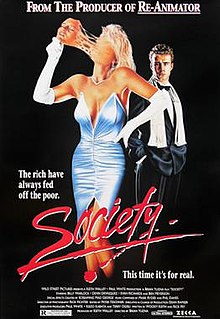
“A Matter of Good Breeding”: The Shape-Shifting Elite in Brian Yuzna’s ‘Society’

By Noah Berlatsky

Source: We Are the Mutants

The elite is an amorphous clotted blob of parasitic greed and hate. Its tendrils extend with slimy stealth into every orifice of society—which makes its precise outlines difficult to see. Are the elite contemptuous coastal liberals and academics? Are they hedge fund managers and tech billionaires? Are they infiltrating globalists or capitalist pigs? Are they your bosses? Or are they your neighbors sneering at your MCU films and your fast food diet? Or are they all of these people and more, gelatinously fusing into a suffocating, boundaryless mass, conspiring in the dank corners of the hierarchy to feed upon and absorb your labor and your soul?

Brian Yuzna’s 1989 schlock horror film Society slides its moist appendages around the concept of the elite, queasily exposing its power and its vile plasticity. Squeezing into the paranoid horror genre at the very end of the Cold War, Society contorts itself away from the communist menace to focus on the evil assimilating rituals of a boneless capitalism. In doing so, though, it inadvertently shows how difficult it is, with the tropes of terror we have, to tell communism and capitalism apart. The two dissolve into a single two-headed, or multi-headed, or faceless mass, impossible to pin down or define, and therefore impossible to escape.

Society‘s protagonist is Bill Whitney (Billy Warlock), a wealthy Beverly Hills teen and star basketball player running for student body president. Everything seems to be going well for him. And yet, “If I scratch the surface, there’ll be something terrible underneath,” he tells his therapist, Dr. Cleveland (Ben Slack), just before biting into an apple and seeing it squirming with (hallucinatory?) maggots. The worm in Bill’s Garden of Eden is his family. His parents Nan (Connie Danese) and Jim (Charles Lucia) are much closer to his sister Jenny (Patrice Jennings) than they are to him. He suspects they don’t love him; he worries he is adopted. Soon, though, he has cause for even more serious alarm. His sister’s ex-boyfriend David Blanchard (Tim Bartell) secretly bugs Bill’s parents and sister; on the tape the three of them reveal that Jenny’s debutante coming out party is a bizarre incestuous group sex ritual. When Bill tries to share the evidence, the tape disappears, and Blanchard is killed in a car crash. The wooden acting and incoherent plot tremble between B-movie incompetence and sweat-drenched fever dream as the conspiracy begins to engulf everyone from Bill’s rival, Ted Ferguson (Ben Meyerson), to his new girlfriend Clarissa Carlyn (Devin DeVasquez), to his doctor, his parents, and the police.

In the film’s infamous conclusion, we learn that Bill was in fact adopted, and his parents and their friends are part of a shape-shifting species that devours humans in a bizarre group feeding sex ritual called the “shunt.” The last twenty minutes of the runtime are an oozy apocalypse courtesy of special effects guru Screaming Mad George: flesh dissolves, mouths turn into clotted rubbery tendrils, and Bill literally reaches up through Ted Ferguson’s anus to pull him inside out in a climactic battle, ending Ted’s life and Bill’s hopes of a Washington internship. Clarissa is so in love with Bill that she betrays her own species, and she, Bill, and Bill’s buddy Milo (Evan Richards) escape the clutches of the elite, whose members have to satisfy themselves with eating Blanchard, saved from his apparent death by car crash for an even more awful fate.

Society is a decadent, absurdly sodden and febrile extension of the body horror genre of the ‘70s and ‘80s, taking The Thing (1982), 1985’s Re-Animator (which Yuzna produced), The Blob (1988), and The Fly (1986), and adding even more K-Y Jelly and quivering sexual innuendo. It can also be seen, though, as a reversal of those late Cold War-era films, reaching through the back end to grab hold of the eye sockets from the inside to pull out the wet, pulsing innards. Just as the Berlin Wall was falling, Society revealed that the fear of the Soviets was fear of the wealthy elite all along.

***

Anti-communist paranoia in Cold War horror often centers on deindividuation and dehumanization. Ronald Reagan was channeling films like 1954’s Them!, with its giant, mindless insect invaders, when he described Communism as an “ant heap of totalitarianism.” The 1958 The Blob features a figurative Red menace: a clump of gelatin fallen from space that absorbs all those in its path, dissolving discrete persons into a single jelly-like mass. 1956’s Invasion of the Body Snatchers imagines alien seed pods falling to earth, from which gestate repulsively fibrous duplicates. They drain human appearance and personality when, in a metaphorical excess of failed vigilance, their targets fall asleep. “Love, desire, ambition, faith—without them life’s so simple,” a pod person explains to the horrified protagonists, sketching a vision of a world enervated by a lack of human warmth and capitalist moxy. Significantly, one of the first signs of the pod invasion is a dual leeching away of business initiative and consumerist impulses. Dr. Miles Binnell (Kevin McCarthy) first notices something awry when he sees an abandoned roadside vegetable stand. Later, when he takes Becky Driscoll (Dana Wynter) out to dinner, the restaurant is almost abandoned. Pod people neither sell nor buy; the hive mind, possessed of invisible tendrils, does not require an invisible hand.

Communism doesn’t just eat through commercial relationships in these films; it eats through domestic ones. Removing consumer desire also removes traditional sexual and romantic impulses, leaving behind monstrous abomination. Science-fiction author Jack L. Chalker neatly summarizes the anti-communist logic in his 1978 novel Exiles at the Well of Souls, in which humans have created Comworlds where “The individual meant nothing; humanity was a collective concept.” To advance that group good, the Comworlds retool sexual biology itself: “Some bred all-females, some retained two sexes, and some, like New Harmony, bred everyone as a bisexual. A couple had dispensed with all sexual characteristics entirely, depending on cloning.” In one of the most quietly ugly moments in Invasion of the Body Snatchers, a working mother prepares a pod for her own baby, noting in a monotone that soon it won’t cry. Plants replace wombs just as outsourced childcare replaces homemaking, and maternal feelings dissolve into a grey, ichorous, proto-feminist puddle.

The 1970s remake of Invasion of the Body Snatchers further teases out the bleakly kinky implications of mind-controlled interference in the reproductive process. Elizabeth Driscoll (Brooke Adams) falls asleep in a field, and, as her personality is sucked from her, her body cracks and crumbles like a rotten pumpkin. Nearby, she rises up in her new form, “born again into an untroubled world, free of anxiety, fear, hate”—and also free of clothes. Pod Elizabeth is completely nude, and the film’s stark gaze willfully conflates desire and terror. In fact, the terror is precisely that she is both fully available and completely unavailable, a desirable body in thrall to some inhuman mass will.

Society takes that body and molds it to different ends. The communist infiltration is replaced with a festering class divide. Good, upstanding businessmen, mothers, and citizens are not infected with an alien ideology. Instead, as the maniacal Dr. Cleveland explains, “No, we’re not from outer space or anything like that. We have been here as long as you have. It’s a matter of good breeding, really.” The parasitic infection is not foreign, but native. No one has been changed; rather, the paranoid revelation is that the evil ones were here all along, squatting wetly in those mansions, and sliding hideously into prestigious internships. No blob or pod or thing needs to take control of the judges, the police, the hospitals, and the student presidency. The blob/pod/thing is already here, salivating. “Didn’t you know, Billy boy, the rich have always sucked off low-class shit like you,” Ted Ferguson sneers, before rolling out an impossibly long tongue to sloppily lick his prey.

Ted’s tongue slides around various kinds of appetite; the rich are hungry not just for deviant power, but for deviant erotics. Just as communism in horror films disorders sexuality, so in Society the rich are marked as evil in large part because of their hypocritical flouting of family values. “We’re just one big happy family except for a little incest and psychosis,” Bill tells Dr. Cleveland nervously, and it’s truer than he knows. His parents and sister share improbably pliable group sex. In a polymorphously perverse primal scene, Bill walks in on them, discovering his mother lying back with her legs turned into arms, and sister Jenny’s head sprouting from her genitals. “If you have any Oedipal fantasies you’d like to indulge in, Billy, now’s the time,” Jenny shrieks gleefully—vapid ‘80s high-class party teen revealed as demonic sexual reprobate.

Billy does have uncomfortable fantasies. Earlier in the film, before he knows what he’s dealing with, he walks in on Jenny in the shower. What he sees is one of the strangest erotic images in film history: through the glazed glass, his sister is facing him from the waist up, her breasts clearly visible. But below the waist her butt is towards him. Bill is frozen in confusion and desire at the sexual grotesque, a literally twisted incestuous spectacle. This erotic narrative stasis is something of a motif in the film. The plot slows down to catch Bill’s wide-eyed reaction during the student president debate, when Clarissa in the audience opens her legs, foreshadowing Sharon Stone’s more explicit move in Basic Instinct (1992) a few years later. Bill similarly comes to a staring halt while watching his parents inspect a phallic, writhing slug in the garden—and then again on the beach, when he is crawling to try to recover some fallen suntan lotion stolen by a couple of mischievous kids. Clarissa, entering stage right, picks up the lotion, and, leaning over him, sprays his face, a move that mimes ejaculation in a phallic role reversal. Finally, when Bill actually has sex with Clarissa, the expression on his face is one of distress and horror as much as pleasure—perhaps because at the height of passion, her left hand slides down sensuously over her back and then down her right arm, as if it’s been cut loose from her body and has wandered off on its own.

The movie itself mirrors Bill’s conflicted gaze, simultaneously fascinated and sickened. The climax is a special effects money shot in multiple respects. The scene is exuberantly concupiscent, with group sex, incest, porn movie tongue kisses, and indeterminate bodily fluids all slickly fusing. The leader of the shunt, Judge Carter (David Wiley), mutters greedily about Blanchard’s beauty mark before devouring him with his mouth, and shoving his hand up his anus. Homosexuality is framed as the ultimate decadence—a terrifying embodiment of penetrative lust that makes you recoil, laugh, and feel things you don’t, or do, want to feel.

The shunt is the Communist blob, with joy added. Judge Carter, Ted, and Jenny all obviously love the shunt. “It’s so fun to see how far you can stretch,” one of Jenny’s fellow shunters tells her. “The hotter and wetter you get the more you can do. It’s great!” The wealthy elite should be opposed to the depersonalization of Communism, but instead they leap in, eager and willing. They’re the enthusiastic audience for all those Cold War films, cheering for the goopy appearance of the Blob.

If all those capitalist viewers loved consuming the Blob, was the Blob ever really a Red Menace in the first place? The problem with seeing Society as an inversion of Cold War anti-communist narratives is that those Cold War anti-communist narratives were often torso-twisted replicas of themselves anyway. The 1988 Blob, for example, replaces the invading goop from space with a biological weapon created by the U.S. government; the shapeless metaphor for communist invasion heaves and bulges and becomes a shapeless metaphor for capitalist invasion.

John Rieder, in 2017’s Science-Fiction and the Mass Culture Genre System, points out that the anti-communism of Invasion of the Body Snatchers can also be read as a terror of capitalism, alluding to the economic signifiers I mentioned earlier.

One of the first signs of the invasion is the closure of a small farmer’s produce stand. Later we see a restaurant losing its business. Finally a group of aliens conspires behind a Main Street-type storefront after one of them grimly turns the sign on the door from Open to Closed. What these emptying-out and closures signify is an economy bent entirely on the production and distribution of seed pods. The colonizing economy is not attuned to the local needs that a produce stand responds to, but rather focuses solely on the single-minded propagation and export of its one and only crop.

The machinations of the body-snatching elites hollow out the town of Santa Mira, just as the society feeds on Blanchard—or just as the vampire feeds in 1922’s Nosferatu. Bram Stoker’s decadent, parasitic aristocrat was robbing helpless victims of their will and individuality via debased, incestuous, homoerotic sexual rituals long before the Cold War seedpods split open. Anti-communism spawned anti-elitism, and anti-elitism spawned anti-communism. Rieder argues that the real danger of the pods is “monopolistic corporate capitalism,” not communism. But which take is the true reading is less important than the way anti-communism is an indistinguishably parasitic replication of anti-capitalism, and vice versa. The tropes of anti-elitism and of anti-communism are grown from one bloated pod. Both dissolve personality, virtue, ambition, love, and sex into a repulsive muck that lives only to eat and perversely reproduce.

Perhaps the best example of how radical and reactionary horror tropes sprout from one another is John Carpenter’s 1988 classic They Live. In the movie, John Nada (Roddy Piper), a virtuous, optimistic, working-class protagonist, discovers that cadaverous aliens are living among us, controlling us with television messages that turn us into obedient, consuming drones. The movie is widely considered a critique of Reagan-era neoliberalism, and it is that. But it’s also a story about the virtues of genocide. A white guy discovers aliens who don’t look like him living in his town, and his first impulse is to murder them. Foreign shape-shifting immigrants, like vampires, are a standard anti-Semitic stand-in for Jews, and They Live can be read as a fascist conspiracy theory, in which brave working Americans finally recognize their racial oppressors, and respond with righteous cleansing violence.

Actual neo-Nazis have in fact read the film in exactly this way. Director John Carpenter insists that this was not his intention, and there’s no reason to disbelieve him. But tropes, like pod people, have minds of their own. When a creator assembles signs that signal “anti-elitism,” those same signs exude a duplicate, indistinguishable signal that is “anti-communism” or its frequent partner on the right, “fascism.” This is certainly the case in Society, a film in which Judaism is as slippery as sexuality. David Blanchard, we’re repeatedly told, is not the right kind of boy to date Jenny. That’s in part, we learn, because he’s Jewish. After his car accident, he has an open casket funeral in a synagogue. The problem is that Jewish people don’t have open casket funerals. Blanchard, whose corpse is faked by the society, is, it turns out (and unbeknownst to the film creators), a fake simulacra of a Jew.

If Blanchard isn’t really a Jew, it follows that the group that rejects him is made up of fake gentiles. And indeed, the vampiric, endogamous, shape-shifting vampires of the society are a not-very-buried anti-Semitic caricature. “You’re a different race from us, a different species, a different class. You’re not one of us. You have to be born into society,” the creatures tell him. This is a statement about the insularity, privilege, and snobbishness of the hereditary rich. But it’s also a racialization of class that is uncomfortably congruent with anti-Semitism. When the rich are horned devils feeding on the blood of your progeny, that could mean they’re not the rich at all, but the usual scapegoat.

Society expresses its disgust for the elite through the visceral, loathsome, oily imagery of homophobia, anti-Semitism, and anti-leftism. Class critique in the popular imagination draws parasitically on the stigmatization of marginalized people, and on tropes of deindividuation and sexual disorder sucked up from anticommunism. This is in part why it’s been so easy for the right over the last half century and more to position itself as the defender of working people. We have built the rhetoric of anti-elitism and the rhetoric of fascism from the same putrid, writhing flesh. If we don’t find a better way to imagine resistance, and soon, society will consume us too.

Watch the full film on Kanopy here.

Hovering in Cyberspace

By Edward Curtin

Source: Behind the Curtain

We live in a fabricated reality where the visible world became nearly meaningless once the screen world became people’s “window on the world.”  An electronic nothingness replaced reality as people gleefully embraced digital wraparound apparitions.  These days people still move about in the physical world but live in the electronic one.  The result is mass hallucination.

This is the fundamental seismic shift of our era. There is a lot of bitching and joking about it, but when all is said and done, it is accepted as inevitable. Digital devices are embraced as phantom lovers. Technological “advances” are accepted as human destiny.  We now inhabit a technological nightmare (that seems like a paradise to so many) in which technology and technique – the standardized means for realizing a predetermined end most efficiently – dominate the world. In such a world, not only does the end justify the means, but to consider such a moral issue is beside the point. We are speeding ahead to nowhere in the most “efficient” way possible.  No questioning allowed!  Unless you wish to ask your phone.

These days there is much political talk and commentary about fascism, tyranny, a police state, etc., while the totalitarianism of technocracy and technology continues apace.  It is not just the ecological (in the human/natural sense) impact of digital technology where one change generates many others in an endless spiral, but the fact that technical efficiency dominates all aspects of life and, as Jacques Ellul wrote long ago, “transforms everything it touches into a machine,” including humans.  For every problem caused by technology, there is always a technological “solution” that creates further technological problems ad infinitum.  The goal is always to find the most efficient (power) technique to apply as rapidly as possible to all human problems.

Writing nearly fifty years ago in Medical Nemesis, Ivan Illich, explained how in medical care the human touch was being replaced by this technical mindset.  He said,

In all countries, doctors work increasingly with two groups of addicts: those for whom they prescribe drugs, and those who suffer from their consequences. The richer the community, the larger the percentage of patients who belong to both…In such a society, people come to believe that in health care, as in all fields of endeavor, technology can be used to change the human condition according to almost any design.

We are of course living with the ongoing results of such medical technical efficiency.  The U.S.A. is a country where the majority of people are drugged in one way or another, legally or illegally, since the human problems of living are considered to have only technological solutions, whether those remedies are effective or anodyne.  The “accidents” and risks built into the technological fixes are never considered since the ideological grip of the religion of technology is all-encompassing and infallible.  We are caught in its web.

Marshall McLuhan, the media guru of the 1960s – whether he was applauding or bemoaning the fact – was right when he claimed that the medium is the message.

Cell phones, being the current omnipresent form of the electronification of life, are today’s message, a sign that one is always in touch with the void.  To be without this small machine is to be rendered an idiot in the ancient Greek sense of the word – a private person.  Translation: one who is out of it, detached, at least temporarily, from the screens that separate us from reality, from the incessant noise and pinging messages that destroy reflection and create reflex reactions.

But to be out of it is the only way to understand it.  And to understand it is terrifying, for it means one knows that the religion of technology has replaced nature as the source of what for eons has been considered sacred. It means one grasps how reality is now defined by technology. It means realizing that people are merging with the machines they are attached to by invisible manacles as they replace the human body with abstractions and interact with machines.  It means recognizing that the internet, despite its positive aspects and usage by dissenters intent on human liberation, is controlled by private corporation and government forces intent on using it as a weapon to control people. It means seeing the truth that most people have never considered the price to be paid for the speed and efficiency of a high-tech world.

But the price is very, very high.

One price, perhaps the most important, is the fragmentation of consciousness, which prevents people from grasping the present from within – which, as Frederic Jameson has noted, is so crucial and yet one of the mind’s most problematic tasks – because so many suffer from digital dementia as their attention hops from input to output in a never-ending flow of mediated, disembodied data.  As a result, a vicious circle has been created that prevents people from the crucial epistemological task of grasping the double-bind that is the ultimate propaganda.  Data is Dada by another name, and we are in Dada land, pissing, not into Marcel Duchamp’s ridiculous work of Dada “art,” a urinal, but into the wind.  And data piled on data equals a heap of data without knowledge or understanding.  There is no time or space for grasping context or to connect the dots. It is a pointillist painting in the form of inert facts that few can understand or even realize that they don’t.

I am typing these words on a Hermes 3000 manual typewriter, a beautiful piece of technology whose sound and movement creates a rhythmic sanctuary where my hands, head, and heart work in unison. It allows me to think slowly, to make mistakes that will necessitate retyping, to do second and third rereadings and revisions, to roll the paper out of the machine and sit quietly as I review it.  My eyes rest on the paper, not a blue-lit screen.

Technology as such is not the problem, for my typewriter is a very useful and endurable machine, a useful technology that has enhanced life. It does not break or need to be replaced every few years, as computers do. It does not contain coltan, tantalum, or other minerals mined in the Democratic Republic of Congo, Rwanda, and other places by poor people working under oppressive conditions created by international consumer greed that is devouring the world.  It does not allow anyone to spy on me as I type.  I am alone and unplugged, disconnected, off-line and out of line, a sine qua non for thinking, and thinking about deep matters.  The typewriter is mine, and mine alone, unlike the connected digital devices that have destroyed aloneness, for to be alone is to contemplate one’s fate and that of all humanity.  It is to confront essential things and not feel the loneliness induced and exacerbated by the illusion of always being in touch.

But while this typing machine allows me to write in peace, I am in no way suggesting that I have escaped the technological condition that we all find ourselves in.  There are little ways to step outside the closing circle, but even then, one is still in it.  I will eventually have to take my paper and type it into a computer document if I wish to publish it in the form you will be reading it.  There is no other way. The technocrats have decreed it so. We are all, as George Orwell once wrote in a different context and meaning, “inside the whale,” the whale in this case being a high-tech digital world controlled by technocrats, and we have only small ways to shield ourselves from it. Sitting in a quiet room, working on a typewriter, taking a walk in the woods without a cell phone, or not owning a cell phone, are but small individual acts that have no effect on the structural realty of what Neil Postman calls technopoly in his masterful book, Technopoly: The Surrender of Culture to Technology.  And even in the woods one may look up to admire a tree only to find that it is a cell phone tower.

Humans have always created and used technology, but for a very long time that technology was subject to cultural and religious rules that circumscribed limits to its use.  Today there are no limits, no rules to constrain it.  The prohibition to prohibit is our motto.  In our acceptance of technical efficiency, we have handed over our freedom and lost control of the means to ends we can’t fathom but unconsciously fear.  Where are we heading? many probably wonder, as they check the latest news ping, no doubt about something to fear, as a thousand pieces of “news” flash through their devices without pause, like wisps of fleeting dreams one vaguely remembers but cannot pin down or understand.  Incoherence is the result.  Speed is king.

Of course, this kaleidoscopic flood of data confuses people who desire some coherence and explanation.  This is provided by what Jacques Ellul, in Presence in the Modern World, calls “the explanatory myth.”  He writes,

This brings us to the other pole of our bizarre intellectual situation today: the explanatory myth.  In addition to its political and its mystical and spiritual function, the explanatory myth is the veritable spinal column of our whole intellectual system…Given that appearances produce confusion and coherence is needed, a new appearance unifies them all in the viewer’s mind and enables everything to be explained.  This appearance has a spiritual root and is accepted only by completely blind credulity.  It becomes the intellectual key for opening all secrets, interpreting every fact, and recognizing oneself in the whirl of phenomena…this myth [is] their one stable point of thought and consciousness…enables everyone to avoid the trouble of thinking for themselves, the worry of doubt, the questioning, the uncertainty of understanding, and the torture of a bad conscience.  What prodigious savings of time and means, which can be put usefully to work manufacturing some more missiles…[they] have a good conscience because they have an answer for everything; and whatever happens and whatever they do, they can rely on the explanation that myth provides.  This process places them within the most complete unreality possible.  They live in a permanent dream, but a realistic dream, constructed from the countless facts and theories that they believe in with all the power of ‘mass persons’ who cannot detach themselves from the mass without dying.

Today that myth is the religion of technology.

So if you have any questions you want answered, you can ask your phone.

Ask your phone why we are living with endless wars on the edge of using our most astounding technological invention: nuclear weapons.

Ask your computer why “nice” Americans will sit behind computer screens and send missiles to kill people half-way around the world whom they are told they are at war with.

Ask your smart device why so many have become little Eichmanns, carrying out their dutiful little tasks at Raytheon, Lockheed Martin, and all the other war manufacturers, or not caring what stocks they own.

Ask your phone what really happened to the Ukrainian International Airlines Flight 752 in Iran.  See if your phone will say anything about cyber warfare, electronic jamming, or why the plane’s transponder was turned off preventing a signal to be sent indicating it was a civilian aircraft.

Ask who is behind the push to deploy 5 G wireless technology.

Ask that smart phone who is providing the non-answers.

Ask and it won’t be given to you; seek and you will not find. The true answers to your questions will remain hidden.  This is the technological society, set up and controlled by the rulers.  It is a scam.

Google it!

God may respond.