

By Margaret Kimberly
Source: Black Agenda Report
The US is starving and killing Venezuelans in real life and, for your family’s viewing pleasure, on television screens.
“Imperialism is quite bipartisan and liberal Hollywood never saw propaganda it didn’t want to hype.”
“The military intervention of #Venezuela, put ‘on the table’ by @realDonaldTrump and his gang of fanatic supremacists, is supported by the gringo propaganda machine. Here is a fragment of their ‘cultural offerings.’”— Ernesto Villegas, Venezuela Minister of Culture
Americans are loathe to think of themselves as being propagandized. The idea is inconsistent with notions of exceptional goodness and superiority that are constantly evoked in this country. But government propaganda does not work in a vacuum. It is bolstered by the corporate media and that includes the entertainment industry.
The latest in the story of fictitious CIA agent Jack Ryan is a case in point. The Ryan character appeared in five different feature films before moving to the small screen via Amazon Prime Video. The new season premieres in November and in this latest incarnation Ryan fights to prevent a nuclear armed Venezuela .
The upside down presentation is typical of the perversion of truth so prevalent in the United State. This country is the only one to have used nuclear weapons and still possesses more than any other. It is the United States that recently withdrew unilaterally from decades old nuclear agreements with Russia. Yet Hollywood has woven a tale of Russia, the country which wanted to keep the non-proliferation agreements, as a villain giving nuclear weapons to Venezuela.
“Government propaganda is bolstered by the entertainment industry.”
Venezuela is the victim of United States aggression in reality and now on the screen. The doctrine of “maximum pressure” has killed 40,000 Venezuelans through sanctions that have deprived that nation of food and medical care. That proof of U.S. aggression is known only to those who access independent media sources. The corporate media, even those who are allegedly liberal, parrot Donald Trump administration talking points, even if they otherwise deride the president and his team. Imperialism is quite bipartisan and liberal Hollywood never saw propaganda it didn’t want to hype.
Of course liberals who are usually overcome by Trump derangement syndrome are happy to go along with aggression schemes. Very few Democrats have expressed opposition to the anti-Venezuelan plots hatched by Trump. There is indeed foreign policy collusion but it doesn’t exist in a relationship with a foreign government. The determination to support American hegemony is an important part of the elite consensus.
That obvious truth is also disappeared and is not to be discussed in what passes for polite and “serious” company. According to myth, America is a classless, post-racial meritocracy and accepting of every political viewpoint. Of course it is anything but. The hierarchies are rigid and tenaciously defended.
“The corporate media, even those who are allegedly liberal, parrot Donald Trump administration talking points.”
Propaganda delivered via popular entertainment plays a particularly insidious role in this process. The goal is to change minds and ensure support for any act the government should choose to make. If this particular iteration of the Jack Ryan story isn’t challenged then no act or aggression will be challenged either.Media imagery is very powerful, that is why governments work so closely with corporate media to present their narratives.
Mace Neufeld created the Jack Ryan film franchise. In 2014 he received a lifetime achievement award from the Israeli Film Festival. Curiously, the event wasn’t held in Israel at all. Instead Beverly Hills was the venue. Neufeld’s co-honoree was Arnon Milchan, a former Mossad operative who parlayed that career into producing hit films such as Twelve Years a Slave.
Israel isn’t alone in this regard. The CIA and the Pentagon both have film liaison offices . Movie credits often end with thanks to the department of defense. That always means that the plot line is approved by the military and the surveillance state.
“Movie credits often end with thanks to the department of defense.”
This grotesque lying on a mass scale cannot be ignored. The propagandists know that repetition plays a huge role in the process of indoctrination. For years Venezuela has been used as a bogeyman to convince people in this country to act against their own interests. “Socialism doesn’t work, just look at Venezuela,” is a statement made to end discussion of free health care or college education or housing or anything else that people need and want. After the 100th New York Times article which says nothing about the U.S. attack but points out that Venezuelans are hungry, the job has been done. Venezuela is now so thoroughly demonized that only a small number of people will come to its defense or even question their government’s policy against that nation.
“Venezuela is now so thoroughly demonized that only a small number of people will come to its defense.”
In 2002 and 2003 the president, the corporate media, and members of Congress all claimed that Iraq possessed chemical weapons. They wanted to make a case for war and they succeeded. Nearly 20 years later there has been no explanation or apology from the guilty parties. The same people claimed that Syria had chemical weapons and advocated for a larger war there. It isn’t hard to believe that a lie about chemicals or nukes in Venezuela could be used to do the same thing if that is what the establishment desired.
Entertainment isn’t harmless. That is why the ruling clique work together to ensure that they all stay on message. They haven’t spent millions of dollars honing the false message that Venezuela is a failed state with evil leadership for no reason. Venezuela’s culture minister, Ernesto Villegas, hits the nail squarely on the head when he describes this latest insult as “crass war propaganda masquerading as entertainment.” If the U.S. should take military action or continue its regime change efforts, the plot will have succeeded. A few well informed people will speak out but the masses will either support an atrocity or ignore any horror that their leadership cares to visit upon the Venezuelan people. Washington and Hollywood are still working hand in hand.
Margaret Kimberley’s Freedom Rider column appears weekly in BAR, and is widely reprinted elsewhere. She maintains a frequently updated blog as well at http://freedomrider.blogspot.com . Ms. Kimberley lives in New York City, and can be reached via e-Mail at Margaret.Kimberley(at)BlackAgendaReport.com.

By Robert J. Burrowes
On 2 October 2019, it will be the 150th anniversary of the birth of Mohandas K. Gandhi in Gujarat, India. I would like to reflect on the visionary leadership that Gandhi offered the world, briefly comparing it with some national leaders of today, and to invite you to emulate Gandhi’s leadership.
While Gandhi is best remembered for being the mastermind and leader of the decades-long nonviolent struggle to liberate colonial India from British occupation, his extraordinary political, economic, social, ecological, religious and moral leadership are virtually unknown, despite the enormous legacy he left subsequent generations who choose to learn from what he taught. This legacy is available online in the 98-volume Collected Works of Mahatma Gandhi.
While touching on Gandhi’s legacy in each of these regards, I would particularly like to highlight Gandhi’s staggering legacy in four of these fields by briefly comparing his approach to politics, economics, society and the environment with the approach of contemporary political leaders such as Jair Bolsonaro (Brazil), Xi Jinping (China), Emmanuel Macron (France), Viktor Orbán (Hungary), Narendra Modi (India), Binjamin Netanyahu (Israel), Shinzo Abe (Japan), Vladimir Putin (Russia), Mohammad bin Salman (Saudi Arabia), Boris Johnson (UK) and Donald Trump (USA).
Before doing so, let me offer a little basic background on Gandhi so that the foundational framework he was using to guide his thinking and behaviour is clear.
Gandhi in Brief
In order to develop his understanding of the human individual and human society, as well as his approach to conflict, Gandhi engaged in ongoing research throughout his life. He read avidly and widely, as well as keenly observing the behaviour of those around him in many social contexts in three different countries (India, England and South Africa). Shaped also by the influence of his mother and his Hindu religion, this led to Gandhi’s unique understanding of the human individual and his approach to the world at large.
For a fuller elaboration of the points about Gandhi discussed below and the precise references, see relevant chapters and sections on Gandhi in The Strategy of Nonviolent Defense: A Gandhian Approach.
Gandhi’s conception of the human individual and human nature
In order to understand Gandhi generally, it is imperative to comprehend his conceptions of the human individual and human nature simply because these are the foundation of his entire philosophy.
Gandhi attached enormous importance to individual responsibility. He also had a very positive view of human nature. Gandhi believed that humans could respond to ‘the call of the spirit’ and rise above selfishness and violence. Moreover, this was necessary in their quest for self-realization. Self-realization, as the Gandhian scholar Professor Arne Naess explains it, ‘involves realizing oneself as an autonomous, fully responsible person’.
In Gandhi’s view, this quest is an individual one that relies on nonviolence, self-reliance, and the search for truth. ‘To find Truth completely is to realize oneself and one’s destiny.’ But what should guide this search? According to Gandhi, it can only be the individual conscience: The ‘inner voice’ must always be ‘the final arbiter when there is a conflict of duty’. And in his view, ‘the voice of God, of Conscience, of Truth or the Inner Voice or “the still small Voice” mean one and the same thing.’
This point is centrally important, because the usual descriptions of Gandhian nonviolence stress its morality, humility and sacrifice while neglecting the fundamental norm ‘that you should follow your inner voice whatever the consequences’ and ‘even at the risk of being misunderstood’.
The point, of course, is that creation of the nonviolent society which Gandhi envisioned required the reconstruction of the personal, social, economic and political life of each individual. ‘We shall get nothing by asking; we shall have to take what we want, and we need the requisite strength for the effort.’ Consequently, the individual required increased power-from-within through the development of personal identity, self-reliance and fearlessness.
So what is fearlessness? For Gandhi, it means freedom from all external fear, including the fear of dispossession, ridicule, disease, bodily injury and death. In his view, progress toward the goal of fearlessness requires ‘determined and constant endeavour’. But why is fearlessness so important? Because a person who is fearless is unbowed by the punitive power of others and that makes them powerful agents of change.
Gandhi’s approach to society and political economy
Gandhi’s conception of society is based on a rejection of both capitalism and socialism.
In relation to capitalism, he rejected the competitive market and private property, with their emphasis on individual competitiveness and material progress and their consequent greed and exploitation of the weak. He also rejected the major institutions of capitalism, including its parliamentary system of democracy (which denied sovereignty to the people), its judicial system (which exacerbated conflict and perpetuated elite power), and its educational system (which divorced education from life and work).
In relation to socialism, he rejected its conception of conflict in terms of class war, its claim that state ownership and centralization are conducive to the common welfare, its emphasis on material progress, and its reliance on violent means.
The Gandhian vision of future society is based on a decentralized network of self-reliant and self-governing communities using property held in trust, with a weak central apparatus to perform residual functions. His vision stresses the importance of individuals being able to satisfy their personal needs through their own efforts – including ‘bread labor’ – in cooperation with others and in harmony with nature.
For Gandhi, this horizontal framework is necessary in order to liberate the exploiter and exploited alike from the shackles of exploitative structures. This is vitally important because, in his view, ‘exploitation is the essence of violence.’ Self-reliance and interdependence must be built into the structure in order to enhance the capacity for self-regeneration and self defense and to eliminate the potential for structural violence inherent in any dependency relationship.
This social vision was clearly evident in Gandhi’s ‘constructive program’, which was intended to restructure the moral, political, social and economic life of those participating in it. The constructive program was designed to satisfy the needs of each individual member of society and was centrally concerned with the needs for self-esteem, security, and justice. The program entailed many elements, some of which are outlined below in order to illustrate this point.
A crucial feature of the constructive program was the campaign for communal unity. This was intended to encourage reciprocal recognition of the identity of Hindus, Muslims, Christians, Jews and those of other religions. According to Gandhi, all people should have the same regard for other faiths as they have for their own.
The campaign to liberate women was intended to secure self esteem, security, and justice for those most systematically oppressed by India’s patriarchal society. ‘Woman has been suppressed under custom and law for which man was responsible… In a plan of life based on nonviolence, woman has as much right to shape her own destiny as man.’
The campaign for the removal of untouchability was meant to restore self-esteem, dignity, and justice to the Harijans (Gandhi’s term for those without caste) in Hindu society. Similarly, the constructive program was concerned with recognizing the needs of indigenous peoples and lepers throughout India. ‘Our country is so vast… one realizes how difficult it is to make good our claim to be one nation, unless every unit has a living consciousness of being one with every other.’
The khadi (handspun/handwoven cloth) and village industries programs were intended to make the villages largely self-reliant and Indians proud of their identity after centuries of oppression and exploitation under British imperial rule. Khadi, Gandhi argued, ‘is the symbol of unity of Indian humanity, of its economic freedom and equality.’ The struggle for economic equality was aimed at securing distributive justice for all. It meant ‘leveling down’ the rich, who owned the bulk of the nation’s wealth, while raising the living standards of ‘the semi-starved’ peasant millions.
Thus, Gandhi stressed the centrality of the individual and the importance of creating a society that satisfied individual human needs. ‘The individual is the one supreme consideration’; individuals are superior to the system they propound. In fact: ‘If the individual ceases to count, what is left of society?… No society can possibly be built on a denial of individual freedom.’
According to Gandhi then, the foundation of this nonviolent society can only be the nonviolent individual: No one need wait for anyone else before adopting the nonviolent way of life. Hesitating to act because the whole vision might not be achieved, or because others do not yet share it, is an attitude that only hinders progress.
So how is this nonviolent society to come into being? For Gandhi, the aim is not to destroy the old society now with the hope of building the new one later. In his view, it requires a complete and ongoing restructuring of the existing social order using nonviolent means. And while it might not be possible to achieve it, ‘we must bear it in mind and work unceasingly to near it’.
The political means for achieving this societal outcome entailed three essential elements: personal nonviolence as a way of life, constructive work to create new sets of political, social, economic and ecological relationships, and nonviolent resistance to direct and structural violence.
Gandhi the nonviolent conflict strategist
So what did nonviolence mean to Gandhi?
According to Gandhi: ‘Ahimsa [nonviolence] means not to hurt any living creature by thought, word or deed.’ The individual, humanity, and other life forms are one: ‘I believe in the essential unity of [humanity] and for that matter of all that lives.’
Given Gandhi’s understanding that conflict is built into structures and not into people, and that violence could not resolve conflict (although it could destroy the people in conflict and/or the issues at stake) his religious/moral belief in the sanctity of all life compelled him to seek a way to address conflict without the use of violence. Moreover, despite his original training as a lawyer in England and his subsequent practice as a lawyer in South Africa, Gandhi soon rejected the law as a means of dealing with conflict too, preferring to mediate between conflicting parties in search of a mutually acceptable outcome.
According to Gandhi, British imperialism and the Indian caste system were both examples of structures that were perpetuated, in large part, as a result of people performing particular roles within them. The essence of Gandhi’s approach was to identify approaches to conflict that preserved the people while systematically demolishing the evil structure. Moreover, because he saw conflict as a perennial condition, his discussions about future society are particularly concerned with how to manage conflict and how to create new social arrangements free of structural violence.
More importantly, according to Gandhi conflict is both positive and desirable. It is an important means to greater human unity. Professor Johan Galtung explains this point: ‘far from separating two parties, a conflict should unite them, precisely because they have their incompatibility in common.’ More fundamentally, Gandhi believed that conflict should remind antagonists of the deeper, perhaps transcendental, unity of life, because in his view humans are related by a bond that is deeper and more profound than the bonds of social relationship.
So how is conflict to be resolved? In essence, the Gandhian approach to conflict recognizes the importance of resolving all three corners of what Galtung calls the ‘conflict triangle’: the attitude, the behavior, and the goal incompatibility itself. The Gandhian method of conflict resolution is called ‘satyagraha’, which means ‘a relentless search for truth and a determination to reach truth’, it is somewhat simplistically but more widely known (and practiced) in English as ‘nonviolent action’ (or equivalent names). While the perpetrator of violence assumes knowledge of the truth and makes a life-or-death judgment on that basis, satyagraha, according to Gandhi, excludes the use of violence precisely because no one is capable of knowing the absolute truth. Satyagraha, then, was Gandhi’s attempt to evolve a theory of politics and conflict resolution that could accommodate his moral system.
It is for this reason then that ‘Satyagraha is not a set of techniques’. This is because the actions cannot be detached from the norms of nonviolence that govern attitudes and behavior. Therefore, an action or campaign that avoids the use of physical violence but that ignores the attitudinal and behavioral norms characteristic of satyagraha cannot be classified as Gandhian nonviolence. Moreover, the lack of success of many actions and campaigns is often directly attributable to a failure to apply these fundamental norms to their practice of ‘nonviolent action’ (by whatever name it is given locally). To reiterate: ‘Satyagraha is not a set of techniques’.
But Gandhi was not just committed to nonviolence; he was committed to strategy as well. Because he was a shrewd political analyst and not naive enough to believe that such qualities as truth, conviction and courage, nor factors such as numbers mobilized, would yield the necessary outcomes in conflict, he knew that strategy, too, was imperative.
Consequently, for example, he set out to develop a framework for applying nonviolence in such a way that desirable outcomes were built into the means of struggle. ‘They say “Means are after all means”. I would say “means are after all everything”. As the means so the end.’
Gandhi the ecologist
According to Karl Marx, the crisis of civilization was created by the production relations of capitalism; for Gandhi, it was created by the process of industrialization itself. This process both stimulated and was fueled by the unrestrained growth of individual wants. The remedy, according to Gandhi, lay in individuals transforming themselves and, through this transformation, founding a just social order.
He argued that social transformation, no matter how profound, would be neither adequate nor lasting if individuals themselves were not transformed. A part of this strategy was ‘the deliberate and voluntary reduction of wants’. Gandhi did not begrudge people a reasonable degree of physical well-being, but he made a clear distinction between needs and wants. ‘Earth provides enough to satisfy every [person’s] need but not for every [person’s] greed.’
But, as with everything else in Gandhi’s worldview, he did not just advocate this simple material lifestyle; he lived it, making and wearing his own khadi, and progressively reducing his personal possessions.
Contemporary Political Leaders
While contemporary national leaders obviously display a wide variety of styles, it is immediately evident that individuals such as Jair Bolsonaro (Brazil), Xi Jinping (China), Emmanuel Macron (France), Viktor Orbán (Hungary), Narendra Modi (India), Binjamin Netanyahu (Israel), Shinzo Abe (Japan), Vladimir Putin (Russia), Mohammad bin Salman (Saudi Arabia), Boris Johnson (UK) and Donald Trump (USA) might be readily identified as representative of virtually all of them.
And whatever one might say about each of these leaders, it is clear from both their words and behaviour that none of them regards the human individual and their conscience as the foundation on which their national societies or even global society should be built. On the contrary, individuals are destroyed, one way or another, so that society is not inconvenienced more than minimally by any semblance of ‘individuality’ or individual conscience.
Moreover, while in some countries there are clearly articulated doctrines about reducing inequality and, in a few cases, some effort to achieve this, there is little or no concerted effort to restructure their national societies and economies so that inequality is eliminated; on the contrary, the wealth of the few is celebrated and defended by law. None of these leaders wears a local equivalent of khadi to express their solidarity with those less privileged and model a lifestyle that all can (sustainably) share.
The oppression of certain social groups, such as women, indigenous peoples, racial and religious minorities, particular castes or classes, those of particular sexual and identity orientations or with disabilities, remains widespread, if not endemic, in each of these societies with considerably less than full effort put into redressing these forms of discrimination.
Not one of these leaders could profess an ecological worldview (and national policies that reflected a deep commitment to environmental sustainability) or the simplicity of material lifestyle that Gandhi lived (and invited others to emulate).
And not one of them could pretend that killing fellow human beings was abhorrent to them with each of these countries and their leaders content to spend vast national resources on military violence rather than even explore the possibility of adopting the strategically superior (when properly understood and implemented) strategy of nonviolent defense that Gandhi advocated. ‘I have always advised and insisted on nonviolent defence. But I recognize that it has to be learnt like violent defence. It requires a different training.’ See The Strategy of Nonviolent Defense: A Gandhian Approach or, more simply, Nonviolent Defense/Liberation Strategy.
For just a taste of the discriminatory, destructive and violent policies of contemporary political leaders, see ‘Equality Reserved: Saudi Arabia and the Convention to End All Discrimination against Women’, ‘156 Fourth World Nations suffered Genocide since 1945: The Indigenous Uyghurs Case’, ‘Weaponizing Space Is the New Bad Idea Coming From Washington D.C.’ and ‘Report Shows Corporations and Bolsonaro Teaming Up to Destroy the Amazon’. But for further evidence of the support of contemporary political leaders for violence and exploitation in all of their forms, just consult any progressive news outlet.
As an aside, it is important to acknowledge that the world has had or still does have some national leaders with at least some of Gandhi’s credentials. It also has many community leaders who display at least some of these credentials too, which is why there are so many social movements working to end violence, inequality, exploitation and ecological destruction in their many forms.
Was Gandhi realistic? Was he right?
But even if you concede that Gandhi was a visionary, you might still ask ‘Was Gandhi realistic?’ Surely it is asking too much for modern political leaders to live simply and nurture ecological sustainability, to work energetically against all forms of inequality and discrimination, and to deal with conflicts without violence, for example. Especially in a world where corporations are so powerful and drive so much of the inequality, violence and ecological destruction that takes place.
Of course, ‘Was Gandhi realistic?’ is the wrong question. With human beings now on the brink of precipitating our own extinction – see ‘Human Extinction by 2026? A Last Ditch Strategy to Fight for Human Survival’ – the more appropriate question is ‘Was Gandhi right?’
And if he was, then we should be attempting to emulate him, however imperfect our attempts may be. Moreover, we should be endeavouring to improve on his efforts because no-one could credibly suggest that Gandhi’s legacy has had the impact that India, or the world, needs.
Can we improve on Gandhi?
Of course we can. As Gandhi himself would want us to do: ‘If we are to make progress, we must not repeat history but make new history. We must add to the inheritance left by our ancestors.’
One key area in which I would improve on Gandhi is an outcome of doing decades of research to understand the fundamental cause of violence in human society: the dysfunctional parenting and teaching models we are using which inflict virtually endless ‘visible’, ‘invisible’ and ‘utterly invisible’ violence on children and adolescents. See ‘Why Violence?’, ‘Fearless Psychology and Fearful Psychology: Principles and Practice’ and ‘Do We Want School or Education?’
This cause must be addressed if we are to have any chance of eliminating the staggering and unending violence, in all of its forms, from our families, communities and societies while empowering all individuals to deal fearlessly and nonviolently with conflict.
Hence, I would encourage people to consider making ‘My Promise to Children’ which will require them to learn the art of nisteling. See ‘Nisteling: The Art of Deep Listening’.
For those who need to heal emotionally themselves in order to be able to engage with children in this way, see ‘Putting Feelings First’.
There are several vitally important reasons why a radical reorientation of our parenting and teaching models is necessary as part of any strategy to end human violence. One reason is that the emotional damage inflicted on children leaves them unconsciously terrified and virtually powerless to deal with reality; that is, to respond powerfully to (rather than retreat into delusion about) political, military, economic, social and ecological circumstances. As casual observation confirms, most individuals in industrialized societies become little more than mindlessly obedient consumers under the existing parenting and teaching models. See ‘Love Denied: The Psychology of Materialism, Violence and War’. This is as far as it can get from Gandhi’s aspiration to generate individuals who are fearless.
Moreover, at their worst, these parenting and teaching models generate vast numbers of people who are literally insane: an accurate description of most of the political leaders mentioned earlier but particularly those who pull the strings of these leaders. See ‘The Global Elite is Insane Revisited’.
Another reason that a radical reorientation of our parenting and teaching models is necessary is so that we produce a far greater number of people of conscience who can think, plan and act strategically in response to our interrelated existential crises. Too few people have these capacities. See, for example, ‘Why Activists Fail’ and ‘Nonviolent Action: Why and How it Works’. Consequently, most activism, and certainly that activism on issues vital to human survival, lacks the necessary strategic orientation, which is explained in Nonviolent Campaign Strategy.
A fourth reason that transformed parenting and teaching approaches are necessary is that it will open up a corner of the ‘conflict square’ that Gandhi (and Galtung) do not discuss: the feelings, particularly fear, that shape all conflicts (that is, the other three corners of the ‘conflict square’: attitude, behaviour and goal incompatibility) and then hold them in place. Fear and other suppressed feelings are central to any conflict and these must be heard if conflict is to be resolved completely. But, more fundamentally, conflict is much less likely to emerge (and then become ‘frozen’) if fear and other feelings are not present at the beginning. Imagine how much easier it would be to deal with any situation or conflict if the various parties involved just weren’t scared (whether of the process and/or certain possible outcomes). See ‘Challenges for Resolving Complex Conflicts’.
Anyway, separately from the above, if you share Gandhi’s understanding that the Earth cannot sustain the massive overconsumption that is now destroying our biosphere, consider participating in a project that he inspired: ‘The Flame Tree Project to Save Life on Earth’.
And consider signing the online pledge of ‘The People’s Charter to Create a Nonviolent World’.
Or, if none of the above options appeal or they seem too complicated, consider committing to:
The Earth Pledge
Out of love for the Earth and all of its creatures, and my respect for their needs, from this day onwards I pledge that:
Despite the now overwhelming odds against human survival, can we get humanity back on track? Gandhi would still be optimistic: ‘A small body of determined spirits fired by an unquenchable faith in their mission can alter the course of history.’
Are you one of those ‘determined spirits’?
Biodata: Robert J. Burrowes has a lifetime commitment to understanding and ending human violence. He has done extensive research since 1966 in an effort to understand why human beings are violent and has been a nonviolent activist since 1981. He is the author of ‘Why Violence?’ His email address is flametree@riseup.net and his website is here.

By Caitlin Johnstone
Source: CaitlinJohnstone.com
You run into a lot of despair in this line of work. The more you learn about the mechanisms of power, the more hopeless things seem at first glance.
The political system is totally locked down, with anyone who tries to upend the status quo being aggressively sabotaged by the mass media and their own political party.
Technology, which futurists have long heralded as the deus ex machina which will liberate humanity from its self-destructive ways, is owned by plutocrats with a vested interest in maintaining the status quo, and is pervasively infiltrated by murderous intelligence agencies from top to bottom.
Even attempts to circulate information about the dangers of war, ecocide and oligarchy are consistently sabotaged by internet censorship, blanket de-platforming and mass media propaganda, and even imprisonment if one’s truth-telling becomes too successful.
Still, I remain unwaveringly hopeful. Not because I foresee any of those massive obstacles vanishing at any time in the near future, but because I see an escape route that none of them are blocking.
I have had a great many bizarre and utterly unanticipated experiences, some of them ongoing, which assure me beyond a shadow of a doubt that humanity is capable of far, far more than our consensus worldview about ourselves accounts for. Most of those experiences I will probably never share publicly, because, while I often venture well off the beaten path in my commentary, if I discussed those experiences people will think I’m way more insane than they already believe me to be. But I don’t mind sharing here that I know from my own experience that humans are capable of radically and permanently shifting into a much healthier and efficacious relationship with mental narrative, which happens to be the mechanism by which existing power structures keep us locked down.
But so what, right? Just because an individual is capable of exiting the fearful egoic state of consciousness which propagandists and social engineers exploit to manipulate us into consenting to the status quo doesn’t mean that everybody is. People have been writing about spiritual enlightenment for millennia, and still we remain collectively asleep. Believing that such a shift is possible on a mass scale is childish and absurd. Right?
Well, maybe. That objection certainly makes sense from the perspective of our consensus worldview about what humans are capable of. Except people who’ve been coaching others into this shift for a long time say in no uncertain terms that it’s becoming more and more common.
“For the first time there is a large scale awakening on our planet,” spiritual teacher Eckhart Tolle said in an interview last year. “Why now? Because if there is no change in human consciousness now, we will destroy ourselves and perhaps the planet. The insanity of the collective egoic mind, amplified by science and technology, is rapidly taking our species to the brink of disaster. Evolve or die: that is our only choice now. Without considering the Eastern world, my estimate is that at this time about ten percent of people in North America are already awakening. That makes thirty million Americans alone, and in addition to those people in other North American countries, about ten percent of the population of Western European countries are also awakening. This is probably enough of a critical mass to bring about a new earth. So the transformation of consciousness is truly happening even though they won’t be reporting it on tonight’s news. Is it happening fast enough? I am hopeful about humanity’s future, much more so now than when I wrote The Power of Now. In fact that is why I wrote that book. I really wasn’t sure that humanity was going to survive. Now I feel differently. I see many reasons to be hopeful.”
Tolle is easily the best-known teacher on the subject of enlightenment in the western world, and he’s been doing it for decades. There’s not much research available on this topic, but if anyone in the west has interacted with enough people and gathered enough experience to make such a declaration, it would be him.
But what if he’s wrong? Well again, maybe. But he’s not alone in this perspective.
“There’s a phenomenon happening in the world today. More and more people are waking up—having real, authentic glimpses of reality,” writes Adyashanti, another longtime popular awakening coach. “In the beginning of my teaching work, most of the people who came to me were seeking these deeper realizations of spirituality. They were seeking to wake up from the limiting and isolated senses of self they had imagined themselves to be. It’s this yearning that underpins all spiritual seeking: to discover for ourselves what we already intuit to be true— that there is more to life than we are currently perceiving. But as time has passed, more and more people are coming to me who have already had glimpses of this greater reality.”
Adyashanti gets a bit more specific than Tolle, saying that it’s non-abiding “glimpse”-type awakenings in particular that are growing more common, which often happen spontaneously without having been sought out.
“This glimpse of awakening, which I call non-abiding awakening, is becoming more and more common,” he writes. “It happens for a moment, an afternoon, a day, a week—maybe as long as a month or two. Awareness opens up, the sense of the separate self falls away—and then, like the aperture on a camera lens, awareness closes back down.”
Jac O’Keeffe, another awakening coach who’s been teaching for some time, has more to add on the subject. She said in a 2015 interview that the awakening process, which used to be a difficult and much more physiologically gruelling ordeal for humans, is coming to us more easily not just as a process, but in terms of how physically taxing it is as well.
“We live in an interesting time, and whether it’s a leap in the evolution of consciousness, or whether it’s because of the industrial age and the quickening that has come about in how we function as human beings; whether it’s unusual, or whether it’s a part of the pattern, I’m not sure,” O’Keeffe said. “However, what’s happening right now is that there’s a mutation happening because we’re not changing fast enough for the changing mechanisms that we have created in the world. And so the shift in consciousness that’s happening now, it’s phenomenally more rapid than how it used to be. Things are not as concrete and as solid, not as difficult to shift in folk’s perception as it used to be. That’s for sure, for sure.”
“The mechanism of which through this is seen also, there seems to be less of a trauma or a dramatic shift,” O’Keeffe added. “Spiritual shifts used to be really difficult on the body, really difficult on every level — they’re not now. And what is that? How come? It’s like our whole cellular structures are more susceptible to transformation, to the embodiment of a higher frequency, a higher vibration. And you know, while we have more toxicity, we also have more availability of hearing what’s beyond all of it, of information, of new influences, of education, you know? We’re learning how to use the mind at last. And so this is bringing about a quickening in the evolution of consciousness.”
Dr Jeffery A Martin, who has been gathering data on awakened individuals for the Center for the Study of Non-Symbolic Consciousness, told me via email that “We see an uptick in our data that starts about 1996. By this I mean the number of people saying they transitioned after that time versus before.”
“However it is important to note that we have a snowball sample, not a full population sample, so that could be a bias in our data,” Martin added. “If it is not, the only correlate we’ve been able to think of is that the Internet was reaching a level of connectivity and information sharing maturity starting about this time. So practices that were formerly secret or soloed were starting to become more available, and one of our key findings is that the best way to make progress is to find your fit from a practice standpoint.”
“I’m reasonably confident that significantly more people are coming to see True Nature than any other time in human history,” said awakening coach Fred Davis when I asked him for comment on the subject via email, adding, “I do think there are more clear beings on the planet than there were even ten years ago.”
Now obviously awakenings becoming more common than they used to be wouldn’t by itself mean much; humanity overall remains deeply unconscious and we appear to be bound for either extinction or Orwellian dystopia if we continue on our current trajectory at its current rate. But the fact that this phenomenon seems to be getting more common and more easy in various ways indicates that something is up. Something entirely unanticipated, from way out of left field which neither the revolutionaries nor the propagandists have foreseen.
But why would we be experiencing a sudden shift in consciousness? Darwinian evolution doesn’t explain it, since if this phenomenon is real it’s moving far too quickly and without natural selection eliminating the unenlightened from the gene pool at any noticeable rate.
Well, maybe as O’Keeffe suggested it’s got something to do with the industrial age and how it’s changed the way we function as a species, or as Martin theorized is due to the increased availability of spiritual teachings online. We now after all have over 4.5 billion human brains connected to each other by the internet with well over half our world’s population now online, which by itself is per definition a shift in human consciousness without adding any fancy stuff about spiritual enlightenment. It’s hard to imagine such a drastic change not having a significant impact on the way our minds operate collectively. So that could be part of it.
It could also have something to do with the fact that, as Adyashanti once suggested in an interview, we’re all aware on some level that we’re at a point of crisis where we’ll either change or go extinct.
“Crises are often the catalyst for change,” he said. “And I think as humanity is in general we can all start to agree, I hope we’re starting to agree, that we’re coming to a place of crisis. That… we’re coming into contact, not just with our own personal mortality, but our mortality as a species. That we as a species may not survive. And that can provide, just like individual mortality, [that] can lead to a change of consciousness because we realize time’s run out. There is no more time. So in that ‘no more time’ sometimes consciousness can shift. And as humanity I think we’re rapidly approaching that same kind of imperative. Time is running out and so quite naturally there is tremendous pressure on humanity and on humanity’s consciousness right now. We all feel it, right? This tremendous pressure to evolve, to awaken, because somehow intuitively everyone knows that if there’s not some rather dramatic shift in consciousness then this opportunity will be missed.”
Another potential explanation for our apparent “quickening” is the possibility that we’re all a lot more interconnected than we assume we are. Some strange and unexpected anomalies in scientific studies have poked a few uncomfortable holes in the consensus worldview about organisms existing as wholly independent individuals on this earth, which opens up the possibility that one person’s awakening could in some ways inform the level of consciousness of the whole of humanity.
Scientist Rupert Sheldrake has been documenting the curious way animals sometimes appear capable of picking up new skills in ways that learning and genetics don’t seem to account for, like the strange case of laboratory rats around the world suddenly getting better at navigating water mazes from generation to generation following a water maze study in the 1920s by psychologist William McDougall. Sheldrake’s theories are often rejected by mainstream scientists with an extreme emotionality which reveals an egoic fixation on dogma rather than scientific objectivity, but if you’re curious about his ideas he had an interesting appearance on The Joe Rogan Experience a few years ago which outlines his thinking more clearly than any other video I’ve found.
If this is true, if humans are interconnected in such a way that one person’s awakening could be informing the rest of the species, then this could indicate that we are on track for a exponential awakening event of the kind that could transform us as a species overnight.
When futurist Roy Amara said “We tend to overestimate the effect of a technology in the short run and underestimate the effect in the long run,” he wasn’t really making a statement about technology, he was making a statement about human cognition. We’re pattern-seeking creatures whose minds tend to think in linear terms within the near future, a tendency which served us well in our evolutionary history when trying to predict when it’s safe to reproduce and where the mammoths will be, but which is absolutely useless in predicting large-scale movements which may be nonlinear. It’s possible that the only reason the predictions the hippies were making about the “great awakening” that started in the sixties was solely because of this cognitive bias Amara spoke of. Perhaps we overestimated the short-term effects of that shift and underestimated its ongoing effects in the long term.
I personally don’t know quite what to make of any of this, which could end up being a good thing. If our future depends on us finding a way out of this ecocidal, omnicidal status quo that the propagandists and manipulators can’t anticipate and slam the door on, it’s going to have to come from an unexpected and mysterious direction. Something does appear to be stirring deep within our species, and for me that’s enough reason to hold out hope and keep pushing for real change. Maybe this shift isn’t what it appears to be from my point of view, and even if it is that doesn’t mean it will necessarily start happening quickly enough, but it’s enough to take a stand on. I believe we’ll either transcend our old self-destructive patterns or perish, so we might as well say “Damn the torpedoes” and sprint toward that transcendence at full speed.
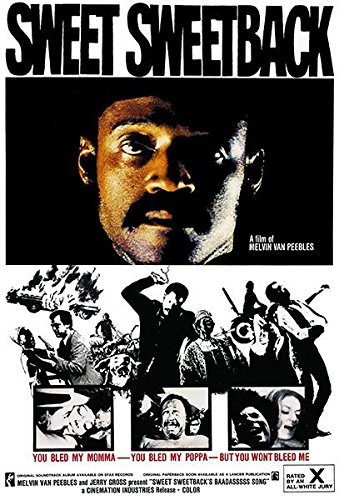
Review by Chuck Foster
Source: Film Threat
On March 31st, 1971, an independent film made by a black man for the black community opened at the Grand Circus Theatre in Detroit and broke the house record. Two days later, it broke another record in Atlanta and became the top-grossing independent film of the year (according to some sources). It sparked a wave of underground filmmaking that lasted at least a decade and became an incredibly polarizing statement of experience. That film was Sweet Sweetback’s Baadasssss Song.
To be fair, this was not the first all-black production to hit the silver screen. So-called “race” films existed through the first half of the 1900s. Comprised of black crews and casts, they delivered entertainment to a specific audience who would relate to the stories. Many of these films are tragically lost to time or have yet to be properly reissued, but one is widely available on any number of fifty or one-hundred public domain movie collections. Clocking in at just under an hour, Oscar Micheaux’s Ten Minutes to Live (1932) presents a near-anthology of two stories centered around a Harlem nightclub. Sporting several musical numbers and a strange sense of framing the image, it and its contemporaries paved the way for a young filmmaker named Melvin Van Peebles.
Sweetback wasn’t Van Peebles’ first film, either. As he tells it, he’d made a series of shorts and brought them to Los Angeles, where the studios offered him a job as a janitor. Instead, he moved to France, where he wrote several books and made 1968’s The Story of a Three-Day Pass, a beautiful film about a black American GI who has a love affair with a white woman while on weekend but finds himself demoted and shamed when he returns to base. The film garnered enough attention to get him a studio deal. Columbia picked him to make The Watermelon Man (1970), the story of a typical suburban bigot who wakes up one day to discover that he’s turned black overnight. Starring Godfrey Cambridge, Estelle Parsons, Howard Caine and Mantan Moreland, it established Van Peebles as a serious, if unorthodox, director.
When it came time to make Sweetback, however, he decided to make it on his own with no studios or financiers telling him what to do. It was a story he wanted to tell and it resonated. Essentially, it centers on Sweetback (Van Peebles), a male prostitute and performer in homemade underground sex shows, whose boss lends him to the police so their boss knows they’re working. Along the way, they arrest Mu-Mu (Hubert Scales), a young, charismatic Black Panther, and take him to a side road for “a little walk.” Sweetback grows angry watching the abuse and attacks the cops, beating them into a coma and setting Mu-Mu free. He then goes on the run, encountering people from his past, the mob, Hell’s Angels and bounty hunters along the way. It sounds pretty straightforward, but it’s not.
Most noticeably, Van Peebles’ visual style blends the uncanny staging of home movies with a French New Wave perspective on iconography and metaphors. The result resembles Easy Rider, Herschell Gordon Lewis and Jean-Luc Godard with George Romero’s “cover-your-ass” style quick editing, but completely unique in delivery. Psychedelic visuals propel the story from parts of Los Angeles we don’t usually see on film to the desert. A bombastic soundtrack, performed by Van Peebles with a very early Earth, Wind & Fire, adds to the tension with gospel, funk, and atonality.
A word should be said about the opening sequence in which Sweetback discovers his calling in life. The young boy, played by Melvin’s son Mario Van Peebles, is rather graphically seduced by a much older woman. Many people have derided the scene as child pornography and irresponsible parenting. No genitals are seen and Mario was under the strict supervision of his father the entire time. Yes, it is disturbing, but it’s also something that happens every day whether we like to admit it or not. Children are abused and coerced into sex on a regular basis. Van Peebles throws that in our face with a stark sense of reality. Pornography is meant to excite; this is just nauseating.
Read anybody’s take on the film today and half love it while the other half loathes it. That contrast typically indicates you’ve done something right. Regardless, Sweet Sweetback’s Baadasssss Song brazenly kicked the door open for everything from direct imitators like Shaft, Superfly, and Dolemite to modern filmmakers like Tyler Perry and Ice Cube. Whether you love it or hate it, we owe this film a debt because it literally changed the world.
Watch the full film on Kanopy here: https://www.kanopy.com/product/sweet-sweetback-s-baadasssss-song

By Andre Vltchek
Source: New Eastern Outlook
It used to be done regularly and it worked: The West identified a country as its enemy, unleashed its professional propaganda against it, then administered a series of sanctions, starving and murdering children, the elderly and other vulnerable groups. If the country did not collapse within months or just couple of years, the bombing would begin. And the nation, totally shaken, in pain, and in disarray, would collapse like a house of cards, once the first NATO boots hit its ground.
Such scenarios were re-enacted, again and again, from Yugoslavia to Iraq.
But suddenly, something significant has happened. This horrific lawlessness, this chaos stopped; was deterred.
The West keeps using the same tactics, it tries to terrorize independent-minded countries, to frighten people into submission, to overthrow what it defines as ‘regimes’, but its power, its monstrously destructive power, has all of a sudden become ineffective.
It hits, and the attacked nation shakes, screams, sheds blood, but keeps standing, keeps proudly erect.
What we are experiencing is a great moment in human history. Imperialism has not yet been defeated, but it is losing its global grip on power.
Now we have to clearly understand ‘Why?’, so we can continue our struggle, with even greater determination, with even greater effectiveness.
First of all, by now we know that the West cannot fight. It can spend trillions on ‘defense’, it can build nuclear bombs, ‘smart missiles’ and strategic warplanes. But it is too cowardly, too spoiled to risk the lives of its soldiers. It either kills remotely, or by using regional mercenaries. Whenever it becomes clear that the presence of its troops would be required, it backs up.
Secondly, it, the West, is totally horrified of the fact that there are now two super-powerful countries – China and Russia – which are unwilling to abandon their allies. Washington and London do all they can to smear Russia and to intimidate China. Russia is being provoked continuously: by propaganda, by military bases, sanctions and by new and newer bizarre mass media inventions that depict it as the villain in all imaginable circumstances. China has been provoked practically and insanely, ‘on all fronts’ – from Taiwan, Hong Kong, Tibet and the so-called ‘Uyghur Issue’, to trade.
Any strategy that could weaken these two countries, is applied. Yet, Russia and China do not crumble. They do not surrender. And they do not abandon their friends. Instead, they are building great railroads in Africa and Asia, they educate people from almost all poor and desperate countries, and stand by those who are being terrorized by both North America and Europe.
Thirdly, all the countries in the world are now clearly aware of what would happen to them, if they give up and get ‘liberated’ by the Western empire. Iraq, Honduras, Indonesia, Libya and Afghanistan, are the ‘best’ examples. Submitting themselves to the West, countries can only expect misery, absolute collapse and the ruthless extraction of their resources. The poorest country in Asia – Afghanistan – has totally collapsed under NATO occupation.
The suffering and pain of the Afghan and Iraqi people is very well known to the citizens of Iran and Venezuela. They are not giving up, because no matter how tough their life is under sanctions and the West-administered terror, they are well-aware of the fact that things could get worse, much worse, if their countries were to be occupied and governed by the Washington and London-injected maniacs.
And everyone knows the fate of the people living in Palestine or Golan Heights, places which have been overrun by the closest ally of the West in the Middle East, Israel.
Of course, there are other reasons why the West cannot get any of its adversaries to kneel.
One is – that the toughest ones are left. Russia, Cuba, China, North Korea (DPRK), Iran, Syria and Venezuela are not going to run away from the battlefield. These are the most determined nations on earth. These are the countries that have already lost thousands, millions, even tens of millions of their people, in the fight against Western imperialism and colonialism.
If one is following the latest attacks of the West carefully, the scenario is pathetic, almost grotesque: Washington and often the EU, too, are trying hard; they are hitting, they are spending billions of dollars, using the local mercenaries (or call it ‘local opposition’), and then they quickly withdraw after wretched but anticipated defeat. So far, Venezuela has survived. Syria survived. Iran survived. China is fighting horrible Western-backed subversions, but it is proudly surviving. Russia is standing tall.
This is a tremendous moment in human history. For the first time, Western imperialism is being not only defeated, but fully unveiled and humiliated. Many are now laughing at it, openly.
But we should not celebrate, yet. We should understand what and why this is happening, and then continue fighting. There are many, many battles ahead of us. But we are on the right track.
Let them try. We know how to fight. We know how to prevail. We have already fought fascism in many of its forms. We know what freedom is. Their ‘freedom’ is not our freedom. Their ‘liberty’ is not our liberty. What they call ‘democracy’ is not how we want our people to rule and to be ruled. Let them go away; we, our people, do not want them!

By Margaret Kimberly
Source: Black Agenda Report
The corporate media are steadfast partners with the United States government and faithfully follow the party line on foreign policy issues.
“The networks and the newspapers can seldom be believed.”
Corporate media always let us know who is in with the in-crowd and who is on the outs with the United States government. They don’t do so with any transparency, but by promoting some stories and disappearing others. They give great attention to events that they believe are advancing U.S. interests. The invisibility treatment goes to those who tell inconvenient truths and defy American dictates.
Protests in Hong Kong against the Chinese government and in Moscow against the Russian government are covered extensively. But only those who know where to look are aware that the #NoMoreTrump campaign in Venezuela drew thousands of people into the streets of Caracas. Likewise only the most discerning are aware that Haitians are part of the Venezuela story. Their corrupt leadership stole millions of dollars that the pre-sanctions Venezuela government set aside for the benefit of the Haitian people. Thousands of Haitians expressed their anger in the only way they can, with sustained mass demonstrations.
“Only those who know where to look are aware that the #NoMoreTrump campaign in Venezuela drew thousands of people into the streets of Caracas.”
The bias isn’t confined to the global south. The yellow vest protests continue throughout France after nearly one year with no sign of letting up, but media coverage has diminished. Of course, even in this instance there is a pecking order. The yellow vests get some attention but African immigrants protesting their plight in France receive hardly any.
The corporate media are steadfast partners with the United States government and faithfully follow the party line on foreign policy issues. They may provide hours of coverage to protests in Hong Kong but won’t mention that the organizers meet with State Department officials. They don’t bother to tell the history of Hong Kong and how it was stolen by the British during the Opium Wars. Hong Kong is part of China and it is up to that government to make decisions about its future. It is indeed suspicious when “pro democracy” demonstrators wave the American flag and the Union Jack.
“The yellow vest protests continue throughout France after nearly one year with no sign of letting up.”
The story of the Moscow protests is similar. Alexei Navalny is once again the leader. He is supported by Mikhail Khodorkovsky, a former oligarch now living in exile after Vladimir Putin imprisoned him for 10 years. Khodorkovsky uses his remaining wealth to further many anti-government actions. This easily verified fact is seldom mentioned when American media tell the story.
The reporting about these manipulated protests is blatant in its disregard for the truth. Yellow vest protesters have been shot in the eyes by police bullets and hundreds have been injured. The Moscow police release most arrested protesters within a day, and unlike in France no one has lost an eye.
The yellow vests put Emanuel Macron on the ropes and he is unlikely to be re-elected. The depth of anger directed at the neo-liberal schemes which tear at the French safety net is clear and his political viability is in doubt. But the Moscow protests orchestrated by a media savvy movement are of far less significance. There is no indication that they have moved beyond a core group of Vladimir Putin opponents or that they reflect the ideology of the nation at large.
“It is indeed suspicious when “pro democracy” demonstrators wave the American flag and the Union Jack.”
Russians were very angry when Putin proposed raising the retirement age, a quite logical response to neo-liberal mischief. But there is no indication that the inability of his opponents to get on the ballot for Moscow municipal elections is a cause for concern among the masses of people.
In Hong Kong the hand of the United States government and its NGOs is obvious. Following the money shows who is leading the less than spontaneous demonstrations. In Moscow the new neo-liberals want to replace the old ones and do so at the urging of people who would attack Russian sovereignty vis a vis the United States.
China and Russia are full of contradictions that cause confusion among the uninformed. Neither country is democratic in the way that Americans understand but, then again, their country isn’t either. The important point is that they are viewed as enemies by a nation which isn’t satisfied unless all others are allies, lap dogs or utterly destroyed.
Every act condoned by the U.S. is a sign of desperation, including threats to physically blockade Venezuela, or goading subservient allies like the U.K. to seize Iranian oil tankers, and now to making it appear that those labeled adversaries are endangered by street protests. The tanker has now sailed on after Iran proved that it wouldn’t be intimidated and can play the same game. Nicolas Maduro is still the president of Venezuela and all the attempts of the U.S. and the cheer leading of friends in media won’t change that fact.
“The task is to oppose U.S. interventions and to defend the rights of all people to practice self-determination.”
Trump administration “maximum pressure” has led to China buying Venezuela’s oil and Iran leaving the nuclear power agreement that allies wanted to preserve. American foreign policy victories exist only as propaganda. The ship, like the seized Iranian oil tanker, has sailed and they are left with lies spread by a compliant media. As always, beware when the designation of friends and foes come from the networks and the newspapers. They can seldom be believed.
One need not like or dislike targeted foreign leaders in order to understand what is happening. The hegemon is in trouble and has picked a foolish trade fight with China which has been no more successful than any other policy decision. The task is to oppose U.S. interventions and to defend the rights of all people to practice self-determination. Supporting faux democracy movements will not lead to justice. Every effort to disrupt the world order just leads to more defeats for the U.S. and that is the best outcome of all.
Margaret Kimberley’s Freedom Rider column appears weekly in BAR, and is widely reprinted elsewhere. She maintains a frequently updated blog as well at http://freedomrider.blogspot.com . Ms. Kimberley lives in New York City, and can be reached via e-Mail at Margaret.Kimberley(at)BlackAgendaReport.com.
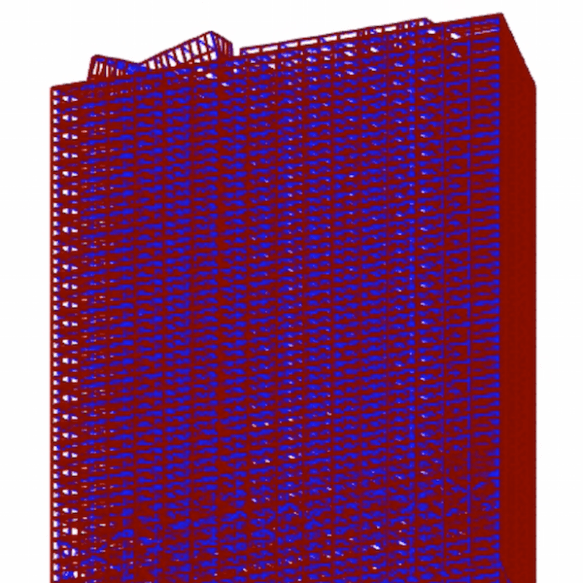
Figure 1 Finite element model of WTC 7 in SAP2000.
By Lead Researcher: J. Leroy Hulsey, Project Team: Feng Xiao (Associate Professor, Nanjing University of Science and Technology), Zhili Quan (Bridge Engineer, South Carolina Department of Transportation)
Source: Institute of Norther Engineering
This report presents the findings and conclusions of a four-year study of the collapse of World Trade Center Building 7 (WTC 7) — a 47-story building that suffered a total collapse at 5:20 PM on September 11, 2001, following the horrible events of that morning. This study was conducted by a three-person team of researchers at the University of Alaska Fairbanks (UAF) Department of Civil and Environmental Engineering with funding provided by Architects & Engineers for 9/11 Truth, Inc., a 501(c)(3) nonprofit organization whose purpose is to conduct research and educate the public about the World Trade Center building collapses on 9/11.
According to the National Institute of Standards and Technology (NIST) — an agency of the U.S. Department of Commerce that investigated the three building failures on 9/11 — the collapse of WTC 7 was the first known instance of the total collapse of a tall building primarily due to fires. However, many independent researchers have studied the collapse of WTC 7 and assembled a body of evidence that raises questions about the validity of NIST’s conclusions.
The objective of this study, therefore, was threefold: (1) Examine the structural response of WTC 7 to fire loads that may have occurred on September 11, 2001; (2) Rule out scenarios that could not have caused the observed collapse; and (3) Identify types of failures and their locations that may have caused the total collapse to occur as observed.
The UAF research team utilized three approaches for examining the structural response of WTC 7 to the conditions that may have occurred on September 11, 2001. First, we simulated the local structural response to fire loading that may have occurred below Floor 13, where most of the fires in WTC 7 are reported to have occurred. Second, we supplemented our own simulation by examining the collapse initiation hypothesis developed by NIST. We also reviewed the collapse initiation hypotheses advanced by private engineering firms whose studies were commissioned as part of litigation related to the collapse of WTC 7. Third, we simulated a number of scenarios within the overall structural system in order to determine what types of local failures and their locations may have caused the total collapse to occur as observed.
Fire Did Not Cause the Collapse of WTC 7
The principal conclusion of our study is that fire did not cause the collapse of WTC 7 on 9/11, contrary to the conclusions of NIST and private engineering firms that studied the collapse.
This conclusion is based upon a number of findings from our different analyses. Together, they show that fires could not have caused weakening or displacement of structural members capable of initiating any of the hypothetical local failures alleged to have triggered the total collapse of the building, nor could any local failures, even if they had occurred, have triggered a sequence of failures that would have resulted in the observed total collapse.
Near-Simultaneous Failure of Every Column Explains the Collapse
The secondary conclusion of our study is that the collapse of WTC 7 was a global failure involving the near-simultaneous failure of every column in the building.
This conclusion is based primarily upon the finding that the simultaneous failure of all core columns over 8 stories followed 1.3 seconds later by the simultaneous failure of all exterior columns over 8 stories produces almost exactly the behavior observed in videos of the collapse, whereas no other sequence of failures that we simulated produced the observed behavior. We cannot completely rule out the possibility that an alternative scenario may have caused the observed collapse; however, the near-simultaneous failure of every column is the only scenario we identified that was capable of producing the observed behavior.
Key Findings Upon Which the UAF Team’s Conclusions Are Based
Approach 1 Findings
•During our nonlinear connection study (Section 2.1.3.2), we discovered that NIST over-estimated the rigidity of the outside frame by not modeling its connections, essentially treating the exterior steel framing as thermally fixed, which caused all thermally-induced floor expansion to move away from the exterior. The exterior steel framing was actually flexible, while the stiffest area resistant to thermal movements, i.e., the point of zero thermal movement, was near the elevator shafts.
•Therefore, during our analysis of WTC 7’s response to fire loading (Section 2.6), we found the overall thermal movements at the A2001 base plate support near Column 79 were not sufficient to displace girder A2001 to the point that it walked off its seat (the initiating failure alleged by NIST). Whereas NIST asserted that the differential westward displacement of girder A2001 relative to Column 79 was 5.5 inches and later revised its calculation to 6.25 inches, we found that the westward displacement of girder A2001 relative to Column 79 would have been less than 1 inch under the fire conditions reported by NIST.
Approach 2 Findings
Under our second approach, we used a solid element model to evaluate the validity of NIST’s collapse initiation hypothesis, introducing a number of assumptions made by NIST that we considered to be invalid or, at best, questionable (Section 3.1). These assumptions included assuming the east exterior wall to be rigid and thermally fixed, assuming shear studs on several beams were broken due to differential thermal movement, assuming no shear studs were installed on girder A2001, and assuming that the bolts fastening girder A2001 to its seats at Columns 44 and 79 were broken (Section 3.1.1). Allowing for these overly generous assumptions, we found the following:
•When girder A2001 is heated to the temperatures assumed by NIST, it expands such that it becomes trapped behind the side plate on the western side of Column 79 as it is pushed to the west by thermally expanding floor beams. This prevents the girder’s web from traveling beyond the bearing seat, thus preventing the girder from walking off its seat (Section 3.2.1).
•NIST, by its own admission, did not include the partial height web stiffeners known to be on girder A2001. In addition to stiffening the web, these stiffeners significantly increase the bending resistance of the flange. In a subsequent analysis where we removed the side plate described in the previous analysis in order to allow for further westward travel of girder A2001, we found that the stresses in the girder flange and stiffener would not be sufficient to cause the flange to fail, thus preventing the girder from walking off its seat (Section 3.2.2).
•In a preliminary collapse initiation hypothesis, NIST posited that beam G3005 buckled because its thermal expansion was restrained by girder A2001. We found that this can happen only when the three lateral support beams S3007, G3007, and K3007 spanning from beam G3005 to the north exterior wall are not included in the model. While these short beams are observed in some of the figures in the NIST report, they are missing from the model(s) used in the thermal and structural analysis shown in the report (Section 3.2.3).
Separate from the NIST investigation, two studies of WTC 7’s collapse were commissioned by opposing sides in the lawsuit “Aegis Insurance Services, Inc. v. 7 World Trade Center Company, L.P.” Experts working in connection with engineering firms Ove Arup & Partners (Arup) and Guy Nordenson and Associates (Nordenson) were retained by the plaintiffs. The engineering firm Weidlinger Associates Inc. (Weidlinger) was retained by the defendants. After evaluating NIST’s collapse initiation hypothesis, we reviewed the Arup, Nordenson, and Weidlinger reports and found the following:
•Arup’s finite element analysis corroborates our finding that girder A2001 would become trapped behind the western side plate of Column 79. However, Arup’s analysis then goes on to contend that the five beams to the east of girder A2001 were heated enough to sag and pull the girder to the east and off of its seats. Putting aside whether this initiating mechanism is valid, we found that Nordenson incorrectly calculated the impact force of the falling girder by considering it as a point load, thus implying an infinite stiffness and no deflection. Calculating the impact force correctly, we found that it is only 34% of the 632,000 lb. force required to shear the girder bearing seat support welds at Floor 12. Therefore, the northeast corner of Floor 12 would not have collapsed if the Floor 13 girder came off its seat at Column 79, and a cascade of floor failures would not ensue.
•The Weidlinger report was prepared as a rebuttal to the Arup and Nordenson reports. Among its points of rebuttal, it corroborates our finding that the falling Floor 13 beam and girder assembly could not break through Floor 12. The Weidlinger report contends instead that Floors 9 and 10 were simultaneously heated to between 750° and 800°C in the exact same area of each floor, eventually causing those floors to fail and triggering a cascade of floor failures down to Floor 5. However, the details of the thermal analysis are not shown in the Weidlinger report, and the thermal analysis has not been made public. It is important to understand that steel structural members reaching temperatures of 750°C due to office fires can be considered extraordinary. Without any analysis provided to substantiate such temperatures, Weidlinger’s collapse initiation hypothesis must be viewed skeptically and can be assumed to have a very low probability of occurrence (Section 3.4.1).
Approach 3 Findings
Under our third approach, we simulated a number of hypothetical scenarios in order to determine what types of local failures and their locations may have caused the total collapse to occur as observed. Based upon a series of analyses, we found the following:
•Columns 79, 80, and 81 did not fail at the lower floors of the building, as asserted by NIST. In order to allow for the observed collapse of the east penthouse approximately 7 seconds prior to the collapse of the rest of the structure, these columns needed to have failed at the upper floors of the building all the way to the penthouse. Yet there were no documented fires above Floor 30. Therefore, fire did not cause the collapse of Columns 79, 80, and 81 nor the collapse of the east penthouse (Section 4.3).
•The hypothetical failure of Columns 79, 80, and 81 — the three easternmost core columns — would not trigger a horizontal progression of core column failures. Therefore, the hypotheses of NIST, Arup/Nordenson, and Weidlinger that the buckling of Column 79 could trigger a progressive collapse of the entire building are invalid, and the collapse of Columns 79, 80, and 81 high in the building was a separate and distinct event (Section 4.4). •Even if we assume the failure of Columns 79, 80, and 81 could lead to the failure of the next row of core columns, the hypothetical failure of Columns 76 to 81 would overload the exterior columns around the southeast of the building, rather than overloading the next row of core columns to the west, which would result in the building tipping to the southeast and not in a straight-down collapse (Section 4.4).
•The hypothetical simultaneous failure of all core columns (but not exterior columns) would cause the building to tip to the southwest rather than causing a straight-down collapse (Section 4.5).
•The simultaneous failure of all core columns over 8 stories followed 1.3 seconds later by the simultaneous failure of all exterior columns over 8 stories produces almost exactly the behavior observed in videos of the collapse. The collapse could have started at Floor 16 and below and produced the same behavior (Section 4.6).
It is our conclusion based upon these findings that the collapse of WTC 7 was a global failure involving the near-simultaneous failure of all columns in the building and not a progressive collapse involving the sequential failure of columns throughout the building.
Read the entire document here: http://ine.uaf.edu/media/222439/uaf_wtc7_draft_report_09-03-2019.pdf
Related videos and follow-up can be found at Architects & Engineers for 9/11 Truth: https://www.ae911truth.org/wtc7
INDIAN COUNTRY NEWS
"It is the duty of every man, as far as his ability extends, to detect and expose delusion and error"..Thomas Paine
Human in Algorithms
From the Roof Top
I See This
blog of the post capitalist transition.. Read or download the novel here + latest relevant posts
अध्ययन-अनुसन्धानको सार
 After the Crash