Mr. Lif, Ayla Nero and The Polish Ambassador


By Charles Hugh Smith
Source: Of Two Minds
And how do we pay for these spiraling out of control costs? By borrowing more, of course.
If we had to choose one “big picture” reason why the vast majority of households are losing ground, it would be: the costs of essentials are spiraling out of control. I’ve often covered the dynamics of stagnating income for the bottom 90%, and real-world inflation, i.e. a decline in purchasing power.
But neither of these dynamics fully describes the relentless upward spiral of the cost basis of our economy, that is, the cost of big-ticket essentials: housing, education and healthcare.
The costs of education are spiraling out of control, stripping households of income as an entire generation is transformed into debt-serfs by student loan debt. The soaring costs of healthcare are a core driver of higher costs in the education complex (and government in general), and to cover these higher costs, counties raise property taxes, which add additional cost burdens to households and enterprises as rents rise.
Rising rents push the cost structure of almost every enterprise and agency higher.
Then there’s the asset inflation created by central bank ZIRP (zero interest rate policy) which has inflated a second echo-bubble in housing that has pushed home ownership out of reach of many, adding demand for rental housing that has pushed rents into the stratosphere in Left and Right Coast cities.
The increasing dominance of monopolies and cartels has eliminated competition in sector after sector. Monopolies and cartels skim immense profits even as the value, quality and quantity of their products and services decline: The U.S. Only Pretends to Have Free Markets From plane tickets to cellphone bills, monopoly power costs American consumers billions of dollars a year.
Thanks to their political influence, monopolies and cartels have legalized looting, raising prices and evading anti-trust regulations because they can pay whatever it takes in our pay-to-play political system.
Let’s look at a few charts that illustrate the relentless rise in costs:

Do you reckon these two charts are connected–soaring costs and ballooning administrative payrolls?

Student loan debt is soaring above $1.5 trillion, guaranteeing profits to lenders and debt-serfdom to the students exiting with degrees that are in over-supply, i.e. possessing little scarcity value in an over-credentialed economy:

The echo housing bubbles in many locales exceed the nosebleed valuations of the previous bubble:

And how do we pay for these spiraling out of control costs? By borrowing more, of course:

Even at low rates of interest, the cost of servicing skyrocketing debt increases, leaving less net income to support additional borrowing.
What will it take to radically reduce the cost basis of our economy? A fundamental re-ordering that breaks up all the cartels and monopolies that push prices higher even as they deliver lower quality goods and services would be a good start.

By Richard Enos
Source: Collective Evolution
It’s not clear whether Facebook was truly conceived by an innocent genius with noble intent, but one fact has become abundantly clear: Facebook is now a mouthpiece and tool for the proliferation of mainstream perception. This is specifically designed to enrich the global elite and continue to disenfranchise ordinary citizens and any attempts to bring important truths to light that would threaten the elite. And, of course, Mark Zuckerberg is now a ‘junior partner’ in this global elite.
The episode of the Jimmy Dore show found in the video below, which is worth watching to get the full context of the discussion, introduces whistleblower Vikram Kumar, a former promoter of third-party videos on Facebook. Dore brings interesting insights into Facebook’s latest strategies in terms of controlling the news commentary. He explains how Facebook is proliferating the establishment’s narrative while limiting and blocking alternative voices which, of course, Facebook characterizes as ‘Fake News’. Here, Kumar discusses Mark Zuckerberg’s testimony in Congress to this effect:
Back in 2017 there was that TechCrunch report that said that Facebook was taking measures to stop the spread of ‘Fake News’ by banning certain political accounts from promoting their videos on their newsfeed. So when I heard Mark Zuckerberg in 2018 telling Congress that he would be doing the same thing, I thought, what changed between 2017 and 2018? Are they taking new measures, are they re-taking the measures? And it wasn’t until a week later that I realized that Variety Magazine reported that Facebook Watch, which is Facebook’s media platform, had reached a multi-million dollar deal with CNN, Fox News, ABC, and large media outlets.
The congressional testimony was the perfect opportunity for the political establishment, the media establishment, and the tech companies to form an alliance against small media outlets.
One of the biggest issues to remedy was the lack of viewership that traditional mainstream media was getting from young people, which is really the target market not only for advertisers but the social engineering wing of the global elite as well. Here’s how Kumar describes it:
As you know, young people, they don’t watch cable… the viewership of Fox News, CNN, and ABC are dying off, they’re getting older and older, and so what Facebook is, is access to young people, right, and so they viewed small anti-establishment media outlets such as yourself as an existential threat to their next generation of revenue.
Tech companies view media companies extremely valuably, you could go back to 1996, there was that merger between Microsoft, General Electric and NBC to create MSNBC.com. A lot of people don’t know that the ‘MS’ in MSNBC stands for Microsoft, and the reason why media companies and tech companies are so intertwined with each other is ’cause you can influence young people so much when you have the distribution network of something like Facebook, and with Facebook Watch, and their media platform, and their deal with CNN, Fox News, and ABC, they’re able to indoctrinate the next generation of young people. And so they want to take viewership away from shows like yours, and put those young people that haven’t been paying attention with cable news back into the pockets of companies like Fox News, ABC, and CNN.
Every media company wants some of that Facebook Watch dough. And so the companies that have coverage that Facebook doesn’t like are out of there, and new companies that have coverage that Facebook likes are back into the deal. And so Facebook is already taking steps to craft the political landscape in the framing that they find positively. And so you get that whole thing where Facebook shuts down over 800 political pages and accounts, and even legitimate political pages that expose things like police brutality… you’re already seeing a coordinated effort from the establishment media and tech companies to kind of craft the narrative for young people.
This is how that Variety Magazine article Kumar talked about characterizes the deal between Facebook and Mainstream Media:
After going through the fake-news wringer, Facebook is shelling out money on original news content. The strategy is partly aimed at driving up viewing on its Facebook Watch platform — but it also is supposed to demonstrate the social-media giant’s commitment to funding trustworthy journalism.
A corporate conglomerate now giving itself the authority to judge what is and isn’t trustworthy journalism. What could possibly go wrong?
The slippery slope that Facebook is trying to anchor itself to is as clear as the nose on Mark Zuckerberg’s face. He continues to want us to think about Facebook as a social media platform whose objective is still ‘to make the world more open and connected,’ yet at the same time he wants Facebook to become the prime arbiter of the ‘news that is fit to print,’ or in this case, to decide which sources of news will benefit and not benefit from Facebook’s tremendous reach. The same Variety article reinforces the idea that Facebook is trying to have things both ways, gaining the advantages of defining itself as a tech company, and not taking on the liabilities inherent in being a media company:
In the past, CEO Mark Zuckerberg has remarked that Facebook is a technology company — not a media company. Asked whether Facebook is now in fact a media company, given that it’s paying for a growing slate of content, Brown responded, “Having worked for big media companies, I don’t think Facebook is a media company. But are we responsible for the media on Facebook? Yes.”
The fact is that we have entered into somewhat uncharted territory in terms of what defines a media company since the rise of the Internet. We can only hope that we will collectively awaken to the fact that Facebook has clearly gone beyond being a platform that provides equal access to all voices and commentaries, and has given in to the temptation to control the flow and proliferation of information. As this Wired article starts off,
FACEBOOK STEADFASTLY RESISTS categorization as a traditional media company. Instead, CEO Mark Zuckerberg insists on calling the social network a technology platform—even though nearly half of all American adults get their news on Facebook. These old arguments no longer work, especially as Facebook starts making its own video content.
It is incumbent upon the awakening community to clearly grasp what is happening here and to act accordingly in terms of our future engagement with social media sites like Facebook. It is important to see how Bill Clinton’s Telecommunications Act of 1996, which allowed media cross-ownership that led to mergers between tech companies and media companies, was a seed that has already started to bear the fruit of an Orwellian dystopia, where the global elite are permitted to continue to proliferate mainstream propaganda and limit exposure to alternative views that are a threat to their agenda.

By Caitlin Johnstone
Source: CaitlinJohnstone.com
The late psychonaut/philosopher Terence McKenna once said “The cost of sanity, in this society, is a certain level of alienation,” and I think my regular readers will immediately and experientially understand exactly what he was talking about.
It’s not always easy to be on the outside of consensus reality. Our entire society, after all, has been built upon consensus–upon a shared agreement about what specific mouth sounds mean, on what money is and how it works, on how we should all behave toward each other in public spaces, and on what normal human behavior in general looks like.
We all share a learned agreement that we picked up from our culture in early childhood that it’s normal and acceptable to stand around with your hands in your pockets and babble about the weather to anyone who gets too close to you, for example, whereas it would be considered weird and disruptive to stand around slathered in Cheese Whiz shrieking the word “Poop!” But we could just as easily reverse that consensus on behavioral norms tomorrow, and as long as we all agreed to it we could do it without missing a beat.
In exactly the same way, there exists a general consensus about what’s going on in our world at the moment. There’s a general consensus that we live in the kind of society we were taught about in school: a free and democratic nation which maybe did some not so great things in the past, but is now a supremely virtuous beacon of light on this earth that kicked Hitler’s ass and then surfed into the present day on a wave of truth and sensible fiscal policy. There’s a general consensus that the news reporters on our screens paint us a more or less accurate picture of world affairs, that there are a lot of Bad Guys in our world with whom the Good Guys in our government are fighting, and that most of our nation’s problems are caused by the people in the other political party.
This consensus is grounded in delusion. It is insanity.
In reality, of course, we live in a world where our understanding of the world is constantly being deceitfully manipulated by oligarchic media propaganda and the utterances of oligarch-owned politicians. Where elections are mostly just a live action role-playing game which allows the rabble to pretend that they have some degree of influence over the things that their government does. Where our government routinely forms alliances with the worst Bad Guys on the planet while manufacturing consent to topple governments whose downfall would be utterly disastrous. Where our nation’s problems have almost nothing to do with half its population disagreeing with our personal ideology, and practically everything to do with the loose international alliance of plutocrats and government agencies who actually run things behind the facade of the comings and goings of official elected governments.
Sanity means seeing this as it is, rather than subscribing to the mass delusion of the consensus worldview. Which, as you probably already know, can make it difficult to relate to others in some ways. Conversations about politics often either get heated very rapidly when you challenge a tightly-held orthodoxy or dead-end in awkwardness. Friendships can end. Family relationships can be ruined. Collective narratives about you can be woven and circulated within your social circle which have nothing to do with how you actually see things.
And that’s just if you talk about your worldview. If you keep your views to yourself, as many do, that’s just another kind of alienation. It’s to stand outside of public political discourse completely, unable to participate out of fear of the backlash you’d receive from your friends, loved ones and acquaintances if you started talking about Trump as a symptom rather than the disease, or said that Corbyn is being targeted by a transparently bogus smear campaign, or said that Russia’s interventions in world affairs are clearly dwarfed by America’s by orders of magnitude. The specific heresies will vary depending upon the social circle, but the inability to voice them necessarily comes with the same sense of alienation.
But the alternative to that sense of alienation is to live a lie. It’s to climb back inside the distorted funhouse-mirror reality tunnel of the establishment narrative control matrix and plug yourself back into the same delusions that everyone else is living. Most of us couldn’t even do that if we wanted to. Even if we could the intense mental gymnastics we’d have to perform just to avoid the discomfort of cognitive dissonance would make it not worth the effort.
We close ourselves off from a full sense of participation in our society when we depart from the consensus worldview, but in closing that door we open so many more. Because, as it turns out, all that effort that people pour into staying on the same wavelength as everyone else closes them off to a vast spectrum of potential human experience. The allure of the mass delusion is that you need to devote yourself to being plugged into it in order to achieve what the mass delusion defines as “success”, but in so doing you lose the ability to leap down psychological and experiential rabbit holes of consciousness that those still jacked into the matrix can’t even imagine. And in so doing you open up the possibility for an immensely more fulfilling and enjoyable life that has really deeply explored the more intimate questions about what it means to be a human being on this planet.
Jiddu Krishnamurti once said, “It is no measure of health to be well-adjusted to a profoundly sick society.” And a profoundly sick society is indeed what we have here. The alienation which we experience is an alienation from something that isn’t worth belonging to anyway.
I began this essay with a quote from one of the celebrated thought leaders of the psychedelic movement, and I think the question of what we can do to cope with the alienation McKenna spoke of is best answered by ending with a quote from another such leader, Timothy Leary:
“Admit it. You aren’t like them. You’re not even close. You may occasionally dress yourself up as one of them, watch the same mindless television shows as they do, maybe even eat the same fast food sometimes. But it seems that the more you try to fit in, the more you feel like an outsider, watching the ‘normal people’ as they go about their automatic existences. For every time you say club passwords like ‘Have a nice day’ and ‘Weather’s awful today, eh?’, you yearn inside to say forbidden things like ‘Tell me something that makes you cry’ or ‘What do you think deja vu is for?’. Face it, you even want to talk to that girl in the elevator. But what if that girl in the elevator (and the balding man who walks past your cubicle at work) are thinking the same thing? Who knows what you might learn from taking a chance on conversation with a stranger? Everyone carries a piece of the puzzle. Nobody comes into your life by mere coincidence. Trust your instincts. Do the unexpected. Find the others.”
By Tom Keiser
Source: WFMU
“It makes no sense. I mean, how can people just vanish off the face of the Earth in this day and age?”
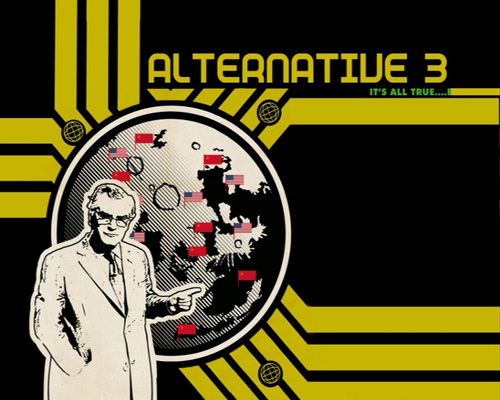
In 1977, a conspiracy was hatched involving writers, actors, politicians, scientists, and Brian Eno. The British television series Science Report was about to be cancelled, and its scheduled April 1 finale gave the creators an opportunity to prank those who believed everything they saw on television, and those so skeptical of everything as to see conspiracies all over the place. The resulting program, Alternative 3, is a classic in fake news programming; The War Of The Worlds by way of the BBC’s 1957 spaghetti harvest hoax.
Alternative 3 is presented as an investigation, with an aborted episode of Science Report as the frame. Twenty-four people interviewed for a Science Report episode on Britain’s “brain drain” have gone missing, including three profiled before the introduction. Over the next hour, further pieces of the puzzle are put into place, connecting the disappearances to the death of a prestigious astronomer, the drunk ravings of a former astronaut, and the theories of an early proponent of the climate change hypothesis, Dr. Carl Gerstein. Contemporary news events, such as the Tangshan earthquake and United Kingdom heatwave and drought in 1976, and the North American mega-blizzard of early 1977, hint at a more destructive event than even the producers of The Day After Tomorrow could have imagined.
Gerstein finally unveils Alternative 3, one of a trio of ways for the human race to survive what he sees as an irreversible and cataclysmic return to the ice age. Compared to the “drastic reduction of the human population” (Alternative 1), and a plan to build underground bases to ride the catastrophe out (Alternative 2), Alternative 3 sounds just as good or bad. But since Alternative 3 is the name of the program, one can guess which is being implemented, and when it’s revealed, it’s a real doozy.
The program’s host, Tim Brinton, was a respected presenter and eventually became a Conservative MP, lending credibility to Alternative 3. Director Christopher Miles worked on feature films and television before and after the program’s release, and writer David Ambrose would go on to write screenplays for The Final Countdown and D.A.R.Y.L., among other films.
Labor issues delayed Alternative 3’s release until June 20, 1977, removing its April Fool’s context entirely — aside from a title card at the end placing the episode at it’s intended release date. The episode’s production values are very similar to British TV documentaries past and present, although it almost resembles self-parody at spots. The segues and dramatizations anticipate Look Around You by 25 years.
The otherworldly tone of the space sequences can be chalked up to Brian Eno’s score, later released under the track “Alternative 3” in his 1978 album Music For Films. Eno would return to lunar exploration later in his career. His 1983 album Apollo: Atmospheres and Soundtracks was later reworked as the soundtrack to the 1989 Apollo program documentary For All Mankind.
There are a few recognizable faces in Alternative 3, at least if you really know your stuff. Shane Rimmer, a self-proclaimed “rent-a-Yank” for British films and the voice of Scott Tracy on the classic TV show Thunderbirds played astronaut Bob Grodin. Richard Marner, who played Dr. Gerstein, became better known in the UK for the show ‘Allo ‘Allo, where he played an inept Nazi colonel. And Norman Chancer, who played science reporter Charles Welbourne, may be best known for his role as Moritz, the unorthodox psychologist in Local Hero.
To this day, many people think Alternative 3 to be disinformation. Viewers at the time believed the disinfo to come from the U.S, British, and Soviet governments, perhaps too busy calling Anglia TV with their outrage to see the cast listing in the credits. A novel based on the TV special also led credence to their worries. The prevaling line of thought these days is that the special was indeed a hoax, but based on factual information. Therefore, Alternative 3 was made to make a real Alternative 3 situation look like such a science fiction fantasy as to remove it from the public’s consciousness. Others still even believe that not only is Alternative 3 real, but is connected to our contact with extraterrestrials. But even a skeptic can love Alternative 3 as an entertaining hour of programming, and it also works as a great counterpoint to 1978’s Capricorn One, about a botched Mars landing being faked to prevent NASA from going under.
No matter what you take from Alternative 3, or what you believe about it, this film will stay with you, just like the sight Bob Grodin saw on the dark side of the moon.
Related Article:
The Truth About Alternative 3 (An archived newsletter excerpt featuring a letter from Leslie Watkins, author of the novelization of the screenplay available here: https://archive.org/details/Alternative3-33rdAnniversaryEdition )

By Robert Fantina
Source: CounterPunch
“Those who cannot remember the past are condemned to repeat it.” So said George Santayana.
It is difficult today to look at many, many situations in the world and not see some of the worst events in history being repeated, especially as they relate to racism and genocide. Has the world forgotten Nazi atrocities against Jews, Gypsies, intellectuals and others? Do we not remember the horrific U.S. bombing of two Japanese cities? Are Churchill’s colonial atrocities no longer worth considering?
We will review some of the most egregious events unfolding in front of us today.
Israel: This racist, apartheid state, which, for over 70 years has brutally oppressed the Palestinian people, this year declared itself the nation-state of the Jewish people, and only the Jewish people. Yet 25% of people who live within the borders of the Zionist entity are not Jewish. And despite marginalizing fully one-quarter of its residents, and relegating them to second-class citizen status, government spokespeople have the nerve to proclaim Israel as a democracy.
And what international outrage does this bring? Despite flagrant and constant violations of international law, not to mention common human decency, most of the countries of the world either ignore it all, or issue gentle rebukes, at best. And the world’s media seldom reports on it.
Myanmar: For several years now, the repression and expulsion of the Rohingya people has been ongoing government policy. A United Nations study of August 2018 found evidence of widespread violations of human rights. As of that date, nearly three-quarters of a million Rohingya people have had to flee their homeland due to the brutal persecution they have experienced. The U.N. study stated that military abuses of the Rohingyas “undoubtedly amount to the gravest crimes under international law.” Yet, like Israel’s brutal oppression of the Palestinians, this gets little press in North America.
India: Earlier this year, the government of India revoked Article 370 in the constitution that allowed occupied Kashmir some limited autonomy. Since that time, tens of thousands of Indian troops have stormed into Kashmir, communications with the outside world have been cut, and news media personal are forbidden from entering. The death toll from this recent repression is unknown. Government officials have publicly announced plans to colonize Kashmir using the same model of land confiscation and illegal settlement construction that Israel has used for decades against Palestine. Again, one listens in vain for international opposition to these crimes against humanity.
Additionally, India has now passed a law easing the path for citizenship for many refugees, but making immigration by Muslims more difficult. This has caused widespread protest demonstration throughout India, which are being met with police violence.
Saudi Arabia: That nation’s brutal onslaught against the people of Yemen continues, with the Yemeni death toll in the thousands and constantly rising. A bill passed by the U.S. Congress to prevent the U.S. from selling more weaponry to Saudi Arabia (the largest buyer of weapons from the U.S.) for use in Yemen was vetoed by President Donald Trump, thus enabling the continued slaughter of the Yemenis.
United States: Undergirding all this is the United States. That nation provides huge amounts of financial support to apartheid Israel, as well as protecting it from the legitimate consequences of its action on the international stage. Government spokespeople talk of ‘monitoring’ the situation in Myanmar, and have been mainly silent about India.
But the U.S. remains busy: its decades-long sanctions against Cuba remain. Following some easing of restrictions during the administration of President Barack Obama, Trump has re-issued them all. His sanctions against Iran, in violation of the Joint Comprehensive Plan of Action (JCPOA) and international law are causing great hardship for the people there. The U.S. supports the overthrow of the governments of Venezuela, issuing cruel sanctions against that country, and Syria, going so far as to actually arm, equip and train anti-government terrorist groups in the country, where, due largely to U.S. interference, hundreds of thousands of people have died, and hundreds of thousands more have been injured and left homeless. U.S. brutality toward the Yemenis has been mentioned above. The U.S. was involved in the recent overthrow of the Bolivian government.
Yet as recently as this week, U.S. Secretary of State Mike Pompeo proclaimed that the U.S. supports the right of people everywhere to self-determination. He said this when announcing additional sanctions against Iran, the irony of it certainly being lost on him and Trump. Self-determination is all well and good in the eyes of the U.S. government, as long as certain conditions are met: the form of government the people select must not be socialist; it must be a government that will do the U.S.’s bidding; it must not be a government that thinks its country’s natural resources are its own; it must not question or oppose Israel in any way, and it must not put its people before U.S. corporate profits. It must, in all ways and at all times, be willing to do its part to satisfy the U.S.’s geo-political goals.
As we look at the results of forgetting, or not learning from, history, we should ask an important question: When similar behaviors, perpetrated by German, Italian and English leaders happened before, what was the result? Additional questions arise: Did Germany succeed in annexing its neighbors? Were Italy and England successful in achieving their political goals? No, the result of such behaviors was a war whose devastation exceeded anything that can be imagined. And it brought the United States into its role as a super-power, which has been detrimental for much of the world.
The U.S. has never been interested in human rights or international law. Those in power in that country have only coveted riches, and have been, and are, willing to obtain them in any way possible, regardless of how much blood must flow. And that blood can be of innocent men, women and children in a far-off country, or of its own citizens who it sends to war. It will attempt, however futilely, to order the world to its liking. And as people protest, all possible efforts will be made to crush them.
One thing the U.S. and many other nations have failed to learn is that people will only be able to tolerate the thwarting of their legitimate aspirations for a limited amount of time: they will not allow it to go on forever. Working to genuinely assist them will make more friends and allies, and ultimately be far more beneficial for the world than opposing them and oppressing them ever will.
Until the U.S. and other powerful nations learn this vital lesson, the suffering they cause will be unending.

Credit: JOEL PETT
By Gunnar Olson
Source: Land Destroyer
The collapse of an entire nation is as spectacular as it is rare. For a nation to simply cease to exist it must suffer such absolute defeat across the entire spectrum of what constitutes a nation; economically, militarily, culturally, socially and politically.
What is much more common is a transition from existing, prevailing socioeconomic, political and military orders to new ones driven by new, emerging special interests. It can happen quickly and violently, or take place as a long-term process with ups and downs and both constructive and destructive processes intertwining.
For the United States, a massive nation with the third largest population on the planet, the largest military and still currently the largest economy, for it to suffer such full-spectrum defeat is impossible.
What is not impossible is for the small handful of special interests currently directing US policy foreign and domestic, to find itself displaced by a new order consisting of entirely different kinds of special interests and, hopefully, special interests that better reflect the best interests of the United States as a whole and function more sustainably among the nations of the world rather than hovering above them.
It is a process that is already ongoing.
America’s Prevailing Order is Fading
The current special interests driving US foreign and domestic policy are centered around Wall Street and Washington and represent an increasingly unrealistic, unsustainable, archaic network based on traditional banking, energy and manufacturing monopolies.
Many of the tools used by these special interests to maintain and expand their power and influence including mass media, extensive lobbying, networks dedicated to political subversion abroad and political distractions at home find themselves increasingly ineffective as both the American people and nations around the globe become increasingly familiar with them and as they begin developing effective countermeasures.
While US special interests dedicate a seemingly immense amount of time countering “Russian” or “Chinese” “propaganda,” it is primarily alternative media from the United States and its partner nations that have done the most to expose and diminish the unwarranted influence wielded from Wall Street and Washington. Wikileaks is a prime example of this.
As America’s elite and their networks weaken, alternatives continue to grow stronger.
An unsustainable socioeconomic and political model, coupled with equally unsustainable military campaigns abroad along with a political and media strategy that is no longer even remotely convincing even to casual observers demarks what is an irreversible decline of America’s current, prevailing order.
America’s Elite Face Challenges from Within as Well as From Abroad
The topic of Chinese corporations out-competing long-established US monopolies has become an increasingly common topic across global media. It is indeed this process that has precipitated the seemingly pointless and futile US-led trade war against China, a futile exercise that seems to only highlight the decline of America’s established elite rather than address it.
Corporations like Huawei, despite facing serious setbacks owed to US sanctions and efforts to undermine them, still move forward, while their US competitors continue to struggle. This is because despite setbacks, Huawei is built upon a solid foundation of business and economic fundamentals, while its American counterparts, despite their initial advantages owed to a lack of competition, have neglected and continue to neglect such fundamentals.
But Chinese corporations aren’t the only challengers America’s established elite face.
Within the US itself some of the most innovative and disruptive companies in the world are cropping up, challenging not only foreign competition but also long-established monopolies based in the US.
Electric vehicle manufacturer Tesla is a perfect example of this. Its breakneck pace of innovation, high-profile successes and the disruptive impact it is having on traditional car manufacturing is setting back the American car industry first and foremost. It also poses a serious threat to the petroleum-centric energy model the US has adopted and propagated globally for over a century.
American car manufacturing monopolies have spent decades developing a model of planned obsolescence and marketing gimmicks as a stand-in for genuine consumer value and innovation. The industry has become a means of simply making as much money as possible and to increase profits each year, with “making cars” merely the means through which this money and the influence it buys is being accumulated.
Tesla has for years now been growing both in terms of business and in terms of sociopolitical influence. US car manufacturing monopolies have attempted to ape the most superficial aspects of Tesla’s appeal, but have entirely failed to examine or replicate the substance that drives the new company’s success.
Just as the US elite have attempted to use what could be described as “dirty tricks” rather than direct competition to deal with competitors like Huawei abroad, similar “dirty tricks” have been employed against disruptive companies within the US itself like Tesla. Attempts by faux-unions to complicate Tesla’s US-based factories are one example of this.
US-based aerospace manufacturer SpaceX is another example of an American-bred competitor directly challenging (and threatening) long-established US monopolies, in this case aerospace monopolies like Lockheed Martin, Boeing and Northrop Grumman.
SpaceX is not only driving aerospace innovation forward at breakneck speeds, it is driving down the overall cost of access to space at the same time. It is doing this at such impressive rates that established aerospace monopolies like Lockheed, Boeing and Northrop, even with their immense lobbying networks, are unable to dissuade SpaceX customers (including the US government itself) from purchasing rides on its rockets.
Bloated monopolies who have become overly reliant on maintaining profits through lobbying and political games have little means to overhaul their massive organizations in the face of real competition as it emerges. Because of this, the prevailing order driving US policy faces an insurmountable obstacle that already appears to have resulted in terminal decline and displacement.
Those doing the displacing stand to assume the position at the levers of American power and influence, with an opportunity to set an entirely new course into the future that will have a fundamental impact on both the American nation and its people, and the nations of the world it will interact with.
America’s New Order May Seek Genuine Competition and Collaboration
Tesla and SpaceX are prominent examples, but by no means the only examples of the ongoing transition that is increasingly evident within America. There are emerging innovations and companies threatening virtually every area America’s current elite dominate. From the alternative media targeting the deeply rooted corporate media of America, to a growing movement of local organic farmers chipping away at America’s massive agricultural monopolies, there are already many tangible examples of a transition taking place; a positive transition that those interested in truly addressing the negative aspects of America’s current role globally can invest in or contribute toward.
In what is perhaps a hopeful sign of the new America that might emerge as this process continues forward is the fact that emerging disruptors like Tesla are not afraid of collaborating with other nations, seeking to simply do business rather than construct a global spanning network aimed at dominating others. Tesla’s massive Gigafactory going into operation in Shanghai, China takes place as the US attempts to sever China’s access to the economic benefits of doing business with the US for purely political and hegemonic purposes.
Despite the apparent hostilities between the US and nations like Russia and China, the consensus in nations targeted by America’s current prevailing order is one of simply wanting to do business on equal terms. Whatever hostility may exist is reserved not for America as a nation or as a people, but toward the handful of special interests obstructing constructive competition and collaboration between these nations and the US.
In the near to intermediate future, this process will continue to resemble a bitter struggle as US special interests attempt to maintain their grip on power, fighting against inevitable decline and displacement, and against competitors both abroad and within the US itself.
Beyond that, there is a hopeful future where the US finds itself a constructive member of a multipolar world, constructively competing against and collaborating with nations rather than attempting to assert itself over them.
Because of this, it is important for nations and peoples to refrain from unnecessary, broad hostilities and to instead patiently weather current efforts emanating from Wall Street and Washington. It is important to establish ties and relations with US interests genuinely interested in true competition and collaboration and who represent America’s future, and to distinguish them from deeply rooted US interests that represent America’s abusive past and and are responsible for America’s current decline.
The foreign policies of Moscow, Beijing and even of many emerging and developing nations may seem overly passive or appeasing, but around the capitals of the world many are aware of the transition taking place in America and are attempting to position themselves advantageously for the fall of the American Empire so they can do business with those who assume the levers of power in America once it does.
By John W. Whitehead
Source: The Rutherford Institute
“Once upon a midnight clear, there was a child’s cry, a blazing star hung over a stable, and wise men came with birthday gifts. We haven’t forgotten that night down the centuries. We celebrate it with stars on Christmas trees, with the sound of bells, and with gifts… We forget nobody, adult or child. All the stockings are filled, all that is, except one. And we have even forgotten to hang it up. The stocking for the child born in a manger. It’s his birthday we’re celebrating. Don’t let us ever forget that. Let us ask ourselves what He would wish for most. And then, let each put in his share, loving kindness, warm hearts, and a stretched out hand of tolerance. All the shining gifts that make peace on earth.”—The Bishop’s Wife (1947)
The Christmas story of a baby born in a manger is a familiar one.
The Roman Empire, a police state in its own right, had ordered that a census be conducted. Joseph and his pregnant wife Mary traveled to the little town of Bethlehem so that they could be counted. There being no room for the couple at any of the inns, they stayed in a stable (a barn), where Mary gave birth to a baby boy, Jesus. Warned that the government planned to kill the baby, Jesus’ family fled with him to Egypt until it was safe to return to their native land.
Yet what if Jesus had been born 2,000 years later?
What if, instead of being born into the Roman police state, Jesus had been born at this moment in time? What kind of reception would Jesus and his family be given? Would we recognize the Christ child’s humanity, let alone his divinity? Would we treat him any differently than he was treated by the Roman Empire? If his family were forced to flee violence in their native country and sought refuge and asylum within our borders, what sanctuary would we offer them?
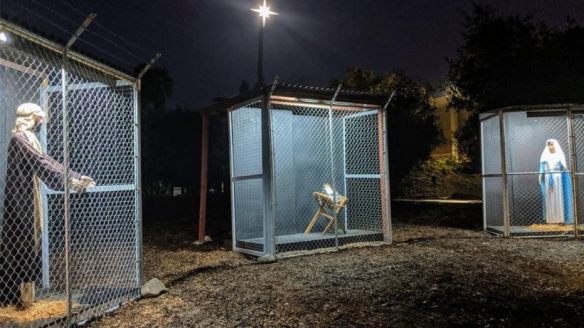
A singular number of churches across the country are asking those very questions, and their conclusions are being depicted with unnerving accuracy by nativity scenes in which Jesus and his family are separated, segregated and caged in individual chain-link pens, topped by barbed wire fencing.
These nativity scenes are a pointed attempt to remind the modern world that the narrative about the birth of Jesus is one that speaks on multiple fronts to a world that has allowed the life, teachings and crucifixion of Jesus to be drowned out by partisan politics, secularism, materialism and war.
The modern-day church has largely shied away from applying Jesus’ teachings to modern problems such as war, poverty, immigration, etc., but thankfully there have been individuals throughout history who ask themselves and the world: what would Jesus do?
What would Jesus—the baby born in Bethlehem who grew into an itinerant preacher and revolutionary activist, who not only died challenging the police state of his day (namely, the Roman Empire) but spent his adult life speaking truth to power, challenging the status quo of his day, and pushing back against the abuses of the Roman Empire—do?
Dietrich Bonhoeffer asked himself what Jesus would have done about the horrors perpetrated by Hitler and his assassins. The answer: Bonhoeffer risked his life to undermine the tyranny at the heart of Nazi Germany.
Aleksandr Solzhenitsyn asked himself what Jesus would have done about the soul-destroying gulags and labor camps of the Soviet Union. The answer: Solzhenitsyn found his voice and used it to speak out about government oppression and brutality.
Martin Luther King Jr. asked himself what Jesus would have done about America’s warmongering. The answer: declaring “my conscience leaves me no other choice,” King risked widespread condemnation when he publicly opposed the Vietnam War on moral and economic grounds.
Even now, despite the popularity of the phrase “What Would Jesus Do?” (WWJD) in Christian circles, there remains a disconnect in the modern church between the teachings of Christ and the suffering of what Jesus in Matthew 25 refers to as the “least of these.”
As the parable states:
“Then the King will say to those on his right, ‘Come, you who are blessed by my Father; take your inheritance, the kingdom prepared for you since the creation of the world. For I was hungry and you gave me something to eat, I was thirsty and you gave me something to drink, I was a stranger and you invited me in, I needed clothes and you clothed me, I was sick and you looked after me, I was in prison and you came to visit me.’ Then the righteous will answer him, ‘Lord, when did we see you hungry and feed you, or thirsty and give you something to drink? When did we see you a stranger and invite you in, or needing clothes and clothe you? When did we see you sick or in prison and go to visit you?’ The King will reply, ‘Truly I tell you, whatever you did for one of the least of these brothers and sisters of mine, you did for me.’ Then he will say to those on his left, ‘Depart from me, you who are cursed, into the eternal fire prepared for the devil and his angels. For I was hungry and you gave me nothing to eat, I was thirsty and you gave me nothing to drink, I was a stranger and you did not invite me in, I needed clothes and you did not clothe me, I was sick and in prison and you did not look after me.’ They also will answer, ‘Lord, when did we see you hungry or thirsty or a stranger or needing clothes or sick or in prison, and did not help you?’ He will reply, ‘Truly I tell you, whatever you did not do for one of the least of these, you did not do for me.’”
This is not a theological gray area: Jesus was unequivocal about his views on many things, not the least of which was charity, compassion, war, tyranny and love.
After all, Jesus—the revered preacher, teacher, radical and prophet—was born into a police state not unlike the growing menace of the American police state. When he grew up, he had powerful, profound things to say, things that would change how we view people, alter government policies and change the world. “Blessed are the merciful,” “Blessed are the peacemakers,” and “Love your enemies” are just a few examples of his most profound and revolutionary teachings.
When confronted by those in authority, Jesus did not shy away from speaking truth to power. Indeed, his teachings undermined the political and religious establishment of his day. It cost him his life. He was eventually crucified as a warning to others not to challenge the powers-that-be.
Can you imagine what Jesus’ life would have been like if, instead of being born into the Roman police state, he had been born and raised in the American police state?
Consider the following if you will.
Had Jesus been born in the era of the America police state, rather than traveling to Bethlehem for a census, Jesus’ parents would have been mailed a 28-page American Community Survey, a mandatory government questionnaire documenting their habits, household inhabitants, work schedule, how many toilets are in your home, etc. The penalty for not responding to this invasive survey can go as high as $5,000.
Instead of being born in a manger, Jesus might have been born at home. Rather than wise men and shepherds bringing gifts, however, the baby’s parents might have been forced to ward off visits from state social workers intent on prosecuting them for the home birth. One couple in Washington had all three of their children removed after social services objected to the two youngest being birthed in an unassisted home delivery.
Had Jesus been born in a hospital, his blood and DNA would have been taken without his parents’ knowledge or consent and entered into a government biobank. While most states require newborn screening, a growing number are holding onto that genetic material long-term for research, analysis and purposes yet to be disclosed.
Then again, had Jesus’ parents been undocumented immigrants, they and the newborn baby might have been shuffled to a profit-driven, private prison for illegals where they first would have been separated from each other, the children detained in make-shift cages, and the parents eventually turned into cheap, forced laborers for corporations such as Starbucks, Microsoft, Walmart, and Victoria’s Secret. There’s quite a lot of money to be made from imprisoning immigrants, especially when taxpayers are footing the bill.
From the time he was old enough to attend school, Jesus would have been drilled in lessons of compliance and obedience to government authorities, while learning little about his own rights. Had he been daring enough to speak out against injustice while still in school, he might have found himself tasered or beaten by a school resource officer, or at the very least suspended under a school zero tolerance policy that punishes minor infractions as harshly as more serious offenses.
Had Jesus disappeared for a few hours let alone days as a 12-year-old, his parents would have been handcuffed, arrested and jailed for parental negligence. Parents across the country have been arrested for far less “offenses” such as allowing their children to walk to the park unaccompanied and play in their front yard alone.
Rather than disappearing from the history books from his early teenaged years to adulthood, Jesus’ movements and personal data—including his biometrics—would have been documented, tracked, monitored and filed by governmental agencies and corporations such as Google and Microsoft. Incredibly, 95 percent of school districts share their student records with outside companies that are contracted to manage data, which they then use to market products to us.
From the moment Jesus made contact with an “extremist” such as John the Baptist, he would have been flagged for surveillance because of his association with a prominent activist, peaceful or otherwise. Since 9/11, the FBI has actively carried out surveillance and intelligence-gathering operations on a broad range of activist groups, from animal rights groups to poverty relief, anti-war groups and other such “extremist” organizations.
Jesus’ anti-government views would certainly have resulted in him being labeled a domestic extremist. Law enforcement agencies are being trained to recognize signs of anti-government extremism during interactions with potential extremists who share a “belief in the approaching collapse of government and the economy.”
While traveling from community to community, Jesus might have been reported to government officials as “suspicious” under the Department of Homeland Security’s “See Something, Say Something” programs. Many states, including New York, are providing individuals with phone apps that allow them to take photos of suspicious activity and report them to their state Intelligence Center, where they are reviewed and forwarded to law-enforcement agencies.
Rather than being permitted to live as an itinerant preacher, Jesus might have found himself threatened with arrest for daring to live off the grid or sleeping outside. In fact, the number of cities that have resorted to criminalizing homelessness by enacting bans on camping, sleeping in vehicles, loitering and begging in public has doubled.
Viewed by the government as a dissident and a potential threat to its power, Jesus might have had government spies planted among his followers to monitor his activities, report on his movements, and entrap him into breaking the law. Such Judases today—called informants—often receive hefty paychecks from the government for their treachery.
Had Jesus used the internet to spread his radical message of peace and love, he might have found his blog posts infiltrated by government spies attempting to undermine his integrity, discredit him or plant incriminating information online about him. At the very least, he would have had his website hacked and his email monitored.
Had Jesus attempted to feed large crowds of people, he would have been threatened with arrest for violating various ordinances prohibiting the distribution of food without a permit. Florida officials arrested a 90-year-old man for feeding the homeless on a public beach.
Had Jesus spoken publicly about his 40 days in the desert and his conversations with the devil, he might have been labeled mentally ill and detained in a psych ward against his will for a mandatory involuntary psychiatric hold with no access to family or friends. One Virginia man was arrested, strip searched, handcuffed to a table, diagnosed as having “mental health issues,” and locked up for five days in a mental health facility against his will apparently because of his slurred speech and unsteady gait.
Without a doubt, had Jesus attempted to overturn tables in a Jewish temple and rage against the materialism of religious institutions, he would have been charged with a hate crime. Currently, 45 states and the federal government have hate crime laws on the books.
Had anyone reported Jesus to the police as being potentially dangerous, he might have found himself confronted—and killed—by police officers for whom any perceived act of non-compliance (a twitch, a question, a frown) can result in them shooting first and asking questions later.
Rather than having armed guards capture Jesus in a public place, government officials would have ordered that a SWAT team carry out a raid on Jesus and his followers, complete with flash-bang grenades and military equipment. There are upwards of 80,000 such SWAT team raids carried out every year, many on unsuspecting Americans who have no defense against such government invaders, even when such raids are done in error.
Instead of being detained by Roman guards, Jesus might have been made to “disappear” into a secret government detention center where he would have been interrogated, tortured and subjected to all manner of abuses. Chicago police have “disappeared” more than 7,000 people into a secret, off-the-books interrogation warehouse at Homan Square.
Charged with treason and labeled a domestic terrorist, Jesus might have been sentenced to a life-term in a private prison where he would have been forced to provide slave labor for corporations or put to death by way of the electric chair or a lethal mixture of drugs.
Indeed, as I show in my book Battlefield America: The War on the American People, given the nature of government then and now, it is painfully evident that whether Jesus had been born in our modern age or his own, he still would have died at the hands of a police state.
Thus, as we draw near to Christmas with its celebrations and gift-giving, we would do well to remember that what happened on that starry night in Bethlehem is only part of the story. That baby in the manger grew up to be a man who did not turn away from evil but instead spoke out against it, and we must do no less.
INDIAN COUNTRY NEWS
"It is the duty of every man, as far as his ability extends, to detect and expose delusion and error"..Thomas Paine
Human in Algorithms
From the Roof Top
I See This
blog of the post capitalist transition.. Read or download the novel here + latest relevant posts
अध्ययन-अनुसन्धानको सार
 After the Crash