Written in History: The Death of America’s Hyper-Power Fantasy

By Martin Sieff

Source: Strategic Culture Foundation

In 1987, Paul Kennedy, a British professor of history at Yale University, unleashed a political and intellectual firestorm with the publication of his great (677-page) book, “The Rise and Fall of the Great Powers.” Kennedy produced a magisterial overview of the competition for global power over the past 500 years from 1500 AD to the present.

Kennedy proposed the thesis that any power that achieved, imagined it had achieved or sought to achieve and maintain a dominant hyper-power role of global dominance was doomed to lose it and then rapidly decline in overall power, wealth, prosperity and influence.

Kennedy argued – with a wealth of detail drawn from different nations over his vast period of half a millennium – that the very attempt to achieve and maintain such power forced every nation that attempted it into a ruinous pattern of strategic overstretch.

This demanded every major global empire in their turn to devote ruinously far too many economic resources to unproductive military power and ever more costly global commitments and conflicts.

The more ambitious the commitments, the quicker came military defeat, economic ruin and national collapse, Kennedy documented.

Kennedy published his book however at exactly the wrong moment for its abundantly documented conclusions and arguments to be taken seriously in the United States. The Cold War was just ending. The heroic actions of the Russian people in rejecting communism and leading in the dismantling of the Soviet Union were being misinterpreted as an eternal and lasting victory for the United States and for the forces of free market capitalism and minimum government regulation.

Kennedy was therefore subjected to a furious firestorm of abuse, especially from the emerging neoconservatives who under President George W Bush succeeded in imposing their reckless policies on nations across the Middle East and Eurasia. Kennedy, unlike his enraged critics was a gracious and tolerant gentleman as well as great scholar and took the firestorm in his stride.

Now more than 30 years after Kennedy published his great work, we can see how prescient, wise and visionary it truly was.

In 2016 President Donald Trump was elected on a platform of dealing with domestic crises raging from economic ruin and impoverishment to an out of control drug and opioid abuse epidemic and the collapse of law and order across the long US land border with Mexico.

That outcome provided telling testimony to the previous US policies of wasting at least $2 trillion on entirely unsuccessful nation-building and government-toppling projects ranging from Iraq to Afghanistan and since extended into such nations as Ukraine, Syria, and Libya

All the national pathologies of bankruptcy, exhaustion, decline and ever spreading human misery that Kennedy in his book traced in previous empires can now be clearly delineated in the policies of the post-Cold War United States.

The bottom line lesson to be drawn from Kennedy’s great book that so outraged neoconservatives at the time was a simple and stunning clear one: Unipolar Moments are just that and nothing more. They last for moments not ages.

Instead, the very attempt to maintain a unipolar moment of apparent global supremacy by any power automatically instead will raise up a host of challenges to that power that will rapidly exhaust and then doom it.

Kennedy traced this process of inexorable over – commitment and decline in 17th century Habsburg Spain. He followed it again in 18th century Bourbon France. He documented it once more in the rise, pride and inevitable fall of the British Empire and in the rash German attempts to create dominant global empires in both world wars of the 20th century.

A generation before Kennedy published his great work, British historian Correlli Barnett, focusing only on the British Empire, published in 1972 his own classic “The Collapse of British Power.” Barnett focused on a one, single unipolar moment – the 1920s and 1930s when the British ruling class, like their American successors today imagined that they were the divinely-appointed global policeman charged by Providence with maintaining their own conceptions of right and wrong over the whole world.

The British at least were reluctantly forced to cede independence to their vast global territories. It is doubtful whether the American people will be so lucky: The US Deep State establishment and their tame, unthinking media puppets remain blindly committed to inflexible expansion, conflict and strategic gambling with the peace and even survival of the world.

Thirty years after his magnum opus was published, Paul Kennedy’s message of warning remains unheeded. America’s Unipolar Moment is long since dead and gone. America’s pretensions to rule supreme as the world’s unchallenged hyper-power have become a dangerous and unsustainable fantasy.

A wakening to sanity is long overdue and the hour is late: National catastrophe can be the only other outcome.

Why you might consider the Buddha’s proposal

By Jack Balkwill

Source: Intrepid Report

The Buddha was said to have predicted the day he would die. When that day approached, his followers, weeping, asked him to stay with them. “I’ve told you that life is about suffering,” he reminded them, “would you have me continue suffering?” With that, his followers let go and allowed their beloved teacher to die in peace.

A thousand years after the Buddha’s death, a monk known as Bodhidharma is said to have brought a version of the Buddha’s philosophy from India to China, where it became known as Ch-an. There is no scientific evidence that Bodhidharma ever existed, but I believe he did, the evidence being the existence of Ch-an, which spread to Korea as Sen, and later to Japan as Zen.

Bodhidharma emphasized the Buddhist opposition to what they call the three poisons—hatred, greed and delusion—defining in three words everything which holds mankind back from constructing a heaven on earth. Understanding this enables adherents to define the causes of suffering and address them.

The Buddha had set out as a young man to discover the cause of suffering, and how to end it. Decades of failed attempts did not deter him. He tried to bring about suffering on himself, but told followers this did not work. Finally, he discovered that intense meditation was the answer to that which he was seeking.

Buddhism is said to have a hundred-thousand sects, but Bodhidharma’s philosophy is one of “Northern School” Buddhism, or “Mahayana” Buddhism, and is about living one’s life to make a better world by opposing hatred, greed and delusion with the goal of ending the suffering of others.

The Buddha was said to have laughed when a follower asked him if he were a god or prophet come to teach them, admitting only that “I am awake.” His Mahayana followers believe he was an enlightened person, with no supernatural powers. The Buddha said that anyone may become so enlightened, primarily through deep meditation, in which one comes in contact with the inherent wisdom of the universe.

Within this philosophy of opposing hatred, greed and delusion to perfect one’s world, there is a teaching that all of us have a role to play should we become aware (the first spark of enlightenment). The belief is that if one meditates long enough, one will discover that role. There is no perfect purpose, nor one better than another, so one person realizes a need to feed the hungry, another furthering the cause of world peace—there are countless ways to relieve suffering in the world.

In this philosophy one recognizes that we are here to make a better world in some way, not to accumulate wealth, or power, or fame, which are seen as delusions by Buddhists.

And so it is that we live in a world where there are thousands of heroes who go unrecognized, driven by a need to make this world a better place. Many may be unaware that they are practicing this engaged form of Zen. They are in the shadows, away from the spotlight of mainstream media. Much of what they do is anathema to the teachings of the establishment.

War, for example, is glorified by the establishment’s mainstream media, because the powers behind mainstream media—its owners, board members and advertisers—make a lot of money from war (through their expanded financial portfolios), and wealth is all that concerns our ruling plutocrats. Guests invited on the cable news networks to discuss wars are often retired generals, many of them on the boards of “defense” companies which profit from war. One does not see peace activists giving the other side, only one side is allowed on all of the TV networks, the side promoting war, guiding the beliefs of the masses.

Watching cable news channels for months one is not likely to see a story about world hunger, a daily problem around the globe. The hungry do not buy products, so are of no interest to the TV “news” networks, existing as they do to profit from the sale of products.

There is a massive amount of work to do in easing suffering that lies outside of mainstream media’s viewpoint.

In my meditation classes I finish my basic course with a discussion about “engaged meditation,” said by many meditation masters of the East to be the highest form of meditation. One meditates on one’s chosen role, sometimes for months, until one discovers one’s chosen role in contributing toward making a better world—free of hatred, greed and delusion.

One student asked me if her work at a battered women’s shelter was a good choice. I replied, of course, if that is what you need to do. Another asked if working at an animal shelter was worthwhile, it seemed to her that it might somehow be a lesser cause than working to end human rights [abuses] or some of the other causes. I replied that of course it is a worthy cause—anything that eases suffering in the world.

We live in a laissez faire capitalist empire in which hatred, greed and delusion are emphasized as ideals. One is told by one’s TV news to hate the Russians, Chinese, Iranians, Venezuelans and North Koreans. One is told that to be successful, all that matters is that one acquires large sums of money at any cost to the public interest. One is told that one’s taxes should go to supporting a worldwide empire which serves the plutocrats against the interests of the masses.

The Buddha would have laughed at all of this, pointing out that following the messages of the mainstream press is delusional. Instead, he would tell you that you have a purpose, and you can find it by meditating deeply on what your role should be in making a better world. Imagine the world we could have if more people did this, united in making a civilization dedicated to ending suffering.

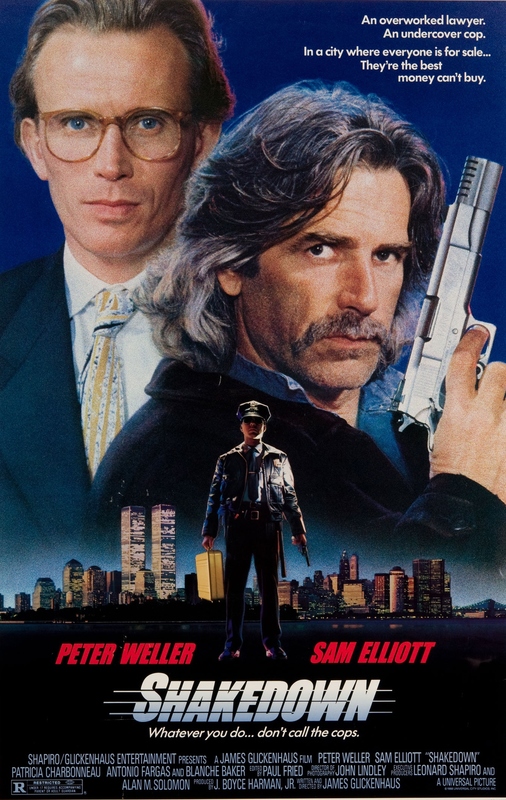
Saturday Matinee: Shakedown (aka Blue Jean Cop)

“Shakedown” (1988) is an action/crime drama written and directed by James Glickenhaus. Peter Weller and Sam Elliot star as Dalton (an idealistic lawyer) and Marks (a veteran cop) who team up to defend a low-level crack dealer who is framed to cover up a ring of crooked cops working for a drug lord. In the midst of his case, Dalton rekindles an affair with the prosecutor of the case Cantrell (Patricia Charbonneau), unbeknownst to his fiancée Gail (Blanche Baker).  Shakedown is one of the more enjoyable  and underrated low-budget action films of the 80s.

America’s Social Depression Is Accelerating

By Charles Hugh Smith

Source: Of Two Minds

We need to value honesty above optimism. Once we can speak honestly, there is a foundation for optimism.

Beneath the rah-rah statistics of “the greatest economy ever,” the social depression is accelerating. The mainstream is reluctantly waking up to the future of the American Dream: downward mobility for all but the top 10% of households. A 2015 Atlantic article fleshed out the zeitgeist with survey data that suggests the Great Middle Class/Nouveau Proletariat is also waking up to a future of downward mobility: The Downsizing of the American DreamPeople used to believe they would someday move on up in the world. Now they’re more concerned with just holding on to what they have.

I have been digging into the financial and social realities of what it takes to be middle class in today’s economy for years: Are You Really Middle Class?

The reality is that the middle class has been reduced to the sliver just below the top 5%–if we use the standards of the prosperous 1960s as a baseline.

The downward mobility isn’t just financial–it’s a decline in political power, control of one’s work and income-producing assets. This article reminds us of what the middle class once represented: What Middle Class? How bourgeois America is getting recast as a proletariat.

The costs of trying to maintain a toehold in the upper-middle class are illuminated in these recent articles on health and healthcare–both part of the downward mobility:

Health Care Slavery and Overwork

How a toxic workplace could, literally, destroy your health

We’re afraid our work is killing us, and we are right

This reappraisal of the American Dream is also triggering a reappraisal of the middle class in the decades of widespread prosperity: The Myth of the Middle Class: Have Most Americans Always Been Poor?

Downward mobility excels in creating and distributing what I term social defeat: In my lexicon, social defeat is a spectrum of anxiety, insecurity, chronic stress, powerlessness, and fear of declining social status.

Downward mobility and social defeat lead to social depression. Here are the conditions that characterize social depression:

1. High expectations of endless rising prosperity have been instilled in generations of citizens as a birthright.

2. Part-time and unemployed people are marginalized, not just financially but socially.

3. Widening income/wealth disparity as those in the top 10% pull away from the shrinking middle class.

4. A systemic decline in social/economic mobility as it becomes increasingly difficult to move from dependence on the state (welfare) or one’s parents to financial independence.

5. A widening disconnect between higher education and employment: a college/university degree no longer guarantees a stable, good-paying job.

6. A failure in the Status Quo institutions and mainstream media to recognize social recession as a reality.

7. A systemic failure of imagination within state and private-sector institutions on how to address social recession issues.

8. The abandonment of middle class aspirations by the generations ensnared by the social recession: young people no longer aspire to (or cannot afford) consumerist status symbols such as luxury autos or homeownership.

9. A generational abandonment of marriage, families and independent households as these are no longer affordable to those with part-time or unstable employment, i.e. what I have termed (following Jeremy Rifkin) the end of work.

10. A loss of hope in the young generations as a result of the above conditions.

The rising tide of collective anger arising from social depression is visible in many places: road rage, violent street clashes between groups seething for a fight, the destruction of friendships for holding the “incorrect” ideological views, and so on. I Think We Can Safely Say The American Culture War Has Been Taken As Far As It Can Go.

A coarsening of the entire social order is increasingly visible: The Age of Rudeness.

Depressive thoughts (and the emotions they generate) tend to be self-reinforcing, and this is why it’s so difficult to break out of depression once in its grip.

One part of the healing process is to expose the sources of anger that we are repressing. As psychiatrist Karen Horney explained in her 1950 masterwork, Neurosis and Human Growth: The Struggle Towards Self-Realization, anger at ourselves sometimes arises from our failure to live up to the many “shoulds” we’ve internalized, and the idealized track we’ve laid out for ourselves and our lives.

The recent article, The American Dream Is Killing Us does a good job of explaining how our failure to obtain the expected rewards of “doing all the right things”(getting a college degree, working hard, etc.) breeds resentment and despair.

Since we did the “right things,” the system “should” deliver the financial rewards and security we expected. This systemic failure to deliver the promised rewards is eroding social mobility and the social contract while generating frustration, anger, etc.

We are increasingly angry at the system, but we reserve some anger for ourselves, because the mass-media trumpets how well the economy is doing and how some people are doing extremely well. Naturally, we wonder, why them and not us? The failure is thus internalized.

One response to this sense that the system no longer works as advertised is to seek the relative comfort of echo chambers–places we can go to hear confirmation that this systemic stagnation is the opposing political party’s fault.

We don’t just self-sort ourselves into political “tribes” online– we are congregating in increasingly segregated communities and states:.

Americans are moving to communities that align more with their politics. Liberals are moving to liberal areas, and conservatives are moving to conservative communities. It’s been going on for decades. When Jimmy Carter was elected in 1976, 26.8% of Americans lived in landslide counties; that is counties where the president won or lost by 20% of the vote.

By 2004, 48.3% of the population lived in these counties. This trend continues to worsen. As Americans move to their preferred geographic bubbles, they face less exposure to opposing viewpoints, and their own opinions become more extreme. This trend is at the heart of why politics have become so polarizing in America.

We’re self-sorting at every level. Because of this, Americans are only going to grow more extreme in their beliefs, and see people on the other side of the political spectrum as more alien.”

Part of the American Exceptionalism we hear so much about is a can-do optimism: set your mind to it and everything is possible.

The failure to prosper as anticipated is generating a range of negative emotions that are “un-American”: complaining that you didn’t get a high-paying secure job despite having a college degree (or advanced degree) sounds like sour-grapes: the message is you didn’t work hard enough, you didn’t get the right diploma, etc.

It can’t be the system that’s failed, right? I discuss this in my book Why Our Status Quo Failed and Is Beyond Reform: the top 10% who are benefiting mightily dominate politics and the media, and their assumption is: the system is working great for me, so it must be working for everyone. That’s the implicit narrative parroted by status quo mouthpieces.

The inability to express our despair and anger generates depression. Some people will redouble their efforts, others will seek to lay the blame on “the other” (some external group) and others will give up. What few people will do is look at the sources of systemic injustice.

Perhaps we need a national dialog about declining expectations, rising inequality and the failure of the status quo that avoids the blame-game and the internalization trap (i.e. it’s your own fault you’re not well-off).

We need ways to express our resentment, anger, despair, etc. that are directed at the source, the complex system we inhabit, not “the other.” We need to value honesty above optimism. Once we can speak honestly, there is a foundation for optimism.

Happy ThanksGetting Day. Poverty and Social Inequality in America

By Philip A Farruggio

Source: Global Research

Yes, we need to finally absolve ourselves, as Amerikans, from the con job concerning Thanksgiving Day. All the ‘pomp and circumstance’ revolving around this holiday is just that, to quote Ebenezer Scrooge (one month early): Humbug!

Of course, even the southern Colonial slaves and Northern ‘indentured servants’ of that era would be thankful to just have a roof over their heads and enough to eat each day. Yet, it was only the slave masters and owners of property and capital who could kneel in their churches or bow in reflected prayer at their lavish dinner tables in true thanksgiving.

Amerika 2018 consists of well over 100 million of our citizens who are lucky just to stay head above water financially… perhaps a few paychecks from being out on the street… literally!

How many families who live next door to me and to YOU (or maybe YOU yourself the reader) who have to have two (or more?)  wage earners full time to just be able to function? How many single parents of even just one child need to live with their parents (if lucky to be able to) in order to function properly?

What about a single mom all on her own? Do the math: How can a single Mom with let us say just one child, who works a blue or even white collar full time job on one salary, be able to stay head above water on let us say the USA median salary for a woman ($ 39,900)? She most likely pays rent, and in my area of North Central Florida even a small two bedroom apt. goes for on average $ 1200 a month in a somewhat ‘safe’ low crime neighborhood.

With her take home pay of $ 725 plus her health insurance contribution (usually 50%) of $ 80 a week, the figure is now $ 645. She would most likely need a car to get around (my area is mostly ‘car driven’ with not the greatest mass transit) and let us say that for even a low end car her payments would be $ 225 monthly for a new car loan, bringing her take home figure to now $ 420. Factor in her car insurance of $ 100 a month, and her take home figure is now $ 320 a week. She and her child need some sort of cable television, and even the low end cable is going to be at least $ 50 a month… and her take home figure is now $ 270 a week. Her phone/internet cost, even at the low end, would have to be at least $ 80 a month, bringing her figure down to $ 190 a week. Then you have food costs for her and her child, clothing costs, gas for her car, and God forbid one of them gets sick, or needs dental work, which is not covered….

The CEOs of all the companies that this single mom pays her hard earned money to earn in excess of a minimum of $ 20 million a year. Some earn double that figure! Within their own companies these CEOs earn in excess of 300 times the pay of their average workers. These folks have lots to be thankful of next Thursday! Mind you: Where is the outrage?

Where is the outcry of millions of working stiffs to say ‘Something is wrong here!?’ This column is just about one tiny example of the unfairness of this current corporate/ capitalist system. Those CEOS and top execs  of Amerikan capitalism, who are even much less than what many label The ONE PERCENT, are paying federal taxes of a top rate of 37%. Now that is before their accountants cut it down to much lower figure than that. Mitt Romney, now a Senator from Utah, admitted a few years ago that he, as a mega mega millionaire, only paid at a rate of perhaps 15%. Please remember that when JFK was president, in 1961, the top tax bracket was at 90%.

Again, with a good accountant, those mega rich may have paid at a rate of maybe 50%. Yet, my late uncle, who was in the 81% bracket then, earning $ 140k a year, still was able to enjoy two brand new twin Cadillacs for he and my aunt, his exclusive country club membership and a new home in the burbs.

Folks, for this Thanksgiving it is time for we hundreds of millions of working stiffs to begin to accept the need for Socialism. It may just be the only way for our great nation to turn the corner economically and morally. Reread some of the scriptures, for all of you who adhere (as this writer does) to the teachings of Jesus, and see what he said about the mega rich: Again I tell you, it is easier for a camel to pass through the eye of a needle than for a rich man to enter the kingdom of God.”

The Wealth Hiding in Your Neighborhood

From country farmland to big city skyscrapers, absentee billionaires may be hiding wealth in your town — and driving up your cost of living.

By Chuck Collins

Source: OtherWords

The rich are hiding trillions in wealth.

You’ve probably heard about their offshore bank accounts, shell corporations, and fancy trusts. But this wealth isn’t all sitting in the Cayman Islands or Panama. Much of it’s hiding in plain view: maybe even in your town.

America’s big cities are increasingly dotted with luxury skyscrapers and mansions. These multi-million dollar condos are wealth storage lockers, with the ownership often obscured by shell companies.

In Boston, where I live, there’s a luxury building boom. According to a study I just co-authored, out of 1,805 luxury units — with an average price of over $3 million — more than two-thirds are owned by people who don’t live here.

One-third are owned by shell companies and trusts that mask their ownership. And of these units, 40 percent are limited liability companies (LLCs) organized in Delaware.

Why Delaware?

Criminals around the world set up their shell companies in Delaware, the premiere secrecy jurisdiction in the United States — where you don’t have to disclose who the real owners are. As a result, human traffickers, drug smugglers, and tax evaders all enjoy the anonymous cover of a Delaware company.

Many of these companies use illicit funds to purchase real estate in North American cities to launder their ill-gotten money.

In New York City, dozens of luxury towers have been connected to global money laundering. In Vancouver, Chinese investors disrupted the city’s housing market so badly that the province of British Columbia established a foreign investor tax and a tax on vacant properties.

With European countries now insisting on more transparency, illicit cash is now cascading into the United States. In fact, the U.S. is now the world’s second-biggest tax haven and secrecy jurisdiction, after Switzerland.

The U.S. Treasury Department’s Financial Crimes Enforcement Network (FinCEN) has increased its scrutiny over real estate markets in Miami, New York, and parts of California, Texas, and Hawaii.

But that just makes the rest of the country more attractive for secret cash — even far from big cities. In a small Vermont town, I met a Russian investor who lives in Dubai. He was buying up thousands of acres of Green Mountain farmland.

Our communities are being fundamentally transformed by land grabs and luxury building booms. These drive up the cost of land in central neighborhoods, with ripple impacts throughout a community. And this worsens the already grotesque inequalities of income, wealth, and opportunity.

Our communities should defend themselves.

Property ownership should have to pass the “fishing license” or “library card” test. In most communities, to get a library card or a fishing license, you need to prove who you are and where you actually live.

In Boston, they’re pretty strict — you need to show a utility bill with your name on it. Cities should require the same for real estate purchases.

At a national level, bi-partisan legislation from Senators Marco Rubio and Sheldon Whitehouse would require real estate owners to be disclosed when buyers use shell corporations and pay millions in cash. That would be a welcome development.

Better still, cities should tax luxury real estate transactions on properties selling for over $2 million to fund local services. Such a tax in San Francisco generated $44 million last year that’s been used to fund free community college and help the city’s neglected trees.

Communities could discourage high-end vacant properties by taxing buildings that sit empty for more than six months a year. Cities like Vancouver have created incentives to house people, not wealth.

We need to defend our communities for the people who live in them, not just store their wealth there.

THE IMPORTANCE OF ALTERNATIVE MEDIA

By John Scales Avery

Source: Blacklisted News

The superficiality of today’s television

Social critic Neil Postman contrasted the futures predicted in Nineteen Eighty-Four and Brave New World in the foreword of his 1985 book “Amusing Ourselves to Death”.

He wrote:

“What Orwell feared were those who would ban books. What Huxley feared was that there would be no reason to ban a book, for there would be no one who wanted to read one. Orwell feared those who would deprive us of information. Huxley feared those who would give us so much that we would be reduced to passivity and egotism. Orwell feared that the truth would be concealed from us. Huxley feared the truth would be drowned in a sea of irrelevance.”

Neil Postman’s book, “Amusing Ourselves To Death; or Public Discourse in an Age of Show Business” (1985), had its origins at the Frankfurt Book Fair, where Postman was invited to join a panel discussing George Orwell’s “Nineteen Eighty-Four”. Postman said that our present situation was better predicted by Huxley’s “Brave New World”. Today, he maintained it is not fear that bars us from truth. Instead, truth is drowned in distractions and the pursuit of pleasure, by the public’s addiction to amusement.

Postman sees television as the modern equivalent of Huxley’s pleasure-inducing drug, soma, and he maintains that that television, as a medium, is intrinsically superficial and unable to discuss serious issues. Looking at television as it is today, one must agree with him.

The wealth and power of the establishment

The media are a battleground where reformers struggle for attention, but are defeated with great regularity by the wealth and power of the establishment. This is a tragedy because today there is an urgent need to make public opinion aware of the serious problems facing civilization, and the steps that are needed to solve these problems. The mass media could potentially be a great force for public education, but in general their role is not only unhelpful – it is often negative. War and conflict are blatantly advertised by television and newspapers.

Newspapers and war

There is a true story about the powerful newspaper owner William Randolph Hearst that illustrates the relationship between the mass media and the institution of war: When an explosion sank the American warship USS Maine in the harbor of Havana, Hearst anticipated (and desired) that the incident would lead to war between the United States and Spain. He therefore sent his best illustrator, Fredrick Remington, to Havana to produce drawings of the scene. After a few days in Havana, Remington cabled to Hearst, “All’s quiet here. There will be no war.” Hearst cabled back, “You supply the pictures. I’ll supply the war.” Hearst was true to his words. His newspapers inflamed American public opinion to such an extent that the Spanish-American War became inevitable. During the course of the war, Hearst sold many newspapers, and Remington many drawings. From this story one might almost conclude that newspapers thrive on war, while war thrives on newspapers.

Before the advent of widely-read newspapers, European wars tended to be fought by mercenary soldiers, recruited from the lowest ranks of society, and motivated by financial considerations. The emotions of the population were not aroused by such limited and decorous wars. However, the French Revolution and the power of newspapers changed this situation, and war became a total phenomenon that involved emotions. The media were able to mobilize on a huge scale the communal defense mechanism that Konrad Lorenz called “militant enthusiasm” – self-sacrifice for the defense of the tribe. It did not escape the notice of politicians that control of the media is the key to political power in the modern world. For example, Hitler was extremely conscious of the force of propaganda, and it became one of his favorite instruments for exerting power.

With the advent of radio and television, the influence of the mass media became still greater. Today, state-controlled or money-controlled newspapers, radio and television are widely used by the power elite to manipulate public opinion. This is true in most countries of the world, even in those that pride themselves on allowing freedom of speech. For example, during the US-led invasion of Iraq in 2003, the official version of events was broadcast by CNN, and criticism of the invasion was almost absent from their transmissions.

The mass media and our present crisis

Today we are faced with the task of creating a new global ethic in which loyalty to family, religion and nation will be supplemented by a higher loyalty to humanity as a whole. In case of conflicts, loyalty to humanity as a whole must take precedence. In addition, our present culture of violence must be replaced by a culture of peace. To achieve these essential goals, we urgently need the cooperation of the mass media.

The predicament of humanity today has been called “a race between education and catastrophe”: Human emotions have not changed much during the last 40,000 years. Human nature still contains an element of tribalism to which nationalistic politicians successfully appeal. The completely sovereign nation-state is still the basis of our global political system. The danger in this situation is due to the fact that modern science has given the human race incredibly destructive weapons. Because of these weapons, the tribal tendencies in human nature and the politically fragmented structure of our world have both become dangerous anachronisms.

After the tragedies of Hiroshima and Nagasaki, Albert Einstein said, “The unleashed power of the atom has changed everything except our way of thinking, and thus we drift towards unparalleled catastrophes.” We have to learn to think in a new way. Will we learn this in time to prevent disaster? When we consider the almost miraculous power of our modern electronic media, we can be optimistic. Cannot our marvelous global communication network be used to change anachronistic ways of thought and anachronistic social and political institutions in time, so that the system will not self-destruct as science and technology revolutionize our world? If they were properly used, our instantaneous global communications could give us hope.

The success of our species is built on cultural evolution, the central element of which is cooperation. Thus human nature has two sides, tribal emotions are present, but they are balanced by the human genius for cooperation. The case of Scandinavia – once war-torn, now cooperative – shows that education is able to bring out either the kind and cooperative side of human nature, or the xenophobic and violent side. Which of these shall it be? It is up to our educational systems to decide, and the mass media are an extremely important part of education. Hence the great responsibility that is now in the hands of the media.

How do the mass media fulfill this life-or-death responsibility? Do they give us insight? No, they give us pop music. Do they give us an understanding of the sweep of evolution and history? No, they give us sport. Do they give us an understanding of need for strengthening the United Nations, and the ways that it could be strengthened? No, they give us sitcoms and soap operas. Do they give us unbiased news? No, they give us news that has been edited to conform with the interests of the military-industrial complex and other powerful lobbies. Do they present us with the need for a just system of international law that acts on individuals? On the whole, the subject is neglected. Do they tell of of the essentially genocidal nature of nuclear weapons, and the urgent need for their complete abolition? No, they give us programs about gardening and making food.

A consumer who subscribes to the “package” of broadcasts sold by a cable company can often search through all 100 or so channels without finding a single program that offers insight into the various problems that are facing the world today. What the viewer finds instead is a mixture of pro-establishment propaganda and entertainment. Meanwhile the neglected global problems are becoming progressively more severe. In general, the mass media behave as though their role is to prevent the peoples of the world from joining hands and working to change the world and to save it from thermonuclear and environmental catastrophes. The television viewer sits slumped in a chair, passive, isolated, disempowered and stupefied. The future of the world hangs in the balance, the fate of children and grandchildren hang in the balance, but the television viewer feels no impulse to work actively to change the world or to save it. The Roman emperors gave their people bread and circuses to numb them into political inactivity. The modern mass media seem to be playing a similar role.

Our duty to future generations

The future of human civilization is endangered both by the threat of thermonuclear war and by the threat of catastrophic climate change. It is not only humans that are threatened, but also the other organisms with which we share the gift of life. We must also consider the threat of a global famine of extremely large proportions, when the end of the fossil fuel era, combined with the effects of climate change, reduce our ability to support a growing global population.

We live at a critical moment of history. Our duty to future generations is clear: We must achieve a steady-state economic system. We must restore democracy in our own countries when it has been replaced by oligarchy. We must decrease economic inequality both between nations and within nations. We must break the power of corporate greed. We must leave fossil fuels in the ground. We must stabilize and ultimately reduce the global population. We must eliminate the institution of war; and we must develop new ethics to match our advanced technology, ethics in which narrow selfishness, short-sightedness and nationalism will be replaced by loyalty to humanity as a whole, combined with respect for nature.

Inaction is not an option. We have to act with courage and dedication, even if the odds are against success, because the stakes are so high.

The mass media could mobilize us to action, but they have failed in their duty.

Our educational systems could also wake us up and make us act, but they too has failed us. The battle to save the earth from human greed and folly has to be fought in the alternative media.

The alternative media, and all who work with them deserve both our gratitude and our financial support. They alone, can correct the distorted and incomplete picture of the world that we obtain from the mass media. They alone can show us the path to a future in which our children, grandchildren, and all future generations can survive.


A book discussing the importance of alternative media can be freely downloaded and circulated from this address:

http://eacpe.org/app/wp-content/uploads/2018/10/Searching-for-truth-by-John-Scales-Avery.pdf

More freely downloadable books and articles on  other global problems can be found on the following link:

http://eacpe.org/about-john-scales-avery/