

By Robert Bridge
Source: Strategic Culture Foundation
Last week, the US said it was working to create “alternative government authorities” on Syrian territory. This latest move, aside from demonstrating once again that the US has no respect for Syria’s territorial integrity, indicates we may be seeing more from that group of mercenaries known as Islamic State.
Thus, it seems to be an appropriate time to reflect upon a set of very strange circumstances that led to the rise of this loathsome terrorist group. Here are the top 10 reasons, in no particular order, as to why we should be very suspicious about this group.
10. Convenient Timing
In late August 2013, the United States was on the verge of initiating a massive attack on the government of Syrian President Bashar Assad over a deadly chemical attack that had occurred in the town of Ghouta just days earlier. Although it would have made no sense for Assad to have resorted to such dirty tactics, Washington had found its casus belli. It should be noted that at this time the so-called Islamic State of Iraq and the Levant was largely unknown. That would change soon enough.
Meanwhile, a terrible thing happened on the way to this jolly little war. UK Prime Minister David Cameron suffered a stunning defeat in the House of Commons, voting down his effort to join the Americans in Syria. Apparently the British were America’s obedient poodle no longer.
The setback had an apparent sobering effect on Barack Obama, who suddenly – in a feigned nod to democratic procedure and all that – called for Congress to decide whether or not to use military force against Syrian. Tellingly, that vote never materialized.
What did materialize, however, and with alarming speed and viciousness, was a terrorist group that rose up like a phoenix from the ashes of Iraq known as Islamic State (ISIS)*, with evil designs to create an Islamic caliphate across a wide swath of Iraq and Syria.
In other words, the perfect casus belli for the US in Syria that would require no need for a vote from Congress.
9. Journalist Killings
As if to draw gratuitous attention to itself more than anything else, the Sunni terrorist group ISIS, under the leadership of one Abu Bakr al Baghdadi, began to grab world headlines not by its battlefield exploits, but by carrying out videotaped executions of Western journalists, as well as destroying cultural heritage sites. I still can’t help wondering: Why didn’t the group just let its fighting skills speak for itself? Why the apparent need for such outrageous publicity stunts? Was this compensation for something the group was desperately lacking?
In any case, starting in August 2014, almost one year to the day that Obama was forced to put the brakes on his Syrian attack, the beheadings began in earnest.
On August 19, US journalist James Foley, seen kneeling on the ground in some undetermined location next to his apparent executioner, ‘Jihadi John,’ reads out a short statement before being beheaded by his captor. However, Islamic State spared its audience the gore by not showing the moment of the actual beheading; the video only shows a head lying on a body following the purported act.
Even Western mainstream publications admitted that something didn’t seem quite right.
Under the headline, ‘Foley murder video may have been staged’ the Telegraph, a reputable British newspaper, interviewed forensic experts who called into question the moment in the video when Foley is allegedly being beheaded by his captor.
“After enhancements, the knife can be seen to be drawn across the upper neck at least six times, with no blood evidence to the point the picture fades to black,” the expert said.
Another expert who examined the video for the newspaper said: “I think it has been staged. My feeling is that the execution may have happened after the camera was stopped.”
Incredibly, every subsequent beheading video put out by Islamic State attracted the same amount of scepticism – not just from alternative websites, who were also noticing the many irregularities contained in the videos, but from mainstream media news sources.
Following the release of the video purported to show the beheading of Steve Sotloff, a journalist who worked with the Jerusalem Post, The Australian newspaper reported that “the apparent beheading on camera of a second US hostage by a man with a British accent was again staged, according to forensic analysis.”
Then there was the video of 21 Egyptian Coptic Christians, dressed in impeccably clean orange jumpsuits, being led along a Libyan beach by black-clad members of ISIS, all of whom appear to be members of some NBA basketball team.
Veryan Khan, editorial director of the Florida-based Terrorism Research & Analysis Consortium, told Fox News that “the speaker, “Jihad Joseph” is much larger than the sea in both the close up and wide shots, and his head is bizarrely out of proportion, meaning he was filmed indoors and the sea added behind him… In addition, the jihadists featured in the film look to be more than 7 feet tall, towering as much as two feet above their victims…”
In July 2015, yet another strange report emerged, CyberBerkut, a Ukrainian group of hackers, said it hacked John McCain’s laptop while he was on an official visit to Kiev around the first week of June 2015. In a report by TechWorm, what they purported to find was a fully staged production of an ISIS execution video, with an actor portraying an executioner who is holding a knife in preparation to behead the prisoner.
The authenticity of this video has not been independently verified.
None of this proves that the individuals in all of the ISIS beheading videos did not go on to meet some grisly fate. However, it seems worth noting that so many forensic experts have spoken out on the “staged” nature of these videos, and that the actual moment of execution during these film productions is never actually shown. Why would such a barbarous group of villains like ISIS need to script and censor their videos?
8. ISIS freedom of movement
Despite employing state-of-the-art fighter jets, like the F-16 Fighting Falcon and A-10 Warthog, the US campaign to destroy Islamic State was largely an exercise in utter futility. There is no other way to explain it. In June 2014, a convoy of hundreds of ISIS fighters drove through 200 km of the Syro-Arabian Desert in fresh-off-the-lot Toyota pickup trucks on the way to Syria. For any modern military, eliminating such a target would have been the equivalent of a lazy afternoon at the shooting range, or shooting fish in a barrel. The fact that these terrorists made it to Syria unmolested tells us everything we need to know about America’s real agenda.
“With state of the art jet fighter aircraft … it would have been – from a military standpoint – ‘a piece of cake’, a rapid and expedient surgical operation, which would have decimated the Islamic State convoys in a matter of hours,” Michel Chossudovsky wrote in Global Research.
“Instead what we have witnessed is an ongoing drawn out six months of relentless air raids and bombings, and the terrorist enemy is apparently still intact.”
“And we are led to believe that the Islamic State cannot be defeated by a powerful US led military coalition of 19 countries,” he added.
The only reasonable conclusion to make from all of this is that the air campaign was not designed to eliminate Islamic State.
In 2002, Rita Katz and Josh Devon founded Search for International Terrorist Entities Institute (SITE), which, according to its website, is “the world’s leading non-governmental counterterrorism organization specializing in tracking and analyzing online activity of the global extremist community.”
In 2006, in a New Yorker article entitled, “Private Jihad: How Rita Katz got into the spying business,” it was mentioned how SITE spoke directly with jihadists via various message boards:
“Katz has a testy relationship with the government, sometimes acting as a consultant and sometimes as an antagonist. About a year ago, a SITE staffer, under an alias, managed to join an exclusive jihadist message board that, among other things, served as a debarkation point for many would-be suicide bombers.
For months, the staffer pretended to be one of the jihadis, joining in chats and watching as other members posted the chilling messages known as “wills,” the final sign-offs before martyrdom. The staffer also passed along technical advice on how to keep the message board going.
When Katz called officials in Washington, she was reportedly met with resistance: ‘Oh, Rita, I’m not sure you should even be communicating with them—you might be providing material support!,” they told her.
In an interview with CNN, Katz admitted that her group was able to “beat [ISIS] with a release” of a video before it had even been disseminated.
In 2007, SITE came under fire for obtaining an alleged Bin Laden video a month prior to its formal release.
Some have raised questions as to how this small group is able to do what the government has not been able to: track ISIS and other terrorist groups with uncanny efficiency.
6. Toyota Trucks
Watching mainstream media reports detail the adventures of Islamic State as they speed carefree across wide-open desert, beards blowing in the wind, one would be forgiven for thinking they were watching a Toyota commercial.
The Times of Israel went so far as to ridicule the leaders of the West for expressing such fear over these militants in their Toyotas like hell raising teenagers speeding around the parking lot of McDonald’s on a Friday night to impress their friends.
“It’s almost unbelievable,” Avi Issacharoff wrote. “They used to say in the IDF that ‘the man in the tank will win,’ justifying the preference for armor over infantry. Now we hear that, from a US source no less, ‘the man in the Toyota’ will defeat the West.”
Somehow we are expected to believe that these shiny new trucks, along with over 2,000 Humvee vehicles, fell into the terrorists’ control by winning some battles in Iraq, like in Mosul and Palmyra. That absurd explanation falls very wide of the mark and needs far more inquiry.
5. Drone attack on Russia
On New Year’s Eve and on January 6, 2018, Russia’s Khmeimim Airbase in Syria was attacked. The first incident involved militants armed with mortars that resulted in the death of two Russian soldiers and damage to several aircraft. The second attack involved a swarm of 13 drones armed with bomblets, which Russian forces countered by means of electronic warfare and air-defense systems. Around half of the drones were electronically hijacked by Russian forces, while the others were shot down without incident. Nevertheless, the attack required a high level of expertise from a “technologically advanced country,” according to Russia.
The United States countered the claim, suggesting that such technology can be easily purchased. Pentagon spokesman Maj. Adrian Rankin-Galloway said the “devices and technologies can easily be obtained in the open market.”
Meanwhile, however, President Putin never mentioned Islamic State when he discussed the incident with the media.
“Those aircraft were only camouflaged – I want to emphasize this – to look like handicraft production. In fact, it is quite obvious that there were elements of high-tech nature there,” the Russian leader said.
So are we expected to believe that Islamic State terrorists were able to buy these UAV drones, or is it more realistic to believe, along with the Russians, that some outside major power was needed to provide the know-how?
4. Never attacked mainland Israel
In March 2016, the warriors of Islamic State picked up their pens in an effort to explain away a question that has been perplexing many observers: why don’t they ever attack Israel?
In the article, translated by a group called MEMRI, the group said it holds to the position that the Palestinian cause does not take precedence over any other jihadi struggle.
“If we look at the reality of the world today, we will find that it is completely ruled by polytheism and its laws, except for the regions where Allah made it possible for the Islamic State to establish the religion…. Therefore, jihad in Palestine is equal to jihad elsewhere,” the article said.
“The apostate [tyrants] who rule the lands of Islam are graver infidels than [the Jews], and war against them takes precedence over war against the original infidels,” the article said, as reported in the Times of Israel.
Whatever the case may be, this seems to be the first time in modern history that a radical jihadist group has had no reason to quarrel with Israel.
3. Oil Export Business
After Islamic State managed to make it across the vast desert between Iraq and Syria without attracting so much as a damaged fender, it managed to do the unthinkable: it set up a very lucrative oil-export business practically overnight in the north of the country. And this was not some small-time operation.
According to one estimate, the motley crew of mercenaries was generating profits of more than £320million a year from oil exports, or about 40,000 barrels of crude every single day.
Are we really expected to believe that a 19-member military organization led by the United States was powerless to put this rag-tag operation out of business?
The reason why the story is so utterly preposterous is that Russia, in a matter of several days, was able to do what this multinational outfit could not do in over a year. In mid-November 2015, Russia had announced that it had destroyed in a matter of days some 500 fuel trucks – and there is plenty of videotape of the Russian attacks for the naysayers who doubt the Kremlin’s claim.
According to Russian General Staff spokesman Colonel General Andrey Kartapolov: “In just the first few days, our aviation has destroyed 500 fuel tanker trucks, which greatly reduced illegal oil export capabilities of the militants and, accordingly, their income from oil smuggling.”
2. Islamic State’s Israeli medical plan
In March 2015, The Wall Street Journal reported a rather stunning revelation that Israel was treating “Al-Qaeda* fighters wounded in the Syria civil war.”
Since the outbreak of the Syrian civil war, Israel has provided medical assistance to nearly 2,000 Syrians.
The Wall Street Journal quoted “an Israeli military official” who said no questions were asked of the patients.
“We don’t ask who they are, we don’t do any screening,” the official said. “Once the treatment is done, we take them back to the border and they go on their way.”
Amos Yadlin, the former military intelligence chief, told the Journal that Hezbollah and Iran “are the major threat to Israel, much more than the radical Sunni Islamists, who are also an enemy.”
“Those Sunni elements who control some two-thirds to 90% of the border on the Golan aren’t attacking Israel. This gives you some basis to think that they understand who is their real enemy – maybe it isn’t Israel.”
The Jerusalem Post repeated a joke allegedly told by Syrian President Bashar Assad to Foreign Affairs, ‘How can you say that al-Qaida doesn’t have an air force? They have the Israeli air force…They are supporting the rebels in Syria. It is very clear.”
1. The Pentagon report that speak volumes
In May 2015, a declassified Pentagon document provided shocking evidence that the US-led campaign in Syria not only contributed directly to the rise of the Islamic State (IS), but that Washington was perfectly satisfied with such an outcome.
The US Defence Intelligence Agency (DIA) report, obtained by Judicial Watch, dated August 2012, states that the “major forces driving the insurgency in Syria” comprise “the Salafist, the Muslim Brotherhood, and AQI [al-Qaeda in Iraq].”
Furthermore, it states, these forces are being supported by a Western-led coalition – “The West, Gulf countries and Turkey support the opposition.”
It went on to predict that the takeover of Hasaka and Deir Ezzor would possibly create a militant Islamist political entity in eastern Syria:
“If the situation unravels there is the possibility of establishing a declared or undeclared Salafist Principality in eastern Syria (Hasak and Der Zor), and this is exactly what the supporting powers want, in order to isolate the Syrian regime, which is considered the strategic depth of the Shia expansion (Iraq and Iran).”
According to Nafeed Ahmez from Middle East Eye, “This extraordinary passage confirms that at least three years ago, the Pentagon anticipated the rise of a ‘Salafist Principality’ as a direct consequence of its Syria strategy – and that the ‘supporting powers’ behind the rebels ‘wanted’ this outcome ‘to isolate the Syrian regime,’ and weaken Shiite influence via Iraq and Iran.”
Let that sink in for a moment. The US-backed coalition, which seemed so inexplicably lacklustre in its fight against Islamic State, to the point where this group was actually able to open an oil export business, not to mention drive its Toyota trucks across wide-open desert unmolested, was more content to let a band of terrorists occupy Syria than the legitimate government in Damascus.
It seems safe to say, based on the findings of this incredible document, that such a rationale is exactly what guided Washington’s hand not only in Syria, but in other regime-change war zones, like Iraq and Libya. Democracy building was not the desired result in these fated places, but absolute chaos.
* Terrorist organization, banned in Russia by court order.

By Andre Damon
Source: WSWS.org
The Democratic Party was thrown into disarray Friday after the publication of a classified memo exposing as a factionally-motivated witch-hunt the investigation by leading intelligence agencies into the Trump administration’s alleged collusion with Russia.
The so-called Nunes memo, which Democratic lawmakers, US intelligence agencies, and major newspapers had been seeking to block for days, alleges that the FBI under the Obama administration used discredited sources and withheld key information to initiate a wiretap of former Trump campaign adviser Cater Page.
The Democrats responded to the prospective release of the Nunes memo with undisguised hysteria, declaring that it threatened National Security and was insufficiently deferential to the US intelligence agencies. Now that the memo has been released, Democrats’ claim that it contains sensitive national security secrets has been exposed as lies.
The memo, written by Republican House Intelligence Committee Chairman Devin Nunes, claims that the FBI obtained a Foreign Intelligence Surveillance (FISA) court authorization to wiretap Page in the fall of 2016 based on a memo compiled by former British intelligence official Christopher Steele.
The so-called Steele dossier, which was released to the public last year, made lurid allegations that Russian government officials had recordings of Trump engaging in “perverted sexual acts” with prostitutes “which have been arranged/monitored by the FSB [Russian intelligence service].” According to the Nunes memo, FBI director James Comey called the Steele Dossier “salacious and unverified” in congressional testimony in June 2017.
In perhaps its most explosive passage, the memo alleges that Andrew McCabe, a deputy FBI director who just stepped down this past week, testified before the House Intelligence Committee in December that “no surveillance warrant would have been sought… without the Steele dossier information.”
In addition, the FISA application “ignored or concealed [Steele’s] anti-Trump financial and ideological motivations,” i.e. the fact that his “research” had been funded by the Clinton campaign.
The Republican memo does not specify what information was collected by the wiretap, or whether it captured any conversations with Trump.
The contents of the memo are another demonstration of the manufactured and partisan character of the anti-Russia campaign and the Democrats’ allegations that Trump “colluded” with Russia. What is playing out is a partisan battle between two criminal and reactionary factions of the state apparatus, centering ultimately around differences over foreign policy.
The release of the memo once again underscores the fact that the US intelligence agencies have massively intervened in US politics. This is true not only with regard to the concocted narrative about “collusion” between Trump and Russia, but equally so with James Comey’s public announcement about re-opening an investigation into Hillary Clinton’s emails just days before the presidential vote, which Clinton claimed may have cost her the election.
The memo has undermined the aura of professional impartiality that the Democrats and their semi-official news outlets, the New York Times and the Washington Post, have sought to cultivate around the so-called “intelligence community.”
The real fear of Democrats is that the exposure of the anti-Russia campaign will undermine the credibility of the FBI. “The selective release and politicization of classified information sets a terrible precedent and will do long-term damage to the intelligence community and our law enforcement agencies,” declared Rep. Adam Schiff of California, the ranking Democrat on the House Intelligence Committee, on Friday.
Schiff added, “If potential intelligence sources know that their identities might be compromised when political winds arise, those sources of vital information will simply dry up, at great cost to our national security.”
But all such arguments about “national security” have been rendered absurd by the release of the document, which contained no sensitive information besides the wrongdoing of the FBI and the Democrats—including Schiff himself.
In an editorial published Friday, ahead of the document’s publication, the New York Times accused congressional Republicans of “undermining the credibility of the law enforcement community,” which they had “once defended so ardently.”
It was left to the satirical news website the Onion to point out the obvious absurdity of such arguments:
Stressing that such an action would be highly reckless, FBI Director Christopher Wray warned Thursday that releasing the “Nunes Memo” could potentially undermine faith in the massive, unaccountable government secret agencies of the United States. “Making this memo public will almost certainly impede our ability to conduct clandestine activities operating outside any legal or judicial system on an international scale,” said Wray, noting that it was essential that mutual trust exist between the American people and the vast, mysterious cabal given free rein to use any tactics necessary to conduct surveillance on U.S. citizens or subvert religious and political groups.
Responding to the Democrats’ allegations that the publication of the document would threaten “national security,” journalist Glen Greenwald tweeted, “What conceivable argument is there that any part of the Nunes Memo could jeopardize national security?”
The Times editorial effectively argues that no documents critical of the actions of the US intelligence apparatus should be published. To make this point, the Times quotes Democratic Senator Ron Wyden, who argued against the release of the memo on the grounds that the public would “see this release as proof that selective classification is used more often to deceive them than to protect them.”
But it is, of course true that “selective classification” is used to deceive the American people. This was demonstrated by the release of the classified Pentagon Papers in 1971, which documented how flagrantly and extensively the Kennedy, Johnson, and Nixon administrations lied to the American people about the Vietnam War.
As The Post, the recently-released film by Stephen Spielberg effectively documents, the New York Times and Washington Post made the decision at the time to defy the Nixon administration and publish the Pentagon Papers, rejecting the spurious argument that their publication would harm “national security.”
The editorial published in the Times Friday reads like a cruder version of the arguments put forward by the Nixon White House to block the release of the Pentagon Papers. If one were to take the editorial at face value, one would conclude that, if the Times had the Nunes memo in its sole possession, it would never have published it.
The Times has become little more than a mouthpiece for the US intelligence agencies, whose aim is to prevent the dissemination of any information that they see as harmful to the interests of the American ruling class and the capitalist state.

By Gary Z McGee
Source: The Mind Unleashed
“The difference between a good life and a bad life is how well you walk through the fire.” ~Carl Jung
Fuck positivity. Fuck feelings. Fuck trying to make yourself feel good all the time. Focus instead on becoming a better version of yourself. Focus on action. Better yet, be proactive. It’s less about feeling positive and more about positive action. Even then, it’s less about being great and more about being better. Indeed. There’s more happiness in a spoonful of hard-earned self-improvement than in an ocean-full of self-affirmations.
“May your trails be crooked, winding, lonesome, dangerous, leading to the most amazing view. May your mountains rise into and above the clouds.” ~Edward Abbey
Here’s the thing: there’s nothing wrong with being happy. When you’re happy, be grateful. Soak it up. Absorb it. Balls to bones. Ovaries to marrow. But then let that shit go. Don’t remain in that state for too long or you’ll atrophy. You’ll stagnate. You’ll lose your focus. Other feelings and emotions have just as much to teach you (even more so, some might argue) as happiness does.
Everyone talks a big game about stretching their comfort zones, but when it really comes down to it most people remain in their comfortable, positive, warm, and happy comfort zones. We cling to them without even realizing it. We get so caught up in them that we lose sight of one of the most vital secrets of living finite lives in a seemingly infinite universe: take all things in moderation.
This includes, especially, positive emotions. Because positive emotions are more likely to hold you hostage than negative ones are. Whereas negative emotions are more likely to motivate you. I’m not saying be negative all the time. For negativity too should be taken in moderation. I’m saying use negative emotions to motivate you into positive action. Ask yourself: what’s more motivating “you’ve made it,” or “there’s no way you’ll make it.”
With “you’ve made it” there nothing more to do. There’s nowhere else to go. You’re done. You’re content. You’re comfort zone has reached its capacity. You’re stuck. You’ve succumbed to the Master’s Complex and forsaken Beginner’s Mind. With “there’s no way you’ll make it,”on the other hand, there’s a challenge. There’s an obstacle to overcome. There’s adventure to be had. You’re comfort zone has something to grow into and ultimately overcome. And then on to the next obstacle. As Shunryu Suzuki said, “In the beginner’s mind there are many possibilities, but in the expert’s there are few.”
Besides, when it really comes down to it, there is no such thing as “you’ve made it.” As long as you’re alive there is still more life to live. As Richard Bach said, “Here is a test to find whether your mission on earth is finished: If you’re alive, it isn’t.”
“To those human beings who are of any concern to me I wish suffering, desolation, sickness, ill-treatment, indignities — I wish that they should not remain unfamiliar with profound self-contempt, the torture of self-mistrust, the wretchedness of the vanquished: I have no pity for them, because I wish them the only thing that can prove today whether one is worth anything or not —that one endures.” ~Friedrich Nietzsche
Ever heard the common cliché, “everything happens for a reason”? Well, fuck that shit! That’s just some sentimental placating bullshit people say to make them feel better about things happening.
Better to be honest with yourself. Better to get rid of the pacifying middleman with his pitiful reach-arounds and mawkish petting. Better to simply own up to the simple fact that shit happens. Good shit happens. Bad shit happens. Good shit happens to bad people. Bad shit happens to good people. Life is just one big shit show and some people get more shit than others.
Sometimes it really is just as simple as good/bad luck. Sometimes fate is out of our hands. And that’s okay. There’s more to being human than choice, there’s vicissitudes. There are unexpected changes that shit all over our choices. Things don’t happen for a reason. Things happen and then we give them a reason to ease our burden.
Which is fine if you wish to remain stuck in the safety of your comfort zone. But it’s disastrous if you wish to become a better, healthier version of yourself. Challenge all feel-good banalities with the self-empowering question: “What can I learn from this?” instead, and then watch as your comfort zone melts into your own progressive evolution.
“Self-importance is a trap, because the moment we start to think that we actually matter is the moment when things start to go wrong. The truth is that you are supremely unimportant, and nothing matters. All of man’s striving is for nothing; all effort is wasted. To realize that everything is meaningless is tremendously liberating, since it then leaves us completely free to create our own lives and ignore the plans that others have for us.” ~Tom Hodgkinson
If self-importance is a trap, then self-improvement is the key to that trap. This is because the former is based on emotion and the latter is based on action. The former is lodged in positive emotion while the latter is engaged in positive action. Again, the action is the thing.
Feel-good emotions, positive affirmations, and idea’s like The Secret, only get you so far. They are akin to having a life jacket in turbulent water. Sure, your safe and secure from drowning. But without action, without swimming, that life jacket means fuck-all. If you don’t swim toward health and survival, you’re dead anyway. Appreciate the life jacket for what it is, but don’t just sit there glowing in your self-importance. Swim! Act! The positive act of swimming toward health, vitality, and survival, trumps the positive emotion of merely having a life jacket so that you don’t drown.
Same thing with happiness. It only gets you so far. Sometimes you just have to say fuck happiness. Fuck just floating here in a contented state. Fuck clinging to this safe and secure comfort zone that everyday constricts my becoming a better version of myself. This is the way comfort zones have been stretched since time immemorial. So swim! Courageously stretch your too-small comfort zone. Transform your life jacket into a life well lived.
The irony is that, in the long run, you’ll reap more happiness out of sowing a little painful and uncomfortable self-improvement than by remaining content in a state of “happy” and comfortable self-importance. And even if you don’t, at least you gave it a shot. At least you had the courage and the wherewithal to make your life better.
“Turn those negative emotions into action that will make you better instead of just feeling better about who you already are.” ~Elan Gale
It all comes down to this moment. Who are you right now? Sincerely ask yourself: do I want to improve myself or do I want to remain the same. There’s nothing inherently “wrong” with choosing either way. But there is something wrong with expecting self-improvement when you choose to remain the same. There is something wrong with expecting your comfort zone to miraculously stretch when you do absolutely nothing to encourage it to stretch. There issomething wrong with expecting your health to improve when you do fuck-all to help it improve.
This is where the rich minerals of negative emotion can be mined and harnessed to encourage the positive action needed to knock down the walls of reinforced positive emotions. If you honestly wish to remain the same, then, by all means, continue to bask in your contentedness and shower in your sentimental positive affirmations and armored happiness. There’s nobody to stop you. But if you really want to get down to brass tacks and utilize the positive action necessary to stretch your comfort zone and live life to the fullest, then tell yourself, “Fuck happiness (for now). It’s time to learn from my other emotions for a time.”
There is immense wisdom in sadness, anger, jealousy, and pain. Nearly all art was created by harnessing the vital power inherent in these sacred yet “negative” emotions. As Anais Nin surmised, “Great art was born of great terrors, great loneliness, great inhibitions, instabilities, and it always balances them.” And so it is also with the art of life. So it goes with attempting to bring balance and harmony to life. True happiness, Eudaimonia-type happiness, is more about transforming bad shit into fodder for good shit, than it is about relishing in mediocre shit and suppressing the bad shit.
Suppressing the bad shit just creates shitty demons that haunt us in our comfort zones anyway. Better not to create the demons in the first place. Or, if they’re already there (which they probably are), embrace them. Engage them. Go full-frontal, vulnerable beast-mode on them. Meet them on their turf, and then dare to transform them into your ally. Now that’stransforming demons into diamonds. That’s the epitome of transforming negative emotion into positive action.
So yeah, fuck happiness! Especially if it’s handicapping you from striving toward Eudaimonia. And especially-especially if you are using it as a sentimental placation or an excuse to remain stuck. A life well-lived cannot be lived inside a safe and secure, yet tiny and ignorant, comfort zone. No matter how happy you are there. It can only be lived by daring yourself to stretch it, again and again. Even if that means Pain, Sadness, and Grief have to drag you through the brambles. There’s adventure at hand. There are new horizons to stretch into. So fuck your positive emotions. Focus instead on transforming your negative emotions into positive action.

Review by Roger Ebert
In the waning days of World War II, American bombers drop napalm canisters on Japanese cities, creating fire storms. These bombs, longer than a tin can but about as big around, fall to earth trailing cloth tails that flutter behind them; they are almost a beautiful sight. After they hit, there is a moment’s silence, and then they detonate, spraying their surroundings with flames. In a Japanese residential neighborhood, made of flimsy wood and paper houses, there is no way to fight the fires.
“Grave of the Fireflies” (1988) is an animated film telling the story of two children from the port city of Kobe, made homeless by the bombs. Seita is a young teenager, and his sister Setsuko is about 5. Their father is serving in the Japanese navy, and their mother is a bomb victim; Seita kneels beside her body, covered with burns, in an emergency hospital. Their home, neighbors, schools are all gone. For a time an aunt takes them in, but she’s cruel about the need to feed them, and eventually Seita finds a hillside cave where they can live. He does what he can to find food, and to answer Setsuko’s questions about their parents. The first shot of the film shows Seita dead in a subway station, and so we can guess Setsuko’s fate; we are accompanied through flashbacks by the boy’s spirit.
“Grave of the Fireflies” is an emotional experience so powerful that it forces a rethinking of animation. Since the earliest days, most animated films have been “cartoons” for children and families. Recent animated features such as “The Lion King,” “Princess Mononoke” and “The Iron Giant” have touched on more serious themes, and the “Toy Story” movies and classics like “Bambi” have had moments that moved some audience members to tears. But these films exist within safe confines; they inspire tears, but not grief. “Grave of the Fireflies” is a powerful dramatic film that happens to be animated, and I know what the critic Ernest Rister means when he compares it to “Schindler’s List” and says, “It is the most profoundly human animated film I’ve ever seen.”
It tells a simple story of survival. The boy and his sister must find a place to stay, and food to eat. In wartime their relatives are not kind or generous, and after their aunt sells their mother’s kimonos for rice, she keeps a lot of the rice for herself. Eventually, Seita realizes it is time to leave. He has some money and can buy food–but soon there is no food to buy. His sister grows weaker. Their story is told not as melodrama, but simply, directly, in the neorealist tradition. And there is time for silence in it. One of the film’s greatest gifts is its patience; shots are held so we can think about them, characters are glimpsed in private moments, atmosphere and nature are given time to establish themselves.
Japanese poets use “pillow words” that are halfway between pauses and punctuation, and the great director Yasujiro Ozu uses “pillow shots”–a detail from nature, say, to separate two scenes. “Grave of the Fireflies” uses them, too. Its visuals create a kind of poetry. There are moments of quick action, as when the bombs rain down and terrified people fill the streets, but this film doesn’t exploit action; it meditates on its consequences.
The film was directed by Isao Takahata, who is associated with the famous Ghibli Studio, source of the greatest Japanese animation. His colleague there is Hayao Miyazaki (“Princess Mononoke,” “Kiki’s Delivery Service,” “My Neighbor Totoro”). His films are not usually this serious, but “Grave of the Fireflies” is in a category by itself. It’s based on a semi-autobiographical novel by Nosaka Akiyuki–who was a boy at the time of the firebombs, whose sister did die of hunger and whose life has been shadowed by guilt.
The book is well-known in Japan, and might easily have inspired a live-action film. It isn’t the typical material of animation. But for “Grave of the Fireflies,” I think animation was the right choice. Live action would have been burdened by the weight of special effects, violence and action. Animation allows Takahata to concentrate on the essence of the story, and the lack of visual realism in his animated characters allows our imagination more play; freed from the literal fact of real actors, we can more easily merge the characters with our own associations.
Hollywood animation has been pursuing the ideal of “realistic animation” for decades, even though that’s an oxymoron. People who are drawn do not look like people who are photographed. They’re more stylized, more obviously symbolic, and (as Disney discovered in painstaking experiments) their movements can be exaggerated to communicate mood through body language. “Grave of the Fireflies” doesn’t attempt even the realism of “The Lion King” or “Princess Mononoke,” but paradoxically it is the most realistic animated film I’ve ever seen–in feeling.
The locations and backgrounds are drawn in a style owing something to the 18th century Japanese artist Hiroshige and his modern disciple Herge (the creator of Tin Tin). There is great beauty in them–not cartoon beauty, but evocative landscape drawing, put through the filter of animated style. The characters are typical of much modern Japanese animation, with their enormous eyes, childlike bodies and features of great plasticity (mouths are tiny when closed, but enormous when opened in a child’s cry–we even see Setsuko’s tonsils). This film proves, if it needs proving, that animation produces emotional effects not by reproducing reality, but by heightening and simplifying it, so that many of the sequences are about ideas, not experiences.
There are individual moments of great beauty. One involves a night when the children catch fireflies and use them to illuminate their cave. The next day, Seita finds his little sister carefully burying the dead insects–as she imagines her mother was buried. There is another sequence in which the girl prepares “dinner” for her brother by using mud to make “rice balls” and other imaginary delicacies. And note the timing and the use of silence in a sequence where they find a dead body on the beach, and then more bombers appear far away in the sky.
Rister singles out another shot: “There’s a moment where the boy Seita traps an air bubble with a wash rag, submerges it, and then releases it into his sister Setsuko’s delighted face–and that’s when I knew I was watching something special.”
There are ancient Japanese cultural currents flowing beneath the surface of “Grave of the Fireflies,” and they’re explained by critic Dennis H. Fukushima Jr., who finds the story’s origins in the tradition of double-suicide plays. It is not that Seita and Setsuko commit suicide overtly, but that life wears away their will to live. He also draws a parallel between their sheltering cave and hillside tombs.
Fukushima cites an interview with the author, Akiyuki: “Having been the sole survivor, he felt guilty for the death of his sister. While scrounging for food, he had often fed himself first, and his sister second. Her undeniable cause of death was hunger, and it was a sad fact that would haunt Nosaka for years. It prompted him to write about the experience, in hopes of purging the demons tormenting him.”
Because it is animated and from Japan, “Grave of the Fireflies” has been little seen. When anime fans say how good the film is, nobody takes them seriously. Now that it’s available on DVD with a choice of subtitles or English dubbing, maybe it will find the attention it deserves. Yes, it’s a cartoon, and the kids have eyes like saucers, but it belongs on any list of the greatest war films ever made.
Note: To activate English subtitles, click on the “CC” button on the bottom-left corner of the video window.
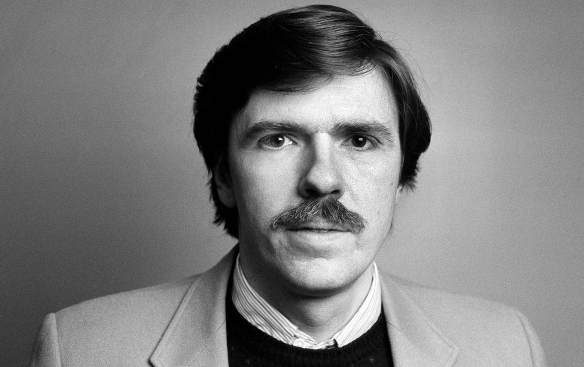
Robert Parry in Washington, D.C. (AP, February 1987)
By Norman Soloman
Source: TheRealNews.com
After Robert Parry died on January 27, I asked another great investigative journalist, Seymour Hersh, for some words. “I ran into Bob more than three decades ago when he was the first to warn of the Iran/Contra affair, to little avail,” Hersh replied. “He was widely seen over the next years as a critic of the mainstream media in America. That was not so. He was a critic of lousy reporting, be it in Pravda or The New York Times. He wanted every journalist, everywhere, to do the research and the interviewing that it takes to get beyond the accepted headline.”
What made Bob Parry a trailblazer for independent journalism also made him a bridge burner with the media establishment. He refused to take on faith the official story, whether from governments or news outlets. After winning acclaim, including a Polk Award, as an Associated Press reporter who broke many big stories on deadly US policies in Central America, he spent three years at Newsweek—where he saw top editors collaborating with officials of the George H.W. Bush administration on what should be shared or withheld from the public. Bob left the magazine in 1990, and soon his relations with mainstream media had a whistle-blower quality. His 1992 book Fooling America: How Washington Insiders Twist the Truth and Manufacture the Conventional Wisdom named names and pulled no punches.
Midway through the decade, Bob did a stint as director of the Nation Institute’s investigative unit. His writing for The Nation during 1996 included pieces about the CIA and drug trafficking by the Nicaraguan contras, the bankrolled power of right-wing foundations, and a seven-page expose that is chilling to read more than 30 years later—an investigative report on the Koch brothers.
In 1995, Parry launched a unique journalistic space, Consortiumnews.com, where he worked intensely as publisher, editor, and writer. For the next 22 years, Parry oversaw the website’s scrutiny of elite wisdom. His work, which included authoring six books, won the I.F. Stone Medal for Journalistic Independence from Harvard’s Nieman Foundation in 2015 and, last year, the Martha Gellhorn Prize for Journalism.
I got to see Bob at work up close, in 1996, when we co-wrote a series on a media darling: “Behind Colin Powell’s Legend.” During interviews, Bob was politely unrelenting. He had a methodical zest for plowing through documents, determined to “master the material.” And he was professionally generous; I wrote just a small proportion of the articles, but he insisted that I share the byline on every one.
Bob was notably non-ideological. What propelled him was a moral core and determination to follow the facts. That devotion led him to expose the lethal deceptions and machinations of Reagan-era figures like Oliver North, Elliott Abrams, and Caspar Weinberger. Three decades later, the same resolve to separate fact from spun fiction put him on a collision course with the conventional wisdom of “Russiagate.”
No one knew better than Bob Parry how intelligence agencies and major media outlets can create a cascading frenzy. Beginning in late 2016, Bob was prolific as he debunked the torrent of hyperbolic claims about Russia that became an ever-present flood across the US media landscape. Some progressive sites went from often posting his articles in 2016 to rarely or never posting them in 2017.
“For years, the mainstream, establishment media have, by their malpractices in covering US-Russian relations from Ukraine to ‘Russiagate,’ been deeply complicit in the unfolding of this new Cold War and its unprecedented dangers,” said Russia scholar Stephen F. Cohen, a contributing editor at The Nation. “Bob Parry, very often alone, exposed those malpractices, especially those committed by the powerful New York Times and Washington Post, misreported story by misreported story, sometimes daily. For this, he was ostracized, slurred, certainly ignored by mainstream media.”
At the end of December, a week after his first stroke left him with badly blurred eyesight, Bob somehow was able to write what turned out to be his final article, brilliant and transcendent, a kind of cri de coeur that is a stunning last testament to “the journalistic principles of skepticism and evenhandedness.” Western journalists, he wrote, “now apparently see it as their patriotic duty to hide key facts that otherwise would undermine the demonizing of Putin and Russia. Ironically, many ‘liberals’ who cut their teeth on skepticism about the Cold War and the bogus justifications for the Vietnam War now insist that we must all accept whatever the US intelligence community feeds us, even if we’re told to accept the assertions on faith.”
At the close of a lengthy tribute that appeared the day after his father’s death, Nat Parry wrote that, “ultimately, Bob was motivated by a concern over the future of life on Earth. As someone who grew up at the height of the Cold War, he understood the dangers of allowing tensions and hysteria to spiral out of control, especially in a world such as ours with enough nuclear weapons to wipe out all life on the planet many times over.”
Robert Parry carried the lantern high. Now others will need to carry it on.

By Anthony Freda
Source: Medium
As it becomes increasingly clear that yesterday’s conspiracy theories are today’s real news, the call to kill the messengers just gets more shrill and hysterical.
The attacks on free speech with high-tech censorship campaigns and old-fashioned hit pieces in the “War on Fake News” are massive and concerted.
The book burners are starting so many fires it’s impossible to stamp them all out.
What are the horrible thought crimes committed by the alternative press?
The new media has consistently exposed the lies and crimes of our corrupt and broken institutions.
Pioneers of alt media have passionately and convincingly made the case that The Patriot Act literally reversed the gains to human liberty codified in The Bill of Rights.
Independent media dismantled the lies that were presented as the pretexts to the invasion of Iraq. The same lies aggressively promoted by Bush, Hillary Clinton, CNN and The New York Times and that resulted in the death of a million people and global chaos. By contrast, how many people have died as a result of alternative media reports? The answer is zero.
The independent press interviewed NSA whistle-blowers who accurately described how the U.S. government was illegally spying on its citizens and retaining our data, and how these whistle-blowers were being persecuted by their own government for coming forward and refusing to break the law.
This was years before anyone heard of Edward Snowden.
Amazingly, there was very little interest in these bombshell allegations in the mainstream press.
It’s hard to believe now, but in those days, people who claimed the government was spying on innocent citizens were dismissed as paranoid by the self-proclaimed arbiters of truth at the NYT and CNN.
Grassroots media detailed a decade ago how police forces all over America were becoming militarized and predicted that this dangerous trend would lead to racially charged conflict on the streets of the nation. What kooks!
We have also railed against; torture, needless wars, police brutality, government corruption, the two-party duopoly, the criminality of the banksters and the end of privacy.
Now the very same mainstream media hacks who promoted the lies that lead to war in Iraq and Libya and mindlessly regurgitate whichever talking point is uploaded onto their teleprompter are gleefully assassinating what they call “fake news” using edited tape and misleading hit-pieces.
While these discredited war cheerleaders lie about why our sons and daughters are sent to die, we are bravely exposing the fraudulent casus belli they traitorously and disgracefully promote.
While these corporate spokespeople work for the interests of the oil and drug companies and political forces that pay their salaries, we risk everything to expose the crimes and scams of these same broken institutions.
We have done a great public service by exposing the deceptive, psychological methods used by the ruling elite to warp historical narratives, manipulate patriotism and manufacture consent.
By helping people to recognize and suspend their belief in propaganda and therefore their own complicity in it, the alternative media is helping to create a public awareness to the tactics our enemies use to keep us divided, steal our rights and slaughter countless innocents all over the world.
I know it’s fun and easy to call us tin-foil-hat wearers, or whatever pejorative has been chosen for you today, but let’s be clear about whose dirty work some are doing. Ironically, many are using talking-points written by deep-state operatives to ridicule the idea that the deep-state exists at all!!
Alternative media is in direct competition with the mainstream media for revenue and the MSM want to control the information we are exposed to.
The MSM is waging a concerted demonization campaign aimed at destroying some of the dominant platforms exposing the lies and crimes of their corporate and deep-state masters and many are helping them do it.
The MSM is an enemy of the truth and of the people. Friends of mine have been accused of being Russian agents in The NYT because they simply told the truth about Clinton during the campaign.
The corporate press has gone from lying to the American people to lying about the American people.
Do we have the will and power to destroy our common enemy?

Photo by Adam Dean
By Robert J. Burrowes
As our world spirals deeper into an abyss from which it is becoming increasingly difficult to extricate ourselves, some very prominent activists have lamented the lack of human solidarity in the face of the ongoing genocide of the Rohingya. See ‘The Rohingya tragedy shows human solidarity is a lie’ and ‘Wrongs of rights activism around Rohingyas’.
While I share the genuine concern of the Yemeni Nobel peace laureate Tawakkol Karman and Burmese dissident and scholar Dr Maung Zarni, and have offered my own way forward for responding powerfully to the ongoing genocide of the Rohingya – see ‘A Nonviolent Strategy to Defeat Genocide’ – in my view the lack of solidarity they mention is utterly pervasive and readily evident in our lacklustre official and personal responses to the many ongoing crises in which humanity finds itself.
To mention just the most obvious: Every day governments spend $US2 billion on weapons and warfare while a billion people lack the basic resources to live a decent life (and more than 100,000 of these people starve to death). Every day millions of people live under dictatorship, occupation or suffer the impacts of military invasion. Every day another 28,800 people are forcibly displaced from their home. Every day another 200 species of life are driven to extinction. And every day our biosphere is driven one step closer to making human life (and perhaps all life) on Earth impossible. See ‘Killing the Biosphere to Fast-track Human Extinction’.
It is not as if any of this information is unavailable. Just as many people and major international organizations are well aware of the plight of the Rohingya, it is also the case that many people and these organizations are well aware of the state of our world in other respects. And still virtually nothing meaningful happens (although there are tokenistic responses to some of these crises).
Hence, it is a straightforward observation that human solidarity is notably absent in virtually any attempt to tackle the major issues of our time. And the Rohingya are just one manifestation of this problem.
Given that I have long observed this phenomenon both personally and politically, and it concerns me as well, I would like to explain psychologically why the lack of sharing and solidarity is such a pervasive problem and suggest what we can do about it.
In order to feel concern for those who are suffering, and to want to act in solidarity to alleviate their suffering, it is necessary to experience certain feelings such as sympathy, empathy, compassion, love and (personal) power. Moreover, it is necessary that these feelings are not suppressed or overwhelmed by fear and, equally importantly, not overwhelmed by a feeling of (unconscious) self-hatred. If someone is scared and full of unconscious self-hatred, then they can have little interest in sharing their own resources or acting in solidarity with those who need help. And this applies whether the adversely impacted individual is a close relative or friend, or someone on the other side of the world.
So why is fear in this context so important? Simply because fear grotesquely distorts perception and behaviour. Let me explain why and how.
If an individual is (consciously or unconsciously) frightened that one or more of their vital needs will not be met, they will be unable to share resources or to act in solidarity with others, whatever the circumstances. In virtually all cases where an individual experiences this fear, the needs that the individual fears will not be met are emotional ones (including the needs for listening, understanding and love). However, the fearful individual is never aware of these deep emotional needs and of the functional ways of having these needs met which, admittedly, is not easy to do given that listening, understanding and love are not readily available from others who have themselves been denied these needs.
Moreover, because the emotional needs are ‘hidden’ from the individual, the individual (particularly one who lives in a materialist culture) often projects that the need they want met is, in fact, a material need.
This projection occurs because children who are crying, angry or frightened are often scared into not expressing their feelings and offered material items – such as a toy or food – to distract them instead. The distractive items become addictive drugs. This is why most violence is overtly directed at gaining control of material, rather than emotional, resources. The material resource becomes a dysfunctional and quite inadequate replacement for satisfaction of the emotional need. And, because the material resource cannot ‘work’ to meet an emotional need, the individual is most likely to keep using direct and/or structural violence to gain control of more material resources in an unconscious and utterly futile attempt to meet unidentified emotional needs.
This is the reason why people such as the Rothschild family, Jeff Bezos, Bill Gates, Warren Buffett, Amancio Ortega, Mark Zuckerberg, Carlos Slim, the Walton family and the Koch brothers as well as the world’s other billionaires and millionaires seek material wealth, and are willing to do so by taking advantage of structures of exploitation held in place by the US military. They are certainly wealthy in the material sense; unfortunately, they are utterly terrified (and full of self-hatred) and each of them justly deserves the appellation ‘poor little rich boy’ (or girl).
If this was not the case, their conscience, their compassion, their empathy, their sympathy and, indeed, their love would compel them to use or disperse their wealth in ways that would alleviate world poverty and nurture restoration of the ancient, just and ecologically sustainable economy: local self-reliance. See ‘The Flame Tree Project to Save Life on Earth’.
Of course, it is not just the billionaires and millionaires of the corporate elite who have suffered this fate.
Those intellectuals in universities and think tanks who accept payment to ‘justify’ (or simply participate in without question) the worldwide system of violence and exploitation, those politicians, bureaucrats and ordinary businesspeople who accept payment to manage it, those judges and lawyers who accept payment to act as its legal (but immoral) guardians, those media editors and journalists who accept payment to obscure the truth, as well as the many middle and working class people who accept payment to perform other roles to defend it (such as those in the military, police, prison and education systems), are either emotionally void or just too frightened to resist violence and exploitation, in one or more of its many manifestations.
Moreover, governments that use military violence to gain control of material resources are simply governments composed of many individuals with this dysfunctionality, which is very common in industrialized countries that promote materialism. Thus, cultures that unconsciously allow and encourage this dysfunctional projection (that an emotional need is met by material acquisition) are the most violent both domestically and internationally. This also explains why industrialized (material) countries use military violence to maintain political and economic structures that allow ongoing exploitation of non-industrialized countries in Africa, Asia and Central/South America.
But, equally importantly, many ‘ordinary’ people are just too scared to share (more than a token of) what they have and to act in solidarity with those who suffer whether through military or other violence, exploitation, persecution, oppression or occupation. Of course, it takes courage to resist this violent world order. But underlying courage is a sense of responsibility towards one’s fellow beings (human and otherwise) and the future.
As noted above, however, fear is not the only problem. Two primary outcomes of fear are self-hatred and powerlessness. Here is how it happens.
When each of us is a child, if our parents, teachers and/or the other adults around us are frightened by a feeling – such as sadness, anger or fear – that we are expressing, then they will use a variety of techniques to stop us expressing this feeling. They might, for example, comfort us to stop us crying, scare us out of expressing our anger (particularly at them) and reassure us so that we do not feel afraid.
Tragically, however, responses such as these have the outcome of scaring us into unconsciously suppressing our awareness of how we feel when, of course, evolutionary pressures generated emotional responses (some pleasant, some less so) to events in our life in order to help guide us into behaving appropriately at any given moment. And this suppression of how we feel is disastrous if we want children to grow up behaving functionally. This is more fully explained in ‘Why Violence?’ and ‘Fearless Psychology and Fearful Psychology: Principles and Practice’.
So where does self-hatred fit into all of this? Well, if a child is angry in response to some violence to which they are being subjected (usually, of course, in an attempt to control their behavior), then they will attempt to defend themselves against this violence in an effort to persevere with their original intention.
However, if the child is then terrorized into submission by a parent or other adult (by being threatened with or experiencing some form of violence, often given the inaccurate label of ‘punishment’) the child will be compelled to unconsciously suppress their awareness of the original feelings, including anger, that were generating their behavior.
Unfortunately, there is a heavy cost to this suppression because each child is genetically programmed to follow their own self-will (manifesting through such mental functions as thoughts, feelings and conscience) rather than to obey the will of another (whether it be parent, teacher, religious figure or anyone else).
Hence, if a child is successfully terrorized into not behaving in accordance with their own self-will, they will experience a strong feeling of self-hatred precisely because they have submitted, out of fear, to the will of another.
Conscious self-hatred is an intensely unpleasant feeling to experience, however, and because the child is systematically terrorized out of expressing and acting on most of their feelings (which is why 100% of children go to school wherever school is available and compulsory: children are not given freedom of choice) the feeling of self-hatred is suppressed along with these many other feelings. Having learned to do this, subsequent opportunities for this self-hatred to be felt are progressively more easily suppressed.
An unconscious feeling does not ‘go away’ however; it is unconsciously projected elsewhere. Suppressed self-hatred is always unconsciously projected as hatred of someone else, some other group (usually of another sex, race, religion or class) and/or something else, often in imitation of the violent parent/adult (because imitation will be given ‘permission’ by the violent parent/adult). And this inevitably leads to destructive behaviors towards that individual, group and/or the ‘something else’ (including the Earth’s environment).
But, and this is important to recognize, this destructive behaviour might simply manifest as inaction: doing nothing in response to someone else’s (or the Earth’s) obvious need.
So the unconscious fear and self-hatred are projected as fear of and hatred for living beings as well as the Earth, and manifests as behavior that is destructive, often by inaction, of themselves, others and the planet.
The tragic reality is that it takes very little violence to terrorize a child and this is why a substantial proportion of the human population is consumed by their own fear and self-hatred, and feels powerless as a result. Consider the people immediately around you: many spend most of their time, consciously or unconsciously, abusing themselves, others and/or the environment, and doing nothing in response to the plight of our world.
So what can we do?
Given existing parenting practice, fear and self-hatred are not easily avoided although they are not necessarily all-consuming. But to be free of them completely requires just one thing: the fearlessness to love oneself truly. What does this mean?
To love yourself truly, you must always courageously act out your own self-will, whatever the consequences. This requires you to feel all of your emotional responses – fear, sadness, anger, pain, joy, love … – to events, including impediments, in your life. See ‘Feelings First’. It is only when you do this that you can behave with awareness: a synthesis of all of the feedback that your various mental functions give you and the judgments that arise, in an integrated way, from this feedback. See ‘Human Intelligence or Human Awareness?’
At first glance loving yourself and acting out your own self-will might sound selfish. But it is not. Self-love is true love. The individual who does not truly love themself cannot love another. Nor will they feel such emotional responses as compassion, empathy and sympathy. Hence, this individual will not seek mutually beneficial outcomes in tackling conflict, will not seek distributive justice in resource allocation, will not value ecological sustainability and will not act in solidarity with those who are suffering. It is this individual, who is terrified, self-hating and powerless, who will act selfishly.
In addition to courageously acting out your own self-will, you might also consider making ‘My Promise to Children’.
And if you love yourself enough to be part of the struggle to end the violence and exploitation of those who are full of fear and self-hatred, you might like to consider signing the online pledge of ‘The People’s Charter to Create a Nonviolent World’ and/or using sound nonviolent strategy for your campaign or liberation struggle. See Nonviolent Campaign Strategy or Nonviolent Defense/Liberation Strategy.
Those who are terrified and self-hating never will.
Biodata: Robert J. Burrowes has a lifetime commitment to understanding and ending human violence. He has done extensive research since 1966 in an effort to understand why human beings are violent and has been a nonviolent activist since 1981. He is the author of ‘Why Violence?’ His email address is flametree@riseup.net and his website is here.
Websites:
Nonviolence Charter
Flame Tree Project to Save Life on Earth
‘Why Violence?’
Feelings First
Nonviolent Campaign Strategy
Nonviolent Defense/Liberation Strategy
Anita: Songs of Nonviolence
Robert Burrowes
Global Nonviolence Network
INDIAN COUNTRY NEWS
"It is the duty of every man, as far as his ability extends, to detect and expose delusion and error"..Thomas Paine
Human in Algorithms
100% Accurate Google Sheets + KDP Book Formatting | 24hr Delivery
From the Roof Top
I See This
blog of the post capitalist transition.. Read or download the novel here + latest relevant posts
अध्ययन-अनुसन्धानको सार

