Neo-Liberalism and the Retreat of Democracy

By David Schultz

Source: CounterPunch

Democracy across the world is under siege. This according to the latest Freedom House report documenting that for 2017, “democracy faced its most serous crisis in decades” as seventy-one countries experienced declines in freedom or fair government, including the United States, and only thirty-five an improvement. This was the twelfth consecutive year of decline in democracy world-wide.

The question is why? Why has confidence in democracy retreated? Freedom House does not provide an answer, but there is a reason. It is democracy’s marriage to neo-liberal capitalism has fostered the conditions leading to its own undoing, similar to the way Karl Marx once described in the Communist Manifesto the “gravedigger thesis” (What the Bourgeoisie therefore produces, above all, are its own grave diggers”) where capitalism would produce the conditions that would undermine its own existence.

From the 1960s until the early 1990s democracy was in the upswing internationally. African de-colonization produced initially popularly elected governments. In South America the demise of strongmen led to a wave of democratic regimes. And the fall of the Berlin Wall in 1989 and the break up of the USSR in 1991 produced the dismantling of communist authoritarian or totalitarian governments that made it possible for Francis Fukuyama to proclaim that democracy had won and emerged as the last grand global political meta-narrative.

Yet several problems upset this rosy picture. Most prominently, it was the marriage of these new emerging democracies with free market capitalism and the victory of neo-liberalism. Internationally as post-colonial and post-communist countries emerged, international organizations such as the World Bank and the IMF forced them to adopt market reforms, often pushing them into what was then called “shock therapy.” Shock therapy involved rapid privatization of state owned enterprises and rapid dismantling of welfare states. This shock therapy was often accompanied by significant corruption as a few rich oligarchs emerged who came to own these newly privatized state enterprises.

Simultaneously, emerging democracies were rapidly pushed into what sociologist Immanuel Wallerstein would call the world-capitalist system. This system turned politically to right in the 1970s and 1980s as Margaret Thatcher in the United Kingdom and Ronald Reagan in the United States pushed neo-liberalism or market fundamentalism as an alternative to the Keynesian welfare state that had dominated the west since the 1930s. It was adopted both for ideological reasons and because of what political economist James O’Connor would call the fiscal crisis of the state tht affect economics across the world in the 1970s. This was a crisis of declining profit among private businesses and therefore declining revenue for states to fund welfare programs. Something had to give, and it was the welfare state.

Neo-liberalism is a political economic theory of the state committed to the laissez-faire market fundamentalism ideology that traces back to Adam Smith and David Ricardo. It includes a belief in comparative advantage, a minimalist state, and market freedom, and is, as articulated in the 1990s and 2000s, driven by finance capital. At the state level, neo-liberalism defines a theory of public administration. If neo-liberalism includes a commitment to market fundamentalism, then that also means that it is dedicated to a politics of limited government. This includes privatization, deregulation, and a scaling back of many traditional functions that capitalist and communist states had performed since at least World War II. But neo-liberalism as a theory transcends the state, providing also an international economic theory committed to free trade and globalism.

This emergence of neo-liberalism in the 1970s and its linkage to democracy is central to the crisis affecting the latter. As neo-liberalism retrenched the welfare state and pushed globalism it was accompanied by a dramatic increase in economic inequality in the world, as Thomas Piketty has pointed out. This occurred in the US and much of the western world. But it also impacted newly emerging democracies in Africa, Eastern Europe, and South America. Pressures for shock therapy market reforms, austerity, and open borders meant export of jobs to other countries, dismantling of social safety nets, and other economic pressures placed on governments and ruling parties.

Politically voters turned on globalism and free trade. This happened here with Trump voters in 2016, but also in Brexit in the UK. But many voters also blamed immigrants for the loss of jobs or social unrest in places ranging from France, to Italy, to Hungary. The increasing economic gap between rich and poor and, more importantly, the erosion of the economic conditions of the working class soured them on democracy. This paved the way for the emergence of strongmen as political leaders, the rise of far-right nationalist parties, and disenchantment with democracy and democratic structures to deliver the economic goods.

What we see today then in terms of the decline in support for democracy across the world is a product of its marriage to neo-liberalism. Capitalism and democracy always had an uneasy co-existence, but the neo-liberal democracy variant demonstrates the powerful contradictions in them. Either their linkage is producing outright rejection of democracy or a populist, rightist version that is merely democracy in form but not in substance.

A Zen Master Explains the Art of ‘Letting Go’, And It Isn’t What You Think

By Christina Sarich

Source: Waking Times

Thich Naht Hanh, the Zen Buddhist master, has some interesting advice about what it means to truly let go. Many people mistake detachment or non-clinging to be a form of aloofness, or emotional disconnect from others, but as Hanh explains, truly letting go often means loving someone more than you have ever loved them before.

The Buddha taught that detachment, one of the disciplines on the Noble Path, also called ariyasaavaka, is not a physical act of withdrawal or even a form of austerity. Though the Buddha teaches of a “non-action which is an integral part of the Right Way,” if it is taken out of context it can give the impression that we should develop a lack of concern for others, and that we should live without truly feeling or expressing our emotions – cutting ourselves off from life.

These type of misinterpretations are sadly common, since there are not always direct translations from the Paali language into English.

This form of “detachment” is an erroneous understanding of the Buddha’s message. Master Hanh states that to truly let go we must learn to love more completely. Non-attachment only happens when our love for another extends beyond our own personal expectations of gain, or our anticipation of a specific, desired outcome.

Hanh describes four forms of complete detachment, which surprisingly, aren’t about holing yourself up in a cave and ignoring everyone who has broken your heart, or ignoring your lust or desire for a romantic interest. This is not detachment. Letting go, means diving in. For example:

Maitri (Not the Love You Know)

Hanh describes the importance of Maitri, not love as we normally understand in a Westernized use of the word. He states,

“The first aspect of true love is maitri (metta, in Pali), the intention and capacity to offer joy and happiness. To develop that capacity, we have to practice looking and listening deeply so that we know what to do and what not to do to make others happy. If you offer your beloved something she does not need, that is not maitri. You have to see her real situation or what you offer might bring her unhappiness.”

In other words, your detachment may come in accepting that certain things you would normally do to make another person feel loved and appreciated may not be what the person you are actively loving now, needs. Instead of forcing that behavior on another person, with an egoic intent to “please” them, you simply detach from that need in yourself, and truly observe what makes another person feel comfortable, safe, and happy.

Hanh further explains,

We have to use language more carefully. “Love” is a beautiful word; we have to restore its meaning. The word “maitri” has roots in the word mitra which means friend. In Buddhism, the primary meaning of love is friendship.”

Karuna (Compassion)

The next form of true detachment is compassion. When we let go, we don’t stop offering a compassionate touch, word, or deed to help someone who is in pain. We also don’t expect to take their hurt or pain away. Compassion contains deep concern, though. It is not aloofness It is not isolation from others.

The Buddha smiles because he understands why pain and suffering exist, and because he also knows how to transform it. You become more deeply involved in life when you become detached form the outcome, but this does not mean you don’t participate fully – even in others’ pain.

Gratitude and Joy

In truly letting go you practice gratitude. Mudita, or joy arises when we are overcome with gratitude for all that we have, such that we no longer cling to some other longed-for result. The Buddha’s definition of joy is more like “Unselfish joy.” It means that we don’t only find happiness when something good happens to us, but when others find happiness.

If you’ve ever had to say goodbye to a love or friend so that they could continue on their life’s path – one that may not have continued to intertwine with your own – you may have felt pain when they found someone new to love, or made a new friend that seemed to take your place. This is not true detachment. Joy arises when you find happiness even when others find joy – and it has little or nothing to do with you.

Upeksha (Equanimity)

Master Hanh describes the final quality of true love which sheds inordinate light on the true process of letting go.

He states,

The fourth element of true love is upeksha, which means equanimity, non-attachment, nondiscrimination, even-mindedness, or letting go. Upa means “over,” and iksha means “to look.” You climb the mountain to be able to look over the whole situation, not bound by one side or the other. If your love has attachment, discrimination, prejudice, or clinging in it, it is not true love.


People who do not understand Buddhism sometimes think upeksha means indifference, but true equanimity is neither cold nor indifferent. If you have more than one child, they are all your children. Upeksha does not mean that you don’t love. You love in a way that all your children receive your love, without discrimination.”

Hanh explains that without this quality our love tends to become possessive – a stomping ground of the ego. We try to put our beloved in our pocket and carry them with us, when they are more like the wind, or a butterfly, or a stream, needing to move and flow, or risk dying. This is not love, this is destruction.

For love to be true love, it must have elements of compassion, joy, and equanimity – and this is truly letting go.

The Art of Letting Go is Artless

The real secret is that letting go is not an art, it is an allowing, a being. A non-attached relationship is healthy, strong and filled with effortless love, kindness and compassion. It is completely selfless because your sense of ‘self’ is no longer asserted in every situation. If you want to truly let go, you’ve got to love more, not less. This is the most common misunderstanding about this priceless teaching of the Buddha.

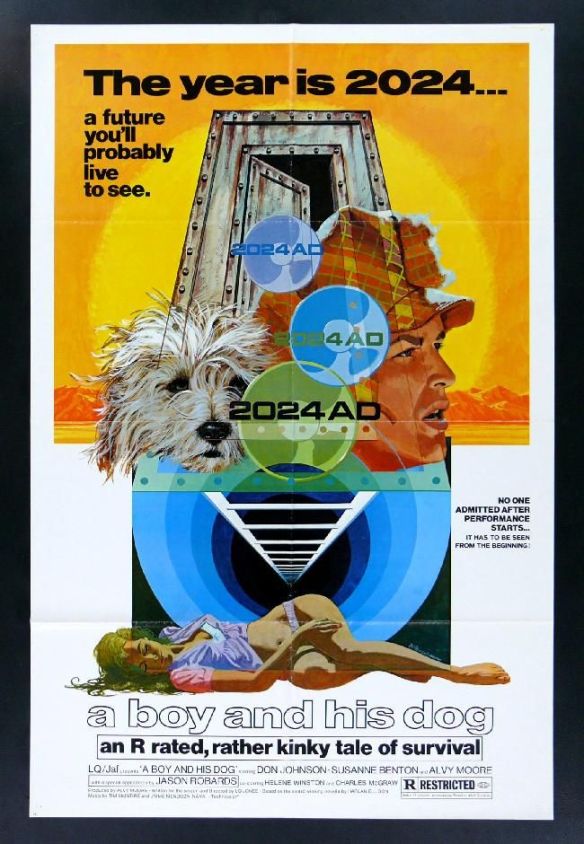
Saturday Matinee: A Boy and His Dog

The great science fiction writer Harlan Ellison recently passed away on June 27. Whether or not one is familiar with his large body of work (the majority of which are short stories), “A Boy and His Dog” (1975), is definitely worth watching. It’s the first and best feature film adaptation of one of Ellison’s stories and features Don Johnson as Vic who, with his dog Blood, struggles to survive the post-apocalyptic wasteland that the southwestern U.S. has become in 2024.

Technology giants hold censorship meeting with US intelligence agencies

By Will Morrow

Source: WSWS.org

The New York Times and Washington Post this week published reports of a private meeting last month between eight major technology and social media corporations and the US intelligence agencies, to discuss their censorship operations in the lead-up to the November 2018 mid-term elections.

The meeting was convened at Facebook’s Menlo Park, California, headquarters on May 23, and was attended by representatives from Amazon, Apple, Google, Microsoft, Snap, Twitter and Oath, which owns Yahoo and the telecommunications network Verizon, along with agents from the FBI and the Department of Homeland Security.

The Post described the meeting, organized at the request of Facebook, as a “new overture by the technology industry to develop closer ties to law enforcement.” Both articles were based on anonymous statements by individuals who attended. One attendee told the Post that the conversation was a “back-and-forth, with both sides talking about how they were thinking about the problem and how we were looking for opportunities to work together.”

The meeting is yet another testament to the increasing integration of the technology giants with the US military/intelligence apparatus. These companies, which provide a growing share of the technical infrastructure for the repressive apparatus of the state, increasingly see the censorship of left-wing, anti-war, and progressive viewpoints as an integral part of their business strategy.

Amazon, Microsoft and Google are competing to secure control over a $10 billion project to host the Pentagon’s Cloud infrastructure, a position that will literally mean hosting the communications between military units engaged in battle. Employees at the three companies have also written letters in recent months denouncing their provision of artificial intelligence technology to improve drone targeting (Google), facial recognition of civilians by police agencies (Amazon), and assisting in the operations of the Immigration and Customs Enforcement (Microsoft).

The Times and the Post are the main media voices for the campaign by the Democratic Party and intelligence agencies for Internet censorship, under the guise of opposing the spread of “misinformation” by the Russian government. This McCarthyite campaign is based on the totally unsubstantiated allegation that Russian “fake news” led to popular disillusionment with Hillary Clinton in the 2016 vote, and the subsequent election of Donald Trump. The newspapers’ synchronized reports therefore present last month’s meeting as aimed at preventing Russian interference in the mid-term elections.

But the real target of the censorship campaign is popular access to left-wing news sources not controlled by the corporate media, and the proliferation of oppositional social media content, such as videos of police killings, mass roundups of immigrants, military interventions, protests and exposures of corporate malfeasance and government criminality.

Since the beginning of the year, Facebook has rolled out a series of changes to its News Feed, including demoting political content in favor of so-called “personal moments,” and prioritizing content from so-called “trustworthy sources”—in reality pro-establishment propaganda outlets—including the Times and the Wall Street Journal. The social media giant has also changed its algorithms to reduce the spread of “viral videos,” which CEO Mark Zuckerberg declared are “not good for people’s well-being and society.”

Last Thursday, Facebook published an announcement by its Head of News Integrity Tessa Lyons, announcing a further expansion of these measures, including the introduction of “fact-checking” for videos and photos. The post also stated that Facebook is introducing “machine learning to help identify and demote foreign Pages that are likely to spread financially-motivated hoaxes to people in other countries.” These will work alongside Facebook’s army of “fact checkers”—i.e., censors—many of them former security and intelligence agents, who belong to the 20,000 people employed in its “security” and “moderation” department.

The “demotion” of what Facebook calls “false news” was codified in “community guidelines” published by the company in April. The guidelines state that because the suppression of “false news” is a “sensitive issue,” the company does not openly remove news stories, which would be easily detected by publishers and their followers, but does the same thing secretly: “significantly reduc[ing] its distribution by showing it lower on the News Feed.” (See: “Facebook codifies its censorship regime”)

Lyons repeated this line of argument in an interview with PBS’ Miles O’Brien on May 16. Admitting that “censoring and fully removing information unless it violates our community standards is not the expectation from our community,” Lyons explained that instead “we work to reduce the damage it can do” by restricting its proliferation. The Washington Post reported yesterday that while speaking at the International Fact Checkers Network conference last week, Lyons “told attendees that … [Facebook] will soon use machine learning to predict pages that are more likely to share misinformation.”

With the official ending of net neutrality this month, the financial oligarchy that controls both the search and social media monopolies and internet service providers has further tightened its grip over the freedom of expression on the internet, with ISPs given the prerogative to block and throttle internet content at will.

The expansion of internet censorship takes place amidst mounting pressure on whistleblower Julian Assange, the Wikileaks journalist who has been effectively imprisoned in the Ecuadorian embassy in London since 2012, where he was forced to take refuge to avoid being extradited to the US and charged for publishing evidence of US government crimes. The persecution of Assange for the “crime” of publishing the truth is aimed at intimidating whistleblowers and honest journalists all around the world.

Google , which attended last month’s meeting with the FBI and Department of Homeland Security, has altered its search engine algorithms to censor left-wing and anti-war websites, including the World Socialist Web Site, whose Google search traffic fell by three quarters in response to changes by the search engine in April 2017. There are indications that Google has recently intensified its censorship of the World Socialist Web Site, with search impressions falling by as much as one third over the past month.

In August 2017, the World Socialist Web Site published an open letter to Google demanding that it end its censorship of the internet, declaring, “Censorship on this scale is political blacklisting. The obvious intent of Google’s censorship algorithm is to block news that your company does not want reported and to suppress opinions with which you do not agree.”

We urge all readers of the World Socialist Web Site seeking to defend the freedom of expression online to contact us and join the struggle against internet censorship.

Russia-gate and the Crisis of American Exceptionalism

By Danny Haiphong

Source: Black Agenda Report

“Indications of deep unrest that occurred under Obama, such as the Occupy Wall Street movement, the Black Lives Matter movement, and the Sanders phenomena, have all been blamed on Russia.”

The era of Trump has been just as frustrating as the era of Obama. Over the last six months, I have channeled some of this frustration into the co-writing of a book with Professor of Liberation Theology Roberto Sirvent titled American Exceptionalism and American Innocence: The Fake News of US Empire. The book will consist of twenty-one chapters detailing just how important the ideologies of American exceptionalism and innocence are to the promotion of US empire, racism, and capitalist exploitation. Russia-gate was a catalyst for the work and has its own chapter in the book. The psychotic narrative has dominated political discourse in the United States for over two years with no end in sight. There was no way to avoid it.

Russia-gate is a manifestation of American exceptionalism. American exceptionalism posits that the American way of life is the most superior way of life. It is the white man’s burden personified in the nation-state. The ideology burdens Americans, defined as white and preferably capitalist, with the duty to civilize those outside of their class and racial affiliation. The twin evils of white rule and capitalist plunder reign supreme and are expanded and protected by a third evil: militarism. American exceptionalism says that war redeems the uncivilized from the perils of ungovernability, capitalist plunder leads the uncivilized to prosperity, and white rule bestows humanity itself upon the non-white world.

“American way of life is ‘white man’s burden’ personified in the nation-state.”

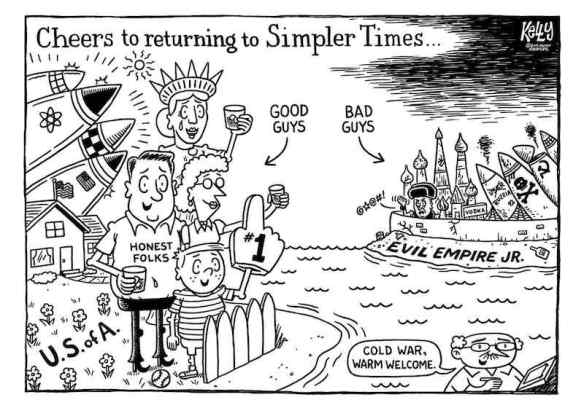
Russia-gate has profoundly challenged the logic of American exceptionalism in a period of American decline. Unlike the first Cold War, Russia has been labeled a threat not for its socialist political economy but because it has been accused of helping elect Donald Trump. The imaginary Russian threat to America is not terrorism or communism, but Russia as a state itself. Russia-gate is predicated upon the notion that the Russian Federation possesses both the will and the power to shape politics in America. This assumes that the American nation-state is neither invincible nor its political system exceptional. A contradiction to say the least.

Russia-gate is another myth of American exceptionalism made for and by the American oligarchy. It follows a long history of the American oligarchy’s need to create an “enemy” to vanquish as proof of its racial and economic superiority. Russian meddling in the 2016 elections has not been proven and will never be proven. The mental gymnastics that the US ruling class has performed to prove their own lie are truly astounding to watch. We have heard everything from Russian President Vladimir Putin conspiring with WikiLeaks and Donald Trump against Hillary Clinton to Trump benefitting from $100,000 worth in supposedly Russian purchased advertisements on social media to promote efforts of Black Lives Matter activists and white nationalists alike. It seems that with each passing day, examples of Russian meddling in US politics become only more absurd and detached from reality. That is, unless one could conceive of $100,000 worth in social media ads superseding the most militarized and high-tech surveillance apparatus in human history or the most corporately-controlled, war-thirsty political system in human history.

“The imaginary Russian threat to America is not terrorism or communism, but Russia as a state itself.”

Russia-gate has buried all truth underneath the lie that the US is under attack from Russia. Putin is under every bed and in every wireless router in America. Untold numbers of Russians are hacking into social media accounts and turning the “alt-left” into Russian trolls. Russia has been conveniently positioned as the most dangerous and heinous nation in the world to instill fear and pro-American chauvinism into the minds of struggling workers and poor people. Who better to promote the lies of American exceptionalism than the spooks in the American intelligence services that have been at the vanguard of Russia-gate since day one?

All seventeen intelligence agencies led by the likes of James Clapper and John Brennan coalesced with Hillary Clinton and her big tent of Wall Street donors to spread the Russia-gate lie back in 2016. Russia-gate’s intelligence objectives were always numerous. The first objective was to make Trump’s campaign promise to ease relations with Russia a political impossibility regardless of the orange billionaire’s actual intentions. The second was to politically neuter the Sanders wing of the Democratic Party in the aftermath of the DNC’s theft of the primary. And the third was to demonize radical and revolutionary forces capable of moving struggling workers and poor people, especially Black people, in the United States away from the two-party system and toward efforts to imagine independent political alternatives. These goals ultimately explain why publications like yours truly have been labeled dupes of Russia and subsequently censored on social media and why the Green Party’s Jill Stein was subject to federal investigation for ties to Russia.

“The mental gymnastics that the US ruling class has performed to prove their own lie are truly astounding to watch.”

American exceptionalism is a potently racist and diseased ideological force that has prevented a public discussion on the consequences of Russia-gate from taking place. We have the Democratic Party and their allies in the intelligence services to thank for this. One can find banners and signs condemning Trump as Putin’s puppet or, homophobically, as “his bitch” at Democratic Party-led demonstrations. Hardline Democrats have expressed outrage over Trump’s mythical connections to Russia but have directed none toward the professional liars leading the campaign. American intelligence agencies are responsible for the COINTELPRO operations that assassinated scores of liberation fighters like Fred Hampton and sent many others like Mumia Abu-Jamal to a life of imprisonment. They are the same liars who told us there were Weapons of Mass Destruction (WMDs) in Iraq and Gaddafi-led genocidal crimes in Libya. These professional liars have led US operations to overthrow over fifty foreign governments around the world in the same number of years, killing millions in Asia, Africa, and Latin America to enrich monopoly capital.

American exceptionalism requires that people in the US forget the atrocities of its government to be truly believed, especially in this time of crisis. The architects of Russia-gate have attempted to place the entirety of what calls itself the left in the US into a permanent political coma by blaming Russia for Trump. Under the spell of Russia-Trump fever, the racist and capitalist rulers of US imperialism can rest comfortably knowing that eight years of Obama-led imperialism — let alone, the genocidal foundations of the US — have been forgotten. Indications of deep unrest that occurred under Obama, such as the Occupy Wall Street movement, the Black Lives Matter movement, and the Sanders phenomena, have all been blamed on Russia. Trump has been vilified as a product of Russian-backed “alt-left” and “alt-right” insurgency when the reality is that the blame for Trump falls at the feet of the hobbling imperialist system.

“Russia has been conveniently positioned as the most dangerous and heinous nation in the world to instill fear and pro-American chauvinism into the minds of struggling workers and poor people.”

Russia-gate personifies everything that is wrong with narrow, Democratic Party-led anti-Trumpism. Trump has been made into a larger than life character in part because US imperialism needs him in the spotlight. If you can’t get rid of him, use him. Criminalizing Trump as a “Manchurian candidate” of Russia has given US imperialism room to continue its NATO-led war provocations in Eastern Europe, its imperial ventures in Syria, and its incessant war maneuvers toward Iran and Korea. It has also given the ruling class a convenient scapegoat to avoid accountability in the rapid decline in living standards across world. Millions are living half-lives under the threat of racist state-sponsored terror and mass unemployment and underemployment. Billions have no wealth at all. All of this is just fine so long as those pesky Russians stop meddling in US affairs.

Russia-gate is what American exceptionalism looks like in its most desperate state. The ideology makes it easy to fall into the trap of blaming Trump for everything, into calling him a fascist or worse, a Russian, as nearly the entire ruling class has pushed us into doing. It is easy to turn a blind-eye to the bi-partisan consensus on endless war and austerity when you have Putin on the brain. Trump can be labeled a fascist for scapegoating immigrants and blamed for Obama’s immigration policies, as prominent CNN and New York Times journalists were caught doing late last month. We can forget the hundreds of years of racist, capitalist oppression inherent to US empire and betray the impoverished masses whose lives are only becoming more imperiled by a system that has nothing to offer but worsening degrees of poverty and war.

“It is easy to turn a blind-eye to the bi-partisan consensus on endless war and austerity when you have Putin on the brain.”

Our commitment must be to the truth. There is no truth to Russia-gate. Russia-gate has muzzled the Black left and pushed the entire left into an even more conservative position than it was prior. Russia-gate has villainized Russia in a period when the world needs the people of the US to align with Russia and China and whoever else is willing stop endless US wars abroad. Russia-gate has once again exposed why it is so difficult for workers in the US to view themselves as an exploited class even when the system has so obviously failed them. That the ruling class can so easily criminalize Russia as it kills Syrians and lynches Black Americans with impunity only amplifies the urgency of the moment. We must vigilantly struggle to expose Russia-gate as a farce, a farce rooted in the mythology of American exceptionalism. We need more to reject this mythology if we are to participate in the global class war with any hope for victory.


Danny Haiphong is an activist and journalist in the New York City area. He is currently writing a book with Roberto Sirvent entitled American Exceptionalism and American Innocence: The Fake News of US Empire. He can be reached at wakeupriseup1990@gmail.com

USA in a Debt Trap Death Spiral

By F. William Engdahl

Source: New Eastern Outlook

The US economy and its financial structures have never recovered from the great financial meltdown of 2008 despite the passage of ten years. Little discussion has been given to the fact that the Republican Congress last year abandoned the process of mandatory budget cuts or automatic sequestration that had been voted in a feeble attempt to rein in the dramatic rise in US government debt. That was merely an added factor in what soon will be recognized as a classic debt trap. What is now looming over not just the US economy but also the global financial system is a crisis that could spell the end of the post-1944 dollar system.

First some basic background. When President Nixon, on advice of Paul Volcker, then at US Treasury, announced on August 15, 1971 the unilateral end of the Bretton Woods gold-dollar system, to replace it with a floating dollar, Washington economists and Wall Street bankers realized that the unique role of the US dollar as leading reserve currency held by all central banks and the currency for world commodity and other trade, especially oil, gave them something that appeared to be a gift from monetary heaven.

So long as the world needed US dollars, Washington could run government deficits without end. Foreign central banks, especially the Bank of Japan in the 1980’s and since the turn of the century, the Peoples’ Bank of China, would have little choice but to reinvest their surplus trade dollar earnings in interest-bearing AAA-rated US Treasury securities. This perverse dollar system allowed Washington to finance its wars in faraway places like Afghanistan or Iraq with other peoples’ money. During the Administration of George W. Bush, when Washington’s annual budget deficit exceeded annually one trillion dollars, Vice President Dick Cheney cynically quipped, “debt doesn’t matter; Reagan proved that.” Up to a point that appeared so. Now we are getting dangerously near to that “point” where debt does matter.

Federal Debt Rise

There are generally speaking three major divisions of debt measured in the US economy: Federal debt of Washington, corporate debt and private household debt. Today, owing in large part to ten years of historic low interest rates following the largest financial crisis in history–the 2007-2008 sub-prime crisis that became a global systemic crisis after September 2008–all three sectors have borrowed as if there was no tomorrow because of the near-zero Federal Reserve interest rates and their various Quantitative Easings. Nothing so radical can last forever.

Since the financial crisis erupted in 2008 US Federal debt has more than doubled from $10 trillion to over $21 trillion today. Yet conditions were made manageable by a Federal Reserve emergency policy that dealt with the financial and banking crisis by buying almost $500 billion annually of that debt. Much of the remainder was bought by China, Japan and even Russia and Saudi Arabia. Further debt levels were restrained by the bipartisan spending caps established in the Budget Control Act of 2011 that had kept recent deficits partially in check.

Now conditions of future US Federal debt and deficit growth are pre-programmed for systemic crisis over the next several years.

‘Trumponomics’ Disaster

The economics of the Trump Tax Cuts Act of 2017, signed in December, dramatically cut certain taxes on business corporations from 35% to 21%, but did not offset that with revenue increases elsewhere. The promise is that cheaper taxes will spur economic growth. This is a myth under present economic conditions and overall public and private debt burdens. Instead, the new tax law, assuming ideal economic conditions, will decrease expected revenues by a total of $1 trillion over the next 10 years. If the economy goes into severe recession, highly likely, tax revenues will plunge and the deficits will explode even more.

What the new Trump tax cut act will do is dramatically increase the size of the US annual budget deficit. The Congressional Budget Office estimates that as early as Fiscal Year 2019 the annual deficit that must be financed by debt will reach $1 trillion. Then the Treasury Borrowing Advisory Committee expects government debt issues of $ 955 billion for FY2018, compared with $ 519 billion in FY 2017. Then for FY 2019 and 2020 the deficit will exceed $1 trillion. By 2028, ten years from now, under mild economic assumptions, the size of the USA Federal debt will rise to an untenable $34 trillion from roughly $21 trillion today, and the deficit in 2028 will exceed $1.5 trillion. And this year 2018 alone, with historically low interest rates the cost of interest only on the total Federal debt will reach $500 billion.

Zombie borrowers…time bombs

Now after almost a decade of unprecedented low interest rates to bail out Wall Street and create new asset inflation in stocks, bonds and housing, the Fed is in the early stages of what some call QT or Quantitative Tightening. Interest rates are rising and have been for the past year, so far very gradually as the Fed is being cautious. The Fed however is continuing to raise rates, and now the Fed Funds stands at 1.75% after nearly ten years at effectively zero. Were they to stop now it would signal a market panic that the Fed knew something far worse than they say.

Because never in its history has the Federal Reserve indulged in such a monetary experiment with so low rates so long, the effects of reversing are going to be as well unprecedented. At the onset of the 2008 financial crisis the Fed rates were around 5%. That is what the Fed is aiming at to return to “normal.” However, with rising interest rates, the lowest credit sector, so-called non-investment grade or “junk bonds” face domino style defaults.

Moody’s Credit Rating has just issued a warning that, barring some sort of miracle, as US interest rates rise, and they are, as much as 22% of US corporations that are being kept alive borrowing at historically low interest, not only in shale oil but in construction and utilities, so-called “zombie” corporations, will face an avalanche of mass defaults on their debt. Moody’s writes that, “low interest rates and investor appetite for yield has pushed companies into issuing mounds of debt that offer comparatively low levels of protection for investors.” The Moody’s report goes on to state some alarming numbers: since 2009, the level of global non-financial junk-rated companies has soared by 58%, representing $3.7 trillion in outstanding debt, the highest ever. Some 40%, or $2 trillion, are rated B1 or lower. Since 2009, US corporate debt has increased by 49%, hitting a record total of $8.8 trillion. Much of that debt has been used to fund stock repurchases by the companies to boost their stock price, the main reason for the unprecedented Wall Street stock market bubble.

Fully 75% of federal spending is economically non-productive including military, debt service, social security. Unlike during the 1930s Great Depression when levels of Federal debt were almost nil, today the debt is 105% of GDP and rising. Spending on national economic infrastructure including the Tennessee Valley Authority and a network of federally-build dams and other infrastructure resulted in the great economic boom of the 1950s. Spending $1.5 trillion on a dysfunctional F-35 all-purpose fighter jet program won’t do it.

Into this precarious situation Washington is doing its very best to antagonize the very countries that it needs to finance these deficits and buy the US debt—China, Russia and even Japan. As financial investors demand more interest to invest in US debt, the higher rates will trigger the default avalanche Moody’s warns. This is the real backdrop to the dangerous US foreign policy actions of the recent period. No one in Washington seems to care and that’s the alarming fact.

The Coming Collapse

By Chris Hedges

Source: Occupy.com

The Trump administration did not rise, prima facie, like Venus on a half shell from the sea. Donald Trump is the result of a long process of political, cultural and social decay. He is a product of our failed democracy. The longer we perpetuate the fiction that we live in a functioning democracy, that Trump and the political mutations around him are somehow an aberrant deviation that can be vanquished in the next election, the more we will hurtle toward tyranny. The problem is not Trump. It is a political system, dominated by corporate power and the mandarins of the two major political parties, in which we don’t count. We will wrest back political control by dismantling the corporate state, and this means massive and sustained civil disobedience, like that demonstrated by teachers around the country this year. If we do not stand up we will enter a new dark age.

The Democratic Party, which helped build our system of inverted totalitarianism, is once again held up by many on the left as the savior. Yet the party steadfastly refuses to address the social inequality that led to the election of Trump and the insurgency by Bernie Sanders. It is deaf, dumb and blind to the very real economic suffering that plagues over half the country. It will not fight to pay workers a living wage. It will not defy the pharmaceutical and insurance industries to provide Medicare for all. It will not curb the voracious appetite of the military that is disemboweling the country and promoting the prosecution of futile and costly foreign wars.

It will not restore our lost civil liberties, including the right to privacy, freedom from government surveillance, and due process. It will not get corporate and dark money out of politics. It will not demilitarize our police and reform a prison system that has 25 percent of the world’s prisoners although the United States has only 5 percent of the world’s population. It plays to the margins, especially in election seasons, refusing to address substantive political and social problems and instead focusing on narrow cultural issues like gay rights, abortion and gun control in our peculiar species of anti-politics.

This is a doomed tactic, but one that is understandable. The leadership of the party, the Clintons, Nancy Pelosi, Chuck Schumer, Tom Perez, are creations of corporate America. In an open and democratic political process, one not dominated by party elites and corporate money, these people would not hold political power. They know this. They would rather implode the entire system than give up their positions of privilege. And that, I fear, is what will happen. The idea that the Democratic Party is in any way a bulwark against despotism defies the last three decades of its political activity. It is the guarantor of despotism.

Trump has tapped into the hatred that huge segments of the American public have for a political and economic system that has betrayed them. He may be inept, degenerate, dishonest and a narcissist, but he adeptly ridicules the system they despise. His cruel and demeaning taunts directed at government agencies, laws and the established elites resonate with people for whom these agencies, laws and elites have become hostile forces. And for many who see no shift in the political landscape to alleviate their suffering, Trump’s cruelty and invective are at least cathartic.

Trump, like all despots, has no ethical core. He chooses his allies and appointees based on their personal loyalty and fawning obsequiousness to him. He will sell anyone out. He is corrupt, amassing money for himself—he made $40 million from his Washington, D.C., hotel alone last year—and his corporate allies. He is dismantling government institutions that once provided some regulation and oversight. He is an enemy of the open society. This makes him dangerous. His turbocharged assault on the last vestiges of democratic institutions and norms means there will soon be nothing, even in name, to protect us from corporate totalitarianism.

But the warnings from the architects of our failed democracy against creeping fascism, Madeleine Albright among them, are risible. They show how disconnected the elites have become from the zeitgeist. None of these elites have credibility. They built the edifice of lies, deceit and corporate pillage that made Trump possible. And the more Trump demeans these elites, and the more they cry out like Cassandras, the more he salvages his disastrous presidency and enables the kleptocrats pillaging the country as it swiftly disintegrates.

The press is one of the principal pillars of Trump’s despotism. It chatters endlessly like 18th-century courtiers at the court of Versailles about the foibles of the monarch while the peasants lack bread. It drones on and on and on about empty topics such as Russian meddling and a payoff to a porn actress that have nothing to do with the daily hell that, for many, defines life in America. It refuses to critique or investigate the abuses by corporate power, which has destroyed our democracy and economy and orchestrated the largest transfer of wealth upward in American history.

The corporate press is a decayed relic that, in exchange for money and access, committed cultural suicide. And when Trump attacks it over “fake news,” he expresses, once again, the deep hatred of all those the press ignores. The press worships the idol of Mammon as slavishly as Trump does. It loves the reality-show presidency. The press, especially the cable news shows, keeps the lights on and the cameras rolling so viewers will be glued to a 21st-century version of “The Cabinet of Dr. Caligari.” It is good for ratings. It is good for profits. But it accelerates the decline.

All this will soon be compounded by financial collapse. Wall Street banks have been handed $16 trillion in bailouts and other subsidies by the Federal Reserve and Congress at nearly zero percent interest since the 2008 financial collapse. They have used this money, as well as the money saved through the huge tax cuts imposed last year, to buy back their own stock, raising the compensation and bonuses of their managers and thrusting the society deeper into untenable debt peonage. Sheldon Adelson’s casino operations alone got a $670 million tax break under the 2017 legislation. The ratio of CEO to worker pay now averages 339 to 1, with the highest gap approaching 5,000 to 1.

This circular use of money to make and hoard money is what Karl Marx called “fictitious capital.” The steady increase in public debt, corporate debt, credit card debt and student loan debt will ultimately lead, as Nomi Prins writes, to “a tipping point—when money coming in to furnish that debt, or available to borrow, simply won’t cover the interest payments. Then debt bubbles will pop, beginning with higher yielding bonds.”

An economy reliant on debt for its growth causes our interest rate to jump to 28 percent when we are late on a credit card payment. It is why our wages are stagnant or have declined in real terms—if we earned a sustainable income we would not have to borrow money to survive. It is why a university education, houses, medical bills and utilities cost so much. The system is designed so we can never free ourselves from debt.

However, the next financial crash, as Prins points out in her book “Collusion: How Central Bankers Rigged the World,” won’t be like the last one. This is because, as she says, “there is no Plan B.” Interest rates can’t go any lower. There has been no growth in the real economy. The next time, there will be no way out. Once the economy crashes and the rage across the country explodes into a firestorm, the political freaks will appear, ones that will make Trump look sagacious and benign.

And so, to quote Vladimir Lenin, what must be done?

We must invest our energy in building parallel, popular institutions to protect ourselves and to pit power against power. These parallel institutions, including unions, community development organizations, local currencies, alternative political parties and food cooperatives, will have to be constructed town by town. The elites in a time of distress will retreat to their gated compounds and leave us to fend for ourselves. Basic services, from garbage collection to public transportation, food distribution and health care, will collapse. Massive unemployment and underemployment, triggering social unrest, will be dealt with not through government job creation but the brutality of militarized police and a complete suspension of civil liberties.

Critics of the system, already pushed to the margins, will be silenced and attacked as enemies of the state. The last vestiges of labor unions will be targeted for abolition, a process that will soon be accelerated given the expected ruling in a case before the Supreme Court that will cripple the ability of public-sector unions to represent workers. The dollar will stop being the world’s reserve currency, causing a steep devaluation. Banks will close. Global warming will extract heavier and heavier costs, especially on the coastal populations, farming and the infrastructure, costs that the depleted state will be unable to address. The corporate press, like the ruling elites, will go from burlesque to absurdism, its rhetoric so patently fictitious it will, as in all totalitarian states, be unmoored from reality. The media outlets will all sound as fatuous as Trump. And, to quote W.H. Auden, “the little children will die in the streets.”

As a foreign correspondent I covered collapsed societies, including the former Yugoslavia. It is impossible for any doomed population to grasp how fragile the decayed financial, social and political system is on the eve of implosion. All the harbingers of collapse are visible: crumbling infrastructure; chronic underemployment and unemployment; the indiscriminate use of lethal force by police; political paralysis and stagnation; an economy built on the scaffolding of debt; nihilistic mass shootings in schools, universities, workplaces, malls, concert venues and movie theaters; opioid overdoses that kill some 64,000 people a year; an epidemic of suicides; unsustainable military expansion; gambling as a desperate tool of economic development and government revenue; the capture of power by a tiny, corrupt clique; censorship; the physical diminishing of public institutions ranging from schools and libraries to courts and medical facilities; the incessant bombardment by electronic hallucinations to divert us from the depressing sight that has become America and keep us trapped in illusions. We suffer the usual pathologies of impending death. I would be happy to be wrong. But I have seen this before. I know the warning signs. All I can say is get ready.