An Open Letter to People with ‘Mental Health’ Issues

Robert J. Burrowes

As ‘mental health’ issues gain more attention, sympathetic and
otherwise, in a wide variety of contexts and countries around the world,
the opportunity for inaccurate perceptions of what causes these issues,
and how to treat them, are likewise expanded.

So if you or someone you know is supposed to have a ‘mental illness’
such as anxiety, depression, schizophrenia, obsessive-compulsive
disorder (OCD), bipolar disorder, anorexia nervosa or post-traumatic
stress disorder (PTSD), I would like to give you the opportunity to
consider an explanation and a way forward that you are unlikely to have
come across.

My first suggestion is that you ignore any label that you have been
given. These labels are an inaccurate and unhelpful way of labeling the
appropriate, diverse and complex emotional responses that a normal human
being will have to emotionally disturbing events. It is inaccurate
because words such as these imply a ‘disorder’ that a normal individual
should not have in response to emotionally challenging events in their
life and it is unhelpful because the term suggests that many different
individuals are having the same (dysfunctional) response.

Human beings have a brilliantly diverse and complex array of emotions
and hence potential emotional responses as a result of the evolutionary
pressures that shaped the emergence of hominids over millions of years.
An extraordinary emotional capacity is one of the defining features of
our humanity and, I would argue, far more important than any other
feature such as our intellectual capacity.

Our emotions or, more simply, our feelings play the central role in
determining our behaviour in any given circumstance. Whatever we do, we
are responding to our feelings. If we are doing what we want to do, we
are doing what we feel like doing. If we are not doing what we feel like
doing, it is because our fear has been triggered sufficiently to
override feelings that would otherwise have us doing something more
functional and enjoyable. Regrettably, human ‘socialization’ (that is,
terrorization) plays heavily on our fear during childhood in order to
turn us into obedient slaves in the forms of student, worker/soldier and
citizen. And this happens irrespective of our level of intelligence. For
a full explanation, see ‘Why Violence?

Unfortunately, once our fear has been utilized to suppress our awareness
of how we genuinely feel and what we want to do – which is sometimes
euphemistically referred to as ’emotional regulation’ – we are no longer
able to access these feelings readily and we live our lives
unconsciously and powerlessly submitting to the will of those we fear
and the institutions they control. But the price for doing so is that
our lives are no longer our own.

As a unique individual who has experienced the ongoing violent trauma
virtually all of us experience during childhood you have found yourself
experiencing a level of emotional response that is very appropriate
given your experience but which is both exacerbated and complicated by
the sudden release of feelings that you had been suppressing since
childhood (and which you are probably being told are inappropriate now).

The fear you feel (probably labeled ‘anxiety’, ‘nervousness’ or
something else) in particular (and perhaps virtually all) contexts is
also triggering the monumental fear (of your parents, teachers,
religious figures and other adults) that you were scared into
suppressing as a child.

The anger you feel about how you were treated and/or what happened to
others (perhaps siblings) you know is merely the peak of the volcano of
anger that you have been keeping the lid on since childhood.

The sadness you feel about what has happened to you and perhaps others
you know is only the tip of the iceberg of sadness you have been
suppressing all of your life.

The guilt, shame, embarrassment… you feel, perhaps about those you let
down or for some other reason, is only the latest addition to the guilt
and other feelings you have been suppressing since childhood.

Do you think I am wrong? Then consider this. Were you ever allowed to
show your fear as a child (and to act on it)? Were you allowed to cry
freely and openly? Were you allowed to get angry (at being ‘done over’
or in defense of yourself)? As often as you needed? Or were you
endlessly admonished and, one way or another, terrorized into behaving
blandly (with ‘acceptable’ feelings like love and happiness tolerated in
particular doses and circumstances).

So if you want to deal powerfully with all of the emotional responses
that are causing your so-called ‘mental illness’, here is my suggestion.
Focus on feeling each and all of your feelings. If you wake from a
nightmare, deliberately and consciously focus on the imagery in the
nightmare while you feel just how terrified you are. Focus on this
feeling for as long as you can. It will be horrendous and will take
enormous courage. But, after a time, it will start to fade and you will
feel some relief. When your fear arises again, in any context, pay
conscious attention to it. You have been suppressing it all of your
life; it just wants to be heard and felt so that you can let it go
forever.

If you feel angry, instead of trying to suppress it, harming yourself or
harming someone else (perhaps, even, someone you love), express your
anger fully and completely but in a safe way. How? Here are some
suggestions but you will need to decide what will work best for you. Get
an axe and chop wood (thinking about utterly destroying who/what is
making you angry: parents, teachers, religious figures, politicians,
military officers…) until your anger has been vented. Or smash a bat or
racquet into a mattress or cushion. Or scream (into a pillow if noise is
an issue). Or punch a punching bag. If you feel angry you need to exert
enormous physical effort to adequately express it. This might require
several hours for any one session and you might need to do a great many
sessions. Remember, you need to work off a lifetime of anger! If you can
set up a safe space for your regular anger sessions, do so. Whatever you
do, however, don’t waste your time saying or writing ‘I feel angry…’.
And don’t waste a moment of your life in an ‘anger management’ course.
Anger, like all emotions, needs to be expressed, not ‘managed’ (that is,
suppressed).

Another reason why it is important that you express your anger as I have
just suggested is because you will often discover afterwards that you
are projecting your anger. Projection is another of the creative ways
that your mind can use to give you a lead back to some of your
suppressed feelings. Projection occurs, for example, when it feels like
you are angry with your spouse for something she/he has done but, once
you fully express the feelings, you realize that, in fact, while your
spouse did something that unintentionally triggered your anger, most of
the anger is actually about someone or something from your childhood.
You cannot discover the source of the projection without fully
expressing the feelings first. Many people who routinely abuse their
spouse and/or children are trapped in a projection which is why their
anger cannot lead to greater self-awareness. People often project their
fear and sadness too: phobias are the result of projected fear, for
example, while sad films enable some people to access their suppressed
sadness.

If you feel sad or anxious or ashamed or guilty or in pain or despairing
or obsessive or depressed or hopeless or compulsive or self-hating or
humiliated or anything else, just let yourself feel it, deeply. And let
it manifest in its own way: cry (if that is what happens when you feel
sad), shake (if that is what happens when you feel scared), feel guilty
or hopeless, feel horrible or …. Deliberately. Consciously. For as long
as it lasts or for as long as you are able to do at the time.

If you feel a sensation in your body, such as muscle tension or a pain
or a sense of contamination, focus on where you feel it and how it
feels. Eventually, after feeling the feelings from this sensation (which
might take very many sessions), you will discover why the sensation
originated and learn what it is trying to teach you.

If you feel suicidal it will often be because you are unconsciously
suppressing another shocking feeling that feels beyond your courage to
feel consciously, such as the feeling of self-hatred for something
shameful you have done, and suicide will seem the best way out. The
suicidal feeling might also arise out a sense of hopelessness or a
desire for release from enormous emotional and/or physical pain. Suicide
is an option that no-one should ever take from you, and I would never do
so, but I gently encourage you to focus on any suicidal feeling in the
belief that the underlying feeling – self-hatred, pain or something else
– will eventually be relieved and the urge to destroy yourself will pass
allowing you to keep traveling the journey of healing.

At this point, I should add that consciously focusing on feeling
physical pain (as a result of injuries or otherwise) is an important
element of any comprehensive healing strategy too.

As you have realized by now, this process of feeling isn’t necessarily
fun and my suggestion runs directly counter to our ‘feel good’ culture
which emphasizes ‘positive’ feelings while teaching you to suppress
‘negative’ ones. However, feeling your suppressed feelings will be,
ultimately, liberating and will progressively restore you to a life of
authenticity: a superior version of the life of dignity, honour and
courage that you once had (or should have had).

If new symptoms arise as you travel your healing journey and even if
these involve difficult feelings, it will usually be a sign that you are
making solid progress in uncovering the original sources of your
emotional ‘ill-health’. These symptoms, if any, simply provide another
opportunity for you to focus on how you feel. Take advantage of them
until they fade so that you learn what they are teaching you.

Another suggestion I have is to alter your diet to the consumption of
organically-grown, vegetarian whole (unprocessed) food so that your
brain gets the nutrition it needs to heal and function well. This also
means that you should discontinue using any drugs that are supposed to
suppress your awareness of your anxiety, depression, OCD, PTSD…
particularly given that psychiatric drugs might generate new symptoms,
worsen your existing symptoms and/or even cause brain damage. If you are
addicted (whether to psychiatric drugs, alcohol or illicit drugs), you
might consider consulting a natural health practitioner (such as a
homeopath or naturopath) who is familiar with assisting people to
withdraw from drugs and to detoxify their bodies, or consider buying the
Charlotte Gerson book ‘Healing the Gerson Way: Defeating Cancer and
other Chronic Diseases’ so that you can undertake Gerson Therapy at home to eliminate all of your physical drug addictions. Alternatively, you might consult the ‘Mad in America‘ website for other methods on how to safely and easily break your addictions.

In addition, I strongly encourage you to discontinue seeing all of those
psychiatrists, psychologists, psychotherapists, counsellors and doctors
(unless they qualify as specified below) who are more terrified of the
natural expression of your feelings than are you (and probably only
offer time-limited sessions). See ‘Defeating the Violence of
Psychiatry‘. You need to feel all of your feelings which have been an appropriate emotional
response to the terror of your childhood. It is feeling our feelings
that allows us to move on from violence and trauma to lead a meaningful
life. Evolution is not stupid even if many of its human products have,
indeed, been stupefied.

If you are lucky enough to know someone (relative, friend or
professional) who feels capable of listening to you while you talk about
violent/traumatic experiences (and thus enable your feelings to surface
more readily) and you trust them to do so, I encourage you to take
advantage of the listening. Ideally, this should happen on a daily basis
with each session lasting for as long as you need it.

Talk about your experiences (or don’t talk if you find this difficult)
but spend time focusing on how you feel about these experiences. Choose
an unpleasant memory from your past and focus on the feelings – sadness,
fear, anger, shame, guilt… – that arise as you talk and then think about
that memory. Keep replaying the memory as often as it feels productive
to do so, until the feelings attached to that memory have all been
felt/expressed and the memory is no longer difficult to contemplate. If
the feelings attached to a particular memory feel too horrible for you
to feel now, choose a memory with feelings that feel manageable and
tackle them first. The more horrible memories will wait until you feel
capable of feeling them because the courage you need to feel your worst
fears will gradually accumulate.

The listener should listen in silence (even if you are not speaking)
and, if capable of doing so, occasionally reflect any of your feelings
they can hear ‘beneath’ the words you are speaking; for example, ‘You
sound scared of your mother/father’ or ‘You sound angry that your
teacher forced you to do something against your will’. If the reflection
is accurate, keep focusing on how you feel by imagining what is bringing
up the feeling. If you feel like crying, then cry. If you need to get
angry, do so in the way that works for you (as mentioned above). And so
on. You are the only one who can interpret your feelings, nightmares,
dreams and other emotional experiences and you should ask any listener
to let you do so. Discourage any listener from reassuring or advising
you; deal with the reality of how you feel, finally, and discover your
own way forward. For more detail, see ‘Nisteling: The Art of Deep
Listening‘.

If you don’t know anyone who can listen without being triggered into
feelings of their own (because they are scared by what happened to
you/them) then you are better off listening to yourself. That means
having regular sessions, preferably on a daily basis, in a safe space
you have created when you allow yourself to deliberately focus on
traumatic experiences and to feel each and all of the feelings,
sometimes in combination, that arise when you do. It will sometimes mean
that you need to abandon what you are doing because something triggers a
sudden rush of feelings that demand your attention immediately. Not very
convenient I know, but neither were your traumatic experiences as a
child.

If you want more information about the process I have described above,
see Anita McKone ‘Fearless Psychology and Fearful Psychology: Principles
and Practice‘.

How long will it take? For many of you it will take a very long time,
perhaps several years of regular sessions. I would like to tell you
otherwise but you have been lied to far too often already – there are no
quick fixes to the emotional trauma you are suffering – and I won’t
insult you by doing so again. Having said ‘it will take a very long
time’, I will add that every individual has a unique healing journey
and, whatever the difficult feelings involved, each session of feeling
is a session of healing – which might reveal an important insight about
your life – and will take you one step closer to gaining a life free of
mental ill-health and full of emotional power.

In essence, it is vastly superior strategy to provide yourself with a
safe space in which your feelings can arise naturally so that you can
feel and express them, safely and completely, rather than endlessly try
to suppress them (but have them manifest ‘out of control’ anyway).

If you have a spouse or child who has been traumatized by your
behaviour, the information in this article is equally valid for them
too. In fact, it is useful information for any person because,
tragically, we were all terrorized during childhood.

Obviously, I haven’t dealt with every issue – like ‘How do I recover
from my emotional devastation when I need to work?’ or ‘How do I recover
emotionally if I have difficult physical injuries too?’ – so I am going
to have to trust you to work out answers to any unanswered questions. I
am just explaining how you can emotionally restore yourself.

Finally, if your life experience generally leaves you inclined to
believe that humans can do better than inflict mass violence on each
other in attempts to ‘resolve’ their conflicts, then you might consider
signing online ‘The People’s Charter to Create a Nonviolent World‘.

In conclusion, I want to summarize your options, which are the options
open to any human. You stand at the fork of two paths. The first path is
the one that takes you further along the journey that you are traveling,
offering you more of what you have now.

The second path, outlined above, offers you a long journey of difficult,
frightening and painful emotional healing – with regular periods of
relief and rewarding insights about your life – which will, if traveled,
lead you to a vastly superior version of your old life.

The third path, which will only open to you once you have traveled the
second path for a considerable time, will provide an encounter with ever
deeper layers of suppressed fear, sadness, pain, anger, shame, guilt,
anxiety, dread, humiliation, self-hatred … terror, fury … until its end
many years later (although your capacity to cope with such horror will
be steadily growing all of the time). At the end of this third path,
should you choose to travel it and once your final layer of suppressed
terror has been felt, you will become the person that evolution intended
you to be on the day you were born.


Biodata: Robert J. Burrowes has a lifetime commitment to understanding
and ending human violence. He has done extensive research since 1966 in
an effort to understand why human beings are violent and has been a
nonviolent activist since 1981. He is the author of ‘Why Violence?
His email address is flametree@riseup.net
and his website is at http://robertjburrowes.wordpress.com


Robert J. Burrowes
P.O. Box 68
Daylesford
Victoria 3460
Australia
Email: flametree@riseup.net

Websites:
Nonviolence Charter
Flame Tree Project to Save Life on Earth
‘Why Violence?’
Nonviolent Campaign Strategy
Nonviolent Defense/Liberation Strategy
Anita: Songs of Nonviolence
Robert Burrowes
Global Nonviolence Network

Saturday Matinee: Obsolete

Source: Truthstream Media

The Future Doesn’t Need Us… Or So We’ve Been Told. With the rise of technology and the real-time pressures of an online, global economy, humans will have to be very clever – and very careful – not to be left behind by the future. From the perspective of those in charge, human labor is losing its value, and people are becoming a liability. This documentary reveals the real motivation behind the secretive effort to reduce the population and bring resource use into strict, centralized control. Could it be that the biggest threat we face isn’t just automation and robots destroying jobs, but the larger sense that humans could become obsolete altogether? *Please watch and share!* Link to film: http://amzn.to/2f69Ocr

Gaslighting: State Mind Control and Abusive Narcissism

By Vanessa Beeley

Source: 21st Century Wire

Exceptionalism: the condition of being different from the norm; also:  a theory expounding the exceptionalism especially of a nation or region.

There are many theories surrounding the origin of American exceptionalism. The most popular in US folklore, being that it describes America’s unique character as a “free” nation founded on democratic ideals and civil liberties. The Declaration of Independence from British colonial rule is the foundation of this theory and has persevered throughout the often violent history of the US since its birth as a free nation.

Over time, exceptionalism has come to represent superiority in the minds and hearts of Americans. Belief in their economic, military and ideological supremacy is what has motivated successive US governments to invest in shaping the world in their superior image with little or no regard for the destruction left in the wake of their exceptional hegemony.

In considering itself, exceptional, the US has extricated itself from any legal obligation to adhere to either International law or even the common moral laws that should govern Humanity.  The US has become exceptionally lawless and authoritarian particularly in its intolerant neo-colonialist foreign policy.  The colonized have become the colonialists, concealing their brutal savagery behind a veneer of missionary zeal that they are converting the world to their form of exceptionalist Utopia.

Such is the media & marketing apparatus that supports this superiority complex, the majority of US congress exist within its echo chamber and are willing victims of its indoctrination. The power of the propaganda vortex pulls them in and then radiates outwards, infecting all in its path.  Self-extraction from this oligarchical perspective is perceived as a revolutionary act that challenges the core of US security so exceptionalism becomes the modus vivendi.

Just as Israel considers itself ‘the chosen people’ from a religious perspective, the US considers itself the chosen nation to impose its version of Democratic reform and capitalist hegemony the world over. One can see why Israel and the US make such symbiotic bedfellows.

“The fatal war for humanity is the war with Russia and China toward which Washington is driving the US and Washington’s NATO and Asian puppet states.  The bigotry of the US power elite is rooted in its self-righteous doctrine that stipulates America as the “indispensable country” ~ Paul Craig Roberts: Washington Drives the World Towards War.

So why do the American people accept US criminal hegemony, domestic and foreign brutal tyranny & neo-colonialist blood-letting with scant protest? Why do the European vassal states not rise up against this authoritarian regime that flaunts international law and drags its NATO allies down the path to complete lawlessness and diplomatic ignominy?

What is Gaslighting?

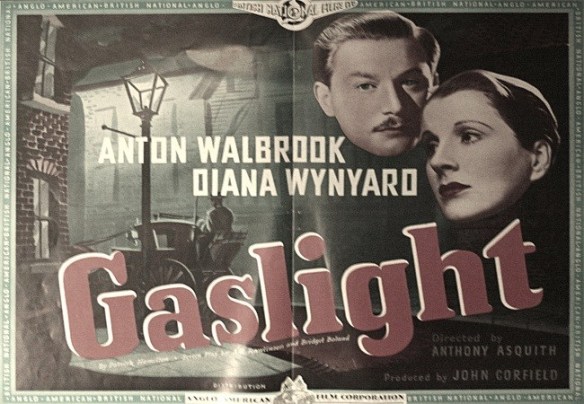
The psychological term “Gaslighting” comes from a 1944 Hollywood classic movie called Gaslight.  Gaslighting describes the abuse employed by a narcissist to instil in their victim’s mind, an extreme anxiety and confusion to the extent where they no longer have faith in their own powers of logic, reason and judgement. These gaslighting techniques were adopted by central intelligence agencies in the US and Europe as part of their psychological warfare methods, used primarily during torture or interrogation.

Gaslighting as an abuser’s modus operandi, involves, specifically, the withholding of factual information and its replacement with false or fictional information designed to confuse and disorientate. This subtle and Machiavellian process eventually undermines the mental stability of its victims reducing them to such a depth of insecurity and identity crisis that they become entirely dependent upon their abuser for their sense of reality and even identity.

Gaslighting involves a step by step psychological process to manipulate and destabilize its victim.  It is built up over time and consists of repetitive information feeds that enter the victim’s subconscious over a period of time, until it is fully registered on the subconscious “hard disk” and cannot be overridden by the conscious floppy disk.  Put more simply, it is brainwashing.

Overall, the main reason for gaslighting is to create a dynamic where the abuser has complete control over their victim so that they are so weak that they are very easy to manipulate.” ~ Alex Myles

Three Stages of Gaslighting: Stage One

The first stage depends upon trust in the integrity and unimpeachable intentions of the abuser, a state of reliance that has been engendered by the abuser’s artful self-promotion and ingratiating propaganda.  Once this trust is gained, the abuser will begin to subtly undermine it, creating situations and environments where the victim will begin to doubt their own judgement.  Eventually the victim will rely entirely upon the abuser to alleviate their uncertainty and to restore their sense of reality which is in fact that of the abuser.

Stage Two

The second stage, defence, is a process by which the abuser isolates the victim, not only from their own sense of identity but from the validation of their peers.  They are made to feel that their opinion is worthless, discredited, down-right weird.  In political circles they would be labelled a conspiracy theorist, a dissident, a terror apologist.  As a consequence, the victim will withdraw from society and cease to express themselves for fear of ridicule, judgement or punishment.

This stage can also be compared to Stockholm Syndrome where a hostage or captive is reduced,by psychological mind games, back to infantile dependency upon their captor.  Narcissistic abuse bonds the victim to the aggressor via trauma.  Stockholm Syndrome bonds the victim to the aggressor via regression to an infantile state where the abuser/aggressor becomes the “parent” who will rescue the victim from imminent annihilation.  Both methods tap into the victim’s survival mechanisms to gain and maintain control.

Stage Three

The final stage is depression.  A life under the tyrannical rule of a narcissist drives the victim into a state of extreme confusion.  They are stripped of dignity & self-reliance.  They, ultimately exist in an information vacuum which is only filled by that which the abuser deems suitable or relevant.  This can eventually invoke symptoms of PTSD [Post Traumatic Stress Disorder]. Flashbacks, constant apprehension, hyper vigilance, mind paralysis, rage and even violence.  The process is complete and the victim has been reduced to a willing accomplice in the abusers creation of a very distorted reality.

Exceptionalism or Narcissism?

We are currently seeing the transformation of US exceptionalism into an abusive Narcissism.

The gargantuan apparatus of mind bending and controlling is being put into hyper drive by the ruling elite.  We are inundated with propaganda that challenges our sense of reality but only after being “tenderized” by the fear factor.  Fear of “terror”, fear of war, fear of financial insecurity, fear of gun violence, fear of our own shadow.  Once we are suitably quaking in our boots, in comes the rendition of reality that relieves our anxiety.  If we challenge this version of events we are labelled a conspiracy theorist, a threat to security. We are hounded, discredited, slandered and ridiculed.  We are isolated and threatened.

Wars are started in the same way.  Despite the hindsight that should enable us to see it coming, the process swings into motion with resounding success. The ubiquitous dictator, the oligarch who threatens to destroy all that the US and her allies represent which of course is, freedom, equality & civil liberty all wrapped up in the Democracy shiny paper and tied with the exceptionalist ribbon.

Next the false flag to engender fear, terror and to foment sectarian strife. The support of a “legitimate” organic, indigenous “revolution” conveniently emerging in tandem with US ambitions for imposing their model of governance upon a target nation. The arming of “freedom fighters”, the securing of mercenary additions to these manufactured proxy forces.  All this is sold in the name of freedom and democracy to a public that is already in a state of anxiety and insecurity, lacking in judgement or insight into any other reality but that of their “abuser”.

The NGO Complex Deployment

Finally, the Humanitarians are deployed.  The forces for “good”, the vanguard of integrity and ethical intervention.  The power that offers all lost souls a stake-holding in the salvation of sovereign nations that have lost their way and need rescuing.  A balm for a damaged soul, to know they can leave their doubts and fears in such trustworthy hands as HRW, Amnesty International, they can assuage their deep sense of guilt at the suffering being endured by the people of far flung nations because they can depend upon the NGOs to provide absolution with minimal effort on their part.  They don’t realise that NGOs are an integral part of their abuser’s apparatus, operating on the leash of neo-colonialist financing and influence.  NGOs provide the optic through which the abuser will allow the victim to perceive their world and once absorbed into this flawed prism the victim’s own cognitive dissonance will ensure they do not attempt a jail break.

In this state of oppressed consciousness the victim accepts what they are told.  They accept that the US can sell cluster bombs to Saudi Arabia that obliterate human beings and lay waste to essential civilian infrastructure in Yemen.  They accept that the US financially, ideologically & militarily supports the illegal state of Israel and provides the arsenal of experimental weapons that maim and mutilate children and civilians on a scale that is unimaginable.  They accept that a crippling blockade of the already impoverished and starving nation of Yemen is “necessary” to resolve the issues of sectarian divisions that only exist in the minds of their Congressional abusers.

The majority of Americans accept mass murder under the pretext of the right to protect, because their ability to form rational and reasoned opinions has been engineered out of them.  This is now the definition of US exceptionalism.  It is their ability to manipulate the world into accepting their lawlessness and global hegemony agenda.  In seeking to impose its own image upon our world the US has drifted so far from its founding principles, one wonders how they will ever return to them.  They have employed a recognised form of torture to ensure capitulation to their mission of world domination which entails the mental, physical and spiritual torture of target civilian populations.

In conclusion, the US has indeed achieved exceptionalism.  The US has become an exceptional global executioner and persecutor of Humanity.  Imperialism is a euphemism for the depths of abuse the US is inflicting upon the people of this world.

Our only hope is to break the cycle of abuse with empathy for the victim and with appreciation for the years of brainwashing that precedes their agonizing passive-aggressive apathy towards crimes being committed in “their name”.

This was an email I received recently from one courageous young American girl whose epiphany is testament to the resilience and survival instinct of the human spirit.

My name is Caroline and I am a 22 year old US citizen. I only fairly recently discovered the truth about Empire/NATO’s activities in Syria and Libya and so many other countries (thanks to writers like Andre Vltchek, Cory Morningstar, Forrest Palmer). I am sickened when I remember that I signed some of those Avaaz petitions and I feel horrified at knowing that I have Syrian and Libyan blood on my hands. I want to believe that I’m not “really” guilty because I really thought (as I had been told) that I was not doing something bad at the time, but still, what I did contributed to the suffering of those people and I want to do something to atone in at least some small way, even though I probably can’t “make up” for what I did or erase my crime.

If it’s not too much trouble, could you please tell me what you think I should do, if there is anything?” 

She deserves an answer…


***

Author Vanessa Beeley is a contributor to 21WIRE, and since 2011, she has spent most of her time in the Middle East reporting on events there – as a independent researcher, writer, photographer and peace activist. She is also a member of the Steering Committee of the Syria Solidarity Movement, and a volunteer with the Global Campaign to Return to Palestine. See more of her work at her blog The Wall Will Fall.


Related Podcast:

Life-Hacks of the Poor and Aimless

horrible-life-hacks-19

On negotiating the false idols of neoliberal self-care

By Laurie Penny

Source: The Baffler

Late capitalism is like your love life: it looks a lot less bleak through an Instagram filter. The slow collapse of the social contract is the backdrop for a modern mania for clean eating, healthy living, personal productivity, and “radical self-love”—the insistence that, in spite of all evidence to the contrary, we can achieve a meaningful existence by maintaining a positive outlook, following our bliss, and doing a few hamstring stretches as the planet burns. The more frightening the economic outlook and the more floodwaters rise, the more the public conversation is turning toward individual fulfillment as if in a desperate attempt to make us feel like we still have some control over our lives.

Coca-Cola encourages us to “choose happiness.” Politicians take time out from building careers in the debris of democracy to remind us of the importance of regular exercise. Lifestyle bloggers insist to hundreds of thousands of followers that freedom looks like a white woman practicing yoga alone on a beach. One such image (on the @selflovemantras Instagram) informs us that “the deeper the self love, the richer you are.” That’s a charming sentiment, but landlords are not currently collecting rent in self-love.

Can all this positive thinking be actively harmful? Carl Cederström and André Spicer, authors of The Wellness Syndrome, certainly think so, arguing that obsessive ritualization of self-care comes at the expense of collective engagement, collapsing every social problem into a personal quest for the good life. “Wellness,” they declare, “has become an ideology.”

There is an obvious political dimension to the claim that wellbeing, with the right attitude, can be produced spontaneously. Months after being elected leader of the most right-wing government in recent British history, yogurt-featured erstwhile PR man David Cameron launched an ill-fated “happiness agenda.” The scheme may have been better received if the former prime minister were not simultaneously engaged in decimating health care, welfare, and higher education—the very social structures that make life manageable for ordinary British people. As part of Cameron’s changes to the welfare system, unemployment was rebranded as a psychological disorder. According to a study in the Medical Humanities journal, in the teeth of the longest and deepest recession in living memory, the jobless were encouraged to treat their “psychological resistance” to work by way of obligatory courses that encouraged them to adopt a jollier attitude toward their own immiseration. They were harangued with motivational text messages telling them to “smile at life” and that “success is the only option.”

This mode of coercion has been adopted by employers, too, as Cederström and Spicer note. Zero-hour-contract laborers in an Amazon warehouse, “although they are in a precarious situation . . . are required to hide these feelings and project a confident, upbeat, employable self.” All of which begs the question: Who exactly are we being well for?

The well-being ideology is a symptom of a broader political disease. The rigors of both work and worklessness, the colonization of every public space by private money, the precarity of daily living, and the growing impossibility of building any sort of community maroon each of us in our lonely struggle to survive. We are supposed to believe that we can only work to improve our lives on that same individual level. Chris Maisano concludes that while “the appeal of individualistic and therapeutic approaches to the problems of our time is not difficult to apprehend . . . it is only through the creation of solidarities that rebuild confidence in our collective capacity to change the world that their grip can be broken.”

The isolating ideology of wellness works against this sort of social change in two important ways. First, it persuades all us that if we are sick, sad, and exhausted, the problem isn’t one of economics. There is no structural imbalance, according to this view—there is only individual maladaption, requiring an individual response. The lexis of abuse and gas-lighting is appropriate here: if you are miserable or angry because your life is a constant struggle against privation or prejudice, the problem is always and only with you. Society is not mad, or messed up: you are.

Secondly, it prevents us from even considering a broader, more collective reaction to the crises of work, poverty, and injustice. That’s the logic exposed by personal productivity gurus like Mark Fritz, who tells us, in The Truth About Getting Things Done, that:

The biggest barrier to achieving the success you have defined for your life is never anyone else or the circumstances you encounter. Your biggest barrier is almost always you. . . . Dr Maxwell Maltz, author of Psycho-Cybernetics [ETA: sounds legit to me!], put it best when he said, “Within you right now is the power to do things you never dreamed possible. This power becomes available to you as soon as you can change your beliefs.

This, of course, is a cyclopean lie—but it’s a seductive one nonetheless. It would be nice to believe that all it takes to change your life is to repeat some affirmations and buy a planner, just as it was once comforting for many of us to trust that the hardships of this plane of existence would be rewarded by an eternity of bliss in heaven. There is a reason that the rituals of well-being and self-care are followed with the precision of a cult (do this and you will be saved; do this and you will be safe): It is a practice of faith. It’s worth remembering that Marx’s description of religion as the opiate of the masses is often misinterpreted—opium, at the time when Marx was writing, was not just known as an addictive drug, but as a painkiller, a solace when the work of survival became unbearable.

With the language of self-care and well-being almost entirely colonized by the political right, it is not surprising that progressives, liberals, and left-wing groups have begun to fetishize a species of abject hopelessness. Positive thinking has become deeply unfashionable. The American punk kids I know describe it, disparagingly, as “posi.” The British ones, of course, describe it as “American.” Whatever you call it, it feels a lot like giving in.

In a scintillating essay at Open Democracy, activist Chloe King writes that

changing your attitude is not going to change or help to dismantle structural injustice and a failed and unsustainable economic model which serves only the elite rich of this world, and exploits the rest of us, particularly the working class and those living in poverty. As far as I am concerned positive thinking will fucking ruin your life. “Just think positive” is a precursor to “it gets better,” and the hard reality is it is only going to get much, much worse for our most vulnerable.

There is truth here. What is also true, however, is that the young people I know who are, in general, the very worst at taking basic care of themselves as individuals—the people whose problem is not that they don’t drink enough asparagus water, but that they don’t drink enough of anything that isn’t day-old wine from a foil bag—are those who went through the student and Occupy uprisings of 2010–2012 and experienced, briefly, what it meant to live a different sort of life. What it meant to be part of a community with common goals of which mutual aid and support were not the least. What it meant to experience that sudden, brief respite from individual striving and build a prefigurative society together. The lonely work of taking basic care of yourself as you wait for the world to change is a poor substitute. When you’re washed up and burned out from putting your body on the line to fight the state, it’s especially galling to be told to share a smile and eat more whole grains.

When modernity teaches us to loathe ourselves and then sells us quick fixes for despair, we can be forgiven for balking at the cash register. Anxious millennials now seem to have a choice between desperate narcissism and crushing misery. Which is better? The question is not rhetorical. On the one hand, Instagram happiness gurus make me want to drown myself in a kale smoothie. On the other, I’m sick and tired of seeing the most brilliant people I know, the fighters and artists and mad radical thinkers whose lives’ work might actually improve the world, treat themselves and each other in ludicrously awful ways with the excuse, implicit or explicit, that any other approach to life is counterrevolutionary.

Some of the left critique of self-care as a neoliberal conspiracy has to do with dismissing the work that women and queer people do to survive. “I have heard feminism be dismissed as a form of self-indulgence,” writes Professor Sara Ahmed of Goldsmiths, University of London. So have I. I’ve heard men on the left write off anti-sexist, anti-racist politics as hopelessly individualistic, whilst also refusing to do the basic work of self-care and mutual care that keeps hope alive and health possible, because that work is women’s work, undignified in comparison to watching your life fall apart while you wait for the revolution or for some girl to pick up the pieces, whichever comes first.

The left has a special talent for counterproductive, theory-enabled wallowing. “Neoliberalism sweeps up too much when all forms of self-care become symptoms of neo-liberalism,” writes Ahmed. “When feminist, queer, and anti-racist work that involves sharing our feelings, our hurt and grief, recognizing that power gets right to the bone, is called neo-liberalism, we have to hear what is not being heard. . . . A world against you can be experienced as your body turning against you. You might be worn down, worn out, by what you are required to take in.”

It is at this point that I confess to you that I’ve been doing yoga for two years and it’s changed my life to an extent that I almost resent. I have trained myself, through dedicated practice on and off the mat, to find enough inner strength not to burst out laughing when the instructor ends the class by declaring “let the light in me honor the light in you.” The instructor is a very nice person who smiles all the time like a drunk kindergarten teacher and could probably kill me with her abs alone, so I have refrained from informing her that the light in me is sometimes a government building on fire.

Downward-facing dog is not a radical position. Nonetheless, that particular asana is among a few small concessions I make to self-care while I wait for the end of patriarchy and the destruction of the money system. Overpriced charcoal health drinks aren’t good for liberating anything except your wallet and your colon in short succession, but walks in the park are free, so I occasionally go out in the sunshine and try to soak up a bit of Vitamin D without worrying about skin cancer, melting ice-caps, and millions of people drowning in Bangladesh. I no longer subsist entirely on chicken nuggets, cigarettes, and spite. I sometimes take a day off, because it became apparent that the revolution was not being driven any faster by my being sick and sad all the time. Late Capitalism is as good an excuse of any for not getting out of bed, but huddling under the covers worrying about Donald Trump is a very inefficient way of sticking it to the man.

The problem with self-love as we currently understand it is in our view of love itself, defined, too simply and too often, as an extraordinary feeling that we respond to with hearts and flowers and fantasy, ritual consumption and affectless passion. Modernity would have us mooning after ourselves like heartsick, slightly creepy teenagers, taking selfies and telling ourselves how special and perfect we are. This is not real self-love, no more than a catcaller loves the woman whose backside he’s loudly admiring in the street.

The harder, duller work of self-care is about the everyday, impossible effort of getting up and getting through your life in a world that would prefer you cowed and compliant. A world whose abusive logic wants you to see no structural problems, but only problems with yourself, or with those more marginalized and vulnerable than you are. Real love, the kind that soothes and lasts, is not a feeling, but a verb, an action. It’s about what you do for another person over the course of days and weeks and years, the work put in to care and cathexis. That’s the kind of love we’re terribly bad at giving ourselves, especially on the left.

The broader left could learn a great deal from the queer community, which has long taken the attitude that caring for oneself and one’s friends in a world of prejudice is not an optional part of the struggle—in many ways, it is the struggle. Writer and trans icon Kate Bornstein’s rule number one is “Do whatever it takes to make your life more worth living. Just don’t be mean.” It’s more than likely that one of the reasons that the trans and queer communities continue to make such gains in culture, despite a violent backlash, is the broad recognition that self-care, mutual aid, and gentle support can be tools of resistance, too. After the Orlando massacre, LGBTQ people across the world started posting selfies under the hashtag #queerselflove. In the midst of the horror, the public mourning, and the fear, queer people of all ages and backgrounds across the world engaged in some light-hearted celebration of ourselves, of one another.

The ideology of wellbeing may be exploitative, and the tendency of the left to fetishize despair is understandable, but it is not acceptable—and if we waste energy hating ourselves, nothing’s ever going to change. If hope is too hard to manage, the least we can do is take basic care of ourselves. On my greyest days, I remind myself of the words of the poet and activist Audre Lorde, who knew a thing or two about survival in an inhuman world, and wrote that self care “is not self-indulgence—it is self-preservation, and that is an act of political warfare.”

Reality and its enemies

By Lawrence Davidson

Source: Intrepid Report

There is an ongoing reality that is destroying hundreds of thousands of lives in the Middle East. And though most Americans are ignorant of the fact, and many of those who should be in the know would deny it, the suffering flows directly from decisions taken by Washington over the last 27 years.

Some of the facts of the matter have just been presented by the first Global Conflict Medicine Congress held at the American University of Beirut (AUB) earlier this month (11–14 May 2017). It has drawn attention to two dire consequences of the war policies Americans have carried on in the region: cancer-causing munition material and drug-resistant bacteria.

Cancer-causing munition material: Materials such as tungsten and mercury are found in the casing of penetrating bombs used in the first and second Gulf wars. These have had long-term effects on survivors, especially those who have been wounded by these munitions. Iraqi-trained and Harvard-educated Dr. Omar Dewachi, a medical anthropologist at AUB fears that “the base line of cancers [appearing in those exposed to these materials] has become very aggressive. . . . When a young woman of 30, with no family history of cancer, has two different primary cancers—in the breast and in the oesophagus—you have to ask what is happening.” To this can be added that doctors are now “overwhelmed by the sheer number of [war] wounded patients in the Middle East.”

Drug-resistant bacteria: According to Glasgow-trained Professor Ghassan Abu-Sittah, head of plastic and reconstructive surgery at AUB Medical Center, drug resistance was not a problem during the Iran-Iraq War of 1980–1988. However, after the fiasco of Iraq’s invasion of Kuwait, things began to change. In the period after 1990, Iraq suffered under a vicious sanctions regime imposed by the United Nations at U.S. insistence. During the next 12 years “Iraqis were allowed to use only three antibiotics” and bacterial resistance quickly evolved.

Those resistant bacteria spread throughout the region, particularly after the American invasion of the country in 2003. Today, according to a Medecins Sans Frontieres analysis, “multidrug resistant [MDR] bacteria now accounts for most war wound infections across the Middle East, yet most medical facilities in the region do not even have the laboratory capacity to diagnose MDR, leading to significant delays and clinical mismanagement of festering wounds.”

Insofar as these developments go, it is not that there aren’t contributing factors stemming from local causes such as factual fighting. However, the major triggers for these horrors were set in motion in Washington. As far as I know, no American holding a senior official post has ever accepted any responsibility for this ongoing suffering.

Hiding reality

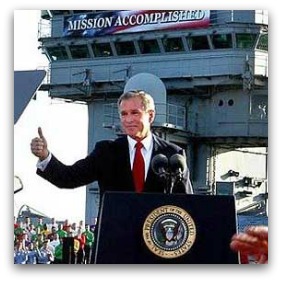
As the cancers and untreatable infections grow in number in the Middle East, there is here in the United States a distressing effort to rehabilitate George W. Bush—the American president whose decisions and policies contributed mightily to this ongoing disaster. It is this Bush who launched the unjustified 2003 invasion of Iraq and thereby—to use the words of the Arab League—“opened the gates of hell.” His rehabilitation effort began in earnest in April 2013, and coincided with the opening of his presidential library.

In an interview given at that time, Bush set the stage for his second coming with an act of self-exoneration. He said he remained “comfortable with the decision making process” that led to the invasion of Iraq—the one that saw him fudging the intelligence when it did not tell him what he wanted to hear—and so also “comfortable” with the ultimate determination to launch the invasion. “There’s no need to defend myself. I did what I did and ultimately history will judge.”

The frivolous assertion that “history will judge” is often used by people of suspect character. “History” stands for a vague future time. Its alleged inevitable coming allows the protagonist to fantasize about achieving personal glory unchallenged by present, usually significant, ethical concerns.

Those seeking George W. Bush’s rehabilitation now like to contrast him to Donald Trump. One imagines they thereby hope to present him as a “moderate” Republican. They claim that Bush was and is really a very smart and analytical fellow rather than the simpleton most of us suspect him to be. In other words, despite launching an unnecessary and subsequently catastrophic war, he was never as ignorant and dangerous as Trump. He and his supporters also depict him as a great defender of a free press, again in contrast to Donald Trump. However, when he was president, Bush described the media as an aider and abettor of the nation’s enemies. This certainly can be read as a position that parallels Trump’s description of the media as the “enemy of the American people.”

But all of this is part of a public relations campaign and speaks to the power of reputation remodeling—the creation of a facade that hides reality. In order to do this you have to “control the evidence”—in this case by ignoring it. In this endeavor George W. Bush and his boosters have the cooperation of much of the mainstream media.

No sweat here: the press has done this before. Except for the odd editorial the mainstream media also contributed to Richard Nixon’s rehabilitation back in the mid-1980s. These sorts of sleights-of-hand are only possible against the background of pervasive public ignorance.

Closed information environments

Local happenings are open to relatively close investigation. We usually have a more or less accurate understanding of the local context in which events play out, and this allows for the possibility of making a critical judgment. As we move further away, both in space and time, information becomes less reliable, if for no other reason than it comes to us through the auspices of others who may or may not know what they are talking about.

As a society, we have little or no knowledge of the context for foreign events, and thus it is easy for those reporting on them to apply filters according to any number of criteria. What we are left with is news that is customized—stories designed to fit pre-existing political or ideological biases. In this way millions upon millions of minds are restricted to closed information environments on subjects which often touch on, among other important topics, war and its consequences.

So what is likely to be more influential with the locally oriented American public: George W. Bush’s rehabilitated image reported on repeatedly in the nation’s mainstream media, or the foreign-based, horror-strewn consequences of his deeds reported upon infrequently?

This dilemma is not uniquely American, nor is it original to our time. However, its dangerous consequences are a very good argument against the ubiquitous ignorance that allows political criminals to be rehabilitated even as their crimes condemn others to continuing suffering. If reputation remodelers can do this for George W. Bush, then there is little doubt that someday it will be done for Donald Trump. Life, so full of suffering, is also full of such absurdities.


Dr. Davidson has done extensive research and published in the areas of American perceptions of the Middle East, and Islamic Fundamentalism. His two latest publications are “Islamic Fundamentalism” (Greenwood Press, 1998) and “America’s Palestine: Popular and Official Perceptions from Balfour to Israeli Statehood” (University Press of Florida, 2001). He has published thirteen articles on various aspects of American perceptions of the Middle East. Dr. Davidson holds a BA from Rutgers, an MA from Georgetown University and a Ph.D. in history from the University of Alberta.

A dystopia in real time

By Dave Lefcourt

Source: OpEdNews.com

Let’s come straight out with it, to the US government, We the People are the enemy.

If you’ve read John W. Whitehead [1] regularly you’re already aware of that.

The tell-tale sign: surveillance camera’s seemingly everywhere. On most street intersections, photo enforced streets, roads by all schools, airports, railway stations, toll roads and all commercial stores.

Then there’s the ubiquitous, “If you see something, say something” heard in Metro subway stations, airports and railway stations. It’s portrayed as a necessary given for our “safety and protection” make us fearful of would be terrorists and other bad guys out to harm us.

But really ALL meant for the authorities to keep close tabs on us everywhere. Combined with electronic surveillance of our cell phones and computers-whether on or off-and the NSA pretty much has us under its constant surveillance.

Of course it’s all against the 4th Amendments strictures against “unreasonable searches and seizures” and without “probable cause” making it all illegal. Yet most Americans apparently don’t care taking the foolish “I haven’t done anything wrong so why worry about it” mantra.

It appears the public has been so propagandized and indoctrinated, they’ve accepted these illegal surveillance intrusions into their everyday lives.

But think about it: If the public absolutely objected to their governments spying on them these illegal intrusions could be severely curtailed, limited only to court ordered warrants for specific instances of suspected criminal activities-as legally specified in the Constitution.

The reason the government has become so paranoid of the people? They know we’re the many and they’re the few and if our police and military realized they were protecting and defending the indefensible, against the Constitution they’ve sworn to uphold, against all enemies, foreign and domestic, the party would all be over.

And that necessary “revolution” returning the government to and for the people could soon be realized.

Then all our illegal wars and occupations ended, the military downsized to defend only against an imminent attack, the billions spent on unnecessary defense industry weaponry eliminated, nuclear weapons eliminated and peace in the world realized.

So our government knows its biggest enemy is its own people, not terrorists, Russia, China, Iran or North Korea.

It’s us, you and me they’re really afraid of. That’s why they take the measures they do. Why they infiltrate peaceful protests and demonstrations with agent provocateurs who initiate violence giving the authorities the pretext to interfere and shut it down. It’s how “Occupy” was shut down in 2011 with government authorities acting in coordination nationwide.

It’s why the National Guard was called out to intervene in the summer of 2014 after police shot an unarmed Michael Brown in the streets of Ferguson, MO. when citizen protests erupted.

Now protests at political conventions are cordoned off far from the convention sites fearing a repeat of the protests and demonstrations at the 1968 Democratic convention.

It’s also why the military draft was eliminated specifically to get a compliant, all volunteer army of draft age men and women who were a significant part of those 1968 protests.

All governments propagandize and indoctrinate its people. In the US it starts with standing to recite the “Pledge of Allegiance” in our schools, the standing for the “Star Spangled Banner”, saluting the flag, belief in our “supposed” free elections, extolling the military as our “heroes”, the Navy a “force for good”, military flyovers at professional athletic events, spotlighting service men and women in the stands eliciting a standing ovation, playing “America the Beautiful” during the 7th inning stretch.

It’s all part of the indoctrination process.

When this past season professional quarterback Colin Kaepernick was ostracized refusing to stand for the national anthem before an NFL game he was condemned in the MSM as un-American, ungrateful and a traitor to his country. Though what he did was not illegal and protected under the Constitution.

Standing for and singing the national anthem is voluntary and not required. But long standing tradition has made it “appear” as required behavior.

It’s hard to know whether Americans are the most propagandized people ever. We certainly are obedient and compliant people accepting illegal government intrusions and generally accepting the governments explanations (propaganda?) of all significant national and international incidents.

It’s almost certain the government knows with a population generally compliant to its strictures it can and will do anything with impunity knowing it will not be held accountable for its actions.

That’s why “official” Washington represents the most dangerous, rogue state entity in the world and seen by most people worldwide as the primary threat to peace in the world.

Yet to most Americans we’re the beacon on the hill embracing freedom and democracy.

In America “official” lies have been taken on a whole new meaning, become the natural order of things; a dystopia in real time.

[1] John W. Whitehead, “Battlefield America: The War on the American People” and “A Government of Wolves: The Emerging American Police State”

Orwell, Freud, and the Syrian Ruse

Reality by other means

By Jason Hirthler

Source: Dissident Voice

We’re an empire now, and when we act, we create our own reality.

— Karl Rove speaking to a small group of reporters at a cocktail party in 2004…… printed in the Washington Post

The adjective ‘Orwellian’ is so overused mostly because it is so incredibly apt on a daily basis. George Orwell’s basic concept reflects a simple tenet of propaganda: the thing you are hiding is often hid behind its exact opposite. Orwell expressed this concept in 1984 with the government slogans, “War is Peace,” “Ignorance is Strength,” and “Freedom is Slavery.” The Austrian psychologist Sigmund Freud evidently suggested something similar about human nature: that to discover our true human nature, we need merely to reverse society’s moral maxims: if a commandment forbids adultery, it’s because we want to commit it. In other words, for both Orwell and Freud, we often disguise what we are doing behind claims that we are doing the opposite. We aren’t committing adultery; we’re practicing fidelity. We aren’t precipitating war; we’re pressing for peace. We aren’t seeking our own self-interest; we’re doing it all for others.

When applied to U.S. propaganda, the formula is revealing. To discover what your government is hiding, just reverse the media narrative. If the papers all say Russia is an imperial aggressor, it’s likely because Washington is. If the news networks say that Assad is a murderous monster, it’s likely because the groups we’re backing are. If the mainstream says Communism is a dire threat, it’s likely because capitalism is a dire threat. All of these examples are demonstrably true.

What confuses many readers is the fact that the first premise–that Russia, Assad, and Communism are all threats–usually has an element of truth to it, though not to the degree that it is portrayed. And so intelligent propaganda doesn’t simply traffic in lies, but rather half-truths, distortions, and omissions that themselves further distort a narrative. It is this sophisticated blend of fact, fiction, hyperbole and omission that makes propaganda so difficult to unpack for the average reader, who has little time, inclination, and practice in deciphering state-directed doctrine.

Reversing Reality

If Freud was correct, then we tend to publicly deny our greatest desires when they run counter to prevailing morality, shielding our base wishes behind a curtain of rectitude, even as we quietly pursue them. The modern instances of this in government are boundless. Example: FISA legitimates the surveillance it was designed to deter. Example: Congress abets the executive it was created to check. Example: ‘Defense’ becomes the aggression it was devised to defend against. Example: Healthcare becomes a bureaucracy built on denial of care in the name of its provision. Example. Journalism: the adversarial role of the fourth estate, becomes the adversary of the truth it was intended to protect. Journalists transcribe the diktats of power. Like the senators that notarize the mandates of the executive. Like the federal agents that entrap citizens in order to protect them. Like the drones that destroy lives to save them. Like the citizens who signal liberal values in support of imperial conquerors. Like the social justice warriors who legislate the intolerance they seek to eradicate. It seems to be a socio-political reality that the forcible assertion of one value guarantees a renaissance of its antitheses. Or is it that we forcibly assert a moral value to disguise a flowering of vice?

The process of turning a story into its opposite is fairly straightforward. If the U.S. is aggressively violating human rights, it needs to be rewritten as a defender of human rights. What this means in practice is switching the roles each of the actors assume in the narrative. Heroes become villains; villains become heroes; and victims are either genuine victims or villains depicted as martyrs for a righteous cause. This requires a good bit of romanticizing your side, demonizing the enemy, and eulogizing the victims. And then, as the author of Mein Kampf recommended, keep it simple. Your side wants one thing: peace. Your enemy wants one thing: war. And the victims want one thing: freedom.

Exhibit A

Take Syria as a recent example. The media narrative states that the U.S. and its freedom-loving allies have cautiously backed a loose confederation of rebels who rose up against Syrian tyrant Bashar al-Assad in 2011. In actuality, the U.S. and its freedom-hating allies have incautiously backed a loose confederation of foreign terrorists who have been paid to overthrow the elected Syrian President Bashar al-Assad. Only occasionally is the real backstory hinted at, which includes weakening Shia strongholds and destabilizing independent states in the region.

In turning the truth around to justify its war of aggression, the state and its supplicant media seized upon a handful of facts as the bedrock on which it constructed a false historical narrative. Which is what you’d expect from the Orwell-Freud model. And so…Are there elements of Syrian civil society that protested Assad in 2011? Absolutely. Are there actual Syrians fighting against Assad now? Sure. Are there elements of corruption and repression in Assad’s history? Definitely. But each of these truths are used to disguise the much larger facts of unmitigated U.S. aggression.

Upon this foundation, the typical narrative is constructed. The United States government is romanticized as a virtuous mediator concerned with supporting the freedom fighters and helping them achieve the freedoms they’ve yearned for. Assad is demonized as the autocratic mass murderer who repeatedly denies these freedoms, and tortures thousands before destroying the bodies. And the Syrian people, engine of the largest refugee crisis since World War Two, are shown as the valiant victims of the war, particularly in Aleppo, where the destruction of the city in an attempt to uproot the terrorist army is leveraged to milk as much emotional content from the war as possible and to further cement Assad’s reputation as a moral monster.

The MSM didn’t stop there. It followed with a series of attempts to further demonize Assad. A massive cache of photos purportedly detailing “regime” torture. This cache was delivered from somebody named “Caesar,” a defector not unlike the fake defector, “Curveball” from the run-up to the Iraq War. Twice false flags have been utilized to claim that the evil optometrist in Damascus has in a fit of pique demanded that innocent Syrians be sprayed with chemical weapons. Now a “crematorium” where Assad supposedly cremates all the Syrian citizens he is slaughtering (supposedly because he hates humanity so much). It doesn’t particularly matter if these stories eventually unravel when evidence is shown to be lacking. The damage is done to the psyche of readers and listeners, who absorb the media reports with the uncritical acceptance of animals entering an abattoir.

The takfiri mercenaries brought in by the West to topple Assad are likewise romanticized by the press. Instead of labeling the terrorists we backed as extremists, the New York Times peddled a story that they were moderates. Beheading of children, tossing gays from rooftops, using citizens as human shields, staging rescue operations, and many other atrocities failed to prevent the media from intransigently pushing this storyline.

No Quick Fix

As you can see, there is no shortage of opportunities to apply the Orwellian label to modern reportage. That said, I’m not suggesting that the authors at The New York Times and the Washington Post are all conniving propagandists consciously preparing deceitful reportage. For every Edward Bernays, there are a dozen Brian Williams. Often, they have simply internalized the values of the institution that employs them. They recognize, perhaps consciously or subconsciously, that their careers depend on their willingness to follow a particular narrative. And they make their choice, rationalizing themselves into a clean conscience.

Which is no surprise. The human species could give a master class in self-deception. And there are psychological needs that appear more urgent for us than truth. Namely, the need to feel good about oneself and believe in one’s tribe. Set aside the need to situate the world in a comprehensible narrative, the need to fit in with one’s peer group, and the need to do meaningful work and self-actualize in society. The point is that all of these needs are undermined by the counter-narratives of the left. Counter-narratives destabilize our cleanly delineated understanding of the world; they often ostracize us from our peer group; and they threaten our ability to contribute to society in a manner approved of by society (i.e., generally contributing to the machinery of consumerism). Who has time for a reconstruction of one’s worldview, especially if it might lead to social alienation? This is why just throwing facts at heavily propagandized people doesn’t often work. There are other forces in play, which may remind us that politics is often little more than a value signaling device for human beings.

So most of us, whatever inklings we may receive of an alternative reality, will settle for doing nothing untoward, recusing ourselves from political debates, and hewing as closely to inoffensive blandishments in our speech as we can. (The only other major path is to adopt the ideologically bankrupt cop-out of lesser evilism and rant about how horrible the other party is. This provides the frisson of feeling at one with the herd, but does nothing to improve society.) In other words, we shackle ourselves to political groupthink and play the role of the conscientious centrist like any good straight man would. We have no time for the revolutionary urgency of the disenfranchised. It was Dostoevsky’s Grand Inquisitor who argued that people don’t want intellectual freedom, but rather to be told what to believe. Only then will they be happy. Otherwise, we ruin our peace of mind through choice paralysis or some variety of existential angst, or through a lack of religious faith that leaves us with no guiding myth to sustain us. Given all these apolitical factors that inform whether or not one challenges the received narrative, is it any surprise that mental slavery and ignorance are as prevalent today as in Orwell’s time?