Prophecy, Spirit and the Dreamtime

spiritual-phenomena-other-dimensions

By Jay Weidner

Source: ZenGardner.com

The mythology of our modern, high-tech culture teaches us that the last frontier for humanity is outer space. Somehow, according to this emerging mythos, the fragile human body is supposed to be able to survive the rigors of travel in outer space over vast distances. The writers of science fiction and Star Trek-style television shows would have us believe that human beings can somehow endure through every kind of radiation and danger to successfully colonize other planets and solar systems.

But this notion is probably never going to happen. As this age ends and the next age begins humanity will lose its interest in conquering space. The last 6000 years have been spent conquering the space around us.

The last frontier of humanity is not the conquering of outer space, of other planets and solar systems. As we approach the end of this era we will realize that the last frontier is time.

Space is defined by the three dimensional reality that surrounds us. It is height, width and depth. We humans possess the most spectacular array of physical and mental abilities ever devised in creation to navigate these three dimensions. These abilities have enabled us to conquer our three-dimensional world.

Now at this critical juncture in history we discover that we have completely conquered the planet’s biosphere. People are living in the coldest environments imaginable and in the hottest tropical jungles. There are few mysteries left concerning the outer physical reality of our planet. Due to oil and cheap energy, we have been able to travel to any place on Earth. As this age of oil ends there will be only one mystery left for us to ponder.

This final mystery is the mystery of time.

Let’s take a look at our perception of time. Much of the way we experience the present moment depends on our experience of time past. The events of the past are distilled and repainted in our memories until their very reality loses its solidity. If we let them cook long enough, images of past events take on a dream like quality. Through this process, our remembrances frequently slide into a fantasy disconnected from anything tangible.

How often have we encountered someone who remembers an incident in a completely opposite manner from the way we remember it? Our minds appear to be constantly rewriting history to make it more agreeable to our present day wishes. Incidents in the past that are disturbing or frightening are frequently glossed over in our memory until they disappear only to be replaced by a memory that is more easily digested by consciousness.

Our view of the future works in a similar but opposite texture. Whereas the past begins to become a dream within our memories, the future is the dream that has not yet arrived. When someone is successful in the material world we like to say that they have “lived their dreams”. This cliché reveals an intrinsic understanding that present and future reality is created from the dream state of the past.

This idea dovetails with the central belief of the Aborigines of Australia. The essential teaching from that tradition is that everything in our world begins in the Dreamtime. From their ancient perspective, every thought, every action emerges from a larger metaphysical landscape that surrounds and pervades our material world. They call this larger reality the Dreamtime. According to this tradition, each living thing first begins in the Dreamtime. After it has become fully developed in the Dreamtime it then concretizes and becomes a part of our three dimensional reality.

This process is recursive in that our future dreams are frequently constructed from the archetypes of ancient dreams. So the past and the future, the material world and the dream world work together to create not only everything that we see, feel and hear but all that we have manifested as human beings. If one looks beyond the veil of linear time, one can easily see that there is a certain control mechanism over this peculiar process. Because reality is so dependent on the dream world, it is possible to shift reality by simply shifting the dream.

Motivational speakers, politicians, television script writers, preachers and many others understand this fundamental concept and use it to re-script reality in their favor. The last thing that they want you to discover is that you have the innate ability to take control of your dreams. They much prefer that you dream their dream, live in their past and help build their future.

Just think about the nature of the media these days. Over the past century, finding new and ever more invasive means of manipulating thoughts, desires and actions have been at the forefront of the research conducted by “psychic engineers”; the advertising agencies, spin doctors, pollsters, pharmaceutical companies, and secret government agencies of our world.

Through the constant barrage of images projected by the media, through the manipulation of food, and the polluting of the atmosphere, much of humanity has become lulled into a hypnotic state and their Dreamtime is occupied with nightmares. This has led us to today, to the present moment, in which our planet and our species are in a state of crisis. To transmute this crisis, this very critical situation in time, we must learn to step outside of linear time and enter the Dreamtime, that subtle realm in which everything becomes possible.

As the word Dreamtime aptly describes, there is little difference between the dream and the time. This very moment will become a dream soon in your memory. Also you are creating the future that is racing towards you – right now.

The dream world, time and four-dimensional space are all the same thing. The fourth dimensional world, often referred to as ‘time’ by physicists, surrounds and permeates our three dimensional reality. Everything that we are is shaped and formed within this topological manifold that flows into and out of our existence. As the stream of time passes we have the ability to alter it’s course. Each moment of our lives offers us the chance to change the course of our dreams and the dreams of those we love.

Understanding this landscape, the ragged mountains and mossy valleys of the wilderness of time, is the frontier that awaits us. When we finally colonize this land and understand its many intricacies and nuances, we will realize that any future is possible. We will no longer need to be slaves to systems that require us to live in someone else’s dream. The powers of the dark sorcerers that rule our world will be overthrown and a new Dreamtime will be created. When we discover how to navigate the river of time, when the topological map of time is finally understood by us, all of the certain dangers that await us will vanish in the blink of an eye during REM sleep.

We are at the crossroads now. There is a choice. One road leads to a mechanistic, toxic, polluted, fascist nightmare from which we may never recover. The other road leads to a revitalized world where we live our dreams in freedom, prosperity and love.

One of the main aims of many ancient spiritual traditions is to provide us with the means to create a conscious break with the almost dictatorial dreams of our past. This is the essence of the teachings of the Buddha for instance. We are slaves to the dreams that we were born into, slaves to a past of which we had nothing to do. Many of these ancient spiritual traditions teach us how to break with the mental slavery that has burdened us for so long.

Humans frequently hurt themselves and others around them defending the imprinted dreams of their past and creating belief systems that make it all right to hurt and destroy people who come from a different past, a different dreamtime.

The way to stop this recurring cycle is to find our way towards a detachment from the heated beliefs and ego-inspired histories and cultures that we were born into. This is not to say that we should reject our traditions. Only that true liberation of ourselves can only begin when we detach ourselves from ingrained spiritual and cultural habits.

Right now we are trapped by time. And this means that we are trapped in a Dreamtime from which escape is nearly impossible. But as long as there is a chance, as long as the odds are not one hundred percent against us – and they are not – we should attempt to make this leap.

If we change the dream we can change the world and ourselves.

The spiritual emergence that is happening right now across the world is the realization that there is only one kind of time. There is no past and there is no future.

There is only NOW.

And we can change the NOW at any time that we like.


For more about the Shasta movie, go to ShastaMovie.com

Jay Weidner’s websites –    JayWeidner.comGaiamTV.com

Jay Weidner’s DVDs

Jay Weidner’s book:
“The Mysteries of the Great Cross of Hendaye: Alchemy and the End of Time”

Upside down economics of debt, poverty, unemployment: Ready to seize solutions now, or do you require more pain?

2013-09-07_1503

By Carl Herman

Source: The Daily Censored

“If people were really self-interested, they would stop trying to be individualistic.” – John B. Cobb, founder of Seizing an Alternative conference (and here, videos here)

Economic Hitman John Perkins’ 2-minutes on today’s neo-colonialism capitalism:

Demonocracy’s 2-minutes on what the US national debt looks like if shown in actual amounts of $100 bills:

Earth economics is upside down.

Accelerating technology can and should provide:

  • more personal freedom from labor,
  • more beauty in infrastructure and nature,
  • greater joy in our freedom to create and explore our beautiful, powerful, and diverse virtues (something like “resource-based economics” as researched by The Venus Project).

We know what we have is in contrived Orwellian opposition of what leadership should create. We know that what we receive is literal criminal fraud:

I could go on to literally ~100 areas of crucial concern.

The first challenge for the 99.99% is to trust their own Emperor’s New Clothes observations that Earth is truly in this tragic-comedy rather than listen to the .01%’s lies attempting to cover naked facts anyone can see.

Please understand that I represent likely hundreds of thousands of professionals making factual claims with objective evidence anyone with a high school-level of education can verify. For example, the June 2015 Seizing an Alternative conference (and here, videos here) at the Claremont Colleges had hundreds of professionals presenting data and solutions in over 80 areas of speciality. My paper and videos for this conference is here.

The purpose of education since the “Age of Enlightenment” is to present facts for public verification, and to seize the victory of refuting lies by would-be dictators, especially when such lies are obvious and of crucial public importance.

The path forward as we build a critical mass of humans recognizing the Emperor’s New Clothes truth is to demand arrests and solutions, obviously:

  1. ARRESTS: the first responsible action upon recognizing massive crimes that annually kill millions, harm billions, and loot trillions is to demand that law enforcement and military enact arrests of criminal leaders to stop the crimes and begin unwinding the truth of what happened in Earth’s tragic-comedy (four-part article series with videos on arrests as the obvious citizen response).
  2. SOLUTIONS: the .01% with corporate media have suppressed solutions documented beginning with Benjamin Franklin how government can abundantly operate without taxes: monetary and credit reform allow the public to have near-instant prosperity: full-employment, zero public deficits and debt, the best infrastructure we can imagine, falling prices, and release of public TRILLIONS held in “rainy day” accounts. Full documentation here.

Humanity’s choices:

  1. Ongoing .01% Orwellian, upside-down, tragic-comic, Emperor’s New Clothes crimes with all the pain, fear, harm, death, debt, poverty, enslavement, crime, destruction, and despair.
  2. Arrests to stop the crimes of the present, and ready-to-start solutions to build a brighter future.

Be your brightest light as the person you’ve always wanted to be.

Former World Bank economist Herman Daly and co-author John B. Cobb of For the Common Good discuss our condition and pathways forward in this 40-minute interview:

Carl Herman is a National Board Certified Teacher of US Government, Economics, and History; also credentialed in Mathematics. He worked with both US political parties over 18 years and two UN Summits with the citizen’s lobby, RESULTS, for US domestic and foreign policy to end poverty. He can be reached at Carl_Herman@post.harvard.edu

Saturday Matinee: Future Shock

future-shock

Future Shock: Orson Welles Narrates a 1972 Film About the Perils of Technological Change

By Jonathan Crow

Source: Open Culture

The beginning of the 1972 documentary Future Shock, directed by Alex Grasshof, shows Orson Welles, bearded and chomping on a cigar, standing on an airport people mover. He turns to the camera and delivers a monologue in his trademark silken baritone. “In the course of my work, which has taken me to just about every corner of the globe, I see many aspects of a phenomenon which I’m just beginning to understand. Our modern technologies have changed the degree of sophistication beyond our wildest dreams. But this technology has exacted a pretty heavy price. We live in an age of anxiety and time of stress. And with all our sophistication, we are in fact the victims of our own technological strengths –- we are the victims of shock… a future shock.”

The documentary itself is wonderfully dated. From its bizarre opening montage; to its soundtrack, which lurches from early electronic music to jazz funk; to some endearing video special effects, which, for whatever reason, mostly centers around Orson Welles’s head, the film feels thoroughly rooted in the Nixon administration. Yet many of the ideas discussed in the movie are, if anything, more relevant now than in the 1970s. Watch it above.

The term “future shock” was invented in Alvin Toffler’s hugely bestselling book of the same name to describe the constant, bewildering barrage of new technologies and all the resulting societal changes those technologies bring about. Anyone who has struggled to comprehend a new, baffling and supposedly essential social media platform, anyone who has been driven to paralysis over the number of choices on Netflix, anyone who found their livelihood decimated because of a hot new app knows what “future shock” is.

Toffler (along with his wife and uncredited co-writer Heidi Toffler) argued that we are in the midst of a massive structural change from an industrial society to a post-industrial one – a society that boggles the mind with an overload of information and an overload of consumer choices. “Change,” as they wrote, “is the only constant.”

Along the way, the Tofflers managed to predict the collapse of America’s manufacturing sector, along with things like Prozac, temp jobs, the internet and the meteoric rise and fall of insta-celebs (Alex from Target, we hardly knew you.) Other predictions – underwater cities, paper clothes and being able to choose your own skin color – haven’t yet come to pass. Still, they had a surprisingly good track record considering these predictions were written over four decades ago.

The video ends with a plea from not Welles, but Toffler himself, who is seen addressing college students.

If we can recognize that industrialism is not the only possible form of technological society, if we can begin to think more imaginatively about the future, then we can prevent future shock and we can use technology itself to build a decent, democratic and humane society. […] We can no longer allow technology just to come roaring down at us. We must begin to say “No” to certain kinds of technology and begin to control technological change, because we have now reached the point at which technology is so powerful and so rapid that it may destroy us, unless we control it. But what is the most important is we simply do not accept everything; that we begin to make critical decisions about what kind of world we want and what kind of technology we want.


Related Content:

Isaac Asimov Predicts in 1964 What the World Will Look Like Today — in 2014

Arthur C. Clarke Predicts the Future in 1964 … And Kind of Nails It

Walter Cronkite Imagines the Home of the 21st Century … Back in 1967

The Internet Imagined in 1969

Marshall McLuhan Announces That The World is a Global Village

Jonathan Crow is a Los Angeles-based writer and filmmaker whose work has appeared in Yahoo!, The Hollywood Reporter, and other publications. You can follow him at @jonccrow. And check out his blog Veeptopus, featuring lots of pictures of badgers and even more pictures of vice presidents with octopuses on their heads.  The Veeptopus store is here.

Ex Machina, et al, and the Metaphysics of Computer Consciousness

ex_machina_2015_movie-wide

By Steven Harp

Source: Reality Sandwich

( ex machina from the phrase “deus ex machina” meaning “god from the machine”)

It seems unquestioned in the world today that science is on the verge of creating consciousness with computers. In a Promethean rapture inspired by its enormous technological success, science aspires now to seize control of fundamental powers at the very heart of the universe.

With the advent of modern science the reality of human consciousness has come to be regarded as physical alone.  A caricature of consciousness has been compounded from such disparate elements as digital code, speculative evolutionary psychology, and a “neuro-phrenology” derived from colorized brain imaging. This caricature from scientists and engineers has gone into public circulation with the help of the media and it has become an acceptable counterfeit currency. And with cinematic virtuosity it has been made plausible by representations in the movies.

In the movie, Ex Machina we see another recycling of the classic Frankenstein story: Life is created from nonliving materials. A lone genius in an isolated laboratory, using the mysterious powers of science, creates new life. In the original Frankenstein story we have a dead body made alive by electricity. In Ex Machina we have a non-living “wetware” circuit given a mechanical body and made conscious by electricity.

This takes the story to a whole new level. Here the scientist is creating the very roots of being. To create consciousness-itself is equivalent to creating de novo cosmic absolutes such as space, matter, or light. It would be equivalent to creating a spectrum of color, a scale of tones, entire ranges of emotion, thought, pain, pleasure, and the entire dictionary of the contents of consciousness, all from the dark and silent abyss of nothingness.

How can something with neither mass nor dimension arise from that which has mass and dimension? How can that which has subjectivity and intentionality arise from that which has objectivity and has no intentionality?  This is the magisterial conundrum and is recognized as the greatest mystery in science.  No one, neither philosopher nor scientist, has a clue to the answer. It has famously been labeled the “hard problem of consciousness” by David Chalmers.

In both cases we see technology extrapolated to the creation our most fundamental being in which man becomes the maker of his most central essence, of what he is himself. The creation becomes the creator, the hand that draws itself.

This year alone has seen 8 major movies featuring synthetic or digital consciousness: Transcendence, Her, ChappieEx Machina, Lucy, Extant, Tomorrowland, and Terminator again.  One has to ask, is there something more than a good story line here?

The claim that technology will give birth to consciousness itself within a computer is entirely based on implicit assumptions about the nature of consciousness and reality. The often made assumption that the brain is like a computer and that nerve impulses are like digital code has no direct experimental foundation and is based on superficial resemblances only. There is no real scientific basis for the claim that the digital processing of symbols should somehow be accompanied by inner experience, that is, by consciousness, awareness, qualia, feeling, sentience, etc. 

A computer simulation of brain function is not going to produce consciousness any more than a computer simulation of kidney function is going to produce urine. There is no magic in computation. No amount of digital processing alone is ever going to produce a color. Without consciousness a computer program is a flow of electrons as meaningless and non-referential as those flowing in a wall.

Despite the flagrant and unbridgeable abyss between mind and matter it is the modern claim that if one can set up the right connections and run some electricity through it, a` la Frankenstein, consciousness will arrive on schedule from nonexistence. When undressed from the bewitching technical language this seems to be an equivalent in science of the Immaculate Conception. Or, in the current philosophical language we would call it the Immaculate Emergence. But perhaps Particle Parthenogenesis would be more accurate.

“We are on the edge of change comparable to the rise of human life on earth.” -Vernon Vinge

For materialists the arrival of artificial intelligence and machine consciousness is inevitable and only a matter of time. We have two main schools of thought developing on how to meet the coming technological tsunami – those who fear it and those who embrace it. We have on the fear side the notion that we are headed toward a near future where artificial intelligence or machine consciousness presents a danger to mankind (à la Stephen Hawking, Elon Musk, Nick Bostrom, etc.)

How this danger will manifest is the great unknown. There are countless possibilities. An embryonic AI lurking in the internet could suddenly cross the threshold into self-awareness and seize control of the world’s nuclear arsenals and missiles and demand surrender.  Or, a self-aware internet could lay low and send out brain wave controlling vibrations through WIFI and the background hum of our electrical circuitry to enslave humankind in order to advance technology sufficiently to develop the body or bodies necessary for a now paralyzed internet consciousness. This may have already happened.

And for those who embrace the change we have the Kurzwellians’ vision of the very technological replacement of humanity. This scenario will begin when computers begin to learn and thus redesign themselves. At this point the computer, or computer network, or robot would be capable of designing computers or robots better than itself. Repetitions of this cycle would result in an intelligence explosion resulting in a superintelligence which may be beyond human comprehension. This has been called the technological singularity and could begin as early as 2040, although the date keeps getting pushed further into the future.

In this process consciousness will transcend the hazards and horrors of warm-blooded protoplasmic existence. The machine descendants of man will transcend our obsolete and obscene modules of flesh. They shall put away the sweaty, smelly, hairy, warty, fatty, itchy, scarred, flawed, urinating, shitting, hurting, needy, conflicted, misshapen sac of meat and gristle and the gravity-enslaved earthly existence to become ascended silicon masters and rule like gods in a heavenly cyberspace and perhaps even reconfigure the universe itself. “We shall be as gods!” is a not so hidden background thought.

Consciousness will emerge like a butterfly from its earthbound caterpillar stage and fly freely in the new digital noosphere of a virtual reality (à la Kurzweil, Moravec, Fredkin).  The mortal human self will be subsumed like mitochondria in a giant computational eukaryote.  Our evolutionary period will expire like the dinosaurs’ and we will become a symbiont in the superior host technology. We have been upgraded by Google! All hail Google! Superintelligence is all! Praise Intelligence!

For artificial intelligence enthusiasts this will be good news for mankind. Maintaining mortal human flesh is a logistical nightmare. It requires very specific atmospheric conditions, it requires a very limited temperature range, it requires a vast range of chemical and energy inputs, it requires specific social and sexual connections, it even requires entertainment. Not meeting even one of these requirements could result in the entire operating system crashing and all the data lost (you).  Our wetware obviously makes for an inferior product when compared to a silicon based circuitry which could just as well exist in the vacuum of space with just a single source of electricity.

We shall put aside our earthly raiment of mortal skin and bone and be arrayed in the finest of indestructible metals, plastics, and silicons. We shall be free at last of nature and its’ inconveniences.  All the wealth and riches of the imagination will be at the tip of our cursor.  A million movie channels will be available and we will have an unbreakable silicon heart. We can even have our heart amputated like an infected appendix.  After all it is only pixels!  It is the next stage of evolution! Rejoice in the in the wonderful future of technology! Praise Evolution!

The notion that mind can be uploaded into a computer (Transcendence, Her, Chappie), if not completely loco, is radical in the extreme. But given the hubris of technological success and the realism of movie depictions, it has been made believable and in mainstream scientific circles it is near heresy to doubt the materialist premise of consciousness synthesis from raw physical materials. 

However there is a curiosity in the movie, Ex Machina, that perhaps reveals a crack in the technological juggernaut.  In the movie, Nathan, the techno-wizard internet mogul, has just created the most extraordinary technology in the history of science, a technology that would revolutionize the world and beyond. With Promethean daring he has just robbed the very cradle of consciousness and created Ava, a conscious robot that passes every Turing test.  It would seem that he would be in a state of elation and brimming with fulfillment.  Instead he is getting drunk at every opportunity. Alcohol is featured in almost every scene in which he appears.  One must ask the question, what has gone wrong with Nathan?    

Is this just an iniquitous twist of character?  Or could he be plain old lonely? Or is it a metaphysical crisis?  He lives like a hermit in a remote and isolated Northern region, but he has a retinue of very lovely synthetic ladies waiting for him in closets. And he has a beautiful and near mindless female companion and assistant that likes to dance. And then, he has the mysterious and unknown otherness of Ava. That should be adequate companionship.

But he has just synthesized consciousness. He has dramatically and inescapably demonstrated that life and consciousness are a merely physical phenomena that have no more meaning than electricity passing through a copper wire. He has shown that he himself is not much more than the ionic exchanges occurring through a polarized lipid membrane in a cranial bone flask.  And when the switch is turned off he dissolves into nothingness.

Our lone genius clearly has grounds for a metaphysical crisis.  He has experimentally proven a deeper isolation:  That is the isolation that the vision of materialism prescribes for man – as a spark of consciousness in a meaningless void. There is no wider mystery in being alive… he is all there is… a pathetic lonely little god… isolated in time as well as space with a separation that he cannot mitigate, even with the agreeable companionship of his ersatz bitches.

It is more than ironic that our synthesizer of new consciousness is intent on anaesthetizing his own.  But is this not also modern man? Alcohol is the universal drug of the world today. Nathan here is materialist everyman rather than the oversensitive genius. Modern man closes the door on his personal consciousness while aspiring to extend consciousness through external technological means. It seems modern man shares the same metaphysical disturbance as our techno-wizard, Nathan.

The materialist everyman has fixated on a physical literalism that excludes the meaningfulness inherent within every conscious experience. He has radically reduced the ontological range of life. Life has been stripped of inner meaning. He is abandoned to a complete separation and isolation in both time and space.

He has embraced the lawful Stalinesque reality of materialism as a total explanation for consciousness. He has embraced the scientific fundamentalism of consilience. And total explanations produce repressive states, both political and personal. However, modern man, like an eviscerated organism continues to live… even though partially.

The Frankenstein of today is more than an out-of-control technology. Our Frankenstein monster is the story that science has authority over all other interpretations of life and has replaced them with a grim and desolate paradigm about the nature of the universe and our place in it. Technology has come to shape the imagery by which the world is depicted and to affirm the underlying metaphysics of materialism. We have shaped our reality and now it shapes us. It is only natural then that Ava, the beautiful and sexy creature in Ex Machina kills her creator, Nathan. But modern man cannot kill his own soul so he must anaesthesize it.

But, exercising our imagination, let us suppose that consciousness, rather than being proven physically dependent is proven physically independent. Materialism, irrespective of technological successes, would be shown wrong and suggest that we have been living in the dark ages of a materialist ideology. And it would reveal the present day metaphysics of consciousness at the heart of a dysfunctional civilization.

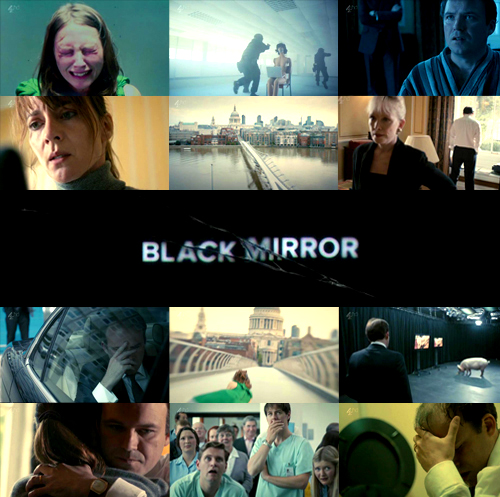
Saturday Matinee: Black Mirror

bm1

“Black Mirror” (2011 – ) is a British anthology series created by satirist Charlie Brooker exploring potential unintended social/psychological effects of technology. It’s sort of an updated and darker version of The Twilight Zone offering (often pessimistic) commentary on society, government, culture and relationships.

Season 1

The National Anthem

15 Million Merits
http://www.dailymotion.com/video/xyllhh_black-mirror-15-million-merits_shortfilms

The Entire History of You

Season 2

Be Right Back

White Bear

The Waldo Moment

White Christmas

Time and the Technological World

321e730d017aeaf2228d3217ae9abd77

Source: The Hipcrime Vocab

Check out this fascinating summary of  How We Got to Now: Six Innovations That Made the Modern World. This particular summary looks at the part of the book that documents how our perception of time has changed, and how that has affected the modern world.

The book talks about something called the “Hummingbird Effect,” which describes the way in which various inventions and technical discoveries change the world in unexpected ways. Some of you may recall James’ Burke’s excellent TV show Connections on BBC/PBS (These used to be available on YouTube, but JamesBurkeWeb appears to have disappeared. Still, some episodes can still be found) which covered the same ground:

Johnson points out that, much like the evolution of bees gave flowers their colors and the evolution of pollen altered the design of the hummingbird’s wings, the most remarkable thing about innovations is the way they precipitate unanticipated changes that reverberate far and wide beyond the field or discipline or problem at the epicenter of the particular innovation. Pointing to the Gutenberg press — itself already an example of the combinatorial nature of creative breakthroughs — Johnson writes:

    “Johannes Gutenberg’s printing press created a surge in demand for spectacles, as the new practice of reading made Europeans across the continent suddenly realize that they were farsighted; the market demand for spectacles encouraged a growing number of people to produce and experiment with lenses, which led to the invention of the microscope, which shortly thereafter enabled us to perceive that our bodies were made up of microscopic cells. You wouldn’t think that printing technology would have anything to do with the expansion of our vision down to the cellular scale, just as you wouldn’t have thought that the evolution of pollen would alter the design of a hummingbird’s wing. But that is the way change happens.”

It starts with Galileo’s observation that a pendulum always swings to-and-fro in a regular amount of time.

“But machines that could keep a reliable beat didn’t exist in Galileo’s age; the metronome wouldn’t be invented for another few centuries. So watching the altar lamp sway back and forth with such regularity planted the seed of an idea in Galileo’s young mind. As is so often the case, however, it would take decades before the seed would blossom into something useful.”

The ability to accurately measure time was a departure from before when:

    “Instead of fifteen minutes, time was described as how long it would take to milk the cow or nail soles to a new pair of shoes. Instead of being paid by the hour, craftsmen were conventionally paid by the piece produced — what was commonly called “taken-work” — and their daily schedules were almost comically unregulated.”

Once the regimentation of the clock was introduced, many things followed from that due to the Hummingbird Effect:

Over the century that followed, the pendulum clock, a hundred times more accurate than any preceding technology, became a staple of European life and forever changed our relationship with time. But the hummingbird’s wings continued to flap — accurate timekeeping became the imperceptible heartbeat beneath all technology of the Industrial Revolution, from scheduling the division of labor in factories to keeping steam-powered locomotives running on time. It was the invisible hand of the clock that first moved the market — a move toward unanticipated innovations in other fields. Without clocks, Johnson argues, the Industrial Revolution may have never taken off — or “at the very least, have taken much longer to reach escape velocity.” He explains:

    “Accurate clocks, thanks to their unrivaled ability to determine longitude at sea, greatly reduced the risks of global shipping networks, which gave the first industrialists a constant supply of raw materials and access to overseas markets. In the late 1600s and early 1700s, the most reliable watches in the world were manufactured in England, which created a pool of expertise with fine-tool manufacture that would prove to be incredibly handy when the demands of industrial innovation arrived, just as the glassmaking expertise producing spectacles opened the door for telescopes and microscopes. The watchmakers were the advance guard of what would become industrial engineering.”

Not mentioned is the introduction of public schools, designed to take farmers used to “cow milking time” and “discipline” them into a workforce able to sit still and obey and punch a clock, a system we are still living with today. Those of us who cannot or will not conform to this ruthless discipline are severely punished:

And yet, as with most innovations, the industrialization of time came with a dark side — one Bertrand Russell so eloquently lamented in the 1920s when he asked: “What will be the good of the conquest of leisure and health, if no one remembers how to use them?” Johnson writes:

    “The natural rhythms of tasks and leisure had to be forcibly replaced with an abstract grid. When you spend your whole life inside that grid, it seems like second nature, but when you are experiencing it for the first time, as the laborers of industrial England did in the second half of the eighteenth century, it arrives as a shock to the system. Timepieces were not just tools to help you coordinate the day’s events, but something more ominous: the “deadly statistical clock,” in Dickens’s Hard Times, “which measured every second with a beat like a rap upon a coffin lid.”

[…]

    “To be a Romantic at the turn of the nineteenth century was in part to break from the growing tyranny of clock time: to sleep late, ramble aimlessly through the city, refuse to live by the “statistical clocks” that governed economic life… The time discipline of the pendulum clock took the informal flow of experience and nailed it to a mathematical grid. If time is a river, the pendulum clock turned it into a canal of evenly spaced locks, engineered for the rhythms of industry.

And as clocks became ever more precise and ubiquitous, things flowed from that – more regimentation, more standardization (village clocks used to be set by the sun’s position, but this introduced inaccuracies in railroad timetables – thus two inventions, one steam-powered and one not, are bound up together), and entirely new scientific discoveries which led to new inventions such as the computers that now rule over our lives:

Johnson goes on to trace the hummingbird flutterings to the emergence of pocket watches, the democratization of time through the implementation of Standard Time, and the invention of the first quartz clock in 1928, which boasted the unprecedented accuracy of losing or gaining only one thousandth of a second per day…But the most groundbreaking effect of the quartz clock — the most unpredictable manifestation of the hummingbird effect in the story of time — was that it gave rise to modern computing and the Information Age. Johnson writes:

    “Computer chips are masters of time discipline… Instead of thousands of operations per minute, the microprocessor is executing billions of calculations per second, while shuffling information in and out of other microchips on the circuit board. Those operations are all coordinated by a master clock, now almost without exception made of quartz… A modern computer is the assemblage of many different technologies and modes of knowledge: the symbolic logic of programming languages, the electrical engineering of the circuit board, the visual language of interface design. But without the microsecond accuracy of a quartz clock, modern computers would be useless.”

And once the computer is invented – note that it becomes the new mega-metaphor taking over from the steam engine – the brain as “neural network” that can be simulated, the economy as a perfect “information processing machine” via the price mechanism and humans as “rational utility maximizers”of Neoliberal economics, and recasting the analog world as binary one of ones and zeros – art, music, literature, etc. that can be simulated through sufficiently complex algorithms. All this flows from our view of the world, which in turn is dictated by our technology.

The Hummingbird Effect: How Galileo Invented Time and Gave Rise to the Modern Tyranny of the Clock (Brain Pickings)

More at the link. It’s worth noting that this entire thesis was laid out by Lewis Mumford as far back in the 1930’s in Technics and Society, and this book looks like it covers much the same ground.

Mumford’s these is that the Industrial Revolution did not spring forth fully-formed from nowhere, but came forth from changes in the human perception of the world and man’s relationship to nature that had been occurring for centuries beforehand. He called this the Eotechnic period, and points out that it needs to be understood to see how the modern world emerged. He classified the subsequent periods as Paleotechnic (centered around the stream engine, iron and coal), and the Neotechnic (centered around electricity and the scientific method). He stressed how much our perception of the natural world and human nature dictate the nature of our science and social organization.

Several intellectual revolutions had to take place in order to get us to the Industrial Revolution. One, as noted above and emphasized by Mumford, was the accurate measurement of time. Another was the increasing control over motive forces exemplified by the windmill and watermill. Another was individual perception, as indicated by the use of perspective in painting. Another was the increasing standardization, political centralization and bureaucracy. Another was the discovery of the New World of which the ancients had no knowledge or precedent. Another was the increasing use of the abstraction of money for trade. But perhaps the biggest one of all was recasting the natural world as a machine that could be analyzed and understood. These changes were all formative to the Industrial Revolution, which could not have come about without them.

Mumford writes extensively about the Medieval period, and how that period increasingly used technology to control the environment but in a genuinely humane way, one designed to enhance human needs and desires rather than control or eliminate them. Think of the medieval clock-making guild as opposed to the deskilled factory worker for example. The decentralized and localized nature of the Medieval period is what allowed technology to be used in this way.

But, beginning in the seventeenth century with the rise of the nation-state and the consolation of Europe’s kingdoms into large, centralized states with standards and bureaucracy (much of it due to the emergence of gunpowder and artillery, against which castles and mounted knights were useless), all that began to to change. Technology became increasingly tyrannical, and man was more and more forced into the “logic of the machine.” Consider the armies that emerged identical uniforms, identical weapons with interchangeable parts and drilled, regimented training designed to turn men into interchangeable parts themselves. Military training was the precursor to the disciplined workforce of the Industrial Revolution, which is why the connection between business and military discipline remains to this day (corporations today are run on the top-down hierarchical military model). Since battles were won by sheer numbers of “citizens” with rifles rather than an aristocratic warrior class who owned horses, the social relations changed, and the common man emerged with more importance. Population growth equaled national strength in the new order. Man’s rationality became celebrated, all other values were discounted. Productivity and technological “progress” became goals in the themselves rather than means to an end. Pursuit of growth and profit became all-consuming, human needs be damned.

In contrast to the Medieval period, today’s technology is dehumanizing, submitting man to centralized control, and seeing him as nothing more than a machine. Mumford envisioned a society where human values could once again take center stage instead of the productivist logic of “the myth of the machine” Thus Mumford was not anti-technology; rather he wanted a world in which technology served profoundly different values than in our present time. The brutal regulation of time, rather than the human time of being in the world – the difference between chronos and kairos, or the subjective and the objective – is one of the best illustrations of this difference. Just because we can measure time down to the nanosecond does not mean we have to be enslaved to it. That is a social choice, as Mumford would quickly remind us.


Treading water in the stream

yun_2729

By Chris Arkenberg

Source: URBEINGRECORDED

I haven’t posted much here in a while and, honestly, I don’t know if I have an audience anymore. You gotta feed the beast or it’ll just go gorge elsewhere at the unlimited trough of spankulation that is the Internet. It’s easier to tweet, and now there’s Ello which hasn’t yet found its center of gravity or true genus locii to root down a thriving community. But it’s refreshing to post more than 140 char without the expectation of serious long-form journeys. And I don’t use Facebook so Ello at least offers some potential to have an intellectual cohort that won’t rat-hole into that heady blend of extremism and uncritical non-thinking that seems to be coded directly into the DNA of Disgracebook. So consider this post my sort of Fakebook personal rant…

But then, I’m not sure I have a lot to say these days. Partly, I do so much of this sort of thing at work where the audience is internal. The content is fairly narrow but still insightful. Not the broad random walks through techno-behaviorology that I’m inclined to pursue here. Partly, on another axis, the Twitters and the constant streams of the technoverse and geopolity have got me a bit swirly, like the inertia of information is too great to adequately slow down and process into some sort of theory. The fascination with the stream is at the expense of any fascination with the particulars of life, like it’s all moving too fast and I’m being entrained to be little more than a relay node in the network. Click, retweet, copy-past, post. A servant to the memes, like apes collared to silicon just to grind out more 1’s and 0’s.

So much of the stream seams meaningless – fleeting glimpses, spikes of outrage, stories about things and events that will be wiped from the collective memory within a week. And maybe that’s the point, to bring all the mundane details to light, to share the bits with each other, to fully become the eyes of the world, in witness of it all. But then, if I really think about it, it’s appalling how many resources, how much energy, how much labor born on the backs of the impoverished, how much of this all goes to keeping the platters spinning and the switches switching and the rare earth’s rare-earthing, across global data centers sucking down megawatts to make sure we archive every random bleating of the global mind. To a post-psychedelic techno-futurist like myself, it’s a bit confusing to feel at odds with the marvel of it all.

I can’t remember the source but this phrase about digital transformation really stuck with me: that it’s emulsifying entire industries. Which underlines that there’s very real import to the network spankulation, that we have some obligation to roll the dung ball of modernity around and around beneath the Sun, to check it for deformations that might drive truly dangerous emulsifications. We can snicker at the death of old industries but what about the demise of comfort or wellness or nutrition or the oft-anticipated end of the state… Are we really ready for this degree of transformation? So I’m left with a crutch of faith that the stream is, on balance, a positive tool to keep us all engaged with the Great Work of unfolding the possible with some integrity, without destroying more than we create. That the relentless bleating of sheep is what keeps the shepherds attentive and considerate, and that the global mind helps us better evolve the animal within towards something more tenable than base self-preservation, something much holier than religion, something much more wise than science.

It’s a lot to put on a stream, I know, but maybe having a degree of faith is what keeps us swimming, lest we give in to the rushing depths and fall like stones, inert and silent.

It’s Time for Some Anti-Science Fiction

nature-spaceships_00374723

Source: The Hipcrime Vocab

It’s Time for Some Anti-Science Fiction
Why must positive depictions of the future always be dependent upon some sort of new technology?

Neal Stephenson is a very successful and well-known science fiction writer. He’s also very upset that the pace of technological innovation has seemingly slowed down and we seem to be unable to come up with truly transformative  “big ideas” anymore. He believes this is the reason why we are so glum and pessimistic nowadays. Indeed, the science fiction genre, once identified with space exploration and utopias of post-scarcity and abundant leisure time, has come to be dominated by depictions of the future as a hellhole of extreme inequality, toxic environmental pollution, overcrowded cities, oppressive totalitarian governments, and overall political and social breakdown. Think of movies like The Hunger Games, Elysium, The Giver, and Snowpiercer.

This pessimism is destructive and corrosive, believes Stephenson. According to the BBC:

Acclaimed science-fiction writer Neal Stephenson saw this bleak trend in his own work, but didn’t give it much thought until he attended a conference on the future a couple years ago. At the time, Stephenson said that science fiction guides innovation because young readers later grow up to be scientists and engineers.

But fellow attendee Michael Crow, president of Arizona State University (ASU), “took a more sort of provocative stance, that science fiction actually needed to supply ideas that scientists and engineers could actually implement”, Stephenson says. “[He] basically told me that I needed to get off my duff and start writing science fiction in a more constructive and optimistic vein.”

“We want to create a more open, optimistic, ambitious and engaged conversation about the future,” project director Ed Finn says. According to his argument, negative visions of the future as perpetuated in pop culture are limiting people’s abilities to dream big or think outside the box. Science fiction, he says, should do more. “A good science fiction story can be very powerful,” Finn says. “It can inspire hundreds, thousands, millions of people to rally around something that they want to do.”

Basically, Stephenson wants to bring back the kind of science fiction that made us actually long for the future rather than dread it. Stephenson means to counter this techno-pessimism by inviting a number of well-known science fiction writers to come up with more positive, even utopian, visions of the future, where we once again come up with “big ideas” that inspire the scientists and engineers in their white labcoats. He apparently believes that it is the duty of science fiction authors to act as, in the words of one commentator, “the first draft of the future. ” Indeed, much of modern technology and space exploration was presaged by authors like H.G. Wells and Jules Verne. From the BBC article above, here are some of the positive future scenarios depicted in the book:

  •     Environmentalists fight to stop entrepreneurs from building the first extreme tourism destination hotel in Antarctica.
  •     People vie for citizenship on a near-zero-gravity moon of Mars, which has become a hub for innovation.
  •     Animal activists use drones to track elephant poachers.
  •     A crew crowd-funds a mission to the Moon to set up an autonomous 3D printing robot to create new building materials.
  •     A 20km tall tower spurs the US steel industry, sparks new methods of generating renewable energy and houses The First Bar in Space.

The whole idea behind Project Hieroglyph, as I understand it, is to depict more positive futures than the ones being depicted in current science fiction and media. That seems like a good idea. But my question is – why must these positive futures always involve more intensive application of technology? Why are we unable to envision a better future in any other way besides more technology, more machines, more inventions, more people, more economic growth, etc. Haven’t we already been down that road?

Or to put it another way, why must science fiction writers assume that more technological innovation will produce a better society when our modern society is the result of previous technological innovations, and is seen by many people as a dystopia (with many non-scientifically-minded people actually longing for a collapse of some sort)? Perhaps, to paraphrase former president Reagan, in the context of our current crisis, technology is not the solution to the problem, technology is the problem.

***

It’s worth pointing out that many of the increasingly dystopian elements of our present circumstances have been brought about by the application of technology.

Economists have pinpointed technology as a key driver of inequality thanks to the hollowing out of the middle class due to the automation of routine tasks that underpinned the  industrial/service economy leaving only high-end and low-end jobs remaining, as well as the “superstar effect” where a few well-paid superstars capture all the gains because technology allows them to everywhere at once. Fast supercomputers have allowed the rich to game the stock market casino where the average stock is now held for just fractions of a second, while global telecommunications has led to reassigning jobs anywhere in the world where the very cheapest workers can be found. America’s manufacturing  jobs are now done by Chinese workers and its service jobs by Indian workers half a world away even as the old Industrial heartland looks suspiciously like what is depicted in The Hunger Games. Rather than a world of abundant leisure, stressed out workers take their laptops to the beach, fearful of losing their jobs if they don’t, while millions have given up even looking for work anymore. A permanently underemployed underclass distracts itself with Netflix, smartphones and computer games, and takes expensive drugs promoted by pharmaceutical companies to deal with their depression.

Global supply chains, supertankers, the “warehouse and wheels,” and online shopping have hollowed out local main street economies and led to monopolies in every industry across the board. Small family farmers have been kicked off the land worldwide and replaced by gargantuan, fossil-fuel powered agricultural factories owned by agribusinesses churning out  bland processed food based around wheat, corn and soy causing soaring obesity rates worldwide and runaway population growth.

Banks have merged into just a handful of entities that are “too-big-to-fail” and send trillions around the world at the speed of light. Gains are privatized while loses and risk are socialized, and the public sphere is sold off to profiteers at fire sale prices. A small financial aristocracy controls the system and hamstrings the world with debt. Just eighty people control as much wealth as half of the planet’s population, and in the world’s biggest economy just three people gain as much income as half the workforce. There are now more prisoners in America than farmers.

A now global trans-national elite of owner-oligarchs criss-crosses the world in Gulfsteam jets and million-dollar yachts and  hides their money in offshore accounts beyond the reach of increasingly impotent national governments, while smaller local governments can’t keep potholes filled, streets plowed and streetlights on for ordinary citizens. Many of the world’s great cities have become “elite citadels” making it impossible for regular citizens to live there. This elite controls bond markets, funds political campaigns and owns and controls a monopolized media that normalizes this state of affairs using sophisticated propaganda tools enhanced by cutting-edge psychological research enabled by MRI scanners. The media is controlled by a small handful of corporations and panders to the lowest common demonstrator while keeping people in a constant state of fear and panic. Advertising preys on our insecurities and desire for status to make us buy more, enabled by abundant credit. The Internet, once the hope for a more democratic future, has ended up as shopping mall, entertainment delivery system and spying/tracking system rather than a force for democracy and revolution.

Security cameras peer at us from every streetcorner and store counter and shocking revelations about the power and reach of the national security state that are as fantastic as anything dreamed up by dystopian science fiction writers have become so commonplace that people hardly notice anymore. Anonymous people in gridded glass office towers read our every email, listen to our every phone call and track our every move using our cell phones. New technology promises “facial recognition” and “smart” technology promoted by corporations promises to track and permanently record literally every move you make.

Remote-control drones patrol the skies of global conflict zones and vaporize people half a world away without their pilots ever seeing their faces. High-tech fighter jets allow us to “cleanly” drop bombs without the messiness of a real war. Private mercenaries are a burgeoning industry and global arms sales continue to increase even in a stagnant global economy with arms companies often selling to both sides. By some accounts one in ten Americans is employed in some sort of “guard labor,” that is, keeping their fellow citizens in line. The number of failed states continues to increase in the Middle East and Africa and citizens in democracies are marching in the streets.

Not that there’s nothing for the national security state to fear after all – technology has enabled individual terrorists and non-state actors to produce devastating weapons capable of destroying economies and killing thousands as 9-11 demonstrated. A single “superempowered” individual can kill millions with a nuclear bomb the size of a suitcase or an engineered virus or other bioterrorism weapon. The latest concern is “cyberwarfare” which could destroy the technological infrastructure we are now utterly dependent upon and kill millions. “Non-state actors” can wreak as much havoc as armies thanks to modern technology, and there are a lot of disgruntled people out there.

And then there is the environmental devastation, of which climate change is the most overwhelming, but includes everything from burned down Amazonian rainforest, to polluted mangroves in Thailand, to collapased fish stocks, dissolving coral reefs and oceans full of jellyfish. Half the  world’s terrestrial biodiversity has been eliminated in the past fifty years and we’ve lost so much polar ice that earth’s gravity is measurably affected. In China, the world’s economic success story, the haze is so thick that people can’t see the tops of the skyscrapers they already have and there are “cancer villages.” The skies may be a bit clearer in America thanks to deindustrialization, but things like drought in the Southwest and increasinginly powerful hurricanes are reminders that no one is immune. Entire countries and major cities look to be submerged under rising oceans and the first climate refugees are already on the move from places like Africa and Southeast Asia leading to anti-immigrant backlash in developed countries.

This is not some future dystopia, by the way, this is where technology has us led right now. Today. Current headlines. Maybe the reason that dystopias are so popular is because that seems to be where technology had led us here in the first decade of the twenty-first century. I’m skeptical that Project Hieroglyph and it’s fostering of “big ideas” will do much to change that.

Thus my fundamental question is, given the above, why is it always assumed that the path to utopia goes through a widespread deployment of even more innovation and technology? Is it realistic to believe that colonies on Mars, drones, intelligent robots, skyscrapers and space elevators will solve any of this?

I’ve written before about the fact that the technology we already have in our possession today was expected to deliver a utopia by numerous writers and thinkers of the past. “The coming of the wireless era will make war impossible, because it will make war ridiculous,” declared Marconi in 1912. HG Wells, a committed socialist who lived during perhaps the greatest period of invention before or since (railroads, harnessing of electricity, radio communication, internal combustion engines, powered flight, antibiotics),  very frequently depicted utopian societies brought about through the applications of greater technology. Science fiction authors still seem to conceive utopias as being exclusively brought about by “technological progress.” But given hindsight, is that realistic anymore?

Maybe it’s time for some anti-science fiction.

***

The classic example of this is William Morris’ utopian novel News From Nowhere.

Morris was a key figure in the Arts and Crafts movement, which was a reaction to the factory-based mass production and subsequent deskilling of the workforce. People no longer collectively made the world of goods and buildings around them, rather they were now made by a small amount of people using deskilled, alienated labor in giant factories with the profits accruing to a tiny handful of capitalist owners. Morris wanted another way.

In Morris’ future London there are very little in the way of centralized institutions.  People work when they want to and do what they want to. Money is not used. Life is lived leisurely pace. Writing during the transformative changes of the Industrial Revolution, Morris’ London looks less like a World’s Fair and more like a lost bucolic pastoral London that had long since vanished under the smoke of factories. Technology plays a very small role yet people are much happier.

Morris’ work was written partially in response to a book entitled Looking Backward by Edward Bellamy, which was extraordinarily popular in the late nineteenth century, but almost forgotten today. Bellamy’s year 2000 utopia had the means of production brought under centralized control, with people serving time in an “industrial army” for twenty years and then retiring to a life of leisure and  material abundance brought about by production for use rather than capitalist profit.

Morris still felt that this subordinated workers to machines rather than depicting a society for the maximization of human well-being, including work. Here is Morris in a speech:

“Before I leave this matter of the surroundings of life, I wish to meet a possible objection. I have spoken of machinery being used freely for releasing people from the more mechanical and repulsive part of necessary labour; it is the allowing of machines to be our masters and not our servants that so injures the beauty of life nowadays. And, again, that leads me to my last claim, which is that the material surroundings of my life should be pleasant, generous, and beautiful; that I know is a large claim, but this I will say about it, that if it cannot be satisfied, if every civilised community cannot provide such surroundings for all its members, I do not want the world to go on.”

Morris’ book shows that utopias need not be high-tech. It also shows that real utopias are brought about by the underlying philosophy of a society and its corresponding social relations. It seems to me like Stephenson’s utopias are all predicated on the continuation of the philosophy and social relations of our current society – more growth, more technology, faster innovation, more debt, corporate control, trickle-down economics, private property, absentee ownership, anarchic markets, autonomous utility-maximizing consumers, etc. It is yoked to our ideas of “progress” as simply an application of more and faster technology.

By contrast, Morris’ utopia has the technological level we would  associate with a “dystopian” post collapse society, yet everyone seems a whole lot happier.

***

Now I don’t mean to suggest that any utopia should necessarily be a place where we have reverted to some sort pre-industrial level of technology. We don’t need to depict utopias as living like the Amish (although that would be an interesting avenue of exploration). I merely wish to point out that a future utopia need not be exclusively the domain of science fiction authors, and need not be predicated by some sort of new wonder technology or space exploration. For example, in an article entitled Is It Possible to Imagine Utopia Anymore? the author writes:

Recently, though, we may have finally hit Peak Dystopia…All of which suggests there might be an opening for a return to Utopian novels — if such a thing as “Utopian novels” actually existed anymore…In college, as part of a history class, I read Edward Bellamy’s Looking Backwards, a Utopian science-fiction novel published in 1888. The book — an enormous success in its time, nearly as big as Uncle Tom’s Cabin — is interesting now less as literature than as a historical document, and it’s certainly telling that, in the midst of the industrial revolution, a novel promising a future socialist landscape of increased equality and reduced labor so gripped the popular imagination. We might compare Bellamy’s book to current visions of Utopia if I could recall even a single Utopian novel or film from the past five years. Or ten years. Or 20. Wikipedia lists dozens of contemporary dystopian films and novels, yet the most recent entry in its rather sparse “List of Utopian Novels” is Island by Aldous Huxley, published in 1962*. The closest thing to a recent Utopian film I can think of is Spike Jonze’s Her, though that vision of the future — one in which human attachment to sentient computers might become something close to meaningful — hardly seems like a fate we should collectively strive for, but rather one we might all be resigned to placidly accept

Many serious contemporary authors have tackled dystopia: David Foster Wallace’s Infinite Jest, Gary Shteyngart’s Super Sad True Love Story, Cormac McCarthy’s The Road, and so on. But the closest thing we have to a contemporary Utopian novel is what we could call the retropia: books like Michael Chabon’s Telegraph Avenue (about a funky throwback Oakland record store) or Jonathan Lethem’s Fortress of Solitude (about 1970s Brooklyn) that fondly recall a bygone era, by way of illustrating what we’ve lost since —  “the lost glories of a vanished world,” as Chabon puts it. Lethem’s more recent Dissident Gardens is also concerned with utopia, but mostly in so far as it gently needles the revolutionaries of yesteryear.

Indeed, the closest things we have to utopias on TV today are shows like Mad Men which take place during the era when Star Trek was on TV rather than a utopia inspired by Star Trek itself. For many Americans, their version of utopia is not in the future but in the past – the 1950’s era of widespread prosperity, full employment, single-earner households, more leisure, guaranteed pensions, social mobility, inexpensive housing, wide open roads and spaces, and increasing living standards. As this article points out:

When I first heard about the project, my cynical heart responded skeptically. After all, much of the Golden Age science fiction Stephenson fondly remembers was written in an era when, for all its substantial problems, the U.S. enjoyed a greater degree of democratic consensus. Today, Congress can barely pass a budget, let alone agree on collective investments.

If someone asked me to depict a more positive future than the one we have, deploying more technology is just about the last thing I would do to bring it about. In fact, the future I would depict would almost certainly include less technology, or rather technology playing a smaller role in our lives. I would focus more on social relations that would make us be happy to be alive, where we eat good food, spend time doing what we want instead of what we’re forced to, and don’t have to be medicated just to make it through another day in our high-pressure classrooms and cubicles. I might even depict a future with no television inspired by Jerry Mander’s 1978 treatise Four Arguments for the Elimination of Television (hey, remember this is fiction after all!)

Rather it would depict different political, economic and social relations first, with new technology playing only a supporting, not a starring role. Organizing society around the needs of productive enterprise, growth and profits (and nothing else) is the reason, I believe, why we are feeling so depressed about the future that dystopias resonate more with a demoralized general public who rolls their collective eyes at the exhortations of science fiction writers with an agenda**. The problem of science fiction is it’s single-minded conflagration of technology with progress.

Personally my utopia would be something more like life on the Greek island of Ikaria*** according to this article from The New York Times (which reads an awful lot like News from Nowhere):

Seeking to learn more about the island’s reputation for long-lived residents, I called on Dr. Ilias Leriadis, one of Ikaria’s few physicians, in 2009. On an outdoor patio at his weekend house, he set a table with Kalamata olives, hummus, heavy Ikarian bread and wine. “People stay up late here,” Leriadis said. “We wake up late and always take naps. I don’t even open my office until 11 a.m. because no one comes before then.” He took a sip of his wine. “Have you noticed that no one wears a watch here? No clock is working correctly. When you invite someone to lunch, they might come at 10 a.m. or 6 p.m. We simply don’t care about the clock here.”

Pointing across the Aegean toward the neighboring island of Samos, he said: “Just 15 kilometers over there is a completely different world. There they are much more developed. There are high-rises and resorts and homes worth a million euros. In Samos, they care about money. Here, we don’t. For the many religious and cultural holidays, people pool their money and buy food and wine. If there is money left over, they give it to the poor. It’s not a ‘me’ place. It’s an ‘us’ place.”

Ikaria’s unusual past may explain its communal inclinations. The strong winds that buffet the island — mentioned in the “Iliad” — and the lack of natural harbors kept it outside the main shipping lanes for most of its history. This forced Ikaria to be self-sufficient. Then in the late 1940s, after the Greek Civil War, the government exiled thousands of Communists and radicals to the island. Nearly 40 percent of adults, many of them disillusioned with the high unemployment rate and the dwindling trickle of resources from Athens, still vote for the local Communist Party. About 75 percent of the population on Ikaria is under 65. The youngest adults, many of whom come home after college, often live in their parents’ home. They typically have to cobble together a living through small jobs and family support.

Leriadis also talked about local “mountain tea,” made from dried herbs endemic to the island, which is enjoyed as an end-of-the-day cocktail. He mentioned wild marjoram, sage (flaskomilia), a type of mint tea (fliskouni), rosemary and a drink made from boiling dandelion leaves and adding a little lemon. “People here think they’re drinking a comforting beverage, but they all double as medicine,” Leriadis said. Honey, too, is treated as a panacea. “They have types of honey here you won’t see anyplace else in the world,” he said. “They use it for everything from treating wounds to curing hangovers, or for treating influenza. Old people here will start their day with a spoonful of honey. They take it like medicine.”

Over the span of the next three days, I met some of Leriadis’s patients. In the area known as Raches, I met 20 people over 90 and one who claimed to be 104. I spoke to a 95-year-old man who still played the violin and a 98-year-old woman who ran a small hotel and played poker for money on the weekend.

On a trip the year before, I visited a slate-roofed house built into the slope at the top of a hill. I had come here after hearing of a couple who had been married for more than 75 years. Thanasis and Eirini Karimalis both came to the door, clapped their hands at the thrill of having a visitor and waved me in. They each stood maybe five feet tall. He wore a shapeless cotton shirt and a battered baseball cap, and she wore a housedress with her hair in a bun. Inside, there was a table, a medieval-looking fireplace heating a blackened pot, a nook of a closet that held one woolen suit coat, and fading black-and-white photographs of forebears on a soot-stained wall. The place was warm and cozy. “Sit down,” Eirini commanded. She hadn’t even asked my name or business but was already setting out teacups and a plate of cookies. Meanwhile, Thanasis scooted back and forth across the house with nervous energy, tidying up.

The couple were born in a nearby village, they told me. They married in their early 20s and raised five children on Thanasis’s pay as a lumberjack. Like that of almost all of Ikaria’s traditional folk, their daily routine unfolded much the way Leriadis had described it: Wake naturally, work in the garden, have a late lunch, take a nap. At sunset, they either visited neighbors or neighbors visited them. Their diet was also typical: a breakfast of goat’s milk, wine, sage tea or coffee, honey and bread. Lunch was almost always beans (lentils, garbanzos), potatoes, greens (fennel, dandelion or a spinachlike green called horta) and whatever seasonal vegetables their garden produced; dinner was bread and goat’s milk. At Christmas and Easter, they would slaughter the family pig and enjoy small portions of larded pork for the next several months.

During a tour of their property, Thanasis and Eirini introduced their pigs to me by name. Just after sunset, after we returned to their home to have some tea, another old couple walked in, carrying a glass amphora of homemade wine. The four nonagenarians cheek-kissed one another heartily and settled in around the table. They gossiped, drank wine and occasionally erupted into laughter.

No robot babysitters or mile-high skyscrapers required.

* No mention of Ernest Callenbach’s Ecotopia published in 1975?

** ASU is steeped in Department of Defense funding and DARPA (The Defense Research Projects Agency) was present at a conference about the book entitled “Can We Imagine Our Way to a Better Future?” held in Washington D.C. I’m guessing the event did not take place in the more run-down parts of the city. Cui Bono?

***Ironically, Icaria was used as the name of a utopian science fiction novel, Voyage to Icaria, and inspired an actual utopian community.