Kafka Warned Us

By

Source: CounterPunch

Kafka’s The Trial can be read in retrospect as a prelude to the Twentieth/Twenty-First century. Although probably not written as prophecy, Kafka’s short unfinished book nevertheless provides a road map to the terrors of the current Surveillance State.

As readers of CounterPunch are all too familiar, modern man, as a single individual, is at the mercy of the modern state and those who, lurking in semi-secrecy, direct it.

Kafka’s The Trial superbly conveys the unease of our current existential situation.

Early one morning, The Trial’s main protagonist, Joseph K, awakes to find that, totally unexpectedly, he has been arrested. Throughout the book he endeavors to find the reason for his arrest without any definite success.

However, what he does discover is a vast semi-secret bureaucracy/organizaton whose inner workings and outward displays of power and decision making remain opaque at best.

Initally, Joseph K, believes that he lives in a “Rechtsstaat” (a state where the rule of law is respected) and thus where it is expected that all civilized norms and laws are upheld.

Yet, he soon comes to see that he has lived in a state of fundamental error and illusion about the true nature of his existence.

What appeared to him as a well ordered and just state is, all of a sudden, revealed to be a capricious omnipotent octopus capable of strangling (in this case literally) anyone deemed to be, for whatever reason, expendable.

All law is suspended or, at least, made a mockery of. All that remains are the inner, turgid demands of power.

Joseph K. is convinced of his innocence. But his conviction is no match for the monolithic power that stands against him. He is eventually crushed, if not by his enemy’s repetitive legal machinations, then by his fatalistic far-reaching administrative power.

In the end, the “Organization” which Joseph K has confronted is almighty and can be controlled by neither appeals to law, logic, or custom. In this, modern man is in a similar situation.

He stands, at any moment, beneath the mercy of a gigantic machinery that, if it wills, can almost casually set into motion his utter annihilation. The devastation and erasure of ones past, present, and future self is an ever-present possible function of the modern state. Advances in technology and organization make such a function all the more easier.

How to combat this greatest threat to humankind’s liberty will make the difference of whether or not future generations live in a world of securely grounded freedom or if they will succumb “like a dog” to the increasingly totalitarian powers of what we call today: the Surveillance State.

Are Facebook and Google the New Colonial Powers?

By Charles Hugh Smith

Source: Of Two Minds

To qualify as colonial powers, Facebook and Google must effectively limit the choices and power of users, and punish or coerce those who question or resist their power.

I was struck by a phrase from a recent essay on advertising and social media, You Are the Product: As Taplin points out, that remark ‘unwittingly revealed a previously unspoken truth: Facebook and Google are the new colonial powers.’

As you’ve no doubt noticed, the dominance of Facebook and Google in online advertising is now “in the news” for a variety of reasons: the possibility that agents of other governments influenced U.S. elections with media buys on Facebook; anti-trust concerns; the potential for these advert-tech giants to effectively silence legitimate online voices under the guise of limiting “fake news”, and of course, the ongoing issues of click fraud and the underperformance of digital ads.

The phrase that captures this broad narrative is: When an online service is free, you’re not the customer. You’re the product.

In other words, if you’re not paying for the service or content, then your information (harvested by Google, Facebook, et al.), your time online (i.e. your attention, a.k.a. eyeballs) and the content you create and post for free (videos of your cute cat, etc.) are the products being sold to advertisers at a premium.

The characterization of the two dominant digital-advert giants as new colonial powers is interesting on a number of fronts. To get a handle on a few of the issues, I recommend reading these two essays:

A Serf on Google’s Farm

Lost Context: How Did We End Up Here?

And watching this video on the archiving of digital information on individuals–including meta-data, that is, data about your behaviors, transactions, posts, etc. that have been scrubbed of your identity markers (name, account numbers, etc.)

Haunted by Data – Maciej Ceglowski (via GFB)

The key dynamics of colonialism for the residents are 1) a lack of choice and 2) a lack of power: the colonial power imposes a regime, either formally or informally, that limits the choices enjoyed by residents and limits their power to bypass or replace the colonial regime.

In the classic Plantation Economy of overt colonialism–a topic I’ve discussed numerous times here–residents are stripped of any options other than working on the plantation and buying their goods at the plantation store. This coercion need not be direct; the colonial regime can strip residents of choice and power by making it impossible to live without cash, for example, and then providing one source of paid work: the plantation.

Once cash is necessary to live, then credit is introduced–but only if you buy at the company store.

I’ve also written extensively about the Neo-Colonial Model in which corporations and banks bring the colonial model of exploitation to the home country, stripmining the domestic populace via dependence on credit.

Welcome to Neocolonialism, Exploited Peasants! (October 21, 2016)

Greece and the Endgame of the Neocolonial Model of Exploitation (February 19, 2015)

The E.U., Neofeudalism and the Neocolonial-Financialization Model (May 24, 2012)

This model is also used in the developing world, where it has replaced the old overt form of Colonialism with the new and improved credit-based version.

To qualify as colonial powers, Facebook and Google must effectively limit the choices and power of users, and punish or coerce those who question or resist their power. As the dominant corporations in search, social media and digital advertising, Facebook and Google limit the options of users simply by being essential due to their dominance.

As for punishing users–the potential to do so is what’s worrying observers. The cover for silencing or banning critics is opaque: non-compliance with guidelines. So who’s to say that users who criticized or questioned the policies of Facebook and Google aren’t silenced along with click-fraudsters, “fake news” purveyors, etc.? Who gets silenced is completely up to the companies, and there is no recourse to the corporation’s opaque judgment.

The Orwellian possibilities are real enough.

Here’s a look at the digital advert market:

And the dominance of Google/Facebook:

End-times for humanity


Humanity is more technologically powerful than ever before, and yet we feel ourselves to be increasingly fragile. Why?

By Claire Colebrook

Source: Aeon

The end of the world is a growth industry. You can almost feel Armageddon in the air: from survivalist and ‘prepper’ websites (survivopedia.com, doomandbloom.net, prepforshtf.com) to new academic disciplines (‘disaster studies’, ‘Anthropocene studies’, ‘extinction studies’), human vulnerability is in vogue.

The panic isn’t merely about civilisational threats, but existential ones. Beyond doomsday proclamations about mass extinction, climate change, viral pandemics, global systemic collapse and resource depletion, we seem to be seized by an anxiety about losing the qualities that make us human. Social media, we’re told, threatens our capacity for empathy and genuine connection. Then there’s the disaster porn and apocalyptic cinema, in which zombies, vampires, genetic mutants, artificial intelligence and alien invaders are oh-so-nearly human that they cast doubt on the value and essence of the category itself.

How did we arrive at this moment in history, in which humanity is more technologically powerful than ever before, and yet we feel ourselves to be increasingly fragile? The answer lies in the long history of how we’ve understood the quintessence of ‘the human’, and the way this category has fortified itself by feeding on the fantasy of its own collapse. Fears about the frailty of human wisdom go back at least as far as Ancient Greece and the fable of Plato’s cave, in which humans are held captive and can only glimpse the shadows of true forms flickering on the stone walls. We prisoners struggle to turn towards the light and see the source (or truth) of images, and we resist doing so. In another Platonic dialogue, the Phaedrus, Socrates worries that the very medium of knowledge – writing – might discourage us from memorising and thinking for ourselves. It’s as though the faculty of reason that defines us is also something we’re constantly in danger of losing, and even tend to avoid.

This paradoxical logic of loss – in which we value that which we’re at the greatest risk of forsaking – is at work in how we’re dealing with our current predicament. It’s only by confronting how close we are to destruction that we might finally do something; it’s only by embracing the vulnerability of humanity itself that we have any hope of establishing a just future. Or so say the sages of pop culture, political theory and contemporary philosophy. Ecological destruction is what will finally force us to act on the violence of capitalism, according to Naomi Klein in This Changes Everything: Capitalism vs the Climate (2014). The philosopher Martha Nussbaum has long argued that an attempt to secure humans from fragility and vulnerability explains the origins of political hierarchies from Plato to the present; it is only if we appreciate our own precarious bodily life, and the emotions and fears that attach to being human animals, that we can understand and overcome racism, sexism and other irrational hatreds. Disorder and potential destruction are actually opportunities to become more robust, argues Nassim Nicholas Taleb in Antifragile (2012) – and in Thank You for Being Late (2016), the New York Times’ columnist Thomas Friedman claims that the current, overwhelming ‘age of accelerations’ is an opportunity to take a pause. Meanwhile, Oxford University’s Future of Humanity Institute pursues research focused on avoiding existential catastrophes, at the same time as working on technological maturity and ‘superintelligence’.

It’s here that one can discern a tight knit between fragility and virility. ‘Humanity’ is a hardened concept, but a brittle one. History suggests that the more we define ‘the human’ as a subject of intellect, mastery and progress – the more ‘we’ insist on global unity under the umbrella of a supposedly universal kinship – the less possible it becomes to imagine any other mode of existence as human. The apocalypse is typically depicted as humanity reduced to mere life, fragile, exposed to all forms of exploitation and the arbitrary exercise of power. But these dystopian future scenarios are nothing worse than the conditions in which most humans live as their day-to-day reality. By ‘end of the world’, we usually mean the end of our world. What we don’t tend to ask is who gets included in the ‘we’, what it cost to attain our world, and whether we were entitled to such a world in the first place.

Stories about the end of time have a long history, from biblical eschatology to medieval plague narratives. But our fear of a peculiarly ‘human’ apocalypse really begins with the 18th-century Enlightenment. This was the intellectual birthplace of the modern notion of ‘humanity’, a community of fellow beings united by shared endowments of reason and rights. This humanist ideal continues to inform progressive activism and democratic discourse to this day. However, it’s worth taking a moment to go back to René Descartes’s earlier declaration of ‘I think, therefore I am’, and ask how it was possible for an isolated self to detach their person from the world, and devote writing, reading and persuasion to the task of defending an isolated and pure ego. Or fast-forward a few centuries to 1792, and consider how Mary Wollstonecraft had the time to read about the rights of man, and then demand the rights of woman.

The novelist Amitav Ghosh provides a compelling answer in his study of global warming, The Great Derangement (2017). Colonisation, empire and climate change are inextricably intertwined as practices, he says. The resources of what would become the Third World were crucial in creating the comfortable middle-class existences of the modern era, but those resources could not be made available to all: ‘the patterns of life that modernity engenders can only be practised by a small minority … Every family in the world cannot have two cars, a washing machine and a refrigerator – not because of technical or economic limitations but because humanity would asphyxiate in the process.’

Ghosh disputes one crucial aspect of the story of humanity: that it should involve increasing progress and inclusion until we all reap the benefits. But I’d add a further strand to this dissenting narrative: the Enlightenment conception of rights, freedom and the pursuit of happiness simply wouldn’t have been imaginable if the West had not enjoyed a leisured ease and technological sophistication that allowed for an increasingly liberal middle class. The affirmation of basic human freedoms could become widespread moral concerns only because modern humans were increasingly comfortable at a material level – in large part thanks to the economic benefits afforded by the conquest, colonisation and enslavement of others. So it wasn’t possible to be against slavery and servitude (in the literal and immediate sense) until large portions of the globe had been subjected to the industries of energy-extraction. The rights due to ‘us all’, then, relied on ignoring the fact that these favourable conditions had been purchased at the expense of the lives of other humans and non-humans. A truly universal entitlement to security, dignity and rights came about only because the beneficiaries of ‘humanity’ had secured their own comfort and status by rendering those they deemed less than human even more fragile.

What’s interesting about the emergence of this 18th-century humanism isn’t only that it required a prior history of the abjection it later rejected. It’s also that the idea of ‘humanity’ continued to have an ongoing relation to that same abjection. After living off the wealth extracted from the bodies and territories of ‘others’, Western thought began to extend the category of ‘humanity’ to capture more and more of these once-excluded individuals, via abolitionism, women’s suffrage and movements to expand the franchise. In a strange way these shifts resemble the pronouncements of today’s tech billionaires, who, having extracted unimaginable amounts of value from the mechanics of global capitalism, are now calling for Universal Basic Income to offset the impacts of automation and artificial intelligence. Mastery can afford to correct itself only from a position of leisured ease, after all.

But there’s a twist. While everyone’s ‘humanity’ had become inherent and unalienable, certain people still got to be more fully ‘realised’ as humans than others. As the circle of humanity grew to capture the vulnerable, the risk that ‘we’ would slip back into a semi-human or non-human state seemed more present than before – and so justified demands for an ever more elevated and robust conception of ‘the human’.

One can see this dynamic at work in the 18th-century discussions about slavery. By then the practice itself had become morally repugnant, not only because it dehumanised slaves, but because the very possibility of enslavement – of some humans not realising their potential as rational subjects – was considered pernicious for humanity as a whole. In A Vindication of the Rights of Woman (1792), for example, Wollstonecraft compared women to slaves, but insisted that slavery would allow no one to be a true master. ‘We’ are all rendered more brutal and base by enslaving others, she said. ‘[Women] may be convenient slaves,’ Wollstonecraft wrote, ‘but slavery will have its constant effect, degrading the master and the abject dependent.’

These statements assumed that an entitlement to freedom was the natural condition of the ‘human’, and that real slavery and servitude were no longer genuine threats to ‘us’. When Jean-Jacques Rousseau argued in The Social Contract (1762) that ‘man is born free, and everywhere he is in chains’, he was certainly not most concerned about those who were literally in chains; likewise William Blake’s notion of ‘mind-forg’d manacles’ implies that the true horror is not physical entrapment but a capacity to enslave oneself by failing to think. It’s thus at the very moment of abolition, when slavery is reduced to a mere symbol of fragility, that it becomes a condition that imperils the potency of humanity from within.

I’m certainly not suggesting that there is something natural or inevitable about slavery. What I’m arguing is that the very writers who argued against slavery, who argued that slavery was not fitting for humans in their very nature, nevertheless saw the unnatural and monstrous potential for slavery as far too proximate to humans in their proper state. Yet rather than adopt a benevolence towards the world in light of this vulnerability in oneself, the opposite has tended to be the case. It is because humans can fail to reach their rational potential and be ‘everywhere in chains’ that they must ever more vigilantly secure their future. ‘Humanity’ was to be cherished and protected precisely because it was so precariously elevated above mere life. The risk of debasement to ‘the human’ turned into a force that solidified and extended the category itself. And so slavery was not conceived as a historical condition for some humans, subjected by ruthless, inhuman and overpowering others; it was an ongoing insider threat, a spectre of fragility that has justified the drive for power.

How different are the stories we tell ourselves today? Movies are an interesting barometer of the cultural mood. In the 1970s, cinematic disaster tales routinely featured parochial horrors such as shipwrecks (The Poseidon Adventure, 1972), burning skyscrapers (The Towering Inferno, 1974), and man-eating sharks (Jaws, 1975). Now, they concern the whole of humanity. What threatens us today are not localised incidents, but humans. The wasteland of Interstellar (2014) is one of resource depletion following human over-consumption; the world reduced to enslaved existence in Elysium (2013) is a result of species-bifurcation, as some humans seize the only resources left, while those left on Earth enjoy a life of indentured labour. That the world will end (soon) seems to be so much a part of the cultural imagination that we entertain ourselves by imagining how, not whether, it will play out.

But if you look closely, you’ll see that most ‘end of the world’ narratives end up becoming ‘save the world’ narratives. Popular culture might heighten the scale and intensity of catastrophe, but it does so with the payoff of a more robust and final triumph. Interstellar pits the frontier spirit of space exploration over a miserly and merely survivalist bureaucracy, culminating with a retired astronaut risking it all to save the world. Even the desolate cinematic version (2009) of Cormac McCarthy’s novel The Road (2006) concludes with a young boy joining a family. The most reduced, enslaved, depleted and lifeless terrains are still opportunities for ‘humanity’ to confront the possibility of non-existence in order to achieve a more resilient future.

Such films hint at a desire for new ways of being. In Avatar (2009), a militaristic and plundering West invades the moon Pandora in order to mine ‘unobtanium’; they are ultimately thwarted by the indigenous Na’vi, whose attitude to nature is not one of acquisition but of symbiotic harmony. Native ecological wisdom and attunement is what ultimately leads to victory over the instrumental reason of the self-interested invaders. In Mad Max: Fury Road (2015), a resource-depleted future world is controlled by a rapacious, parasitic, and wasteful elite. But salvation comes from the revolutionary return of a group of ecologically attuned and other-directed women, all blessed with a mythic wisdom that enables ultimate triumph over the violent self-interest of the literally blood-sucking tyrant family. These stories rely on quasi-indigenous and feminist images of community to offer alternatives to Western hyper-extraction; both resolve their disaster narratives with the triumph of intuitive and holistic modes of existence over imperialism and militarism. They not only depict the post-post-apocalyptic future in joyous terms, but do so by appealing to a more benevolent and ecologically attuned humanity.

These films whisper: take a second glance at the present, and what looks like a desperate situation might actually be an occasion for enhancement. The very world that appears to be at the brink of destruction is really a world of opportunity. Once again, the self-declared universal humanity of the Enlightenment – that same humanity that enslaved and colonised on the grounds that ‘we’ would all benefit from the march of reason and progress – has started to appear as both fragile and capable of ethical redemption. It’s our own weakness, we seem to say, that endows humanity with a right to ultimate mastery.

What contemporary post-apocalyptic culture fears isn’t the end of ‘the world’ so much as the end of ‘a world’ – the rich, white, leisured, affluent one. Western lifestyles are reliant on what the French philosopher Bruno Latour has referred to as a ‘slowly built set of irreversibilities’, requiring the rest of the world to live in conditions that ‘humanity’ regards as unliveable. And nothing could be more precarious than a species that contracts itself to a small portion of the Earth, draws its resources from elsewhere, transfers its waste and violence, and then declares that its mode of existence is humanity as such.

To define humanity as such by this specific form of humanity is to see the end of that humanity as the end of the world. If everything that defines ‘us’ relies upon such a complex, exploitative and appropriative mode of existence, then of course any diminution of this hyper-humanity is deemed to be an apocalyptic event. ‘We’ have lost our world of security, we seem to be telling ourselves, and will soon be living like all those peoples on whom we have relied to bear the true cost of what it means for ‘us’ to be ‘human’.

The lesson that I take from this analysis is that the ethical direction of fragility must be reversed. The more invulnerable and resilient humanity insists on trying to become, the more vulnerable it must necessarily be. But rather than looking at the apocalypse as an inhuman horror show that might befall ‘us’, we should recognise that what presents itself as ‘humanity’ has always outsourced its fragility to others. ‘We’ have experienced an epoch of universal ‘human’ benevolence, a globe of justice and security as an aspiration for all, only by intensifying and generating utterly fragile modes of life for other humans. So the supposedly galvanising catastrophes that should prompt ‘us’ to secure our stability are not only things that many humans have already lived through, but perhaps shouldn’t be excluded from how we imagine our own future.

This is why contemporary disaster scenarios still depict a world and humans, but this world is not ‘the world’, and the humans who are left are not ‘humanity’. The ‘we’ of humanity, the ‘we’ that imagines itself to be blessed with favourable conditions that ought to extend to all, is actually the most fragile of historical events. If today ‘humanity’ has started to express a sense of unprecedented fragility, this is not because a life of precarious, exposed and vulnerable existence has suddenly and accidentally interrupted a history of stability. Rather, it reveals that the thing calling itself ‘humanity’ is better seen as a hiatus and an intensification of an essential and transcendental fragility.

Anxiety Dream

By Miya Tokumitsu

A 1636 Dutch print depicts a tender domestic scene: a father in his nightdress walks to and fro, soothing a wakeful baby while mom gets some well-deserved sleep. The accompanying verse is equally sweet, assuring us that God, like this kindly father, will comfort us when we become gripped with anxiety and cry out in the night.

But when we wake today, heart pounding at the recollection that we have a big presentation in six hours, many of us might find a last-minute cancellation more conducive to recovering sleep than the idea of a loving God who cradles and sings to us. Adding to our anxiety is the knowledge that the loss of every minute is setting us back. There seems hardly to be sleep enough to go around, much less to share with our loved ones. We know the stats: most Americans sleep a paltry 6.8 hours per night, less than the recommended eight hours. The litany of sleep deprivation consequences is also familiar: obesity, depression, anxiety, loss of libido, and heart disease, among others.

We also instinctively understand that we have a stake in each other’s sleep. In addition to immediate hazards, like overtired drivers taking the wheel or bleary-eyed colleagues gumming up our beautiful spreadsheets, we know that widespread depression and worn-out immune systems affect society broadly, and over the long term. And yet we often understand our sleep in terms of pure individual choice.

For that reason, wilful sleep deprivation remains a cultural ideal. This you-snooze-you-lose mindset was recently captured by internet-marketplace Fiverr’s advertisement poster, which, alarm-like, blared “SLEEP DEPRIVATION IS YOUR DRUG OF CHOICE . . . YOU MIGHT BE A DOER.” After all, what is the condition of sleep, if not an absence of motivation to chase the $5 gigs the company peddles? In this same vein, a 2012 Business Insider slideshow fawned over “19 Successful People Who Barely Sleep.” Marissa Mayer, Yahoo! CEO, got pride of place as slide number one. Slide number three was Donald Trump.

An equally individualistic pro-sleep discourse does exist, primarily in click-bait articles nestled within chum boxes, which limply scold us for watching Netflix in bed. Entering this soporific terrain, sleep-evangelist Arianna Huffington urges readers of her book, The Sleep Revolution, to sleep more, prescribing rituals to maximize its quality, including pre-bedtime soaks with Epsom salts, and counting one’s blessings.

As with our wakefulness, our slumber too is motivated and shaped by anxiety. Those who do protect their eight hours often do so because it helps them perform better at work. It’s no wonder that Huffington, a boss, approves of this motivation for sleep, writing, “It would actually be better for business if employees called in tired, got a little more sleep, and then came in a bit late, rather than call in sick a few days later or, worse, show up sick, dragging themselves through the day while infecting others.”

It may appear that as a society we have conflicting sleep ideals, but really, we’re not so much of two minds as we are fumbling around, trying to work out the role that sleep plays in a prosperous life. We want to get sleep right because we know that doing so is essential to thriving individually—indeed, Thrive is the name Huffington chose for her wellness company—but we fret over the quantity, preparatory rites, and timing of our sleep because sleep lies at the juncture between the private and the social, the biological, and the cultural.

Sleep is intensely private: where, when, with (and without) whom, and how we dress and prepare for sleep are intimate and emotional decisions. But sleep is also social: we modify our behavior and expectations on the assumption that those beyond our immediate domiciles—neighbors, colleagues both local and time zones away—are slumbering at certain hours. And although sleep is private, we do want social reassurance that we are sleeping the right way and look down upon those who choose other arrangements. Just mosey over to the comment section of any website discussing infant sleep, and you’ll find accusations of “baby torture,” and remarks like, “You may think you are fine, but no. You did hurt your baby.” Just as eating habits often come with a moral or ethical motivations that imply—or outright state—the absence of such morals and ethics of those who eat differently, sleep helps constitute our identity, something we generally like to have affirmed.

Enter the market. There are seemingly endless ways to buy yourself some sleep—books like Huffington’s, herbal teas, white noise machines, Ambien, melatonin, ear plugs tucked into earplug cases, therapy. And if you want to put sleep off—stimulants from espresso to cocaine, late night TV, alarms, gyms that open at 5 am.

Contrary to Huffington’s claim to revolutionary momentousness, it seems someone’s always been around to sell sleep optimization. Historian Sasha Handley writes in her book Sleep in Early Modern England that in the seventeenth and eighteenth centuries the panoply of goods deemed ideal for proper sleep by Brits counted breathable bed linens, thermometers to help maintain ideal room temperatures, bedclothes including nightcaps and nightcap liners, even ventilators. “No other daily activity was so heavily governed by principles of good health,” Handley writes, “nor consumed as much time, money, and labour as did sleep.” Yesterday’s silver-gilt ventilator has today become a whole range of electronic devices to track your sleep and analyze which components of your psyche and environment need correction.

We may scream at each other over the “correct” way to sleep, but the truth is that where we come down on these questions—and, indeed, whether we even have a choice at all—is largely a matter of our financial resources and anxieties. As with parenting, there are multitudinous dictums competing over how to do sleep right, but few resources to actually achieve our cultural ideals. For well-to-do families, whether to co-sleep with babies may be a considered choice. No such luck for households that cannot afford a bassinet or crib. Coffee-fuelled all-nighters are technically a choice, but usually one coerced by negative economic consequences for missing a deadline. And what can Huffington say to readers who don’t have a bathtub or even a private bedroom from which to banish their phone?


Our Political Parties Are Obsolete

By Charles Hugh Smith

Source: Of Two Minds

When the parties do finally implode, the general mood will be: good riddance.

History informs us that once something is obsolete, it can disappear far faster than anyone expected. While we generally think of obsoleted technologies vanishing, social and political systems can become obsolete as well.

Should a poor soul who entered a deep coma a year ago awaken today, we must forgive his/her astonishment at the political wreckage left by the 2016 election. The Democratic Party, a mere year ago an absurdly over-funded machine confident in an easy victory in the presidential race, is now a complete shambles: its leadership in free-fall, its Fat-Cat donors disgusted, and its demented intoxication with pinning collaboration with Russia on the Trump camp eroding whatever feeble legacy legitimacy it still holds. What the party stands for is a mystery, as its Elites are clearly beholden to insiders, special interests and Corporate donors while glorifying the worst excesses of globalism and the National Security State’s endless war on civil liberties.

The newly awakened citizen would also marvel at the chaotic war zone of the Republican Party, in which the Insider Warlords are battling insurgent Outsiders, while the same Elites that fund the Democratic machine are wondering what they’re buying with their millions of dollars in contributions, for it’s unclear what the Republican Party stands for: it’s for Small Government, except when it’s for Bigger Government, which is 95% of the time; it’s for more law enforcement and the militarization of local police, and more intrusion into the lives of the citizenry; it’s for stricter standards for welfare, except for Corporate Welfare; it’s for tax reform, except the thousands of pages of give-aways, loopholes and tax breaks for the wealthy and corporations all remain untouched, and so on: a smelly tangle of special interests masked by a few sprays of PR air freshener to the millions left behind by the globalization that has so enriched Corporate America and the class of financier-owners, bankers, insiders and technocrats–the same group that funds and controls both political parties.

Political parties arose to consolidate centralized control of the central state.We have now reached the perfection of this teleology: the political elites and the financial elites are now one class. In our pay-to-play “democracy,” only the votes of wealth and institutional power count.

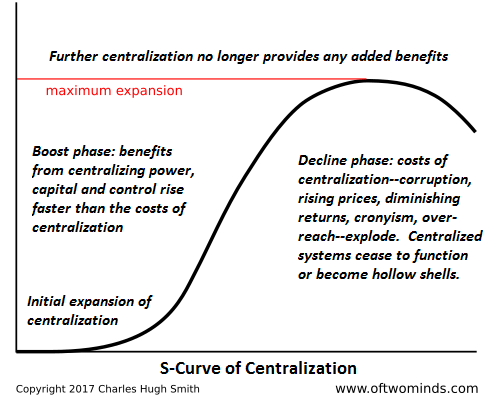
As I have often noted here, the returns on centralization are diminishing to less than zero. The initial returns on centralizing capital, production and social-political power were robust, but now the centralized cartel-state is eating its own tail, masking its financial bankruptcy by borrowing from the future, and cloaking its political bankruptcy behind the crumbling facades of the legacy parties.

Now that technology has enabled decentralized currency, markets and governance, the centralized political parties are obsolete. They are the political equivalent of buggy whips, and those holding tight to the fantasy that their current dissolution will magically be transformed into unity by some future leadership will be disappointed.

The fragmentation of the political parties is not temporary–it is permanent. As I discussed yesterday, political and social fragmentation are the consequence of economic fragmentation–these are self-reinforcing dynamics, as fragmentation in one feeds fragmentation in the others.

Those who have gotten rich inside the bloated machinery of the parties will never accept their era has ended. The dreams of private jets and millions of dollars in contributions die hard. But the voters and donors are both waking up to the cold reality that the parties are nothing but wealth distribution machines that sluice millions from financial elites to various political elites.

All the legacy claims of both parties ring false; neither party gives a hoot about the working class, small business or civil liberties. Their entire game plan is to whip up hot-button social issues to distract a fragmented citizenry and arouse last-gasp emotional loyalty to empty slogans.

Is it any wonder that people are abandoning both parties and claiming Independent status? All the core systems of the nation are failing, visibly, painfully, badly, and yet all the parties can dredge up is more of the same and TINA–there is no alternative.

The citizen who just awakened also awakened to the truth: the legacy parties have no solutions; their game plan is to milk the system as long as they can before it collapses in a rotten heap of corruption, fraud, collusion, debt and profiteering that benefits the few at the expense of the many.

When the parties do finally implode, the general mood will be: good riddance. A centralized spoils system is no longer a viable way to govern the nation. Political systems everywhere are facing a choice: Decentralize or die.

Escaping the iron cage of hopelessness

By Edward Curtin

Source: Intrepid Report

“Specialists without spirit, sensualists without heart; this nullity imagines that it has attained a level of civilization never before achieved”—Max Weber, The Protestant Ethic and the Spirit of Capitalism

“In this frightful round of unchecked means, nobody knows any longer where they are going, purposes are forgotten, and ends are overtaken. Human beings have set off at astronomically high speeds toward nowhere.”—Jacques Ellul, Presence in the Modern World

In a previous article, I argued that those who think science can solve our major social problems—in particular, world destruction with nuclear weapons and the poisoning of the earth’s ecology and atmosphere—were delusional and in the grip of the myth of science and technology. These problems were created by science when it became untethered from any sense of limits in its embrace of instrumental rationality. Once it became wedded to usefulness and the efficiency of technical means, it lost its original aim: the search for truth. (Obviously this doesn’t include all scientists.) In embracing means as ends, it produced an endless loop of means justifying means that has resulted in what Weber called an “iron cage.” Concomitantly, the ideology of pure objectivity and impartial innocence was joined to elite state power and the capitalist profit motive where it was supported and instantaneously and completely applied to technical applications, including nuclear, biological, chemical and “conventional” weapons; bio-engineering; GMO foods and people; eugenics and cloning; and chemical/oil production, etc. It is indisputable that if our planet is incinerated or slowly destroyed through toxic pollution that modern science with its Faustian “prohibition to prohibit” will stand indicted, if anyone is left to make the case.

Albert Camus warned us long ago:

And even though we do it in diverse ways, we extol one thing and one alone: a future world in which reason will reign supreme. In our madness, we push back the eternal limits, and at once dark Furies swoop down upon us to destroy. Nemesis, goddess of moderation, not of vengeance, is watching. She chastises, ruthlessly, all those who go beyond the limit.

Ostensibly rational, the illogical logic of modern science has resulted in a mystifying double-bind that denies human freedom and leads to widespread despair and hopelessness. Many people feel trapped by this deterministic ethos, while others fail to see that the cause of our problems can’t be their solutions.

In this essay, I will explore the possibility of a path out of the seeming impossibility of escaping the cul-de-sac of our spiritually disinherited and disenchanted condition.

Max Weber argued that modern rational capitalism was informed by a religious impetus of inner-directed worldly asceticism derived from Protestant Christianity. In essence, modern capitalism was a religion. Likewise, modern mainstream science, despite the discoveries of quantum physics, rests upon a materialistic presupposition that is a self-contradictory act of faith that it denies to others. Committed to determinism, this materialistic scientific world view offers no basis for its truth claim since what is determined cannot be disputed when it wasn’t freely chosen. To espouse a position that was predetermined is to choose nothing. In essence, such science is also a religion that, like capitalism, serves no end but its own regeneration.

Is it any wonder that so many people feel trapped on an endless merry-go-round that contradicts their felt experience and their hopes for a better world? They look around and see a mad world of war and lies and science run amok. The physical scientists tell them that everything started with a bang and will end with a bang or a whimper of one sort or another and that’s how it goes since when did people so puny think they were anything but specks in a vast cosmos of meaningless gas that will devour them in a few billion years, give or take a year or so. The psych folks tell them they are the products of their brain chemicals and neurotransmitters and must submit “freely” to chemical treatment if they know what’s good for them and want to be happy. The social scientists insist that all knowledge is socially conditioned and relative and therefore everything they think and feel is also relative and so they are lost souls forever wandering in a world of relativity where true wisdom is impossible and the difference between right and wrong is a relative choice that has no basis in any “reality.” And of course the power elites and media play with their minds in endless games of mind control as they insist the only real truth comes through screens that they control. Mind and body warped, so many people stumble through their days like the living dead in search of some exit from their pain and confusion.

Or to say it differently. Science—both physical and social—has resulted in the systemization of doubt and the embrace of the relativity of thought and knowledge. The modern predicament is such that whereas in former times people felt that their knowledge was fact or truth and that it was grounded in a physically palpable reality, we have been exposed to systematic doubt and the suspicion has grown that all the various standpoints are limited and “relative.” While not consciously espoused by the majority of people, this doubting worldview permeates social life as a vague insecurity and uncertainty. It may be left to intellectuals to circulate such relativizing ideas, but they have become part of the cultural air we breathe. For people today in a scientifically based society, faced with the relativizing of all knowledge and every eternal verity, the question of how to understand their deaths, and thus their lives, has become acutely problematic. Uncertainty has undermined people’s wills as they have forgotten they are free.

The question that modernity forces us to ask is this: once knowledge is seen to be relative; old cosmologies are transformed by science; symbol systems and religions are seen as the products of humans’ own creativity; reality is understood to be socially constructed; once these developments take place consciously and unconsciously, how then can people understand their lives and deaths and find the confidence to live in peace and harmony with the earth and all living creatures?

Tolstoy put it this way:

Science is meaningless because it gives no answer to our question, the only question important for us: ‘What shall we do and how shall we live?’

In order to make our way out of this maze, we might contemplate the underlying presupposition that “everything is relative.” That, of course is an absurd position. Everything can’t be relative when the statement “everything is relative” is an absolute statement. Joined to that, one can muse on the self-contradiction of materialistic determinism and perhaps glimpse an escape from the iron cage, the prison, the closed room, the garbage pail, or the no-exit—so many terms that our best writers have used to describe the modern condition.

Rudolf Steiner did that as follows in The Philosophy of Freedom:

Materialism can never offer a satisfactory explanation of the world. For every attempt at an explanation must begin with the formation of thoughts about the phenomena of the world. Materialism, thus, begins with the thought of Matter or material processes. But, in doing so, it is ipso facto confronted by two different sets of facts, viz., the material world and the thought about it. The materialist seeks to make these latter intelligible by regarding them as purely material processes. He believe that thinking takes place in the brain, much in the same way that digestion takes place in the animal organs. Just as he ascribes mechanical, chemical, and organic processes to Nature, so he credits her in certain circumstances with the capacity to think. He overlooks that, in doing so, he is merely shifting the problem from one place to another. Instead of to himself he ascribes the power of thought to Matter. And thus he is back again at his starting-point. How does Matter come to think of its own nature?

But these are intellectual exercises and are therefore probably not very helpful to the average person.

Tolstoy maintained that for the modern person death had no meaning because civilization was based on progress—an ‘infinite’ progress—which according to its own internal logic should never come to an end.

On this road of progressiveness everything is provisional and indefinite and so individual death seems like a failure and meaningless because it marks an end. But what then, asked Tolstoy, is the meaning to our lives? Are they meaningless means to meaningless ends?

Materialistic science can only answer in the affirmative. A negative affirmative. But for most people this doesn’t satisfy. They sense the truth that we live by faith—scientists do, religious believers do, atheists do, agnostics do, everyone does—faith is the water we swim in; it is our element. It is what impels us to get out of bed in the morning. But getting out of bed in the morning is a choice, a judgment. It is not inevitable. We do it in faith that the day will be meaningful and worth meeting. We encounter others in good faith and hope they do the same with us. This awareness of the faith dimension of life is a daily human experience that points beyond itself and is a source of hope, even when confusion reigns. While modern science and philosophy have largely attempted to treat all things, including people, as objects to be controlled by subjects, most people encounter others in daily life not as Its, as in Buber’s I-It, but as Thous, as in I-Thou.

Where have I come from? Why am I here? Where am I going? These are life’s basic questions that science answers with nowhere, no reason, and nowhere in that order. Such answers are attestations of a faith in nothing, what is usually called nihilism.

The psychiatrist R.D. Laing maintained that the key to a sane world is for people to truly regain experiencing their experience and not to make-believe. He felt that most people had become estranged from the roots of their being. He put it thus:

The condition of alienation, of being asleep, of being unconscious, of being out of one’s mind, is the condition of the normal man. Society highly values its normal man. It educates children to lose themselves and to become absurd, and thus to be normal. Normal men have killed perhaps 100,000,000 of their fellow normal men in the last fifty years. Our behavior is a function of our experience. We act according to the way we see things. If our experience is destroyed, our behavior will be destructive. If our experience is destroyed, we have lost our own selves. . . . There is everything to suggest that man experienced God. Faith was never a matter of believing. He existed, but of trusting, in the presence that was experienced and known to exist as a self-validating datum. It seems likely that far more people in our time experience neither the presence of God, nor the presence of his absence, but the absence of his presence. . . . The fountain has not played itself out, the frame still shines, the river still flows, the spring still bubbles forth, the light has not faded. But between us and IT, there is a veil which is more like fifty feet of solid concrete. Deus absconditus. Or we have absconded.

So what can we do to break through this mystification of experience that has resulted in a double-bind that has trapped us?

I say nothing, at first. We are so busy doing and thinking our doing is the solution to our problems. We must stop the world we know by first not doing and by simply being in the presence of Being. We must develop a contemplative discipline of allowing the awareness of our egocentric thinking to reveal to us the arrogance of our confused belief that we can coerce others and the natural world to do our bidding and that every problem has a solution. The grotesqueness of nuclear weapons is the physical manifestation of that willfulness. For the magician, the applied scientist, and the technologist all wish to conquer reality with techniques from the outside rather than being open to the truths that Reality (that we are in and is us and that goes by different names—Being, the Tao, Logos—all names for the unnameable) might reveal to us.

“To ‘know’ reality,” writes Alan Watts, “you cannot stand outside it and define it; you must enter into it, be it, feel it.” So the first thing we must “do” is to do nothing so we may heal our divided minds; otherwise we are spinning in a vicious circle, “like everything else which the divided mind attempts.”

This seems self-evident to me and “doing” this should be our first “act” of dissent—our break-out (by breaking in)—from the reigning consensus that underlies the violent and sick condition of the world today. James Douglass, author of the ground-breaking book, JFK and the Unspeakable, says this perfectly in Lightning East to West: Jesus, Gandhi, and the Nuclear Age:

What we know ‘out there’ as the most resistant evil reality to be transformed, is in reality “in here” in its primary being. The precise nature of that correspondence, or identity, between inner and outer worlds is the mystery which Jung was attempting to describe with his theory of Synchronicity, whereby outer events can be increasingly recognized as unifying correlations of a profoundly traveled inner way. Once we begin to see this profound interpenetration of inner and outer worlds in a oneness of reality, the insoluble enigma of the world of evil gives way to the edge of the unifying mystery of Oneness, or of Love, a mystery that we cannot fully understand but which we can in fact move into with our lives and participate in to the extent of experiencing an ever-more-united world in Reality.

I think if we can see the big picture by “doing nothing,” we will have taken a major step toward a solution, or at the least an insight into how we can act to resist the evil that is occurring in the world.

“Seeing through” is to diagnose—dia, through + gignoskein, to know, perceive—which can allow us to see through to the roots of world problems. Without a deep comprehension of the causes of these problems, and how so many of our solutions have failed because they are based on false premises, we will get nowhere.

“The way one sees through the situation changes the situation,” writes Laing. Then, “as soon as we convey in any way . . . what we see or think we see, some change is occurring even in the most rigid situation.”

I think we can agree that we are in a “most rigid situation” as the nuclear weapons await discharge, countries and people are destroyed by U. S. war-making, the environment is poisoned, elite capitalist crooks line their pockets at the expense of everyone else, etc. Many of us convey this again and again, seemingly to no avail. Perhaps this is because we are missing the forest for the trees in our understandable haste to remedy it all. I suspect this is so and scatter these thoughts like breadcrumbs in the hope they may suggest a way home. “Conveying” my thought experiments in the hope “some” change occurs in the process. First, in me.

The word spiritual has acquired a bad name with its embrace by New-Agers et al. with its association with magic and out of the world mumbo-jumbo. So I use it reservedly. But if we look to those so many hold in such high regard for their fight against violence and injustice—e.g. Gandhi and Martin Luther King Jr., to name but two—it is apparent that their “truth-force” and “non-violent resistance” were rooted in a spiritual understanding of the human condition. We don’t need to get caught up in words, for they have a way of missing the truth. Gandhi said God was truth and truth was God. King equated God with love. Truth, God, Love—do the words matter? Did not these men grasp the deepest dimensions of our problems? Didn’t they understand the root causes of hate and violence? Didn’t they see the Tao? Didn’t they see that the way we conceive existence through our deterministic and instrumental sciences is a reflection of our violent world? Didn’t they realize that we can’t force change on anyone from the outside without doing violence and that the only way forward is to move the world through love and truthful resistance? Didn’t they tell us that freedom is our birthright and is indivisible, and when you deny existential freedom you are lost in despair?

Despite the question marks, these are rhetorical questions. Don’t our deepest experiences confirm their truth?

Let me end with James Douglass’s words, for it seems to me they ring true, despite being far outside the reigning scientific paradigm and “common sense.”

Is there a spiritual reality, inconceivable to us today, which corresponds in history to the physical reality which Einstein discovered and which led to the atomic bomb? Einstein discovered a law of physical change: the way to convert a single particle of matter into enormous physical energy. Might there not be, as Gandhi suggested, an equally incredible and undiscovered law of spiritual change, whereby a single person or small community of persons could be converted into an enormous spiritual energy capable of transforming a society and a world? I believe that there is, that there must be, a spiritual reality corresponding to E=mc2 because, from the standpoint of creative harmony, the universe is incomplete without it, and because, from the standpoint of moral freedom, humankind is sentenced to extinction without it. I believe that the human imperative of our end-time is that we discover the spiritual equation corresponding to Einstein’s physical equation, and that we then begin to experiment seriously in its world-transforming reality while there is time.

We must experiment in truth, for time is running out.


Edward Curtin is a writer whose work has appeared widely. He teaches sociology at Massachusetts College of Liberal Arts. His website is edwardcurtin.com.

Saturday Matinee: Rollerball (1975)

The Science Fiction of Rollerball Is Nothing Compared to the Facts of Real Life Control

By Rich Monetti

Source: Omni

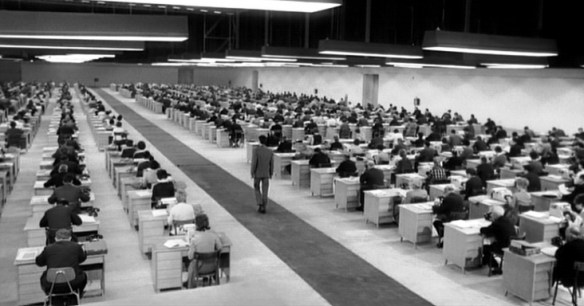
If you’ve never seen Rollerball, stop what you’re doing and dial up the DVD for this 1975 Science Fiction Movie classic. Set in the year 2024, this dystopia puts Bread and Circuses on a violent whirlwind that’s engineered to keep the world’s corporate overlords out of the crosshairs. As such, revolving door heroes are amply provided and give the population cause to question the saccharin surroundings they live in. That is until each warrior meets their predetermined end and complacency has no other choice but to comply. Great Science Fiction but real control is so much easier.

Nonetheless, the backdrop of this dark world takes place after the “Corporate Wars” have bankrupted the world’s nations. In the void left behind, the corporations employ and govern. This leaves the public free of concerning themselves with important decisions, which are better left to “the few” in this standout among dystopian movies.

The Privileged Few

They also enjoy the privilege – even at the expense of Jonathan E. (James Caan). In the hero class of distraction, E. lost his wife to an executive who wanted her for himself.  Paid off to leave him, the accompanying villa in Rome was no match for the rugged, introspect of the world renowned figure.

In this, we are given the vehicle to dig into underbelly as we digest the glory of the game and all its bloodletting. Obviously discontented, Jonathan questions the tradeoff between the material preeminence his position affords and freedom. One of his hanger’s on who serves among the privilege Jonathan reaps doesn’t have such depth and toes the line the system forges like the mindless drone she is. “But comfort is freedom,” reasons Ella.

Enough of the citizenry bought off with nice things, the oversight does not even consider those who may reap much less, because this set up is sure to have losers on a far greater scale. This all sends E. off to determine how people have been so effectively siphoned off as sheep.

Information is Power

Expectedly, the information is scarce – or better yet – properly edited. Summaries of important works are readily available, and in case 24-7 of the game on telescreen gives way to inquiry, the overlords will reset any doubt in the comfort of your own easy chair.  “What do you want books for?,” Jonathan’s teammate, Moon Pie asks  “Look Johnny, if you wanna learn somethin’, just get a Corporate Teacher to come and teach it to ya’.

Jonathan defers and goes to Geneva to visit a computerized archive.  The prospects are quickly eradicated as the librarian is little help, and the system even less. Leaving E at a loss, the willing agent reveals that “the whole of the 13th Century is gone.”

All still escapes Ella with Jonathan coming to a crossroad. “Why don’t you do what the executives want – especially since you’ll be paid handsomely,” she doesn’t get it.

Specifically, they want him to retire. His survival defies the preset odds and disturbs the complacency. Or in chilling John Houseman-speak, the game was created to demonstrate “the futility of individuality.”

Real Control is much Easier

Your mind is officially blown. But a simple look at voter turnout or the tune out that hundreds of TV stations afford us and control takes on the form of despondency. Most significantly, a two party system in which the same elites support both sides, and the important decisions gives the many the illusion of choice.

Even so with the two party gaming clearly at our disposal, we are still sold on the stark differences, and coalesce into our corners over less substantial issues. So while we all don’t like American jobs shipped overseas of elite born trade policy, hate money in politics, the never ending improprieties of the big banks and inefficient delivery of healthcare, we are unable to find crossover or a leader able to unite across party lines.

Instead, our only common place involves a shared sense that the other side is mired in stupidity. This even as we see enough smarts among them that they are also able to navigate survival against such a stacked deck. Blinded by the many fictional divides, who really needs to pick up spilled guts or dislodged eyeballs when the powerlessness our elites have created is so much easier to clean up.

All the News That’s Fit to Print

Of course, the chance to narrow the divides can be a function of the availability of information. In the Science Fiction of Rollerball, this is diminished by keeping information controlled by offering tidbits or official accounts. But secrets only give rise to the desire to seek out what you’re not supposed to know.

It’s far more efficient to let people think they have a free press, and now with the internet and cable news, sources that rise to the top are the ones providing fictitious entertainment in place of facts.

In addition, the unseen hand of Google elevating disinformation now rivals the wall between advertising and content, which doesn’t really exist, and has always acted as editors to protect the elite.

Of course, we do have our distractions, and the cult-like mass following of the NFL can’t help but be seen as a parallel to Rollerball. The circus though is subtle and smarter than 2024.

Whoever has the most Toys

Putting aside violence on the decline, a no one left standing approach has been replaced with parity where everyone has a chance to win. Far more effective for viewership, and the Sunday, Monday, Thursday cascade plays right into the American consumerism that one ups Rollerball’s ability to feign comfort for the masses.  Or why give people stuff to keep them complacent when you can make them ever in pursuit of the next gadget that is sure to bring unending happiness.

As Brad Pitt says in Fight Club, “the things you own, they ending up owning you.” For example, when Apple outsources production to a Chinese factory where nets keep workers from jumping out the windows, stock options go a long way to allaying the guilt and getting you that Lexus you can’t do without.

But who knows, Rollerball might have emerged because people figured out how to beat the system, and the powerful went back to the basics that the Romans perfected.  Maybe, we should be content, and let the elites have their ball so they go don’t go home and take it with them.  You know, before they return with something worse, and we’re left rolling over dead instead of despondent.


Watch the full film here.

(To switch off subtitles, click the “cc” button on the bottom left corner of the video window.)

Godzilla Amazon: The Amount of Power in Jeff Bezos’ Hands Should Frighten All Americans

Amazon very effectively uses technology and data to sidestep traditional restrictions on monopoly power.

By Matt Stoller

Source: AlterNet

To understand the depth and breadth of Jeff Bezos’ ambitions for the company he built, type www.relentless.com into your browser. The domain Bezos registered in 1994 will redirect to Amazon, the company aptly, and ambitiously, nicknamed The Everything Store. He tells his shareholders that the company will act like an aggressive startup — that at Amazon, it is always Day One.

Like Google and Facebook, Amazon uses technology and data to sidestep traditional restrictions on monopoly power. Our lives are increasingly organized by the platforms these companies run, platforms which now mediate the way we communicate and engage in commerce with each other. We are living in a world organized by tech monopolists, a change in power relationships that no one voted for but has been imposed upon us nonetheless.

Now, Bezos is attempting to add more power to his empire with the surprise announcement that the company will pay $13.7 billion for Whole Foods Market. Amazon will now have a store footprint in neighborhoods across America.

Our communities and the way we engage in commerce will change. Imagine walking into a Whole Foods store and seeing different prices depending on whether you are a member of Amazon Prime — or seeing different prices depending on any other way that you interact with Amazon.

This isn’t implausible. It is what the company does when it opens up stores. For instance, Amazon is creating a chain of physical book stores to take the place of the book stores the company destroyed. In these stores, there are no price tags at all: You scan the items with your phone and have a price delivered to you, personalized by Amazon. Why wouldn’t Amazon extend this to Whole Foods? “Our goal with Amazon Prime, make no mistake,” says Amazon CEO Jeff Bezos, “is to make sure that if you are not a Prime member, you are being irresponsible.”

This statement and the amount of power in Bezos’ hands should frighten all Americans. Bezos meant that Amazon will soon be so good for consumers that it would just be folly not to be a member. But what he unwittingly implied is that as a citizen, you will have no choice but to interact with his institution to buy and sell key goods that everyone needs — on his terms.

Jeff Bezos, in other words, has a vision. To be everywhere, to be the platform for everything for every consumer. So when Bezos calls you irresponsible for not tithing to Amazon, America has a big political problem.

Amazon’s takeover of Whole Foods means that it can target and eliminate regional competitors one by one as it did with its online competitors. When Diapers.com emerged as a competitor to Amazon, Amazon simply sold diapers below cost until the company capitulated and sold itself to Bezos. There’s no reason to assume Amazon wouldn’t bring the same predatory pricing strategy to bear in every city in America. Why wouldn’t it? Even though predatory pricing is illegal, the government hasn’t enforced those laws for decades. Whole Foods tends to source from local farms as part of a commitment to localism; these farms will now be negotiating with a much bigger entity that is committed to a ruthless model of efficiency.

There are so many ways that Amazon can use its power that it’s simply impossible to figure out what it will do. Amazon probably doesn’t even know yet; it will discover and test them, relentlessly. Maybe you will get first in line, or last in line, for the most popular toy during the Christmas period, or maybe the restaurant you own will get access to the freshest yet limited batch strawberries you need based on whether you are giving better deals to Prime members.

Or here’s a more creative possibility. Amazon is excluding Amazon Prime video from Apple TV so that Prime members will buy its streaming device instead of Apple’s. As the smartphone market commodifies and transforms, Bezos could simply use his combined physical and online footprint to keep you from even seeing prices at his stores unless you are using Amazon-approved electronic devices. If Amazon were just one of many stores that would be one thing. But Amazon is quickly becoming the dominant way to buy and sell.

And this, make no mistake, is what is happening. Upon the announcement of the acquisition, Target’s stock price dropped by 10 percent and Walmart’s by 5 percent. Amazon’s rose by more than the price it is paying for Whole Foods. Wall Street sees the writing on the wall. There is only one force that can stop Amazon from organizing and regulating basically all American retail commerce — our democratic institutions and our political system. We the people.

Bezos knows Amazon is a political enterprise at this point. The day before he announced his company’s attempt to buy this supermarket chain, he released a request on Twitter to have people offer ideas for where he can direct charity money. That is the kind of public relations undertaken by political leaders. And Amazon put out an ad for a Ph.D. economist-cum-lobbyist “to educate regulators and policy makers about the fundamentally procompetitive focus of Amazon’s businesses.” And he has put political fixers, like Ivanka Trump’s lawyer and ex-Clinton administration officer Jamie Gorelick, on his board of directors. He also bought The Washington Post.

The public should speak out in opposition to this merger. More than that, the government should take this opportunity to reject the entire pro-finance pro-concentration philosophy that has taken hold in this country since the Reagan era. It is no accident that Whole Foods founder John Mackey was forced to surrender his life’s work because financiers looking for a quick buck bought up a large bloc of shares in his company and pressured him to sell the company to Amazon. The day before the announcement of the sale, he called these hedge funds “Ringwraiths,” after the evil characters in “Lord of the Rings.” Bezos might be the most powerful empire-builder in the land, but he had help.

This merger should frighten all of us. But it should also embolden anyone who believes that America should not be in thrall to monopolists like Bezos. For them, today, as Jeff Bezos might put it, is Day One.

Matt Stoller is fellow at the Open Markets program, where he is researching the history of the relationship between concentrated financial power and the Democratic party in the 20th century.