You Want a Picture of the Future? Imagine a Boot Stamping on Your Face

By John W. Whitehead

Source: The Rutherford Institute

“The Internet is watching us now. If they want to. They can see what sites you visit. In the future, television will be watching us, and customizing itself to what it knows about us. The thrilling thing is, that will make us feel we’re part of the medium. The scary thing is, we’ll lose our right to privacy. An ad will appear in the air around us, talking directly to us.”—Director Steven Spielberg, Minority Report

We have arrived, way ahead of schedule, into the dystopian future dreamed up by such science fiction writers as George Orwell, Aldous Huxley, Margaret Atwood and Philip K. Dick.

Much like Orwell’s Big Brother in 1984, the government and its corporate spies now watch our every move.

Much like Huxley’s A Brave New World, we are churning out a society of watchers who “have their liberties taken away from them, but … rather enjoy it, because they [are] distracted from any desire to rebel by propaganda or brainwashing.”

Much like Atwood’s The Handmaid’s Tale, the populace is now taught to “know their place and their duties, to understand that they have no real rights but will be protected up to a point if they conform, and to think so poorly of themselves that they will accept their assigned fate and not rebel or run away.”

And in keeping with Philip K. Dick’s darkly prophetic vision of a dystopian police state—which became the basis for Steven Spielberg’s futuristic thriller Minority Report which was released 15 years ago—we are now trapped into a world in which the government is all-seeing, all-knowing and all-powerful, and if you dare to step out of line, dark-clad police SWAT teams and pre-crime units will crack a few skulls to bring the populace under control.

Minority Report is set in the year 2054, but it could just as well have taken place in 2017.

Seemingly taking its cue from science fiction, technology has moved so fast in the short time since Minority Report premiered in 2002 that what once seemed futuristic no longer occupies the realm of science fiction.

Incredibly, as the various nascent technologies employed and shared by the government and corporations alike—facial recognition, iris scanners, massive databases, behavior prediction software, and so on—are incorporated into a complex, interwoven cyber network aimed at tracking our movements, predicting our thoughts and controlling our behavior, Spielberg’s unnerving vision of the future is fast becoming our reality.

Both worlds—our present-day reality and Spielberg’s celluloid vision of the future—are characterized by widespread surveillance, behavior prediction technologies, data mining, fusion centers, driverless cars, voice-controlled homes, facial recognition systems, cybugs and drones, and predictive policing (pre-crime) aimed at capturing would-be criminals before they can do any damage.

Surveillance cameras are everywhere. Government agents listen in on our telephone calls and read our emails. Political correctness—a philosophy that discourages diversity—has become a guiding principle of modern society.

The courts have shredded the Fourth Amendment’s protections against unreasonable searches and seizures. In fact, SWAT teams battering down doors without search warrants and FBI agents acting as a secret police that investigate dissenting citizens are common occurrences in contemporary America.

We are increasingly ruled by multi-corporations wedded to the police state. Much of the population is either hooked on illegal drugs or ones prescribed by doctors. And bodily privacy and integrity has been utterly eviscerated by a prevailing view that Americans have no rights over what happens to their bodies during an encounter with government officials, who are allowed to search, seize, strip, scan, spy on, probe, pat down, taser, and arrest any individual at any time and for the slightest provocation.

All of this has come about with little more than a whimper from a clueless American populace largely comprised of nonreaders and television and internet zombies. But we have been warned about such an ominous future in novels and movies for years.

The following 15 films may be the best representation of what we now face as a society.

Fahrenheit 451 (1966). Adapted from Ray Bradbury’s novel and directed by Francois Truffaut, this film depicts a futuristic society in which books are banned, and firemen ironically are called on to burn contraband books—451 Fahrenheit being the temperature at which books burn. Montag is a fireman who develops a conscience and begins to question his book burning. This film is an adept metaphor for our obsessively politically correct society where virtually everyone now pre-censors speech. Here, a brainwashed people addicted to television and drugs do little to resist governmental oppressors.

2001: A Space Odyssey (1968). The plot of Stanley Kubrick’s masterpiece, as based on an Arthur C. Clarke short story, revolves around a space voyage to Jupiter. The astronauts soon learn, however, that the fully automated ship is orchestrated by a computer system—known as HAL 9000—which has become an autonomous thinking being that will even murder to retain control. The idea is that at some point in human evolution, technology in the form of artificial intelligence will become autonomous and that human beings will become mere appendages of technology. In fact, at present, we are seeing this development with massive databases generated and controlled by the government that are administered by such secretive agencies as the National Security Agency and sweep all websites and other information devices collecting information on average citizens. We are being watched from cradle to grave.

Planet of the Apes (1968). Based on Pierre Boulle’s novel, astronauts crash on a planet where apes are the masters and humans are treated as brutes and slaves. While fleeing from gorillas on horseback, astronaut Taylor is shot in the throat, captured and housed in a cage. From there, Taylor begins a journey wherein the truth revealed is that the planet was once controlled by technologically advanced humans who destroyed civilization. Taylor’s trek to the ominous Forbidden Zone reveals the startling fact that he was on planet earth all along. Descending into a fit of rage at what he sees in the final scene, Taylor screams: “We finally really did it. You maniacs! You blew it up! Damn you.” The lesson is obvious here, but will we listen? The script, although rewritten, was initially drafted by Rod Serling and retains Serling’s Twilight Zone-ish ending.

THX 1138 (1970). George Lucas’ directorial debut, this is a somber view of a dehumanized society totally controlled by a police state. The people are force-fed drugs to keep them passive, and they no longer have names but only letter/number combinations such as THX 1138. Any citizen who steps out of line is quickly brought into compliance by robotic police equipped with “pain prods”—electro-shock batons. Sound like tasers?

A Clockwork Orange (1971). Director Stanley Kubrick presents a future ruled by sadistic punk gangs and a chaotic government that cracks down on its citizens sporadically. Alex is a violent punk who finds himself in the grinding, crushing wheels of injustice. This film may accurately portray the future of western society that grinds to a halt as oil supplies diminish, environmental crises increase, chaos rules, and the only thing left is brute force.

Soylent Green (1973). Set in a futuristic overpopulated New York City, the people depend on synthetic foods manufactured by the Soylent Corporation. A policeman investigating a murder discovers the grisly truth about what soylent green is really made of. The theme is chaos where the world is ruled by ruthless corporations whose only goal is greed and profit. Sound familiar?

Blade Runner (1982). In a 21st century Los Angeles, a world-weary cop tracks down a handful of renegade “replicants” (synthetically produced human slaves). Life is now dominated by mega-corporations, and people sleepwalk along rain-drenched streets. This is a world where human life is cheap, and where anyone can be exterminated at will by the police (or blade runners). Based upon a Philip K. Dick novel, this exquisite Ridley Scott film questions what it means to be human in an inhuman world.

Nineteen Eighty-Four (1984). The best adaptation of Orwell’s dark tale, this film visualizes the total loss of freedom in a world dominated by technology and its misuse, and the crushing inhumanity of an omniscient state. The government controls the masses by controlling their thoughts, altering history and changing the meaning of words. Winston Smith is a doubter who turns to self-expression through his diary and then begins questioning the ways and methods of Big Brother before being re-educated in a most brutal fashion.

Brazil (1985). Sharing a similar vision of the near future as 1984 and Franz Kafka’s novel The Trial, this is arguably director Terry Gilliam’s best work, one replete with a merging of the fantastic and stark reality. Here, a mother-dominated, hapless clerk takes refuge in flights of fantasy to escape the ordinary drabness of life. Caught within the chaotic tentacles of a police state, the longing for more innocent, free times lies behind the vicious surface of this film.

They Live (1988). John Carpenter’s bizarre sci-fi social satire action film assumes the future has already arrived. John Nada is a homeless person who stumbles across a resistance movement and finds a pair of sunglasses that enables him to see the real world around him. What he discovers is a world controlled by ominous beings who bombard the citizens with subliminal messages such as “obey” and “conform.” Carpenter manages to make an effective political point about the underclass—that is, everyone except those in power. The point: we, the prisoners of our devices, are too busy sucking up the entertainment trivia beamed into our brains and attacking each other up to start an effective resistance movement.

The Matrix (1999). The story centers on a computer programmer Thomas A. Anderson, secretly a hacker known by the alias “Neo,” who begins a relentless quest to learn the meaning of “The Matrix”—cryptic references that appear on his computer. Neo’s search leads him to Morpheus who reveals the truth that the present reality is not what it seems and that Anderson is actually living in the future—2199. Humanity is at war against technology which has taken the form of intelligent beings, and Neo is actually living in The Matrix, an illusionary world that appears to be set in the present in order to keep the humans docile and under control. Neo soon joins Morpheus and his cohorts in a rebellion against the machines that use SWAT team tactics to keep things under control.

Minority Report (2002). Based on a short story by Philip K. Dick and directed by Steven Spielberg, the setting is 2054 where PreCrime, a specialized police unit, apprehends criminals before they can commit the crime. Captain Anderton is the chief of the Washington, DC, PreCrime force which uses future visions generated by “pre-cogs” (mutated humans with precognitive abilities) to stop murders. Soon Anderton becomes the focus of an investigation when the precogs predict he will commit a murder. But the system can be manipulated. This film raises the issue of the danger of technology operating autonomously—which will happen eventually if it has not already occurred. To a hammer, all the world looks like a nail. In the same way, to a police state computer, we all look like suspects. In fact, before long, we all may be mere extensions or appendages of the police state—all suspects in a world commandeered by machines.

V for Vendetta (2006). This film depicts a society ruled by a corrupt and totalitarian government where everything is run by an abusive secret police. A vigilante named V dons a mask and leads a rebellion against the state. The subtext here is that authoritarian regimes through repression create their own enemies—that is, terrorists—forcing government agents and terrorists into a recurring cycle of violence. And who is caught in the middle? The citizens, of course. This film has a cult following among various underground political groups such as Anonymous, whose members wear the same Guy Fawkes mask as that worn by V.

Children of Men (2006). This film portrays a futuristic world without hope since humankind has lost its ability to procreate. Civilization has descended into chaos and is held together by a military state and a government that attempts to keep its totalitarian stronghold on the population. Most governments have collapsed, leaving Great Britain as one of the few remaining intact societies. As a result, millions of refugees seek asylum only to be rounded up and detained by the police. Suicide is a viable option as a suicide kit called Quietus is promoted on billboards and on television and newspapers. But hope for a new day comes when a woman becomes inexplicably pregnant.

Land of the Blind (2006). This dark political satire is based on several historical incidents in which tyrannical rulers were overthrown by new leaders who proved just as evil as their predecessors. Maximilian II is a demented fascist ruler of a troubled land named Everycountry who has two main interests: tormenting his underlings and running his country’s movie industry. Citizens who are perceived as questioning the state are sent to “re-education camps” where the state’s concept of reality is drummed into their heads. Joe, a prison guard, is emotionally moved by the prisoner and renowned author Thorne and eventually joins a coup to remove the sadistic Maximilian, replacing him with Thorne. But soon Joe finds himself the target of the new government.

All of these films—and the writers who inspired them—understood what many Americans, caught up in their partisan, flag-waving, zombified states, are still struggling to come to terms with: that there is no such thing as a government organized for the good of the people. Even the best intentions among those in government inevitably give way to the desire to maintain power and control at all costs.

Eventually, as I point out in my book Battlefield America: The War on the American People, even the sleepwalking masses (who remain convinced that all of the bad things happening in the police state—the police shootings, the police beatings, the raids, the roadside strip searches—are happening to other people) will have to wake up.

Sooner or later, the things happening to other people will start happening to us and our loved ones.

When that painful reality sinks in, it will hit with the force of a SWAT team crashing through your door, a taser being aimed at your stomach, and a gun pointed at your head. And there will be no channel to change, no reality to alter, and no manufactured farce to hide behind.

As George Orwell warned, “If you want a picture of the future, imagine a boot stamping on a human face forever.”

Globalisation: Hyperstition, Surveillance, and the Empire of Reason

By S.C. Hickman

Source: Techno Occulture

Edmund Berger in his essay Underground Streams speaking of various tactics used by the Situationists, Autonomia, and the Carnivalesque:

“Like the Situationists the Autonomia would engage with the tradition of the Carnivalesque alongside a Marxist political analysis. Bakhtin had described the carnival as “political drama without footlights,” where the dividing line between “symbol and reality” was extremely vague, and the Autonomia had embodied this approach through their media-oriented tactics of detournement. But under a regime of emergency laws a great portion of the Autonomia was sent to prison or into exile, leaving its legacy through an extensive network of radical punk and anarchist squats and social centers.”

One of the things we notice is that the Autonomia movement actually struck a nerve at the heart of Power and forced their hand, which obligingly reacted and used their power over and dominion of the Security System to screen out, lock up, and exclude this threat. That’s the actual problem that will have to be faced by any emancipatory movement in the present and future: How to create a movement that can be subversive of the system, and yet chameleon like not rouse the reactionary forces to the point of invoking annihilation or exclusionary measures?

A movement toward bottom-up world building, hyperstition, and exit from this Statist system will have to do it on the sly utilizing a mirror world strategy that can counter the State and Public Security and Surveillance strategies.  Such Counter-Worlds of Exit and Hyperstitional instigation will need to work the shadow climes of the energetic unconscious, triggering a global movement from the shadows rather than in direct opposition.

In many ways as I think we need a politics of distortion, allure, and sincerity, one that invents a hyperstitional hyperobject among the various multidimensional levels of our socio-cultural systems, calling forth the energetic forces at the heart of human desire and intellect, bypassing the State and Corporate filters and Security Systems of power and control. Such a path will entail knowing more about the deep State’s secret Security apparatus and Surveillance methodologies, technologies, and tactics than most thinkers are willing to acknowledge or even apprehend. Like the Hacker movements of the 90’s up to Anonymous one will need to build shadow worlds that mimic the stealth weapons of the State and Corporate Global apparatus and assemblages; but with one caveat – these weapons are non-violent “weapons of the mind”, and go unseen and unrecognized by the State Security Systems at Local and Global levels.

A global system of mass, warrantless, government surveillance now imperils privacy and other civil liberties essential to sustaining the free world. This project to unilaterally, totally control information flow is a product of complex, ongoing interplay between technological, political, legal, corporate, economic, and social factors, including research and development of advanced, digital technologies; an unremitting “war on terror”; relaxed surveillance laws; government alliances with information technology companies; mass media manipulation; and corporate globalism. One might say it as the Googling of the World.

The United Stats internally hosts 17 intelligence agencies under the umbrella known as the Security Industrial Complex. They are also known for redundancy, complexities, mismanagement and waste. This “secret state” occupies 10,000 facilities across the U.S. Over the past five years the total funding budget exceeded half a trillion dollars. The notion of globalization which has its roots in the so called universalist discourses of the Enlightenment had as its goal one thing: to impose a transparent and manageable design over unruly and uncontrollable chaos: to bring the world of humans, hitherto vexingly opaque, bafflingly unpredictable and infuriatingly disobedient and oblivious to human wishes and objectives, into order: a complete, incontestable and unchallenged order. Order under the indomitable rule of Reason.1

This Empire of Reason spreads its tentacles across the known world through networks and statecraft, markets and tradecraft, war and secrecy, drugs and pharmakon.  The rise of the shadow state during Truman’s era began a process that had already been a part of the Corporate worldview for decades. The monopoly and regulation of a mass consumption society was and always will be the goal of capitalist market economies. In our time the slow and methodical spread of the American surveillance state and apparatus has shaped the globalist agenda. Because of it the reactionary forces of other state based control systems such as Russia and China are exerting their own power and surveillance systems as counters to Euro-American hegemony.

Surveillance is a growing feature of daily news, reflecting its rapid rise to prominence in many life spheres. But in fact surveillance has been expanding quietly for many decades and is a basic feature of the modern world. As that world has transformed itself through successive generations, so surveillance takes on an ever changing character. Today, modern societies seem so fluid that it makes sense to think of them being in what Bauman terms a ‘liquid’ phase. Always on the move, but often lacking certainty and lasting bonds, today’s citizens, workers, consumers and travelers also find that their movements are monitored, tracked and traced. Surveillance slips into a liquid state.

As Bauman relates it liquid surveillance helps us grasp what is happening in the world of monitoring, tracking, tracing, sorting, checking and systematic watching that we call surveillance. Such a state of affairs engages with both historical debates over the panopticon design for surveillance as well as contemporary developments in a globalized gaze that seems to leave nowhere to hide, and simultaneously is welcomed as such. But it also stretches outwards to touch large questions sometimes unreached by debates over surveillance. It is a conversation in which each participant contributes more or less equally to the whole. (Bauman)

Our network society has installed its own “superpanopticon” (Mark Poster). Such a system is ubiquitous and invisible to the mass of users. As Poster states it “The unwanted surveillance of one’s personal choice becomes a discursive reality through the willing participation of the surveilled individual. In this instance the play of power and discourse is uniquely configured. The one being surveilled provides the information necessary.” For Poster, this supply of self-surveillance is provided through consumer transactions stored and immediately retrievable via databases in their constitution of the subject as a “sum of the information in the fields of the record that applies to that name.” The database compiles the subject as a composite of his or her online choices and activities as tracked by IFS. This compilation is fixed on media objects (images, text, MP3s, Web pages, IPs, URLs) across the deluge of code that can be intercepted through keyword pattern recognition and private lists of “threatening” URLs.2

Our so called neoliberal society has erased the Public Sphere for the atomized world of total competition in a self-regulated market economy devoid of politics except as stage-craft. As authors in the Italian autonomist movements have argued for the past fifty and more years, this “total subsumption” of capital upon the life-sphere has been accomplished through “material” and “immaterial” means.  According to these authors, capital in late capitalism and neoliberalism has attempted to progressively colonize the entire life-sphere. Resistance, they argue, comes through the “reserves” to capital that remain as the social and intellectual foundation from which capital draws, including through “immaterial labor” using digital means. Gradually during modernity, such theorists have argued, life itself has been taken as a target for capitalist subsumption, through the cooptation of communication, sexual and familial relationships (Fortunati 1995), education, and every other sphere of human activity, with economic exchange and survival as the ultimate justification for all relationships.3

Capital’s “apparatus of capture” has become increasingly efficient and broad in its appropriation of selves as subjects of its political economy through the combination of appropriating governmental functions such as: buying off political actors and agencies, cutting public funding to modernist institutions and infrastructures, redefining the agenda of education and other cultural institutions toward capitalist values, owning and narrowing the focus of the media, forcing family structures and individuals to adapt to scarcity economies, and using government police and surveillance forces and economic pressures to crush resistance. In short, it is said that neoliberalism has advanced by the totalitarian institutionalization of national and international capitalism, one nation after another, using domestic means to force compliance in domestic markets and using international pressures (economic, military, cultural) to do the same to other countries, cultures, and peoples. (Day, pp. 126-127)

The increased accuracy (or believed accuracy) of increased surveillance and feedback targeting through the collection of social big data and its analyses and social and political uses (ranging from drone predators to state surveillance in both democratic and communist/ authoritarian governments to consumer targeting— for example, the targeting done by Target Corporation, as described in a 2012 New York Times article [Duhigg 2012])— belong to a conjoined mechanism of cybernetic and neoliberal governmentality, which crosses governmental and corporate databases and organizations. Social big data seeks to demarcate trends, which then directly or indirectly act as norms, which further consolidate individual and group action within market-determined norms (Rouvroy 2013). People are forced into competition, into a “freedom” that is monitored and checked within systems of feedback control. As Norbert Weiner suggested in the Cold War period (Wiener 1954, 1961), communicative control can be used toward a discourse of “rationality”; a rationality that is seen as proper to a given political economy. The documentary indexing of the subject provides the codes for the subject’s social positioning and expressions by others and by itself. Thanks to networked, mobile devices, the subject can attempt to continuously propose him- or herself to the world as the subject of documentary representation. (Day, pp. 132-133)

Those of us in the West who use mobile devices are becoming hooked into an elaborate datasociety in which every aspect of our lives is conditioned to enforce a self-regulatory system of choices and taboos. The surveillance is done at the level of individuals, who are monitored and whose actions are predicted throughout key moments of their consumption or production, marking changes in trends and phase states, and recalculating the trajectory of entities according to these new parameters and relationships. Our algorithmic society is splicing us all into a grid of total control systems from which it will become increasingly difficult to extricate ourselves.

As Douglas Rushkoff said recently digital technology is programmed. This makes it biased toward those with the capacity to write the code. In a digital age, we must learn how to make the software, or risk becoming the software. It is not too difficult or too late to learn the code behind the things we use—or at least to understand that there is code behind their interfaces. Otherwise, we are at the mercy of those who do the programming, the people paying them, or even the technology itself.4 More and more our mass society is being programmed through an immaterial grid of datafied compliance and surveillance that captures our desires and regulates our choices. In some ways we’ve become the mindless generation, unable to stand back from the immersive worlds of our technosphere in which we live and breath. We’ve become enamored with our Mediatainment Industrial Complex that encompasses us to the point that those being born now will not know there ever was a word without gadgets. In fact we’ve all become gadgets in a market world of science fiction, our desires captured by the very gadgets we once thought would free us from the drudgery of time. Instead we’ve been locked within a world without time, a timeless realm in which the very truth of history has been sucked out of it and instead we live in a mythic time of no time, prisoners of a cartoon world of endless entertainment and false desires. In such a world the virtual has become actual, we wander through life caught in the mesh of a fake world of commodity cartoons, citizens of a dreamland turned nightmare. Shall we ever wake up?

Modern radical thought has always seen subjectivation as an energetic process: mobilization, social desire and political activism, expression, participation have been the modes of conscious collective subjectivation in the age of the revolutions. But in our age, energy is running out and desire, which has given modern social dynamics their soul, is absorbed in the black hole of virtualization and financial games, as Jean Baudrillard argues in his 1976 book, Symbolic Exchange and Death. In this book, Baudrillard analyzes the hyperrealistic stage of capitalism, and the instauration of the logic of simulation.

The end of the spectacle brings with it the collapse of reality into hyperrealism, the meticulous reduplication of the real, preferably through another reproductive medium such as advertising or photography. Through reproduction from one medium into another the real becomes volatile, it becomes the allegory of death, but it also draws strength from its own destruction, becoming the real for its own sake, a fetishism of the lost object which is no longer the object of representation, but the ecstasy of denegation and its own ritual extermination: the hyperreal. […]

The reality principle corresponds to a certain stage of the law of value. Today the whole system is swamped by indeterminacy, and every reality is absorbed by the hyperreality of the code and simulation. The principle of simulation governs us now, rather that the outdated reality principle. We feed on those forms whose finalities have disappeared. No more ideology, only simulacra. We must therefore reconstruct the entire genealogy of the law of value and its simulacra in order to grasp the hegemony and the enchantment of the current system. A structural revolution of value. This genealogy must cover political economy, where it will appear as a second-order simulacrum, just like all those that stake everything on the real: the real of production, the real of signification, whether conscious or unconscious.

Capital no longer belongs to the order of political economy: it operates with political economy as its simulated model. The entire apparatus of the commodity law of value is absorbed and recycled in the larger apparatus of the structural law of value, this becoming part of the third order of simulacra. Political economy is thus assured a second life, an eternity, within the confines of an apparatus in which it has lost all its strict determinacy, but maintains an effective presence as a system of reference for simulation. (Baudrillard 1993a: 71-72, 2).5

We’ve all become simulations now. It’s not our bodies that matter in this digital universe of data, but rather the dividual traces we leave across the virtualized world that can be manipulated to produce profit. In the sphere of semiocapitalism, financial signs are not only signifiers pointing to particular referents. The distinction between sign and referent is over. The sign is the thing, the product, the process. The “real” economy and financial expectations are no longer distinct spheres. In the past, when riches were created in the sphere of industrial production, when finance was only a tool for the mobilization of capital investment in the field of material production, recovery could not be limited to the financial sphere. It also took employment and demand. Industrial capitalism could not grow if society did not grow. Nowadays, we must accept the idea that financial capitalism can recover and thrive without social recovery. Social life has become residual, redundant, irrelevant. (Bifo)

Those of us of an older generation still remember what existed the other side of the virtual screen, but the mass of young being born now will not have that luxury and their minds will be completely immersed in this new virtual actuality with no sense of the Outside.

While those on the Left still ponder outmoded political worlds the world of capital has abandoned both the political and the social. It’s time to wake up … I wanted to say, “before it’s too late”. My problem, my despair is that it is already too late. And, yet, I continue throwing out my little posts in hopes that someone is listening, that someone will awaken from their dogmatic slumber and act… is that you?


  1. Bauman, Zygmunt; Lyon, David. Liquid Surveillance: A Conversation (PCVS-Polity Conversations Series) (pp. 79-80). Wiley. Kindle Edition.
  2. Raiford Guins. Edited Clean Version: Technology and the Culture of Control (Kindle Locations 1304-1308). Kindle Edition.
  3. Day, Ronald E.. Indexing It All: The Subject in the Age of Documentation, Information, and Data (History and Foundations of Information Science) (p. 126). The MIT Press. Kindle Edition.
  4. Douglas Rushkoff. Program or Be Programmed (Kindle Locations 1363-1367). Kindle Edition.
  5. Berardi, Franco Bifo. After the Future (Kindle Locations 2276-2294). AK Press. Kindle Edition.

How Fear of Russia Misleads Americans

NSA whistleblower Thomas Drake sees grave dangers in the U.S. government and media exaggerating foreign threats as a means to mislead and control the American public, reports Dennis J Bernstein.

By Dennis J Bernstein

Source: Consortium News

Russia has been made “the go-to scapegoat” for distracting Americans from the serious problems afflicting the U.S. government, says Thomas Drake, a former senior executive at the National Security Agency who blew the whistle on multi-billion-dollar waste and violations of the rights of citizens through secret mass surveillance programs after 9/11.

As retaliation, the Obama Administration indicted Drake in 2010 as the first whistleblower since Daniel Ellsberg charged with espionage, carrying a possible 35-year prison term. However, in 2011, the government’s case against him collapsed and he went free in a plea deal. He became the recipient of the 2011 Ridenhour Truth-Telling Prize.

I sat down with Thomas Drake on June 3, 2017, at the home of ConsortiumNews editor Robert Parry in Arlington, Virginia, on the occasion of the awarding of the 2016 Gary Webb Freedom of the Press Award to Oliver Stone.

Dennis Bernstein: I want to ask you about a story. ConsortiumNews has offered quite a different perspective on the relationship between the U.S. government and Russia [questioning the allegations about] Trump collaborating with Putin. What’s your take on this story? Do you think that ConsortiumNews is onto something in terms of really questioning that whole line?

Thomas Drake: Yes. This hyperbolic narrative that is posited almost to the point of hysteria. They would say that Russians are behind everything. “It’s all the Russians’ fault and you can blame Russia.” It’s just pure political pretension and there is a significant amount of propaganda behind it.

It’s intended to distract. It’s intended to keep people from really looking at some of the deeper truths of our own government and so it is very convenient for the political elites, on both sides of what has become the Democratic/Republican divide, which in fact is not a divide; it’s two sides of the same coin, with slightly different narrative – to project all the blame on Russia and particularly the hyper-conflation of the littlest thing that would appear to be that Trump is ruining the country or Trump is the worst thing that has ever happened. Just really taking this
way, way beyond the pale.

And ConsortiumNews — having written for ConsortiumNews going back several years now as a result of my case and mass domestic surveillance and government abuse of power — is one of the few – it’s surreal for me to say this right now – it’s one of the few alternative media outlets who have the courage to stand up to the elite narrative and get behind this hyper-partisan politicization of blaming it all on external entities.

And, in this case, Russia has become the go-to scapegoat, frankly. And it’s easy to simply focus on that as your excuse without having to concern yourself with the deeper trends in terms of the darker history of American politics.

And Gary Webb – I am quite familiar with his case. Remember he had his own profession turn on him because they wanted to curry favor with power and they wanted to have access to power. So it was full access press and power is an aphrodisiac. Henry Kissinger said that. …

DB: Access press, as in, if you don’t say the right thing […] they can toss you into prison.

TD: Yep, precisely. And so you’re willing to overlook what may be done under the cover or blanket of government, the government structure. And so ConsortiumNews is one of the few. …

I was sort of the pre-Snowden Snowden. …

DB: He cites you for opening that door….

TD: Well, he has said there wouldn’t have been him without me. And he has cited a number of people who have preceded him, right? And I was there at the foundation, at this extraordinary willful violation of, in secret, of what I call the subversion of the Constitution. Really, it was a silent coup against the Constitution….

DB: What are the multiple dangers of the way in which information is used now, and slanted to support policy as opposed to inform?

TD: Well, it’s self-interest. It’s largely self-interest driven. You have, what I have sometimes called Gov-Corp, which is a combination of government and corporations and it’s an extraordinarily pathological relationship because they feed on each other. One protects the other and when you have the government corrupting itself to serve very powerful interests at the expense of public interests, guess what? Something has to give and what gives is public transparency. What gives is accountability. What gives is responsible power. What gives is the promise. What gives is “we the people”, right?

Power just… generally at least, power is about the people and it’s pathological, and so unfortunately the checks and balances that have in the past – Ellsberg is eyewitness to this — he’s certainly a key person by simply standing up with his colleague Edgar Russo, standing up to power in terms of the bright and shiny light called Vietnam, right? He clearly brought into the public purview what was really going on with Vietnam and, ultimately, as we know, I was a very young teen growing up in the ’70s. He was already in his early 40s at the time. That, yeah, the government can use power… and that, yeah, power does tend to corrupt. Lord Acton was right.

So, what became known as the imperial presidency of Nixon, this era makes that era look like a hyper type of person, especially post-9/11. It’s just extremely concerning. It’s what I would call the devolution of democracy and constitutional rights following 9/11 and Ellsberg has said and I have said, what was actually unlawful and unconstitutional has been made legal from his time.

And the old, what became the infamous statement made by Nixon, “You know, if the President says it’s okay, it’s not illegal.” I heard almost those exact same words when I confronted the lead attorney in the Office of General Counsel. That was the first week in October 2001. I had already found out about the massive domestic surveillance program that had been unleashed. And I confronted him and he said, “This is great. The White House has approved the program. It’s all legal.” …. The hairs on the back of my neck were like…. I’m having major flashbacks… Wait a minute, just because the White House approves it, it makes it okay? I mean, history is not kind. He says,” Yep, we’re the executive agent – all approved. Yes. Don’t ask any more questions.”

So, because the White House approved it, then it’s okay to violate the Constitution. All those checks were put in place as a result of the … president resigning, the standing committees and intelligence House and the Senate, the Foreign Intelligence Surveillance Act and a whole lot of others, right? So that was the check and balance, right? Nah, just, hey 9/11, the failure of the government to provide the common defense. 3,000 people murdered that day. It should never have happened. It really should never have happened. And so we are going to use that as sort of a reverse false flag. We’re going to use that as an excuse, because, “Hey, after all, the Constitution is not a suicide pact… you know, we don’t know where the enemy is.”

So just this weird, everything is existential now. We now know how the enemy is because of 9/11. And so it’s weird for me, having been brought up as a very young lad during the Cold War and remembering alarms going off and they’d turn off the lights and block the hall and face your lockers, right? The air raid sign drills and fears of the nuclear winter. It’s like these people want a World War 2.0.

We have far more in common with the Russians than we don’t. We have far in common than our own disputes. I assume there are some differences, right? I recognize, I am well aware, in terms of historical notes, but hey we have far more in common than we have difference.

DB: I guess what we all have in common is the state of the Earth at this point.

TD: The state of the Earth? We are the third rock from the sun. I mean, this is our home. The world is a much smaller place, in part because of technology and in part because we find out that, yeah, we really are dependent on each other.

And yet there is this addiction to conflict. There is this addiction to have threats. There is this addiction to divide. And this is not pretty. I mean, human history, the dark side of human history, and if the 20th century is not an optic lesson, then I don’t know what is….. I could go back to any of the others, in terms of written history that we know of, right? And yet here we are. And so, to me it is a sign of an empire….

The U.S. is an empire… and it is a sign of an empire that is losing it. And so, just like the Roman Empire, I mean, if you go back to the rise and fall of the Roman Empire, you know…. Those who don’t learn the lessons of the past are doomed to repeat them.

DB: Well, and the beat goes on. We’re going to let you join the party.

TD: The beat does go on. Yeah.

DB: But as we speak, there’s a major bombing, frightening bombing in Iran today.

TD: I did not know that. Wow.

DB: After the President of the United States is in Saudi Arabia. When is the last time you heard of a major suicide bomb in Iran?

TD: Not in Iran, no.

DB: So, here we go and who knows what comes next, who know what that’s going to bring in that part of the world. We thank you for all of your courage and all the suffering you did for all of us so we could know more. Thank you very much.

TD: Yeah. No. I have really become a warrior for peace. That’s what I have become. Ultimately it’s about who we are as human beings and who we are for each other and after all it is us, right? And in terms of U.S. culture and background, I think Pogo was right. We have met the enemy and the enemy is us. We are our own worst enemies.

It’s just that, for some of us, it’s critical to hold power accountable. We recognize we don’t govern ourselves very well. If you put people over others, yeah, bad things happen. But bad things tend to happen. And it’s that whole control, power. It’s all about — psychopathy is an area of study that I increasingly have as an issue, because of this idea that people gaining pleasure from the distress of others. So, it’s a disease. It really is. And some of us, at great sacrifice, weren’t going to just sit idly by and watch it all happen.

I care deeply about who we are as human beings. And I’ve spent a lot of time in front of college students and high school students and civic auditoriums and small group settings and churches and college campuses talking about these things. These are things that matter.https://consortiumnews.com/2017/06/20/how-fear-of-russia-misleads-americans/

America’s Real Red Scare

The Slow-Motion Collapse of the American Empire

By William J. Astore

Source: TomDispatch.com

Jump into your time machine and let me transport you back to another age.

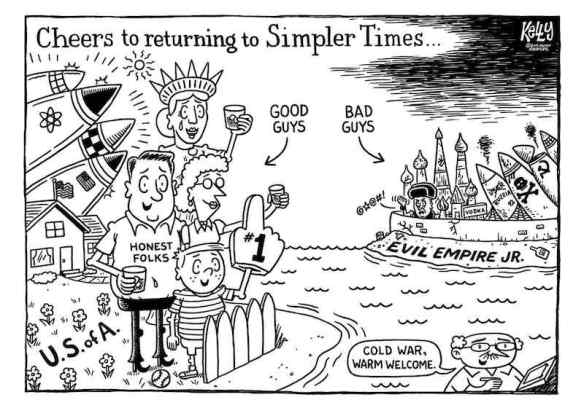
It’s May 2001 and the Atlantic Monthly has just arrived in the mail.  I’m tantalized by the cover article.  “Russia is finished,” the magazine announces.  The subtitle minces no words: “The unstoppable descent into social catastrophe and strategic irrelevance.”  Could it be that the country I had worried most about as a military officer during all those grim years of the Cold War, the famed “Evil Empire” that had threatened us with annihilation, was truly kaput, even in its Russian rather than Soviet guise?

Sixteen years later, the article’s message seems just a tad premature.  Today’s Russia surely has its problems — from poverty to pollution to prostitution to a rickety petro-economy — but on the geopolitical world stage it is “finished” no longer.  Vladimir Putin’s Russia has recently been enjoying heightened influence, largely at the expense of a divided and disputatious superpower that now itself seems to be on an “unstoppable descent.”

Sixteen years after Russia was declared irrelevant, a catastrophe, finito, it is once again a colossus — at least on the American political scene, if nowhere else.  And that should disturb you far less than this: more than a generation after defeating the Soviet Union in the Cold War, the United States of 2017 seems to be doing its level best to emulate some of the worst aspects of its former foe and once rival superpower.

Yes, the U.S. has a Soviet problem, and I’m not referring to the allegations of the moment in Washington: that the Trump campaign and Russian officials colluded, that money may have flowed into that campaign via Russian oligarchs tied to Putin, that the Russians hacked the U.S. election to aid Donald Trump, that those close to the president-elect dreamed of setting up a secret back channel to Moscow and suggested to the Russian ambassador that it be done through the Russian embassy, or even that Putin has a genuine hold of some sort on Donald Trump.  All of this is, of course, generating attention galore, as well as outrage, in the mainstream media and among the chattering classes, leading some to talk of a new “red scare” in America.  All of it is also being investigated, whether by congressional intelligence committees or by former FBI director — now special counsel — Robert Mueller.

When it comes to what I’m talking about, though, you don’t need a committee or a counsel or a back channel or a leaker from some intelligence agency to ferret it out.  Whatever Trump campaign officials, Russian oligarchs, or Vladimir Putin himself did or didn’t do, America’s Soviet problem is all around us: a creeping (and creepy) version of authoritarianism that anyone who lived through the Cold War years should recognize.  It involves an erosion of democratic values; the ever-expanding powers exercised by a national security state operating as a shadow government and defined by militarism, surveillance, secrecy, prisons, and other structures of dominance and control; ever-widening gaps between the richest few and the impoverished many; and, of course, ever more weapons, along with ever more wars.

That’s a real red scare, America, and it’s right here in the homeland.

In February, if you remember — and given the deluge of news, half news, rumor, and innuendo, who can remember anything these days? — Donald Trump memorably compared the U.S. to Russia.  When Bill O’Reilly called Vladimir Putin “a killer” in an interview with the new president, he responded that there was little difference between us and them, for — as he put it — we had our killers, too, and weren’t exactly innocents abroad when it came to world affairs.  (“There are a lot of killers. You think our country’s so innocent?”)  The president has said a lot of outlandish things in his first months in office, but here he was on to something.

My Secret Briefing on the Soviet Union

When I was a young lieutenant in the Air Force, in 1986 if memory serves, I attended a secret briefing on the Soviet Union. Ronald Reagan was president, and we had no clue that we were living through the waning years of the Cold War.  Back then, believing that I should know my enemy, I was reading a lot about the Soviets in “open sources”; you know, books, magazines, and newspapers.  The “secret” briefing I attended revealed little that was new to me. (Classified information is often overhyped.)  I certainly heard no audacious predictions of a Soviet collapse in five years (though the Soviet Union would indeed implode in 1991).  Like nearly everyone at the time, the briefers assumed the USSR would be our archenemy for decades to come and it went without saying that the Berlin Wall was a permanent fixture in a divided Europe, a forever symbol of ruthless Communist oppression.

Little did we know that, three years later, the Soviet military would stand aside as East Germans tore down that wall.  And who then would have believed that a man might be elected president of the United States a generation later on the promise of building a “big, fat, beautiful wall” on our shared border with Mexico?

I wasn’t allowed to take notes during that briefing, but I remember the impression I was left with: that the USSR was deeply authoritarian, a grim surveillance state with an economy dependent on global weapons sales; that it was intent on nuclear domination; that it was imperialist and expansionist; that it persecuted its critics and dissidents; and that it had serious internal problems carefully suppressed in the cause of world mastery, including rampant alcohol and drug abuse, bad health care and declining longevity (notably for men), a poisoned environment, and an extensive prison system featuring gulags.  All of this was exacerbated by festering sores overseas, especially a costly and stalemated war in Afghanistan and client-states that absorbed its resources (think: Cuba) while offering little in return.

This list of Soviet problems, vintage 1986, should have a familiar ring to it, since it sounds uncannily like a description of what’s wrong with the United States today.

In case you think that’s an over-the-top statement, let’s take that list from the briefing — eight points in all — one item at a time.

1. An authoritarian, surveillance state: The last time the U.S. Congress formally declared war was in 1941.  Since then, American presidents have embarked on foreign wars and interventions ever more often with ever less oversight from Congress.  Power continues to grow and coalesce in the executive branch, strengthening an imperial presidency enhanced by staggering technologies of surveillance, greatly expanded in the aftermath of the 9/11 terrorist attacks.  Indeed, America now has 17 intelligence agencies with a combined yearly budget of $80 billion.  Unsurprisingly, Americans are surveilled more than ever, allegedly for our safety even if such a system breeds meekness and stifles dissent.

2. An economy dependent on global weapons sales: The U.S. continues to dominate the global arms trade in a striking fashion.  It was no mistake that a centerpiece of President Trump’s recent trip was a $110 billion arms deal with Saudi Arabia.  On the same trip, he told the Emir of Qatar that he was in the Middle East to facilitate “the purchase of lots of beautiful military equipment.”  Now more than ever, beautiful weaponry made in the U.S.A. is a significant driver of domestic economic growth as well as of the country’s foreign policy.

3. Bent on nuclear domination: Continuing the policies of President Obama, the Trump administration envisions a massive modernization of America’s nuclear arsenal, to the tune of at least a trillion dollars over the next generation.  Much like an old-guard Soviet premier, Trump has boasted that America will always remain at “the top of the pack” when it comes to nuclear weapons.

4. Imperialist and expansionist: Historians speak of America’s “informal” empire, by which they mean the U.S. is less hands-on than past imperial powers like the Romans and the British.  But there’s nothing informal or hands-off about America’s 800 overseas military bases or the fact that its Special Operations forces are being deployed in 130 or more countries yearly.  When the U.S. military speaks of global reach, global power, and full-spectrum dominance, this is traditional imperialism cloaked in banal catchphrases.  Put differently, Soviet imperialism, which American leaders always professed to fear, never had a reach of this sort.

5. Persecutes critics and dissidents: Whether it’s been the use of the Patriot Act under George W. Bush’s presidency, the persecution of whistleblowers using the World War I-era Espionage Act under the Obama administration, or the vilification of the media by the new Trump administration, the U.S. is far less tolerant of dissent today than it was prior to the Soviet collapse.  As Homeland Security Secretary and retired four-star Marine General John Kelly recently put it, speaking of news stories about the Trump administration based on anonymous intelligence sources, such leaks are “darn close to treason.”  Add to such an atmosphere Trump’s attacks on the media as the “enemy” of the people and on critical news stories as “fake” and you have an environment ripe for the future suppression of dissent.

In the Soviet Union, political opponents were often threatened with jail or worse, and those threats were regularly enforced by men wearing military or secret police uniforms.  In that context, let’s not forget the “Lock her up!” chants led by retired Lt. General Michael Flynn at the Republican National Convention and aimed at Donald Trump’s political opponent of that moment, Hillary Clinton.

6. Internal problems like drug abuse, inadequate health care, and a poisoned environment: Alcoholism is still rife in Russia and environmental damage widespread, but consider the U.S. today.  An opioid crisis is killing more than 30,000 people a year.  Lead poisoning in places like Flint, Michigan, and New Orleans is causing irreparable harm to the young.  The disposal of wastewater from fracking operations is generating earthquakes in Ohio and Oklahoma.  Even as environmental hazards proliferate, the Trump administration is gutting the Environmental Protection Agency.  As health crises grow more serious, the Trump administration, abetted by a Republican-led Congress, is attempting to cut health-care coverage and benefits, as well as the funding that might protect Americans from deadly pathogens.  Disturbingly, as with the Soviet Union in the era of its collapse, life expectancy among white men is declining, mainly due to drug abuse, suicide, and other despair-driven problems.

7. Extensive prison systems: As a percentage of its population, no country imprisons more of its own people than the United States.  While more than two million of their fellow citizens languish in prisons, Americans continue to see their nation as a beacon of freedom, ignoring Guantánamo Bay, Cuba.  In addition, the country now has a president who believes in torture, who has called for the murder of terrorists’ families, and who wants to refill Guantánamo with prisoners.  It also has an attorney general who wants to make prison terms for low-level drug offenders ever more draconian.

8. Stalemated wars: You have to hand it to the Soviets.  They did at least exhibit a learning curve in their disastrous war in Afghanistan and so the Red Army finally left that country in 1989 after a decade of high casualties and frustration (even if its troops returned to a land on the verge of implosion).  U.S. forces, on the other hand, have been in Afghanistan for 16 years, with the Taliban growing ever stronger, yet its military’s response has once again been to call for investing more money and sending in more troops to reverse the “stalemate” there.  Meanwhile, after 14 years, Iraq War 3.0 festers, bringing devastation to places like Mosul, even as its destabilizing results continue to manifest themselves in Syria and indeed throughout the greater Middle East.  Despite or rather because of these disastrous results, U.S. leaders continue to over-deploy U.S. Special Operations forces, contributing to exhaustion and higher suicide rates in the ranks.

In light of these eight points, that lighthearted Beatles tune and relic of the Cold War, “Back in the USSR,” takes on a new, and far harsher, meaning.

What Is to Be Done?

Slowly, seemingly inexorably, the U.S. is becoming more like the former Soviet Union.  Just to begin the list of similarities: too many resources are being devoted to the military and the national security state; too many over-decorated generals are being given too much authority in government; bleeding-ulcer wars continue unstanched in Afghanistan, Iraq, and elsewhere; infrastructure (roads, bridges, pipelines, dams, and so on) continues to crumble; restless “republics” grumble about separating from the union (Calexit!); rampant drug abuse and declining life expectancy are now American facts of life. Meanwhile, the latest U.S. president is, in temperament, authoritarian, even as government “services” take on an increasingly nepotistic flavor at the top.

I’m worried, comrade!  Echoing the cry of the great Lenin, what is to be done?  Given the list of symptoms, here’s one obvious 10-step approach to the de-sovietization of America:

1. Decrease “defense” spending by 10% annually for the next five years.  In the Soviet spirit, think of it as a five-year plan to restore our revolution (as in the American Revolution), which was, after all, directed against imperial policies exercised by a “bigly” king.

2. Cut the number of generals and admirals in the military by half, and get rid of all the meaningless ribbons, badges, and medals they wear.  In other words, don’t just cut down on the high command but on their tendency to look (and increasingly to act) like Soviet generals of old.  And don’t allow them to serve in high governmental positions until they’ve been retired for at least 10 years.

3. Get our military out of Afghanistan, Iraq, and other war-torn countries in the Greater Middle East and Africa.  Reduce that imperial footprint overseas by closing costly military bases.

4. Work to eliminate nuclear weapons globally by, as a first step, cutting the vast U.S. arsenal in half and forgetting about that trillion-dollar “modernization” program.  Eliminate land-based ICBMs first; they are no longer needed for any meaningful deterrent purposes.

5. Take the money saved on “modernizing” nukes and invest it in updating America’s infrastructure.

6. Curtail state surveillance.  Freedom needs privacy to flourish.  As a nation, we need to remember that security is not the bedrock of democracy — the U.S. Constitution is.

7. Work to curb drug abuse by cutting back on criminalization.  Leave the war mentality behind, including the “war on drugs,” and focus instead on providing better treatment programs for addicts.  Set a goal of cutting America’s prison population in half over the next decade.

8. Life expectancy will increase with better health care.  Provide health care coverage for all using a single-payer system.  Every American should have the same coverage as a member of Congress.  People shouldn’t be suffering and dying because they can’t afford to see a doctor or pay for their prescriptions.

9. Nothing is more fundamental to “national security” than clean air and water.  It’s folly to risk poisoning the environment in the name of either economic productivity or building up the military.  If you doubt this, ask citizens of Russia and the former Soviet Republics, who still struggle with the fallout from the poisonous environmental policies of Soviet days.

10. Congress needs to assert its constitutional authority over war and the budget, and begin to act like the “check and balance” it’s supposed to be when it comes to executive power.

There you have it.  These 10 steps should go some way toward solving America’s real Russian problem — the Soviet one.  Won’t you join me, comrade?


William J. Astore, a retired lieutenant colonel (USAF) and history professor, is a TomDispatch regular.  His personal blog is Bracing Views.

A dystopia in real time

By Dave Lefcourt

Source: OpEdNews.com

Let’s come straight out with it, to the US government, We the People are the enemy.

If you’ve read John W. Whitehead [1] regularly you’re already aware of that.

The tell-tale sign: surveillance camera’s seemingly everywhere. On most street intersections, photo enforced streets, roads by all schools, airports, railway stations, toll roads and all commercial stores.

Then there’s the ubiquitous, “If you see something, say something” heard in Metro subway stations, airports and railway stations. It’s portrayed as a necessary given for our “safety and protection” make us fearful of would be terrorists and other bad guys out to harm us.

But really ALL meant for the authorities to keep close tabs on us everywhere. Combined with electronic surveillance of our cell phones and computers-whether on or off-and the NSA pretty much has us under its constant surveillance.

Of course it’s all against the 4th Amendments strictures against “unreasonable searches and seizures” and without “probable cause” making it all illegal. Yet most Americans apparently don’t care taking the foolish “I haven’t done anything wrong so why worry about it” mantra.

It appears the public has been so propagandized and indoctrinated, they’ve accepted these illegal surveillance intrusions into their everyday lives.

But think about it: If the public absolutely objected to their governments spying on them these illegal intrusions could be severely curtailed, limited only to court ordered warrants for specific instances of suspected criminal activities-as legally specified in the Constitution.

The reason the government has become so paranoid of the people? They know we’re the many and they’re the few and if our police and military realized they were protecting and defending the indefensible, against the Constitution they’ve sworn to uphold, against all enemies, foreign and domestic, the party would all be over.

And that necessary “revolution” returning the government to and for the people could soon be realized.

Then all our illegal wars and occupations ended, the military downsized to defend only against an imminent attack, the billions spent on unnecessary defense industry weaponry eliminated, nuclear weapons eliminated and peace in the world realized.

So our government knows its biggest enemy is its own people, not terrorists, Russia, China, Iran or North Korea.

It’s us, you and me they’re really afraid of. That’s why they take the measures they do. Why they infiltrate peaceful protests and demonstrations with agent provocateurs who initiate violence giving the authorities the pretext to interfere and shut it down. It’s how “Occupy” was shut down in 2011 with government authorities acting in coordination nationwide.

It’s why the National Guard was called out to intervene in the summer of 2014 after police shot an unarmed Michael Brown in the streets of Ferguson, MO. when citizen protests erupted.

Now protests at political conventions are cordoned off far from the convention sites fearing a repeat of the protests and demonstrations at the 1968 Democratic convention.

It’s also why the military draft was eliminated specifically to get a compliant, all volunteer army of draft age men and women who were a significant part of those 1968 protests.

All governments propagandize and indoctrinate its people. In the US it starts with standing to recite the “Pledge of Allegiance” in our schools, the standing for the “Star Spangled Banner”, saluting the flag, belief in our “supposed” free elections, extolling the military as our “heroes”, the Navy a “force for good”, military flyovers at professional athletic events, spotlighting service men and women in the stands eliciting a standing ovation, playing “America the Beautiful” during the 7th inning stretch.

It’s all part of the indoctrination process.

When this past season professional quarterback Colin Kaepernick was ostracized refusing to stand for the national anthem before an NFL game he was condemned in the MSM as un-American, ungrateful and a traitor to his country. Though what he did was not illegal and protected under the Constitution.

Standing for and singing the national anthem is voluntary and not required. But long standing tradition has made it “appear” as required behavior.

It’s hard to know whether Americans are the most propagandized people ever. We certainly are obedient and compliant people accepting illegal government intrusions and generally accepting the governments explanations (propaganda?) of all significant national and international incidents.

It’s almost certain the government knows with a population generally compliant to its strictures it can and will do anything with impunity knowing it will not be held accountable for its actions.

That’s why “official” Washington represents the most dangerous, rogue state entity in the world and seen by most people worldwide as the primary threat to peace in the world.

Yet to most Americans we’re the beacon on the hill embracing freedom and democracy.

In America “official” lies have been taken on a whole new meaning, become the natural order of things; a dystopia in real time.

[1] John W. Whitehead, “Battlefield America: The War on the American People” and “A Government of Wolves: The Emerging American Police State”

DISMISSED: Trump Fires Scandal Plagued FBI Director James Comey – What Does It Mean?

Image (from Land Destroyer Report): The FBI has an impressive portfolio of intentionally created, then foiled terror plots. Its methods include allowing suspects to handle both real and inoperable weapons and explosives. These methods allow the FBI to switch entrapment cases “live” at any moment simply by switching out duds and arrests with real explosives and successful attacks. Because the FBI uses “informants,” when attacks go live, these confidential assets can be blamed, obfuscating the FBI’s involvement.

By Shawn Helton

Source: 21st Century Wire

US President Donald Trump has accepted a recommendation to ‘dismiss’ FBI director James Comey. Was this a reprisal for the suddenly widened Russia-gate probe into the White House or was there something else at play within the operations of the deep state?

Comey was at the center of a political controversy over much of the last year during the US presidential election cycle in 2016, and well into 2017. Throughout 2016, the former FBI director opened, closed and reopened (only to close again) a probe into Hillary Clinton, her email server and looking into accusations leveled at the Clinton Foundation, while also entertaining a dubious Russian probe into the Trump administration alleged ‘connections to Russia’ that helped mine various stories, including a so-called ‘dossier‘ regarding the newly elected president in early 2017.

In recent years, there have been many highly questionable actions under Comey’s leadership at the FBI, such as the Orlando nightclub shooting incident – who’s main suspect was previously interviewed by the FBI, as well as a highly questionable ‘ISIS inspired’ shooting event in Garland, Texas linked to an FBI informant case run out of Phoenix, Arizona, and the federal agency’s dramatic encroachment on public privacy following a suspicious San Bernardino mass shooting.  These are only just a few examples…

Grabien News highlights a list of scandals that were either attached to Comey or perpetuated under his watch:

“Here are 10 of Comey’s biggest embarrassments at the FBI:

1. Before he bombed the Boston Marathon, the FBI interviewed Tamerlan Tsarnaev but let him go. Russia sent the Obama Administration a second warning, but the FBI opted against investigating him again.

2. Shortly after the NSA scandal exploded in 2013, the FBI was exposed conducting its own data mining on innocent Americans; the agency, Bloomberg reported, retains that material for decades (even if no wrongdoing is found).

3. The FBI had possession of emails sent by Nidal Hasan saying he wanted to kill his fellow soldiers to protect the Taliban — but didn’t intervene, leading many critics to argue the tragedy that resulted in the death of 31 Americans at Fort Hood could have been prevented. 

4. During the Obama Administration, the FBI claimed that two private jets were being used primarily for counterterrorism, when in fact they were mostly being used for Eric Holder and Robert Mueller’s business and personal travel. 

5. When the FBI demanded Apple create a “backdoor” that would allow law enforcement agencies to unlock the cell phones of various suspects, the company refused, sparking a battle between the feds and America’s biggest tech company. What makes this incident indicative of Comey’s questionable management of the agency is that a) The FBI jumped the gun, as they were indeed ultimately able to crack the San Bernardino terrorist’s phone, and b) Almost every other major national security figure sided with Apple (from former CIA Director General Petraeus to former CIA Director James Woolsey to former director of the NSA, General Michael Hayden), warning that such a “crack” would inevitably wind up in the wrong hands.

6. In 2015, the FBI conducted a controversial raid on a Texas political meeting, finger printing, photographing, and seizing phones from attendees (some in the group believe in restoring Texas as an independent constitutional republic).

7. During its investigation into Hillary Clinton’s mishandling of classified material, the FBI made an unusual deal in which Clinton aides were both given immunity and allowed to destroy their laptops. 

8. The father of the radical Islamist who detonated a backpack bomb in New York City in 2016 alerted the FBI to his son’s radicalization. The FBI, however, cleared Ahmad Khan Rahami after a brief interview. 

9. The FBI also investigated the terrorist who killed 49 people and wounded 53 more at the Pulse Nightclub in Orlando, Fla. Despite a more than 10-month investigation of Omar Mateen — during which Mateen admitting lying to agents — the FBI opted against pressing further and closed its case. 

10. CBS recently reported that when two terrorists sought to kill Americans attending the “Draw Muhammad” event in Garland, Texas, the FBI not only had an understanding an attack was coming, but actually had an undercover agent traveling with the Islamists, Elton Simpson and Nadir Soofi. The FBI has refused to comment on why the agent on the scene did not intervene during the attack.”

It’s important to remember that Comey is not the only FBI director who bears responsibility for the controversial aspects of 2013’s Boston Bombing. Under FBI director Robert Mueller “Tamerlan Tsarnaev came to the attention of the FBI on at least two occasions” prior to allegedly being involved in what many researchers have described as a false flag terror event in Boston. A questionable event that has arguably been used as a pretext to further clamp down on individual rights in the US.

We should also be reminded that the FBI has been routinely caught foiling their very own ‘terror plots’ over the past several years.

In recent years, the investigative tactics of various intelligence agencies have come into question, none perhaps more dubious then the Newburgh FBI sting that involved entrapping four men to participate in a fabricated event created by the bureau. Here’s a 2011 passage from The Guardian describing how an FBI informant named Shahed Hussain coerced four others into a fake terror plot:

“The “Newburgh Four” now languish in jail. Hussain does not. For Hussain was a fake. In fact, Hussain worked for the FBI as an informant trawling mosques in hope of picking up radicals.

Yet far from being active militants, the four men he attracted were impoverished individuals struggling with Newburgh’s grim epidemic of crack, drug crime and poverty. One had mental issues so severe his apartment contained bottles of his own urine. He also believed Florida was a foreign country.

Hussain offered the men huge financial inducements to carry out the plot – including $250,000 to one man – and free holidays and expensive cars.

As defence lawyers poured through the evidence, the Newburgh Four came to represent the most extreme form of a controversial FBI policy to use invented terrorist plots to lure targets. “There has been no case as egregious as this. It is unique in the incentive the government provided. A quarter million dollars?” said Professor Karen Greenberg, a terrorism expert at Fordham University.”

The reputation of the FBI has suffered greatly in the recent past as well as over the past couple of decades. Incidentally, the FBI is on record as ‘handling’ Emad A. Salem, a former Egyptian army officer who was a prized undercover operative thrust into confidential informant status and person who played a key role in the 1993 WTC bombing.

All of this has happened under the watchful eye of the FBI…

Over last summer, 21WIRE observed some curious connections between the Clinton Foundation and FBI director James Comey, as well as his questionable handling of other cases related to the Clinton family. Here’s the following passage to consider in light of the new information related to the Clinton investigation:

“Many will also be unaware that before Comey was installed by the Obama Administration as FBI Director, he was on the board of Director at HSBC Bank – a bank implicated in international money laundering, including the laundering of billions on behalf of international drugs and narcotics trafficking cartels.Forbes also points out where Comey was also at the key choke-point during the case involving dodgy auditor KPMG which followed on by the HSBC criminal case:

“If Comey, and his boss Attorney General Alberto Gonzalez, had made a different decision about KPMG back in 2005, KPMG would not have been around to miss all the illegal acts HSBC and Standard Chartered SCBFF +% were committing on its watch. Bloomberg reported in 2007 that back in June of 2005, Comey was the man thrust into the position of deciding whether KPMG would live or die for its criminal tax shelter violations.”

Is this just a surface effort by the White House to clean the slate for an agency perpetually embroiled in controversy?

More from RT below…

Trump fires FBI Director James Comey

RT

President Donald Trump has fired FBI Director James Comey at the recommendation of US Attorney General Jeff Sessions and Deputy Attorney General Rod Rosenstein, according to a White House announcement.

“The FBI is one of our Nation’s most cherished and respected institutions and today will mark a new beginning for our crown jewel of law enforcement,” said President Trump.

“While I greatly appreciate you informing me, on three separate occasions, that I am not under investigation, I nevertheless concur with the judgment of the Department of Justice that you are not able to effectively lead the Bureau,” Trump told Comey in a letter.

The letter announcing the termination was hand-delivered to FBI headquarters by Keith Schiller, a Trump security aide, according to several reports citing a White House official.

A search for a new permanent FBI Director will begin immediately.

The firing of Comey comes days after he testified to Congress on investigations into alleged Russian meddling in the 2016 US election.

RT continues here

The Government Is Still the Enemy of Freedom

By John W. Whitehead

Source: The Rutherford Institute

“Rights aren’t rights if someone can take them away. They’re privileges. That’s all we’ve ever had in this country, is a bill of temporary privileges. And if you read the news even badly, you know that every year the list gets shorter and shorter. Sooner or later, the people in this country are gonna realize the government … doesn’t care about you, or your children, or your rights, or your welfare or your safety… It’s interested in its own power. That’s the only thing. Keeping it and expanding it wherever possible.”— George Carlin

My friends, we’re being played for fools.

On paper, we may be technically free.

In reality, however, we are only as free as a government official may allow.

We only think we live in a constitutional republic, governed by just laws created for our benefit.

Truth be told, we live in a dictatorship disguised as a democracy where all that we own, all that we earn, all that we say and do—our very lives—depends on the benevolence of government agents and corporate shareholders for whom profit and power will always trump principle. And now the government is litigating and legislating its way into a new framework where the dictates of petty bureaucrats carry greater weight than the inalienable rights of the citizenry.

We’re in trouble, folks.

Freedom no longer means what it once did.

This holds true whether you’re talking about the right to criticize the government in word or deed, the right to be free from government surveillance, the right to not have your person or your property subjected to warrantless searches by government agents, the right to due process, the right to be safe from soldiers invading your home, the right to be innocent until proven guilty and every other right that once reinforced the founders’ belief that this would be “a government of the people, by the people and for the people.”

Not only do we no longer have dominion over our bodies, our families, our property and our lives, but the government continues to chip away at what few rights we still have to speak freely and think for ourselves.

If the government can control speech, it can control thought and, in turn, it can control the minds of the citizenry.

The unspoken freedom enshrined in the First Amendment is the right to think freely and openly debate issues without being muzzled or treated like a criminal.

In other words, if we no longer have the right to tell a Census Worker to get off our property, if we no longer have the right to tell a police officer to get a search warrant before they dare to walk through our door, if we no longer have the right to stand in front of the Supreme Court wearing a protest sign or approach an elected representative to share our views, if we no longer have the right to protest unjust laws by voicing our opinions in public or on our clothing or before a legislative body—no matter how misogynistic, hateful, prejudiced, intolerant, misguided or politically incorrect they might be—then we do not have free speech.

What we have instead is regulated, controlled speech, and that’s a whole other ballgame.

Protest laws, free speech zones, bubble zones, trespass zones, anti-bullying legislation, zero tolerance policies, hate crime laws and a host of other legalistic maladies dreamed up by politicians and prosecutors are conspiring to corrode our core freedoms purportedly for our own good.

For instance, the protest laws being introduced across the country—in 18 states so far—are supposedly in the name of “public safety and limiting economic damage.”

Don’t fall for it.

No matter how you package these laws, no matter how well-meaning they may sound, no matter how much you may disagree with the protesters or sympathize with the objects of the protest, these proposed laws are aimed at one thing only: discouraging dissent.

In Arizona, police would be permitted to seize the assets of anyone involved in a protest that at some point becomes violent.

In Minnesota, protesters would be forced to pay for the cost of having police on hand to “police” demonstrations.

Oregon lawmakers want to “require public community colleges and universities to expel any student convicted of participating in a violent riot.”

A proposed North Dakota law would give drivers the green light to “accidentally” run over protesters who are blocking a public roadway. Florida and Tennessee are entertaining similar laws.

Pushing back against what it refers to as “economic terrorism,” Washington wants to increase penalties for protesters who block access to highways and railways.

Anticipating protests over the Keystone Pipeline, South Dakota wants to apply the governor’s emergency response authority to potentially destructive protests, create new trespassing penalties and make it a crime to obstruct highways.

In Iowa, protesters who block highways with speeds posted above 55 mph could spend five years in prison, plus a fine of up to $7,500. Obstruct traffic in Mississippi and you could be facing a $10,000 fine and a five-year prison sentence.

A North Carolina law would make it a crime to heckle state officials. Under this law, shouting at a former governor would constitute a crime.

Indiana lawmakers wanted to authorize police to use “any means necessary” to breakup mass gatherings that block traffic. That legislation has since been amended to merely empower police to issue fines for such behavior.

Georgia is proposing harsh penalties and mandatory sentencing laws for those who obstruct public passages or throw bodily fluids on “public safety officers.”

Virginia wants to subject protesters who engage in an “unlawful assembly” after “having been lawfully warned to disperse” with up to a year of jail time and a fine of up to $2,500.

Missouri wants to make it illegal for anyone participating in an “unlawful assembly” to intentionally conceal “his or her identity by the means of a robe, mask, or other disguise.”

Colorado wants to lock up protesters for up to 18 months who obstruct or tamper with oil and gas equipment and charge them with up to $100,000 in fines.

Oklahoma wants to create a sliding scale for protesters whose actions impact or impede critical infrastructure. The penalties would range from $1,000 and six months in a county jail to $100,000 and up to 10 years in prison. And if you’re part of an organization, that fine goes as high as $1,000,000.

Michigan hopes to make it easier for courts to shut down “mass picketing” demonstrations and fine protesters who block entrances to businesses, private residences or roadways up to $1,000 a day. That fine jumps to $10,000 a day for unions or other organizing groups.

Ask yourself: if there are already laws on the books in all of the states that address criminal or illegal behavior such as blocking public roadways or trespassing on private property—because such laws are already on the books—then why does the government need to pass laws criminalizing activities that are already outlawed?

What’s really going on here?

No matter what the politicians might say, the government doesn’t care about our rights, our welfare or our safety.

How many times will we keep falling for the same tricks?

Every despotic measure used to control us and make us cower and fear and comply with the government’s dictates has been packaged as being for our benefit, while in truth benefiting only those who stand to profit, financially or otherwise, from the government’s transformation of the citizenry into a criminal class.

Remember, the Patriot Act didn’t make us safer. It simply turned American citizens into suspects and, in the process, gave rise to an entire industry—private and governmental—whose profit depends on its ability to undermine our Fourth Amendment rights.

Placing TSA agents in our nation’s airports didn’t make us safer. It simply subjected Americans to invasive groping, ogling and bodily searches by government agents. Now the TSA plans to subject travelers to even more “comprehensive” patdowns.

So, too, these protest laws are not about protecting the economy or private property or public roads. Rather, they are intended to muzzle discontent and discourage anyone from challenging government authority.

These laws are the shot across the bow.

They’re intended to send a strong message that in the American police state, you’re either a patriot who marches in lockstep with the government’s dictates or you’re a pariah, a suspect, a criminal, a troublemaker, a terrorist, a radical, a revolutionary.

Yet by muzzling the citizenry, by removing the constitutional steam valves that allow people to speak their minds, air their grievances and contribute to a larger dialogue that hopefully results in a more just world, the government is deliberately stirring the pot, creating a climate in which violence becomes inevitable.

When there is no steam valve—when there is no one to hear what the people have to say, because government representatives have removed themselves so far from their constituents—then frustration builds, anger grows and people become more volatile and desperate to force a conversation.

Then again, perhaps that was the government’s plan all along.

As John F. Kennedy warned in March 1962, “Those who make peaceful revolution impossible will make violent revolution inevitable.”

The government is making violent revolution inevitable.

How do you lock down a nation?

You sow discontent and fear among the populace. You terrorize the people into believing that radicalized foreigners are preparing to invade. You teach them to be non-thinkers who passively accept whatever is told them, whether it’s delivered by way of the corporate media or a government handler. You brainwash them into believing that everything the government does is for their good and anyone who opposes the government is an enemy. You acclimate them to a state of martial law, carried out by soldiers disguised as police officers but bearing the weapons of war. You polarize them so that they can never unite and stand united against the government. You create a climate in which silence is golden and those who speak up are shouted down. You spread propaganda and lies. You package the police state in the rhetoric of politicians.

And then, when and if the people finally wake up to the fact that the government is not and has never been their friend, when it’s too late for peaceful protests and violence is all that remains to them as a recourse against tyranny, you use all of the tools you’ve been so carefully amassing—the criminal databases and surveillance and identification systems and private prisons and protest laws—and you shut them down for good.

As I make clear in my book Battlefield America: The War on the American People, once a government assumes power—unconstitutional or not—it does not relinquish it. The militarized police are not going to stand down. The NSA will continue to collect electronic files on everything we do. More and more Americans are going to face jail time for offenses that prior generations did not concern themselves with.

The government—at all levels—could crack down on virtually anyone at any time.

Martin Luther King saw it coming: both the “spontaneous explosion of anger by various citizen groups” and the ensuing crackdown by the government.

“Police, national guard and other armed bodies are feverously preparing for repression,” King wrote shortly before he was assassinated. “They can be curbed not by unorganized resort to force…but only by a massive wave of militant nonviolence….It also may be the instrument of our national salvation.”

Militant nonviolent resistance.

“A nationwide nonviolent movement is very important,” King wrote. “We know from past experience that Congress and the President won’t do anything until you develop a movement around which people of goodwill can find a way to put pressure on them… This means making the movement powerful enough, dramatic enough, morally appealing enough, so that people of goodwill, the churches, laborers, liberals, intellectuals, students, poor people themselves begin to put pressure on congressmen to the point that they can no longer elude our demands.

“It must be militant, massive nonviolence,” King emphasized.

In other words, besides marches and protests, there would have to be civil disobedience. Civil disobedience forces the government to expend energy in many directions, especially if it is nonviolent, organized and is conducted on a massive scale. This is, as King knew, the only way to move the beast. It is the way to effect change without resorting to violence. And it is exactly what these protest laws are attempting to discourage

We are coming to a crossroads. Either we gather together now and attempt to restore freedom or all will be lost. As King cautioned, “everywhere, ‘time is winding up,’ in the words of one of our spirituals, corruption in the land, people take your stand; time is winding up.”


ABOUT JOHN W. WHITEHEAD

Constitutional attorney and author John W. Whitehead is founder and president of The Rutherford Institute. His new book Battlefield America: The War on the American People (SelectBooks, 2015) is available online at http://www.amazon.com. Whitehead can be contacted at johnw@rutherford.org.