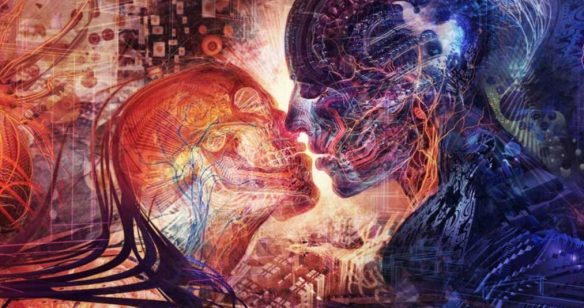
3 EXTRAORDINARY PARADOXES OF PERSONAL AWAKENING

By Dylan Charles

Source: Waking Times

How do you reconcile the utter madness of the world with the overwhelming joy of being alive in it?

“Paradox: a situation, person, or thing that combines contradictory features or qualities.”

Without question we live in interesting times. The deception, insanity and turmoil in our world has no end, yet when we tune in very closely to life’s pulse, we find softness and connection open to us at every step. These contradictory features of the human experience point to the dualistic nature of the universe, but ultimately offer a glimpse of a middle way, the center, where harmony resides in a sea of chaos. A seeming, but natural paradox.

“When people find one thing beautiful,
another consequently becomes ugly.
When one man is held up as good,
another is judged deficient.

Similarly, being and nonbeing balance each other;
difficult and easy define each other;
long and short illustrate each other;
high and low rest upon one another;
voice and song meld into harmony;
what is to come follows upon what has been.”

~Tao Te Ching 2

This is what personal awakening means. To create a harmonious relationship with your own life. To solve the paradox. Have you experienced any of these 3 extraordinary paradoxes of personal awakening?

1. The Awakening is Triggered by Fear and Supported by Love

Like an invading virus triggers the immune system, fear triggers the awakening. War, strife, turmoil, conspiracy, control, death, suffering, theft, abuse. This is the world we have created for ourselves. The toll of such heaviness manifests as a dense type of contagious fear, a chronic trigger that perpetuates the fight or flight response, but without an immediate or tangible threat to face directly. But there is nowhere to run or hide from the fear. We can confront it or be consumed by it. Or transmute it.

And what is to found beyond the fear? Love. An endless stream of it. In the stream the fear makes sense as a force which guides us into the stream of love.

2. Healing Hurts

The awakening is ultimately a healing process, but it’s hardly free of pain, because it is in a sense a recovery from injury or illness, like a form of forgetfulness of who you really are. As such, it actually hurts. A lot. And just like the agony of having a broken bone set, or the pain of recovering from a difficult surgery, emotional and spiritual pain is a necessary component of healing.

Letting go into whatever it is, depression, sadness, boredom, or even grief, is how healing begins. There is no out, only through. The remembrance of the pain is there to forever color the outcome of the healing process.

“If you desire healing,
let yourself fall ill
let yourself fall ill.” ~Jalaluddin Mevlana Rumi

3. The Void Has Everything We Need

Counter intuitive it may seem, but stepping out of the cultural and mental clutter and into the void, where being and non-being balance each other, reveals everything we truly need. It turns out that silence is the teacher. In silence the universe comes into focus. Time stops and morphs into timelines. Infinite possibilities all become clear at once. Everything we need to know and feel is in this space, but to get there, everything has to be stripped away.

“In the pursuit of knowledge, every day something is added. In the practice of the Tao, every day something is dropped.” ~Tao Te Ching

Final Thoughts

What lies above lies below. A proper life is about balancing the joy of being alive with the terror of being alive. Ignoring either side of the equation leads to chaos.

“Do you want to improve the world?
I don’t think it can be done.

The world is sacred.
It can’t be improved.
If you tamper with it, you’ll ruin it.
If you treat it like an object, you’ll lose it.

There is a time for being ahead,
a time for being behind;
a time for being in motion,
a time for being at rest;
a time for being vigorous,
a time for being exhausted;
a time for being safe,
a time for being in danger.

The Master sees things as they are,
without trying to control them.
She lets them go their own way,
and resides at the center of the circle.”

~Lao Tzu, Tao Te Ching

Love and Let Love: Overcoming Egocentric Love

By Gary Z. McGee

Source: The Mind Unleashed

“Love could be labeled poison and we’d drink it anyway.” ~Atticus

Love is a tricky subject. It’s multifaceted, both subjectively and objectively. It’s both lost and found within the complex folds of our unique mind-body-spirit dynamic. It’s both a spiraling in and a spiral out. We all know the “feeling” of love, but we can’t seem to describe it to each other. But boy do we try: in poetry, in song, in dance, in bed. Even in art.

Unfortunately, the predominant love paradigm in our culture is egocentric, ownership-based love. We live in a world where relationships are mostly based upon materialism, ownership and immediate gratification. It’s almost like we’re conditioned to consume to the point that we “consume” each other. Even the words we use toward each other imply ownership.

It’s sad. But no condition is insurmountable. We can recondition ourselves to form healthy relationships based upon respect, honesty, and trust. We can update the love paradigm into one of soul-centric, relationship-based love. But first we need to recognize each other as opposite sides of the same being. Our yin-yang dynamic is more dynamic than we tend to allow it to be.

The thing is, our language is dreadfully inadequate to do the concept of love any justice. There are over seven-billion people on the planet and we each have a different psycho-physiological reaction to any given stimuli, however minute that difference. And with abstract stimuli such as Love, Consciousness, and God, that difference is magnified.

The fact is: we each have our own definition for the concept of love (ego), but that definition is written in a language older than words (soul). So how do we understand this language? Simply put: mindfulness. More complexly put: we must become aware of what our mind-body-spirit is telling us, and then be honest about that information regarding our relationships. And poetically put: “You only have to let the soft animal of your body love what it loves.” ~Mary Oliver

The ability to love (vulnerability):

“Vulnerability is not knowing victory or defeat, it’s understanding the necessity of both; it’s engaging. It’s being all in.” ~Brene Brown

Our ability to love another person is predetermined by our ability to love ourselves. Similar to the airplane-crash-landing analogy, “Always put the mask on yourself before assisting someone who may be less capable,” we must put the Mask of Love on ourselves before loving someone who may or may not be capable of authentic love.

The irony is that we must first learn self-love to understand that egocentric love isn’t the healthiest way to love. We must first love our ego in order to transform it into an ego that isn’t just in love with itself. An ego that isn’t loved tends to become self-serving and egocentric (codependent or merely independent), but an ego that is loved tends to become self-actualized and soul-centric (interdependent).

An ego that has learned interdependence through self-love is more likely to love authentically. It is more likely to be vulnerable with another ego. And vulnerability is the key to loving greatly. It’s the secret of deep authenticity. A crucial aspect of self-actualized love, as opposed to egocentric love, is to allow ourselves to be vulnerable so that we may be astonished by love, taken aback by it, in awe of it. As the great Rumi once said, “Close your eyes. Fall in love. Stay there.”

The ability to let others love (freedom):

“The only way of loving a person is to love them without hope.” ~Walter Benjamin

Have you ever caught yourself saying this, regarding love and relationships? “I just don’t want to get hurt.” Or heard someone else say it? We hear people say this, and we nod in empathy, followed by an understanding pat on the back, or a sympathetic hug.

But, wait a minute! Who ever said getting hurt wasn’t a part of love? Are not pain and love two sides of the same coin? If we love something deeply enough, does it not hurt when we lose it? The thing is, the ability to love another person takes an enormous act of courage. And if we are genuinely allowing ourselves to love another person, then we must open ourselves up to the possibility of being hurt. This is what it means to be vulnerable. If we’re not “all in,” then what’s the point of trying?

Pain should not be avoided at the expense of love. Love should be embraced at the risk of pain. Indeed.

If we’ve already learned to love ourselves, which we should have taken care of before attempting to love another person anyway, then insecurities be damned! It’s time to go for it. It’s time to move all in. Rejection happens. But if we don’t at least give it a shot, and that means getting vulnerable and laying our insecurities out on the table like a bad hand of poker, then we’ll never know if it could have been something magical or not.

A relationship is actually two uniquely different people who have gone from being independent dancers to becoming an interdependent dance. This is the beauty of romantic, soul-centric love. It becomes a dance. But, and here’s the rub, the dance can only be enjoyable if both parties are free to dance… or not.

This is where it gets difficult: allowing our partner to love the way they need to love. This sounds simple enough, but it is deceivingly simple. Because we might not like the way they love. It requires good communication skills, brutal honesty, and an exemplary trust in the other dancer.

One of the biggest assumptions we make about love is imagining that the other person loves the same way that we do. In other words, we assume that what the other person means by love means the same thing that we mean by it. But this simply cannot be true if we are genuinely allowing the other person to be an individual with their own unique tastes and opinions.

Letting our lover love the way they need to love is just as much a part of the dance as our unique way of loving is. But we must be honest, first with ourselves and then with our partners. Sometimes this honesty will hurt, but pain is necessary for growth. And if a relationship is what we’re trying to grow, then pain is par for the course.

If the way another person loves doesn’t jive with the way that you love, then the dance either needs to end or it needs to take on a new form. If this sounds counter-intuitive, that’s because it is. As the great Victor Hugo cryptically stated, “Love is never stronger than when it is completely unreasonable.”

The ability to let love go (compersion):

Everything we love is well-arranged dust.” ~Atticus

The ability to let love go is our ability to let go of our ego’s attachment to it.

Falling in love is both very easy and very difficult. It is easy when we are coming from a place of non-attachment and interdependence; when we’re allowing all things to mysteriously and majestically flow. But it is difficult when we are coming from a place of attachment and codependence, and we’re rigidly trying to control everything. It’s the difference between being Love, and vainly trying to pigeonhole love into the box of our expectation.

As Stephen Levine profoundly stated, “True love has no object. Many speak of their unconditional love for another. Unconditional love is the experience of being. You cannot unconditionally love someone. You can only be unconditional love. It is not a dualistic emotion. It is a sense of oneness with all that is. The experience of love arises when we surrender our separateness into the universal. It is a feeling of unity. You don’t love another, you are another.”

When we let love go, we’re not letting go of Love itself –not at all. We are letting go of the ego aspect of love. We’re letting go of the attachment, the need to cling. It’s not like we let go of love and then forget about it. No, it’s more like we are saying goodbye. Like proud parents who are sad that their child has left home, but are happy for their growth and open to the possibility of their return.

Love itself is never abandoned, nor is it forgotten. Only the needy, codependent, ego side of love that’s filled with unhealthy expectations and cultural predispositions about the way love should be is abandoned. Authentic love lasts forever, despite us, and even in spite of our egos. The more we let love go, the more we realize that we never owned it in the first place. It was never a thing that could be owned. It could only ever have been free, or it was never really love at all.

So, let’s learn to be Love in the face of expectation. Let’s be Love despite the love that thinks it needs validation. Let’s be Love even when others cannot. That is the heart of both compersion and forgiveness… Love, let others love, and then let go of your ego’s attachment to love. Do this, again and again, in a kind of loving life-death-rebirth process, and the ability of soul-centric, self-actualized love will not elude you.

Sacred Agency

By Kingsley L. Dennis

Source: Reality Sandwich

The following essay was originally published on KingsleyDennis.com


Transcendence is the only real alternative to extinction.

—Václav Havel, Independence Hall, Philadelphia, July 4, 1994

We are cosmologizing the human.

—Henryk Skolimowski, The Participatory Mind


Human consciousness has been on a long journey. Our awareness has shifted from the earlier archaic, animistic mode; to the religious and scientific; and then later to an industrial, mechanistic consciousness. Our ancestors did not live in the same world as we live in now, nor would they have exhibited the same kind of consciousness as we currently do. Consciousness is not a fixed phenomenon or static expression—it changes alongside the flows and fluxes of history, time, and environment.

An integral mode of consciousness began to emerge after the successive industrial revolutions that adapted a “machine style” perspective of control, power, and efficiency; and which eventually propelled global society toward excessive consumption and accelerated growth. This integral consciousness emerged parallel to a new era of technological innovation. That is, a consciousness that reflects dynamics of connection and communication across condensed time and space.

It can be said that we have gone from worshipping faith, then objective knowledge, to finally arriving at an understanding that everything depends upon the subjective self. Throughout this whole journey, like the hero that traverses through the underworld, we have ventured far in search of a mode of being – a state of consciousness and awareness – that can benefit us. A place of conscious self-awareness, which may be termed as sacred, has been present within humanity from the very beginning. It never went away – only we went away. This situation is similar to the behavior of individuals as observed by psychologist Abraham Maslow. Maslow noted how people step back from doing something important, believing others will do it instead. Somewhere along the way we made an internal agreement to stay back and not to overestimate our abilities. It appears that too many of us for too long have avoided being ‘fully human’ and content to remain as ‘only human.’

Regardless of how we may articulate it, the sacred presence within humanity cannot be denied as it is an expression of the evolutionary impulse. As such, it does not stop at transitional stages but is compelled to push toward ever higher states and degrees of consciousness. We are in the hands of a force that we can barely recognize. Throughout the long journey of our development human beings have been deeply involved in this sacred unfolding (for want of a better expression). What this means is that the transcendental yearning to go beyond one’s present state persists in each of us. All of this, our very humanism, should be an inherent part of our cultural mythology. Or at least should influence how we understand and perceive our reality.

Our experience of reality is never pure, but always mediated through consciousness in its various states of reception. The myths we hold as an individual, a culture, and as a collective species reflects our own state of mind. Unfortunately, humanity has for far too long considered itself separate from the cosmos. We feel as if exiled upon a dead planet somewhere upon the fringes of our galaxy. If we do not fully know ourselves it may be because our cultural myths (our narratives) place us within a cosmically isolated reality. To be truly integrated we must recognize that we participate not only upon the planet but also within a grander mythology. In other words, we should accept our responsibility as having sacred agency. After all, the history of human civilization is the history of ourselves as change agents.


Sacred Agency

The philosopher Karl Jaspers referred to the period from 800–200 BCE as the Axial Age. It was a time that, according to Jaspers, similar expressions of new thinking appeared in Persia, India, China, and the Western world. He indicated also that the Axial Age represented an in-between period, where old certainties had lost their validity and new ones were yet to emerge. The new religions that arose in this time—Hinduism, Buddhism, Confucianism, Taoism, and monotheism—influenced new thinking in terms of individuality, identity, and the human condition. These new emerging religions helped to catalyze new forms of thinking and expressions of human consciousness. And yet, over time, we have seen how they were not wholly successful in establishing permanent developmental change.

Social thinker Duane Elgin has referred to our present time as the Second Axial Age in that religions of separation are being replaced by a new spirit of communion. Elgin says that the world is moving into a spiritual communion and empathic connection with a living cosmos. Maybe we are in need of being reminded that there is nowhere else to go when the cosmos already exists within us. This empathic consciousness that Elgin speaks of can be related to the emerging integral consciousness that reflects our increased interconnectivity through our global networks. This connects with our innate, fundamental drive to seek out communion and coherence. A mode of human consciousness that seeks coherence is itself a reflection of a universal natural order. In other words, it is a self-referencing feedback loop. And so now allow me to speculate.

My suggestion is that a purpose for sentient human life upon this planet is as a driver toward establishing a coherent planetary consciousness. In other words, to act as a channel to ‘bring in’ – i.e., receive consciousness – from the consciousness field and to manifest it specifically (that is, to project it) within our earthly reality. There is a correlation here with Aurobindo’s concept of the Supermind/Overmind, in that a form of higher consciousness can be made immanent upon the material plane. Aurobindo referred to this as human evolution moving towards a suprarational or spiritual age that exhibits an intuitive or Gnostic mode of consciousness.

The finer channeling of the consciousness field would require the adequate preparation of human receptivity. That is, our minds and even perhaps our nervous system would need to be sufficiently prepared in order to successfully actualize this potential. By raising localized aspects of human consciousness through individual perceptions and awareness we may better increase the coherence of consciousness amongst the whole—a form of collective transcendence through species consciousness. And this can be made tangible by local agents – i.e., each one of us – becoming aware and conscious in everyday acts of right thinking, right behavior, and right being. It is a mode of sensitive and balanced consciousness that comes only with considerable effort and discipline. This discipline forms part of the developmental awakening within each individual, and which then influences our perceptions and life experiences.

As such, we can come to recognize that we are no longer either isolated individuals or an inarticulate mass. We are localized consciousness acting through aware individuals who consciously seek to connect, collaborate, and care about the future. Each one of us, as localized consciousness, is a reflection of the grander nonlocal consciousness. And in this way each one of us is also a reflection of the other. No individual lives within a shell separated from everybody else, but each is connected to all through our conscious humanity.

What we are seeing emerge across the world is the early stirrings of a planetary civilization; one that is driving toward diversity and coherence. And as we connect and share our thoughts, ideas, and visions we will be helping to strengthen the signal or reception of consciousness and thus the bringing in of the grander cosmic consciousness. A planetary consciousness spread across the Earth may not only be a real possibility, it may very well be a fundamental cosmic purpose.


Human Purpose in the Sacred Order

Recent scientific discoveries indicate that our reality is coded from beyond cosmic space-time; and as such our reality behaves in a way consistent with what we know as a holographic projection. That is, the totality of our reality is in-formed from a deep consciousness beyond it. The known cosmos thus acts as a nonlocal consciousness field, of which sentient life forms as localized manifestations. It has been inferred through various religious and sacred texts, and various wisdom traditions, that the universe (material reality) came into being as a way for its source to ‘know itself.’ This is reminiscent of ‘know thyself,’ the famous maxim from the Oracle of Delphi. Or, in modern language, we can say that we are the eyes through which the cosmos contemplates itself.

Self-consciousness is generally attributed to those sentient organisms at a high peak of mental development. Self-reflection is one of the prized attributes of self-consciousness. Furthermore, self-realization is something we credit to each attained individual consciousness. A realization of the self is part of the path of human actualization. It is a path in which purpose and meaning are core drivers and potentials. Human beings – or we could say human becomings – are naturally driven by a longing, a purpose, and this signifies a connection with a sacred impulse. In our times human civilization has shifted into an unprecedented era of self-actualization. The psychologist Abraham Maslow, who originated a scale of self-actualization, recognized that one of the characteristics of self-actualizers is that they have far less doubt about what is right and wrong than normal people do, and they act upon this inner knowing.

As we further speculate, what would self-realization upon a greater scale be like? That is, self-realization as a planetary consciousness? Or as a galactic consciousness? What would a fully realized and self-conscious cosmic consciousness operating through all of its localized manifestations be like? This would constitute a state of coherent self-aware consciousness beyond our imagination. We can only speculate, or internally gaze upon the possibility.

As a recap then, human consciousness is a localized expression of the greater nonlocal consciousness field. As sentient beings we receive aspects of this consciousness that pervades our space-time. We are animated by it, and we then manifest this through our own minds and human cultures. Our individual expressions of consciousness also reflect back into the greater nonlocal consciousness field. The greater our individual perceptions and conscious realization, the greater the total realization of the entire holographic field consciousness (as if in a feedback loop). To put it another way, cosmic consciousness is ‘in-formed’ through the emerging awareness of each of its conscious subparts, or components. The art of the sacred then is that we each have a role in bringing the unfinished world into existence through conscious participation.

As each one of us wakes up (to use a common metaphor) the cosmic net shines that little bit brighter. If enough individual consciousnesses awake upon this planet we may catalyze a localized planetary field into collective conscious awareness. In this case, we are each a conscious agent of cosmic realization and immanence. We each have an obligation in our existence on this planet to raise our individual, localized expressions of consciousness. In doing so, we both infect and inspire others in our lives to raise theirs, as well as reflecting back our conscious contribution into the cosmic consciousness. In this way, we can act as both citizens of the cosmos as well as caretakers for the sacred order.

We have now arrived at a place where we can recognize and accept that our reality is not a static affair but an active, fluid realm that makes demands upon us. And in knowing this we are compelled to embrace the obligations and responsibilities that come with this role. We are on a path of completion – of conscious completion and communion – which is the eternal path of the sacred. Through this sacred journey of completion we connect and commune with everything else in our reality, and beyond. As human beings we have been tasked with this sacred endeavor. We can become aware of our creative contribution to reality and this can give us meaning and purpose. Perhaps this will finally provide us with our place in the cosmos. And how can we walk this path?

We can take this journey through our small acts of conscious awareness – our thoughts, attitudes, behavior, and our everyday actions. Upon the next level, our social changes and emerging technologies may form part of this process, establishing an extended mind and empathic embrace across the face of the earth. Magic is alive; magic never died. Everything is ultimately a technology of the soul; and all magic, all science, and all human expression is a part of this soulful technology. And with each step forward we move closer to soulful communion with a grand conscious and sacred order.

The sacred impulse animates the expression of consciousness at the individual, collective, and planetary level. And one day we may witness a grand awakening, unprecedented upon this planet, and this may very well be the purpose for sentient life, as conscious agents of the sacred order. This is likely to be more reality than fantasy. The hidden treasure that is at the very core of our existence wishes to be known – for us to know ourselves – by our individual journeys of self-realization.  We are not alone. A great planetary future awaits us, as a great treasure that wishes for communion. Welcome to the new story.


Truth has to appear only once, in a single mind, for it to be impossible for anything ever to prevent it from spreading universally and setting everything ablaze.

—Teilhard de Chardin, The Heart of Matter

The Search for Meaning in Modern Life

By Kingsley L. Dennis

Source: Waking Times

Every good story about a search begins with a tale. So, here’s one; it’s a tale about a magician who gave a dinner for his neighbours.

There was once a Magician who built a house near a large and prosperous village. One day he invited all the people of the village to dinner. ‘Before we eat,’ he said, ‘we have some entertainments.’

Everyone was pleased, and the Magician provided a first-class conjuring show, with rabbits coming out of hats, flags appearing from nowhere, and one thing turning into another. The people were delighted. Then the Magician asked: ‘Would you like dinner now, or more entertainments?’

Everyone called for entertainments, for they had never seen anything like it before; at home there was food, but never such excitement as this. So, the Magician changed himself into a pigeon, then into a hawk, and finally into a dragon. The people went wild with excitement.

He asked them again, and they wanted more. And they got it. Then he asked them if they wanted to eat, and they said that they did. So the Magician made them feel that they were eating, diverting their attention with a number of tricks, through his magical powers.

The imaginary eating and entertainments went on all night. When it was dawn, some of the people said, ‘We must go to work.’ So the Magician made those people imagine that they went home, got ready for work, and actually did a day’s work

In short, whenever anyone said that he had to do something, the Magician made him think first that he was going to do it, then, that he had done it and finally that he had come back to the Magician’s house.

Finally, the Magician had woven such spells over the people of the village that they worked only for him while they thought that they were carrying on with their ordinary lives. Whenever they felt a little restless he made them think that they were back at dinner at his house, and this gave them pleasure and made them forget.

And what happened to the Magician and the people, in the end? Do you know, I cannot tell you, because he is still busily doing it, and the people are still largely under his spell.

Modern life is much like this tale – we live under a magician’s spell – and the magician is called Modernity. Modernity, especially as it emerged in western, industrialized cultures, created a system that put a spell on us. And this spell is principally promoted through our mainstream medias. Whether rationally, instinctively, or deep in our hearts, most of us know that something is not right about how human societies are managed. Human life is not yet in balance. And too many people still live in fear.

We are manipulated by our mainstream medias at unprecedented levels, and constantly fed with a controlled flow of information. This process is the old mind of humanity, still operating through control, censorship, and consumerism. In this way our contemporary societies are increasingly centered around emotion to a degree that allows people to be entertained as well as manipulated like never before. What we may be less aware of is that the human being is driven by an evolutionary energy that manifests through mental, emotional, and physical/sexual processes. This energy can be used to develop and drive us forward, or it can be hampered, blocked, and manipulated into slowing down our development. Mental, emotional, and physical/sexual energies are all necessary components of the social human being. If we take just a casual look at our mainstream media, entertainment, and social attractions/distractions we will readily see that these are the very areas which are targeted by the ‘culture of spectacle’ that is modern society.

Ancient religious-spiritual traditions have long talked about such ‘energy predators’ that are said to feed off from unstable human mental and emotional states. The early gnostic Christians referred to some of these as the Archons; various North American Indian tribes refer to Wetiko/Wendigo; Don Juan in the Carlos Castenada books refers to the Predators; and South American shamans have long talked of spirits that feed off from and fragment the vulnerable human inner state/soul.

We must wonder why it is that our modern cultures promote entertainments that manipulate and play upon excessively distorted images of mental and emotional anguish as well as exaggerated portrayals of sexuality. Furthermore, we are bombarded daily with images of death. In fact, a recent study into western media announced that the most repeated word in media is ‘death.’ Further, it revealed that in the first twelve years of a child’s life they would have been subjected to around 20,000 murders through television news and programs, films, online content, and video games. These forms of stimulation directly target a person’s mental, emotional, and physical states, which in turn hampers the operation of harmonious, developmental energies.

Modern life is increasingly a life addicted to high stimulation. Yet by its very nature it also creates anxiety. Many people are forced, or seduced, into lives that are continually stressful and busy. There is no room for the spaces, the intervals, of internal reflection. Yet similar to how music is not music without the intervals, so is life not a life without those internal spaces.

We spend our days trying to grasp at life, trying to understand it, often with ways that are not adequate. It is like trying to capture the ocean with a bucket. The ocean stands magnificently before us, and yet so many of us in modern societies are running around anxiously with empty buckets in our hands. We’ve been told that only full buckets are of any use – full buckets represent usefulness and progress.

Here is another story:

A man had two large pots, each hung on an end of a pole which he carried across his neck. One of the pots had a crack in it, and while the other pot was perfect and always delivered a full portion of water at the end of the long walk from the stream to his house, the cracked pot arrived only half full.

For a full two years this went on daily, with the man delivering only one and a half pots full of water to his house. Of course, the perfect pot was proud of its accomplishments, feeling accepted and appreciated. But the poor cracked pot was ashamed of its own imperfection, and miserable that it was able to accomplish only half of what it had been made to do. After two years of what it perceived to be a bitter failure, it spoke to the man one day by the stream.

“I am ashamed of myself, and I want to apologize to you.”

“Why?” asked the man. “What are you ashamed of?”

“I have been able, for these past two years, to deliver only half my load because this crack in my side causes water to leak out all the way back to your house. Because of my flaws, you have to do all of this work, and you don’t get full value from your efforts.” the pot said.

The man felt sorry for the old cracked pot, and in his compassion, he said, “As we return to my house, I want you to look at the beautiful flowers along the path. It will make you feel better.”

Indeed, as they went up the hill, the old cracked pot took notice of the sun warming the beautiful wild flowers on the side of the path, and this made it feel a little happier. But at the end of the path, it still felt bad because it had leaked out half its load, and so again the Pot apologized to the man for its failure.

The man said to the pot, “Did you notice that there were flowers only on your side of your path, but not on the other pot’s side? That’s because I have always known about your flaw, and I took advantage of it. I planted flower seeds on your side of the path, and every day while we walk back from the stream, you’ve been watering them. For two years I have been able to pick these beautiful flowers to take home to my wife. With you being just the way you are, you have given beauty and meaning to me every day.”

The way we are can give us beauty and meaning every day, and yet it seems we are living in a world of decreasing meaning. Our modern systems strive for perfection – for progress and efficiency – yet there is less and less happiness.

And the situation is worse in modern western cultures where so many people are seemingly dissatisfied even when they have acquired most things to keep them happy. Perhaps a society that provides superficial comfort produces conditions that do not develop people or cause them to turn an inward gaze or to question notions of their meaning and existence. It is important that other cultures do not follow this western model of superficial consumerism.

It is unfortunate that the meaning of life is often a meaningless question to so many people. Seeking the ‘unnamable’ might sound like madness to many people, and certainly there is little place for it in modern societies that prize themselves on progress. And yet a life that seeks meaning is its own adventure. The ‘unnamable’ does not need to be named – only recognized internally. The external world is not the only reality that exists for us.

The attitude of the modern-day person to the ‘world outside’ has largely been one of hostility – we have been conquering the external world for the most part of human history, instead of mastering our own inner nature. This hostile attitude ignores the reality that all life is interdependent and that our lives are a projection of our inner realities – that is, our fears, anxieties, and insecurities become projected into the world the same as our hopes, visions, and dreams. Whatever we project externally eventually becomes our sense of reality.

We all share a collective reality, despite our cultural differences. Although it alters depending upon where we were born and in which cultures we live, the methods each modern system uses are basically the same – we are provided with beliefs, cultural references, and norms and attitudes. The writer Doris Lessing referred to this as ‘The prisons we choose to live inside.’ And within these psychological prisons many people, as well as the institutions of the modern world, have rejected the wisdom of sages, mystics, philosophers, and even the voices of creative artists. They prefer instead the superficial trappings, entertainments, and technological distractions of the consumerist marketplace. Now, I wish to be clear here – I am not anti-technology. In fact, I am a great supporter of it; but not at the expense of the human vision. Despite the technological progress of the external world, there must always be a developed interior world to observe, reflect, and to question it. Without this, the exterior life is unleashed without values. Without an interior life to seek for significance, what gives meaning to our lives?

So, what is the ‘interior life’? There are no instruction sets for how to live a human life – and we live in a world where more and more people are at a loss to know either why they live or why they die. In life we must strive to examine the human condition.

Modernity has attempted to reinterpret the human condition – to see it as an external drive for progress – and this has resulted in a separation from our need to seek an essential inner self. This modern project has sought to divorce the human being from their imperative to find meaning in existence. The human project, if we wish to call it that, can never be ‘completed’ – it is an eternal quest to always be becoming. Here is a quote I would like to share:

‘When you have found yourself you can have knowledge. Until then you can only have opinions. Opinions are based on habit and what you conceive to be convenient to you. The study of the Interior Life requires self-encounter along the way. You have not met yourself yet. The only advantage of meeting others in the meantime is that one of them may present you to yourself. Before you do that, you will possibly imagine that you have met yourself many times. But the truth is that when you do meet yourself, you come into a permanent endowment and bequest of knowledge that is like no other experience on earth.’ ~TARIQAVI

What we are truly seeking for – and what the interior life can show us – is power over ourselves: not for power over others.

The world is in need of soulful healing, not power-seeking through corruption and manipulation. The world requires healed, integrated, and balanced people; for that which we lack in ourselves we shall always find lacking in the world outside. Also, there are many external forces in the world that are trying to make us live not according to our own sense but according to dominant social narratives. We are told that we must live according to certain social narratives that generally benefit those systems that have no interest in the human soul. And when we deny ourselves such essential nutrients we find that we have a discomfort within us. People are taking increasing amounts of antidepressants, or stimulants; as well as relaxants – we take drugs to bring us up and other drugs to take us down. We are open and vulnerable to the energies of discouragement. Here is a tale about the price of discouragement:

Once the word spread that the devil was pulling out of his business and was arranging to sell-off all his tools of the trade to the highest bidder. The night of the sale all the tools were arranged for the bidders to view. What a motley crew it was! There were sinister tools of hatred, jealousy, envy, malice, treachery, plus all the other elements of evil. Yet besides these there also was an instrument that seemed harmless, a wedge-shaped instrument that appeared worn out, shabby, and yet was priced so much higher than all others. Someone asked the devil what was the name of such a poor-looking instrument.

‘Discouragement,’ answered the Devil.

‘And why is the price so high for such a non-malicious sounding instrument? asked the bidder.

‘Because,’ spoke the Devil, ‘this instrument is more useful to me than any other. I can enter the consciousness of a human being when all other ways fail me and once inside through the discouragement of that person I can do whatever I please. The instrument is worn out because I use it almost everywhere and as very few people know about this I can continue to successfully achieve my goals.’

And as the price of discouragement was so very, very high even today it remains a tool in the property of the Devil.

The price of discouragement is a price too many people are paying – and it is a high price (as the devil knows!)

It is a common situation that we tell people at work we are happy when for much of the time we are not. We buy more and more items to feel happiness within ourselves or to buy happiness in others. People in modern cultures continue to accumulate goods and possessions whilst feeling empty within. Such consumerism empties our pockets and fails to fill our souls. And not only our physical lives become crowded with belongings but our psychological spaces too. We are crowded with those belongings that have accumulated as psychological attachments: the beliefs, ideologies, nationalisms, opinions, likes, dislikes, and all the rest. We are often cluttered in our minds by belonging to this and that and all the other things that we cling to or that cling to us. And this is where some of the disruptions are, and will continue to come from, because our belongings are now breaking apart. As our social, cultural, economic, and work lives go through change and transformation – as they are currently doing – then the clinging to old ‘belongings’ will only serve to cause greater confusion and disorientation. Already it seems as if we are living in a world that is displaying increasing outward signs of craziness and psychopathic tendencies. We must ensure that the world never has more critics than visionaries, or more complainers than positive doers. We must ensure that we do not lose sight of our frameworks for meaning.

Pre-modern societies, for example, lived within their own frameworks of meaning. Not all questions had their answers, yet mysteries and the mysterious at least had a home in which they could exist. We often live today within an atmosphere of meaningless questions and contradictory answers. The pursuit of meaning is being replaced by the pursuit of progress. Progress may alleviate some of our suffering and pains, yet it shall never compensate for the lack of fulfillment we feel inside, for this requires metaphysical or transcendental nourishment. Any notion of the spiritual, or the metaphysical, is often considered not essential to our daily life, and we are taught to dismiss it. Modernity’s task was thus seen as freeing us from the illusions of transcendence. And yet the desire, or the need, for some Absolute remains deep within us and can never be totally eradicated. Perhaps it is this contradiction that lies at the heart of our contemporary distress.

Modern life also tries to eradicate, or at least hide, all sense of enigma. Yet it is precisely these enigmas that make our lives rich in wonder and awe. To attempt to abolish them is an act of great ignorance and hubris. Unanswerable questions must be embraced and not rejected. Mystery and the mysterious must be allowed a space to thrive and enthrall us. It is this sense of mystery that keeps us curious, and curiosity is one of our driving, motivating forces.

Modern societies may well praise their sophisticated intellectual culture, yet it comes at the cost of having a deteriorated spiritual culture. That which belongs to the experience of the human soul is considered not only incommunicable, but rather dangerous to communicate. In the end, life’s mysteries are kept out of sight because they cannot be fully known and thus controlled. There is a spell upon us, and we are being distracted from the essential. Here is another tale:

A lion was captured and imprisoned in a reserve where, to his surprise, he found other lions that had been there for many years, some even their whole life having been born in captivity. The newcomer soon became familiar with the activities of the other lions, and observed how they were arranged in different groups.

One group was dedicated to socializing, another to show business, whilst yet another group was focused on preserving the customs, culture and history from the time the lions were free. There were church groups and others that had attracted the literary or artistic talent. There were also revolutionaries who devoted themselves to plot against their captors and against other revolutionary groups. Occasionally, a riot broke out and one group was removed or killed all the camp guards and so that they had to be replaced by another set of guards. However, the newcomer also noticed the presence of a lion that always seemed to be asleep. He did not belong to any group and was oblivious to them all. This lion appeared to arouse both admiration and hostility from the others. One day the newcomer approached this solitary lion and asked him which group he belonged to.

‘Do not join any group,’ said the lion. ‘Those poor ones deal with everything but the essential.’

‘And what is essential?’ asked the newcomer.

‘It is essential to study the nature of the fence’

A whole society can be distracted. There is a pertinent analogy here to how, in 256AD, the Persian army took Antioch from the Roman Empire. Many of the inhabitants were attending the roman theatre and were oblivious to the enemy archers who had climbed up behind them into the stands. The actors down below had seen the enemy archers and were desperately trying to warn them with hand signals…but the audience did not understand, thinking it part of the entertainment – until it was too late. They were amused up to the point of death. Perhaps we too, in the words of social critic Neil Postman, are ‘Amusing ourselves to Death.’

Understanding Our Place In The World

The only genuine freedom is to be found by turning within ourselves. The human being is naturally an imaginative and creative creature. Reality may be harsh and painful, yet it is also the realm of so much wonder and awe. We may live our lives playing in the mud, yet our minds can reach the stars. Our science can reach into the molecule as well as penetrate into the formation of the universe. Our mystics and sages can reach into the pulsating heart of the cosmos. The human being has an inner dimension that needs to be investigated and which, in turn, is timeless.

It is my view that the role of imagination – the interpenetration of the interior world – is crucial. It is what fuses together that which is above to that which is below. It is also a channel for intuition; and it is through intuition that we get closer to the essential. The inward gaze forever attempts to reveal the role of the human being, and what makes us human. It is about trying to understand our place in the world and our shifting views of the world. And right now, we find ourselves at a crucial point in human history.

Life on this planet is undergoing a great change. There is a revolution coming as people, especially the young people, develop their ways of communication, collaboration, and a new consciousness. We are seeing examples of empathy and compassion from young people around the world, as well as innovation, creativity, and inspired motivation. I have stated before that we are shifting into an epoch where new value sets will emerge as the dominant traits.

[1] And some of these values are already being expressed within our younger generations. I refer to these as the ‘C’ values of Connection – Communication – Collaboration – Consciousness – Compassion. Such changes will come into our lives, yet not overnight. It is not like flicking on a light switch. I expect it will be a process where much soul-searching and the questioning of our meanings and values will have to occur beforehand. However, it is not all about violence and thuggery, despite what our mainstream news may be showing us. There is a change emerging across the planet, and this change shall arise from within, through a new understanding of the human spirit, and of our place not only in our local cultures but also within a shared, planetary home. These are critical times of transition – and of momentous importance to us.It is important to recognize that we are undergoing a shift from localized cultures into a period of becoming planetary citizens. Nationalisms will need to become secondary, or put aside altogether, as we come closer together as a global species. And this significant transition is dissolving our securities, our belief systems, and our models of reality. Everything around us is beginning to shake – and so is the earth, literally. We can no longer remain within the old narratives. We are in need of new worldviews, both as individuals as well as within our communities and societies. What we now need is genuine and sincere far-reaching vision. And in our mainstream cultures we are also lacking hope and trust, especially in our socio-political systems. What is now essential is hope and trust in humanity, and in the richness and resilience of the human spirit. We are on the cusp of a different world coming into being, and at its centre shall be the human heart and soul. There can be no genuine, lasting future if it is based solely on the exterior life – it must be driven by the values that come from the interior of the human being.

To be prepared for the future world that is now emerging before us we must adapt our thinking and our consciousness to all possibilities. What we first need is a genuine change of mind:

God decided to come down to Earth for a quick look at how creation was coming along.

God approached Earth and happened to look at a big tree full of howling monkeys. As God looked down, one of the monkeys happened to look up and saw God.

The monkey became excited and started to shout: ‘I see God…..I see God!’

None of the other monkeys paid any attention. Some thought the monkey was crazy or perhaps just a religious fanatic. They went on about their daily lives of collecting food, taking care of their young, fighting with each other, etc., etc. Not getting any attention, our monkey decided to try to get attention from God, and said:

‘God, Almighty, You are the Beneficent, the Merciful, please help me!’

In an instant, the monkey was transformed into a man living in his own human community. Everything changed, except for one thing: the monkey’s mind. The monkey immediately realized that could be a problem.

‘Well, thank you God, but what about my mind?’

‘That,’ said God, ‘you will have to change yourself.’ 

As in this story, we have the human form. The next step is for us to assume the responsibility for the correct level of consciousness. It is as simple and as difficult as that.

We have to accept the responsibility for our own choices and actions; and also, how we choose to respond to events. Everything begins and ends with ourselves, and anything other than this is an excuse, no matter how plausible it may seem to us. As creative, imaginative beings we invent and innovate. At the same time, we are masters at inventing our own false stories and imaginings that self-deceive. In this regard we must choose carefully where we wish to put our attention, time, and efforts. After all, when we visit a beautiful garden do we choose to sit by the roses and savour their sweet smell, or to sit amidst the weeds that prick us? It is important to gift ourselves moments of joy, for joy is an infectious energy – and it shares easily too.

It is up to us to choose those moments, events, and circumstances to engrave upon our memories and heart. It is also about choosing what things to forget. Most of the things we encounter or accumulate we would be best to give up, or give away. We should only keep the few, thus ensuring the quality and integrity of those things we keep close to us. Here is another tale:

An Arabian legend tells of two friends who were travelling through the desert and at one point they fell into disagreement about the trip whereby one of the friends slaps the other across the face.

The friend who had been slapped said nothing, only wrote in the sand: ‘Today my best friend slapped me in the face.’

Both friends continued on their journey and eventually arrived at an oasis where there were baths to refresh themselves. The friend who had been slapped jumped into the large baths yet soon found himself starting to drown. The other friend immediately jumped in after him and saved him. After recovering the first man took a pen and wrote on a stone: ‘Today my best friend saved my life.’

Intrigued, the friend asked: ‘Why is it that after I hurt you, you wrote in the sand and now after saving you, you write on a stone?

Smiling, the other friend replied: ‘When a good friend offends us, we write in the sand where the wind of forgetfulness and forgiveness will be responsible for clearing it off; on the other hand, when something great happens to us, we burn it into stone in memory of the heart where no wind in the world can erase it.’

We build up and develop our own interior world by all the small things and moments we choose to engrave upon our heart, spirit, and soul. We can choose those things we wish to line our forward path with.

Choosing Our Path

We should not be afraid to talk about things of the spirit – to be present with spirit and to live with it in our everyday moments. As Bob Dylan says, those who are not busy being born are busy dying. We are representatives of the spirit, and so should seek to be present to this, without the urge for external showing-off. There is no need for acting weird or strange; to wear odd clothes or follow customs antagonistic to the culture in which we are living. We may think and feel differently, and have experiences that are beyond the accepted, normal ken. Yet to revert to odd external behavior only shows that we are unable to internalize and stabilize these experiences and energies. To all purposes, there is nothing wrong in appearing normal to the outside world. To engage with the spirit, we may have to first learn how to be still, without being bored. There are already enough active distractions in the world as it is – why add more?

It is a normal request to ask for ‘practical things.’ People want to find activities, acts, exercises, and rituals to help them along their own path of development. And the world offers many of these things, in varying degrees of genuineness, sincerity, and effectiveness. Yet sometimes being given an action to attend to belittles the process of the initial search. For me personally, I am unable to give specific remedies for the search for meaning, other than to say that a person must first experience what this longing, this need, feels like. We are catalysts for our own search for meaning, and each path is walked differently. To begin with, we must learn how to articulate this need. This will then begin the course of one’s life that will forever alter what comes after. We are compelled to trust our instincts, our intuition, and to take the appropriate response. We are not here in this life to live like ghosts amongst the phantasms of the world. We always have an internal choice, and this should not force us to surrender into the abyss of mass insanity. As the story goes,

There was once a wise and powerful king who ruled in a remote city of a far kingdom. And the king was feared for both his might and his love of wisdom. At the heart of the city was a well whose water was cool and crystalline, and all the inhabitants drank from this well, even the king and his courtiers, because there was no other well in the city. One night, while everyone was asleep, a witch entered the city and poured seven drops of a strange liquid into the well, and said:

‘From now on, anyone who drinks this water will go crazy.’

The next morning all the inhabitants drank the water from the well, except the king and his lord chamberlain, and very soon everyone went mad, as the witch had foretold. During that day, all people went through the narrow streets and public places whispering to each other:
‘The king is mad. Our king and his lord chamberlain have lost their reason. Naturally, we cannot be ruled by a mad king. We must dethrone him!’

That night, the king ordered a golden cup of water from the well to be brought to him. And when they brought the cup the king and his lord chamberlain drank heavily from it. Soon after that there was great rejoicing in that distant city of a far kingdom because the king and his lord chamberlain had regained their reason.

We must be fearless in committing to the inner path we have chosen, so long as we harm no other. The genuine inner path is a subtle one. At times it can seem as if nothing is happening – as if we are going nowhere. Perhaps the path itself is a search for no-place and no-where. And yet we can rest assured that the inner path is active in each moment, in all times. And the search for this can bring meaning to us as we engage with the modern world. Amidst the distractions and entertainments on offer it is possible to remain focused with our own internal meaningful enjoyment. And this inner joy brings with it its own sacred moments.

It will do us good to remember that life lies beyond reason, and is a sacred thing. And we should allow this sacred presence into our lives, with joy, respect, and even a little humour. After all, just a little bit of joy, respect, and humour can go a long, long way – and we have far to travel.


References:

[1] See The Phoenix Generation: A New Era of Connection, Compassion & Consciousness

Food for the Moon

By rahkyt

Source: Sacred Space in Time

I don’t know how to say this politely: you are part of a remorseless, psychopathic system that circumscribes your very thought processes and forms your every opinion and belief.

This system of thought, action and being envelops you like air and you can’t see it, feel it or hear it. And yet, you do see it, feel it and hear it every day because it is in your mind as it is in the mind of every person around you.

This system is designed to cull your energy through work and play, to foster its own continuation by way of your personal energetic production. And the production of every, single soul around you. its stability is dependent upon your ignorance.

Because once you become aware of it, you begin to see it everywhere. As it has always been everywhere. Been everything. It notices your awakened state and actively seeks to lull you back to sleep or, failing in that, destroying you utterly and erasing every true sign of your existence from its collective memory.

Once you choose knowledge, you are done. Once you choose truth, you are finished.

It is best to go on ahead and believe you’re dead from that very instant like the ancient Samurais of Japan used to do, for the sake of your own psychological stability moving forward.

Because move forward you must. We must. There is work to do and little time to do it. There are dragons to slay, literally, and they have been awaiting your arrival for millennia.

And now that the time of prophecy and projection is finally upon us, as those awakened souls kindle the flames of love within others and that collective and mighty roar signals the onset of the conflagration of the Ages, your options are reduced to the potentialities of the moment. The Now.

You are brought from the heights of abstract psychological and mental confabulation to the pressing, survivalist instincts that instruct you on how to make it through this moment. And the next. And the one after that.

Don’t worry. There’s no time for wasted energy. You will know what to do.

Your spirit has been preparing for this time for eternity. When the moments of your engagement arrives, you will step the steps predestined, say the words preordained and do the things you were preconceived to do.

And that is just how its going to be. So don’t waste anymore time on worry or regret. The system and its people don’t give a damn about you. Or any of us.

We’re only sustenance. Food for the moon. And Saturn, of course.


Jesus Was Born in a Police State

By John W. Whitehead

Source: The Rutherford Institute

“Jesus is too much for us. The church’s later treatment of the gospels is one long effort to rescue Jesus from ‘extremism.’”—author Gary Wills, What Jesus Meant

The Christmas narrative of a baby born in a manger is a familiar one.

The Roman Empire, a police state in its own right, had ordered that a census be conducted. Joseph and his pregnant wife Mary traveled to the little town of Bethlehem so that they could be counted. There being no room for the couple at any of the inns, they stayed in a stable, where Mary gave birth to a baby boy, Jesus.

Unfortunately, Jesus was born into a police state not unlike the growing menace of the American police state. When he grew up, he had powerful, profound things to say—things that would change how we view people, alter government policies and change the world. “Blessed are the merciful,” “Blessed are the peacemakers,” and “Love your enemies” are just a few examples of his most profound and revolutionary teachings.

When confronted by those in authority, Jesus did not shy away from speaking truth to power. Indeed, his teachings undermined the political and religious establishment of his day. It cost him his life. He was eventually crucified as a warning to others not to challenge the powers-that-be.

Yet what if Jesus, the revered preacher, teacher, radical and prophet, had been born 2,000 years later? What if, instead of being born into the Roman police state, he had been born and raised in the American police state?

Consider the following if you will.

Had Jesus been born in the era of the America police state, rather than traveling to Bethlehem for a census, Jesus’ parents would have been mailed a 28-page American Community Survey, a mandatory government questionnaire documenting their habits, household inhabitants, work schedule, how many toilets were in their home, etc. The penalty for not responding to this invasive survey can go as high as $5,000.

Instead of being born in a manger, Jesus might have been born at home. Rather than wise men and shepherds bringing gifts, however, the baby’s parents might have been forced to ward off visits from state social workers intent on prosecuting them for the home birth. One couple in Washington had all three of their children removed after social services objected to the two youngest being birthed in an unassisted home delivery.

Had Jesus been born in a hospital, his blood and DNA would have been taken without his parents’ knowledge or consent and entered into a government biobank. While most states require newborn screening, a growing number are holding onto that genetic material long-term for research, analysis and purposes yet to be disclosed.

Then again, had Jesus’ parents been undocumented immigrants, they and the newborn baby might have been shuffled to a profit-driven, private prison for illegals where they would have been turned into cheap, forced laborers for corporations such as Starbucks, Microsoft, Walmart, and Victoria’s Secret. There’s quite a lot of money to be made from imprisoning immigrants, especially when taxpayers are footing the bill.

From the time he was old enough to attend school, Jesus would have been drilled in lessons of compliance and obedience to government authorities, while learning little about his own rights. Had he been daring enough to speak out against injustice while still in school, he might have found himself tasered or beaten by a school resource officer, or at the very least suspended under a school zero tolerance policy that punishes minor infractions as harshly as more serious offenses.

Had Jesus disappeared for a few hours let alone days as a 12-year-old, his parents would have been handcuffed, arrested and jailed for parental negligence. Parents across the country have been arrested for far less “offenses” such as allowing their children to walk to the park unaccompanied and play in their front yard alone.

Rather than disappearing from the history books from his early teenaged years to adulthood, Jesus’ movements and personal data—including his biometrics—would have been documented, tracked, monitored and filed by governmental agencies and corporations such as Google and Microsoft. Incredibly, 95 percent of school districts share their student records with outside companies that are contracted to manage data, which they then use to market products to us.

From the moment Jesus made contact with an “extremist” such as John the Baptist, he would have been flagged for surveillance because of his association with a prominent activist, peaceful or otherwise. Since 9/11, the FBI has actively carried out surveillance and intelligence-gathering operations on a broad range of activist groups, from animal rights groups to poverty relief, anti-war groups and other such “extremist” organizations.

Jesus’ anti-government views would certainly have resulted in him being labeled a domestic extremist. Law enforcement agencies are being trained to recognize signs of anti-government extremism during interactions with potential extremists who share a “belief in the approaching collapse of government and the economy.”

While traveling from community to community, Jesus might have been reported to government officials as “suspicious” under the Department of Homeland Security’s “See Something, Say Something” programs. Many states, including New York, are providing individuals with phone apps that allow them to take photos of suspicious activity and report them to their state Intelligence Center, where they are reviewed and forwarded to law-enforcement agencies.

Rather than being permitted to live as an itinerant preacher, Jesus might have found himself threatened with arrest for daring to live off the grid or sleeping outside. In fact, the number of cities that have resorted to criminalizing homelessness by enacting bans on camping, sleeping in vehicles, loitering and begging in public has doubled.

Viewed by the government as a dissident and a potential threat to its power, Jesus might have had government spies planted among his followers to monitor his activities, report on his movements, and entrap him into breaking the law. Such Judases today—called informants—often receive hefty paychecks from the government for their treachery.

Had Jesus used the internet to spread his radical message of peace and love, he might have found his blog posts infiltrated by government spies attempting to undermine his integrity, discredit him or plant incriminating information online about him. At the very least, he would have had his website hacked and his email monitored.

Had Jesus attempted to feed large crowds of people, he would have been threatened with arrest for violating various ordinances prohibiting the distribution of food without a permit. Florida officials arrested a 90-year-old man for feeding the homeless on a public beach.

Had Jesus spoken publicly about his 40 days in the desert and his conversations with the devil, he might have been labeled mentally ill and detained in a psych ward against his will for a mandatory involuntary psychiatric hold with no access to family or friends. One Virginia man was arrested, strip searched, handcuffed to a table, diagnosed as having “mental health issues,” and locked up for five days in a mental health facility against his will apparently because of his slurred speech and unsteady gait.

Without a doubt, had Jesus attempted to overturn tables in a Jewish temple and rage against the materialism of religious institutions, he would have been charged with a hate crime. Currently, 45 states and the federal government have hate crime laws on the books.

Had anyone reported Jesus to the police as being potentially dangerous, he might have found himself confronted—and killed—by police officers for whom any perceived act of non-compliance (a twitch, a question, a frown) can result in them shooting first and asking questions later. Daniel Shaver, 26 years old, was crawling on the floor, sobbing and begging for his life, and had just reached down to pull up his shorts when a police officer opened fire on him with an AR-15 rifle. “If you move, we’re going to consider that a threat and we are going to deal with it and you may not survive it,” the cop shouted at Shaver before his partner started shooting.

Rather than having armed guards capture Jesus in a public place, government officials would have ordered that a SWAT team carry out a raid on Jesus and his followers, complete with flash-bang grenades and military equipment. There are upwards of 80,000 such SWAT team raids carried out every year, many on unsuspecting Americans who have no defense against such government invaders, even when such raids are done in error.

Instead of being detained by Roman guards, Jesus might have been made to “disappear” into a secret government detention center where he would have been interrogated, tortured and subjected to all manner of abuses. Chicago police “disappeared” more than 7,000 people into a secret, off-the-books interrogation warehouse at Homan Square.

Charged with treason and labeled a domestic terrorist, Jesus might have been sentenced to a life-term in a private prison where he would have been forced to provide slave labor for corporations or put to death by way of the electric chair or a lethal mixture of drugs.

Either way, whether Jesus had been born in our modern age or his own, he still would have died at the hands of a police state.

Indeed, as I show in my book Battlefield America: The War on the American People, what Jesus and other activists suffered in their day is happening to those who choose to speak truth to power today.

For those who celebrate Christmas as a season of miracles, it is indeed a time for joy and thanksgiving. Yet it should also be a time of reckoning, re-awakening and re-commitment to making this world a better place for all humanity.

Remember, what happened on that starry night in Bethlehem is only part of the story. That baby in the manger grew up to be a man who did not turn away from evil but instead spoke out against it, and we must do no less.

Thus, we are faced with a choice: remain silent in the face of evil or speak out against it. As Nobel Prize-winning author Albert Camus proclaimed:

What the world expects of Christians is that Christians should speak out, loud and clear, and that they should voice their condemnation in such a way that never a doubt, never the slightest doubt, could rise in the heart of the simplest man. That they should get away from abstraction and confront the blood-stained face history has taken on today. The grouping we need is a grouping of men resolved to speak out clearly and to pay up personally.

Seeking Happiness Beyond Neo-Liberal Consumerism

(Photo by Chris Hondros/Getty Images)

By Graham Peebles

Source: Dissident Voice

Irrespective of nationality, religion, race, or gender; whether stinking rich, desperately poor, or somewhere in between, happiness is the one thing everyone is seeking – consciously or not.

The architects of the socio-economic system in which we live have devised a system that promises to satisfy this yearning. But instead of building a society at ease with itself, full of peaceful, happy people, collective discontent is fed, resulting in a range of mental health issues, and in some cases, suicide.

Happiness, according to the duplicitous devotees of Neo-Liberalism, is to be found in the homogenous shopping centers of the world, the sterile holiday resorts and brash casinos. In things, in products and services that stimulate and excite: Happiness in this perverse paradigm has been replaced by pleasure, love exchanged for desire, choice substituted for freedom.

Echoes of happiness

Happiness that lasts is what we yearn for, not a transient state in which one feels the tingle of happiness for a moment or so, only to see it evaporate as the source of our happiness loses its appeal, or is exhausted — the holiday comes to an end, a relationship breaks up, the gamble doesn’t pay off, a new I-Phone or handbag hits the high street making the old one redundant etc., etc. We sense that a state of lasting happiness is possible but know not where it is or how to find it. The mistake commonly made, and one we are constantly encouraged to make, is to search for happiness within the sensory world where all experiences, pleasant or unpleasant, are facile and transient. The inevitable consequence of such shallow encounters with happiness is discontent and frustration.

Despite being repeatedly confronted with disappointment, instead of refraining from this never-ending quest, the searcher becomes increasingly desperate; a new relationship may be sought, a change of job or new home, more shopping outings, dinners planned, alcohol and drugs taken and so on into the darker reaches of sensory satisfaction and hedonistic indulgence.

Of course, it is important to enjoy life, and, yes, something resembling happiness is experienced on these excursions, but it is a happiness dependent on something, other people, and on certain elements being in place: take these away and the “happiness” very quickly evaporates. Such happiness is a mere echo of ‘True Happiness’, and one that carries with it conflict, fear and anxiety; this taste of happiness, functioning via the desire principle and the medium of the senses is relentlessly stoked by the exponents of neo-liberal idealism.

The success of their divisive project; i.e., profitability, growth, development, progress, call it what you will, is totally contingent on consumerism and the act of consuming relies on, and is the result of, perpetual desire. To their utter shame, despite having a responsibility to create the conditions in which ‘True Happiness’, can be experienced, most, if not all governments collude with corporate man/woman to promote the unhealthy, materialistic values that are the source of unhappiness.

Desire is constantly agitated through advertising, television, film and print media; fantastical, sentimental, idealized images, of not just where happiness lies, but what love looks like, are pumped around the world every minute of every day. The aim of this extravagant pantomime is to manipulate people into believing they need the stuff that the corporate-state is selling in order to be happy. But happiness cannot be found within the world of sensations, pleasure yes, but not happiness, and pleasure will never fill the internal void that exists and is perpetuated through this movement into materiality. Pleasure is not happiness, nor does it bring lasting happiness, at best it creates a false sense of relief from unhappiness and inner conflict, a momentary escape before dissatisfaction and desire bubble up again.

Cycles of discontent

Nothing but discontent is to be found within this endless cycle of desire, temporary satisfaction, and continued longing. It is an insatiable, inherently painful pattern that moves the ‘Seeker of Happiness’ further and further away from the treasure he or she is searching for, creating disharmony and conflict, for the individual and society. Add to this polluted landscape competition and inequality and a cocktail of division and chaos emerges: Competition between individuals and nations separates and divides, working against humanity’s natural inclination towards cooperation, sharing and tolerance; qualities that were crucial in the survival of early man.

Competition fosters ideas of superiority and inferiority, and together with conformity, an image of ‘success’ and ‘failure’, of beauty, and what it means to be a man or a woman, particularly a young man or young, is projected and thrust into the minds of everyone from birth. One of the effects of this is the tendency towards comparison, leading to personal dissatisfaction (with myriad symptoms from self-harming to addiction and depression), and the desire, or pressure, to conform to the presented ideal.

At the root of these interconnected patterns of discontent and misery, lies desire. Desire not just for pleasure, but desire for things to be other than they are; it is this constant movement of desire that creates unhappiness and deep dissatisfaction. If desire is the obstacle to happiness, then all desire needs to be negated, including the desire for happiness. Perhaps the question to be addressed then is not what will bring lasting happiness, but how to be free of unhappiness and discontent.

In ancient Greece, where life was hard and happiness was widely believed to be reserved for those rare individuals whom the Gods favoured, Socrates (470 BC – 399 BC) proposed that happiness could be attained by everyone by controlling their hedonistic desires, turning their attention towards the soul and by living a moral life. His view finds its root in the teachings of the Buddha, who, almost 100 years earlier had made clear in the Second Noble Truth, that far from bringing happiness, desire is, in fact, the cause of all suffering, and further, that freedom from suffering and unhappiness is brought about when desire is overcome.

True Happiness is an aspect of our natural self. It will not be found within the world of pleasure and material satisfaction, comfort and indulgence. It is an inherent part of who and what we are, and in principle at least, the possibility of unshakable happiness exists for everyone, everywhere, irrespective of circumstances.

A New Concept of Consciousness

By Ervin Laszlo

Source: Reality Sandwich

The following is excerpted from The Intelligence of the Cosmos by Ervin Laszlo, published by Inner Traditions.

What about mind? If the world is vibration, is also mind and consciousness a form of vibration? Or on the contrary, are all vibrations, the observed world, a manifestation of mind?

Although it is true that when all is said and done all we know is our consciousness, it is also true that we do not know our own consciousness, not to mention the consciousness of anyone else. We do not know what consciousness really is or how it is related to the brain. Since our consciousness is the basis of our identity, we do not know who we really are. Are we a body that generates the stream of sensations we call consciousness, or are we a consciousness associated with a body that displays it? Do we have consciousness, or are we consciousness? Consciousness could be a kind of illusion, a set of sensations produced by the workings of our brain. But it could also be that our body is a vehicle, a transmitter of a consciousness that is the basic reality of the world. The world could be material, and mind could be an illusion. Or the world could be consciousness, and the materiality of the world could be the illusion.

Both of these possibilities have been explored in the history of philosophy, and today we are a step closer than before to understanding which of them is true. There are important insights emerging at the expanding frontiers where physical science joins consciousness research.

On the basis of a growing series of observations and experiments, a new consensus is emerging. It is that “my” consciousness is not just my consciousness, meaning the consciousness produced by my brain, any more than a program transmitted over the air would be a program produced by my TV set. Just like a program broadcast over the air continues to exist when my TV set is turned off, my consciousness continues to exist when my brain is turned off.

Consciousness is a real element in the real world. The brain and body do not produce it; they display it. And it does not cease when life in the body does. Consciousness is a reflection, a projection, a manifestation of the intelligence that “in-forms” the world.

Mystics and shamans have known that this is true for millennia, and artists and spiritual people know it to this day. Its rediscovery at the leading edge of science augurs a profound shift in our view of the world. It overcomes the answer the now outdated materialist science gives to the question regarding the nature of mind: the answer according to which consciousness is an epiphenomenon, a product or by-product of the workings of the brain. In that case, the brain would be like an electricity-generating turbine. The turbine is material, while the current it generates is not (or not strictly) material. In the same way, the brain could be material, even if the consciousness it generates proves to be something that is not quite material.

On first sight, this makes good sense. On a second look, however, the materialist concept encounters major problems. First, a conceptual problem. How could a material brain give rise to a truly immaterial stream of sensations? How could anything that is material produce anything immaterial? In modern consciousness research this is known as the “hard problem.” It has no reasonable answer. As researchers point out, we do not have the slightest idea how “matter” could produce “mind.” One is a measurable entity with properties such as hardness, extension, force, and the like, and the other is an ineffable series of sensations with no definite location in space and an ephemeral presence in time.

Fortunately, the hard problem does not need to be solved: it is not a real problem. There is another possibility: mind is a real element in the real world and is not produced by the brain; it is manifested and displayed by the brain.


Mind beyond Brain: Evidence for a New Concept of Consciousness

If mind is a real element in the real world only manifested rather than produced by the brain, it can also exist without the brain. There is evidence that mind does exist on occasion beyond the brain: surprisingly, conscious experience seems possible in the absence of a functioning brain. There are cases—the near-death experience (NDE) is the paradigm case—where consciousness persists when brain function is impaired, or even halted.

Thousands of observations and experiments show that people whose brain stopped working but then regained normal functioning can experience consciousness during the time they are without a functioning brain. This cannot be accounted for on the premises of the production theory: if there is no working brain, there cannot be consciousness. Yet there are cases of consciousness appearing beyond the living and working brain, and some of these cases are not easy to dismiss as mere imagination.

A striking NDE was recounted by a young woman named Pamela. Hers has been just one among scores of NDEs;* it is cited here to illustrate that such experiences exist, and can be documented.

*For a more extensive sampling see Ervin Laszlo with Anthony Peake from The ­Immortal Mind (Rochester, Vt.: Inner Traditions, 2014).

Pamela died on May 29, 2010, at the age of fifty-three. But for hours she was effectively dead on the operating table nineteen years earlier. Her near-demise was induced by a surgical team attempting to remove an aneurism in her brain stem.

After the operation, when her brain and body returned to normal functioning, Pamela described in detail what had taken place in the operating theater. She recalled among other things the music that was playing (“Hotel California” by the Eagles). She described a whole series of conversations among the medical team. She reported having watched the opening of her skull by the surgeon from a position above him and described in detail the “Midas Rex” ­bone-cutting device and the distinct sound it made.

About ninety minutes into the operation, she saw her body from the outside and felt herself being pulled out of it and into a tunnel of light. And she heard the bone saw activate, even though there were specially designed speakers in each of her ears that shut out all external sounds. The speakers themselves were broadcasting audible clicks in order to confirm that there was no activity in her brain stem. Moreover, she had been given a general anesthetic that should have assured that she was fully unconscious. Pamela should not have been able either to see or to hear anything.

It appears that consciousness is not, or not entirely, tied to the living brain. In addition to NDEs, there are cases in which consciousness is detached from the brain in regard to its location. In these cases consciousness originates above the eyes and the head, or near the ceiling, or above the roof. These are the out-of-body experiences: OBEs.

There are OBEs where congenitally blind people have visual awareness. They describe their surroundings in considerable detail and with remarkable accuracy. What the blind experience is not restored eyesight, because they are aware of things that are shielded from their eyes or are beyond the range of normal eyesight. Consciousness researcher Kenneth Ring called these experiences “transcendental awareness.”

Visual awareness in the blind joins a growing repertory of experiences collected and researched by Stanislav Grof: “transcendental ­experiences.” As Grof found, these beyond-the-brain and ­beyond-here-and-now experiences are widespread—more widespread than anyone would have suspected even a few years ago.

There are also reports of ADEs, after-death experiences. Thousands of psychic mediums claim to have channeled the conscious experience of deceased people, and some of these reports are not easy to dismiss as mere imagination. One of the most robust of these reports has come from Bertrand Russell, the renowned English philosopher. Lord Russell was a skeptic, an outspoken debunker of esoteric phenomena, including the survival of the mind or soul beyond the body. He once wrote, “I believe that when I die I shall rot, and nothing of my ego will survive.” Yet after he died he conveyed the following message to the medium Rosemary Brown.

You may not believe that it is I, Bertrand Arthur William Russell, who am saying these things, and perhaps there is no conclusive proof that I can offer through this somewhat restrictive medium. Those with an ear to hear may catch the echo of my voice in my phrases, the tenor of my tongue in my tautology; those who do not wish to hear will no doubt conjure up a whole table of tricks to disprove my retrospective rhetoric.

. . . After breathing my last breath in my mortal body, I found myself in some sort of extension of existence that held no parallel as far as I could estimate, in the material dimension I had recently experienced. I observed that I was occupying a body predominantly bearing similarities to the physical one I had vacated forever; but this new body in which I now resided seemed virtually weightless and very volatile, and able to move in any direction with the minimum of effort. I began to think I was dreaming and would awaken all too soon in that old world, of which I had become somewhat weary to find myself imprisoned once more in that ageing form which encased a brain that had waxed weary also and did not always want to think when I wanted to think. . . .

Several times in my life [Lord Russell continued] I had thought I was about to die; several times I had resigned myself with the best will that I could muster to ceasing to be. The idea of B.R. no longer inhabiting the world did not trouble me unduly. Befitting, I thought, to give the chap (myself) a decent burial and let him be. Now here I was, still the same I, with the capacities to think and observe sharpened to an incredible degree. I felt earth-life suddenly seemed very unreal almost as it had never happened. It took me quite a long while to understand that feeling until I realized at last that matter is certainly illusory although it does exist in actuality; the material world seemed now nothing more than a seething, changing, restless sea of indeterminable density and volume.

This report “from beyond” appears hardly credible, were it not that it is supported by other ADEs. One of the most striking and difficult to dismiss of these ADEs is the case of a deceased chess grand master who played a game with a living grand master.*

*For details see Laszlo with Peake, The Immortal Mind.

Wolfgang Eisenbeiss, an amateur chess player, engaged the medium Robert Rollans to transmit the moves of a game to be played with Viktor Korchnoi, the world’s third-ranking grand master. His ­opponent was to be a player whom Rollans was to find in his trance state. Eisenbeiss gave Rollans a list of deceased grand masters and asked him to contact them and ask who would be willing to play. Rollans entered his state of trance and did so. On June 15, 1985, the former grand master Geza Maroczy responded and said that he was available. Maroczy was the third-ranking grand master in the year 1900. He was born in 1870 and died in 1951 at the age of eighty-one. Rollans reported that Maroczy responded to his invitation as follows.

I will be at your disposal in this peculiar game of chess for two reasons. First, because I also want to do something to aid mankind ­living on Earth to become convinced that death does not end everything, but instead the mind is separated from the physical body and comes up to us in a new world, where individual life continues to manifest itself in a new unknown dimension. Second, being a Hungarian patriot, I want to guide the eyes of the world into the direction of my beloved Hungary.

Korchnoi and Maroczy began a game that was frequently interrupted due to Korchnoi’s poor health and numerous travels. It lasted seven years and eight months. Speaking through Robert Rollans, Maroczy gave his moves in the standard form: for example, “5. A3 – Bxc3+”; Korchnoi gave his own moves to Rollans in the same form, but by ordinary communication. Every move was analyzed and recorded. It turned out that the game was played at the grand-master level and that it exhibited the style for which Maroczy was famous. It ended on February 11, 1993, when at move forty-eight Maroczy resigned. Subsequent analysis showed that it was a wise decision: five moves later Korchnoi would have achieved checkmate.

In this case the medium Rollans channeled information he did not possess in his ordinary state of consciousness. And this information was so expert and precise that it is extremely unlikely that any person Rollans could have contacted would have possessed it.

There are also firsthand testimonies of consciousness without a functioning brain. The well-known Harvard neurosurgeon Eben Alexander, who was just as insistently skeptical about consciousness beyond the brain as Lord Russell had been, gave a detailed account of his conscious experience during the seven days he spent in deep coma. In the condition in which he found himself, conscious experience, he previously said, is completely excluded. Yet his experience—which he described in detail in several articles and three bestselling books—was so clear and convincing that it has changed his mind. Consciousness, he is now claiming, can exist beyond the brain.

The above-cited cases illustrate that there is remarkable, and on occasion remarkably robust, evidence that consciousness is not confined to the living brain. Although this evidence is widespread, it is not widely known. There are still people, including scientists, who refuse to take cognizance of it. This is not surprising, given that the evidence is anomalous for the dominant world concept. Those who strongly disbelieve that such phenomena exist, not only refuse to consider evidence to the contrary, they often fail to perceive evidence to the contrary.

Nonetheless, the view that consciousness is a fundamental element in the world is gaining recognition. The Manifesto of the Summit on Post-Materialist Science, Spirituality and Society (Tucson, Arizona, 2015) declared: “Mind represents an aspect of reality as primordial as the physical world. Mind is fundamental in the universe, i.e., it cannot be derived from matter and reduced to anything more
basic.”