
THE ESTABLISHMENT OF MASS PSYCHOLOGY & FALSE SOLIDARITY

View of crowd covering ears

By Kingsley L. Dennis

Source: Waking Times

It is always necessary to critically question our assumptions and the information that informs our social behaviour. In this light, I intend to cast a glance over current social manifestations regarding how the pandemic has been redefining our social patterns and relations. I will also be examining these patterns from the perspectives of mass psychology, mental intoxication, and a reprogrammed solidarity. According to Prof. Mattias Desmet,[i] the four conditions that allow mass formation – popularly referred to as crowd psychology – to emerge are: a lack of social bonds; people experiencing life as meaningless or senseless; free-floating anxiety; and free-floating frustration and aggression. In recent years, going back decades, these conditions have been building up within our modern societies. As I mentioned in a previous essay,[ii] social anxiety and psychological suffering were already growing exponentially even before the pandemic outbreak of 2020. The foundations for establishing a mass psychology were existent in many, if not most, of our industrialized societies and cultures before the traumatic experience of the current pandemic. At such junctures of psychological vulnerability, a shift of attachment – that is, a transference of identification – can be achieved rapidly. What has likely occurred within the past 18 months has been a widescale process of reprogrammed solidarity.

Prof. Mattias Desmet believes the world has experienced a huge, global ritual that has established a new form (a recalibrated form) of social bonding. Desmet also states that this newly arrived mass psychology is a manner of compensation for many years of extreme individualism where people felt they needed to seek out new and different collective bonds of solidarity. This new solidarity frees people from their prior isolationism and atomization. It is a socially programmed and managed method of social re-gathering. And it is being accomplished on a worldwide scale. Also, it is being brought into being through a form of ritual. Rituals are not only for religious or sacred circumstances. By definition, a ritual is ‘a sequence of activities involving gestures, words, actions, or objects, performed according to a set sequence.’[iii] That is, they are a range of actions performed according to a prescribed order. And that ‘prescribed order’ can come through agreement or imposition – or a mixture of both. Participation in rituals also develop a degree of loyalty to the group/grouping through adherence to and the performing of acts that support the main narratives. These acts of obedience (behaviour sets) can be regarded as rituals, similar to how more familiar religious rituals are performed to denote loyalty to a specific religious faith. When social acts are performed through an emotional attachment of ritual, a form of ‘hypnotic allegiance’ is established that is then extremely hard to break away from. This can then lead to a form of misplaced ethics that can cause people to engage in acts of self-sacrifice in order to uphold what they have been led to believe is their ethical position. People caught up within the mass hypnosis are made to sincerely believe that the mainstream narratives are correct and that they are right to be following and supporting them – even when the evidence points to the contrary. In other words, such people strongly believe in the moral rightness of their position, and this gives them a more powerful sense of solidarity and justification. Similarly, during the Crusades each side felt they were doing ‘God’s work’ by engaging in mass slaughter. What we see here is a condition of misplaced ethics.

People swept up within a mass or crowd psychology tend to protect and maintain it whether consciously or unconsciously. This is why they are most likely to reject any contrary information when it is presented to them; or will reject even the chance for such information to be presented. This amounts to a state of mild induced hypnosis which has shifted from an external identification to a self-maintained state. That is, people engage in the process of their own induced hypnosis. This may sound implausible to some people, yet we need to observe the conditions that were present to allow such states of hypnosis. Part reason for this is that many of the people who accepted the slippage into the formation of a mass psychology were already experiencing psychological discontent. This could come from perceiving a lack of life purpose and meaning; a dislike of their jobs; general restlessness and anxiety; and similar issues related with their previous life status. In such cases, the way to break the hypnosis is not by trying to persuade such people to return to their ‘old normal’ ways, which they were not happy with previously, but by searching out ways to alleviate the source of their psychological discontent. And this suggests a radical transformation in our social and cultural systems and ways of living. Furthermore, it points to a shift away from increasing materialism, automation, and technological dependency into a path that celebrates more the beauty and meaning in being human.

Mass Hypnosis of Solidarity

Persons susceptible to mass psychology are less likely to be responsive or sensitive to rational argument and debate. It is because they did not fall into line with the main narrative through reasoning but rather through a form of ‘mental intoxication’ that triggered a transference of social bonding to the newly established mass solidarity. Such triggers are generally most effective when they are presented through emotional states – these are often based upon fear; (in)securities; and mortality. When such fear-related triggers are heightened and expanded through widescale media coverage, then most, if not all, alternative narratives are discredited, discarded, and ignored. When within such heightened emotional states, cognitive decisions become overruled by inter-personal circumstances. Importantly, the state-supported narrative (the new consensus) gives people an object to connect their anxiety with. They have a mental representation of what is the cause of their anxiety. Their previous condition of free-floating anxiety has now become anchored, and people feel they are then better able to control their frustrations. To take away their belief in the dominantly imposed narrative would confront the person with their initial unease and psychological discontent. For this reason, it is difficult to break or stop such collective psychological formations once they have been established. Once the psychological patterning and emotional identification has been constructed it is then difficult to deconstruct – a significant collective solidarity has been established that imprints the mass mind.

Another factor that strengthens the mass psychology is that the imposed mainstream narratives appear to speak in one collective voice. They are clearer in what they represent and appear to come from a place of unified agreement (i.e., all state actors and state-affiliated actors are showing public agreement). It is important that there is no public disagreement on the narratives. This sense of external clarity further strengthens the issue as a ritualistic act – a hypnotic formation. The other voices that speak out against the dominant imposed narratives are not regarded or seen as coherent because they speak in many, varied voices. This is usually because they come from many and varied sources that have liberty to say things in different ways. Yet this seeming lack of narrative coherency is weaker at confronting or opposing the hypnotic collective. Those people who remain uncertain and not yet fully decided are then more liable to choose the ‘crowd narrative’ because the mass storyline falsely appears as more solid. Those people caught within the mass programming believe themselves to be expressing their own opinions when in fact there has been a clever sleight-of-hand in that they have been provided with a set of pre-formed ‘opinion bundles’ that they can then put forward as their own. Such people are therefore not expressing personal opinions arrived at through individual critical questioning but rather conditioned ‘thought bundles’ provided through the programming techniques built into the establishment of the psychological collective mass. The mass hypnosis of solidarity comes with a pre-prepared collection of opinion sets for bulk dispersal. However entrenched this situation appears, there is always the possibility for counteracting the collective hypnosis.

Regathering our Unity

It is important that those people who see, perceive, and understand the contradictions and falsity in the mass narratives continue to speak out. Hypnosis can be lessened or weakened through continual exposure to rational information, even when that information opposes the narratives of the mass psychology.

The first step in countering the mass psychosis is to disconnect people’s anxiety from the ‘object’ that people were persuaded to transfer their identification to. This can be understandably difficult when the mainstream media is not at your availability but is working to maintain the hypnotic imprinting of the mass narratives. One way, however, that works to make this disconnect is by presenting a scenario – an ‘object threat’ – that may be greater than the one used in the original collective imprinting. For example, if people realized that the current ‘health crisis’ could lead to a condition of totalitarianism, then this realization could be sufficient to awaken people from their hypnosis as they still have the cognitive capacity to grasp that the social condition of totalitarianism is a graver threat than a biological agent with low mortality rate.

The real issues, and the one that creates a fertile ground for inducing a mass psychology in the first place, is the lack of social bonding in our societies and a perceived lack of meaning. This perceived lack of meaning and purpose in everyday life is what produces the feeling of ‘free-floating’ anxiety. The danger here is that a populace under the sway of mass psychology – mass induced hypnosis – is more likely to support or go along with a totalitarian regime that maintains this mass hypnosis. This was one of the reasons why Germany’s National Socialism (the Nazi regime) was so successful in its aims.

The people who were less susceptible to hypnosis of mass psychology tended to be those who disagreed with the ideology behind it or had more experience in using critical analysis of social phenomena, and/or were more aware of the processes of social conditioning and the uses of mainstream propaganda. They were much more capable of spotting from the onset how the narratives of the mass psychology were treating people as mere biological units to be moved around the board. The question that now needs to be asked is: how can those people who stand apart from the mass hypnosis be able to unify? Those who can speak out against the mass hypnosis need to connect together. And their advantage is that they are unified through an understanding whilst remaining diverse in their backgrounds, belief structures, identities, etc. Such people can find cohesion in perspectives whilst remaining as diverse and independent individuals. This diversity and individual independence bring greater strength than a collective mass that has been unified through the programming of a false solidarity.

It is important that those people with perceptive cognition recognize that a global ritual has been set into motion that has as its goal the ‘retraining’ of the populace into welcoming upon them a new civilizational model. The willing compliance to adopt this new model of order, at the local, regional, national and global level, will sever humanity from its own biological and constitutional roots. In order to move forward as human beings, we will likely need to reject certain materialistic futures offered to us. These offers will come with promises of comfort and convenience; yet they will hide an underbelly of human disconnect and the loss of the human spirit. If a deal is made with the devil, then we can be sure that our souls will be collected without delay. And the great truth that gives humanity its strength is that the human soul and spirit can never be taken without our willing compliance. In that, by denying them our willing compliance we strengthen our unity by default. The unity established through conscious awareness is always greater energetically than the perceived unity through unconscious programming. If the fewer are aware, and conscious of what is being attempted by the mass hypnosis, then this shall energetically give us a stronger unity. And the way to break the mass hypnosis is by aligning with a greater truth that shall gradually resynch and recalibrate the energetic vibration of the collective.
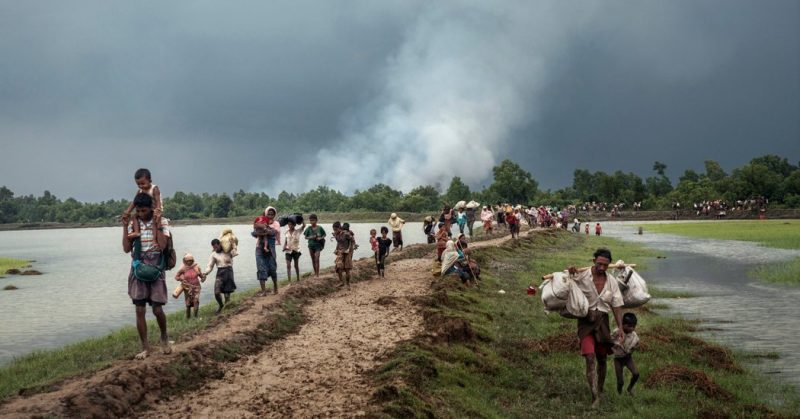
Why Fear and Self-hatred Destroy Human Sharing and Solidarity

Photo by Adam Dean

By Robert J. Burrowes

As our world spirals deeper into an abyss from which it is becoming increasingly difficult to extricate ourselves, some very prominent activists have lamented the lack of human solidarity in the face of the ongoing genocide of the Rohingya. See ‘The Rohingya tragedy shows human solidarity is a lie’ and ‘Wrongs of rights activism around Rohingyas’.

While I share the genuine concern of the Yemeni Nobel peace laureate Tawakkol Karman and Burmese dissident and scholar Dr Maung Zarni, and have offered my own way forward for responding powerfully to the ongoing genocide of the Rohingya – see ‘A Nonviolent Strategy to Defeat Genocide’ – in my view the lack of solidarity they mention is utterly pervasive and readily evident in our lacklustre official and personal responses to the many ongoing crises in which humanity finds itself.

To mention just the most obvious: Every day governments spend $US2 billion on weapons and warfare while a billion people lack the basic resources to live a decent life (and more than 100,000 of these people starve to death). Every day millions of people live under dictatorship, occupation or suffer the impacts of military invasion. Every day another 28,800 people are forcibly displaced from their home. Every day another 200 species of life are driven to extinction. And every day our biosphere is driven one step closer to making human life (and perhaps all life) on Earth impossible. See ‘Killing the Biosphere to Fast-track Human Extinction’.

It is not as if any of this information is unavailable. Just as many people and major international organizations are well aware of the plight of the Rohingya, it is also the case that many people and these organizations are well aware of the state of our world in other respects. And still virtually nothing meaningful happens (although there are tokenistic responses to some of these crises).

Hence, it is a straightforward observation that human solidarity is notably absent in virtually any attempt to tackle the major issues of our time. And the Rohingya are just one manifestation of this problem.

Given that I have long observed this phenomenon both personally and politically, and it concerns me as well, I would like to explain psychologically why the lack of sharing and solidarity is such a pervasive problem and suggest what we can do about it.

In order to feel concern for those who are suffering, and to want to act in solidarity to alleviate their suffering, it is necessary to experience certain feelings such as sympathy, empathy, compassion, love and (personal) power. Moreover, it is necessary that these feelings are not suppressed or overwhelmed by fear and, equally importantly, not overwhelmed by a feeling of (unconscious) self-hatred. If someone is scared and full of unconscious self-hatred, then they can have little interest in sharing their own resources or acting in solidarity with those who need help. And this applies whether the adversely impacted individual is a close relative or friend, or someone on the other side of the world.

So why is fear in this context so important? Simply because fear grotesquely distorts perception and behaviour. Let me explain why and how.

If an individual is (consciously or unconsciously) frightened that one or more of their vital needs will not be met, they will be unable to share resources or to act in solidarity with others, whatever the circumstances. In virtually all cases where an individual experiences this fear, the needs that the individual fears will not be met are emotional ones (including the needs for listening, understanding and love). However, the fearful individual is never aware of these deep emotional needs and of the functional ways of having these needs met which, admittedly, is not easy to do given that listening, understanding and love are not readily available from others who have themselves been denied these needs.

Moreover, because the emotional needs are ‘hidden’ from the individual, the individual (particularly one who lives in a materialist culture) often projects that the need they want met is, in fact, a material need.

This projection occurs because children who are crying, angry or frightened are often scared into not expressing their feelings and offered material items – such as a toy or food – to distract them instead. The distractive items become addictive drugs. This is why most violence is overtly directed at gaining control of material, rather than emotional, resources. The material resource becomes a dysfunctional and quite inadequate replacement for satisfaction of the emotional need. And, because the material resource cannot ‘work’ to meet an emotional need, the individual is most likely to keep using direct and/or structural violence to gain control of more material resources in an unconscious and utterly futile attempt to meet unidentified emotional needs.

This is the reason why people such as the Rothschild family, Jeff Bezos, Bill Gates, Warren Buffett, Amancio Ortega, Mark Zuckerberg, Carlos Slim, the Walton family and the Koch brothers as well as the world’s other billionaires and millionaires seek material wealth, and are willing to do so by taking advantage of structures of exploitation held in place by the US military. They are certainly wealthy in the material sense; unfortunately, they are utterly terrified (and full of self-hatred) and each of them justly deserves the appellation ‘poor little rich boy’ (or girl).

If this was not the case, their conscience, their compassion, their empathy, their sympathy and, indeed, their love would compel them to use or disperse their wealth in ways that would alleviate world poverty and nurture restoration of the ancient, just and ecologically sustainable economy: local self-reliance. See ‘The Flame Tree Project to Save Life on Earth’.

Of course, it is not just the billionaires and millionaires of the corporate elite who have suffered this fate.

Those intellectuals in universities and think tanks who accept payment to ‘justify’ (or simply participate in without question) the worldwide system of violence and exploitation, those politicians, bureaucrats and ordinary businesspeople who accept payment to manage it, those judges and lawyers who accept payment to act as its legal (but immoral) guardians, those media editors and journalists who accept payment to obscure the truth, as well as the many middle and working class people who accept payment to perform other roles to defend it (such as those in the military, police, prison and education systems), are either emotionally void or just too frightened to resist violence and exploitation, in one or more of its many manifestations.

Moreover, governments that use military violence to gain control of material resources are simply governments composed of many individuals with this dysfunctionality, which is very common in industrialized countries that promote materialism. Thus, cultures that unconsciously allow and encourage this dysfunctional projection (that an emotional need is met by material acquisition) are the most violent both domestically and internationally. This also explains why industrialized (material) countries use military violence to maintain political and economic structures that allow ongoing exploitation of non-industrialized countries in Africa, Asia and Central/South America.

But, equally importantly, many ‘ordinary’ people are just too scared to share (more than a token of) what they have and to act in solidarity with those who suffer whether through military or other violence, exploitation, persecution, oppression or occupation. Of course, it takes courage to resist this violent world order. But underlying courage is a sense of responsibility towards one’s fellow beings (human and otherwise) and the future.

As noted above, however, fear is not the only problem. Two primary outcomes of fear are self-hatred and powerlessness. Here is how it happens.

When each of us is a child, if our parents, teachers and/or the other adults around us are frightened by a feeling – such as sadness, anger or fear – that we are expressing, then they will use a variety of techniques to stop us expressing this feeling. They might, for example, comfort us to stop us crying, scare us out of expressing our anger (particularly at them) and reassure us so that we do not feel afraid.

Tragically, however, responses such as these have the outcome of scaring us into unconsciously suppressing our awareness of how we feel when, of course, evolutionary pressures generated emotional responses (some pleasant, some less so) to events in our life in order to help guide us into behaving appropriately at any given moment. And this suppression of how we feel is disastrous if we want children to grow up behaving functionally. This is more fully explained in Why Violence?’ and Fearless Psychology and Fearful Psychology: Principles and Practice.

So where does self-hatred fit into all of this? Well, if a child is angry in response to some violence to which they are being subjected (usually, of course, in an attempt to control their behavior), then they will attempt to defend themselves against this violence in an effort to persevere with their original intention.

However, if the child is then terrorized into submission by a parent or other adult (by being threatened with or experiencing some form of violence, often given the inaccurate label of ‘punishment’) the child will be compelled to unconsciously suppress their awareness of the original feelings, including anger, that were generating their behavior.

Unfortunately, there is a heavy cost to this suppression because each child is genetically programmed to follow their own self-will (manifesting through such mental functions as thoughts, feelings and conscience) rather than to obey the will of another (whether it be parent, teacher, religious figure or anyone else).

Hence, if a child is successfully terrorized into not behaving in accordance with their own self-will, they will experience a strong feeling of self-hatred precisely because they have submitted, out of fear, to the will of another.

Conscious self-hatred is an intensely unpleasant feeling to experience, however, and because the child is systematically terrorized out of expressing and acting on most of their feelings (which is why 100% of children go to school wherever school is available and compulsory: children are not given freedom of choice) the feeling of self-hatred is suppressed along with these many other feelings. Having learned to do this, subsequent opportunities for this self-hatred to be felt are progressively more easily suppressed.

An unconscious feeling does not ‘go away’ however; it is unconsciously projected elsewhere. Suppressed self-hatred is always unconsciously projected as hatred of someone else, some other group (usually of another sex, race, religion or class) and/or something else, often in imitation of the violent parent/adult (because imitation will be given ‘permission’ by the violent parent/adult). And this inevitably leads to destructive behaviors towards that individual, group and/or the ‘something else’ (including the Earth’s environment).

But, and this is important to recognize, this destructive behaviour might simply manifest as inaction: doing nothing in response to someone else’s (or the Earth’s) obvious need.

So the unconscious fear and self-hatred are projected as fear of and hatred for living beings as well as the Earth, and manifests as behavior that is destructive, often by inaction, of themselves, others and the planet.

The tragic reality is that it takes very little violence to terrorize a child and this is why a substantial proportion of the human population is consumed by their own fear and self-hatred, and feels powerless as a result. Consider the people immediately around you: many spend most of their time, consciously or unconsciously, abusing themselves, others and/or the environment, and doing nothing in response to the plight of our world.

So what can we do?

Given existing parenting practice, fear and self-hatred are not easily avoided although they are not necessarily all-consuming. But to be free of them completely requires just one thing: the fearlessness to love oneself truly. What does this mean?

To love yourself truly, you must always courageously act out your own self-will, whatever the consequences. This requires you to feel all of your emotional responses – fear, sadness, anger, pain, joy, love … – to events, including impediments, in your life. See ‘Feelings First’. It is only when you do this that you can behave with awareness: a synthesis of all of the feedback that your various mental functions give you and the judgments that arise, in an integrated way, from this feedback. See ‘Human Intelligence or Human Awareness?’

At first glance loving yourself and acting out your own self-will might sound selfish. But it is not. Self-love is true love. The individual who does not truly love themself cannot love another. Nor will they feel such emotional responses as compassion, empathy and sympathy. Hence, this individual will not seek mutually beneficial outcomes in tackling conflict, will not seek distributive justice in resource allocation, will not value ecological sustainability and will not act in solidarity with those who are suffering. It is this individual, who is terrified, self-hating and powerless, who will act selfishly.

In addition to courageously acting out your own self-will, you might also consider making ‘My Promise to Children’.

And if you love yourself enough to be part of the struggle to end the violence and exploitation of those who are full of fear and self-hatred, you might like to consider signing the online pledge of ‘The People’s Charter to Create a Nonviolent World’ and/or using sound nonviolent strategy for your campaign or liberation struggle. See Nonviolent Campaign Strategy or Nonviolent Defense/Liberation Strategy.

Those who are terrified and self-hating never will.


Biodata: Robert J. Burrowes has a lifetime commitment to understanding and ending human violence. He has done extensive research since 1966 in an effort to understand why human beings are violent and has been a nonviolent activist since 1981. He is the author of ‘Why Violence?’ His email address is flametree@riseup.net and his website is here.

Websites:
Nonviolence Charter
Flame Tree Project to Save Life on Earth
‘Why Violence?’
Feelings First
Nonviolent Campaign Strategy
Nonviolent Defense/Liberation Strategy
Anita: Songs of Nonviolence
Robert Burrowes
Global Nonviolence Network

Love, Western Nihilism and Revolutionary Optimism


By Andre Vltchek

Source: Dissident Voice

How dreadfully depressing life has become in almost all of the Western cities! How awful and sad.

It is not that these cities are not rich; they are. Of course, things are deteriorating there, the infrastructure is crumbling and there are signs of social inequality, even misery, at every corner. But if compared to almost all other parts of the world, the wealth of the Western cities still appears to be shocking, almost grotesque.

The affluence does not guarantee contentment, happiness or optimism. Spend an entire day strolling through London or Paris, and pay close attention to people. You will repeatedly stumble over passive aggressive behavior, over frustration and desperate downcast glances, over omnipresent sadness.

In all those once great [imperialist] cities, what is missing is life. Euphoria, warmth, poetry and yes – love – are all in extremely short supply there.

Wherever you walk, all around, the buildings are monumental, and boutiques are overflowing with elegant merchandize. At night, bright lights shine brilliantly. Yet the faces of people are gray. Even when forming couples, even when in groups, human beings appear to be thoroughly atomized, like the sculptures of Giacometti.

Talk to people, and you’ll most likely encounter confusion, depression, and uncertainty. ‘Refined’ sarcasm, and sometimes a bogus urban politeness are like thin bandages that are trying to conceal the most horrifying anxieties and thoroughly unbearable loneliness of those ‘lost’ human souls.

Purposelessness is intertwined with passivity. In the West, it is increasingly hard to find someone that is truly committed: politically, intellectually or even emotionally. Big feelings are now seen as frightening; both men and women reject them. Grand gestures are increasingly looked down upon, or even ridiculed. Dreams are becoming tiny, shy and always ‘down to earth’, and even those are lately extremely well concealed. Even to daydream is seen as something ‘irrational’ and outdated.

*****

To a stranger who comes from afar, it appears to be a sad, unnatural, brutally restrained and, to a great extent, a pitiful world.

Tens of millions of adult men and women, some well educated, ‘do not know what to do with their lives’. They take courses or go ‘back to school’ in order to fill the void, and to ‘discover what they want to do’ with their lives. It is all self-serving, as there appear to be no greater aspirations. Most of the efforts begin and end with each particular individual.

Nobody sacrifices himself or herself for others, for society, for humanity, for the cause, or even for the ‘other half’, anymore. In fact, even the concept of the ‘other half’ is disappearing. Relationships are increasingly ‘distant’, each person searching for his or her ‘space’, demanding independence even in togetherness. There are no ‘two halves’; instead there are ‘two fully independent individuals’, co-existing in a relative proximity, sometimes physically touching, sometimes not, but mostly on their own.

In the Western capitals, the egocentricity, even total obsession with one’s personal needs, is brought to a surreal extreme.

Psychologically, it can only be described as a twisted and pathological world.

Surrounded by this bizarre pseudo reality, many otherwise healthy individuals eventually feel, or even become, mentally ill. Then, paradoxically, they embark on seeking ‘professional help’, so they can re-join the ranks of the ‘normal’, read ‘thoroughly subdued’ citizens. In most cases, instead of continuously rebelling, instead of waging personal wars against the state of things, the individuals who are still at least to some extent different, get so frightened by being in the minority that they give up, surrender voluntarily, and identify themselves as ‘abnormal’.

Short sparks of freedom experienced by those who are still capable of at least some imagination, of dreaming about a true and natural world, get rapidly extinguished.

Then, in a short instant, everything gets irreversibly lost. It may appear as some horror film, but it is not. It is the true reality of life in the West.

I cannot function in such an environment for more than a few days. If forced, I could last in London or Paris for two weeks at most, but only while operating on some ‘emergency mode’, unable to write, to create and to function ‘normally’. I cannot imagine ‘being in love’ in a place like that. I cannot imagine writing a revolutionary essay there. I cannot imagine laughing, loudly, happily, freely.

While briefly working in London, Paris or New York, the coldness, purposelessness, and chronic lack of passion and of all basic human emotions, is having a tremendously exhausting effect on me, derailing my creativity and drowning me in useless, pathetic existentialist dilemmas.

After one week there, I’m simply beginning to get influenced by that terrible environment: I’m starting to think about myself excessively, ‘listening to my feelings’, instead of considering the feelings of the others. My duties towards humanity get neglected. I put on hold everything that I otherwise consider essential. My revolutionary edge loses its sharpness. My optimism begins to evaporate. My determination to struggle for a better world begins to weaken.

This is when I know: it is time to run, to run away. Fast, very fast! It is time to pull myself from the stale emotional swamp, to slam the door behind the intellectual bordello, and to escape from the terrifying meaninglessness that is dotted with injured, even wasted lives.

I cannot fight for those people from within, only from outside. Our way of thinking and feeling do not match. When they get out and visit ‘my universe’, they bring with them resilient prejudices: they do not register what they see and hear, they stick to what they were indoctrinated with, for years and decades.

For me personally there are not many significant things that I can do in Western cities. Periodically I come to sign one or two book contracts, to open my films, or to speak briefly at some university, but I don’t see any point of doing much more. In the West, it is hard to find any meaningful struggle. Most struggles there are not internationalist; instead they are selfish, West-oriented in nature. Almost no true courage, no ability to love, no passion, and no rebellion remain. On closer examination, there is actually no life there; no life as we human beings used to perceive it, and as we still understand it in many other parts of the world.

*****

Nihilism rules. Was this mental state, this collective illness something that has been inflicted on purpose by the regime? I don’t know. I cannot yet answer this question. But it is essential to ask, and to try to understand.

Whatever it is, it is extremely effective – negatively effective but effective nevertheless.

Carl Gustav Jung, a renowned Swiss psychologist and psychiatrist, diagnosed Western culture as ‘pathological’, right after WWII. But instead of trying to comprehend its own abysmal condition, instead of trying to get better, even well, Western culture is actually made to expand, to rapidly spread to many other parts of the world, dangerously contaminating healthy societies and nations.

It has to be stopped. I say it because I do love this life, the life, which still exists outside the Western realm; I’m intoxicated with it, obsessed with it. I live it to the fullest, with great delight, enjoying every moment of it.

I know the world, from the ‘Southern Cone’ of South America, to Oceania, the Middle East, to the most god-forsaken corners of Africa and Asia. It is a truly tremendous world, full of beauty and diversity, and hope.

The more I see and know, the more I realize that I absolutely cannot exist without a struggle, without a good fight, without great passions and love, and without purpose; basically without all that the West is trying to reduce to nothing, to make irrelevant, obsolete and ridiculous.

My entire being is rebelling against the awful nihilism and dark pessimism that is being injected almost everywhere by Western culture. I’m violently allergic to it. I refuse to accept it. I refuse to succumb to it.

I see people, good people, talented people, wonderful people, getting contaminated, having their lives ruined. I see them abandoning great battles, abandoning their great loves. I see them choosing selfishness and their ‘space’ and ‘personal feelings’ over deep affection and inseparability, opting for meaningless careers over great adventures of epic battles for humanity and a better world.

Lives are being ruined one by one, and by millions, every moment and every day. Lives that could have been full of beauty, full of joy, of love, full of adventure, of creativity and uniqueness, of meaning and purpose, but instead are reduced to emptiness, to nothingness, in brief: to thorough meaninglessness. People living such lives are performing tasks and jobs by inertia, respecting without questioning all behavior patterns ordered by the regime, and obeying countless grotesque laws and regulations.

They cannot walk on their own feet anymore. They have been made fully submissive. It is over for them.

That is because the courage of the people in the West has been broken. It is because they have been reduced to a crowd of obedient subjects, submissive to the destructive and morally defunct Empire.

They have lost the ability to think for themselves. They have lost courage to feel.

As a result, because the West has such an enormous influence on the rest of the world, the entire humanity is in grave danger, is suffering, and is losing its natural bearing.

*****

In such a society, a person overflowing with passion, a person fully committed and true to his or her cause can never be taken seriously. It is because in a society like this, only deep nihilism and cynicism are accepted and respected.

In such a society, a revolution or a rebellion could hardly go beyond the pub or a living room couch.

A person, who is still capable of loving in such an emotionally constipating and twisted environment, is usually seen as a buffoon, even as a ‘suspicious and sinister element’. It is common for him or for her to be ridiculed and rejected.

Obedient and cowardly masses hate those who are different. They distrust people who stand tall and who are still capable of fighting, people who know perfectly well what their goals are, people who do and not just talk, and those who find it easy to throw their entire life, without the slightest hesitation, at the feet of a beloved person or an honorable cause.

Such individuals terrify and irritate those suave, submissive and shallow crowds in Western capitals. As a punishment, they get deserted and divorced, ostracized, socially exiled and demonized. Some end up getting attacked, even thoroughly destroyed.

The result is: there is no culture, anywhere on Earth, so banal and so obedient as that which is now regulating the West. Lately, nothing of revolutionary intellectual significance is flowing from Europe and North America, as there are hardly any detectable unorthodox ways of thinking or perceptions of the world there.

The dialogues and debates are flowing only through fully anticipated and well-regulated channels, and needless to say they fluctuate only marginally and through the fully ‘pre-approved’ frequencies.

*****

What is on the other side of the barricade?

I don’t want to glorify our revolutionary countries and movements.

I don’t even want to write that we are the “exact opposite” of that entire nightmare that has been created by the West. We are not. And we are far from being perfect.

But we are alive if not always well. We are standing, trying to advance this wonderful ‘project’ called humanity, attempting to save our planet from Western imperialism, its nihilist gloom, as well as absolute environmental disaster.

We are considering many different ways forward. We have never rejected socialism and Communism, and we are studying various moderate and controlled forms of capitalism. The advantages and disadvantages of the so-called ‘mixed economy’ are being discussed and evaluated.

We fight, but because we are much less brutal, orthodox and dogmatic than the West, we often lose, as we recently (and hopefully only temporarily) lost in Brazil and Argentina. We also win, again and again. As this essay goes to print, we are celebrating in Ecuador and El Salvador.

Unlike in the West, in such places like China, Russia and Latin America, our debates about the political and economic future are vibrant, even stormy. Our art is engaged, helping to search for the best humanist concepts. Our thinkers are alert, compassionate and innovative, and our songs and poems are great, full of passion and fire, overflowing with love and longing.

Our countries do not steal from anyone; they don’t overthrow governments in the opposite parts of the world, they do not undertake massive military invasions. What we have is ours; it is what we have created, produced and sown with our own hands. It is not always much, but we are proud of it, because no one had to die for it, and no one had to be enslaved.

Our hearts are purer. They are not always absolutely pure, but purer than those in the West are. We do not abandon those whom we love, even if they fall, get injured, or cannot walk any longer. Our women do not abandon their men, especially those who are in the middle of fighting for a better world. Our men do not abandon their women, even when they are in deep pain or despair. We know whom and what we love, and we know whom and what we hate: in this we rarely get ‘confused’.

We are much simpler than those living in the West. In many ways, we are also much deeper.

We respect hard work, especially work that helps to improve the lives of millions, not just our own lives, or the lives of our families.

We try to keep our promises. We don’t always succeed in keeping them, as we are only humans, but we are trying, and most of the times we are managing to.

Things are not always exactly like this, but often they are. And when “things are like this”, it means that there is at least some hope and optimism and often even great joy.

Optimism is essential for any progress. No revolution could succeed without tremendous enthusiasm, as no love could. No revolution and no love could be built on depression and defeatism.

Even in the middle of the ashes to which imperialism has reduced our world, a true revolutionary and a true poet can always at least find some hope. It will not be easy, not easy at all, but definitely not impossible. Nothing is ever lost in this life for as long as our hearts are beating.

*****

The state in which our world is right now is dreadful. It often feels that one more step in a wrong direction, another false turn, and everything will finally collapse, irreversibly. It is easy, extremely easy, to give up, to throw everything up into the air, and to land on a couch with a six-pack of beer, or to simply declare “there is nothing that can be done”, and then resume one’s meaningless life routine.

Western nihilism has already done its devastating work: it has landed tens of millions of thinking beings on their proverbial couches of defeatism. It has spread pessimism and gloom, and a general belief that things can never improve anymore. It has maneuvered people into refusing to ‘accept labels’, into rejecting progressive ideologies, and into a pathological distrust of any power. The “all politicians are the same” slogan could be translated clearly into: “We all know that our Western rulers are gangsters, but do not expect anything else from those in other parts of the world.” “All people are the same” reads: “The West has been plundering and murdering hundreds of millions, but don’t expect anything better from Asians, Latin Americans or Africans”.

This irrational, cynical negativism already domesticated in virtually all countries of the West, has successfully been exported to many colonies, even to such places as Afghanistan, where people have been suffering incessantly from crimes committed by the West.

Its goal is evident: to prevent people from taking action and to convince them that any rebellion is futile. Such attitudes are brutally choking all hopes.

In the meantime, collateral damage is mounting. Metastases of the passivity and nihilistic cancers which are being spread by the Western regime are already attacking even that very human ability to love, to commit to a person or to a cause, and to stand by one’s pledges and obligations.

In the West and in its colonies, courage has lost its entire luster. The Empire has managed to reverse the whole scale of human values, which was firmly and naturally in place on all the continents and in all cultures, for centuries and millennia. All of a sudden, submission and obedience have come to vogue.

It often feels that if the trend is not reversed soon, people will increasingly start to live like mice: constantly scared, neurotic, unreliable, depressed, passive, unable to identify true greatness, and unwilling to join those who are still pulling our world and humanity forward.

Billions of lives will get wasted. Billions of lives are already being wasted.

Some of us write about invasions, coups and dictatorships imposed by the Empire. However, almost nothing is being written about this tremendous and silent genocide that is breaking the human spirit and optimism, throwing entire nations into a dark depression and gloom. But it is taking place, even as these lines are being penned. It is happening everywhere, even in such places as London, Paris and New York, or more precisely, especially there.

In those unfortunate places, fear of great emotions has already been deeply rooted. Originality, courage and determination are now evoking fear. Great love, great gestures and unorthodox dreams are all observed with panic and mistrust.

But no progress, no evolution is possible without entirely unconventional ways of thinking, without the revolutionary spirit, without great sacrifices and discipline, without commitment, and without that most powerful and most daring set of emotions, which is called love.

The demagogues and propagandists of the Empire want us to believe that ‘something ended’; they want us to accept defeat.

Why should we? There is no defeat anywhere on the horizon.

There are only two separate realities, two universes, into which our world had been shattered into: one of Western nihilism, another of revolutionary optimism.

I have already described the nihilism, but what do I imagine when I dream about that better, different world?

Do I envision red flags and people forming closed ranks, charging against some lavish palaces and stock exchanges? Do I hear loud revolutionary songs blasted from loudspeakers?

I actually do not. What comes to my mind is essentially very quiet and natural, human and warm.

There is a park near the old train station in the city of Granada, Nicaragua. I visited it some time ago. There, several old trees are throwing fantastic shadows on the ground, providing a desirable shade. Into a few big metal columns are engraved the most beautiful poems ever written in this country, while in between those columns stand simple but solid park benches. I sat on one of them. Not far from me, a couple of ageing lovers was holding hands, reading cheek to cheek from an open book. They were so close that they appeared to be forming a simple and totally self-sufficient universe. Above them were the shining verses written by Ernesto Cardenal, one of my favorite Latin American poets.

I also recall two Cuban doctors, sitting on a very different bench, thousands of miles away, chatting and laughing next to two goodhearted and corpulent nurses, after performing a complex surgery in Kiribati, an island nation ‘lost’ in the middle of South Pacific.

I remember many things, but they are never monumental, only human. Because that is what revolution really is, I think: a couple of ageing peasants in a beautiful public park, both of them in love, holding hands, reading poetry to each other. Or two doctors travelling to the end of the world, just in order to save lives, far from the spotlight and fame.

And I always remember my dear friend, Eduardo Galeano, one of the greatest revolutionary writers of Latin America, telling me in Montevideo, about his eternal love for his wonderful lady called “Reality”.

Then I think: no, we cannot lose. We are not going to lose. The enemy is mighty and many people are weak and scared, but we will not allow the world to be converted into a mental asylum. We’ll fight for each and every person who has been affected, and drowned in gloom.

We’ll expose the abnormality and perversity of Western nihilism. We’ll fight it with our revolutionary enthusiasm and optimism, and we will use the greatest weapons, such as poetry and love.


Andre Vltchek is a philosopher, novelist, filmmaker and investigative journalist. He has covered wars and conflicts in dozens of countries. Three of his latest books are the revolutionary novel Aurora and two bestselling works of political non-fiction: Exposing Lies Of The Empire and Fighting Against Western Imperialism. View his other books here. Watch his Rwanda Gambit, a documentary about Rwanda and DRCongo. He continues to work around the world and can be reached through his website and Twitter. Read other articles by Andre.

A Crisis of the Heart

AAEAAQAAAAAAAANZAAAAJDE2ODFkMTY5LTcyYTktNGIwMi1iMDUxLWQ5MzA4ZDQ3OWU4ZA

By rahkyt

Source: Sacred Space in Time

The loss of life for any reason is always to be commiserated with and in instances of collective horror such as the terrorist attacks that have recently beset the West, the heart of oceanic humanity breaks a bit more.

With that said, our social media feeds become filled with national colors and heartful memes in solidarity with members of the human family hit by unthinkable tragedy. It is right to do so. But it is also right to understand that tragedies are occurring all around us, in our own nations as well as others, every single day.  Middle-aged whites in the US are killing themselves with drugs and alcohol and poor eating habits at a rate never seen before. They are hopeless and despairing as the American dream fades. Blacks remain mired in the same hopelessness caused by the same reasons, economic and social, with the added addition of racism and eugenic tactics centuries in the formation. Native Americans on Reservations continue to experience the effects of genocide, a program running in the collective American consciousness since this nation’s inception. The deaths add up and fade into consciousness as the background cries of the disillusioned and dehumanized.

Inhumanity reigns and the statistics state that people have been growing less and less compassionate toward each other for decades in this nation. These computers and smart phones draw us together but also tear us apart, the virtual world is as real as the real one. People spend hours per day jacked into the matrix, seamlessly moving between one and the other. Death by texting is on the rise,  porn increases objectification and consumer culture further consolidates the banality of social interaction and heart-based intimacy.

These realities indicate a crisis of the soul. Of the heart. When we are upset and outraged about one group of people but care nothing for others, something is very wrong. When there is compassion for those whom we might share something in common with and lack of compassion for those with whom we do not, there is a division of the heart, a dehumanization that speaks to the pervasivity of mainstream media programming of the mind.

Perhaps those who say humanity cannot change are right. Perhaps this is the best we can do. But perhaps it is also true that by consciously examining the memes and events and seeking to understand the issues at levels beyond those trumpeted in the mainstream we will come to realize that we have more in common with the Oppressed everywhere than the privileged so many of us wish to join in their glass mansions and private retreats. It is in the experience of self as seen through the eyes of others and experienced in the visceral engagement of souls on an eternal journey that true empathy and compassion are known.

When life ends, all that matters is the love. The love we give and the love we receive. The divisions dissipate. Living as if each one of us was from Beirut, or Paris, or Chicago, or Kenyan, every, single, day, and sharing our portion of love is how the dogs of war are banished. How the flames of hate are extinguished. The source is never what we are told and the cause goes back so far in the past that the effect is shrouded in mystery.

Share this outpouring of love with the world. Feel the pain of all those sacrificed on the alters of political and economic gain. Those next door, down the street, in the next city and state, and even across the nation. We must stand in solidarity with those who’ve made the ultimate sacrifice, but the war is not just between nations and ideologies. The war is within each of us. Every, single day.

5/15 Global Day of Solidarity for Fast Food Workers

The New Yorker Daily, December 5 2013

The New Yorker Daily, December 5 2013

Today is the day of the largest global fast food strike yet, targeting major chain restaurants including McDonald’s, Burger King, Wendy’s, Taco Bell and KFC. Organized with the help of Fast Food Forward, the Service Employees International Union and a number of regional activist organizations, fast food workers in 150 cities and 33 countries (including Morocco, Japan, India, Belgium, Germany, Brazil, Argentina and New Zealand) are taking action for better pay and working conditions.

RT will post updates of the event throughout the day here: http://rt.com/news/159180-fast-food-worker-strike/

Sarah Kendzior describes the nature of the struggle that fast food employees commonly experience in the following excerpt from “The Minimum Wage Worker Strikes Back”:

Jenina dropped out of nursing school after her mother lost her job, because she needed the tuition money to pay bills. Her income from McDonald’s, where she started working as a high school senior, helps support her mother and younger sister. Patrick’s Chipotle income helps support his mother, a makeup artist who has struggled to find steady work since the recession. Krystal’s Taco Bell income helps support her son; her sister, who lives with her and works at Jack in the Box; and now, her newborn daughter.

Every worker I interview is supporting someone: an unemployed parent, a child, a sibling, a friend. Most of their friends and family members work in fast food or other service industries. Everyone is in their twenties or older. All but one is African-American.

They dream of different jobs. The women want to be nurses, the men want to work in the automotive or culinary industries. But no one can pay for training when they cannot save for day to day, much less for the future.

As a result, fast food workers are turning to activism: not out of ideological motives, but because overturning the economic system seems more feasible than purchasing the credentials for a new career.

Read the full article here: https://medium.com/debt-ridden/fa4c36eb306b