American society spawns trauma and this trauma expresses itself in a variety of self-destructive pathologies, including the erosion of democracy and rise of neo-fascism.
Corporate capitalism, defined by the cult of the self and the ruthless exploitation of the natural world and all forms of life for profit, thrives on the fostering of chronic psychological and physical disorders. The diseases and pathologies of despair — alienation, high blood pressure, diabetes, anxiety, depression, morbid obesity, mass shootings (now almost two per day on average), domestic and sexual violence, drug overdoses (over 100,000 per year) and suicide (49,000 deaths in 2022) — are the consequences of a deeply traumatized society.
The core traits of psychopaths — superficial charm, grandiosity and self-importance, a need for constant stimulation, a penchant for lying, deception, manipulation and the inability to feel remorse or guilt — are celebrated. The virtues of empathy, compassion and self-sacrifice, are belittled, neglected and crushed. The professions that sustain community, such as teaching, manual labor, the arts, journalism and nursing, are underpaid and overworked. The professions that exploit, such as those in high finance, Big Pharma, Big Oil and information technology, are lavished with prestige, money and power.
“The fact that millions of people share the same vices does not make these vices virtues, the fact that they share so many errors does not make the errors to be truths, and the fact that millions of people share the same forms of mental pathology does not make these people sane,” Eric Fromm writes in The Sane Society.
The classic works on trauma by Dr. Bessel van der Kolk, Dr. Gabor Maté and Dr. Judith Herman state bluntly that what is accepted as normal behavior in a corporate society is at war with basic human needs and our psychological and physical health. Huge segments of the American public, especially the tens of millions of people who have been discarded and marginalized, endure chronic trauma. Barbara Ehrenreich in “Nickel and Dimed: On (Not) Getting By in America” describes the life of the working poor as one long “emergency.” This trauma is as destructive to us personally as it is socially and politically. It leaves us in a state of dysphoria where confusion, agitation, emptiness and loneliness define our lives. Whole segments of American society, especially the poor, have been rendered superfluous and invisible. As Dr. van der Kolk writes, “trauma is when we are not seen and known.”
“Our culture teaches us to focus on our personal uniqueness, but at a deeper level we barely exist as individual organisms,” Dr. van der Kolk notes.
Trauma numbs our capacity to feel. It fractures our self. It disconnects us from our bodies. It keeps us in a state of hyperarousal. It makes us confuse our desires, often artificially implanted by the consumer society, with our needs. Traumatized people view the world around them as hostile and dangerous. They lack a positive image of themselves and lose the capacity to trust. Many replace intimacy and love with sexual sadism, which is how we became a pornified culture. Trauma creates what the psychiatrist Robert Jay Lifton calls a “counterfeit” world defined by phantom enemies, lies and dark conspiracies. It negates a sense of purpose and a life of meaning.
Trauma, Dr. Herman writes, “impels people both to withdraw from close relationships and to seek them desperately.” It induces feelings of shame, guilt, and inferiority, she writes, “as well as the need to avoid reminders of the trauma that occurs in daily life. Trauma severely compromises the capacity for intimacy. Trauma can dramatically reduce focus to extremely limited goals, often a matter of hours or days.”
“If trauma entails a disconnection from the self, then it makes sense to say that we are being collectively flooded with influences that both exploit and reinforce trauma,” Dr. Maté writes. “Work pressures, multitasking, social media, news updates, multiplicities of entertainment sources — these all induce us to become lost in thoughts, frantic activities, gadgets, meaningless conversations. We are caught up in pursuits of all kinds that draw us on, not because they are necessary or inspiring or uplifting, or because they enrich or add meaning to our lives, but simply because they obliterate the present.”
Trauma also drives many to flee into the arms of those who are orchestrating the abuse.
Systematic and repetitive trauma, whether by a single abuser or a political system, destroys personal autonomy. The perpetrator becomes omnipotent. Resistance is accepted as futile. “The goal of the perpetrator is to instill in his victim not only fear of death but also gratitude for being allowed to live,” Dr. Herman writes. This trauma lays the foundation for the most insidious characteristic of all tyrannies, large and small. Total control. Prolonged trauma reduces its victims to a state of psychological infantilism. It conditions them to plead for their own enslavement.
“We are not content with negative obedience, not even with the most abject submission,” George Orwell wrote of the ruling “Inner Party” in his novel “1984.” “When finally you surrender to us, it must be of your own free will. We do not destroy the heretic because he resists us; so long as he resists us we never destroy him. We convert him, we capture his inner mind, we reshape him. We burn all evil and all illusion out of him; we bring him over to our side, not in appearance, but genuinely, heart and soul.”
Christian fascism, the subject of my book “American Fascists: The Christian Right and the War on America,” preys on this trauma. It replicates systems of control common to all tyrannies, including cults. Christian fascists skillfully break down adherents, severing them from their families and communities. They manipulate their shame, despair, feelings of worthlessness and guilt – the byproducts of their trauma – to demand total obedience to the church leadership, who are almost always white and male. These leaders, supposedly spokespeople for God, cannot be questioned or criticized. The connecting tissue among the disparate militia groups, QAnon conspiracy theorists, anti-abortion activists, right-wing patriot organizations, Second Amendment advocates, neo-Confederates and Trump supporters that stormed the Capitol on Jan. 6 is not only this Christian fascism but trauma.
“Totalitarian governments demand confession and political conversion of their victims,” Dr. Herman writes. “Slaveholders demand gratitude from their slaves. Religious cults demand ritualized sacrifices as a sign of submission to the divine will of the leader. Perpetrators of domestic battery demand that their victims prove complete obedience and loyalty by sacrificing all other relationships. Sex offenders demand that their victims find sexual fulfillment in submission. Total control over another person is the power dynamic at the heart of pornography. The erotic appeal of this fantasy to millions of terrifyingly normal men fosters an immense industry in which women and children are abused, not in fantasy but in reality.”
Donald Trump is a perpetrator and savior. He personifies the callous indifference of patriarchy, wealth, privilege and power towards the vulnerable, as well as the promise that once his cultish followers surrender to him they will be protected. He inspires in equal measure fear and solace.
“People who embrace the small tyrannies are much more susceptible to embracing the large ones,” Dr. Herman told me. “When you have a political party that embraces the subordination of women, the subordination of people of color, the subordination of gender non-conforming people, and the subordination of non-Christians, then it’s not a party that embraces democracy. It’s a party that is looking for a fascist leader and is going to find one.”
In Dr. van der Kolk’s “The Body Keeps Score: Brain, Mind, and Body in the Healing of Trauma,” he opens with stark statistics compiled by the Centers for Disease Control and Prevention showing that “one in five Americans was sexually molested as a child; one in four was beaten by a parent to the point of a mark being left on their body; and one in three couples engages in physical violence. A quarter of us grew up with alcoholic relatives, and one out of eight witnessed their mother being beaten or hit.”
The endemic trauma in American society, which is getting worse under the onslaught of the gig economy, pronounced social inequality, indiscriminate police violence, the climate crisis and the seizure of the political process and most institutions by corporations and the ruling oligarchs, is our most serious public health crisis. It has grave individual, social and political consequences.
“If trauma is truly a social problem,” Dr. Herman in “Truth and Repair: How Trauma Survivors Envision Justice” writes, “then recovery cannot simply be a private individual matter. The wounds of trauma are not merely those caused by the perception of violence and exploitation. The actions or inactions of bystanders, all those who are complicit in or who prefer not to know about the abuse or who blame the victims, often cause deeper wounds.” “Full healing,” she adds, “because it originates in a fundamental injustice, requires a full hearing within the community to repair through some measure of justice the trauma survivors have endured.”
You can see my recent two-part interview with Dr. Herman here and here.You can see my interview with Dr. Maté here.
“Recovery has to take place in relationships,” Dr. Herman said in my interview. “When people feel reconnected to their communities and re-accepted in their communities, then the shame is relieved and the isolation is relieved, and that really creates the platform for healing.”
The key is community. Not virtual communities. But communities where we can reconnect and see in our wounds the wounds of others. It requires access, without onerous medical bills, to mental health professionals. It requires dismantling the corporate structures of oppression. It demands a new ethic, one that values empathy and self-sacrifice. We must reject the cynicism, indifference and cult of the self that all tyrannies inculcate in those they dominate to keep them passive. We must reach out to our neighbors, especially those in distress and those who are demonized. We must uncouple from consumer society and turn away from the allure of our cultural narcissism.
The moral philosopher Bernard Williams argues that resentment and indignation are as important as empathy and connection to solidify social bonds. It is not only our own dignity we must protect, but the dignity of others. These “shared sentiments” he writes “bind people together in a community of feeling.” Acts of resistance around these “shared sentiments,” this “community of feeling,” establish ourselves as distinct, autonomous beings. We may not defeat these tyrannies, but by battling against them we free ourselves from the grip of the small and large tyrannies that deform American society.
The most potent weapon of the oppressor is the mind of the oppressed.
-Steve Biko, South African freedom fighter, beaten to death in an Apartheid prison cell in 1977.
So you think that you make up your own mind about what you will do, how you will do it, what you will buy and so on.
Good, because that is what you are supposed to believe. Especially when you are thinking what others want you to think.
Most of us like to believe that we have ‘a mind of our own’.
But, in fact, any serious consideration of the evidence leads to the exact opposite conclusion. In the vast majority of cases, you haven’t had a mind that was yours since you were very young. At least on anything that really matters in your life.
Hence, I have argued, it is important to understand the Elite’s ‘Great Reset’, with its fourth industrial revolution (technocratic), eugenicist and transhumanist programs, as simply the latest manifestation of this 5,000-year war on Homo Sapiens during which Elites (local, ‘national’, ultimately global) have used a range of policies to contrive ‘great events’ – orchestrated wars and famines; slavery; human sacrifice; imperialism and colonialism; economic exploitation through contrived financial crises (including depressions); ‘natural’ disasters, revolutions and ‘medical’ crises to name the most obvious – to distract attention from and facilitate profound changes in world order, to kill off substantial proportions of the human population and enslave those left alive while obscuring vast transfers of wealth from ordinary people to the Elite (whether local, ‘national’ or, ultimately, global). See ‘Historical Analysis of the Global Elite: Ransacking the World Economy Until “You’ll Own Nothing.”’
Both of these nuclear attacks are readily identifiable as measures consistent with the explicit Elite program to kill off a substantial proportion of the human population.
Thus, while I have previously identified four fundamental shortcomings in the efforts of anti-war activists over the past 100 years, which together account for the movement’s failure to have any impact in undermining war as an institution – see ‘Rage Against the War Machine: What Rage? “When will they ever learn?”’ – it is also clear that another very old threat, now being embellished by new and more pernicious forms, is being ignored too.
So, as I have become increasingly aware over recent years, there is another entire dimension of war-fighting that is only being discussed at the margin and must be considered and addressed not only by those committed to ending war but by anyone who values human life, identity, freedom and free will.
Because, as is manifestly obvious to those investigating more deeply and as captured in the title of this article, there is a battle now being fought in the technocratic realm and it is being waged against all of humanity simultaneously, not just a particular population.
In essence, this battle is the final battle in the war being fought to control your mind.
To put this another way, a primary battlefield of what many now call fifth-generation warfare (5GW) is your mind and who controls it. What is 5GW? It is defined by James Corbett in the following terms: ‘Fifth-generation warfare is an all-out war that is being waged against all of us by our governments and the international organizations to which they belong. It is being waged against each and every one of us right now, and it is a battle for full-spectrum dominance over every single aspect of your life: your movements and interactions, your transactions, even your innermost thoughts and feelings and desires. Governments the world over are working with corporations to leverage technology to control you down to the genomic level, and they will not stop until each and every person who resists them is subdued or eliminated.’ See ‘Your Guide to 5th-Generation Warfare’.
But, to reiterate the distinction in Corbett’s words: 5th Generation warfare is ‘being waged at all levels, not just the mental.’ and any review of the ‘Great Reset’ plans demonstrates the extraordinary breadth and depth of the control now being imposed.
Nevertheless, control of our minds is central to the war being fought and any successful defense in this war requires that we identify the threats to our mind and defend ourselves adequately against them. Otherwise we are poorly placed to identify and defend against all of the other threats.
Of course, using less invasive but still very effective weapons, the war to control your mind is ancient and it is this component on which this article is focused both because it is extremely advanced and is necessary if other components of the Elite plan are to be fully implemented.
Ancient? In fact, several authors have addressed this subject. For example, in their 2015 book on the subject, Marie D. Jones and Larry Flaxman observed that:
Mind control is probably as old as our awareness that we each had a mind of our own. Throughout the course of history, there are a number of names for mind control that describe a common goal: to take over a person’s innermost thoughts and control his or her behaviors and actions. Brainwashing, coercion, thought reform, mental manipulation, psychological warfare, programming, conversion, gas lighting, indoctrination methods, psychic driving, crowd control: They all describe a method by which a person’s individual thoughts, beliefs, and perceptions are disrupted, dismissed, and destroyed – even replaced with the thoughts, beliefs, and perceptions of someone else. Whether designed to create the perfect assassin or super soldier, indoctrinate prisoners of war, recruit members into a cult or religious belief system, or control the consuming masses and direct their behaviors in accordance to the political whims of the day, mind control has been used extensively in our past, is in use today, and no doubt will be used in the future. See Mind Wars: AHistory of Mind Control, Surveillance, and Social Engineering by the Government, Media, and Secret Societies.
And by 1956 Joost A. M. Meerloo, M.D. had already written a book canvassing a wide spectrum of mind control techniques and technologies in a variety of categories with, for just one example, an insightful discussion on how readily justice is subverted within legal systems by such techniques and technologies. See The Rape of the Mind.
Anyway, for the purposes of this article, I have distinguished four distinct categories of mind control, which have evolved at different times historically. I then explain each in turn. In chronological order, I label these different categories as follows:
This war, to briefly reiterate its essential nature, has its basis in the manner in which human adults – as parents, teachers, religious figures and in other roles – use a potent combination of ‘visible’, ‘invisible’ and ‘utterly invisible’ violence to terrorize children and adolescents into submissive obedience under the pretext of ‘socializing’ them. See ‘Why Violence?’, ‘Fearless Psychology and Fearful Psychology: Principles and Practice’ and ‘Do We Want School or Education?’
This works well for the Elite because it creates a human population that readily follows orders from parents, teachers, religious figures, employers, police, judges, military personnel, governments and anyone else ‘in authority’.
Hence, human societies everywhere are essentially populated with adults who are easily scared into uncritically obeying Elite directives, conveyed through a variety of its agents, as the past 3.5 years have graphically demonstrated. But because the fear is largely unconscious, most adults can easily be led to believe they are acting out of their own free will or, at worst, following ‘reasonable’ orders ‘for the good of the community’.
Moreover, this can occur for a number of reasons. Denied safe opportunities to focus on feeling their fear and terrorized out of expressing their anger and other feelings during childhood – the logical response to ‘visible’, ‘invisible’ or ‘utterly invisible’ violence inflicted by an adult – the child ‘learns’ a range of ways to suppress awareness of these feelings, almost invariably unconsciously, which is why their fear, anger and other feelings are not necessarily obvious to the person or those around them.
A variety of psychological mechanisms such as denial – denying the existence of a reality that frightens/angers in order to feel safe – and delusion – constructing a delusion in relation to a frightening/infuriating reality that cannot be denied or suppressed in order to feel safe – are everyday occurrences for most people. But these two psychological mechanisms are not the only ones. For one discussion of several key ways in which fear manifests but is unconsciously psychologically concealed by the individual, see ‘The Disintegrated Mind: The Greatest Threat to Human Survival on Earth’.
But another outcome of suppressing awareness of how one feels – including angry – also denies the child the awareness and capacity to defend themselves against violence and other injustices. As a result most children – even those who learn to ‘bully’ – end up acting very powerlessly in the face of violence and injustice as they grow up.
And this continues into adulthood. Having ‘learned’, under threat of violence from parents, teachers and other adults, not to defend themselves against their parents, teachers and other adults as a child, the child grows into an equally powerless adult.
Thus, in the current context of threats posed by the Elite program – the World Economic Forum’s ‘Great Reset’ with its fourth industrial revolution (technocratic), eugenicist, transhumanist, political and economic components – even among those who have been able to perceive the most obvious delusions being presented to them, the bulk of these individuals have proven incapable of doing little more than complaining powerlessly, begging an Elite agent to ‘go easy’ on them (by lobbying or petitioning a government or international organization such as the World Health Organization), cross-posting the latest irrelevant post from one social media platform to another, possibly advocating unspecified resistance (or strategically irrelevant action), or attending a protest demonstration.
Seeking out and applying strategic means of resistance to the ‘Great Reset’, or recognizing and acting on it when offered, has remained beyond them.
But while childhood terrorization is enough to immobilize most people into behaving powerlessly under threat, Elite agents have also invested enormous effort to work out how best to capitalize on this fear. And while fear isn’t the only psychological motivator used, it is the most powerful, with more gross or subtle versions used depending on the context. As the historical record demonstrates.
Obviously, as you may know, there is an extensive history of psychological manipulation of human populations particularly in relation to mobilizing national populations to support and participate in wars, which any investigation of Elite-driven propaganda prior to and during wars will illustrate. But war is only one context in which human populations are psychologically manipulated by Elites. Much of the Elite propaganda around the ‘Covid-19 pandemic’, for example, was grounded in manipulating people’s fear.
Of course, the knowledge of how to manipulate us did not drop out of the sky. But while earlier periods of human history clearly demonstrate the Elite’s intuitive understanding that triggering fear was a powerful form of behavioural control, since World War II particularly, Elite-sponsored institutions, including governments, have invested enormous sums of money to find out, as precisely as possible, how to manipulate our psychological responses to stimuli in order to control our behaviour. An excellent example of these institutions is The Tavistock Institute of Human Relations in the UK, founded in 1947.
But as Dr Daniel Estulin has described in great detail in his book Tavistock Institute: Social Engineering the Masses, the Institute’s sanitized name – The Tavistock Institute of Human Relations – does not describe its real work.
‘The Tavistock Institute, in Sussex, England, describes itself as a nonprofit charity that applies social science to contemporary issues and problems. [In fact] it is the world’s center for mass brainwashing and social engineering activities. It grew from a somewhat crude beginning at Wellington House into a sophisticated organization that was to shape the destiny of the entire planet and, in the process, change the paradigm of modern society.’
The book details both the Tavistock Institute network – identifying connections to research institutes, think tanks, and the drug industry, including the Stanford Research Center, Rand Corporation, Harvard Business School and Office of Naval Research in the U.S. – demonstrating its enormous reach around the world, and exposes the methods of brainwashing and psychological warfare employed.
In the words of Estulin:
‘The essential premise of the work of Tavistock is… that certain kinds of democratic “institutions represent far more efficient instrumentalities for fascist dictatorship than the traditional, straightforwardly” authoritarian models…. The psychological sciences have followed the route initially outlined in 1945 by Dr. John Rawlings Rees, grand master of psywar counterinsurgency.’
Discussing the work of psychiatrist Rees, who wrote the book The Shaping of Psychiatry by War in 1945, Estulin observes that ‘Rees called for the development of psychiatric shock troops in order to develop “methods of political control based upon driving the majority of the human population toward psychosis” through procedures of so-called programmed behavioural modification. He proposed this to render the population submissive under the post-World War II economic world order.’ See Estulin Tavistock Institute p. 6.
And, to highlight the point that it is our fear that is the Elite’s greatest asset in this war against our minds (and trumps intelligence, no matter how great), intellectuals who, in theory, should be more capable of investigating what is happening in relation to those key issues of concern to society – such as those discussed here: ‘The Treason of the Intellectuals’ – are routinely exposed as simply frightened (again, even if unconsciously so) and support an Elite-driven narrative that is readily exposed by serious scrutiny.
And in his own study of ‘mind games’, psychologist Roy Eidelson argues that ‘five issues consistently and profoundly shape the way we understand ourselves, our lives, and the world around us. They are vulnerability, injustice, distrust, superiority, and helplessness. Each of these is a core concern and the basis for one of the questions I mentioned earlier: Are we safe? Are we treated fairly? Who should we trust? Are we good enough? Can we control what happens to us?’ Focusing on these questions which could, in theory, usefully be at the centre of an enlightened public policy, Elites specialize in producing misleading, self-serving and widely promulgated answers that usually ‘lead us away from the more equal and more humane society most of us desire’ in order to ‘exploit these concerns for the specific purpose of advancing their own narrow interests while bringing harm and suffering to so many.’ In his book, Eidelson goes on to explain these five core concerns and examines ‘the specific mind games that the 1% use to take advantage of them’. Given their power, Eidelson concludes that ‘it’s not surprising that these five concerns figure so prominently in the propaganda campaigns of plutocrats who aim to discourage resistance to their agenda.’ See Political Mind Games: How the 1% Manipulate Our Understanding of What’s Happening, What’s Right, and What’s Possible.
Beyond any specific measures, however, the sheer complexity and far-reaching nature of the Elite ‘Great Reset’ program is frightening for most people to contemplate, let alone investigate in detail. Thus, like some other books with a futuristic or dystopian perspective, Alvin Toffler’s 1970 book Future Shock describes a phenomenon we are witnessing now: a population that is psychologically overwhelmed by the rate of change: ‘Future shock is a time phenomenon, a product of the greatly accelerated rate of change in society. It arises from the superimposition of a new culture on an old one. It is culture shock in one’s own society.’ See Toffler Future Shock p.11. So unlike the traveler who can return home to a familiar culture, the victim of future shock cannot. There is no going back and this is fearfully disorienting for most people (and another reason why people submit to the injection: the hope that things will then ‘go back to normal’). The adverse psychological impact of the ‘Great Reset’ has been discussed by several commentators but few realized it was deliberate and why it was so.
The point is simple: as those involved in this research have long known, fear is the most important factor driving human behaviour.
And once that fear has been deeply embedded in the unconscious by childhood terrorization, it is a straightforward task, for those who know what they are doing, to manipulate it later in life in accord with Elite prerogatives.
But it also makes virtually all humans particularly vulnerable to other forms of mind control too, including those that are political.
Political Mind Control
Since the dawn of human civilization, history records a long and steady (if occasionally interrupted) process of Elite efforts to capture and control the minds of those people within their domain, sometimes coupled with efforts to expand that domain.
Whether intent on extorting labor, securing military service, payment of taxes or imposing other forms of control, a submissively obedient population made the task immeasurably easier.
And even when violence was used to impose physical control, it was occasionally accompanied, but almost invariably followed, by efforts to subdue the prospect of any further resistance using less physically violent means. For a thoughtful discussion of how illiteracy and then literacy, for example, have been historically exploited by Elites, see ‘Risen Word’.
But it wasn’t until the C19th century when ‘modern’ methods of political mind control started to be seriously developed and deployed.
Not content with the existing and highly effective psychological methods – again, all founded on terrorizing individuals throughout childhood into submissive obedience to parents, religious figures, school teachers, employers and other significant adults in the child’s life and designed to train the child for a life of servitude – development of political forms of mind control (including ‘news reporting’, advertising, propaganda and censorship) advanced dramatically during the 19th and 20th centuries.
Thus, at least since the emergence of the international news agencies that started in the 1830s, the quality of what qualifies as ‘news reporting’ has been steadily in decline although it is uncertain that there has been a time in history when news reporting actually reported any sort of objective truth. In one sense, this is understandable. Inevitably, those who own and control a media channel have a perspective and the outlet invariably reports from that perspective, declared or not. And provided we are aware of this, we may choose to consume news from a declared perspective or ignore it if not to our taste. In any case, it is a rare outlet in the C21st that publishes a range of perspectives.
In the corporate news world, however, these days we are bombarded with what is called ‘news’ through a variety of media: television, radio, newspapers and social media via the internet. But because the corporate (mainstream) news world is owned by the Elite and its agents who therefore control the major international news agencies (Reuters, Agence France-Presse, Associated Press and United Press International) as well as the major news corporations (such as Alphabet, Comcast, Disney, AT&T, News Corporation, Time Warner, Fox, Facebook, the BBC, Bertelsmann and Baidu), the population that chooses to pay attention to it is fed a uniform and carefully-crafted narrative which is designed to promote Elite interests. This is graphically illustrated in this brief video compilation. Watch ‘Local News Anchors Repeating Same Script Compilation’. There are no genuinely alternative worldviews in this domain.
Of course, these days, the education of journalists starts the process, with most journalists now attending a tertiary institution to learn their craft. But how effectively these institutions turn out graduates committed to unearthing and reporting the truth, whatever the cost, is something worth considering. Given the way news reporting is now so tightly controlled, while this article by Professor Bill Willers might illustrate an unusually graphic example of how news reporting has been corrupted, it will come as no surprise to those familiar with corporate journalism. See ‘What Is Taught in Schools of Journalism?’
Because the reality is that virtually every journalist in the corporate media world becomes a hack, employed to simply write and present stories from the scripts they are given that promote the Elite narrative. And any journalist with genuine integrity keen to report the truth is not employed. Or dismissed once exposed as a truth-teller.
Moreover, journalists with genuine integrity and courage – such as Julian Assange – must create outlets of their own and the Internet now features a significant number in this category. But this does not mean that their freedom to express views that contradict the Elite narrative is respected. Of course not! Just ask Assange, now imprisoned in solitary confinement for four years in Belmarsh prison following seven years imprisonment until losing his asylum at the Ecuadorian Embassy in London, for simply reporting the truth we are all entitled to know.
‘He ripped back the veil on the dark machinations of the U.S. Empire, the wholesale slaughter of civilians in Iraq and Afghanistan, the lies, the corruption, the brutal suppression of those who attempt to speak the truth. The Empire intends to make him pay. He is to be an example to anyone who might think of doing what he did.’ See ‘The Crucifixion of Julian Assange’.
Needless to say, every journalist in a corporate or government media setting is well aware of Assange’s fate and, while some might make use of the tolerance occasionally afforded a slight variation on the Elite-driven narrative, cowed into submissively reporting what they know to be the permissible perspective. It is safer than risking jail. Or even unemployment.
The outcome of these combined factors is that, in essence, much of what is called ‘news reporting’ by the legacy (corporate) media is nothing more than propaganda. And this has been the case for a very long time.
This has particularly included the use of propaganda, often designed to play on unconscious fears, sophisticated enough to manipulate vast proportions of large national populations to do the bidding of those responsible for controlling the methods deployed. See the 1928 book Propaganda.
Most notably perhaps, in this case, was Adolf Hitler’s understanding of the ‘big lie’ in manipulating the German population during World War II and its use by his propaganda minister Joseph Goebbels who is (perhaps incorrectly) attributed with these words: ‘If you tell a lie big enough and keep repeating it, people will eventually come to believe it.’ See ‘Joseph Goebbels: On the “Big Lie”’.
And, more recently, in a video interview, Professor Michel Chossudovsky thoughtfully discusses the importance of lies in various contexts, including in relation to 911, wars and the Covid-19 crisis. Watch ‘When The Lie Becomes The Truth’.
In fact, to reiterate, it has been the case for very many decades already that even the most basic communication in government and corporate media is effectively devoid of educational material or truthful information designed to inform you so that you can make your own thoughtfully-considered evaluation in response to it. For another account of this, written in 1988, see Manufacturing Consent: The Political Economy of the Mass Media. Of course, this is precisely how the Global Elite wants it and why it has unfolded this way.
For example, this article by Lara-Nour Walton at Fairness & Accuracy In Reporting (FAIR) thoughtfully identifies six different ways that prominent corporate media outlets lie in relation to Israeli violence against the Palestinians, now including the use of artificial intelligence. See ‘Six Tropes to Look Out for That Distort Israel/Palestine Coverage’.
For other work that thoughtfully teases out more of the nuances employed to manipulate our minds, you can read what the following authors have identified in their respective articles: Lynn Hasher, David Goldstein and Thomas Toppino highlight that frequency of repetition makes something seem true; Jordan Hall points out the increasing difficulty of making sense of anything given the variety of plausible explanations deliberately promulgated; John Pilger reminds us of the value of ‘omission’ of relevant history, truths and facts; and Caitlyn Johnstone, among other points, mentions Elite efforts to ‘exploit glitches in human cognition like the illusory truth effect, which causes our minds to mistake the experience of having heard something before with the experience of having heard something that is true.’ See, respectively, ‘Frequency and the Conference of Referential Validity’, ‘The War on Sensemaking’, ‘Silencing the Lambs: How Propaganda Works’ and ‘Why Propaganda Works’.
And, in an update to the ‘bread and circuses’ trick used in ancient Rome, another simple but extremely effective method is to make sure that most people are comfortable enough economically (if not made vulnerable by their marginal economic existence) while deluging us with a huge range of issues to consider as well as many forms of entertainment (sport, cinema, theatre, art galleries, museums…) and use these to distract us from any central issues. So, in the current context, while most people are debating the latest controversies in the recent game of football, tennis or basketball, and some others are arguing about whether or not the SARS-CoV-2 ‘virus’ exists, whether or not the various WHO-approved, government-imposed lockdowns and other measures were necessary, and whether or not the ‘vaccines’ are ‘safe and effective’, a multitude of other issues are presented (the war in Ukraine, a range of gender and sexual identity issues, environmental threats, economic and financial challenges… each with a range of subsidiary issues) to further overwhelm and confuse us. This works very well with people who are already busy with work, families, financial obligations and other responsibilities, and draws our attention away from the fundamental threat: the Elite’s ‘Great Reset’ and its component eugenicist, technocratic, transhumanist, political and economic programs.
[Obviously, I am not suggesting that other issues – the risk of nuclear war, many environmental and human rights threats… – are not vitally important too. It’s just that the current Elite program threatens to destroy our capacity to consider and engage in all other issues, such as those just nominated, if it is not defeated.]
Anyway, with so many tools at its disposal, the Elite’s political war against our minds is invisible to virtually everyone.
As you will not be surprised to read, these days, the political mind control industry is huge, embracing substantial sections of national economies.
So, with virtually all human adults effectively terrorized out of the capacity for independent thinking and investigation at a young age, once an Elite narrative has been decided, the relevant propaganda is then prepared by its agents in the massive ‘public relations’ industry, worth $US107billion globally in 2023 – see ‘Public relations market size worldwide from 2022 to 2027’ – before being promulgated through its agents in international organizations, governments, the corporate media (and a relatively new and powerful weapon: corporate social media such as Facebook, Twitter [now X], Instagram, TikTok, YouTube…), education systems and the entertainment industry, while its vast censorship network – see ‘Report on the Censorship-Industrial Complex: The Top 50 Organizations to Know. The citizen’s starter kit to understanding the new global information cartel’ and ‘Docs Offer Glimpse Inside Censorship Industrial Complex’ – is deployed to ensure that the truth, labeled variously by Elite agents as ‘misinformation’ (false information unintentionally created or shared), ‘malinformation’ (information based on fact but used out of context to mislead, harm or manipulate) and ‘disinformation’ (false information deliberately created to mislead, harm or manipulate) – see ‘We’re in This Together. Mis-, Dis-, and Malinformation Stops with You’ – is prevented from being widely exposed.
As you might have immediately realized, such definitions vastly expand the capacity of Elite agents to censor narratives that compete with the one that is endorsed by the Elite – that is, to suppress free speech – which, of course, is how they have been used. For more on this, see ‘A Century of Censorship’.
For example, the latest UN report on this subject uses a classically Orwellian newspeak to justify censorship in order to maintain ‘information integrity’. For the unwary, the superficially benign wording used in the report might conceal its true intent but you can judge for yourself from its opening paragraph which calls for an
‘empirically backed consensus around facts, science and knowledge. To that end, the present brief outlines potential principles for a code of conduct that will help to guide Member States, the digital platforms and other stakeholders in their efforts to make the digital space more inclusive and safe for all,
while vigorously defending the right to freedom of opinion and expression, and the right to access information. The Code of Conduct for Information Integrity on Digital Platforms is being developed
in the context of preparations for the Summit of the Future. My hope is that it will provide a gold
Given the Elite’s extensive history of using propaganda and censorship to control what people believe in order to manipulate their behaviour – while suppressing any forum that endeavours to share alternative perspectives, arguments and critiques – the problem with an ‘empirically backed consensus around facts, science and knowledge’ is that it simply means that Elite deceit, lies and manipulation would be shielded from scrutiny. Which is why this report is just another attempt to conceal Elite propaganda and censorship, in this case by labeling the Elite-endorsed narrative as the one with ‘information integrity’.
And this is why major international organizations such as the EU, WHO and UN are putting enormous effort into clamping down on those seeking to expose the truth behind Elite manipulation and manoeuvring.
As Taylor Hudak explains in a recent article about censorship proposals in the European Union, concern has been expressed about ‘loopholes that would allow the surveillance of journalists while paving the way for unprecedented interventions in the internal media market by the European Commission.’ See ‘Centralizing Information Control! Inside the EU’s Latest Proposal to Censor the Media’.
But any straightforward interpretation of the draconian censorship measures being introduced by the European Union leads to the obvious and inevitable conclusion that free speech is being terminated in Europe.
As Ben Bartee points out in an article summarizing three previous ones he has written: ‘Nation-states under EU jurisdiction can no longer be rationally said to be “free,” to the extent that they ever truly were to begin with. They are now part of a wholly integrated slave colony of the multinational technocracy, headed by the World Economic Forum and similar organizations outside of the reach of any democratic control.’ See ‘Brutal EU Censorship Regime Takes Hold, “Free Speech” Advocate Elon Musk Folds, YouTube Adopts WHO “Misinformation” Policy’.
Of course, not to be left out, the US military is vitally concerned with what we are led to believe as well and US Special Operations Command (USSOCOM) ‘has contracted New York-based Accrete AI to deploy software that detects “real time” disinformation threats on social media. The company’s Argus anomaly detection AI software analyzes social media data, accurately capturing “emerging narratives” and generating intelligence reports for military forces to speedily neutralize disinformation threats. Synthetic media, including AI-generated viral narratives, deep fakes [a digitally manipulated image to replace one person’s likeness with that of another], and other harmful social media-based applications of AI, pose a serious threat to US national security and civil society,” Accrete founder and CEO Prashant Bhuyan claimed. ‘Social media is widely recognized as an unregulated environment where adversaries routinely exploit reasoning vulnerabilities and manipulate behavior through the intentional spread of disinformation.’
But Accrete will also launch a business version of its Argus software for disinformation detection later this year. ‘The AI software will provide protection for “urgent customer pain points” against AI-generated synthetic media, such as viral disinformation and deep fakes. Providing this protection requires AI that can automatically “learn” what is most important to an enterprise and predict the likely social media narratives that will emerge before they influence behavior.’ See ‘USSOCOM to Use AI to Detect Disinformation Threats on Social Media’.
To reiterate: the purpose of this AI technology is for ‘military forces to speedily neutralize disinformation threats’; that is, anything that contradicts the Elite-driven narrative. Free speech is vanishing before our eyes.
But the threats keep accumulating.
In a recent publication on its iVerify initiative, the United Nations Development Program noted that ‘Understanding online information pollution is an urgent global challenge. Misinformation, disinformation, and hate speech threaten peace and security, disproportionately affecting those who are already vulnerable.’ Thus:
So how reliable is fact-checking in defense of the truth?
As it turns out, one recent study concludes that censorship now sometimes masquerades under the guise of ‘fact checking’. Originally an honorable attempt to confirm something as fact, it is now just a corrupt way of concealing censorship and eliminating truthful analysis from the discourse.
In her detailed report of her research into the fact checking industry, Dr Judith Brown identified about ‘500 active fact check platforms’ – noting that it is ‘likely that the number of fact check platforms is far greater than those located’ – with about half linked to media outlets. After explaining many aspects of the fact check industry, it is clear that it is big business. In her report she notes a long list of fact checking ‘grants and donations’ from such entities as the US National Endowment for Democracy, Ford Foundation, the Bill and Melinda Gates Foundation, Open Society, Rockefeller Fund, the EU, American and European Embassies, large media corporations, Google, Meta, and various UN agencies. She concludes her report simply:
‘Fact checkers are the mechanism of censorship. They can only do this with immense sums of money that come from the rich and powerful to support their industry…. The fact check industry’s access to wealth and power undermines democracy throughout the world.’ See ‘Fact Checking the “Fact Checkers”’.
As Ilana Rachel Daniel notes in a recent video presentation: ‘The very definition of living in a free world means access to a full spectrum of information and choices where discussion and debate of those facts lead us to a life of self-determination.’ But in her two-part presentation, which acknowledges the work of Antonio Pasquali – see ‘Society can be controlled through its means of communication’ – she provides a fine overview of how mind manipulation is a polished art among those keen to control our behaviour and how their technologies (such as the television and smart phone) and tools (such as Google, Facebook, Twitter, Youtube and the Metaverse) play a vital role in this. See ‘Mind Manipulation – Who is in Control? Part 1’ and ‘Mind Manipulation – Who is in Control? Part 2’.
In their analysis of censorship, John and Nisha Whitehead highlight the role of technology now too. ‘By “censor,” we’re referring to concerted efforts by the government to muzzle, silence and altogether eradicate any speech that runs afoul of the government’s own approved narrative.’
In fact, the Whiteheads label this phenomenon ‘technocensorship’: ‘we are technically free to speak. In reality, however, we are now only as free to speak as a government official – or corporate entities such as Facebook, Google or YouTube – may allow.’ See ‘Technocensorship: The Government’s War on So-Called Dangerous Ideas’.
And this depends, in part, on direction from government intelligence agencies.
As Larry Sanger, a cofounder of Wikipedia, noted in a recent interview with journalist Glenn Greenwald, the online ‘encyclopedia’ has ‘become an instrument of “control” in the hands of the… establishment, among which he counts the CIA, FBI, and other US intelligence agencies’. Noting that this was being observed as early as 2008, Sanger reports that ‘A great part of intelligence and information warfare is conducted online, on websites like Wikipedia.’
Of course, earlier this year, Elon Musk, owner of X (formerly Twitter), released a trove of documents showing how the platform’s former executives colluded with the FBI to remove content the agency wanted hidden’ and ‘assisted the US military’s online influence campaigns’ on behalf of multiple US intelligence agencies. And ‘Meta CEO Mark Zuckerberg has also admitted that Facebook, the biggest social media platform on Earth, censored accurate information that was damaging to President Joe Biden’s 2020 election campaign at the direct request of the FBI.’ See ‘Former Editor: CIA Moderating Wikipedia’.
But the number of hurdles to a mind free of control by outsiders just keeps expanding.
Elite agents routinely employ ‘trolls’: People employed as part of ‘online armies’ to secretly promote particular perspectives on social media. This distorts people’s sense of what is happening, and why, towards the Elite perspective promoted by the ‘trolls’. See, for example, ‘Inside Israel’s million dollar troll army’.
A more blunt tool of censorship is the use of cyber attacks to close down independent news outlets, as happened to the highly reputable but unforgivably independent outlet ‘SouthFront’ on 18 August 2023, thus destroying the public record of a large body of thought on vital issues. See ‘Cyber Attacks against Independent Media, Censorship and Double Standards’. Fortunately, after much effort, the site was restored at a new Internet address: ‘SouthFront’.
Already victims of psychological mind control from childhood, and now under the barrage of Elite propaganda and the cover provided by massive censorship, relatively few people were capable of investigating the evidence for themselves: Had a unique pathogenic ‘virus’ been isolated (when none had been previously)? Were the measures taken – lockdowns, mask-wearing, PCR testing, mandatory injections – scientifically justified? What else was going on behind the scenes? Which should have led to discovery of the obscured but profound threat posed by the Elite’s ‘Great Reset’ – with its related fourth industrial revolution, eugenicist and transhumanist programs – and consideration of what it all meant for themselves and those they love.
The point is simple: Elite control of most human minds is already so extensive that most people are disinclined to even countenance an alternative to the Elite-driven narrative. For an illustration of this, see ‘The Corona War. They’re Coming After Our Thoughts’.
But if someone does decide to challenge or expose Elite dogma in a particular context, there is yet another hurdle they might be required to navigate. Elite agents (and those in their thrall) might seek to discredit the offending individual. One way of attempting this is by applying the label ‘conspiracy theorist’ to the person concerned. This tactic has been used extensively, and effectively, since the 1950s, scaring many people into renouncing the evidence and conscientious beliefs that shaped their original perspective while scaring many others into believing that the truth-teller was lying.
As explained by academic philosopher David Coady, use of the term ‘conspiracy theorist’ serves ‘a function similar to that served by the term “heresy” in medieval Europe. In both cases these are terms of propaganda, used to stigmatise and marginalise people who have beliefs that conflict with officially sanctioned or orthodox beliefs of the time and place in question.’ See ‘In defence of conspiracy theories (and why the term is a misnomer)’.
In essence, navigating the psychological and political hurdles that stand in our way to knowing and acting on the truth is an enormous challenge. Unfortunately, these are not all.
Part 2 of this study will consider the medical and technological methods used to control our minds and explain what is necessary to win this war.
Biodata: Robert J. Burrowes has a lifetime commitment to understanding and ending human violence. He has done extensive research since 1966 in an effort to understand why human beings are violent and has been a nonviolent activist since 1981. He is the author of ‘Why Violence?’ His email address is flametree@riseup.net and his website is here.
Infinite Jest is frequently attention-repellent. David Foster Wallace’s brick-sized novel is physically challenging, an 800g book that forces you to flick back and forth to the errata. This is not optional. Major plot points hinge on throwaway glosses.
I was a bratty, bookish 15-year-old when it was published in 1996. A 1,000-page-plus novel bloated with endnotes that have their own footnotes was an irresistible challenge. David Foster Wallace was not an obscurantist in his own literary taste — he taught Stephen King and Thomas Harris at Illinois state university — but Infinite Jest is a book at bloody-minded war with its own bookness. With its maddening excess of information that you must hold in your hand as best you can, it feels more like the internet.
As well as being attention-repellent, it is also sometimes just repellent. There are scenes of comedically extreme horror: a woman dying after the handbag that holds her artificial heart is snatched from her, a man dying in his own filth while obsessively watching reruns of M*A*S*H, a dog dragged behind a car until all that’s left is a leash, a collar and a “nubbin”. Before livestreamed mass shootings and animal cruelty for clicks, Wallace knew that the grisly and grotesque was what the public wanted.
He did not see the future. But he saw the forces shaping the future, and understood the ways they would deform people in turn.
In an aside, Wallace writes about how, with the introduction of the “Teleputer” (what we would call a laptop), video calls enjoyed huge popularity, followed by dramatic decline. Users quickly discover that being seen is enormously anxiety-inducing, partly because it means you must visibly be paying attention to the other party at all times, partly because you must also pay attention to how you look when making a call.
The answer to this anxiety is, first, “high definition masking” — a flattering composite of the user’s face digitally overlaid on the screen. Then comes actual masking — hyperreal rubber versions of the user’s face that can be quickly strapped on for calls. Eventually, in response to this “stressfully vain repulsion at their own videophonic appearance”, consumers revert to audio-only, which is now “culturally approved as a kind of chic integrity”.
This divide between the real and the represented has been borne out by our experience of Zoom, Instagram and TikTok: filters are now so advanced that they can be applied to moving images, and you can digitally beautify yourself while livestreaming. Only instead of resorting to rubber masks, we remodel the flesh itself: “filter face” tweakments, intended to bring the human closer to the digital ideal, are on the rise. Wallace was right about the way pervasive exposure to our own image would break us. It’s just that the way we’ve responded is, somehow, even more dystopian than he imagined.
Infinite Jest’s near future is now our near past, and in 2008, Wallace killed himself after suffering decades of profound depression. By the middle of the next decade, his greatest novel had been recast as a byword for tedious white masculinity, the author himself cancelled. This was, at least in the biographical sense, deserved. In 1990, Wallace had met the poet Mary Karr. He was a resident in a halfway house, she was a volunteer, and he became obsessed with her. They dated, they broke up, then he assaulted and stalked her. In 2018, Karr tweeted that he had “tried to buy a gun. kicked me. climbed up the side of my house at night. followed my son age 5 home from school. had to change my number twice, and he still got it. months and months it went on.”
The novel includes multiple men in recovery steeping in the shame of their past violence, and it would be nice to imagine that this was Wallace examining his own conscience. On the other hand, it also includes a reciprocated love story between the large, lunkish, David-Foster-Wallace-ish character Don Gately, and the beautiful, idealised, Mary-Karr-ish Joelle van Dyne. Infinite Jest was, arguably, an implement of his ongoing harassment and should not be dishonestly mined for signs of redemption.
Still, it is a very contemporary thing to demand moral purity in artists: the kind of impulse that, perhaps, comes from seeking simplicity when far too much knowing is possible. “What do we do with the art of monstrous men?” asked Claire Dederer, as though to be an audience is inevitably to be an accomplice. Good art can be made by people who’ve done bad things, and perhaps only a monstrous man can faithfully portray the outlines of his own monstrosity. Reading is not an act of worship, although one of the problems for Infinite Jest is that certain male readers have treated it as such.
And so, Infinite Jest has plummeted from literary touchstone to confirmed red flag. In a viral tweet from 2020 listing “Top 7 Warning Signs In a Man’s Bookshelf”, the first item was “A dog-eared copy of Infinite Jest”. The “dog-eared” was important: it was the act of having read it, rather than posing as someone who might read it, that sounded the klaxon.
But unread copies could be equally alarming: when the actor Jason Segal bought Infinite Jest in preparation for playing Wallace in a film, he recalled that the female bookseller rolled her eyes and said: “Every guy I’ve ever dated has an unread copy on his bookshelf.” Nicole Cliffe made it number four on her catalogue of “Books that Literally All White Men Own”.
I have never run into a “DFW guy” — they’re probably more of an American campus thing. But I ran into the “Philip Roth guy” at university and recognise the type: clammy, proprietorial, forcing his literary taste on girls in lieu of forcing himself. That I had read Infinite Jest felt vaguely embarrassing. All that effort, and it turned out the most high-status option would have been to not read it and then be glibly dismissive.
It’s perversely appropriate that Infinite Jest ended up holding such a key place in the vocabulary of this irony-bound strand of performative feminism, because irony was one of the things that Wallace was both appalled and fascinated by. In a 1993 essay, he writes that “irony and ridicule are entertaining and effective, and that at the same time they are agents of a great despair and stasis in US culture.”
Infinite Jest isn’t above irony, but it often pits itself against irony. “It’s like there’s some rule that real stuff can only get mentioned if everybody rolls their eyes or laughs in a way that isn’t happy,” thinks one character. Another feels an “aftertaste of shame after revealing passion of any belief and type when with Americans, as if he had made flatulence instead of had revealed belief” (the weird syntax is because this character is Quebecois). When sincerity is untenable, it becomes easier to engage with symbols than things.
Over and again in the novel, the “real” gets displaced by the representation, like the rubber faces that can replace flesh ones on video calls. One of the centrepiece scenes of Infinite Jest features a geopolitical strategy game called Eschaton — a kind of Risk, but played by teenagers with balls and rackets to stand for missiles. The game comes violently undone when the players start hitting each other and the referee can’t work out how to distinguish between the territory and the map. As for the M*A*S*H-obsessive, “crucial distinctions had collapsed” between the fiction and the real.
And maybe this is connected to the novel’s weirdly well-informed interest in transsexuality. The gender ideology that makes front-page news now was a niche interest in the Nineties, confined mostly to academic papers and message boards for transitioners. Wallace’s inclusion of a young, effeminate, gay, “gender-dysphoric” character and a middle-aged, masculine, straight crossdresser suggests a hefty familiarity with the sexology literature long before any of this had crossed into the mainstream — it’s effectively a thumbnail sketch of the influential theory, developed by Ray Blanchard in the Eighties and Nineties, that male transsexuality divides into “two types”, the autogynephiliac and the homosexual.
But it also fits with the vision of an America where the signifiers that stand for “woman” hold more weight than the physical fact of femaleness. Gender as we experience it now — the idea of an “essence” or “true self” that renders the material body irrelevant — couldn’t have come to exist without the internet. Only when technology allowed people to present themselves as pure language, signifier unmoored from signified, did it become possible to believe that sex was malleable or unreal. Maybe transsexuality fascinated Wallace because he saw it as another way that humans confuse the symbol with the thing itself, the feminine with the female.
This summer, I started rereading Infinite Jest, mostly out of curiosity. It is, still, a very annoying book. But there’s something I didn’t understand about it in 1996 that I do now I’m older than Wallace was when he wrote it. He saw American culture as an exhausted force, trapped smirking in a hall of mirrors. And he saw that getting worse as screens extended their influence.
One of Wallace’s influences, Thomas Pynchon, wrote stories about the technology that made America possible: geographical surveys (Mason Dixon), the postal service (The Crying of Lot 49). Infinite Jest is about the technology that could undo a state: a kind of entertainment so compelling that it turns consumers utterly away from reality. It asks whether the real, or something like it, might be worth recovering.
It is, still, a difficult book — and difficult in new ways. The wheedling presence of my phone is competition that Infinite Jest never had to contend with the first time around. The disturbing fact of Wallace’s own bad acts, too, was not available to me in the Nineties, and even if it had been it probably wouldn’t have struck me as a problem for the novel. But the difficulty is, and always has been, the point. Of course Infinite Jest could be shorter, lighter, less infuriating. But if it’s heavy, it’s because it’s weighing you back down in the physical world.
Is our expansive evolution in technological advancement a wrong turn for humanity? Or has it evolved without our consciousness keeping up to steward it effectively?
One of my first really disquieting insights about the planet and the pace of change came when I saw the film “World Out of Balance” or “Koyaanisqatsi” in the 1980’s.
The concept behind the film was that Nature has an exquisite balance between various forces, and that’s when I first thought about the likelihood of the existence of a higher intelligence.
The film was jarring because it showed dramatically, now 40 plus years ago, the havoc that was wreaked by technology not just on the environment, but how human technology was literally putting the world out of balance – a harmony that was naturally sustained prior to human intervention.
Computers Introduced Me to Rapid Change
At that time, I just getting interested in computer graphics and I encountered “Moore’s Law”, which refers to the observation made by Intel co-founder Gordon Moore in 1965 that the number of transistors on integrated circuits doubles approximately every two years.
That meant that processing power doubled in the same span of time, allowing graphics, for example, to go from color, to 3D, to 3D with texture mapping and other effects, and on and on.
One example of this was the original movie Jurassic Park, which was made with 3D models of dinosaurs having their wire frames “texture mapped” – covered with skin and then animated on a Silicon Graphics work station. The processing power required to render these images quickly enough for a 30 frames per second film was staggering.
I just Googled the company. As I suspected they are extinct like the dinosaurs; and the process I described above now happens on a phone, or on a website, and films are using artificial intelligence to fool audiences.
As I began writing about digital video and animation, and attended conferences, I found myself on a carousel of a continual need to adapt to change, and “upgrade” my system to keep up with the latest advancements.
It worked for me for a while and I enjoyed integrating solutions based on a creative understanding of what was coming out, but eventually, I realized that I could no longer keep up.
I had to take a break from the relentless pressure, which I did, and ended my tech writing career.
It was around that time I was reading Eckhart Tolle, and learning how the Ego, the voice in my head, always wants MORE.
The Continued Acceleration of Change
Moore’s law for integrated circuits was only the beginning, of course. We now have the promise of quantum computing and the reality of artificial intelligence, which both have the potential to put the world as we knew it even more out of balance.
When we consider our human conditioning, the wider the gap between one’s childhood where one “learns the ropes” and perhaps conforms for one’s safety and one’s adulthood — when everything has changed creates intense discomfort relative to the gap in years.
For a dinosaur like me the continual need to “download the app” is stressful. For my friends’ grandchildren it’s just part of being alive.
Peter Russell, in his new book “Forgiving Humanity” uses a sobering term – Exponential Change – as he describes how rapid changes in technology first affected agrarian culture, increased dramatically with the industrial revolution and accelerated again with the advent of computer technology and integrated circuits.
It’s Not You, It’s Exponential Change
He reaches a conclusion that is both profound and daunting:
“This doesn’t mean humankind has taken a wrong turn. Spiraling rates of development, with all their consequences, positive and negative, are the inevitable destiny of any intelligent, technologically-empowered species.”
So the fact that we have knocked the world out of its natural harmony is something that is part of evolution? In essence, we are a part of nature that keeps pushing the envelope, but it can have dire consequences for a species that goes too far?
That is certainly what we are up against with respect to artificial intelligence, where the notion of exponential change in terms of brute intellectual capacity, is making many experts wary of consequences of an “intelligence” that vastly dwarfs human capabilities.
Consider the difference between exponential change versus simple, let us say, incremental change. Exponential means that is multiplied by its current value, or the power of 2. Anyone who has played with relationships like that in math knows how rapidly it can spin out of control.
Calculations of this order of magnitude quickly go beyond what the human brain can process.
And how does this expansion of potential knowledge affect consciousness today?
Peter Russell takes one of the driving forces of exponential change – AI – and discusses his new book by interviewing “his clone” in a fascinating video.
There is the possibility that with enough shocks or consequences that humanity may begin to glean that a purely intellectual approach to reality is the reason for our imbalance, and that knowledge itself, without wisdom or “being”, is fraught with peril. Blind intellect alone creates conflict with a higher, natural intelligence which it ignores.
Russell uses the analogy of how a wheel that spins faster and faster will eventually come apart.
Taking a Cosmic Perspective – Collectively and Individually
In the video Russell’s “clone” suggests that a way for humanity to adapt, and actually align with the natural forces that have brought it to this point, is to begin to take a truly “cosmic perspective” and see our species in true proportion to the vast universe in which we now find ourselves.
Advances like the Webb Telescope have opened humanity’s eyes to a more accurate understanding of the vast scale of the universe we inhabit. We now know that galaxies move in clusters of unimaginable proportions.
Russell points out that there are trillions of stars and life might have evolved to an intelligent level on some of these, and that perhaps such life has found itself at the point where we are many times in eternity.
We have to confront the stark reality that from such a perspective within the vastness of Nature, we are here for only a brief interval both as individuals – and indeed perhaps as a species.
Russell suggests that such a perspective can make us more aware and grateful for our higher capabilities in areas beyond the intellect, such as art, culture, and probably philosophy. Humanity needs to become more deeply human once again rather than purely mental, as the computers we use are just brute intellect.
A Shift Beyond Copernican Proportions
Such a “renaissance” would be like a new Copernican revolution. Most of us have a perspective (in consciousness) that WE are the center of all existence.
But from a “cosmic” perspective we must recognize that cannot be true; it must be an illusion. We can begin by sensing the truth through our bodies that we are organic beings within dimensions of a vast organism (maybe like the microscopic organisms that exist in our gut and make our “lives” possible are organic beings within us) – and this recognition could serve to dampen both our hubris as a species as to how important we are (dominant on this planet), but also make this a cornerstone of a viable personal philosophy.
I don’t know if I will be here to witness it, but I sense that this shift is very much in line with current trends toward a more dramatic “Disclosure” of our place in the universe – revealing that several other interplanetary or interdimensional species have been here, communicated with humans and are still monitoring human affairs.
Harvard astronomer Avi Loeb, who gained prominence when he speculated that “Oumamoua” – the interstellar object spotted entering and leaving our solar system recently, showed that it was intelligently controlled. He has since begun Galileo project to search for evidence of extraterrestrial intelligence.
All of this is finally putting to rest the misgivings of the famous Brookings memo that greatly contributed to the secrecy around UFOs – the memo speculated that if extraterrestrial life were a proven reality many social structures, religions and institutions would collapse. Better to hush it up.
But of course, we are now witnessing the dissolution of many conditioned beliefs and the institutions that these flawed beliefs supported; among them our belief in our dominance as a species and our self-importance as individuals.
It would give me hope to see the shift completed with a deep comprehension of our connection to the universe both epigenetically and spiritually.
“When in doubt observe and ask questions. When certain, observe at length and ask many more questions.” — George Patton
Once again, I thought I would follow up on Joe Martino’s recent discussion of huge gaps and worse in many peoples’ understanding. This is such an important point first made by Socrates: You don’t know what you don’t know.
Joe mentioned the Dunning-Kruger effect in which people with relatively little knowledge will overestimate what they in fact know. Joe’s piece used the example of brand influencers who tend to become very sure of their pronouncements because, of course, they had a vested interest in it.
This speaks to the conditioning that takes place in corporate environments, similar to how an individual accumulates a self or Ego.
One thing that happens with people who are sure of themselves is that they frequently break off mentally and become separate from any sense of Wholeness (to defend their position). This crystallizes the ego which then, with many insecure people, and hardens with each challenge – something we can see in our current politics.
It’s also obvious that whatever we think we know is generally another thought. The exception is if it is a bodily sensation or emotion which is purely felt, without interpretation.
Unfortunately, most people are also heavily invested in feeling good – or avoiding any discomfort – and the discipline of sensing emotions in the body and allowing them to be experienced without judgement is quite foreign. I say it’s unfortunate because in my recent experience, it is the one way to begin to heal trauma stored in the body.
And speaking of the body, this is where we can surely go even a step further.
We Don’t Know What We Don’t Know that We Don’t Know
Things get even more complicated when you focus on the real mystery. The vastness of the gaps is staggering.
An example of this is qualia – defined as “the internal and subjective component of sense perceptions, arising from stimulation of the senses by phenomena.”
What this really comes down to is our Experience, which is somehow created out of our Awareness of whatever is happening. But qualia for humans is more subtle and indefinable – scientists have been unable to explain, for example, why some wine tastes dry and another fruity.
How does the subjective part – the judgment – come into (our?) awareness.
Neuroscience now can identify and label the various components of the experience in terms of physics and biochemistry, but they cannot explain how “we” experience things like awe, gratitude and so on.
And for the sense of “someone” experiencing any phenomena they can only give it another label: Consciousness.
When trying to define “ourselves” or the experience of being, our language has proven so inadequate (partly due to the subject/object grammatical bias of English and most modern languages) that to the extent any speculations or theories are wrong – we probably don’t even have the capability to comprehend what makes them so incomplete.
This conundrum exists because science deals with facts and certainty and our experience actually seems to arise in a space other than that which science can adequately define.
But still, we are deeply conditioned to believe that our experiences and thoughts about what has, may or is happening comprise a separate self or identity, that is often surmised to exist in the brain.
But recent neurological advances have failed to locate any physical or even biochemical basis for a separate self.
If we return once again to the body, we can also see that all of our senses, and even thoughts, can be reduced to a biochemical reaction. We can now view it as information passing from the receptor to the brain, gut or heart.
Since this information is based on very specific individual parameters, the results are almost by definition finite and fallible. What we experience is by no means a universally known phenomenon. We generally experience what we’ve been conditioned to experience, which separates us from other humans, and for that matter from all other life forms.
Birds can see better than we can, whales, dolphins and bats live on sound and most animals can hear things humans can’t. If you have a cat you know that its world is nothing like yours.
And now, even when humans have invented incredible instruments to augment our senses and allow a glimpse even into vast apparent distances away from our planet out into the cosmos, we are confronted more and more with phenomena that we cannot explain.
(I wrote “apparent distances” because our view of “outer” space is always, inevitably a subjective experience that seems to create an image within “us” – presumably within our brains from a signal through the optic nerve. I often suspect that even the way we perceive “outer space” is a function of our limited sensory and intellectual capacities).
The irony is that it is Science that now points most effectively to what we don’t even know that we don’t know, and yet it is the same science that is the cause of so much human hubris and delusion.
Before Quantum Mechanics was discovered and Einstein’s theories verified we didn’t know that we had no clue about matter and energy. Because a lot in the quantum world doesn’t make “sense” there are presumably more vast areas where we can’t even comprehend our own ignorance.
I dealt with some of these issues when I wrote about Robert Lanza’s theory of Biocentrism. Science seems to be dragged kicking and screaming into a new paradigm where the self we believe in doesn’t really exist – and what WE ARE (not what we have or do) is aligned intimately with Nature, or our environment, or whatever label one might want to use in what is really an infinitely sacred Mystery.
The Limitations of Current Scientific Labels
Another example would be biology where for centuries all life was thought of as either animal or plant. Then they found microbes, and eventually viral agents and the line between life and the “objective” world blurred.
Returning our attention to qualia, and consciousness, again these personal “events” are defined as subjective experiences.
Science can’t really explain subjectivity. As previously noted, that may well be because explanations involve a subject and an object (as conditioned by our language and grammar) but what if everything is just an arising in Consciousness (subjectivity)?
If we take the concept of “Wholeness” literally – there cannot in fact be anyone outside of the whole to have a subjective experience.
This is the essence of “Nonduality” – a modern popular philosophical movement.
Our interpreted experience is comprised of thoughts, words and feelings. But where do these occur?
The body and the brain are the short answers, the ones the DKE people would grab hold on, but upon deeper examination “your” experience of your hands, for example, takes place visually and tactilely; you can both see your hands and feel them. But how is that happening and by whom?
But what makes them “yours”? What is it that differentiates “you” from everything else you see or feel?
If you think about it, a separate “identity” was not originally within awareness when your body was first born. It started when someone told you ‘your’ name.
And ever since the narrative of a separate person, made up mainly of thoughts and memories has accumulated more knowledge based on that one erroneous assumption of separation, culminating in an illusory experience of “you.”
How do we make the bulk of humanity aware of this delusion? I wonder if it is not central to the issue of what we now may become “Disclosure” where our psychological world seems poised to explode in ways we cannot know that we do not know. And as the 70’s comedy team called Firesign Theater once said: “Everything you know is wrong.”
I would think that under the circumstances the most appropriate position to take in many instances is what Eckhart Tolle recommends – deep acceptance of not knowing.
Moreover, in the face of such overwhelming evidence of our ignorance, we might be better advised to ask very deep questions – and as Joe Martino has also mentioned, allowing silent sensing to bring us a response (perhaps not even answer) that could even bring up physical emotions or sensations, but no actual conclusion.
I tried to use that technique in the book I wrote recently “Conversations with Nobody” written with AI, about AI and giving a taste of AI.
Because the format of the book was an apparent “conversation” with a nonhuman intelligence the questions I posed (or prompts) were actually the only creative element in the book – and were designed to either take the AI’s response and follow up with more depth, or pose a question that had some nuance and would make the reader think about an issue like the one in this article.
Of course the potential promise of AI is to provide impersonal and presumably more factual information than a mere human; but so far that promise is unfulfilled.
The AI generally gave answers perfectly in line with the most obvious human biases – not surprising in that its “answers” were simply guesses as to next appropriate word in the response, based on its programming as a “language” model. No actual human thought was involved in the response.
But the openness of the question may evoke an appropriate feeling in one who considers it silently. It may even take one beyond one’s mind. Questions to ponder and go beyond the conditioned limitations of Dunning-Kruger:
What do we really know?
Who (or what) are we?
What is our relationship to reality – what was here before we got here and thought about it?
Because there is so much personal anguish, unhappiness, and human mental and physical suffering in the world, many people often wonder how they might personally change to find happiness, contentment, or some elusive something. Or even how to change other people, as if that arrogant illusion could ever work.
This question of significant personal change is usually couched within the context of narrow psychological analyses. This is very common and is a habit of mind that grows stronger over the years. People are reduced to their family upbringings and their personal relationships, while the social history they have lived through is dismissed as irrelevant.
The United States is very much a psychological society. Sociological and historical analyses are considered insignificant to people’s identities. It’s as if economics, politics, culture, and propaganda are beside the point.
Yes, it is often admitted that circumstances, such as illness, death, divorce, unemployment, etc. affect people, but such circumstances are not considered central to who people are and whom they become. These matters are rarely seen contextually, nor are connections made. They are considered inessentials despite the fact that they are always connected to larger social issues – that biography and history are intertwined.
In writing about what he termed the sociological imagination, C. Wright Mills put it clearly when he described it as “the idea that the individual can understand his own experience and gauge his own fate only by locating himself within his period, that he can know his own chances in life only by becoming aware of those of all individuals in his circumstances. In many ways it is a terrible lesson; in many ways a magnificent one.”
Without learning it, one cannot know who one is or whom one might become if one chose to change and were not just blown by the winds of fate.
We now live in a digital world where the uncanny nature of information pick up sticks is the big game. Uncanny because most people cannot grasp its mysterious power over their minds.
What was true in 1953 when Ray Bradbury penned the following words in Fahrenheit 451, is exponentially truer today:
Cram them full of non-combustible data, chock them so damn full of ‘facts’ that they feel stuffed, but absolutely ‘brilliant’ with information. Then they’ll feel they’re thinking, they’ll get a sense of motion without moving. . . . Don’t give them any slippery stuff like philosophy or sociology to tie things up with. That way lies melancholy.
That it is all noise, all signal – no silence. That it prevents deep reflection but creates the habit of mental befuddlement that is consonant with the mental derangement of the mainstream media’s 24/7 news reports.
When almost everything you hear is a lie of one sort or another, it becomes barely possible to keep your wits about you.
These bits of bait are scattered all over the mind’s floor, tossed by an unknown player, the unnameable one who comes in the night to play with us. Their colors flood the mind, dazzle and razzle the eye. It is screen time in fantasy-land.
This summer’s two hit movies – “Oppenheimer” and “Barbie” – while seemingly opposites, are two sides of this same counterfeit coin. Spectacles in The Society of the Spectacle as Guy Debord put it:
The spectacle is a social relation between people that is mediated by an accumulation of images that serve to alienate us from a genuinely lived life. The image is thus an historical mutation of the form of commodity fetishism.
“Oppenheimer,” while concentrating on the man J. Robert Oppenheimer who is called “the father of the atomic bomb,” omits the diabolic bombings of Hiroshima and Nagasaki as if there were no innocent victims, while “Barbie” plays the coy game of satirizing the doll that celebrates women as sex objects while advertising its same sex doll status. It’s just great “fun.” Colorful salt water taffy for a summer hoot. “Little Boy” meets sexy sister in the land of dreams where existential crises lead to expanded consciousness. Yes, Hollywood is the Dream Factory.
There is so much to attend to, multi-colored tidbits begging to be touched carefully, to grab our full consideration as we delicately lift them into the air of our minds. So many flavors. Call it mass attention disorder order or paranoia (beside the mind) or digital dementia. The names don’t matter, for it is a real condition and it is widespread and spreading madly. Everyone knows it but represses the truth that the country has become a comic book travesty sliding into quicksand while bringing the world down with it.
“Oppenheimer” plays while a mumbling and bumbling U.S. President Biden pushes the world toward nuclear annihilation with Russia over Ukraine.
“Barbie” struts on her stilettos while men receive guidance from the CDC on “chest feeding” and millions of young people are not sure what sex they are.
What’s up?
It’s all noise, all signal – no silence.
The instinct of self-defense has disappeared. “Not to see many things, not to hear many things, not to permit many things to come close,” this, Nietzsche told us, is the instinct of self-defense. But we have let all our defenses down because of the Internet, cell phones, and the digital revolution. We have turned on, tuned in, and dropped into computerized cells whose flickering bars note signal strength but not mental bondage. Not the long loneliness of distant signals barely heard, but “Cause” what Rodriquez sings for us:
Cause my heart’s become a crooked hotel full of rumours But it’s I who pays the rent for these fingered-face out-of-tuners and I make 16 solid half hour friendships every evening
It’s all noise, all signal – no silence.
I recently had the arduous task of reviewing nearly fifty years of a writer’s personal journals. The thing that stood out to me was the repetitive nature of his comments and analyses of people he knew and the relationships he had. His political, literary, and historical comments were insightful, and his keen observations into the decades long diminution of the belief in existential freedom captured well the growing domination of today’s deterministic ethos with its biological emphasis and its underlying hopeless nihilism. But it was also very clear that the people he wrote about were little different after forty to fifty years. Their situations changed but they did not – fundamentally. They were encased in long-standing carapaces that protected them from change and choices that would force them to metamorphosize or undergo profound metanoias. Most of them saw no connection between their personal lives and world events, nor did they seem to grasp what William James, in writing about habits, said, “if we suffer the wandering of our attention, presently it will wander all the time. Attention and effort are … but two names for the same psychic fact.”
The notebooks, of course, were one man’s observations. But they seemed to me to capture something about people generally. In the notes I took, I summarized this by the words “social addiction,” a habit of living and thinking that has resulted in vast numbers of people locked in their cells, confused, totally bamboozled, and in despair. This condition is now widely recognized, even by the most unreflective people, for it is felt in the gut as a dazed death-in-life, a treading of water waiting for the next disaster, the next bad joke passing for serious attention. It is impossible to fail to recognize, if not admit, that the United States has become a crazy country, mad and deluded in the worst ways and leading the world to perdition on a fool’s dream of dominance and delusions.
The psychoanalyst Allen Wheelis, an intriguing writer who questioned his own profession, put it well in his 1973 book How People Change:
Often we do not choose, but drift into those modes which eventually define us. Circumstances push and we yield. We did not choose to be what we have become, but gradually, imperceptibly, became what we are by drifting into the doing of those things we now characteristically do. Freedom is not an objective attribute of life; alternatives without awareness yield no leeway… Nothing guarantees freedom. It may never be achieved, or having been achieved, may be lost. Alternatives go unnoticed; foreseeable consequences are not foreseen; we may not know what we have been, what we are, or what we are becoming. We are the bearers of consciousness but of not very much, may proceed through a whole life without awareness of that which would have meant the most, the freedom which has to be noticed to be real. Freedom is the awareness of alternatives and of the ability to choose. It is contingent upon consciousness, and so may be gained or lost, extended or diminished.
He correctly warned that insight does not necessarily lead to change. It may help initiate it, but in the end the belief in freedom and the power of the will is necessary. This has become harder in a society that has embraced biological determinism as a result of decades of propaganda. Freedom has become a slogan only. We have generally become determined to be determined.
To realize that one has choices is necessary and that not to decide is to decide. Decisions (from Latin de = off and caedere = to cut) are hard, for they involve deaths, the elimination of alternatives, the facing of one own’s death(s) with courage and hope. The loss of illusions. This too has become more difficult in a country that has jettisoned so much of the deep human spirituality that still animates many people around the world whom the U.S. government considers enemies.
Such decisions also involve the intellectual honesty to seek out alternative voices to one’s fixed opinions on a host of public issues that affect everyone’s lives.
To recognize that who we are and who we become intersect with world events, war, politics, the foreign policies of one’s country, economics, culture, etc.; that they cannot be divorced from the people we say we are. That none of us are islands but part of the main, but when that main becomes corporate dominated mainstream news pumped into our eyes and ears day and night from little machines, we are in big trouble.
To not turn away from what the former CIA analyst Ray McGovern calls this propaganda machine – the Military-Industrial-Congressional-Intelligence-Media-Academic-Think Tank Complex (MICIMATT) – is a choice by default and one of bad faith in which one hides the truth from oneself while knowing one is doing so.
To not seek truth outside this complex is to deny one’s freedom and to determine not to change even when it is apodictic that things are falling apart and all innocence is being drowned in a sea of lies.
It’s all noise, all signal – no silence.
Change begins with desire, at the personal and public level. It takes courage to face the ways we have all been wrong, missed opportunities, shrunk back, lied, refused to consider alternatives. Everyone senses that the U.S. is proceeding down a perilous road now. Everything is out of joint, the country heading for hell.
I recently read an article by Timothy Denevi about the late writer Joan Didion who, together with her husband John Gregory Dunne, was at the Royal Hawaiian Hotel in Honolulu in June 1968 when Senator Robert F. Kennedy, who was assassinated in Los Angeles a few days previously, had died. The thing that struck me in the article was what Didion described as the sickening indifference of so many vacationers to the news about RFK’s death and funeral. Because television reception was sketchy in Hawaii, Didion and Dunne, not Kennedy supporters, were only able to watch a three-hour ABC taped special on June 8 that covered the assassination, funeral, and train ride of the body to Arlington Cemetery as millions of regular people kept vigil along the tracks. A television had been set up on a large veranda where guests could watch this taped show. But few vacationers were interested; the opposite, actually. It angered them that this terrible national tragedy was intruding into their vacations. They walked away. It seemed to Didion and Dunne that something deep and dark was symbolized by their selfish indifference. As a result, Didion suffered an attack of vertigo and nausea and was prescribed antidepressants after psychiatric evaluation. She felt the 1960s “snapping” as she too snapped.
I think those feelings of vertigo and nausea are felt by many people today. Rightly so. The U.S.A. is snapping. It is no longer possible to remain a normal person in dark times like these, no matter how powerfully that urge tempts us. Things have gone too far on so many fronts from the Covid scam with all its attendantdeaths and injuries to the U.S. war against Russia with its increasing nuclear risks, to name only two of scores of disasters. One could say Didion was a bit late, that the snapping began in Dallas, Texas on November 22, 1963 when President Kennedy was assassinated by the CIA. As Billie Joel sings, “J.F.K. blown away, what more do I have to say?” And why was he assassinated? Because he changed dramatically in the last year of his life to embrace the role of peacemaker despite knowing that by doing so he was accepting the real risk that he would be killed. He was courage and will personified, an exceptional example of radical change for the sake of the world.
So I come back to my ostensible subject: Do people change?
The short answer is: Rarely. Many play at it while playing dumb.
Yet is does happen, but only by some mixture of miracle and freedom, in an instant or with the passing of time where meaning and mystery can only exist. Where we exist. “If there is a plurality of times, or if time is cyclic,” the English writer John Berger muses, “then prophecy and destiny can coexist with freedom of choice.” Time always tells.
The last entry in the writer’s notebooks that I reviewed was this:
I read that Kris Kristofferson, whose music I love, has said that he would like the first three lines of Leonard Cohen’s “Bird on a Wire” on his tombstone:
Like a bird on the wire Like a drunk in a midnight choir I have tried in my way to be free
“Emotional intelligence is the “something” in each of us that is a bit intangible. It affects how we manage behavior, navigate social complexities, and make personal decisions to achieve positive results.”
When emotional intelligence (EQ) first appeared to the masses, it served as the missing link in a peculiar finding: people with average IQs outperform those with the highest IQs 70 per cent of the time. This anomaly threw a massive wrench into the broadly held assumption that IQ was the sole source of success.
Decades of research now point to emotional intelligence as being the critical factor that sets star performers apart from the rest of the pack. The connection is so strong that 90 per cent of top performers have high emotional intelligence.
Emotional intelligence is the “something” in each of us that is a bit intangible. It affects how we manage behavior, navigate social complexities, and make personal decisions to achieve positive results.
Despite the significance of EQ, its intangible nature makes it very difficult to know how much you have and what you can do to improve if you’re lacking. You can always take a scientifically validated test, such as the one that comes with the Emotional Intelligence 2.0 book.
Unfortunately, quality (scientifically valid) EQ tests aren’t free. So, I’ve analyzed the data from the million-plus people TalentSmart has tested in order to identify the behaviors that are the hallmarks of a high EQ. What follows are sure signs that you have a high EQ.
1. You have a robust emotional vocabulary
All people experience emotions, but it is a select few who can accurately identify them as they occur. Our research shows that only 36 per cent of people can do this, which is problematic because unlabeled emotions often go misunderstood, which leads to irrational choices and counterproductive actions.
People with high EQs master their emotions because they understand them, and they use an extensive vocabulary of feelings to do so. While many people might describe themselves as simply feeling “bad,” emotionally intelligent people can pinpoint whether they feel “irritable,” “frustrated,” “downtrodden,” or “anxious.” The more specific your word choice, the better insight you have into exactly how you are feeling, what caused it, and what you should do about it.
2. You’re curious about people
It doesn’t matter if they’re introverted or extroverted, emotionally intelligent people are curious about everyone around them. This curiosity is the product of empathy, one of the most significant gateways to a high EQ. The more you care about other people and what they’re going through, the more curiosity you’re going to have about them.
3. You embrace change
Emotionally intelligent people are flexible and are constantly adapting. They know that fear of change is paralyzing and a major threat to their success and happiness. They look for change that is lurking just around the corner, and they form a plan of action should these changes occur.
4. You know your strengths and weaknesses
Emotionally intelligent people don’t just understand emotions; they know what they’re good at and what they’re terrible at. They also know who pushes their buttons and the environments (both situations and people) that enable them to succeed. Having a high EQ means you know your strengths and you know how to lean into them and use them to your full advantage while keeping your weaknesses from holding you back.
5. You’re a good judge of character
Much of emotional intelligence comes down to social awareness; the ability to read other people, know what they’re about, and understand what they’re going through. Over time, this skill makes you an exceptional judge of character. People are no mystery to you. You know what they’re all about and understand their motivations, even those that lie hidden beneath the surface.
6. You are difficult to offend
If you have a firm grasp of whom you are, it’s difficult for someone to say or do something that gets your goat. Emotionally intelligent people are self-confident and open-minded, which creates a pretty thick skin. You may even poke fun at yourself or let other people make jokes about you because you are able to mentally draw the line between humor and degradation.
7. You know how to say no (to yourself and others)
Emotional intelligence means knowing how to exert self-control. You delay gratification, and you avoid impulsive action. Research conducted at the University of California, San Francisco, shows that the more difficulty that you have saying no, the more likely you are to experience stress, burnout, and even depression. Saying no is indeed a major self-control challenge for many people. “No” is a powerful word that you should not be afraid to wield. When it’s time to say no, emotionally intelligent people avoid phrases such as “I don’t think I can” or “I’m not certain.” Saying no to a new commitment honors your existing commitments and gives you the opportunity to successfully fulfill them.
8. You let go of mistakes
Emotionally intelligent people distance themselves from their mistakes, but do so without forgetting them. By keeping their mistakes at a safe distance, yet still handy enough to refer to, they are able to adapt and adjust for future success. It takes refined self-awareness to walk this tightrope between dwelling and remembering. Dwelling too long on your mistakes makes you anxious and gun shy, while forgetting about them completely makes you bound to repeat them. The key to balance lies in your ability to transform failures into nuggets of improvement. This creates the tendency to get right back up every time you fall down.
9. You give and expect nothing in return
When someone gives you something spontaneously, without expecting anything in return, this leaves a powerful impression. For example, you might have an interesting conversation with someone about a book, and when you see them again a month later, you show up with the book in hand. Emotionally intelligent people build strong relationships because they are constantly thinking about others.
10. You don’t hold grudges
The negative emotions that come with holding onto a grudge are actually a stress response. Just thinking about the event sends your body into fight-or-flight mode, a survival mechanism that forces you to stand up and fight or run for the hills when faced with a threat. When the threat is imminent, this reaction is essential to your survival, but when the threat is ancient history, holding onto that stress wreaks havoc on your body and can have devastating health consequences over time. In fact, researchers at Emory University have shown that holding onto stress contributes to high blood pressure and heart disease. Holding onto a grudge means you’re holding onto stress, and emotionally intelligent people know to avoid this at all costs. Letting go of a grudge not only makes you feel better now but can also improve your health.
11. You neutralize toxic people
Dealing with difficult people is frustrating and exhausting for most. High EQ individuals control their interactions with toxic people by keeping their feelings in check. When they need to confront a toxic person, they approach the situation rationally. They identify their own emotions and don’t allow anger or frustration to fuel the chaos. They also consider the difficult person’s standpoint and are able to find solutions and common ground. Even when things completely derail, emotionally intelligent people are able to take the toxic person with a grain of salt to avoid letting him or her bring them down.
12. You don’t seek perfection
Emotionally intelligent people won’t set perfection as their target because they know that it doesn’t exist. Human beings, by our very nature, are fallible. When perfection is your goal, you’re always left with a nagging sense of failure that makes you want to give up or reduce your effort. You end up spending your time lamenting what you failed to accomplish and what you should have done differently instead of moving forward, excited about what you’ve achieved and what you will accomplish in the future.
13. You appreciate what you have
Taking time to contemplate what you’re grateful for isn’t merely the right thing to do; it also improves your mood because it reduces the stress hormone cortisol by 23 per cent. Research conducted at the University of California, Davis, found that people who worked daily to cultivate an attitude of gratitude experienced improved mood, energy, and physical well-being. It’s likely that lower levels of cortisol played a major role in this.
14. You disconnect
Taking regular time off the grid is a sign of a high EQ because it helps you to keep your stress under control and to live in the moment. When you make yourself available to your work 24/7, you expose yourself to a constant barrage of stressors. Forcing yourself offline and even–gulp!–turning off your phone gives your body and mind a break. Studies have shown that something as simple as an e-mail break can lower stress levels. Technology enables constant communication and the expectation that you should be available 24/7. It is extremely difficult to enjoy a stress-free moment outside of work when an e-mail that will change your train of thought and get you thinking (read: stressing) about work can drop onto your phone at any moment.
15. You limit your caffeine intake
Drinking excessive amounts of caffeine triggers the release of adrenaline, and adrenaline is the source of the fight-or-flight response. The fight-or-flight mechanism sidesteps rational thinking in favor of a faster response to ensure survival. This is great when a bear is chasing you, but not so great when you’re responding to a curt e-mail. When caffeine puts your brain and body into this hyper-aroused state of stress, your emotions overrun your behavior. Caffeine’s long half-life ensures you stay this way as it takes its sweet time working its way out of your body. High-EQ individuals know that caffeine is trouble, and they don’t let it get the better of them.
16. You get enough sleep
It’s difficult to overstate the importance of sleep to increasing your emotional intelligence and managing your stress levels. When you sleep, your brain literally recharges, shuffling through the day’s memories and storing or discarding them (which causes dreams) so that you wake up alert and clearheaded. High-EQ individuals know that their self-control, attention, and memory are all reduced when they don’t get enough–or the right kind–of sleep. So, they make sleep a top priority.
17. You stop negative self-talk in its tracks
The more you ruminate on negative thoughts, the more power you give them. Most of our negative thoughts are just that–thoughts, not facts. When it feels like something always or never happens, this is just your brain’s natural tendency to perceive threats (inflating the frequency or severity of an event). Emotionally intelligent people separate their thoughts from the facts in order to escape the cycle of negativity and move toward a positive, new outlook.
18. You won’t let anyone limit your joy
When your sense of pleasure and satisfaction are derived from the opinions of other people, you are no longer the master of your own happiness. When emotionally intelligent people feel good about something that they’ve done, they won’t let anyone’s opinions or snide remarks take that away from them. While it’s impossible to turn off your reactions to what others think of you, you don’t have to compare yourself to others, and you can always take people’s opinions with a grain of salt. That way, no matter what other people are thinking or doing, your self-worth comes from within.
Social psychosis is widespread. In the words of the British psychiatrist, R. D. Laing, “The condition of alienation, of being asleep, of being unconscious, of being out of one’s mind, is the condition of the normal man.”
He was not referring to raving, drooling, hitting-your-head-against-the-wall lunacy but a taken-for-granted acceptance of a world long teetering on the edge of nuclear extinction, to take the most extreme example, but surely only one of many. The insouciant acceptance and support of psychotic rulers who promote first-strike nuclear war is very common. First strike nuclear policy is United States policy.
I recently wrote an article about the dangers of the fourteen U.S. Trident submarines. These subs constantly cruise under the oceans carrying 3,360 nuclear warheads equivalent to 134,400 Hiroshima bombs. All are on first strike triggers. And of course these are supplemented by all the land and air based nukes. My point was not very complicated: now that the United States government has abrogated all nuclear weapons treaties and continues to escalate its war against Russia in Ukraine, we are closer to nuclear annihilation than ever before.
This conclusion is shared by many esteemed thinkers such as the late Daniel Ellsberg who died on June 16, 2023 and whose 2017 book The Doomsday Machine: Confessions of a Nuclear War Planner, makes clear that nuclear war, waged intentionally or by mistake or accident, is very possible. In the months before he died, he warned that this is now especially true with the situation in Ukraine and the U.S. provocations against China.
The Grayzone’s Max Blumenthal recently addressed the UN Security Council on the danger of U.S. actions in Ukraine and asked:
Will we see another Douma deception, but this time in Zaporizhzhia?
Why are we doing this? Why are we tempting nuclear annihilation by flooding Ukraine with advanced weapons and sabotaging negotiations at every turn?
Finian Cunningham has just raised the specter of a thermonuclear catastrophe initiated by a U.S./Ukrainian false flag attack on the Zaporozhye Nuclear Power Plant.
So my article was in no way unusual, except for my concentration on the Trident submarines.
When, against my better judgment, I read some commentators’ responses to my piece at a few websites where my article was posted, I was taken aback when I read the following [all emphases are mine]:
Like many other boomers, Edward J Curtin Jr is caught up in ‘nuclear terror’ … whereas on 4chan you see that a large portion of the young generation has come to accept the massive evidence that Hiroshima & Nagasaki were chemically firebombed like Tokyo, and ‘nuclear weapons’ most likely do not exist at all. The 10 alleged ‘nuclear powers’ have had reasons to hoax together, just like the global collusion on ‘covid’ & ‘vaccines’.
So, the point is? Subs with nukes have been cruising around the world’s oceans for over 60 years, back to the time when they tried to scare us with the Cuban missile crisis. I was on a fast attack sub during the Vietnam war, friend of mine got boomer duty, which is what they call the ones that carry the missiles. They’re there for show, they aren’t going to use them. Yes, they should be banned internationally, just in case. But as with the Nuremberg trials and principles, that’s not nearly enough. We’re going to need to create our own New World Order
This is the way the world ends This is the way the world ends This is the way the world ends Not with a bang but a whimper
I vote for the bang!
The nuke is exaggerated. Reality is that too many will survive a nuclear WWIII. There will still be too many useless eaters and psychos left in the underground bunkers no matter how many nukes we drop. Like Chernobyl it will only develop to paradises for animals, natives and homeless on food stamps, while we the exceptionals will suffer from an underground life for 50 years without seeing natural light . A global virus and for double insurance a coupled vaxx, will be a much more effective tool to clean the filth and double shareholders profit..
Dear Ed the sea monsters about as real as nukes.
Another one of the “elites” hoaxes.
To hear that there are no nuclear weapons and never were; to learn that some in their embrace of nihilism hope for a nuclear holocaust; to read that nuclear weapons are never going to be used because they only exist for show – well, this at least confirmed my suspicion that many who comment on articles are either bonkers or trolls or both. Some probably have nothing better to do than inform writers how wrong they are. It frightened me. It made me wonder how many of the millions of silent ones think similarly or have come to embrace hopelessness as a way of life – the feeling that they have no power because that has been drilled into them from birth. I have long thought that cultural normality can be understood as the use of one’s freedom to create a prison, a cell in which one can convince oneself that one is safe because the authorities have established a sacred umbrella to protect one from an apocalyptic hard rain that they never think is going to fall.
The Pew Research Center recently surveyed the American public on their sixteen greatest fears. Nuclear war was not one them. It was as if nuclear weapons did not exist, as if they have been buried in the cellar of public awareness. As if Mad Magazine’s Alfred E. Newman’s motto was the national motto: “What? Me worry?” No doubt more Americans are aware of the gross public spectacle of Joey Chestnut stuffing his mouth with sixty-five hot dogs in ten minutes than they are of the Biden administration’s insane escalation toward nuclear war in Ukraine. We live in Guy Debord’s “Society of the Spectacle.”
Although he was writing years ago, Ronald Laing’s words sound ironically prescient today after so many years of endless propaganda, the destruction of human experience resulting in destructive behavior, and the relentless diminishment of human beings to the status of machines:
At this moment in history, we are all caught in the hell of frenetic passivity. We find ourselves threatened by extermination that will be reciprocal, that no one wishes, that everyone fears, that may just happen to us ‘because’ no one knows how to stop it. There is one possibility of doing so if we can understand the structure of this alienation of ourselves from our experience, our experience from our deeds, our deeds from human authorship. Everyone will be carrying out orders. Where do they come from? Always from elsewhere. Is it still possible to reconstitute our destiny out of the hellish and inhuman fatality?
That is the key question now that more than fifty years have elapsed since Laing penned those words in his now classic book, The Politics of Experience (isbn.nu). He said then, which is exponentially truer today, that “machines are already becoming better at communicating with each other than human beings with each other.” Talking about deep things has become passé for so many.
If we don’t start worrying and unlove the machines, we are doomed sooner or later. Sooner is probable. Nuclear weapons are very real. They are poised and ready to fly. If we continue to live in denial of the madness of those who provoke their use while calmly promoting first-strike policies as the U.S. government does, we are worse than fools. We are suicidal.
As Daniel Ellsberg told us, “Don’t wait ‘till the bombs are actually falling.” That will be too late. There is no doubt that before a nuclear war can happen, we must go insane, normally so.
Let’s make the few protest voices in the wilderness the cries of hundreds of millions:



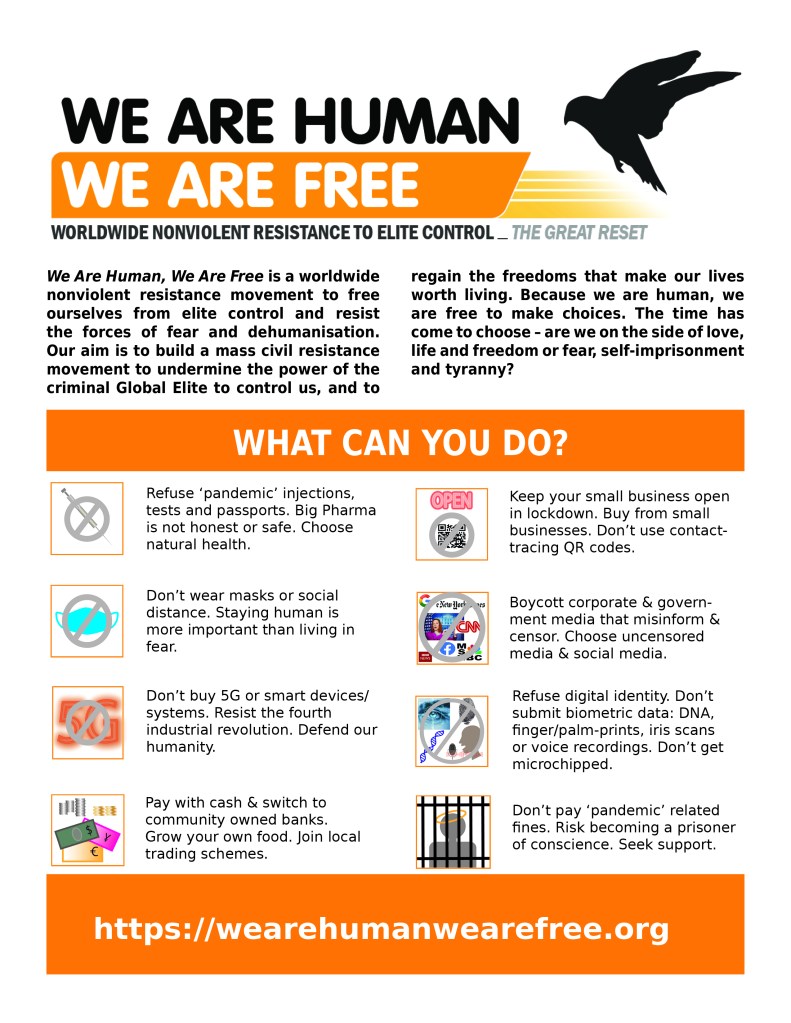





 After the Crash