What “Normal” Are We Returning To? The Depression Nobody Dares Acknowledge

By Charles Hugh Smith

Source: Of Two Minds

Perhaps we need an honest national dialog about declining expectations, rising inequality, social depression and the failure of the status quo.

Even as the chirpy happy-talk of a return to normal floods the airwaves, what nobody dares acknowledge is that “normal” for a rising number of Americans is the social depression of downward mobility and social defeat.

Downward mobility is not a new trend–it’s simply accelerating. As this RAND Corporation report documents, ( Trends in Income From 1975 to 2018) $50 trillion in earnings has been transferred to the Financial Aristocracy from the bottom 90% of American households over the past 45 years.

Time magazine’s article on the report is remarkably direct: The Top 1% of Americans Have Taken $50 Trillion From the Bottom 90% — And That’s Made the U.S. Less Secure.

“The $50 trillion transfer of wealth the RAND report documents has occurred entirely within the American economy, not between it and its trading partners. No, this upward redistribution of income, wealth, and power wasn’t inevitable; it was a choice–a direct result of the trickle-down policies we chose to implement since 1975.

We chose to cut taxes on billionaires and to deregulate the financial industry. We chose to allow CEOs to manipulate share prices through stock buybacks, and to lavishly reward themselves with the proceeds. We chose to permit giant corporations, through mergers and acquisitions, to accumulate the vast monopoly power necessary to dictate both prices charged and wages paid. We chose to erode the minimum wage and the overtime threshold and the bargaining power of labor. For four decades, we chose to elect political leaders who put the material interests of the rich and powerful above those of the American people.”

I’ve been digging into downward mobility and social depression for years: Are You Really Middle Class?

The reality is that the middle class has been reduced to the sliver just below the top 5%–if we use the standards of the prosperous 1960s as a baseline.

The downward mobility isn’t just financial–it’s a decline in political power, control of one’s work and ownership of income-producing assets. This article reminds us of what the middle class once represented: What Middle Class? How bourgeois America is getting recast as a proletariat.

This reappraisal of the American Dream is also triggering a reappraisal of the middle class in the decades of widespread prosperity: The Myth of the Middle Class: Have Most Americans Always Been Poor?

Downward mobility excels in creating and distributing what I term social defeat: In my lexicon, social defeat is the spectrum of anxiety, insecurity, chronic stress, fear and powerlessness that accompanies declining financial security and social status.

Downward mobility and social defeat lead to social depression. Here are the conditions that characterize social depression:

1. High expectations of endlessly rising prosperity instilled as a birthright no longer align with economy reality.

2. Part-time and unemployed people are marginalized, not just financially but socially.

3. Widening income/wealth disparity as those in the top 10% pull away from the bottom 90%.

4. A systemic decline in social/economic mobility as it becomes increasingly difficult to move from dependence on the state or one’s parents to financial independence.

5. A widening disconnect between higher education and employment: a college/university degree no longer guarantees a stable, good-paying job.

6. A failure in the Status Quo institutions and mainstream media to recognize social depression as a reality.

7. A systemic failure of imagination within state and private-sector institutions on how to address social depression issues.

8. The abandonment of middle class aspirations: young people no longer aspire to (or cannot afford) consumerist status symbols such as luxury autos or conventional homeownership.

9. A generational abandonment of marriage, families and independent households as these are no longer affordable to those with part-time or unstable employment.

10. A loss of hope in the young generations as a result of the above conditions.

The rising tide of collective anger arising from social depression is visible in many places: road rage, violent street clashes between groups seething for a fight, the destruction of friendships for holding “incorrect” ideological views, and so on.

A coarsening of the entire social order is increasingly visible: The Age of Rudeness.

Depressive thoughts (and the emotions they generate) tend to be self-reinforcing, and this is why it’s so difficult to break out of depression once in its grip.

One part of the healing process is to expose the sources of anger that we are repressing. As psychiatrist Karen Horney explained in her 1950 masterwork, Neurosis and Human Growth: The Struggle Towards Self-Realization, anger at ourselves sometimes arises from our failure to live up to the many “shoulds” we’ve internalized, and the idealized track we’ve laid out for ourselves and our lives.

The article The American Dream Is Killing Us does a good job of explaining how our failure to obtain the expected rewards of “doing all the right things” (getting a college degree, working hard, etc.) breeds resentment and despair.

Since we did the “right things,” the system “should” deliver the financial rewards and security we expected. This systemic failure to deliver the promised rewards is eroding the social contract and social cohesion. Fewer and fewer people have a stake in the system.

We are increasingly angry at the system, but we reserve some anger for ourselves, because the mass-media trumpets how well the economy is doing and how some people are doing extremely well. Naturally, we wonder, why them and not us? The failure is thus internalized.

One response to this sense that the system no longer works as advertised is to seek the relative comfort of echo chambers–places we can go to hear confirmation that this systemic stagnation is the opposing ideological camp’s fault.

Part of the American Exceptionalism we hear so much about is a can-do optimism: set your mind to it and everything is possible.

The failure to prosper as anticipated is generating a range of negative emotions that are “un-American”: complaining that you didn’t get a high-paying secure job despite having a college degree (or advanced degree) sounds like sour-grapes: the message is you didn’t work hard enough, you didn’t get the right diploma, etc.

It can’t be the system that’s failed, right? I discuss this in my book Why Our Status Quo Failed and Is Beyond Reform: the top 10% who are benefiting mightily dominate politics and the media, and their assumption is: the system is working great for me, so it must be working great for everyone. This implicit narrative carries an implicit accusation that any failure is the fault of the individual, not the system.

The inability to express our despair and anger generates depression. Some people will redouble their efforts, others will seek to lay the blame on “the other” (some external group) and others will give up. What few people will do is look at the sources of systemic injustice and inequality.

Perhaps we need an honest national dialog about declining expectations, rising inequality and the failure of the status quo that avoids polarization and the internalization trap (i.e. it’s your own fault you’re not well-off).

We need to value honesty above fake happy-talk. Once we can speak honestly, there will be a foundation for optimism.

THE INDIVISIBILITY OF LIFE

By Julian Rose

Source: Waking Times

‘Know Thyself.’ On a tombstone in an English churchyard is the following inscription, “Here lies John Bailey. The fact that he died does not guarantee that he lived.”

And that is surely the point. ‘To Live’ is the dynamic expression of existence; not being stuck in some soulless routine permanently in fear of stepping out of line with a sterile status quo.

The art of living involves the assertion of freedom, creativity and empathy with and for fellow humans and all living beings. It is our deepest self expression of an organic sense of purpose. The will to live is expressed through the flow of that warm inner feeling called ‘love of life’.

When, within the human experience, attempts are made to block this flow by forces opposed to Life, our ‘love of life’ causes us to adopt an unwavering commitment to fight for the preservation of all that is good, real and humane. In other words, to defend the basic tenets of a civilised society. Many actively engaged individuals find themselves in this position today.

But why such a high proportion of humanity fails to respond to this ‘Life-call’, preferring instead a ‘no risk’ three dimensional sub-existence – is an unsolved conundrum – in spite of thousands of divergent explanations being put forward?

However, one thing we do know is that when some form of material wealth or power is experienced by those who have sidelined their innate spirituality, it becomes an addiction around which a fixated dependency immediately forms. From there on, such individuals only experience existence as a sterile ambition-chasing game.

In these circumstances, Life becomes reduced to a competition to build and protect material wealth and status; and all those who reject such extremity – but nevertheless remain essentially passive – serve as fuel for the ambitions of these vampires.

The present pyramid of top-down economic and political oppression is built upon this catastrophic deviation from the organic, spirit led, path of Life.

The net result of this deviation from truth is the manifestation of a compensatory expression of the suppressed life-force. The original expression, blocked from following its organic path, turns in on itself and starts to devour that which would otherwise have guided the individual to the light.

Whereas, to openly give free voice to that Divine source of which we are all descendants, is the supreme individual expression of the life force with which we have all been blessed.

We are living through a time of open manifestation of the domineering anti-life materialistic obsession, stripped of all spiritual energy. What we are seeing on a daily basis today, emanating from the top end of the ‘competition pyramid’, is a ‘pandemic’. But it has nothing to do with a virus and everything to do with a feverish grasping for ultimate power and control over others – which includes all life forms down to the very DNA of life itself.

Taken at its face value, this is an abject expression of clinical insanity. If such an extremity was expressed within a family unit, the perpetrator would be recognised as deeply disturbed and in need of serious help and quite possibly of being isolated for fear of causing serious harm to others.

But when the same symptoms are displayed by politicians, bankers, media editors, corporate directors, the police and so forth – it is not recognised as insanity or even megalomania – but as an  ‘acceptable’ type of eccentric behaviour, which is grudgingly seen as ‘par for the course’.

This should lead us all to reflect on how such a stark departure from a human path of life could ever have been engineered into existence.

How a set of values applied to leadership within a family and to political/corporate ‘leadership’ – could be so starkly different. And how such a schizophrenic state of affairs could be allowed to continue to prevail in every corner of the world?

My conclusion is that such a gross imbalance exists due to the engineered separation of primary values within the greater social community, so as to create a divide and conquer controlling agent within society. Once this is in place, schizophrenic actions are not seen for what they are, they are taken as the norm.

In reality, there is no such division between values and responsibilities we see as important within families and those we see as important within political and business affairs. They are indivisible. That which expresses truth – and guidance based upon this truth – has Divine origins. The Divine is whole.

But by the time formal education and parental ambition (for siblings) has weighed-in, a separation of the material and the spiritual/social is all too often made manifest. It is as though these two realms were innately antagonistic.

This state of affairs is the signature of a bankrupt society. An engineered split that looks distinctly like the work of demons; as there is no natural explanation for why antagonism should exist between material and spiritual realms.

All animate and inanimate life is built of spirit and matter – ‘spirit-matter’ – which cannot be separated into opposing elements. But that separation is exactly what the proponents of an increasingly robotic human race have set their sights on.

To reinstate the wholeness which is our natural birthright, and to ensure its continuity throughout the life cycles that proceed from childhood through adolescence and into adulthood, is the essential task all caring, humanitarian and feeling individuals cannot turn away from.

‘Living’ means bringing a better world into being. Encouraging the spark of Life to rise up out of the ashes of a dystopian wilderness. To let Life educate us rather than those who police the status quo.

The verb ‘to educate’ comes from the Latin ‘e-ducare’ meaning ‘to draw out from’. This is a direct reference to encouraging the manifestation of our innate creativity.  Not the ‘fact absorbing’ mission that has been forced on young people during decades of ‘schooling’. The real meaning of such words has been deliberately obfuscated.

The imperative for getting this new dynamic moving cannot be overstated. Much of humanity is on the brink of psychological, psychotic and schizophrenic imprisonment. A state which cannot help but deeply imbalance the very fabric of our living planet.

Faced by this dramatic challenge to create unity out of disunity, we have to draw strongly upon the well of our deeper selves. For the ‘real me’ and the ‘real you’ are the only forces that can rise-up and radiate enough light to penetrate and dissolve the false clouds hanging over this world.

But how can one exert light, freedom and justice when all around fellow humans are covering their faces with a mask of anxiety and fear? When every news item inflates a lie? When the whole world seems turned up-side-down by demonic double speak?

Yes, that is the predominant question on millions of minds right at this moment.

The answer lies in the expression “know thyself”. “Thyself” as an eternal spirit/being of cosmic origins which has – temporarily – taken on a human form and is currently resident on Planet Earth.

‘A cosmic being having an earthly experience’.

Once you and I can detach ourselves from living the lie and primarily identify ourselves with a state of ‘non-attachment’ to the material and ego-led realm, we are free. We cannot be destroyed. We have become eternal. At one with our Creator.

This is a place completely out of reach of our oppressors – whatever form they may take. From here we can go into battle for planet Earth and planet people with not a trace of fear; knowing that when we give all for the cause of truth, Truth returns all to us – with a bonus!

This is how we are to defeat the demonic entities which we have allowed to occupy and rule this planet. They are but mirrors of our failure to follow the call of truth. To BE our true selves. To listen and respond to the inner voice of deeper guidance.

We have the will to quite simply dump our old false existence and transform from pseudo-humans into real humans, indivisible from the divine wellspring of Life. For each one of us, that is our uniquely individual challenge. When expressed collectively, it forms the foundation of a new society.

Of such beings, when they finally pass, it will be stated “The fact that this brave soul had a human experience is here recorded. May that soul continue its great exploration of the divine infinite from whence it came.”

How Conspiracy Theorizing May Soon Get You Labelled a ‘Domestic Terrorist’

Cass Sunstein

By Matthew Ehret

Source: Strategic Culture Foundation

If you are starting to feel like forces controlling the governments of the west are out to get you, then it is likely that you are either a paranoid nut job, or a stubborn realist.

Either way, it means that you have some major problems on your hands.

If you don’t happen to find yourself among the tinfoil hat-wearing strata of conspiracy theorists waiting in a bunker for aliens to either strike down or save society from the shape shifting lizard people, but are rather contemplating how, in the 1960s, a shadow government took control of society over the dead bodies of many assassinated patriots, then certain conclusions tend to arise.

Three Elementary Realizations for Thinking People

The first conclusion you would likely arrive at is that the United States government was just put through the first coup in over 58 years (yes, what happened in 1963 was a coup). Although it is becoming a bit prohibitive to speak such words aloud in polite society, Nancy Pelosi’s official biographer Molly Ball, recently penned a scandalous Time Magazine article entitled ‘The Secret History of the Shadow Campaign that Saved the 2020 Elections’ which admitted to this conspiracy saying:

“Even though it sounds like a paranoid fever dream- a well-funded cabal of powerful people, ranging across industries and ideologies, working together behind the scenes to influence perceptions, change rules and laws, steer media coverage and control the flow of information.” (Lest you think that this was a subversion of democracy, Ball informs us that “they were not rigging the election; they were fortifying it.”)

Another conclusion you might come to is that many of the political figures whom you believed were serving those who elected them into office, actually serve the interests of a clique of technocrats and billionaires lusting over the deconstruction of western civilization under something called “a Great Reset”. Where this was brushed off as an unfounded conspiracy theory not long ago, even Canada’s Deputy Prime Minister (and neo-Nazi supporting Rhodes Scholar) Chrystia Freeland decided to become a Trustee of the World Economic Forum just weeks ago. In this role, Freeland joins fellow Oxford technocrat Mark Carney in their mutual endeavor to be a part of the new movement to decarbonize civilization and make feudalism cool again.

Lastly, you might notice that your having arrived at these conclusions is itself increasingly becoming a form of thought-crime punishable in a variety of distasteful ways elaborated by a series of unprecedented new emergency regulations that propose extending the definition of “terrorism”. Those implicated under the new definition will be those broad swaths of citizens of western nations who don’t agree with the operating beliefs of the ruling oligarchy.

Already a 60 day review of the U.S. military is underway to purge the armed forces of all such “thought criminals” while McCarthyite legislation has been drafted to cleanse all government jobs of “conspiracy theorists”.

Another startling announcement from the National Terrorism Advisory Bulletin that domestic terrorists include: “ideologically-motivated violent extremists with objections to the exercise of governmental authority [and] perceived grievances fueled by false narratives.”

While not yet fully codified into law (though it will be if not nipped in the bud soon), you can be sure that things are certainly moving fast as, before our very eyes, the right to free speech is being torn to shreds by means of censorship across social media and the internet, cancelling all opinions deemed unacceptable to the ruling class.

The Conspiracy to Subvert Conspiracy Theorizing

This should not come as a surprise, as Biden’s new addition to the Department of Homeland Security is a bizarre figure named Cass Sunstein who famously described exactly what this was going to look like in his infamous 2008 report ‘Conspiracy Theories’ (co-authored with Harvard Law School’s Adrien Vermeule). In this under-appreciated study, the duo foresaw the greatest threat to the ruling elite took the form of “conspiracy theorizing” within the American population using as examples of this delusion: the idea that the government had anything to do with the murders of John F. Kennedy and Martin Luther King Jr, or the planning and execution of 9-11.

Just to be clear, conspiracy literally means ‘two or more people acting together in accord with an agreed upon idea and intention’.

The fact that Vermeule has made a legal career arguing that laws should be interpreted not by the “intentions” of lawgivers, but rather according to cost-benefit analysis gives us a useful insight into the deranged mind of a technocrat and the delusional reasoning that denies the very thing which has shaped literally ALL of human history.

In their “scholarly” essay, the authors wrote “the existence of both domestic and foreign conspiracy theories, we suggest, is no trivial matter, posing real risks to the government’s antiterrorism policies, whatever the latter may be.” After establishing his case for the threat of conspiracies, Sunstein says that “the best response consists in cognitive infiltration of extremist groups”.

Not one to simply draw criticisms, the pro-active Sunstein laid out five possible strategies which the social engineers managing the population could deploy to defuse this growing threat saying:

“(1) Government might ban conspiracy theorizing. (2) Government might impose some kind of tax, financial or otherwise, on those who disseminate such theories. (3) Government might itself engage in counter speech, marshaling arguments to discredit conspiracy theories. (4) Government might formally hire credible private parties to engage in counter speech. (5) Government might engage in informal communication with such parties, encouraging them to help”.

(I’ll let you think about which of these prescriptions were put into action over the ensuing 12 years.)

Cass Sunstein was particularly sensitive to this danger largely because: 1) he was a part of a very ugly conspiracy himself and 2) he is a world-renowned behaviorist.

The Problem of Reality for Behaviorists

As an economic behaviorist and lawyer arguing that all “human rights” should be extended to animals (blurring the line separating human dynamics from the law of the jungle as any fascist must), Sunstein has spent decades trying to model human behavior with computer simulations in an effort to “scientifically manage” such behavior.

As outlined in his book Nudge (co-authored with Nobel Prize winning behaviorist Richard Thaler), Sunstein “discovered” that people tend to organize their behavioral patterns around certain fundamental drives, such as the pursuit of pleasure, avoidance of pain, and certain Darwinian drives for sex, popularity, desire for conformity, desire for novelty, and greed.

One of the key principles of economic behaviorism which is seen repeated in such popular manuals as Freakonomics, Nudge, Predictably Irrational, The Wisdom of Crowds, and Animal Spirits, is that humans are both biologically determined due to their Darwinian impulses, but, unlike other animals, have the fatal flaw of being fundamentally irrational at their core. Since humans are fundamentally irrational, says the behaviorist, it is requisite that an enlightened elite impose “order” upon society while maintaining the illusion of freedom of choice from below. This is the underlying assumption of Karl Popper’s Open Society doctrine, which was fed to Popper’s protégé George Soros and which animates Soros’ General Theory of Reflexivity and his Oxford-based Institute for New Economic Thinking (INET).

This was at the heart of Obama’s science Czar John Holdren’s call for world government in his 1977 Ecoscience (co-written with his mentor Paul Ehrlich) where the young misanthrope envisioned a future utopic world governed by a scientifically managed master-class saying:

“Perhaps those agencies, combined with UNEP and the United Nations population agencies, might eventually be developed into a Planetary Regime- sort of an international superagency for population, resources, and environment. Such a comprehensive Planetary Regime could control the development, administration, conservation, and distribution of all natural resources, renewable or nonrenewable”.

The caveat: If Darwinian impulses mixed with irrational “animal spirits” were truly all that animated those systems which behaviorists wish to map and manipulate (aka: “nudge” with rewards, punishments), then a scientific priesthood would indeed be a viable and perhaps necessary way to organize the world.

Fortunately, reality is a bit more elegant and dignified than behaviorists wish to admit.

Why Computer Modellers Hate Metaphysics

On a closer inspection of history, we find countless instances where people shape their individual and group behavior around sets of ideas that transcend controllable material impulses. When this happens, those individuals or groups tend to resist adapting to environments created for them. This incredible phenomenon is witnessed empirically in the form of the American Revolution, Warsaw Ghetto Uprisings, Civil Rights movements, and even some bold manifestations of anti-lockdown protests now underway around the world.

Among the most troublesome of those variables which upset computer models are: “Conscience”, “Truth”, “Intentions”, “Soul”, “Honor”, “God”, “Justice”, “Patriotism”, “Dignity”, and “Freedom”.

Whenever individuals shape their identities around these very real, though immaterial (aka: “metaphysical”) principles, they cannot be “nudged” towards pre-determined decisions that defy reason and morality. Adherence to these principles also tends to afford thinking people an important additional edge of creative insight necessary to cut through false explanatory narratives that attempt to hide lies behind the appearance of truth (aka: sophistry).

As witnessed on multiple occasions throughout history, such individuals who value the health of their souls over the intimidating (and extremely malleable) force of popular opinion, will often decide to sacrifice personal comfort and even their lives in order to defend those values which their minds and consciences deem important.

These rare, but invaluable outliers will often resist policies that threaten to undo their freedoms or undermine the basis of their society’s capacity to produce food, and energy for their children and grandchildren. What is worse, is that their example is often extremely contagious causing other members of the sheep class to believe that they too are human and endowed with unalienable rights which should be defended.

The Intentions Ordering World History

Perhaps, most “destructive” of all is that these outlier people tend to look for abstract things like “causes” in historical dynamics shaping the context of their present age, as well as their current geopolitical environment.

Whenever this type of thinking is done, carefully crafted narratives fed to the masses by an enlightened elite will often fail in their powers to persuade, since seekers after truth soon come to realize that IDEAS and intentions (aka: conspiracies) shape our past, present and future. When the dominating intentions shaping society’s trajectory is in conformity with Natural Law, humanity tends to improve, freedoms increase, culture matures and evil loses its hold. Inversely, when the intentions animating history are out of conformity with Natural Law, the opposite happens as societies lose their moral and material fitness to survive and slip ever more quickly into dark ages.

While sitting in a jail in Birmingham Alabama in 1963, Rev. Martin Luther King Jr. described this reality eloquently when he said:

“A just law is a man-made code that squares with the moral law or the law of God. An unjust law is a code that is out of harmony with the moral law. Any law that uplifts human personality is just. Any law that degrades human personality is unjust… One has not only a legal but a moral responsibility to obey just laws. Conversely one has a moral responsibility to disobey unjust laws”

From Plato’s organization of his Academy and efforts to shape a Philosopher King to beat the forces of the Persian Empire, to Cicero’s efforts to save the Roman Republic, to Augustine’s battles to save the soul of Christianity all the way to our present age, conspiracies for the good and counter-conspiracies for evil have shaped history. If one were to begin an investigation into history without an understanding that ideas and intentions caused the trajectory of history, as is the standard practice among history professors dominant in todays world, then one would become incapable of understanding anything essential about one’s own reality.

It is irrelevant that behaviorists and other fascists wish their victims to believe that history just happens simply because random short-sighted impulses kinetically drive events on a timeline- the truth of my claim exists for any serious truth seeker to discover it for themselves.

Back to our Present Sad State of Affairs

Now we all know that Sunstein spent the following years working as Obama’s Regulatory Czar alongside an army of fellow behaviorists who took control of all levers of policy making as outlined by Time Magazine’s April 13, 2009 article ‘How Obama is Using the Science of Change’. As the fabric of western civilization, and traditional values of family, gender, and even macro economic concepts like “development” were degraded during this period, the military industrial complex had a field day as Sunstein’s wife Samantha Power worked closely with Susan Rice in the promotion of “humanitarian bombings” of small nations under Soros’ Responsibility to Protect doctrine.

After the Great Reset Agenda was announced in June 2020, Sunstein was recruited to head the propaganda wing of the World Health Organization known as the WHO Technical Advisory Group where his skills in mass behavior modification was put to use in order to counteract the dangerous spread of conspiracy theories that persuaded large chunks of the world population that COVID-19 was part of a larger conspiracy to undermine national sovereignty and impose world government.

The head of WHO described Sunstein’s mandate in the following terms:

“In the face of the COVID-19 pandemic, countries are using a range of tools to influence behavior: Information campaigns are one tool, but so are laws, regulations, guidelines and even fines…That’s why behavioral science is so important.”

Today, hundreds of Obama-era behaviorists have streamed back into influential positions of government under the new “scientifically managed”, evidence-based governance coming back to life under Biden promising to undo the dark days of President Trump.

Ideologues who have been on record calling for world government, the elimination of the sick and elderly (see Obamacare architect Ezekiel Emmanuel’s Why I Hope to Die At 75), and population control are streaming back into positions of influence. If you think that anything they have done to return to power is unlawful, or antithetical to the principles of the Constitution, then these technocrats want you to know that you are a delusional conspiracy theorist and as such, represent a potential threat to yourself and the society of which you are but a part.

If you question World Health Organization narratives on COVID-19, or doubt the use of vaccines produced by organizations like Astra Zeneca due to their ties to eugenics organizations then you are a delusional conspiracy theorist.

If you doubt that global warming is caused by carbon dioxide or that implementing the Paris Climate accords may cause more damage to humanity than climate change ever could, then you must be a conspiracy theorist.

If you believe that the U.S. government just went through a regime change coordinated by something called “the deep state”, then you run the risk of being labelled a delusional threat to “the general welfare” deserving of the sort of treatment dolled out to any typical terrorist.

It appears that the many comforts we have taken for granted over the past 50-year drunken stupor called “globalization” are quickly coming to an end, and thankfully not one but two opposing intentions for what the new operating system will be are actively vying for control. This clash was witnessed in stark terms during the January 2021 Davos Summit, where Xi Jinping and Putin’s call for a new system of win-win cooperation, multipolarity and long-term development offset the unipolar zero-sum ideologues of the west seeking to undo the foundations of industrial civilization.

Either way you look at it, conspiracies for good and for evil do exist now, as they have from time immemorial. The only question is which intention do you want to devote your life towards?

Living in Dark Times: I Revolt, Therefore I Am!

By Dr. Rudolf Hänsel

Source: Global Research

“Really, I live in dark times! The guileless word is foolish. (…) The laughing man has only not yet received the terrible news.” This is how Bertolt Brecht‘s poem “An die Nachgeborenen” (To those born later) begins; published in June 1939.

It is one of the most important texts in German exile literature. Three generations later, we are again living in dark times.

Most citizens instinctively feel that “Something is Rotten in the State of Denmark” and “Time is Out of Joint” (Shakespeare). However, a sense of authority and a mental obedience reflex prevent them from distrusting the brazen lies of politicians, scientists and the mass media and from saying no. With this behaviour they stabilise the totalitarian system. 

Science has the task of leading people to knowledge. Depth psychology, for example, has found out what prevents people from using their common sense instead of handing over power to politicians. The clear-sighted free citizen will no longer obey: he will rebel against the unconstitutional Corona measures of governments as an outgrowth of the New World Order and will embrace the spirit of revolt. His highest goal is the realisation of freedom for all people. In this act of outrage, he finds himself: I revolt, therefore I am!

Science has to lead man to knowledge

The human community rightly expects science to alleviate the plight of people and to serve the protection of life. But there are hardly any independent scientists left, only academics (with university or college education) who kowtow. More and more scientists are hawking their knowledge and skills, and often their souls, to the military-industrial-media complex and Big Money. They even move so far away from their humanity that they help perfect the means for the general destruction of humanity. 

This is also true of psychologists, psychotherapists and psychiatrists who could greatly enrich people’s lives. The fact that the science of psychology is still very much underestimated in our latitudes is largely due to the fact that many German psychologists of Jewish faith had to go into exile in the USA during the period of fascism. However, psychology is also eyed with suspicion because many of its representatives, while striving to help individuals, are in favour of preserving the system. They want the person seeking advice to find his way in society, to be a good and well-behaved citizen. 

In war, the state hires psychologists so that the soldier stays in line and does not run away. And if the soldier’s mind falls ill on the battlefield, he is picked up by the psychologist on home leave and prepared again so that he continues to defend the fatherland at the risk of his life. Nowadays, psychologists give dubious advice to young and old alike on how to get through their anxieties, depressions and fits of despair due to the politically imposed Corona measures in reasonably good health. The betrayal of one’s own professional ethics is pushing humanity into misery. (1)

What joy, on the other hand, when one learns that a judge in Germany has already filed a 190-page constitutional complaint with the supreme court in December 2020 because of the drastic Corona measures imposed by the federal and state governments, because it is high time to “stabilise our liberal-democratic legal order again”. (2) Or that a professor from Tübingen is leaving the German Academy of Sciences and Literature Mainz, a sister organisation of the National Academy of Sciences “Leopoldina”, which advises the German government. His reason for leaving reads: 

“I want to serve a science that is committed to fact-based honesty, balanced transparency and comprehensive humanity.” (3)

First comes the feeling, then the action!

It is very difficult to get a person to move directly for a humane, peaceful and free society. Unconscious fears and inner psychological blocks prevent him from thinking rationally. When he becomes aware of this with the help of an experienced and compassionate psychologist or psychotherapist, he can begin to “have the mind free and cast off all timidity” (Rabelais). 

This person can listen to the other person when he is given new information and one draws his attention. He can then also think his own thoughts and begin to change, to take action. For this to happen, however, his deep soul feeling, his emotional life, must be addressed. The insight of scientific depth psychology is: First comes the feeling, then the action!

For this reason, it is counterproductive and hurtful to discriminate against fearful and obedient fellow citizens as “complete idiots” or “ducking mice”. Such an assessment shows that one does not know their deeper motives. Therefore, all conceivable motivations for obedience and fearful silence must be explored – especially authoritarian and religious upbringing in the parental home and school as well as the influence of society. (4)

Often it is the very personal accounts of those affected that speak to people deep down, stir them up and make them think. A positive example is the heartbreaking story of colleague Peter König, which was published on 27 December 2020 in the Canadian online platform “Global Research” (www.globalresearch.ca): “Death by Ventilator – A Personal Story – for the World to Know.” (5)

I revolt, therefore I am!

The clear-sighted human being who has become conscious of himself, who knows himself to be the master of his destiny, can really do nothing else but rebel against the conditions of the present social order, to commit himself to the spirit of revolt. The form of life that corresponds to this is that of permanent indignation.

In 1952, the French writer, philosopher, critic of religion and winner of the Nobel Prize for Literature Albert Camus (1913-1960) published the book “L’homme révolté” (Man in Revolt). Camus’ thinking culminates in the call to revolt in the sense of an incessant struggle for a higher degree of freedom. To take note of the absurdity of the world is to revolt against it. In this act of revolt, man would find himself – in a variation of Descartes‘ formula: “I revolt, therefore I am! 

This person wants neither earthly promises nor reassurances about the hereafter. The announcement of a future kingdom of God on earth or in heaven is indifferent to him. In both cases one had to wait, and during this time the innocent did not stop dying. The working masses, tired of suffering and dying, would be people without God. Man’s place in the revolt would be at their side. 

For free man and his revolt in the name of human right and human dignity, there would be no higher goal than the realisation of freedom for all – and that immediately and not via the “diversions” of a dictatorship, as the revolutionary demanded. 

Notes:

(1) http://www.nrhz.de/flyer/beitrag.php?id=27182&css; https://www.globalresearch.ca/cook-sweetens-meal-arsenic-charched-attempt-murder/5732124

(2) https://de.rt.com/inland/111310-richter-erhebt-verfassungsbeschwerde-gegen-corona/

(3) https://de.rt.com/inland/111305-aus-protest-gegen-lockdown-politik-tuebinger-professor-verlaesst-akademie-der-wissenschaften/

(4) https://www.globalresearch.ca/dispel-the-magic-belief-in-author…-power-and-violence-strengthen-community-feelings/5729560; http://www.nrhz.de/flyer/beitrag.php?id=27120&css

(5) https://www.globalresearch.ca/covid-death-by-ventlator-a-personal-storyfor-the-world-to-know/5733068


Generation Numb: How Losing My Phone Exposed Me to the Pain of My Peers

This terrible void of which everyone stays pleasantly unobservant is the unofficial sickness of Gen Z.

By Ben Scheer

Source: ScheerPost

I hadn’t planned to give up my smartphone. After all, I was starting my sophomore year of college and I had not met a single adult who lives without one and definitely no other 19-year-old. If you haven’t noticed, it is part of the culture. A few weeks into the semester, I forgot my phone (a Google Pixel 2, for all you phone nerds) in the backseat of an Uber on my way back from shopping off campus. This would lead to an opening to consider a break from the phone and everything that comes with it.

I remember feeling frustrated at myself for being so absentminded and immediately rushed to track it down, anxiously calling the driver from a friend’s phone. While I listened to the open ringing on the line I began to think about this one technology’s central role in my life.

That gateway to other worlds.

Over the next few days I continued to hope my phone would come back to me and also thought further into its role in my relationships. I felt how hindering it was in communicating with the people I love.

How it had required me to be always ready to pluck it from my pocket, pull my focus and as a result, never be truly present. I saw in that reflection the possibility for healthier relationships, less dependent on constant digital connection.

More free, less reliant.

Sure, there were a thousand things that would be made more challenging and tedious, but it would be worth it if I could be more present for my own life.

Days later, after I had given up hope of seeing it again, I used a friend’s phone to call my dad to tell him.

“I will get you another one, what kind do you want?” was the first thing he said.

“Actually I think I’m good,” I responded, to his surprise. “I can write you and my mom by email. If we want to talk, I can call you from my computer.”

Quickly, I started to feel the change. My mood and habits became clearer; I felt happier, more grounded, less looming anxiety, feeling more alone and with myself, more conscious of my space and those in it.

Being alone led to more opportunities for reflection and boredom. I felt calmer, and my walking and pace of day actually slowed down. It is hard to describe how it changed the patterns in my brain but I could feel it readjusting, as it does if you spend a week in the woods or on a beach. One thing I felt was that my days were longer and more connected from one moment to the next.

I also became more aware of the moods and feelings of others around me and was suddenly terrified to see how dependent my peers were on all their screens, and, looking back just a bit, how consumed I, too, had been.

Something else bubbled up from my unconscious: My expectations of college differed from what I was seeing. Between talking to older relatives and seeing college life on TV and in the movies, I was expecting a . . . BIT MORE JOY! Young souls, free minds, positive energy, community. I was seeking some bright spark in the people around me, yet all too often what I saw was dull, void, distractible, unthinking, unfeeling people enveloped in the world of their screens instead of being in community and conversing with the people around them.

Yes, that is harsh. It is also what I see.

So much lost human potential.

I want something or someone to blame, but maybe what I should really be blaming is myself for expecting something else. The truth is, though, I feel right in blaming the phones.

It has been over a year since I gave up my smartphone, but I remember vividly when looking at my phone for hours a day seemed normal to me. I was content to stare at the screen for hours, doing the same thing: Watching mildly entertaining videos or mashing game buttons, swiping on Tinder, scrolling on IG, surfing memes and YouTube videos. In many ways, it’s a drug too good to give up, seemingly a harmless drug, but no. We have opened Pandora’s box of marvels and there is no way to close it now.

We are continually wanting what we do not yet have, an innate motivation amplified and rerouted by capitalism’s hyperdrive marketing engines. A good fix for this constant yearning, or any discomfort is to drown it out with distractions. Feeling an uncontrollable emotion? Existential itch? Low-grade anxiety? No problem: Try scrolling on the social of your choice for a bit, trust me, it takes the edge off.

Trauma or poverty, pain or loneliness, all manner of worry, we have a cure! Or at least the emotional response can be staved off long enough for you to find the next thing to click.

This terrible void of which  everyone stays pleasantly unobservant is a part of me as well, the unofficial sickness of my generation. (COVID-19 will be the official one, memorialized in our virtual yearbooks.) This hole, this pit, that is created from not knowing one’s self, not trusting one’s self, or not allowing feelings. So distracted that these insecurities that we act on every day are a mystery. That you cannot see how fundamentally OK everything actually is because you have music constantly in your ear and a fear that, in silence, your own thoughts would be too scary. The sickening thought that your true feelings for someone were no more than an act of comfort-seeking desperation and that “love” is a lifesaver from yourself.

I can’t blame anyone though. The distractions surround us, they surround the people we are with. The collective unfeeling is so great, so vast, it cracked me open, actually made me cry often once I allowed myself to experience it. I felt like I was losing my footing in the world in which I had grown up. Disconnected from my past and unsure of where we were going.

(Side note: If you haven’t yet watched The Social Dilemma, go do that, it’s worth it.)

Walking into a small college class to see no one looking at each other or chatting, the blank vacant stares. The soft glow. It felt … confusing? Why were so many interesting young people ignoring one another? What was a classroom like before these tools were available and allowed everywhere? Why were the screens so celebrated?

Then my confusion grew, and from it rage and pain. These emotions danced together, fueled me and crushed me. I saw, for the first time, the real power that the phones held. Yes, a power we had given them, but a power nonetheless. The power to keep people who were 500 miles apart tethered to one another, or keep people sitting right next to each other brutally apart.

Who can I blame? It is just the world I have been born into, and the technology- and profit-driven changes are coming faster every year. We live in the future with brain equivalents in our pockets and a web that contains all of our collective knowledge but reveals the worst of what we are and so little of the love we contain and of which we are capable.

Is the internet a good idea? Are phones good for humans? These are not questions we have answered or even barely thought to ask in the mainstream of our culture. Of course they are, what else could they be? Progress! Faster communication! More knowledge! More speed! More fun! We will all be more efficient and entertained, and from that we will live better lives.

NO! Stop, slow down. Please. These gadgets, these everywhere-anytime screens, are ruining the minds of the people who have been mesmerized since they were only little children.

To clarify: not ruining, in that people are made stupid (although it definitely does not help develop our attention span), but rather ruining our emotional capacity and spiritual selves. And these limits fetter us as we are already so strained by the pain we are able to see through our little windows; we don’t have a moment to feel, to feel our own pain, or that of our friends.

Or, for that matter, the pain of the world, or the impact of our constant consumption, or where all this STUFF comes from and where it ends up, or the pain of our history and centuries of exploitation of other humans and nature from which all this wealth originally was derived.

Being human is objectively great. We can use language and words to describe how we feel. We can feel the sun on our face and take in the taste of a thousand foods, dance to every song. Feel great pain and great happiness. Yet, all the time I see this discomfort, unrest and fear in my most distracted friends. It is coming from the disconnection from what they are feeling, a disconnection from being.

This is the worst theft of modern-day, first-world life: the theft of being present.

The phones and distractions and speed create this disconnection from the simple fact that you are actually OK, better then OK — you are alive and can feel and that is a gift to cherish.

Worse than the days of sadness are the days of not feeling anything. Some people are depressed not because anything is wrong but because they are numb to their feelings, too distracted and avoidant to feel them; avoidant, and scared of what might happen if they let themselves feel.

Try this: Really study those you love, let their face become new to you, again, and become fascinated in the way they move. Feel the wonder of being with another human.

After more than a year without a smartphone, I am more hopeful than I was in those first few months. Not to say that everything is all right, far from it. Here in the United States our technology has allowed for multiple realities to coexist alongside one another and I don’t see a clear path out of that problem. Distraction and narrow self-interest prevent us from seeing and grappling with the apocalyptic future climate change can bring in a much shorter time frame than even most globally aware people are willing to accept.

However, I do know that change is a constant and I am healed by looking past my own lifetime and by all the simple beauties of life and living. In the end, these technologies do NOT define us. We can work together to change how we coexist.


Postscript: For those who are interested in also letting go of your smartphone, I would recommend downgrading to a flip-phone or phone of a similar level. I now walk around the world with a thick, red brick through which I can communicate with my work and family in case of emergencies. 

Welcome To The Interregnum

Your unease has a name: Zozobra

By Chris Martensen

Source: Peak Prosperity

We’re between things.  It’s an uncomfortable place.

We are transitioning from an old story into a new one and that has folks feeling anxious.   By “we” I mean everyone on the planet.  If you find yourself with a deep sense of unease, yet unable to quite pin it down, you will find this article extremely helpful.

The old story of endless growth on a finite planet is winding down.  Whatever replaces it won’t be a continuation of the past.  Things are going to have to change, whether we like it or not.

Put more bluntly: the easy times are over, and a period of disruption has begun.

It may be many years or even decades before thing truly settle into a new equilibrium (of sorts – there really isn’t any such thing in this ever-changing universe).  The old will fall away even before the new has arrived. That process has already begun, hence the nervousness, anger, and fear.

My day job is serving as an information scout, an ambassador of the unknown, and because of that I’m acutely aware of the degree to which people are already worn down, burnt out, and unable to process any more.

Folks are so exhausted by the trials and tribulations dished up by the crazy-making machine fondly referred to as “2020,” that many are paralyzed.  Unable to take new actions because they are overwhelmed.

Yet, as I wrote recently, no choice IS a choice.  When so much is changing and so much is on the line, remaining frozen with anxiety is as much a determinant of your future prospects as taking swift action – each sets one down different paths promising different outcomes.

Truthfully, there is much that can be done that will contribute to a more resilient future for yourself and for the world.  But first we have to know where we are.  We have to sketch out the map as best we can, even if the edges remain blanks with little more than “there be monsters” scribed at the borders.

To orient properly, you must be aware of the idea that the Age of Growth is over.  We are now entering a Post-Growth era. Our task now is to settle into a very different existence – one with fewer ‘things’ and less ‘stuff’, but also offering more meaning and worthy challenges.

Like any good adventure, a little danger is involved.  But nothing quite so dangerous to your soul’s journey as wasting your life on trivial pursuits.

The Interregnum

The gap between reigns when the old king has died but the new successor has yet to be decided is called an interregnum.  It can also refer to the gap between first learning of something and then finally understanding its deeper significance:

in·ter·reg·num, noun

a period when normal government is suspended, especially between successive reigns or regimes.

– an interval or pause between two periods of office or other things. “the interregnum between the discovery of radioactivity and its detailed understanding”

I love this word because it perfectly matches our current state.

One feature of an interregnum, where power hangs in the balance, is that it’s a very uncertain time.  Anxiety rules the day because nobody knows how things might land.  It could be good for them personally, or very bad.  The old king was good.  His successor son is an already hated petty tyrant.  Perhaps a different, better successor will somehow manage to claim the throne instead…

This sort of uncertainty is a potent source of anxiety. Which is why an interregnum is the cradle of people’s most deep-seated fears.

The old king is gone.  Nobody knows who or what is in charge right now.  Is it humanity’s deep technological prowess or is it Mother Nature herself?

Does our destiny lie in our own hands or have the die already been cast and we’re simply awaiting to see how unfortunate of a roll it’s going to be?

Is there still time to sort out a decent solution to our many predicaments and problems, or have those moments already been wasted?

Nobody knows at this moment.  But the uncertainty is hanging thick.  Corrosive.  Emotional.  Explosive.

Welcome to the interregnum.  May the odds ever be in your favor.

Demoralization

Now while the above may sound depressing, as I’ve written before the better term is demoralizing, and there’s a very important distinction between the two terms.

Depression is a reaction to current circumstances. It can be treated with talk therapy to resolve an inner conflict, or temporary chemical rebalancing.

Demoralization, on the other hand, is what you experience when your cognitive map no longer aligns with the actual circumstances of life:

Rather than a depressive disorder, demoralization is a type of existential disorder associated with the breakdown of a person’s ‘cognitive map’. It is an overarching psycho-spiritual crisis in which victims feel generally disoriented and unable to locate meaning, purpose or sources of need fulfilment.

The world loses its credibility, and former beliefs and convictions dissolve into doubt, uncertainty and loss of direction.

Frustration, anger and bitterness are usual accompaniments, as well as an underlying sense of being part of a lost cause or losing battle. The label ‘existential depression’ is not appropriate since, unlike most forms of depression, demoralization is a realistic response to the circumstances impinging on the person’s life.

(Source)

Did you catch that? Demoralization is actually a realistic response under certain conditions.

Those conditions are manifesting themselves now. Which means that the waves of dispiriting statistics we’re seeing are not ‘bad’; they are telling us something important.

People are right to be deeply disturbed by the ways in which the main narrative of their culture no longer maps to reality.  Worse, the Endless Growth narrative is killing life on this planet and therefore harming each of us in ways both overt and subtle.

More and more people are detecting that, and that’s a good thing. Because that’s the necessary first step in crafting a new narrative and adopting a different model that hopefully serves us better.

We often say here at Peak Prosperity that if you’re feeling anxiety (or demoralization), it means that there’s a gap between what you know and what you’re doing.  Since you can’t unlearn something, your best course of action is to change your behavior.

To take action to better align what you know with what you do.

I totally get the frustration, anger and bitterness on display in politics all across the West right now, but these are almost universally misdirected at the wrong targets.  Whether by intent or accident, this is usually the case and heavily supported by a media system that actually promotes divisiveness over unity, and isolation over connection.

(Source – PeakProsperity – The End of Growth)

Bottom line: If you are demoralized there’s nothing wrong with you.  But there is definitely something wrong with the larger situation.

If you know someone who is demoralized, don’t try to ‘fix’ them by helping them fit back into their old lives better.  The problem isn’t with their ability to adapt.  The problem is they are already adapting to what is coming.  They’re ahead of the curve, not behind it.  They just see the new curve before you do.

With that critical framing for the word demoralization, we can now go a bit deeper.  But first, I want to introduce an important term relating to demoralization: Zozobra.  It describes a potent sensation one might experience during an interregnum, especially if demoralization is in play.

Zozobra

I came across this article very recently and have now read it a few times. It’s pitch perfect.

It neatly captures the context of demoralization.  By naming it we can begin to understand it, know its presence, and reduce its unconscious hold on us:

There’s a word for your overwhelming anxiety, and it’s “zozobra”

Nov 3rd, 2020

Ever had the feeling that you can’t make sense of what’s happening? One moment everything seems normal, then suddenly the frame shifts to reveal a world on fire, struggling with pandemic, recession, climate change, and political upheaval.

That’s “zozobra,” the peculiar form of anxiety that comes from being unable to settle into a single point of view, leaving you with questions like: Is it a lovely autumn day, or an alarming moment of converging historical catastrophes?

The word “zozobra” is an ordinary Spanish term for “anxiety” but with connotations that call to mind the wobbling of a ship about to capsize. The term emerged as a key concept among Mexican intellectuals in the early 20th century to describe the sense of having no stable ground and feeling out of place in the world.

This feeling of zozobra is commonly experienced by people who visit or immigrate to a foreign country: the rhythms of life, the way people interact, everything just seems “off” – unfamiliar, disorienting and vaguely alienating.

According to the philosopher Emilio Uranga (1921-1988), the telltale sign of zozobra is wobbling and toggling between perspectives, being unable to relax into a single framework to make sense of things. As Uranga describes it in his 1952 book “Analysis of Mexican Being”:

“Zozobra refers to a mode of being that incessantly oscillates between two possibilities, between two affects, without knowing which one of those to depend on … indiscriminately dismissing one extreme in favor of the other. In this to and fro the soul suffers, it feels torn and wounded.”

What makes zozobra so difficult to address is that its source is intangible. It is a soul-sickness not caused by any personal failing, nor by any of the particular events that we can point to.

Instead, it comes from cracks in the frameworks of meaning that we rely on to make sense of our world — the shared understanding of what is real and who is trustworthy, what risks we face and how to meet them, what basic decency requires of us and what ideals our nation aspires to.

(Source)

What ‘cracks in the framework of meaning’ could be more profound than facing the collapse of – well – everything?  Our many predicaments exist at all levels from top to bottom.  There’s no safe level on which to ride out the coming storm.  There’s nowhere to run.  There’s only right where you are.

When everything seems “off” – unfamiliar, disorienting and vaguely alienating, then you’re in some sort of foreign land.  You are out of bounds, off all of your known maps.  There’s no sense of place, nowhere to settle down. Zozobra.

When everything is wobbling and up for grabs, you wouldn’t be entirely human if you weren’t experiencing some sort of emotional unease.  AS with the adjustment reaction, an emotional arc is simply a part of the process.  Both unavoidable and necessary.

Those who navigate uncertainty best are those who process the quickest.  As always, having a good mental map, and the right terms, is helpful to that process.

Conclusion

If you are feeling nervous, angry or fearful – congratulations! – there’s nothing at all wrong with you.  In fact, your senses are operating normally, and your cognition is on the mark.  You are having an adjustment reaction, your cognitive map has a better grasp on reality than your culture, and zozobra is par for the course.

The most valuable part of naming and understanding these things is that they lose their ability to paralyze you with dread.

Our emotions are not “the truth”, but rather uncomfortable sensations that serve as an early warning system.  They are like a quantum processor able to parse through massively complex systems and situations way before our cortex can offer any guidance.

There’s also a comfort – a relief – that comes from understanding that our reactions are both perfectly normal and perfectly healthy.

There’s nothing that requires treatment. Nothing that requires medication. Nothing at all to be done about any of it.  Except knowing what it is, getting past whatever paralysis might exist as rapidly as possible, and then taking action.

Because you alone can’t alter the larger trends of ecological destruction, monetary printing, insane political responses, etc. and so forth, all that truly remains is for you to align your actions with what you know to be true.

And there’s so much to be done.  Soils need to be rebuilt.  Waste streams reformed into nutrient loops.  Energy efficiency to be built into the next generation of – everything.

The lists are as endless as they are exciting. And you can play a role, both at the individual level as well as contributing positively at the collective one.

Yes, there’s a “great reset” coming.  Whether it will be controlled and precise or a nature-driven chaotic mess remains to be seen.

But right now, you need to make a choice: You can either actively shape your future or wait to be shaped by it.

I’m all about controlling what I can and leaving the rest behind.  Maybe you are, too.

If so, then you’re part of our tribe here at Peak Prosperity.  We’re busying preparing for what is increasingly likely to consist of more macro chaos than control.

You know, to avoid being demoralized with an overwhelming sense of zozobra during this interregnum.

Why Do Most People Believe Propaganda and False Flag Attacks?

By Robert J. Burrowes

In his 1995 book The Demon-Haunted World Carl Sagan lamented as follows:

I have a foreboding of [a] time when… awesome technological powers are in the hands of a very few, and no one representing the public interest can even grasp the issues; when the people have lost the ability to set their own agendas or knowledgeably question those in authority; when, clutching our crystals and nervously consulting our horoscopes, our critical faculties in decline, unable to distinguish between what feels good and what’s true, we slide, almost without noticing, back into superstition and darkness.

The dumbing down… is most evident in the slow decay of substantive content in the enormously influential media… but especially a kind of celebration of ignorance…. The plain lesson is that study and learning – not just of science, but of anything – are avoidable, even undesirable.

We’ve arranged a global civilization in which most crucial elements… profoundly depend on science and technology. We have also arranged things so that almost no one understands science and technology. This is a prescription for disaster. We might get away with it for a while, but sooner or later this combustible mixture of ignorance and power is going to blow up in our faces. See The Demon-Haunted World: Science as a Candle in the Dark.

While it is 25 years since these words of Sagan’s were published a year before his death, one can only lament the ongoing decline of what might simply be labeled the capacity for critical thinking, whether in relation to society and politics, or the science and technology that so concerned Sagan.

At a time in human history when so much is at stake, why is it so difficult to engage most people in anything resembling a thoughtful investigation, consideration and analysis of what is taking place? Why is it that more people do not question what they are told, what they read and what they are shown? In short, why is it that most people do not seek out the evidence for themselves rather than simply believing what is presented to them?

In one sense, the answer to this question might seem simple. People are daily bombarded with ‘information’, in various guises, and a lifetime of submissively accepting what they are told leaves few with any inclination, or energy, to question anything. But let me offer a fuller explanation given the critical importance of this issue if we are to mobilize an effective response to the challenges confronting humanity.

So first: What is propaganda? A false flag attack? Why do most people simply believe what they are told without investigating, carefully, for themselves? And why are those who challenge the elite-driven narrative often labeled ‘conspiracy theorists’ or, depending on the issue, some other pejorative such as ‘peddling debunked science’, ‘anti-vaxxer’ or ‘anti-semitic’ for example?

What is Propaganda?

Propaganda is the deliberate and systematic effort, using a variety of means, to manipulate people into believing and behaving in accordance with something that is not true. For one comprehensive explanation of how this is done, see Trust Us, We’re Experts! How Industry Manipulates Science and Gambles with Your Future, a book which Robert F. Kennedy Jr. observes ‘shows how giant corporations employ sophisticated psychiatric techniques, unscrupulous public figures, junk science, tainted studies and clever PR mercenaries in a relentless effort to market products that routinely kill, maim, deform and poison consumers and our environment’. See ‘Trust Us, We’re Experts!: How Industry Manipulates Science and Gambles with Your Future’.

While some people argue that propaganda can be used for good, the fact is that something that is simply true should appeal to people anyway, even if it is unpleasant. This is because the truth is the only powerful place from which to start to address any circumstance, including unpleasant and difficult ones.

Propaganda is delivered by a variety of means. Aside from that issued, in various ways, by governments and corporations, propaganda is delivered by education systems as ‘knowledge’, by the corporate media as ‘news’ and by the entertainment industry as films, television programs, video games, music, literature and in other forms. But all propaganda is designed to instill and reinforce a limited set of fears, approved beliefs and endorsed behaviours so that the ‘individual’ responds submissively within the carefully managed system of elite political, social and economic control.

For example, education is designed to teach the individual a limited range of technical functions intended to help create, maintain but essentially serve the emerging technocratic tyranny (as it supersedes the existing version of industrial capitalism), make the individual a passive consumer and politically submissive, while ensuring that an intelligent mind capable of seeking out relevant evidence for themselves, critiquing society and responding powerfully does not develop. See ‘Do We Want School or Education?’

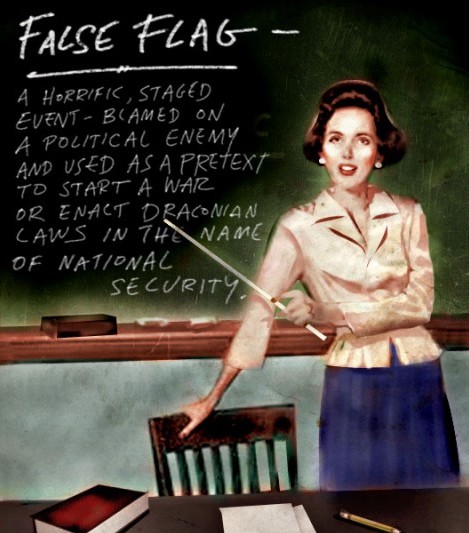
What is a False Flag Attack?

A false flag attack occurs when a government carries out a terror attack against its own population and then falsely blames an enemy to justify a political course of action, such as going to war against the country or countries it blames. While, again, those who question false flag attacks are often denounced by elite propagandists as ‘conspiracy theorists’, in fact the documentation of false flag attacks that have later been admitted is quite long. For one list, see ‘53 Admitted False Flag Attacks’. Of course, plenty of false flag attacks have not been admitted, even when the evidence is overwhelming, as in the case of 9/11 for example.

So Why Do Most People Believe Propaganda?

In an early book on propaganda written in 1928 by Sigmund Freud’s nephew, Edward Bernays, he opened with this paragraph:

The conscious and intelligent manipulation of the organized habits and opinions of the masses is an

important element in democratic society. Those who manipulate this unseen mechanism of society constitute an invisible government which is the true ruling power of our country. See Propaganda.

As Bernays makes clear from the outset, his preoccupation is the manipulation of people to do the bidding of others: clearly, a debased and cynical view of the human individual on which many of humanity’s less morally committed characters have capitalized since Bernays wrote the book.

For example, Joseph Goebbels, Nazi Minister of Propaganda from 1933 to 1945 and an avid reader of Bernays’ work, observed that ‘Propaganda works best when those who are being manipulated are confident they are acting on their own free will.’

But to understand why the approach of Bernays and his disciples such as Goebbels even works, we need to consider why it is that most people are so gullible in the first place. Why don’t more people ask deeper questions about what is taking place rather than simply accepting, without serious question, whatever is presented to them (whether by parents, teachers, religious figures, doctors, propagandists, marketing agents, governments or the corporate media)?

The fundamental problem is simply this: parents, teachers, religious figures and other significant adults in the child’s life require obedience. And obedience means that the child not only behaves as directed by the adult but also that the child believes what the adult believes. This latter point is easily overlooked but is actually the key issue. Why? Because a child who does not believe what the adult believes might think and behave in a way that scares the adult. And demanding obedience is essentially about eliminating beliefs (and their consequent behaviours) that would frighten the parent, teacher or other adult.

Parents require obedience virtually from the moment of birth, doing everything from comforting a child to stop them crying – see ‘Comforting a Baby is Violent’ – to punishing them for acting contrary to parental will once they start moving independently. Of course, once the child starts to think or believe differently, especially if this ‘difference’ is too far from a belief of the child’s parents, teachers or religious leaders (or a widely-accepted belief within their society), the child is quickly pulled back into line with some combination of inducements and/or violence. See ‘Punishment is Violent and Counterproductive’.

Despite legal conventions meaninglessly affirming versions of it – such as the Universal Declaration of Human Rights Article 18 declaring ‘Everyone has the right to freedom of thought…’ – the freedom to think for oneself is not a human right in any meaningful sense of the term and, even if it were, it would really only mean the freedom to think for oneself within certain clearly defined and narrow parameters. And only if you are an adult.

This is why, for example, a child who decides not to go to school does not emerge. Such a possibility would be frightening to virtually every parent, so no child is given that option, let alone allowed the opportunity to come up with, consider and act on that option for themself. Why? Because attendance at school, wherever it exists, is legally compulsory (meaning punishment will be inflicted for failure to comply), and only the rarest parent has the vaguest concept of freedom themselves, let alone the courage to defend their child’s freedom, including the freedom to choose how they spend the bulk of their time for the 8-13 years of ‘school age’.

Consequently, the freedom to think for oneself and act accordingly is strangled at a very young age and certainly by the time a child is compelled to attend a prison for children, also known as ‘school’. As a result the child’s concept of freedom, should they ever come across the notion, can only be a parody of the real thing. And the adult who emerges from this childhood is simply incapable of comprehending what freedom might mean for the obvious reason that to be meaningfully understood, freedom must be experienced.

Of course, is it not just parental authority and school that denies any child the experience of liberty. As Jean-Jacques Rousseau noted in his treatise The Social Contract in 1762, ‘Man is born free; and everywhere he is in chains’. Every institution in society is designed to circumscribe freedom, one way or another. It is just that a childhood spent living under the control of their parents and then teachers and religious figures leaves all children devoid of the experience of freedom and so any subsequent limits are not even noticed. In fact, they are expected and ‘taken for granted’.

So with parents, teachers and religious figures endlessly inflicting ‘visible’, ‘invisible’ and ‘utterly invisible’ violence on the child in the name of ‘socialization’ (which includes requiring obedience under threat of violence for non-compliance), the child progressively and rapidly loses several innate capacities, notably including a sense of their own Self-will, the capacities to think and feel for themselves, as well as conscience. See ‘Why Violence?’ and ‘Fearless Psychology and Fearful Psychology: Principles and Practice’. Anything that is too far from the dominant narrative simply becomes ‘unthinkable’ because the child’s innate capacity to perceive the truth is suppressed along with other mental capacities.

But soon it is not just parents, teachers and religious leaders that are the accepted ‘authority figures’ in the child’s life. No longer able to seriously question the imperatives of parents, teachers and religious figures because they have been terrorized out of doing so, the child has also unconsciously ‘learned’ that virtually any information with which they are presented must be true, even when the source is simply a government or corporate media outlet presenting elite propaganda. For the vast bulk of adult humans, the idea of questioning a dominant narrative does not even occur to them and it is certainly not something they can do with any intelligence, persistent research effort or courage.

So just as Hitler, ably supported by his Propaganda Minister Joseph Goebbels, was able to direct most Germans prior to and into World War II, it is quite straightforward for the global elite to be able to direct the bulk of the human population to believe, for example, that President John F. Kennedy was assassinated by the ‘lone gunman’ Lee Harvey Oswald, that the ‘Gulf of Tonkin incident’ justified the United States war on Vietnam, that a ‘virus’ labeled HIV caused a ‘disease’ labeled AIDS, that the three buildings 1,2 and 7 of the World Trade Center were destroyed by two aircraft flown by novice pilots into the top stories of the Twin Towers and justified the subsequently launched US ‘War on Terror’, that a ‘virus’ labeled SARS-Cov-2 exists and causes a ‘disease’ labeled Covid-19 that has justified the destruction of everything from a range of human rights to the global economy while accelerating four distinct paths to human extinction, that we live in a democracy in which each adult has a say in how they are governed, or even that ongoing effort is being made to bring a greater degree of shared prosperity to the people of the world.

For just a taste of the extensive evidence to debunk each of these propaganda-driven delusions, see these respective analyses of what the evidence actually demonstrates: On the Trail of the Assassins: One Man’s Quest to Solve the Murder of President Kennedy, the Pentagon PapersAIDS Inc.: Scandal of the CenturyArchitects & Engineers for 9/11 Truth‘Unmasking the Lies Around COVID-19: Facts vs Fiction of the Coronavirus Pandemic’‘The Elite’s COVID-19 Coup to Destroy Humanity that is also Fast-Tracking Four Paths to Human Extinction’‘America After the Election: A Few Hard Truths About the Things That Won’t Change’ and ‘The Federal Reserve Cartel: The Eight Families’.

In essence: my point is that is it is not the power of the propaganda, increasingly sophisticated though it has become, that makes people believe it, but a ‘socialization’ model designed to produce submissively obedient ‘individuals’ who gullibly interpret what is happening, and even their own ‘experience’, in terms of the information or scenario (that is, propaganda) with which they are presented. And because of the deeply-seated and unconscious fear of holding a divergent view, most people simply believe the widely-promulgated propaganda narrative with which they become familiar and, hence, comfortable. Moreover, those who challenge the elite-driven narrative frighten them, particularly when elite agents in government and the corporate media label them ‘conspiracy theorists’. For one explanation of why the term ‘conspiracy theorist’ emerged to denigrate those who challenge elite orthodoxy, see ‘In defence of conspiracy theories (and why the term is a misnomer)’.

And so this combination of dysfunctional parenting, education and religious exposure leaves the child devoid of their intuitive ‘truth register’ as well as the other mental faculties that would make them question explanations that obviously lack credibility while investigating and analyzing the evidence for themself. In fact, the idea of doing so never even occurs to them. Hence, a terrorized, gullible and easily manipulated individual enters adulthood. And, as the elite intends, galvanizing an effective response by such people to the truth hidden behind the propaganda is very difficult.

Resisting Propaganda

There is no point hoping that the global elite will discontinue their use of propaganda to shape the course of human events. This is largely because the global elite is insane. See ‘The Global Elite is Insane Revisited’. Moreover, attempts to curb the use of propaganda must inevitably run into the institutions and organizations that the elite controls. And while we can strategically resist these if we choose, the most powerful defence we have against elite propaganda is the human mind that can perceive and critique it. Hence, as a priority, I would profoundly alter our parenting model to achieve this outcome. See ‘My Promise to Children’.

If you are uncertain of your own capacity to critique propaganda, you can expand your capacity to do so by feeling the fear (to release it) that limits your mental faculties. See ‘Putting Feelings First’.

If you are interested in planning or participating in a strategy to achieve a peace, environmental or social justice outcome (particularly in relation to those issues that threaten human extinction), or to resist the elite coup currently taking place under cover of Covid-19, you can read sets of strategic goals for doing so in Campaign Strategic Aims or Coup Strategic Aims.

Moreover, if you wish to tackle the environmental threats to human existence while also strengthening your self-reliant capacity to resist the latest elite onslaught to take (much) greater control of your life, consider participating in ‘The Flame Tree Project to Save Life on Earth’. The greater your dependence on elite systems and processes of any kind, the less power you will have to resist as the noose tightens.

If you are interested in participating in the worldwide effort to resist elite and other violence, you are also welcome to sign the online pledge of ‘The People’s Charter to Create a Nonviolent World’.

More simply, if you like, you might consider committing to:

The Earth Pledge

Out of love for the Earth and all of its creatures, and my respect for their needs, from this day onwards I pledge that:

  1. I will listen deeply to children. See ‘Nisteling: The Art of Deep Listening’.
  2. I will not travel by plane
  3. I will not travel by car
  4. I will not eat meat and fish
  5. I will only eat organically/biodynamically grown food
  6. I will minimize the amount of fresh water I use, including by minimizing my ownership and use of electronic devices
  7. I will not own or use a mobile (cell) phone
  8. I will not buy rainforest timber
  9. I will not buy or use single-use plastic, such as bags, bottles, containers, cups and straws
  10. I will not use banks, superannuation (pension) funds or insurance companies that provide any service to corporations involved in fossil fuels, nuclear power and/or weapons
  11. I will not accept employment from, or invest in, any organization that supports or participates in the exploitation of fellow human beings or profits from killing and/or destruction of the biosphere
  12. I will not get news from the corporate media (mainstream newspapers, television, radio, Google, Facebook, Twitter…)
  13. I will make the effort to learn a skill, such as food gardening or sewing, that makes me more self-reliant
  14. I will gently encourage my family and friends to consider signing this pledge.

Conclusion

The world is complex: it is difficult to understand and requires enormous effort.

Propaganda is designed to give people information that is easy to understand (and sometimes frightening) while distracting them from the truth and offering a simple ‘choice’ (or command) designed to mobilize action in support of an elite-driven narrative.

For example, by telling people they are threatened by a virus, most will be scared into focusing their attention on the ‘virus’. They will pay no attention to the many more complex and dangerous things that are taking place under cover of the ‘virus’: a technocratic/transhumanist coup that is utterly transforming the very essence of human society, economy and even the human individual. See ‘Beware the Transhumanists: How “Being Human” is being Re-engineered by the Elite’s Covid-19 Coup’ and ‘Klaus Schwab and His Great Fascist Reset’.

Only a tiny proportion of the human population has even the vaguest idea of how the world actually works. But not even a tiny proportion of these people recognize that terrorizing children into obedience is the fundamental explanation of why the world works in the way that it does.

Unless we can mobilize greater recognition of our responsibility for giving the global elite the control over us that it has, and tackle this problem at its core – by fundamentally revising existing parenting and education models so that we produce powerful individuals – it will continue to be enormously difficult to mobilize sufficient strategic response to the challenges that confront humanity.

And while we are now fast-tracking four distinct paths to human extinction, there is an urgency about our predicament that accelerates daily.


Biodata: Robert J. Burrowes has a lifetime commitment to understanding and ending human violence. He has done extensive research since 1966 in an effort to understand why human beings are violent and has been a nonviolent activist since 1981. He is the author of ‘Why Violence?’ His email address is flametree@riseup.net and his website is here.

37 Tips For Navigating A Society That Is Full Of Propaganda And Manipulation

By Caitlin Johnstone

Source: Axis of Logic

For as long as there has been human language, humans have been using it to manipulate one another. The fact that it is possible to skillfully weave a collection of symbolic mouth noises together in such a way as to extract favors, concessions, votes and consent from other humans has made manipulation so common that it now pervades our society from top to bottom, from personal relationships between two people to international relationships between government agencies and the public.

This has made it very difficult to figure out what’s going on, both in our lives and in the world. Here are some tips for navigating this complex manipulation-laden landscape, whether that be the manipulations you may encounter in your small-scale personal interactions or the large-scale manipulations which impact the entire world:

1 — Understand the fact that humans are storytelling animals, and that whoever controls the stories controls the humans. Mental narrative dominates human consciousness; thought is essentially one continuous, churning monologue about the self and what it reckons is going on in its world, and that monologue is composed entirely of mental stories. These stories can and will be manipulated, on an individual scale by people we encounter and on a mass scale by skillful propagandists. We base our actions on our mental assessments of what’s going on in the world, and those mental assessments can be manipulated by narrative control.

2 — Be humble and open enough to know that you can be fooled. Your cognitive wiring is susceptible to the same hacks as everyone else, and manipulators of all sorts are always looking to exploit those vulnerabilities. It’s not shameful to be deceived, it’s shameful to deceive people. Don’t let shame and cognitive dissonance keep you compartmentalized away from considering the possibility that you’ve been duped in some way.

3 — Watch people’s behavior and ignore the stories they tell about their behavior. This applies to people in your life, to politicians, and to governments. Narratives can be easily manipulated and distorted in many different ways, while behavior itself, when examined with as much objectivity as possible, cannot be. Pay attention to behavior in this way and eventually you’ll start noticing a large gap between what some people’s actions say and what their words say. Those people are the manipulators. Distrust them.

4 — Be suspicious of people who keep telling you what they are and how they are, because they’re trying to manipulate your narrative about them. Be doubly suspicious of people who keep telling you what you are and how you are, because they’re trying to manipulate your narrative about you.

5 — Learn to see how trust and sympathy are used by manipulators to trick people into subscribing to their narratives about what’s going on. Every manipulator uses trust and/or sympathy as a primer for their manipulations, because if you don’t have trust or sympathy for them, you’re not going to mentally subscribe to their stories. This is true of mass media outlets, it’s true of State Department press releases which implore you to have sympathy for the people of Nation X, and it’s true of family members and coworkers. Once you’ve spotted a manipulator, your task is to kill off all of your sympathy for them and your trust in them, no matter how hard they start playing the victim to suck you back in.

6 — Be suspicious of anyone who refuses to articulate themselves clearly. Word salading is a tactic notoriously used by abusive narcissists, because it keeps the victim confused and unable to figure out what’s going on. If they can’t get a clear handle on what the manipulative abuser is saying, they can’t form their own solid position in relation to it, and the abuser knows this. Insist on lucid communication, and if it’s refused to you, remove trust and sympathy. Apply this to people in your life, to government officials, and to 8chan propaganda constructs.

7 — Familiarize yourself with cognitive biases, the glitches in human cognition which cause us to perceive things in a way that is not rational. Pay special attention to confirmation bias, the backfire effect, and the illusory truth effect. Humans have an annoying tendency to seek out cognitive ease in their information-gathering and avoid cognitive dissonance, rather than seeking out what’s true regardless of whether it brings us cognitive ease or dissonance. This means we tend to choose what we believe based on whether believing it is psychologically comfortable, rather than whether it’s solidly backed by facts and evidence. This is a weakness in our cognitive wiring, and manipulators can and do exploit it constantly. And, again, be humble enough to know that this means you.

8 — Trust your own understanding above anyone else’s. It might not be perfect, but it’s a damn sight better than letting your understanding be controlled by narrative managers and dopey partisan groupthink, or by literally anyone else in a narrative landscape that is saturated with propaganda and manipulation. You won’t get everything right, but betting on your own understanding is the very safest bet on the table. It can be intimidating to stand alone and sort out the true from the false by yourself on an instance-by-instance basis, but the alternative is giving someone else authority over your understanding of the world. Abdicating your responsibility to come to a clear understanding of what’s going on in your world is a shameful, cowardly thing to do. Be brave enough to insist that you are right until such time as you yourself come to your own understanding that you were wrong.

9 — Understand that propaganda is the single most overlooked and under-appreciated aspect of our society. Everyone’s constantly talking about what’s wrong with the world, but hardly any of those discussions are centered around the fact that the public been manipulated into supporting the creation and continuation of those problems by mass media propaganda. The fact that powerful people are constantly manipulating the way we think, act and vote should be at the forefront of everyone’s awareness, not relegated to occasional discussions in fringe circles.

10 — Respect the fact that the science of modern propaganda has been in research and development for over a century. Think of all the military advancements that have been made in the last century to get an idea of how sophisticated this science must now be. They are far, far ahead of us in terms of research and understanding of the methods of manipulating the human psyche toward ends which benefit the powerful. If you ever doubt that the narrative managers could be advanced and cunning enough to pull off a given manipulation, you can lay that particular doubt to rest. Don’t underestimate them.

11 — Understand that western mass media propaganda rarely consists of full, outright lies. At most, such outlets will credulously publish the things that are told to them by government agencies which lie all the time. More often, the deception comes in the form of distortions, half-truths, and omissions. Pay more attention to discrepancies in things that are covered versus things that aren’t, and to what they’re not saying.

12 — Put effort into developing a good news-sense, a sense for what’s newsworthy and what’s not. This takes time and practice, but it lets you see which newsworthy stories are going unreported by the mass media and which non-stories are being overblown to shape an establishment-friendly narrative. When you’ve got that nailed down, you’ll notice “Why are they acting like this is a news story?” and “Why is nobody reporting this??” stories all the time.

13 — Be patient and compassionate with yourself when it comes to developing your narrative navigating skills. Like literally any skill set, you’ll suck at it for a while. If you learn you’ve been wrong about something, just take in the new information, adjust appropriately, and keep plugging away. Don’t expect to have mastered this thing before you’ve had time to master it. Like anything else, if you put in the hours you’ll get good at it.

14 — Find reliable news reporters who have a good sense for navigating the narrative matrix, and keep track of them to orient yourself and stay on top of what’s going on. Use individual reporters, not outlets; no outlet is 100 percent solid, but some reporters are pretty close on some specific subjects. Click this hyperlink for an article on one way to do build a customized and reliable news stream. Click this hyperlink for a list of all my favorite news reporters on Twitter right now.

15 — Don’t let paranoia be your primary or only tool for navigating the narrative matrix. Some people’s only means of understanding the world is to become intensely suspicious of everything and everyone, which is about as useful as a compass which tells you that every direction is north. Spend time in conspiracy and media criticism circles and you’ll run into many such people. Rejecting everything as false leaves you with nothing as true. Find positive tools for learning what’s true.

16 — Hold your worldview loosely enough that you can change it at any time in the light of new information, but not so loosely that it can be slapped out of your head by someone telling you what to think in a confident, authoritative tone. As Carl Sagan once said, “It pays to keep an open mind, but not so open your brains fall out.”

17 — Speaking of confident, authoritative tones, be suspicious of confident, authoritative tones. It’s amazing how much traction people can get with a narrative just by posturing as though they know that what they’re saying is true, whether they’re an MSNBC pundit or a popular conspiracy Youtuber. So many people are just plain faking it, because it works. You run into this all the time in debates on online political forums; people come at you with a supremely confident posture, but if you push them to present their knowledge on the subject and the strength of their arguments, there’s not actually anything there. They’re just accustomed to people assuming they know what they’re talking about and leaving their claims unchallenged, and it completely throws them off when someone doesn’t buy their feigned confidence shtick.

18 — Be aware that sociopaths exist. There are people who, to varying degrees, do not care what happens to others, and these are the types of people who will use manipulation to get their way whenever it serves them. If you don’t care about truth or other people beyond the extent to which you can use them, then there’s no disincentive to manipulating.

19 — Be aware of projection, and be aware of the fact that it cuts both ways: unhealthy people tend to project their wickedness onto others, while healthy people tend to project their goodness. Don’t let your goodness trick you into thinking there aren’t monsters who will deceive and manipulate you, and don’t let sociopaths project their own sinister motives onto you by telling you how rotten you are. This mixes a lot of good people up, especially in their personal lives. Not everyone is good, and not everyone is truthful. See this clearly.

20 — Be suspicious of those who excessively advocate civility, rules and politeness. Manipulators thrive on rules and civility, because they know how to manipulate them. Someone who’s willing to color outside the lines and get angry at someone noxious even when they’re acting within the rules makes a manipulator very uncomfortable. Often times those telling you to calm down and behave yourself when you are rightfully upset are manipulators who have a vested interest in getting you to adhere to the rules set they’ve learned to operate within.

21 — Meditation, mindfulness, self-inquiry and other practices are powerful tools which can help you understand your own inner processes, which in turn helps you understand how manipulators can manipulate you, and how they manipulate others. Just be sure that you are using them for this purpose, not for escapism as most “spiritual” types do. You’re trying to become fully aware of what makes you tick mentally, emotionally and energetically; you’re not trying to become some vapid spiritual bliss bunny. The goal isn’t to feel better, the goal is to get better at feeling. Better at consciously experiencing your own inner world.

22 — Be relentlessly honest with yourself about your own inner narratives and the various ways you engage in manipulation. You can’t navigate your way through the narrative control matrix if you aren’t clear on your own role in it. Look inside and consciously take an inventory.

23 — Understand that truth doesn’t generally move in a way that is pleasing to the ego, i.e. in a way Hollywood scripts are written to appeal to. Any narrative that points to a Hollywood ending where the bad guy gets karate kicked into lava and the hero gets the girl is manufactured. Russiagate and QAnon are both perfect examples of an egoically pleasing narrative with the promise of a Hollywood ending, either by Trump and his cohorts being dragged off in chains or by the “white hats” overcoming the Deep State and throwing all the Democrats and Never-Trumpers in prison for pedophilia. Ain’t gonna happen, folks.

24 — Try to view the world with fresh eyes rather than with your tired old grown-up eyes which have taught you to see all this as normal. Hold an image in your mind of what a perfectly healthy and harmonious world would look like; the sharp contrast between this image and the world we have now allows you see through the campaign of the propagandists to normalize things like war, poverty, ecocide, and impotent electoral systems which keep seeing the same government behavior regardless of who people vote for. None of this is normal.

25 — Know that the truth has no political party, and neither do the social engineers. All political parties are used to manipulate the masses in various ways, and nuggets of truth can and do emerge from any of them. Thinking along partisan lines is guaranteed to give you a distorted view. Ignore the imaginary lines between the parties. You may be certain that your rulers do.

26 — Remain always aware of this simple dynamic: the people who become billionaires are generally the ones who are sociopathic enough to do whatever it takes to get ahead. This class has been able to buy up near-total narrative control via media ownership/influence, corporate lobbying, think tank funding, and campaign finance, and are thus able to manipulate the public into consenting to agendas which benefit nobody but plutocrats and their lackeys. This explains pretty much every major problem that we are facing right now.

27 — Understand that nations are pure narrative constructs; they only exist to the extent that people agree to pretend that they do. The narrative managers know this, and they exploit the fact that most of us don’t. Take Julian Assange, perfect example: he was pried out of the embassy and imprisoned by an extremely obvious collaboration between the US, UK, Sweden, Ecuador, and Australia, yet they each pretended that they were acting as separate, sovereign nations completely independently of one another. Sweden pretended it was deeply concerned about rape allegations, the UK pretended it was deeply concerned about a bail violation, Ecuador pretended it was deeply concerned about skateboarding and embassy cat hygiene, the US pretended it was deeply concerned about the particulars of the way Assange helped Chelsea Manning cover her tracks, Australia pretended it was too deeply concerned about honoring the sovereign affairs of these other countries to intervene on behalf of its citizen, and it all converged in a way that just so happened to look exactly the same as imprisoning a journalist for publishing facts. You see this same dynamic constantly, whether it’s with military interventions, trade deals, or narrative-shaping campaigns against non-aligned governments.

28 — Understand that war is the glue which holds the US-centralized empire together. Without the carrot of military/economic alliance and the stick of military/economic violence, the US-centralized empire would cease to exist. This is why war propaganda is constant and sometimes so forced that glaring plot holes become exposed; it’s so important that they need to force it through, even if they can’t get the narrative matrix around it constructed just right. If they ceased manufacturing consent for the empire’s relentless warmongering, people would lose all trust in government and media institutions, and those institutions would lose the ability to propagandize the public effectively. Without the ability to propagandize the public effectively, our rulers cannot rule.

29 — Remember that when it comes to foreign policy, the neocons are always wrong. They’ve been so remarkably consistent in this for so long that whenever there’s a question about any narrative involving hostilities between the US-centralized power alliance and any other nation, you can just look at what Bill Kristol, Max Boot and John Bolton are saying about it and believe the exact opposite. They’re actually a very helpful navigation tool in this way.

30 — Notice how the manipulators like to split the population in two and then get them arguing over how they should serve the establishment. Arguing over whether it’s better to vote Democrat or Republican, arguing over whether it’s better to increase hostilities with Iran and Venezuela or with Syria and Russia, over whether you should support the US president or the FBI, arguing over how internet censorship should happen and whom should be censored rather than if censorship should happen in the first place. The longer they can keep us arguing over the best way to lick the imperial boot, the longer they keep us from talking about whether we want to lick it at all.

31 — Watch out for appeals to emotion. It’s much easier to manipulate someone by appealing to their feely bits rather than their capacity for rational analysis, which is why any time they want to manufacture support for military interventionism you see pictures of dead children on news screens everywhere rather than a logical argument for the advantages of using military violence based on a thorough presentation of facts and evidence. You see the same strategy used in the guilt trips they lay on third-party voters; it’s all emotional hyperbole that crumbles under any fact-based analysis, but they use it because it works. They go after your heart strings to
circumvent your head.

32 — Pay attention to how much propaganda goes into maintaining the propaganda machine itself. This is done this because propaganda is just that central to the maintenance of dominant power structures. Much effort is spent building trust in establishment narrative management outlets while sowing distrust in sources of dissent. You’ll see entire propaganda campaigns built around accomplishing solely this.

33 — Make a practice of asking “Who benefits from this narrative I’m being sold?” and “Who benefits from this belief I have?” Who benefits from your hating China or the Latest Official Bad Guy? Who benefits from the belief that the status quo is acceptable? Keep asking this about the narratives coming to you, and about the beliefs you already hold in your head.

34 — Learn the art of perceiving life without the perceptual filter of narrative. Mentally “mute” the narrative soundtrack and watch where all the resources are going, where the weapons are moving to and coming from, who’s being killed and imprisoned etc, to get a clear picture of what’s going on in the world.

35 — Whenever the mass media begin declaring that some dastardly deed has been committed which requires immediate military action, your default assumption should be that they’re lying, because they’ve got an extensively documented history of doing so. After lying so consistently about such things so many times, the burden of proof is always on the western power structures who are making the claim, and that burden requires mountains of independently verifiable evidence to be met.

36 — Dismiss all Latest Official Bad Guy narratives. The only ones who benefit from you hating a foreign government are the powerful people who are targeting that government and seeking to manufacture support for future actions against it. Don’t be a pro bono CIA propagandist.

37 — Be acutely aware that the only reason the status quo is accepted as “normal”, and its defenders regarded as “moderate”, is because vast fortunes are poured into making it seem that way. If we could see the status quo of this world with fresh eyes, we’d scream in horror.