The Primary Mechanism Of Your Oppression Is Not Hidden At All

By Caitlin Johnstone

Source: CaitlinJohnstone.com

I write a lot about government secrecy and the importance of whistleblowers, leakers and leak publishers, and for good reason: governments which can hide their wicked deeds from public accountability will do so whenever possible. It’s impossible for the public to use democracy for ensuring their government behaves in the way they desire if they aren’t allowed to be informed about what that behavior even is.

These things get lots of attention in conspiracy circles and dissident political factions. Quite a few eyes are fixed on the veil of government opacity and the persecution of those brave souls who try to shed light on what’s going on behind it. Not enough eyes, but quite a few.

What gets less attention, much to our detriment, is the fact that the primary mechanism of our oppression and exploitation is happening right out in front of our faces.

The nonstop campaign by bought politicians, owned news outlets, and manipulated social media platforms to control the dominant narratives about what’s going on in the world contribute vastly more to the sickness of our society than government secrecy does. We know this from experience: any time a whistleblower exposes secret information about the malfeasance of powerful governments like NSA surveillance or Collateral Murder, we see not public accountability, nor demands for sweeping systemic changes to prevent such malfeasance from reoccurring, but a bunch of narrative management from the political/media class.

This narrative management is used to shift attention away from the information that was revealed and onto the fact that the person who revealed it broke the law or misbehaved in some way. It’s used to convince people that the revelations aren’t actually a big deal, or that it was already basically public knowledge anyway. And it’s used to manipulate public attention on to the next hot story of the day and memory hole it underneath the white noise of the media news churn. And nothing changes.

We’ve seen it happening over and over and over again. The narrative management machine has gotten so effective and efficient that it’s been able to completely ignore the recent revelation that the US, UK and France almost certainly bombed Syria in 2018 for a completely false reason. A few half-assed Bellingcat spin jobs and an otherwise total media blackout, and it’s like the whole thing never happened.

What this tells us is that our first and foremost problem is not the fact that conspiracies are happening behind a curtain of government secrecy, but that the way people think, act and vote is being actively manipulated right out in the open. Government secrecy is indeed one aspect of establishment narrative control, but controlling the public’s access to information is only one aspect. The bigger part of it is controlling how the public thinks about information.

The reason people never use the power of their superior numbers to force real change, even though they’re being exploited and oppressed in myriad ways by the ruling class, is because they’ve been propagandized into accepting the status quo as desirable (or at least normal). The propaganda of the political/media class is therefore the establishment’s front line of defense. Its most powerful, and essential, weapon.

This is important for dissidents of all stripes to understand, because it means we’re not just passively waiting around for another Manning or Snowden or an Ian Henderson to give us information which we can use to fight the oppression machine. Those individuals have done a great public service, but the battle to awaken human consciousness to what’s really going on in our world is in no way limited to leakers and whistleblowers. It is not at the mercy of government secrecy.

If you are engaged in any type of media, you are engaging the narrative matrix which keeps the public asleep and complacent. It doesn’t matter if you have a Twitter account, a Youtube account, some flyers or a can of spray paint: if you are capable of getting any kind of message out there, you are able to directly influence the mechanism of your oppression. You are able to inform people that they are being lied to, you are able to explain why, and you are able to point them to where they can find more information.

This is extremely empowering. You do not need to wait around hoping that some bombshell piece of information makes it past all the various security checks and spinmeisters and triggers a real social awakening. You can be that information. You can become a catalyst for that awakening.

The key to turning this ship around does not lie hidden somewhere behind a veil of government opacity. It lies in you. It lies in all of us. We can begin awakening our fellow humans right now by attacking the narrative management of the propaganda machine that sits right in front of us, unarmored and unhidden.

A Metaphysical Malaise?

By Kingsley L. Dennis

Source: Waking Times

‘The real tragedy of our time lies not so much in the unprecedented external events themselves as in the unprecedented ethical destitution and spiritual infirmity which they glaringly reveal.’

Paul Brunton

There is little doubt that we are living in an age of extreme contradictions where opposing trends appear to exist side by side. It is a time when individuals take greater care of their bodies and are obsessed by diet and health fads, while obesity is an epidemic. We live amidst a paradoxical combination of playfulness and fear, of fun and anxiety, of euphoria and unease. It has been said that ‘When a materialistic civilization becomes outwardly impressive but remains inwardly impoverished, when political relations become an elaborate façade for hiding the spiritually empty rooms behind them, menacing problems are sure to appear on every side.’This quote adequately describes our current situation and yet the author, Paul Brunton, published this in 1952.  However, it remains as starkly correct in its analysis for today as it was for his own time.

The current situation is that ‘menacing problems’ are indeed appearing on every side: political corruption and ineptitude; economic manipulations; national aggression and politically-motivated warfare; refugee crises; human torture and suffering; capitalist greed; corporate corruption; aggravated social unrest; religious and moral intolerance; increased displays of psychopathic behaviour (private individuals and authority figures); blatant propaganda; environmental degradation; ecological ignorance; spiritual destitution, and the rest.

The result is that many people have become ‘spiritually numbed’ by what they see occurring in the world, and feel that only a similar harsh, physical response can be effective. The words ‘mystical’ and ‘spiritual’ remain vague and ethereal. People have always depended on language to bring guidance and nourishment. Yet in this mental environment, words are but skeletal traces of the real flesh. The crisis of our times has clarified little and succeeds in confusing almost everything for the rest of us. There is nowhere to turn in public for finding the truth – seemingly little to believe in for the present and too much uncertainty for the future. The result of this is that many people have doubts that they don’t know how to deal with, and these are building up within their minds like a pathological infection.

An Absence of Meaning

In these current times there is a sense, a feeling, of something lacking or missing within many people’s lives. Unfortunately, this need has been met by the consumerist marketplace. There is a great deal of compensation for this lack through ‘quick fix’ guruism; that is, costly paid retreats, so-called spiritual counselling, and ‘life coaching’ mentorship. Yet these are like fast-food remedies for a deeper hunger. The real struggle today is rather between the material perspective on life and that of the inner, developmental state. Many of the events occurring in the world are manifestations of issues existing within ourselves. The anger and negativity we see so much of in the world is a projection from the collective interior state of humanity. We can manifest both the dream or the nightmare, and we share in its waking state. Being physically mature is not enough; we also need to be emotionally, intellectually, and inwardly mature.

Our cultures and societies are in disequilibrium because they seek to be governed by artificial laws that ignore the timeless wisdom that corresponds to human development. It is a dominant mentality that promotes a short-sighted, myopic worldview that is largely concerned only with physical gains and material power. It is a mentality that promotes fear, defence and attack – rather than a welcoming, embracing vision.

Our societies do not consider human purpose and the deeper meaning of human existence. They drive us to live by working; to enjoy through distractions; and to eventually die with debt and taxes. The world is governed not by fairness or equity, but by a lopsided arrangement of elite power. Conferences of peace are based on compromise and not compassion. Trade is based on strength rather than collaboration. Power and politics are at war with the world and do so beyond the reach of accountability. There is a resurgence of the illegitimate, surging through black markets, offshores, and dark networks. Dark pathways will always emerge and grow in the places where the light is flickering without focus or intent.

Today’s so-called modern cultures are increasingly fragmented, or like liquid streams, that can no longer be accurately identified or navigated by the old signs, symbols, and meanings. Modern life has, to some degree, started to dissolve in order to re-assemble. This may indeed be a part of the needed cathartic process that humanity has to pass through before circumstances will improve. A feature of the current times is that new ways of thinking and behaviour have not yet fully materialized into the present order of things. That which now constitutes ‘daily life’ is void of the questions of metaphysical meaning. Any notion of the developmental, or the metaphysical, is deemed outside of daily life, and people are continually programmed against such deeper truths. In other words, we should not let anything that is ‘other’ – otherworldly or transcendental – replace the responsibility of our social daily grind.

Human societies often make political declarations to promote what they decide to be ‘social happiness.’ Yet political institutions have no genuine models for this, for the dominant political mindset is overruled by a form of psychosis. Social ‘happiness’ is whatever fits into the particular dominant belief system of the age. And as can be seen, this dominant belief, or narrative, has been hijacked by a collective psychosis that I have termed the wounded mind. It appears that as a collective society we have no lasting image of happiness. As a consequence, personal lives are in danger of becoming now less about actual experience and more about the data trails left behind. We have entered another struggle – another social fray – where the battle is between the transparency of our private, inner lives and our public identity.

Identity & Self

These days people are being encouraged to expose their inner demons onto the public stage, especially online. The human shadow is wanting to come out and be revealed. According to Jung, the psychological ‘shadow’ is the underdeveloped and undesirable aspects of ourselves that we try to keep hidden away. And yet there are times when we are unable to hold it at bay, or unconsciously wish for it to manifest. Humanity possesses a tremendous imagination for doing good as well as evil, and this can be a finer line than is realized. As the aphorism states, the road to hell is paved with good intentions. Each person needs to exercise the capacity to detect and acknowledge those unconscious desires, feelings, and thoughts that exist within. American psychologist Rollo May once wrote – ‘Our age is one of transition, in which the normal channels for utilizing the daemonic are denied; and such ages tend to be times when the daemonic is expressed in its most destructive form’2

In short, we need to be extremely mindful in these times about what’s inside of us. Our minds – our thinking and consciousness – is a target and has been for a long time. In the last century this has become more evident, more public. We have become increasingly stuck in modern times within our stories around psychological need and a ‘loss of self.’ Perhaps what is needed is to acknowledge that some people are suffering from what is termed as ‘soul loss.’

People who experience ‘soul loss’ frequently have the feeling of being fragmented, not whole or completely ‘in’ themselves. They feel as if an essential part of them is missing. They may clinically be diagnosed as ‘dissociated.’ Depression is another symptom of soul loss. Soul loss can be associated with the traumas of modern life – fear, terror (warfare), incest or rape, domestic abuse. These are all the external stresses that modern life creates. Counselor and educator John Bradshaw uses the term toxic shame which he sees as a form of alienation from the self, causing it to be ‘otherated.’ In response, people may turn to external sources to fill this internal void.

Carl Jung also made a reference to soul loss in his psychological work. According to psychotherapist Robert Francis Johnson,

‘This loss of soul Jung speaks of is manifested in our culture by the crises we are all facing (increased drug use, violence, moral and emotional numbness) and our attempt to solve moral and spiritual questions by electing wounded leaders who promise economic answers.’3

It is interesting that Johnson refers to ‘wounded leaders’ here who seek our compliance through the language of greed (‘economic answers’). Similarly, prominent Jungian analyst Marie von Franz writes that

‘Soul loss can be observed today as a psychological phenomenon in the everyday lives of the human beings around us. Loss of soul appears in the form of a sudden onset of apathy and listlessness; the joy has gone out of life, initiative is crippled, one feels empty, everything seems pointless.’4

Is this not a description of what faces many people today? Apathy, listlessness, a feeling of a pointless, joyless life? There is clearly a toxic social problem, and we are clearly in need of a metaphysical response.

Where is the Metaphysical?

Any society or civilization that does not recognize the human as a developmental being will fall short in its accomplishments. We simply cannot allow ourselves to fall short – not in the long run, at least. Yet recognition of the human as a developmental being will not come from the world first; and definitely not from social-cultural-political institutions. It will first only come from the individual. And it is from here that genuine change must be nurtured. Now is a crucial time for managing our psychological, emotional, and physical states. We may be uncertain about the future, yet we have the technologies to radically transform our age into something unprecedented. We have both external technologies as well as what may be called ‘technologies of the soul.’ What we are, we transmit to others. We are compelled not only to be mindful, but crucially to be both sensible and soul-ful.

On a practical level, the number of people around the world who have been awoken by the current crises to seek greater inner development is not in the majority. It can be said that at present there exists a metaphysical malaise. Those people who aspire for inner self-development are still all too few. However, a majority was never needed. There is enough.

Humanity is now engaged in a profound moment along its species path. Whether it is recognized or not, we are each living and participating in a reality that exists upon profound metaphysical principles. That’s the bottom line. We can choose to participate in this metaphysical reality, consciously and willingly, or to drift through our lives unbeknown to the forces that impel us. Right now, it is about recognizing this choice, and whether to act upon it. It will not be easy, for all the obstacles that the psychosis-ridden governing systems will throw at us. And yet it must be a force of unwavering inner commitment and genuine self-trust. Each person must choose their freedom from within. The real site of freedom can only be within the inner self – and it is to this we must place our trust.

Snakes In Suits: Are Psychopaths Running The World?

By Alanna Ketler

Source: Collective Evolution

Often when we think of the word psychopath, we think of deranged serial killers that are hopefully locked up in prison for life. While there are many psychopaths who kill for reasons that are unfathomable to most of us and who are indeed in prison, there is an even greater number roaming free in our society and often using their condition to their advantage in any way possible. In fact, it is very likely that you know some–they might even be your colleagues.

Most of us do not know or work with any serial killers, at least not that we are aware of. So, what exactly is a psychopath and how can we define them? The dictionary definition is as follows:

“A person suffering from a chronic mental disorder with abnormal or violent social behavior.”

As you can probably tell, a lot more than just serial killers will fit into this broad definition. In fact, according to Canadian psychologist Dr. Robert Hare, a world-renowned expert on psychopathy, an estimated 1% of the Earth’s population is psychopathic and around 25% of the population of male inmates at federal correctional facilities are psychopathic.

Psychopathic Traits

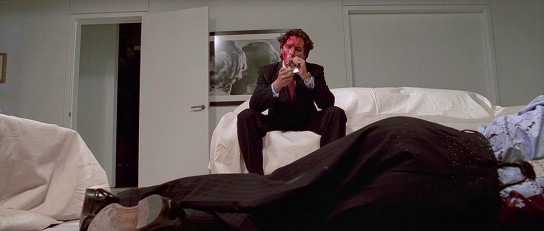
It is important to note that, in contrast with the popular image of the ‘deranged psycho,’ psychopaths tend to be very well composed, take good care of their appearance and are very charming (think of Christian Bale as Patrick Bateman in American Psycho). Because of this you may have a difficult time spotting them out, as they are masters of deception and are able to fake a lot of the qualities that define regular people. Some other psychopathic traits, according to Hare’s Psychopathy Checklist, are as follows:

  • Glib and superficial charm
  • Grandiose estimation of self
  • Need for stimulation
  • Manipulative and cunning
  • Complete lack of remorse or guilt
  • Pathological lying
  • Have a parasitic lifestyle, often latching onto and taking from others
  • Have a history of early behavioral problems
  • Overly impulsive
  • Are very irresponsible
  • Unable to accept responsibility for actions
  • Unable to commit to long-term relationships
  • History of juvenile delinquency
  • Display criminal versatility
  • Experienced a “revocation of conditional release”
  • Lacks realistic long term goals
  • History of promiscuous sexual behavior
  • Have poor behavioral controls
  • Are callous and lack empathy
  • Have a “shallow affect” (psychopaths show a lack of emotion when an emotional reaction is appropriate.)

You can actually rate yourself to find out if you are psychopath. On each criterion, the subject is ranked on a 3-point scale: (0 = item does not apply, 1 = item applies somewhat, 2 = item definitely applies). The scores are summed to create a rank of zero to 40. Anyone who scores 30 and above is most likely a psychopath. Hare has used this test and checklist to detect which inmates are psychopaths.

Snakes In Suits

What many of us may not realize is that psychopaths actually thrive in the corporate world. Hare has actually co-authored a book with Dr. Paul Babiak on this topic entitled, Snakes In Suits: Understanding and Surviving the Psychopaths in Your Office. Psychopaths manipulate others to accrue power, sometimes pitting them against each other in an attempt to divide and conquer. They are often attracted to bigger, dynamic corporations with very little structure or supervision. They generally don’t work well in teams because they don’t like to share information or skills and it brings them joy to watch others fail. They are addicted to power, status and money. Sound familiar?

The corporate world is set up to favor psychopathic traits such as fearlessness, dominant behavior and immunity to stress. Because of this, psychopaths often find themselves in these types of positions, and then have an easier time climbing the corporate ladder and obtaining positions of great power. This is where they can do real damage to society as we see it today.

Are Psychopaths Running The World?

Not only as corporate heads do psychopaths find success in our modern-day society, but also within our governments and political system — often as front-line politicians. This may come as a shock to you, but when you really look at some of the atrocities that are taking place on our planet, and if you’ve ever wondered how things that are so inhumane could actually be happening, well, therein lies part of your answer.

When you consider the war, genocide, senseless murder of civilians, treatment of the indigenous cultures of the world, chemicals in our food, air and water supply, acts of “terrorism”, war crimes and so many other unjust and cruel actions which are often instigated by our political leaders, it becomes easy to see how psychopaths actually fit the requirements for these types of roles quite well. As mentioned before they are masters of deception, pathological liars and often quite charming.

Many soldiers go to war and because they are conditioned to believe that they are fighting an enemy in the name of peace. They do as they are told and commit these heinous acts against other human beings. The reason why so many soldiers suffer from post-traumatic stress disorder is because it is not within human nature to murder other humans, and especially innocent civilians.

We already know how many politicians are crooked, but perhaps its time to start looking at them with the psychopath checklist in mind so that we can be better equipped to protect not only ourselves but our society from their malicious acts.

But Can’t We Help Them?

It is natural for anyone who is involved in spiritual work to have compassion for these individuals and feel compelled to help them overcome their psychopathic behavior. However, most research has pointed towards the understanding that psychopaths are born, not made and therefore cannot be cured. This is one of the main differences that separates sociopaths from psychopaths. Another is that sociopaths have a conscience, albeit a weak one, and will often justify something they know to be wrong. By contrast, psychopaths will believe that their actions are justified and feel no remorse for any harm done. Sociopaths are made, and have a higher likelihood of overcoming their current condition. However, many of those with sociopathic behavior will find themselves in similar corporate positions.

Hare’s research discovered that by attempting to heal or help a psychopath, you might actually be strengthening their cunning abilities, as they will find a way to manipulate you into believing that they are remorseful and understand how their actions were wrong.

Lucid Living

By Caitlin Johnstone

Source: CaitlinJohnstone.com

Beneath all our evolutionary conditioning, beneath all our cultural mind viruses and power-serving, power-promulgated belief systems, beneath the chaos and confusion of life in an insane society, there is a deep stillness.

We all know deep down in our guts that that stillness is there, and that it is our natural condition. That’s why we all spend our lives trying out different strategies for coming to inner tranquility. Most of those strategies are unhealthy and doomed to fail, but that inner stillness at the root of our being is what we’re always reaching to experience.

Beneath all the warmongering, conflict and violence in our species, there is a bottomless foundation of pure peace. We all know deep in our guts that it’s there; that’s why we all secretly long for peace, even if most of us are confused about how to get there.

Beneath all the division, drama and us-versus-them othering, there is an underlying perception in each of us which sees only oneness. We all know deep in our guts that this perception is there, which is why, even though we get mixed up about how best to achieve it, we’re always reaching in some way toward unity.

Beneath all human hate, rejection, bigotry and prejudice, there is a profound love for all that arises. We all intuitively sense this love below our own surface-level awareness, which is why we all, in our own clumsy ways, seek love.

We all know this, on some level. We all know that everything we really want is already our own true nature. That’s why all of us, in our own convoluted, delusional, map-upside-down-and-compass-near-a-magnet ways, seek truth.

That’s all we’re ever really dealing with here, those of us who value peace, truth and justice. All we’re ever really dealing with (in ourselves and in others) is humankind’s built-in impulse to come home, and its flailing, awkward attempts to manifest that impulse.

Peace is your true nature. Oneness is your true nature. Love is your true nature.

I am not here saying that there is some aspect of you that is these things, some small part of you which you can find by rummaging around in your mind and possibly locating underneath your id to the east of your latent oedipal complex or whatever. I’m saying that is you. It’s what you really are, beneath everyone’s mental stories about what you really are.

Day after day from the moment this planet births our body, we experience a field of consciousness containing sensory input, thoughts and feelings. That field of consciousness is all any of us ever experience from cradle to grave, yet it almost never occurs to anyone to pop the hood and directly investigate what makes it tick.

What intense investigation will show you is that all any of us are actually experiencing in any waking moment is this singular, unified field of consciousness being perceived by something that is utterly free from it, in the same way lucid investigation into a dream will reveal a singular, unified dream being perceived by a dreamer who has no stake in what happens to any of the dream characters.

And, just as in the experience of lucid dreaming, when the dreamer realizes the truth of what’s really happening, the experience suddenly becomes a lot more fun. You realize that you, the dreamer are not actually being chased by pirates or whatever, and that you’re actually free from the drama and entanglements in the dream which until that moment seemed perilously threatening. From that free perspective, the dream is delightful. The dream is beloved.

An ineffable something is perceiving the mysterious field of consciousness which has been arising every day since your physical form first showed up here. That ineffable something is your true nature. And it is everything you’ve ever sought in this strange dream world. The only thing keeping your from recognizing this has been your fixation on the drama of the dream.

Lucid living means the dreamer of this waking life, the witness of this beautiful, dancing, ever-changing field of consciousness, is seen clearly to be what you really are.

And the good news is that you are already what it is you’ve been seeking. You just have to perceive this with lucidity. Your innate love of truth is already calling you home. Just follow it.

Saturday Matinee: Society

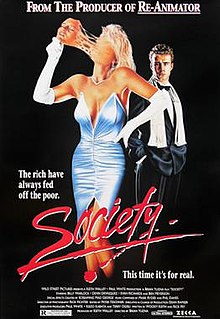
“A Matter of Good Breeding”: The Shape-Shifting Elite in Brian Yuzna’s ‘Society’

By Noah Berlatsky

Source: We Are the Mutants

The elite is an amorphous clotted blob of parasitic greed and hate. Its tendrils extend with slimy stealth into every orifice of society—which makes its precise outlines difficult to see. Are the elite contemptuous coastal liberals and academics? Are they hedge fund managers and tech billionaires? Are they infiltrating globalists or capitalist pigs? Are they your bosses? Or are they your neighbors sneering at your MCU films and your fast food diet? Or are they all of these people and more, gelatinously fusing into a suffocating, boundaryless mass, conspiring in the dank corners of the hierarchy to feed upon and absorb your labor and your soul?

Brian Yuzna’s 1989 schlock horror film Society slides its moist appendages around the concept of the elite, queasily exposing its power and its vile plasticity. Squeezing into the paranoid horror genre at the very end of the Cold War, Society contorts itself away from the communist menace to focus on the evil assimilating rituals of a boneless capitalism. In doing so, though, it inadvertently shows how difficult it is, with the tropes of terror we have, to tell communism and capitalism apart. The two dissolve into a single two-headed, or multi-headed, or faceless mass, impossible to pin down or define, and therefore impossible to escape.

Society‘s protagonist is Bill Whitney (Billy Warlock), a wealthy Beverly Hills teen and star basketball player running for student body president. Everything seems to be going well for him. And yet, “If I scratch the surface, there’ll be something terrible underneath,” he tells his therapist, Dr. Cleveland (Ben Slack), just before biting into an apple and seeing it squirming with (hallucinatory?) maggots. The worm in Bill’s Garden of Eden is his family. His parents Nan (Connie Danese) and Jim (Charles Lucia) are much closer to his sister Jenny (Patrice Jennings) than they are to him. He suspects they don’t love him; he worries he is adopted. Soon, though, he has cause for even more serious alarm. His sister’s ex-boyfriend David Blanchard (Tim Bartell) secretly bugs Bill’s parents and sister; on the tape the three of them reveal that Jenny’s debutante coming out party is a bizarre incestuous group sex ritual. When Bill tries to share the evidence, the tape disappears, and Blanchard is killed in a car crash. The wooden acting and incoherent plot tremble between B-movie incompetence and sweat-drenched fever dream as the conspiracy begins to engulf everyone from Bill’s rival, Ted Ferguson (Ben Meyerson), to his new girlfriend Clarissa Carlyn (Devin DeVasquez), to his doctor, his parents, and the police.

In the film’s infamous conclusion, we learn that Bill was in fact adopted, and his parents and their friends are part of a shape-shifting species that devours humans in a bizarre group feeding sex ritual called the “shunt.” The last twenty minutes of the runtime are an oozy apocalypse courtesy of special effects guru Screaming Mad George: flesh dissolves, mouths turn into clotted rubbery tendrils, and Bill literally reaches up through Ted Ferguson’s anus to pull him inside out in a climactic battle, ending Ted’s life and Bill’s hopes of a Washington internship. Clarissa is so in love with Bill that she betrays her own species, and she, Bill, and Bill’s buddy Milo (Evan Richards) escape the clutches of the elite, whose members have to satisfy themselves with eating Blanchard, saved from his apparent death by car crash for an even more awful fate.

Society is a decadent, absurdly sodden and febrile extension of the body horror genre of the ‘70s and ‘80s, taking The Thing (1982), 1985’s Re-Animator (which Yuzna produced), The Blob (1988), and The Fly (1986), and adding even more K-Y Jelly and quivering sexual innuendo. It can also be seen, though, as a reversal of those late Cold War-era films, reaching through the back end to grab hold of the eye sockets from the inside to pull out the wet, pulsing innards. Just as the Berlin Wall was falling, Society revealed that the fear of the Soviets was fear of the wealthy elite all along.

***

Anti-communist paranoia in Cold War horror often centers on deindividuation and dehumanization. Ronald Reagan was channeling films like 1954’s Them!, with its giant, mindless insect invaders, when he described Communism as an “ant heap of totalitarianism.” The 1958 The Blob features a figurative Red menace: a clump of gelatin fallen from space that absorbs all those in its path, dissolving discrete persons into a single jelly-like mass. 1956’s Invasion of the Body Snatchers imagines alien seed pods falling to earth, from which gestate repulsively fibrous duplicates. They drain human appearance and personality when, in a metaphorical excess of failed vigilance, their targets fall asleep. “Love, desire, ambition, faith—without them life’s so simple,” a pod person explains to the horrified protagonists, sketching a vision of a world enervated by a lack of human warmth and capitalist moxy. Significantly, one of the first signs of the pod invasion is a dual leeching away of business initiative and consumerist impulses. Dr. Miles Binnell (Kevin McCarthy) first notices something awry when he sees an abandoned roadside vegetable stand. Later, when he takes Becky Driscoll (Dana Wynter) out to dinner, the restaurant is almost abandoned. Pod people neither sell nor buy; the hive mind, possessed of invisible tendrils, does not require an invisible hand.

Communism doesn’t just eat through commercial relationships in these films; it eats through domestic ones. Removing consumer desire also removes traditional sexual and romantic impulses, leaving behind monstrous abomination. Science-fiction author Jack L. Chalker neatly summarizes the anti-communist logic in his 1978 novel Exiles at the Well of Souls, in which humans have created Comworlds where “The individual meant nothing; humanity was a collective concept.” To advance that group good, the Comworlds retool sexual biology itself: “Some bred all-females, some retained two sexes, and some, like New Harmony, bred everyone as a bisexual. A couple had dispensed with all sexual characteristics entirely, depending on cloning.” In one of the most quietly ugly moments in Invasion of the Body Snatchers, a working mother prepares a pod for her own baby, noting in a monotone that soon it won’t cry. Plants replace wombs just as outsourced childcare replaces homemaking, and maternal feelings dissolve into a grey, ichorous, proto-feminist puddle.

The 1970s remake of Invasion of the Body Snatchers further teases out the bleakly kinky implications of mind-controlled interference in the reproductive process. Elizabeth Driscoll (Brooke Adams) falls asleep in a field, and, as her personality is sucked from her, her body cracks and crumbles like a rotten pumpkin. Nearby, she rises up in her new form, “born again into an untroubled world, free of anxiety, fear, hate”—and also free of clothes. Pod Elizabeth is completely nude, and the film’s stark gaze willfully conflates desire and terror. In fact, the terror is precisely that she is both fully available and completely unavailable, a desirable body in thrall to some inhuman mass will.

Society takes that body and molds it to different ends. The communist infiltration is replaced with a festering class divide. Good, upstanding businessmen, mothers, and citizens are not infected with an alien ideology. Instead, as the maniacal Dr. Cleveland explains, “No, we’re not from outer space or anything like that. We have been here as long as you have. It’s a matter of good breeding, really.” The parasitic infection is not foreign, but native. No one has been changed; rather, the paranoid revelation is that the evil ones were here all along, squatting wetly in those mansions, and sliding hideously into prestigious internships. No blob or pod or thing needs to take control of the judges, the police, the hospitals, and the student presidency. The blob/pod/thing is already here, salivating. “Didn’t you know, Billy boy, the rich have always sucked off low-class shit like you,” Ted Ferguson sneers, before rolling out an impossibly long tongue to sloppily lick his prey.

Ted’s tongue slides around various kinds of appetite; the rich are hungry not just for deviant power, but for deviant erotics. Just as communism in horror films disorders sexuality, so in Society the rich are marked as evil in large part because of their hypocritical flouting of family values. “We’re just one big happy family except for a little incest and psychosis,” Bill tells Dr. Cleveland nervously, and it’s truer than he knows. His parents and sister share improbably pliable group sex. In a polymorphously perverse primal scene, Bill walks in on them, discovering his mother lying back with her legs turned into arms, and sister Jenny’s head sprouting from her genitals. “If you have any Oedipal fantasies you’d like to indulge in, Billy, now’s the time,” Jenny shrieks gleefully—vapid ‘80s high-class party teen revealed as demonic sexual reprobate.

Billy does have uncomfortable fantasies. Earlier in the film, before he knows what he’s dealing with, he walks in on Jenny in the shower. What he sees is one of the strangest erotic images in film history: through the glazed glass, his sister is facing him from the waist up, her breasts clearly visible. But below the waist her butt is towards him. Bill is frozen in confusion and desire at the sexual grotesque, a literally twisted incestuous spectacle. This erotic narrative stasis is something of a motif in the film. The plot slows down to catch Bill’s wide-eyed reaction during the student president debate, when Clarissa in the audience opens her legs, foreshadowing Sharon Stone’s more explicit move in Basic Instinct (1992) a few years later. Bill similarly comes to a staring halt while watching his parents inspect a phallic, writhing slug in the garden—and then again on the beach, when he is crawling to try to recover some fallen suntan lotion stolen by a couple of mischievous kids. Clarissa, entering stage right, picks up the lotion, and, leaning over him, sprays his face, a move that mimes ejaculation in a phallic role reversal. Finally, when Bill actually has sex with Clarissa, the expression on his face is one of distress and horror as much as pleasure—perhaps because at the height of passion, her left hand slides down sensuously over her back and then down her right arm, as if it’s been cut loose from her body and has wandered off on its own.

The movie itself mirrors Bill’s conflicted gaze, simultaneously fascinated and sickened. The climax is a special effects money shot in multiple respects. The scene is exuberantly concupiscent, with group sex, incest, porn movie tongue kisses, and indeterminate bodily fluids all slickly fusing. The leader of the shunt, Judge Carter (David Wiley), mutters greedily about Blanchard’s beauty mark before devouring him with his mouth, and shoving his hand up his anus. Homosexuality is framed as the ultimate decadence—a terrifying embodiment of penetrative lust that makes you recoil, laugh, and feel things you don’t, or do, want to feel.

The shunt is the Communist blob, with joy added. Judge Carter, Ted, and Jenny all obviously love the shunt. “It’s so fun to see how far you can stretch,” one of Jenny’s fellow shunters tells her. “The hotter and wetter you get the more you can do. It’s great!” The wealthy elite should be opposed to the depersonalization of Communism, but instead they leap in, eager and willing. They’re the enthusiastic audience for all those Cold War films, cheering for the goopy appearance of the Blob.

If all those capitalist viewers loved consuming the Blob, was the Blob ever really a Red Menace in the first place? The problem with seeing Society as an inversion of Cold War anti-communist narratives is that those Cold War anti-communist narratives were often torso-twisted replicas of themselves anyway. The 1988 Blob, for example, replaces the invading goop from space with a biological weapon created by the U.S. government; the shapeless metaphor for communist invasion heaves and bulges and becomes a shapeless metaphor for capitalist invasion.

John Rieder, in 2017’s Science-Fiction and the Mass Culture Genre System, points out that the anti-communism of Invasion of the Body Snatchers can also be read as a terror of capitalism, alluding to the economic signifiers I mentioned earlier.

One of the first signs of the invasion is the closure of a small farmer’s produce stand. Later we see a restaurant losing its business. Finally a group of aliens conspires behind a Main Street-type storefront after one of them grimly turns the sign on the door from Open to Closed. What these emptying-out and closures signify is an economy bent entirely on the production and distribution of seed pods. The colonizing economy is not attuned to the local needs that a produce stand responds to, but rather focuses solely on the single-minded propagation and export of its one and only crop.

The machinations of the body-snatching elites hollow out the town of Santa Mira, just as the society feeds on Blanchard—or just as the vampire feeds in 1922’s Nosferatu. Bram Stoker’s decadent, parasitic aristocrat was robbing helpless victims of their will and individuality via debased, incestuous, homoerotic sexual rituals long before the Cold War seedpods split open. Anti-communism spawned anti-elitism, and anti-elitism spawned anti-communism. Rieder argues that the real danger of the pods is “monopolistic corporate capitalism,” not communism. But which take is the true reading is less important than the way anti-communism is an indistinguishably parasitic replication of anti-capitalism, and vice versa. The tropes of anti-elitism and of anti-communism are grown from one bloated pod. Both dissolve personality, virtue, ambition, love, and sex into a repulsive muck that lives only to eat and perversely reproduce.

Perhaps the best example of how radical and reactionary horror tropes sprout from one another is John Carpenter’s 1988 classic They Live. In the movie, John Nada (Roddy Piper), a virtuous, optimistic, working-class protagonist, discovers that cadaverous aliens are living among us, controlling us with television messages that turn us into obedient, consuming drones. The movie is widely considered a critique of Reagan-era neoliberalism, and it is that. But it’s also a story about the virtues of genocide. A white guy discovers aliens who don’t look like him living in his town, and his first impulse is to murder them. Foreign shape-shifting immigrants, like vampires, are a standard anti-Semitic stand-in for Jews, and They Live can be read as a fascist conspiracy theory, in which brave working Americans finally recognize their racial oppressors, and respond with righteous cleansing violence.

Actual neo-Nazis have in fact read the film in exactly this way. Director John Carpenter insists that this was not his intention, and there’s no reason to disbelieve him. But tropes, like pod people, have minds of their own. When a creator assembles signs that signal “anti-elitism,” those same signs exude a duplicate, indistinguishable signal that is “anti-communism” or its frequent partner on the right, “fascism.” This is certainly the case in Society, a film in which Judaism is as slippery as sexuality. David Blanchard, we’re repeatedly told, is not the right kind of boy to date Jenny. That’s in part, we learn, because he’s Jewish. After his car accident, he has an open casket funeral in a synagogue. The problem is that Jewish people don’t have open casket funerals. Blanchard, whose corpse is faked by the society, is, it turns out (and unbeknownst to the film creators), a fake simulacra of a Jew.

If Blanchard isn’t really a Jew, it follows that the group that rejects him is made up of fake gentiles. And indeed, the vampiric, endogamous, shape-shifting vampires of the society are a not-very-buried anti-Semitic caricature. “You’re a different race from us, a different species, a different class. You’re not one of us. You have to be born into society,” the creatures tell him. This is a statement about the insularity, privilege, and snobbishness of the hereditary rich. But it’s also a racialization of class that is uncomfortably congruent with anti-Semitism. When the rich are horned devils feeding on the blood of your progeny, that could mean they’re not the rich at all, but the usual scapegoat.

Society expresses its disgust for the elite through the visceral, loathsome, oily imagery of homophobia, anti-Semitism, and anti-leftism. Class critique in the popular imagination draws parasitically on the stigmatization of marginalized people, and on tropes of deindividuation and sexual disorder sucked up from anticommunism. This is in part why it’s been so easy for the right over the last half century and more to position itself as the defender of working people. We have built the rhetoric of anti-elitism and the rhetoric of fascism from the same putrid, writhing flesh. If we don’t find a better way to imagine resistance, and soon, society will consume us too.

Watch the full film on Kanopy here.

Epistemological divide: How we live in two different worlds of understanding

By Kurt Cobb

Source: Resilience

Epistemology is the study of how we know things. All of us cycle between two main ways of knowing in our modern culture: 1) the rational, reductionist way and 2) the holistic, relational, intuitive way. By far the most dominant way is the rational, reductionist way and our institutions, scientific, economic, financial and organizational are governed by this way of thinking.

For the reductionist thinker, everything in the universe is made up of parts. If we can understand the parts, we can understand the whole. Depending on the field, the physical world is nothing but atoms and molecules and the social world is nothing but self-maximizing, rational actors. The reductionist view is very powerful and filled with “nothing but” statements. It never occurs to the thoroughgoing reductionist that the idea of “parts” is merely a mental construct.

In our everyday relationships with friends and family, in our nonrational pursuits in music and the arts, in our religious lives, we tend toward the second way of thinking, holistic, relational and intuitive.

We cycle back and forth between these ways of knowing almost effortlessly and for the most part unconsciously. That seems to work well for us as individuals—except when we miscalculate or misperceive a situation and bad consequences follow. Mostly, we regroup and recover and go on, adjusting for what we have learned.

Can the same be said of society as a whole? Yes and no. Global human society can be likened to a superorganism that has its own logic and modes of action. Each of us is strongly influenced by its trajectory and constrained in our actions. We may wish fervently to address income inequality or hunger or climate change. But the complex interactions and power arrangements in our global society make it difficult to do anything but make a small dent. Even our personal destinies seem to be caught up in a flow of events which we cannot control, but rather must react to.

The reductionist way suggests mastery through manipulation of carefully measured forces: mass, temperature, vectors of force, energy gradients (both physical and chemical). We build machines that use energy to build yet more machines. We erect great public works, dams, bridges and roads that create the arteries through which commerce and people flow. We douse the land with chemical fertilizers boosting farm yields to feed hungry billions.

The holistic way suggests mastery through alignment with natural and social forces. We say that it is best to “go with the flow” in both the physical and social dimensions of our lives. Such words imply an intuitive apprehension of an entire pattern. Recognition of patterns becomes the master key to understand the world. But what is a pattern? It is certainly something that repeats, but not always exactly.

Mark Twain is often quoted as saying,”History never repeats itself but it does rhyme.” The mystery of comparison is the engine of perception, cognition and our resulting cultural outputs of literature, art and music.

The holistic way tries to see the entire picture including all the messy consequences. Knowing that those consequences ramify infinitely, it can only intuit the extent and significance of any pattern. The holistic way knows ahead of time that it will never see the whole, only “feel” its meaning.

Both ways are general approaches to modeling the world we see. We create mental models of how the world works and fits together. When we mistake those models for “the truth,” we can get stuck, failing to adjust to new information and experience. We begin to dismiss information contrary to our model rather than embracing such information as a new insight for our process of adjustment. You can hear the dismissal happening when people say, “That can’t be” or “Everybody knows that…”

Heraclitus says, “Nothing endures but change.” The global superorganism—described by Nate Hagens in the piece cited above entitled, “Economics for the future – Beyond the superorganism”—keeps changing but in a direction that constantly undermines the survivability of humankind (and many other organisms and animals). That organism perceives the world as parts to be controlled and exploited, not just partially and temporarily, but completely and permanently. The perception that the universe is a seamless whole where a victory of mastery in one place means a perilous defeat in another, never occurs to this superorganism.

As Hagens describes it, the global human superorganism does not understand that there is a future in which the consequences of its actions will be manifested in a colossal systemic collapse. There is only the hungry maw of now, of immediate control and mastery, of immediate gratification, of immediate power.

The point is not to banish the reductionist way of thinking. Rather, it is to recognize it for what it is, but one model of perception that has its limitations and will never embrace the entire universe—a model that is as prone to error as any other model and one that will never get close to “the truth” because as Heraclitus tells us, “the truth” of the universe is always changing.

“The Cost Of Sanity, In This Society, Is A Certain Level Of Alienation”

By Caitlin Johnstone

Source: CaitlinJohnstone.com

The late psychonaut/philosopher Terence McKenna once said “The cost of sanity, in this society, is a certain level of alienation,” and I think my regular readers will immediately and experientially understand exactly what he was talking about.

It’s not always easy to be on the outside of consensus reality. Our entire society, after all, has been built upon consensus–upon a shared agreement about what specific mouth sounds mean, on what money is and how it works, on how we should all behave toward each other in public spaces, and on what normal human behavior in general looks like.

We all share a learned agreement that we picked up from our culture in early childhood that it’s normal and acceptable to stand around with your hands in your pockets and babble about the weather to anyone who gets too close to you, for example, whereas it would be considered weird and disruptive to stand around slathered in Cheese Whiz shrieking the word “Poop!” But we could just as easily reverse that consensus on behavioral norms tomorrow, and as long as we all agreed to it we could do it without missing a beat.

In exactly the same way, there exists a general consensus about what’s going on in our world at the moment. There’s a general consensus that we live in the kind of society we were taught about in school: a free and democratic nation which maybe did some not so great things in the past, but is now a supremely virtuous beacon of light on this earth that kicked Hitler’s ass and then surfed into the present day on a wave of truth and sensible fiscal policy. There’s a general consensus that the news reporters on our screens paint us a more or less accurate picture of world affairs, that there are a lot of Bad Guys in our world with whom the Good Guys in our government are fighting, and that most of our nation’s problems are caused by the people in the other political party.

This consensus is grounded in delusion. It is insanity.

In reality, of course, we live in a world where our understanding of the world is constantly being deceitfully manipulated by oligarchic media propaganda and the utterances of oligarch-owned politicians. Where elections are mostly just a live action role-playing game which allows the rabble to pretend that they have some degree of influence over the things that their government does. Where our government routinely forms alliances with the worst Bad Guys on the planet while manufacturing consent to topple governments whose downfall would be utterly disastrous. Where our nation’s problems have almost nothing to do with half its population disagreeing with our personal ideology, and practically everything to do with the loose international alliance of plutocrats and government agencies who actually run things behind the facade of the comings and goings of official elected governments.

Sanity means seeing this as it is, rather than subscribing to the mass delusion of the consensus worldview. Which, as you probably already know, can make it difficult to relate to others in some ways. Conversations about politics often either get heated very rapidly when you challenge a tightly-held orthodoxy or dead-end in awkwardness. Friendships can end. Family relationships can be ruined. Collective narratives about you can be woven and circulated within your social circle which have nothing to do with how you actually see things.

And that’s just if you talk about your worldview. If you keep your views to yourself, as many do, that’s just another kind of alienation. It’s to stand outside of public political discourse completely, unable to participate out of fear of the backlash you’d receive from your friends, loved ones and acquaintances if you started talking about Trump as a symptom rather than the disease, or said that Corbyn is being targeted by a transparently bogus smear campaign, or said that Russia’s interventions in world affairs are clearly dwarfed by America’s by orders of magnitude. The specific heresies will vary depending upon the social circle, but the inability to voice them necessarily comes with the same sense of alienation.

But the alternative to that sense of alienation is to live a lie. It’s to climb back inside the distorted funhouse-mirror reality tunnel of the establishment narrative control matrix and plug yourself back into the same delusions that everyone else is living. Most of us couldn’t even do that if we wanted to. Even if we could the intense mental gymnastics we’d have to perform just to avoid the discomfort of cognitive dissonance would make it not worth the effort.

We close ourselves off from a full sense of participation in our society when we depart from the consensus worldview, but in closing that door we open so many more. Because, as it turns out, all that effort that people pour into staying on the same wavelength as everyone else closes them off to a vast spectrum of potential human experience. The allure of the mass delusion is that you need to devote yourself to being plugged into it in order to achieve what the mass delusion defines as “success”, but in so doing you lose the ability to leap down psychological and experiential rabbit holes of consciousness that those still jacked into the matrix can’t even imagine. And in so doing you open up the possibility for an immensely more fulfilling and enjoyable life that has really deeply explored the more intimate questions about what it means to be a human being on this planet.

Jiddu Krishnamurti once said, “It is no measure of health to be well-adjusted to a profoundly sick society.” And a profoundly sick society is indeed what we have here. The alienation which we experience is an alienation from something that isn’t worth belonging to anyway.

I began this essay with a quote from one of the celebrated thought leaders of the psychedelic movement, and I think the question of what we can do to cope with the alienation McKenna spoke of is best answered by ending with a quote from another such leader, Timothy Leary:

“Admit it. You aren’t like them. You’re not even close. You may occasionally dress yourself up as one of them, watch the same mindless television shows as they do, maybe even eat the same fast food sometimes. But it seems that the more you try to fit in, the more you feel like an outsider, watching the ‘normal people’ as they go about their automatic existences. For every time you say club passwords like ‘Have a nice day’ and ‘Weather’s awful today, eh?’, you yearn inside to say forbidden things like ‘Tell me something that makes you cry’ or ‘What do you think deja vu is for?’. Face it, you even want to talk to that girl in the elevator. But what if that girl in the elevator (and the balding man who walks past your cubicle at work) are thinking the same thing? Who knows what you might learn from taking a chance on conversation with a stranger? Everyone carries a piece of the puzzle. Nobody comes into your life by mere coincidence. Trust your instincts. Do the unexpected. Find the others.”

The Hidden Utopia: Hobo Graffiti and Sixties Paranoia in ‘The Crying of Lot 49’

By Pepe Tesoro

Source: We Are the Mutants

Thomas Pynchon’s 1966 novel The Crying of Lot 49 is usually regarded as one of the best testimonies of Cold War paranoia and early psychedelic ’60s culture. Even though it is a keen and pointed exploration of the growing anxieties over the exponential post-war rise of mass media and market capitalism, the central conspiracy revealed in the novel doesn’t reproduce itself through the then-new and fascinating forces of radio waves or cathode rays. Quite the opposite: the kernel of the conspiracy in Pynchon’s novel lays precisely in a clandestine communication network sent through old-fashioned, conventional mail. This network itself possesses roots that go back as far as medieval nobility feuds, its presence identified with something as ancient and basic as graffiti. Fredric Jameson attributed the true effectiveness of the novel to this anomalous feature. “[T]he force of Pynchon’s narrative,” he writes in The Geopolitical Aesthetic: Cinema and Space in the World System, “draws not on the advanced or futuristic technology of the contemporary media so much as from their endowment with an archaic past.”

It would seem that in order to perform an adequate exploration of the psychological and social and political disruptions of an era’s newest and most cutting-edge technological developments, sometimes it is required to take one or two steps back, as if the reflection over contemporary objects would be better served through the examination of old and already familiar realities. The long history and deep cultural footprint of retro-futuristic aesthetics in Pynchon’s fictional universe seems to point in somewhat the same direction. But this odd narrative movement doesn’t just go backwards; it also, quite interestingly, usually goes downwards. That’s the case of the The Crying of the Lot 49, where the occult conspiracy that our poor protagonist, Oedipa Maas, struggles to unveil, doesn’t just rely on the old means of the mail. Its members are imagined as marginalized individuals living in between the remnants and scraps of industrial machinery, as if the life of the vagabond would be the only true escape from the madness of modern civilization. These elusive individuals, as imagined by Oedipa, seem to be:

…squatters who stretched canvas for lean-tos behind smiling billboards along all the highways, or slept in junkyards in the stripped shells of wrecked Plymouths, or even, daring, spent the night up some pole in a lineman’s tent like caterpillars, swung among a web of telephone wires, living in the very copper rigging and secular miracle of communication, untroubled by the dumb voltages flickering their miles, the night long, in the thousands of unheard messages.

This supposed conspiracy of the homeless and the outcast, not subtly named W.A.S.T.E., is then imagined as a hidden net that mimics modern global communication networks, and even lives as close as it can to those hardware channels. And precisely because of that, it stays totally untouched by modernity and is invisible to its gaze. The particular mixture of secrecy, homelessness, and clandestine communication systems in Oedipa’s imagination was not new at the time, and can be traced back to the life and especially the works of one Leon Ray Livingston.

Livingston, born in 1872, was probably the most notorious American hobo. “Hobo“ is actually a rather particular term in American cultural history; it doesn’t merely designate an individual who lacks a stable location or place for living, but it instead indicates a quite idiosyncratic American social character, determined by the country’s own history of geographical expansion and industrialization. The hobo was a homeless man that crossed the entire continent, from city to city, throughout the growing railroad’s network, surfing the new, blossoming industrial landscapes a job at a time. Throughout the years, the hobo came to be recreated by the national cultural imagination as a romantic figure, a mystical outsider, a mysterious and almost invisible inhabitant of the modern world’s new industrial features, constantly at the edge of society, always trying to avoid unwelcome company and harassing authorities. That popular image was mostly the work of Livingston.

Livingston was not just a hobo; he was also a popular author. Under the pen name of “A-No1,” he published a series of books that fictionalized the hobo lifestyle and basically created from scratch the romantic and enigmatic portrait just described. But probably the most fascinating and persistent myth that emerged from the A-No1 books was the existence of a secret hobo code, presented in unnoticed and almost invisible chalk or charcoal graffiti. This code, composed of cryptic, seemingly ordinary and almost-childish hieroglyphs and symbols, was supposedly used by traveling hobos to transmit messages to their colleagues, such as “Dangerous town,” “Safe place to spend the night,” or “Here lives a nice lady.” It is known and well-documented (mostly through the work of filmmaker Bill Daniel) that the practice of signing the side of wagons and rail post with their personal monikers was and still is a spread practice for hobos and railroad workers in America. But with respect to a secret code that transmitted useful messages from hobo to hobo, there is not much evidence that it actually existed. After all, why would the hobo, a supposedly elusive and off-the-grid character, want to make public their own secret means of communication? It is not unfair to assume that the publication of the hobo code was probably nothing more than a ploy to fabricate and maintain that same legendary elusiveness.

Either way, thanks to Leon Ray Livingston’s works, the hobo’s supposed secret code became a common emblem of the intriguing and puzzling (and pretty much fantastic) mysteries of industrial civilization’s own underground realities. It seemed at the same time spooky and exhilarating to imagine that the unstoppable machine of progress was leaving behind, in its own dark residue, a striving secret society of outcasts and ostracized rebels living an almost chivalrous adventure, having happily exchanged social status and at times mental health to be free of the oppressive commands of power. I think it goes without saying how popular this common narrative has stayed throughout the years in science fiction and, more generally, in popular culture. The mystic figure of the marginalized can be tracked from the charming and magical homeless lady in Frank Capra’s A Pocketful of Miracles, to the cyberpunk Martian mutant separatists in Total Recall, to the Lo-Teks in Johnny Mnemonic and the Nebuchadnezzar crew in The Matrix series, just to name a few. These cyberpunk re-imaginations fall under the myth of the “hidden utopia”: the assumption that the hopes of resistance against the conspiracy of modern civilization lays in a counter-conspiracy of the outcasts, the unlikely sub-inhabitants of its most obscure and remote corners.

This is exactly what is deployed by Pynchon in The Crying of the Lot 49. Or, at least, this is how a borderline-paranoid protagonist tends to imagine a seemingly active but always evasive conspiracy, as if the myth of the hidden utopia could be also a borderline-paranoid fantasy of those made anxious and disoriented by postmodern subjectivity. It’s also possible to observe the echo of the hobo graffiti’s legend in Pynchon’s book, as the W.A.S.T.E. logo, a simply drawn muted cornet, suspiciously similar to the purported signs of the hobo code, appears to have been placed all over the most seemingly mundane corners of Oedipa’s reality, such as on the walls of a public bathroom or on the edge of a sidewalk.

But the recovery and use by Pynchon of these older cultural cues is not an idealization of the hidden problems of the homeless and the marginalized. After all, any social articulation outside the limits of the community itself can easily turn into a contradiction, a fantasy, a paradox not allowed by the predominant culture. If the whole world has been conquered by malignant forces and crooked interests, the possibility of a constructive, non-nihilistic escape from this system literally lays outside of this world. That’s why Pynchon, as Oedipa, finds himself at a dead end, accepting that, if W.A.S.T.E. and its obscure conspirators were to exist, its own definition would prohibit the final revelation of its actual existence. That’s good for Pynchon, who playfully explores the literary potential of such contradiction, but it ain’t so good for Oedipa, who is still and forever trapped in modern society, and seems destined to always live on the epistemic edge of paranoia, unable to determine if everything she experiences is a convoluted prank by her ex-lover, if she has gone definitively crazy, or if W.A.S.T.E. is, in fact, real.

In a dream-like episode in the middle of the novella, Oedipa encounters an old ex-anarchist friend, Jesús Arrabal, who, torn apart by the demise of the emancipatory narrative, has to admit to her the metaphysical impossibility, or at least almost supernatural essence, of any revolutionary promise: “You know what a miracle is. Not what Bakunin said. But another world’s intrusion into this one.” Alien invasion? Religious intervention? Not quite, but similarly unlikely: the possibility that, under the all-mighty and ubiquitous forces of the Machinery and the cannibalistic and expanding logic of Capital, there could have formed a secret alliance of those who have been cast out of society, those who inhabit the obscure nooks of the dirt and the piles of garbage, under the colossal figure of the ominous constructions and highways. Like parasites in the wires of modern communication systems, these posited liberatory beings have been exiled in a land “invisible yet congruent with the cheered land [Oedipa] lived in,” barely but firmly surviving out of the realm of the living, right next to where we stand, but nevertheless unnoticed by the naked eye.