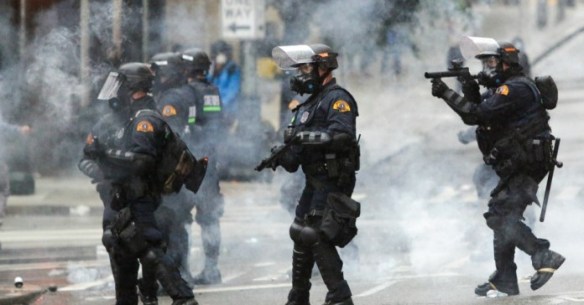
When you see riot police surround the Lincoln Memorial and protesters snatched off the streets by masked soldiers in unmarked cars.
And when you realize that it is all being watched by an unblinking eye of A.I. surveillance.
At times, it feels like we are living in a real-world version of dystopia. The strange outcome, though, is that it means we need dystopian fiction now more than ever, to help us sort and even make it through it.
You’d think with everything going on, now would be the last time to escape to a world of darkness. And yet books, including those of awful imagined worlds, are in deep demand.
Some of it has been a return to old classics. In a period of disease and lockdowns lasting for weeks, booksellers report the seeming irony that Albert Camus’ The Plague and Gabriel García Márquez’s One Hundred Years of Solitude have seen renewed demand. And some of it has been escaping into new worlds, as with Divergent author Veronica Roth taking readers into another post-apocalypse with her new novel Chosen Ones. People have even been willing to enter imagined worlds that seem not too far away, such as Lawrence Wright’s best-selling pandemic thriller The End of October.
Yet the value of the genre is as much in education as entertainment. It can elucidate dangers, serving the role of warning and even preparation. Think of the recent resonance of Margaret Atwood’s 1985 Handmaid’s Tale and its 2020 sequel The Testaments or the revival of interest in It Can’t Happen Here by Sinclair Lewis in 1935. These are finely written works, not as indulgences, but as a pure expression of the idea that to be forewarned is to be forearmed. Even Susan Collins’ Hunger Games prequel, The Ballad of Songbirds and Snakes, might be interpreted in that light, showing how authoritarian rule can originate through the manipulations of an ambitious striver.
Our personal corner of this dark market is the meld of imagination with research. For our book Burn-In: A Novel of the Real Robotic Revolution, we chose the setting of not a far-off imagined world like Panem or Gilead, but Washington, D.C., just around the corner. What happens as Silicon Valley’s visions of utopia hits our real, and very divided, country? What plays out in politics, business, and even family life as our economy is rewired by AI and automation? Yet to make our scenario more haunting, we back up everything that happens in it with 27 pages of endnotes.
When the scarier elements from an imagined world come to life in the real one, however, there is no gleeful “I told you so.” When the novel coronavirus accelerated the more widespread roll out of the robots, remote work, job automation, and AI surveillance projected in our book, we certainly weren’t happy. All it meant was that all the tough dilemmas that our characters face would come quicker for all of us. What was perhaps most disturbing of the last few weeks, though, were when some of the most dystopian scenes we had painted of a future Washington, D.C., also came true, from our book’s scene of riot police deployed around the Lincoln Memorial to the militarized fence thrown up around the White House being put exactly where we had it in Burn-In.
Yet what makes dystopian fiction different is that its creators are oddly optimists at heart, as we are. These works are not about prediction, but prevention. The stories warn of just how far things can go if action isn’t taken, wrapped in a package that is far more impactful than a white paper or PowerPoint. Indeed, research shows that narrative, the oldest communication technology of all, holds more sway over both the public and policymakers than even the “most canonical academic sources.” Our minds can’t help but connect to the “synthetic environment” that our fictional heroes and villains experience, living part of our lives through theirs, even if imagined.
Most importantly, though, the dark worlds are only the setting. The stories are really about the agency of the people in them. And that is perhaps the true value of the dystopian fiction. These stories are not about what those characters experience so much as how they act. At the heart of every story of darkness is a story of perseverance.
As we face our own difficult journeys through the reality of 2020, it is perhaps that lesson which is most important of all.
If people in power were no longer able to hide secrets and spin lies about what’s going on in the world, all of our major problems would come to an end. Because secretive and manipulative power structures are the source of all of our major problems.
If the public could see what’s actually happening in their world, they would immediately begin using the power of their numbers to overhaul our current system. This is why our current system pours so much energy into preventing the public from seeing what’s actually happening in their world.
If it weren’t for the constant campaign of obfuscation and manipulation of public perception via veils of government secrecy and propaganda, humanity would naturally find its way out of the power-driven tribulations it now faces, as surely as you’ll avoid obstacles and hazards in your path when you are walking with your eyes open. The only problem in this case is that our eyes have not been permitted to open.
It isn’t actually necessary to hold a bunch of hard, rigid ideas about exactly what kind of society we should have, what kind of political system we should have, what kind of economic system we should have. There’s nothing wrong with promoting ideas and having preferences of course, but really if you just gave humanity the ability to navigate through its own troubles by removing the blindfolds of propaganda and power opacity, it would organically create a healthy society, and realistically such a society probably won’t look a whole lot like our mental models.
You do have the option, then, of simply promoting the end of government/political/corporate/financial opacity and the end of establishment perception management. Wanting humanity to see with clear eyes so that it can make its own informed decisions about where to take itself is a complete political position, in and of itself. You don’t have to hold any other political preferences of any kind if you don’t want to.
The desire for an end to the obfuscations and manipulations of the powerful so that humanity can find its own way is the most anti-authoritarian position you can possibly take, because it also protects the world from your own authoritarian impulses.
I personally am very leftwardly inclined and believe that if humanity had its perception management blindfolds removed it would naturally create a world where we’re all truly equal and everyone is taken care of by the collective each according to their need, but what the hell do I know? Maybe if the blindfold is removed I’d be proven wrong. I respect human sovereignty enough to want to find out, free from my own political preferences. I should not be the one making such societal decisions, society as a whole should. I just want human perception to be freed up enough to make that call.
How To Defeat The Empire
"What I do advocate, in as many different ways as I can come up with, is a decentralized guerrilla psywar against the institutions which enable the powerful to manipulate the way ordinary people think, act and vote."https://t.co/4F5dWaURdq
If you choose to make the end of perception management your foremost priority, that means you push for government transparency at every opportunity and support any movement to take away secret hiding places from the powerful.
It means opposing the way the powerful bolt shut all the doors on public scrutiny of their behavior, smear anyone who speculates about what they might be up to as a crazy conspiracy theorist, and imprisons anyone who leaks information about what they’re really doing to the people.
It means you support whistleblowers like Chelsea Manning and Edward Snowden who help shine light on the things power tries to keep hidden in the dark.
It means you support WikiLeaks and Julian Assange and any journalist who helps expose the secrets of the powerful.
It means you support breaking up the monolithic mass media and giving everyone the equal ability to influence the dominant narratives.
It means opposing internet censorship, since Silicon Valley plutocrats propping up the establishment their kingdoms are built upon by censoring anti-establishment voices is another way of keeping people from being shown the truth about their world.
I personally would add that it means supporting the decriminalization of psychedelics, because seeing within ourselves is just as important as seeing what’s happening in our world and entheogens can facilitate this seeing, but maybe that’s just me.
Cancel Government Secrecy: Notes From The Edge Of The Narrative Matrix
"Government says it needs secrecy to make war on its enemies effectively, and, curiously, the more secrecy we allow it the more wars and enemies it seems to have."https://t.co/fLWa478cva
Again, there’s no harm in engaging in politics and pushing for the changes you’d like to see in your world, and there can be many benefits to doing so. But as long as people are successfully prevented from seeing and understanding what’s really happening in their world by the obfuscation of information and by the manipulation of people’s perception of that information, the status quo will always remain in place.
So in my opinion this is the most sensible point upon which to converge our energy. I personally have no interest in controlling what humanity does, and desire only that people come to see freely enough to make their own decisions.
It’s absolutely insane that information which affects us all is kept hidden away from our clear vision by secrecy and propaganda. It’s even crazier that they shame us when we wonder what’s really going on and throw us in prison when we try to find out. We must liberate ourselves from this madness so we can create a healthy world together.
Personality is persona, a mask…The mask is magic…Larva means mask; or ghost…it also means mad, a case of demoniacal possession.”
Norman O. Brown, Love’s Body
Walk the streets in the United States and many countries these days and you will see streaming crowds of people possessed by demons, masked and anonymous, whose eyes look like vacuums, staring into space or out of empty sockets like the dead, afraid of their own ghosts. Fear and obedience oozes from them. Death walks the streets with people on leashes in lockstep.
That they have been the victims of a long-planned propaganda campaign to use an invisible virus to frighten them into submission and shut down the world’s economy for the global elites is beyond their ken. This is so even when the facts are there to prove otherwise.
It is a clear case, as Peter Koenig tells Michel Chossudovsky in this must-see interview, that is not a conspiracy theory but a blatant factual plan spelled out in the 2010 Rockefeller Report, the October 18, 2019 Event 201, and Agenda 21, among other places.
Who can wake the sleepwalkers up in this cowardly new world where culture and politics collude to create and exploit ignorance?
Fifty-five years ago on, July 20, 1965, Bob Dylan released his song “Like a Rolling Stone.” It arrived like a rocking jolt into the placid pop musical culture of the day. It was not about wanting to hold someone’s hand or cry in the chapel. It wasn’t mumbo-jumbo like “Wooly Bully,” the number one hit. It wasn’t like the pop pap that dominates today’s music scene. It wasn’t Woody Guthrie in slow time.
It beat you up. It attacked. It confronted you. Maybe, if you were alive then, you thought Dylan was kidding you. You thought wrong. Bitching about his going electric was a dodge. He was addressing all of us, including himself.
Still is. But who wants to hear his recent “Murder Most Foul” and read Dylan’s scathing lyrics about the assassination of JFK, the killing that started the slow decay that has resulted in such masked madness. “And please, Don’t Let Me Be Misunderstood,” he tells us in capital letters for emphasis. Exactly what all the mainstream media have done, of course, and not by accident.
There are no alibis.
“How does it feel/To be on your own/with no direction home/A complete unknown/Like a rolling stone?”
It was in the mid-1960s when confidence in knowing where home was and how to get there disappeared into thin air. If you left mommy and daddy, could you ever get back from where you were going? Who had the directions?
Absolutes were melting and relativity was widespread. Life was wild and the CIA was planning to make it wilder and more confusing with the introduction of LSD on a vast scale. MKUltra was expanding its scope. Operation Mockingbird was singing so many tunes that heads were spinning, as planned.
The national security state killers were in the saddle, having already murdered President Kennedy and Malcolm X as they sharpened their knives for many more to come. The peace candidate, Lyndon Baines Johnson, had been elected nine months earlier with 61.1% of the popular vote and went immediately to work secretly expanding the war against Vietnam. War as an invisible virus. Who knew?
Who, but a small anti-war contingent, wanted to know?
War takes different forms, and the will to ignorance and historical amnesia endure. War is a disease. Disease is weaponized for war. In 1968 Richard Nixon was elected on a “secret plan” to end the Vietnam War and then ramped it up to monstrous proportions, only to be reelected in 1972 by carrying 49 out of 50 states.
Who wants to know now? The historian Howard Zinn once said correctly that this country’s greatest problem wasn’t disobedience but obedience.
What’s behind the masks? The lockstep?
On the same day that Dylan released “Like a Rolling Stone,” Secretary of Defense Robert McNamara, just back from a “fact-finding” trip to Vietnam, recommended to LBJ that U.S. troop levels in Vietnam be increased to 175,000 and that the U.S. should increase its bombing of North Vietnam dramatically.
This was the same McNamara who, in October 1963, had agreed with JFK when he signed NSAM 263 calling for the withdrawal of 1,000 military personnel from Vietnam by the end of 1963 and the remainder by the end of 1965. One of the moves that got Kennedy’s head blown open.
Poor McNamara, the fog of war must have clouded his conscience, confused the poor boy, just like Secretary of State Colin Powell holding up that vile vial of “anthrax” at the United Nations on February 5, 2003 and lying to the world about weapons of mass destruction in Iraq.
Powell recently said, “I knew I didn’t have any choice. He’s the President.” How “painful,” to use his word, it must have been for the poor guy, lying so that so many Iraqis could be slaughtered. Of course, he had no choice. These war criminals all wear masks. And have no choice.
Masks, or demonic possession, or both. You?
Also in that fateful year 1965, far out of sight and out of mind for most Americans, the CIA planned and assisted in the slaughter of more than a million Indonesians, led by their man, General Suharto. This led to the coup against President Sukarno, who two years earlier had been on good terms with JFK as they worked to solve the interrelated issues of Indonesia and Vietnam. Their meeting planned for early 1964 was cancelled in Dallas on November 22, 1963.
And the politicians and media luminaries came out in their masks and told the public that communists everywhere were out to get them.
It’s tough being on your own. It hurts to think too much. Or think for yourself, at least. To obey an authority higher than your bosses. “I was tricked” is some sort of mantra, is it not?
You never turned around to see the frowns on the jugglers and the clowns
When they all did tricks for you
Dylan was lost and disgusted when he wrote the song. His own music sickened him, which, for an artist, means he sickened himself. He had just returned from a tour of England and was sick of people telling him how much they loved his music when he didn’t. He needed to change.
What else is the point of art but change? If you’re dead, or afraid of getting dead, you aren’t going to change. You’re stuck. Stuck is dead. Why wear a mask if you know who you are?
Knowledge, or more accurately, pseudo-knowledge or mainstream media lies, is a tomb “the mystery tramp” sold to us, a place to hide to avoid pain and guilt.
I have read more books than anyone I know. It sickens me.
I know too much. That sickens me.
I sicken myself. All the news sickens me.
I know so much no one believes me.
As Francesco Serpico once told me: “It’s all lies.”
Of course. Dylan and Serpico are blood brothers.
Only art tells the truth. Real art.
Not bullshit pop art. Some say “Like a Rolling Stone” is about Edie Sedgwick, “the girl of the year” in 1965 and one of Andy Warhol’s superstars. Perhaps to a degree it is, but it’s far more than that. It’s about us.
Poor Edie was poisoned by her wealthy family at a young age and barely had a chance. She was an extreme example of a rather common American story. People poisoned in the cradle. Thinking of her got me thinking of Andy Warhol, the death obsessed hoarder, the guy who called his studio “The Factory” in a conscious or unconscious revelation of his art and persona, his wigs and masks and the hold he has had on American culture all these years. Isn’t he the ultimate celebrity?
Warhol once took my photo on a deserted street. His and my secret but this is the truth. West 47th Street on an early Sunday morning, 1980. I guess he thought he was doing art or collecting images for his museum of dead heads. When I asked him why, he said I had an interesting face.
I told him he did too, rather transparent and creepy, but I didn’t want to capture him. He was a ghost with a camera, a face like a death mask, trying to capture a bit of life. I told him I didn’t give him permission to shoot me, but he turned and walked away into the morning mist. The shooters always just walk away in pseudo-innocence.
I then went down the street to the Gotham Book Mart that was my destination and asked James Joyce why he had written “The Dead,” and Joyce, secretive as ever, quoted himself, “Ed,” he said, “Think you’re escaping and run into yourself. Longest way round is the shortest way home.” Now that was direction.
Only those who know how to play and be guided by intuition are able to escape the living tomb of so-called knowledge; what Dylan called, lifelessness. But that was from “Desolation Row,” released as the closing track of Highway 61 Revisited on August 30, 1965. The only acoustic song on the album. Slow it down to make the point another way. “Like a Rolling Stone” was the opening track.
Do you feel all alone or part of a masked gang roaming the streets incognito? Miss and Mr. Lonely, does that mask help? How do you feel?
Desolation means very lonely. From Latin, de, completely, solare, lonely.
Does that mask help? Do you feel alone together now, one of the crowd?
Do you really want to know about desolation row? It’s here. It was here in 1965, too. Only the true lonely know how it feels to really be all alone.
The Umbrella People, those who some call the deep state or secret government under whose protection all the politicians work, say they want to protect us all from death and disease. They are lying bastards who’ve gotten so many to imitate their masked ways. They can only sing a mockingbird’s song.
Listen to real singers. Dylan has arched the years, as true artists do. Who has paid close attention to what he said this year about the assassination of President Kennedy in his song, “Murder Most Foul”? Or were many caught up in the propaganda surrounding corona virus, and rather than contemplating his indictment of the U.S. government and its media accomplices, were they contemplating their navels to see if a virus had secreted itself in there. Viruses lurk everywhere, they say, and the corporate media made certain to circulate a vaccine about the truth in Dylan’s song. This is normal operating procedure.
We are still on Desolation Row.
“Take Off the Masks.” That was the title of a book by Rev. Malcolm Boyd that I reviewed long ago. He was a gay priest who decided that his mask was a lie. He came out into the light of truth. He had guts.
It is time for everyone to take off the masks. Escape from Desolation Row by seeing what’s going on behind our backs.
Listen to Dylan, long ago – today:
At midnight all the agents
And the superhuman crew
Come out and round up everyone
That knows more than they do
And they bring them to the factory
Where their heart attack machine
Is strapped across their shoulders
And then the kerosene
Is brought down from the castles
By insurance men who go
Check to see that nobody is escaping
To Desolation Row
Praise be to Nero’s Neptune
The Titanic sails at dawn
Everybody’s shouting
“Which side are you on?”
‘The individual has to live in humanity as well as humanity in the individual’
Sri Aurobindo
In the gnostic Gospel of Thomas, it is written that Jesus pronounced: ‘There is light within a man of light, and it lights up the whole world. If he does not shine, there is darkness.’ Furthermore – ‘If you bring forth what is within you, what you bring forth will save you. If you do not bring forth what is within you, what you do not bring forth will destroy you.’
The inner resources each person has within them can bring insight, conscious awareness, and experiential knowing onto contemporary issues and their distress. It is essential to bring the inner world to bear onto the physical, material world. Both realms must participate and be in congruence. In order to achieve genuine solutions, each of us must be prepared to change and transform from within, and not just by changing our ideas. Each person has a responsibility not only to the outer world but also to their individual inner life.
A person cannot live by the conventions of society alone, or from the impacts and influences of everyday life. We need sustenance from a source that is beyond all social institutions, and from beyond the distractions and attractions of physical life. It is necessary to create a distance from the tirades that life brings us. Ironically, the newly imposed rules of social distancing may help us indirectly by triggering an awareness of a form of distancing in terms of energetic attachment and attention. In this, perhaps, a more acute state of self-awareness can develop as an antidote to the general state of social unconsciousness. One of the questions of our time should be about how to resist the conditioned conventions of the mass mind by cultivating new muscles of perception.
It is a question of personal freedom of thought and perspective. Our choice is thus twofold: between recognizing the unconscious forces of the mass mind; and aiming for the personal development of our awareness to act as individuals. Freedom is a question of our responsibility. And our responsibility is likewise a question of freedom.
Dag Hammerskjold[i], the Swedish diplomat, wrote in his diary: ‘I don’t know Who – or What – put the question, I don’t know when it was put. I don’t even remember answering. But at some moment I did answer Yes to Someone – or Something – and from that hour I was certain that existence is meaningful and that, therefore, my life, in self-surrender, had a goal.’ 1 The responsibility of freedom, for Hammerskjold, was about saying ‘Yes’ to the unknown and ineffable source of trust in oneself.
Such meaning cannot be taught or given but must be lived and experienced. The living of such meaning is a mysterious process that is revealed through the poetic and lucid spontaneous connections in life. This is also the power of myth, dreams, and the imagination. The inner intuition can break down our cages of conditioning and allow us to see more clearly the situation we are in. This understanding has the power to directly change lives. Human freedom, with genuine conscious awareness, recognizes also the need for the social community, but not as an unconscious community. The human community needs to come together with at least a minimum of psychological insight. As the Indian sage Sri Aurobindo said – ‘The individual has to live in humanity as well as humanity in the individual.’
When communities and individuals lack psychological insight, they are open and vulnerable to the impulses of the unconscious from within as without. That is, manifestations of the unconscious do not just occur within an individual’s mind but also within the mass psyche of the collective. Unawareness of such forces can bring about emotional, mental, and physical instability. It is a psychological trait that when our minds recognize a repressed force within ourselves, a corresponding expression manifests in our outer, physical world. The source for so many ills resides within us. This is because the psychic or soul reality is real. We are conditioned into thinking that ‘psychic’ elements or things of the spirit are inferior to the physical things of life because they are non-material. The images we have within us, however, can be just as powerful as those without. Modern society has neglected, or considered unimportant, the power of psychic phenomenon. As a result, we are oppressed by forces that can dominate our own psychic lives.
What humanity is largely experiencing today is the moral uncertainty that precedes a new understanding as the old morality enters its death phase. As we each gain awareness and trust our intuition – our personal gnosis – we gain a new orientation to the world. We uncage ourselves and find a new freedom. The ultimate human question is in finding this freedom and to make steps towards it.
The first step, and responsibility, is to recognize and identify the shadows of our unconscious that then manifest as external dominant forces. It will ultimately help us to know and accept the presence of the oppressive forces close to us. Mental and emotional balance comes not only from an acceptance of the reality of malevolent forces but also from the recognition of false optimism. The presence of false optimism is like the presence of false gold. It exists because the real gold exists. The commercialization and consumerism of false optimism has been part of what became known as the ‘New Age’ phenomenon. Whilst it is important to have a clear focus, concentration, and a grounded mindset, there is danger in the gilded roses distracting us from the alertness of the inner vision. Rose-colored spectacles are no compensation for our own intuitive penetrating gaze. Finally, we may ask ourselves – in the face of all these challenges and the danger of a fool’s paradise: what can I do about this?
To this question the remarkable Carl Gustav Jung answered: ‘To the constantly reiterated question “What can I do?” I know no other answer except “Become what you have always been,” namely, the wholeness which we have lost in the midst of our civilized, conscious existence, a wholeness which we always were without knowing it.’2 As long as the majority of people expect all problems to be solved outside of themselves our societies will continue to be dominated by unruly forces. The question of human freedom from these forces depends upon people willing to assume the responsibility of conscious awareness. We each have a power for creating change that we carry around with us, literally, each moment of our lives – why do so many people fail to make use of it? The great perennial task of humanity has always been the same: to become what we have always been, and to show others the way by our own individual presence and behavior. Through our deliberate and conscious presence, we can assist others to become what they have always been also. As it was written in the gnostic Gospel of Truth almost two thousand years ago –
‘That it is in you that this light, which does not fail, dwells…Speak of the truth with those who seek it…You who are the children of the understanding heart…Joy to the man who has discovered himself, and awakened and blessed is he who openeth the minds of the blind.’3
We are asked to be ‘children of the understanding heart’ – a call that has rung out over millennia. It is a perennial call and it will always continue to ring out, for those with ears to hear. We are called to transform from ‘I am what I have,’ to ‘I am what I do,’ to ‘I am what I am.’
This is the answer to one of the questions of our times – and it is the human question. Jung was right when he said that we should become what we have always been – I am what I am. When we are finally able to heal ourselves from within then, and only then, can we heal others and the world without.
Everything begins from the source: I am. The power for change begins and ends with us, the individual – not from the hand of a minority elite. The individual has to live within the heart of humanity, as will humanity ever exist within the heart of each person. The question of responsibility is to resist the forces of dehumanization. To defy the forces that place us as anonymous numbers within algorithms. The responsibility is to grow into our humanhood – and to become the humanity that has always awaited us. A humanity within each individual – an individual within our humanity. I am because We are.
The fight to liberate humanity from oppression, exploitation, butchery and madness is really a fight to expand consciousness.
The existential threats our species now faces are ultimately due to the fact that powerful people advance omnicidal, ecocidal, oppressive, violent and exploitative agendas behind veils of secrecy and propaganda distortion. They do evil things while deliberately keeping people unconscious of those evil things, so that the people will not use the power of their numbers to stop them.
The people do not use the power of their numbers to force a change into a healthy paradigm which puts human interests first because their perception of the world is aggressively manipulated by power structures who have a vested interest in keeping that from happening. Wealth and power are kept in the hands of elites and their underlings by propagandizing people into believing the current status quo is the only way things can be. War agendas are consented to because people are propagandized into believing this or that boogie man poses some imminent threat and needs to be eliminated. Surveillance, censorship, government secrecy and police militarization are tolerated because people are manipulated into believing they need these things.
And so on. In all cases, the key carrying agent for all of these toxic agendas is unconsciousness. If people were conscious of the real nature of these agendas and how badly they’re being robbed in order to advance them, they would refuse to consent to them and force them to stop. So they are kept unconscious of their reality by perceptual manipulation like propaganda, government opacity, internet censorship, and the war on adversarial journalism.
How To Defeat The Empire
"What I do advocate, in as many different ways as I can come up with, is a decentralized guerrilla psywar against the institutions which enable the powerful to manipulate the way ordinary people think, act and vote."https://t.co/4F5dWaURdq
The fight against these malignant power structures is therefore a fight to increase public awareness of their toxic agendas, and of the perceptual manipulation tactics which are being used to prevent that awareness from being spread. It’s a fight to expand collective human consciousness of what’s really going on in the world.
But unconsciousness of abusive power structures and their perception manipulation tactics are not the only way in which humanity is unconscious. In exactly the same way that we are collectively unconscious of the reality of external events, we are individually unconscious of the reality of internal events as well.
Generally speaking, humans are confused about the nature of experience and their thoughts and actions are largely governed by unconscious conditioning patterns. Rather than experiencing life as it actually shows up, we tend to experience it through layers of mental narratives about what’s really going on which distort our ability to experience things lucidly.
Becoming conscious of your inner world brings clarity to your internal dynamics in exactly the same way that becoming conscious of your external world brings clarity to world dynamics: you are able to see what’s really happening. This can take the form of realizing unhelpful thought patterns in yourself which had been subconsciously running on autopilot your whole life, or unhelpful beliefs about yourself that you formed in early childhood and came to take for granted.
If you take the inward expansion of consciousness even further, you can come to see that the thing you’ve always thought of as “you” is actually a misperception based on a faulty assumption about the nature of experience, and your true self is more accurately described as a boundless field of space-like awareness to which no mental narratives can apply. But you need to become fully conscious of the fact that this is what’s really happening before it–and the peace and lucidity which comes with it–can be your lived experience.
How To Wake Up
"I’ve been putting off writing this article all year, but readers keep asking for it, and since I’ve been writing about mass enlightenment a lot lately I figure I might as well slip it in now."#enlightenment#spiritualityhttps://t.co/gmxHh267LX
"I talk about the power of self-enquiry a fair bit in my musings about enlightenment and human consciousness, so I thought it might be good to tap out a how-to on the subject in case anyone finds it useful"https://t.co/lk8QfbOP7o
The inward and outward expansions of consciousness exist on the same continuum, and neither is more important or more valuable than the other. People who are more interested in politics and government might see the exploration of the inner dimensions as airy fairy bullshit, and people who are more interested in spirituality and enlightenment might see the exploration of international power dynamics as deluded nonsense for muggles.
But objectively they hold the same value. Someone engaged in relentlessly honest self-inquiry is doing something that is just as valuable as someone who is engaged in investigative journalism. Going to therapy and having transformative personal breakthroughs is as valuable as making a viral video exposing the reality of police brutality. All expand consciousness, so all are facilitating the revolution.
In this particular sense, there’s no fundamental difference between someone like Julian Assange and someone like Eckhart Tolle. You might object that one of these men is in prison and the other is enjoying what appears to be a fairly cushy and unmolested life, but there’s a reason for that: our rulers don’t understand just how threatening the expansion of inner consciousness is to their empire. If they did, old Eckhart would be rotting in a prison cell just like Julian.
Sociopaths don’t understand the inner dimensions. They don’t really have the cognitive software for it. They have an acute understanding of how to manipulate language and information in order to get what they want, but the notion of honest introspection with the goal of truth for truth’s sake is wholly alien for them. Someone who sees the world as a field of potential assets to be exploited will never think to look inside themselves and consider how they might be misinterpreting reality, but they will see attempts to interfere with their toxic agendas in the world as direct threats to their ability to get what they want. Which is why Julian Assange is in prison and Eckhart Tolle is not.
This inability to perceive the other half of the revolution will be their undoing. It is our ace in the hole.
Because it turns out that expanding one’s consciousness inwardly greatly enhances one’s ability to expand consciousness outwardly. Once you succeed in loosening the grip of mental narrative upon your experience, you become much more difficult to propagandize and much more adept at noticing narrative manipulation. Propaganda relies on people buying into their narratives, as well as fear and greed, to effectively manipulate public perception. Someone who is inwardly very lucid will have none of these hooks, and will have a much easier time becoming conscious of the outer world if they choose to do so.
For this reason, the most effective rebels in this revolution engage in both inner work and in outer work. They fight the revolution on both fronts, which instead of dividing their effectiveness actually makes them more effective at both. Honoring the reality of both humanity’s inward and outward adventures helps bring clarity to each of them.
The sociopaths who rule our society are only capable of fighting us on one front, while we appear to be gaining ground on the other. The phenomenon commonly known as spiritual enlightenment appears to be becoming more and more common (Tolle again repeated his belief that this is the case in a recent interview with Russell Brand), and if you’re paying attention you’ll see other unusual phenomena emerging in the collective consciousness as well. Consciousness is rapidly expanding of economic injustice, racial injustice, police militarization etc, and we can expect it to keep expanding into other dynamics in the same way.
The lights are turning on everywhere, more and more abusive and unwholesome dynamics are being brought into consciousness around the world, and it’s only a matter of time before we collectively cough up the whole disgusting furball and move together into a healthy and harmonious world.
There are no moderate, mainstream centrists in the US-centralized empire. They do not exist.
It’s not that moderate, mainstream centrism is an inherently impossible position. In a healthy world, that’s exactly what the predominant worldview would be. But we do not live in a healthy world.
There are no moderate, mainstream centrists anywhere in the tight alliance of nations which function as a single empire on foreign policy, because that functional empire is built upon murder, terrorism, exploitation, oppression, ecocide and the stockpiling of armageddon weapons.
People who support the status quo of this empire are called “moderates”, but, just like the so-called “moderate rebels” of Syria, they are in fact violent extremists.
This is John Bolton. Actual John Bolton. They brought on actual, literal John Bolton as an expert analyst on intelligence claims about a US-targeted government, AND, ALSO, did NOT inform their audience that this person has built his entire career on lying about these things. https://t.co/r1dRjIv2CK
This is the reality of living in a world that is profoundly psychologically unhealthy. If you make a career out of facilitating wars which cause explosives to be dropped from the sky on top of innocent human beings causing their bodies to be ripped to shreds and buried in rubble, then you are treated as an exemplar of ideal leadership and rewarded with prestigious positions in politics, punditry, book publishing and think tankery. If you oppose those same wars, you are marginalized and smeared as at best an extremist whack job and at worst a literal traitor conducting psyops for a foreign government.
Because the plutocratic class owns the political class which advances depraved plutocratic agendas andthe media class which normalizes and justifies those agendas, a mainstream consensus has been forcibly manufactured that maintaining the oppressive, exploitative, omnicidal, ecocidal status quo is a good and sane thing to do. Voices which point out that this is bat shit crazy are marginalized and ignored when possible and smeared and demonized when necessary.
The ability of our plutocratic rulers and their lackeys to do this is the only reason why defenders of the status quo get to call themselves “centrists” and “moderates”. It’s not because their position is middle-of-the-road in any way whatsoever, it’s because they stand in alignment with the consensus that has been deliberately artificially manufactured and shoved into the mainstream by sheer force of narrative control.
I Watched Joe Biden Give An Award To George W Bush So You Don’t Have To
“'This is a man who’d been to the darkest places as a crim- uh, a prisoner of war,' Bush said of McCain. He almost said criminal. Okay, I’m glad I kept watching."https://t.co/kUHFARUWzB
This consensus manufacturing is then carried home by a glitch in human cognition known as status quo bias, which causes us to tend toward holding to the familiar as a default preference and perceive the risk of losing what we have as far less favorable than the reward gaining something better. Psychology Todayexplains:
Research from Kahneman and Tversky suggests that losses are twice as psychologically harmful as gains are beneficial. In other words, individuals feel twice as much psychological pain from losing $100 as pleasure from gaining $100. One interpretation is that in order for an individual to change course from their current state of affairs is that the alternative must be perceived as twice as beneficial. This highlights the challenges we may face when considering a change to our usual way of doing things.
When military members are considering their choices as their contract comes to an end, many consider re-enlisting simply because they are unaware of the many opportunities that exist for them. Even when we understand our current path is no longer beneficial or no longer makes us happy, we must still overcome the natural urge to stay on the path unless the alternative is sufficiently attractive. In order for us to readily pursue an alternate path, we must believe that the alternative is clearly superior to the current state of affairs.
The status quo effect is pervasive in both inconsequential and major decisions. Oftentimes we are held back by what we believe to be the safe option, simply because it is the default. Bearing in mind our natural propensity for the status quo will enable us to recognize the allure of inertia and more effectively overcome it.
Status quo bias is further exacerbated in our current predicament by the fact that so many people are now so close to the brink of financial ruin and so terrified of what can happen to them if things change in a sudden and unpredictable way. The result of this is that now you’ve got the majority of people in the most dominant country on earth supporting the “slow incremental change” philosophy of so-called centrism, which in practice has always ended up meaning no change whatsoever. Meanwhile our ecosystem is dying and the US is escalating nuclear tensions with Russia and China and everyone’s getting more and more crazy and miserable under the oppressive and exploitative status quo.
Did you ever climb a tree when you were a kid and get stuck because you were afraid to climb down? It’s a common experience for a lot of us. You get lost in the joy of the climb and so pleased with yourself in how well you’re doing, then suddenly you notice that the branches are getting a lot thinner and the wind is starting to sway you back and forth, and suddenly you look down and get terrified.
Maybe you called out for your mother and she came out and told you to climb down, calling up “Well you can’t stay up there!” And you knew she was right, but in that moment the idea of looking down and letting go of the thin branches you were clinging to felt so much scarier than just staying put in your precarious and unsustainable position.
That’s exactly where we’re at right now with status quo bias in our current predicament. People know things need to change, but they’re in such a precarious position that the risk of change feels far too scary to take the leap and force a deviation from our trajectory toward disaster.
But that is our only choice if we are to survive as a species. We know we were able to climb down from whatever trees we got stuck in as kids, and we know that our mother was as right then as that small inner voice inside us is now: we can’t stay here. We’ve got to wake up from the status quo narrative management and find a way to get down from our precarious and unsustainable position to the stable ground of sanity.
“Trump’s American dystopia has reached a new and ominous cliff,” warns a CNN opinion headline. “The last two and a half months in America have felt like the opening montage in a dystopian film about a nation come undone,” writesNew York Timescolumnist Michele Goldberg, in describing the images of militarized police storming U.S. cities to put down protests in the days following George Floyd’s murder, which came on the heels of two months of pandemic, panic, and widespread economic collapse. A very popular post published elsewhere on Medium was titled, bluntly, “America is a Dystopia.”
There is a lotofdystopia talk getting tossed around right now, for reasons that probably seem obvious. Those images we’ve all spent hours staring at on Twitter and cable TV — the military vehicles patrolling suburban streets, the lines of tactical vested officers cordoned around the Lincoln Memorial, the scenes of tear gas blurring flames as masked protesters clash with armed police — match up reasonably well with the aesthetics and broad strokes of a genre that we’ve spent the last 10 years staring at on Netflix and the other channels on cable TV.
But this is not “Trump’s American dystopia.” It is the continued, if inflamed, dystopian state of play as it has laid for centuries. The montage of horrors did not begin only a few months ago or when a cohort of privileged observers suddenly became aghast at the SWAT howitzers and brutal policing tactics when they were seen on suburban streets.
Years of toothless and profitable pop culture dystopias have primed consumers to ignore race, helping to obscure the fact that the real dystopia arrived long ago.
Comparing America to a dystopia has become something of a national pastime.
If we wanted to get pithy about it, we might say that the 2010s were the dystopia decade, a period that saw both the rise of dystopia as a reliably profitable and uniform entertainment format in mass culture and what appeared to be the IRL manifestation of the images and tropes the genre broadcast by decade’s end. TheHunger Games rose to dominate box offices and spawned a follow-on flotilla of similarly shaped YA dystopian fare. Black Mirror mainstreamed a visual mode of bleak cynicism about technology, and critical darlings like Ex Machina, Her, and Mad Max: Fury Road made apocalypses brought about by artificial intelligence and climate change palatable for the intelligentsia. Meanwhile, Blade Runner, RoboCop, Starship Troopers, and Children of Men became frequent touchstones. Partly because they are good films that offered prescient cultural and political commentary, and partly because their visuals provide handy fodder for comparative screen-grabbing on social media while we’re watching high-tech police forces brutalize popular uprisings, climate change-fueled wildfires spread across cityscapes, and A.I. take on alarming new dimensions, like being racist.
As a result, comparing America to a dystopia has become something of a national pastime; a recurring op-ed framework, a subgenre of Twitter commentary — especially during crisis points and moments of mass upheaval.
But what are we actually talking about when we talk about “dystopia”? Gesturing towards a vague constellation of injustices set to the color palette of a “gritty” summer blockbuster and declaring it dystopian won’t cut it — for dystopia to be useful as a cautionary tool for avoiding bad futures, we need to understand exactly what the ingredients setting a society on the road to ruin are. As it stands, much of the modern dystopian discourse seems content to position dystopia as something that is bad, with an air of futurity. To quote Daniel Mallory Ortberg’s famous mocking of Black Mirror: “What if phones, but too much.” What if high-tech cops, what if sea level rise, etc.
“The adjective dystopian implies fearful futures where chaos and ruin prevail,” writes Gregory Claeys, a historian and professor at Royal Holloway, University of London, and author of Dystopia: A Natural History. Though in a historical and literary sense, he says, dystopia most commonly describes “a regime defined by extreme coercion, inequality, imprisonment, and slavery.”
Because its most popular touchstones are science fiction, modern dystopia discourse tends to fixate on profit- or warfare-accelerating technologies — digital surveillance, facial recognition, automation software, drones, technologized weapons — and their capacity to serve the wealthy and powerful in a time of ecological collapse, health crises, and/or widening inequality. Our current moment fits the bill. The coronavirus, mass unemployment, and police brutality against a racial justice uprising are unfolding to the backdrop of SpaceX rocket launches and tech billionaires like Amazon’s Jeff Bezos rapidly expanding their wealth.
When I noted on Twitter that the SpaceX launch was sending astronauts on a for-profit trip into space as a surge of protests swept the country, it struck a chord. Many responded bycomparingthe events to Elysium, the 2013 Neill Blomkamp film about a future where the poor toil and swelter on Earth while the wealthy live in luxury in a space station that orbits above the Terran rabble.
Others pointedtothe greatGil Scott Heron song, “Whitey’s On the Moon.” The musician and poet released it in 1970, one year after the NASA moon landing, which was itself one year after Dr. Martin Luther King, Jr.’s assassination provoked a mass nationwide uprising, perhaps the last at a scale comparable to the one we’re seeing today.
Some of the lyrics:
A rat done bit my sister Nell.
(with Whitey on the moon)
Her face and arms began to swell.
(and Whitey’s on the moon)
I can’t pay no doctor bill.
(but Whitey’s on the moon)
Ten years from now I’ll be payin’ still.
(while Whitey’s on the moon)
That song was recorded a half-century ago, yet the plight remains the same. It was the same in 1993, when Octavia Butler, in her own magisterial dystopia, Parable of the Sower, set in a mostly Black community in Southern California in the apocalyptic 2020s, described the news of the death of a Mars explorer as eliciting the following reaction: “People here in the neighborhood are saying she had no business going to Mars, anyway. All that money wasted on another crazy space trip when so many people here on earth can’t afford water, food, or shelter.”
Billionaires can afford to send payloads into orbit, to explore space for science and for profit, but we cannot afford to provide health care to the poor or even basic racial equality. That’s what too many of us are missing when we talk about dystopia.
As comparatively radical as a dystopia like Elysium (or, say, Snowpiercer) is — in terms of summer blockbusters, anyway — its critique is limited to class. It glosses over race. It’s Matt Damon versus Sharlto Copley and Jodi Foster and the other white orbital techno-authoritarians. Take a scan through any of the most popular dystopian cinema products of the last decade or so, and you’ll find the same thing; matters of race are omitted almost entirely from the big screen eschatologies. Not only are the genre’s prime exports — Hunger Games, Divergent, Blade Runner, Elysium, RoboCop, the list goes on — written and directed by white people, the protagonists, actors, and even antagonists are nearly uniformly white. And despite many of these being imagined, written, and made in a nation whose founding arrangement was the most dystopian system conceivable, race is never even a component of the conversation in mainstream dystopian cinema, much less what the uprisings are predicated upon. Even the Handmaid’s Tale, which exploded in the wake of Trump’s misogyny-lined ascendency to the presidency, relegates any matter of racial politics deep into the background.
The most influential dystopia of the 21st century, I would argue, is not ‘1984,’ but ‘Atlas Shrugged,’ which alone is responsible for a generation of greed-is-good Republican policymaking.
Angelica Jade Bastién points all this out in “Why Don’t Dystopias Know How to Talk About Race?”, where she explains how this in effect allows white viewers to cosplay as the oppressed, without actually interrogating in any meaningful way what oppression might actually entail or who gets oppressed and why.
“Race is relegated to inspiration, coloring the towering cityscapes of these worlds, while the white characters toil under the hardships that Brown and Black people experience acutely in real life,” Bastién writes. “In this way, dystopias become less fascinating thought experiments or vital warnings than escapades in which white people can take on the constraints of what it means to be the other.”
And in so doing, these popular dystopias appropriate the other’s struggles while conveniently ignoring the actual roots of said struggle. I do still think there’s utility in dystopias and trying to heed their warnings, but only if we recognize what’s being warned against, and only, especially, if we manage to understand that many of the looming “dystopias” perceived by more affluent entertainment consumers have been the realities of plenty of communities who have faced deep inequalities, technologized surveillance, and state oppression for generations already.
There’s a tweet that’s gone viral a number of times over the dystopian decade, each time in slightly different variation. Its most recent iteration came just this January, before the pandemic and the uprising came to dominate dystopia discourse:
White dystopia fanboys like me, pundits, columnists, and social media users need to get this through our skulls. To invert a notorious quote attributed to William Gibson, the dystopia has always been here; it just hasn’t been evenly distributed.
The “dystopia” lens too often fixes conditions like those — heavily policed communities, invasive surveillance, state oppression — in the future, and it glosses over the realities of the present and the long histories of oppression of Black communities and bodies, plenty of which was technologically abetted. The writer Anthony Walton noted in a 1999 Atlantic piece, “Technology Versus African Americans,” that from “the caravel to the cotton gin, technological innovation has made things worse for Blacks.” Western technologies, he writes, formed the infrastructure that gave rise to Black slavery:
Arab and African slave traders exchanged their human chattels for textiles, metals, and firearms, all products of Western technological wizardry, and those same slavers used guns, vastly superior to African weapons of the time, in wars of conquest against those tribes whose members they wished to capture… The slave wars and trade were only the first of many encounters with Western technology to prove disastrous for people of African descent. In the United States, as in South America and the Caribbean, the slaves were themselves the technology that allowed Europeans to master the wilderness.
What better fits Claeys description of dystopia — “a regime defined by extreme coercion, inequality, imprisonment, and slavery” — than actual chattel slavery? America was founded as a dystopia.
Yet for white and affluent consumers, the constant generation of novel and fantastic apocalyptic scenarios serves to extend the horizon for the arrival of the hellish conditions contained in dystopia — if oppression is a nebulous but ever-approaching threat, it’s perpetually obscured, lifted away into a sub-fictional ether. It needs not be interrogated, not now, anyway. Which is how power prefers it.
That’s the other thing about dystopia: In many of its guises, it’s a plainly conservative enterprise. The most influential dystopia of the 21st century, I would argue, is not 1984, but Atlas Shrugged, which alone is responsible for a generation of greed-is-good Republican policymaking. The 600,000-page book, which I have (regrettably) read, positions a handful of great white men and women as the only thing keeping society together and inveighs against the millions of working-class “moochers” with a barely veiled racist subtext. (Its author was also openly racist.) Many dystopias are less flagrant but similarly conservative: They highlight the fear that we might all end up like the poor unwashed masses if we are not careful to uphold the social order, not the fear that the poor might never be liberated. And that, in fact, includes the ur-dystopia.
“Visions of the apocalypse are at least as old as 1000 B.C.,” according to the dystopian historian Claeys. “The triumph of chaos over order defined the Egyptian ‘Prophecies of Neferti’ foretold the complete breakdown of society.” In it, the “great no longer rule the land,’ the ‘slaves will be exalted.’” The first dystopia, in other words, was a cautionary tale for the haves against sliding into the world of the have-nots. It’s hard not to shake that vibe from a lot of the Twitter commentariat, pointing at the protests from afar, going “man it’s so dystopian” and moving on to whatever the central animating conflict is in their own personal heroic narratives.
There are still useful deployments of dystopian language — it can certainly be effective shorthand for “this is fucked in a new way, pay attention.” A good example is this series of viral tweets that chronicle a day of peaceful protest where demonstrators were in turn greeted with the creepy electrified visage of Gov. Andrew Cuomo on a towering billboard, beaming down the newly instated curfew. A couple hours later, many protesters would be beaten.
NYC Has Become A Dystopian Novel: What Happened After 8pm Curfew
I’ve been to many protests and marches during my life, but I’ve never seen anything like what we experienced last night.
I think everyone around the country and world needs to understand what’s happening here. pic.twitter.com/kWdgdLxZ6M
And dystopias can still jolt the politically uninvolved to wake up — this podcaster even pointed to Elysium as an entry point into radical politics. But the surfeit of commentary that amounts to “wow, this is like Blade Runner send tweet” needs an upgrade. White viewers like me need to rethink and reevaluate what it means to watch and read popular dystopian fiction, how those products are shaping our perspectives and critiques of the futures and what they’re missing. And many more Black voices clearly need to be added to the mainstream canon and the broader discussion — there’s tons of great Black dystopian fiction; Dhalgren by Samuel Delany, Who Fears Death by Nnedi Okorafor, Zone One by Colson Whitehead, pretty much anything by Ishmael Reed. Who Fears Death is in development for a TV series, which is a start, but these voices need to be better foregrounded and made central to modern dystopia discourse.
A lack of diversity has been a problem in science fiction since the genre’s inception, and it persists. When I went to the Nebulas, a high-profile sci-fi awards conference last year, attendees were overwhelmingly white. The fact that Octavia Butler’s magisterial Parable of the Sower — a dystopia that actually and skillfully manages to interrogate climate change, total economic collapse, privatization, andracist oppression — is somehow not a film or a limited series yet is as scathing an indictment of Hollywood’s insistence on whitewashing dystopias as anything. The book absolutely rips.
This is not to disparage anyone who feels like they’re living in a certain kind of almost-future hell. The number of people who genuinely experience the world as an impending or current dystopia is almost certainly rising in tandem with trends of still-increasing inequality. A decade of jobless recovery ended in 2019 with the highest levels of income inequality in 50 years, and record numbers of people of all backgrounds, even whites, are sliding into poverty and despair, and our encounters with climate change, technological surveillance, conservatism’s hard drift toward authoritarianism, and all of the above being increasingly mediated through digital devices. Our current socioeconomic system is now ideally structured to be a dystopian protagonist generator. It is rewarding elites with unprecedented wealth and luxury, equipping the agents of the state with increasingly advanced weapons and technology, exacerbating ecological collapse, and positioning us all to experience the devastation alone, blinking into a screen, hoping for tiny units of validation from a pithy comment or two about the state of the morass on social media. It is us versus [gestures wildly] all of that, out there.
Which makes it all the more imperative that white fans, pundits, and observers stop ignoring what it has historically meant to experience actual dystopian conditions. It means acknowledging and working to improve the material conditions for those who are surviving the current iteration, and not glibly waving off dystopia as some always-approaching, faceless Empire without zeroing in on the nation’s institutional prejudices, its targets for violence, its specific hatreds. It means we have to stop LARPing in appropriated fictions. It means understanding that this has always been a dystopia — and that those who have always resisted it are at the center of the story.
The title of today’s post is not meant to be taken literally. I trust plenty of people. I trust friends who’ve demonstrated their trustworthiness over the years. I trust my family. Having people in my life I love and trust makes everything far more meaningful and pleasant. I hope people reading this likewise have a circle of trust they’ve built over the years.
On the other hand, you should never trust anyone or anything that hasn’t given you good reason to do so, and if someone or something gives you good reason not to trust them, you should never forget that. The more power a person or institution has in society, the less trustworthy they tend to be. I don’t say this because it’s fun to be cynical, I say this because my life experience has demonstrated its accuracy.
In the 21st century alone, I’ve been given good reason to distrust all sorts of things around me, including the U.S. government (all governments really), intelligence agencies, politicians, mass media, Wall Street and Silicon Valley, to name a few. These power centers make up “society” as we know it in 2020, which is really just massive concentrations of lawless financial and political power obfuscating rampant criminality behind the cover of various ostensibly venerable institutions. What’s most remarkable is how many people still maintain trust in so many of these provably untrustworthy organizations and industries, which speaks to the power of propaganda as well as the comfort of denial.
That said, the ground is clearly beginning to shift on this front. As more and more people recognize that the system’s designed to work against them, increased numbers will reject conventional wisdom and search for an alternative framework. Unfortunately, this next step can be equally treacherous and it’s important not to jump from the frying pan into the fire.
This is where social media comes into play. It offers an endless array of opinions and analysis that you don’t get from mass media, but it’s also filled with bad actors, professional propagandists and con artists. At this point, everyone knows that social media is the new information battleground, so every character or institution with malicious intent is aggressively playing in this arena and often with boatloads of money. The charlatans at MSNBC will have you believe it’s just the Russians or Chinese, but every government and every single special interest on the planet is now involved. They’re all on social media in one form or another, trying to push you in a specific direction that’s usually not in your best interests.
It took me a while, but I’ve finally recognized how unthoughtful and treacherous social media is whenever some big news event hits. Important arguments quickly lose all nuance and devolve into binary talking points and agendas. People split into teams in a way that feels very much akin to the traditional, and now largely discredited, red/blue political theater. For covid-19, it felt like half of Twitter thought it was an extinction-level event, while the other half was convinced the whole thing was a hoax. In the aftermath of George Floyd, you were either cheering on the civil unrest, or wanted to send in the military. Increasingly, if you aren’t in one of two manufactured camps on any issue you’ll be shouted down and ostracized. That’s not the kind of discussion I’m here for.
As someone who’s found great value in Twitter over the years, I’ve become far more careful in how I use it and where to direct my attention and energy. It reminds me of Mos Eisley in Star Wars, a wretched hive of scum and villainy, but simultaneously a place you can connect with Han Solo and get a spaceship.
As we move forward, it’s going to feel like the world’s ending, and in some ways it will be. No the world isn’t literally ending, but a specific kind of world is ending, and it’ll be extremely difficult for many people to tell the difference as it’s happening. This will likely lead to many more episodes of mass insanity as professional manipulators take advantage of millions upon millions of disoriented people. Priority number one should be to stand guard at the gate of your mind during this time so as not to become a victim.
We live in an age of mass corruption, mass oligarch looting and mass institutional and structural breakdown.
We also live in an age of mass manipulation, mass hysteria and mass psychological warfare.
Navigating through these two realities will become increasingly difficult.
The best thing you can do from here on out is use your time and energy as productively as possible. We’re going to need builders, creators and inventors more than ever before, because we’re past the point of putting this thing back together. We’ll need to recreate, reimagine and rebuild, and all of this must spring from a point of consciousness in order to bring forth something that is both better and sustainable. Become more beautiful and resilient as others become ugly and unhinged. Focus on what’s within your capacity to control and always remember to resist the crazy.




 After the Crash