The Worst Economic Gloom In 50 Years

By Michael Snyder

Source: Activist Post

We haven’t seen anything like this in decades.  Energy prices are soaring to unprecedented heights.  Food shortages in some parts of the world are starting to become quite severe.  Rampant inflation is out of control all over the globe.  Meanwhile, economic activity is slowing down everywhere that you look.  Some are comparing this current crisis to the “stagflation” of the 1970s, but I believe that is a far too optimistic assessment.  Just about everyone can see that economic conditions are rapidly deteriorating, and there is a tremendous amount of alarm about what the months ahead will bring.

According to a brand new Wall Street Journal-NORC survey that was just released, the percentage of Americans that believe that the state of the U.S. economy is “poor or not so good” is 83 times larger than the percentage of Americans who believe that the state of the U.S. economy is “excellent”…

A severe pessimism grips the U.S. economy and Americans report the highest level of dissatisfaction with their financial situation in at least half a century, poll results released Monday show.

Eighty-three percent of Americans describe the state of the economy as poor or not so good, according to a Wall Street Journal-NORC Poll. Only one percent describe the economy as “excellent.”

I would like to talk to someone from the one percent of Americans who still believe that the U.S. economy is in “excellent shape”.

To me, it is always fascinating to find someone who can completely deny reality even when all of the evidence points in the other direction.

The same survey found that the percentage of Americans who are “not at all satisfied with their financial condition” is the highest in at least 50 years

Thirty-five percent said they are not at all satisfied with their financial condition, the highest level of dissatisfaction since NORC began asking the question every few years starting in 1972.

Sixty-three percent of Americans say they are extremely or very concerned about the price of gas. Fifty-four percent say they are extremely or very concerned about the impact of high grocery prices on their household’s financial situation. Just 13 percent say they not very or not at all concerned about gas prices and 19 percent about grocery prices.

In other words, this is the gloomiest that Americans have been about their own personal finances in at least five decades.

Wow.

One of the big reasons why people feel this way is because the price of just about everything is going up.

In particular, the price of gasoline has been making national headlines just about every day.  On Tuesday, it set another brand new record

The national average price of gas is now $4.955, reflecting an over three-cent jump overnight, 28-cent rise in the last week, and nearly 64-cent rise in the last month. Diesel also hit another record on Tuesday, reaching $5.719.

Currently, 16 states are experiencing an average price of gas of $5.00 or more. That includes Maine ($5.023), Massachusetts ($5.21), New Jersey ($5.032), Pennsylvania ($5.031), Michigan ($5.214), Ohio ($5.061), Indiana ($5.234), Illinois ($5.532), Idaho ($5.025), Alaska ($5.469), Hawaii ($5.493), Washington ($5.489), Oregon ($5.485), Nevada ($5.564), Arizona ($5.181), and California ($6.390). California’s Mono County appears to be reporting the highest gas price average in the Golden State — $7.213.

Unfortunately, there is a growing consensus among the experts that this is just the beginning.  Here is one example

With the summer travel season just getting underway, demand for gasoline, coupled with the cut-off of Russian oil shipments due to the war in Ukraine, is sending oil prices higher on global markets.

The national average for gasoline could be close to $6 by later this summer according to Tom Kloza, global head of energy analysis for the OPIS, which tracks gas prices for AAA.

And here is another example

GasBuddy head of petroleum analysis Patrick De Haan provided insight into record-high gas prices, warning on Wednesday that “we’re going to be swimming in these high prices for a while.”

Speaking on “Varney & Co.” on Wednesday, De Haan also revealed his forecasts for how high prices at the pump will climb, arguing that they could reach a national average of $6 a gallon in the coming months, but “what seems like more of a guarantee is that $5 mark.”

Others are even more pessimistic.  In fact, the head of commodity trading giant Trafigura just warned that the price of oil could actually make a “parabolic ” move in the months ahead.

Needless to say, energy prices have a domino effect throughout the entire economy.  When commentator Anthony B. Sanders contacted moving companies about his coming move out of state, he could hardly believe the quotes that he was given

As I line up my move from Fairfax VA to Columbus OH, I am getting a variety of quotes from moving companies. And wow! The cost of moving using a national moving company for a 4 bedroom house is $15,000 to $20,500. That includes International, North American and Bekins.

One of the reasons for the high cost of moving is the massive increase in diesel fuel used for trucking. Diesel fuel under Biden has risen 117%. And since it was revealed that natural gas often is used for electric charging stations, and NATGAS is up 281% under Biden (but there aren’t many electric moving trucks yet).

Could you imagine paying $20,000 to move from Virginia to Ohio?

In the old days, you could purchase your own new vehicle for that much money.

In this crazy environment, some companies are attempting to hide inflation by shrinking their package sizes

“Joining the parade of downsized products is cereal stalwart Honey Bunches of Oats, which has seen the weight of its standard box, previously 14.5 ounces, lessen to 12 ounces — a reduction of roughly 17 percent,” the U.K. paper said.

Angel Soft toilet paper has also reduced its size from 425 sheets per roll to 320, while Bounty paper towels have cut their rolls from 165 sheets per roll to 147 late last year. Gatorade also cut its bottle size from 32 ounces to 28 ounces.

Do they actually believe that we will not notice that the packages have changed?

And this isn’t just happening here in the United States.  At this point, this is taking place all over the globe

In the U.S., a small box of Kleenex now has 60 tissues; a few months ago, it had 65. Chobani Flips yogurts have shrunk from 5.3 ounces to 4.5 ounces. In the U.K., Nestle slimmed down its Nescafe Azera Americano coffee tins from 100 grams to 90 grams. In India, a bar of Vim dish soap has shrunk from 155 grams to 135 grams.

Our standard of living is falling with each passing day, and that process is only going to accelerate during the second half of this year.

In a desperate attempt to keep living the way that they always have, many Americans are turning to their credit cards at an alarming rate.

Needless to say, that is only a short-term solution.

And at the same time, overall economic activity continues to slow down

A closely followed measurement from the Atlanta Federal Reserve Bank suggests the economy could be headed for a second-quarter decline in gross domestic product, the broadest measure of goods and services produced in a country. The GDPNow tracker shows the economy grew at an annualized pace of just 0.9% in the spring, a steep decline from its previous estimate of 1.3% on June 1.

If U.S. GDP is actually negative for the second quarter, that will be two quarters in a row, and that will mean that we are officially in a recession right now.

But what we are heading into in 2023 and beyond is not going to be just a “recession”.

Ultimately, we are heading into the sort of “nightmare scenario” that I have warned about for years.

It took decades of very foolish decisions for us to reach this point, and our leaders in Washington continue to make very foolish decisions.

So the truth is that there are no long-term solutions in sight.

Only pain.

So if the American people are this upset about the economy now, how will they be feeling six months down the road?

IT’S ALL A DISTRACTION… BUT A DISTRACTION FROM WHAT, EXACTLY?

By Dylan Charles

Source: Waking Times

In a recent conversation with a close friend we were talking about the insane firehose of fear-inducing narratives coming from the talking heads on TV, and she commented that, ‘it was all just a big distraction.’

I hear that a lot. It’s all just a big distraction.

Perhaps it’s true.

But a distraction from what, exactly?

I’m going to zoom all the way out for a few hundred words here. All the way out beyond the distraction from the economic and globalist reality bearing down on all of us. All the way out beyond the cultural revolution underpinning the agendas being pimped on us by mainstream media. All the way out beyond the technocratic, bio-fascist takeover coming from the world’s largest and most-overfunded organizations, like the WEF. All the way out, even, beyond the dehumanization and depopulation agenda becoming evermore clear to the layman in today’s post-Covid authoritarian world.

I’m going full spiritual here, because there’s something big that warrants your attention. Something which all the news, narratives and punditry never even skirt around, much less touch upon.

And that is the fact that you are so much more that what the material scientists and policy makers would have you believe. You’re being distracted from your connection to your higher self, to spirit itself.

It’s been a fascinating journey writing and publishing at Waking Times for over ten years. We’ve discussed in great detail the works of pioneering thinkers like Rupert Sheldrake and Graham Hancock, and even brought renewed attention to the works of people like Rudolf Steiner, Carl Jung and other intellectuals who’ve helped to walk us over the gap between science and spirit. The message that always stuck with me is that the true value of being human, as opposed to a mind-controlled robot, is their uniqueness, individuality and our unique human capacity experience wonder, mystery, and inspiration.

And we need inspiration right now. It’s the antidote to fear. And we need to wonder about the big picture. Your connection to your higher self and all the courage and humanity to be found within that. We need to wonder what we truly are, without all the dense commentary and negative social thought loops keeping us bound to the stupidity inherent in pop culture and group think.

What are you, truly?

“The cosmos is within us. We are made of star-stuff. We are a way for the universe to know itself.” ~Carl Sagan

Yeah, something like that.

The thing is, when you lose track of, or allow yourself to be distracted from, this reality, the walls of the world close in on you. You forget about the present moment and look at the future as a foe whose power comes from the failures of your past. You forget that you’re endowed with the power to create, as Paul Levy reminded us in a podcast I did with him. You forget that your natural state is independence and courage, and you forget that you always have instant access to access these qualities, should you desire to call them in.

When you’re distracted from the reality of your own sovereign standing as a unique and potentially powerful spiritual being, you’re unable to set your own sails according to your own life passions. You are rudderless in a sea of mediocrity and conformity, and thereby perpetually seek the false sense of security and safety that comes from thinking you’re part of a tribe. You self-sabotage and engage in all kinds of senseless self-destruction in order to numb the pain of denying your

Your connection to spirit is what gives your life meaning in a world where phoniness is front page news all day, everyday.

The reason why this connection matters is because you’re being put to the test. The test is whether or not you can keep yourself together through all of the bullshit we’re doggie-paddling around in, so that you can still manage to be effective in your own life rather than becoming food for the hostile beings that feed off fear and anxiety.

So, above all the information, data and reasoning required to find material truth in this world, you need to be connected to who you really are, and you need to know what’s right for you. Not what they say is right for you. These are distinctly different things. You need a connection to your spirit. Your higher self. You need access to the best part of your being.

The part of you that doesn’t need public consensus in order to make a decision regarding your personal health. That part of you that doesn’t check to see what everyone else is doing before declaring whatever it is you truly want out of this magical life. That part of you that wants to you be healthy, balanced and vital in a world of poison and pollution.

When you don’t know who or what you are, you look outward towards others to complete this complex puzzle. When you don’t know who you are, you deny your own inner wisdom. You concern yourself with things you have no power over. You live your life seeking approval, people pleasing and over-obligating yourself. When you don’t know who you are, you leave the door wide open for fear, self-doubt, worry, and overwhelm.

If it’s all a distraction, then it’s time you refocus and recover your energy and power from the rigid, thought-controlling social discredit system being built up around you. The only thing that can save any of us is if all us remember who we are.

“A man with outward courage dares to die; a man with inner courage dares to live.” ~Lao Tzu

Creating consensus on Ukraine

By Rick Staggenborg, MD

Source: OpEdNews.com

The antiwar community has fractured at a time when it most needs to speak with one voice to end the war in Ukraine. About all we can agree on is that the war is a terrible thing that needs to be stopped. Beyond that, reasonable people disagree about messaging, and unreasonable people demonize those who disagree. The result is that average Americans who don’t usually follow politics, let alone international affairs, form opinions based on emotional responses to what they hear in mainstream media rather than what may be most likely to promote peace. This is true despite the fact that most would say that peace is what they want.

The ability to influence American thinking through emotional appeals is what those with the power to manipulate the media count on to serve imperialism’s aims. If we can at least agree that how we frame our response is important, people who sincerely want to do something to end the war might be able to agree on what message would most effectively sway public opinion in a way that might influence our government to act in the interest of peace.

The most fundamental disagreement is over whether it’s necessary to call Russia out as solely or even primarily at fault for the war, or whether it is important to provide the context needed to understand the US role in creating the conditions that led it to decide that it had no choice but to respond to Ukrainian actions in Donbass with military force.

Given that our goal is to influence public opinion, it’s understandable that most peace groups have opted to follow the lead of politicians and mainstream commentators and preface every statement with a condemnation of Russia. After all, since they believe these accusations are justified, they fear being seen as supportive of Russia if they only focus on what the US has done that promotes war and what it hasn’t done that might have prevented it. Some peace groups go so far as to ignore clear US provocations as unimportant. Since it was Russia that invaded, they believe that their proper job is to wave Ukrainian flags and protest Russia’s actions, despite the reality that this will have no beneficial effect on the course of the war.

Other peace activists feel that either approach absolves the US of responsibility for creating conditions that led to the conflict. Believing the US actually initiated the conflict, they argue that dating its onset as February 24 is not only misleading, but false. They see the conflict as having started long before the Russian invasion and argue that knowing what choices Putin had is relevant to assigning blame.

The truth is that we don’t have to agree on who is at fault if we don’t make that an issue. As a psychotherapist with training in family therapy, I know from experience that focusing on who is responsible for a problem almost never leads to a satisfactory solution. And from a practical standpoint, placing sole blame on Russia is counterproductive not only because it splits the antiwar movement, but because to much of the public it provides a justification for an aggressive US response. Avoiding a conflict over whether Russia should be characterized as the sole aggressor is why many want to limit the message to demanding that the US
1) stop arming Ukraine, 2) declare it will never support Ukraine joining NATO, and 3) push Ukraine to negotiate without preconditions.

From a family therapy perspective, trying to keep the discussion focused on a solution would certainly be the approach to take if the US actually wanted to end the conflict. Unfortunately, that doesn’t seem to be the case. The effect of sending increasingly lethal weapons and imposing sanctions that primarily harm civilians is to prolong the war and increase casualties of both soldiers and civilians on both sides.

Recent reports indicate that the effort to help a depleted Ukrainian military drive Russia out of Donbass is futile. However, this approach is very profitable for a weapons industry that generously funds the elections of members of Congress willing to serve its interests, which is no doubt why any debate about how the US should proceed assumes that it will involve continuing a strategy that has proven to result in arming extremists when used in places like Iraq and Afghanistan. And yes, there are extremists with significant influence in Ukraine despite media denials.

Clearly, the focus on providing weapons has redirected the public’s attention from the question of how to end the war to how best to punish Russia, regardless of how US strategy affect Ukrainian civilians. This is not by accident, but by design. That’s why it is necessary to challenge the distortions, omissions and outright lies that are used to influence public opinion to conform with the goals of American imperialism. Unfortunately, the inability to agree on the facts is what has led to the stark divisions among those wanting to do something to make the war to end. That is we have to put aside our pride and listen to each other to understand why a minority firmly believes that the consensus opinion of the majority is based on misplaced trust in mainstream media.

Most Americans think they are informed if they read mainstream media and watch a variety of TV news sources. Antiwar activists know differently, because we know we have been lied into war repeatedly, at least from Vietnam through Syria. Unfortunately, like the general public, many peace proponents have no idea how information that challenges the government’s narrative is being systematically suppressed in unprecedented ways.

It’s always been true that truth is the first casualty of war. In today’s hybrid warfare, it is more critical than ever to control the information domain. The way news is presented by government officials and approved media frames the way most people think about US foreign policy. This is why the idea of sending ever more powerful weapons to prolong a military conflict that cannot be won is never challenged. While the ultimate outcome of Russia’s invasion cannot be predicted with certainty, the one thing we know for sure is that providing increasingly lethal weaponry will lead to more death on both sides and do nothing to promote stability in the region.

Of course, there is much more that could be said about the tremendous amount of disinformation in the mainstream media regarding Ukraine. While much of it is relevant to understanding the situation, it is far beyond the scope of this essay. I can only recommend that those who are inclined to believe what they read or hear in government-approved media look at any of the credible alternative sources that present evidence of critical facts that are being withheld from them.

A good way to find them is to look at the list of websites that Prop or Not, a shadowy group that claims to be the arbiter of “reliable sources,” claims should not be trusted. Interspersed among many dubious websites listed are some of the most informative sources of information contradicting the mainstream narrative. These are sites with authors that include prominent investigative journalists and veterans of the CIANSAState Departmenthigh ranking White House positions and military intelligence. They cite their sources, which gives their articles far more credibility than the mostly anonymous sources favored by the New York Times and Washington Post when reporting on many of the same stories.

I urge anyone interested in finding a common message to present to the public to read the statement released by the US Peace Council.

M=EC2 – THE MEDITATION EQUATION

By Kingsley Dennis

Source: Waking Times

‘When one begins to meditate, one accomplishes the only really free deed in this human life… we are completely free in this. Meditation is the archetypal free deed. – Rudolf Steiner

Arguably one of the world’s most famous equations is Einstein’s E = mcwhere energy equals mass times the speed of light squared. I am now proposing my own equation, which likely will be nowhere near as recognized or celebrated. Nevertheless, I feel it has worth sharing. Here it is: M = ECWhat does it signify? It means: meditation equals extended mind times contact and communication. At this point, I feel that some explanation is required. Here goes.

Philosophers, artists, and scientists have been debating for centuries the questions concerning human consciousness: what it is and how it emerges. The question of human consciousness has also been at the heart of many wisdom teachings, although these have tended to be based on revelation rather than investigation and empirical research. Over the course of these varied discussions, debates have been divided between the materialistic approach (the mind is contained in the brain), and what may be rather loosely termed as the ‘spiritual-metaphysical’ worldview (the mind exists outside of the brain). In recent decades, thanks largely to the advance in technologies, scientists have been able to map and study the human brain – including neuronal patterns, brain disorders, and pathways of human thinking. Yet this has led, in main, to an increased certitude among many scientists of a material view of human consciousness.

In other words, consciousness exists as a by-product of the physical brain and, as such, cannot exist without brain function. This is the dominant view amongst materialist thinkers and scientists. In more recent years however, and with the further research into nonlocal and field phenomena, investigators have been re-visiting mainstream theories of human consciousness. Specifically, as the unified field theory gains more support pointing to the nature of a nonlocal, interconnected cosmos, a different perspective is emerging on how consciousness may operate. And an understanding on the true nature of consciousness will validate and give meaning to the act of meditation; specifically, how meditation may provide access to contact, and possibly communication, beyond the material realm. First, we need to explore current concepts and perspectives on human consciousness.

Concepts of Consciousness: 1 – The Turbine Theory

The dominant mainstream narrative concerning human consciousness is that it is generated by the brain as a form of by-product. This has been referred to as the ‘turbine theory,’ whereby just how electricity would be generated by a working turbine as a by-product, so too is human consciousness the by-product of a functioning human brain (motor). This theory postulates human consciousness as being local and produced from something tangible. Also, when this producer/motor stops functioning – i.e., the brain ceases to be alive – then consciousness, and related streams of experience, likewise stop. Medical science has gone a long way to validate the ‘turbine theory’ of consciousness by repeated experiments on how impaired brain functioning results in distorted consciousness.

The basic premise of this understanding of consciousness is that neuronal networks in the human brain have evolved to such a high state of complexity that they produce a level of self-consciousness above that of any other animal on the planet (except perhaps dolphins, porpoises, and whales). Here, the degree of consciousness produced by each specific living creature is related to the level of biological complexity. In recent years, there have been renewed calls for a neurological basis for consciousness. For many scientists working in this field, consciousness is a by-product of complexity; thus, complex systems produce varying levels of consciousness, and ‘how much consciousness they have depends on how many connections they have and how they’re wired up.’[1] Despite recent scientific theories of consciousness, most still cling to the basis of an old paradigm ‘turbine theory.’

In other words, that consciousness is a secondary phenomenon resulting from primary activity located in the human brain. Regardless of the attempts by mainstream science to strengthen their outlook on consciousness, this ‘complexity-produces-consciousness as a by-product’ perspective has so many holes. The many holes in this dominant yet conservative theory is owing to a range of experiences that throw doubt upon its validity. Challenges to the turbine theory of consciousness have come, as one example, from increasing evidence of ‘after death’ conscious experiences.

Concepts of Consciousness: 2 – The Cloud Theory

According to the orthodox view, consciousness ceases when the brain dies – i.e., no generator, no current. For many, this may seem like an obvious deduction. However, evidence to the contrary clearly contradicts this theory. Many cases have shown that human consciousness is maintained even though a person is technically declared brain dead. The near-death experience (known as NDE) has been reported by sufficiently large numbers of people who were declared brain-dead. Conscious experience in brain dead people has been reported in almost 25 percent of tracked cases. The NDE phenomenon has now been widely researched and discussed by many credible sources.[2] Furthermore, this phenomenon is not new and there are accounts of NDEs occurring in medieval times.[3] The existence of consciousness – a by-product of brain activity – in the absence of brain function cannot be accounted for by the mainstream turbine theory. There are also numerous indications that human consciousness exists in cases of permanent death. That is, many years after a person has died their consciousness remains available for contact and communication, such as through channelling or forms of ESP. There is now enough credible evidence to put doubt into the mainstream theory that consciousness is solely a by-product of localized brain activity.

One way to account for these anomalies would be to suggest that consciousness is in some way conserved beyond the brain – that is, as a nonlocal phenomenon. In this hypothesis, consciousness is something stored external to the brain. This can be framed in terms of a ‘cloud theory’ of consciousness, as this is similar to how information would be conserved on digital platforms accessed by computer networks or other cloud-enabled devices. Likewise, using this analogy, the mainstream ‘turbine theory’ of consciousness would be akin to an old-fashioned computer without Internet or built-in-memory that would lose all its data once switched off. In this regard, the cloud theory posits consciousness as nonlocal, rather than localized within the brain. Furthermore, the cloud theory allows for not only individual consciousness to be stored, and be recalled, but multiple.

This perspective of accessing multiple consciousnesses, beyond the individual one, is reminiscent of Jung’s collective unconscious. This theory would appear to support the observations of psychiatrists and consciousness researchers who have induced altered states of consciousness in their clients, including past life regression. When in altered states a vast majority of people have the capacity to recall almost everything that has happened to them, as well as in previous life incarnations. Moreover, their recall is not limited solely to their own experience but can also include the experiences of other people as well.[4] This cloud theory therefore suggests something akin to a collective field of consciousness that makes complete information available relative to the mode of access. This perspective shares similarities with the scientific research on the Akashic Field[5] and Morphic Resonance.[6] However, despite the appropriateness of the cloud theory of consciousness, it too does not account for all observations.

Concepts of Consciousness: 3 – The Unified Field Theory

In various recorded accounts of altered state consciousness, it appears that contact/access is not only made with traces of one’s nonlocal consciousness but also with distinctive separate conscious intelligence. That is, with an active consciousness that is not the consciousness of a human being. Such experiences, once the realm of mystical, shamanic, or indigenous traditions, has increasingly entered mainstream culture. Previously, such ‘encounters’ were labelled as supernatural or simply conveniently ignored as a quirky anomaly. However, as western science has developed its exploration of the inner realms (such as in transpersonal psychology and similar practices), such experiences have become more widespread and thus need to be accounted for. From this evidence a remarkable conclusion arises: that human consciousness can connect, and often communicate, with conscious entities that not only manifest a sense of self, but also carry distinct memories and information. This experience can neither be accounted for in the mainstream turbine theory nor the cloud theory of consciousness. We now need to consider yet another concept – that consciousness is a unified field phenomena with holographic qualities.

The unified field theory posits that consciousness may manifest in spacetime yet originates from a source that exists in a realm beyond spacetime.  In other words, consciousness has its origins in a deeper dimension (in a ‘unified source field’) and yet manifests through physical-material reality. This concept would suggest that all forms of localized consciousness are expressions of a unified consciousness field that is beyond spacetime. The implications of this understanding are that consciousness is not ‘in’ the brain, ‘produced’ by the brain, nor ‘stored’ beyond the brain. Rather, the human mind is a localized aspect of a conscious intelligence that infuses the cosmos from its source beyond spacetime.

This may be a hard pill to swallow for many people. However, when we examine the phenomena that is consciousness, this perspective makes a lot of sense. The viewpoint of this new model says that the brain receives and interprets consciousness, which is an interrelated aspect of the cosmos, and then projects this as the individual mind. Yet the brain does not produce consciousness. This understanding, which is now increasingly supported by the very latest scientific findings, points toward a Unified Source Field (USF) as generating what we perceive as spacetime. The materiality of spacetime is thus a holographic projection, coded from an underlying cosmic intelligence-field. It is this underlying intelligence-field that is the source of all material reality and conscious life. Every element that emerges into physical reality is simultaneously interrelated with the underlying Unified Source Field. As such, each material element in existence is also in contact and communication with this unified intelligence-field. Human consciousness – the human mind – is at all times connected to a deeper dimension of Source consciousness.

A Deeper Dimension: Consciousness, Contact, Communication

The understanding that consciousness originates from a deeper dimension of reality beyond spacetime has been embraced by many well-known spiritual figures, mystics, visionaries, artists, and even a handful of intuitive scientists. It may one day come to represent the dominant understanding amongst humanity (as it perhaps once was). The universe has already been recognized by mainstream science as exhibiting an incredible – almost impossible – degree of coherence. Now we may know why this is. It is because there is no random cosmos, no separation of materiality and immateriality, no empty space, no ‘out there’ and ‘in here.’ Everything – absolutely everything – is an integral part of a nonlocal conscious field whose origin is a Unified Source Field (USF) existing beyond the spacetime dimension. What this implies is that there is an inherent form of order to the material dimension. The cosmos, and all aligned aspects within it, adheres to an intelligent, conscious impulse toward coherence and connection.[7] Perception too, as an attribute of consciousness, trends toward greater conscious coherence (awareness) and connection. At the core of this drive for connectivity, I suggest, is an urge for conscious awareness of Source (the Unified Source Field). And so, this leads me back to the equation at the beginning of this essay; what I call the meditation equation: M = EC2.

Meditation equals extended mind times contact and communication. Meditation has from time immemorial been a part of human life, even if not formally recognized as so. Meditation can take only a second. A quick pause of chatter in the mind. A momentary close of the eyes. A transitory step back from the entanglement in physical reality. A fleeting respite from external stimuli. A brief break from the outer world to focus upon the inner. And the inner world is expansive – it is where the origin resides. And in this state, contact can be made with those aspects in existence beyond our material reality. And with contact can also come communication.

As human beings, we are already in contact and communication with aspects beyond our perception or acknowledgment. We only do not recognize such contacts as so. The inner nudge, the inspirational idea, the coincidental happening, the inexpressible sense, the indescribable knowing. These are the contacts humanity has. What if we consciously take it to the next level by intending to listen to such contact? What if we then ask for communication? We can give ourselves permission to start asking for contact and communication whilst in a meditative state. By showing acceptance, and readiness to allow for contact and communication beyond our physical senses and sense-reality, we are acknowledging the interrelatedness of all life. And life wishes to communicate amongst itself. Sentient life wishes to be heard, and to share.

Life is not meaningless nor without purpose. Our inherent connectivity transcends localized space and time. The human being is intrinsically connected with the cosmos and with Source consciousness. One day, it is hoped, this understanding will be, for all of us, as clear as pure water; and we will laugh gently to ourselves thinking how it could ever have been otherwise.

Pop Culture Has Become an Oligopoly

By Adam Mastroianni

Source: Experimental History

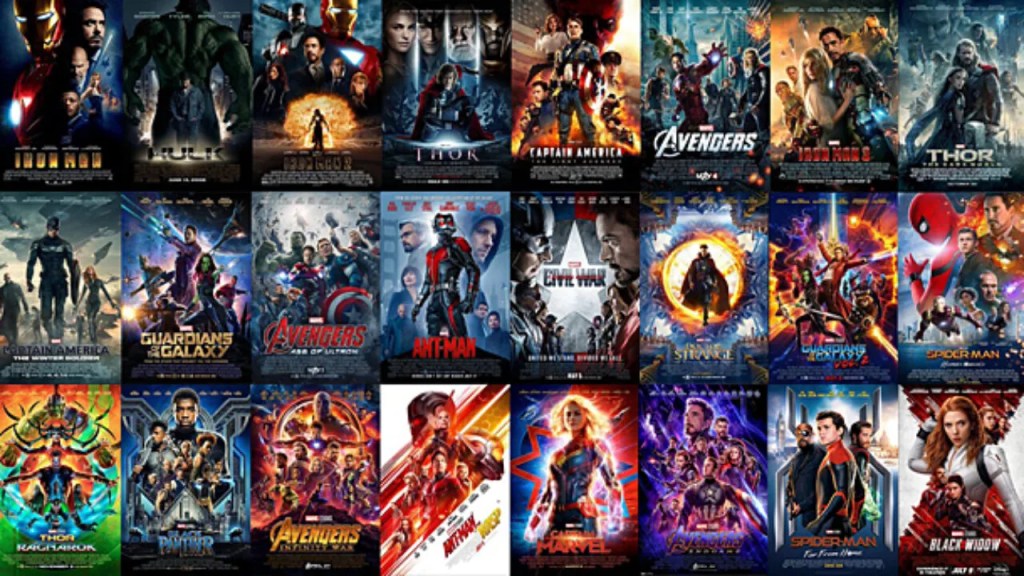
You may have noticed that every popular movie these days is a remake, reboot, sequel, spinoff, or cinematic universe expansion. In 2021, only one of the ten top-grossing films––the Ryan Reynolds vehicle Free Guy––was an original. There were only two originals in 2020’s top 10, and none at all in 2019.

People blame this trend on greedy movie studios or dumb moviegoers or competition from Netflix or humanity running out of ideas. Some say it’s a sign of the end of movies. Others claim there’s nothing new about this at all.

Some of these explanations are flat-out wrong; others may contain a nugget of truth. But all of them are incomplete, because this isn’t just happening in movies. In every corner of pop culture––movies, TV, music, books, and video games––a smaller and smaller cartel of superstars is claiming a larger and larger share of the market. What used to be winners-take-some has grown into winners-take-most and is now verging on winners-take-all. The (very silly) word for this oligopoly, like a monopoly but with a few players instead of just one.

I’m inherently skeptical of big claims about historical shifts. I recently published a paper showing that people overestimate how much public opinion has changed over the past 50 years, so naturally I’m on the lookout for similar biases here. But this shift is not an illusion. It’s big, it’s been going on for decades, and it’s happening everywhere you look. So let’s get to the bottom of it.

(Data and code available here.)

Movies 

At the top of the box office charts, original films have gone extinct. 

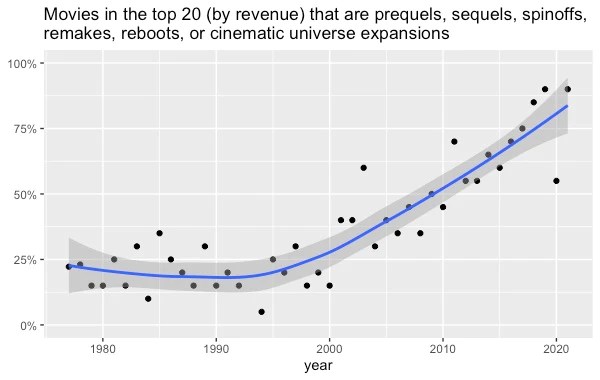
I looked at the 20 top-grossing movies going all the way back to 1977 (source), and I coded whether each was part of what film scholars call a “multiplicity”—sequels, prequels, franchises, spin-offs, cinematic universe expansions, etc. This required some judgment calls. Lots of movies are based on books and TV shows, but I only counted them as multiplicities if they were related to a previous movie. So 1990’s Teenage Mutant Ninja Turtles doesn’t get coded as a multiplicity, but 1991’s Teenage Mutant Ninja Turtles II: The Secret of the Ooze does, and so does the 2014 Teenage Mutant Ninja Turtles remake. I also probably missed a few multiplicities, especially in earlier decades, since sometimes it’s not obvious that a movie has some connection to an earlier movie.

Regardless, the shift is gigantic. Until the year 2000, about 25% of top-grossing movies were prequels, sequels, spinoffs, remakes, reboots, or cinematic universe expansions. Since 2010, it’s been over 50% ever year. In recent years, it’s been close to 100%.

Original movies just aren’t popular anymore, if they even get made in the first place.

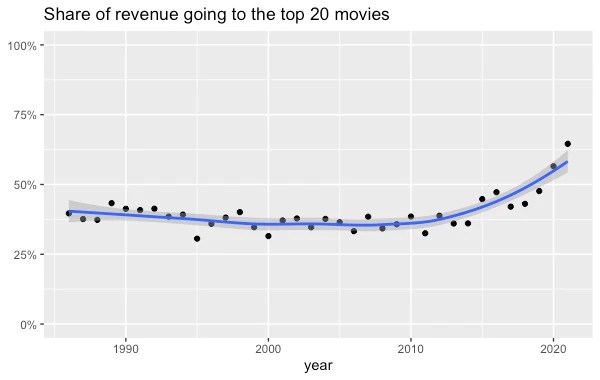
Top movies have also recently started taking a larger chunk of the market. I extracted the revenue of the top 20 movies and divided it by the total revenue of the top 200 movies, going all the way back to 1986 (source). The top 20 movies captured about 40% of all revenue until 2015, when they started gobbling up even more.

Television

Thanks to cable and streaming, there’s way more stuff on TV today than there was 50 years ago. So it would make sense if a few shows ruled the early decades of TV, and now new shows constantly displace each other at the top of the viewership charts.

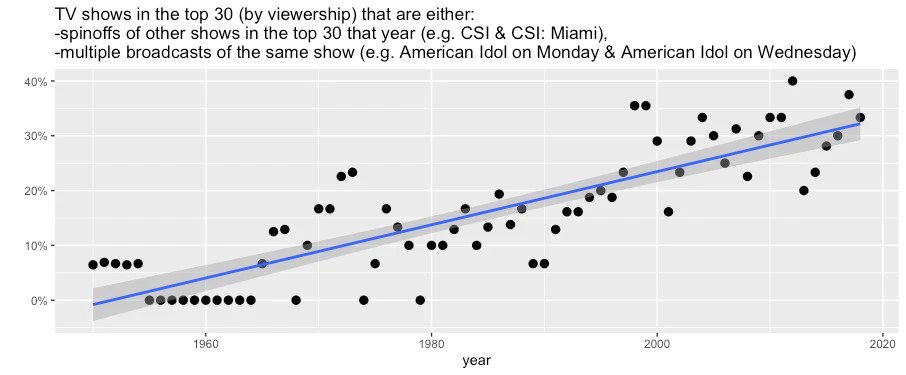
Instead, the opposite has happened. I pulled the top 30 most-viewed TV shows from 1950 to 2019 (source) and found that fewer and fewer franchises rule a larger and larger share of the airwaves. In fact, since 2000, about a third of the top 30 most-viewed shows are either spinoffs of other shows in the top 30 (e.g., CSI and CSI: Miami) or multiple broadcasts of the same show (e.g., American Idol on Monday and American Idol on Wednesday). 

Two caveats to this data. First, I’m probably slightly undercounting multiplicities from earlier decades, where the connections between shows might be harder for a modern viewer like me to understand––maybe one guy hosted multiple different shows, for example. And second, the Nielsen ratings I’m using only recently started accurately measuring viewership on streaming platforms. But even in 2019, only 14% of viewing time was spent on streaming, so this data isn’t missing much.

Music

It used to be that a few hitmakers ruled the charts––The Beatles, The Eagles, Michael Jackson––while today it’s a free-for-all, right?

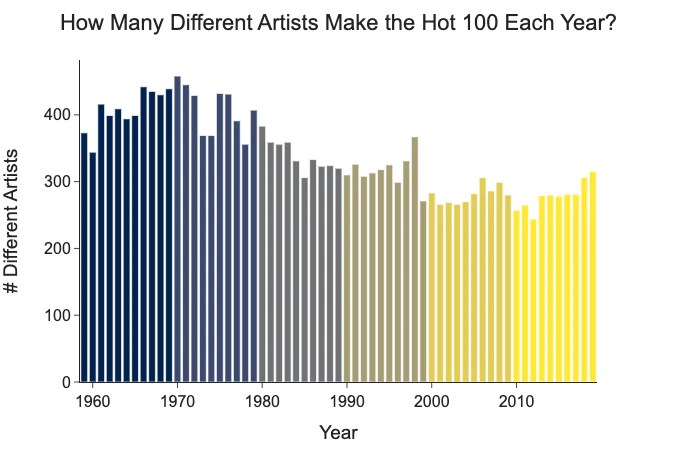
Nope. A data scientist named Azhad Syed has done the analysis, and he finds that the number of artists on the Billboard Hot 100 has been decreasing for decades.

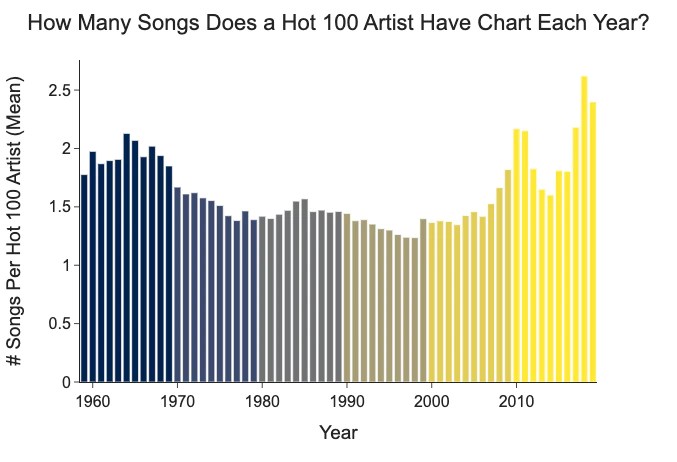
And since 2000, the number of hits per artist on the Hot 100 has been increasing. 

(Azhad says he’s looking for a job––you should hire him!)

A smaller group of artists tops the charts, and they produce more of the chart-toppers. Music, too, has become an oligopoly.

Books

Literature feels like a different world than movies, TV, and music, and yet the trend is the same.

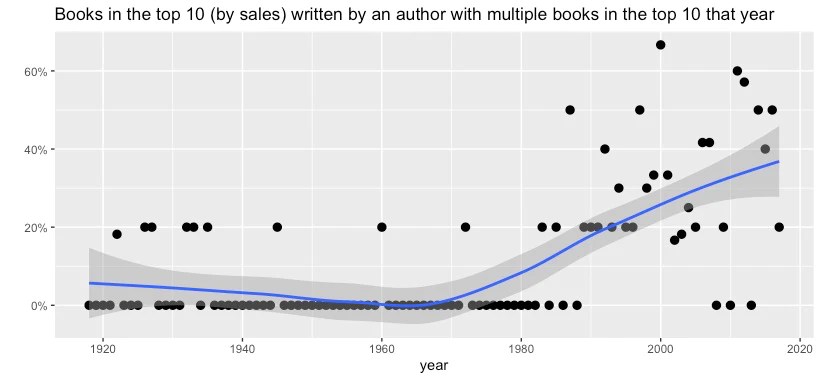
Using LiteraryHub’s list of the top 10 bestselling books for every year from 1919 to 2017, I found that the oligopoly has come to book publishing as well. There are a couple ways we can look at this. First, we can look at the percentage of repeat authors in the top 10––that is, the number of books in the top 10 that were written by an author with another book in the top 10.

It used to be pretty rare for one author to have multiple books in the top 10 in the same year. Since 1990, it’s happened almost every year. No author ever had three top 10 books in one year until Danielle Steel did it 1998. In 2011, John Grisham, Kathryn Stockett, and Stieg Larsson all had two chart-topping books each.

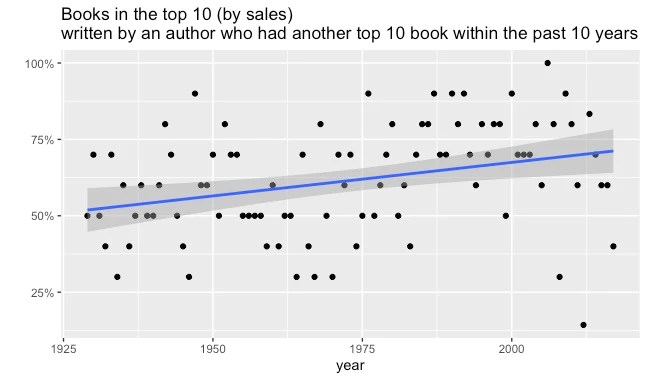
We can also look at the percentage of authors in the top 10 were already famous––say, they had a top 10 book within the past 10 years. That has increased over time, too. 

In the 1950s, a little over half of the authors in the top 10 had been there before. These days, it’s closer to 75%.

Video games

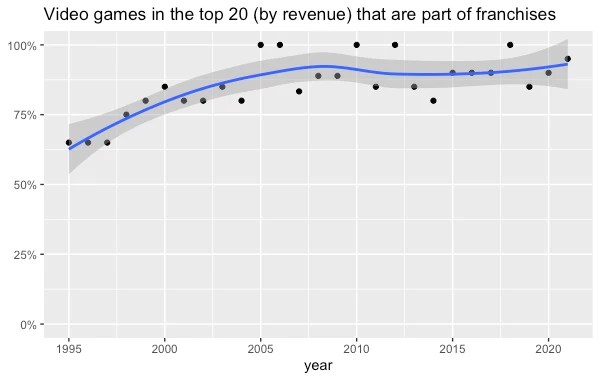
I tracked down the top 20 bestselling video games for each year from 1995 to 2021 (sources: 1234567) and coded whether each belongs to a preexisting video game franchise. (Some games, like Harry Potter and the Sorcerer’s Stone, belong to franchises outside of video games. For these, I coded the first installment as originals and any subsequent installments as franchise games.)

The oligopoly rules video games too:

In the late 1990s, 75% or less of bestselling video games were franchise installments. Since 2005, it’s been above 75% every year, and sometimes it’s 100%. At the top of the charts, it’s all Mario, Zelda, Call of Duty, and Grand Theft Auto.

Why is this happening?

Any explanation for the rise of the pop oligopoly has to answer two questions: why have producers started producing more of the same thing, and why are consumers consuming it? I think the answers to the first question are invasionconsolidation, and innovation. I think the answer to the second question is proliferation.

Invasion

Software and the internet have made it easier than ever to create and publish content. Most of the stuff that random amateurs make is crap and nobody looks at it, but a tiny proportion gets really successful. This might make media giants choose to produce and promote stuff that independent weirdos never could, like an Avengers movie. This can’t explain why oligopolization started decades ago––YouTube only launched in 2005, for example, and most Americans didn’t have broadband until 2007––but it might explain why it’s accelerated and stuck around.

Consolidation

Big things like to eat, defeat, and outcompete smaller things. So over time, big things should get bigger and small things should die off. Indeed, movie studiosmusic labelsTV stations, and publishers of books and video games have all consolidated. Maybe it’s inevitable that major producers of culture will suck up or destroy everybody else, leaving nothing but superstars and blockbusters. Indeed, maybe cultural oligopoly is merely a transition state before we reach cultural monopoly.

Innovation

You may think there’s nothing left to discover in art forms as old as literature and music, and that they simply iterate as fashions change. But it took humans thousands of years to figure out how to create the illusion of depth in paintings. Novelists used to think that sentences had to be long and complicated until Hemingway came along, wrote some snappy prose, and changed everything. Even very old art forms, then, may have secrets left to discover. Maybe the biggest players in culture discovered some innovations that won them a permanent, first-mover chunk of market share. I can think of a few:

  • In books: lightning-quick plots and chapter-ending cliffhangers. Nobody thinks The Da Vinci Code is high literature, but it’s a book that really really wants you to read it. And a lot of people did!
  • In music: sampling. Musicians seem to sample more often these days. Now we not only remake songs; we franchise them too.
  • In movies, TV, and video games: cinematic universes. Studios have finally figured out that once audiences fall in love with fictional worlds, they want to spend lots of time in them. Marvel, DC, and Star Wars are the most famous, but there are also smaller universe expansions like Better Call Saul and El Camino from Breaking Bad and The Many Saints of Newark from The Sopranos. Video game developers have understood this for even longer, which is why Mario does everything from playing tennis to driving go-karts to, you know, being a piece of paper.

Proliferation

Invasion, consolidation, and innovation can, I think, explain the pop oligopoly from the supply side. But all three require a willing audience. So why might people be more open to experiencing the same thing over and over again?

As options multiply, choosing gets harder. You can’t possibly evaluate everything, so you start relying on cues like “this movie has Tom Hanks in it” or “I liked Red Dead Redemption, so I’ll probably like Red Dead Redemption II,” which makes you less and less likely to pick something unfamiliar. 

Another way to think about it: more opportunities means higher opportunity costs, which could lead to lower risk tolerance. When the only way to watch a movie is to go pick one of the seven playing at your local AMC, you might take a chance on something new. But when you’ve got a million movies to pick from, picking a safe, familiar option seems more sensible than gambling on an original.

This could be happening across all of culture at once. Movies don’t just compete with other movies. They compete with every other way of spending your time, and those ways are both infinite and increasing. There are now 60,000 free books on Project Gutenberg, Spotify says it has 78 million songs and 4 million podcast episodes, and humanity uploads 500 hours of video to YouTube every minute. So uh, yeah, the Tom Hanks movie sounds good.

What do we do about it?

Some may think that the rise of the pop oligopoly means the decline of quality. But the oligopoly can still make art: Red Dead Redemption II is a terrific game, “Blinding Lights” is a great song, and Toy Story 4 is a pretty good movie. And when you look back at popular stuff from a generation ago, there was plenty of dreck. We’ve forgotten the pulpy Westerns and insipid romances that made the bestseller lists while books like The Great GatsbyBrave New World, and Animal Farm did not. American Idol is not so different from the televised talent shows of the 1950s. Popular culture has always been a mix of the brilliant and the banal, and nothing I’ve shown you suggests that the ratio has changed.

The problem isn’t that the mean has decreased. It’s that the variance has shrunk. Movies, TV, music, books, and video games should expand our consciousness, jumpstart our imaginations, and introduce us to new worlds and stories and feelings. They should alienate us sometimes, or make us mad, or make us think. But they can’t do any of that if they only feed us sequels and spinoffs. It’s like eating macaroni and cheese every single night forever: it may be comfortable, but eventually you’re going to get scurvy. 

We haven’t fully reckoned with what the cultural oligopoly might be doing to us. How much does it stunt our imaginations to play the same video games we were playing 30 years ago? What message does it send that one of the most popular songs in the 2010s was about how a 1970s rock star was really cool? How much does it dull our ambitions to watch 2021’s The Matrix: Resurrections, where the most interesting scene is just Neo watching the original Matrix from 1999? How inspiring is it to watch tiny variations on the same police procedurals and reality shows year after year? My parents grew up with the first Star Wars movie, which had the audacity to create an entire universe. My niece and nephews are growing up with the ninth Star Wars movie, which aspires to move merchandise. Subsisting entirely on cultural comfort food cannot make us thoughtful, creative, or courageous.

Fortunately, there’s a cure for our cultural anemia. While the top of the charts has been oligopolized, the bottom remains a vibrant anarchy. There are weird books and funky movies and bangers from across the sea. Two of the most interesting video games of the past decade put you in the role of an immigration officer and an insurance claims adjuster. Every strange thing, wonderful and terrible, is available to you, but they’ll die out if you don’t nourish them with your attention. Finding them takes some foraging and digging, and then you’ll have to stomach some very odd, unfamiliar flavors. That’s good. Learning to like unfamiliar things is one of the noblest human pursuits; it builds our empathy for unfamiliar people. And it kindles that delicate, precious fire inside us––without it, we might as well be algorithms. Humankind does not live on bread alone, nor can our spirits long survive on a diet of reruns.

MATERIALISM & THE LOSS OF SOUL

By Kingsley L. Dennis

Source: Waking Times

The non-material, or non-visible, realm does not lie dormant. It is active, constantly. It is what infuses and makes possible the world we know and see. The intangible realm of vital forces is what we often call the ‘spiritual’ dimension for within it lies the conscious intelligences that establish material life. Spiritual matters have long been an abstract thing for many people. Yet they are no longer to remain abstract – they are now to flow into culture not only through ‘spiritual channels,’ but through all manner of ways, including people. The flow and merger between the suprasensory world and the sensory world (the realm of the phenomenal), has always been in operation. Only now, it looks set to increase.

Materialism is all good and well – yet up to a certain point. This is recognized by some as the ‘Fall’ – the deep immersion into physical reality. To a certain degree, this immersion into physicality was necessary for developing individualism and to perceive existence in relation to Source. Once this recognition is gained, then begins the ‘return journey’ back to Source/Origin consciousness. However, if a species remains too long within the grip of materialistic forces, then a hardening – or deadening – can occur that crystallizes certain faculties and organs of perception, which leads to an evolutionary stagnation. As such, the stagnation of evolvement can be due to the over-influence of entropic forces. The impulse of spiritual knowledge (developmental forces) descending into the physical world has been opposed by other forces that do not wish for people to discover their inner freedom. Yet this time, this moment in human development, has been foreseen and, on some levels, even planned for. What is to come about has been viewed as inevitable by those who know what is at stake.

The entropic forces that exist in opposition aim to ‘over-materialize’ materialism. They intend to deepen the entanglement within physical matter, and to create artificial material forms that would not have arisen in the natural course of human evolvement. This is a matter of exercising certain powers upon the physical plane. This is being applied in such a way as to block a renewal of human culture beyond materialism and to direct it into a new form of materialism, a more etheric form that seems un-material. This is what I refer to as the ‘fallacy of materialism’ – the digital-virtual realms, whilst seeming contrary to physical-materialism, are in fact working to deepen human entanglement in material forces. These digitized spaces, because of their sense of non-physicality, are really an etheric manifestation of materialism. Or rather, a realm of theoretical materialism. Theoretical materialism signifies a reality construct that does not need to be physical to the touch, yet it is based on, or is a projection from, a material foundation. Within both the theoretical and regular mode of materialism, the human being is encapsulated within an amalgamation of material processes. It is also a world of facts and external evidence that a person becomes lost within. All life experience proceeds from this material realm, and this conditions the human being to gain a view of life that is factually based, and to accept that there is no other reality except this world of materialism and factual experience. Any notion of the soul or spirit – the transcendental impulse – is either regarded as being a by-product from material reality or is rejected altogether as a false notion. This is the power of the immersion into matter-reality.

Deep materialism finally becomes a cosmology of entropy and decline. It leads to mechanical, artificial modes of thinking that eventually brings about a stagnation in those forces driving human development. If continued, these materialistic forces carve out a path of technological advancement and evolution that further blocks vital, spiritualized forces. In this route, the human being strives for greater material benefits yet neglects the vital human forces of spiritualized connection. Our current epoch is concerned with the development of the material world; and if the human being is not to degenerate totally into a mere accomplice of machines, then a path must be found which leads from the mechanical impulse towards a life of the spirit. However, entropic forces are in play that are opposed to forms of spiritualization (spiritual freedom), and which work to reduce and, eventually, dispose of spiritual seeking and to replace it with an ethereal and otherworldly ‘virtual paradise’ where all needs can be fulfilled-by-illusion. A part of this ‘supra-materialism’ is the notion of immortality that is arising through transhumanist tropes. This can be referred to as the immortality falsehood as it works not through the spirit-soul but through a prolongation of the physical life experience by merger with machinic forms. This is a mode of potential immortality within the physical sphere but not within the spiritual. In the end, it is an entrapment for it disavows the inner spirit release from the physical domain. This can lead to a state of soullessness within the human being as the contact with Source becomes, over time, diminished. Or, perhaps this materialistic, transhumanist agenda will attract those people already without full spirit-soul incarnation.

It may be that there are people walking around in physical incarnation, in physical bodies, yet who are lacking, for want of a better word, a soul. Rudolf Steiner made note of this a hundred years ago when he stated

‘…a kind of surplus of individuals is appearing in our times who are without Egos [‘I’], who are not truly human beings. This is a terrible truth…They make the impression of a human being if we do not look closely, but they are not human in the fullest sense of the word.’ 1

Steiner warned us to be aware that what we encounter as human beings in human form may not always have to be what it appears to be. He stated that the outer appearance can be just that: appearance. He went on to state: ‘We encounter people in human form who only in their outer appearance are individuals…in truth, these are humans with a physical, etheric, and astral body, but beings are embodied in them, beings that make use of these individuals in order to operate through them.’2 What this refers to is that human bodies can be vessels for other beings to operate through.

This makes us realize that the world of ‘spirit’ may not always be what we have thought it to be. In other words, it may not be all divine light and ascension. It also involves the aspect of discernment. For there are players and forces that wield a great deal of influence within the physical world. And some of these influences act through the presence of certain individuals that may appear outwardly ‘normal.’ In this light, a completely different kind of spirituality is at work in present-day humanity. It may be inferred, without sounding dramatic, that certain power groups, and their important individual members, are influenced (and perhaps dominated) by a non-human species of being that are intent on implementing non-human objectives. Such groups and individuals would, in this case, exhibit a distinct lack of ‘soul’ – i.e., empathy and compassion – and would appear to others as displaying almost sociopathic tendencies.[i] Yet at the same time, such people can appear unusually charismatic and are able to exert great influence over other people, especially with their words and speeches, whilst being themselves emotionally stunted.

To consider this further, such beings might be motivated in their actions to attempt to block other human being’s connection to their own individual inner/spiritual impulse. By a range of actions, they could focus on distracting people away from the notion of a metaphysical reality and of their inherent connection to Source (or a realm of vital conscious intelligence beyond matter-reality). In extreme cases, such players might even target the bio-psycho human body in an attempt to sabotage the vessel so as to make it a less viable vehicle for soul-spirit incarnation. What else might they hope to achieve? Again, referring to Rudolf Steiner, he stated that: ‘Their objective is to maintain the whole of life as a mere economic life, to gradually eradicate everything else that is part of the intellectual and spiritual life, to eradicate the spiritual life precisely where it is most active…and swallow up everything through the economic life.’3

By hijacking cultural, social, and economic systems, the focus turns away from the inner life, which tends to be more active once people have satisfied their primary needs (see Maslow’s Hierarchy of Needs). Also, if there are uncertainties, disruptions, and fluctuations in these systems, then people can become psychologically influenced in a negative way. That is, for those people who come under the domination of such economic forces – i.e., are subservient through debt – they are more likely to experience a loss of personal empowerment and will. If we take only a cursory glance at the actions of many incumbent leaders, politicians, corporate businesses, financial institutions, and more, we can see a clear lack of any soulful behaviour or intent. Quite the contrary, many of these individuals and groups seem determined to curtail human freedoms, sovereignty, and inner empowerment. If Steiner were alive today, he would no doubt say that what we are currently witnessing upon the physical plane is an act of soulless terraforming of the planet and a controlling manipulation of the human life experience by nefarious forces that have anti-human aims and intentions. Perhaps this is why so many people today are experiencing depression, frustration, and apathy – a paralysis of will – from which they feel unable to resolve. This gets manifested as a sense of weariness and dissatisfaction that is projected out into their everyday lives.

Because of this, and other factors, the consciously aware person of today is being asked to step into their role as a physical representative of sacred life. It is important that metaphysical realities are never diminished or disowned, and that the life of the spirit remains healthy and strong in expression within physical life. If there is ever a struggle against the human soul, then we may be witnessing this in these current times. We would do well to remember that each person possesses that special treasure that can never be taken from them. And this is the true eternal and genuine immortality. These are the times to be soulful, and to bring forth the human spirit.

References

Cited in Grosse, Erdmuth Johannes (2021) Are There People Without A Self? Forest Row: Temple Lodge, p31-2

Cited in Grosse, Erdmuth Johannes (2021) Are There People Without A Self? Forest Row: Temple Lodge, p60

Cited in Grosse, Erdmuth Johannes (2021) Are There People Without A Self? Forest Row: Temple Lodge, p63

The Power of Presence, How “Living In The Now” Can Change Your Life

By Allie Stark

Source: Collective Evolution

Presence is the powerful practice of being in the moment.

It is created through an acute awareness of one’s thoughts, feelings, and emotions, and in our modern day society, being present doesn’t always come easily. The overstimulation and distraction that come from technology, social media, work, family life, social engagements, and the never-ending “to-do” lists regularly take us out of the now and into a memory from the past or a fear about the future.

Cultivating the power of presence comes from creating the space to observe one’s mind and one’s self. This skill of observation allows us to look at our own lives and the lives of others without attaching judgment or analysis. Using this awareness, we become mindfully attuned to all that is around us through our five senses (smell, touch, taste, sight, and sound) as well as our physical sensations — you know, those signs from our bodies that we often tend to ignore.

Our bodies are equipped with a natural mechanism called the “stress response,” also known as the “fight-or-flight” response, which was first described by Walter Cannon at Harvard. When we encounter something that feels like a threat, the amygdala in the brain experiences the emotion fear. The brain then communicates to the hypothalamus, which communicates to the nervous system, which signals to the adrenal glands to release the stress hormones cortisol, adrenaline, and noradrenaline. This assembly-line-like process of the sympathetic nervous system is a crucial part of our body’s internal self-protection mechanism. The only problem is that we are not physiologically designed to be frightened often.

In today’s world, many of us live in overdrive and operate in a constant state of “flight or flight.” This state can be a result of feeling the fear of imagined threats: financial security, societal achievement, the steadiness or demise of a relationship, a perceived health threat, the loss of a loved one, etc. Operating from this place, it is no wonder that many of us feel the perils of stress and anxiety on a daily basis. We struggle with migraines, digestive issues, difficulty breathing, lack of concentration, fatigue, depression, and innumerable other physical ailments because our body is actually attempting to flee the scene of a real threat (car crash, lion chase, assault, etc.) that simply isn’t there. 

The opposite is also true. When we practice deep breathing and mindfulness, we encourage our body to employ the “relaxation response,” our body’s counterbalance to the stress response as defined by Harvard professor Herbert Benson. Being in a state of relaxation, your body will experience physiological symptoms of ease, openness, and balance.

A few days ago, I unintentionally experimented with the topic of presence when I accidentally left my phone at home. Even though I am generally good about creating intentional space to be phone free, something felt different. Normally, I choose to not bring it on a walk, I choose to keep it in my purse during dinner with a friend, and I choose to put it on airplane mode when I am writing or working during the day. Yesterday was the middle of the work week and if I had been asked whether or not I wanted to bring my phone along for the day, my answer would have unquestionably been “yes.”

Climbing up the stairs to the train platform, my hand impulsively reached into my bag in search of my phone. I was subconsciously looking for a meditative distraction during my morning commute. Remembering that it wasn’t there, I closed my eyes, took five deep breaths, and boarded the train car upon its arrival. Within moments of taking my seat, three street performers made an announcement, turned up their boom box, and had at it with their superfly dance moves. I was engrossed and totally present: wide eyes, big smile, heart beating in my chest.

Over the course of the rest of the day, I made note of a few other observations that I could have missed if I was in the phone zone:

  • A gathering of beautiful purple flowers on the sidewalk that had fallen off a tree
  • The smile from a saxophone player on the street
  • A little girl selling brownies in front of her house (although there weren’t many left because she was eating them when she thought no one was looking!)
  • The way the breeze felt on my skin between the high-rises

Upon noticing each of these observations I felt the tension in my body dissipate, I smiled effortlessly, and my body felt calm and at ease. Being fully involved in the present moment, I didn’t have the time to become entrenched in thoughts about the past or fears about the future. I was simply aware of what was going on in the now.

Now let’s be realistic. I know that we live in a technology-focused era and that our phones and our computers are significant tools for work, connectivity, and enjoyment.

They serve a purpose, and an important one at that. We also live in an age where anxiety disorders are the most common mental illness in the U.S., affecting 40 million adults in the United States age 18 and older, or 18% of the population. Countless studies have begun to explore the effects of mindfulness on reducing anxiety and depression, with many of the results from these studies suggesting that mindfulness-based therapy is a promising intervention for treating anxiety and mood problems in clinical populations. If pills, therapies, and medical advice aren’t curing our ailments, it seems foolish not to give mindfulness a shot.

If nothing else, maybe we will get the opportunity to notice small and simple details throughout the day that put a smile on our face.

A Weird, Stupid Dystopia

By Caitlin Johnstone

Source: CaitlinJohnstone.com

The last few days in the United States have seen a parade of wealthy freaks fellating each other’s egos and preening for the cameras in outlandish garb while ordinary Americans suffer more and more.

The weekend’s White House Correspondents’ Dinner saw a gaggle of media celebrities congregate to congratulate one another on what a great job they’ve been doing bravely telling the truth and holding the most powerful government on earth to account. The host, Trevor Noah of The Daily Show, gushed with enthusiasm about how much freedom the press have in America to say things the powerful don’t like.

“As we sit in this room tonight, people, I really hope you all remember what the real purpose of this evening is,” Noah said. “Yes, it’s fun. Yes, we dress nice. Yes, the people eat, they drink, we have fun. But the reason we’re here is to honor and celebrate the fourth estates and what you stand for — what you stand for — an additional check and balance that holds power to account and gives voice to those who otherwise wouldn’t have one.”

“And if you ever begin to doubt your responsibilities, if you ever begin to doubt how meaningful it is, look no further than what’s happening in Ukraine,” said Noah. “Look at what’s happening there. Journalists are risking and even losing their lives to show the world what’s really happening. You realize how amazing it is. In America, you have the right to seek the truth and speak the truth even if it makes people in power uncomfortable, even if it makes your viewers or your readers uncomfortable. You understand how amazing that is? I stood here tonight and I made fun of the president of the United States, and I’m going to be fine. I am going to be fine, right? Do you really understand what a blessing it is?”

Of course there are people who’ve said things that US presidents don’t like who are not in fact fine. Julian Assange continues to waste away in Belmarsh Prison as the US government continues its efforts to extradite him to he can become the first publisher ever tried under the Espionage Act. Edward Snowden, an American, remains in exile because one US president after another continues to refuse to pardon his heroic whistleblowing about the sinister surveillance practices of the US intelligence cartel. Daniel Hale, also an American, sits in prison for exposing the depravity of America’s monstrous drone program.

Trevor Noah did not mention these people, or the many others who’ve been persecuted, silenced, imprisoned and killed for saying things the powerful individuals who govern the US don’t approve of, because as a member of the mainstream media his job is not to inform but to propagandize.

Far from providing “an additional check and balance that holds power to account and gives voice to those who otherwise wouldn’t have one” as Noah claims, the people in his audience on Saturday night are tasked with manipulating public thought in facilitation of the interests of the powerful. The mainstream news media in America, and throughout all the so-called free democracies of the western world, are propaganda institutions whose first and foremost job is to manufacture consent for oligarchy and empire.

Which is why the President of the United States, when he took the podium that night, had nothing but friendly words for the mainstream press.

“What’s clear, and I mean this from the bottom of my heart, is that you, the free press, matter more than you ever did in the last century,” Biden said. “We’ve all seen the courage of Ukrainian people because of the courage of American reporters in this room, and your colleagues across the world who are on the ground taking their lives in their own hands.”

This past weekend also saw a friendly gathering of brave fourth estate truth warriors and political and government operatives of the US empire at a party hosted by the billionaire owner of the neocon war propaganda rag The Atlantic.

Politico reports:

David and Katherine Bradley and Laurene Powell Jobs hosted a dinner at the Bradleys’ home. SPOTTED: Secretary of State Antony Blinken and Cabinet Secretary Evan Ryan, Commerce Secretary Gina Raimondo, CIA Director Bill Burns, press secretary Jen Psaki, Deputy A.G. Lisa Monaco, Sen. Tina Smith (D-Minn.), FCC Chair Jessica Rosenworcel, Del. Stacey Plaskett (D-U.S. Virgin Islands), homeland security adviser Elizabeth Sherwood-Randall, Jeffrey Goldberg, Nick Thompson, Peter Lattman, Anne Applebaum, Russell Berman, Franklin Foer, David Frum, Elaine Godfrey, Adam Harris, Mark Leibovich, Jeff Dufour, Heather Kuldell, Kevin Baron, José Andrés, Enes Kanter, Mitch Landrieu, Dafna Linzer, Rachel Martin, Judy Woodruff, Jake Tapper, Wolf Blitzer, Jonathan Capehart, Katty Kay, Steve and Jean Case, John Dickerson and Jen Palmieri.

Yep, when you see a shady basketball player/empire propagandist fraternizing with the CIA Director while surrounded by media celebrities and government insiders at a party hosted by a media-owning plutocrat, you know you’re in a country where power is held to account. Right, Trevor?

The orgy of embarrassment was capped off by the 2022 Met Gala, a big weird dystopian parade of rich freaks dressed like Hunger Games aristocracy and laughing in the face of everyone who can’t afford to live.

An honest Met Gala dress would have a corset made from the bones of Yemeni children, draped with a cloth of stolen gold and lithium spun by the tiny hands of child slaves, with a full-length train that leached oil and blood wherever it went.

This while ordinary Americans struggle just to survive. While American women appear to be on the precipice of losing their reproductive sovereignty. While money is poured into a proxy war which threatens to escalate into a conflict that could easily end all life on earth.

This is your dying empire, America. This is your end-stage capitalism. This is your dystopia, in all its weird, phony, stupid glory.

It is horrifying. The longer you look at it, the creepier it gets.

Breathe it all in, folks.

We’re in for a hell of a ride.