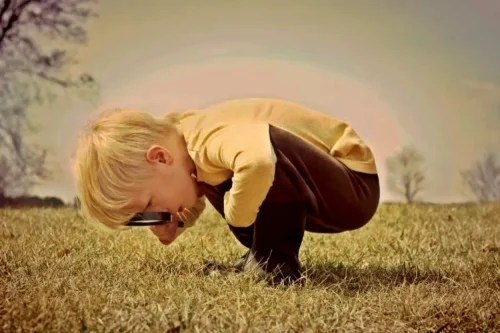
Pandemic? Great Reset? How about… a beginner’s mind?

By Mickey Z.

Source: Dissident Voice

“In the beginner’s mind there are many possibilities. In the expert’s, there are few.” 1

Has there ever been a more urgent time to embrace many possibilities? This age of pervasive uncertainty and division may well be very fertile ground for questioning our assumptions and interrogating our beliefs. In fact, we just might be living in the ideal time to accept that there are limitless ways to perceive even the most contentious issues.

Expert vs. Beginner

The expert’s mind is over-secure in its prowess. Such a mentality may promote shortsighted habits like confirmation bias. Many “authorities” will only seek out (read: cherry-pick) information that validates and justifies their behavior because expertise — real or imagined — causes us to grow less curious.

If we already feel well-versed in a topic, we tend to pay less attention to it. We ask fewer questions. This is a stifling choice even if we know 95 percent of what there is to know about a particular subject. Ideally, this is when we should be paying more attention to it in order to discern the nuances that remain to be learned.

Conversely, the beginner’s mind is ever-hungry for input — regardless of its source or its tendency to reinforce existing beliefs. In the beginner’s mind, there are fewer limits and fewer expectations. There is much more room for revelation and awe. Nothing is taken for granted and even the tiniest detail has the potential to inspire reverence.

The beginner’s mind is basically the polar opposite of today’s social media algorithms, mainstream news headlines, and popular political discourse.

3 (of the many) Benefits of a Beginner’s Mind

Creativity

Habits and structure can be incredibly useful. They can also become an obstacle to innovation. A beginner’s mind encourages us to approach familiar problems with a fresh perspective. This mindset often results in the exploration of avenues that an expert would casually dismiss as “been there, done that.”

Gratitude

A beginner’s mind awakens each morning, ready to wipe the slate clean and start anew. From this fresh perspective, it feels more natural to identify and appreciate your blessings.

Mindfulness

Seeing the world like a beginner prevents you from “going through the motions.” There is a clearer understanding that the present is all you have. The past is where guilt and regret dwell. In the future may lie apprehension and anxiety. Right here, right now, the moment is enough.

How to Rediscover a Beginner’s Mind

By its very definition, there are an infinite number of ways to occupy a beginner’s mind. To follow are some basic guidelines but think of them like Bruce Lee’s finger pointing a way to the moon. As Lee urged, “Don’t concentrate on the finger or you’ll miss all that heavenly glory.”2

1. Reject your ego’s need to be an expert

Eavesdrop on a conversation at the local supermarket. Even better, scroll (without reacting) through most threads on social media. You’ll see and hear so many people pretending they know“what’s really happening” and “what’s gonna happen.” Your ego craves the status of being right. The beginner in you would rather open-mindedly look for reality than be deemed an expert at anything.

2. Slow down

As touched on above, we must avoid going through the motions. Whenever possible, slow down to question and explore. Take your time to learn — even from the most unlikely of sources.

3. Channel your inner child

Re-introduce yourself to some of your closest childhood friends: wonder, mischief, and playfulness. Reject the cynical adult premise of “same shit, different day.”

4. See with new eyes

In the words of Marcel Proust: “The real voyage of discovery consists not in seeking new landscapes, but in having new eyes.”3 Practically speaking, your quest for new eyes can begin with simple exercises like treating your hometown as if you were a tourist and seeing what you can discover.

5. Embrace nonsense 

As Gary Zukav, author of Dancing Wu Li Masters: An Overview of the New Physics, (1979)posits: “Nonsense is nonsense only when we have not yet found that point of view from which it makes sense.”

6. Meditation

Perhaps the most time-worn path to a beginner’s mind is the practice of mindful meditation. Whether you choose a spiritual or secular approach, even ten minutes a day of meditation will expand your consciousness.

The child is in me still and sometimes not so still.4

There is no one right way to inhabit a beginner’s mind. After all, it is not a destination. It’s all about the process, the learning, and those moments of epiphany made possible by not closing off your options… so re-activate your inner child.

Keep re-evaluating what you believe before your perceptions can grow ossified. Don’t limit your explorations by choosing in advance what it is you wish to find. Turn your truth over and over, again and again. Avoid accumulating old answers. Instead, dedicate far more of your time to conjuring up new questions. Through it all, let compassion serve as your compass.

The experts [sic] have gotten us into this mess.

It’s time to give beginners their opportunity to shine.

  1. Shunryu Suzuki, Prologue Zen Mind, Beginner’s Mind, (1973). []
  2. Bruce Lee, Enter the Dragon, 1973. []
  3. The Captive. (La Prisonnière, the fifth volume of Remembrance of Things Past), 1923. []
  4. Fred Rogers, (2003). The World According to Mister Rogers: Important Things to Remember, p. 45, Hachette UK. []
What Is To Be Done?

By Paul Edwards

Source: Information Clearing House

Not an original title for a piece that will assert we are in a unique moment in world history?  No, Lenin used it to expose the cruelty and villainy of the empire that ruled Russians like a slave master.  Claiming we are in a “unique moment” is not original, either.  We Americans, with our caudal appendage, Europe, have been told time and again we are in “unique moments”, unmatched in its peril, so that it’s now routine to say it of every asinine Presidential election. 

I have spent a lifetime reading and listening to the best minds in journalism and reportage bemoan, attack, mourn, and decry the encyclopedia of lunacies and disasters our system has inflicted on our country, the world, and ourselves, its naive, ignorant people.

Since the Gulf War, and the rolling chain of shameful absurdities that followed—Iraq, Afghanistan, Libya, Syria, et.al.—in the idiotic dirty joke of the bumbling “War on Terror”, I have seen the mainstream press devoured by the Capitalist Monster to the point where all voices of integrity have been marginalized and expelled, then denounced and vilified by the diseased whores who slunk into their places.

Now, with America’s ridiculous, transparent, and contemptible falsity so obvious in every aspect of governance at home and abroad, I have seen the entire press converted into an organ of crude and dishonest propaganda for the Capitalist War Machine that is coldly, inhumanly  dictating our demise.  The viciously dishonest and relentlessly stupid storm of juvenile horseshit disseminated by all mainstream outlets— print, tv, and internet—is an ethical crime of diabolical dimensions.  Our government, with its cadre of vacuous, degraded simpletons, men and women of no intellectual size, depth, or scope, profoundly ignorant yet arrogant in their smarmy inadequacy, is restricting and distorting knowingly all truth that conflicts with the malign intentions of the War Lobby to pursue nuclear war with Russia until they get it.  And, of course, they need a second enemy and so must tell China what it can and can’t do. Where do these moronic fuckers get the brass to try that shameless madness with Xi and his power? 

And this is done while the few strong voices of courage and integrity that, against all the power of money and corruption of The Empire, continue to try to provide an educating effect through reason and evidence, are exiled and suppressed from platforms of influence.

I have long wondered at their dedication and staying power in the face of the cynical, unwarranted abuse they get, including, of course, from their supposed colleagues who, collectively, aren’t worth the powder to blow them to hell, as my Dakota Grandpa used to say.  I can only assume they are held together, in place, by the unbreakable fiber of integrity in them that they have no choice but to honor.  

And yet, though those few and proud speak out against false America and denounce it where denunciation is richly warranted, I feel, even in their most blistering analyses that there is a conviction, a certainty, an honest, incontestable statement of truth, that is missing.  I had hoped to hear it expressed by those who have great credibility, and great reputations, profiles and followings, but I have been disappointed.

My list of heroes is not long.  I acknowledge them as the heirs to the great ones before: Ed Murrow, Eric Sevareid, David Brinkley, Walter Cronkite, Sy Hersh, David Halberstam.  I include among the present greats Chris Hedges, John Pilger, Aaron Mate, Michael Brenner, Max Blumenthal, Patrick Lawrence, Glenn Greenwald, Edward Snowden, Chelsea Manning, and Julian Assange.

All of them have done honest, deeply informed work to counter the rampant imbecility and cruelty of the American government and its stenographers, the press.  The one conclusion none has plainly stated, that all have suggested, is neither obscure nor complicated.

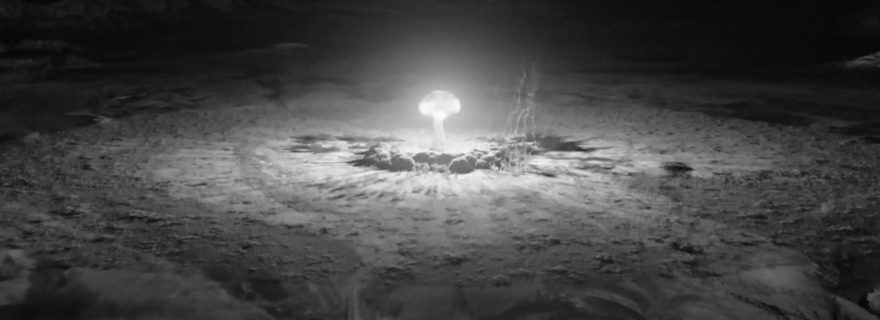
It is this: America can not be reformed or improved under Capitalism. Its corrupt, rotten burlesque democracy must and will be destroyed.  Not by any action of the torpid, gelded, stupid people.  It will come, and soon, by financial chaos and meltdown, or by nuclear war.

We are told that unless bold action is taken, unless we find the moral courage to act, unless we come together, get money out of politics, vote for better candidates, unless we do this, that, or the other thing, disaster will follow.  Sadly, that is all nonsense.   In fact, it makes no difference what we do: America, as a viable state, is finished.

This is intolerably painful to admit.  Every instinct of self-preservation, every human yearning for safety and justice rejects it.  All our training, our education, our immersion in bullshit propaganda screams against it but, admitted or not, it is fact, it is truth, and collapse of America’s baselessly arrogant, obscene, punishing oppression of the compliant world, already tenuous and strained, is coming.   And soon…

It is said to be easier for people to imagine the end of the world, than the end of Capitalism.  This will end soon when it will no longer be necessary to imagine either, because both will have happened.  In the same way that socio-political truth has been screened out by official deceit, environmental truth has been obscured and denied by our own and the world’s rulers.   What Capitalism has done to humans is trivial beside what it’s done to the earth and all living things.  In this, too, we are told that if we can just do this or that the world will recover and all will be well.  It won’t.   No matter what we do.  And that will almost certainly be what we have done up to now: nothing. 

Humans, mostly, are large, dull children.  They have a great need to feel loved, protected, pardoned, saved.  That’s why they were given religions by elites that have always owned them.  All dogmatic religions are bullshit by definition, their fatuous fraud shown up by every advance of knowledge from Galileo to the Webb Telescope.  

I, like all my kind, wish for mercy and grace, but I don’t look for it in a ludicrous infantile fantasy, or in deluded hope where there is clearly none.  Both religion and science, in the hands of priests and hustlers, have set us up for unavoidable misery and suffering, and arranged for the suicide of our species and the murder of the living world.  There is nothing you can do about this.  We have the ability to love those we hold dear, and the world we have known.  Let that be enough, for it is all you will ever have.

Dictatorship in Disguise: Authoritarian Monsters Wreak Havoc on Our Freedoms

By John & Nisha Whitehead

Source: The Rutherford Institute

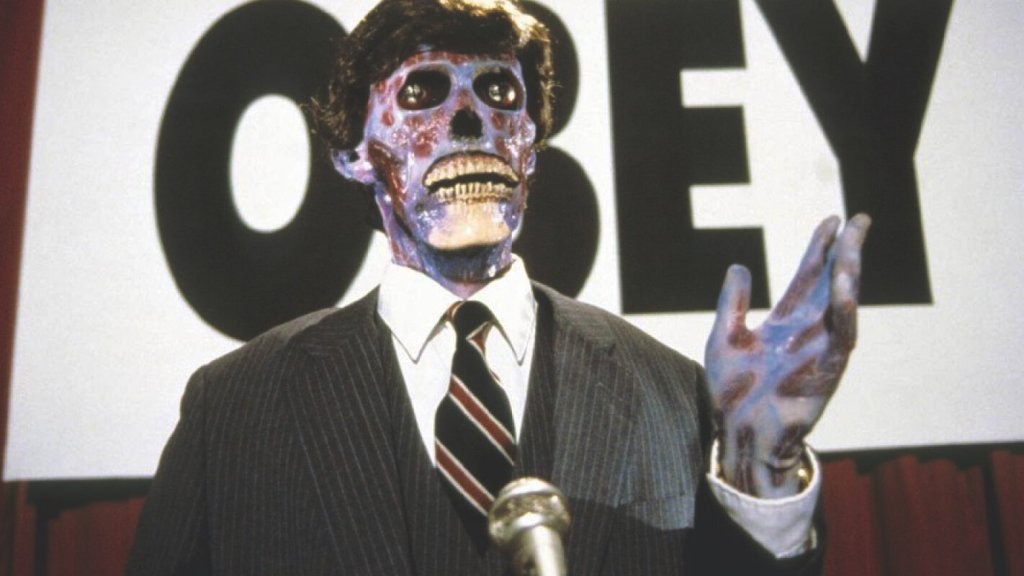
“You see them on the street. You watch them on TV. You might even vote for one this fall. You think they’re people just like you. You’re wrong. Dead wrong.” — They Live 

We’re living in two worlds.

There’s the world we see (or are made to see) and then there’s the one we sense (and occasionally catch a glimpse of), the latter of which is a far cry from the propaganda-driven reality manufactured by the government and its corporate sponsors, including the media.

Indeed, what most Americans perceive as life in America—privileged, progressive and free—is a far cry from reality, where economic inequality is growing, real agendas and real power are buried beneath layers of Orwellian doublespeak and corporate obfuscation, and “freedom,” such that it is, is meted out in small, legalistic doses by militarized police and federal agents armed to the teeth.

All is not as it seems.

Monsters with human faces walk among us. Many of them work for the U.S. government.

This is the premise of John Carpenter’s film They Live, which was released in November 1988 and remains unnervingly, chillingly appropriate for our modern age.

Best known for his horror film Halloween, which assumes that there is a form of evil so dark that it can’t be killed, Carpenter’s larger body of work is infused with a strong anti-authoritarian, anti-establishment, laconic bent that speaks to the filmmaker’s concerns about the unraveling of our society, particularly our government.

Time and again, Carpenter portrays the government working against its own citizens, a populace out of touch with reality, technology run amok, and a future more horrific than any horror film.

In Escape from New York, Carpenter presents fascism as the future of America.

In The Thing, a remake of the 1951 sci-fi classic of the same name, Carpenter presupposes that increasingly we are all becoming dehumanized.

In Christine, the film adaptation of Stephen King’s novel about a demon-possessed car, technology exhibits a will and consciousness of its own and goes on a murderous rampage.

In In the Mouth of Madness, Carpenter notes that evil grows when people lose “the ability to know the difference between reality and fantasy.”

And then there is Carpenter’s They Live, in which two migrant workers discover that the world is not as it seems. In fact, the population is actually being controlled and exploited by aliens working in partnership with an oligarchic elite. All the while, the populace—blissfully unaware of the real agenda at work in their lives—has been lulled into complacency, indoctrinated into compliance, bombarded with media distractions, and hypnotized by subliminal messages beamed out of television and various electronic devices, billboards and the like.

It is only when homeless drifter John Nada (played to the hilt by the late Roddy Piper) discovers a pair of doctored sunglasses—Hoffman lenses—that Nada sees what lies beneath the elite’s fabricated reality: control and bondage.

When viewed through the lens of truth, the elite, who appear human until stripped of their disguises, are shown to be monsters who have enslaved the citizenry in order to prey on them.

Likewise, billboards blare out hidden, authoritative messages: a bikini-clad woman in one ad is actually ordering viewers to “MARRY AND REPRODUCE.” Magazine racks scream “CONSUME” and “OBEY.” A wad of dollar bills in a vendor’s hand proclaims, “THIS IS YOUR GOD.”

When viewed through Nada’s Hoffman lenses, some of the other hidden messages being drummed into the people’s subconscious include: NO INDEPENDENT THOUGHT, CONFORM, SUBMIT, STAY ASLEEP, BUY, WATCH TV, NO IMAGINATION, and DO NOT QUESTION AUTHORITY.

This indoctrination campaign engineered by the elite in They Live is painfully familiar to anyone who has studied the decline of American culture.

A citizenry that does not think for themselves, obeys without question, is submissive, does not challenge authority, does not think outside the box, and is content to sit back and be entertained is a citizenry that can be easily controlled.

In this way, the subtle message of They Live provides an apt analogy of our own distorted vision of life in the American police state, what philosopher Slavoj Žižek refers to as dictatorship in democracy, “the invisible order which sustains your apparent freedom.”

We’re being fed a series of carefully contrived fictions that bear no resemblance to reality.

Tune out the government’s attempts to distract, divert and befuddle us and tune into what’s really going on in this country, and you’ll run headlong into an unmistakable, unpalatable truth: what we are dealing with today is an authoritarian beast that has outgrown its chains and will not be restrained.

Through its acts of power grabs, brutality, meanness, inhumanity, immorality, greed, corruption, debauchery and tyranny, the government has become almost indistinguishable from the evil it claims to be fighting, whether that evil takes the form of terrorism, torture, disease, drug traffickingsex trafficking, murder, violence, theft, pornography, scientific experimentations or some other diabolical means of inflicting pain, suffering and servitude on humanity.

We have let the government’s evil-doing and abuses go on for too long.

We’re being fed a series of carefully contrived fictions that bear no resemblance to reality.

Despite the fact that we are 17,600 times more likely to die from heart disease than from a terrorist attack; 11,000 times more likely to die from an airplane accident than from a terrorist plot involving an airplane; 1,048 times more likely to die from a car accident than a terrorist attack, and 8 times more likely to be killed by a police officer than by a terrorist , we have handed over control of our lives to government officials who treat us as a means to an end—the source of money and power.

As the Bearded Man in They Live warns, “They are dismantling the sleeping middle class. More and more people are becoming poor. We are their cattle. We are being bred for slavery.”

We have bought into the illusion and refused to grasp the truth.

From the moment we are born until we die, we are indoctrinated into believing that those who rule us do it for our own good. The truth is far different.

The powers-that-be want us to feel threatened by forces beyond our control (terrorists, pandemics, mass shootings, etc.).

They want us afraid and dependent on the government and its militarized armies for our safety and well-being.

They want us distrustful of each other, divided by our prejudices, and at each other’s throats.

Most of all, they want us to continue to march in lockstep with their dictates as fearful, controlled, pacified zombies.

This brings me back to They Live, in which the real zombies are not the aliens calling the shots but the populace who are content to remain controlled.

When all is said and done, the world of They Live is not so different from our own. As one of the characters points out, “The poor and the underclass are growing. Racial justice and human rights are nonexistent. They have created a repressive society and we are their unwitting accomplices. Their intention to rule rests with the annihilation of consciousness. We have been lulled into a trance. They have made us indifferent to ourselves, to others. We are focused only on our own gain.”

We, too, are focused only on our own pleasures, prejudices and gains. Our poor and underclasses are also growing. Injustice is growing. Inequality is growing. A concern for human rights is nearly nonexistent. We too have been lulled into a trance, indifferent to others.

Oblivious to what lies ahead, we’ve been manipulated into believing that if we continue to consume, obey, and have faith, things will work out. But that’s never been true of emerging regimes. And by the time we feel the hammer coming down upon us, it will be too late.

So where does that leave us?

The characters who populate Carpenter’s films provide some insight.

Underneath their machismo, they still believe in the ideals of liberty and equal opportunity. Their beliefs place them in constant opposition with the law and the establishment, but they are nonetheless freedom fighters.

When, for example, John Nada destroys the alien hypno-transmitter in They Live, he delivers a wake-up call for freedom. As Nada memorably declares, “I have come here to chew bubblegum and kick ass. And I’m all out of bubblegum.”

In other words: we need to get active and take a stand for what’s really important.

Stop allowing yourselves to be easily distracted by pointless political spectacles and pay attention to what’s really going on in the country.

As I make clear in my book Battlefield America: The War on the American People and in its fictional counterpart The Erik Blair Diaries, the real battle for control of this nation is taking place on roadsides, in police cars, on witness stands, over phone lines, in government offices, in corporate offices, in public school hallways and classrooms, in parks and city council meetings, and in towns and cities across this country.

All the trappings of the American police state are now in plain sight.

Wake up, America.

If they live (the tyrants, the oppressors, the invaders, the overlords), it is only because “we the people” sleep.

‘Us vs. Them’ Thinking Is Hardwired—But Consciousness Can Overpower It

By Joe Martino

Source: The Pulse

Are we hardwired to categorize each other into ‘Us vs Them?’ Simply put, yes. But this hardwiring is remarkably easy to break. It’s time we equip ourselves with the knowledge and tools to do so.

Why? Well, anything from powerful governments to mainstream and alternative media is consistently trying to divide us by focusing aggressively on our differences. When we know how these mechanisms work and focus our consciousness in an effective way, these attempts to divide fail.

First a quick story.

When we first launched our membership I hired marketing teams to help. They would always tell me “in the sales messaging we need to create an ‘Us vs Them dynamic’ in order to get people to buy.” I resisted.

I felt like that wasn’t necessary and also contrary to our mission of unifying people to create a better world. But, the marketers were right. When we would A/B test sales messaging without ‘Us vs Them’ compared to sales messaging with it, the ‘Us vs Them’ messaging always won.

I have to admit this made me a bit sad. Was I thinking too idealistically about human beings? Maybe. But I always asked ‘Why doesn’t Us vs Them messaging work on me?” Before you suggest I’m naive and think “of course the messaging works on you,” read to the end of this piece. You’ll see how simply it is for this messaging not to work on anyone should they choose.

Neuroscience suggests that this Us vs Them biological trait developed thousands of years ago. As you might imagine, it had much to do with survival in much different times than we live in today.

It essentially states that human beings are primed to make very basic and categorical Us vs Them judgments. In fact, your brain is processing these Us vs Them differences in a twentieth of a second. These noticed differences are your classically promoted artificial constructs of: ethnicity, gender, skin color, age, socioeconomic class, and even something like sports team preference.

(I say artificial because social constructs tell us we should focus on these as differences. We don’t actually have to see them as differences as we are ALL one species. Other animals do not engage their Us vs Them biology within their species – only we do – and it’s a taught behaviour.)

All of this is enhanced by a multi-purposed hormone in our brain called Oxytocin.

Oxytocin has been shown to be a wonderful hormone for connecting and bonding with others that we know in our communities, ‘Us’. It’s often referred to as the love hormone or connection hormone. It essentially heightens meaningful connections with our in-group.

But on the flip side, studies have shown that when it comes to people who we see as strangers (Them), oxytocin creates a decrease in cooperation and increases envy when people are struggling. Further, it pushes one to gloat when they are ‘winning.’ In fact, there are many ways in which oxytocin is linked to dividing ourselves from ‘Them’ and keeping it that way.

In short, oxytocin enhances this Us vs Them divide. But, while this sounds like we may be doomed for division and judgment of others forever, what has also been shown is that these almost instantaneous judgements we make can be manipulated incredibly easily. And that’s without bringing in a little bit of conscious awareness and presence.

Studies have shown that when you expose people to others who look different from them, the ‘Us’ wiring often turns on when people look similar, and the ‘Them’ wiring turns on when people look different. This showed an implicit judgment based on ethnicity.

Yet when those same people were exposed to people who looked the same and different from them but were now wearing baseball hats with team logos, things changed. Suddenly the participants brains indicated that Us and Them had nothing to do with ethnicity anymore, it was about which team they supported.

A tiny change created an instantaneous manipulation of who is Us vs Them. I wrote about a similar phenomenon in a recent piece called Racism Plummeted When People Were Told Aliens Exist. This showed that when humans were told aliens existed, the Us became humans, and the Them became aliens. Suddenly people were nicer to each other and more accepting of differences.

The point? It doesn’t take much to for us to see each other as one, we just have to focus our consciousness a bit.

Consciousness Is Everything

There is much gained in our well being and in society when we become more self-aware, reflective and present. It moves unconscious and often automatic behaviour into a lens where we can ask: why do we do this?

Further, an increase in the above mentioned traits can lead to something as simple as stopping ourselves before we do something destructive out of anger. We can then pause for a short period, reflect, and respond.

The more we move from automatic, unconscious and reactive ways of living to present, reflective and conscious ways of living, the more harmony surrounds our lives.

What I’m saying can bring up similarities to new-agey, online influencer judgments that the ‘conscious’ are more than the ‘unconscious,’ this is not at all what I’m saying here. And I will expand in a moment.

First, I trust it’s clear that we can be manipulated into different Us vs Them dichotomies very easily. Studies exploring implicit bias also show that when we are exposed to different people regularly, we become less judgemental towards their differences.

Even still, we can build self awareness around how WE play into these divides in order to diffuse them.

For example, during COVID government leaders like Justin Trudeau sowed division in Canada by making unvaccinated Canadians less than. He did this by calling them names and characterizing them in ways that would cause the general population to dislike them.

“They [the unvaccinated] don’t believe in science/progress and are very often misogynistic and racist. It’s a very small group of people, but that doesn’t shy away from the fact that they take up some space.”Justin Trudeau

He combined this rhetoric with un-contextualized and false data around vaccination status in Canada to strengthen his propaganda.

Note, I’m not focusing on Trudeau here because I’m “a Poilievre fan” or anything. In fact, I don’t feel our current structure of politics is healthy nor serving us as people. I’m simply illustrating the ways in which our society has become ‘lost’ in division. Getting out of it requires us to take a close examination of what is happening so we can choose a different path.

In contrast, some unvaccinated people around the world began to refer to themselves as ‘pure bloods’ because they were not vaccinated. This led to memes, hateful rhetoric, and actions like avoiding and separating themselves from their vaccinated friends and families. Instead of attempting to understand why some became vaccinated, it was often simply seen as ‘the vaccinated are sheep.’

Once again we see division, in/out groups, and greater than/less than beliefs.

In both cases we are seeing the destruction and damage that can occur when we allow our flimsy biological traits around Us vs Them to be fed and upheld by faulty information and propaganda.

What is also important to note is that our ‘authoritative’ institutions of government and mainstream media will often be guilty of this destructive behaviour which deeply normalizes it amongst the masses.

That said, we are not doomed. Consciousness is everything. By that I mean, the quality of our consciousness. The ways in which we slow down, reflect, and become more present in everyday life becomes an antidote to propaganda feeding Us vs Them.

This is why we have the section at the top of our articles to “Pause and set your pulse.” To cultivate more presence and self awareness, check out a couple of the pieces of content I list at the bottom of this piece.

Let’s go deeper. Perhaps why I have felt Us vs Them messaging does not work on me stems from: what happens when we have experiences that lead us to feel we are all one and interconnected with everything? I have had these experiences many times in my life. I experienced them through meditation, breath work, and even randomly.

Thrust into what can be best described as ‘sensing the nature of our reality,’ when you have these transcendental experiences you do not see yourself as all that separate from everything else. Sure, you are YOU, and you know you are an individual, but you also have a knowing of the connection and sameness you share with everything.

What happens if we nurture and hold that knowing in our consciousness and allow it to form our worldview? Does our sense of Us vs Them get triggered as easily? I don’t think so. But that’s my experience.

This direct experience has led me to believe that a shift in our consciousness can be one of the most powerful tools in changing the way we see each other and ultimately re-design our society – because it has to happen.

Albert Einstein had some thoughts on this as well:

“A human being is part of a whole, called by us the ‘Universe’ —a part limited in time and space. He experiences himself, his thoughts, and feelings, as something separated from the rest—a kind of optical delusion of his consciousness. This delusion is a kind of prison for us, restricting us to our personal desires and to affection for a few persons nearest us. Our task must be to free ourselves from this prison by widening our circles of compassion to embrace all living creatures and the whole of nature in its beauty.”Albert Einstein

A task indeed, but one that is very possible with the right practice and focus.

Education Is Key Too

Why are things the way they are? We have to explore content that seeks to answer these questions. Instead of using social media for fast memes, 15 second videos, and short out of context video clips, deepen your knowledge. Consume less, but spend MORE time on each thing you consume.

Buying into this fast and distracting culture of information consumption is only furthering the problems we have. Social media algorithms are rigged to build an echo chamber around you and to give you ‘truth’ that confirms your existing bias’. This is not real education.

As for the biological trait itself, why can’t we focus our attention on our human similarities instead of our differences? We can. But culturally we have learned not to because somewhere along the lines it’s what we chose to obsess over.

Perhaps because powerful people glean more power by dividing masses. Perhaps because our current economic systems thrive off division, competition, and having various classes. Either way, we’re making this all up as we go. It doesn’t have to be like this.

For those who might think “this is our biology. We will always do best in small groups of the same type of people,” this doesn’t appear to be true. Studies have shown that diversity trumps ability. Diversity significantly enhances the level of innovation in organizations around the world.

Groups of only ‘like-minds’ become echo chambers and our efficiency and innovation suffers. Yet another reason we must learn to love, respect and communicate with one another.

(Note: here I’m pointing to the uncovering our potential as humans and having that be our driver. Not productivity and innovation tied to making more money and having a ‘bullish market economy’)

The Takeaway

The key is that consciousness can overcome a flimsy biological trait that produces Us vs Them thinking within us. We can engage experience and education that connects us to our similarities, adopts a consciousness of interconnection and a shared stewardship of our planet and people.

Everything from ‘woke ideology’ constantly obsessing over our differences, to political news commentary always inviting people to ‘dislike the other side’ is contributing to a worse direction for humanity. Don’t just sit there and blame it though, simply choose to engage differently. Improve how you use social media. Consume less content but go deeper.

Consciousness is the power here. Why can’t we extend our worldview of who we are into oneness and a deeper connectedness? Why must we fight to shut off our wonder and hold to petty differences?

FILMMAKER REVEALS THE TRUTH ABOUT SUBLIMINAL MESSAGES

By Dylan Charles

Source: Waking Times

We’re all being conditioned to think and believe certain things without any rational explanation through subliminal messaging in advertising, music, film, television, political propaganda, and military psychological operations.

Considering the definition of the word subliminal – ‘existing or functioning below the threshold of consciousness’ – it is easy to downplay the power of this brainwashing technique because most people are not consciously aware that it is happening, yet, it is affecting their lives. Once you realize that subliminal messaging is real and start to pay attention, it becomes much easier to recognize the we are, indeed, all being conditioned to behave a certain way, to want certain things, and to believe in ideas, without being able to rationally explain why.

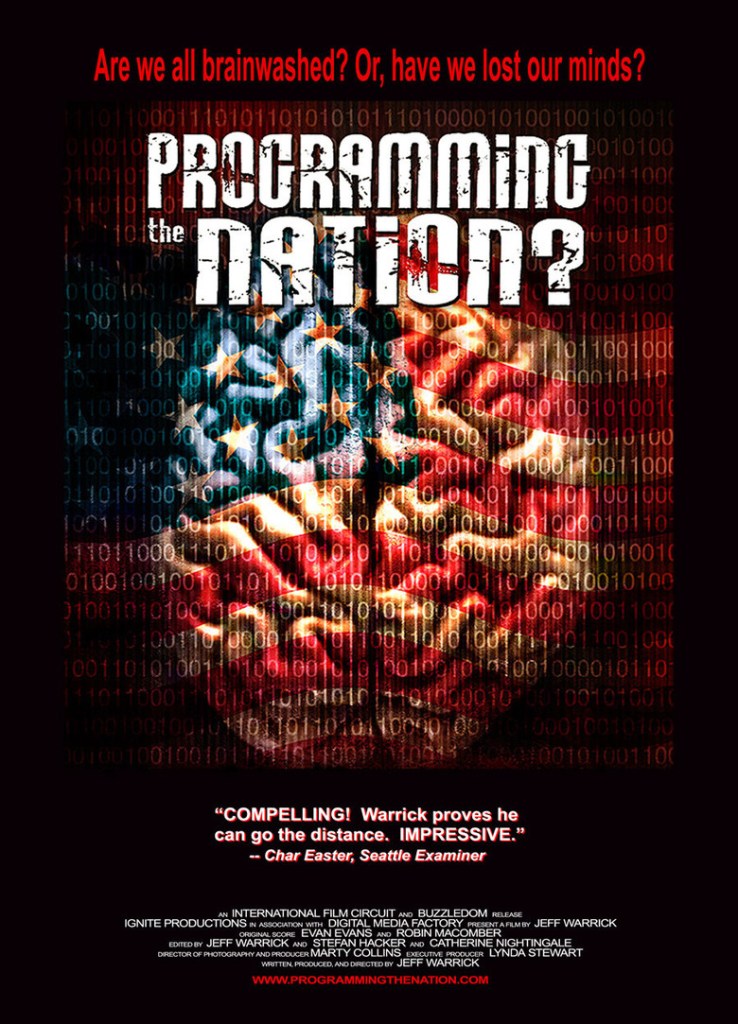
Below is a short video in which Jeff Warrick, the director of Programming the Nation (2011), offers his take on the truth about subliminal messaging. Warrick shares a few examples of messages embedded within ads, which are not likely to be seen consciously, but are admitted into the subconscious mind.

A common response to this type of revealing information is skepticism and disbelief that sexual innuendos or random words embedded in pictures or film will not impact a person’s willingness to buy a product.

Although it is a common assumption that sex sells because for most people it is associated with feelings of pleasure, excitement, enjoyment or even love, subliminal messaging is about much more than helping advertisers sell more product. These messages are designed to have an impact on general consumer behavior and affect people’s life patterns, thus molding society as a whole, creating and captivating more and more receptive consumers.

When bombarded with subliminal messaging, the mind is likely to trigger emotions, memories or feelings, without a person’s conscious recognition of why they feel a certain way. A person may not consciously realize why they start to become more attracted to certain behaviors, lifestyles or products, but they are more likely to succumb to the attraction.

“..subliminal ads are used as a technique not only to increase sales but is also used to divert youth and involve them in such type of behaviour which is only hazardous to the consumer.” ~ (Impact of Subliminal Messaging in TV Advertisements on Consumer Behaviour – A Case Study of Youth in Kashmir Province of J&K, Blue Ocean Research Journalssource)

Are subliminal messages contributing to a variety of economic, social, and political problems currently present in our culture, such as over-competitiveness, low self-esteem, obesity, over-consumption and debt? There are many examples that support this idea and demonstrate that subliminal messaging, over time, can have a powerful impact.

Take, for instance, advertising to women. If you look at any variety of ads that are targeted at women ages 18-35, an overwhelming majority will personify that women and girls should be thin, wear lots of makeup, style their hair in certain ways, and, of course, look very sexy. It almost appears as though it is the advertisers’ job to make young women feel bad about themselves.

See the following example of women in advertising in the video below:

Other examples are films such as the Rambo series of the 1980’s and the more resent American Sniper, which glorify mindless military self-sacrifice, torture and violence. They romanticize obedience to authority and unquestioning loyalty to a war-mongering government.

“‘American Sniper’ lionizes the most despicable aspects of U.S. society—the gun culture, the blind adoration of the military, the belief that we have an innate right as a “Christian” nation to exterminate the “lesser breeds” of the earth, a grotesque hypermasculinity that banishes compassion and pity, a denial of inconvenient facts and historical truth, and a belittling of critical thinking and artistic expression.” – Chris Hedges

Below is the complete documentary by Jeff Warrick, Programming the Nation, that offers a full history behind subliminal message. In the film, Warrick examines if subliminal messaging and other subconscious techniques have conditioned the United States public to become one of the highest consuming nations in the world, accounting for about 25 percent use of the worlds natural resources even though its populace makes up less than 5 percent of the global population.

Billionaires, Bunkers and Brain Damage

“The rich are not like us”

By Mickey Z.

Source: Dissident Voice

Douglas Rushkoff has an article (based on his latest book) called “The super-rich ‘preppers’ planning to save themselves from the apocalypse,” in The Observer.

This excerpt gives you an idea of how the barbaric brain of a billionaire operates:

Finally, the CEO of a brokerage house explained that he had nearly completed building his own underground bunker system, and asked: “How do I maintain authority over my security force after the event?” The event. That was their euphemism for the environmental collapse, social unrest, nuclear explosion, solar storm, unstoppable virus, or malicious computer hack that takes everything down.

This single question occupied us for the rest of the hour. They knew armed guards would be required to protect their compounds from raiders as well as angry mobs. One had already secured a dozen Navy Seals to make their way to his compound if he gave them the right cue. But how would he pay the guards once even his crypto was worthless? What would stop the guards from eventually choosing their own leader?

The billionaires considered using special combination locks on the food supply that only they knew. Or making guards wear disciplinary collars of some kind in return for their survival. Or maybe building robots to serve as guards and workers – if that technology could be developed “in time.” It’s as if they want to build a car that goes fast enough to escape from its own exhaust

I tried to reason with them. I made pro-social arguments for partnership and solidarity as the best approaches to our collective, long-term challenges. The way to get your guards to exhibit loyalty in the future was to treat them like friends right now, I explained. Don’t just invest in ammo and electric fences, invest in people and relationships. They rolled their eyes at what must have sounded to them like hippy philosophy.

After reading that, you may be wondering if the rich are brain-damaged. To which I reply: Why weren’t you thinking that all along and yes, they are brain-damaged. Some studies to consider:

There’s plenty more where that came from but, of course, all such “research” must be viewed with healthy skepticism. Personally, since I’m justifiably wary of “studies,” I’ll just look around to see — with my own three eyes — how the wealthiest humans on the planet have behaved since, well… forever.

Or consider the words of the immortal Dorothy Parker: “If you want to know what God thinks of money, just look at the people he gave it to.”

Translation: The billionaires are not going to save you — or ever help you. They’re running scared to get their brain-damaged butts into bunkers.

So, connect with your peers. Connect across “party” lines and ideological hive minds. Toss away your purity litmus tests and find common ground.

What will save us is what always saves us: community, resilience, compassion, open-mindedness, innovation, and imagination.

The Gaslighting of the Masses

By CJ Hopkins

Source: Off-Guardian

For students of official propaganda, mind control, emotional coercion, and other insidious manipulation techniques, the rollout of the New Normal has been a bonanza. Never before have we been able to observe the application and effects of these powerful technologies in real-time on such a massive scale.

In a little over two and a half years, our collective “reality” has been radically revised. Our societies have been radically restructured. Millions (probably billions) of people have been systematically conditioned to believe a variety of patently ridiculous assertions, assertions based on absolutely nothing, repeatedly disproved by widely available evidence, but which have nevertheless attained the status of facts. An entire fictitious history has been written based on those baseless and ridiculous assertions. It will not be unwritten easily or quickly.

I am not going to waste your time debunking those assertions. They have been repeatedly, exhaustively debunked. You know what they are and you either believe them or you don’t. Either way, reviewing and debunking them again isn’t going to change a thing.

Instead, I want to focus on one particularly effective mind-control technology, one that has done a lot of heavy lifting throughout the implementation of the New Normal and is doing a lot of heavy-lifting currently. I want to do that because many people mistakenly believe that mind-control is either (a) a “conspiracy theory” or (b) something that can only be achieved with drugs, microwaves, surgery, torture, or some other invasive physical means. Of course, there is a vast and well-documented history of the use of such invasive physical technologies (see, e.g., the history of the CIA’s infamous MKULTRA program), but in many instances mind-control can be achieved through much less elaborate techniques.

One of the most basic and effective techniques that cults, totalitarian systems, and individuals with fascistic personalities use to disorient and control people’s minds is “gaslighting.” You’re probably familiar with the term. If not, here are a few definitions:

“the manipulation of another person into doubting their perceptions, experiences, or understanding of events.”American Psychological Association

“an insidious form of manipulation and psychological control. Victims of gaslighting are deliberately and systematically fed false information that leads them to question what they know to be true, often about themselves. They may end up doubting their memory, their perception, and even their sanity.”Psychology Today

“a form of psychological manipulation in which the abuser attempts to sow self-doubt and confusion in their victim’s mind. Typically, gaslighters are seeking to gain power and control over the other person, by distorting reality and forcing them to question their own judgment and intuition.”Newport Institute

The main goal of gaslighting is to confuse, coerce, and emotionally manipulate your victim into abandoning their own perception of reality and accepting whatever new “reality” you impose on them. Ultimately, you want to completely destroy their ability to trust their own perception, emotions, reasoning, and memory of historical events, and render them utterly dependent on you to tell them what is real and what “really” happened, and so on, and how they should be feeling about it.

Anyone who has ever experienced gaslighting in the context of an abusive relationship, or a cult, or a totalitarian system, or who has worked in a battered women’s shelter, can tell you how powerful and destructive it is. In the most extreme cases, the victims of gaslighting are entirely stripped of their sense of self and surrender their individual autonomy completely. Among the best-known and most dramatic examples are the Patty Hearst case, Jim Jones’ People’s Temple, the Manson family, and various other cults, but, the truth is, gaslighting happens every day, out of the spotlight of the media, in countless personal and professional relationships.

Since the Spring of 2020, we have been subjected to official gaslighting on an unprecedented scale. In a sense, the “Apocalyptic Pandemic” PSYOP has been one big extended gaslighting campaign (comprising countless individual instances of gaslighting) inflicted on the masses throughout the world. The events of this past week were just another example.

Basically, what happened was, a Pfizer executive confirmed to the European Parliament last Monday that Pfizer did not know whether its Covid “vaccine” prevented transmission of the virus before it was promoted as doing exactly that and forced on the masses in December of 2020. People saw the video of the executive admitting this, or heard about it, and got upset.

They tweeted and Facebooked and posted videos of Pfizer CEO Albert Bourla, Bill Gates, the Director of the CDC, official propagandists like Rachel Maddow, and various other “experts” and “authorities” blatantly lying to the public, promising people that getting “vaccinated” would “prevent transmission,” “protect other people from infection,” “stop the virus in its tracks,” and so on, which totally baseless assertions (i.e., lies) were the justification for the systematic segregation and persecution of “the Unvaccinated,” and the fomenting of mass fanatical hatred of anyone challenging the official “vaccine” narrative, and the official New Normal ideology, which hatred persists to this very day.

The New Normal propaganda apparatus (i.e., the corporate media, health “experts,” et al.) responded to the story predictably. They ignored it, hoping it would just go away. When it didn’t, they rolled out the “fact-checkers” (i.e., gaslighters).

The Associated PressReutersPolitiFact, and other official gaslighting outfits immediately published lengthy official “fact-checks” that would make a sophist blush. Read them and you will see what I mean. They are perfect examples of official gaslighting, crafted to distract you from the point and suck you into an argument over meaningless details and definitions. They sound exactly like Holocaust deniers pathetically asserting that there is no written proof that Hitler ordered the Final Solution … which, there isn’t, but it doesn’t fucking matter. Of course Hitler ordered the Final Solution, and of course they lied about the “vaccines.”

The Internet is swimming with evidence of their lies … tweets, videos, articles, and so on.

Which is what makes gaslighting so frustrating for people who believe they are engaged in an actual good-faith argument over facts and the truth. But that’s not how totalitarianism works. The New Normals, when they repeat whatever the authorities have instructed them to repeat today (e.g., “trust the Science,” “safe and effective,” “no one ever claimed they would prevent transmission”), could not care less whether it is actually true, or even if it makes the slightest sense.

These gaslighting “fact-checks” are not meant to convince them that anything is true or false. And they are certainly not meant to convince us. They are official scripts, talking points, and thought-terminating clichés for the New Normals to repeat, like cultists chanting mantras at you to shut off their minds and block out anything that contradicts or threatens the “reality” of the cult.

You can present them with the actual facts, and they will smile knowingly, and deny them to your face, and condescendingly mock you for not “seeing the truth.”

But here’s the tricky thing about gaslighting.

In order to effectively gaslight someone, you have be in a position of authority or wield some other form of power over them. They have to need something vital from you (i.e., sustenance, safety, financial security, community, career advancement, or just love). You can’t walk up to some random stranger on the street and start gaslighting them. They will laugh in your face.

The reason the New Normal authorities have been able to gaslight the masses so effectively is that most of the masses do need something from them … a job, food, shelter, money, security, status, their friends, a relationship, or whatever it is they’re not willing to risk by challenging those in power and their lies. Gaslighters, cultists, and power freaks, generally, know this. It is what they depend on, your unwillingness to live without whatever it is. They zero in on it and threaten you with the loss of it (sometimes consciously, sometimes just intuitively).

Gaslighting won’t work if you are willing to give up whatever the gaslighter is threatening to take from you (or stop giving you, as the case may be), but you have to be willing to actually lose it, because you will be punished for defending yourself, for not surrendering your autonomy and integrity, and conforming to the “reality” of the cult, or the abusive relationship, or the totalitarian system.

I have described the New Normal (i.e., our new “reality”) as pathologized-totalitarianism, and as a “a cult writ large, on a societal scale.” I used the “Covidian Cult” analogy because every totalitarian system essentially operates like a cult, the main difference being that, in totalitarian systems, the balance of power between the cult and the normal (i.e., dominant) society is completely inverted. The cult becomes the dominant (i.e., “normal”) society, and non-cult-members become its “deviants.”

We do not want to see ourselves as “deviants” (because we haven’t changed, the society has), and our instinct is to reject the label, but that is exactly what we are … deviants. People who deviate from the norm, a new norm, which we reject, and oppose, but which, despite that, is nonetheless the norm, and thus we are going to be regarded and dealt with like deviants.

I am such a deviant. I have a feeling you are too. Under the circumstances, it’s nothing to be ashamed of. On the contrary, we need to accept it, and embrace it. Above all, we need to get clear about it, about where we stand in this new “reality.”

We are heading toward New Normal Winter No. 3. They are already cranking up the official propaganda, jacking up the fabricated “cases,” talking about reintroducing mask-mandates, fomenting mass hatred of “the Unvaccinated,” and so on. People’s gas bills and doubling and tripling. The global-capitalist ruling classes are openly embracing neo-Nazis. There is talk of “limited” nuclear war. Fanaticism, fear, and hatred abound. The gaslighting of the masses is not abating. It is increasing. The suppression of dissent is intensifying. The demonization of non-conformity is intensifying. Lines are being drawn in the sand. You see it and feel it just like I do.

Get clear on what’s essential to you. Get clear about what you’re willing to lose. Stay deviant. Stay frosty. This isn’t over.

Consider the Chickens

Intelligence, ethics, and the inner lives of animals

By Rafia Zakaria

Source: The Baffler

I OWE CHICKENS AN APOLOGY. Not only have I been eating them until very recently, but I have refused to even consider the possibility of a chicken having any kind of inner life. This estimation was not made from a lack of interaction. As children, my twin brother and I purchased baby chicks from a street vendor. We did this unfazed by the fact that quite often, the chickens would die. Once, when we were nine, we had two that lived, a hen and a rooster. No one told us that we should probably get more hens. Not having any other female companions, the rooster exerted his attentions on the one chicken. She would lay an egg or two every day, much to our delight, but soon sickened and died. Then there was only an incel rooster who roamed our compound and terrorized the women. After a few ugly incidents, he was “given away” to one of the women who worked at our house. We were never told what happened to him, and I didn’t care. There is nothing worse than an incel rooster patrolling your house all day long.

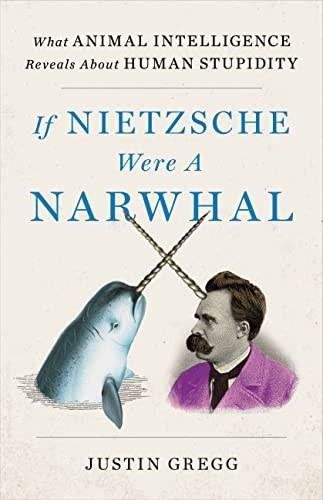
Now, so many years later, I’ve found my way to animal behaviorist Justin Gregg’s brilliant new book If Nietzsche Were a Narwhal: What Animal Intelligence Reveals About Human Stupidity. Gregg’s chicken coop is “a huge enclosed area” with high rafters, because as an animal scientist, he knows them to be jungle birds who need perches on which to sleep at night. But it is not only the magisterial heights of Gregg’s discussion of chickens that stayed with me. I was struck also by Gregg’s description of his chickens’ varied personalities, one anxious, another friendly, and so on; he tells us that these chickens do have inner lives and thus a consciousness of themselves as distinct from others. Instead of the feckless creatures I (and most people) assume them to be, chickens have just the sort of intelligence that is necessary for their own survival. They don’t think like humans, Gregg tells us, because they do not need to.

Intelligence, in Gregg’s explanation, does not exist in the way SATs or other IQ tests would have you believe. Those tests quantify a certain kind of ability to process information. People who do not do well on such tests may have other kinds of abilities that simply are not being measured. Intelligence is not one easily definable thing; engineers working on artificial intelligence cannot agree on a definition of it. But what humans have is a tendency to ask why things operate in a certain way. In Gregg’s terminology, humans are “why specialists,” a proclivity that in natural selection terms is no advantage and perhaps even a liability. A narwhal swimming around in the sea, for instance, would never have the kind of mental breakdown that the German philosopher pondering nihilism suffered toward the end of his life. Animal intelligence is practical and does not get caught up in abstract thought. By and large, animals make calculations based on what they can observe; ideas such as “causality,” which lie at the crux of human intelligence, are outside their capacity for thought.

Humans evolved to become why specialists. As Gregg tells it, 200,000 years ago, humans were hanging out with chimpanzees and exhibited no interest in the whys. They could make rudimentary tools and had some kind of assemblage of grunts that allowed for basic communication. He notes that roughly 40,000 years ago, cave paintings were created. Here were humans asking the whys; symbolic representation is an exclusively human thing.

Inability to be why specialists does not mean that animals are not capable of “metacognition,” the ability to be conscious of their own thinking or cognition. One of the most stunning examples in this book full of stunning examples is that of Natua, a dolphin at the Dolphin Research Center in Florida. An experiment was set up where Natua was exposed to two kinds of sounds, one a very high tone and one a very low tone. After hearing the sound, Natua had to choose between two paddles, one for the high and another for the low. If he chose correctly, he was given a fish for a reward. If he did not, he was sent for a long time-out, in that the experiment stopped. As the experiment progressed, the high tone sound came very close to the low sound such that they were nearly indistinguishable. At this point, Natua was unable to tell the difference; “he just started randomly pressing paddles,” Gregg writes. His behavior proved that some animals are capable of metacognition, the awareness that they do not know, or that their thinking about something is wrong.

It is no surprise that Gregg is pessimistic about how humans have used their abilities as why specialists, and he thinks that there is a chance that humans might not even survive over another century. The prospect of nuclear war and the climate crisis suggest, in Gregg’s view, that the end is possible. In the meantime, developing a consciousness of animals as beings who are capable of metacognition, of having individual personalities and so on, points to the need for a new ethics. This new set of basic premises would abandon the centering principle that the animal-human relationship must always be of one having dominion over the other.

But if you consider the continued resistance to the idea of animal rights, it is hard to be optimistic about the emergence of a new ethics of mutuality that eschews the dominion portion. Too many human rationalizations, attached to what we eat, what we wear, how we live, are predicated on the belief that we are the only feeling beings and that our actions upon animals are independent of consequences. If you know the fear of a chicken or a cow or a pig about to be slaughtered, you may look at your food in a different way. You might eschew fried chicken or beef or pork completely. If you understand that a horse being whipped is suffering terribly, is extremely scared and dissolute, you can also understand that there is a need for a radical expansion of mindfulness and a concomitant shrinking of power.

In the moral universe informed by Gregg’s argument, the survival of the human race is not an imperative for the planet because humans as a species have been far more disastrous for the world than others. “Prognostic myopia” keeps us horribly and condemnably in the moment, burning fossil fuels and trashing the oceans even though we know that it is terrible for the environment. This is a unique position among philosophers, a lot of whom have lately concerned themselves with questions of ethics and planetary survival. 

As a contrast to Gregg, the Oxford Associate Professor in Philosophy William MacAskill, in his What We Owe the Future, proposes “effective altruism” as a way to live ethically in times of climate crisis. If Gregg argues against human exceptionalism, MacAskill reduces humans to data points, where the survival of the most, and the most benefit to the planet, are guideposts to a present and future ethics. Using Gregg’s arguments, however, effective altruism is rendered meaningless. Even those who live sparingly on twenty-six thousand pounds a year, like MacAskill, are still a burdensome threat, unless we define their worth according to tiresome illusions of human exceptionalism.

If Nietzsche Were A Narwhal is the sort of critical look at human dominion that our world needs. A few years ago, Brown University environmental historian Bathsheba R. Demuth wrote Floating Coast: An Environmental History of the Bering Strait, a similarly groundbreaking look at the consequences of the extractive relationship humans have had with the environment. Just as Gregg reveals the risks of humans imagining their power over animals as shorn of consequences, Demuth reveals the consequences of human dominion over nature.

Thinkers and scientists like Gregg and Demuth are presenting readers with the urgent and pressing necessity for a new ethics. The unthinking, extractive, and dominant human treats animals as a lower form of existence, rather than a different form; we assess the environment based on what can be extracted from it. Like our means of communication, our means of travel, of treating disease, and so much else, our ethics need an urgent and pressing update that takes into consideration the understanding of animals. Factory farms, the constant consumption of animal products, and the greedy use of fossil fuels are the seeds of destruction.

I am not sure I could have offered the chicken and rooster of my childhood a deluxe chicken coop with high rafters, but an argument for better living conditions and the introduction of new companions for the rooster would have been easier if we had understood the first thing about the animals around us. I do not need to underscore the rapid pace at which our world is changing. If Nietzsche Were A Narwhal is a must-read because it explains how we can save the world only if we exist in symbiosis with the thinking, feeling creatures that have had the misfortune of sharing the planet with humans, who turn out not to be as intelligent as they believe themselves to be.