Our age of horror

In this febrile cultural moment filled with fear of the Other, horror has achieved the status of true art

By M M Owen

Source: aeon

In Ray Bradbury’s horror short story, ‘The Next in Line’ (1955), a woman visits the catacombs in Guanajuato, Mexico. Mummified bodies line the walls. Lying awake the next night, haunted by her macabre tour, she finds that her heart ‘was a bellows forever blowing upon a little coal of fear … an ingrown light which her inner eyes stared upon with unwanting fascination’.

Our present era is one in which the heart of culture is blowing hard upon a coal of fear, and the fascination is everywhere. By popular consent, horror has been experiencing what critics feel obliged to label a ‘golden age’. In terms of ticket sales, 2017 was the biggest year in the history of horror cinema, and in 2018, Hereditary and A Quiet Place have been record-breaking successes. In both the United States and the United Kingdom, sales of horror literature are up year over year – an uptick that industry folk partly attribute to the wild popularity of Netflix’s Stranger Things (2016-). And the success isn’t merely commercial. Traditionally a rather maligned genre, these days horror is basking in the glow of critical respectability. As The New York Times remarked this June, horror ‘has never been more bankable and celebrated than it is right now’.

As any historian of the genre will tell you, horror has had previous golden ages. Perhaps ours is just a random quirk of popular taste. But perhaps not. Perhaps we are intoxicated by horror today because the genre is serving a function that others aren’t. Can’t. Horror’s roots run deep, but they twist themselves into forms very modern. The imagination’s conversion of fear into art offers a dark and piercing mirror.

My earliest horror memory is Stay Out of the Basement (1992), one of R L Stine’s Goosebumps series of young adult novels. In the story, a botanist accidently creates a hybrid plant clone of himself. When the clone comes to life, he tries to steal his humanoid self’s life. The botanist’s children unmask the imposter, and in a mess of green blood and plant mush, the clone is felled with an axe. The rescued father disposes of the rest of the mutating plant matter, and the family is all set to live happily ever after. But at the very end, the daughter is standing in the garden and feels a small plant nudging her ankle. The plant whispers to her: ‘Please – help me. I’m your father.’ Stay Out of the Basement is no masterpiece, but I was young, and it struck me cold.

Horror is what anthropologists call biocultural. It is about fears we carry because we are primates with a certain evolved biology: the corruption of the flesh, the loss of our offspring. It is also about fears unique to our sociocultural moment: the potential danger of genetically modifying plants. The first type of fear is universal; the second is more flexible and contextual. Their cold currents meet where all great art does its work, down among the bottomless caves on the seabed of consciousness. Lurking here, a vision of myself paralysed in the dirt, invisible to those I love.

Horror has always been with us. Prehistoric cave paintings are rife with the animal-human hybrids that remain a motif of horror to this day. Every folktale tradition on Earth contains tales of malevolent creatures, petrifying ghosts and graphic violence. The classics are frequently horrifying: in Homer’s Odyssey, when the Cyclops encounters Odysseus’ men, the monster eats them, ‘entrails, flesh and the marrowy bones alike’.

We have always told horror stories, and we always will. Because horror is an artistic expression of an ontological truth: we are creatures formed in no small part by the things to which we are averse. Fear is a base ingredient of consciousness, partaking of brain circuits that are so ancient humans share them with all vertebrate lifeforms. As the neuroscientist Antonio Damasio has described, the whole weird soup of human feeling emerged as a result of our beginning to process whether to ‘approach or avoid … certain places or things or creatures’. Our cognition absorbs reality as a vast spectrum of potential encounters, and horror alchemises the dark end into art.

Thus, evolutionary analyses of horror mention monsters as the genre’s most defining feature. As the philosopher Stephen T Asma puts it, ‘during the formation of the human brain, the fear of being grabbed by sharp claws, dragged into a dark hole and eaten alive was not an abstraction’. For a quarter of a million years – the vast majority of Homo sapiens’ existence as a species – we lived outdoors, with giant hyenas, saber-toothed cats and other carnivores representing a real threat to life. That other ancient health risk, the biological pathogen, manifests itself in the tendency of monsters to be not only violent but also disgusting – feral, oozing blood and saliva, bearing their infectious teeth. From the evolutionary perspective, horror’s vast monstrous menagerie echoes with Paleolithic peril.

Historically, horror’s willingness to play directly to our evolved physiology has seen it earn a low reputation. Western culture was built on a vision of ourselves as above the beasts, above the beastliness of acquiescing helplessly to the demands of the body. But horror can bypass all intellect, extract from us an embarrassingly animalistic response. The skittish physicality of the ‘jump scare’ is a manipulation of what biologists call the startle response, present in all mammals. And cruder horror always contains that other ghastly reminder of our physicality: gore. Gore disgusts us, and the way that gore can be darkly compelling to us disgusts us. Whenever horror is criticised, it is criticised for staging a dark carnival of physicality. Perhaps the only sort of media we moralise more than we do horror is that other mainliner of bodily response, pornography.

Horror’s historical ghettoisation has meant that weightier, smarter horror reliably gets labelled as something else. The finest films of our current golden age have been dubbed ‘elevated horror’ and ‘post-horror’. In literary circles, works of horror seen as sufficiently cerebral get relabelled ‘Gothic’. It’s certainly true that great horror is always about more than gore. But we should be careful not to gentrify the genre by cleansing it of everything but the philosophy.

There are always beings that want to bite us, scratch us, puncture our fragile flesh. There is the terrible old coercion of brute, muscular force, the lethal threat of contagion and infection. There is darkness, disorientation. And looming explicitly or symbolically in all horror is that vast shadow that the anthropologist Ernest Becker said ‘haunts the human animal like nothing else’: death.

‘And he that sat on the cloud thrust in his sickle on the Earth; and the Earth was reaped’. Witness the machinations of that famous slasher, God (Revelation 14:16). Horror encodes the story of our long primate journey, but these biological foundations support the towering edifice of culture. And for millennia, horror merged with our oldest cultural phenomena: religion and folklore. In fact, for most of its history, horror wasn’t really art, as we tend to understand that term today. It certainly wasn’t fiction. Prior to about 1750, in our pivot toward the Enlightenment, the best horror stories can all be found within theology and lore. In Europe, for generations Satan was every bit as petrifying as Pennywise, the murderous clown of Stephen King’s It (1986). Demonic forces were terrifyingly real; in the Bible, Jesus spends almost as much time performing exorcisms as he does healing people. There were widespread societal panics about the threat of werewolves and vampires, and tens of thousands of women were murdered as witches.

This isn’t to judge the credulity of bygone peoples. But the reason that horror – unlike say tragedy, or comedy, or the epic – didn’t exist as an artistic genre until relatively recently is that its deep history is fundamentally pre-scientific. Nothing in the annals of art is as scary as what you’ll find in bygone worldviews. Who needs make-believe scares when everyone you know is awaiting the day of judgment, at which point an angel will sweep a sickle across the Earth and make the blood run for hundreds of miles? It is no coincidence that the Gothic – horror’s regal antecedent – emerged precisely at the moment when lots of people began to believe that God really might be dead. Modern horror is in part the story of what happens when our threatened minds shed a theology. Once holy texts can no longer entirely encode the terrors of being, horror enters fully the arena of art.

However, the old ways cast a long shadow. In the pantheon of genres, horror remains an adolescent, and it has a sort of adolescent relationship with its past: half rebellion, half dependency. On the one hand, more than any other genre, horror loves to thematise the coldest sorts of atheism. ‘All my tales,’ said horror grandee H P Lovecraft, ‘are based on the fundamental premise that common human laws and interests and emotions have no validity or significance in the vast cosmos-at-large.’ In The Silence of the Lambs(1988), amused by what he sees as clear evidence for the absence of any benevolent deity, the charmingly evil Hannibal Lecter ‘collects church collapses, recreationally’.

On the other hand, horror is marked everywhere by the centuries it spent wedded to otherworldly belief systems. In 2018’s biggest horror movie, Hereditary, an obscure figure from demonology possesses a teenage boy and wreaks death upon his family. Much Japanese horror features yūrei, tormented and enraged spirits denied a smooth passage to the afterlife. Horror was a dark, mutant child of the Enlightenment, and yet it can’t shake its pre-scientific genes. Its penchant for lurid supernaturalism is a big reason why, when it fails, it can so easily seem puerile. The modern, skeptical mind whispers: This is just silly. Haven’t we outgrown all this? On Halloween – a celebration of horror’s pre-artistic forms – children are meant to have the most fun.

Why does horror have this double-edged relationship with its religious and spiritual heritage? Perhaps because, for all its modernity, the sheer scale of theological enquiry still reflects the genre’s ambition. As leading horror author Joe Hill told me, horror is what we turn to when we want to explore ‘the biggest and darkest questions’. And even demoted from dogma to metaphor, the old myths offer a fine way to channel those grand subjects of which horror is so fond: good versus evil, the tribulations of the soul, the end of days. Even though it requires our suspension of disbelief, the paranormal presents us with the very real prospect of brittle reason splintering against the mystery of reality.

‘There’s a sense of uncertainty and potential wrongness underlying most of human existence,’ the Canadian author Gemma Files told me. All of humankind’s great mythic narratives know this, and horror doesn’t let us forget it. At the core of the numinous impulse – that oceanic feeling in which horror was submerged for so many centuries – is the strange certainty that reality is unpredictable and inscrutable, that certain things will forever resist the reach of the human mind. Horror will always share in this sense. It may have fallen from heaven, but it still isn’t entirely of this Earth. Cormac McCarthy’s The Road(2006) centres on a father and son as they wander across a blasted, post-apocalyptic America. The horrors are everywhere: they discover, chained in a basement, ‘a man with his legs gone to the hip and the stumps of them blackened and burnt’. The man is being harvested by cannibals, piece by piece. It is a bleak, fallen world, where the memory of a time when trout swam in the streams shimmers with celestial grace. When the father meets an elderly man, he tells him: ‘There is no God and we are his prophets.’

And so what of today? Horror reverberates with fears Paleolithic and God-fearing, but it is also always reacting to its present moment. And it seems reasonable to perceive any swell in the production and popularity of horror – any dawning of a new golden age – as the expression of a culture that is afraid. ‘In anxious times,’ David Bruckner, director of The Ritual (2017) and other horror movies, told me, ‘people are more likely to turn to horror. If you have an uneasy night at the movie theatre, you are sort of answering the call of your times.’

‘I think we’re living in a nightmare, basically.’ So said horror legend Ramsey Campbell, when I asked him why he thinks horror is flourishing right now. This is one of those things that cooler heads will say is your mind deceiving you. By many objective measures, for many people, life today is better than ever. But horror has never been too worried about culture’s long-term trajectory; it is always fixated on how it could all go badly wrong, any minute now. Horror is steeped in worry; its narratives frequently open with the calm before a terrible storm. And every person connected with horror that I interviewed smelled doom on the breeze.

Horror has always made good use of our deep aversion to what Lovecraft called ‘the oldest and strongest kind of fear’: the unknown. This is one of the ways in which horror (like the folktale) can display a sort of archetypal conservatism. In general terms, the best way to survive a horror setting is to be supremely, boringly sensible: don’t talk to strangers, don’t stay the night in a foreign town, don’t go to the aid of anyone who looks sick, don’t go into that crumbling old building. If a very attractive stranger tries to seduce you, it is almost definitely a trap. Respect tradition, do not commit sacrilege, listen to the advice of elderly locals. At the heart of a lot of horror is a conservative craving for the predictable and the known. The unpleasant atonal dissonance you’ll hear in every horror score reflects, through the collapse of harmony, the disintegration of familiar and comforting patterns out there in the world.

Horror, then, thrives on discombobulation. And today, the discombobulation is everywhere. The causes of the anxiety are scattershot, and you already know them. There are those scientific breakthroughs of the sort that get Silicon Valley execs psyched, but which many others find deeply, opaquely perturbing. Take artificial intelligence, whose rise has seen more and more science fiction turn horrific: ‘One day the AIs are going to look back on us the same way we look at fossil skeletons on the plains of Africa,’ says Nathan, a central character in Ex Machina (2015). And even if the robots don’t vanquish poor old Homo sapiens, other sorts of scientific experimentation might. One of the great horror trends of the 21st century has been the zombie, and in all of the best works of zombie fiction, the immediate cause of the outbreak is the same: biological experimentation gone horribly wrong. The zombie is the gnashing, lunging embodiment of that modern terror, the global pandemic. People might not fear Satan anymore, but they sure as hell fear Ebola.

Outside of the lab, there is that slower method of planetary destruction: climate change. ‘Horror,’ the author Jeff VanderMeer told me, ‘is the beauty of the natural world juxtaposed against the way we destroy those natural systems without understanding them.’ VanderMeer’s Southern Reach trilogy (2014), some of my favourite horror novels of all time, diluted my enjoyment of the UK’s recent heatwave and refused to let me forget that what I was basking in were the convulsions of an aching planet. A biosphere cast brutally off-balance forms the setting for M R Carey’s The Girl With All the Gifts(2014), where humanity has been devastated by a fungal infection. Where horror once worried about the weather gods, it now just worries about the weather. Climate change, meanwhile, is a major cause of mass migrations, potent fuel for what leading critic Leslie Klinger described to me as horror’s historical trend of feeding off ‘the invasion of foreigners into previously stable populations’. At a base level, we are in-groupish creatures. I’ve spent time with rural, paganish communities who enjoy a singsong and are sexually unrepressed; none of them tried to burn me alive in a giant wicker man. But horror says: you never knowStick to your own.

If all these fears sound selfish, parochial, insular – don’t get the wrong idea. Horror offers a map of the psyche and, like fear itself, is inherently apolitical. It can easily offset its archetypal conservatism with a radical sort of anarchism. Horror might thematise our fear of the unknown – but it also warns about clinging too stubbornly to the familiar. In a lot of horror, survival is predicated on a capacity to quickly adapt to brutal change. Horror has little time for the conservative sentimentality that swirls around ideas such as institutions and tradition, and even something like the nation-state is often revealed as a sort of frilly, doomed illusion. The protections of social hierarchy or private property are never of any use, and horror loves to punish characters who arrogantly believe that wealth will shield them. In horror, the consolations of the past melt in contact with the white-hot heart of present fear. Conservatism fails because it is revealed that at bottom there is nothing to conserve. As the author Michael Marshall Smith put it to me, great horror often declares: ‘It’s just you versus the monster. Always has been. Always will be.’

In this, lots of horror is intensely universalising. Frequently, a scenario comes down to a simple contest between humankind and something else. Splitting up is a suicidal move in horror; survival often follows an impulse toward communal effort. Similarly universalising is the way that, at extreme moments of threat or fear, a given character’s skin colour or gender or nationality will often be effaced. At horror’s pitch, we perceive a simple human, doing what we all do every day of our lives: struggling to live, to persist, to overcome. In The Babadook(2014), a widowed mother is stalked by an amorphous, black-hatted monster that embodies her grief at losing her husband. The monster – her terrible, life-sucking trauma – threatens to claim her son, and destroy what is left of her family. Late in the film, bloodied and exhausted, the mother faces down the Babadook, yelling: ‘If you touch my son again, I’ll fucking kill you.’ The monster is tamed. It is a show of furious bravery that could be any mother, anywhere; courageous love in the face of total disorder.

It’s easy to romanticise horror, but there are also unsexy, funcitonal reasons why it’s having its moment right now. The streaming revolution has given creators a reliable and direct way to reach a dedicated, self-selecting audience. Trusting this audience, distributors like A24 and Blumhouse have put a great amount of both creative wherewithal and cold hard dollars into horror cinema. The genre has always been reliably profit-turning, but it has also always been prone to the lazy recycling of ideas and tropes. Today, even experimental horror can be profitable. In literature, meanwhile, a revival of interest in horror greats like Shirley Jackson, as well as a slew of Stephen King adaptations, has been a boost for the genre at large.

Yet on their own, these tantalising products would never suffice to make horror soar. Horror has been with us since the dawn of storytelling. It manifests the fears of the human animal, and even today echoes the slippery spiritual suspicion that reality isn’t what it seems. Our world is ripe for upending, and horror expresses that best. Horror can thrive today because ours is a strange and febrile cultural moment. It seems every civilisation has believed they are on the brink of cataclysmic change; such an idea has a weird narcissistic appeal. But today there is everywhere a deep feeling that the horses of disaster are about to plunge in the heavy clay. There is a sort of great loop being completed here: as horror has morphed from theology to art, the ruinous power has moved from the judgment of God to the hand of humans. The end of days in one programmer’s idle tinkering, in one laboratory’s overlooked quarantine protocols. Robert Louis Stevenson, author of The Strange Case of Dr Jekyll and Mr Hyde (1886), wrote, ‘Sooner or later, everyone sits down to a banquet of consequences.’ As a genre, horror is forever pulling up a chair, licking its lips at the feast to come.

Breathing this nervous air, current horror – like the theology that provided its former home – is animated by the full spectrum of human psychology. It is driven by our desire to stop all the clocks, shrink into a bubble of the familiar and the known, reject all things foreign. Equally, current horror is shot through with the bone-deep knowledge that if we can’t adapt, we will perish. Its narratives warn us not to cling to outdated consolations, to recognise that we all face the same monsters, in the end. The world has always been dark and full of terrors, and horror has always known it. The dark pleasure of enjoying horror is all about countenancing this awful truth from within a little bubble of safety. It is about the doppelgängered headspace of loathing the real thing but craving its imaginative facsimile. If the genre of horror has a master virtue, a single human quality that it consistently exalts, it is an old one: bravery. We are certain to need that, wherever we are headed.


With thanks to all the horror authors, editors, screenwriters, directors and critics who generously gave me their time to explore horror: Nick Antosca, Stephen T Asma, David Bruckner, Ramsey Campbell, Noël Carroll, Ellen Datlow, Gemma Files, Steven Gerrard, Joe Hill, Carole Johnstone, Leslie Klinger, John Langan, Lisa Morton, Andy Nyman, Jami O’Brien, Xavier Aldana Reyes, Priya Sharma, David J Skal, Michael Marshall Smith, Eugene Thacker, Paul Tremblay, and Jeff VanderMeer. 

A Clockwork Orange: Waiting for the Sun

By Doug “Uncola” Lynn

Source: The Burning Platform

Society should not do the wrong thing for the right reason, even though it frequently does the right thing for the wrong reason.

 History has shown us what happens when you try to make society too civilized, or do too good a job of eliminating undesirable elements. It also shows the tragic fallacy in the belief that the destruction of democratic institutions will cause better ones to arise in their place.

Stanley Kubrick on “A Clockwork Orange”, an interview with film critic Michel Ciment

An obscure Texas political consultant named Bill Miller once said “politics is show business for ugly people”.  It’s true for the most part, aside from the consequences.  This is because the theatrics of politicians result in policies that affect the lives of others; often against the will of the governed. In books and movies, however, the characters are much ado about nothing. Until, that is, life imitates art.

So it is with the futuristic dystopian story of “A Clockwork Orange”.  Both the book, by the author Anthony Burgess, and the film by director Stanley Kubrick, serve as moral dilemmas and cautionary tales plumbing such considerations as free will, the duality of mankind, societal anarchy, and the ascendancy of an all-powerful state.

A 1973 review written in Sight and Sound Magazine, stated: “Kubrick has appropriated theme, character, narrative and dialogue from Anthony Burgess’ novel, but the film is more than a literal translation of a construct of language into dramatic-visual form”. Therefore, for that reason, and for others described later, the film will remain this article’s primary focus.

As any perfunctory internet research will show, Stanley Kubrick is known as a visionary artist and director, but also as the subject of multiple conspiracies. In addition to A Clockwork Orange, Kubrick’s oeuvre includes avant-garde films such as Dr. Strangelove, The Shining, 2001 A Space Odyssey, and Eyes Wide Shut; to name a few.  Just as these movies demonstrate the inner workings of mankind operating through the disparate threads which bind reality, so do some claim that a larger picture is presented as well.  The big picture, of course, is said to include conspiratorial clues and undertones in Kubrick’s films ranging from Freemasonry, to America’s alleged faked moon landing, to an occultist global financial elite, and the terrorist attacks of 911 being planned as a world transformational event.

There exist multiple published writings, both online and in print, describing the secret meanings hidden in Kubrick’s movies.  Furthermore, it has been argued that Kubrick’s “somewhat surreal films” appeal to the viewer’s subconscious and, therefore, “lend themselves to this sort of interpretation”.

That is another reason why Kubrick’s film will remain the focus of this essay, as opposed to the novel: Either these alleged conspiracies are imagined in the minds of the viewers, or Kubrick deliberately inserted these elements into his creations.  Given Kubrick’s reputation for perfectionism, one can only conclude the symbolism was specifically placed and for exact reasons.

For example, in Kubrick’s The Shining, there are those who contend it is “laden with symbolism, hidden messages”, and “conspiracy theories”.   In Eyes Wide Shut, some contend it was meant to reveal secret societies and sex-magic by means of “evidence” which includes occult symbolism and references to Ishtar, the ancient Babylonian goddess of fertility, love, war and sex.

In his other films, like 2001 A Space Odyssey, it has been argued the strategic placement of the sun, or other circular lights, were utilized by Kubrick as symbolic movie projectors of sorts, whereby time and events unwind before the audience like a clock.  Additionally, even in movies not directed by Kubrick, there are those who say mirrors are used to demonstrate mind control.  It is a fact both of these visualizations are present in A Clockwork Orange.

Once again, and for all of the reasons delineated heretofore, the following presentation will analyze Kubrick’s film as opposed to the novel from which it derived.  The story, and Kubrick’s alchemy, will then be analyzed through the lens of three separate realities followed by some concluding comments at the very end.

THE UNWINDING

In Kubrick’s A Clockwork Orange, the viewers witness the tragic life and circumstances of a teenager named Alex DeLarge navigating a decadent post-modern world. In the film, Alex is played by the actor Malcolm McDowell.  The story unfolds against the backdrop of a futuristic dystopian society that has descended into anarchy and violence; especially within the younger generation.

The very first scene focuses on the evil-eyed Alex adorned with a black fedora and sunray eyeliner beneath his right eye. As the camera pulls back, the boy is shown with three of his young friends identified in the narrative as “droogs”. The youths are shown sitting in the Korova Milk Bar where they imbibe “Milk Plus”; or milk laced with recreational drugs of various types.

Upon leaving the bar, the boys come across a drunk lying in an alley and singing what Alex calls the songs of the drunk man’s “fathers”.  This implies a line of separation between the previous time and the new; between the old and the young.  This separation of time is actually confirmed when the drunk tells the young hooligans he no longer wants to live in this “stinking world” because there’s “no law and order anymore”, where the young “get onto the old”, and “it’s no world for an old man any longer”.

The boys commence to beat the old boozer senseless.

In the next scene, Alex and his droogs come across a group of five other boys who, on an abandoned theatrical stage, are attempting to rape a young woman.  Seemingly, the stage implies the violence unfolding as melodrama, causing this viewer to question if the descent into societal violence was staged as well?  The boys assaulting the woman were wearing military-style camo clothing and adorned with Nazi accoutrements. Alex taunted them in a near Shakespearean manner, and the rival gangs went to war.  The battle also appeared as theatrically choreographed and was set in sync to Giaochino Rossini’s La Gazza Ladra overture.

In the next scene, we see Alex and his gang fleeing to the countryside in a red sports car, looking very much like four demons racing towards hell.

Chaos ensued until Alex eventually ended up in prison and, thus, in possession of the state.

In prison, Alex sat before an open Bible and fantasized he was a Roman soldier whipping the back of Jesus Christ. His voiceover narration said he didn’t like the New Testament’s “preachy talking” as much as the Old Testament’s violence and sex. He furthermore envisioned slicing open the throats of ancient enemies and later eating grapes fed to him by the naked wives and handmaidens of his vanquished foes.

In the privacy of the facility’s library, Alex petitioned the prison chaplain regarding a new treatment that could help him secure his freedom.  The chaplain informed Alex the new treatment was called the Ludovico Technique and that it was dangerous.  The boy then tells the priest that in spite of any potential danger, he wanted “for the rest of his life to be one act of goodness”.

In response, the chaplain tells Alex that “goodness is chosen” and “when a man cannot choose, he ceases to be a man”.

The next scenes showed a group of prisoners walking outside around a circle on the ground.  Before the men are lined up for inspection, a cadre of dignitaries exit from a long hallway, and walk before the prisoners. In so doing, one man tells the others that, soon, the “prisons will be full of political prisoners” and that the “petty criminals need faster reconditioning”. Standing in line, Alex speaks up and the man selects Alex from the group. The viewer later discovers the man was actually the new Minister of the Interior who was visiting the prison that day.

Soon, Alex is admitted into the Ludovico Treatment Center and begins his reconditioning. He is strapped to a chair with brackets forcing both of his eyes open so they can’t be closed. He then watches violent videos of which he greatly enjoys at first. When a man begins to bleed on screen, Alex’s bloodlust is quenched, and speaking in the Nadsat lingo (a combination of Cockney English and Russian), he says: “It’s funny how the colors of the real world only seem really real when you viddy them on a screen”.

After the first video, another film is shown where a woman in a red wig is being gang-raped. Due to the drugs being injected into Alex’s bloodstream, he begins to feel ill, but he can’t avert his gaze due to the brackets on his eyes. Even trying to move his eyes away, he says: “I still could not get out of the line of fire of this picture”.

In another scene, Alex views another session which consists of Nazis marching, paratroopers jumping, bombs falling, and all to the light and airy melody of Beethoven’s “Ninth Symphony, Fourth Movement”.  When Alex realizes the soundtrack is Beethoven, he begins to scream pitifully, begging the doctors to stop the treatment; because he once enjoyed that music as a free man.

Certainly one of the most challenging and difficult social problems we face today is, how can the State maintain the necessary degree of control over society without becoming repressive, and how can it achieve this in the face of an increasingly impatient electorate who are beginning to regard legal and political solutions as too slow? The State sees the spectre looming ahead of terrorism and anarchy, and this increases the risk of its over-reaction and a reduction in our freedom. As with everything else in life, it is a matter of groping for the right balance, and a certain amount of luck.

Stanley Kubrick on “A Clockwork Orange”, an interview with film critic Michel Ciment

His treatment complete, Alex is then presented to a group of onlookers as the Ministry of Interior addresses the audience.  The man tells them his political party promised Law and Order and “to make the streets safe for ordinary peace-loving citizens“.

In a demonstration that ensues on a raised dais, or stage, in front of the group, Alex is verbally and physically bullied while remaining unable to fight back.  As the bully exits the stage, an overhead spotlight, appearing very much like a film projector, or the sun, follows the man as he bows and waves to the audience.

Next, Alex was presented with a gorgeous, nicely tanned, platinum blonde who stands topless before him wearing only a pair of cotton panties.  As Alex, on his knees, reaches upward to touch her breasts, he becomes sick once again. The blonde then exits the stage similar to the bully, waving and bowing in dramatic fashion.

As the minister touts the new and improved Alex, the boy’s old prison chaplain rises up to challenge him, claiming Alex had been deprived of choice, and that his “reformation is insincere” because his conditioning requires “self-interest merely to avoid pain”. The chaplain then says: “He ceases to be a wrongdoer, he ceases also to be a creature capable of moral choice”.

In response, the Minister exclaims: “We’re not concerned with motives, with the higher ethics; we are concerned only with cutting down on crime and with relieving the ghastly congestions within our prisons”.  He then added:

“He will be your true Christian, ready to turn the other cheek. Ready to be crucified rather than crucify. Sick to the very heart at the thought of even killing a fly. Reclamation. Joy before the angels of God! The point is that it works!”

The State had set Alex free. Literally.  More chaos ensued; but, this time, it is all directed against the boy.  As Alex eventually returns to his old self, and the State even apologizes for not knowing any better, it remains clear the government still views Alex as a political pawn to be played in its next theatrical production.

The viewer is left with the impression of the cycle continuing; or merely more of the same as the sun rises and sets over the spinning world.

Alex is characterised not only by his actions against society, but in the actions of the State against Alex. The two are equated in the film, his charm reproduced in its durance, the principal difference – a perhaps considerable one – in the State’s coarsely institutional and indiscriminately committed immoralities that Alex can only practise on a restricted scale.

  – Daniels, Don. “A Clockwork Orange”,  Sight & Sound, Winter 1973

[A clockwork orange is] an organic entity, full of juice and sweetness and agreeable odor, being turned into an automaton.

 – Burgess, Anthony. 1987 prefatory note to “A Clockwork Orange: A Play With Music”

…the attempt to impose upon man, a creature of growth and capable of sweetness, to ooze juicily at the last round the bearded lips of God, to attempt to impose, I say, laws and conditions appropriate to a mechanical creation, against this, I raise my swordpen–”

  – Burgess, Anthony.  The character F. Alexander, “A Clockwork Orange”, p. 25

Through the Lens of Psychology and Violence, Chemically Enhanced

When I was a young man at college more than three decades ago, I asked one of my friends what he thought of the film A Clockwork Orange.  Now, this guy had a high IQ. When younger, he was identified as a gifted child who then became member of Mensa, and later the dean of the psychology department at a large American university.  I’ve never forgotten his answer. He said: “The future is sex and violence”.

Obviously, both he and Kubrick were proven correct.

Over the past four decades, global academia has made ignorant the youth in Western Societies. Whereas emphasis was once placed on critical thinking, logic, classic literature, science, and math, today’s schools now prioritize identity politics while the youth, especially boys, fall through society’s cracks mesmerized by television, violent video games, and drugs; prescribed or otherwise.

In A Clockwork Orange, Alex and his gang of droogs demonstrated awareness and cleverness, but simultaneously lacked compassion and empathy in ways that were near reptilian. Moreover, Alex’s parents were goofy enablers; the mother in particular, who had purple hair and seemed blind to her son’s evil. They were, in fact, perfect representations of the modern real-world parents who go on television, after their child murders and maims, to say:  “He seemed like such a nice boy. We never saw it coming”.

This has remained true since the Columbine shooters through the most current of events in even the bucolic U.S. Midwestern state of Iowa, where two separate girls were recently brutally assaulted and murdered in as many months.  Both the killers of Mollie Tibbets and Celia Barquin Arozamena were young men in their early twenties.  In the latter case, the murderer, Collin Daniel Richards, admitted he had an urge to rape and kill a woman” and the meme for his Facebook cover page said:  “Let’s go commit a murder”.

Obviously, we no longer live in a Norman Rockwell world.  Even so, we can’t say we weren’t warned by Kubrick in A Clockwork Orange.

The famous psychologist, Sigmund Freud, presented the idea that humans operate by means of a trinity of cognitive processes as follows:  The Id (instincts), Ego (reality) and Superego (morality).  Freud furthermore speculated these three systems (i.e. tripartite) developed at different stages of life.

In the case of Alex in Kubrick’s film, he was representative of the Id, acting out of his desire for childish satisfaction.  It is therefore possible the Ego in the film was represented by the modifying presence of the prison chaplain, and with the State acting as the Superego taming Alex’s Id by means of chemically conditioned censorship of action.

The Id, Ego, and Superego could also be perceived as manifested in the body (impulse), mind/soul (cognitive) and spirit (conscious /law).

As both the film, A Clockwork Orange, and present reality indicate: When balance is lacking, chaos follows in the form of hell on earth.  But, on the other hand, if proper balance can be restored, then both individuals and society are better off.

But what is the proper balance and who decides?  The State?  Or, is there another way to unify mankind into peace and harmony?

By definition, a human being is endowed with free will.  He can use this to choose between good and evil.  If he can only perform good or only perform evil, then he is a clockwork orange–meaning he has the appearance of an organism lovely with colour and juice but is in fact only a clockwork toy to be wound up by God or the Devil or (since this is increasingly replacing both) the Almighty State.  It is as inhumane to be totally good as it is to be totally evil.  The important thing is moral choice.  Evil has to exist along with good, in order that moral choice may operate.  Life is sustained by the grinding opposition of moral entities.

 –  Burgess, Anthony. 1986 introduction to “A Clockwork Orange”

I think this suggests the failure of culture to have any morally refining effect on society. Hitler loved good music and many top Nazis were cultured and sophisticated men but it didn’t do them, or anyone else, much good.

Stanley Kubrick on “A Clockwork Orange”, an interview with film critic Michel Ciment

Through the Lens of the Occult, Sun Worship, and Ancient Knowledge

Again, a simple internet search of “Stanley Kubrick occult” will yield a number of online links and even a book on the topic entitled “Kubrick’s Code: An Examination of Illuminati & Occult Symbolism in Stanley Kubrick’s Films”.  In A Clockwork Orange, specifically, there are those who contend “subliminals” are present therein, including references to MK Ultra/mind control, Freemasonry, Sun/Solar worship, Templar/Iron Cross, Black Sun, the Eye of Horus, and more.

Having personally seen the movie, and recently, I will say these elements are definitely incorporated into the film.  I was intrigued by the “Clockwork Orange as Sun” angle but, upon viewing the movie again, it appeared to me the solar aspect was presented (similar to Kubrick’s other films) as more of a film projector of sorts; whereby the viewers could nearly perceive themselves as projections in the screen, along with the fictional characters, as the story unwound.

A Clockwork Orange.  Mechanical. Circles. Time.

It is also said the sun can affect people’s moods; as does film.

In the earliest written creation epic, the “Enuma Elish”, claimed by some scholars to have influenced the Bible’s Book of Genesis, Marduk is the Babylonian god who defeats the female water god, Tiamat. Marduk is then awarded fifty other names. In Mesopotamia and Sumeria, Marduk is known as the sun gods Shamash and Anu (Utu), respectively.  In Egypt he was worshipped as Ra.

According to ancient lore, Marduk’s act of creation marks the start of time. He was also worshipped as Bel Marduk the God of war.

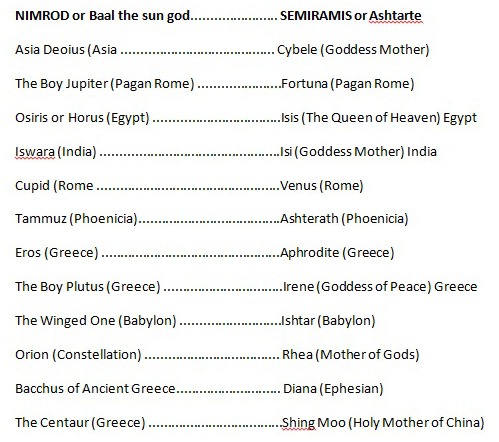
In the scriptures of Judaism and Christianity, Marduk and Tiamat were first identified as the humans Nimrod (In Genesis, chapter 10, called “a mighty hunter before the Lord”) and his wife Semiramis (later known as the mythological Queen of Heaven).

There are those who say it was Nimrod who established the first state religion by unifying mankind and building a tower in the Tigris/Euphrates region of antiquity.  However, after he incorporated, and then diversified, he went public:

Source

Did it all start on the plains of Shinar after a great flood, when the male sun overcame female water?

In A Clockwork Orange, Alex and his droogs were certainly warlike and sought to ravage the females in their paths.  Moreover, perhaps as another clue, one of the songs on the film’s soundtrack is titled “Overture to the Sun”.

In the scene previously described, when the rival gang was in the act of melodramatically wrestling a woman in order to rape her on a stage, it did appear Kubrick incorporated elements of the “Enuma Elish” into his film: namely the expanse of sky above and a winged sun god overlooking acts of sex and violence (Chaos) below.

Within the occult, there are those identifying the Sun as being a symbol of Lucifer the Light Bringer and with the accompanying “illuminating rays of knowledge”; all supposedly essential to the ancient sun worship cult called “The Illuminati”.

Furthermore, others have connected both Freemasonry and the Illuminati as having originated in ancient Egypt:

Popular history texts and encyclopedias generally paint the Illuminati as having its origins in 1776 Bavaria. However, the origins go back much further. The Illuminati are tied directly through masonry to the sun and Isis cults of ancient Egypt.

Source

In truth, Kubrick’s A Clockwork Orange has more occult symbols than even a U.S. dollar bill; along with specific parallels to Freemasonry.  All of these visuals, like the Eye of Horus right on the money, are hidden in plain sight:

The checkered pattern is found in Freemason lodges and is known as “Moses Pavement” which symbolizes the duality of man.  Of course, the Eye of Horus, snakes, and phalluses, are all symbols of the occult as well.

Why would Kubrick have included these in A Clockwork Orange and, also, in his other films?

Coincidence? Art? Conspiracy?

Let the readers, and viewers, decide.

Additionally, as addressed before, Kubrick’s film does include some peculiar references to Christianity.  Complementing Alex’s aforementioned prison fantasy of being a Roman soldier in the act of whipping Christ, there was an earlier scene in his room where he fondles his pet snake before the snake appeared to act as a phallus between the legs of a naked woman pictured on his wall.  The buttocks of the woman looked to have been held up by the raised arms of four naked Jesus Christ figurines; complete with crowns of thorns.  Then, as a rapturous Alex enjoyed the music of Beethoven in a near masturbatory manner, he envisioned himself a vampire and saw a woman in a white (wedding?) dress being hung by rope, along with fiery explosions and men being crushed by rocks.

These examples, along with the symbols of Alex’s pet snake and the Eye of Horus on his right sleeve and right eye, leave the viewer with the impression the boy’s worldview was nothing short of Luciferian.

Moreover, just as western holidays like Christmas (Sol) and Easter (Ishtar) have their originations in ancient sun worship and female pagan fertility deities, so too, it seems, does A Clockwork Orange.  In another example, one of the droogs in the Korova Milk Bar, with sun/projector overhead, drew milk from the breasts of a replica nymph that he called “Lucy”.

Are all of these occult references designed to point the viewer’s attention towards Lucifer? Was Kubrick trying to warn his audience that the future for both individual and state belonged to Satan? Or, is it possible the director was actually advocating for such?

Either way, Kubrick’s futuristic vision may have been right, on many levels correct, and in more ways, than most people today realize.

Through the Lens of the Established State, Modern Politics , Time, and the Circular Cycles of Man

There are those who have tied Donald Trump to Kubrick’s A Clockwork Orange:

And, paradoxically, it now appears the Satanists are even threatened by The Orange Jesus as they seek to convert the younger generation.

Founded in 2012, The Satanic Temple (not to be confused with the Church of Satan) is a non-theistic organization that has gained prominence since President Trump’s election. The group reported it gained “thousands of new members” after Trump won the presidential race.

…Since the election, The Satanic Temple has launched multiple campaigns aimed at challenging Christian influence in the political sphere. One example is their After School Satan Clubs.

Obviously those on the Political Left, and some in the middle, view Trump as similar to the right-wing, authoritarian (law and order) party in Kubrick’s film; who brainwashed naive dupes into supporting misguided policies. Yet, to the other half of the audience watching the political theater on their screens, it appears that Trump is more comparable to Alex; who, after creating carnage in the proverbial political swamp, is now undergoing reeducation by the Established State right before their very eyes.

Could Kubrick have foreseen the inevitability of time’s passage delivering an Orange Reality TV Star to the world stage? It’s doubtful, because he didn’t write the book.  Even so, is it still possible that Trump is a clockwork man, arriving right on schedule?

Since the times of the first songs, the elite have cynically oppressed the proles while telling them it’s for their own good; for their safety, or for the good of Mankind overall.  That is the commonality of gangsters, thugs, neocons, corrupt politicians, fascists, and tyrannical collectivists. They abrogate timeless moral principles for their own benefit and tell us it’s for ours.

In the narrative of A Clockwork Orange, there is a contrarian to the current government, an author, who played dual roles in the film’s plot. Towards the end, he argues on the telephone with an unseen coconspirator that “the common people must not sell liberty for a quieter life”.

Yet, isn’t that what we’ve done today in the once free nations of the western world?

In many ways, A Clockwork Orange is a mirrored representation of modern America.  In the movie, a right-wing party is the established power suppressing the rights of commoners in order to sustain its continuity of control; and the media, and opposition party, were fighting on the side of liberty.

Paradoxically, in the real world currently, the media, the Political Left, and lukewarm conservatives, are in singularity with the Established State; as Trump and his Deplorables wreak havoc before the global towers of power.

Based upon raw intuition, instinct, and Tweets, Trump is the political manifestation of Freud’s Id.  Therefore, he and his gang of supporters must be reformed via electronic programming and conditioning (punishment and reward) by the state as it seeks to secure its everlasting continuity.

Play ball and society will experience harmony, but only on the state’s terms.  Disobey at your own peril. This is one of the themes in A Clockwork Orange.   Other undertones of the film speak to secrecy, smoke, mirrors, and mind control, where the state vanquishes the violent urges of its citizens by creating a new reality via cyclical, or looped, feedback.  Consensus will be manufactured and contrarian views need not apply.  Not acceptable? No problem. The state has a pill for that.

As humans, we have free will, and that is a right that cannot be denied to us.  The Ludovico Technique represents the government’s, or any authority figure’s, interference with our personal liberties, and the dangers of these interferences. The battle of good versus evil is presented an innumerable amount of times in literature and cinema–but A Clockwork Orange puts a twist on this common theme.  Which is worse, chosen evil or forced good?  According to A Clockwork Orange, chosen evil is the lesser evil, because it demonstrates it allows us a choice.  If humans lose moral choice, they become machines.  Free will to choose between good and evil is the central theme and message in A Clockwork Orange.

Source

Whether or not Trump is real or just an actor, like in Kubrick’s films, he has revealed certain realities. The fact remains the state does not now endorse free will and it has, instead, resorted to electronic conditioning to form its new reality.

This will work until it doesn’t. Then the process begins again, just has it always has throughout history; as predictable as seasons, or the sun crossing the sky.

Conclusion

In researching this article, and Stanley Kubrick’s life’s work, I discovered many websites that were a strange combination of profoundly perceptive insights, unique observations, and batshit craziness.  But one interesting theme presented in Kubrick’s storytelling is the idea of mankind’s Odyssey:  Seeking meaning through faith, action, and fortune, upon the world stage; overcoming base instincts, then rising on a tide of reason and rationality, before the cycle rounds another bend and mankind falls again.

When watching A Clockwork Orange, the viewer is forced to consider the ironies of individual and state. In turn, this blogger now questions if both entities are not merely two parallel paths to hell on earth.

The sun rises and sets on individuals and nations alike. Yet, throughout history, Man’s Id was successfully moderated at times by his Ego and Superego thus allowing, for the most part, periods of equilibrium and justice; even if only for a season.

Fate or free will? That is the question. Given the cycles of history, where does hope now reside?  Why would anyone have optimism at all?

In A Clockwork Orange, the Ludovico Technique was meant to fix dystopia’s problems.  Today, in the real world, it is media narratives that are meant to address what ails us. Unfortunately, however, these are twin movies unspooling separately and all at once. In turn, it means certain worldviews must be reprogrammed, as it were.

This explains why social media companies are purging “incorrect thinkers” on their respective platforms. They are viewed as subversive moles, and petty criminals, damaging the fertile ground of the new world order.

It’s also why a bogus Russian dossier was utilized to derail the Orange Criminal.  One wonders if he was wound up as part of a plan to place asunder the old ways; like the tide rolling out before the dawn of a new day.

The lesson learned from A Clockwork Orange is to beware the algorithmic hammers of conformity; always watching, ever ready, and waiting to shine down from on high; ceaselessly smiling, shaking hands, and kissing babies on the way.

Before new experiments and orthodoxies can be tried, there must be good reasons to do so.  For out of chaos comes creation.  The circle runs like clockwork and always on time.

The Id of Man will be tempered by a new religion; or perhaps an old one by another name.

Anti-Defamation League, Facebook, Google & Youtube Appoint Themselves As Official Internet Censor

By Richard Enos

Source: Collective Evolution

If you are reading this, that means that articles that speak against the activities of the Anti-Defamation League are not being automatically scrubbed from the internet.

Yet.

In a foreboding sign that the free expression of opinion on the internet is too much of a threat to the powerful elite of our society, the Anti-Defamation League is leading the charge in turning their own subjective opinions on ‘hate speech’ into the absolute rule of Internet law. As this Cnet article reports,

FacebookTwitterGoogle and Microsoft, among others, are joining with the ADL to form a Cyberhate Problem-Solving Lab, the companies and the civil rights group said Tuesday. They’ll exchange ideas and develop strategies to try to curb hate speech and abuse on the companies’ various platforms and across the internet.

“These companies have an added responsibility to do everything within their power to stop hate from flourishing on their watch,” ADL CEO Jonathan Greenblatt said in a statement. “We look forward to tackling this pressing challenge together.”

Wow. A Cyberhate Problem-Solving Lab. What heroes of selfless service to humanity.

Like Monika Bickert, Facebook’s head of global policy, who said in a statement that “some of the best minds in engineering will work alongside the ADL to help us rise to the occasion.” What occasion? The threat of the power that the proliferation of free speech on the internet is giving to individual human beings fighting for truth and justice.

Who Died And Made Them King?

It is disconcerting to me that we are moving into a time where a once free and neutral internet has suddenly come more and more under the control of powerful dictatorial forces. Yes, dictatorial. The ADL is marching into the internet cyberscape with the sense of entitlement to DICTATE what should and shouldn’t be said by the rest of us. Doesn’t this mimic that actions of a certain dictator from the past that the ADL would claim to have been zealously opposed to? (I won’t name names for fear of triggering some sophisticated ADL-Google-keyword-cyber-censoring mechanism).

The obvious fact is that the cabal of organizations that will be sitting down at the Cyberhate Problem-Solving Lab will likely make little mention of the impact of cyber-bullying and online hate speech on human individuals. They will be more prone to focus on how to continue hiding crimes against humanity perpetrated by the global elite since time immemorial, crimes like massive fraud, slavery, pedophilia, torture, and murder. And why would these organizations be motivated to hide these crimes? Because they are now controlled by the very global elite who are perpetrating them in the first place.

The War On Hate

The whole narrative of a group that self-identifies as having the authority ‘to curb hate speech and abuse’ on the internet is deeply flawed and even hypocritical. And employing tactics in the same mold as the failed wars on drugs, cancer, and terrorism further gives them away. These are nothing more than tactics of obfuscation of what is really going on.

Human growth is not advanced by attempts to stifle, destroy, or eradicate darkness. As I discussed in my article ‘Let’s Discard The ‘Right’ To Be Insulted By Free Speech,’ we do not evolve by stopping people from expressing any hatred or other negative emotions that are deep inside them, we evolve by allowing people to express themselves freely and becoming immune to their ‘offensive’ remarks by learning not to take them personally.

Hate speech in itself cannot demean the object of hatred, it only reveals the unhealed emotions of its source. And the more we allow these unhealed emotions a chance to be let out, the more space we create for personal and collective healing.

In that regard, attempts to actually do something positive about human hatred through censorship is at best naive, and in most cases like this one, it turns out to be a vehicle of domination for those who would wish to maintain and expand control over information and the self-expression of individuals.

The Need To Move Off These Platforms

The ADL aside, internet corporations like Facebook that continue to delve more deeply into censorship are playing a bit of a risky game. Perhaps many of them feel that they are ‘too big to fail,’ in the sense that they believe they are too essential to the lives of most people to suddenly get abandoned en masse. Perhaps, for now, that is true. But I’m not sure that they should really be messing with an Awakening Community that is growing larger by the heartbeat.

Your Life Is Not Limited To One Path

By Joe Martino

Source: Collective Evolution

It is no secret that life can sometimes feel like a limited paved road laid out before us that we feel the need to stick to. Look at how we are brought up. Most of the time we come into the world and begin gaining our perceptions from those closest to us –our parents. As time goes on we find ourselves in school. Throughout that time we also begin watching what others do around us, what we see on TV and in movies.

What is happening is we are observing and creating an idea of how life should be; the best way to play the game. But what is ‘best?’

How many times have we heard “That’s not the best decision” or “That’s not the best decision for the whole family.” When you look at either statement you realize that “best” is subjective. What the “best” is to one person may not be the “best” to another. Even further, both of the perceptions of “best” are created from whatever belief systems each have created in their own lives. This is the key factor to realize.

We Get Trapped in Belief Systems

In either case, both scenarios have one thing in common, a belief system of what the “best” choice or decision is. When we create a belief system like this, we limit how we view things. We no longer feel what is “best,” but instead we analyze and define “best” based on a story; often a story from the past, based on entirely different times than the present moment.

Let’s take the example of a child coming out of high school today.  9 times out of 10, that child will be told, and may even believe, that the “best” decision they can make for their life is to continue their education at university or college. It does not matter that they do not know what they want to study, or that the education system will potentially cost them $100,000+, many will state that is best -and even have pride about it.

Next, they would be told to get a job so they can buy a house, as owning and buying a house is a smart decision. Should this child begin their life based on these belief systems, more often than not they will take this idea of what is “BEST” throughout the rest of their life. They will judge their decisions by this, express emotions based on this, develop self-esteem based on this and so forth. From then on, every decision they make will be based on this belief system handed down and taught to them.

Even getting specific, what to study in school, what type of job to get, what type of car to buy, how to spend and save money, what type of house to buy and so on. What is really happening with all of this? We are defining the ideal life or what’s “best” and then we limit our life to a small scope of how things should be.

The Deep Truth

Here is the absolute truth, ready? None of it has any real truth to it. It’s just all a belief system. Perception, ideas! But we often live by this and it becomes so real in our minds that we become stuck thinking this is the way to do it. Then when depression and anxiety follow, as we may believe we are stuck, we forget to look back on the belief system that is often caging us and our reality into a small tight space we often don’t deeply resonate with.

Look at our world. We often all chase the same thing, the same stuff because that is what we have been sold as the ideal life. Each area of the world has its own version of this. Who’s life are you really living? Whose dreams are you chasing and carrying out? We take on these beliefs and we begin to sacrifice ourselves, our health, and our soul desires so we can carry out someone else’s idea of “best” that we grabbed onto.

Back to the child from the example above. Now they have grown into a young man or woman and are in a job they don’t truly like. But it pays the bills and lives up to the idea of “best” that has been given to them. Most of the time, people around them will all reinforce that their decisions are the “best” because they have all been sold on the same belief system. “You have to make sacrifices, you have to work really hard to have a good life!” is what we are told. But who says what is “good?” Even when that grown up child is expressing their sadness or frustration for the reality they are in, we continue to reinforce it to protect the idea of ‘the best.’

We take this entirely expansive creative individual playing in an expansive playground called Earth and we confine them to this tiny little narrow path of what the “best” is. Instead of spending their life being able to make any choice they choose, they stay limited to what they have been sold as the “best” even if they don’t truly love it.

Even Deeper

Then you have the even deeper part, we then look upon and judge others when they make “the wrong decisions.” Look at how we view those who change their minds about what they want to play with all the time. What do we say about those people? “They need to make up their mind and get their life on track.” What track? There is a track? Says who? “They didn’t make a smart decision with their money or their house so they are going to pay for it later.” Who says some decisions are better than others? Is it not an experience either way?

You are the creator of your life and reality. You can choose to play and create whatever type of life you choose. And guess what? If you make a decision and start creating a particular life then you realize you want to create something new, you are free to do this!

No matter what story we tell ourselves like: “it’s too late, I can’t change this now, it’s too costly” etc. know that these are all egoic illusions. You are never limited to whatever life you have created even if you have been doing it for 30 years. Remember to ask yourself: the life you are chasing, the goals you have set, who’s goals are they really? Where did you first hear of them? Are they from your heart? Or are they what you have been sold?

Look inside yourself at what YOU TRULY want and how you wish to express yourself and create. Start there, and create from that space. You will see very quickly that you can create anything you choose.

Remember, there is no right or wrong path here. It’s about looking back on what we choose, where we are at and saying “Is this where I want to be? Am I feeling peace? Expressing my deepest self? Am I inspired about where I am at?” and if you aren’t, you create a new path and see how that feels. Follow how you FEEL, not what you seek as right or wrong. Our life reflects our state of consciousness.

How to Beat a Manipulator

These six men own as much wealth as half the world’s population

By Caitlin Johnstone

Source: Consortium News

Humans are hackable. Ask any conman. Our desire to think we have control over our lives often hides this from ourselves, but most of us are highly suggestible and hypnotizable. If you think you’re not, you’re in more danger of being hacked than someone who has humbled themselves enough to see how this works in them.

There’s no need to be ashamed of being conned. Realizing that you’ve been, or are being, conned will naturally bring up feelings of embarrassment, but it’s never your fault that someone’s taken you for a ride. Get clear: conning someone is the crime; being conned is being a victim of that crime. That’s how the law sees it in fraud cases. Manipulators would love you to think that it’s your fault for allowing yourself to be manipulated, but that’s just another manipulation isn’t it?

Manipulators use one of our most astounding, useful, and beautiful human characteristics when they con us—empathy. Our innately trusting nature is the reason why we’ve been able to collaborate on large scales to create and innovate in extraordinary ways unseen anywhere else in the animal kingdom. Because we learn by modeling, and we are shaped by the group we inhabit and our urge to create harmony will make life viscerally uncomfortable until we are back in alignment with our tribe. We are the peacemakers; we seek alignment, which is how we are paced by manipulators into aligning with their sick agendas. How gross is it then that our ability to empathize and relate to each other is one manipulators use to control us?

Because of the reach of mass media, every single one of us is in an abusive relationship with plutocratic manipulators. Many of us are in personal relationships with manipulators too. Conveniently, the strategies for dealing with sociopathic manipulators are the exact same, from plutocrats to your live-in partner.

Get Clear on Your Own Will

You are easy prey if you don’t know what you want and you leave it up to others to decide for you. If you don’t have a sense of who you are and what you stand for, anyone can come in and co-opt that for their own sick agendas. Sit down, get quiet, and make an inventory of who you are and what you need. Don’t be squeamish about adding things that you don’t have yet. That’s the point. Make a list of what you need not just to survive, but to thrive. Apply the live-and-let-live rule to every one of your wants, and if you’re confident that nothing you want will hurt or interfere in anyone else’s will, then the list is good. You can stand by it unequivocally, and you should do so with as much strength and confidence as you can muster. Grow to its size and advocate loudly for it.

Watch Where the Resources Go

How do you really know if you’re being manipulated? Well, what manipulators understand that the rest of us don’t is that there are real life resources like sex, money, work, gold, oil, land, water, food, people, air, etc; and there are good feelings. They will always try to get you to swap real things for good feelings. If you don’t have empathy, you see the whole world in a completely different way. Most people are trying to get what they need without hurting anyone, because hurting someone hurts them too. Manipulators don’t experience that, so they just get what they need by telling their victim that they’ll hurt someone if they don’t hand it over.

Zoom out and take an inventory of who’s got all the stuff. Which way are the scales tipped? Good manipulators try to shift the ground underneath us to funnel the real wealth into their coffers, while placating us with good feelings about how blessed our hard work is and all that, and how selfish it would be to demand healthcare when there’s people in Syria who need to be bombed for their freedom. Leave all that behind and zoom and out and see who’s got all the stuff. Who has all the power, all the wealth, all the real stuff that you can really use in the real world, and who is barely existing but has hope for a better tomorrow?

Same in a marriage. Who has all the wealth, power, kudos, retirement savings, and who just has a story about what a good person they are? Religion has primed us for manipulation, and that was by design. Over millennia, we have been taught to value fealty, piety, hard work, submission, and to leave judgement and reward til after we die. This creates the perfect environment for manipulators who can see very clearly what the valuable real-world things are, and what are creations woven of fairytales. Work out what’s real in the here and now, and see who is in control of what should be your stuff. Is it you? If it’s not, you’re being manipulated out of it.

Watch Their Actions, Not Their Words

Manipulators only have words. They can’t just walk up to you and say “Give me your life savings,” they have to weave a complex story that makes you feel like it’s the right thing to do. A good conman will never ask for anything if they can get away with it. Ideally, they want you to make the offer. That’s the best kind of con, the one where the victim thinks it was their idea in the first place. A great conman will have you begging him to take the thing that he wanted all along, so then he can even get your gratitude for it.

By zooming out and seeing what they’re doing, rather than listening to what they’re saying, you can get a much better idea of what’s actually happening. If, for example, they’re saying they support single-payer healthcare while voting against it, sabotaging any efforts in any direction, taking money from donors who oppose it, and generally running interference on it, then those actions tell the real story. If the offer is not what you asked for but you are so desperate, so far down the line with them, so invested, and so cut off from any alternate solutions that you’ll take anything, then the con is complete.

Think about it from their point of view. Ideally, they want to be the ones you go to for the thing they don’t want you to have. They want to be the ones you place your hope and energy with so you don’t go to someone who will actually help them, but they also need to string you along for as long as possible, doing as little as possible, while taking as much energy as they can from you without arousing suspicion. They sing the song of inertia, of incrementalism, of “Not now, but soon.” That’s how they keep you trapped. If you zoom out and watch what they’re actually doing, rather than what they’re saying, you will know when it’s time to say bye Felicia and seek out an actual solution.

Don’t Try to Out-Manipulate Them

Once you’ve figured out you’re being manipulated, the knee-jerk reaction is to try and manipulate them back. Dude. Don’t even. Do you know how beautiful and precious you are to even think that that’s possible? These people have had no empathy for all their lives, and without all that emotional noise clouding their decisions, they have been playing every single person in their life like a game of chess. They are masters. They are five moves ahead of you already, and you’re just learning what a rook is. They have a whole lifetime of manipulating under their belt, and you are a total noob. You will lose that game. Don’t play it.

Instead, go with your strengths. Demand what you want and stick to that, loudly and unapologetically. Keep asking for what you want in the most direct way possible. Remember, a manipulator aims to take your will from you. Take it back. Many of us have been so manipulated for so long, we don’t even know what we want anymore. Make your inventory, keep it simple, keep it to what you know you need to thrive, and then plant your feet and demand it.

Meanwhile, keep pointing out the weird things they do to try and avoid giving you what they said they would. Shout it from the rooftops when they do something sly. They’ve used your politeness and goodwill to hide their little indiscretions. Don’t let them anymore. If they’re being creepy, say it. Don’t be manipulated into tacit consent by your politeness.

Keep telling the truth to yourself at least, even when it doesn’t tally with your worldview. Remain as intellectually honest with yourself as possible about what the knowable facts are, and what is conjecture or wishful thinking. Verify everything as much as you can so you know you’re standing on solid, factual ground. Manipulators love to keep people as confused as possible. Get as many quantifiable, verified, real-world facts as you can underneath you and build your worldview on them. And when you’re sure of yourself, say it like it’s true, because you know it is. Be unequivocal with the things you know. When you’re sure, don’t let anyone get in any wriggle room. Approach your private research with curiosity, objectivity and a light hand, but once the work is done, plant your feet in its truth and don’t let them be uprooted.

And lastly, don’t play by the rules, play by what is right. Manipulators love rules because they love to strategize about how to bend them, and how to bend you with them. Think of the worst kind of lawyers and you’ll know exactly what I mean. If you’re a deeply good person like you know you are, and you are always trying to point yourself at the highest interest, you know deep down if you’re doing the right thing. Trust your guts and forge ahead. Keep doing the right thing, even if it breaks a rule.

Apply The Manipulator’s Rules In Reverse

There’s something in psychology called “projection”, and anyone who has done a good deal of inner work will tell you that it’s a handy self-enquiry tool to see if what you hate in others, you can find in yourself. In order not to deal with our guilt, we tend to project the things we don’t like on to other people to hide the shame of it from ourselves. Bringing it out into the light can often result in some healthy forgiveness of both ourselves and our perception of others.

That’s great, but what the sages neglect to tell you is that people are also projecting all the time on to you. If you’re suggestible and good-hearted enough to not want to harm anyone, you can take everyone’s projections on to you as truth without even realizing it. Unless you develop a strong, conscious, healthy sense of who you are as a person, you can be gaslit into thinking that you’re any amount of the horrible things people project on to you, and that can easily grind you to a confused and babbling halt. Again, take an inventory of who you are and what you want, and grow in size until you can stand in that truth and defend it. Find your will and take it back.

Manipulators particularly use projection as a tactic to hide what they’re doing to you in plain sight. A manipulator can have you chasing your tail by simply suggesting that you or others are doing what you are seeing them doing with your own eyes. DNC caught rigging the election? Oh no, it was actually Russia who rigged the election by catching the DNC rigging the election. See what I did there? It’s so dumb, but it works.

Here’s the key: simply reverse the pronouns. When faced with a manipulator, everything he says about you, he is saying about himself, and everything he says about himself, is what he thinks of you. If he’s telling you you’re duplicitous and you’re a liar and you’re trying to take him for all he’s got, he’s actually saying he’s duplicitous and he’s a liar and he’s trying to take you for all you’ve got. If you have good grounds to believe you are being manipulated by someone, reverse the pronouns in your mind and let them tell you who they are. It works from personal relationships right up to the grand manipulators employed by the plutocrats.

Bring as much awareness as possible to all the ways you’re being manipulated, and all the ways you’ve been inadvertently manipulating. Make it as conscious in yourself as possible so we can all add to the sum of human knowledge as to how to transcend the manipulations. Once we draw back and fill out to our own individual sovereign boundaries, we will be able to trust ourselves to stand in our truth. We will also be able to see who we can trust so much more easily, and once you know you can trust someone, you can collaborate with them. These newly-conscious and divine collaborations will create the very things we need to solve the real world problems we face as a species and take the will of the planet from the sociopaths and return it to the will of the people.

And that’s really all it will take. A tipping point of un-manipulatable and awake people collaborating to create new systems that will surpass the old is all it will take to wrest power from the manipulators who only have the old Biblical tools of fear, guilt and shame to work with. This is doable, and it only needs you.


This commentary was originally published on CaitlinJohnstone.com .


Human Extinction by 2026? A Last Ditch Strategy to Fight for Human Survival

By Robert J. Burrowes

There is almost unanimous agreement among climate scientists and organizations – that is, 97% of over 10,000 climate scientists and the various scientific organizations engaged in climate science research – that human beings have caused a dramatic increase in the amount of carbon dioxide, methane and nitrous oxide released into Earth’s atmosphere since the pre-industrial era and that this is driving the climate catastrophe that continues to unfold. For the documentary evidence on this point see, for example, ‘Quantifying the consensus on anthropogenic global warming in the scientific literature’, ‘Consensus on consensus: a synthesis of consensus estimates on human-caused global warming’ and ‘Scientists Agree: Global Warming is Happening and Humans are the Primary Cause’.

However, there is no consensus regarding the timeframe in which this climate catastrophe will cause human extinction. This lack of consensus is primarily due to the global elite controlling the public perception of this timeframe with frequent talk of ‘the end of the century’ designed to allow ongoing profit maximization through ‘business as usual’ for as long as possible. Why has this happened?

When evidence of the climate catastrophe (including the pivotal role of burning fossil fuels) became incontrovertible, which meant that the fossil fuel industry’s long-standing efforts to prevent action on the climate catastrophe had finally ended, the industry shifted its focus to arguing that the timeframe, which it presented as ‘end of the century’, meant that we could defer action (and thus profit-maximization through business as usual could continue indefinitely). Consequently, like the tobacco, sugar and junk food industries, the fossil fuel industry has employed a range of tactics to deflect attention from their primary responsibility for a problem and to delay action on it.

These well-worn tactics include suggesting that the research is incomplete and more research needs to be done, funding ‘research’ to come up with ‘evidence’ to counter the climate science, employing scholars to present this ‘research’, discrediting honest climate scientists, infiltrating regulatory bodies to water down (or reverse) decisions and recommendations that would adversely impact profits, setting up ‘concerned’ groups to act as ‘fronts’ for the industry, making generous political donations to individuals and political parties as well as employing lobbyists.

As a result of its enormous power too, the global elite has been able to control much of the funding available for climate science research and a great deal of the information about it that is made widely available to the public, particularly through its corporate media. For this reason, the elite wields enormous power to shape the dialogue in relation to both the climate science and the timeframe.

Therefore, and despite the overwhelming consensus noted above, many climate scientists are reluctant to be fully truthful about the state of the world’s climate or they are just conservative in their assessments of the climate catastrophe. For example, eminent climate scientist Professor James Hansen referred to ‘scientific reticence’ in his article ‘Scientific reticence and sea level rise’, scientists might be conservative in their research – for example, dependence upon historical records leads to missing about one-fifth of global warming since the 1860s as explained in ‘Reconciled climate response estimates from climate models and the energy budget of Earth’ – and, in some cases, governments muzzle scientists outright. See ‘Scientist silencing continues for federally-funded research’. But many of the forces working against full exposure of the truth are explained in Professor Guy McPherson’s article ‘Climate-Change Summary and Update’.

However, in contrast to the elite-managed mainstream narrative regarding the climate timeframe, there is a group of courageous and prominent climate scientists who offer compelling climate science evidence that human beings, along with millions of other species, will be extinct by 2026 (and perhaps as early as 2021) in response to a projected 10 degree celsius increase in global temperatures above the pre-industrial level by that date. See ‘Will humans be extinct by 2026?’

Before outlining the essence of this article, it is worth noting that the website on which it is posted is ‘Arctic News’ and the editors of this site post vital articles on the world’s climate by highly prominent climate scientists, such as Professor Peter Wadhams (Emeritus Professor of Polar Ocean Physics at Cambridge University and author of A Farewell to Ice: A Report from the Arctic), Dr Andrew Glikson (an Earth and paleoclimate scientist who is a visiting fellow at the Australian National University), Professor Guy McPherson who has written extensively and lectures all over the world on the subject, and ‘Sam Carana’, the pseudonym used by a group of climate scientists concerned to avoid too many adverse impacts on their research, careers and funding by declaring themselves publicly but nevertheless committed to making the truth available for those who seek it.

So, in a few brief points, let me summarize the evidence and argument outlined in the article ‘Will humans be extinct by 2026?’


The Climate Science of Destruction of the Biosphere

In the Arctic, there is a vast amount of carbon stored in soils that are now still largely frozen; this frozen soil is called permafrost. But as Arctic temperatures continue to rise and the permafrost thaws, in response to the warming that has occurred already (and is ongoing) by burning fossil fuels and farming animals for human consumption, much of this carbon will be converted into carbon dioxide or methane and released into the atmosphere. There is also a vast amount of methane – in the form of methane hydrates and free gas – stored in sediments under the Arctic Ocean seafloor. As temperatures rise, these sediments are being destabilized and will soon result in massive eruptions of methane from the ocean floor. ‘Due to the abrupt character of such releases and the fact that many seas in the Arctic Ocean are shallow, much of the methane will then enter the atmosphere without getting broken down in the water.’

Adversely impacting this circumstance is that the sea ice continues to retreat as the polar ice cap melts in response to the ongoing temperature increases. Because sea ice reflects sunlight back into Space, as the ice retreats more sunlight hits the (dark-colored) ocean (which absorbs the sunlight) and warms the ocean even more. This causes even more ice melt in what becomes an ongoing self-reinforcing feedback loop that ultimately impacts worldwide, such as triggering huge firestorms in forests and peatlands in North America and Russia.

More importantly, however, without sea ice, storms develop more easily and because they mix warm surface waters with the colder water at the bottom of shallow seas, reaching cracks in sediments filled with ice which acts as a glue holding the sediment together, the ice melt destabilizes the sediments, which are vulnerable to even small differences in temperature and pressure that are triggered by earthquakes, undersea landslides or changes in ocean currents.

As a result, huge amounts of methane can erupt from the seafloor of the Arctic Ocean and once this occurs, it will further raise temperatures, especially over the Arctic, thus acting as another self-reinforcing feedback loop that again makes the situation even worse in the Arctic, with higher temperatures causing even further methane releases, contributing to the vicious cycle that precipitates ‘runaway global warming’.

‘These developments can take place at such a speed that adaptation will be futile. More extreme weather events can hit the same area with a succession of droughts, cold snaps, floods, heat waves and wildfires that follow each other up rapidly. Within just one decade [from 2016], the combined impact of extreme weather, falls in soil quality and air quality, habitat loss and shortages of food, water, shelter and just about all the basic things needed to sustain life can threaten most, if not all life on Earth with extinction.’

The article goes on to outline how the 10 degree increase (above the pre-industrial level) by 2026 is likely to occur. It will involve further carbon dioxide and methane releases from human activity (particularly driving cars and other vehicles, flying in aircraft and eating animal products, as well as military violence), ongoing reduction of snow and ice cover around the world (thus reflecting less sunlight back into Space), an increase in the amount of water vapor (a greenhouse gas) in the atmosphere, a falling away of ‘aerosol masking’ (which has helped reduce the impact of emissions so far) as emissions decline, as well as methane eruptions from the ocean floor. If you would like to read more about this and see the graphs and substantial documentation, you can do so in the article cited above: ‘Will humans be extinct by 2026?’


The Ecology of Destruction of the Biosphere

Not that these scientists, who focus on the climate, discuss it but there are other human activities adversely impacting Earth’s biosphere which also threaten near-term extinction for humans, particularly given their synergistic impacts.

For example, recent research has drawn attention to the fact that the ‘alarming loss of insects will likely take down humanity before global warming hits maximum velocity…. The worldwide loss of insects is simply staggering with some reports of 75% up to 90%, happening much faster than the paleoclimate record rate of the past five major extinction events’. Without insects ‘burrowing, forming new soil, aerating soil, pollinating food crops…’ and providing food for many bird species, the biosphere simply collapses. See ‘Insect Decimation Upstages Global Warming’.

Moreover, apart from ongoing destruction of other vital components of Earth’s life support system such as the rainforests – currently being destroyed at the rate of 80,000 acres each day: see ‘Measuring the Daily Destruction of the World’s Rainforests’ – and oceans – see ‘The state of our oceans in 2018 (It’s not looking good!)’ – which is generating an extinction rate of 200 species (plants, birds, animals, fish, amphibians, insects and reptiles) each day with another 26,000 species already identified as ‘under threat’ – see ‘Red list research finds 26,000 global species under extinction threat’ – some prominent scholars have explained how even these figures mask a vital component of the rapidly accelerating catastrophe of species extinctions: the demise of local populations of a species. See ‘Biological annihilation via the ongoing sixth mass extinction signaled by vertebrate population losses and declines’.

In addition, relying on our ignorance and our complicity, elites kill vast areas of Earth’s biosphere through war and other military violence – see, for example, the Toxic Remnants of War Project and the film ‘Scarred Lands & Wounded Lives’ – subject it to uncontrolled releases of radioactive contamination – see Fukushima Radiation Has Contaminated The Entire Pacific Ocean And It’s Going To Get Worse’ – and use geoengineering to wage war on Earth’s climate, environment and ultimately ourselves. See, for example, ‘Engineered Climate Cataclysm: Hurricane Harvey’ and ‘The Ultimate Weapon of Mass Destruction: “Owning the Weather” for Military Use’.

Separately from all of this, we live under the unending threat of nuclear war.

This is because insane political and corporate elites are still authorizing and manufacturing more of these highly profitable weapons rather than dismantling them all (as well as conventional weapons) and redirecting the vast resources devoted to ongoing military killing (US$1.7 trillion annually: see ‘Global military spending remains high at $1.7 trillion’) to environmental restoration and programs of social uplift.

By the way, if you think the risk of nuclear war can be ignored, you might find this recent observation sobering. In a review of (former US nuclear war planner) Daniel Ellsberg’s recent book The Doomsday Machine: Confessions of a Nuclear War Planner, Earth and paleoclimate scientist Dr Andrew Glikson summarized the book as follows: ‘This, then, is the doomsday machine. Not simply the existence of fission weapons or unspeakably destructive hydrogen bombs, but the whole network rigged together: thousands of them on hair-trigger alert, command and control equipment built in the 1970s and ’80s, millions of lines of antique code sitting on reels of magnetic tape or shuffled around on floppy discs even now. An architecture tended by fallible and deeply institutionalized human beings.’ See ‘Two Minutes To Mid-Night: The Global Nuclear Suicide Machine’.

So, irrespective of whether elites or their agents or even we acknowledge it, Earth’s biosphere is under siege on many fronts and, very soon now, Earth will not support life. Any honest news source routinely reports one or another aspect of the way in which humans are destroying the Earth and perhaps suggests courses of action to respond powerfully to it. This, of course, does not include the insane global elite’s corporate media, which functions to distract us from any semblance of the truth.


How did all this happen?

How did human beings end up in a situation that human extinction is likely to occur within eight years (even assuming we can avert nuclear war)? And is there any prospect of doing enough about it now to avert this extinction?

To answer the first question briefly: We arrived at this juncture in our history because of a long sequence of decisions, essentially made by elites to expand their profit, power and privilege, and which they then imposed on us and which we did not resist powerfully enough. For a fuller explanation, see ‘Strategy and Conscience: Subverting Elite Power So We End Human Violence’.

In any case, the key questions now are simply these: Is it too late to avert our own extinction? And, if not, what must we do?

Well, I am not going to dwell on it but some scientists believe it is too late: we have already passed the point of no return. Professor Guy McPherson is one of these scientists, with a comprehensive explanation and a great deal of evidence to support it in his long and heavily documented article ‘Climate-Change Summary and Update’.

So, the fundamental question is this: If we assume (highly problematically I acknowledge) that it is possible to avert our own extinction by 2026, what must we do?

Because we need to address, in a strategic manner, the interrelated underlying causes that are driving the rush to extinction, let me first identify one important symptom of these underlying causes and then the underlying structural and behavioral causes themselves. Finally, let me invite your participation in (one or more aspects of) a comprehensive strategy designed to address all of this.

As in the past, at least initially, the vast bulk of the human population is not going to respond to this crisis in any way. We need to be aware of this but not let it get in our way. There is a straightforward explanation for it.

Fear or, far more accurately, unconscious terror will ensure that the bulk of the human population will not investigate or seriously consider the scientific evidence in relation to the ongoing climate catastrophe, despite its implications for them personally and humanity generally (not to mention other species and the biosphere). Moreover, given that climate science is not an easy subject with which to grapple, elite control of most media in relation to it (including, most of the time, by simply excluding mention of key learning from the climate scientists) ensures that public awareness, while reasonably high, is not matched by knowledge, which is negligible.

As a result, most people will fearfully, unintelligently and powerlessly accept the delusions, distractions and denial that are promulgated by the insane global elite through its various propaganda channels including the corporate media, public relations and entertainment industries, as well as educational institutions. This propaganda always includes the implicit message that people can’t (and shouldn’t) do anything in response to the climate catastrophe (invariably and inaccurately, benignly described as ‘climate change’).

A primary way in which the corporate media reports the issue but frames it for a powerless response is to simply distribute ‘news’ about each climate-related event without connecting it either with other climate-related events or even mentioning it as yet another symptom of the climate catastrophe. Even if they do mention these connections, they reliably mention distant dates for phenomena like ‘heatwaves’ repeating themselves and an overall ‘end of century’ timeframe to preclude the likelihood that any sense of urgency will arise.

The net outcome of all this, as I stated above, is that the bulk of the human population will not respond to the crisis in the short term (as it hasn’t so far) with most of what limited response there is confined to powerlessly lobbying elite-controlled governments.

However, as long as you consider responding – and by responding, I mean responding strategically – and then do respond, you become a powerful agent of change, including by recruiting others through your example.

But before I present the strategy, let me identify the major structural and behavioral causes that are driving the climate catastrophe and destruction of the biosphere, and explain why some key elements of this strategy are focused on tackling these underlying causes.


The Political Economy of Destruction of the Biosphere

The global elite ensures that it has political control of the biosphere as well as Space by using various systems, structures and processes that it largely created (over the past few centuries) and now controls, including the major institutions of governance in the world such as national governments and key international organizations like the United Nations. For further information, see ‘Strategy and Conscience: Subverting Elite Power So We End Human Violence’.

It does this, for example, so that it can economically utilize, via the exploitative mechanisms of capitalism and its corporations (which the elite also created), domains of the biosphere rich in resources, particularly fossil fuels, strategic minerals and fresh water. The elite will use any means – including psychological manipulation, propaganda issued by its corporate media, national educational institutions, legal systems and extraordinary military violence – to achieve this outcome whatever the cost to life on Earth. See ‘Profit Maximization Is Easy: Invest In Violence’.

In short, the global elite is so insane that its members believe that killing and exploiting fellow human beings and destroying the biosphere are simply good ways to make a profit. Of course, they do not perceive us as fellow human beings; they perceive and treat us as a great deal less. This is why, for example, the elite routinely uses its military forces to attack impoverished and militarily primitive countries so that they can steal their resources. See ‘The Global Elite is Insane Revisited’.

But they are happy to steal from those of us living in western economies too, with Professor Barbara G. Ellis issuing the latest warning about yet another way this could easily happen. See Depositors – Not Taxpayers – Will Take the Hit for the Next “2008” Crash Because Major Banks May Use the “Bail-In” System’.

Anyway, because of elite control of governments, it is a waste of time lobbying politicians if we want action on virtually all issues that concern us, particularly the ‘big issues’ that threaten extinction, such as the climate catastrophe, environmental destruction and war (especially the threat of nuclear war). While in very limited (and usually social) contexts (such as issues in relation to the right of women to abortions or rights for the LGBTQIA communities), when it doesn’t significantly adversely impact elite priorities, gains are sometimes made (at least temporarily) by mobilizing sufficient people to pressure politicians. This has two beneficial outcomes for elites: it keeps many people busy on ‘secondary issues’ (from the elite perspective) that do not impact elite profit, power and privilege; and it reinforces the delusion that democracy ‘works’.

However, in the contexts that directly impact elite concerns (such as their unbridled exploitation of the biosphere for profit), politicians serve their elite masters, even to the extent that any laws that might appear to have been designed to impede elite excesses (such as pollution generated by their activities) are readily ignored if necessary, with legal penalties too insignificant to deter phenomenally wealthy corporations. See ‘The Rule of Law: Unjust and Violent’.

Of course, if any government does not obey elite directives, it is overthrown. Just ask any independently-minded government over the past century. For a list of governments overthrown by the global elite using its military and ‘intelligence’ agencies since World War II, see William Blum’s book Killing Hope: U.S. Military and CIA Interventions Since World War II or, for just the list, see ‘Overthrowing other people’s governments: The Master List’.

How does the elite maintain this control over political, economic, military, legal and social structures and processes?


The Sociology of Destruction of the Biosphere

As explained in the literature on the sociology of knowledge, reality is socially constructed. See the classic work The Social Construction of Reality: A Treatise in the Sociology of Knowledge. That is, if an individual is born or introduced into a society in which particular institutions are in control and behaviors such as chronic over-consumption, unlimited profit-making, rampant exploitation of the environment and grotesque violence against (at least some) people are practiced, then the typical individual will accept the existence of these institutions and adopt the behaviors of the people around them even though the institutions and behaviors are dysfunctional and violent.

But while the sociology of knowledge literature recognizes that children ‘must be “taught to behave” and, once taught, must be “kept in line”’ to maintain the institutional order, this literature clearly has no understanding of the nature and extent of the violence to which each child is actually subjected in order to achieve the desired ‘socialization’. This terrorization, as I label it, is so comprehensive that the typical child quickly becomes incapable of using their own intellectual and emotional capacities, including conscience and courage, to actually evaluate any institution or behavior before accepting/adopting it themselves. Obviously then, they quickly become too terrified to overtly challenge dysfunctional institutions and behaviors as well.

Moreover, as a result of this ongoing terrorization, inflicted by the significant adults (and particularly the parents) in the child’s life, the child soon becomes too (unconsciously) afraid to resist the behavioral violence that is inflicted on them personally in many forms, as outlined briefly in the next section, so that they are ‘taught to behave’ and are ‘kept in line’.

In response to elite-driven imperatives then, such as ‘you are what you own’ to encourage very profitable over-consumption, most people are delusionarily ‘happy’ while utterly trapped behaving exactly as elites manipulate them – they are devoid of the psychological capacity to critique and resist – and the elite-preferred behavior quickly acquires the status of being ‘the only and the right way to behave’, irrespective of its dysfunctionality.

In essence: virtually all humans fearfully adopt dysfunctional social behaviors such as over-consumption and profit-making at the expense of the biosphere, rather than intelligently, conscientiously and courageously analyzing the total situation (including the moral and ecological dimensions of it) and behaving appropriately in the context.

Given the pervasiveness and power of elite institutions, ranging from those mentioned above to the corporate media and psychiatry – see ‘Defeating the Violence of Psychiatry’ – resistance to violent socialization (of both children and adults) requires considerable awareness, not to mention courage.

And so our fear makes virtually all of us succumb to the socialization pressure (that is, violence) to accept existing institutions and participate in widespread social behaviors (such as over-consumption) that are dysfunctional and violent.


The Psychology of Destruction of the Biosphere

This happens because each child, from birth, is terrorized (again: what we like to call ‘socialized’) until they become a slave willing to work and, in industrialized countries at least, to over-consume as directed.

Under an unrelenting regime of ‘visible’, ‘invisible’ and ‘utterly invisible’ violence, each child unconsciously surrenders their search in pursuit of their own unique and powerful destiny and succumbs to the obedience that every adult demands. Why do adults demand this? Because the idea of a powerful child who courageously follows their own Self-will terrifies adults. So how does this happen?

Unfortunately, far too easily and, strange though it may seem, it is not just the ‘visible’ violence (such as hitting, screaming at and sexually abusing) that we normally label ‘violence’ that causes the main damage, although this is extremely damaging. The largest component of damage arises from the ‘invisible’ and ‘utterly invisible’ violence that we adults unconsciously inflict on children during the ordinary course of the day. Tragically, the bulk of this violence occurs in the family home and at school. See ‘Why Violence?’ and Fearless Psychology and Fearful Psychology: Principles and Practice.

So what is ‘invisible’ violence? It is the ‘little things’ we do every day, partly because we are just ‘too busy’. For example, when we do not allow time to listen to, and value, a child’s thoughts and feelings, the child learns to not listen to themSelf thus destroying their internal communication system. When we do not let a child say what they want (or ignore them when they do), the child develops communication and behavioral dysfunctionalities as they keep trying to meet their own needs (which, as a basic survival strategy, they are genetically programmed to do).

When we blame, condemn, insult, mock, embarrass, shame, humiliate, taunt, goad, guilt-trip, deceive, lie to, bribe, blackmail, moralize with and/or judge a child, we both undermine their sense of Self-worth and teach them to blame, condemn, insult, mock, embarrass, shame, humiliate, taunt, goad, guilt-trip, deceive, lie, bribe, blackmail, moralize and/or judge.

The fundamental outcome of being bombarded throughout their childhood by this ‘invisible’ violence is that the child is utterly overwhelmed by feelings of fear, pain, anger and sadness (among many others). However, mothers, fathers, teachers, religious figures and other adults also actively interfere with the expression of these feelings and the behavioral responses that are naturally generated by them and it is this ‘utterly invisible’ violence that explains why the dysfunctional behavioral outcomes actually occur.

For example, by ignoring a child when they express their feelings, by comforting, reassuring or distracting a child when they express their feelings, by laughing at or ridiculing their feelings, by terrorizing a child into not expressing their feelings (for instance, by screaming at them when they cry or get angry), and/or by violently controlling a behavior that is generated by their feelings (for example, by hitting them, restraining them or locking them into a room), the child has no choice but to unconsciously suppress their awareness of these feelings.

However, once a child has been terrorized into suppressing their awareness of their feelings (rather than being allowed to have their feelings and to act on them) the child has also unconsciously suppressed their awareness of the reality that caused these feelings. This has many outcomes that are disastrous for the individual, for society and for the biosphere because the individual will now easily suppress their awareness of the feelings that would tell them how to act most functionally in any given circumstance and they will progressively acquire a phenomenal variety of dysfunctional behaviors, including some that are violent towards themself, others and/or the Earth.

Moreover, terrorizing the child has many flow-on effects. For example, once you terrorise a child into accepting certain information about themself, other people or the state of the world, the child becomes unconsciously fearful of dealing with new information, especially if this information is contradictory to what they have been terrorized into believing. As a result, the child will unconsciously dismiss new information out of hand.

In short, the child has been terrorized in such a way that they are no longer capable of learning (or their learning capacity is seriously diminished by excluding any information that is not a simple extension of what they already ‘know’). This is one important explanation why some people are ‘climate deniers’ and most others do nothing in response to the climate catastrophe. See ‘The Psychology of Denial’.

Consequently, under this onslaught of terror and violence, the child surrenders their own unique Self and takes on their socially constructed delusional identity which gives them relief from being terrorized while securing the approval they crave to survive.

So if we want to end violence against the biosphere, we must tackle this fundamental cause. Primarily, this means giving everyone, child and adult alike, all of the space they need to feel, deeply, what they want to do, and to then let them do it (or to have the emotional responses they naturally have if they are prevented from doing so).

For some insight into the critical role that school plays in reducing virtually all children to wage slaves for employment in some menial or ‘professional’ role or as ‘cannon fodder’ for the military, while stripping them of the capacity to ask penetrating questions about the very nature of society and their own role in it, see ‘Do We Want School or Education?’

In summary, given that human society is so dysfunctional, beginning with the fact that human beings do not know how to parent or educate their children to nurture their unique and extraordinary potential, humans face a monumental challenge, in an incredibly short timeframe, to have any chance of survival.

And we are going to have to fix a lot more things than just our destruction of the biosphere if we are to succeed, given that ecologically destructive behavior and institutions have their origin in dysfunctional psychology, societies and political economy.

To reiterate however, it is our (often unconscious) fear that underpins every problem. Whether it is the fear getting in the way of our capacity to intelligently analyze the various structures and behaviors that generate the interrelated crises in which we now find ourselves or the fear undermining our courage to act powerfully in response to these crises, acknowledging and dealing with our fear is the core of any strategy for survival.


So what’s the plan?

Let’s start with you. If you consider the evidence in relation to destruction of our biosphere, essentially one of two things will happen. Either you will be powerful enough, both emotionally and intellectually, to grapple with this evidence and you will take strategic action that has ongoing positive impact on the crisis or your (unconscious) fear will simply use one of its lifelong mechanisms to remove awareness of what you have just read from your mind or otherwise delude you, such as by making you believe you are powerless to act differently or that you are ‘doing enough already’. This immobilizing fear, whether or not you experience it consciously, is a primary outcome of the terrorization to which you were subjected as a child.

So, if you sense that improving your own functionality – so that you can fully access your emotional responses, conscience and courage – is a priority, try ‘Putting Feelings First’.

If you already feel able to act powerfully in response to this multi-faceted crisis, in a way that will have strategic impact, you are invited to consider joining those participating in The Flame Tree Project to Save Life on Earth, which outlines a simple plan for people to systematically reduce their consumption, by at least 80%, involving both energy and resources of every kind – water, household energy, transport fuels, metals, meat, paper and plastic – while dramatically expanding their individual and community self-reliance in 16 areas, so that all environmental concerns are effectively addressed. You might also consider signing the online pledge of ‘The People’s Charter to Create a Nonviolent World’.

If you are interested in nurturing children to live by their conscience and to gain the courage necessary to resist elite violence fearlessly, while living sustainably despite the entreaties of capitalism to over-consume, then you are welcome to make ‘My Promise to Children’. To reiterate: capitalism and other dysfunctional political, economic, military, legal and social structures only thrive because our dysfunctional parenting robs children of their conscience and courage, among many other qualities, while actively teaching them to over-consume as compensation for having vital emotional needs denied. See ‘Love Denied: The Psychology of Materialism, Violence and War’.

If you are interested in conducting or participating in a campaign to halt our destruction of the biosphere (or any other manifestation of violence for that matter) you are welcome to consider acting strategically in the way that the extraordinary activist Mohandas K. Gandhi did. Whether you are engaged in a peace, climate, environment or social justice campaign, the 12-point strategic framework and principles are the same. See Nonviolent Campaign Strategy.

The two strategic aims and a core list of strategic goals to end war and to end the climate catastrophe, for example, are identified in Campaign Strategic Aims’ and, using these examples, it is a straightforward task to identify an appropriate set of strategic goals for your local environment campaign. As an aside, the strategic framework to defend against a foreign invading power or a political/military coup, to liberate your country from a dictatorship or a foreign occupation, or to defeat a genocidal assault is explained in Nonviolent Defense/Liberation Strategy.

If you would like a straightforward explanation of ‘Nonviolent Action: Why and How it Works’ and an introduction to what it means to think strategically, try reading about the difference between ‘The Political Objective and Strategic Goal of Nonviolent Actions’.

If you anticipate violent repression by a ruthless opponent, consider planning and implementing any nonviolent action according to the explanation in ‘Nonviolent Action: Minimizing the Risk of Violent Repression’.

Finally, if you are going to do nothing in response to this crisis, make it a conscious decision to do nothing. This is far preferable to unconsciously and powerlessly doing nothing by never even considering the evidence or by simply deluding yourself. It also allows you to consciously revise your decision at some point in future if you so wish.


Conclusion

The evidence in relation to destruction of the Earth’s biosphere, leading to ongoing and rapid degradation of all ecosystems and their services, is readily available and overwhelming. The many and varied forms of destruction are having synergistic impact. An insignificant amount of the vast evidence in relation to this destruction is sampled above.

There is a notable group of prominent climate scientists who present compelling evidence that human extinction will occur by 2026 as a result of a projected 10 degree celsius increase in global temperatures above the pre-industrial level by this date. The primary document for this is noted above and this document, together with the evidence it cites, is readily available to be read and analyzed by anyone.

Largely separately from the climate catastrophe (although now increasingly complicated by it), Earth’s sixth mass extinction is already advancing rapidly as we destroy habitat and, on our current trajectory, all species will soon enter the fossil record.

Why? Because we live in a world in which the political, economic, military, legal and social structures and processes of human society are utterly incapable of producing either functional human beings or governance mechanisms that take into account, and respect, the ecological realities of Earth’s biosphere.

So, to reiterate: We are on the fast-track to extinction. On the current trajectory, assuming we can avert nuclear war, some time between 2021 and 2026 the last human will take their final breath.

Our only prospect of survival, and it still has only a remote chance of succeeding, is that a great number of us respond powerfully now and keep mobilizing more people to do so.

If you do absolutely nothing else, consider rearranging your life to exclude all meat from your diet, stop traveling by car and aircraft, substantially reduce your water consumption by scaling down your ownership of electronic devices (which require massive amounts of water to manufacture), and only eat biodynamically or organically grown whole food.

And tell people why you are doing so.

This might give those of us who fight strategically, which can include you if you so choose, a little more time to overturn the structural and remaining behavioral drivers of extinction which will require a profound change in the very nature of human society, including all of its major political, economic, military, legal and social institutions and processes (most of which will need to be abolished).

If this sounds ‘radical’, remember that they are about to vanish anyway. Our strategy must be to replace them with functional equivalents, all of which are readily available (with some briefly outlined in the various documents mentioned in the plan above).

‘It won’t happen’, you might say? And, to be candid, I sincerely believe that you are highly probably right. I have spent a lifetime observing, analyzing, writing about and acting to heal dysfunctional and violent human behavior and, for that reason, I am not going to delude myself that anything less than what I have outlined above will achieve the outcome that I seek: to avert human extinction. But I am realistic.

The insane individuals who control the institutions that are driving extinction will never act to avert it. If they were sane enough to do so, they would have been directing and coordinating these institutions in taking action for the past 40 years. This is why we must resist them strategically. Moreover, I am only too well aware that the bulk of the human population has been terrorized into powerlessness and won’t even act. But our best chance lies in offering them our personal example, and giving them simple and various options for responding effectively.

It is going to be a tough fight for human survival, particularly this late in the ‘game’. Nevertheless, I intend to fight until my last breath. I hope that you will too.


Biodata: Robert J. Burrowes has a lifetime commitment to understanding and ending human violence. He has done extensive research since 1966 in an effort to understand why human beings are violent and has been a nonviolent activist since 1981. He is the author of ‘Why Violence?’ http://tinyurl.com/whyviolence His email address is flametree@riseup.net and his website is here. http://robertjburrowes.wordpress.com

Robert J. Burrowes
P.O. Box 68
Daylesford, Victoria 3460
Australia

Email: flametree@riseup.net

Websites:
Nonviolence Charter
Flame Tree Project to Save Life on Earth
‘Why Violence?’
Feelings First
Nonviolent Campaign Strategy
Nonviolent Defense/Liberation Strategy
Anita: Songs of Nonviolence
Robert Burrowes
Global Nonviolence Network

9 Things You Don’t Know about Yourself

By Steve Ayan

Source: Waking Times

Your “self” lies before you like an open book. Just peer inside and read: who you are, your likes and dislikes, your hopes and fears; they are all there, ready to be understood. This notion is popular but is probably completely false! Psychological research shows that we do not have privileged access to who we are. When we try to assess ourselves accurately, we are really poking around in a fog.

Princeton University psychologist Emily Pronin, who specializes in human self-perception and decision making, calls the mistaken belief in privileged access the “introspection illusion.” The way we view ourselves is distorted, but we do not realize it. As a result, our self-image has surprisingly little to do with our actions. For example, we may be absolutely convinced that we are empathetic and generous but still walk right past a homeless person on a cold day.

The reason for this distorted view is quite simple, according to Pronin. Because we do not want to be stingy, arrogant, or self-righteous, we assume that we are not any of those things. As evidence, she points to our divergent views of ourselves and others. We have no trouble recognizing how prejudiced or unfair our office colleague acts toward another person. But we do not consider that we could behave in much the same way: Because we intend to be morally good, it never occurs to us that we, too, might be prejudiced.

Pronin assessed her thesis in a number of experiments. Among other things, she had her study participants complete a test involving matching faces with personal statements that would supposedly assess their social intelligence. Afterward, some of them were told that they had failed and were asked to name weaknesses in the testing procedure. Although the opinions of the subjects were almost certainly biased (not only had they supposedly failed the test, they were also being asked to critique it), most of the participants said their evaluations were completely objective. It was much the same in judging works of art, although subjects who used a biased strategy for assessing the quality of paintings nonetheless believed that their own judgment was balanced. Pronin argues that we are primed to mask our own biases.

Is the word “introspection” merely a nice metaphor? Could it be that we are not really looking into ourselves, as the Latin root of the word suggests, but producing a flattering self-image that denies the failings that we all have? The research on self-knowledge has yielded much evidence for this conclusion. Although we think we are observing ourselves clearly, our self-image is affected by processes that remain unconscious.

1. Your motives are often a complete mystery to you

How well do people know themselves? In answering this question, researchers encounter the following problem: to assess a person’s self-image, one would have to know who that person really is. Investigators use a variety of techniques to tackle such questions. For example, they compare the self-assessments of test subjects with the subjects’ behavior in laboratory situations or in everyday life. They may ask other people, such as relatives or friends, to assess subjects, as well. And they probe unconscious inclinations using special methods.

To measure unconscious inclinations, psychologists can apply a method known as the implicit association test (IAT), developed in the 1990s by Anthony Greenwald of the University of Washington and his colleagues, to uncover hidden attitudes. Since then, numerous variants have been devised to examine anxiety, impulsiveness, and sociability, among other features. The approach assumes that instantaneous reactions require no reflection; as a result, unconscious parts of the personality come to the fore.

Notably, experimenters seek to determine how closely words that are relevant to a person are linked to certain concepts. For example, participants in a study were asked to press a key as quickly as possible when a word that described a characteristic such as extroversion (say, “talkative” or “energetic”) appeared on a screen. They were also asked to press the same key as soon as they saw a word on the screen that related to themselves (such as their own name). They were to press a different key as soon as an introverted characteristic (say, “quiet” or “withdrawn”) appeared or when the word involved someone else. Of course, the words and key combinations were switched over the course of many test runs. If a reaction was quicker when a word associated with the participant followed “extroverted,” for instance, it was assumed that extroversion was probably integral to that person’s self-image.

“When we try to assess ourselves accurately, we are really poking around in a fog.” ~Steve Ayan

Such “implicit” self-concepts generally correspond only weakly to assessments of the self that are obtained through questionnaires. The image that people convey in surveys has little to do with their lightning-fast reactions to emotionally laden words. And a person’s implicit self-image is often quite predictive of his or her actual behavior, especially when nervousness or sociability is involved. On the other hand, questionnaires yield better information about such traits as conscientiousness or openness to new experiences. Psychologist Mitja Back of the University of Münster in Germany explains that methods designed to elicit automatic reactions reflect the spontaneous or habitual components of our personality. Conscientiousness and curiosity, on the other hand, require a certain degree of thought and can therefore be assessed more easily through self-reflection.

2. Outward appearances tell people a lot about you

Much research indicates that our nearest and dearest often see us better than we see ourselves. As psychologist Simine Vazire of the University of California, Davis, has shown, two conditions in particular may enable others to recognize who we really are most readily: First, when they are able to “read” a trait from outward characteristics and, second, when a trait has a clear positive or negative valence (intelligence and creativity are obviously desirable, for instance; dishonesty and egocentricity are not). Our assessments of ourselves most closely match assessments by others when it comes to more neutral characteristics.

The characteristics generally most readable by others are those that strongly affect our behavior. For example, people who are naturally sociable typically like to talk and seek out company; insecurity often manifests in behaviors such as hand-wringing or averting one’s gaze. In contrast, brooding is generally internal, unspooling within the confines of one’s mind.

We are frequently blind to the effect we have on others because we simply do not see our own facial expressions, gestures, and body language. I am hardly aware that my blinking eyes indicate stress or that the slump in my posture betrays how heavily something weighs on me. Because it is so difficult to observe ourselves, we must rely on the observations of others, especially those who know us well. It is hard to know who we are unless others let us know how we affect them.

3. Gaining some distance can help you know yourself better

Keeping a diary, pausing for self-reflection, and having probing conversations with others have a long tradition, but whether these methods enable us to know ourselves is hard to tell. In fact, sometimes doing the opposite—such as letting go—is more helpful because it provides some distance. In 2013, Erika Carlson, now at the University of Toronto, reviewed the literature on whether and how mindfulness meditation improves one’s self-knowledge. It helps, she noted, by overcoming two big hurdles: distorted thinking and ego protection. The practice of mindfulness teaches us to allow our thoughts to simply drift by and to identify with them as little as possible. Thoughts, after all, are “only thoughts” and not the absolute truth. Frequently, stepping out of oneself in this way and simply observing what the mind does fosters clarity.

4. We too often think we are better at something than we are

Gaining insight into our unconscious motives can enhance emotional well-being. Oliver C. Schultheiss of Friedrich-Alexander University of Erlangen-Nürnberg in Germany has shown that our sense of well-being tends to grow as our conscious goals and unconscious motives become more aligned or congruent. For example, we should not slave away at a career that gives us money and power if these goals are of little importance to us. But how do we achieve such harmony? By imagining, for example. Try to imagine, as vividly and in as much detail as possible, how things would be if your most fervent wish came true. Would it really make you happier? Often we succumb to the temptation to aim excessively high without taking into account all of the steps and effort necessary to achieve ambitious goals.

Are you familiar with the Dunning-Kruger effect? It holds that the more incompetent people are, the less they are aware of their incompetence. The effect is named after David Dunning of the University of Michigan and Justin Kruger of New York University.

Dunning and Kruger gave their test subjects a series of cognitive tasks and asked them to estimate how well they did. At best, 25 percent of the participants viewed their performance more or less realistically; only some people underestimated themselves. The quarter of subjects who scored worst on the tests really missed the mark, wildly exaggerating their cognitive abilities. Is it possible that boasting and failing are two sides of the same coin?

As the researchers emphasize, their work highlights a general feature of self-perception: Each of us tends to overlook our cognitive deficiencies. According to psychologist Adrian Furnham of University College London, the statistical correlation between perceived and actual IQ is, on average, only 0.16—a pretty poor showing, to put it mildly. By comparison, the correlation between height and sex is about 0.7.

So why is the chasm between would-be and actual performance so gaping? Don’t we all have an interest in assessing ourselves realistically? It surely would spare us a great deal of wasted effort and perhaps a few embarrassments. The answer, it seems, is that a moderate inflation of self-esteem has certain benefits. According to a review by psychologists Shelley Taylor of the University of California, Los Angeles, and Jonathon Brown of the University of Washington, rose-colored glasses tend to increase our sense of well-being and our performance. People afflicted by depression, on the other hand, are inclined to be brutally realistic in their self-assessments. An embellished self-image seems to help us weather the ups and downs of daily life.

5. People who tear themselves down experience setbacks more frequently

Although most of our contemporaries harbor excessively positive views of their honesty or intelligence, some people suffer from the opposite distortion: They belittle themselves and their efforts. Experiencing contempt and belittlement in childhood, often associated with violence and abuse, can trigger this kind of negativity—which, in turn, can limit what people can accomplish, leading to distrust, despair, and even suicidal thoughts.

It might seem logical to think that people with a negative self-image would be just the ones who would want to overcompensate. Yet as psychologists working with William Swann of the University of Texas at Austin discovered, many individuals racked with self-doubt seek confirmation of their distorted self-perception. Swann described this phenomenon in a study on contentment in marriage. He asked couples about their own strengths and weaknesses, the ways they felt supported and valued by their partner, and how content they were in the marriage. As expected, those who had a more positive attitude toward themselves found greater satisfaction in their relationship the more they received praise and recognition from their other half. But those who habitually picked at themselves felt safer in their marriage when their partner reflected their negative image back to them. They did not ask for respect or appreciation. On the contrary, they wanted to hear exactly their own view of themselves: “You’re incompetent.”

Swann based his theory of self-verification on these findings. The theory holds that we want others to see us the way we see ourselves. In some cases, people actually provoke others to respond negatively to them so as to prove how worthless they are. This behavior is not necessarily masochism. It is symptomatic of the desire for coherence: If others respond to us in a way that confirms our self-image, then the world is as it should be.

Likewise, people who consider themselves failures will go out of their way not to succeed, contributing actively to their own undoing. They will miss meetings, habitually neglect doing assigned work, and get into hot water with the boss. Swann’s approach contradicts Dunning and Kruger’s theory of overestimation. But both camps are probably right: hyperinflated egos are certainly common, but negative self-images are not uncommon.

6. You deceive yourself without realizing it

According to one influential theory, our tendency for self-deception stems from our desire to impress others. To appear convincing, we ourselves must be convinced of our capabilities and truthfulness. Supporting this theory is the observation that successful manipulators are often quite full of themselves. Good salespeople, for example, exude an enthusiasm that is contagious; conversely, those who doubt themselves generally are not good at sweet talking. Lab research is supportive as well. In one study, participants were offered money if, in an interview, they could convincingly claim to have aced an IQ test. The more effort the candidates put into their performance, the more they themselves came to believe that they had a high IQ, even though their actual scores were more or less average.

Our self-deceptions have been shown to be quite changeable. Often we adapt them flexibly to new situations. This adaptability was demonstrated by Steven A. Sloman of Brown University and his colleagues. Their subjects were asked to move a cursor to a dot on a computer screen as quickly as possible. If the participants were told that above-average skill in this task reflected high intelligence, they immediately concentrated on the task and did better. They did not actually seem to think that they had exerted more effort—which the researchers interpret as evidence of a successful self-deception. On the other hand, if the test subjects were convinced that only dimwits performed well on such stupid tasks, their performance tanked precipitously.

But is self-deception even possible? Can we know something about ourselves on some level without being conscious of it? Absolutely! The experimental evidence involves the following research design: Subjects are played audiotapes of human voices, including their own, and are asked to signal whether they hear themselves. The recognition rate fluctuates depending on the clarity of the audiotapes and the loudness of the background noise. If brain waves are measured at the same time, particular signals in the reading indicate with certainty whether the participants heard their own voice.

Most people are somewhat embarrassed to hear their own voice. In a classic study, Ruben Gur of the University of Pennsylvania and Harold Sackeim of Columbia University made use of this reticence, comparing the statements of test subjects with their brain activity. Lo and behold, the activity frequently signaled, “That’s me!” without subjects’ having overtly identified a voice as their own. Moreover, if the investigators threatened the participants’ self-image—say, by telling them that they had scored miserably on another (irrelevant) test—they were even less apt to recognize their voice. Either way, their brain waves told the real story.

In a more recent study, researchers evaluated performances on a practice test meant to help students assess their own knowledge so that they could fill in gaps. Here, subjects were asked to complete as many tasks as possible within a set time limit. Given that the purpose of the practice test was to provide students with information they needed, it made little sense for them to cheat; on the contrary, artificially pumped-up scores could have led them to let their studies slide. Those who tried to improve their scores by using time beyond the allotted completion period would just be hurting themselves.

But many of the volunteers did precisely that. Unconsciously, they simply wanted to look good. Thus, the cheaters explained their running over time by claiming to have been distracted and wanting to make up for lost seconds. Or they said that their fudged outcomes were closer to their “true potential.” Such explanations, according to the researchers, confuse cause and effect, with people incorrectly thinking, “Intelligent people usually do better on tests. So if I manipulate my test score by simply taking a little more time than allowed, I’m one of the smart ones, too.” Conversely, people performed less diligently if they were told that doing well indicated a higher risk for developing schizophrenia. Researchers call this phenomenon diagnostic self-deception.

7. The “true self” is good for you

Most people believe that they have a solid essential core, a true self. Who they truly are is evinced primarily in their moral values and is relatively stable; other preferences may change, but the true self remains the same. Rebecca Schlegel and Joshua Hicks, both at Texas A&M University, and their colleagues have examined how people’s view of their true self affects their satisfaction with themselves. The researchers asked test subjects to keep a diary about their everyday life. The participants turned out to feel most alienated from themselves when they had done something morally questionable: They felt especially unsure of who they actually were when they had been dishonest or selfish. Experiments have also confirmed an association between the self and morality. When test subjects are reminded of earlier wrongdoing, their surety about themselves takes a hit.

Another study by Newman and Knobe involved “Mark,” a devout Christian who was nonetheless attracted to other men. The researchers sought to understand how the participants viewed Mark’s dilemma. For conservative test subjects, Mark’s “true self” was not gay; they recommended that he resist such temptations. Those with a more liberal outlook thought he should come out of the closet. Yet if Mark was presented as a secular humanist who thought being homosexual was fine but had negative feelings when thinking about same-sex couples, the conservatives quickly identified this reluctance as evidence of Mark’s true self; liberals viewed it as evidence of a lack of insight or sophistication. In other words, what we claim to be the core of another person’s personality is in fact rooted in the values that we ourselves hold most dear. The “true self” turns out to be a moral yardstick.George Newman and Joshua Knobe, both at Yale University, have found that people typically think humans harbor a true self that is virtuous. They presented subjects with case studies of dishonest people, racists, and the like. Participants generally attributed the behavior in the case studies to environmental factors such as a difficult childhood—the real essence of these people must surely have been different. This work shows our tendency to think that, in their heart of hearts, people pull for what is moral and good.

The belief that the true self is moral probably explains why people connect personal improvements more than personal deficiencies to their “true self.” Apparently we do so actively to enhance appraisals of ourselves. Anne E. Wilson of Wilfrid Laurier University in Ontario and Michael Ross of the University of Waterloo in Ontario have demonstrated in several studies that we tend to ascribe more negative traits to the person we were in the past—which makes us look better in the here and now. According to Wilson and Ross, the further back people go, the more negative their characterization becomes. Although improvement and change are part of the normal maturation process, it feels good to believe that over time, one has become “who one really is.”

Assuming that we have a solid core identity reduces the complexity of a world that is constantly in flux. The people around us play many different roles, acting inconsistently and at the same time continuing to develop. It is reassuring to think that our friends Tom and Sarah will be precisely the same tomorrow as they are today and that they are basically good people—regardless of whether that perception is correct.

Is life without belief in a true self even imaginable? Researchers have examined this question by comparing different cultures. The belief in a true self is widespread in most parts of the world. One exception is Buddhism, which preaches the nonexistence of a stable self. Prospective Buddhist monks are taught to see through the illusionary character of the ego—it is always in flux and completely malleable.

Nina Strohminger of the University of Pennsylvania and her colleagues wanted to know how this perspective affects the fear of death of those who hold it. They gave a series of questionnaires and scenarios to about 200 lay Tibetans and 60 Buddhist monks. They compared the results with those of Christians and nonreligious people in the U.S., as well as with those of Hindus (who, much like Christians, believe that a core of the soul, or atman, gives human beings their identity). The common image of Buddhists is that they are deeply relaxed, completely “selfless” people. Yet the less that the Tibetan monks believed in a stable inner essence, the more likely they were to fear death. In addition, they were significantly more selfish in a hypothetical scenario in which forgoing a particular medication could prolong the life of another person. Nearly three out of four monks decided against that fictitious option, far more than the Americans or Hindus. Self-serving, fearful Buddhists? In another paper, Strohminger and her colleagues called the idea of the true self a “hopeful phantasm,” albeit a possibly useful one. It is, in any case, one that is hard to shake.

8. Insecure people tend to behave more morally

Insecurity is generally thought of as a drawback, but it is not entirely bad. People who feel insecure about whether they have some positive trait tend to try to prove that they do have it. Those who are unsure of their generosity, for example, are more likely to donate money to a good cause. This behavior can be elicited experimentally by giving subjects negative feedback—for instance, “According to our tests, you are less helpful and cooperative than average.” People dislike hearing such judgments and end up feeding the donation box.

Drazen Prelec, a psychologist at the Massachusetts Institute of Technology, explains such findings with his theory of self-signaling: What a particular action says about me is often more important than the action’s actual objective. More than a few people have stuck with a diet because they did not want to appearweak-willed. Conversely, it has been empirically established that those who are sure that they are generous, intelligent, or sociable make less effort to prove it. Too much self-assurance makes people complacent and increases the chasm between the self that they imagine and the self that is real. Therefore, those who think they know themselves well are particularly apt to know themselves less well than they think.

9. If you think of yourself as flexible, you will do much better

People’s own theories about who they are influence how they behave. One’s self-image can therefore easily become a self-fulfilling prophecy. Carol Dweck of Stanford University has spent much time researching such effects. Her takeaway: If we view a characteristic as mutable, we are inclined to work on it more. On the other hand, if we view a trait such as IQ or willpower as largely unchangeable and inherent, we will do little to improve it.

In Dweck’s studies of students, men and women, parents and teachers, she gleaned a basic principle: People with a rigid sense of self take failure badly. They see it as evidence of their limitations and fear it; fear of failure, meanwhile, can itself cause failure. In contrast, those who understand that a particular talent can be developed accept setbacks as an invitation to do better next time. Dweck thus recommends an attitude aimed at personal growth. When in doubt, we should assume that we have something more to learn and that we can improve and develop.

But even people who have a rigid sense of self are not fixed in all aspects of their personality. According to psychologist Andreas Steimer of the University of Heidelberg in Germany, even when people describe their strengths as completely stable, they tend to believe that they will outgrow their weaknesses sooner or later. If we try to imagine how our personality will look in several years, we lean toward views such as: “Level-headedness and clear focus will still be part and parcel of who I am, and I’ll probably have fewer self-doubts.”

Overall, we tend to view our character as more static than it is, presumably because this assessment offers security and direction. We want to recognize our particular traits and preferences so that we can act accordingly. In the final analysis, the image that we create of ourselves is a kind of safe haven in an ever-changing world.

And the moral of the story? According to researchers, self-knowledge is even more difficult to attain than has been thought. Contemporary psychology has fundamentally questioned the notion that we can know ourselves objectively and with finality. It has made it clear that the self is not a “thing” but rather a process of continual adaptation to changing circumstances. And the fact that we so often see ourselves as more competent, moral, and stable than we actually are serves our ability to adapt.

Unsouling From the Wilderness

By Kingsley L. Dennis

Source: Waking Times

“Crazy Horse dreamed and went into the world where there is nothing but the spirits of all things. That is the real world that is behind this one, and everything we see here is something like a shadow from that one.” ~Black Elk, Black Elk Speaks

“Modern man, I dutifully noted, is in search of a soul, and the age is an age of longing.” ~Theodore Roszak, Where the Wasteland Ends

Perhaps the reason some of us are feeling a sense of loss and longing is that we are, as Black Elk informs us, living in the shadow world. Our reality on this side may only be the fleeting ghosts of a place that is more real somewhere else. On this side we have broken our commitment to the earth and have unsouled ourselves from the wilderness. By the first century CE, the essayist Plutarch was asking, “Why is it that the gods are no longer speaking to us?”

For a long time now, we have been trying to create a new and different image of ourselves. It is an image where modern humanity is placed at the center of its own universe. We learn by observing, probing, experimenting, and finally dissecting and destroying the dynamic world we live within. From this, the modern mind started to develop a new reality for itself.

The collective reality in which we now reside does not take kindly to opposing perspectives. We have inherited an alienated consciousness that views the world as an outside entity – a world of objects that move in mechanical motion. This alienated consciousness has substituted the enchantment and mystery of living within a dynamic and animated world with a dream of the artificial, and ultimately the unreal. The modern landscape is now more scattered with administration than adventure. The central image of our modern age has been that of consumerism: the ability of the average person to buy the material goods they require in order to have a decent standard of living. A standard of living albeit promoted to us through our mainstream media and glamorous propaganda.

Only recently have some of us come to realize that consumerism has now become a contemporary form of crash therapy for unsatisfied people wanting to buy their way into happiness to escape from the very system they are simultaneously supporting. The easy acquisition of things has become more about trying to cover up anxiety as a substitute for contentment. Modern life, especially in the highly-developed West, is now rife with people parading their false selves in place of authenticity.

The modern history of the West has been about the removal of mystery, mind, and magic from the world around us. In the past there were realms of wilderness that existed outside of the social order, and each culture had these ‘wild zones’ where people danced with the little folk in the woods, undertook initiations in caves, circles, and hard-to-find corners. There were pagan rituals, crazy ecstasies, and unknown zones where primal energies were released. These were the places of wilderness, where dreamtime reigned, and clock-time was banned. And now these wild places are fewer and fewer as a new ‘reality order’ becomes the manifesto of the day. Now it is many of us who are feeling haunted. We have lost the presence of the ‘transcendent’ within our modern societies.

We must now recognize that something has happened – a break, a mutation, has occurred that has placed us in an ‘intermediate’ stage between eras. Modern life is being not so much rewritten as reconfigured. We are seeing odd things occurring in relation to time, speed, and distance. It’s as if right now the clock, and our sense of timing, is malfunctioning. This ahistorical period is out of time, until it resets itself. And here, the possibility of transcendence lingers like a phantasma.

We are in a time of carnivalesque distortion where ‘fast food’ is a parody of our normal food preparation and consumption; mediatized sport is a spectacle of its original form; and the music industry is one huge commercial carnival that mocks genuine creativity. In the pop music industry, the spectacle, the live show – the ‘carnival performance’ – is often more important than the actual merit of the song (even when the performer mimes, as they often do). We are in a different world right now – or at least a seemingly different reality.

In this new world of different relations, symbols, and meanings we have become unmoored from our harbors. We are talking about the fractal, the quantum, the molecular, the nano, the bots, artificial intelligence, and the singularity – yet we find we have no soulful connection with any of these terms or their significances. Perhaps we have entered a void-time.

The Sense of the Void

With human life having lost its reference to transcendence and the notion of the sacred, there is the ever-present danger that we may descend to a form of human morality that lacks any real meaning or higher principles. It is not hard to believe that a degree of inertia has crept into our modern societies. The result is that many of us may now be finding ourselves with a hollow space inside. This space becomes the perfect seedbed for the consuming desires, distractions, and attractions of modernity’s excesses. Within such an environment we wonder whether we may find ourselves waking up to a world where the dream is still dreaming itself and we can no longer distinguish what is real.

An age of the quantifiable has been ushered in and everyone, and everything, gets given a mark or a measurement. Ever since the industrial age brought in the points system – the marking scores – into mass education we’ve been carrying numbers around with us. Before then, students were known as apprentices and they spent time embedded in their discipline learning its skills. They either learnt great skills or they didn’t; now they get an 85, a 78, a 66, or a 45. Now all modern institutions think in numbers and our social status is quantified by such numbers, or grades, that allow us into other specialized zones – such as the members clubs, the elite institutions, or even into the ‘good credit’ rating books. The organic nature and capacity of a person has been stripped down to the quantifiable, and this measures the worth of an individual according to such grades. These associated numbers then follow the person around for the rest of their lives, influencing their careers, associations, and social freedoms. Society is now painting-by-numbers.

The mesmerizing void that is modern life tries to appease us with simulated pleasures. Through our unsouling from the greater transcendent wilderness we have become all too easily appeased by seeking inadequate answers to life’s meaning. By not seeking for the essential, we cannot hope to be anything other than temporary. Within the past century millions of people in developed parts of the world have distanced and divorced themselves from nature. We are negotiating how to adapt to a world structured within an increasingly artificial environment. The mutational shift is well underway, and new arrangements will need to be sought.

A potential lack of understanding can disconnect us from a world that is at the same time becoming increasingly connected. For thousands of years our ancestors lived alongside natural forces, learning from environmental cycles, and reading the world around them. This uncoupling from the wilderness is not only in favor of urban settings but eventually artificially constructed settings that will soon be made ‘smart.’ The profusion of what are called ‘mega-cities’ are set to implement ‘smart’ technologies which will be a combination of connected information and communication infrastructures.

A Moment of Reflection

We are, it is said, the most highly-developed and articulate species on planet Earth, and yet we live in a world of reflections. We are doomed never to be able to see directly our own faces. Our face, as well as our ‘true face’ as they say, is non-visible to us; and so we are guided by reflections and their appearances.

There is a short-story from Argentinean writer Jorge Luis Borges entitled ‘Fauna of Mirrors’ that tells of a time during the reign of the Yellow Emperor when the world of mirrors and the world of men were not, like today, cut off from one another.[i] Both kingdoms lived in harmony and each could come and go through the mirrors. Yet one night the mirror people invaded the earth and a mighty battle ensued until finally the magic arts of the Yellow Emperor prevailed. The mirror people were pushed back and imprisoned into their mirrors, and punished by being forced to repeat, as if in a dream, all the actions of the world of men. They were stripped of their power and their forms and reduced to mere reflections. A day will come, however, when the magic spell will be broken and little by little these reflections will awaken and will slowly differ from us. Then they will stop imitating the world of humans and eventually they will break through the glass once again to enter the earth.

They say that life imitates art far more than art imitates life. Upon reflection, every culture and society claim a portion of our private psyche as its own. With the narrowing of our sensibilities comes not only a much-diminished reality but also a contracted perspective whereby this condensed form of perception and visibility becomes as hyperreality to us. If it’s true that modern life has muffled the call of transcendental mystery, then it is equally true that it has made transcendence both a more needed and yet more difficult promise. The cry for the ‘death of the soul’ and the unsouling from the wilderness has helped to pave the slippery path toward a simplified hyperreality that is now stealing the show. Fasten seatbelts…

A Bardo Chat with: Aranyani, Hindu Goddess of the Forests 

Author (A): Hello Aranyani. Are you there?

Aranyani (Ai): (short pause) Hello…hello!

A: Hello Aranyani. How are you today?

Ai: Today? Why today? I don’t have days like you do.

A: Ah yes, sorry. I was thinking in my own terms of time. It’s a frequent trap!

Ai: That’s okay, we understand. Traps are there to break out of. I am good, thank you. I am well.

A: That is good to hear. I am glad to know you are well amidst all this disconnection going on right now.

Ai: Disconnection? I am gently strolling through my forests. There is no disconnection (another short pause). All is well here.

A: Sorry, I should have been more specific. I meant disconnection between us, humans, and the natural world. It seems that we’ve done a terrible job of respecting Nature and our environment.

Ai: Mmm, yes, that is so. I am not fond of strolling too near to your civilizations. But why do you call it a job? You see, already you show a wrong way to look at things. Your way of words shows how your mind thinks. Looking after the natural world, as you put it, is not a ‘job.’ It is a recognition of respect, or mutual interdependence, and of compassion and love.

A: Sorry again. I know that I use my words too loosely. It is the way we use phrases here.

Ai: Yes, I know how your species is. For one thing, you don’t listen at all very well. You consider yourselves as a separate species. My dear, nothing is separate. You see space between bodies and you label this as separation. You think and behave like children, and Nature is your forgiving mother.

A: I know, we’ve got a lot of things back-to-front. Would you care to explain more on this relationship?

Ai: (a soft sigh) Maybe a little. Everything communicates here, it always has. You don’t necessarily need a mouth or words or letters to communicate. It all communicates energetically, and you humans are also attuned to this. Every part was supposed to work together. You are strange in that you forgot how to properly listen. And now you build devices outside of yourselves to wrap around the earth – but you don’t need them. And there will be a time when you shall know this, and learn to communicate correctly, as you were always meant to – and not with your machine things. All of nature is alive, don’t you know that?

A: Yes, some of us do; but not enough, unfortunately.

Ai: You knew better before, a long time ago.

A: Yes, I have a feeling we did. Yet we now need to learn how to know in a different way.

Ai: Well….. (long pause)

A: Hello, are you there Aranyani?

Ai: Oh yes, sorry, I was dancing. I have a tune in my head. It’s been given to me from the trees.

A: Wonderful! I was saying that we need to learn how to know in a different way.

Ai: That’s not really how it is. Learning, knowing, and all these things – it’s all head stuff. You live too much in your heads. You always think you need to grab onto something – to know better, and the like. I would say you have to open up more, and to remember everything that was placed inside you. You are coming to a different place now…

A: Yes, thank you. And what do you mean by ‘coming to a different place’?

Ai: I mean you are not in your little tribal units anymore. You are now all over the earth. You grew and connected as you should, and now you are coming to a time when you can really be of help to the earth.

A: You mean as a global species?

Ai: (laughs) You and your fancy words. Yes, you are connecting more strongly with the body of Gaia now. Soon you will find your minds being changed for you. That should be fun!

A: Ah, and what do you mean by that?

Ai: (hums to herself) I don’t feel I should reveal too much just now. Not too many of you have realized that your minds are attuned to Gaia, your planet consciousness. Consciousness is not only those thoughts in your head, silly! (laughs). This is the true language, the natural language, and it is everywhere. This language flows through the trees, the plants, the animals, and through all of Gaia. There is a language that connects, and the humans are disconnected from this. Yes, that is the true disconnection. You talk about disconnect from Nature, but really it is disconnection from your shared language. You speak in tongues but only babble silly words.

A: Yes, true – we do babble a lot.

Ai: Babble, babble, yes you do! Like that story you tell yourselves. You call it the Tower of Babel, right?

A: Yes, that’s true. And it’s a perfect analogy. We tried to build a tower to our Creator and we ended up being divided in languages through our ignorance.

Ai: Yes, that’s it right there. You were disconnected through your ignorance.

A: Mm…yes (sighs)

Ai: Don’t worry, dear. You still have it all inside of you. Your connection to Origin and the universal language is still there. And you are not disconnected from us either. You are always with us, and you always have been.

A: Okay, sure. And thanks. But by being with you always are we not making the balance of Nature worse?

Ai: Oh, dear ones – it’s always about you, isn’t it!? Let me tell you that Nature is far more capable of taking care of herself than you are. Things change, yes. And you are making a mess and not clearing up your mess, like children. This is true too. Yet so many more things come to pass that are not in your hands – that is Nature. She is so far beyond your comprehension of her. You think of these separate things within Nature, like the trees and the forests, and the rivers. But you cannot yet see them as being all together as a wondrous Being. She is a Being far beyond your little minds. And she cares for you. Little children, wake up!

A: Yes, yes.

Ai: Be more joyful and love the things you have, and which surround you. The disconnection you speak of is less from Nature and more from yourselves (starts to sing)

A: That is so true – thank you.

Ai: I have to go now…byeee (voice fades into distance)

A: Yes, thank you Aranyani – bye!


About the Author

Kingsley L. Dennis is the author of The Phoenix Generation: A New Era of Connection, Compassion, and Consciousnessand The Sacred Revival: Magic, Mind & Meaning in a Technological Age, available at Amazon. Visit him on the web at http://www.kingsleydennis.com/.

References:

[i] See his short-story collection The Book of Imaginary Beings.