The U.S. Economy In Two Words: Asymmetric Gains

By Charles Hugh Smith

Source: Of Two Minds

The Status Quo is in trouble if the bottom 95% wake up to the asymmetric gains that are the only possible output of our hyper-financialized economy.

The core dynamic of the U.S. economy in this era is asymmetric gains: the gains in income, wealth and power are increasingly concentrated in the top slice of the economy and society, while the income, wealth and power of the majority stagnate or decline.

The Status Quo must paper over this widening gulf with threadbare narratives that no longer match reality: for example, we’re an ownership society. We sure are: the vast majority of the nation’s productive assets are owned by the top 5%.

The U.S. economy has changed, but the transformation is largely invisible to the average participant and conventional economist. The previous iteration of the economy expired in the 1970s, an era of stagflation (stagnant growth and rising inflation that eroded the purchasing power of most households), higher energy costs and increasing global competition, an era in which the “external costs” of industrial-scale pollution finally came home to roost and the early stages of digital technologies began impacting human labor.

Stocks and bonds were destroyed in the 1970s. Investing capital in industrial production no longer generated outsized profits.

The 1980s ushered in a New Economy based on financial magic: the outsized profits flowed to those with access to credit and the tools of financialization: buying assets with borrowed money, selling the assets off in the global marketplace and reaping enormous gains by producing no goods or services.

We now inhabit a hyper-financialized economy in which the only way to get ahead is to speculate. For the middle class, this means speculating in housing: if you hit the jackpot and your house soars in value, then leverage this new wealth into the cash needed to buy a second property–or extract the equity to fund a more luxe lifestyle.

Entrepreneurs seek to generate “value” only as a means of cashing out via an initial public offering or selling their company to a global corporation. The “value” sought now is the perception of value–the magic of future promise that boosts valuations into the millions, or better yet, billions.

How many entrepreneurs are looking forward to owning their company ten years hence? Very few, as “the long haul” has no value in a hyper-financialized economy. If you don’t cash out in six months, your Big Idea might be worthless, leapfrogged by some other Big Idea.

In a hyper-financialized economy, hype is the most valuable skill. Those who can raise $100 million in capital for a fancy juicer win, as do those who sell the Big Idea to global corporations desperate not to miss out on the Next Big Thing.

In a hyper-financialized economy, future income is pulled into the present and monetized to benefit the top dogs. We borrow from the future to fund the inefficiencies of today. It’s a great system, and the Status Quo has the answer to everything: the government can never go broke because all it has to do is print more money.

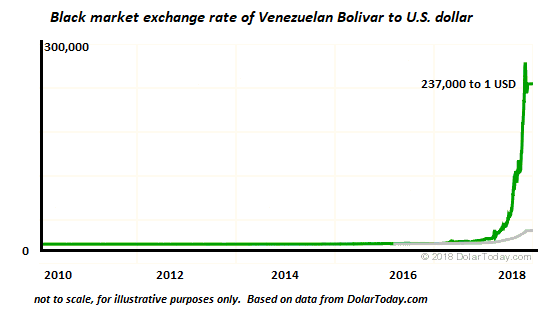
What a swell idea. Isn’t that what Venezuela has done for the past decade? And how did that work for them? If you think that destroying the purchasing power of “money” is a winner, then by all means, go on believing that the government can never go broke because all it has to do is print more money.

Here’s my favorite chart of asymmetric gains. The vast majority of the gains reaped since the 2008-09 Global Financial Meltdown have flowed to the top .1%. This is not a bug, it is a feature of hyper-financialization. Indeed, it is the only possible output of the current system.

Meanwhile, the bottom 95% live in an economy where wages go nowhere and costs are soaring. The financial media cheers when wages (supposedly) rise by 2%, but nobody dares measure the impact of rising costs in services such as healthcare and higher education.

The Status Quo is in trouble if the bottom 95% wake up to the asymmetric gains that are the only possible output of our hyper-financialized economy. Hype and propaganda are the key tools of the present era, as these are required to disconnect perception from reality. How long the disconnect will last is anyone’s guess, but when the two reconnect, all that is solid now will melt into thin air.


Twelve Tips For Making Sense Of The World

By Caitlin Johnstone

Source: CaitlinJohnstone.com

In an environment that is saturated with mass media propaganda, it can be hard to figure out which way’s up, let alone get an accurate read on what’s going on in the world. Here are a few tips I’ve learned which have given me a lot of clarity in seeing through the haze of spin and confusion. Taken separately they don’t tell you a lot, but taken together they paint a very useful picture of the world and why it is the way it is.

1. It’s always ultimately about acquiring power.

In the quest to understand why governments move in such irrational ways, why expensive, senseless wars are fought while homeless people die of exposure on the streets, why millionaires and billionaires get richer and richer while everyone else struggles to pay rent, why we destroy the ecosystem we depend on for our survival, why one elected official tends to advance more or less the same harmful policies and agendas as his or her predecessor, people often come up with explanations which don’t really hold water.

The most common of these is probably the notion that all of these problems are due to the malignant influence of one of two mainstream political parties, and if the other party could just get in control of the situation all the problems would go away. Other explanations include the belief that humans are just intrinsically awful, blaming minorities like Jews or immigrants, blaming racism and white supremacy, or going all the way down wild and twisted rabbit holes into theories about reptilian secret societies and baby-eating pedophile cabals. But really all of mankind’s irrational behavior can be explained by the basic human impulse to amass power and influence over one’s fellow humans, combined with the fact that sociopaths tend to rise to positions of power.

Our evolutionary ancestors were pack animals, and the ability to rise in social standing in one’s pack determined crucial matters like whether one got first or last dibs on food or got to reproduce. This impulse to rise in our pack is hardwired deeply into our evolutionary heritage, but when left unchecked due to a lack of empathy, and when expanded into the globe-spanning 7.6 billion human pack we now find ourselves in due to ease of transportation and communication, it can lead to individuals who will keep amassing more and more power until they wield immense influence over entire clusters of nations.

2. Money rewards sociopathy.

The willingness to do anything to get ahead, to claw your way to the top, to betray whomever you need to, to throw anyone under the bus, to step on anyone to pass them in the rat race, will be rewarded in our current system. Being willing to underpay employees, cheat the legal system, and influence legislators will be rewarded exponentially more. People with a sense of empathy are often unwilling to do such things, whereas sociopaths and psychopaths are. About four percent of the population are sociopaths, and about one percent are psychopaths, with some five to fifteen percent falling somewhere along the borderline. The less empathy you have, the further you are willing to go, and the further up the ladder you can climb.

3. Wealth kills empathy.

If that weren’t bad enough, studies have shown that controlling large amounts of wealth actually destroys one’s sense of compassion for one’s fellow man. When you are able to use wealth to obtain everything from security to loyalty to personal relationships, you no longer have to be tuned in to the brain’s empathy center the rest of humanity depends on to get an accurate reading on what’s going on with the people we’re surrounded by. Most people need to be constantly feeling around their families, coworkers, employers, friends and acquaintances in order to ensure their own safety, social standing and security, whereas a wealthy person can simply purchase those things. Being born into wealth or having it for a long time can prevent that sense of empathy from being as strong as it is in the rest of the population.

4. Money is power.

2014 Princeton study showed that ordinary Americans have essentially zero influence over their nation’s policy and behavior regardless of how they vote, while wealthy Americans have a great deal of influence. This is because the ability to use corporate lobbying and campaign donations effectively amounts to the legalized bribery of elected officials, which means that money translates directly into political power. This creates a ruling class which is naturally incentivized to use their influence to increase their own wealth while decreasing everyone else’s, because since power is relative, the less money everyone else has the more power the ruling class has.

This is why billionaires keep hoarding more and more wealth while using legalized bribery to stifle economic justice legislation. It isn’t because they want to be able to buy thousands of luxury cars or dozens of private jets; they can only use one at a time the same as everyone else. They hoard wealth to keep the rest of the population from having it. Because money equals power, spreading wealth around would be tantamount to making everyone king, and because power is relative, making everyone king would mean that no one is king.

Rulers, historically, do not give up power easily, and this elite wealthy class is no exception. Hence all their aggressive attempts to suppress any movement against the status quo from the unwashed masses.

5. This same ruling class controls the media.

It’s common knowledge that most media is controlled by plutocrats, whether it’s the old money plutocrats who control the legacy media or the new money Silicon Valley plutocrats who control much of the new media. Media control is an essential component of rule; this has always been the case, since the days when kings would order dissident books burned and bishops would torture dissident orators to death. This is why the first thing a new plutocrat does as soon as rising to a certain level of wealth is start buying up media influence, like Jeff Bezos did when he bought the Washington Post in 2013. Bezos bought WaPo not because he is a stupid businessman who thought newspapers were about to make a lucrative resurgence, but because he is a brilliant businessman who knows that the status quo he is building his empire upon requires a propaganda firm that the public will trust and believe.

6. People are always manipulating each other.

Cultivating an acute awareness of when you are being manipulated, and considering whether someone might have a motive to do so, is an essential component to making sense of the world.

It is very rare to encounter someone who won’t try to manipulate you in any way. Generally people you’ll encounter in your life will try to influence the way you perceive them and your relationship to them, they’ll try to pull you in in some ways and push you out in others, try to hook you up to their personal agendas and goals and shape you in a way that fits with their shape. There’s nothing inherently malevolent in such behavior, it’s just what people do and what they always have done. Again, humans are social creatures, and we do what we can to increase our standing within our social circles.

The big problem is when skillful manipulators find their way into positions of large-scale influence like government or media. Unfortunately, these are the types who tend to get elevated into such positions, because they can manipulate their way in, and generally they do so for reasons of personal ambition rather than altruism. These skillful manipulators form an essential echelon of the ruling class’ loyal servants, and are the minds behind the pro-establishment narratives you’ll suddenly see circulated from think tanks to media platforms to the establishment lackeys on Capitol Hill.

7. Society is made of narrative.

Most of human experience is filtered through our mental stories about it, from our sense of self, to our ideas about who we are, to our beliefs about how we’re supposed to behave in society, to what money is and how it works, to where power exists and who we’re supposed to obey. All of these things are purely conceptual constructs which only exist in the realm of thought; a “dollar” exists to the extent that we’ve all agreed to pretend it’s a real thing and that it has a certain amount of purchasing power. At any time we could collectively decide to change the rules about how power functions or what money is and how it operates, and then instantly the rule of the elite class would be over without anyone firing a shot. It really would be that simple.

That’s how powerful a force narrative is, which is why the ruling plutocrats fight so hard to keep us from seizing control of it. This is why whistleblowers and outlets like WikiLeaks are aggressively and constantly smeared and demonized in the corporate media; if they can create suspicion of truth-tellers then they can keep them from being trusted, and thus keep them from being believed. This tool has been used to minimize the impact of everything from on the ground reports of what’s happening in Syria to leak drops from Edward Snowden; if you can create enough suspicion of someone it doesn’t matter if they’re speaking 100 percent truth; nobody will believe them, and thus the dominant narrative will remain the same.

Maintaining an awareness that there is always an unending battle to control the narrative and manipulate it to advance plutocratic interests is an essential part of understanding the world.

8. The lines between nations are imaginary.

Those lines drawn on the map between countries are pure narrative as well; they’re only as real as the collective public agrees to pretend they are. The ruling elites know this and exploit this. They don’t think in terms of nations and governments, they think in terms of individuals and groups of individuals.

Key strategic region in the Middle East? No need to take over the whole country, just flood it with extremist groups who are loyal to your agendas and control its oil fields. Primo naval real estate in the southern hemisphere? No need to annex it and plant your country’s flag there, just secure enough influence over the important moving parts using corporate contracts, trade agreements, military/intelligence treaties and secret deals and you can use it however you want.

This is why I am dismissive of arguments that “Israel controls America” or “America controls Europe”. There is no “Israel” or “America”; they’re made-up ideas which rulers once upon a time treated as real, but in the modern days of nationless plutocracy they no longer do. There are individuals, there are corporations, there are government agencies, there are factions and groups, and these are what the ruling elites deal with. Governmental structures are only tools which are used by the ruling elites for the purpose of manipulation, control, and military violence, and they only do so insofar as it is useful. The idea of real nations and governments is a cutesy fairy tale sold to the masses so they won’t see the manipulations.

9. Powerful forces are naturally incentivized to collaborate with each other toward mutual interests.

You can be a low-grade millionaire and still live like a relatively normal civilian, but once you start obtaining giant amounts of wealth control you need to start collaborating with existing power structures or they’ll snuff you out to prevent you from rocking their boat, because again, money equals power. This is why Jeff Bezos contracts with the CIA and sits on a Pentagon advisory board, and it’s why Facebook and Google collaborate extensively with government agencies; they never would have been allowed to grow to their size if they had not. Plutocratic dynasties which have been in place since long before Amazon, Facebook and Google figured this out many generations ago, and have agreed to push forward in a direction of mutual interest that doesn’t upset the status quo that their wealth is built upon.

This is extremely true of the west, where an effective empire has been created by a complex transnational alliance of mostly western plutocrats, but it is true outside of that empire as well; there are power alliances to be found everywhere that there is power.

10. There is an immense amount of wealth that can be grabbed in the chaos of war and conflict.

In the same way that existing power structures are naturally incentivized to quash any emerging power which would upset their status quo, alliances of power structures push to crush non-aligned power structures the world over. Whenever you see the tight western alliances and their media propaganda arms attacking the interests of Russia, China, Syria, Iran, Venezuela etc., you are seeing an alliance of power structures working to disrupt the interests of another alliance of power structures in order to absorb their assets.

The chaotic, Wild West environments that these conflicts create allow for an amount of underhanded looting and pillaging that you could never get away with in your own country, in the exact same way the colonialists and conquistadors of old could never have gotten away with brazenly grabbing gold, land and slaves from their fellow Europeans in Madrid or Rome but were given no legal trouble in the new world. The colonialists and conquistadors pushed into the Americas, Africa and Asia on the pretense of spreading Christianity and civilization; modern day conquerers push into non-aligned power structures on the pretense of spreading freedom and democracy in precisely the same way.

This chaos doesn’t require direct military conflict to be profitable; the uncritical enmity against Russia that the western plutocratic alliance has manufactured with its media control has allowed them to be blamed for everything from incriminating WikiLeaks documents to a corporate raid by Ukrainian oligarchs without any questions asked. Anyone who has ever had to deal personally with a sociopath knows how much they love to exploit the gray areas that chaotic situations give them, and geopolitical conflicts create those situations in spades.

11. The neocons are always wrong.

This one’s really easy. If you ever want to be on the right side of history for a foreign policy debate, look at what Bush-era PNAC neocons like John Bolton and Bill Kristol are saying about it, and take the opposite position. Neocon thought leaders have been loudly and catastrophically wrong about everything since the turn of the century, from Afghanistan to Iraq to Libya to Syria, and they’re not about to start being right now.

12. The push towards truth always starts with yourself.

You can’t out-manipulate seasoned manipulators. The main error most people make when trying to deal with a sociopath is to try and manipulate them back. Don’t even try. They have years of experience on you because they literally have done nothing else. While you were laughing and crying and worrying and connecting and relating to people, they were working out how to play humans like Garry Kasparov worked out how to play chess. And when you have literal teams of sociopaths collaborating together to amass power, you my dear child, do not have a chance. Don’t play their game. You will lose.

The only way to win this is to set your compass resolutely to “true.” Always be honest with yourself. Find all the different ways that you are manipulating others and see them and acknowledge them. Find your tribal allegiances and your desire to be right, and tip your hat to their existence. The more self-aware we are, the less levers we have to be manipulated by. If you are blindly partisan or loyal to a particular faction, that makes you gullible to propaganda because your wishful thinking and your desire to be right come into play. Get honest with yourself about who you are and what you want, and you will start to become an un-playable piece on the board.

If we can’t beat these bastards with truth, we don’t deserve to win.

Saturday Matinee: The Occupation of the American Mind

From OccupationMovie.org:

Israel’s ongoing military occupation of Palestinian territory and its repeated invasions of the Gaza strip have triggered a fierce backlash against Israeli policies virtually everywhere in the world — except the United States. The Occupation of the American Mind takes an eye-opening look at this critical exception, zeroing in on pro-Israel public relations efforts within the U.S. Narrated by Roger Waters and featuring leading observers of the Israeli–Palestinian conflict, the film explores how the Israeli government, the U.S. government, and the pro-Israel lobby have joined forces, often with very different motives, to shape American media coverage of the conflict in Israel’s favor. The Occupation of the American Mind provides a sweeping analysis of Israel’s decades-long battle for the hearts, minds, and tax dollars of the American people — a battle that has only intensified over the past few years in the face of widening international condemnation of Israel’s increasingly right-wing policies. (Running time: 85 mins)

If you are a member of a major library system you can watch the full film at Kanopy.

Colonizing the Western Mind

By Jason Hirthler

Source: CounterPunch

In Christopher Nolan’s captivating and visually dazzling film Inception, a practitioner of psychic corporate espionage must plant and idea inside a CEO’s head. The process is called inception, and it represents the frontier of corporate influence, in which mind spies no longer just “extract” ideas from the dreams of others, but seed useful ideas in a target’s subconscious. Inception is a well-crafted piece of futuristic sci-fi drama, but some of the ideas it imparts are already deeply embedded in the American subconscious. The notion of inception, of hatching an idea in the mind of a man or woman without his or her knowledge, is the kernel of propaganda, a black art practiced in the States since the First World War. Today we live beneath an invisible cultural hegemony, a set of ideas implanted in the mass mind by the U.S. state and its corporate media over decades. Invisibility seems to happen when something is either obscure or ubiquitous. In a propaganda system, an overarching objective is to render the messaging invisible by universalizing it within the culture. Difference is known by contrast. If there are no contrasting views in your field of vision, it’s easier to accept the ubiquitous explanation. The good news is that the ideology is well-known to some who have, for one lucky reason or another, found themselves outside the hegemonic field and are thus able to contrast the dominant worldview with alternative opinions. On the left, the ruling ideology might be described as neoliberalism, a particularly vicious form of imperial capitalism that, as would be expected, is camouflaged in the lineaments of humanitarian aid and succor.

Inception 1971

In a short span of time in the 1970s, dozens of think tanks were established across the western world and billions of dollars were spent proselytizing the tenets of the Powell Memo in 1971, which galvanized a counter-revolution to the liberal upswing of the Sixties. The neoliberal economic model of deregulation, downsizing, and privatization was preached by the Reagan-Thatcher junta, liberalized by the Clinton regime, temporarily given a bad name by the unhinged Bush administration, and saved by telegenic restoration of the Obama years. The ideology that underlay the model saturated academia, notably at the University of Chicago, and the mainstream media, principally at The New York Times. Since then it has trickled down to the general populace, to whom it now feels second nature. Today think tanks like the Heritage Foundation, the Brookings Institute, Stratfor, Cato Institute, American Enterprise Institute, Council on Foreign Relations, Carnegie Endowment, the Open Society Foundation, and the Atlantic Council, among many others, funnel millions of dollars in donations into cementing neoliberal attitudes in the American mind.

The ideological assumptions, which serve to justify what you could call neocolonial tactics, are relatively clear: the rights of the individual to be free of overreach from monolithic institutions like the state. Activist governments are inherently inefficient and lead directly to totalitarianism. Markets must be free and individuals must be free to act in those markets. People must be free to choose, both politically and commercially, in the voting booth and at the cash register. This conception of markets and individuals is most often formulated as “free-market democracy,” a misleading conceit that conflates individual freedom with the economic freedom of capital to exploit labor. So when it comes to foreign relations, American and western aid would only be given on the condition that the borrowers accepted the tenets of an (highly manipulable) electoral system and vowed to establish the institutions and legal structures required to fully realize a western market economy. These demands were supplemented with notions of the individual right to be free of oppression, some fine rhetoric about women and minorities, and somewhat more quietly, a judicial understanding that corporations were people, too. Together, an unshackled economy and an unfettered populace, newly equipped with individual rights, would produce the same flourishing and nourishing demos of mid-century America that had been the envy of humanity.

A False Promise

This ‘Washington Consensus’ is the false promise promoted by the West. The reality is quite different. The crux of neoliberalism is to eliminate democratic government by downsizing, privatizing, and deregulating it. Proponents of neoliberalism recognize that the state is the last bulwark of protection for the common people against the predations of capital. Remove the state and they’ll be left defenseless. Think about it. Deregulation eliminates the laws. Downsizing eliminates departments and their funding. Privatizing eliminates the very purpose of the state by having the private sector take over its traditional responsibilities. Ultimately, nation-states would dissolve except perhaps for armies and tax systems. A large, open-border global free market would be left, not subject to popular control but managed by a globally dispersed, transnational one percent. And the whole process of making this happen would be camouflaged beneath the altruistic stylings of a benign humanitarianism.

Globalists, as neoliberal capitalists are often called, also understood that democracy, defined by a smattering of individual rights and a voting booth, was the ideal vehicle to usher neoliberalism into the emerging world. Namely because democracy, as commonly practiced, makes no demands in the economic sphere. Socialism does. Communism does. These models directly address ownership of the means of production. Not so democratic capitalism. This permits the globalists to continue to own the means of production while proclaiming human rights triumphant in nations where interventions are staged. The enduring lie is that there is no democracy without economic democracy.

What matters to the one percent and the media conglomerates that disseminate their worldview is that the official definitions are accepted by the masses. The real effects need never be known. The neoliberal ideology (theory) thus conceals the neoliberal reality (practice). And for the masses to accept it, it must be mass produced. Then it becomes more or less invisible by virtue of its universality.

A Pretext for Pillage

Thanks to this artful disguise, the West can stage interventions in nations reluctant to adopt its platform of exploitation, knowing that on top of the depredations of an exploitative economic model, they will be asked to call it progress and celebrate it.

Washington, the metropolitan heart of neoliberal hegemony, has numerous methods of convincing reluctant developing nations to accept its neighborly advice. To be sure, the goal of modern colonialism is to find a pretext to intervene in a country, to restore by other means the extractive relations that first brought wealth to the colonial north. The most common pretexts for intervention depict the target nation in three distinct fashions.

First, as an economic basket case, a condition often engineered by the West in what is sometimes called, “creating facts on the ground.” By sanctioning the target economy, Washington can “make the economy scream,” to using war criminal Henry Kissinger’s elegant phrasing. Iran, Syria, and Venezuela are relevant examples here. Second, the West funds violent opposition to the government, producing unrest, often violent riots of the kind witnessed in Dara, Kiev, and Caracas. The goal is either to capsize a tottering administration or provoke a violent crackdown, at which point western embassies and institutions will send up simultaneously cries of tyranny and brutality and insist the leader step aside. Libya, Syria, and Venezuela are instructive in this regard. Third, the country will be pressured to accept some sort of military fettering thanks to either a false flag or manufactured hysteria over some domestic program, such as the WMD restrictions on Iraq, chemical weapons restrictions on Syria, or the civilian nuclear energy restrictions on Iran. Given that the U.S. traffics in WMDs, bioweapons, and nuclear energy itself, insisting others forsake all of these is perhaps little more than racially motivated despotry. But significant fear mongering in the international media will provide sufficient moral momentum to ram through sanctions, resolutions, and inspection regimes with little fanfare.

Schooling the Savages

Once the pretext is established, the appropriate intervention is made. There’s no lack of latent racism embedded in each intervention. Something of Edward Said’s Orientalism is surely at play here; the West is often responding to a crude caricature rather than a living people. One writer, Robert Dale Parker, described western views of Asia as little more than, “a sink of despotism on the margins of the world.” Iran is incessantly lensed through a fearful distrust of the ‘other’, those abyssal Persians. Likewise, North Korea is mythologized as a kingdom of miniature madmen, possessed of a curious psychosis that surely bears no relation to the genocidal cleansing of 20 percent of its population in the Fifties, itself an imperial coda to the madness of Hiroshima.

The interventions, then, are little different than the missionary work of early colonizers, who sought to entrap the minds of men in order to ensnare the soul. Salvation is the order of the day. The mission worker felt the same sense of superiority and exceptionalism that inhabits the mind of the neoliberal. Two zealots of the age peddling different editions of a common book. One must carry the gospel of the invisible hand to the unlettered minions. But the gifts of the enlightened interloper are consistently dubious.

It might be the loan package that effectively transfers economic control out of the hands of political officials and into the hands of loan officers, those mealy-mouthed creditors referred to earlier. It may be the sanctions that prevent the country from engaging in dollar transactions and trade with numberless nations on which it depends for goods and services. Or it might be that controversial UNSC resolution that leads to a comprehensive agreement to ban certain weapons from a country. Stipulations of the agreement will often include a byzantine inspections regime full of consciously-inserted trip wires designed to catch the country out of compliance and leverage that miscue to intensify confrontational rhetoric and implement even more far-reaching inspections.

Cracking the Shell

The benign-sounding structural adjustments of the West have fairly predictable results: cultural and economic chaos, rapid impoverishment, resource extraction with its attendant ecological ruin, transfer of ownership from local hands to foreign entities, and death from a thousand causes. We are currently sanctioning around 30 nations in some fashion; dozens of countries have fallen into ‘protracted arrears’ with western creditors; and entire continents are witnessing huge outflows of capital–on the order of $100B annually–to the global north as debt service. The profiteering colonialists of the West make out like bandits. The usual suspects include Washington and its loyal lapdogs, the IMF, World Bank, EU, NATO, and other international institutions, and the energy and defense multinationals whose shareholders and executive class effectively run the show.

So why aren’t Americans more aware of this complicated web of neocolonial domination? Italian communist Antonio Gramsci, who pioneered the concept of cultural hegemony, suggested that the ruling ideologies of the bourgeoisie were so deeply embedded in popular consciousness that the working classes often supported leaders and ideas that were antithetical to their own interests. Today, that cultural hegemony is neoliberalism. Few can slip its grasp long enough to see the world from an uncolored vantage point. You’ll very rarely encounter arguments like this leafing through the Times or related broadsheets. They don’t fit the ruling dogma, the Weltanschauung (worldview) that keeps the public mind in its sleepy repose.

But French-Algerian philosopher Louis Althusser, following Gramsci, believed that, unlike the militarized state, the ideologies of the ruling class were penetrable. He felt that the comparatively fluid zones of Ideological State Apparatuses (ISAs) were contexts of class struggle. Within them, groups might attain a kind of ‘relative autonomy’, by which they could step outside of the monolithic cultural ideology. The scales would fall. Then, equipped with new knowledge, people might stage an inception of their own, cracking open the cultural hegemony and reshaping its mythos in a more humane direction. This seems like an imperative for modern American culture, buried as it is beneath the hegemonic heft of the neoliberal credo. These articles of false faith, this ideology of deceit, ought to be replaced with new declarations of independence, of the mind if not the mainstream.


Jason Hirthler is a veteran of the communications industry and author of The Sins of Empire: Unmasking American Imperialism. He lives in New York City and can be reached at jasonhirthler@gmail.com.

WikiLeaks and whistleblowers condemn new allegations against Julian Assange

By James Cogan

Source: WSWS.org

WikiLeaks has announced it will sue the British Guardian over the scurrilous allegations it made on May 15 that Julian Assange “hacked” the communication system of the Ecuadorian embassy in London where he has been confined since he sought political asylum in June 2012.

The only and obvious motive behind the unsubstantiated, “anonymous” allegations is to provide the Ecuadorian government with a pretext to renege on Assange’s asylum and force him out of the embassy. Upon doing so, he would be arrested by waiting British police for breaching bail conditions. Once in British custody, the WikiLeaks editor would face the prospect of extradition to the US to stand trial on charges of espionage, which could lead to his protracted imprisonment or, potentially, even his execution (see: “Conspiracy emerges to push Julian Assange into British and US hands”).

In a tweet issued shortly after the publication of the Guardian articles, WikiLeaks denounced the assertions as an “anonymous libel” made on behalf of the “current UK-US government onslaught against Mr Assange’s asylum—while he can’t respond. You’ve gone too far this time. We’re suing.”

Assange cannot respond because on March 28, more than seven weeks ago, the Ecuadorian government of President Lenín Moreno cut off all his communications with the outside world and has blocked him from even receiving visitors. Ample indications exist that Ecuador did so on the demand of Washington, as part of the price for improved relations with the US.

WikiLeaks ended its tweet with a link to the scathing review that Assange wrote of the Guardian-published 2014 book, The Snowden Files: The Inside Story of the World’s Most Wanted Man. The author of the book was Luke Harding, the same Guardian journalist who co-wrote the May 15 attack on Assange and WikiLeaks.

In the first sentence of his review, Assange described Harding’s work as a “hack job in the purest sense of the word” and more than substantiated that characterisation. He condemned the Guardian for having “caved to government pressure” over the publication of leaked material and for leaving Edward Snowden “in the lurch” when the NSA whistleblower fled to Hong Kong in June 2013. It was a representative of WikiLeaks who organised for Snowden to escape to Russia, where he was eventually granted political asylum.

Harding and the Guardian did not have credibility in 2014 and they do not today.

Beside WikiLeaks and the World Socialist Web Site, only a handful of other websites and individuals have stepped forward to denounce the Guardian for serving as the conduit for the anti-Assange vendetta of the US government and intelligence agencies. In the main, there is a complicit silence on the part of the pro-imperialist establishment media and no less pro-imperialist pseudo-left organisations.

Former British whistleblower Craig Murray, who has vocally defended Assange from the outset, wrote on his blog yesterday that the Guardian articles included “outright lies.” Murray exposed, for example, the false claim by the newspaper that Sweden was “unable to question Assange” over allegations he may have committed sexual offences in 2010. The reprehensible attempt to slander Assange as a “rapist” has been relentlessly used to try and undermine the immense international support for WikiLeaks and its editor.

In fact, Assange was questioned before he left Sweden for Britain and a prosecutor deemed he had no case to answer. A second prosecutor, however, reopened the case and pursued it aggressively, gaining an arrest warrant to force Assange to return to Sweden to answer “questions.” The warrant was issued under conditions in which US and allied governments were baying for Assange’s blood because WikiLeaks had published vast amounts of damning evidence of war crimes and intrigues that had been courageously leaked by then Private Bradley [now Chelsea] Manning.

Assange correctly refused to submit to the politically-motivated warrant and challenged it in the British courts. He sought asylum in June 2012 only when his legal avenues ran out to prevent his extradition to Sweden, and likely rendition on to the US.

When Swedish authorities finally agreed to Assange’s longstanding offer to answer any questions, from Britain, he was interviewed by prosecutors and police for two days in November 2016. In May 2017, Sweden completely dropped the case. After more than six years of persecution, Assange was never charged with any crime.

Craig Murray characterised the May 15 Guardian articles as a “new low… in a collaboration between long term MI6 mouthpiece Luke Harding and the CIA financed neo-con propagandists of Focus Ecuador”—the right-wing Spanish-language site which was also provided the “anonymous” information that Assange “hacked” the embassy.

Murray opined: “I would bet any money that these anonymous ‘sources’ are as always Harding’s mates in the British security services.”

The Intercept website featured today an interview conducted by Glenn Greenwald, its editor and former whistleblower, with previous Ecuadorian President Rafael Correa, whose administration granted Assange asylum in 2012.

Correa denounced his protégé and successor Lenín Moreno for cutting off Assange’s communications and visitors, labelling it as “basically torture and “a clear violation of his rights.” He declared the Ecuadorian government “is attacking Julian’s mental health.” He reviewed the closer relations between Moreno’s administration and Washington that had been developed immediately prior to the attack on Assange

Correa stated that the Guardian allegations that Assange hacked the embassy were “absurd” and that it had “presented no evidence for this, just an anonymous source.”

The ex-president stated that if Moreno allowed the WikiLeaks’ editor to be forced out of the London embassy without an iron-clad guarantee he would not be extradited to the US, it would be a “terrible betrayal, a violation of the rules of asylum and a breach of Ecuador’s responsibility to protect the safety and welfare of Julian Assange.”

The almost universal hostility towards Assange and indifference to his fate on the part of the establishment press and self-styled “left” is in stark contrast to mass popular sentiment. On Facebook, Twitter and other social media, every defence of Assange is being responded to with a stream of supportive comments, retweets and shares, and sharp and informed rebuttals of all those who attempt to attack Assange and WikiLeaks with pro-state propaganda and lies.

The social force that must be politically mobilised in defence of democratic rights is the international working class. It must be alerted and educated as to the tremendous dangers posed by the steadily escalating efforts to censor the Internet, suppress free speech and railroad whistleblowers and principled journalists like Julian Assange into prison or worse.


The author also recommends:

Ecuador hints it may hand over Julian Assange to Britain and the US
[12 May 2018]

Freedom for Julian Assange!
[11 January 2018]

How false flag operations are carried out today

By Philip M. Giraldi

Source: Intrepid Report

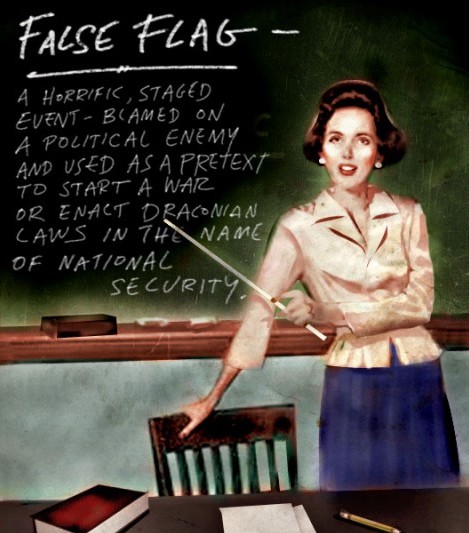
False Flag is a concept that goes back centuries. It was considered to be a legitimate ploy by the Greeks and Romans, where a military force would pretend to be friendly to get close to an enemy before dropping the pretense and raising its banners to reveal its own affiliation just before launching an attack. In the sea battles of the eighteenth century among Spain, France and Britain hoisting an enemy flag instead of one’s own to confuse the opponent was considered to be a legitimate ruse de guerre, but it was only “honorable” if one reverted to one’s own flag before engaging in combat.

Today’s false flag operations are generally carried out by intelligence agencies and non-government actors including terrorist groups, but they are only considered successful if the true attribution of an action remains secret. There is nothing honorable about them as their intention is to blame an innocent party for something that it did not do. There has been a lot of such activity lately and it was interesting to learn by way of a leak that the Central Intelligence Agency (CIA) has developed a capability to mimic the Internet fingerprints of other foreign intelligence services. That means that when the media is trumpeting news reports that the Russians or Chinese hacked into U.S. government websites or the sites of major corporations, it could actually have been the CIA carrying out the intrusion and making it look like it originated in Moscow or Beijing. Given that capability, there has been considerable speculation in the alternative media that it was actually the CIA that interfered in the 2016 national elections in the United States.

False flags can be involved in other sorts of activity as well. The past year’s two major alleged chemical attacks carried out against Syrian civilians that resulted in President Donald Trump and associates launching 160 cruise missiles are pretty clearly false flag operations carried out by the rebels and terrorist groups that controlled the affected areas at the time. The most recent reported attack on April 7 might not have occurred at all, according to doctors and other witnesses who were actually in Douma. Because the rebels succeeded in convincing much of the world that the Syrian government had carried out the attacks, one might consider their false flag efforts to have been extremely successful.

The remedy against false flag operations such as the recent one in Syria is, of course, to avoid taking the bait and instead waiting until a thorough and objective inspection of the evidence has taken place. The United States, Britain and France did not do that, preferring instead to respond to hysterical press reports by “doing something.” If the U.N. investigation of the alleged attack turns up nothing, a distinct possibility, it is unlikely that they will apologize for having committed a war crime.

The other major false flag that has recently surfaced is the poisoning of Sergei Skripal and his daughter Yulia in Salisbury, England, on March 4. Russia had no credible motive to carry out the attack and had, in fact, good reasons not to do so. The allegations made by British Prime Minister Theresa May about the claimed nerve agent being “very likely” Russian in origin have been debunked, in part through examination by the U.K.’s own chemical weapons lab. May, under attack even within her own party, needed a good story and a powerful enemy to solidify her own hold on power so false flagging something to Russia probably appeared to be just the ticket as Moscow would hardly be able to deny the “facts” being invented in London. Unfortunately, May proved wrong and the debate ignited over her actions, which included the expulsion of twenty-three Russian diplomats, has done her severe damage. Few now believe that Russia actually carried out the poisoning and there is a growing body of opinion suggesting that it was actually a false flag executed by the British government or even by the CIA.

The lesson that should be learned from Syria and Skripal is that if “an incident” looks like it has no obvious motive behind it, there is a high probability that it is a false flag. A bit of caution in assigning blame is appropriate given that the alternative would be a precipitate and likely disproportionate response that could easily escalate into a shooting war.

US Collapse – the Spectacle of Our Time

By Finnian Cunningham

Source: Axis of Logic

May you live in interesting times, goes the Chinese proverb. Few can doubt that we are indeed living in such an interesting time. Big changes are afoot in the world, it seems.

None more so than the collapsing of the American Empire.

The US is going through an historic “correction” in the same way that the Soviet Union did some 30 years ago when the latter was confronted with the reality of its unsustainable political and economic system. (That’s not meant to imply, however, that socialism is unviable, because arguably the Soviet Union had fatally strayed from its genuine socialist project into something more akin to unwieldy state capitalism.)

In any case, all empires come to an end eventually. History is littered with the debris of countless empires. Why should the American Empire be any different? It’s not. Only arrogant “American exceptionalism” deludes itself from the reality.

The notable thing is just how in denial the political class and the US news media are about the unfolding American crisis.

This is partly where the whole “Russiagate” narrative comes into play. Blaming Russia for allegedly destabilizing US politics and society is a cover for denial over the internal rot facing the US.

Some may scoff at the very idea of an “American Empire”. That’s something Europeans did, not us, goes the apologist for US power. The quick retort to that view is to point out that the US has over 1,000 military bases in more than 100 countries around the world. If that is not a manifestation of empire then what is?

For seven decades since the Second World War, “Pax Americana” was the grandiose name given to US imperial design for the global order. The period was far from peaceful as the vainglorious name suggests. Dozens of wars, proxy conflicts and violent subversions were carried by the US on every continent in order to maintain its empire. The so-called “global policeman” was more often a “global thug”.

That US empire is now teetering at the cusp of an emerging multipolar world order led by China, Russia and other rising powers.

When US leaders complain about China and Russia “reshaping the global order” to reflect their interests what the American leaders are tacitly admitting is the coming end of Washington’s presumed hegemony.

Rather than accepting the fate of demise, the US is aggressively resisting by denigrating China and Russia’s power as somehow illegitimate. It’s the classic denial reaction of a sore loser.

So, what are the telltale signs that the US is indeed undergoing a seminal “correction” — or collapse?

The heyday of American capitalism is well passed. The once awesome productive system is a skeleton of its former self. The rise of massive social poverty alongside obscene wealth among a tiny elite is a sure sign that the once mighty American economy is chronically moribund. The country’s soaring $20 trillion national debt is another symptom of chronic atrophy.

Recent self-congratulatory whooping by President Trump of “economic recovery” is like the joy felt from looking at a mirage. The roaring stock market is an elite phenomenon which can just as easily slump over night.
What the champagne bubbles can’t disguise is the structural failing of US capitalism to reverse exploding inequality and endemic poverty across America. The national prowess of US capitalism has been superseded by global capitalism where American corporations among others scour the planet for cheap labor and tax havens. There is no going back to a supposed golden age, no matter how much Trump crows about “America First”.

The other side of the coin from historic US economic demise is the concomitant rise in its militarism as a way to compensate for its overall loss of power.

It is no coincidence that since the end of the Cold War following the dissolution of the Soviet Union, US military interventions around the world have erupted with increased frequency and duration. The US is in a veritable permanent state of war actively deploying its forces simultaneously in several countries, particularly in the oil-rich Middle East.

Washington of course gives itself a fig leaf cover by calling its surge in militarism a “war on terror” or “defending allies”. But, increasingly, US war conduct is seen for what it plainly is — violation of international law and the sovereignty of nations for the pursuit of American imperial interests.

In short, the US is patently lashing out as a rogue regime. There’s no disguising that fiendish fact.

In addition to waging wars, bombing countries, sponsoring terrorist proxies and assassinating enemies at will with drones, Washington is increasingly threatening others with military aggression. In recent months, North Korea and Iran have been openly threatened based on spurious claims. Russia and China have also been explicitly warned of American aggression in several strategic documents published by the Trump administration.

The grounds for American belligerence are baseless. As noted, the real motive is to do with compensating for its own inherent political, economic and social crises. That then amounts to American leaders inciting conflicts and wars, which is in itself a grave violation of international law — a crime against peace, according to Nuremberg principles.

The American Empire is failing and flailing. This is the spectacle of our time. The Western mainstream news media are either blind, ignorant or complicit in denying the historic collapse. Such media are indulging reckless fantasies of the US political class to distract from the potential internal implosion. Casting around for scapegoats to “explain” the deep inherent problems, the political class are using Russia and alleged Russian “interference” as a pretext.

World history has reached a foreboding cross-roads due to the collapsing of the American Empire. Can we navigate a safe path forward avoiding catastrophic war that often accompanies the demise of empires?

A lot, it seems, depends on ordinary American people becoming politically organized to challenge their dysfunctional system run by and for the elites. If the American people cannot hold their elites to account and break their corrupt rule, overhauling it with something more equitable and democratic, then the world is in peril of being plunged into total war. We can only but wish our American brothers and sisters solidarity and success.

Fake News Is Fake Amerika