Our Hopelessly Dysfunctional Democracy

By Charles Hugh Smith

Source: Of Two Minds

When the system is rigged, “democracy” is just another public-relations screen to mask the unsavory reality of Oligarchy.

Democracy in America has become a hollow shell. The conventional markers of democracy–elections and elected representatives–exist, but they are mere facades; the mechanisms of setting the course of the nation are corrupt, and the power lies outside the public’s reach.

History has shown that democratic elections don’t guarantee an uncorrupt, functional government. Rather, democracy has become the public-relations stamp of approval for corrupt governance that runs roughshod over individual liberty while centralizing the power to enforce consent, silence critics and maintain the status quo.

Consider Smith’s Neofeudalism Principle #1: If the citizenry cannot replace a dysfunctional government and/or limit the power of the financial Aristocracy at the ballot box, the nation is a democracy in name only.

In other words, if the citizenry changes the elected representation but the financial Aristocracy and the Deep State remain in charge, then the democracy is nothing but a PR facade for an oppressive oligarchy.

If the erosion of civil liberties and rising inequality characterize the state of the nation, democracy is both dysfunctional and illiberal. A state that strips away the civil liberties of its citizens via civil forfeiture, a war-on-drugs Gulag and unlimited surveillance may be a democracy in name, but it is at heart an oppressive oligarchy.

If the super-wealthy continue to become ever wealthier while the bottom 95% of the citizenry struggle in various stages of debt-serfdom, the state may be a democracy in name, but it is at heart an oppressive oligarchy.

Author/commentator Fareed Zakaria recently addressed the illiberal aspects of America’s faded democracy in an article America’s democracy has become illiberal.

Zakar’s prettified critique avoided the real worm at the heart of our democracy:the state exists to enforce cartels. Some might be private, some might be state-run, and others might be hybrids, such as our failed Sickcare system and our military industrial complex.

The ultimate role of democracy isn’t to “give the people a voice;” the only meaningful role of democracy is to protect the liberties of individuals from state encroachment, break up cartels and monopolies and limit the corruption of private/public money.

America’s democracy has failed on all counts. Civil liberties in a nation of ubiquitous central-state surveillance, a quasi-political Gulag (that nickel bag will earn you a tenner in America’s drug-war Gulag) and civil forfeiture (we suspect you’re up to no good, so we have the right to steal your car and cash) are eroding fast.

In America, the central government’s primary job is enforcing and funding cartels. As many of us have pointed out for years, a mere $10 million in lobbying, revolving-door graft (getting paid $250,000 for a speech or for a couple of board meetings) and bribes (cough-cough, I mean campaign contributions) can secure $100 million in profits–either by erecting regulatory/legal barriers or by direct federal funding of the cartel’s racket (healthcare, defense, “National Security,” etc.).

I explain why this is so in my books Resistance, Revolution, Liberation, Inequality and the Collapse of Privilege and Why Our Status Quo Failed and Is Beyond Reform.

The fact that the corruption is veiled does not mean it isn’t corruption. In the sort of nations Americans mock as fake democracies, the wealthy protect their wealth and incomes with bags of cash delivered at night to politicians.

Nothing so crass or obvious here, of course. Here, the government of Algiers gives $25 million to the Clinton Foundation for “favors,” the Russian government gives hundreds of thousands to John Podesta’s firm for “advice” (heh), the Koch Brothers fund an array of front-organizations that work on behalf of their agenda, K Street lobbying firms rake in tens of millions of dollars every year, and the first thing tech companies do when they realize some interest group might crimp their profits courtesy of lobbying the central state’s politicos is set up their own lavish lobbying and “contribution” schemes.

In theory, democracy enables advocacy by a variety of groups in order to reach a consensual solution to problems shared by everyone. In practice, the advocacy is limited to a select group of insiders, donors and the various fronts of the wealthy: foundations, think-tanks, lobbyists, etc.

Does anyone think America’s democracy is still capable of solving the truly major long-term problems threatening the nation? Based on what evidence? What we see is a corrupt machine of governance that kicks every can down the road rather than suffer the blowback of honestly facing problems that will require deep sacrifices and changes in the status quo.

We see a dysfunctional machine of governance that changes the name of legislation and proposes policy tweaks, while leaving the rapacious cartels untouched. (See the current sickcare “debate” for examples.)

We see an Imperial Project setting the state’s agenda to suit its own desires, and a corporate media that is quivering with rage now that the public no longer believes its tainted swill of “news” and “reporting.”

The divide between the haves and the have-nots is not limited to money–it’s also widening between the few with political power and the teeming serfs with effectively zero political power. When the system is rigged, “democracy” is just another public-relations screen to mask the unsavory reality of oligarchy.


The Dance of Death

By Chris Hedges

Source: OpEdNews.com

The ruling corporate elites no longer seek to build. They seek to destroy. They are agents of death. They crave the unimpeded power to cannibalize the country and pollute and degrade the ecosystem to feed an insatiable lust for wealth, power and hedonism. Wars and military “virtues” are celebrated. Intelligence, empathy and the common good are banished. Culture is degraded to patriotic kitsch. Education is designed only to instill technical proficiency to serve the poisonous engine of corporate capitalism.

Historical amnesia shuts us off from the past, the present and the future. Those branded as unproductive or redundant are discarded and left to struggle in poverty or locked away in cages. State repression is indiscriminate and brutal. And, presiding over the tawdry Grand Guignol is a deranged ringmaster tweeting absurdities from the White House.

The graveyard of world empires — Sumerian, Egyptian, Greek, Roman, Mayan, Khmer, Ottoman and Austro-Hungarian — followed the same trajectory of moral and physical collapse. Those who rule at the end of empire are psychopaths, imbeciles, narcissists and deviants, the equivalents of the depraved Roman emperors Caligula, Nero, Tiberius and Commodus. The ecosystem that sustains the empire is degraded and exhausted. Economic growth, concentrated in the hands of corrupt elites, is dependent on a crippling debt peonage imposed on the population. The bloated ruling class of oligarchs, priests, courtiers, mandarins, eunuchs, professional warriors, financial speculators and corporate managers sucks the marrow out of society as its members retreat into privileged enclaves.

The elites’ myopic response to the looming collapse of the natural world and the civilization is to make subservient populations work harder for less, squander capital in grandiose projects such as pyramids, palaces, border walls and fracking, and wage war. President Trump’s decision to increase military spending by $54 billion and take the needed funds out of the flesh of domestic programs typifies the behavior of terminally ill civilizations. When the Roman Empire fell, it was trying to sustain an army of half a million soldiers that had become a parasitic drain on state resources.

The complex bureaucratic mechanisms that are created by all civilizations ultimately doom them. The difference now, as Joseph Tainter points out in “The Collapse of Complex Societies,” is that “collapse, if and when it comes again, will this time be global. No longer can any individual nation collapse. World civilization will disintegrate as a whole.”

Civilizations in decline, despite the palpable signs of decay around them, remain fixated on restoring their “greatness.” Their illusions condemn them. They cannot see that the forces that gave rise to modern civilization, namely technology, industrial violence and fossil fuels, are the same forces that are extinguishing it. Their leaders are trained only to serve the system, slavishly worshiping the old gods long after these gods begin to demand millions of sacrificial victims.

“Hope drives us to invent new fixes for old messes, which in turn create even more dangerous messes,” Ronald Wright writes in “A Short History of Progress.” “Hope elects the politician with the biggest empty promise; and as any stockbroker or lottery seller knows, most of us will take a slim hope over prudent and predictable frugality. Hope, like greed, fuels the engine of capitalism.”

The Trump appointees — Steve Bannon, Jeff Sessions, Rex Tillerson, Steve Mnuchin, Betsy DeVos, Wilbur Ross, Rick Perry, Alex Acosta and others — do not advocate innovation or reform. They are Pavlovian dogs that salivate before piles of money. They are hard-wired to steal from the poor and loot federal budgets. Their single-minded obsession with personal enrichment drives them to dismantle any institution or abolish any law or regulation that gets in the way of their greed. Capitalism, Karl Marx wrote, is “a machine for demolishing limits.” There is no internal sense of proportion or scale. Once all external impediments are lifted, global capitalism ruthlessly commodifies human beings and the natural world to extract profit until exhaustion or collapse. And when the last moments of a civilization arrive, the degenerate edifices of power appear to crumble overnight.

Sigmund Freud wrote that societies, along with individuals, are driven by two primary instincts. One is the instinct for life, Eros, the quest to love, nurture, protect and preserve. The second is the death instinct. The death instinct, called Thanatos by post-Freudians, is driven by fear, hatred and violence. It seeks the dissolution of all living things, including our own beings. One of these two forces, Freud wrote, is always ascendant. Societies in decline enthusiastically embrace the death instinct, as Freud observed in “Civilization and Its Discontents,” written on the eve of the rise of European fascism and World War II.

“It is in sadism, where the death instinct twists the erotic aim in its own sense and yet at the same time fully satisfies the erotic urge, that we succeed in obtaining the clearest insight into its nature and its relation to Eros,” Freud wrote. “But even where it emerges without any sexual purpose, in the blindest fury of destructiveness, we cannot fail to recognize that the satisfaction of the instinct is accompanied by an extraordinary high degree of narcissistic enjoyment, owing to its presenting the ego with a fulfillment of the latter’s old wishes for omnipotence.”

The lust for death, as Freud understood, is not, at first, morbid. It is exciting and seductive. I saw this in the wars I covered. A god-like power and adrenaline-driven fury, even euphoria, sweep over armed units and ethnic or religious groups given the license to destroy anything and anyone around them. Ernst Juenger captured this “monstrous desire for annihilation” in his World War I memoir, “Storm of Steel.”

A population alienated and beset by despair and hopelessness finds empowerment and pleasure in an orgy of annihilation that soon morphs into self-annihilation. It has no interest in nurturing a world that has betrayed it and thwarted its dreams. It seeks to eradicate this world and replace it with a mythical landscape. It turns against institutions, as well as ethnic and religious groups, that are scapegoated for its misery. It plunders diminishing natural resources with abandon. It is seduced by the fantastic promises of demagogues and the magical solutions characteristic of the Christian right or what anthropologists call “crisis cults.”

Norman Cohn, in “The Pursuit of the Millennium: Revolutionary Messianism in Medieval and Reformation Europe and Its Bearing on Modern Totalitarian Movements,” draws a link between that turbulent period and our own. Millennial movements are a peculiar, collective psychological response to profound societal despair. They recur throughout human history. We are not immune.

“These movements have varied in tone from the most violent aggressiveness to the mildest pacifism and in aim from the most ethereal spirituality to the most earth-bound materialism; there is no counting the possible ways of imagining the Millennium and the route to it,” Cohen wrote. “But similarities can present themselves as well as differences; and the more carefully one compares the outbreaks of militant social chiliasm during the later Middle Ages with modern totalitarian movements the more remarkable the similarities appear. The old symbols and the old slogans have indeed disappeared, to be replaced by new ones; but the structure of the basic phantasies seems to have changed scarcely at all.”

These movements, Cohen wrote, offered “a coherent social myth which was capable of taking entire possession of those who believed in it. It explained their suffering, it promised them recompense, it held their anxieties at bay, it gave them an illusion of security — even while it drove them, held together by a common enthusiasm, on a quest which was always vain and often suicidal.

“So it came about that multitudes of people acted out with fierce energy a shared phantasy which though delusional yet brought them such intense emotional relief that they could live only through it and were perfectly willing to die for it. It is a phenomenon which was to recur many times between the eleventh century and the sixteenth century, now in one area, now in another, and which, despite the obvious differences in cultural context and in scale, is not irrelevant to the growth of totalitarian movements, with their messianic leaders, their millennial mirages and their demon-scapegoats, in the present century.”

The severance of a society from reality, as ours has been severed from collective recognition of the severity of climate change and the fatal consequences of empire and deindustrialization, leaves it without the intellectual and institutional mechanisms to confront its impending mortality.

It exists in a state of self-induced hypnosis and self-delusion. It seeks momentary euphoria and meaning in tawdry entertainment and acts of violence and destruction, including against people who are demonized and blamed for society’s demise. It hastens its self-immolation while holding up the supposed inevitability of a glorious national resurgence. Idiots and charlatans, the handmaidens of death, lure us into the abyss.


The U.S. Deep State Rules – On Behalf of the Ruling Class

By Glen Ford

Source: Black Agenda Report

“The U.S. Deep State is unlike any other, in that there is no other global superpower bent on world domination.”

The Deep State is busy denying that it exists, even as it savages a sitting president and brutally bitch-slaps its host society, demanding the nation embrace its role as global psycho thug and kick some Russian ass. The New York Times, always available to divert attention from the essential facts of who rules America, points to Egypt, Turkey and Pakistan as the natural habitats of Deep States. Apparently, Deep State-infected countries tend to be nations with majority Muslim populations, whose military-intelligence apparatus hovers over society and periodically seizes control of the civil government.

The Times quoted high-ranking operatives of the Deep State to prove that such structures are alien to the U.S. Michael V. Hayden, who ran the CIA under Democratic President Obama and Republican George Bush, recoiled at the term. He “would never use” the words Deep State in connection with his own country. “That’s a phrase we’ve used for Turkey and other countries like that, but not the American republic.”

Loren DeJonge Schulman, a former Obama National Security Council official, claimed to be repelled by the very idea of an American Deep State. “A deep state, when you’re talking about Turkey or Egypt or other countries, that’s part of government or people outside of government that are literally controlling the direction of the country no matter who’s actually in charge, and probably engaging in murder and other corrupt practices,” she said.

Apparently, Ms. Schulman did not consider it murder when Obama and his top national security advisors met every Tuesday at the White House to decide who would be assassinated by drone or other means. But she is “shocked” to hear “that kind of [Deep State-phobic] thinking from” President Trump “or the people closest to him.”

Once the Times had located the nexus of Deep Statism in the Muslim world, the lesser lights at The New Yorker endorsed the corporate media consensus that the U.S. is Deep State-free. Staff writer David Remnick admits that U.S. presidents “have felt resistance, or worse, from elements in the federal bureaucracies,” citing Eisenhower’s warnings against the military-industrial complex, Lyndon Johnson’s “pressure from the Pentagon,” and the “rebuke” of Obama’s Syria policy through the State Department’s “dissent channel.” However, he denies that any “subterranean web of common and nefarious purpose” threatens the orderly and transparent processes of the U.S. political system.

In reality, the U.S. Deep State is by far the world’s biggest and most dangerous version of the phenomenon; a monstrous and not-so subterranean “web of common and nefarious purpose” that is, by definition, truly global, since its goal is to rule the planet. Indeed, the Deep States of Turkey, Egypt and Pakistan — all nominal U.S. allies – are midgets in comparison and must operate in a global environment dominated by Washington’s Deep State apparatus. So vast is the imperial Deep State, that its counterparts in other nations exist largely to collaborate with, resist, or keep tabs on the U.S. behemoth, the predator that seeks to devour all the rest.

What is a Deep State? The U.S. Deep State is unlike any other, in that there is no other global superpower bent on world domination. (Washington’s political posture is also unique; no other nation claims to be “exceptional” and “indispensable” and thus not subject to the constraints of international law and custom.) Indeed, the U.S. is so proudly and publicly imperialist that much of what should be secret information about U.S. military and other capabilities is routinely fed to the world press, such as the 2011 announcement that the U.S. now has a missile that can hit any target on the planet in 30 minutes, part of the Army’s “Prompt Global Strike” program. Frightening the rest of the world into submission — a form of global terrorism — is U.S. public policy.

However, arming and training Islamic jihadist terrorists to subvert internationally recognized governments targeted by the U.S. for regime change is more than your usual variety of covert warfare: It is a policy that must forever be kept secret, because U.S. society would suffer a political breakdown if the facts of U.S. and Saudi nurturing of the international jihadist network were ever fully exposed. This is Deep State stuff of the highest order. The true nature of U.S. foreign policy in the 21st century, and the real character of the current wars in Syria and Iraq, must be hidden from the U.S. public at all cost. An alternative reality must be presented, through daily collaboration between corporate media, corporate universities, and the public and covert organs of the U.S. State.

What part of the New York Times coverage of the war against Syria is a lie? Damn near all of it. What role does the Deep State play in crafting the lies dutifully promulgated by the corporate media? That’s impossible to answer, because the Deep State is a network of relationships, not a clearly delineated zone or space or set of organizations. The best way to describe the imperial Deep State is: those individuals and institutions that are tasked with establishing the global supremacy of the corporate ruling class. Such activities must be masked, since they clash with the ideological position of the ruling class, which is that the bourgeois electoral system of the United States is the world’s freest and fairest. The official line is that the U.S. State is a work of near-perfection, with checks and balances that prevent any class, group or section from domination over the other. The truth is that an oligarchy rules, and makes war on whomever it chooses — internationally and domestically — for the benefit of corporate capital.

The Deep State and its corporate imperatives manifestly exists when corporate lobbyists and lawyers are allowed to draw up the Trans Pacific Partnership global “trade” agreement, but the contents are kept secret from the Congresspersons whose duty is to vote on the measure. The Deep State is where corporate power achieves its class aims outside the public processes of government. It’s where the most vicious class warfare takes place, whether on a foreign killing field, or in the corporate newsroom that erases or misrepresents what happened on that battlefield.

At this stage of capitalism, the U.S. ruling class has less and less use for the conventional operations of the bourgeois state. It cannot govern in the old way. More and more, it seeks to shape events through the levers of the collaborating networks of the Deep State. It’s number one global priority is to continue the military offensive begun in 2011, and to break Russia’s resolve to resist that offensive. The ruling class and its War Party, now consolidated within the Democratic Party and regrouping among Republicans, have effectively neutralized a sitting president whose party controls both Houses of Congress, less than two months into his term.

Only a Deep State could pull that off.


BAR executive editor Glen Ford can be contacted at Glen.Ford@BlackAgendaReport.com.

Glen Ford’s blog

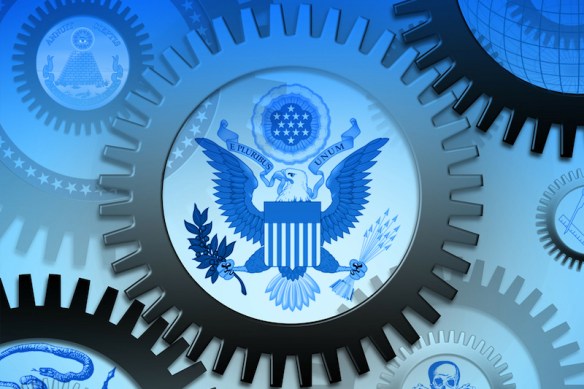
Aristocracy Deceives Public about the Deep State

deep_state_gears_1088x725

By Eric Zuesse

Source: Strategic Culture Foundation

The «deep state» is the aristocracy and its agents. Wikispooks defines it as follows:

The deep state (loosely synonymous with the shadow government or permanent government) is in contrast to the public structures which appear to be directing individual nation states. The deep state is an intensely secretive, informal, fluid network of deep politicians who conspire to amplify their influence over national governments through a variety of deep state milieux. The term «deep state» derives from the Turkish »derin devlet», which emerged after the 1996 Susurluk incident so dramatically unmasked the Turkish deep state.

Their article is so honest that it continues from there, directly to:

Official Narrative

The official narrative of deep states used to be that they simply do not exist. This position was modified in the last few years to the claim that they don’t exist here. In 2013 the New York Times defined the deep state as «a hard-to-perceive level of government or super-control that exists regardless of elections and that may thwart popular movements or radical change. Some have said that Egypt is being manipulated by its deep state». [1] Since the Times (like the rest of the commercially-controlled media) is more or less a under the control of the deep state, such a mention is very interesting.

However, one of the deep state’s many agents, Marc Ambinder, came out with a book in 2013, Deep State: Inside the Government Secrecy Industry, much praised by others of the deep state’s agents, such as Martha Raddatz, Jeremy Scahill, and Peter Bergen; and it pretends that the ‘deep state’ is only within the official government, not above it and controlling it — not what has been called by some «the money power,» and by others «the aristocracy» (or the «oligarchy» as it was termed — though even that, only indirectly — by the only people who have scientifically established that it exists in America and controls this country: to acknowledge publicly that the U.S. is controlled by an «aristocracy» is prohibited in scholarly publications; it’s too ‘radical’ a truth to allow in print; it is samizdat).

On its third page, Ambinder’s piece of propaganda make clear what he means by ‘deep state’:

This book is about government secrets — how they are created, why they get leaked, and what the government is currently hiding. We will delve into the key elements of the American secrecy apparatus, based on research and unprecedented access to lawmakers, intelligence agency heads, White House officials, and program managers. …

That piece of trash failed even to discuss George W. Bush’s lies in which Bush stated during 2002 and 2003 that he possessed conclusive proof that Saddam Hussein was reconstituting his WMD (weapons of mass destruction) program — what America’s aristocratically controlled ‘news’ media attributed instead to ‘failures of intelligence’ by the Bush Administration — which had supposedly caused the Bush regime to invade Iraq in 2003. That was supposedly an enormous ‘failure of intelligence’, but Ambinder’s book ignored it entirely — and yet there are still suckers who buy that and the aristocracy’s other propaganda (and so who misunderstand even such a basic concept as «the deep state» or «the aristocracy»).

One of the biggest indicators that one is reading propaganda from the deep state is that the government’s lies are not being called »lies» (unless the deep state is losing control over the government, which rarely happens). Instead, they are called by such phrases as ‘failures of intelligence’. But what about when the people who control the government misrepresent what their ‘intelligence’ actually shows and doesn’t show? Lying is attributed, in the ‘news’ media, only to the aristocracy’s enemies. After all: the aristocracy’s enemies can be acknowledged to exist, even if the existence of an aristocracy isn’t being acknowledged.

Another mouthpiece of the deep state is (like virtually all magazines) The Nation magazine, which headlined on 17 February 2017, «What Is the Deep State? Even if we assume the concept is valid, surely it’s not useful to think of the competing interests it represents as monolithic.» Their propagandist, Greg Grandin, asked «What is the ‘deep state’?» and he ignored what wikispooks said, and he asserted, instead, «The problem with the phrase ‘deep state’ is that it is used to suggest that dishonorable individuals are subverting the virtuous state for their private ambitions.» Aside from propagandist Grandin’s having merely assumed there ‘the virtuous state’, which might not even exist at all, in this country, or perhaps in any other, he was trying to, as he said, get «beyond the binds of conspiracy theory,» as if any hierarchical social structure, corporate or otherwise, doesn’t necessarily and routinely function by means of conspiracies — some of which are nothing more than entirely acceptable competitive strategies, often entirely legal. He wants to get beyond accepting that reality? Why would anyone wish to read such absurd, anti-factual, writings as that? Why would anyone hire such deceptive writers as that? Perhaps the answer to the latter question (which raises the problem here to being one about the aristocracy, since this is about the ‘news’ media, which in every aristocratically controlled country are controlled by its aristocracy) is that only writers such as that will pump their propaganda, and will hide such realities as are here being discussed (and, via links, documented).

Nothing that’s alleged here is denying that there are divisions within the aristocracy (or «deep state»). Nothing is alleging that the aristocracy are «monolithic.» It’s instead asserting that, to the extent the aristocracy are united around a particular objective, that given objective will likely become instituted, both legally and otherwise, by the government — and that, otherwise, it simply won’t be instituted at all. This is what the only scientific analysis that has ever been done of whether or not the U.S. is controlled by an aristocracy found definitely to be the case in the U.S.

(And, of course, that’s also the reason why this momentous study was ignored by America’s ‘news’ media, except for the first news-report on it, mine at the obscure site Common Dreams, which had 414 reader-comments within just its first four months, and then the UPI’s report on it, which, like mine, was widely distributed to the major ‘news’ media and rejected by them all — UPI’s report was published only by UPI itself, and elicited only two reader-comments there. Then came the New Yorker’s pooh-poohing the study, by alleging «the politicians all know this, and we know it, too. The only debate is about how far this process has gone, and whether we should refer to it as oligarchy or as something else.» Their propagandist ignored the researchers’ having noted, in their paper, that though their findings were extremely inconsistent with America’s being a democracy, the problem was almost certainly being understated in their findings: «The failure of theories of Majoritarian Electoral Democracy is all the more striking because it goes against the likely effects of the limitations of our data,» and, especially, «our ‘affluent’ proxy is admittedly imperfect,» and so, «interest groups and economic elites actually wield more policy influence than our estimates indicate.»

In fact, their «elite» had consisted not of the top 0.1% as compared to the bottom 50%, but instead of the top 10% as compared to the bottom 50%, and all empirical evidence shows that the more narrowly one defines «the aristocracy,» the more lopsidedly dominant is the ‘elite’s relative impact upon public policies. Then, a month after the press-release on their study was issued, the co-authors were so disappointed with the paltry coverage of it that had occurred in America’s ‘news’ media, so that they submitted, to the Washington Post, a reply to their study’s academic critics, «Critics argued with our analysis of U.S. political inequality. Here are 5 ways they’re wrong.» It was promptly published online-only, as obscurely as possible, so that there are also — as of the present date — only two reader-comments to that public exposure. This is typical news-suppression in America: essentially total suppression of samizdat information — not merely suppression of the officially top-secret information, such as propagandists like Ambinder focus upon. It’s deeper than the state: it is the deep state, including far more than just the official government.)

Another matter that America’s press has covered-up is the extreme extent to which the only scientific analysis of whether America is a democracy or instead an aristocracy, had found it to be an aristocracy; so, here in closing will be directly quoted the least-obscurantist statement of this fact, in the study itself:

The picture changes markedly when all three independent variables are included in the multivariate Model 4 and are tested against each other. The estimated impact of average citizens’ preferences drops precipitously, to a non-significant, near-zero level. Clearly the median citizen or «median voter» at the heart of theories of Majoritarian Electoral Democracy does not do well when put up against economic elites and organized interest groups. The chief predictions of pure theories of Majoritarian Electoral Democracy can be decisively rejected. Not only do ordinary citizens not have uniquely substantial power over policy decisions; they have little or no independent influence on policy at all.

By contrast, economic elites are estimated to have a quite substantial, highly significant, independent impact on policy.

They weren’t allowed to say «aristocracy», nor even directly to say «oligarchy», but they were allowed to say this. So: now, you’ve seen it. But the secret is still a secret; what’s samizdat, stays samizdat (so long as the government isn’t overthrown and replaced — and maybe even after the existing regime does become replaced).

How 90% of American Households Lost an Average of $17,000 in Wealth to the Plutocrats in 2016

By Paul Buchheit

Source: Information Clearing House

America has always been great for the richest 1%, and it’s rapidly becoming greater. Confirmation comes from recent work by Thomas Piketty, Emmanuel Saez, and Gabriel Zucman; and from the 2015-2016 Credit Suisse Global Wealth Databooks (GWD). The data relevant to this report is summarized here.

The Richest 1% Extracted Wealth from Every Other Segment of Society 

These multi-millionaires effectively shifted nearly $4 trillion in wealth away from the rest of the nation to themselves in 2016. While there’s no need to offer condolences to the rest of the top 10%, who still have an average net worth of $1.3 million, nearly half of the wealth transfer ($1.94 trillion) came from the nation’s poorest 90% — the middle and lower classes, according to Piketty and Saez and Zucman. That’s over $17,000 in housing and savings per lower-to-middle-class household lost to the super-rich.

Put another way, the average 1% household took an additional $3 million of our national wealth in one year while education and infrastructure went largely unfunded.

It Gets Worse: Each MIDDLE-CLASS Household Lost $35,000 to the 1% 

According to Piketty and Saez and Zucman, the true middle class is “the group of adults with income between the median and the 90th percentile.” This group of 50 million households lost $1.76 trillion of their wealth in 2016, or over $35,000 each. That’s a $35,000 decline in housing and financial assets, with possibly increased debt, for every middle-class household.

Housing Wealth for the 90% Has Been Converted into Investment Wealth for the Plutocrats

In the 1980s, the housing wealth of the bottom 90% made up about 15 percent of total household wealth (Figure 8 here and Page 41 here).

In the 1980s, the corporate equities owned by the richest .01% made up about 1.2 percent of total household wealth (Figure 8 here).

Housing was 12 times greater than super-rich stock holdings back then. Now they’re nearly equal. The home values of 112,000,000 households have been reduced to just over 5 percent of total wealth, while the stocks and securities of the richest 12,000 households are approaching 5 percent of total wealth. Our homes have turned to dust, and the plutocrats have turned the dust into gold.

Even the Wages of the Poorest Americans Have Been Transferred to the Plutocrats 

It’s bad enough that the poorest 50% of America have no appreciable wealth, but their income has not increased in 40 years (see Table 1 here). More evidence comes from Pew Research.

As Piketty, Saez, and Zucman note, the richest 1% and the poorest 50% “have basically switched their income shares.” They explain, “We observe a complete collapse of the bottom 50% income share in the US between 1978 and 2015, from 20% to 12% of total income, while the top 1% income share rose from 11% to 20%.”

Making America Great for 1% of Us 

In his book, Glass House: The 1% Economy and the Shattering of the All-American Town, Brian Alexander describes today’s America through the lens of his hometown of Lancaster, Ohio, which had been a leading glasswares manufacturer. But the town started falling apart in the 1980s. A major glasswares company was bought up with borrowed money by private equity firms, which then cut jobs and wages, allowed manufacturing facilities to fall into disrepair, stopped contributing to pensions, moved company headquarters out of state, and demanded tax breaks to keep the glassware plant in Lancaster.

Capitalism as usual. Yet 59 percent of Lancaster’s county voted for Trump. Alexander explains that the people of Lancaster “remained captured by an ultra-conservative, anti-tax philosophy that prevented them from raising funds to repair the crumbling streets..”

Delusions persist about the power of the market and the dangers of governing ourselves. The business media has conditioned us to fear the words ‘social’ and ‘public,’ as if they connote evil or ineptitude or anti-Americanism. But the public good depends on cooperation. Society fosters individual accomplishment, not the other way around.

The obscene transfer of wealth and income to the plutocrats won’t end until we demand a return to the Commons, where we work as a society rather than allow predatory plutocratic individuals to control us. There are 112 million households in America that are giving thousands of their hard-earned dollars to the 1%, and we have finally begun to fight back, together, as a massive force of Americans who refuse to let the theft continue.


Paul Buchheit is a writer for progressive publications, and the founder and developer of social justice and educational websites, including: UsAgainstGreed.org, PayUpNow.org, and RappingHistory.org. This article was first published at Common Dreams

Russ Baker on the Media’s Deep State Conversion Moment

index

By Russ Baker

Source: Who.What.Why.

The term “Deep State” has recently become as popular with the media as the term “#resistance.” It certainly wasn’t always that way.

For years, a lonely few have set out to enlighten people on the notion that, when it comes to affairs of state, there is usually more to the story than we are told.

I started WhoWhatWhy because I realized that the publications I worked for had no interest, no understanding of, could not fathom, or were just plain scared to explore the possibility that We, the People, were not in control of our destiny.

You can read most media all day long and you’d never get a sense, except fleetingly, that eight people have as much wealth as half of the world’s population. A handful of people can put their selected candidate in the White House, and the masses remain blissfully unaware as the process unfolds.

A company with vast resources can make sure the so-called free market works a whole lot better for itself than it does for its smaller rivals — even if the other companies offer a better product or service — and corporate media remains silent.

The media typically does not make us wonder why there seem to be wars going on all the time, why Americans are able to live so well compared to most of the world, nor that even today, resource extraction is a very deadly one-way street. They rarely seem to stop and ponder why it is that no matter which of the two political parties is in office, public policy seems to always cater to the 1% and not … the public.

The media does cover politics plenty. But it does not very often cover deep politics — that is, the forces beneath the  surface, the powers behind the daily events, what’s been called the Deep State.

To those unfamiliar with it, this expression sounds creepy, even paranoid, with a hint of conspiracy theory — itself a catchall term designed to discredit any critical analysis that comes perilously close to something that may lead back to the Deep State. How could there be something other than politics or the state — deep politics and a deep state?

Well, ask yourself: Is that giant bank where you have your money actually run by the smiling masses you see in their ads? The ones who say “We’re here for you” but when you call, they all read from the same script and admit they’re powerless? One thing your bank doesn’t do, usually, is advertise the top people, the biggest shareholders, and how much power they wield, and how much money they make.

It takes something like a financial scandal for the CEO to suddenly appear in the limelight, like a mole rubbing its eyes, and you say, “Oh, so that’s the main guy.” You never knew.

The media overall hates these “deep” concepts because they are anathema to people trying to keep their jobs and move up in a hierarchical system owned and influenced by the most powerful, while still wearing the thrilling mantle of “troublemaker.”

Let’s be clear: the Deep State is not six people in hoods muttering incantations. It’s a shifting landscape of those at the top of the heap — not a monolith but a bloody battlefield, with factions breaking both bread and heads.

It includes financiers, industrialists, media titans, generals, spymasters, strategists, and experts in the black arts of mass influence. It even includes a super-verboten topic: how the “overworld” (the legit) do business, albeit usually at arm’s length, with the underworld.

Look at Trump’s track record on this; look at CIA’s well-documented cooperation with the mob and with global drug cartels. Also off-limits to the media: the role of highly profitable illegal activity in making great fortunes (prohibition, drug trade, money laundering) and the cooperation of elements of the state.

***

The deeper meaning and scope of the Deep State is now being misrepresented by those who still hope for handouts from the system — either they’re deliberately obscuring the real nature of the Deep State, or they’re really trying, without much success, to throw some light on a topic to which they’ve come late and have little incentive to dig into too deeply.

One example is the Los Angeles Times, which, despite some great journalism and bravery over the years, has retained a mysteriously close relationship with the CIA and similar entities, serving as their hatchet men against reporters who cut too near the bone of the truth. Look up Gary Webb — or read this “review” of a book on the Deep State by yours truly.  

Recently, one of its longtime Washington hands presumed to explain to the rest of us about the Deep State whose very existence he and his paper denied for so long.

The scariest new catchphrase of the Trump era — and we’re only one month in — is the “deep state,” a term borrowed from countries like Turkey and Egypt, where networks of military officers and intelligence operatives control much of the government.

Um, no. It isn’t just entrenched mid-level bureaucrats, soldiers and spies who make up the Deep State — it is also the extremely wealthy who ultimately manipulate and influence these pawns on the board of power.

The New York Times apparently got the same memo as its West Coast namesake:

A wave of leaks from government officials has hobbled the Trump administration, leading some to draw comparisons to countries like Egypt, Turkey and Pakistan, where shadowy networks within government bureaucracies, often referred to as “deep states,” undermine and coerce elected governments.

The point of all this is that if you limit a description of some poisonous Deep State to those actually employed in “bureaucracies,” you are actually playing into the hands of the most powerful Deep State players: the super-rich who benefit when government itself is discredited to the point that everything can be outsourced — to them. And that’s exactly what we have seen in case after case, with the privatization of intelligence, police work, prisons, schools, and so on. Let’s get rid of those nefarious Deep State education officials and save the day with billionaire Betsy DeVos!

No — the Deep State IS populated by people like Betsy DeVos and her husband and their coterie. They’re the ones who can buy the loyalty of modestly-paid government figures who expect to travel out the revolving door to dip into the abundant coffers of the Koch brothers et al.

To be clear, we probably don’t want to think of the Deep State as synonymous with the plutocracy — it’s not all about money. It is about an ideology of self-interest and a kind of fascist value system, and an ability to build deep links into institutions like the FBI, the Pentagon, the NSA, the CIA, local law enforcement, etc. Of course, elements within the Deep State, as is true throughout the world, can also be forces for good, resisting when things in the surface world “go too far.” That, in part, is what we are seeing in the resistance to Trump from surprising quarters.

It’s also something to keep in mind when we see the Washington Post leading the charge against Trump. The Post is, like Amazon, the property of Jeff Bezos — and the CIA is one of Amazon’s biggest customers (for its cloud computing services.) The CIA is none too happy with Trump — with very good reason, for once (well, there was also that battle with Cheney and the neocons), and so, yes, that too is all the Deep State at work.

And no, don’t look to The Post to fully explain it all. Why? Again, my personal experience — here’s the Post’s contracted-out hit piece on my Deep Politics book.

***

The Deep State has cajoled or intimidated almost the entirety of journalism, mainstream to Left to Right — to ignore its existence, and to defame those who dare investigate it, by lumping them with all manner of crazy under the all-purpose dysphemism “conspiracy theory.” Try googling related terms: conspiracy theorist, conspiracy nut, etc — you will find that the “top” news organizations have routinely beaten up on those who dared break ranks by slapping this deadly moniker on them. It’s the loud cousin of the whispering campaign, the sort that makes it hard to find work and scares off would-be allies.

I’ll note that back in the 1960s, the CIA got really nervous as interest in the assassination of President John F. Kennedy heated up, with reputable, brave people asking a lot of questions about the impossible ridiculous fantasy story the media sold us in the Warren Report. In an internal CIA memo, the agency prescribed all manner of tactics to discredit those who were sticking their noses where they oughtn’t, conferring on them the deadly “Conspiracy Theorist” label.

And, in the 1970s, Carl Bernstein, of Watergate sleuth fame, wrote a piece in Rolling Stone revealing the extent to which the security apparatus had penetrated America’s media itself. Shades of Romania and East Germany.

Even Bill Moyers, whom I greatly admire, and who has been complimentary of WhoWhatWhy’s work — brought on a conservative to explain what Deep State is all about. Given the history and the continuing resistance to the concept at the time that program aired in 2014, probably a smart move.

But the times they are a-changin’. Since Wikileaks’ revelations, since Edward Snowden, since … Trump, the shameless and spineless in journalism have spun on a dime and now the things some of us were attacked for are smack dab in the middle of the “conversation,” albeit with the system stingily withholding credit to those who were there first.

In any case, now that it’s all the vogue, I say to the establishment media: No. You do not get to define this term, you do not get to tell the rest of us if there is a Deep State, the nature of its influence, or whether we should or should not be concerned about it.


Related Videos:

The Acquisitive Self, Minus the Self

article-2386232-1B30C5F9000005DC-668_634x633

By Natasha Vargas-Cooper

Source: The Baffler

Los Angeles isn’t exactly the place that comes to mind when you think of decorous restraint in the display of wealth, even in the dregs of the Great Recession. Here in my hometown, possibly more than in any other outpost of faux-meritocratic privilege in our republic of getting and spending, untrammeled acquisition is understood as an expression of individual will—and more than that, a matter of taste.

Yet for all the studio money sloshing around our bright, stucco world, most of us have never encountered the miniscule stratum of humans that hovers above the rich: the pure, gilt-edged, entrenched, multigenerational wealthy. Movie star money is food stamps compared to oil money, hedge fund money, and even some of that dank old money that still floats around the haciendas of Pasadena. We might have stood kegside next to Kirsten Dunst once, but we don’t know the kinds of rich people that F. Scott Fitzgerald had in mind when he wrote that the rich “are different from you and me”: the Vanderbilts, Rothschilds, and Astors. Hell, our L.A. doesn’t even boast a new-money Midwestern poultry heiress.

We don’t see these types—let alone interact with them—because they’ve largely seceded from public view. This is the guilt-prone social formation that Paul Fussell dubbed the “top out-of-sight class,” because you typically can’t see their houses/compounds unless you have access to a helicopter. Prior to the mid-twentieth century, the top out-of-sight class had been very much in sight; Manhattan’s Fifth Avenue and Philadelphia’s Main Line mansions are still monuments to their Caligulan self-regard. But ever since the Great Depression, and its attendant booms in Social Realist art and Popular Front politics, they staged a quiet but striking mass retreat. So spooked out were the über-rich that they became almost discreet. “The situation now is very different from the one in the 1890s satirized by Thorstein Veblen in The Theory of the Leisure Class,” Fussell wrote in 1983. “In [Veblen’s] day the rich delighted to exhibit themselves conspicuously. . . . Now they hide.”

Thirty years later, this is still mostly true, but thanks to the exhibition-friendly canons of social media, the scions of excess are back and flaunting it, baby—and it’s an entirely underwhelming display. These aren’t the out-of-sight rich but their twentysomething children, flouting their parents’ wealth-whispers code of silence. With acres of unproductive time on their hands, bored rich kids are using their gold-plated iPhones to post images of their baubles of privilege, their chemical stimulants of preference, and their outlandish bar tabs on Instagram, the photo-sharing service of the moment. It’s a bit as though a Bret Easton Ellis novel has come blandly to life, without the benefit of any irony.

Predictably enough, a Tumblr photo-blog has stirred vacantly into being, to compile all these outpourings of opulence in one convenient place. Launched in 2012 by a founder who remains anonymous, Rich Kids of Instagram (RKOI for short) curates and tags photos posted on Instagram by the likes of Barron Hilton, Tiffany Trump, and other “funemployed” trust-funders. The Tumblr, which slaps a whimsical, intricately scrolled frame around each photo but adds little else, doesn’t come with a explanation or an editorial policy, other than that it purports to show you the lifestyles that the unseen rich had previously shared only with their similarly rich friends. “They have more money than you do and this is what they do,” goes the tagline.

Why should we look? The payoffs for the nonrich civilian viewer are oddly perfunctory. After all of the social mythologies we’ve lovingly constructed to envelop the delusions of the 1 percent, this is the lurid end-of-the-rainbow payoff they’ve decided to lord over the rest of us—a fistful of watches, car interiors, and European spa photos? The content of Rich Kids of Instagram is less the aftermath of an imperial Roman bacchanal than the shamefaced hangover of an especially inane and oversexed (though well-appointed!) frat party. Around about the dozenth selfie featuring a buff and/or emaciated scion nestled into a private jet with a bottle of Cristal and a $10,000 clip of cash (“Always make sure to tip your pilot and co-pilot 10k. #rulesofflyingprivate”), you can’t help but wonder, “Is that all there is?”

The Duller Image

Indeed, in strictly visual terms, the site is hard to distinguish from a luxe Sharper Image catalog—merchandised out, to be sure, but disappointingly clichéd. The rich boys of Instagram—the son of fashion mogul Roberto Cavalli, for example, and a weak-chinned fellow with the handle Lord_Steinberg—post pictures of their IWC Grande Complication Perpetual watches, multiple Lamborghinis, and six-figure bar tabs. Here, all the shiny expensive crap seems to cry out, is what I’ve done with my life in lieu of becoming an adult. The young rich ladies, such as Alexa Dell (of, you know, the Dell computers fortune), mainly document how all this pelf looks from the other side of the gender divide: they snap pics of themselves surrounded by tangerine Hermès shopping bags, eating sushi sprinkled with 24K gold flakes, and holding their American Express Centurion card minimum payment notifications (typically $40,000).

There’s not even much in the way of the makings of righteous socialist outrage. (Swazi Leaks this most definitely is not; that project, by contrast, pairs leaked photographs of Swaziland’s high-rolling absolute monarch with pictures of $1-a-day sub-subsistence conditions in the slums.) Yes, the rich kids seem determined to remind us that they have stuff the rest of us will never have. The captions they post with their photos are, at times, slyly aware of their part in inequality (cf. a picture of a private jet and a luxury car with the caption “The struggle is real”). But for all that, the kids don’t seem especially power-hungry so much as aimless and languid. Behind these faux-provocative posts lurks a desperate clamor for attention that almost verges on a cry for help—something that makes you feel a certain involuntary (and certainly undeserved) pity for these manically self-documented upper-crusters.

Nevertheless, the rich kids keep on multiplying their blandified self-inventories, and some among the rest of us, presumably, keep looking. In the beginning, few of the kids knew their Instagram feeds were being monitored by RKOI; the security detail for Alexa Dell, for one, wasn’t prepared to see some of her pictures, with recognizable details that could give away her whereabouts (usually closely guarded by her family), show up on the site. Her social media presence was quickly scrubbed. But now, many of the kids featured know they’re getting Tumblr’d, and some court the attention by submitting photos for consideration, tagged with #rkoi. Rich Kids of Instagram has earned its subjects thousands of followers for their individual feeds, and even momentarily catapulted some of the sort-of rich, perhaps splashing out on a once-a-year chartered yacht to Saint Tropez, into better company than they could ordinarily afford.

American media culture has done its part by spinning off these social-media maunderings into a full complement of incoherent dreck. Last winter, the E! cable network debuted #RichKids of Beverly Hills, a reality TV series loosely organized around the premise (if we can call it that) of the Tumblr account. (The show even features—wink, wink—an “Instagram-obsessed” cast member named Morgan Stewart, who delivers such walk-on anathemas to viewer interest as “I’ve taken so many selfies on my cell phone today it’s, like, embarrassing.” No, son, what’s embarrassing is that you’re saying this shit out loud, in front of a television camera.)

The PG-13 Class War

If an E! show wasn’t enough, this summer saw the release of a book-like object, also called The Rich Kids of Instagram, credited to the site’s anonymous founder together with a ghostwriter/collaborator named Maya Sloan. Like its “inspiration,” the book—billed for some reason as a novel—is unrelentingly dumb, though it does supply an important clue to the weird demographic marketing strategy behind the Rich Kids franchise. It’s clearly written for kids or, um, young adults, suggesting that the notion of “aspirational” reading and viewing—the grand media euphemism for the lifestyle-voyeurism genre—is ripe for retirement. Instead, this plotless, and nearly character-less, flight of fancy is something far more inert, and less interesting: an empty vessel of careless adolescent fantasy.

The book’s careful observance of PG-13 canons of teen rebellion is so pronounced as to be obtrusive. There’s little in the way of appalling or casual sex; the cussing and chronic drug use (nothing too hard, mind you: pills, weed, blow) is there mainly for box-checking shock value. In this, as well, the book is true to the real-life Tumblr; nowhere do you see anything truly threatening or transgressive, like Jordan Belfort snorting coke out of a hooker’s ass in Martin Scorsese’s The Wolf of Wall Street. No, all you encounter, in the book as on the Tumblr feed, is the sort of teen spliff smoking you’d find at an average Dave Matthews show—but in a jet, bro!!

In the same way that such scenes beg to be seen as transgressive, the Rich Kids oeuvre begs to be seen as a populist-baiting vindication of privilege for privilege’s sake: Take that, plebes! But there’s a telling sleight of hand here. The book’s main gimmick is identical to the Tumblr’s MO: the outrage is all imputed to you, the reader, in advance, by its ostensible targets or by the medium itself. This means, in turn, that the proceedings float serenely above any semblance of real-world criticism. So, not surprisingly, the book suffers from the same thing the actual rich kids of Instagram kids do, only at far more tedious length: a depressing lack of imagination. Here, for example, is one of the novel’s rich kids fuming about her maid while also clumsily name-checking her 1,200-thread-count sateen sheet set: “Woven in Italy. For what I paid, I could buy your illegal Guatemalan cousins. That is, if you weren’t from Jersey.”

There’s no pulse-pounding social tension or class resentment on offer here—unless you’re especially aroused by inarticulate dialogue. The novel doesn’t proceed in a mood of detached anthropological inquiry, the way that, say, Louis Auchincloss or John Marquand’s old-money fictions did. There’s no anger, no weight, no insight. All you have in the way of a rich-kid call-to-arms is the empty bravado of the anonymous site creator’s acknowledgements at the front of the book: “To all the RKOI kids, who are unapologetically themselves; in a world where so few people will live out loud, you guys have guts, and for that you deserve admiration.” (And yes, Rich Kid self-awareness once again stops well short of the obvious irony involved in an anonymous social media impresario’s celebration of the overclass’s bold capacity “to live out loud.”)

For “gutsy” exemplars of individual lifestyle, the kids are distressingly uniform in their motivation, behavior, and dramatic purpose. Far from emblazoning their excellent individuality upon our collective prole brainpan, the novel’s cast of characters merges into an interchangeable ensemble of predictable, privileged reflexes and half-copped attitude. Each member of this brat pack is outfitted with a suffocatingly oversignifying name and a ponderous chapter rendered in his or her voice. To save time, here’s a rundown of the main players in the book (think of it as the literary equivalent of a bar-tab selfie):

• Annalise Hoff, a high-strung media heiress who dotes on her Murdoch/Hearst mashup Daddy: “I know: Freud would have a field day with me. I don’t take the short bus, after all. I have a Bentley waiting.”

• Christian Rixen, a Denmark Royal and jewelry designer, who employs an oddly clinical diction suggesting that this is what Southern Californian rich assholes hear when Europeans speak to them: “The countess may have birthed me, but she was far from maternal.”

• Miller Crawford, a Mayflower legacy, rifle heir, and aspiring record producer—and what passes for a self-starting entrepreneur in these circles: “I made a promise long ago: I won’t be that guy. The kind who orders staff to do petty bullshit. Sure, there are emergencies. Scoring coke for an after-hours, buying last-minute condoms. As for the rest? I can get my own double latte, thanks.”

• Todd Evergreen, a Mark Zuckerberg stand-in with a suitably generic name—an upper-middle-class kid who became an overnight billionaire by captaining an overcapitalized software startup. We don’t hear from Evergreen, who is eventually driven into paranoia and Howard Hughes–like seclusion until the novel’s crashingly unpersuasive, life-affirming coda. “I liked their things,” Evergreen says of the rich kids, “don’t get me wrong. Not for the things themselves, but how excited they got about them. How their faces lit up when they talked about them. But I liked the people for other reasons. Better reasons.”

• Desdemona Goldberg, a bipolar singer/actress: “Wow, I think, that coke was awesomeness.

You don’t say. This novelization rounds out the Rich Kids trifecta: Tumblr, TV show, and book. The net effect is, fittingly enough, akin to that of another notorious plutocratic foray into cultural exhibitionism—a Damien Hirst installation. In both, we see our culture lords courting outrage in the most safely inert and vanity-fed forms of display. Both aim to provoke an aesthetic response that is little more than a fleeting revulsion, compounded by the inevitable gawking at the price tag attached to the finished product. And both make a huge deal of curating predators, whether it be champagne-squirting twentysomethings captured in photo-blog form (RKOI) or a really big shark lifelessly preserved in a bath of acid (Hirst).

Binge and Purge

For that matter, the Rich Kids franchise outdoes even Hirst, and achieves a further refinement of this recursive aesthetic of total consumption: it’s a monument to the acquisitive self minus the actual self. Sometimes the kids don’t even bother to take pictures of items they buy. Instead, they share photos of the shopping bags from whatever luxury store they just blew through. Other times, they display pictures of receipts, personal check stubs, or their names embossed on credit cards.

Capital is always on the verge of dematerializing our common world; as Marx and Engels famously warned back in the day, under the height of bourgeois domination, “all that is solid melts into the air.” Here, however, is a gloss on that crippling dynamic that the founders of socialism never could have anticipated: the children of capital are rendering their innermost selves—their critics-be-damned determination to live out loud—as a random agglomeration of nonsignifying digits. The beauty they transmit back, what they see, is nothing more than a place-holding string of credit limits where a human self, or at least a measure of use value, might once have been.

Still, there are evidently some young self-starters who are gleaning a different aspirational message from the whole enterprise. When frequent RKOI contributor Aleem Iqbal, a nineteen-year-old whose dad owns a luxury car leasing service in England, went on a recent binge of selfie-taking, some unintended consequences ensued. The younger Iqbal saturated his Instagram feed with shots of himself driving really expensive cars with the vanity plate “LORD.” On June 6 the teenager leased a $560,000 Lamborghini Aventador Roadster, and a few hours later someone set it on fire. A week after that, three more of his luxury cars, two Audi R8 Spyder supercars and a Bentley Flying Spur, were torched. This was not his understanding of the new social contract at all. Instead of a reality TV or book deal, all his self-infatuated Instagram entries had earned him was the smoldering hulks of four plute-mobiles. On his Facebook page, the aggrieved teen called the campaign of high-end vandalism “a vile act of jealously towards my business.”

Maybe so; it could be like George Orwell said, and there really are only two classes, the rich and the haters. On the other hand, a follower of some RKOI property might have thought it was high time to perform a salutary act of simple math: subtracting some small amount of indecent luxury from the torrent of inert and unproductive excess that we all, inexplicably, must endure. Vileness, after all, is in the eye of the beholder.

Phantom Democracy in the Age of the Internet

trumpandflag

By Nozomi Hayase

Source: Dissident Voice

After the Electoral College vote, the Trump presidency is now official. As denial and blame games continue, it becomes clear this was not a foreign government coup d’état. The truth is that democracy in America has been rotten to the core for decades. It is meddled with by corporate lobbyists, Big Pharma, Big Oil and Wall Street –those who are addicted to money and power.

American democracy is hollowed out, veiled with a loud media echo chamber, bringing feigned solidity to its emptiness. Out of this vacuum emerges a madness for power. U.S. politics is a contest of those who are driven by insatiable hunger – the most callous, cunning and manipulative people in society.

In this system, only people who lack empathy and advance self-serving agendas without concerns for others can rise to the top. The results of this year’s presidential election may mean that this person who many saw as ‘unfit to be president’ was better suited to play this dirty game than his opponent, Hillary Clinton.

Ascent of Trump

Donald Trump, a perceived outsider, seemed to appear out of nowhere. The former producer of the American game show The Apprentice sniffed the vulnerability of disfranchised Americans who are continually betrayed by the establishment. He then quickly moved in for the kill, turning the electoral arena into a new Reality TV show.

With social media as a hunting ground, this new Republican contender made direct connection with his audience, pouring out charm and grooming them with fake promises. By deploying words as weapons of control, he managed to garner favorable reactions from his followers. His language cast a magic spell where contradictory remarks and lies bypassed critical examination. Emotions triumphed over reason and under the grip of irrational logic, facts no longer seemed to matter. With a chameleon-like ability to shape-shift and say whatever voters wanted to hear, he was able to create a mirage and ensnare the populace into a grandiose fantasy.

What was the press, as a supposed watchdog of power doing during this Trump’s uncanny rise in popularity? Mainstream media did nothing to prevent it and instead facilitated this process. His bombastic comments hit jackpot high ratings in the corporate media and rhetoric not bound by facts was not only tolerated, but actively promoted with their shortsighted mentality of profit at any cost.

WikiLeaks and the Democratizing Power of the Internet

This same corporate media also buried a few important facts regarding the 2016 U.S. presidential election. This year’s election was an unprecedented phenomenon. This is not only because the lesser evil game was fought between two of the historically most disliked candidates, but also because of the role played by a new actor from outside of the U.S. electoral arena. Days before the election, a Forbes article acknowledged the significance of WikiLeaksDNC emails, calling them a “Holy Grail of understanding of U.S. electoral politics.” It noted how “few understand the importance of WikiLeaks in the eventual writing of the history of presidential politics.”

WikiLeaks has shown how elections in the existence of a truly free press will never be the same as before. U.S. politics sponsored by corporate masters creates a milieu of deception, lies and fraud that is fraught with corruption. These power driven politicians can only thrive in secrecy. When their actions are exposed, like Hillary’s highly paid Goldman Sachs speeches, crafted public images that suck the masses into their illusions of grandeur tend to shatter. Contrary to hysterical rants of ‘Russia hacked the election!’, the defeat of the Clinton dynasty was a testimony to the power of transparency.

WikiLeaks, the world’s first global 4th estate, which operates outside of any government was birthed on the Internet. It showed a potential for emancipation unleashed by this Net. Much of the force of democratization on the Internet is being subverted to create mass surveillance and censorship. Yet at the same time, its effect of empowering ordinary people cannot be denied.

In fact, Bernie Sander’s campaign was built on social media’s grassroots organizing. With independent campaign funding, this virtually unknown senator from Vermont successfully sparked the idea of socialism and raised issues of Wall Street corruption, economic injustice and poverty at a national level. Sander’s largest support came from millennials. It was these natives of the Internet that galvanized his political revolution.

Fake News and Fake Authority

Democrats appear to be disconnected with this new reality of the Internet’s bottom up spontaneous crowd gathering or even worse were adversaries to it. This was shown in their reaction to the corruption revealed in the DNC email database and Trump’s winning of the election.

On the second day of the Democratic National Convention, hundreds of Sanders delegates who learned about DNC’s rigging of the primary walked out in protest. Chanting “This is what Democracy looks like!”, they vowed not to go with Hillary. This crisis of the American political system opened up an opportunity for real democracy. But then, Bernie turned away, urging his supporters to nominate Hillary and sided with the corrupted Democratic Party. His failure to seize this historical moment helped throw the election to Trump, who the Clinton campaign had portrayed as a ‘pied piper candidate’.

After all this came the Fake News explosion. Some established liberal media, freaked out by the country quickly turning red in this Republican takeover, created a new red scare. On November 24, an article in The Washington Postmade wild accusations that Russia was engaging in propaganda during the election to spread ‘fake news’ in favor of Trump. The anonymous site that claimed to have identified these fake news sites that the author cited in the article, was shown to be nothing but a black list that labels anyone who challenges the official narrative as untrustworthy or even insinuating them to be Russian agents, spies or traitors.

Despite U.S. Intelligence Chief James Clapper’s claim that intelligence agencies lacked strong evidence for WikiLeaks’ connection with an alleged Russian cyberattack, it was way easier for progressives to ignore facts and spread paranoia, blaming the loss of Clinton on anyone but themselves.

In the age of the Internet, fake news can easily be manufactured and spread. Yet, at the same time it can also be shut down with countering views that surround them. Also, in this new environment, traditional media is losing its monopolizing power to disseminate information. They no longer can claim to be the sole purveyor of truth. In the case of the Washington Post‘s fake news scandal, The Intercept and Matt Taibbi of Rolling Stone quickly denounced and challenged its claim, halting this report on ‘fake news’. Social media networks also countered the gatekeepers who tried to dictate what is real through filtering views that challenge the official narrative. In the end, this fake news article was debunked, with Wapo issuing a correction on that story shortly after its publication. What this has shown is the publisher’s false authority and the establishment’s desperate attempt to reassert their shrinking legitimacy to keep people under their sphere of influence.

From Regime Change to Game Changer

The election is over and liberals’ hope to stop the rise of demagoguery is fading. The president elect began recruiting his rich buddies into his cabinet. Recently, he convened a group of Silicon Valley tech leaders to invite them into his new ‘construction project to rebuild America’. As this void of American democracy is being filled with more blatant patronage networks, new insurgencies of civic power are also arising. The potent and creative power of the Internet is already here. Those who have experienced it will not easily succumb to the reality being handed down to them from the teetering Trump Tower.

Just as the power of the Internet can be used by the oligarchic class to corral the masses, it can also be used to empower the people, through its open network. When the liberating force of a free net is claimed by citizens to create movements across borders, linking diverse struggles, it can give all a chance to not only change a regime, but to change the game altogether.

One game changer is WikiLeaks. With the creative use of technology, this Internet of the media built a robust network that is resistant to censorship, making it possible for the organization to be free from state and corporate influence, allowing it to truly serve the interests of the people. It has gained its own credibility through a perfect record of authentication of documents and rigorous scientific journalism that publishes full and verifiable archives. Despite corporate media’s smearing of the organization, public opinion polls indicate that Americans strongly approve WikiLeaks’ Podesta leaks.

Another democratic tool that is available to people everywhere is cryptocurrency like Bitcoin. With this new invention, ordinary people now have power to create their own money and peer-to-peer networks that are not intermediated by any governments, banks or corporations. Just as WikiLeaks distributes free speech beyond borders and lets truth be discovered through each individual’s participation, with Bitcoin, free speech becomes an app that can be downloaded from anywhere by anyone and values are created through people transacting freely, verified by a consensus of equal peers.

In Their Nothingness, We Find Our Power

On January, 20 2017, Trump will be sworn in with the Oath of Office. The White House will become his new executive boardroom. With this United States Incorporated, the Constitution may be slowly shredded off from his business contract. With the president elect’s proposal on Twitter to give penalties, including jail time or loss of citizenship for burning the American flag, coupled with his recent call for the expansion of nuclear weapons, many are rightfully fearful of the future.

Yet, wars and destruction of civil society are already happening around the world. Crackdowns on cash and schemes of demonetization are taking place in countries like Venezuela and India. When faced with the reality of their national currencies quickly disappearing or losing value, people are waking up to the fact that these claimed values are fake and that they are not backed by real economic activity or anything of true value. More and more people are seeing bubbles pumped up by toxic assets and fraud of financial engineering that rent-seeks earnings of hard working people and creates money out of thin air.

In his speech “Currency Wars and Bitcoin’s Neutrality”, technologist and author Andreas Antonopoulos spoke of how “cash is being eradicated around the world as a scourge.” He then pointed out how governments are waging currency wars against other countries and their own people in order to benefit from a crisis they artificially created. He emphasized how governments and central banks can’t win this game, because “cash is something that we can create, electronic cash, self sovereign cash, digital cash – Bitcoin.” He then noted how this math-based ‘Internet of money’ offers an exit from this old world of currency wars. He alerted the Bitcoin community that as the battle intensifies, those who create a new infrastructure as an exit from nation-state gated economies, and those who point to this exit will be called traitors, criminals, thug and terrorists.

This war on cash and censorship with Fake News memes are attacks on our fundamental freedoms. It is a battle for truth, involving the question of who will define our human reality. This war is now full on, yet mostly brewing beneath the radar. Just before Christmas, President Obama quietly signed into law the 2017 National Defense Authorization Act. This included the ‘Countering Disinformation and Propaganda Act’, which was presented to help counter foreign enemy propaganda, yet is actually a McCarthy era-style censorship law.

We live in a time when traditional authority and leaders have failed us and there is vacuousness in this space where a center used to hold. In the story of Faust, Goethe wrote about a universal man following his thirst for knowledge. In this journey, Dr. Faust meets Mephisto (the devil) who tried to trick and tempt him to come under his control. In the scene A Dark Gallery, Faust told Mephisto, “In your Nothingness I hope to find my All”. He then took the key and entered into this mysterious unknown.

Our quest for real democracy invokes this thirst for knowledge. It invites us all to enter into the realm of Nothingness. We no longer want to believe; we want to know. We no longer blindly accept a world conceived by a few elites. Now, in this chaos and abyss we are descending into, we may be able to find the real source of our own legitimacy. With knowledge that springs from deep within, we are able to penetrate the deception of those who seek to control us and recognize their actual emptiness. In their nothingness, we can find the creative power that has always been there, power that can bring life back to this phantom of democracy.


Nozomi Hayase, Ph.D., is a writer who has been covering issues of freedom of speech, transparency, and decentralized movements. Her work is featured in many publications. Find her on twitter @nozomimagine. Read other articles by Nozomi.